HAL Id: inria-00629657
https://hal.inria.fr/inria-00629657
Submitted on 7 Oct 2011
HAL is a multi-disciplinary open access
archive for the deposit and dissemination of
sci-entific research documents, whether they are
pub-lished or not. The documents may come from
teaching and research institutions in France or
abroad, or from public or private research centers.
L’archive ouverte pluridisciplinaire HAL, est
destinée au dépôt et à la diffusion de documents
scientifiques de niveau recherche, publiés ou non,
émanant des établissements d’enseignement et de
recherche français ou étrangers, des laboratoires
publics ou privés.
Negation for Free!
Nadjib Lazaar, Nourredine Aribi, Arnaud Gotlieb, Yahia Lebbah
To cite this version:
Nadjib Lazaar, Nourredine Aribi, Arnaud Gotlieb, Yahia Lebbah. Negation for Free!. [Research
Report] RR-7749, INRIA. 2011, pp.16. �inria-00629657�
a p p o r t
d e r e c h e r c h e
0249-6399 ISRN INRIA/RR--7749--FR+ENG Domaine 2N
EGATION
for free!
Nadjib Lazaar — Aribi Noureddine
Arnaud Gotlieb — Yahia Lebbah
N° 7749
Centre de recherche INRIA Rennes – Bretagne Atlantique
Nadjib Lazaar
†, Aribi Noureddine
‡Arnaud Gotlieb
†, Yahia Lebbah
‡Domaine : Algorithmique, programmation, logiciels et architectures ´Equipes-Projets Celtique
Rapport de recherche n° 7749 — October 2011 —16pages
Abstract: Global constraint design is a key success of CP for solving hard combi-natorial problems. Many works suggest that automaton-based definitions and filtering make easier the design of new global constraints. In this paper, from such a design, we present an approach that gives an automaton-based definition of theNEGATIONof
a global constraint... for free! For a given global constraint C, the idea lies in giving operators for computing an automaton that recognizes only tuples that are not solution of C, and use theREGULARglobal constraint to automatically reason on this
automa-ton. We implemented this approach for automaton-based global constraints, including global contiguity and≤lexconstraints, and got experimental results that show that
their automatically computed negation is highly competitive with more syntactic trans-formations.
Key-words: Global Constraints; Negation; Deterministic Finite Automaton.
∗This work is supported by INRIA-DGRSDT (France, Algeria).
†INRIA Rennes Bretagne Atlantique, Campus Beaulieu, 35042 Rennes, France mail: {nadjib.lazaar,
arnaud.gotlieb}@irisa.fr
‡ Universit´e d’Oran Es-Senia, Lab. LITIO,B.P. 1524 EL-M’Naouar, 31000 Oran, Algerie, mail:
Ngation gratuite des contraintes globales
R´esum´e : Les contraintes globales reprsentent en grande partie la puissance de la PPC. Ces dernires annes, on retrouve de nouvelles reprsentations des contraintes glob-ales par des automates tats finis (DFA) ou encore des MDD (Multivalued Decision Diagram) avec du filtrage gnrique. Dans cet article, partir d’une reprsentation DFA, nous prsentons une approche pour la ngation des contraintes globales. En prenant une contrainte globale C, l’ide est de dfinir des oprateurs qui calculent un automate qui ne reconnait que les solutions de ¬C. Pour le filtrage, nous utilisons la contrainte gnrique REGULAR qui prend l’automate de la version nie de la contrainte. Nous avons expri-ment cette approche sur deux exemples (i.e., global contiguity et Lex), les rsultats sont compars ceux d’une ngation nave d’un niveau syntaxique.
1
Introduction
Modern constraint programming languages aim at making easy problems formulation and solving. One of the key success of CP is global constraints design. Since its intro-duction in [6], automaton-based definition of global constraint has grown and is now recognized as a mainstream technique. Carlsson and Beldiceanu proposed in [6,3] to use automata representation and reformulation for designing new global constraints from constraint checkers. Pesant proposed in [14] a generic global constraint, theREG -ULARglobal constraint which holds if a fixed-length sequence of finite-domain
vari-ables represents a word of a given regular language. In another context, Andersen et al. [1] proposed to use the multivalued decision diagram structure (MDD) to replace the domain store where constraints have an MDD-Based presentation.
As suggested by the above mentioned works, building new global constraints is often required to address challenging combinatorial problems. Obviously, having log-ical negation in the tool-box would be interesting to facilitate this process. In our previous works related to program verification [10,11,12], we faced the problem of negating existing global constraints. Our (naive) solution involved simple syntactic transformations of the original constraints to easily compute its negation. For example, the negation of: inverse(all[R](i in R) g[i], all[S](j in S) f[j]); in OPL was easily expressed by:
or(i in S) g[f[i]]! = i; or(j in R) f[g[j]]! = j.
As possible, the syntactic transformations can exploit also the existing global con-straints to express the negation form of a given constraint. For example, the negation of an atLeast constraint can be expressed using the atMost and vice-versa, GCC by atLeast and atMost, allDifferent by a disjunction of GCC, etc.
However, those syntactic transformations did not capture the essence of logical negationand did not filter constraints in a sufficient and consistent way.
In (Constraint) Logic Programming, negation–as–failure has been the traditional approach to deal with negation in the general framework of the Clark completion. How-ever, it is well known that negation–as–failure corresponds only to logical negation on ground instances. Constructive negation, as proposed by Stuckey in [18], presents a sound and complete operational model of negation in the Herbrand Universe. An in-teresting implementation of this operator in the constraint concurrency model of Oz has been proposed by Schulte in [16]. Constructive constraint negation is general as it can handle any constraint but is also ineffective in terms of filtering. Indeed, no dedicated filtering algorithms is available for the negation of the constraint and thus, these operators are usually not useful to prune the search space. More recently, con-straint negation has been considered in the more general context of logical connectives [5,2,13]. However, in these works, negation is proposed for constraints defined in extension and cannot be applied to global constraints that capture complex relations among a set of variables.
In this paper, we present an approach that takes the automaton-based design of a global constraint as input and automatically returns an automaton-based definition of the NEGATIONof this global constraint. For a given global constraint C, the idea is first to give operators for computing a Deterministic Finite Automaton (DFA) that recognizes the tuples that are not solution of C ; and second to use theREGULARglobal constraint [14] to automatically derive filtering rules for this new automaton.
One can choose an MDD-based design and just swap end-states to get the nega-tion form. But this approach has two limitanega-tions: First, it is expensive, because for a given constraint, the generated MDD contains only the feasible paths. To do such
NEGATIONfor free!4 4
negation, the infeasible portion has to be generated as well as the feasible one. Sec-ond, for efficiency reasons, MDD-based global constraints are usually represented by fixed-width MDDs [8] which are correct but produce imprecise relaxations. This repre-sentation may include assignments violating the constraint, thus, building the negation of a given global constraint by swapping the end-states between accepting and non-accepting states in a fixed-width MDD, may be unsound. On the contrary, we will see that using a folded DFA for building the negation is guaranteed to be sound.
This paper contains global constraint examples that were automatically negated through our approach, including the negation of the global contiguity and ≤lex
constraints. We implemented our approach in Gecode, where a good implementation ofREGULARis available, and got experimental results on these global constraints that
show our negation is highly competitive with more syntactic transformations.
The paper is organized as follows. The next section describes the process of con-structing the automaton of the negated constraint and usingREGULAR. Section3
illus-trates the approach on two constraints: global contiguity, and ≤lex. The
experi-mentations are described in section4. Section5concludes the paper.
2
Negation on
DFA-based Global Constraints
In this section, we present an efficient method to handle the negation of the automaton-based design global constraints. This kind of global constraint has behind a specific DFA (Deterministic Finite Automaton) as a checker of ground instances. We summa-rize the approach in two points:
- From the DFA of a given global constraint C, we generate, using an automatic pro-cess, the complement which is the DFA of the negation form (¬C).
- We derive the filtering algorithm using theREGULARconstraint.
2.1
Notations
A Deterministic Finite Automata (DFA) A of a given constraint C is defined as a 7-tuple, (X, E, Ψ, Σ, δ, e0, F ), consisting of:
• a sequence of finite-domain variables X (i.e., signature of the constraint C), • a finite set E of states ei,
• a finite set of labeled states Ψ s.t. source(e0): the starting state, node(ei):
inter-mediate state, sink(ei): sink state2, final(ei): final state,
• a finite alphabet Σ,
• a transition function δ, (ei, s, ej) is a transition where ei, ej ∈ E, s ∈ Σ ∪ {$}3,
• the start state e0where source(e0) ∈ Ψ,
• a set of final states F ⊆ E where ∀ei ∈ F : f inal(ei) ∈ Ψ.
We stress the fact that any state ei should have exclusively one of the four possible
labels in Ψ. We note L the language recognized by A (i.e., L(A)) where L ⊆ Σ∗.
2State e
iis a sink state if and only if it is not a final state and there are no transitions leading from eito
another state.
3$ represents the empty transition.
2.2
DFA Complement
To have the complement of a global constraint DFA’s we use three operators, namely: Complete, Swap-state and Clean-up operators.
2.2.1 A CompleteDFA
A deterministic automaton A of a given constraint C considers essentially the patterns where the constraint is evaluated to the accepted or satisfied states (i.e., final states). It does not consider all the possible patterns of the constraint. The patterns that violate the constraint are not considered, because they do not lead to satisfaction states. Thus, to complete an automaton we have to add all possible states in order to be able to consider all the possible patterns of the constraint instance (i.e., C(A)). Formally speaking, the completeoperator on A returns an extended automaton C(A) that takes in account all transitions as well as those leading to a sink state.
Definition 1 (C(A)) The complete automaton of A = (X, E, Ψ, Σ, δ, e0, F ) is C(A) =
(X, E′, Ψ′, Σ, δ′, e0, F ) s.t.:
• E′ = E ∪ {ek: ∃s ∈ Σ, ei∈ E s.t. (ei, s, ek) /∈ δ}
• Ψ′ = Ψ ∪ {sink(ek) : ek∈ E′\E}
• δ′= δ ∪ {(ei, s, ek) : ∃s ∈ Σ, ei∈ E′, ek∈ E}/
For |E| = n and |Σ| = m, the complete operator adds at most nm states and transi-tions, and is O(nm). It is correct where it preserves L(A) by adding only sink states. It is also complete where, for each state of the computed DFA’s, there is as outgoing arcs as symbols in Σ.
2.2.2 ADFA Swap-state
The swap-state S swaps the sink states to final and vice-versa.
Definition 2 (S(A)) Let us take the automaton A = (X, E, Ψ, Σ, δ, e0, F ), a
swap-state onA is S(A) = (X, E, ψ′, Σ, δ, e0, F′) s.t.:
∀ei, ej ∈ E : f inal(ei), sink(ej) ∈ Ψ
⇒ sink(ei), f inal(ej) ∈ Ψ′
It is obvious to say that the swape-state operator is correct and complete where all (and only) sink (resp. final) states are swapped.
2.2.3 ADFA Clean-up
The Clean-up operator on a DFA A, noted U(A), is the inverse function of the complete operator (i.e., U(C(A)) = C(U(A)) = A) , where the clean-up reduces the automaton by removing all transitions leading to a sink state.
NEGATIONfor free!6 6
Definition 3 (U (A)) The clean-up operator of A = (X, E, Ψ, Σ, δ, e0, F ) is U (A) =
(X, E′, Ψ′, Σ, δ′, e0, F ) s.t.:
• E′ = E\{ek : sink(ek) ∈ Ψ}
• Ψ′ = Ψ\{sink(ek) : ek∈ E}
• δ′= δ \ {(ei, s, ek) ∈ E × Σ × E : sink(ek) ∈ Ψ}
The clean-up operator preserves L(A) where it cannot remove a final or a node state (correctness). At the end, the computed DFA’s removes all sink states and transitions leading to its (completeness).
Using the three operators seen before, we get the complement of a given DFA of a global constraint.
Theorem 1 LetA a DFA. ¯A is the complement s.t.: ¯
A = U (S(C(A))) PROOF
Let L(A) (resp. L(B)) a regular language for some DFA A = (X, E, Ψ, Σ, δ, e0, F )
(resp. B = (X, E′, Ψ′, Σ, δ′, e0, F′)) s.t. B = U (S(C(A)))). B is the complement of
A iff L(A) = L(B) (i.e., L(A) = Σ∗− L(A) as stated by [9]).
• w ∈ L(A) ⇒ w /∈ L(B): Let w ∈ L(A), so ∃ei s.t.(e0, w, ei) ∈ δ∗ and
f inal(ei) ∈ Ψ. eiis a final state in C(A) (Def.1) where it is swapped to sink
state by S(C(A)) (Def.2). By U(S(C(A))) eiwill be removed as it is sink state,
so final(ei) /∈ Ψ′(Def.3) and w /∈ L(B).
• w ∈ L(B) ⇒ w /∈ L(A): In the same way, the inverse is also true.
Property 1 The complement of a regular language is regular [9].
The property guarantees that the complement of a given DFA automaton A (i.e., the recognized regular language L) is a DFA (i.e., regular language).
Property 2 The complement of aDFA of a given constraint C represents the DFA of the negated form¬C.
A DFA of a given constraint C represents the solution set of the constraint, therefore all instantiations that do not belong to this solution set are recognized by the complement DFA. So, the complement DFA represents the solution set of¬C.
2.3
Filtering the negation with the
REGULARconstraint
Having the automaton is not enough to get a filtering algorithm of the negation of a given global constraint: rules associated to the regular expressions recognized by the automaton have to be considered [6]. While automatic construction of the automaton of the negation is easy, finding filtering rules is difficult, especially when generalized arc-consistency is required. In the general case, as the automaton for the negation is a DFA that can be augmented with counters, the generic global constraintGRAMMARcould be used to automatically derive filtering rules [17,15]. However, this constraint has exponential cost w.r.t. the states of the automaton. When strings are of fixed length, [7] pointed out an approach where theGRAMMARconstraint is processed with theREGU
-LARglobal constraint [14] by transforming the push-down automaton associated to the constrained grammar to a finite-state automaton. Thus, in our approach, we selected the REGULAR global constraint to encode generic filtering rules for the negation of
global constraints.
A regular language membership constraint is a constraint C on a sequence of finite-domain variables x associated with a DFA A = (X, E, Ψ, Σ, δ, e0, F ) s.t:
regular(x, A) = {τ : τ tuple of x recognized by A}
The consistency algorithm of theREGULARconstraint has three main phases. The
for-ward, the backward and the maintaining phases collect states from E that support the pair (xi, vi) (i.e., vi∈ Dxi).
The forward phase unfolds the DFA A by constructing the corresponding Multival-ued Decision Diagram (MDD) which is an acyclic graph by construction. The MDD contains different layers Li(L1, L2, . . . , Ln). Each layer contains states from E where
arcs appear between consecutive layers. The first layer L1contains only the start state
e0(source(e0) ∈ Ψ). We unfold the DFA from L1to Lnaccording to the transition
function σ.
The backward phase removes states and the corresponding incoming arcs from layer Ln to L1. We start by removing from the last Layer Ln all no final states and
their incoming arcs. For a layer Li, we remove all states and their incoming arcs that
have no outgoing arcs.
There is also a maintaining phase if a domain reduction is provoked by another constraint. Here the MDD needs to be maintained by removing all arcs corresponding to the removed value. We remove also, for each layer, all unreachable states or those without outgoing arcs.
To show how REGULAR is used in our framework, we illustrate the automatic derivation for the negation of global contiguity and Lex in the next section.
3
Case Studies
In this section we take two case studies to illustrate our approach, namely global contiguity and ≤lexconstraints. We construct DFA of the negated form and we get the filtering
NEGATIONfor free!8 8
3.1
Case study:
¬global contiguity
The global contiguity(var) [3,4] is defined on a vector of variables var. Each variable var[i] can take value in {0, 1}. The global contiguity constraint holds since the valuation of the sequence of variables var contains no more than one group of contiguous 1. For example, if we take a sequence of 10 variables, the sequence 0011110000 is a correct sequence where 0011100110 is not.
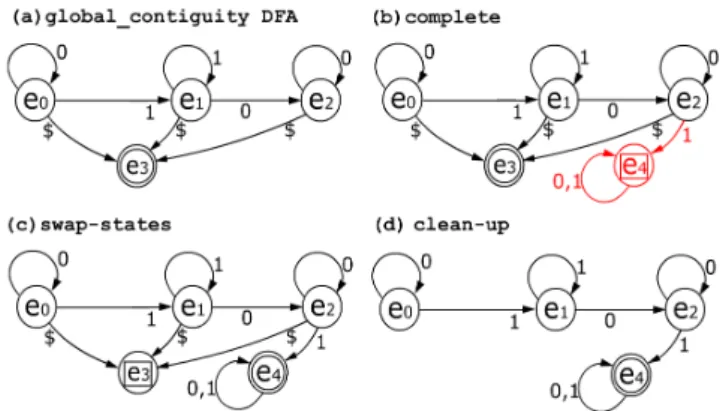
The DFA of global contiguity constraint is given in Fig. 1part(a). It corre-sponds to:
A = (var, {e0, e1, e2, e3}, Ψ, {0, 1}, δ, e0, {e3}),
Ψ = {source(e0), node(e1), node(e2), f inal(e3)},
δ = {(e0, 0, e0), (e0, 1, e1), (e0, $, e3), (e1, 1, e1), (e1, 0, e2),
(e1, $, e3), (e2, 0, e2), (e2, $, e3)}.
Figure 1: Complement DFA of the global contiguity constraint.
To construct the complement of the DFA shown in Fig.1part(a), we first call the complete operator (Fig.1 part(b)) where the sink state e4 is added to complete the
automaton. Second, the swap-states operator swaps the added state e4to final and the
finalstate e3is swapped to sink state (Fig.1part(c)). The clean-up step removes the
resulting sink state e3(Fig.1part(d)).
Once the DFA of the negated form constructed, we exploit the filtering algorithm of theREGULARconstraint.
The regular expression of the consistent tuples of global contiguity is given by:
0∗1∗0∗
If we consider the negation form, we have as regular expression of the consistent tuples of ¬global contiguity:
0∗11∗00∗1{0, 1}∗
These two regular expressions can be easily modeled in any CP language containing theREGULARconstraint.
The fact that the automaton of global contiguity constraint is defined on the variables values, enabled to exploit efficiently and directly theREGULARconstraint.
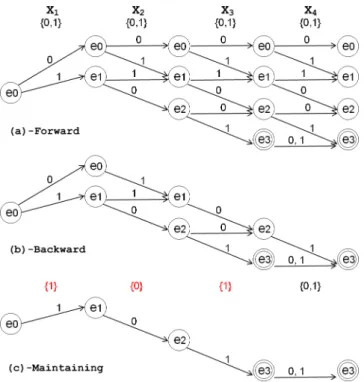
Let us take an example with four variables (x1, x2, x3, x4). Fig.2shows the three
phases ofREGULARconsistency algorithm. The MDD is constructed with four layers
corresponding to the variables. The forward phase unfolds the negated DFA of Fig.1
where the backward phase removes 9 arcs and 6 states. If another constraint reduces the domain of x3by removing the value 0, the maintaining phase removes 6 arcs and
3 states to have at the end only two solutions (1010 and 1011).
Figure 2:REGULARconstraint on ¬global contiguity with four variables.
3.2
Case study:
¬Lex
The lexicographic ordering constraint[3, 4] ~x ≤lex ~y over two vectors of variables
~x =< x0, x1, ..., xn−1> and ~y =< y0, y1, ..., yn−1> holds iff n = 0, or x0< y0, or
x0= y0, and ~x =< x1, ..., xn−1>≤lex< y1, ..., yn−1>. The automaton is defined on
the relation between every two consecutive variables. In order to exploit theREGULAR
constraint, we should transform the Lex constraint as following: ~x ≤lex~y ≡ LexRel(r0, r1, ..., rn−1)
where ri∈ {<, =, >}, and rel(ri, xi, yi) ≡ xiriyi. The automaton of
LexRel(r0, r1, ..., rn−1) is given in Figure3part(a)where it corresponds to:
A = ((~x, ~y), {e0, e1, e2}, Ψ, {=, <, >}, δ, e0, {e1, e2}),
Ψ = {source(e0), f inal(e1), f inal(e2)},
δ = {(e0, =, e0), (e0, <, e1), (e0, $, e2), (e1, =, e1), (e1, <, e1), (e1, >, e1)}.
This constraint can be easily implemented with theREGULARconstraint, where the
accepted regular expression is:
NEGATIONfor free!10 10
Figure 3: Complement DFA of the ≤lexconstraint.
Negating form of the ≤lexconstraint is shown in part(d) of the Figure3 which
rep-resents the complement of the DFA of ≤lex. part (b,c,d) shows respectively the
com-plete, swap-state and clean-up steps to obtain the complement. From the complement of this constraint (i.e., DFA of ²lex) we get the associated regular expression:
=∗> {=, <, >}∗
With the regular expression of the negated ≤lex, we are able to exploit efficiently and
directly theREGULARconstraint for filtering.
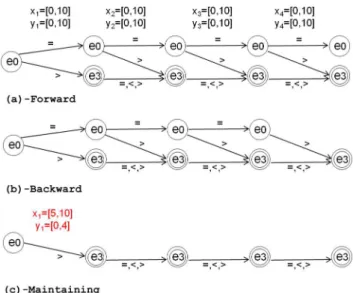
Figure 4:REGULARconstraint on ¬ ≤lexwith four variables.
Let us take a simple example with ~x = [x1, x2, x3, x4] and ~y = [y1, y2, y3, y4]
where each variable takes a value in [0, 10]. Fig.4shows the three phases ofREGULAR
consistency algorithm on ¬ ≤lex. The MDD is constructed with four layers
corre-sponding to the variables (xi, yi). The forward phase unfolds the negated DFA of Fig.3
and the backward phase removes the state e0form the last layer. In the case of a
reduc-tion by other constraints where the domain of x1is reduced to [5, 10] and y1to [0, 4],
the maintaining phase removes 6 arcs and 3 states.
4
Experimental validation
The goal of our experimental validation was to check that an automaton-based negated global constraint version (gotten for free through the presented framework) was more effective than a version where the negation is syntactically computed. For both the global contiguity and≤lexconstraints, we built Gecode models and run our
ex-periments on Intel Core2Quad CPU, Q6600 of 2.4 GHz, Linux machine with 3 Go of RAM.
4.1
global contiguity
The declarative specification of global contiguity can be given by: global contiguity(x) ≡ ∀i, j ∈ 1..n : i < j s.t.
(xi= 1) ∧ (xj = 0) ⇒ (∀k ∈ j + 1..n : xk= 0)
Where, the negated form can be declaratively given by:
¬global contiguity(x) ≡ ∃i, j ∈ 1..n : i < j s.t. (xi = 1) ∧ (xj= 0) ∧ (∃k ∈ j + 1..n : xk = 1)
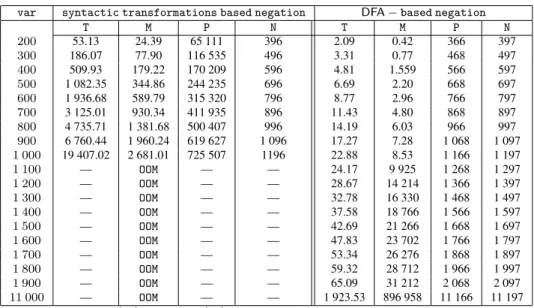
The Table1contains our experimental results on global contiguity. We give a
comparison between the implementation of the declarative specification of ¬global contiguity and DFA-based implementation using our negation approach and theREGULAR
con-straint. The reported results are on different instances (from 200 to 11.103variables)
where a solving to get the first 100 solutions is launched. The results are on time/memory consumptions, number of propagations and the generated nodes. For each instance, from 200 to 103, the DFA-Based negation gives an interesting and impressive results
comparing to the syntactic transformations based negation. For example, let us take the instance of 103 variables, the syntactic approach take more than five minutes and
2.5 Go of memory. With our DFA approach, the solving to get the first 100 solutions takes only 32 ms and 9 Mo of memory. For big instances (more than 103variables),
the syntactic approach reports an out-of-memory. Our approach stills giving interest-ing results also for the huge instance (11.103variables) with 32 sec.. Fig.5shows the
increase of time consumption of a solving to get the first 100 solutions with a syntactic negation and a DFA-based negation according to the grow-up of instances. The time consumption in the syntactic transformations increase following an exponential, where the increase time using our approach is in a linear way.
4.2
≤
leqThe declarative specification of ≤leqon ~x =< x0, x1, ..., xn−1> and ~y =< y0, y1, ..., yn−1>
can be given as follows:
NEGATIONfor free!12 12
Table 1: Experimental results on ¬global contiguity.
var syntactic transformations based negation DFA − based negation
T M P N T M P N 200 53.13 24.39 65 111 396 2.09 0.42 366 397 300 186.07 77.90 116 535 496 3.31 0.77 468 497 400 509.93 179.22 170 209 596 4.81 1.559 566 597 500 1 082.35 344.86 244 235 696 6.69 2.20 668 697 600 1 936.68 589.79 315 320 796 8.77 2.96 766 797 700 3 125.01 930.34 411 935 896 11.43 4.80 868 897 800 4 735.71 1 381.68 500 407 996 14.19 6.03 966 997 900 6 760.44 1 960.24 619 627 1 096 17.27 7.28 1 068 1 097 1 000 19 407.02 2 681.01 725 507 1196 22.88 8.53 1 166 1 197 1 100 — OOM — — 24.17 9 925 1 268 1 297 1 200 — OOM — — 28.67 14 214 1 366 1 397 1 300 — OOM — — 32.78 16 330 1 468 1 497 1 400 — OOM — — 37.58 18 766 1 566 1 597 1 500 — OOM — — 42.69 21 266 1 668 1 697 1 600 — OOM — — 47.83 23 702 1 766 1 797 1 700 — OOM — — 53.34 26 276 1 868 1 897 1 800 — OOM — — 59.32 28 712 1 966 1 997 1 900 — OOM — — 65.09 31 212 2 068 2 097 11 000 — OOM — — 1 923.53 896 958 11 166 11 197
T: time(ms), M : memory(MB), P : propagations, N : nodes, OOM : Out − Of − Memory
Figure 5: Time consumptions for ¬global contiguity (syntactic and DFA-Based negation).
(x0= y0∧ < x1, ..., xn−1> ≤lex < y1, ..., yn−1>)
where the negation form is simply:
¬(~x ≤lex~y) ≡ ((n = 1) ∧ (x0> y0)) ∨ ((n > 1) ∧ ((x0> y0)∨
(< x1, ..., xn−1> ¬≤lex < y1, ..., yn−1>)))
This is a first transformation to get the negation of ≤lex. One can also express the
negation using the global constraint >lexwhich is available on Gecode:
¬(~x ≤lex~y) ≡ ~x >leq~y
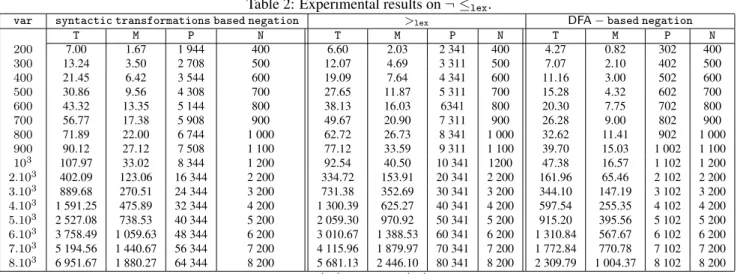
The Table 2contains results on the syntactic negation and the >lexglobal
con-straint. We compare the two results with our DFA-based negation approach. The reported results are on 200 to 8.103 variables instances. The DFA-based negation is
better than the syntactic negation and the original constraint >lex. Let us take the big
instance with 8.103 variables, our generic approach to negate ≤
lex have a time
con-sumption three times less than the syntactic negation and two times less than >lex
constraint. For memory consumption, the >lexhave a consumption two times or more
than the DFA-based negation. Through these comparaisons, we see that the DFA-based negation is widely better than the syntactic negation and remains very competitive with its equivalent well established global constraint >lex.
N E G A T IO N for fr ee! 14 14
Table 2: Experimental results on ¬ ≤lex.
var syntactic transformations based negation >lex DFA − based negation
T M P N T M P N T M P N 200 7.00 1.67 1 944 400 6.60 2.03 2 341 400 4.27 0.82 302 400 300 13.24 3.50 2 708 500 12.07 4.69 3 311 500 7.07 2.10 402 500 400 21.45 6.42 3 544 600 19.09 7.64 4 341 600 11.16 3.00 502 600 500 30.86 9.56 4 308 700 27.65 11.87 5 311 700 15.28 4.32 602 700 600 43.32 13.35 5 144 800 38.13 16.03 6341 800 20.30 7.75 702 800 700 56.77 17.38 5 908 900 49.67 20.90 7 311 900 26.28 9.00 802 900 800 71.89 22.00 6 744 1 000 62.72 26.73 8 341 1 000 32.62 11.41 902 1 000 900 90.12 27.12 7 508 1 100 77.12 33.59 9 311 1 100 39.70 15.03 1 002 1 100 103 107.97 33.02 8 344 1 200 92.54 40.50 10 341 1200 47.38 16.57 1 102 1 200 2.103 402.09 123.06 16 344 2 200 334.72 153.91 20 341 2 200 161.96 65.46 2 102 2 200 3.103 889.68 270.51 24 344 3 200 731.38 352.69 30 341 3 200 344.10 147.19 3 102 3 200 4.103 1 591.25 475.89 32 344 4 200 1 300.39 625.27 40 341 4 200 597.54 255.35 4 102 4 200 5.103 2 527.08 738.53 40 344 5 200 2 059.30 970.92 50 341 5 200 915.20 395.56 5 102 5 200 6.103 3 758.49 1 059.63 48 344 6 200 3 010.67 1 388.53 60 341 6 200 1 310.84 567.67 6 102 6 200 7.103 5 194.56 1 440.67 56 344 7 200 4 115.96 1 879.97 70 341 7 200 1 772.84 770.78 7 102 7 200 8.103 6 951.67 1 880.27 64 344 8 200 5 681.13 2 446.10 80 341 8 200 2 309.79 1 004.37 8 102 8 200
T: time(ms), M : memory(MB), P : propagations, N : nodes, OOM : Out − Of − Memory
RR
n°
5
Conclusion
In this paper, we have proposed an approach to get automatically a filtering algorithm for the negation of an automaton-based global constraint. Our approach is built over au-tomata operations and exploits theREGULARglobal constraints to automatically derive
filtering rules for the negation. Through experiments, we evaluated this approach on two well-known global constraints, namely the negation of global contiguity and ≤lex, for which we automatically derived filtering algorithms. The Gecode models
and results show that our versions are efficient. We forecast 1) to extend our approach to push-down automata by using the genericGRAMMARconstraint and 2) to extend it
to logical connectives (i.e., conjunction, disjunction) between global constraints.
References
[1] H. R. Andersen, T. Hadzic, J. N. Hooker, and P. Tiedemann. A constraint store based on multivalued decision diagrams. In Proceedings of the 13th international conference on Principles and practice of constraint programming, CP’07, pages 118–132, Berlin, Heidelberg, 2007. Springer-Verlag.
[2] Fahiem Bacchus and Toby Walsh. Propagating logical combinations of con-straints. In IJCAI, pages 35–40, 2005.
[3] Nicolas Beldiceanu, Mats Carlsson, Romuald Debruyne, and Thierry Petit. Re-formulation of global constraints based on constraints checkers. Constraints, 10(4):339–362, 2005.
[4] Nicolas Beldiceanu, Mats Carlsson, Sophie Demassey, and Thierry Petit. Global constraint catalogue: Past, present and future. Constraints, 12:21–62, March 2007.
[5] Jefferson C., Moore N. C. A., Nightingale P., and Petrie K. E. Implementing logical connectives in constraint programming. Artif. Intell., 174(16-17):1407– 1429, 2010.
[6] Mats Carlsson and Nicolas Beldiceanu. From constraints to finite automata to filtering algorithms. In ESOP, pages 94–108, 2004.
[7] Katsirelos G., Narodytska N., and Walsh T. Reformulating global grammar con-straints. In CPAIOR, volume 5547 of LNCS, pages 132–147. Springer, 2009. [8] Samid Hoda, Willem-Jan Van Hoeve, and J. N. Hooker. A systematic approach
to mdd-based constraint programming. In Proceedings of the 16th international conference on Principles and practice of constraint programming, CP’10, pages 266–280, Berlin, Heidelberg, 2010. Springer-Verlag.
[9] John E. Hopcroft, Rajeev Motwani, and Jeffrey D. Ullman. Introduction to Au-tomata Theory, Languages, and Computation (3rd Edition). Addison-Wesley, 2006.
[10] Nadjib Lazaar, Arnaud Gotlieb, and Yahia Lebbah. Fault localization in constraint programs. In ICTAI (1), pages 61–67. IEEE Computer Society, 2010.
NEGATIONfor free!16 16
[11] Nadjib Lazaar, Arnaud Gotlieb, and Yahia Lebbah. On testing constraint pro-grams. In CP, volume 6308 of LNCS, pages 330–344. Springer, 2010.
[12] Nadjib Lazaar, Arnaud Gotlieb, and Yahia Lebbah. A framework for the au-tomatic correction of constraint programs. In ICST, page Forthcomming. IEEE Computer Society, 2011.
[13] Olivier Lhomme. Arc-consistency filtering algorithms for logical combinations of constraints. In CPAIOR 2004, volume 3011 of LNCS, pages 209–224, 2004. [14] Gilles Pesant. A regular language membership constraint for finite sequences of
variables. In Mark Wallace, editor, CP, volume 3258 of LNCS, pages 482–495. Springer, 2004.
[15] Claude-Guy Quimper and Toby Walsh. Global grammar constraints. In Fr´ed´eric Benhamou, editor, CP, volume 4204 of LNCS, pages 751–755. Springer, 2006. [16] Christian Schulte. Programming deep concurrent constraint combinators. In
PADL 2000, volume 1753 of LNCS, pages 215–229. Springer, 2000.
[17] Meinolf Sellmann. The theory of grammar constraints. In Fr´ed´eric Benhamou, editor, CP, volume 4204 of LNCS, pages 530–544. Springer, 2006.
[18] Peter J. Stuckey and Peter J. Stuckey. Negation and constraint logic programming, 1995.
Centre de recherche INRIA Bordeaux – Sud Ouest : Domaine Universitaire - 351, cours de la Libération - 33405 Talence Cedex Centre de recherche INRIA Grenoble – Rhône-Alpes : 655, avenue de l’Europe - 38334 Montbonnot Saint-Ismier Centre de recherche INRIA Lille – Nord Europe : Parc Scientifique de la Haute Borne - 40, avenue Halley - 59650 Villeneuve d’Ascq
Centre de recherche INRIA Nancy – Grand Est : LORIA, Technopôle de Nancy-Brabois - Campus scientifique 615, rue du Jardin Botanique - BP 101 - 54602 Villers-lès-Nancy Cedex
Centre de recherche INRIA Paris – Rocquencourt : Domaine de Voluceau - Rocquencourt - BP 105 - 78153 Le Chesnay Cedex Centre de recherche INRIA Saclay – Île-de-France : Parc Orsay Université - ZAC des Vignes : 4, rue Jacques Monod - 91893 Orsay Cedex
Centre de recherche INRIA Sophia Antipolis – Méditerranée : 2004, route des Lucioles - BP 93 - 06902 Sophia Antipolis Cedex
Éditeur
INRIA - Domaine de Voluceau - Rocquencourt, BP 105 - 78153 Le Chesnay Cedex (France)