
HAL Id: hal-00674655
https://hal.inria.fr/hal-00674655v3
Submitted on 13 Apr 2012
HAL is a multi-disciplinary open access
archive for the deposit and dissemination of
sci-entific research documents, whether they are
pub-lished or not. The documents may come from
teaching and research institutions in France or
L’archive ouverte pluridisciplinaire HAL, est
destinée au dépôt et à la diffusion de documents
scientifiques de niveau recherche, publiés ou non,
émanant des établissements d’enseignement et de
recherche français ou étrangers, des laboratoires
Guillaume Ducoffe
To cite this version:
Guillaume Ducoffe. Eulerian and Hamiltonian Directed Hypergraphs. [Research Report] RR-7893,
INRIA. 2012, pp.55. �hal-00674655v3�
a p p o r t
d e r e c h e r c h e
0249-6399 ISRN INRIA/RR--7893--FR+ENG Domaine 3Eulerian and Hamiltonian Directed Hypergraphs.
G. Ducoffe
N° 7893
Centre de recherche INRIA Sophia Antipolis – Méditerranée 2004, route des Lucioles, BP 93, 06902 Sophia Antipolis Cedex
G. Ducoffe
∗Th`eme : R´eseaux, syst`emes et services, calcul distribu´e ´
Equipe-Projet Mascotte
Rapport de recherche n° 7893 — Mars 2012 — 52 pages
Abstract: Let H = (
V
,E
) be a directed hypergraph, also called a dihypergraph. Each vertex v ∈V
is incident to some hyperarcs inE
. Conversely, each hyperarc E ∈E
is incident to some vertices inV
. H is Eulerian if there is a dicycle C such that each hyperarc E ∈E
appears exactly once in C. Similarly, H is Hamiltonian if there is a dicycle C0 such that every vertex v ∈V
appears exactly once in C0.We show that both problems are NP-complete. Some necessary conditions for a dihypergraph to be Eulerian are presented. We exhibit some families of hypergraphs for which those are sufficient conditions. We also gener-alize a part of the properties of the Eulerian digraphs to the uniform and regular directed hypergraphs. Stronger generalizations of Eulerianicity to dihypergraphs are also studied.
Finally, we show that the generalized de Bruijn and Kautz dihypergraphs are Eulerian and Hamiltonian in most cases. We also study some properties of their bipartite representation digraph.
Key-words: directed hypergraphs, Eulerian and Hamiltonian dicycles, de Bruijn and Kautz dihypergraphs
∗
R´esum´e : Soit un Hypergraphe orient´e H = (
V
E
), qu’on appelle aussi un dihypergraphe. Chaque sommet v ∈V
est reli´e `a des hyperarcs dans
E
. R´eciproquement, chaque hyperarc E ∈E
est reli´e `a des sommets dansV
. H est Eul´erien s’il existe un dicycle C tel que chaque hyperarc E ∈E
n’apparaisse qu’une et une seule fois dans C. De mˆeme H est Hamiltonien s’il existe un dicycle C0 tel que chaque sommet v ∈V
n’apparaisse qu’une et une seule fois dans C0.Nous montrons que ces deux probl`emes sont NP-complets. Des conditions n´ecessaires pour qu’un hypergraphe orient´e soit Eul´erien sont pr´esent´ees. Nous exhibons des familles d’hypergraphes pour lesquelles elles sont suffisantes. Nous g´en´eralisons aussi certaines propri´et´es des graphes orient´es Eul´eriens aux hypergraphes orient´es uniformes et r´eguliers. D’autres g´en´eralisations plus fortes de l’Eulerianicit´e aux dihypergraphes sont aussi ´etudi´ees.
Enfin nous montrons que les hypergraphes de de Bruijn et de Kautz sont Eul´eriens et Hamiltoniens dans la plupart des cas. Nous ´etudions ´egalement certaines propri´et´es de leur repr´esentation bipartie.
1
Introduction
Two concepts that are well-known and studied in Graph Theory are: Eulerian and Hamiltonian (di)cycles. An Eulerian(di)cycle in a (di)graph G is a (di)cycle C such that each edge of G (resp. each arc of G) appears exactly once in C. A close notion is the Hamiltonian (di)cycle: where each vertex of G appears exactly once (see [8]).
A connected graph is Eulerian if and only if each vertex has an even degree, and a strongly connected digraph is Eulerian if and only if each vertex has equal indegree and outdegree. Therefore for a given (di)graph G, deciding whether G has an Eulerian (di)cycle can be done in polynomial time. On the other hand, deciding whether G has a Hamiltonian (di)cycle is an NP-complete problem [13].
A recent work generalizes the graph-theoretic concept of an Euler cycle to undirected hypergraphs [26]. We now generalize the digraph-theoretic concept of an Eulerian dicycle to directed hypergraphs. Basically, the difference between a usual digraph D and a dihypergraph H is that (hyper)arcs in H may have multiple heads and multiple tails. We say that an Eulerian dicycle in a dihypergraph is a dicycle C such that a hyperarc appears exactly once in C. We also define and study a generalization of Hamiltonian dicycles to directed hypergraphs. Similarly, a Hamiltonian dicycle in a dihypergraph is a dicycle C such that a vertex appears exactly once in C.
We show that deciding if a dihypergraph is Eulerian is an NP-complete problem. Actually, deciding whether a dihypergraph is Eulerian is as hard as deciding if a dihypergraph is Hamiltonian. However, we show that some results about the Eulerian digraphs can be generalized, in the case where the studied dihypergraphs are uniform and regular. Finally, we study a special family of regular, uniform dihypergraphs, including Kautz and de Bruijn directed hypergraphs [7].
Definitions and discussion about the proper generalization of an Eulerian dicycle to directed hypergraphs are given in Section 2. In Section 3, the mentioned-above equivalence between Eulerian and Hamiltonian dicycles are presented. Results about Eulerian, uniform, regular dihypergraphs are presented in Section 4. Section 5 deals with the particular subclass of the Consecutive-(d, s) dihypergraphs. The last section shows the existence of com-plete Berge dicycles (dicycles that are simultaneously Eulerian and Hamiltonian) in various cases of Consecutive dihypergraphs.
2
Definitions and Notations
2.1
Directed Hypergraphs
An undirected hypergraph H, simply called a hypergraph, is a pair (
V
(H),E
(H)) whereV
(H) is a non-empty set of elements (called vertices) andE
(H) is a collection of subsets (or edges) ofV
(H). If we replaceE
(H) by a set of ordered pairs of subsets ofV
(H) (called hyperarcs), H is a directed hypergraph (or dihypergraph).Let E = (E−, E+) be a hyperarc in
E
(H). Then the vertex sets E−and E+are called the in-set and the out-set of the hyperarc E, respectively. The sets E−and E+need not to be disjoint. Moreover, at most one of these sets may be empty. The hyperarc E is said to join the vertices of E−to the vertices of E+. Furthermore, the vertices of E−are said to be incident to the hyperarc E and the vertices of E+are said to be incident from E. The vertices of E−are adjacent to the vertices of E+, and the vertices of E+are adjacent from the vertices of E−.If E is a hyperarc in a dihypergraph H, then |E−| is the in-size and |E+| is the out-size of E. The maximum
in-sizeand the maximum out-size of H are respectively:
s−(H) = max E∈E(H)|E − | and s+(H) = max E∈E(H)|E +|.
5
6
7
8
9
10
11
12
13
14
15
2
2
3
4
4
3
1
0
5
6
7
2
4
3
1
0
5
6
7
2
4
3
1
0
5
6
7
2
4
3
1
0
0
1
5
6
7
8
9
10
11
12
13
14
15
2
3
4
0
1
5
6
7
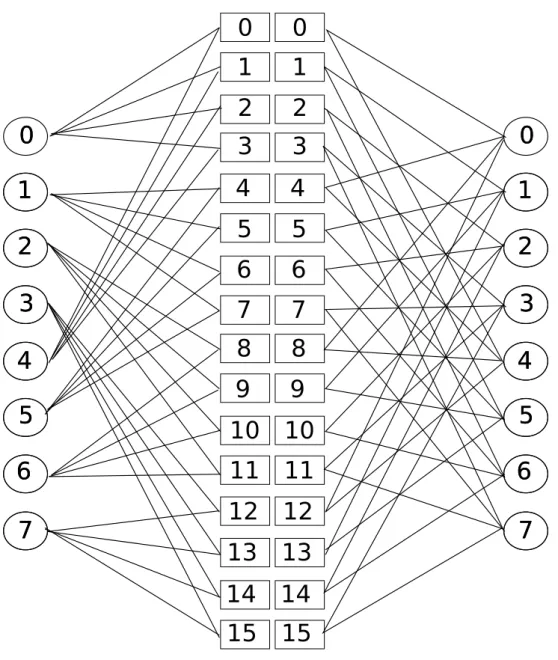
Figure 1: The bipartite representation digraph of the de Bruijn dihypergraph GBH1(4, 8, 2, 16)
The order of H is the number of vertices in
V
(H) and is denoted by n(H). The number of hyperarcs in H is denoted by m(H). We note that a digraph is a directed hypergraph D = (V
(D),E
(D)) with s−(D) = s+(D) = 1.Let v be a vertex in H. The in-degree of v is the number of hyperarcs that contain v in their out-set, and is denoted by dH−(v). Similarly, the out-degree of vertex v is the number of hyperarcs that contain v in their in-set, and is denoted by dH+(v) .
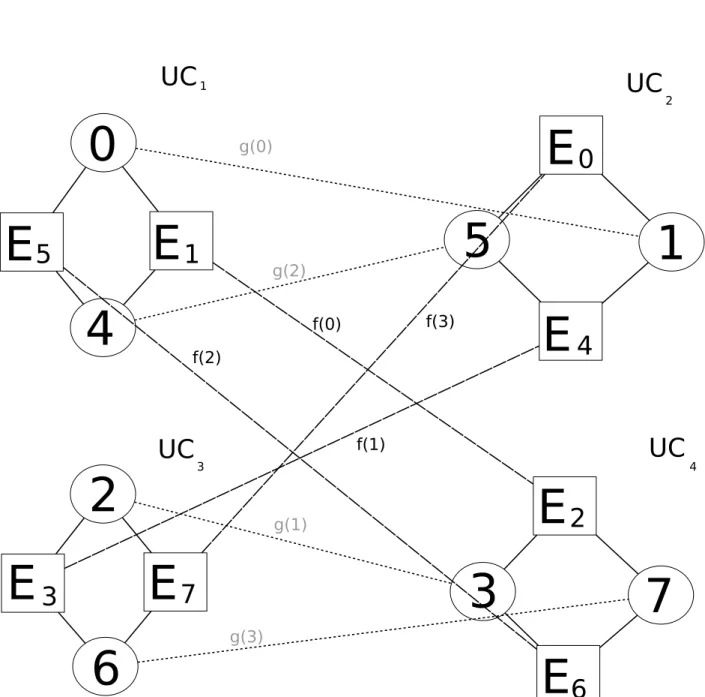
To a directed hypergraph H, we associate a bipartite representation digraph R(H) = (
V
1(R) ∪V
2(R),E
(R)),This representation digraph is useful for drawing dihypergraphs. To make the figure more readable, we duplicate vertices and hyperarcs, and we put in the left part the arcs of R(H) from vertices of H to hyperarcs of H, and in the right part those from
E
(H) toV
(H). Remark that when you inverse the respective roles ofV
1(R)and
V
2(R) in R(H), you intuitively exchange the role of the vertices with the role of the hyperarcs in H. This is aninformal definition of the dual dihypergraph H∗. Formally:
V
(H∗) =E
(H)E
(H∗) =V
(H)and a vertex e is in V−if and only if v ∈ E+; similarly, e is in V+if and only if v ∈ E−.
It is important to notice that a hyperarc V ∈
E
(H∗) may have an empty in-set (if dH−(v) = 0) or an empty out-set (if dH+(v) = 0).Other transformations are possible. For example, in the mirror dihypergraph ˜H(sometimes called the symmet-ric image of H), the orientation of every hyperarc in H is inversed:
V
( ˜H) =V
(H) andE
( ˜H) = {(E+, E−) | (E−, E+) ∈E
(H)}.When we replace the hyperarcs by complete bipartite digraphs, we get the underlying multidigraph U (H): This multidigraph has as vertex set
V
(U (H)) =V
(H), and as arc setE
(U (H)), that is the multiset of all ordered pairs (u, v) such that u ∈ E−and v ∈ E+, for some hyperarc E ∈E
(H).We emphasize that U (H) needs not to be simple: the number of arcs from u to v in U (H) is the number of hyperarcs E = (E−, E+) in H such that u ∈ E−and v ∈ E+. Thus, the in- and out-degrees of a vertex in U (H) are
dU(H)− (u) =
∑
E∈E(H) E+3u |E−| and d+ U(H)(u) =∑
E∈E(H) E−3u |E+|.Observe that the underlying multidigraph of a given dihypergraph is unique. However, a given digraph D can be the underlying digraph of many dihypergraphs H. In fact, the hyperarcs in H form a legitimate partition of the arcs in D. A legitimate partition means that vertices in the in-set E−of a hyperarc must be adjacent to every vertex in E+, in D.
Remark 1. If s−= s+= 1 then U (H) = H.
Moreover, H can always be transformed into a BF-graph:
Definition 1 ([21]). A Backward hyperarc, or simply B-arc, is a hyperarc E = (E−, E+) with |E+| = 1. A Forward hyperarc, or simplyF-arc, is a hyperarc E = (E−, E+) with |E−| = 1.
ABF-graph is a hypergraph H whose hyperarcs are either B-arcs or F-arcs. When all the hyperarcs are B-arcs, H is aB-graph. In the same way, when all the hyperarcs are F-arcs, H is a F-graph.
Let E = (E−, E+) be a hyperarc of H that is neither a B-arc nor a F-arc. First we add a new vertex e in H. Then we replace E by the B-arc E1= (E−, {e}) and the F-arc E2= ({e}, E+). When iterating this process we get
By a dipath in H we mean a sequence P = u0, E0, . . . , ui, Ei, . . . , up−1, Ep−1, up, such that, for all i, j, we have
ui∈
V
(H), Ej∈E
(H), and ui∈ Ei−1+ ∩ Ei−. We say that P is a dipath of length p.One can build the line directed hypergraph L(H) (denoted line dihypergraph of H). Vertices are labeled by the dipaths of length 1 in H, and hyperarcs are labeled by the dipaths of length 1 in H∗:
V
(L(H)) = [ E∈E(H) {(uEv) | u ∈ E−, v ∈ E+},E
(L(H)) = [ v∈V(H) {(EvF) | v ∈ E+∩ F−};where the in-set and the out-set of hyperarc (EvF) are defined as :
(EvF)− = {(uEv) | u ∈ E−}, (EvF)+ = {(vFw) | w ∈ F+}. Particularly when D is a digraph, L(D) is called the line digraph of D. The following results are used in the next sections:
Theorem 1 ( [6]). Let H be a directed hypergraph.
1. The digraphs R(L(H)) and L2(R(H)) are isomorphic. 2. The digraphs U(L(H)) and L(U (H)) are isomorphic. 3. The digraphs(L(H))∗and L(H∗) are isomorphic.
2.2
Eulerian and Hamiltonian Dicycles in Dihypergraphs
Let H be a directed hypergraph. A dipath P = u0, E0, . . . , ui, Ei, . . . , up−1, Ep−1, upis a dicycle in H if and only if
we have u0= up.
Dicycles in a digraph are a special case of dicycles in a dihypergraph.
Remark 2. A dicycle in the dihypergraph H can be seen as a dicycle in its bipartite representation R(H). In the same way, we can extend the digraph-theoretic notions of Eulerian dicycles and Hamiltonian dicycles, to the dihypergraphs:
Definition 2. Let H be a dihypergraph. We say that H is Eulerian (resp. H is Hamiltonian) if, and only if, there is a dicycle C in H, such that every hyperarc of H (resp. every vertex of H) appears in C exactly once. We call C an Eulerian dicycle (resp. a Hamiltonian dicycle).
Remark 3. A dihypergraph H is Eulerian if and only if there is a dipath P = u0, E0, . . . , ui, Ei, . . . , um−1, Em−1, um,
such that every hyperarc of H appears exactly once in P, and umis in E0−.
Indeed, when u06= up, we can always replace u0by up, and in so doing we have an Eulerian dicycle.
Our generalization of an Eulerian dicycle to dihypergraphs is close to the extension of an Euler tour to the undirectedhypergraphs, that was proposed in [26].
Definition 3 ( [26]). Let Hube an undirected hypergraph. A tour is a sequence T= v0, E0, v1, . . . , vm−1, Em−1, v0
where for all i, vi6= vi+1and vi, vi+1are in hyperedge Ei. Particularly, T is called anEuler tour when every edge
appears exactly once in T . Huis an Eulerian hypergraph if there exists an Euler tour T in Hu.
Remark 4. An Eulerian dicycle in H (resp. a Hamiltonian dicycle in H) is a dicycle in R(H), such that each vertex of
V
2(R) (resp. ofV
1(R)) appears exactly once.As a consequence, a necessary and sufficient condition for R(H) to be Hamiltonian is that there is a dicycle C in H, such that C is simultaneously an Eulerian dicycle and a Hamiltonian dicycle in H. In reference to the undirected case [5], we call C a complete Berge dicycle:
Definition 4. Let H be a directed hypergraph. A complete Berge dicycle in H is a dicycle C in H, such that C is an Eulerian dicycle and a Hamiltonian dicycle in H.
In the following sections, we focus on Eulerian dihypergraphs. We assume that the studied dihypergraphs have no isolated vertex, without any loss of generality.
3
First Results
3.1
Some conditions
First we recall the well-known caracterization of the Eulerian digraphs:
Theorem 2 ( [4]). Let D be a digraph. The following statements are equivalent: 1. D is Eulerian.
2. D is (strongly) connected, and for all vertex v∈
V
(D) d−(v) = d+(v).3. D is (strongly) connected, and it has acycle decomposition (that is its arcs can be partitioned into arc-disjoint dicycles).
A digraph D is weakly connected when its underlying multigraph is connected. It is a strongly connected di-graph provided for each pair of vertices u, v ∈
V
(D) there exists a dipath from u to v. These connectivity notions can be extended to dihypergraphs as well [6]. We say that H is strongly (resp. weakly) connected when its underlying multidigraph U (H) is strongly (resp. weakly connected). U (H) is weakly connected when its underlying multi-graph GU(H)is a connected multigraph. The digraph-theoretic notions of vertex-connectivity and arc-connectivityare also generalized by the dihypergraph-theoretic notions of vertex-connectivity and hyperarc-connectivity. Un-like 1-arc connected digraphs, 1-hyperarc connected dihypergraphs are not always 1-vertex connected.
Remark that unlike an Eulerian digraph, an Eulerian dihypergraph does not need to be strongly connected. Indeed, let H be an Eulerian dihypergraph. If we add a new vertex x in H, such that x is incident to only one hyperarc E of H, and d−(x) = 0, then H is still Eulerian, but H cannot be strongly connected anymore.
On the other hand, we have the following necessary condition:
Proposition 3. Let H be a dihypergraph. If H is Eulerian, then H is weakly connected.
Proof. Let H be a dihypergraph. Let GU(H)be the underlying multigraph of U (H). We want to prove that GU(H) is connected.
Remark first that for all hyperarc E ∈
E
(H), vertices in the subset E−∪ E+are in the same connected com-ponent in GU(H), by the definition of U (H).Moreover, let E, F be two distinct hyperarcs in
E
(H). Since there is an Eulerian dicycle in H, therefore, ∃u ∈ E+, ∃v ∈ F−, such that there is a dipath in H from u to v. Since there is a dipath from u to v in H, thereforethere is a dipath P from u to v in U (H). Let Pube the undirected version of P in GU(H). Puis a path from u to v
(resp. from v to u) in GU(H). So subsets E−∪ E+and F−∪ F+are in the same connected component in GU(H)
too. Therefore, GU(H)is connected.
A necessary condition for a uniform, undirected hypergraph Hu to be Eulerian is presented in [26]. A
k-uniform undirected hypergraph is a hypergraph Husuch that for all hyperedge E in
E
(Hu), E is a subset ofV
(Hu)with k elements. An extension of this property to dihypergraphs is presented and studied in the next section. Theorem 4 ( [26]). Let Hube a k-uniform, undirected hypergraph. If Huis an Eulerian hypergraph, then
|Vodd(Hu)| ≤ (k − 2)m(Hu)
where Vodd(Hu) denotes the set of vertices in Huthat are incident to an odd number of edges, and m(Hu) is the
total number of edges in Hu.
Using the same idea we prove a necessary condition for a directed hypergraph H to be Eulerian. Theorem 5. Let H be a dihypergraph. If H is Eulerian then:
∑
v∈V(H)
|d+(v) − d−(v)| ≤
∑
E∈E(H)
[(|E+| − 1) + (|E−| − 1)].
Proof. Let m = m(H) be the number of hyperarcs in H. Let C = v0, E0, v1, . . . , vm−1, Em−1, v0 be an Eulerian
dicycle in H. By definition, a given vertex may appear many times in C, but every hyperarc appears exactly once in the dicycle C. Let us find the maximum number of occurences of a given vertex v in C. ∀i 6= j we may have vi= vj, but we are sure that Ei6= Ej. So a vertex v can appear, at most, min (d+(v), d−(v)) times in C and, as a
consequence, we have the following inequality:
∑
v∈V(H)
min (d+(v), d−(v)) ≥ m(H)
Moreover, we know that:
min (d+(v), d−(v)) =1 2(d +(v) + d−(v) − |d+(v) − d−(v)|) Since
∑
v∈V(H) d+(v) =∑
E∈E(H) |E−|∑
v∈V(H) d−(v) =∑
E∈E(H) |E+|therefore, the following inequalities are all equivalent to the previous one: 1 2
∑
v∈V(H) (d+(v) + d−(v) − |d+(v) − d−(v)|) ≥ m(H)∑
v∈V(H) (d+(v) + d−(v) − |d+(v) − d−(v)|) ≥ 2m(H)∑
v∈V(H) d+(v) +∑
v∈V(H) d−(v) −∑
v∈V(H) |d+(v) − d−(v)| ≥∑
E∈E(H) 2∑
E∈E(H) |E−| +∑
E∈E(H) |E+| −∑
v∈V(H) |d+(v) − d−(v)| ≥∑
E∈E(H) 2∑
u∈V(H) |d+(u) − d−(u)| ≤∑
E∈E(H) [(|E+| − 1) + (|E−| − 1)]For a directed graph, Theorem 5 is equivalent to the Euler condition:
Corollary 1. Let D be a digraph. If D is Eulerian, then for all u ∈
V
(D), d+(u) = d−(u).Theorem 5 is not a sufficient condition for a strongly connected dihypergraph H to be Eulerian: a counter-example is presented in Section 3.3, Figure 6.
Another necessary condition was proposed by N. Cohen (private communication), who transposed the search of an Eulerian dicycle to a flow networks problem.
Definition 5. Let N = (
V
,E
) be a directed graph, with two specific vertices s and t (the source and the sink, respectively). N is called anetwork. Each arc uv ∈E
has acapacity c(uv) ∈ N∗. Aflow is a mapping f :E
→ N, such that:1. for all uv∈
E
, f(uv) ≤ c(uv) (capacity constraint) 2. for all vertex v6= s,t∑
uv∈E
f(uv) =
∑
vw∈E
f(vw) (conservation of flows)
Thevalue of the flow is | f | =
∑
v∈V
f(sv).
Let H be a directed hypergraph. If there is a hyperarc E whose in-set (resp. whose out-set) is empty, then H cannot be Eulerian. Else, let ϕ be a function from
E
(H) toV
(H)2, such that for all E, ϕ(E) ∈ E−× E+. Actuallywe transform the hyperarcs into arcs. So we get a digraph, denoted Dϕ[H] = (
V
(H), ϕ(E
(H))). Observe thatDϕ[H] is a subdigraph of U (H). There are
∏
E∈E(H)|E−||E+| possible ϕ functions.
Remark 5. A dihypergraph H is Eulerian if and only if there exists a function ϕ such that Dϕ[H] is an Eulerian
digraph.
By Theorem 2, a necessary and sufficient condition for a digraph D to be Eulerian is that for every vertex v, d−(v) = d+(v) and D must be connected. When D satisfies only the first condition, we call it a balanced digraph.
Let s,t /∈
V
(H) be two vertices. Consider the network Nf(H) = (V
f(H),E
f(H)), such that:V
f(H) =V
(H) ∪ {E−| E ∈E
(H)} ∪ {E+| E ∈E
(H)} ∪ {s,t}E
f(H) = {sE+j : Ej∈E
(H)} ∪ {E−jt: Ej∈E
(H)} ∪ {E+j v: v ∈ E + j } ∪ {vE − j : v ∈ E − j }Each arc uv ∈
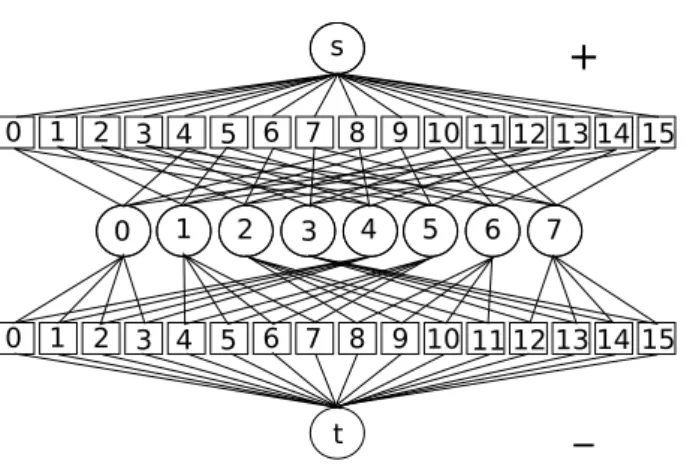
E
f(H) has a capacity of 1. In those conditions, by the flow min-cut Theorem, themax-imum value of an s − t flow in Nf(H) is the greatest number of pairwise arc-disjoint dipaths between s and t in
Nf(H). An upper bound of this value is m(H).
Lemma 1. Let H be a dihypergraph. If H is Eulerian, then the maximum value of an s − t flow in Nf(H) is m(H).
More precisely, there exists ϕ such that Dϕ[H] is a balanced digraph if and only if this condition is verified.
Proof. If H is Eulerian, by Remark 5, there exists ϕ such that Dϕ[H] is a balanced digraph. As a consequence, we
only need to show the second part of the lemma.
Let us assume the maximum value of the flow is m(H), that is there are m(H) pairwise arc-disjoint dipaths in Nf(H) between s and t. Let P1, . . . , Pm(H)be m(H) pairwise arc-disjoint dipaths in Nf(H) between s and t. By
construction those dipaths are of the form s, E+j
1, vi, E
−
j2,t, such that every E
+
j1 (resp. every E
−
s t 0 1 2 3 4 5 6 7 8 9 10 11 12 13 14 15 0 1 2 3 4 5 6 7 0 1 2 3 4 5 6 7 8 9 10 11 12 13 14 15
+
_
Figure 2: The flow networks Nf(GBH1(4, 8, 2, 16)).dipath Pk. We define the function ϕ as follows: if s, E+j
1, vi, E − j2,t and s, E + j2, vi0, E −
j3,t are among the m(H) pairwise
arc-disjoint dipaths between s and t, then ϕ(Ej2) = (vi, vi0). Clearly, Dϕ[H] is a balanced digraph.
Now, let us suppose there exists ϕ such that Dϕ[H] is a balanced digraph. Let v be a vertex of Dϕ[H]. Since
dD−
ϕ[H](v) = d
+
Dϕ[H](v) one can define a bijection between the out-links and the in-links of v. Those arcs are all
associated to a different hyperarc by ϕ. Therefore we can build d−D
ϕ[H](v) pairwise arc-disjoint dipaths in Nf(H)
between s and t. Since
∑
v∈V(H)
dD−
ϕ[H](v) = m(H) by construction of Dϕ[H], therefore there are m(H) pairwise
arc-disjoint dipaths in Nf(H) between s and t.
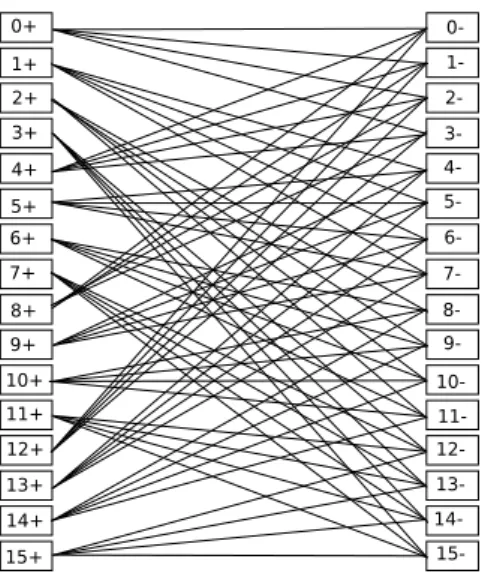
Another formulation of Lemma 1 is proposed. Actually, it is easier to show the characterization if we transpose the flow networks problem to a perfect matching problem. The relation between both of these problems is well known. Let BP(H) = (
V
1(BP),V
2(BP),E
(BP)) be a bipartite graph, with:V
1(BP) = {E+j : Ej∈E
(H
)}V
2(BP) = {E−j : Ej∈E
(H
)}E
(BP) = {E+jE− j0 : E + j ∩ E − j0 6= /0}Lemma 2. Let H be a directed hypergraph. There is a perfect matching in BP(H) if and only if the maximum value of an s− t flow in Nf(H) is m(H).
Proof. Let e, f be two vertex-disjoint edges in BP(H): e = Ei+
1E − i2 and f = E + j1E − j2. By construction of BP(H) Ei+ 1 ∩ E − i2 6= /0 and E + j1∩ E −
j26= /0. Therefore we can select a vertex u ∈ E
+ i1∩ E − i2 and a vertex v ∈ E + j1∩ E − j2. Clearly, P1= s, Ei+1, u, E − i2,t and P2= s, E + j1, v, E −
j2,t are two dipaths in Nf(H) between s and t. Furthermore, since e and f
are vertex-disjoint, therefore Ei16= Ej1 and Ei2 6= Ej2. As a consequence, P1and P2are arc-disjoint.
Reciprocally, let P1= s, Ei+1, u, E − i2,t and P2= s, E + j1, v, E −
j2,t be two arc-disjoint dipaths in Nf(H) between s
and t. By construction of Nf(H), u is in Ei+1 ∩ E − i2 and v is in E + j1∩ E − j2. Therefore e = E + i1E − i2 and f = E + j1E − j2 are
edges in BP(H). Moreover, since P1and P2are arc-disjoint, therefore Ei1 6= Ej1and Ei26= Ej2. As a consequence,
0+ 0-1+ 1-2+ 2-3+ 3-4+ 4-5+ 5-6+ 6-7+ 7-8+ 8-9+ 9-10+ 10-11+ 11-12+ 12-13+ 13-14+ 14-15+
15-Figure 3: The bipartite graph BP(GBH1(4, 8, 2, 16)).
Let us assume there is a perfect matching in BP(H). That means there are m(H) pairwise vertex-disjoint edges in BP(H). So there are m(H) pairwise arc-disjoint dipaths in Nf(H) between s and t. Reciprocally, if there are
m(H) pairwise arc-disjoint dipaths in Nf(H) then there are m(H) pairwise vertex-disjoint edges in BP(H) - that is
a perfect matching.
A well-known condition allowing a bipartite graph to have a perfect matching is the Hall’s Theorem. We use the following result so that we can prove a necessary and sufficient condition for a dihypergraph to have a balanced digraph.
Theorem 6 (Hall, [5]). Let G = (
V
1∪V
2,E
) be a bipartite graph such that |V
1| = |V
2|. There is a perfectmatching in B if and only if for every subset S⊂
V
1,|Ad j(S)| ≥ |S|, where Ad j(S) denotes the set of verticesadjacent to some vertex of S.
Let X be a subset of
V
(H). Let d+(X ) (also denoted dH+(X )) be the number of hyperarcs E ∈E
(H) such that E−∩ X 6= /0, and ds−(X ) (also denoted ds,H− (X )) be the number of hyperarcs E such that E+⊆ X. We are now able to prove the following result:Theorem 7. Let H be a dihypergraph. There exists ϕ such that Dϕ[H] is a balanced digraph if and only if for
every subset X⊆
V
(H) ds−(X ) ≤ d+(X ).Proof. Let us assume there exists ϕ such that Dϕ[H] is a balanced digraph. For every subset X ⊆
V
(H), forevery hyperarc E such that E+⊆ X, we necessarily have (u, v) = ϕ(E) ∈
V
(H) × X . Since Dϕ[H] is balanced,hence there must be the image ϕ(F) of some hyperarc F whose origin is v. Clearly, F−∩ X is not empty. Hence ds−(X ) ≤ d+(X ).
Reciprocally, let us assume that for every subset X ⊂
V
(H), d−s (X ) ≤ d+(X ). Let S = {E+j1, E + j2, . . . , E + j|S|} be a subset of
V
1(BP), and X = |S| [ k=1 E+jk. Observe that |Ad j(S)| = d
+
Furthermore,
V
1(BP) andV
2(BP) obviously have the same cardinality. By Theorem 6, there is a perfect matchingin BP(H). Therefore by Lemma 2 , there are m(H) pairwise arc-disjoint dipaths in Nf(H) between s and t. So, by
Lemma 1, there exists ϕ such that Dϕ[H] is a balanced digraph.
Observe that we may define d−(X ) and d+s (X ) in the same way as d+(X ) and ds−(X ). Another formulation of Theorem 7 is: there exists ϕ such that Dϕ[H] is a balanced digraph if and only if for every subset X ⊂
V
(H)ds+(X ) ≤ d−(X ).
Proposition 8. Let H be a B − graph (resp. a F − graph). If for all subset X ⊂
V
(H), d−s (X ) ≤ d+(X ), then:∑
u∈V(H)
|d+(u) − d−(u)| =
∑
E∈E(H)
[(|E+| − 1) + (|E−| − 1)].
Proof. By symmetry, if Proposition 8 is true for B-graphs, then it is true for F-graphs. Let H be a B-graph. Observe that, for every subset X , ds−(X ) = d−(X ) =
∑
x∈X
d−(x). If, for every subset X , d−(X ) ≤ d+(X ), then, for every vertex v, d−(v) ≤ d+(v). Therefore:
∑
v∈V(H) |d+(v) − d−(v)| =∑
v∈V(H) d+(v) − d−(v) =∑
v∈V(H) d+(v) −∑
v∈V(H) d−(v) =∑
E∈E(H) |E−| −∑
E∈E(H) |E+|As for a B-graph |E+| = 1 for every E ∈
E
(H):∑
E∈E(H) |E−| −∑
E∈E(H) |E+| =∑
E∈E(H) |E−| −∑
E∈E(H) 1 =∑
E∈E(H) |E−| − 1 =∑
E∈E(H) [|E+| − 1 + |E−| − 1]Consequently, Theorem 7 is stronger than Theorem 5 for B-graphs and F-graphs.
Remark 6. Deciding whether there exists ϕ such that Dϕ[H] is a balanced digraph can be done in polynomial
time. But the connectivity of Dϕ[H] cannot be guaranteed.
Actually, deciding whether there exists ϕ such that Dϕ[H] is strongly connected is an NP-complete problem
[25]. But the condition of Theorem 7 is sufficient if we impose that for every ϕ, Dϕ[H] is connected.
Proposition 9. Let H be a dihypergraph. We denote λ =
∑
E∈E(H)
|E+||E−| − 1. Let GU(H) be the underlying
multigraph of the underlying multidigraph U(H). If GU(H)is λ + 1-edge connected, then H is Eulerian if and only
if for every subset X , d−s (X ) ≤ d+(X ).
Proof. Let E be a hyperarc in H. By construction of U (H), there are |E−||E+| arcs of U(H) that are associated to E. Hence the association of E to a single arc, by some function ϕ, requires the deletion of |E−||E+| − 1 of these arcs. Therefore, if GU(H)is λ + 1-edge connected, then every Dϕ[H] is weakly-connected.
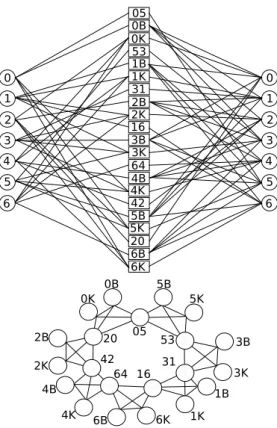
This solution appears very restrictive. Another approach is the skeleton-connectivity. Let H be a BF-graph. We know that for all hyperarc E ∈
E
(H), E−or E+is a singleton, denoted {e}. The choice of e is not unique when E is an arc. Observe that for all ϕ, {e} is in {ϕ(E)−, ϕ(E)+}. Consequently, we have a better control over the possible values of ϕ(E) than in the general case.We define a graph S(H) = (
V
(S),E
(S)) such thatV
(S) is isomorphic toE
(H), and if E, F are two hyperarcs in H, then EF is inE
(S) if and only if they share a singleton. Formally, the edge exists if and only if there is {u} ∈ {E+, E−}, there is {v} ∈ {F+, F−}, such that u = v. We call H a skeleton-connected dihypergraph when S is a connected graph.0 1 2 3 4 5 6 0 1 2 3 4 5 6 05 53 31 16 64 42 20 0B 0K 1B 1K 2B 2K 3B 3K 4B 4K 5B 5K 6B 6K 05 53 31 16 64 42 20 6B 6K 5B 5K 4K 4B 3K 3B 2K 2B 1K 1B 0B 0K
Figure 4: A skeleton-connected dihypergraph.
Lemma 3. Let H be a BF-graph. If H is skeleton-connected then for every ϕ, Dϕ[H] is weakly connected.
Proof. Let E, F be two hyperarcs in H, such that EF is an edge of S(H). By definition, there exists {u} ∈ {E+, E−}, there exists {v} ∈ {F+, F−}, such that u = v. Furthermore since |{u}| = 1, therefore {u} is in
{ϕ(E)+, ϕ(E)−} and in {ϕ(F)+, ϕ(F)−}. So ϕ(E)ϕ(F) is still an edge of S(D ϕ[H]).
Consequently, S(H) connected implies S(Dϕ[H]) connected. Clearly, skeleton-connectivity implies
weakly-connectivity for a digraph. Therefore, Dϕ[H] is weakly connected.
We generalize the Euler’s Theorem to BF-graphs:
Theorem 10. Let H be a skeleton-connected BF-graph. H is Eulerian if and only if for every subset X of
V
(H) ds−(X ) ≤ d+(X ).Proof. That follows from Lemma 3 and Theorem 7.
In Section 2.1, we detail the method of construction of a BF-graph BF(H) from any given dihypergraph H. So we may imagine using the method and combining it with Theorem 10, in order to get Eulerian dihypergraphs. Unfortunately, BF(H) may be skeleton-connected if and only if H is already a BF-graph (hence H = BF(H)), or m(H) = 1.
From any dihypergraph H, such that for earch hyperarc E, E−6= /0 and E+6= /0, one can obtain a B-graph B(H) in the following way: let E ∈
E
(H) be a hyperarc that is not a B-arc. Then we order the elements of E+, denoted e1, e2, . . . , e|E+|, and we replace E by the |E+| B-arcs Ee1, Ee2, . . . , Ee|E+|, such that for all j, with 1 ≤ j ≤ |E+|:(Eej)+= {ej}.
In the same way, H could be transformed into a F-graph, denoted F(H). We present a sufficient condition for B(H) and F(H) to be Eulerian.
Proposition 11. Let H be a directed hypergraph, having no hyperarc E such that E−= /0 or E+= /0. If R(H) is Eulerian, then both B(H) and F(H) are Eulerian.
Proof. By construction of the bipartite representation digraph R(H),
E
(R(H)) =E
1∪E
2, whereE
1= {uiEj: ui∈E−j } and
E
2= {Ejui: ui∈ E+j}. One can easily check that there is a natural bijection f betweenE
1and the F-arcsin F(H), plus another one b between
E
2and the B-arcs of B(H). Let us assume that R(H) is Eulerian.Let C = u0, u0E0, E0, E0u1, u1, . . . , uk, ukEk, Ek, Eku0, u0be an Eulerian dicycle in R(H). Then CF= u0, f (u0E0), u1,
f(u1E1), . . . , uk, f (ukEk), u0is an Eulerian dicycle in F(H), and CB= u0, b(E0u1), u1, b(E1u2), . . . , uk, b(Eku0), u0
is an Eulerian dicycle in B(H).
3.2
Equivalences and Complexity
We know that from a dihypergraph H, we can build other dihypergraphs that are related to H (see Section 2.1). The search of an Eulerian dicycle in H is equivalent to the search of other dicycles in those directed hypergraphs: Proposition 12. Let H be a dihypergraph. The following statements are equivalent:
1. H is Eulerian. 2. H∗is Hamiltonian. 3. ˜H is Eulerian. 4. BF(H) is Eulerian.
Proof. Let us prove that H is Eulerian if, and only if, H∗is Hamiltonian. To a dicycle C = v0, E0, v1, . . . , vp, Ep, v0
of H we associate in H∗a dicycle C∗= e0,V1, e2, . . . , ep,V0, e0. If C is an Eulerian dicycle in H (i.e. C contains
each edge exactly once) then C∗contains each vertex of H∗exactly once, and so C∗is a Hamiltonian dicycle of H∗. Conversely, if C∗is a Hamiltonian dicycle of H∗(each vertex appears exactly once), C is an Eulerian dicycle.
We prove now that H is Eulerian if, and only if, ˜H is Eulerian. Since ˜˜H= H we only need to prove the implication. For a given hyperarc E = (E−, E+) ∈
E
(H) we call ˜E= (E+, E−) the associated hyperarc inE
( ˜H). Let C = v0, E0, . . . , vm−1, Em−1, v0be an Eulerian dicycle in H. Then, by definition of ˜H, ˜C= v0,Em−1˜ , . . . , v1, ˜E0, v0is an Eulerian dicycle in ˜H.
Finally, let us show that H is Eulerian if and only if BF(H) is Eulerian. Let C = v0, E0, v1, . . . , vm(H)−1, Em(H)−1, v0
be an Eulerian dicycle in H. For all j, if Ej is neither a B-arc nor a F-arc, Ej is replaced in BF(H) by a B-arc
Ej,1and a F-arc Ej,2, that are linked by a new vertex ej; in order to obtain an Eulerian dicycle CBFof BF(H), we
replace Ej by the sequence Ej,1, ej, Ej,2in C. Conversely, assume that CBF is an Eulerian dicycle in BF(H). By
construction of BF(H), Ej,1only shares a common vertex with Ej,2. Consequently, Ej,1, ej, Ej,2is a subsequence
of CBF, where ejis the vertex of BF(H) by which Ej,1and Ej,2are linked. So we may replace this subsequence
by Ejfor every such Ej, and we get a dicycle C that is an Eulerian dicycle in H.
These equivalences may help to prove that some given dihypergraphs are Eulerian. Remark that because of Proposition 12, searching an Eulerian dicycle in a directed hypergraph H is as hard as searching a Hamiltonian dicycle in its dual. Since it is already the case when the studied dihypergraphs are digraphs [2], deciding whether a dihypergraph H is Hamiltonian is an NP-complete problem. So the following result is not that surprising: Theorem 13. Deciding if a dihypergraph H is Eulerian is NP-complete.
Proof. Let C be a dipath. One can verify, in O(|
E
(H)|) operations, whether C is an Eulerian dicycle in H. Conse-quently, the problem is in NP.Now, assume that H is an instance for the Hamiltonian problem: Given a dihypergraph H. Is there a Hamil-tonian dicycle in H ?This problem is NP-complete. Moreover, the dual of H can be built in O(|
E
(H)| + |V
(H)|) operations. By Proposition 12, H is Hamiltonian if and only if H∗is Eulerian. Hence, the Eulerian problem is NP-complete too.Finding Hamiltonian dihypergraphs is useful to build Eulerian dihypergraphs. The following lemma is used in the next sections:
Lemma 4. Let H be a directed hypergraph. H is Hamiltonian if, and only if, its underlying multidigraph U (H) is Hamiltonian.
Proof. By definition of U (H), any dicycle in H is a dicycle in U (H), with the same vertices, and reciprocally.
This lemma, and its proof, have a direct application. Let
G
be a family of Hamiltonian digraphs. Let D be a digraph inG
. Using a legitimate partition of the arcs inE
(D), we can build a dihypergraph H, whose underlying digraph is D. Consequently, we build a setH
of Hamiltonian dihypergraphs. LetH
∗= {H : H∗∈
H
}. ThenH
∗is a set of Eulerian dihypergraphs, by Proposition 12.
Here is another application: let D be a digraph. From D we build a dihypergraph HDsuch that:
V
(HD) =V
(D) and for every vertex v we associate a hyperarc V defined as follows:V−= {v}
V+= {w ∈
V
(D) : vw ∈E
(D)}An Eulerian dicycle in HD(resp. a Hamiltonian dicycle) is always a complete Berge dicycle. Therefore HDis
Eulerian if and only if D is Hamiltonian.
3.3
Line Dihypergraphs Properties
For a given digraph D, the line digraph L(D) is Hamiltonian if, and only if, D is Eulerian (see [13]). First, we give a new proof of this result.
Lemma 5. Let D be a digraph. Its line digraph L(D) is isomorphic to U (D∗).
Proof. Let D be a digraph. By construction of its dual dihypergraph,
V
(U (D∗)) is isomorphic toE
(D). Since every arc in D is represented by a vertex in L(D), thereforeV
(L(D)) andV
(U (D∗)) are isomorphic.Let v be a vertex in D. Let Ev= (Ev−, Ev+) be the associated hyperarc in D ∗. E−
v is the set of the arcs
uv∈
E
(D), and Ev+is the set of the arcs vw ∈E
(D). As a consequence, for each vertex uv in U (D∗), uv is incident to the vertices vw ∈V
(U (D∗)). Those are the relations of incidence in L(D). Moreover, in D∗the vertex uv is only incident to the hyperarc Ev. Therefore, U (D∗) is a simple digraph.Corollary 2. Let D be a digraph. D is Eulerian if and only if its line digraph L(D) is Hamiltonian. Proof. Let D be a digraph.
Dis Eulerian ⇐⇒
D∗is Hamiltonian, by Proposition 12 ⇐⇒ U(D∗) is Hamiltonian, by Lemma 4 ⇐⇒
L(D) is Hamiltonian, by Lemma 5 ⇐⇒
This property is useful for some special families of digraphs, such that Kautz and de Bruijn digraphs, that are stable by line digraph operation [13]. Using induction, one can prove that every digraph of the family is Hamiltonian. It was shown in [6] that de Bruijn and Kautz dihypergraphs are also stable by line dihypergraph operation. So it is natural to wonder whether Corollary 2 can be generalized to dihypergraphs. Unfortunately, that is not exactly the case.
Proposition 14. Let H be a directed hypergraph.
L(H) is Hamiltonian ⇐⇒ U (H) is Eulerian. Proof.
U(H) Eulerian ⇐⇒
L(U (H)) Hamiltonian by Corollary 2 ⇐⇒ U(L(H)) Hamiltonian by Theorem 1 ⇐⇒
L(H) Hamiltonian, by Lemma 4.
We show with two counter-examples that both implications do not hold: there are dihypergraphs H Eulerian such that L(H) is not Hamiltonian, and there are dihypergraphs H not Eulerian such that L(H) is Hamiltonian. By Proposition 14, we only need to study the relation between H Eulerian and U (H) Eulerian.
Consider the following dihypergraph H1= (
V
(H1),E
(H1)):V
(H1) = {1, 2, 3, 4, 5} andE
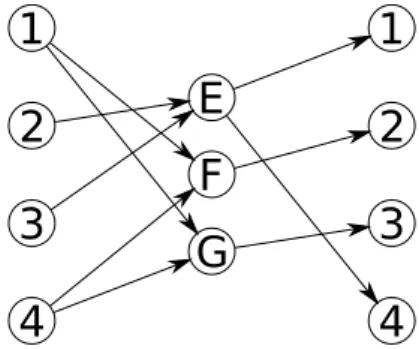
(H1) = {E, F}The bipartite representation digraph of H1is in Figure 5.
1, E, 3, F, 1 is an Eulerian dicycle in H1. But dU(H+
1)(2) =
∑
2∈E−
|E+| = 4, that is different than dU(H−
1)(2) =
∑
2∈E+
1
2
3
4
E
F
G
1
2
3
4
Figure 5: An example of H Eulerian and U (H) not Eulerian.
E
F
1
2
3
4
5
1
2
3
4
5
Figure 6: An example of H not Eulerian and U (H) Eulerian.
On the other hand, there exist dihypergraphs H that are not Eulerian such that U (H) is Eulerian and so L(H) is Hamiltonian: let H2= (
V
(H2),E
(H2)) be the following dihypergraph:V
(H2) = {1, 2, 3, 4} andE
(H2) = {E, F, G}.
The bipartite representation of H2is in Figure 6.
Remark that H2verifies the necessary condition of Theorem 5. Furthermore, H2is strongly connected. One
may observe that its underlying multidigraph U (H2) is Eulerian (it is even a 2-regular digraph). However, H2is not
Eulerian because it does not verify the condition of Theorem 7. Indeed, ds−({2, 3}) = 2, which is strictly greater than d+({2, 3}) = 1.
We show in the next sections there are dihypergraphs H, that are not digraphs, that are Eulerian and such that U(H) is Eulerian.
Nonetheless, Corollary 2 could be generalized in this way:
Proposition 15. Let H be a dihypergraph. If H is Eulerian, then there is a dicycle C in L(H), whose length is m(H), and such that a vertex in
V
(L(H)) appears at most once in C.Proof. Let u0, E0, u1, . . . , um(H)−1, Em(H)−1, u0be an Eulerian dicycle in H. Let C = (u0E0u1), [E0u1E1], (u1E1u2), . . . ,
(um(H)−1Em(H)−1u0), [Em(H)−1u0E0], (u0, E0, u1). C is a dicycle in L(H) whose length is m(H). Moreover, for all
j6= j0vertex ujEjuj+1is different than vertex uj0E
j0uj0+1because H is Eulerian and consequently Ej6= Ej0.
Hence, if there are enough Eulerian dicycles in H, whose associated dicycles in U (H) are arc-disjoint, then there may be a Hamiltonian dicycle in L(H). Based on this intuition, we now present a stronger notion of Eulerian
dihypergraphs. Let c be a positive integer. We assume that H is a dihypergraph such that for every hyperarc E, |E−||E+| = c.
Definition 6. A digraph partition of H is a collection of functions ϕ1, ϕ2, . . . , ϕcfrom
E
(H) toV
(H)2, such thatfor all i6= j for every hyperarc E, ϕi(E) 6= ϕj(E). Formally:
E
(Dϕ1[H]),E
(Dϕ2[H]), . . . ,E
(Dϕc[H]) is a partitionof
E
(U (H)).We now introduce the notion of strongly Eulerian dihypergraphs. A directed hypergraph H is strongly Eule-rian if there is a digraph-partition ϕ1, ϕ2, . . . , ϕc, such that for every j, Dϕj[H] is an Eulerian digraph.
By Remark 5, a strongly Eulerian dihypergraph is an Eulerian dihypergraph. Furthermore, a digraph is strongly Eulerian if and only if it is an Eulerian digraph. Non-trivial examples of strongly Eulerian dihypergraphs are presented in the Appendix.
Lemma 6. Let H be a dihypergraph. If H is strongly Eulerian, then there is a cycle decomposition in U (H). Proof. Let ϕ1, ϕ2, . . . , ϕcbe a digraph-partition of H. Observe that an arc in U (H) is also an arc in one and only
one Dϕj[H], where 1 ≤ j ≤ c.
Let us assume that for every 1 ≤ j ≤ c Dϕj[H] is an Eulerian digraph. Let Cjbe an Eulerian dicycle in Dϕj[H].
Then C1,C2, . . . ,Ccis a cycle decomposition of U (H).
We now show the following result:
Theorem 16. Let H be a dihypergraph. If H is strongly Eulerian, then L(H) is Hamiltonian.
Proof. Since H is strongly Eulerian, therefore H is Eulerian. By Proposition 3, H is weakly connected. Conse-quently, U (H) is also weakly connected. By Lemma 6, there is a cycle decomposition in U (H). Therefore, by Theorem 2, U (H) is Eulerian. If U (H) is Eulerian, then L(H) is Hamiltonian by Proposition 14.
3.4
Kronecker Product of Dihypergraphs
Eulerian and Hamiltonian properties of the digraph products have been intensively studied. We propose a brief study of a dihypergraph product. Let
H
be a family of Eulerian (resp. Hamiltonian) dihypergraphs. We want to know whether the product of two elements ofH
is still an Eulerian (resp. Hamiltonian) dihypergraph. The studied dihypergraph product is a generalization of a digraph product:Definition 7. Let G1= (
V
1,E
1), G2= (V
2,E
2), be two digraphs. Their Kronecker product G1⊗ G2is a digraphG= (
V
,E
) such that: 1.V
=V
1×V
22.
E
= {(hu1, u2i, hv1, v2i) : (u1, v1) ∈E
1and(u2, v2) ∈E
2}Among the properties of Kronecker product, we are interested in its Hamiltonian properties:
Proposition 17 ( [23]). Let C1,C2be two dicycles whose respective sizes are n1and n2. Then G= C1⊗ C2is the
union ofgcd (n1, n2) disjoint dicycles, whose size is lcm(n1,n2).
We define the Kronecker product of two dihypergraphs H1, H2, denoted H = H1⊗ H2, as follows:
V
(H) =V
(H1) ×V
(H2)E
(H) ≈E
(H1) ×E
(H2)(E, F)−= E−× F− (E, F)+= E+× F+
Lemma 7. Let H1, H2be two dihypergraphs.
U(H1⊗ H2) and U (H1) ⊗U (H2) are isomorphic.
Proof. One may easily check that
V
(U (H1⊗ H2)) andV
(U (H1) ⊗ U (H2)) are isomorphic. Let u1, v1 be twovertices of H1and u2, v2be two vertices of H2. Let us suppose there are k1arcs in U (H1) from u1to v1. They
are associated to k1different hyperarcs of H1, denoted E1, E2, . . . , Ek1. Similarly, let us suppose there are k2arcs
in U (H2) from u2 to v2, associated to hyperarcs F1, F2, . . . , Fk2. Then there are k1k2arcs in U (H1⊗ H2) from
(u1, u2) to (v1, v2), that are associated to hyperarcs (E1, F1), . . . , (E1, Fk2), . . . , (Ek1, F1), . . . , (Ek1, Fk2). That is the
same number of arcs from (u1, u2) to (v1, v2) in U (H1) ⊗U (H2).
Lemma 8. Let H1, H2be two dihypergraphs.
(H1⊗ H2)∗and H1∗⊗ H ∗
2are isomorphic.
Proof. Vertices in H1∗⊗ H2∗and in (H1⊗ H2)∗are labeled by
E
(H1) ×E
(H2). Hyperarcs in H1∗⊗ H2∗are labeledby
V
(H1) ×V
(H2), such that, if v1is a vertex of H1and v2is a vertex of H2:(V1,V2)−= {(e, f ) : v1∈ E+and v2∈ F+} = {(e, f ) : (v1, v2) ∈ (E, F)+}
(V1,V2)+= {(e, f ) : v1∈ E−and v2∈ F−} = {(e, f ) : (v1, v2) ∈ (E, F)−}
Those are the same relations of incidence as in (H1⊗H2)∗. Therefore H1∗⊗H2∗and (H1⊗H2)∗are isomorphic.
We deduce from these lemmas the following theorem: Theorem 18. Let H1, H2be two dihypergraphs.
1. If n(H1) is coprime to n(H2) and H1, H2are Hamiltonian, then H1⊗ H2is Hamiltonian.
2. If m(H1) is coprime to m(H2) and H1, H2are Eulerian, then H1⊗ H2is Eulerian.
Proof. Let us assume that H1and H2 are Hamiltonian. Then U (H1) and U (H2) are Hamiltonian, by Lemma 4.
Furthermore, if n(H1) is coprime to n(H2), then U (H1)⊗U (H2) is Hamiltonian, by Proposition 17. U (H1)⊗U (H2)
is isomorphic to U (H1⊗ H2), by Lemma 7. Therefore, H1⊗ H2is Hamiltonian, by Lemma 4.
Now let us assume that H1and H2are Eulerian. That means that H1∗andH ∗
2 are Hamiltonian by Proposition
12. If m(H1) = n(H1∗) is coprime to m(H2) = n(H2∗), then H ∗ 1⊗ H ∗ 2 is Hamiltonian. H ∗ 1⊗ H ∗ 2 is isomorphic to
(H1⊗ H2)∗, by Lemma 8. Therefore, (H1⊗ H2)∗is Hamiltonian. By Proposition 12, H1⊗ H2is Eulerian.
4
The Properties of d-regular, s-uniform Dihypergraphs
Let (s−, s+) be a couple of positive integers. A (s−, s+)-uniform dihypergraph H is a dihypergraph such that the in-size (resp. the out-size) of every hyperarc in H equals s−(resp. equals s+). When s−= s+= s we also say that His a s-uniform dihypergraph.
Regular dihypergraphs generalize regular digraphs. Let (d−, d+) be a couple of positive integers. A (d−, d+ )-regular dihypergraph H is a dihypergraph such that the in-degree (resp. the out-degree) of every vertex in H equals d−(resp. d+). When d−= d+= d we also say that H is a d-regular dihypergraph. Remark that a dihypergraph H is (p, q)-uniform if, and only if, its dual dihypergraph H∗is (p, q)-regular, for some positive integers p, q.
0
1
2
3
0
1
2
3
E
F
G
E
F
G
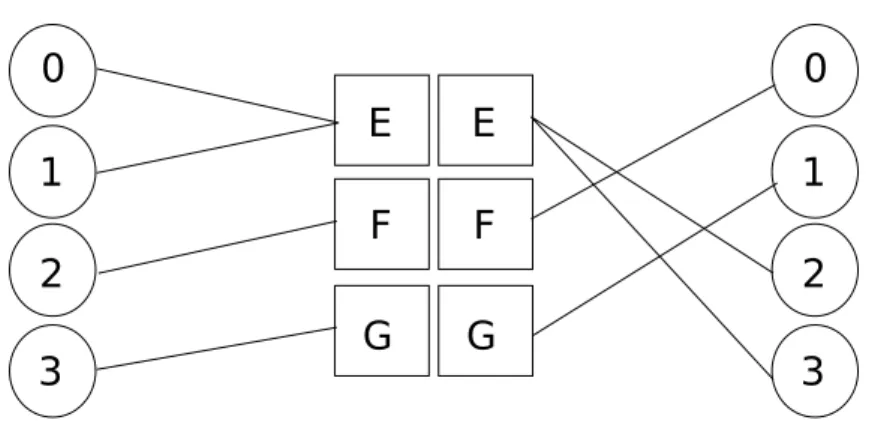
Figure 7: A regular dihypergraph that is not Eulerian.
When the studied dihypergraphs are uniform, Theorem 5 can be reformulated, in a very similar way to [26]: Corollary 3. Let H be an Eulerian dihypergraph. If H is (s−, s+)-uniform, then :
∑
v∈V(H)
|d+(v) − d−(v)| ≤ (s++ s−− 2)m(H)
Observe that even though d-regular dihypergraphs always verify the necessary condition of Theorem 5, they are not always Eulerian (see Figure 7).
The next result is a generalization of the Hamiltonian property of the disjoint unions of dicycles:
Proposition 19. Let H be a 1-regular dihypergraph. H is Hamiltonian if and only if H is connected, and for all hyperarc E∈
E
(H), |E−| = |E+|. Consequently, deciding whether H is Hamiltonian can be done in polynomial time.Proof. Let H be a 1-regular dihypergraph. Remark that its dual H∗is a digraph. By Theorem 2, H∗is Eulerian if and only if it is connected and, for every vertex e ∈
V
(H∗), d−(e) = d+(e). Moreover, by Proposition 12, H is Hamiltonian if and only if H∗is Eulerian.This does not mean that deciding whether a uniform dihypergraph is Eulerian is an easier task than in the general case. We recall the following result about regular digraphs:
Theorem 20 (see [2]). Deciding whether a 2-regular digraph D is Hamiltonian is an NP-complete problem. In [26], the authors use a similar result about 3-regular graphs, for proving that deciding whether a k-uniform hypergraph, k ≥ 3, is Eulerian is an NP-complete problem. We do the same for uniform dihypergraphs. First observe that if the dihypergraphs are 1-uniform, that is they are digraphs, we know that deciding whether a digraph is Eulerian can be done in polynomial time. [13]
Theorem 21. Let (s−, s+) be a couple of positive integers. If s−≥ 2, or s+≥ 2, then deciding whether a (s−, s+ )-uniform dihypergraph is Eulerian is an NP-complete problem.
Proof. By Proposition 12, we only need to prove the case when s+≥ 2 ; indeed, the mirror dihypergraph of a (s−, s+)-uniform dihypergraph is a (s+, s−)-uniform dihypergraph. Furthermore, by Theorem 13, we already know that the problem is in the NP-class. The idea consists in associating, in a polynomial time, to a 2-regular digraph D a dihypergraph HD, such that HDis Eulerian if and only if D is Hamiltonian ; we add useless vertices in
the process in HDto have the desired uniformity.
1.
V
(HD) =V
(D) ∪ [A ×V
(D)] ∪ [B ×V
(D)], where A and B are two sets satisfying |A| = s−− 1 and |B| = s+− 2.2. To each vertex v ∈
V
(D) we associate a hyperarc Ev∈E
(HD), such that Ev−= {v} ∪ [A × {v}], andEv+= {wv, w
0
v} ∪ [B × {v}], where wvand w
0
vare the out-neighbors of v in D.
By construction, HDis a (s−, s+)-uniform dihypergraph. Suppose that D is Hamiltonian. Let C = v0, v0v1, v1, . . . , vn−1,
vn−1v0, v0be a Hamiltonian dicycle in D. From C, we build a dicycle
C
Din HD,C
D= v0, Ev0, v1, Ev1, . . . , vn−1, Evn−1, v0,where Evi is the hyperarc that is induced by vi. By definition of a Hamiltonian dicycle, ∀v ∈
V
(D), v appears onlyonce in C. Therefore, by construction of HD, ∀Ev∈
E
(HD), Evappears exactly once inC
D. SoC
Dis an Euleriandicycle in HD.
Moreover, remark that ∀E, F ∈
E
(HD), by construction of HDwe have E+∩F−⊂V
(D). LetC
D= v0, E0, v1, . . . ,vm−1, Em−1, v0be an Eulerian dicycle in HD. Because of the previous remark, we know that ∀i, vi∈
V
(D). Buta vertex v ∈
V
(D) is incident to only one hyperarc in HD. As a consequence, for all i, Eiis the hyperarc that isinduced by vi. So C = v0, v0v1, v1, . . . , vm−1, vm−1v0, v0is a Hamiltonian dicycle in D.
Nonetheless, we are able to prove more results than in the general case, when the studied dihypergraphs are uniform and also regular. When H is a digraph, we know that:
Theorem 22 (see [13]). Let D be a weakly-connected digraph. If D is regular, then all its iterated line digraphs Ln(D), n ≥ 1, are Hamiltonian and Eulerian.
We are able to prove that, more generally:
Theorem 23. Let H be a weakly-connected, d-regular, s-uniform directed hypergraph. Then ∀n ≥ 1, Ln(H) is Eulerian and Hamiltonian.
Proof. Since H is d-regular and s-uniform, then U (H) is a ds-regular multidigraph. As a consequence, for all n Ln(U (H)) is also ds-regular. By Theorem 1, we show by induction that for all n, U (Ln(H)) is isomorphic to Ln(U (H)). So for all n, U (Ln(H)) is Eulerian (because it is a regular multidigraph), that is equivalent, by Proposition 14, to L(Ln(H)) = Ln+1(H) Hamiltonian.
Moreover, H∗is s-regular, d-uniform. Therefore, ∀n ≥ 1 Ln(H∗) is also Hamiltonian. Again by Theorem 1, we prove by induction that for all n, (Ln(H))∗is isomorphic to Ln(H∗). Therefore, by Proposition 12, ∀n ≥ 1 Ln(H) is Eulerian.
Remark 8. Theorem 23 holds when H is (d−, d+)-regular, H is (s−, s+)-uniform, if we add the extra-condition: d−s−= d+s+.
In the case when s = d we are able to prove slightly more than Theorem 23:
Proposition 24. Let H be a d-regular, d-uniform dihypergraph. There is a complete Berge dicycle in L(H). In other words, the bipartite representation digraph R(L(H)) is Hamiltonian.
Proof. Because of the d-regularity, d-uniformity of H, its own bipartite representation digraph R(H) is d-regular. Therefore, ∀i ≥ 1 Li(R(H)) is Hamiltonian. Particularly when i = 2. By Theorem 1, we know that L2(R(H)) and R(L(H)) are isomorphic. Therefore, R(L(H)) is Hamiltonian.
Uniform B-graphs and F-graphs also have an interesting property. When their line dihypergraph L(H) is Hamil-tonian, they are not necessarily Eulerian, but they verify the necessary condition of Theorem 7:
Proposition 25. Let H be a (1, s+)-uniform dihypergraph (resp. a (s−, 1)-uniform dihypergraph). If L(H) is Hamiltonian, then for all subset X⊂
V
(H), ds−(X ) ≤ d+(X ).Proof. By symmetry, we only show the property for B-graphs.
Let H be a (s−, 1)-uniform dihypergraph, such that its line dihypergraph L(H) is Hamiltonian. By Proposition 14, its underlying multidigraph U (H) is Eulerian. Therefore, for all subset X ⊂
V
(H), we havedU−(H)(X ) =
∑
x∈X dU(H)− (x) =∑
x∈X dU(H)+ (x) = dU(H)+ (X ) .Since H is a (s−, 1)-uniform dihypergraph, therefore dU(H)− (X ) = s−.dH−(X ). Furthermore: dU(H)+ (X ) =
∑
E∈E(H) s.t. E−∩X6= /0 |E−∩ X| ≤∑
E∈E(H) s.t. E−∩X6= /0 |E−| = s−.dH+(X ) Consequently: ds,H− (X ) = dH−(X ) = dU(H)− (X ) s− = dU(H)+ (X ) s− ≤ d + H(X )4.1
A Particular Subfamily
One can find a family of uniform dihypergraphs for which the condition of Theorem 5 is a sufficient condition. But that imposes very restrictive conditions over this family.
Let
H
be a set of dihypergraphs, such that for all H ∈H
:1. H is (s−, s+)-uniform, for some couple of positive integers (s−, s+). 2. for all hyperarc E ∈
E
(H), E−∩ E+= /0.3. for all hyperarcs E, F ∈
E
(H), such that E 6= F, if E ∩ F 6= /0 then E+∩ F−6= /0 and F+∩ E−6= /0.We associate to H ∈
H
an undirected hypergraph Hu, whose set of vertices isV
(H), and whose set of edgesis
E
u= {E−∪ E+: E ∈E
(H)}. Huis called the underlying hypergraph of H. By construction, Huis a k-uniformhypergraph, where k = s−+ s+. The Eulerian properties of the undirected uniform hypergraphs have been studied in [26]. Particularly, the authors of this paper define the strongly connectivity of an undirected uniform hypergraph: Definition 8 ( [26]). Let Hube a k-uniform, undirected hypergraph. Let G be a graph, whose vertices are the
edges of Hu, such that an edge E is linked to another edge F if and only if|E ∩ F| = k − 1. Huis called a strongly
connected hypergraph when G is a connected graph.
Theorem 26 ( [26]). Let Hu be a k-uniform, undirected hypergraph. If Hu is strongly connected, then Hu is
Eulerian if and only if
|Vodd(Hu)| ≤ (k − 2)m(Hu)
This theorem generalizes the Euler condition for a graph G to be Eulerian: G is Eulerian if and only if it is connected and all its vertices have an even degree.
Theorem 27. Let H ∈
H
be a(s−, s+)-uniform dihypergraph, and Hube the underlying hypergraph of H. If Huis strongly connected, then H is Eulerian if and only if
∑
v∈V(H)
|d+(v) − d−(v)| ≤ (s−+ s+− 2)m(H)
Proof. By Corollary 3, if H is Eulerian then
∑
v∈V(H)
|d+(v) − d−(v)| ≤ (s−+ s+− 2)m(H). Let us assume this condition is verified.
Let v be a vertex in H. Since for all hyperarc E, E−∩ E+= /0, therefore the degree of v in Hu, that is
the number of edges that contain v, denoted d(v), is equal to dH−(v) + dH+(v). Consequently, when d(v) is odd, dH−(v) 6= dH+(v). Therefore
∑
v∈V(H)
|d+(v) − d−(v)| is an upper bound of |Vodd(Hu)|. We recall that by construction,
Huis a s−+ s+-uniform hypergraph. Moreover, Huis strongly connected. Since |Vodd(Hu)| ≤ (s−+ s+− 2)m(H),
and m(H) = |
E
u|, therefore Huis Eulerian by Theorem 26.We denote Ej the edge in Huthat is associated to hyperarc Ej. Let T = u0, E0, u1, . . . , um−1, Em−1, u0be an
Euler tour in Hu. For all j, we have uj+1∈ Ej∩ Ej+1by definition of an Euler tour. Consequently, Ej∩ Ej+16= /0.
By definition of
H
, there exists a vertex vj+1 ∈ E+j ∩ E − j+1 because E + j ∩ E − j+16= /0. As a consequence, C = v0, E0, v1, . . . , vm−1, Em−1, v0is an Eulerian dicycle in H.Remark 9. Actually, the property ”H is in
H
=⇒ H is uniform” could be replaced by the following one: if H is a dihypergraph inH
, then there exists an integer k such that for all hyperarc E∈E
(H), |E−| + |E+| = k.4.2
Universal Cycles and Universally Eulerian Dihypergraphs
Finally, we present another kind of so-called Eulerian dicycles. Let
F
be a set of N combinatorial objects, and A be an alphabet. An element ofF
is associated to one or many words of length n over A.Definition 9 ( [27]). A universal cycle (or ucycle) of
F
is a word w= a0a1a2. . . aN−1over A, with each F∈F
represented by exactly one subword aiai+1. . . ai+n(index addition is interpreted modulo N).
Observe that a same word of length n could represent many elements in
F
. So there are possibly more than one bijection betweenF
and the subwords of length n in a ucycle.It was suggested in [1] to use universal cycles as an extension of the Eulerian cycles to the uniform hyper-graphs. This can be done with the uniform dihypergraphs too. Indeed, let H = (
V
(H),E
(H)) be a (s−, s+ )-uniform dihypergraph. A hyperarc E ∈E
(H) could be represented as a word of length k = s−+ s+over the alphabet A =V
(H), denoted w = v0v1. . . vk−1, where {v0, v1, . . . , vs−−1} and {vs−, vs−+1, . . . , vk−1} are the in-setand the out-set of E respectively. In so doing, a hyperarc is associated to s−!s+! words of length k over the alphabet A.
Definition 10. Let H be a (s−, s+)-uniform dihypergraph. H is universally Eulerian if there is a ucycle of
E
(H) over the alphabetV
(H).Observe that an Eulerian digraph D is a universally Eulerian digraph. Indeed, let v0, v0v1, v1, . . . , vm−1, vm−1v0, v0
be an Eulerian dicycle in D. Then v0v1v2. . . vm−1is a ucycle of
E
(D) over the alphabetV
(D).Proposition 28. A universally Eulerian dihypergraph is an Eulerian dihypergraph.
Proof. Let H be a (s−, s+)-uniform dihypergraph. Let us assume that H is universally Eulerian, and let CU =
v0v1. . . vm−1 be a universal cycle of
E
(H) over the alphabetV
(H). We denote by Ei the hyperarc that isrep-resented by vivi+1. . . vi+k−1, where k = s−+ s+. Remark that vi+s− is in Ei+∩ Ei+1− . As a consequence, C =
Proposition 28 shows that universal Eulerianicity is a stronger notion than simple Eulerianicity. Like strongly Eulerian dihypergraphs, universally Eulerian dihypergraphs verify the following property:
Theorem 29. Let H be a (s−, s+)-uniform dihypergraph. if H is universally Eulerian, then L(H) is Hamiltonian. We prove Theorem 29 with two Lemmas:
Lemma 9. Let H be a universally Eulerian dihypergraph. Let CU be a ucycle of
E
(H) overV
(H). For all vertex v:d−(v) = s+.|CU|v
d+(v) = s−.|CU|v
where|CU|vdenotes the number of occurences of v in CU.
Proof. By definition, s−consecutive vertices in CUare the in-set of a given hyperarc, and s+consecutive vertices
are the out-set of a given hyperarc.
Let v be a vertex in H. When d−(v) = d+(v) = 0, Lemma 9 holds. Else v is necessarily in CU, and so
d−(v), d+(v) 6= 0. Let us assume that CU= v0v1, . . . vm−1, and v = vifor some i ∈ {0, . . . , m − 1}. Then v is in the
in-set of Ei, Ei−1, . . . , Ei−s−+1and in the out-set of Ei+1−k, Ei+2−k, . . . , Ei+s+−k, where k = s−+ s+. Furthermore,
vertex v cannot be twice in the same in-set nor twice in the same out-set. Consequently, any occurrence of v in CU
increases the in-degree d−(v) of s+(resp. the out-degree d+(v) of s−).
Lemma 10. Let H be a (s−, s+)-uniform dihypergraph. If H is universally Eulerian, then U (H) is Eulerian. Proof. Let v be a vertex in H. Observe that dU(H)− (v) = s−d−H(v) and dU(H)+ (v) = s+dH+(v). Therefore, by Lemma 9, for all vertex v, dU(H)− (v) = dU(H)+ (v). In other words, U (H) is a balanced digraph.
Furthermore, since H is universally Eulerian, therefore H is Eulerian by Proposition 28. By Proposition 3, H, and so U (H) is weakly connected. Therefore U (H) is Eulerian by Theorem 2.
Theorem 29 is now a direct consequence of Lemma 10 and Proposition 14.
5
Consecutive Dihypergraphs
5.1
De Bruijn, Kautz and Consecutive digraphs
5.1.1 Definitions
Definition 11. The generalized de Bruijn digraph GB(d, n) (also called Reddy-Pradhan-Khul digraph), is the digraph whose vertices are labeled with the integers modulo n; there is an arc from vertex i to vertex j if, and only if, j≡ di + α (mod n), for some α with 0 ≤ α ≤ d − 1.
If n = dD, GB(d, n) is nothing else than the de Bruijn digraph B(d, D). [18]
Definition 12. The generalized Kautz digraph GK(d, n) (also called Imase-Itoh digraph), is the digraph whose vertices are labeled with the integers modulo n; there is an arc from vertex i to vertex j if, and only if, j≡ −di − d + α (mod n), for some α with 0 ≤ α ≤ d − 1.
Both of those families of digraphs can be generalized in the following way:
Definition 13. The Consecutive-d digraph G(d, n, q, r) (see [14]) is the digraph whose vertices are labeled modulo n, such that there is an arc from vertex i to vertex j if, and only if, j≡ qi + r + α (mod n), for some α with 0 ≤ α ≤ d − 1. We assume that 1 ≤ d, q ≤ n − 1, and 0 ≤ r ≤ n − 1.
When q = d and r = 0, G(d, n, d, 0) = GB(d, n). When q = r = n − d, G(d, n, n − d, n − d) = GK(d, n).
Finally, we present a subfamily that was introduced in [18]: Let λ be a positive integer, with 1 ≤ λ ≤ d. Then GBλ(d, n) is the subdigraph of GB(d, n) such that there is a link from i to j if, and only if, j ≡ di + α (mod n), for some α with 0 ≤ α ≤ λ − 1. Actually, the digraph GBλ(d, n) is nothing else than the consecutive digraph
G(λ, n, d, 0). But the notation of GBλ(d, n) helps to understand that it is a subdigraph of GB(d, n). More precisely,
provided λ = d, GBd(d, n) = GB(d, n). We can define in a similar way GKλ(d, n).
5.1.2 Hamiltonian properties
Consecutive-d digraphs have been intensively studied, especially in [17], [14], [24], [10], [11], [20], [16], [19], and [9]. Particularly, the characterization of the Hamiltonian Consecutive-d digraphs is nearly complete:
Theorem 30 ( [11], [17], [14], [24]). Let G = G(d, n, q, r) be a Consecutive-d digraph.
If d= 1, then G is Hamiltonian if and only if all of the 4 following conditions hold: 1. gcd (n, q) = 1.
2. For every prime number p such that p|n, p divides q − 1. 3. If n is a multiple of4, then q − 1 is also divisible by 4. 4. gcd (n, q − 1, r) = 1.
When d= 2, G is Hamiltonian if and only if one of the following conditions is verified: 1. gcd (n, q) = 2
2. gcd (n, q) = 1 and either G(1, n, q, r) or G(1, n, q, r + 1) is Hamiltonian.
When d= 3:
1. Ifgcd (n, q) ≥ 2 then G is Hamiltonian if and only if 3 ≥ gcd (n, q). 2. If1 ≤ |q| ≤ 3, and n is coprime to q, then G is always Hamiltonian.
If d≥ 4, then G is Hamiltonian if and only if d ≥ gcd (n, q).
Corollary 4 ( [14]). Let G = G(d, n, q, r) be a Consecutive - d digraph. If λ = gcd (n, q) ≥ 2, then G is Hamiltonian if, and only if, λ ≤ d.
The only remaining case is when d = 3, for which we only have a partial characterization.
In particular, the characterization of the Hamiltonian generalized de Bruijn digraphs (resp. the Hamiltonian generalized Kautz digraphs) is complete:
Theorem 31 ( [18]). If λ = gcd (n, d) ≥ 2 then GBλ(d, n) and GKλ(d, n) are Hamiltonian.
Theorem 32 ( [18], [15]). GB(d, n) is Hamiltonian if and only if one of the following conditions holds: 1. d≥ 3.
2. d= 2 and n is even.
Similarly, GK(d, n) is Hamiltonian if and only if one of the following conditions holds: 1. d≥ 3.
2. d= 2 and n is even. 3. d= 2 and n is a power of 3.
GB(d, n) and GK(d, n) are also Eulerian [18].
Finally, consecutive-d digraphs have interesting line digraph properties. We use the following relations [18]: Proposition 33. If gcd (n, d) = λ ≥ 2 then L(GBλ(d,n λ)) = GBλ(d, n) L(GKλ(d, n λ)) = GKλ(d, n) Particularly, we have for all n:
L(GB(d, n)) = GB(d, dn) and L(GK(d, n)) = GK(d, dn). Proof. A possible mapping from the arcs of GBλ(d,
n
λ) to the vertices in GBλ(d, n) is this one: let (i, j) be an arc of GBλ(d,n
λ) such that j ≡ di + α (mod n
λ), then we associate the vertex of GBλ(d, n) f (i, j) ≡ di + α (mod n) to the arc (i, j). Since gcd (n, d) = λ we can show that f is a one-to-one mapping. Furthermore, if j ≡ di + α (mod
n
λ) then λ j ≡ λ(di + α) (mod n). Consequently: d. f (i, j) + β ≡ d.(di + α) + β ≡d
λλ(di + α) + β ≡ d
λλ. j + β ≡ d j + β (mod n) So we have {d. f (i, j) + β : 0 ≤ β ≤ λ − 1} = { f ( j, k) : ( j, k) is an arc of GBλ(d,
n λ)}
5.2
Definitions of de Bruijn and Kautz dihypergraphs
In [7] de Bruijn and Kautz digraphs have been generalized to dihypergraphs. Two distinct definitions were pro-posed for de Bruijn dihypergraphs. First scheme is a generalization of the alphabetical definition of a de Bruijn digraph. In the dihypergraph B1(d, D, s), d is the size of a first alphabet A, and s is the size of a second alphabet B.
Vertex labels are of the form [BA]D, and hyperarc labels are of the form [A][BA]D−1[A].
Vertex (b1, a1, b2, a2, . . . , bD−1, aD−1, bD, aD) belongs to the in-set of hyperarcs (a1, b2, a2, . . . , aD−1, bD, aD, α),
with α ∈ A.
Hyperarc (a0, b1, a1, . . . , bD−1, aD−1, aD) has as out-set all the vertices (b1, a1, . . . , bD−1, aD−1, β, aD), with β ∈ B.
An extension of the latest definition, denoted by GBH1(d, n, s, m), exists, when d, n, s, m verify some
partic-ular conditions detailed in [7]. With this definition, GBH1(d, (ds)D, s, d2(ds)D−1) and B1(d, D, s) are isomorphic.
![Table 3: Necessary and sufficient conditions for H([d ,n, q, r], [d, n,q, r]) to have a complete Berge dicycle](https://thumb-eu.123doks.com/thumbv2/123doknet/13044647.382665/46.892.109.634.558.624/table-necessary-sufficient-conditions-h-complete-berge-dicycle.webp)
