People’s Democratic Republic of Algeria Ministryof Higher Education and Scientific Research
AbdelHamid Ibn Badis University of Mostaganem Faculty of Foreign Languages
Department of English
A dissertation Submitted in Partial Fulfilment for the Requirement of a Master Degree in Didactics of Foreign Languages
Submitted by:
Bouhalili Hanan
Board of Examiners:
Supervisor: Ms. Bentamra Soumia University of Mostaganem
Chairperson: Mrs. Ould Si Bouziane Sabrina University of Mostaganem
Examiner: Mrs. Derraz Amel University of Mostaganem
Academic Year 2019/2020
The role of reflective worksheet in
enhancing teachers’ reflective
feedback to promote speaking skill
Case study of Second Year Master students at AbdelHamid Ibn Badis University in Mostaganem
Dedication:
I dedicate this work to my lovely family, my dear parents whom without their patient, care and love I could not be that educated and successful person that I am now, to my brothers and
sisters for their support and help.
To my best friend Imen who helped me a lot in finishing my thesis with her love and kindness.
Acknowledgement
Thanks to Allah for his blessings and protection that are given to us.
Special thanking to my supervisor Ms. Soumia Bentamra for her guidance, who dedicated her precious time and valuable efforts to make this work possible.
I would like to express our gratitude and thanking the members of the jury Mrs. Derraz Amel and Mrs. Ould Si Bouziane Sabrina for taking the time to evaluate my work.
I would like to express deep gratitude to all teachers and students who took time to answer my questions and helped me in finishing this work.
Abstract
Feedback and reflective thinking are two major important factors that contribute to ones’ own learning and improve it. However, to enhance learners' reflective thinking and give and receive feedback in a good and effective way, one may need to use different tools to facilitate and help students and teachers during the learning process. An example of such tools is the use of reflective work sheets. This study aims at investigating the role of the reflective work sheet in enhancing teachers' reflective feedback to promote speaking skill. Furthermore, the present research attempts to present for students and teachers a new tool, which is the
reflective work sheet, to better understand and find solutions to students' errors. In conducting this research, a mixture of qualitative and quantitative methods was used to collect data from the respondents which are questionnaire and interview to prove or disconfirm the research hypothesis. This study was conducted with second year Master students of didactics of foreign languages at Abdelhamid Ibn Badis University. The results enquire that feedback and reflective thinking are two essential elements to develop students' speaking skills and help them overcome their errors. On the other hand, reflective work sheets can be a good choice for both teachers and students to use in their regular reflections to more improve and develop their speaking proficiency and the learning experience in its entirety.
List of figures
List of graphs Graph 2.1 ………..…..25 Graph 2.2………...26 Graph 2.3………...26 Graph 2.4……….27 Graph 2.5……….28 Graph 2.6……….28 Graph 2.7……….29 Graph 2.8……….29 Graph 2.9……….30 Graph 2.10………...30 Graph 2.11………...31
Table of content Dedication ………2 Acknowledgement………3 Abstract………4 List of graphs………5 List of figures ………..6 Table of content………...7 General introduction ………..10
Chapter one: literature review 1.1. Introduction...12 1.2. Definition of feedback...12 1.3. Types of feedback...13 1.3.1. Teacher-student feedback...13 1.3.1.1. Formative feedback...13 1.3.1.2. Summative feedback...14 1.3.1.3. Formal feedback...14 1.3.1.4. Informal feedback...14 1.3.1.5. Constructive feedback...15 1.3.1.5.1. Positive feedback...15
1.3.1.5.2. Positive feed-forward feedback...15
1.3.1.5.3. Negative feedback...15
1.3.1.5.4. Negative feed-forward feedback...16
1.3.2. Self-assessment...16
1.3.3. Student to student feedback...16
1.4. Impact of feedback on learning...17
1.4.1. Motivation...17
1.4.3. Language skills...18
1.5. Definition of speaking...18
1.5.1. Challenges that face EFL students in speaking English...18
1.5.2. Feedback in speaking...19
1.6. Reflective thinking...19
1.6.1. Gibbs reflective circle...20
1.6.2. Tools to enhance reflective thinking...22
1.6.2.1. Reflective journals...22
1.6.2.2. Portfolios...22
1.6.2.3. Reflective worksheet...22
1.7. Conclusion...22
Chapter two: Methodology and data analysis 2.1. Introduction...23
2.2. Procedure...23
2.3. Context of the study...23
2.4. Participants...24
2.5. Data collection instruments...24
2.5.1. Questionnaire...24
2.5.1.1. Description of the questionnaire...24
2.5.1.2. Analysis of students' questionnaire...25
2.5.2. Interview...31
2.5.2.1. Description of the interview...31
2.5.2.2. Analysis of the interview...31
2.6. Conclusion...33 Chapter three: discussion of results and recommendations
3.1. Introduction...34
3.2. The interpretations of students' answers...34
3.2.1. General discussion of the questionnaire...36
3.3. Interpretations of Teachers' interview...36
3.3.1. General discussion of the interview...39
3.4. Recommendations...39
3.4.1. Teachers' recommendations...39
3.4.2. Description of students' reflective worksheet...40
3.4.3. Description of Teachers' reflective worksheet...41
3.5. Conclusion...42 General conclusion...43 Cited works...46 Appendices...48 Student’s questionnaire ………..…….48 Teacher’s interview ……….……50
Student’s reflective worksheet……….……51
General introduction
Innovative teachers are believed to be instinctive about students' challenges such as lack of understanding, loss of focus, low engagement, de-motivation or any signs of weaknesses. They do try to find new ways to be motivated, solve problems and encourage students to succeed. Innovative teaching requires invention and creativity in designing new methods and practices to make sure that students always get the best learning experiences. It can be achieved without the use of technology for example the use of portfolios, reflective journals and the reflective work sheet.
Given the fact that education at University requires much more responsibility and autonomy because students at this level feel responsible for their own learning; they need to practice reflection on their lessons to find the gaps and the weaknesses in their learning. To promote and help students develop and promote reflective thinking and encourage them to be active learners towards their lessons, teachers thought of the use of the reflective work sheet.
The source of motivation for this work is that students find some difficulties in using some reflective tools to develop their reflective thinking such as reflective journals and portfolios especially for students of M2 didactics of foreign languages at the department of English at Abdelhamid Ibn Badis University.
The above issue raises several questions; one main question, and two sub-questions respectively:
1_Is the reflective feedback effective in enhancing students’ learning? 2_ How to develop teachers' reflective feedback?
3_To what extent can the reflective work sheet be effective in promoting students’ speaking skills?
To answer these questions, the following hypotheses are suggested:
1_Reflective feedback may represent a very appealing tool in helping students enhance their ways of learning.
3_The reflective worksheet may be very effective for both teachers and learners to make the best use of reflective feedback as a learning tool.
The aim of this study is to give students a new and easy technique to practice and develop their reflective thinking as a learning strategy by answering the questions mentioned in the reflective work sheet. To conduct this research both qualitative and quantitative methods were used. A questionnaire was addressed to M2 students of didactics of foreign languages at Abdelhamid Ibn Badis University, and an interview was carried out with teachers of M2 students of didactics of foreign languages at Abdelhamid Ibn Badis University.
The work is divided into three chapters. The first chapter starts with an overview of feedback and its different types that are most common in foreign language teaching. The next step we took in this chapter is to highlight the impact of feedback on the learning process in particular on students' motivation, performance and language skills including the speaking skill.
On the other hand, we spot the light on reflective thinking since it is highly important for students. Then we have introduced Gipp's (1989) reflective circle and the different tools to enhance reflective thinking notably, reflective journals, portfolios and mainly the reflective work sheet.
The second chapter targets the methodology used in investigating the role of the reflective work sheet in enhancing teachers' reflective feedback, covering as well the analysis of the questionnaire and the interview. The third chapter discusses the findings of both the questionnaire and the interview which demonstrates the role of the reflective work sheet in enhancing teachers' reflective feedback.
Literature Review: Feedback and Speaking. 1.1.Introduction
Feedback is used to assist the learner in improving their knowledge, skills, attitudes or behaviours that suits standard objectives and goals. To be constructive, feedback must contain information upon which the learner can act to improve performance. The feedback process offers for the learner an opportunity to reflect on performance and the learning process. Therefore, reflection is critical to professional learning. “Reflective feedback conversations” (Cantillon and Sargeant, 2008) offer a strategic approach for promoting the learners’ critical reflection, self-assessment and a fact-based process to improvement.
The present chapter examines different literature regarding the role of feedback in students’ learning achievements including motivation, performance and language skills; moreover, historical perspectives and detailed discussion around the sorts of feedback that are integrated in the educational field. In addition to that, the current chapter highlights several perceptions about different tools to enhance reflective thinking and more specifically, reflective worksheet
1.2.Definition of feedback:
The term feedback was first coined as a compound noun “feed “and “back” which means to provide back, Kauchak (1989) defined feedback” as any information about the current behaviour that can be used to improve the future performance of the students”. In other words, feedback is described as the present behaviour that contributes to students’ development of performance. Similarly, Zublin (2011) defined feedback as the sequence of teaching and response to learners’ performance, it is provided by either external agent (teachers, peers), or internal agent (ones’ self). Although feedback is perceived as information provided for the purpose of developing learners’ performance; yet, it is used to cue teachers on the errors or weaknesses in their teaching methods (Hattie, 2011).
Giving and receiving feedback is a challenging task because it needs several points to consider. It should be communicative in a manner that is constructive and emotionally sensitive (Eraut, 2006); helpful, clear, and understandable (Dauham, 2005), and promote meaningful and give the students the opportunity to rethink and rework the errors of their efforts (Helterbran, 2005). Svinichi(2001) claimed that “feedback should avoid
personalization or emotionally charged wording”; in addition “the assessor should attempt to remove all personality clashes, likes or dislikes, and be impartial”(Stott, 2001).
1.3.Types of feedback:
Since feedback is quite important and has been the focus and place of interests for many researchers; it takes different forms and shapes, each type has his role to play in developing and improving student’s learning. Those forms can be given in a single entity for instance: informal feedback about a student’s grasp of a concept in classroom or a combination of multiple entities for example: formal, informal and peer feedback on one stage of an assessment task. Types of feedback are divided into three dimensions which are:
1.3.1. Teacher-student feedback:
Teacher-student feedback ensures building relationships between the students and the teacher by which the teacher provides information about student’s performance highlighting the positive and the negative points thus the student when receiving this feedback will in response improve or change the performance or the behaviour according to what looks almost like a standard one. In the teacher-student feedback five types are giving attention to, which are:
1.3.1.1.Formative feedback
“The main aim of formative feedback is to increase student’s knowledge, skills, and
understanding in some content area or general skills” (Valerie.J.Shute, 2008 p78).in the same line, formative feedback has a crucial role in enhancing student’s skills, knowledge and help them to gain understanding and high quality of learning for example the use of problem solving. In addition, formative feedback tends to modify or change learner’s thinking or behaviour according to what suits their learning outcomes (Shute, 2008 p153)
Using formative feedback requires the use of cognitive mechanisms. First, it helps in finding the gaps between the current level of performance and desired one. This may motivate learners to reach a high level of effort (Lock and Latham, 1990).Second; formative feedback can effectively reduce the cognitive load of a learner, especially novice or struggling in processing new information due to high performance demands and thus support their learning practices.
1.3.1.2.Summative feedback:
Summative feedback is generally carried out at the end of the course or project. It is used for evaluation, it enables the person to make administrative decisions about effectiveness and about merit, continuation, pay and so on. Key features of the data regarding the
summative feedback are; that the data are less subject to the influence of contextual conditions. In addition to that, they deal with overall performance and they are evaluative. Also the data are of quantitative manner and are outcome-oriented.
1.3.1.3.Formal feedback:
Formal feedback is collecting information or any aspect of a course from the teacher or the students for example to know students’ responses about a new method being used in the classroom. It may take place at any time because it is something that emerges spontaneously in the moment in the moment or during action for example one may use informal feedback when the errors are recognised at the end of the course and the teacher cannot leave it t the next session.
It requires building rapport with students to effectively encourage and guide them without causing breakdown specially in focussing on fluency in oral classes, where the teacher stops the students for each mistake and provide feedback which may cause interruption and stop speaking.
It has many positive aspects such as: it is quick and easy to obtain the information, allows teachers and students to collect information at any point during the class, helps the learners to become more reflective about their learning and it may fosters a good rapport between teachers and students by showing that teachers care for their learning and their opinions are important for them (Development, 2013)
1.3.1.4. Informal feedback:
Informal feedback is defined as in-the-moment, ongoing development advice given to students. In addition, it is communicated in everyday interactions and it is not planned
beforehand out of the official meetings, for example: giving feedback to a student after the class is finished. It can be provided individually or in groups.
1.3.1.5.Constructive feedback:
Constructive feedback is a tool that is used to build things up, it give praise for
achievements and suggestions to better improvements. In addition, it is seen as specific, issue-focused and based on observations. It is also called supportive feedback given to students to help them identify the problems and the weaknesses and provide solutions. Therefore, it may be positive or negative and it is used as supportive tool between the teacher and the students that links between them both.
For feedback to be constructive it needs to be: first, the teacher should see the person’s behaviour without making assumptions and interpretations. In addition show the student his mistakes and provide recommendations and solutions. The feedback should be in a language that the student can understand, there are four types of constructive feedback notably:
1.3.1.5.1. Positive feedback:
Positive feedback is giving comments about a past behaviour. It is often given when things went well and to be continued. (Ellis, 2009)Claimed that «positive feedback affirms that a learner response to an activity is correct”
1.3.1.5.2. Positive feed-forward feedback:
Positive feed-forward feedback is a type of feedback where the teacher affirms comments about future behaviour. It focuses on the behaviour that will improve performance in the future. It is future focused to provide the one with the adequate information about what could possibly be done differently in the future; it gives future-oriented options or solutions.
1.3.1.5.3. Negative feedback:
Negative feedback is a kind of corrective comments about past behaviours that was not successful and should not be repeated. Teacher when providing this type of feedback they want from students to rethink and change those failed or unsuccessful performances to better ones.
In Audiolingualism “negative assessment is to be avoided as far as possible since it functions as “punishment” and may inhibit or discourage learning”. In the same line, negative comments on student’s performance sometimes it is perceived as punishment especially if they had already personnel conflicts with their teachers.
1.3.1.5.4. Negative feed-forward feedback:
It focuses on behaviours that should be avoided in the future. It is a kind of corrective comments about future performance that should be changed to be better. It occurs after there has been a change in the environment, it mechanism come into play to restore the variable toward its origins set point and to improve it in the future.
1.3.2. Self-assessment:
Self-assessment in defined as “the involvement of learners in making judgements about their achievements and the outcomes of their learning” (Wride, 2017), it increases the role of the student as an active participant in their learning and to achieve the wanted goals. Therefore, students may question their own learning experiences and highlight the reasons behind their success or failure and provide the possible improvements they should do to reach the desired achievements
1.3.3. Student to student feedback:
It is also called peer feedback, for a long time learners have took the opportunity of being responsible of their own learning. It occurs when students offer each other advice and suggestions in relation to each other’s work, behaviour or performances. Students do not give grades to each other but rather learn, negotiate meanings, ideas and comments.
This type of feedback should be given according to a certain evaluation criteria given by the teacher without criticism or negative comments that is based on personnel or emotional conflicts. Peer feedback enables students” to take an active role in the management if their own learning” (Carless, 2006).
Peer feedback helps students to be experts and responsible of their own learning and help them to build independence especially when the teacher builds an atmosphere that encourages “failing forward” that is one may see mistakes as opportunities to learn from, students will feel at ease be motivated to learn more without being afraid of making mistakes.
Despite its benefits, some researchers found that peer feedback has several challenges as well. Thus, some peers may give comments on the most noticeable errors and sometimes give advice that does not offer help. Moreover, some studies have questioned the validity of peer’s comments such as Ching (1991),he questioned whether students are capable of giving a
high quality of feedback similar to the one offered by the teacher, unless if one offers them a proper training or systematic structure to follow in giving feedback.
1.4.The impact of feedback on learning:
The use of feedback as being part of the learning process is quit essential and very important. It appears in different branches such as: medicine, psychology and educational system among others. This is not surprising since feedback is seen as a key factor that effects learning and interpersonal communication (Eraut, 2006).In addition, Carless (2006) described feedback as being the heart of development of effective learning. In the same line, giving feedback requires providing the learner with the positive or negative information about his or her performance and based on this the learner try to improve or maintain the preferred
behaviour or change it if it was negative to look like a standard one. Feedback has an impact on various aspects of student’s learning such as: motivation, performance and language skills.
1.4.1.Motivation:
In pedagogical theory, positive feedback is important because it provides support to the learner and fosters motivation .Giving and receiving feedback has been a crucial issue, lately researchers paid more attention about the type of feedback that could improve student’s motivation to learn, positive feedback in among those types. It helps learners to develop their own self-efficacy which plays an essential role on how one approaches goals, tasks and challenges. Thus it makes learners feel exiting and ambitious towards learning cited in (Ellis, 2009).
1.4.2. Performance:
Ur (1991) claimed that” the objective of feedback is to improve the performance” p242.In addition assessment theories and academics highlighted the importance of feedback on performance assessment tasks for supporting improvements and progress in student learning achievements (Orrila, 2006). Feedback has been considered as an important element in improving the learning process for students. Thus it facilitates for learners development, become independent and help them to improve their performance by: monitoring, evaluating and regulating their own learning performances and improve them in the future.
1.4.3. Language skills:
In learning a foreign language, the learner needs to learn the four language skills which are: reading, writing, speaking and listening. The process of learning any language starts first with: listening, then speaking then reading and finally writing. Feedback in language skills takes place especially in productive skills: writing and speaking. Many
researchers claimed that feedback has a crucial role in developing the writing skill. Moreover, peer feedback has positive effects in improving the writing skill and enhances student’s motivation (Mohamed Farah2012). When students receive feedback from each other they are more encouraged to correct their mistakes and improve more their writing because some of them do not like others to see their mistakes or be a place of judgement in front of other classmates.
1.5. Definition of the speaking skill:
Speaking is defined as interactive process of constructing meaning that involves
producing, receiving and processing information (Burns and Joyce, 1997). In the same line of thought, the speaking skills are defined as the skills that enable the person to communicate effectively in order to convey messages in a passionate, thoughtful, and convincing manner; it helps the person to share his thoughts, opinions and feelings with en external agent.
To give feedback correctly and effectively without interrupting them on speaking skill, one may need to follow several strategies such as first, the teacher may make notes of the mistakes that the student is making while they are speaking, and then one may provide the necessary feedback on each student errors and handle it to them. Second, the teacher may try to instead of pointing to the mistakes directly they try to repeat what the student said, using the correct language structure and pronunciation in this manner students will recognise the mistakes they made and correct it next time.
1.5.1. Challenges that face EFL students in speaking skill:
Speaking skills are often the most difficult language skills among others especially for EFL learners because of different reasons. First, grammar and vocabulary should be taken into account because to communicate effectively, one may needs to acquire the knowledge of grammar and vocabulary to produce correct and meaningful utterances, likewise the
pronunciation which is the basic among the linguistic features that is the place of interests for teachers of EFL classes .the next issue is: using colloquial speech and contradicted forms, it is
necessary to make EFL learners familiar with colloquial language for example: idioms and different phrases and expressions that is related to the target culture and used in everyday’s speech as well.
Third, since speaking in mainly limited to the classrooms and it does not exist outside, it raises a crucial issue that is the lack of practice. Teachers of speaking should encourage students to freely express their thoughts even outside the classrooms as much as they can. Finally, the majority of EFL students are facing some challenges regarding language use in term of language accuracy and fluency; while speaking, they came across difficulties such as: shyness, anxiety and the fear of making mistakes.
1.5.2. Feedback in speaking:
Giving feedback have been an important and difficult task for teachers because they feel confused whether to focus on accuracy or fluency especially when in early time when teachers do not know their students; more precisely their needs and weaknesses. Various studies were conducted to avoid such a confusion, to give students feedback for their speaking mistakes; certain strategies need to be followed such as: leaving feedback till the end.
Sometimes, the best way to correct students' errors is by not correcting them at all in order to avoid different psychological conflicts such as: anxiety and stress as Henter(2011) argued that delayed feedback could be beneficial in promoting accuracy. Furthermore, teachers may also try to note down their students' mistakes and after they finish, they talk to them one by one and propose for them their corrections and suggestions.
On the other hand, the body language could be a key factor push students away from feeling embarrassed or anxious. When the teacher tried to deal with their students' in a good and kind way; students will feel comfortable and they will not be blocked even if they make mistakes, they would feel in a way that their mistakes are welcomed in the classroom.
1.6. Reflective thinking:
Reflective thinking and critical thinking are often used similarly but they are quite different. Critical thinking is the use of the cognitive skills such as: application, analysing, synthesizing, evaluation, reflection and many other skills that increase the probability of desired outcome (Halpern, 2007) cited in the role of thinking (2014), whereas, reflective thinking involves “consideration of the larger context, the meaning and the implications of an experience or an action” branch, W.T and parajape, A. (2002). Therefore, reflective thinking
does not only mean noting down what a student did or planning to do, but rather, the reason behind the done actions or future actions. In other words, better understand one’s own learning, exploring emotions, reactions and knowledge.
1.6.1. Gipp’s reflective circle:
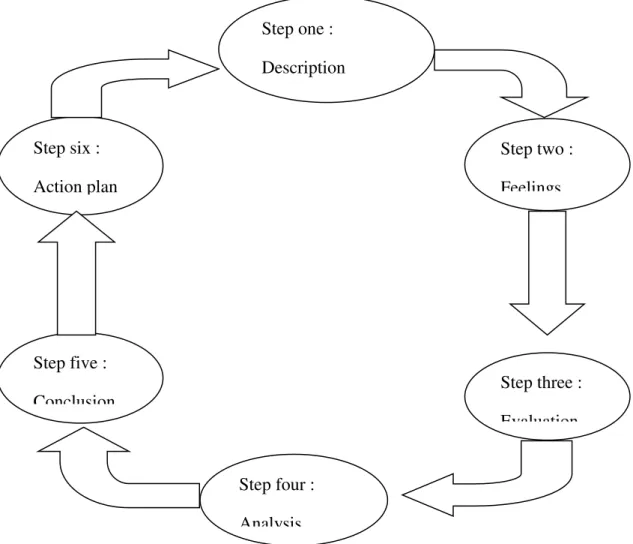
In 1988, the American Sociologist and Psychologist Graham Gibbs published his reflective cycle model in his book” Learning by Doing”. Gibbs reflective cycle helps its users to reflect and think systematically about their performance, learning experiences or specific situation. Using this cycle makes people aware of their own actions and better improves future desired performances. It goes through six steps, starting by Description, Feeling, Evaluation, moving to Analysis, Conclusion and finally Action plan.
Step one: Description: In this step, the learner describes the performance, activity or the
situation in details by asking several questions such as: what happened? When did it happen? Who were involved? Where did it happen? What did I do? What did other do? What were the results? Every single detail that could be a key for better understanding is important and should not be neglected.
Step two: Feelings: The learner or the person thinks about the feeling and thoughts triggered
in that situation or activity not in the purpose of making judgement, rather to raise awareness. These questions could be helpful, for instance: what someone felt before, during and after the event? And what the people felt during and after the event as well? This step allows people to speak about their feeling when they raise these questions to solve or rise by the teacher or someone else and the final two questions provide another different view from people’s perspectives.
Step three: Evaluation: In this stage, it is difficult for a person to be objective in his thinking
about the situation, when they ask themselves: which things that worked well and in what way? Which others did not work as well? And whether it was good or bad experience in order to maintain objectivity; the use of the following questions are preferable: for example: what went well during the event? Why? What did not go well? And why? What was your
contribution? And which contribution did other people made?
Step four: Analysis: In this phase, people list what they have learned from the previous
experience, performance or activity; whether it is positive or negative to encourage future actions; whether to maintain the same or rethink and improve them to have better ones.
Step five: Conclusion: One may take a step back, look and question oneself from a distance,
what else could they have done in this experience or task. In this step, people make
conclusions about done work by stepping back and think and question themselves about what could have been done in the situation? The information gathered from previous step would encourage and be useful to make conclusions and this can be done well by answering the following questions: to what positive or negative points has this experience, task or performance led? If this event happens again what will they do?
Step six: Action Plan: Based on the conclusions one has made, if they had negative
experience they would likely to promise themselves or make plan about how to change, improve and seek for better experience and if it was positive experience, one would likely to maintain that experience or performance in the future.
This cycle helps people to reflect and rethink systematically about the event they had and make decision and promises to better improve that situation, event or maintain it in the same manner.
Figure 1.1: Gipps reflective circle
Step one : Description Step five : Conclusion Step six : Action plan Step two : Feelings Step three : Evaluation Step four : Analysis
1.6.2. Tools to enhance reflective thinking: 1.6.2.1. Reflective journals:
Interchangeably named reflective diaries are papers where the person writes his daily experiences that can be either positive or negative ones. It helps one to self-reflect and learn from past experiences. The purposes behind writing reflective journals notably are to
understand the things that have happened, to reflect why a certain event happened in a specific manner, to align future actions with ones values and lessons learned from past
situation and to share and get one’s thoughts and ideas out of one’s head. People when writing a reflective journal they ask themselves the three main “Wh” questions which are: the what, so what and what’s next.
1.6.2.2. Reflective portfolios:
Is a set of writings that summarizes the insights and experiences a student has gained from practical assignments, used to assess students’ engagement in the classroom and their ability the input they have in a given context, it allows the students to explore their own learning process, it demand the students to highlight their own perspectives and feelings toward their learning. A reflective portfolio generally contains short written pieces that summarizes and reflect on a practical task.
1.6.2.3. Reflective worksheet:
The reflective work sheet is a work sheet that allows students to evaluate their attitudes, behaviours and their class-work. It is an effective way to get students to rethink about their own learning. Moreover, the reflective work sheet gives the students the chance to question their thinking, was it appropriate to act that way, why and how to improve it more.
1.7.Conclusion:
In this chapter we spot the light on the different types of feedback that most common, then we defined feedback in general and from different scholar's point of views; therefore, we described teacher's feedback on writing and especially on the speaking skill where most of teachers feel confused weather to focus on fluency or accuracy which depends on the content and the students capacities. Moreover, we defined the reflective thinking and its relation with critical thinking and we came across different tools that enhance reflective thinking such as: diaries, reflective journals and the reflective work sheet.
Methodology and Data Analysis 2.1. Introduction:
In the first chapter we have presented an overview of feedback, the different types of feedback. In addition, the different impacts of feedback on the students' learning process, more precisely the impact of feedback on students' motivation, performance and their
language skills for example the speaking skill. On the other hand we have presented definition of reflective thinking, Gipp's (1989) reflective circle and the different tools to develop
reflective thinking, notably reflective journals, portfolios and reflective work sheets. In this chapter we are going to spot the light on mainly the methodology used in conducting this research. First, we tackled the procedure of this research, the context, the participants and the different methods used in collecting data such as: questionnaire with students and an
interview with teachers. At the end of this chapter we have the analysis of the findings.
2.2. Procedure:
The present research was carried out with second year master students of didactics of foreign languages at the department of English at Abdelhamid Ibn Badis University in Mostaganem. This study was conducted in relation to the different speaking activities done in the classroom such as: discussions and presentations done in the first semester in different modules. At the end of the semester an interview was done with teachers and a questionnaire was sent to students.
2.3. Context of the study:
The current study was conducted with second year master students of didactics of foreign languages at the department of English at Abdelhamid Ibn Badis University in Mostaganem during the academic year 2019-2020. The study aims at investigating the role of the reflective work sheet in enhancing teacher's reflective feedback which motivated us to choose this particular setting of the enquiry. We chose this particular setting because students at that level are expected to be responsible of their own learning and to be reflective thinkers as well.
2.4. Participants:
The selected sample for this research paper is composed of thirty second year master students of didactics of foreign languages (ten males and twenty females) who study at Abdelhamid Ibn Badis University. The sample was chosen intentionally because at that level students are expected to have a good level in speaking the English language.
2.5. Data collection instruments:
For this study, we used different data gathering tools which include: students' questionnaire and interview with teachers.
2.5.1. Questionnaire:
In conducting research, the researcher needs to use different tools to collect data from the chosen participants. One of these tools is the use the questionnaire. A questionnaire can be defined as series of questions used in order to collect data and information from the sample being selected as Saul Mctead (2018) claimed "a questionnaire is a research instrument
consisting of a series of questions for the purpose of gathering information from respondents".
To investigate the role of the reflective work sheet in enhancing teacher's reflective feedback thirty copies of the questionnaire were sent to second year master students of didactics of foreign languages at the end of the first semester via Facebook because classes were stopped because of the spread of Corona virus. The main aim behind choosing this particular time is that because students that time had research to do which requires more responsibility, research and reflection to make sense of what they are doing.
2.5.1.1. Description of the questionnaire:
The questionnaire consists of both qualitative and quantitative questions; close-ended and open-ended questions. The close-ended questions were selected for the purpose of getting the exact answers from respondents ,which took the form of yes/no questions or giving a set of suggestions and ask them to cross (X) the appropriate answer ,while open-ended questions were used to get further and more explanations. Our questionnaire is divided into two sections and each section consists of a number of questions (see appendix 1)
Section one: students' language proficiency (Q1_Q8):
In this section the students are asked several different questions concerning the English language, the speaking skill and the feedback they receive from their teachers. The questions are likely close-ended questions where students are asked to cross the suitable answer.
Section two: reflective thinking: (Q9_Q11):
This section aimed at knowing if students do practice reflection on their learning or not ,what importance does the reflective thinking have according to them and what reflective tool they do use in their usual reflection and finally what difficulties they do face in using such tool.
2.5.1.2. Analysis of the students’ questionnaire:
The first question aimed at knowing whether students do like to speak or not. From of the students' answers of the first question, it is clear that they do like to speak and they are motivated to practice the English language.
Graph 2.1: student's opinion about the importance of speaking activities in learning English
This question was tackled to know students' opinion about the importance of the speaking activities. The above graph shows that: 97% of students find that the speaking activities they do in the classroom are interesting and important in learning the English language since it helps them to: first, communicate easily and effectively with foreigners. Second, it does help them to express their thoughts and feelings in a clear manner. As one of the respondents claimed:
97% 3%
the importance of speaking skill
in learning English
"The speaking activities that we do in the classroom helped me to communicate effectively with my foreign friends through expressing my thoughts and ideas easily and correctly"
While a student claimed that he does not like the speaking activities because it makes him anxious, stressed and he lost control while speaking
Graph 2.2: student's mistakes during speaking activities
This question targets the mistakes that students make during speaking activities. According to the results shown in the table above 50% students sometimes do mistakes during speaking, 10% of students always do mistakes,10% rarely do mistakes and 7% of students never do mistakes while speaking time.
Graph 2.3: possibility of dealing with mistakes and problems.
10% 50% 33%
7%
frequency of making mistakes
by students
always sometimes rarely never
yes 60% no 10% neutral 30%
relying on one's self to deal with
such problems
This question enquires at knowing if students rely on themselves to deal with their mistakes or on others such as their teachers or their friends .According to the results, 60% of students do rely on themselves to deal with their speaking mistakes,10% of students do not rely on themselves to deal with their mistakes but rather they do rely on their teachers or their
classmates and 30% of students sometimes rely on themselves and sometimes they ask for the correction from the teacher or their friends.
Graph 2.4: teacher's correction of student's mistakes.
The present question seeks to explore how often does teachers correct students' mistakes. The meanwhile results shown in the table above highlight that 10% of teachers do correct student's mistakes while 60% sometimes do correct, and 23% of them rarely corrects students’
mistakes; while, 7% of them never do that.
10% 60% 23%
7%
teachers correctin their students'
mistakes
always sometimes rarely never
73% 17%
7% 3%
teachers' feedback
Graph 2.5: teacher's feedback.
This question seeks to discover whether teachers do provide students with feedback or not.73% of students claimed that teachers do provide them with feedback, 17% claimed that teachers sometimes do give feedback, while 7% said that teachers rarely do provide feedback and 3% said that teachers do not provide them with feedback at all.
Graph 2.6:the kind of teacher's feedback.
The aim of asking this question is to know the impact of teachers' feedback on students; weather it motivates them or not. As the following graph shows 43%of students find teacher's feedback motivating, 13%find it discouraging, 17% find it little bit discouraging and 27% find little bit motivating.
Graph 2.7: when do teachers provide feedback.
43% 13%
27%
17%
type of teachers' feedback
motivating little bit motivating little bit discouraging discouraging
after finishing speaking 40% while speaking 37% both 23%
when the teacher provides
feedback
This question enquires to know when teachers provide feedback. The above graph represents that 40% of students receive feedback when they finish speaking, 37% of students receive feedback while speaking and 23% of students receive feedback on both cases; sometimes while speaking and other when they finish speaking.
Graph 2.8: the importance of feedback.
This question seeks to know the importance of feedback from the students' perspectives. The findings assert that for 80% of students’ feedback is quite important, while for 7% of them feedback is less important and for 13% of students’ feedback is equal important.
Graph 2.9: reflection of students on their learning.
80% 7% 13%
importance of feedback
very important less important equal important
always 43% sometimes 37% rarely 13% never 7%
students' reflection on their own
learning
The main aim behind asking this question is to know if students do reflect on their learning or not. 43% of students do always reflect on their learning, 37% of them sometimes do reflect, 13% is students rarely do reflect and 7% of students never reflect.
Graph 2.10:the importance of reflective thinking.
This particular question aimed to know the importance of the reflective thinking for students. The findings of our questionnaire claimed that 70%of students find the reflective thinking important, while 20% see that reflective thinking is neutral important and 10% of them find the reflective thinking not important at all.
Graph 2.11:the reflective tool (s)that students use in their reflections.
This question targets to know which reflective tool the students use in their reflections.50%of participants use portfolios as a reflective tool, 33%of them use reflective journals while 17% of them use other tools such as: phone notes.
yes 70% no 10% neutral 20%
importance of reflective thinking
50% 33%
17%
type of reflective tools
students use
Graph 12: the difficulties of using portfolios and reflective journals:
This question enquires to know which difficulties students find in using their preferred reflective tool whether reflective journals or portfolios. Half of students find difficulties in managing time where 30% find difficulties in whether to focus on their writings quality when they reflect or on the reflection it-self and 20% of them stopped reflecting because they found difficulties in.
2.5.2. Interview:
As an additional data instrument, a well structured interview was done online with teachers of the chosen population to get more detailed data about the subject. The questions of the
interview were sent to most teachers that students had different speaking activities with. According to Nick Fox (2006)"The interview is an important data gathering technique involving verbal communication between the researcher and the subject". Thus, an interview is generally a qualitative research technique used by researchers in gathering data; it involves a conversation between an interviewer which is the researcher and the interviewee which is the selected person for the research. The respondents respond and answer the asked questions which are in most cases open-ended questions. In this case the interviewer has the chance to ask and get further information and details about the subject.
2.5.2.1. Description of the interview:
The second method used to collect more data in this research is an interview with teachers. The designed interview was done at the end of the first semester online on Facebook with five teachers of didactics of foreign languages at the department of English at Abdelhamid Ibn Badis University because of the difficulties of meeting teachers that time according to some health issues. Meanwhile, interview contains of thirteen questions, it was done for the sake of collecting more information about the subject from the point of view of teachers.
2.5.2.2. Analysis of the interview:
Question (1): The first question was an attempt to explore the importance of the speaking
skill for teachers. The majority of teachers agreed on the fact that the speaking skill is more important in comparison to other language skills such are: reading, writing and listening.
Question (2): This question enquires about the different speaking activities that teachers
for presentations, 2 also prefer to have role-plays, 3 ask for debate. On the other hand 1 of them preferred face to face interaction and 2 of teachers provided investigative journalist activity. 2 interviewees added the option of dialogues.
Question (3): The current question was an attempt to discover the different errors that
students make during their speaking time. The data collected from this question asserts that 4 of teachers said that students make grammar mistakes, 3 of teacher said that most of their students' mistakes are pronunciation mistakes. Where 3 of them said that it was mostly the problem of translation from mother tongue to English, 1 of them vote for the error of incorrect choice of words and finally 1of them vote of the error of wrong word order. In addition, 5 teachers stated that students mostly commit mistakes of forgetting the “s” of the third person.
Question (4): This question targets to know teachers' correction of students' mistakes whether
they correct them by themselves or they deepen on peer-correction.the results confirms that 7of teachers use peer correction while 9 of them use teacher correction.
Question (5): This question enquires to explore other different correction techniques that
teachers use in the classroom. 4 of teachers stated that they do not use other correction techniques, 5of them stated that they ask students to use Google where 1 of them use other correction techniques such as reminding students of the grammar rules.
Question (6): The Meanwhile question was asked to know when does teachers provide their
students with feedback, whether during their speaking time, post speaking time or both. The data collected shows that 6of teachers vote for both, 3of teachers correct the students' mistakes during speaking time while 3of them correct the mistakes in post speaking time.
Question (7): The data shows that 6 of teachers use constructive feedback, 1of them use
formative feedback, 1 of them use summative and 4 of them use peer feedback while of others have mentioned others types of feedback they use such as online and verbal feedback.
Question (8): This question targets the positive and the negative aspects of teachers' feedback
on their students. The results affirms that 5of teachers' have negative impact on students such as embarrassment, lack of confidence and feel offended while in the other hand 8of teachers' feedback have a positive impact on students for instance: enhance the learning skills and positive improvements.
Question (9): This question targets the students' reactions to their teachers' feedback. The
results affirm that 9of teachers noticed positive reactions to their feedback for instance: students find their feedback helpful. On the other hand 4 of them noticed negative reactions such as feeling anxious.
Question (10): The following question was an attempt to discover the importance of students'
reflections from their points of view. The majority of teachers claimed that reflective thinking is very important for them.
Question (11): The next addressed question aimed to know the teachers' opinions about the
use of the reflective work sheet as a tool to enhance students' reflective thinking. The majority of teachers claimed that the reflective work sheet can be a very effective tool to develop ones reflective thinking.
Question (12): targets the recommendations and suggestions that teachers want to add. 2.6. Conclusion:
This chapter attempts to cover the methodology used in conducting this research where the main important points where covered such as: the context where the study took place, the respondents Who were concerned and the data collection instruments which took the form of a questionnaire for the students and an interview with teachers. At the end, we have presented more details about the analysis of the findings of both the questionnaire and the interview.
Data Discussions and Recommendations 3.1. Introduction:
The previous chapter spots the light on the different data collection instruments, the
participants, the procedure and context of this research study and finally the analysis of the findings of both the questionnaire and the interview. In this chapter we are going to interpret the different questions being asked previously in the questionnaire and the interview. Have a general discussion and at the end of this chapter, we are going to propose a sample of a reflective work sheet that can be used in future reflections.
3.2. The interpretation of students' answers: Question number one:
As the results shows in the first question, most of students like to speak the English language; thus, they are motivated to learn the English language.
Question number two:
Most of students find the speaking activities that the teacher provided them with in the
classroom, important and interesting for the reason that it plays an essential role in developing their speaking skill, where others see that the speaking activities as tools to enhance their speech and express themselves correctly, clearly and effectively.
Question number three:
The results shown in this question confirms that students face different problems and make different mistakes while producing the language. For that they need to have correction of their errors.
Question number four:
The results of this question enquires that some students rely on themselves in correcting their mistakes by checking for example the correct spelling on their mobiles or using the
Question number five:
The findings of this question admit that most of teachers do correct their students’ mistakes during the speaking activities which encourage and motivate students to more improve and develop their speaking proficiency.
Question number six:
The data collected from the answers of question six claimed that in most of the times teachers do provide their students with feedback to correct their mistakes to help them improve their speaking performance because it is important for them to develop such a skill to use it in future discussions.
Question number seven:
When teachers provide students with feedback, it is important to know the effect of that feedback on students; whether it motivates them to work more to improve or it discourage them and make them anxious and stressed. Most of the chosen participants find that their teachers’ feedback is motivating for them and it pushes them to have the will to change to a better English speaker.
Question number eight:
The results of this questions show that students are aware of the importance of feedback because feedback identifies the places of mistakes that students make during speaking and also it provides them with possible solutions and suggestions for further improvements.
Question number nine:
The data collected from this question confirms that most of students practice reflection on their learning to identify the problems and possible solutions or other plans for it. While few students do not practice reflection because they see it tiring more precisely they do not see reflective thinking essential for learning.
Question number ten:
The findings of this questions asserts that most of students are aware of the importance of reflective thinking since it plays an essential role in developing their learning while few students do not see it important.
Question number eleven:
From the data collected from this question we can see that half of students use portfolios as a reflective tool because they easier to use and interesting while some of them prefer to use reflective writings instead because they feel comfortable with it and few of them use other techniques such as their mobiles or dictionaries. In addition, in the answers of this question we have noticed that some students do not use any reflective tool.
3.2.1. General discussion of the questionnaire:
The data collected from the questionnaire enquires that students like speaking English and they are motivated to learn the English language through the different speaking activities that teachers provide them with in the classroom which plays an essential part in improving their speaking proficiency through practice. However, they do face some problems in producing the language for that they needed the correction and help of their teachers to encourage, correct and facilitate learning the language for them which can be done by providing feedback. Teachers' feedback can be motivating or the opposite depends on the way it is given, the purpose and how students receive it, some students claimed that sometimes their teachers exaggerate in providing feedback which may make students feel anxious and stressed.
On the other hand, students to more improve their learning they practice different activities such as reflective thinking which is very essential and crucial for them because reflective thinking helps students to identify their strengths and weaknesses, how to deal and get rid of their weaknesses and how to improve and develop more their learning achievements. Students in their reflections use different tools such as the reflective journals and portfolios since those tools are easy to use and interesting but they do face challenges as well in using them such as time, students sometimes do not have the time for reflections especially when they have exams or tests. Also they feel confused when they write down their reflections whether to focus on the quality of the peace of writing or on the reflection itself.
3.3. Interpretations of teachers' interview: Question number one:
The findings of this question confirms that the speaking skill is very important in learning the English language in comparison to other language skills for instance: reading, writing and
listening since it is image of students' capacities; a good speaker of English is received as a good learner as well of the language. In addition to that the speaking skill helps students to express their thoughts, ideas and feeling in a correct way as o e of the teachers claimed" it helps students to put ideas into words . It enables them also to present the world around them using words"
Question number two:
In this question the teachers listed different speaking activities that they use in the classrooms mostly for example: dialogues, presentations and face to face interactions. Furthermore, they claimed that they use them according to what they think it may suit their students' needs.
Question number three:
The answers of this question enquires that most of teachers' students make grammar,
pronunciation mistakes and forget the "s" of the third person singular. In addition to that they have problems in translation into mother tongue, wrong word order and using wrong word stress.
Question number four:
Teachers claimed that in dealing with their students' different errors they use different types of feedback that they think it may be the best then the other for example most of teachers depend on peer correction because they think that students may understand and well grasp their mistakes if one of their classmates show it to them, it would be a good way to avoid embarrassment in front of the others. However, other teachers preferred to correct their students by themselves because they think that it is their job to provide feedback and correct their students; they can give feedback in a correct and comprehensible way then their
classmates.
Question number five:
In correcting students' mistakes, teachers believe that it should be more than one technique to ensure a good quality of feedback and correction to facilitate for students understanding of their mistakes and know how to deal with them. In addition to that, teachers nowadays welcome the use of technology such as Google search engine as a tool to correct students as one of the teachers claimed" I sometimes ask my students to check the spelling or the sentence structure on Google when they have access to Internet to correct their mistakes"
Question number six:
In providing students with feedback, it is necessary to Know when to provide it because wrong time choice may lead to unwelcomed problems such as anxiety, stress and decrease in students' level as a teacher claimed" the time of giving feedback depends, if it may cause confusion or miss understanding I prefer to leave feedback at the end"; as a result, most of teachers using timing dependently on the mistake itself.
Question number seven:
Teachers use different types of feedback with their students in the classroom such as formative, summative, constructive and others such as online feedback using the internet connection. As a result, teachers take into account the learners needs before deciding upon which type of feedback to use, furthermore Teachers use most suitable type of feedback they think it is more effective and useful for their students.
Question number eight:
Students while may receive feedback differently from each other, some of them may have a positive attitude towards their teachers' feedback and this can be noticed in their
improvements in their studies as one of the teachers being interviewed asserts that "the feedback i provide my students with may in some cases: enhance the use of their language, make them recognize their shortcomings positively and enhance their learning skills"
Question number nine:
In receiving feedback; students react to that feedback according to what they have understood from it. In this case, students are supposed to be more open to criticism and judgment because they are mature and responsible learners. Teachers’ remarks about the students' reactions towards their feedback confirms that most of students received feedback with acceptance, openly and positively. However, some students felt anxious and stressed as one of the teachers claimed that" some students felt anxious but most of them found feedback more helpful; as it directs them towards areas of improvement"
Question number ten:
The majority of teachers find the reflective thinking extremely important and interesting since it helps them to decide upon their future courses to respond to their students' needs and could
be a remark for teachers’ success in their teaching practices. In addition it offers to learners the chance to evaluate their own learning and highlight their weaknesses and strengths as one of the teachers said" it is an opportunity for students to ponder and assess what they have learned, and also make them able to identify aspects of the lessons that they struggle with or found unclear".
Question number eleven:
The answers of this question ensures that the reflective work sheet is helpful and more interesting for students for the reason that it offers them the chance to highlight their weaknesses and strengths, to think about the possible solutions hence reflect on their hole learning process as one of the teachers said "the reflective work sheet is very useful in the sense that it makes students more aware of the different aspects of the lesson and it makes them think about it meaningfully and critically".
3.3.1. General discussion of the interview:
It is clear that the speaking is crucial in learning English and the errors done need to be corrected hence teachers need to provide students with feedback. But feedback to be
motivating and encouraging for students it needs to have a positive impact on them hence give it in the correct time and manner to avoid embarrassment and low self-esteem for students. On the other side we have another ingredient that also helps and motivates students for more learning achievements which is the reflective thinking, this important factor helps students to investigate their own learning and put under the telescope to examine which calls for a more interesting, helpful and easy tool than the portfolios and reflective journals which is the reflective work sheet.
3.4. Recommandations:
3.4.1. Teachers' recommandations:
Teachers one: teachers should always take into consideration the students needs when deciding about the lessons to teach
Teacher two: it is important to build rapport between teachers and students to make the teaching and the learning process effective.
Teacher three: the reading skill should not be neglected as well because it is a tool to enhance both the speaking and the writing skills.
In addition to teachers' recommendations we want to propose a sample of a reflective work sheet that may help students and teachers in their reflections. Since students have already problems in using portfolios and reflective writing, the reflective work sheet may overcome these problems. In addition to that the designed sheet may fill in the between the students and their teachers Because through this sheet teachers may have an idea about what is missing in their teaching practices and they may figure out how to overcome these problem, hence get a good learning experience.
Based on students' and teachers' answers we have designed the following reflective work sheets for both students and teachers:
3.4.2. Description of students' reflective work sheet:
This reflective work sheet can be used for all modules, it contains different questions about the students learning or the lessons they had. It is expected to be handed at the end of each unit, semester or even each class by the teacher. This sheet encourages students for more reflections and autonomy in learning which can be used appropriately with teacher's guidance.
Section one: concerning the language:
Strengths and weaknesses in speaking the language:
In this question students are supposed to list their strengths and weaknesses that they face during speaking activities. Hence from the list they can decide upon which points to work on more to improve them, while for teachers it is a chance for them to be familiar more with their students' weaknesses as a result they may change or addition to their lessons plan to what suits their students. In addition, teachers may also see in the next reflective work sheet if students did overcome their weaknesses or not from the next list of weaknesses.
The next question tackles the main problems that students face during speaking and the possible solutions for them. Also this sheet includes questions about the different speaking activities that teachers provide them for instance: if the teachers provided activities are interesting or not, and what other speaking activities that is more interesting and helpful for them.
Teachers' feedback:
The students' reflective work sheet also includes different questions about the teachers' feedback. Since feedback plays an essential part and it is important to build the relationship between the teacher and the students; it is important to know students' opinion about it, what are their likes or dislikes about it; so as to make the teacher aware of the positive and the negative aspects of their feedback therefore correct the in preferable behaviours.In this section the student is asked different questions such as: the impact of teacher's feedback on them, what they like about it and what they do not.
Concerning reflective thinking:
In this section students are asked about the role of their reflections in their studies whether it helped them or not, how often they practice reflection and if they are biased in there
reflections or not.
3.4.3. Description of Teachers' reflective work sheet:
Concerning the meanwhile reflective work sheet it embarrasses the different aspects in may involve in the teachers' teaching and have an impact on it. Is covers several important questions that each teacher should question there selves. This sheet could be filled at the end of each course, semester or unit. Furthermore, it may help teachers to think and investigate their own teaching practices and directed to the correct way. This can be done when teachers realize their mistakes or weak points in their teaching and replace them with a more suitable one.
Concerning the lessons:
In this part the teachers are asked several questions about their lessons plan, the weaknesses and strengths, the different speaking activities that they provide students with and others.
Concerning feedback:
In this part of the sheet the teachers are required to ask themselves about the feedback whether or not it is clear, is the type they are using suitable for their students. In addition to that questioning also there recommendations and suggestions clear for their students or not and what are the positive and negative points of their feedback.
Concerning the learners:
As the last part of the sheet represents some questions about the type of learners they have in the classroom and do they have a good relationships with their students and built rapport with them or not.
3.5. Conclusion:
This chapter represents the different interpretations of the answers collected from both questionnaire and the interview, the data collected from each question was interpreted and a general discussion was done for both of the findings of the questionnaire and the interview. Moreover, this chapter offers different teachers' recommendations that they have mentioned in the interview and as a suggestion we have presented reflective worksheets for both teachers and students that can be used for every module.