Distributed Dynamic Priority Queuing
Medium Access Control Protocol
by
Himal P. Karmacharya
B. S., Electrical Engineering and Computer Science MIT
Submitted to the Department of Electrical Engineering and Computer Science in Partial Fulfillment of the Requirements for the Degree of
Masters of Engineering in Electrical Engineering and Computer Science at the Massachusetts Institute of Technology
February 6, 2001
Copyright 2001 Himal P. Karmacharya. All rights reserved.
The author hereby grants to M.I.T. permission to reproduce and distribute publicly paper and electronic copies of this thesis
and to grant otjefdsthe right to do so.
A u th o r ... ... ... ... Department of Electrical Engineering and Computer Science
February 6, 2001 Certified by ...
Whay Chiou Lee
A VI-A Company Thesis Supervisor
Certified
b,
... ... ..."ai-Yeung Siu Associate Professor-of Mechanical Engineering iesis Supervisor
Accepted by... .
Ar t C. Smith Chairman, Department Committee on Graduate Theses
MASSACHUSETTS INSTITUTE OF TECHNOLOGY
Distributed Dynamic Priority Queuing
Medium Access Control Protocol
by
Himal Karmacharya
Submitted to the
Department of Electrical Engineering and Computer Science February 6, 2001
In partial fulfillment of the requirements for the Degree of
Masters in Engineering in Electrical Engineering and Computer Science
ABSTRACT
Deployment of local area networks in home environment requires implementing a quality of service (QoS) mechanism that provides a good delay and jitter performance for voice and video applications, both of which are common in home networks. A medium access control (MAC) protocol is a mechanism for coordinating access to a shared communication channel among a population of stations. QoS provision is an inherent problem in all Ethernet-like MAC protocols, which do not have a central scheduler with global information. A number of MAC protocols have been proposed to address this problem but they have not been able to completely resolve the issue.
We propose a new protocol, referred to as the Distributed Dynamic Priority
Queuing
(DDPQ) MAC protocol, which is similar to Ethernet and Distributed Fair Priority Queuing MAC protocols, the latter of which is a MAC protocol for an emerging HPNA (Home Phoneline Networking Association) technology. The proposed protocol provides a better delay and jitter performance for real-time traffic in home networking environment. This is shown by simulations, which compare the performance of the new protocol against the above two existing protocols. A comprehensive literature survey is also carried out to analyze some of the popular approaches taken to provide QoS in Ethernet-like conditions.Faculty Thesis Supervisor: Kai-Yeung Siu
Title: Associate Professor of Mechanical Engineering VI-A Company Thesis Supervisor: Whay Chiou Lee Title: Member of Technical Staff, Motorola, Inc.
ACKNOWLEDGEMENTS
I would like to express my gratitude to my supervisor at Motorola, Whay C. Lee, who persevered with me and gave me direction during the entire phase of my thesis work. I learnt greatly under him and much of what has been accomplished in this thesis is a lot due to him. I would like to thank Patrick Maurer who gave me guidance and help whenever I needed it. I would also like to thank my thesis advisor, Prof. Siu, who took his time to review my thesis. Lastly I would like to thank all my friends, my apartment mates, and my family members who were inspirational throughout the period and who egged me on just when I was starting to have doubts about finishing the thesis on time.
TABLE OF CONTENTS
Chapter
Page
1. Introduction 15
1.1. Home Networking 15
1.2. Quality of Service 16
1.3. Medium Access Control 18
1.4. Outline of Thesis 19
2. Survey of Contention-based MAC Protocols 21
2.1. ALOHA Protocols 21
2.1.1. Pure and Slotted ALOHA 21
2.1.2. Pseudo-Bayesian Algorithm 23
2.2. Tree Splitting Algorithm 23
2.3. Ethernet Protocols and Extensions 24
2.3.1. CSMA/CD Ethernet 25
2.3.2. Binary Logarithm Arbitration Method 29 2.3.3. Methods based on IFG Modification 29 2.3.4. Longest-Waiting-Time-First Collision Resolution 30 2.4. Prioritized Contention-Based MAC Protocols 31 2.4.1. Wait-Before-Transmit Priority Ethernet 33 2.4.2. Method based on Sharing of Contention Mini-Slots
among Priority Classes 34
2.5. Emerging MAC Protocols for Home Networks 35
2.5.2. IEEE 802.11 38
2.5.3. HiperLAN 40
3. Throughput Analysis for Ternary-Tree Splitting and BEB 41
3.1. BEB Analysis 41
3.2. Ternary-Tree Splitting Analysis 42
4. Objectives of Research 45
5. Distributed Dynamic Priority Queuing 47
5.1. Profile Synchronization 48
5.2. Profile Encoding 51
5.3. Flow Chart Description 53
5.4. Method of Load Estimation 81
5.5. Optimal Slot Allocation 83
6. Simulation studies 91
6.1. Simulation Parameters 93
6.2. Simulation Results and Discussions 94
6.2.1. Scenario #1 95 6.2.2. Scenario #2 99 6.2.3. Scenario #3 102 7. Conclusion 111 8. Bibliography 113 A. Appendix 117
A.1. Simulation Traffic Source Models 117
A.2. Throughput for BEB and Ternary-Tree Splitting 119
List of Figures
Figure Page
2.1: CSMA/CD MAC Protocol 27
2.2: CSMA/CD Collision Resolution 28
2.3: HPNA 2.0 Collision Resolution Mechanism 37
3.1: Comparison of BEB Throughput against Ternary-Tree
Splitting Throughput 44
5.1: Profile Synchronization FSM 50
5.2: Example of Profile Encoding 52
5.3: DDPQ MAC Protocol 62
5.4: DDPQ initialization process 63
5.5: DDPQ carrier sense process 64
5.6: DDPQ check synchronization process 65
5.7: DDPQ update transmission process 66
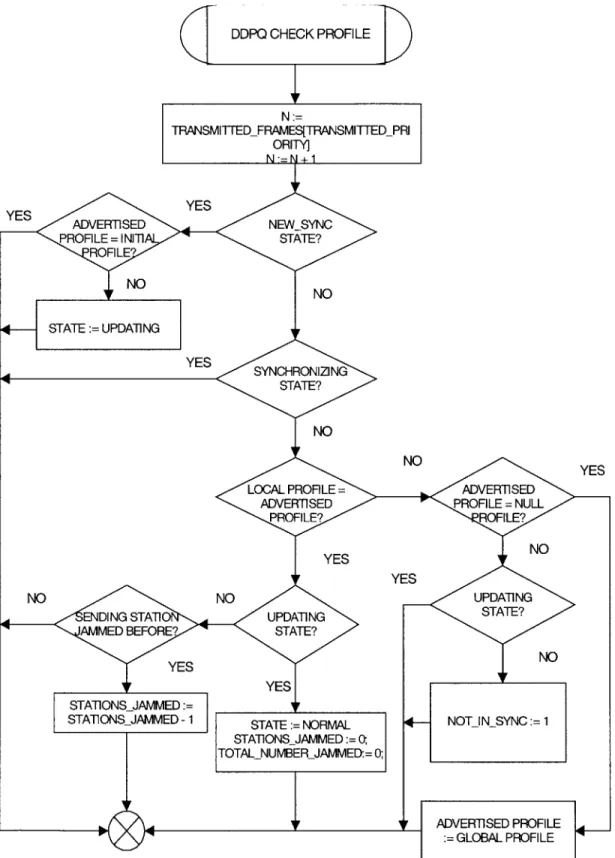
5.8: DDPQ check profile process 67
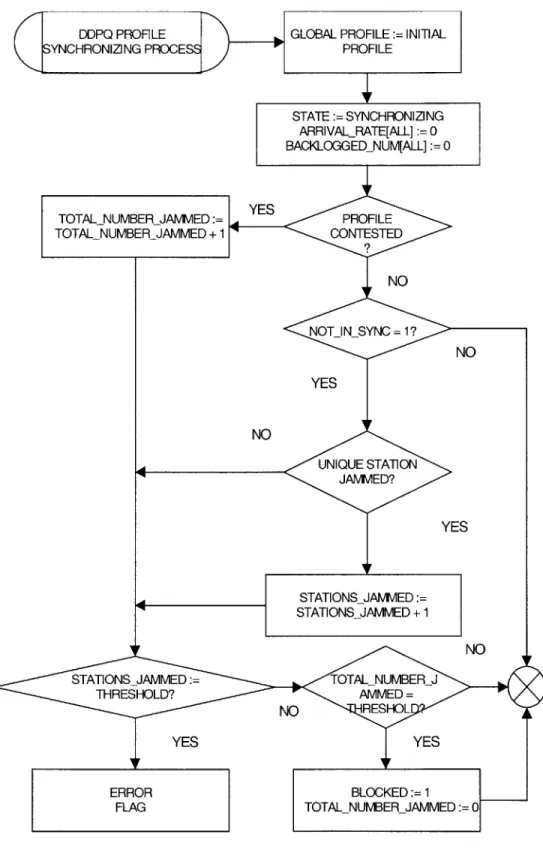
5.9: DDPQ profile synchronizing process 68
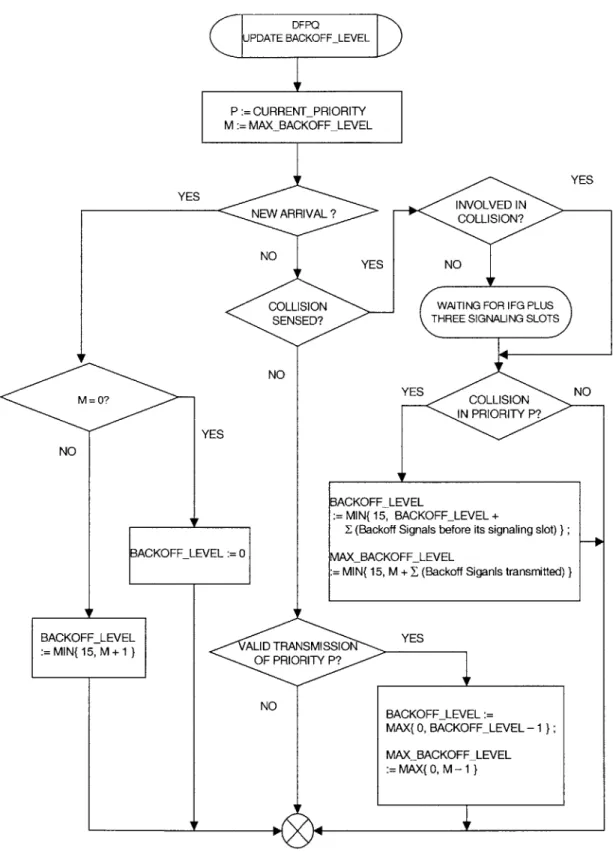
5.10: DFPQ update backoff level process 69
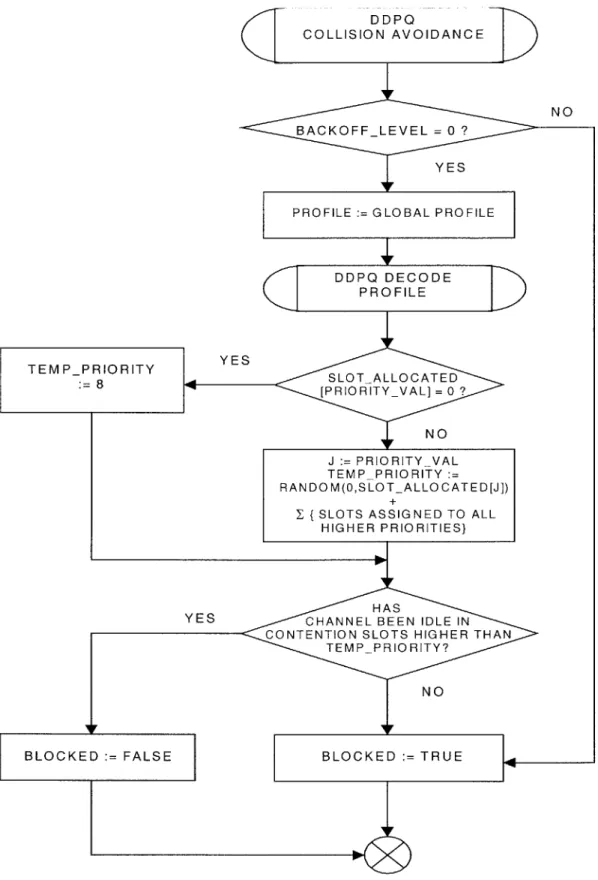
5.11: DDPQ collision avoidance process 70
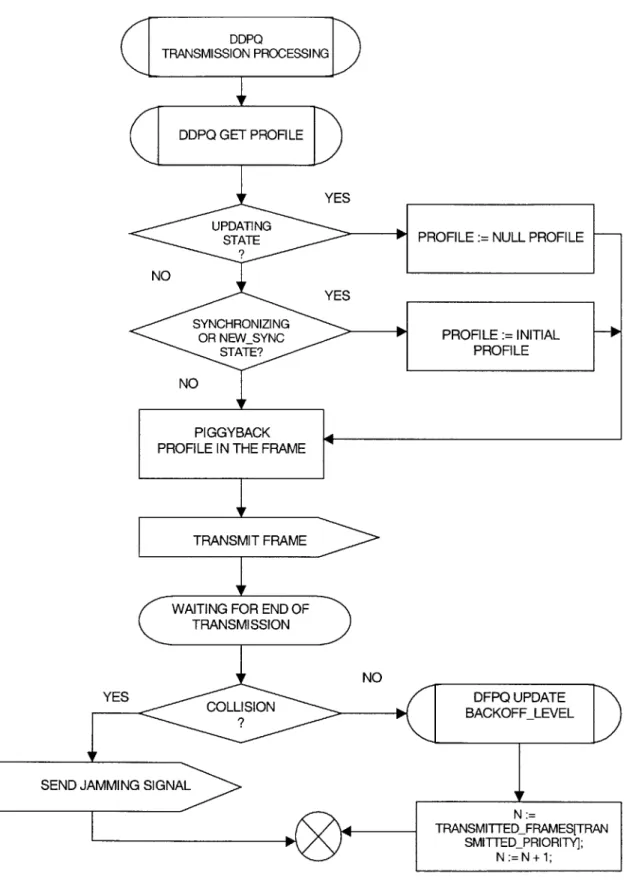
5.12: DDPQ transmission processing process 71
5.13: DDPQ blocked processing process 72
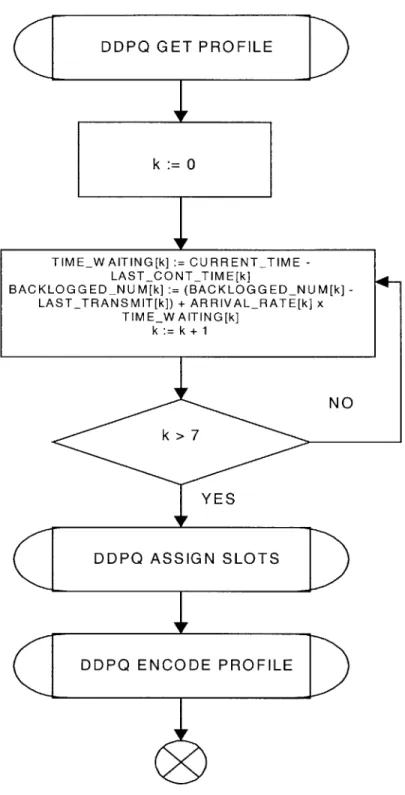
5.14: DDPQ get profile process 73
5.15: DDPQ assign slots process 74
5.16: DDPQ encode profile process 75
5.17: DDPQ first byte allocation process 76
5.18: DDPQ second byte allocation process 77
5.20: DFPQ collision resolution process 79
5.21: DDPQ update arrival rate process 80
5.22: Maximum ICT point vs. Backlog Number 87
5.23: ICT vs. Number of Slots Allocated 87
6.1: Simulated Network 92
6.2: Scenario #1 Throughput vs. Offered Load 96
6.3: Scenario #1 Mean Access Delay vs. Offered Load 97
6.4: Scenario #1 Jitter vs. Offered Load 98
6.5: Scenario #2 Throughput vs. Number of Stations 100 6.6: Scenario #2 Mean Access Delay vs. Number of Stations 101 6.7: Scenario #2 Jitter vs. Number of Stations 101
6.8: Scenario #3 Throughput vs. Offered Load 103
6.9: Scenario #3 Mean Access Delay vs. Offered Load 104
6.10: Scenario #3 Jitter vs. Offered Load 104
6.11: Scenario #3 Voice Access Delay vs. Offered Load 105 6.12: Scenario #3 Voice Jitter vs. Offered Load 106 6.13: Scenario #3 Video Access Delay vs. Offered Load 107 6.14: Scenario #3 Video Jitter vs. Offered Load 107 6.15: Scenario #3 Data Access Delay vs. Offered Load 108 6.16: Scenario #3 Data Jitter vs. Offered Load 109
List of Tables
Table Page
5.1: Initialization Parameters for DDPQ 61
6.1: Parameters for Traffic Sources 93
6.2: General Channel Parameters 93
6.3: Parameters unique to DFPQ and DDPQ 93
List of Acronyms
Acronym Complete Expression BEB Binary Exponential Backoff
BL Backoff Level
BLAM Binary Logarithm Arbitration Method CRL Collision Resolution Length
CRP Collision Resolution Period
CSMA/CA Carrier Sense Multiple Access with Collision Avoidance CSMA/CD Carrier Sense Multiple Access with Collision Detection
CTS Clear to Send
DCF Distributed Coordination Function DDPQ Distributed Dynamic Priority Queuing DFPQ Distributed Fair Priority Queuing
ETSI European Telecommunications Standards Institute
FCFS First-Come-First-Serve
FIFO First In First Out
HOLP Head-of-Line-Priority
HPNA Home Phoneline Networking Alliance ICT Instantaneous Contention Throughput
IFG Inter-Frame Gap
LAN Local Area Networking
MAC Medium Access Control
MBL Maximum Backoff Level
OSI Open Systems Interconnection
PC Personal Computer
QoS Quality of Service
RTS Request to Send
SLA Service Level Agreement
TBEB Truncated Binary Exponential Backoff TDMA Time Division Multiplexing Access WBPTE Wait-Before-Transmit Priority Ethernet
1. Introduction
In this thesis, we propose a novel Distributed Dynamic Priority Queuing (DDPQ) MAC protocol, which is an enhancement of an existing Distributed Fair Priority Queuing (DFPQ) MAC protocol. Our protocol provides good QoS capability to multimedia traffic by dynamically adapting to changing levels and mix of offered loads.
1.1. Home Networking
Home networking is the term describing a local area network (LAN) setup in a home environment that enables the connection and integration of multiple computing and communication devices. Until recently, home network has been largely ignored. However, rapid proliferation of personal computers (PCs) and the Internet, advancements in telecommunications technology, and progress in the development of smart devices have increasingly emphasized the market potential of home networking. Furthermore, as these growth and advancement trends continue, the need for simple, flexible, and reliable home networks will greatly increase. It is estimated that by 2005 all consumer devices that are not network ready will be obsolete. [FrHOO]
Consumer devices include both traditional data appliances like PC, handheld PDAs, etc and multimedia appliances like TV, stereo, telephone, etc. Data traffic has different set of requirements than multimedia traffic and their convergence puts a lot of demand on the system. For example, multimedia applications have a very strict delay requirement and are not so much concerned with dropping some frames--formatted packets. For such applications, frames that are significantly delayed cannot be used for reassembling the content and have to be discarded. On the other hand data transmissions are non-real time and do not have a strict delay requirement, but they are very sensitive to frame losses. The problem facing the system then is the fair resolution of medium contention among these diverse traffics so as to reconcile some seemingly conflicting set of requirements.
Protocols that are employed to coordinate access to a shared channel are often referred to as MAC, or access protocols. Traditional LANs consist of a multi-access channel that is allocated among a set of stations competing for its use. A data frame that arrives at a station is inserted in a first-in-first-out (FIFO) transmit queue where the frame waits until it gets access to the channel so that it can be transmitted to its destination. Traditional LANs were originally designed for best-effort data transmission and are not suitable for the strict delay requirement of real-time multimedia traffic.
The Home Phoneline Networking Alliance (HPNA) is an association of industry-leading companies working together to ensure adoption of a single, unified phoneline networking standard and rapidly bring to market a range of interoperable home networking solutions [HPNA]. HPNA technology uses the same pair of wires as the existing analog telephone services to support a network in the home. The first version of the HPNA technology, which was introduced in 1998, offers a 1 Mbps data rate and uses the Carrier Sense Multiple Access with Collision Detection (CSMA/CD) as its MAC protocol. The second version, known as HPNA 2.0, offers a 10 Mbps data rate and uses the DFPQ MAC protocol to support integrated traffic classified into 8 priority levels.
1.2. Quality of Service
QoS
is defined as the desired performance specification of the network (the network service, data rate, expected performance, and other contractual information) as specified in service level agreements (SLAs) between service providers and their customers [CFFOO]. QoS is an important consideration for home networks because communication resources are shared among a variety of service classes (e.g. internet telephony, video, file transfer, Internet access, etc), such that there is a trade-off between the efficiency of resource allocation and how well QoS is satisfied for all users. These different service classes have different bandwidth and latency requirements that have to be met by the network.The parameters for service provision in today's integrated networks include delay, jitter, and packet loss ratio, in addition to a service contract that specifies transmission rate requirements. Delay, the time from when the frame is received in the transmit queue to its receipt at the destination, is an important metric for QoS because information contained within the frame often has a time limit after which it becomes obsolete. If a frame is delayed beyond its time limit, it has to be discarded by the receiving station. This is especially true of real time applications. Jitter is the measure of the variation in the delay metric. It is the difference between the highest and the lowest frame delay readings. A high jitter could result, for instance, in the flickering of screen in video transmission. Frame loss ratio is important because it determines how often the packet has to be retransmitted. Generally a high frame loss ratio would mean a high delay factor and, consequently, poor QoS.
Non-real-time traffic, such as best-effort data, can tolerate higher delay and jitter, whereas real-time traffic is generally characterized by its stringent delay and jitter requirements. Supporting QoS requirement is difficult in a distributed LAN system because there is no central agent to schedule stations' channel access so as to meet their QoS needs. Traditionally, different types of traffic with diverse QoS requirements are assigned different priorities, so that these priorities may be used to implement different packet handling procedures to provide differentiated services. It is to be noted, however, that QoS differentiation is strictly speaking not equivalent to prioritization.
In a common approach for supporting integrated traffic, real-time traffic is assigned a higher priority than non-real-time traffic, wherein higher priority traffic is given preference in accessing channel resources so that it experiences smaller delay and jitter than lower priority traffic. With proliferation of emerging multimedia applications, there are increasingly more classes of real-time and non-real-time traffic with diverse QoS requirements. Thus, growing number of priorities are used in today's communication systems to provide finer grain QoS.
1.3. Medium Access Control
The MAC layer is one of two sub-layers that make up the Data Link Layer of the Open Systems Interconnection (OSI) networking framework [BeG92]. It is responsible for moving data packets to and from one station to another across a shared channel. Some of the features of a MAC layer is the presence of a shared medium, a population of users and a centralized or distributed scheduling algorithm that allocates transmission opportunities among the users.
There are two basic kinds of MAC protocols: free and contention-based. While contention-free protocols feature scheduled transmissions either statically, or adaptively among end users such that collisions are entirely avoided, contention-based MAC protocols feature channel contention among end users wherein collisions are possible. In this thesis, we focus on contention-based MAC protocols because of their wide deployment (e.g., Ethernet), efficiency in handling bursty traffic, and scalability. In most contention-free MAC protocols, idle users consume a portion of the channel resources which become major in bursty traffic or when the number of potential users is large. Contention-based MAC protocols, on the other hand, are more scalable to bursty traffic and the number of users in the system. Idle users do not transmit and hence do not consume any portion of the channel resources.
Contention-based MAC protocols have been studied extensively in the past and have been deployed in a variety of wireless and wire-line networking environments [RoS90]. They employ collision avoidance and collision resolution mechanisms. One widely used way to minimize collision is carrier sensing. Stations sense the channel before transmitting and if they find the channel busy, they defer their transmission until the channel is idle for a pre-specified duration. This ensures that stations do not collide with ongoing transmission. The duration of idle period could be the same for all stations or could be a function of some state of the station (e.g. priority, arrival time, etc). Collisions can still occur if two or more stations transmit at the same time and are resolved using a variety of collision resolution algorithms. Typically, collision resolution algorithm makes use of the feedback information on the contention outcome that is
available to the users via the common channel. The users can either detect the state of the common channel, or a centralized network entity can communicate that state to them. Depending on the type of channel states (or channel feedback) that is available, different collision resolution algorithms may be employed to resolve collisions. For the purpose of this thesis, a contention cycle is defined as a packet-scheduling pattern that occurs whenever the channel is idle and stations are competing for channel access. A contention cycle is terminated by a successful transmission or a collision.
A hybrid approach is also common which attempts to combine the two general MAC protocols. It is a contention-based reservation in that a contention-based approach is used for transmission of reservation requests, and contention-free approach is used for actual data transmission. Collisions involving actual data frames carry a high overhead especially when the frames are large. Instead small slots are used to reserve the time slot for actual data transmission. These schemes derive their efficiency from the fact that reservation periods are shorter than transmission periods by several orders of magnitude.
1.4. Outline of Thesis
This thesis is divided into 8 chapters, the contents of which are described below. Chapter 2 summarizes some of the relevant MAC protocols for QoS provision in a de-centralized multi-access channel and discusses their relative merits and demerits in providing QoS. All the protocols discussed are extensions of the popular CSMA/CD MAC protocol.
Chapter 3 compares the throughput performance of two separate collision resolution methods used by Ethernet and the protocol developed in this thesis.
Chapter 4 highlights the problems addressed in this thesis and the approaches taken to do so. It also outlines the motivation behind the study.
Chapter 5 presents the new DDPQ MAC protocol.
Chapter 6 discusses the simulation models and parameters used for the simulation purpose. It summarizes and discusses the results obtained from the simulations and
compares the result for the new protocol against the benchmark protocols, namely DFPQ and CSMA/CD.
Chapter 7 provides a conclusion to the thesis work. Chapter 8 lists the references cited in the thesis work.
Finally, we provide an appendix to describe the traffic source models used for performance evaluation, and Matlab' code for some algorithms used in the thesis.
2. Survey of Contention-Based MAC Protocols
Since the DDPQ MAC protocol is a contention-based MAC protocol, we provide a survey of some existing contention-based MAC protocols in this chapter.
2.1. ALOHA Protocols
A well known contention-based MAC protocol is the family of ALOHA protocols. Many LANs today implement some sophisticated variants of ALOHA protocols. Because of their great popularity, analyses have been carried out for a large number of variations. The protocols within the family differ in their transmission and retransmission strategies and also in their adaptation to different circumstances and channel features. The following section covers some of these variations.
2.1.1. Pure and Slotted ALOHA
The original version operates with continuous or unslotted time and is referred to as Pure, or Unslotted, ALOHA [Abr70]. In this protocol, stations transmit their packets as soon as they are generated. If there is a collision in the system, all colliding stations schedule their retransmission at a random time in the future. The maximum throughput for Pure ALOHA has been determined to be 1/(2e), based on an analysis that assumes an infinite population and a Poisson packet arrival process [BeG92]. Specifically, consider a packet (old or new) scheduled for transmission in time t. Packet transmission is successful when there is no packet scheduled for transmission in the time interval (t-T, t+T), where T is the time it takes for a packet to be transmitted in the channel. The length of this interval, 2T, is called the vulnerable period. Since packets are transmitted soon after their arrival, the probability of success PU is given by the probability that no other packet arrives in the vulnerable period (length 2T). Assuming a Poisson process,
PSC = ea-2e g where g is the mean arrival rate.
Packets are scheduled at the rate of g of which only a fraction P, is successful. Since throughput S is defined as the fraction of time useful information is carried on the channel, we get
S
= g T - T G=g-T.-. S = G -e-2
G
where G is the normalized offered load. At G = 1/2, S takes on its maximum value of 1/(2e).
A later version of the ALOHA protocol, which operates with discrete or slotted time, and packets of a fixed size, is referred to as Slotted ALOHA [Rob75]. As with Pure ALOHA, new arrivals are immediately scheduled for transmission in the next slot. However, each transmission may start only at the beginning of a slot. Slot length, denoted T, is set to the duration of packet transmission. This means that a transmission is successful if there is no other packet arrival in the time interval (t-T, t), i.e. the vulnerable region is of length T. Thus, the throughput of Slotted ALOHA is
S=G-e-G
The maximum throughput for a Slotted ALOHA system occurs at G = 1 and has the value of l/e.
Both Slotted and Pure ALOHA protocols have been shown to be unstable at high load. Fayolle et. al. [FLB74] prove that under high load condition the number of backlogged packets in the slotted ALOHA system will grow to infinity. As a result no packet will be transmitted and the expected delay for a packet will be infinite.
2.1.2. Pseudo-Bayesian Algorithm
Rivest [Riv87] proposes a Pseudo-Bayesian algorithm as a way to stabilize ALOHA. Instead of immediately offering newly arrived packets for contention, as is the case in ALOHA, they are transmitted with a probability p, where p is varied depending upon the estimate of the backlogged packet number. An estimate n' of the backlog number n is maintained. The probability of transmission p is then given by p = min (1, 1/n'). The algorithm essentially tries to achieve an attempt rate (G) of 1 for any slot. When the backlog number is large, p is small and hence it is unlikely that two packets will commence transmission in the same slot, thereby reducing the chances of collision. The following rule is observed in updating the estimated backlog
n'(k + 1)= max (A, n'(k) + A -1) if success or idle = n'(k) + A + (e - 2)- otherwise
X is an unknown too and is either estimated as the time average rate of successful transmissions or is taken as a fixed value. Assuming that X is known and is a fixed value, the expected delay for the pseudo-Bayesian algorithm is given by
W= e -1/2
1-2-e
As shown by Tsitsiklis [Tsi87] this system is stable for all values of X < l/e. However as X approaches l/e, the delay becomes unbounded.
2.2.
Tree Splitting Algorithm
The basic idea behind splitting algorithms is to inhibit the transmission of newly arrived frames until all collided frames get transmitted. Following a collision, collided packets choose one of the multiple slots allocated to resolve the collision. There are various ways by which the stations involved in a collision could choose which allocated
slot to transmit in. They could choose one of the slots randomly or they could use the arrival time of their collided frames to determine the slot or they could use their addresses, etc.
The most basic splitting algorithm is the tree algorithm [Cap77], [TsM78], [Hay78]. The algorithm has a rooted binary tree structure; when a collision occurs in the kth slot, the collided stations randomly split into two subsets. The first subset transmits in the next slot (k + 1) and if the result is a success or an idle, the second subset transmits in the slot afterwards (k + 2). However, if a collision occurs in k + 1, the first subset splits again and the second subset waits for that collision to be resolved. In case of a ternary-tree splitting, the collided stations randomly split into three subsets rather than two. DFPQ employs ternary tree splitting with an important distinction. It uses mini slots, compared to the data slots used in normal splitting algorithms, to establish a partial ordering among the collided frames. Stations transmit in the order they have been organized.
Another popular splitting algorithm is the First-Come-First-Serve (FCFS) algorithm [BeG92]. In this method, the collided stations choose a subset based on the arrival time of the collided frames. Each subset will consist of all packets that arrived in some given interval. If a collision occurs again, this interval is split into two smaller intervals. By always transmitting the earlier arriving interval first, the algorithm will normally transmit successful packets in the order of their arrival time.
2.3. Ethernet Protocol and Extensions
Ethernet [MeB76] is a variation of the original Slotted ALOHA protocol. It augments the Slotted Aloha by utilizing carrier sensing i.e. instead of transmitting in the next slot after a frame arrives, stations wait until the channel is idle for a predetermined period. This avoids collision with an ongoing transmission. The Ethernet MAC protocol was originally designed for best effort service and hence does not provide any QoS support for real-time traffic. Simple as it is, the protocol does not have a scheme that distinguishes between real-time traffic and non-real-time traffic. As explained later, it
also suffers from an undesirable capture effect. A number of approaches that have been proposed to overcome the capture effect phenomenon are also surveyed in this section.
2.3.1. CSMA/CD Ethernet
The Ethernet MAC protocol is based on CSMA/CD, which is specified in the IEEE 802.3 standards document [802.3]. Incidentally, HiPNA 1.0 is also based on this MAC protocol.
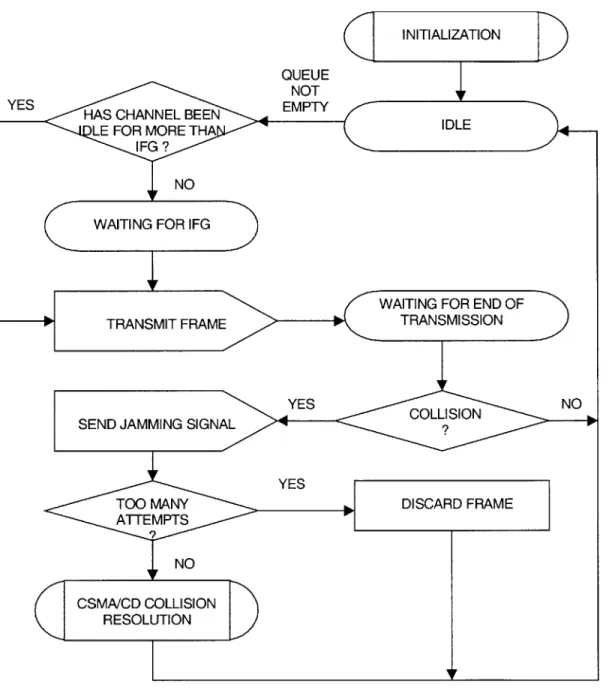
In the CSMA/CD MAC protocol (see Figure 2.1), a station that is ready to transmit senses the channel and waits until the channel is idle. It defers contention while the channel is busy. As soon as the station senses an idle channel for one inter-frame gap (IFG), it transmits its frame. An IFG is defined as the predetermined delay between two frame transmissions and is chosen such that all stations in the system perceive an idle channel i.e. no station will transmit when any station in the channel is still hearing a transmission. In the event of a collision, the protocol utilizes a Truncated Binary Exponential Backoff (TBEB) scheme for collision resolution [MeB76]. In this collision resolution scheme, a station involved in collision waits a random number of slots which
is uniformly distributed between 0 and 2min(k, 10) _ 1 where k is the number of collisions
suffered by the frame, before it tries to retransmit the frame. After a maximum of 16 retransmissions, the frame is discarded. The flow-charts in Figure 2.1 and Figure 2.2 describe the operation of the CSMA/CD MAC protocol.
A station is said to be one-persistent if upon sensing the channel to be busy, it does not defer its access attempt, but continues listening until the channel becomes idle whereupon it attempts transmission [ToK75]. A station is p-persistent if it defers its access attempt for some period of time with a probability of i-p. The persistence feature has been used to enhance the QoS capability in some CSMA/CD-like MAC protocols
[ChR85].
It has been shown that under moderate to high loads, TBEB results in a channel capture effect where a single host sends a lot of frames in succession while other nodes
are forced to wait a long time to access the channel [YaR94]. Capture effect occurs because only the "winning" station of a contention attempt gets to reset its collision counter. Recall that under TBEB, each station updates its collision counter independently, and only in response to a successful transmission attempt. During a contention interval, when several stations are contending for the channel, it is expected that each of them would possess a non-zero collision counter value. Eventually, when one of the stations gains access to the channel and transmits successfully, it will reset its collision counter. Note that at the next end-of-carrier event, all other stations will still have non-zero collision counter values. Thus, the "winning" station is free to transmit its next frame immediately, while other active stations must continue to backoff, resulting in a probabilistic last-in-first-out scheduling discipline that would impose considerable variations in contention access delay. In the event of a collision, the newly arrived frame chooses a much smaller backoff period compared to the frames that have been colliding repeatedly. As a result, the same station is likely to win the second time and the third time and so on, such that it transmits a stream of frames while other stations are forced to wait a long period of time before they can transmit. This phenomenon is known as a capture effect. Note that the capture effect enables a "lucky" host to monopolize the channel. The capture effect is especially detrimental for real-time applications. It has been shown that in the presence of a bursty traffic (with a burst size as small as 10KB) the capture effect severely degrades audio/video performance even at low network usage of 10-15%. [ToD96]
(I
INITIALIZATION IDLEWAITING FOR IFG
TRANSMIT FRAME
WAITING FOR END OF TRANSMISSION
YES JCOLLISION NO
SEND JAMMING SIGN>AL 4?1
CSMA/CD COLLISION RESOLUTION
Figure 2.1: CSMA/CD MAC Protocol YES
TOO MANY DISCARD FRAME
ATTEMPTS
NO
D4-QUEUE
NOT YES HAS CHANNEL BEEN EMPTY
LE FOR MORE THA
IFG ? T
NO
CSMA/CD COLLISION RESOLUTION YES BACKOFFCOUNT = 16 10 NO QUIT:= TRUE WAIT TIMER EXPIRES BACKOFFCOUNT:= BACKOFFCOUNT + 1
Figure 2.2: CSMA/CD Collision Resolution
X:= min(BACKOFFCOUNT, 10) Y:= RANDOM(0, 2 - 1)
2.3.2. Binary Logarithm Arbitration Method (BLAM)
In [Mol97], Molle proposes a MAC protocol that is interoperable with the standard IEEE 802.3 MAC protocol. This protocol was motivated by the need to address the capture effect in CSMA/CD. In this MAC protocol, a binary logarithmic arbitration method (BLAM) is introduced for collision resolution. Each station provides a collision counter that is incremented when any active station is involved in a collision, and reset when any station successfully transmits a burst of frames or after the station ceases transmitting for a predetermined period. Thus, the collision counters of transmitting and non-transmitting stations are updated symmetrically. Each station that is involved in a collision generates a random backoff delay from its collision counter using truncated exponential distribution. The station transmits its data after the backoff delay, unless another station is transmitting on the shared channel, in which case the station waits for the channel to become idle. Meanwhile if there is a collision in the channel, a new collision resolution cycle is triggered. It is worth contrasting the BLAM approach to the original CSMA/CD where stations only update their counter following their own activity. Because the collision counters of transmitting and non-transmitting stations are updated symmetrically in this method, we do not see the capture effect phenomenon.
2.3.3. Methods based on IFG Modification
Kalkunte, et al., have devised a number of methods that modify the IFG to address the capture effect in CSMA/CD. In one method [KaM98], if a station has just transmitted a frame and has another in its queue, then it must wait the IFG plus an additional slot time. The additional slot time pause allows other stations with frames waiting to acquire the channel.
In a more sophisticated method [KKM98], the delay times in Ethernet network devices are modified by adding an integer multiple of a delay interval to the minimum IFG, and decrementing the integer in each network station in response to a carrier sense. Each station has a unique integer value from the range of zero to the number of stations (n) minus one. The unique integer value ensures that each station has a different delay
interval in accessing the media after sensing an idle channel. The station having a zero integer value will get first access to the channel and it resets its integer counter to (n-i) after transmitting successfully. If it does not have any frame to transmit, it enters a deferral state where it waits out the remaining period in the contention cycle. All stations having nonzero integer values decrement their respective integer counters upon sensing a transmission. Thus the method of Kalkunte, et al. offers fair access by rotating indexes. Each station also includes a deferral timer that counts the maximum delay interval of (n-1) delay intervals plus the minimum IFG value, and thus establishes a bounded access latency for a half-duplex shared network.
This scheme scales poorly because the access latency bound increases linearly with the number of stations. In addition, the system incurs an overhead for idle stations. This overhead increases linearly with the number of stations. Besides, all stations in the system need to monitor the arrival or departure of stations in the network since n should be known accurately for the algorithm to work correctly. This might require significant overhead since stations can join in or leave the network at any time, thus requiring some signaling mechanism to inform the rest of the network when a station leaves the network or just establishes connection.
2.3.4. Longest-Waiting-Time-First Collision Resolution
In [SoK96], Sobrinho and Krishnakumar proposed an overlay mechanism to Ethernet's MAC protocol that provides QoS guarantees to real-time traffic. The approach relies on the ability of the network interface cards to sense channel activity and, in addition, requires only that those cards be capable of sending jam signals of pre-specified duration. Real-time host follows conventional Ethernet rules at the beginning of a
session, possibly using a more expedite retransmission algorithm, to transmit its first frame. Subsequent frames are transmitted according to an overlay mechanism.
When a transmitting host detects a collision, it withholds its frame transmission but continues to jam the channel up to a pre-specified maximum allowed interval of time. This maximum duration is a direct function of the host's contention delay, measured from
the time that the access attempt has been scheduled until the host perceives the medium to be idle for an IFG interval. The jamming signal transmitted following a collision is called a black burst and is transmitted in discrete blocks called the black slot. The winner among contending hosts is thus the one that has been waiting the longest for access to the channel.
The collision resolution process distinguishes between a real time station and a non-real-time station. While real time stations utilize the jamming mechanism described above, non-real-time stations use the traditional TBEB mechanism to resolve collisions. And since they jam the channel immediately following a collision and are not randomly re-scheduled, real time sources have priorities over the data sources. Data source is blocked out until all real-time sources transmit their frames. Note that this first-come-first-serve collision resolution mechanism eliminates capture effect.
This protocol implicitly assumes that all real-time frames have the same delay requirement. It therefore gives channel access to the real-time station that has waited the longest. However, real-time traffics often have varying delay requirements in which case this method performs poorly. For instance, a frame that has been waiting for a long time would get access to the channel over a frame that has waited less even though the first frame could tolerate considerably higher delay than the latter frame.
2.4. Prioritized Contention-Based MAC Protocols
While capture effect is a huge problem for supporting real-time traffic on Ethernet MAC protocol, it is not the only problem. CSMA/CD MAC protocol is a best effort service i.e. it does not differentiate between real-time traffic and data traffic. In essence, both real-time traffic and data traffic are treated as equal even though the former has a strict delay bound whereas the latter can tolerate long delays. The approaches in the previous section for resolving capture effect fail to address this shortcoming of CSMA/CD.
A popular approach for enhancing the QoS capability of CSMA/CD implements priorities among different service classes. The priority values are then used to vary the
frame delay in a differentiated manner. A contending frame can experience two kinds of delays. It could incur a collision avoidance delay before being transmitted so as to minimize the probability of collision (for example, deferring transmission when a station finds a busy channel). It could also incur a delay when it collides and then undergoes collision resolution. This is called the collision resolution delay. One approach of prioritization varies the collision avoidance delay, so that higher priority frames enjoy preference over lower priority frames in gaining access to the channel as lower priority frames must defer initial contention in favor of higher priority frames. Another method varies the collision resolution delay, so that higher priority frames have smaller collision resolution delays than lower priority frames. Other methods exist that utilize a hybrid of the two methods described above.
In a prioritized contention-based MAC protocol, two types of collisions could occur: intra-priority collisions and inter-priority collisions. An intra-priority collision occurs when two or more stations of the same priority transmit at the same time. An inter-priority collision occurs when two or more stations of different priorities transmit at the same time. A prioritized contention-based MAC protocol could be designed to permit only intra-priority collisions. In this case, transmission resources are divided exclusively among service classes of different priorities. It could also be designed to permit both types of collisions. For example, all active stations, regardless of their priorities, may be permitted to contend for access to the channel initially, and only when they collide is a priority scheme utilized to impose different collision resolution delays to resolve the collision.
In this section, we present some of the popular protocols that use priority levels for QoS support.
2.4.1. Wait-Before-Transmit Priority Ethernet (WBTPE)
In [ObD93], Obaidat and Donahue propose a scheme for introducing priorities into the CSMA/CD protocol. In their scheme, referred to as WBTPE, each frame incorporates a random delay before transmission to allow higher priority frames first opportunity to transmit, and a collision delay which allows higher priority frames first opportunity to transmit following collisions. Specifically, the waiting is randomly selected from a range bounded between two values that depend on the slot time and the priority index of the frame. After a collision, an affected frame must wait and sense the channel for a period of time that is proportional to the slot time and the priority index of the frame.
The contention delay td experienced by a frame is computed as a function of its
priority and given by
1.5 -p - tsiot td 51.5 -(p +.5)- tsiot
where p is the priority and t,;,0 is the length of priority contention slot. The smaller the
value of p, the greater the priority of the frame.
A value of td is chosen randomly between the bounds so as to reduce the number of collisions between frames of equal priority. Higher priority frames get preference over lower priority frames because their contention delay period is shorter.
In the collision resolution process, a station automatically waits and senses the
channel for td (= 2 * p * t,1.). If, during this wait period, there is an attempted
transmission, the station waits for the completion of the transmission and repeats contention algorithm, else it implements the TBEB collision resolution algorithm of the CSMA/CD MAC protocol.
This approach suffers from excessive intra-priority collisions when the offered load is high in any priority. The randomization scheme is not very effective because the width of the period in which randomization occurs is less than a slot (worst-case propagation delay). Note that IFG length is equal to the slot length and that the IFG
length is determined such that stations can hear the transmission from any other station in the channel. Since the contention delays chosen by the stations are separated by less than IFG, the transmissions are more likely to collide.
2.4.2. Method based on Sharing of Contention Mini-Slots among Priority Classes Ruszczyk, et. al. propose a contention-based reservation system for supporting multiple priority classes [RLC99a]. This prior system is based on a MAC protocol framework with contention-based reservation, also proposed by Ruszczyk, et al. [RLC99b]. In this framework, mini-slots are used for transmission of reservation requests in a based approach whereas actual data are transmitted contention-free in data slots. Mini-slots are considerably shorter than transmission periods and hence entail smaller collision overhead; the ratio of mini-slot size to the transmission period determines the efficiency of the approach.
The prior system resolves collisions of reservation requests using a combination of probabilistic tree splitting and FCFS splitting techniques. The collision resolution procedure utilizes the FCFS splitting technique to select a collision resolution interval, and provides two contention mini-slots to improve the likelihood of successful reservations. Each contending user transmits a reservation request in a randomly selected contention mini-slot. Two contention mini-slots are provided for a predetermined maximum number of collision resolution iterations, after which only one contention
mini-slot is provided.
A centralized controller allocates mini-slots for transmission of reservation requests among the stations. At the beginning of each contention cycle, the centralized controller transmits an entry poll message that includes feedback information for each contention mini-slot in the preceding contention cycle and an assignment of contention mini-slots for the current contention cycle. The system considers three kinds of feedback from a contention mini-slot. There could either be a SUCCESS or a COLLISION or an IDLE. The aggregate feedback state for the priority class is a function of the feedback states for all of the contention mini-slots assigned to that priority class. Specifically, the
aggregate feedback state is IDLE if the result is IDLE for all contention mini-slots; COLLISION if the result is COLLISION for at least one contention mini-slot; and SUCCESS otherwise. If the priority class is allocated zero contention mini-slots in a contention cycle, then the aggregate feedback state for the priority class takes on the value NONE, and the priority class is said to have sat out or be on vacation for the contention cycle.
In the prioritized system, the centralized controller allocates a variable number of contention mini-slots to each priority class, such that inter-priority collisions are avoided. The centralized controller keeps track of the feedback for each contention mini-slot, and for each priority class, determines an aggregate feedback state. Based on the aggregate feedback state the scheduler determines a preferred allocation of contention mini-slots, which it then uses to determine an actual allocation of contention mini-slots.
If the available number of contention mini-slots for a given contention cycle is less than the sum of the preferred numbers of contention mini-slots, the centralized controller allocates mini-slots in such a way that some of the priority classes get less than their preferred number of contention mini-slots. Essentially, the controller attempts to meet the requirements of higher priority classes, and allocates contention mini-slots to the lower priority classes only if contention mini-slots are available. On the other hand, if there is any slot in excess of the sum of the preferred numbers of contention mini-slots, the remaining mini-slots are assigned one at a time to priority classes having zero contention mini-slots. If there are still more mini-slots remaining then they are assigned again one at a time to priority classes having one contention mini-slot. This process is repeated until either all contention mini-slots have been assigned or all priority classes have been assigned their maximum number of contention mini-slots.
2.5.
Emerging MAC Standards for Home Networks
Many MAC protocols have emerged for home networks. They can be separated into wire-line (e.g., HPNA) and wireless (e.g., IEEE 802.11, HiperLAN) technologies. Because collision detection mechanism is not available in wireless medium, these
technologies are fundamentally different. In this section, we survey HPNA 2.0, IEEE 802.11, and HiperLAN MAC protocols.
2.5.1. HPNA 2.0
HPNA 2.0 MAC protocol supports eight priorities and is essentially a distributed Head-of-Line-Priority (HOLP) queuing discipline [FrHOO], [G.pntOO]. In HOLP, a frame of a given priority is not served unless there is no higher priority frames pending transmission [Dai87]. The protocol does not support preemption, so a new arrival of a given priority must wait for the current frame transmission to end regardless of the priority of the frame.
In the first contention cycle upon start-up all active stations contend for channel access with the same lowest priority. Subsequently, inter-priority collisions are avoided by using separate contention slots for different priorities. All contention cycles consist of eight contention slots, each assigned to a separate priority level, ordered from high to low priorities. A user of a given priority class may not transmit in any contention slot of a higher priority. On the other hand, the user is permitted to transmit in any contention slot of its own or a lower priority, the latter case being an exception rather than a rule. Intra-priority collisions are resolved via a ternary tree splitting algorithm with partial ordering.
Each frame is prioritized a priori based on its need for QoS support. These priorities are used to determine the contention delay of a frame. Higher priority frames commence transmission in earlier contention slots and acquire channel before the lower priority frames. Note that this is a strict priority scheme, i.e. lower priority frames always defer to higher priority frames.
Although not a feature for QoS support, the collision resolution process of HPNA 2.0 MAC protocol employs a separate collision resolution mechanism, Distributed Fair Priority Queuing (DFPQ), that provides better performance than the TBEB mechanism of CSMA/CD [FrHOO], [G.pntOO]. A period after each collision (following an IFG) is divided into three signal slots as shown in Figure 2.3. A collided station randomly chooses one of the slots and transmits a Backoff Signal in the slot. Note that more than
one station can transmit a Backoff Signal in the same signal slot, in which case they collide again. In essence, collision is resolved by means of a stack operation utilizing a collision resolution tree, which consists of three signal slots at each node. Because collision is resolved immediately and collided frames are transmitted before new arrivals, DFPQ does not exhibit the capture effect seen in TBEB. Access delay in DFPQ stays bounded even in the presence of excess load [FrHOO]. This may be contrasted to TBEB
where delay can be very high when the offered load is excessive.
Specifying priority levels for differentiated contention and resolving collisions with tree-splitting algorithm are common approaches for extending CSMA/CD. What is new to DFPQ though is the partial ordering through signal slots following a collision. The avoidance of any idle contention slots, in contrast to normal splitting algorithms, more than compensates for the small overhead of 3 signal slots required to establish the ordering. Each station keeps a Backoff Level (BL) and Maximum Backoff Level (MBL) counter. A BL counter indicates how many successful transmission of its priority a station has to wait before it can start contending again. An MBL counter specifies the BL value for a newly arrived packet. All stations monitor collision events and use the Backoff Signals to compute/update their BL and MBL values. The station(s) corresponding to the signaling slot 0 gets first access to the channel, followed by the station(s) corresponding to slot 1 and so on (a partial ordering is established among the frames that collided).
Note that stations with higher priority waiting frames may pre-empt the collision resolution process by transmitting in a contention slot earlier than the one in which the previous collision occurred. This means that higher priority frames do not wait for the collision to be resolved; only frames of the same priority or lower do.
COLLISION IFG SIGO SIG1 I SIG2 I TRANSMISSION
HPNA 2.0 MAC protocol has a few undesirable deficiencies. Intra-priority collisions are excessive when the offered load at any priority is high. Recall that the protocol has a rigid priority scheme, i.e. lower priorities always defer to higher priorities. Hence it does not effectively provide QoS guarantee for low priority users. Specifically, it is difficult to allocate bandwidth fairly, such that there can be some rate and/or delay guarantees for each priority class. Inter-priority collision avoidance may cause indefinite blocking to low priority frames. When only a few low priorities are present, channel resources are wasted because the contention slots allocated to all higher priorities must be waited out. Also since the scheme does not allow preemption, even the delay suffered by higher priority frames may be large in the presence of large data frames
2.5.2. IEEE 802.11
Another competing technology for home environment is the IEEE 802.11 MAC protocol, which has been adopted as a wireless standard by the IEEE body. This MAC protocol defines two access methods: Distributed Coordination Function (DCF) also known as Carrier Sense Multiple Access with Collision Avoidance (CSMA/CA) and Point Coordination Function (PCF) [ChG97].
The CSMA/CA MAC protocol [ChG97] is an adaptation of 802.3 CSMA/CD for wireless environment and features collision avoidance scheme since collision detection is not available in wireless environment. Like CSMA/CD, it is a best effort model but is expected to have a worse QoS performance due to greater interference from neighboring stations, absence of collision detection capability, and presence of hidden stations. The CSMA/CA MAC protocol defines two forms of medium contention: basic access method and channel access using Request to Send (RTS) / Clear to Send (CTS) frames.
In the basic access method, a station senses the channel before initiating transmission. If the channel is idle for an interval greater than IFG, it starts transmitting. If the channel is busy, it defers until after the channel is detected to be idle for IFG and then generates a random backoff period for an additional deferral time before transmitting. This further deferral minimizes collisions if multiple stations are
contending and is needed because there is no collision detection mechanism in wireless medium. Immediate positive acknowledgements are used to determine successful reception of data packets. In case an acknowledgement is not received, as is the case
when there is a collision, the frame is presumed lost and a retransmission is scheduled. If the data frame is large, it is better to use a different access scheme specified in the CSMA/CA protocol. The sender sends a RTS frame and the receiver responds with a
CTS frame if it is ready to receive. A successful exchange of the RTS and CTS frames reserves the channel for the time duration needed to transmit the actual data frame. Since the RTS and CTS frames are small compared to the data frame, this scheme allows a fast collision detection and transmission path check. The rules for the transmission of the RTS frame are the same as those for data frames under basic access method. CTS frame is transmitted as an acknowledgement to the RTS. The overhead of RTS and CTS frames is justified only when the data frame is significantly larger than RTS and CTS frames.
The PCF [ViZ95] protocol specified as an alternative contention resolution method in the MAC layer protocol of IEE802.11 is designed to accommodate those services that have a strict delay requirement. It is a connection-oriented time division multiplexing access (TDMA) scheme, and provides contention free access to the polled stations. The access point is the point coordinator for a coverage area and it maps a prioritizing scheme to determine which station has the right to transmit. The station with the highest priority is polled first followed by the second highest and so on.
While wireless transmission would be a very attractive feature for home networking, 802.11 needs a better QoS support to be suitable for home networking. Of the two protocols outlined in the specifications for 802.11, CSMA/CA is a best effort service and does not support QoS requirements. And even PCF, which was claimed to be suitable for real-time traffic, has been shown to perform poorly for integrated data and voice transmission and is not scalable [ViZ95].
2.5.3. HiperLAN
HiperLAN is a standard for wireless LANs defined by the European Telecommunications Standards Institute (ETSI). The HiperLAN MAC protocol [ALM98] features a QoS support mechanism in the form of a dynamic priority scheme. The priority of a frame is calculated dynamically according to a predetermined mapping that takes into account both the initial user priority and the frame lifetime remaining. Frames that cannot be delivered within the allocated lifetime are discarded. The protocol
also features a collision avoidance scheme similar to that of IEEE 802.11 MAC.
A station is allowed to transmit immediately if it senses the channel to be idle for IFG. Each data frame transmission must be explicitly acknowledged by the receiving station. If, however, the station senses a busy channel, it undergoes a prioritization mechanism at the end of ongoing transmission. It waits for the channel to be idle for p slots where p is the priority assigned to the frame. If the channel is sensed idle for p slots, the station transmits a burst in p + 1 slot, otherwise it stops contending and waits for the next contention cycle. All stations that transmit a burst in this phase again transmit a burst of B slots where B is a random variable with an exponential distribution. Following its burst if a station observes a busy channel, it forgoes contention and waits for the next contention cycle; otherwise it waits for a random number of slots before transmitting its frame. Once again if it senses a transmission while waiting, the station defers contention and waits for the next contention cycle.
This scheme is an improvement over the IEEE 802.11 MAC protocol. It features both a collision avoidance scheme and a QoS support mechanism for real-time frames. Collision avoidance incurs a huge overhead, which is justified in a wireless medium where collisions can only be identified after the receiving station performs an error check on the received frame but not in a wire-line medium where collision detection mechanism is available. There is also a large overhead involved with keeping the time-to-live value stamp for each frame (this has to be updated before each contention cycle).
3. Throughput Analysis for Ternary-Tree Splitting and BEB
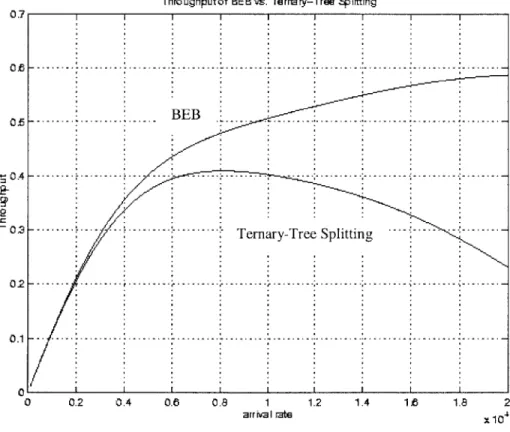
In this section, we compare the throughput performances of Binary Exponential Backoff (BEB) and ternary-tree splitting collision resolution methods in slotted CSMA/CD. In TBEB, a station involved in collision waits a random number of slots which is uniformly distributed between 0 and 2 min(k, 10) - 1 where k is the number ofcollisions suffered by the frame, before it tries to retransmit the frame. In BEB, the backoff period is uniformly distributed between 0 and 2k - 1. Since the truncated nature
of TBEB only occurs rarely and it makes the analysis complicated, we only analyze BEB for the sake of simplicity. Ternary-tree splitting is the collision resolution method for DFPQ as well as the protocol developed in this thesis. An analytical comparison would serve to highlight the differences in the two fundamentally different collision resolution approaches and to shed light on later simulation results. The analysis for BEB is based on the work of Tobagi and Hunt [ToH80] and the same approach is used for ternary-tree splitting. It is assumed that there is an infinite population of users. The frame arrival is a Poisson process with a given mean arrival rate.
3.1. BEB analysis
The channel alternates between busy periods (containing successful transmission and collision periods) and idle periods. The success or failure of a transmission period in the busy period depends only upon the length of the preceding transmission period. Given the transmission period is of length x, the length of the remainder of the busy period is a function of x and its average is denoted by B(x). Similarly, the average time that the channel is carrying successful transmissions in the remainder of the busy period is
denoted by U(x). The average length of an idle period I is c/(1-e-g) [RoS90], where r is the propagation delay. Let an(x) give the probability of n arrivals in a period of length x. Then,
B(x)= a1(x) [T +r+[1-ao(T +r)] -B(T +r)]+ 1- a,(x) +r+[1 -a0( y+r)] -B(y-+r)]
U(x)= a,(x) [T+[1-ao(T+)]-U(T+r)]+ I1- aI(x)
[1-ao(y
)B(y+r)]-ao(x) Il-ao (x)
The first term in the expression for B(x) corresponds to a single packet arriving during x in which case its transmission takes T +r time. If there is at least one arrival in T + - (given by probability 1- ao(T + T)), the remainder of the busy period is denoted by B(T + t). The second term corresponds to more than one packet arriving during x, in
which case the busy period is of length y + -c. If there is at least one packet arrival during this time, the remainder of the busy period is given by B(y +).
The expression for U(x) is also similar except that in a transmission time of T + , the total utilized time is T, and in case of a collision, there is no utilized time. Note that just like in the case of B(x), the additional utilized time is given by U(T + ) and U(y +).
The above set of equations can be solved by substituting for x = T +'T and x = Y +
- and finding an expression for B(T + ,), B(y + -c), U(T + r), and U(y + z). The system throughput, S is given by
S_ U(1) B(r) + I 3.2. Ternary-tree Splitting analysis
Ternary-tree splitting method can be analyzed in a similar manner, with one notable difference. Whenever there is a collision, all the frames involved in a collision are resolved before any newly arrived frames get transmitted. Therefore, the second terms in the expressions for both B(x) and U(x) are different. The collision resolution length (CRL), instead of being just y +,z as in the equations above, is a function of frame multiplicity (number of frames involved in the collision) and the expected number of cycles for that multiplicity before the collision is fully resolved. It is given by,
CR x)= Ia,(x)-E(n)