
The MIT Faculty has made this article openly available.
Please share
how this access benefits you. Your story matters.
Citation
Shell, Hanna Rose and Gregg Mitman. “The Documentary Impulse.”
Technology and Culture 58, 3 (July 2017): 846–855 © 2017 Johns
Hopkins University Press
As Published
http://dx.doi.org/10.1353/TECH.2017.0084
Publisher
Johns Hopkins University Press
Version
Final published version
Citable link
http://hdl.handle.net/1721.1/116149
Terms of Use
Article is made available in accordance with the publisher's
policy and may be subject to US copyright law. Please refer to the
publisher's site for terms of use.
Technology and Culture, Volume 58, Number 3, July 2017, pp. 846-855 (Article)
Published by Johns Hopkins University Press
DOI:
For additional information about this article
https://doi.org/10.1353/tech.2017.0084
ABSTRACT: This article has two interconnected goals. It is, first of all, a
review of the film The Land Beneath Our Feet, an exemplary documentary that combines the history of technology, science and technology studies, and environmental history in its exploration of the social, cultural, and natural consequences of the rubber industry’s expansion in Liberia. The essay’s larger purpose, however, is to explore the powerful role documentary film-making practices have to play in the development of new approaches in the history of technology. Here, an interview with historian and film co-director Gregg Mitman provides the framework for an expansive conversation about both the “documentary impulse” that he explores in his film and related written works, and also the growing role of audiovisual practice in scholarly work.
The Land Beneath Our Feet, co-directed by Sarita Siegel and Gregg Mitman
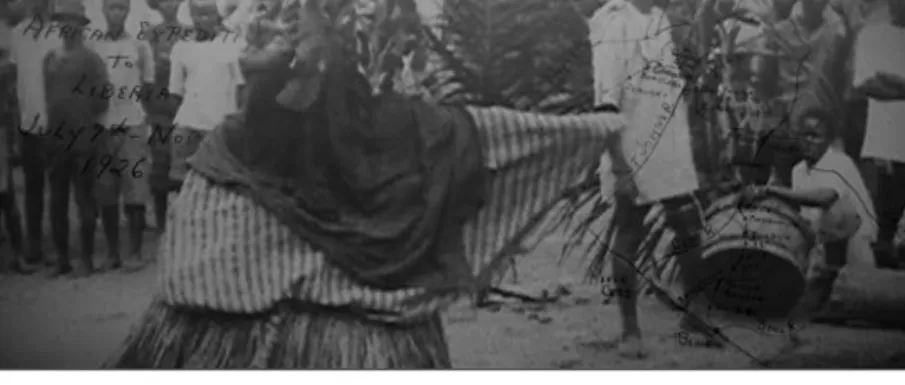
(Alchemy Films, 2016), is powerful and subtle as it navigates among themes of history and technology, representation and the land, personal narrative and national crisis as they pertain to the issue of land rights. The film is fluent, speaking to multiple audiences in different ways, moving be-tween divergent layers of meaning and magnitude. It is also punctuated by moments of great surprise, unexpected eruptions in sonic and narrative terms. It will leave those who engage with it, whether in the classroom, the theater, or online, with a new set of ways to think about the history of tech-nology (fig. 1).
The seed for the film’s concept came when Gregg Mitman, a historian of science, medicine, and the environment, learned of the existence of a cache of archival footage and photographs shot on a 1926 Harvard expedi-tion to Liberia, sponsored by the Firestone Tire and Rubber Company. Founded in 1900, by the 1920s Firestone had greatly expanded and was seeking new sources of rubber to keep up with the growing demand for Hanna Rose Shell is an associate professor of science, technology, and society at MIT. Gregg Mitman is the Vilas Research and William Coleman Professor of History of Science, Medical History, and Environmental Studies at the University of Wisconsin-Madison.
©2017 by the Society for the History of Technology. All rights reserved. 0040-165X/17/5803-0009/846–55
B E Y O N D W O R D S
The Documentary Impulse
BEYOND WORDS
tires. Within the next half-decade, the company connected with Harvard University, which initiated an expedition to help identify and study dis-eases that might threaten Firestone’s success in Liberia. Contending with a bevy of biological, cultural, political, and technological challenges, Fire-stone secured from the Americo-Liberian government a ninety-nine-year lease that granted the company access to one million acres of land and eventually established the world’s largest contiguous rubber plantation. This was a global corporate capitalism that emerged in the context of—and even drew on for its infrastructural and discursive viability—what Mitman and his co-author, photography historian Kelley Wilder, have described as “the documentary impulse.”1
Richard Strong, head of Harvard’s Department of Tropical Medicine and leader of the Liberia expedition team, assigned to Loring Whitman, an amateur photographer and recent Harvard graduate, the task of capturing a wide array of material on film celluloid and 4 x5 large-format photo-graphic negatives. The film footage would ultimately total nearly four hours. The expedition investigated issues of flora, fauna, and disease, all under the rubric of what was called “industrial hygiene.” Along the way, the expedition encountered complicated issues pertaining to the land, from the basics of circumnavigation (maps were lacking) to conflicts and contradictions in matters of land rights and working conditions.2Mitman
came upon this material, which prompted him to initiate a new research project. This research became both the instigator of and part of the mate-rial for writing a book, a scholarly project in the traditional sense. But it 1. Gregg Mitman and Kelly Wilder, “Introduction,” 3. For a broader context, see Betsy A. McLane’s A New History of Documentary Film, and for the earlier period Jen-nifer Tucker, Nature Exposed.
2. The very existence of the documentary footage, and the historical context in which such an enormously cumbersome and expensive film endeavor made sense, is taken up by Mitman in his chapter “A Journey without Maps.”
FIG. 1Composite of archival materials. (Source: created for The Land Beneath
T E C H N O L O G Y A N D C U L T U R E
JULY 2017 VOL. 58
also evolved into the film as well as multimedia and advocacy projects, which continue to grow (figs. 2–5).
Multiple histories of technology converge in The Land Beneath Our
Feet. It is a profound work, moving from an inquiry into footage to become
a kind of cine-essay as well as cine-history, as it tells the story of a Liberian
FIG. 2 Descendants from a Bassa community displaced by Firestone watch film footage of their ancestors performing a traditional dance for the Harvard expedition and share their stories with Emmanuel Urey. (Source: still from
The Land Beneath Our Feet.)
FIG. 3 Large Clearing at Firestone Plantation No. 3, Photograph by Loring Whit-man, 26 July 1926. (Source: VAD 2035-329, courtesy of Indiana University Liberian Collections.)
BEYOND WORDS
FIG. 4 Loring Whitman, View of Base Camp and Clearing. Photograph by Loring Whitman. (Source: VAD 2035-844, courtesy of Indiana University Liberian Collections.)
FIG. 5 Emmanuel Urey, his father, Yarkpawolo Taylor, and his stepmother, Korto Yarkpawolo watch footage of road building undertaken by the Amer-ico-Liberian government through the use of forced labor. The footage prompted Emmanuel’s father to share his own stories building roads by hand as a young man at the time the Harvard expedition passed near his village of Gomue. (Source: Still from The Land Beneath Our Feet.)
T E C H N O L O G Y A N D C U L T U R E
JULY 2017 VOL. 58
graduate student, Emmanuel Urey, whom Gregg meets at the University of Wisconsin and who becomes invested in repatriating the footage and in-terrogating its meaning for past and present-day land conflicts in Liberia, while at the same time using it as a spark to reignite family histories and stories.3Mitman’s own, and differently motivated, “documentary
im-pulse,” his drive to trace this footage, and the way in which the footage it-self prompted a range of collaborations, encounters, and discoveries, have led to a film that—alongside its companion digital history project, A
Liber-ian Journey: History, Memory, and the Making of a Nation—presents a
model for future work at the nexus of making and knowing in various humanities disciplines.4
Documentary co-director Mitman is the author of a number of books including Breathing Space: How Allergies Shape Our Lives and Landscapes and Reel Nature: America’s Romance with Wildlife on Film. He has co-edited Documenting the World: Film, Photography, and the Scientific
Rec-ord, Thinking with Animals: New Perspectives on Anthropomorphism, and Landscapes of Exposure: Knowledge and Illness in Modern Environments.
He has also worked on multiple film and media projects, and founded the film festival “Tales from Planet Earth.” The Land Beneath Our Feet, co-directed with Sarita Siegel, was completed in 2016 and has been showing at film festivals throughout 2016 and 2017. It is available for educational use through Passion River Films. I discussed the project with Mitman, with the goal of exploring how film study and filmmaking play a role in his schol-arly work as researcher, author, and filmmaker.
HRS: Can you talk a bit about how this film project got started? How did you first come upon the 1926 expedition footage?
GM: I was asked to serve as a scholar consultant on a film that was going to be made about the roots of international conservation in colonial-ism. That film’s focus was on Harold J. Coolidge, a Boston Brahmin, Harvard primatologist, and a kind of mover and shaker in interna-tional conservation circles. Much of the film was to draw on archival footage from a number of expeditions that Coolidge was on; one was this 1926 Harvard African expedition to Liberia.
3. For a provocative account of certain genres of documentary filmmaking as they relate to the rhetorical strategies of essay-writing, see Timothy Corrigan’s The Essay
Film; on the historical reinscription of the filmic document through its incorporation
into the work of historical documentary filmmaking, see Hanna Rose Shell’s “Cinehis-tory and Experiments on Film.”
4. The digital history project http://liberianhistory.org, spearheaded by Mitman, has been and remains a collaborative effort by scholars at the University of Wisconsin– Madison, the Center for National Documents and Records Agency in Liberia, the Center for History and New Media at George Mason University, and the Indiana Uni-versity Liberian Collections, as well as all those who visit and annotate the site with their own memories, histories, and points of reflection.
BEYOND WORDS
The archival footage raises lots of questions about colonialism, rep-resentation, and race. Ultimately, I washed my hands of that film proj-ect. But in the process I got really interested in the film record as a kind of historical document and what this Harvard expedition to Liberia was really about.
HRS: I see, so you came across this footage, and then it prompted you to explore some new research avenues.
GM: Yes, and as I got to thinking about that, it brought me to the connec-tion between Harvard’s Department of Tropical Medicine and the Firestone Tire and Rubber Company, which was establishing what would become one of the world’s largest rubber plantations in Liberia at the time.
One of the greatest impediments to Firestone’s success in this mas-sive technological project of the 1920s was disease: tropical diseases both plant and human. And so the head of Harvard’s Department of Tropical Medicine, Richard Strong, met with Harvey Firestone and offered Harvard’s services to do a complete biological and medical sur-vey of Liberia. That they chose to document that expedition on film greatly piqued my interest.
HRS: Can you talk a bit about why this moment proved to be so interest-ing to you, given your convergent interests in the histories of technol-ogy and the environment?
GM: I think the moment of Firestone’s arrival in Liberia is a really inter-esting one, because to me it really speaks to the importance of the rise of the modern industrial plantation. Whether it’s Firestone or United Fruit, these plantations involved massive projects of large-scale land-scape transformation that required a lot of coordinated expertise in terms of engineering, science, and medicine to remake the economy of nature and a nation (figs. 6–7).
I think for some people what is surprising about Firestone is that it actually worked. You have three generations of rubber trees that are on those plantations. Those plantations have been producing rubber for almost one hundred years now. Firestone sees it as a very sustainable operation. What is really telling to me is that the Harvard doctors and scientists on this expedition referred to their work as industrial hygiene, so they very much saw themselves on the playing field of in-dustrial technology.
HRS: Even before you saw this Firestone expedition footage, though, you’d long been interested in using old films as sources for the history of sci-ence and technology. I’m thinking of your 1999 Reel Nature, for exam-ple, a book that I think has had a great impact in terms of pushing his-torians of science, the environment, and technology to examine audiovisual sources.
T E C H N O L O G Y A N D C U L T U R E
JULY 2017 VOL. 58
GM: Reel Nature began as a project having nothing to do with film. It
started from work on the history of animal behavior. It was through working on this subject that I came to understand the importance of film as a technology of science and entertainment. I came to see the ways in which they came together in the understanding and popular perception of animal behavior. When I was writing that book, though, I wasn’t immersed at all in film production. At that point, I was really analyzing it more from a historical perspective.
HRS: So how did you get involved in film production in the first place?
GM: Well, an important part of it, even a stage of it—a precursor—was when I got involved with film curation, setting up a film festival that was launched in 2007, Tales from Planet Earth. That was a really important new direction for me, and from then on, things got much more hands-on for me from a production perspective. When we started the film festival in 2007, it was meant to be a one-off thing. And one of the reasons I did it was because I wanted to trouble what people thought of as the genre of environmental film. I think people at the time equated environmental film with wildlife documentary, nature film, or something very didactic. I wanted to break the mold of what people thought of as environmental film and put different strands of environmentalism in conversation with one another, both in terms of the films we screened and also by bringing in filmmakers to be part of
FIG. 6Sketch map made by Loring Whitman of the Harvard University African Expedition to Liberia, 7 July–21 November 1926. (Source: Courtesy of Indiana University Liberian Collections.)
BEYOND WORDS
a residency. I invited two filmmakers. One was Judith Helfand, who made this amazing film Blue Vinyl, which is a toxic comedy about the polyvinyl chloride industry. It speaks to the environmental justice side of environmental film, which is really about framing the environment as where people live, work, and play. And then I invited Sarita Siegel, who really came more out of a background in wildlife and nature film-making and had done a National Geographic film on orangutan reha-bilitation in Borneo. But what’s interesting to me is these two commu-nities don’t really speak to one another, and I wanted to bring different kinds of films together, different kinds of communities—with an at-tempt to really think about the environment in new ways, bringing this strand of environmental justice / social justice filmmaking together with a strand of natural history / wildlife filmmaking, and begin to ask what happens when you think about those together . . .
HRS: Did working on the festival get you thinking about the materiality of film in a different way? For me, confronting film as a producer, and also when I’ve exhibited at festivals, I’m always struck by its “artifac-tual” as well as it directly communicative capacity. Though we are often talking about it as a digital as much as an analog kind of artifact.
FIG. 7 Rubber Saplings Under Metal Roof, Mount Barclay Plantation. Photo-graph by Loring Whitman, 18 July 1926. (Source: VAD 2035-194, courtesy of Indiana University Liberian Collections.)
T E C H N O L O G Y A N D C U L T U R E
JULY 2017 VOL. 58
GM: Absolutely. It was thinking about not so much the content of film but more its social life as a medium. That is what spawned these other projects related to the expedition footage.
HRS: So stepping back from the film and to the historical book, it seems like you are also really interested in the question of what role that film documentation of the expedition was playing.
GM: The Harvard team was following Liberian guides along well-worn paths, but none of the Harvard scientists was trained in cartography. And they made this decision that out of the eight-member team, one person would be devoted solely to document the expedition by shoot-ing motion picture footage and photographs. It was one of the greatest expenses of the expedition and also required investment in a lot of labor. Film canisters weigh a lot. They had to devote two porters just to take the film canisters, let alone all the chemicals, because Whitman developed in the field. So, what is it, what is that impulse that we see, to document the work, which is the subject of a book we just published. And it’s particularly prominent in 1920s expeditionary film. And it’s not just institutions like the American Museum of Natural History or Harvard that are doing this, but multinational corporations like Fire-stone are undertaking this as well. FireFire-stone had its own film crew in Liberia making industrial films.
HRS: Might you compare writing books and making films as modes of doing historical work?
GM: One of the big differences between writing a book and making a film is that film is this completely collaborative medium, and so you’re working with a team of people from sound recordists to cinematogra-phers to editors, a whole range of people, and there is no single voice in that. My feeling is the humanities increasingly need to be doing these kinds of projects and others that involve collaborative expertise. You are creating a story out of that collaborative process, which is quite different than when you’re sitting in a room by yourself writing a book. I think more and more that is the direction the humanities need to move toward, because the notion of the kind of lone individ-ual author is just not the way in which most of the world operates.
Bibliography
Corrigan, Timothy. The Essay Film: From Montaigne, after Marker. Ox-ford: Oxford University Press, 2011.
McLane, Betsy A. A New History of Documentary Film. 2nd ed. London: Continuum Books, 2012.
Mitman, Gregg. “A Journey without Maps: Film, Expeditionary Science, and the Growth of Development.” In Documenting the World: Film,
BEYOND WORDS
Photography, and the Scientific Record, edited by Gregg Mitman and
Kelly Wilder, 124–49. Chicago: University of Chicago Press, 2016. _____, and Kelly Wilder. “Introduction” in Documenting the World: Film,
Photography, and the Scientific Record, edited by Gregg Mitman and
Kelly Wilder, 1–22. Chicago: University of Chicago Press, 2016. Shell, Hanna Rose. “Cinehistory and Experiments on Film.” Journal of
Vis-ual Culture 11, no. 3 (December 2012): 288–306.
Tucker, Jennifer. Nature Exposed: Photography as Eyewitness in Victorian


![Cycloaddition dipolaire [3+2] à partir d'hétérocycles aromatiques N-aminés](data:image/gif;base64,R0lGODlhAQABAIAAAP///wAAACH5BAEAAAAALAAAAAABAAEAAAICRAEAOw==)