HAL Id: hal-02322773
https://hal.archives-ouvertes.fr/hal-02322773
Submitted on 11 Dec 2019HAL is a multi-disciplinary open access
archive for the deposit and dissemination of sci-entific research documents, whether they are pub-lished or not. The documents may come from teaching and research institutions in France or abroad, or from public or private research centers.
L’archive ouverte pluridisciplinaire HAL, est destinée au dépôt et à la diffusion de documents scientifiques de niveau recherche, publiés ou non, émanant des établissements d’enseignement et de recherche français ou étrangers, des laboratoires publics ou privés.
Stable isotope probing and metagenomics highlight the
effect of plants on uncultured phenanthrene-degrading
bacterial consortium in polluted soil
François Thomas, Erwan Corre, Aurélie Cebron
To cite this version:
François Thomas, Erwan Corre, Aurélie Cebron. Stable isotope probing and metagenomics highlight the effect of plants on uncultured phenanthrene-degrading bacterial consortium in polluted soil. ISME Journal, Nature Publishing Group, 2019, 13 (7), pp.1814-1830. �10.1038/s41396-019-0394-z�. �hal-02322773�
1
Stable isotope probing and metagenomics highlight the effect of plants on uncultured
2
phenanthrene-degrading bacteria in polluted soil
3 4
Running title: Phenanthrene degraders in bare vs. planted soil 5
6
François THOMAS1,2, Erwan CORRE3, Aurélie CEBRON1† 7
8
1 Université de Lorraine, CNRS, LIEC 54500 Nancy, France 9
2 Sorbonne Université, CNRS, Integrative Biology of Marine Models (LBI2M), 10
Station Biologique de Roscoff (SBR), 29680 Roscoff, France 11
3 CNRS, Sorbonne Université, FR2424, ABiMS, Station Biologique de Roscoff, 29680, 12
Roscoff, France 13
14
† Corresponding author: [email protected]; Full postal address: LIEC 15
UMR7360, Faculté des Sciences et technologie, Bd des Aiguillettes, BP70239, 54506 16
Vandoeuvre-les-Nancy, France. Phone: (+33) 372745215. 17
18
ISME J sections: Microbial ecology and functional diversity of natural habitats 19
20
Abstract
21
Polycyclic aromatic hydrocarbons (PAHs) are ubiquitous soil pollutants. The discovery that 22
plants can stimulate microbial degradation of PAHs promoted research on rhizoremediation 23
strategies. We combined DNA-SIP with metagenomics to assess the influence of plants on the 24
identity and metabolic functions of active PAH-degrading bacteria in contaminated soil, using 25
phenanthrene (PHE) as a model hydrocarbon. 13C-PHE dissipation was 2.5-fold lower in 26
ryegrass-planted conditions than in bare soil. Metabarcoding of 16S rDNA from bare and 27
planted conditions revealed respectively 130 and 73 OTUs significantly enriched in 13C-SIP 28
incubations compared to 12C-controls. Active PHE-degraders were taxonomically diverse 29
(Proteobacteria, Actinobacteria and Firmicutes), with Sphingomonas and Sphingobium 30
dominating in bare and planted soil, respectively. Metagenomes of 13C-enriched DNA 31
fractions contained more genes involved in aromatic compounds metabolism in bare soil, 32
whereas carbohydrate catabolism genes were more abundant in planted soil. Functional gene 33
annotation allowed reconstructing complete pathways for PHE catabolism. 34
Sphingomonadales were the major taxa performing the first steps of PHE degradation in both 35
conditions, suggesting their critical role to initiate in-situ PAH remediation. Analysis of 36
metagenomic bins from 13C-enriched Sphingomonas and Sphingobium highlighted different 37
metabolic strategies, the latter containing less PAH-degrading genes but a more diverse 38
repertoire of carbohydrate active enzymes potentially targeting plant root material. 39
40
Introduction
41
Polycyclic aromatic hydrocarbons (PAHs) are ubiquitous soil pollutants with environmental 42
and public health concerns [1]. PAHs released into the environment by industrial activities 43
can be removed through physical, chemical and biological processes [2]. Microorganisms that 44
use PAHs as carbon sources play essential roles in natural attenuation of pollutants in 45
contaminated ecosystems [3]. Numerous PAH catabolic pathways are described in bacteria, 46
archaea and fungi, including both aerobic and anaerobic processes [1,3]. Several studies have 47
evidenced an increased microbial degradation of PAHs in the presence of plants [4,5]. The 48
discovery of this "rhizosphere effect" promoted the development of rhizoremediation 49
strategies to treat PAH-contaminated soils [6,7]. However, literature shows contrasting results 50
with no rhizosphere effect or even a negative influence on PAH-degradation efficiency [8,9]. 51
These discrepancies may reflect the use of different model plants, soil types, indigenous 52
microorganisms [10] and types of PAHs [11]. Such variations may also result from temporal
53
variations in rhizospheric processes during plant development. We previously showed that
54
phenanthrene degradation was slowed down during the early development of ryegrass [12], a 55
plant commonly used in PAH rhizoremediation studies [13]. Differences in PAH-degradation 56
with or without plants could be explained by the selection of two distinct PAH-degrading 57
bacterial populations. Indeed, active bacterial populations were different in soil supplemented 58
or not with root exudates [14] and in planted or bare soil microcosms [12]. Plant roots exude 59
labile carbon sources that can be preferentially degraded by rhizospheric microbial 60
communities to the detriment of PAH dissipation [9]. Therefore, investigation of PAH-61
degraders in the rhizosphere of contaminated soils is needed to decipher the influence of 62
plants and ultimately improve PAH biodegradation efficiency. One challenge is to specifically 63
target microorganisms actively degrading PAHs in polluted soils, without the cultivation bias. 64
DNA-Stable Isotope Probing (DNA-SIP) is a powerful technique for linking functions with 65
identity of uncultured microorganisms in complex microbiota. Approaches combining DNA-66
SIP and metagenomics are increasingly used to investigate microbial communities involved in 67
anthropogenic compound biodegradation [15,16]. To date DNA-SIP has been successfully 68
applied to identify soil bacteria that metabolize PAHs such as naphthalene [17,18,19,20], 69
phenanthrene [14,18,21,22,23,24,25,26], anthracene [24,27,28], fluoranthene [24], pyrene 70
[29,30] and benzo[a]pyrene [31]. DNA-SIP has also been used to explore PAH-degraders in 71
the presence of purified root exudates [14] and to identify degraders of root exudates in the 72
rhizosphere [32]. However, we still lack a comprehensive view on the major microbial actors 73
of PAH degradation and their catabolic pathways in contaminated soils, and how it changes in 74
the presence of plants. 75
In this study we investigated PAH-degrading bacteria of a historically polluted soil, using 76
13C-labelled phenanthrene (PHE) as a metabolic tracer. We combined DNA-SIP with 77
metagenomics to assess for the first time the influence of plant rhizosphere on the diversity, 78
identity and metabolic functions of bacteria actively involved in phenanthrene degradation. 79
80 81
Material and Methods
82 83
Soil sample and phenanthrene spiking
84
Soil was collected from a former coking plant site (NM soil, Neuves-Maisons, France), dried 85
at room temperature, sieved to 2 mm and stored in the dark at room temperature until 86
experimental set-up. PAH contamination dates back ca. 100 years and reaches 1 260 mg 87
Σ16PAHs.kg-1. Other soil characteristics were detailed elsewhere [33]. For spiking, two 88
batches of soil were recontaminated at 2 500 mg.kg-1 respectively with [U-13C14]-labeled 89
phenanthrene (Sigma-Aldrich Isotec, St Louis, USA) and unlabeled 12C-PHE (Fluka). Ten 90
grams of dry soil were mixed with 2.5 ml of PHE stock solutions (10 mg.ml-1 in hexane). 91
After complete solvent evaporation, aliquots of 1.1 g recontaminated soil were mixed with 9.9 92
g of non-recontaminated soil (1:10 dilution) to obtain a final concentration of fresh PHE of 93 250 mg.kg-1. 94 95 SIP incubations 96
SIP incubations were performed using previously described two-compartment microcosms 97
[12]. Eight ryegrass seedlings (Lolium multiflorum, Italian ryegrass, Podium variety, LG 98
seeds, France) were allowed to grow for 21 days until roots reached the bottom of the first 99
compartment containing 30 g of non-recontaminated NM soil and maintained at 80% of the 100
soil water-holding capacity in a growth chamber (22°C /18°C day/night, 80% relative 101
humidity, c.a. 250 µmol photons m-2 s-1, 16 hours photoperiod). A second compartment 102
containing 10 g of 12C or 13C PHE-spiked soil was then appended below the first one to allow 103
root colonization in the growth chamber. After 10 days, soil from the second compartment 104
was retrieved in a glass Petri dish. Roots were removed using a brush and tweezers. Aliquots 105
of soil were collected in glass vials for organic extraction and isotopic analysis; the rest was 106
stored in plastic vial and immediately frozen in liquid nitrogen for further nucleic acid 107
extraction. All samples were stored at -80°C until analysis. Non-vegetated ("bare") 108
microcosms were handled in the same way, except no ryegrass was planted in the first 109
compartment. Independent triplicates were performed for the four conditions (i.e. 12C-bare, 110
12C-planted, 13C-bare and 13C-planted), for a total of 12 microcosms. Aerial plant biomass 111
was harvested, ground in liquid nitrogen, dried at 60°C and stored at room temperature. To 112
capture the initial PHE concentration, an additional set of second compartments was prepared 113
and sacrificed within 2 hours. 114
115
Organic extraction and phenanthrene quantification
116
Lyophilized soil was pulverized in a mixer mill (MM200, Retsch). Soil samples (250 mg) 117
were mixed with 1 g activated copper and 2 g anhydrous Na2SO4 and extracted with 118
dichloromethane (DCM) using an high pressure and temperature automated extractor Dionex 119
ASE350 as described elsewhere [34]. Post-extraction soil residues were recovered for isotopic 120
analysis. DCM extracts were analyzed by gas chromatography coupled to mass spectrometry 121
(GC-MS) [35]. 122
The 13C content coming from the added 13C-PHE was expressed as 13Csample = α × PHEsample, 123
where PHEsample is the PHE content (mg.kg-1) and α the massic proportion of carbon atoms in 124
PHE molecule (0.9434). The proportion of 13C remaining compared to the amount added 125
initially was expressed as 100 × 13Csample D10/13Csample D0. D0 was the initial measure and D10 126 after 10 days. 127 128 Isotopic analysis 129
Isotopic composition of soil samples and post-extraction soil residues, dry DCM extracts and 130
aerial plant biomass was determined at the INRA PTEF (Champenoux, France) using 131
Elemental analyzer (vario ISOTOPE cube, Elementar, Hanau, Germany) interfaced in line 132
with a gas isotope ratio mass spectrometer (IsoPrime 100, Isoprime Ltd, Cheadle, UK). 133
Carbon isotopic composition was expressed as δ13C (‰) versus Vienna PeeDee Belemnite 134
(V-PDB). The ratio of 13C versus 12C in samples was expressed as Rsample = RV-PDB × (1 + 135
δ13Csample/1000), where RV-PDB = 13CV-PDB/12CV-PDB = 0.0112375. The proportion of 13C in a 136
sample compared to the amount initially added from 13C-PHE was calculated as (Rsample D10 – 137
Rmatrix)/(Rsample D0 – Rmatrix), where Rmatrix is the natural 13C/12C ratio of the NM soil, DCM 138
extracts or soil residues (average 0.01085). 139
140
DNA extraction and isopycnic separation
141
DNA was extracted from 0.5 g of soil using the Fast DNA Spin Kit for Soil (MP Biomedicals, 142
France). Five replicate extractions were pooled for each sample. DNA was quantified using 143
the Quant-iT Picogreen dsDNA assay kit (Invitrogen). Isopycnic separation of 12C- and 13 C-144
labeled DNA ("light" and "heavy" DNA, respectively) was performed as described previously 145
[36]. DNA (3.9 µg) was mixed in 5.1 ml tubes with CsCl solution and gradient buffer to a 146
final density of 1.725 g.ml-1. Ultracentrifugation was performed in a vertical rotor (VTi 65.2, 147
Beckman), at 15°C, 176 985g for 40 h (INRA, Champenoux). Thirteen fractions (ca. 400 µl) 148
were collected per tube and weighed on a digital balance (precision 10-4 g) to confirm 149
gradient formation. DNA was precipitated with 800 µl polyethylene glycol 6000 (1.6 M) and 150
2 µl polyacryl carrier (Euromedex) overnight at room temperature, recovered by 151
centrifugation 45 min at 13 000g and washed once with 500 µl 70% (v/v) ethanol. Pellets 152
were dried for 2 min in a vacuum concentrator (Centrivap Jouan RC1010, ThermoScientific), 153
resuspended in 30 µl molecular-biology grade water (Gibco, Life Technologies) and stored at 154 -20°C. 155 156 Real-time quantitative PCR (qPCR) 157
Bacterial 16S, Archaeal 16S and fungal 18S rRNA gene copies were quantified using the 158
primer pairs 968F/1401R [37], 571F/910R [38] and FF390R/Fung5F [39,40]. qPCR reactions 159
(20µl) were performed as described previously [41] on a CFX96 real-time system (BioRad) 160
and contained 1X iQ SybrGreen Super Mix (BioRad), 12 µg bovine serum albumin, 0.2 µl 161
dimethyl sulfoxide, 40 µg of T4 bacteriophage gene 32 product (MP Biomedicals, France), 1 162
µl of template (DNA or 10-fold linearized standard plasmid dilution series from 108 to 102 163
gene copies.µl-1) and 8 pmol of each primer. Reactions were heated at 95°C for 5 min, 164
followed by 45 cycles of 30 s at 95°C, 30 s at 56°C for bacterial 16S rRNA, 60°C for archaeal 165
16S rRNA or 50°C for 18S rRNA, 30 s at 72°C and 10 s at 82°C to capture the fluorescence 166
signal while dissociating primer dimers. Dissociation curves were obtained by heating 167
reactions from 50 to 95 °C. Fractions identified as containing "heavy" DNA were pooled and 168
quantified by Picogreen assay. 169
170
16S rRNA gene amplicon sequencing and analysis
171
Fragments of 430 bp covering the V3/V4 region of bacterial 16S rRNA genes were amplified 172
from 12 samples of "heavy" DNA recovered from 13C-SIP and 12C-control samples and 173
sequenced as described previously [12] with a dual-index paired-end strategy [42]. Amplicons 174
were obtained by 28 cycles of PCR using Accuprime Super Mix (Invitrogen) on 1 µl template 175
DNA, purified using the UltraClean-htp 96 Well PCR Clean-Up kit (MOBIO) and quantified 176
by Picogreen assay. An equimolar pool at 10 nM was purified using Nucleospin PCR Clean-177
Up kit (Macherey-Nagel) and sequenced on a single lane of Illumina Miseq PE250 at the 178
Georgia Genomics Facility (Athens, GA, USA). Paired-end reads were trimmed to a 179
minimum Qscore of 20, joined with Pandaseq [43] and filtered for length in the 400-450 bp 180
range with no ambiguous bases. Sequence data were analyzed as described previously [12] in 181
QIIME v1.9 [44] with chimera detection and clustering in Operational Taxonomic Units 182
(OTUs) at 97% using UCHIME and USEARCH v6.1, respectively [45, 46], followed by 183
taxonomy assignment using the RDP classifier [47] with the Greengenes database v13_8 [48]. 184
After removal of chloroplasts and mitochondria OTUs, datasets were rarefied to the lowest 185
number of sequences per sample (9 532 sequences). To identify OTUs significantly enriched 186
in 13C-SIP incubations compared to 12C-controls, a subset of data was produced to keep only 187
OTUs (i) represented by at least 5 sequences in each triplicate 13C-SIP sample and (ii) with an 188
average abundance higher in 13C-SIP samples compared to 12C-controls. This subset was then 189
log-transformed and compared using Welch's test with Benjamini-Hochberg correction of the 190
p-value performed in R v3.1.3 [49], separately for bare and planted samples. 191
192
Shotgun metagenomic sequencing and analysis
193
"Heavy" DNA recovered from the six 13C-SIP samples was sequenced on 3 lanes of Illumina 194
MiSeq PE300 at the Georgia Genomics Facility (Athens, GA, USA). Adapters removal and 195
quality filtering was performed on raw reads using Trimmomatic [50] with the following 196
parameters: remove adapters (ILLUMINACLIP:adapters.fa:2:30:10), trim 5'- or 3'-bases if 197
phred Qscore <25 (LEADING:25 TRAILING:25), trim read when average quality < 25 198
(SLIDINGWINDOW:4:25) and discard reads shorter than 100 bp (MINLEN:100). Based on 199
FastQC report, paired and unpaired reads 2 obtained after Trimmomatic were further cropped 200
at 250 and 230 bp, respectively. Unassembled DNA sequences were uploaded to MG-RAST 201
[51] and compared to the Subsystems database (November 2017) with default parameters. 202
Proportions in functional profiles were compared using Welch's two-sided test with 203
Benjamini-Hochberg correction. Raw metagenomic reads were assembled separately for each 204
sample using SPAdes v3.7.0 [52], with the –meta option and testing kmer sizes of 21, 33, 55, 205
77 ,99 and 127. Taxonomic assignment of assembled contigs longer than 5 kb was performed 206
using PhyloPythiaS [53]. Genomic features on assembled contigs were predicted and 207
annotated using prokka v1.12 [54]. Predicted genomic features were also screened for 208
functional genes encoding enzymes potentially involved in aerobic degradation of aromatic 209
compounds using AromaDeg [55], with minimum BLAST homology of 50% and minimum 210
alignment length of 150 bp. Sequences of selected AromaDeg enzyme families were further 211
aligned using MAFFT [56] with the L-INS-i method. Alignments were manually edited in 212
JalView [57] and used for maximum-likelihood phylogenetic tree construction in MEGA v6 213
[58] after selection of the best protein model. Genes encoding putative carbohydrate active 214
enzymes (CAZymes) were annotated using dbcan [59]. The GhostKOALA annotation server 215
[60] was used to assign KEGG orthologies to genes in the metagenomes and reconstruct 216 metabolic pathways. 217 218 Data access 219
16S rRNA gene amplicon sequences are available at NCBI under BioProject ID 220
PRJNA485442 (BioSamples: SAMN09791490-SAMN09791501). Raw and assembled 221
shotgun metagenomics data are available on MG-RAST under study name RHIZORG_WGS 222
and RHIZORG_ASSEMBLED, respectively. 223 224
Results
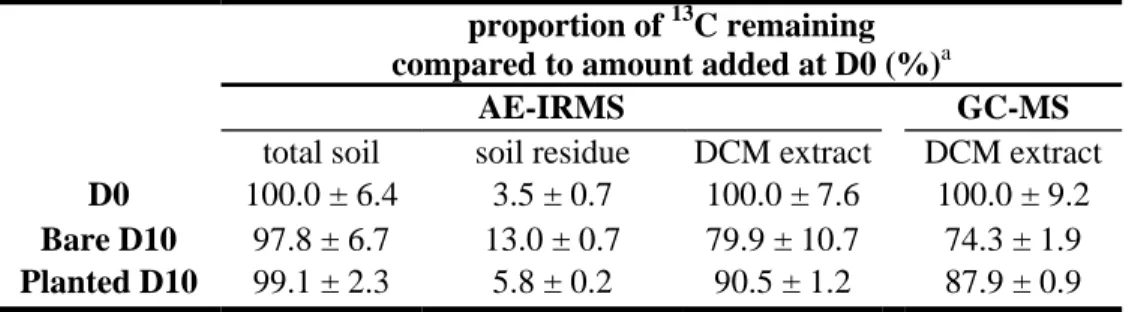
225 226 Fate of phenanthrene 227The fate of spiked PHE was followed in total soil, organic extracts and soil residues after 228
extraction (Table 1). No decrease in 13C content was observed in total soil over the 10 days 229
period. The proportion of 13C remaining in DCM extracts (containing PAHs) decreased of ca. 230
25% in bare soil and only 10% in planted soil (Welch t-test P=0.06). Consistency between 231
AE-IRMS and GC-MS results indicates that most of the DCM-extractable 13C was 13C-PHE, 232
without major contributions of 13C-labeled degradation products. At Day 0, 3.5% of the 233
spiked 13C was already non-extractable with DCM and recovered in soil residues, suggesting 234
a rapid sequestration of PHE on soil particles. After 10 days, this non-extractable fraction 235
reached 13% and 5.8% in bare and planted microcosms, respectively (Student t-test, 236
P<0.001). This increase likely reflects the incorporation of 13C in microbial biomass, and the 237
production of 13C-labeled hydrophilic intermediates that were not extracted with DCM. Aerial 238
plant biomass was only weakly enriched in 13C (0.048% 13C content increase compared to 239
12C-controls). 240
241
Taxonomic characterization of active PHE degraders
242
Community gDNA extracted from 12C-controls and 13C-SIP incubations was separated by 243
isopycnic centrifugation and fractionated. Quantification of bacterial 16S rRNA genes 244
showed a 6-fold increase in fractions 6-8 (buoyant density 1.713-1.727 g.ml-1) of 13C-SIP bare 245
microcosms compared to 12C-controls (Figure S1A). This increase was only 2-fold in planted 246
microcosms (Figure S1B), suggesting a lower incorporation of 13C within bacterial biomass 247
in the presence of ryegrass. Archaeal and fungal rRNA genes were not enriched in any 248
fractions from 13C-SIP compared to 12C-controls (not shown), suggesting that Archaea and 249
Fungi did not metabolize a significant proportion of PHE in the tested conditions. Fractions 6-250
8 from each sample were pooled (hereafter "heavy DNA") and analyzed by high-throughput 251
sequencing of the 16S rRNA genes. We obtained a total of 405 345 quality-filtered paired-end 252
16S rDNA sequences from the 12 samples, ranging from 9 532 to 52 544 sequences per 253
sample. Based on rarefied dataset, sequences were clustered in 5 690 OTUs at 97% identity. 254
The taxonomic affiliation of OTUs differed between heavy DNA fractions of 13C-SIP 255
incubations and 12C-controls in both bare and planted conditions (Figure 1A). We detected 256
130 and 73 OTUs significantly enriched in 13C-SIP incubations compared to 12C-controls in 257
bare and planted conditions, respectively, with 40 OTUs shared between the two conditions 258
(Figure 1B). These active PHE-degrading OTUs were affiliated to Actinobacteria, Alpha-, 259
Beta- and Gammaproteobacteria in both conditions, while Firmicutes were only enriched in 260
heavy DNA fractions from bare soil. Arthrobacter, unknown Sphingomonadaceae and 261
Gammaproteobacteria "PYR10d3" were present at a similar level in both conditions. PHE-262
degrading Sphingomonas and Alcaligenaceae OTUs were favored in bare soil compared to 263
planted condition. Conversely, Sphingobium and unknown Micrococcaceae were more 264
represented in planted condition. In each condition, one genus dominated the PHE-degrading 265
population. Namely, Sphingomonas dominated in bare soil (43% of total sequences and 61% 266
of total OTUs), while Sphingobium prevailed in planted soil (28% of total sequences, 41% of 267
total OTUs). 268
269
Functional profiling of 13C-labeled metagenomes
270
A total of ~90 million paired-end reads representing 17.6 Gb sequence data were obtained for 271
the six heavy DNA samples from 13C-SIP incubations (Table S1). MG-RAST analysis 272
showed that 14 of the 28 functional categories were differentially represented in the two 273
conditions (Figure 2A). The greatest differences between bare and planted conditions were 274
found for the two categories: “Carbohydrates” (8.63% and 10.61% in bare and planted soil 275
13C-metagenomes, respectively; q-value=0.016) and “Metabolism of aromatic compounds” 276
(4.66% and 2.45% in bare and planted soil 13C-metagenomes, respectively; q-value=0.015). 277
Within the category “Carbohydrates” (Figure 2B), the abundance of gene sequences affiliated 278
to the metabolism of polysaccharides, monosaccharides, fermentation, di- and 279
oligosaccharides, central carbohydrates and aminosugars, were all significantly over-280
represented in the planted soil 13C-metagenomes. Within the category “Metabolism of 281
aromatic compounds” (Figure 2C), sequences matching the anaerobic degradation genes 282
were detected in identical relative abundance between the two conditions. The genes 283
belonging to the three other sub-categories, i.e. peripheral pathways for catabolism of 284
aromatic compounds, metabolism of central aromatic intermediates, and other, were 285
significantly over-represented in bare soil 13C-metagenomes. 286
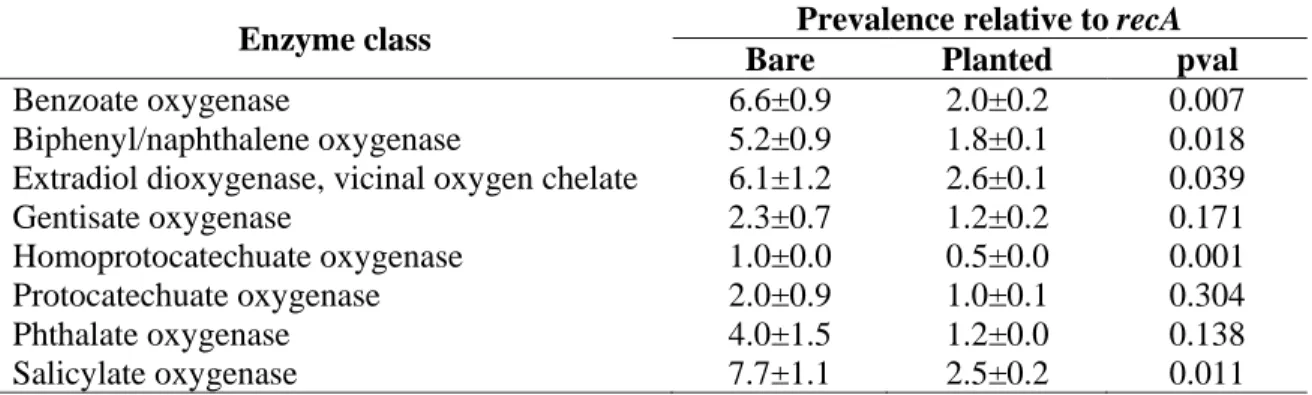
Genes encoding enzymes potentially involved in aerobic degradation of aromatic compounds 287
were detected in assembled metagenomes using AromaDeg, and their prevalence was 288
calculated relative to the single-copy gene recA (Table 2). A significantly lower prevalence of 289
genes encoding benzoate oxygenases, biphenyl oxygenases, extradiol dioxygenases of the 290
vicinal oxygen chelate superfamily, homoprotocatechuate oxygenases and salicylate 291
oxygenases was found in 13C-enriched metagenomes from planted condition compared to bare 292
soil. We further analyzed selected members of two enzyme families involved in the first steps 293
of PAH degradation, namely the biphenyl/naphthalene family of Rieske non-heme iron 294
oxygenases and extradiol dioxygenases of the vicinal oxygen chelate family (EXDO I). The 295
biphenyl/naphthalene family comprises most of the dioxygenases reported to date to activate 296
PAHs for further aerobic degradation, whereas the EXDO I family comprises enzymes that 297
fission the ring of pre-activated mono- or polyaromatic derivatives [55]. We notably detected 298
66 and 20 ORFs encoding oxygenases of the biphenyl/naphthalene family from 299
Proteobacteria (Clusters XXIV and XXVI) or Actinobacteria (Clusters I, II and V), 300
respectively, as well as 46 ORFS encoding proteobacterial EXDOs preferring bicyclic 301
substrates related to dihydroxynaphthalene dioxygenases (Cluster XII). Phylogenetic analysis 302
of biphenyl/naphthalene oxygenases from Proteobacteria (Figure 3A) revealed that the vast 303
majority (56/66) was closely related to known sequences from Sphingomonas, Sphingobium 304
and Novosphingobium with equal distributions between bare and planted soil. Few additional 305
sequences were related to Cycloclasticus, Burkholderia or Acidovorax spp. No sequences 306
were affiliated to Pseudomonas. Within Actinobacteria (Figure 3B), 12 biphenyl/naphthalene 307
dioxygenases were closely related to sequences from Arthrobacter phenanthrenivorans 308
(Cluster II) and Arthrobacter keyseri (Cluster V). In planted conditions only, 4 additional 309
sequences related to Mycobacterium and Terrabacter were detected in Cluster V, as well as 2 310
more divergent sequences. In Cluster XII of the EXDO I family (Figure 4), most detected 311
sequences grouped with known proteins from Sphingomonas, Sphingobium and 312
Novosphingobium. Among these, a relatively divergent clade of 20 sequences emerged, with 313
more detected members in bare soil compared to planted conditions. Finally, few additional 314
EXDO I Cluster XII sequences were related to Sphingopyxis, Pseudomonas, Acidovorax or 315
Burkholderia. 316
317
Reconstruction of phenanthrene degradation pathways
318
Combining results of the above AromaDeg analysis and the GhostKOALA annotation 319
pipeline, we reconstructed both the O-phthalate/protocatechuate pathway leading to the 3-320
oxoadipate, as well the naphthalene pathway leading to salicylate (Figure 5). GhostKOALA 321
failed to recognize genes involved in the first steps of PHE degradation that were detected 322
with AromaDeg, likely because the KEGG database only contains nahAc and nidA genes 323
from Pseudomonas and Mycobacterium, respectively. Salicylate could be converted to 324
gentisate or catechol, being further degraded through ortho- and meta-cleavage pathways 325
leading to intermediates of the TCA cycle. All genes involved in these pathways were present 326
in both conditions. Sequences affiliated to Sphingomonadales dominated the early steps of 327
degradation leading to 1-hydroxy-2-naphthaldehyde and pyruvate, as well as later reactions 328
converting naphthalene-1,2-diol to salicylaldehyde and pyruvate. Genes involved in the 329
downstream conversion to gentisate were mainly detected from Betaproteobacteria (including 330
Alcaligenaceae) and Sphingomonadales. Genes annotated in the meta- and ortho-cleavage 331
pathways for catechol utilization were taxonomically more diverse, with sequences affiliated 332
to Alpha-, Beta- and Gammaproteobacteria, Actinobacteria and Firmicutes. Overall, 333
Actinobacteria and Firmicutes had higher contributions to the phthalate and protocatechuate 334
pathway than the naphthalene and salicylate pathway. 335
Focus on Sphingomonas and Sphingobium metagenomes
337
We further focused on the two dominant PHE-degrading populations of Sphingomonas and 338
Sphingobium identified in bare and planted soil through SIP (Figure 1B). After taxonomic 339
affiliation of contigs larger than 5 kb, the best metagenome assemblies were obtained for 340
Sphingomonas population in bare soil and Sphingobium population in planted soil, 341
respectively, with maximum contig size larger than 1 Mb (Supplementary Table S2). The 342
Sphingobium metagenome from bare soil was more fragmented (average size 71 kb, 343
maximum size 278 kb). This likely reflects a lower coverage of the Sphingobium-affiliated 344
sequences in 13C-enriched metagenomes and corroborates the lower success of this PHE-345
degrading genus in bare soil compared to planted conditions. The single-copy RecA protein 346
of 13C-enriched metagenomes of Sphingomonas was identical in the 3 bare soil microcosms 347
and had its best blastp hit (91% identity) against Sphingomonas sp. MM-1 [61], while that of 348
Sphingobium was identical in the 3 planted microcosms and had its best blastp hit (100% 349
identity) against Sphingobium herbicidovorans NBRC 16415 [62] and Sphingobium sp. 350
MI1205 [63]. Functional gene annotation revealed a large arsenal of dioxygenases and 351
monooxygenases with some that could have potential activity on aromatic compounds in 352
Sphingomonas metagenomes from bare soil (Supplementary Table S3), often grouped in 353
genomic regions. The potential for aromatic compounds degradation was much more 354
restricted in Sphingobium metagenomes from planted conditions. We then hypothesized that 355
the greater success of Sphingobium PHE-degraders compared to Sphingomonas in planted 356
conditions might not be directly due to aromatic compound catabolism, but rather to a more 357
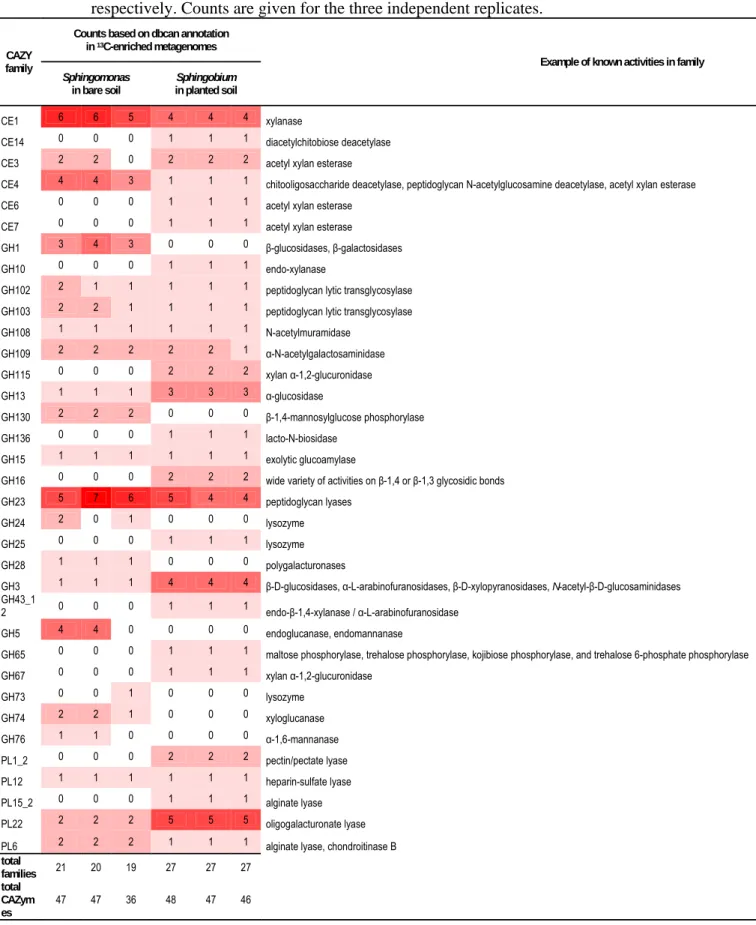
efficient use of plant-derived carbon sources. To test this hypothesis, we screened the 358
metagenomes for genes encoding carbohydrate active enzymes (CAZymes) in the groups 359
carbohydrate esterases (CE), glycoside hydrolases (GH) and polysaccharide lyases (PL) 360
(Table 3). Similar numbers of CAZymes were detected in Sphingomonas (36 to 47 total 361
CAZymes) and Sphingobium (46 to 48 total CAZymes). However, a larger diversity of CAZy 362
families was found in Sphingobium (27 different families) than in Sphingomonas (19 to 21) 363
metagenomes. Families detected only in Sphingobium metagenomes include enzymes 364
potentially involved in plant cell wall breakdown, including the degradation of xylan (CE6, 365
CE7, GH10, GH115, GH43_12, GH67), pectin (PL1_2) and other cell wall compounds 366
(GH16), as well as in the use of disaccharides (maltose, trehalose) that are found in root 367
exudates (GH65). Furthermore, the prevalence of three additional families also potentially 368
involved in plant cell wall breakdown was higher in Sphingobium metagenomes compared to 369
Sphingomonas (GH13, GH3, PL22). 370
371 372 373 374 375
Discussion
376Phenanthrene is often highly concentrated in PAH-contaminated environments and is a model 377
for research on PAH catabolism [1]. We used DNA-SIP to investigate the diversity and 378
metabolic potential of microorganisms involved in phenanthrene degradation in historically 379
contaminated soil. We further assessed the influence of ryegrass, a plant commonly used in 380
phytoremediation studies on PAH-contaminated soils [2,11,64]. To our knowledge, this study 381
is the first to use DNA-SIP combined to metagenomics to assess the influence of plants on 382
bacteria actively involved in phenanthrene degradation in polluted soils. Here, we showed a 383
decreased dissipation rate of phenanthrene in the ryegrass rhizosphere, corroborating previous 384
results [12,14]. The rhizosphere environment contains higher nutrient concentration than the 385
surrounding bulk soil due to root exudates, comprising an array of organic compounds 386
including carbohydrates, amino acids, proteins, flavonoids, aliphatic acids, organic acids and 387
fatty acids [10,32]. Excessive nutrient availability can inhibit the biodegradation of pollutants 388
[65,66,67]. Thus, rhizospheric bacteria may preferentially use labile carbon sources from 389
exudates, leading to slower phenanthrene degradation. The phenanthrene degradation rates we 390
observed (20% and 10% in bare and planted soil in 10 days, respectively) were lower than 391
previous reports, e.g. 60 to 70% PHE degradation in 9 days [21,24] or 68% in 12 days [14]. 392
This discrepancy might be linked to the more realistic conditions of the present experimental 393
setup within a genuine plant rhizosphere, allowing constant input of rhizodeposits during the 394
10-days time course. The limited dissipation of 13C-PHE after 10 days minimized the risk of 395
cross-feeding, ensuring that 13C-labeled microorganisms are the primary degraders of 396
phenanthrene in the NM soil. 397
398
The active 13C-PHE-degrading OTUs belonged to similar taxa in bare and planted soil but the 399
presence of plants modified their relative abundance. 13C-enriched OTUs affiliated to 400
Arthrobacter, unclassified Sphingomonadaceae and Gammaproteobacteria "PYR10d3" were 401
present at a similar level in both conditions. Members of the Actinobacteria and 402
Sphingomonadaceae are considered potent PAH-degraders in soil and sediments 403
[23,68,69,70]. Representatives of the Arthrobacter genus are able to degrade many organic 404
pollutants [71]. Using DNA-SIP, some species were previously shown as the dominant 405
phenanthrene degraders in soil supplemented with root exudates [14] and in activated sludge 406
[26]. Interestingly, an Arthrobacter oxydans strain was isolated from the same soil used in the 407
present study, for its ability to degrade phenanthrene [72]. The Pyr10d3 candidate order is a 408
separate branch in Gammaproteobacteria first identified in a SIP experiment using 13 C-409
pyrene as substrate [29] and its abundance was increased considerably with the increase of 410
petroleum-hydrocarbon contamination of a soil located close to petrochemical plant [73]. 411
Firmicutes affiliated to Paenibacillaceae were only active in bare soil while in a previous 412
study it was found as phenanthrene degraders when the soil was supplemented with root 413
exudates [14]. Paenibacillus spp. were previously enriched from petroleum-hydrocarbon-414
contaminated sediment and salt marsh rhizosphere using either naphthalene or phenanthrene 415
as the sole carbon source [74]. The greatest influence of ryegrass on active PHE-degraders 416
was found for Sphingomonas and Sphingobium-related 13C-enriched OTUs, which dominated 417
in bare and planted soil, respectively. Sphingomonads, members of the family 418
Sphingomonadaceae within the Alphaproteobacteria, utilize both substituted and 419
unsubstituted mono- and poly-aromatic hydrocarbons up to 5-rings [27] and have been widely 420
identified as phenanthrene degraders [24,75]. PAH-degrading sphingomonads are common 421
Gram-negative, aerobic, chemoheterotroph bacteria adapted to oligotrophic environments 422
[75]. They evolved original strategies to enhance PAH bioavailability, e.g. hydrophobic and 423
negatively charged cell surface, production of a specific sphingoglycolipid, formation of 424
biofilms due to sphingans exopolysaccharide production, presence of high-affinity uptake 425
system, and chemotactic response towards PAH [75]. Sphingomonas spp. are commonly 426
encountered in PAH-contaminated environments as phenanthrene degraders 427
[11,22,23,68,75,76,77,78,79] and the amount of phenanthrene available in soils influences the 428
diversity of Sphingomonas [18]. Similarly, representatives of Sphingobium can biodegrade 429
environmental pollutants such as PAHs [80,81,82,83]. In bare soil, 13C-enriched 430
Sphingomonas OTUs coincided with a greater proportion of active Alcaligenaceae OTUs, 431
while in rhizospheric soil Sphingobium OTUs were associated with a greater proportion of 432
active unknown Micrococcaceae. Alcaligenes representatives were previously identified 433
during creosote-contaminated soil bioremediation [84], and many studies showed PAH 434
degradation by various Alcaligenes isolates [85,86,87]. Micrococcaceae are well-known PAH 435
degraders [88,89] and their abundance was favoured in planted compared to bare aged-PAH 436
contaminated soil [33]. 437
438
To date, the impact of plant rhizosphere on the functional diversity was mostly assessed in 439
pristine soils [90,91]. Our study is one of the first to highlight the differences in metagenomes 440
of PAH-degrading bacteria from bulk and rhizospheric soil. We recovered enough 13C-labeled 441
DNA for direct shotgun metagenomic sequencing, overcoming the potential bias of multiple 442
displacement amplification often used in DNA-SIP approaches [92]. The 13C-enriched 443
metagenomes from planted soil showed that ryegrass rhizosphere selected for an active 444
population with specific functions compared to bare soil, i.e. a lower proportion of genes 445
involved in aromatic compounds utilization together with a higher and diversified capability 446
for carbohydrate degradation. This is reminiscent of the higher transcription of genes related
447
to carbon and amino-acid uptake and utilization shown in the willow rhizosphere [93].
448
Moreover, the AromaDeg analysis confirmed the lower proportion of genes potentially 449
involved in the first steps of aerobic degradation of aromatic compounds in planted soil 450
metagenomes. Reconstruction of complete catabolic pathways (Figure 5) showed that several 451
routes are used to mineralize phenanthrene both in bare and planted soil, since genes assigned 452
to the o-phthalate/protocatechuate, gentisate and catechol ortho and meta-cleavage pathways 453
were present. Sphingomonadales were the major taxa performing the first steps of 454
phenanthrene degradation. They appear to degrade phenanthrene preferentially through lower 455
meta-cleavage pathway, as it was shown for Sphingobium chungbukense [94]. These results 456
suggest that autochthonous Sphingomonadales could have a critical role to initiate in-situ 457
PAH remediation in historically polluted soils, by increasing PAH bioavailability and opening 458
new substrate niches for other degraders. Our data further show that active PHE-degrading 459
communities act as consortia, whereby the complete mineralization of phenanthrene is 460
achieved through combined activity of taxonomically diverse co-occurring bacteria using 461
various degradation pathways. This strategy might limit the competition for substrates 462
between different degrading populations and overall increase PAH dissipation efficiency. 463
464
The dominant PHE-degraders Sphingomonas and Sphingobium OTUs were active both in 465
bare and planted soils but in various proportions, leading to a lower phenanthrene degradation 466
rate in the rhizosphere where Sphingobium dominated. Previous studies did not evidence a 467
specificity of Sphingomonas and Sphingobium spp. for environments with low and high 468
nutrient levels, respectively. For example, Vinas et al. [84] detected Sphingomonas in soil 469
bioremediation treatments both with and without nutrient amendment. Recently, comparative 470
genomics of Novosphingobium strains showed that phylogenetic relationships were less likely 471
to describe functional genotype similarity, in term of metabolic traits, than the habitat from 472
which they were isolated [95]. Thus, catabolic differences among Sphingomonads appear 473
strain-specific. Some Sphingomonad strains can simultaneously take up mixed substrates 474
rather than being specialists in the degradation of aromatic compounds, because they can 475
assimilate various mono-, di-, and polysaccharides [75,96]. The greater success of 13 C-476
enriched Sphingobium OTUs in planted soil, together with a larger diversity of CAZymes 477
than the Sphingomonas metagenome from bare soil, suggests a similar behaviour. In the 478
conditions tested, PHE-degrading Sphingobium representatives likely took advantage of labile 479
carbon compounds from root exudates, outcompeting the less versatile PHE-degrading 480 Sphingomonas. 481 482 Conclusion 483
In summary, this study identified the metabolically active phenanthrene degraders in an aged-484
polluted soil, and showed their taxonomic diversity among Alpha-, Beta- and 485
Gammaproteobacteria, Actinobacteria and Firmicutes that could act as a consortium. 486
Members of the Sphingomonadales were the dominant PHE-degraders identified through 487
DNA-SIP, and the main actors of the first steps in the degradation pathways. Hence, they 488
likely play a crucial role to initiate in-situ PAH remediation. Results further indicated that the 489
presence of plants impacted the active PHE-degrading community and induced a slower PHE 490
dissipation. In particular, plants induced a drastic shift in the taxonomic composition of PHE-491
degrading Sphingomonadales, favouring the growth of Sphingobium populations with a more 492
diverse repertoire of carbohydrate-active enzymes potentially targeting plant root material, to 493
the detriment of less versatile Sphingomonas representatives that prevailed in bare soil. 494
495 496
Acknowledgement.
497
This study was part of the RhizOrg project funded by the ANR (Agence Nationale de la 498
Recherche, ANR-13-JSV7-0007_01 project allocate to A. Cébron). The authors thank Dr. S. 499
Uroz (INRA Champenoux) for giving them access to the ultracentrifuge equipment, Dr. E. 500
Morin (INRA Champenoux) for initial discussions on metagenome assembly, and the ABiMS 501
platform (Roscoff) where metagenomic analyses were performed. 502
503
Conflict of interest
504
The authors declare that they have no conflict of interet. 505
506 507
References
508
1. Ghosal D, Ghosh S, Dutta TK, Ahn Y. Current state of knowledge in microbial 509
degradation of polycyclic aromatic hydrocarbons (PAHs): a review. Front Microbiol. 510
2016; 7:1369. 511
2. Khan S, Afzal M, Iqbal S, Khan QM. Plant–bacteria partnerships for the remediation of 512
hydrocarbon contaminated soils. Chemosphere. 2013; 90:1317-1332. 513
3. Doyle E, Muckian L, Hickey AM, Clipson N. Microbial PAH degradation. Adv Appl 514
Microbiol. 2008; 65:27-66. 515
4. Reilley KA, Banks MK, Schwab AP.Dissipation of polycyclic aromatic hydrocarbons in 516
the rhizosphere. J Environ Qual. 1996; 25:212-219. 517
5. Binet P, Portal JM, Leyval C. Dissipation of 3–6-ring polycyclic aromatic hydrocarbons in 518
the rhizosphere of ryegrass. Soil Biol Biochem. 2000; 32:2011-2017. 519
6. Chaudhry Q, Blom-Zandstra M, Gupta SK, Joner E. Utilising the synergy between plants 520
and rhizosphere microorganisms to enhance breakdown of organic pollutants in the 521
environment. Environ Sci Pollut Res. 2005; 12:34-48. 522
7. El Amrani A, Dumas AS, Wick LY, Yergeau E, Berthomé R. “Omics” insights into PAH 523
degradation toward improved green remediation biotechnologies. Environ Sci Technol. 524
2015; 49:11281-11291. 525
8. Rentz JA, Alvarez PJ, Schnoor JL. Repression of Pseudomonas putida phenanthrene 526
degrading activity by plant root extracts and exudates. Environ Microbiol. 2004; 6:574-527
583. 528
9. Phillips LA, Greer CW, Farrell RE, Germida JJ. Plant root exudates impact the 529
hydrocarbon degradation potential of a weathered-hydrocarbon contaminated soil. Appl 530
Soil Ecol. 2012; 52:56-64. 531
10. Berg G, Smalla K. Plant species and soil type cooperatively shape the structure and 532
function of microbial communities in the rhizosphere. FEMS Microbiol Ecol. 2009; 68:1-533
13. 534
11. Guo M, Gong Z, Miao R, Rookes J, Cahill D, Zhuang J. Microbial mechanisms 535
controlling the rhizosphere effect of ryegrass on degradation of polycyclic aromatic 536
hydrocarbons in an aged-contaminated agricultural soil. Soil Biol Biochem. 2017; 537
113:130-142.
12. Thomas F, Cébron A. Short-term rhizosphere effect on available carbon sources 539
phenanthrene degradation and active microbiome in an aged-contaminated industrial soil. 540
Front Microbiol. 2016; 7:92. 541
13. Olson PE, Castro A, Joern M, DuTeau NM, Pilon-Smits EA, Reardon KF, Comparison of 542
plant families in a greenhouse phytoremediation study on an aged polycyclic aromatic 543
hydrocarbon–contaminated soil. J Environ Qual. 2007; 36:1461-1469. 544
14. Cébron A, Louvel B, Faure P, France Lanord C, Chen Y, Murrell JC, Leyval C. Root 545
exudates modify bacterial diversity of phenanthrene degraders in PAH polluted soil but not 546
phenanthrene degradation rates. Environ Microbiol. 2011; 13:722-736. 547
15. Sul WJ, Park J, Quensen JF, Rodrigues JL, Seliger L, Tsoi TV et al. DNA-stable isotope 548
probing integrated with metagenomics for retrieval of biphenyl dioxygenase genes from 549
polychlorinated biphenyl-contaminated river sediment. Appl Environ Microbiol. 2009; 550
75:5501-5506.
551
16. Kim SJ, Park SJ, Cha IT, Min D, Kim JS, Chung WH et al. Metabolic versatility of 552
toluene degrading iron reducing bacteria in tidal flat sediment characterized by stable 553
isotope probing based metagenomic analysis. Environ Microbiol. 2014; 16:189-204. 554
17. Jeon CO, Park W, Padmanabhan P, DeRito C, Snape JR, Madsen EL. Discovery of a 555
bacterium with distinctive dioxygenase that is responsible for in situ biodegradation in 556
contaminated sediment. PNAS. 2003; 100:13591-13596. 557
18. Singleton DR, Powell SN, Sangaiah R, Gold A, Ball LM, Aitken MD. Stable-isotope 558
probing of bacteria capable of degrading salicylate naphthalene or phenanthrene in a 559
bioreactor treating contaminated soil. Appl Environ Microbiol. 2005; 71:1202-1209. 560
19. Padmanabhan P, Padmanabhan S, DeRito C, Gray A, Gannon D, Snape JR et al. 561
Respiration of 13C-labeled substrates added to soil in the field and subsequent 16S rRNA 562
gene analysis of 13C-labeled soil DNA. Appl Environ Microbiol. 2003; 69:1614-1622. 563
20. Uhlik O, Wald J, Strejcek M, Musilova L, Ridl J, Hroudova M et al. Identification of 564
bacteria utilizing biphenyl benzoate and naphthalene in long-term contaminated soil. PloS 565
One. 2012; 7:e40653. 566
21. Jiang L, Song M, Luo C, Zhang D, Zhang G. Novel phenanthrene-degrading bacteria 567
identified by DNA-stable isotope probing. PloS One. 2015; 10:e0130846. 568
22. Martin F, Torelli S, Le Paslier D, Barbance A, Martin-Laurent F, Bru D et al. 569
Betaproteobacteria dominance and diversity shifts in the bacterial community of a PAH-570
contaminated soil exposed to phenanthrene. Environ Pollut. 2012; 162:345-353. 571
23. Regonne RK, Martin F, Mbawala A, Ngassoum MB, Jouanneau Y. Identification of soil 572
bacteria able to degrade phenanthrene bound to a hydrophobic sorbent in situ. Environ 573
Pollut. 2013; 180:145-151. 574
24. Song M, Jiang L, Zhang D, Luo C, Wang Y, Yu Z, Zhang G. Bacteria capable of 575
degrading anthracene phenanthrene and fluoranthene as revealed by DNA based stable-576
isotope probing in a forest soil. J Hazard Mat. 2016; 308:50-57. 577
25. Crampon M, Cébron A, Portet-Koltalo F, Uroz S, Le Derf F, Bodilis J. Low effect of 578
phenanthrene bioaccessibility on its biodegradation in diffusely contaminated soil. Environ 579
Pollut. 2017; 225:663-673. 580
26. Li J, Zhang D, Song M, Jiang L, Wang Y, Luo C, Zhang G. Novel bacteria capable of 581
degrading phenanthrene in activated sludge revealed by stable-isotope probing coupled 582
with high-throughput sequencing. Biodeg. 2017; 28:423-436. 583
27. Jones MD, Crandell DW, Singleton DR, Aitken MD. Stable isotope probing of the 584
polycyclic aromatic hydrocarbon degrading bacterial guild in a contaminated soil. Environ 585
Microbiol. 2011; 13:2623-2632. 586
28. Zhang S, Wang Q, Xie S. Stable isotope probing identifies anthracene degraders under 587
methanogenic conditions. Biodeg. 2012; 23:221-230. 588
29. Singleton DR, Sangaiah R, Gold A, Ball LM, Aitken MD. Identification and 589
quantification of uncultivated Proteobacteria associated with pyrene degradation in a 590
bioreactor treating PAH contaminated soil. Environ Microbiol. 2006; 8:1736-1745. 591
30. Jones MD, Singleton DR, Carstensen DP, Powell SN, Swanson JS, Pfaender FK, Aitken 592
MD. Effect of incubation conditions on the enrichment of pyrene-degrading bacteria 593
identified by stable-isotope probing in an aged PAH-contaminated soil. Microb Ecol. 2008; 594
56:341-349.
595
31. Song M, Luo C, Jiang L, Zhang D, Wang Y, Zhang G. Identification of benzo [a] pyrene 596
(BaP)-metabolizing bacteria in forest soils using DNA-based stable-isotope probing. Appl 597
Environ Microbiol. 2015; 81:7368-7376. 598
32. el Zahar Haichar F, Marol C, Berge O, Rangel-Castro JI, Prosser JI, Balesdent J, 599
Achouak W. Plant host habitat and root exudates shape soil bacterial community structure. 600
ISME J. 2008; 2:1221. 601
33. Cébron A, Beguiristain T, Faure P, Norini M-P, Masfaraud J-F, Leyval C. Influence of 602
vegetation on the in situ bacterial community and polycyclic aromatic hydrocarbon (PAH) 603
degraders in aged PAH-contaminated or thermal-desorption-treated soil. Appl Environ 604
Microbiol. 2009; 75: 6322–30. 605
34. Biache C, Mansuy-Huault L, Faure P, Munier-Lamy C, Leyval C. Effects of thermal 606
desorption on the composition of two coking plant soils: Impact on solvent extractable 607
organic compounds and metal bioavailability. Environ Pollut. 2008; 156: 671-677. 608
35. Biache C, Ouali S, Cébron A, Lorgeoux C, Colombano S, Faure P. Bioremediation of 609
PAH-contamined soils: consequences on formation and degradation of polar-polycyclic 610
aromatic compounds and microbial community abundance. J Hazard Mat. 2017; 329:1-10. 611
36. Dunford E, Neufeld JD. DNA stable-isotope probing (DNA-SIP). J Vis Exp. 2010; 2: 1-612
6. 613
37. Felske A, Akkermans ADL, De Vos WM. Quantification of 16S rRNAs in complex 614
bacterial communities by multiple competitive reverse transcription-PCR in temperature 615
gradient gel electrophoresis fingerprints. Appl Environ Microbiol. 1998; 64: 4581-4587. 616
38. Baker GC, Smith JJ, Cowan DA. Review and re-analysis of domain-specific 16S primers. 617
J Microbiol Meth. 2003; 55:541-555. 618
39. Smit E, Smit E, Leeflang P, Leeflang P, Glandorf B, Glandorf B et al. Analysis of fungal 619
diversity in the wheat rhizosphere by sequencing of cloned PCR-Amplied genes encoding 620
18S rRNA and temperature gradient gel electrophoresis. Society. 1999; 65: 2614–2621. 621
40. Vainio EJ, Hantula J. Direct analysis of wood-inhabiting fungi using denaturing gradient 622
gel electrophoresis of amplified ribosomal DNA. Mycol Res. 2000; 104: 927–936. 623
41. Cébron A, Norini M-P, Beguiristain T, Leyval C. Real-Time PCR quantification of PAH-624
ring hydroxylating dioxygenase (PAH-RHDα) genes from Gram positive and Gram 625
negative bacteria in soil and sediment samples. J Microbiol Methods. 2008; 73: 148–59 626
42. Kozich JJ, Westcott SL, Baxter NT, Highlander SK, Schloss PD. Development of a dual-627
index sequencing strategy and curation pipeline for analyzing amplicon sequence data on 628
the MiSeq Illumina sequencing platform. Appl Environ Microbiol. 2013; 79: 5112–20. 629
43. Masella AP, Bartram AK, Truszkowski JM, Brown DG, Neufeld JD. PANDAseq: 630
paired-end assembler for Illumina sequences. BMC Bioinformatics. 2012; 13: 31. 631
44. Caporaso JG, Kuczynski J, Stombaugh J, Bittinger K, Bushman FD, Costello EK, et al. 632
QIIME allows analysis of high-throughput community sequencing data. Nat Methods. 633
2010; 7: 335–6. 634
45. Edgar RC. Search and clustering orders of magnitude faster than BLAST. Bioinformatics. 635
2010; 26: 2460–1. 636
46. Edgar RC, Haas BJ, Clemente JC, Quince C, Knight R. UCHIME improves sensitivity 637
and speed of chimera detection. Bioinformatics. 2011; 27: 2194–2200. 638
47. Wang Q, Garrity GM, Tiedje JM, Cole JR. Naive Bayesian classifier for rapid 639
assignment of rRNA sequences into the new bacterial taxonomy. Appl Environ Microbiol. 640
2007; 73: 5261–7. 641
48. McDonald D, Price MN, Goodrich J, Nawrocki EP, DeSantis TZ, Probst A, et al. An 642
improved Greengenes taxonomy with explicit ranks for ecological and evolutionary 643
analyses of bacteria and archaea. ISME J. 2012; 6: 610–8. 644
49. R Core TeamR: A Language and Environment for Statistical Computing. 2013. Vienna, 645
Austria. 646
50. Bolger AM, Lohse M, Usadel B. Trimmomatic: A flexible trimmer for Illumina sequence 647
data. Bioinformatics. 2014; 30: 2114–2120. 648
51. Meyer F, Paarmann D, D’Souza M, etal. The metagenomics RAST server—a public 649
resource for the automatic phylo- genetic and functional analysis of metagenomes. BMC 650
Bioinformatics. 2008; 9: 386. 651
52. Bankevich A, Nurk S, Antipov D, Gurevich AA, Dvorkin M, Kulikov AS, et al. SPAdes: 652
A New Genome Assembly Algorithm and Its Applications to Single-Cell Sequencing. J 653
Comput Biol. 2012; 19: 455–477. 654
53. Patil KR, Roune L, McHardy AC. The phyloPythiaS web server for taxonomic 655
assignment of metagenome sequences. PLoS One. 2012; 7: e38581.. 656
54. Seemann T. Prokka: rapid prokaryotic genome annotation. Bioinformatics. 2014. 30: 657
2068-2069. 658
55. Duarte M Jauregui R Vilchez-Vargas R Junca H Pieper DH. AromaDeg a novel database 659
for phylogenomics of aerobic bacterial degradation of aromatics. Database. 2014; 1–12. 660
56. Katoh K, Rozewicki J, Yamada KD. MAFFT online service: multiple sequence 661
alignment interactive sequence choice and visualization. Brief Bioinform. 2017; 1–7. 662
57. Waterhouse AM, Procter JB, Martin DMA, Clamp M, Barton GJ. Jalview Version 2-A 663
multiple sequence alignment editor and analysis workbench. Bioinformatics 2009; 25: 664
1189–1191. 665
58. Tamura K, Stecher G, Peterson D, Filipski A, Kumar S. MEGA6: Molecular evolutionary 666
genetics analysis version 6.0. Mol Biol Evol. 2013; 30: 2725–2729. 667
59. Yin Y, Mao X, Yang J, Chen X, Mao F, Xu Y. DbCAN: A web resource for automated 668
carbohydrate-active enzyme annotation. Nucleic Acids Res. 2012; 40: 445–451. 669
60. Kanehisa M, Sato Y, Morishima K. BlastKOALA and GhostKOALA: KEGG tools for 670
functional characterization of genome and metagenome sequences. J Mol Biol. 2016; 428: 671
726–731. 672
61. Tabata M, Ohtsubo Y, Ohhata S, Tsuda M, Nagata Y. Complete genome sequence of the 673
γ-hexachlorocyclohexane-degrading bacterium Sphingomonas spstrain MM-1. Genome 674
Announcements. 2013; 1:e00247-13. 675
62. Zipper C, Nickel K, Angst W, Kohler HP. Complete microbial degradation of both 676
enantiomers of the chiral herbicide mecoprop [(RS)-2-(4-chloro-2-methylphenoxy) 677
propionic acid] in an enantioselective manner by Sphingomonas herbicidovorans sp. nov. 678
Appl Environ Microbiol. 1996; 62: 4318-4322. 679
63. Tabata M, Ohhata S, Nikawadori Y, Sato , TKishida K, Ohtsubo Y et al. Complete 680
genome sequence of a γ-hexachlorocyclohexane-degrading bacterium Sphingobium 681
spstrain MI1205. Genome Announcements. 2016; 4:e00246-16. 682
64. Rezek J, Mackova M, Zadrazil F, Macek T. The effect of ryegrass (Lolium perenne) on 683
decrease of PAH content in long term contaminated soil. Chemosphere. 2008; 70:1603-684
1608. 685
65. Chaillan F, Chaineau CH, Point V, Saliot A, Oudot J. Factors inhibiting bioremediation 686
of soil contaminated with weathered oils and drill cuttings. Environ Pollut. 2006; 144:255-687
265. 688
66. Carmichael LM, Pfaender FK. The effect of inorganic and organic supplements on the 689
microbial degradation of phenanthrene and pyrene in soils. Biodeg. 1997; 8:1-13. 690
67. Chaineau CH, Rougeux G, Yepremian C, Oudot J. Effects of nutrient concentration on 691
the biodegradation of crude oil and associated microbial populations in the soil. Soil Biol 692
Biochem. 2005; 37:1490-1497. 693
68. Leys NM, Ryngaert A, Bastiaens L, Verstraete W, Top EM, Springael D. Occurrence and 694
phylogenetic diversity of Sphingomonas strains in soils contaminated with polycyclic 695
aromatic hydrocarbons. Appl Environ Microbiol. 2004; 70:1944-1955. 696
69. Leys NM, Bastiaens L, Verstraete W, Springael D. Influence of the 697
carbon/nitrogen/phosphorus ratio on polycyclic aromatic hydrocarbon degradation by 698
Mycobacterium and Sphingomonas in soil. Appl Microbiol Biotechnol. 2005; 66:726-736. 699
70. Alonso-Gutiérrez J, Figueras A, Albaigés J, Jiménez N, Vinas M, Solanas AM, Novoa B. 700
Bacterial communities from shoreline environments (Costa da Morte Northwestern Spain) 701
affected by the Prestige oil spill. Appl Environ Microbiol. 2009; 75:3407-3418. 702
71. Leigh MB, Pellizari VH, Uhlík O, Sutka R, Rodrigues J, Ostrom NE et al. Biphenyl-703
utilizing bacteria and their functional genes in a pine root zone contaminated with 704
polychlorinated biphenyls (PCBs). ISME J. 2007; 1:134. 705
72. Thion C, Cébron A, Beguiristain T, Leyval C. PAH biotransformation and sorption by 706
Fusarium solani and Arthrobacter oxydans isolated from a polluted soil in axenic cultures 707
and mixed co-cultures. Int Biodeter Biodeg. 2012; 68:28-35. 708
73. Tardif S, Yergeau É, Tremblay J, Legendre P, Whyte LG, Greer CW. The willow 709
microbiome is influenced by soil petroleum-hydrocarbon concentration with plant 710
compartment-specific effects. Front Microbiol. 2016; 7:1363. 711
74. Daane LL, Harjono I, Barns SM, Launen LA, Palleron NJ, Häggblom MM. PAH-712
degradation by Paenibacillus sppand description of Paenibacillus naphthalenovorans 713
spnova naphthalene-degrading bacterium from the rhizosphere of salt marsh plants. Int J 714
Syst Evol Microbiol. 2002; 52:131-139. 715
75. Waigi MG, Kang F, Goikavi C, Ling W, Gao Y. Phenanthrene biodegradation by 716
sphingomonads and its application in the contaminated soils and sediments: a review. Int 717
Biodeter Biodeg. 2015; 104:333-349. 718
76. Daane LL, Harjono I, Zylstra GJ, Häggblom MM. Isolation and characterization of 719
polycyclic aromatic hydrocarbon-degrading bacteria associated with the rhizosphere of salt 720
marsh plants. Appl Environ Microbiol. 2001; 67:2683-2691. 721
77. Johnsen AR, Winding A, Karlson U, Roslev P. Linking of microorganisms to 722
phenanthrene metabolism in soil by analysis of 13C-labeled cell lipids. Appl Environ 723
Microbiol. 2002; 68:6106-6113. 724
78. Meyer S, Moser R, Neef A, Stahl U, Kämpfer P. Differential detection of key enzymes of 725
polyaromatic-hydrocarbon-degrading bacteria using PCR and gene probes. Microbiol. 726
1999; 145:1731-1741. 727
79. Ding GC, Heuer H, Smalla K. Dynamics of bacterial communities in two unpolluted soils 728
after spiking with phenanthrene: soil type specific and common responders. Front 729
Microbiol. 2012; 3:290. 730
80. Kanaly RA, Harayama S. Biodegradation of high-molecular-weight polycyclic aromatic 731
hydrocarbons by bacteria. J Bacteriol. 2000; 182:2059-2067. 732
81. Kanaly RA, Harayama S. Advances in the field of high molecular weight polycyclic 733
aromatic hydrocarbon biodegradation by bacteria. Microb Biotechnol. 2010; 3:136-164. 734
82. Stolz A. Molecular characteristics of xenobiotic-degrading sphingomonads. Appl 735
Microbiol Biotechnol. 2009; 81:793-811. 736
83. Maeda AH, Kunihiro M, Ozeki Y, Nogi Y, Kanaly RA. Sphingobium barthaii spnova 737
high molecular weight polycyclic aromatic hydrocarbon-degrading bacterium isolated 738
from cattle pasture soil. Int J Syst Evolut Microbiol. 2015; 65:2919-2924. 739
84. Vinas M, Sabaté J, Espuny MJ, Solanas AM. Bacterial community dynamics and 740
polycyclic aromatic hydrocarbon degradation during bioremediation of heavily creosote-741
contaminated soil. Appl Environ Microbiol. 2005; 71:7008-7018. 742
85. Weissenfels WD, Beyer M, Klein J. Degradation of phenanthrene fluorene and 743
fluoranthene by pure bacterial cultures. Appl Microbiol Biotechnol. 1990; 32:479-484. 744
86. Lal B, Khanna S. Degradation of crude oil by Acinetobacter calcoaceticus and 745
Alcaligenes odorans. J Appl Bacteriol. 1996; 81:355-362. 746
87. Samanta SK, Singh OV, Jain RK. Polycyclic aromatic hydrocarbons: environmental 747
pollution and bioremediation. TRENDS Biotechnol. 2002; 20:243-248. 748
88. Kästner M, Breuer-Jammali M, Mahro B. Enumeration and characterization of the soil 749
microflora from hydrocarbon-contaminated soil sites able to mineralize polycyclic 750
aromatic hydrocarbons (PAH). Appl Microbiol Biotechnol. 1994; 41:267-273. 751
89. Margesin R, Moertelmaier C, Mair J. Low-temperature biodegradation of petroleum 752
hydrocarbons (n-alkanes phenol anthracene pyrene) by four actinobacterial strains. Int 753
Biodeter Biodeg. 2013; 84:185-191. 754
90. Uroz S, Ioannidis P, Lengelle J, Cébron A, Morin E, Buée M, Martin F. Functional 755
assays and metagenomic analyses reveals differences between the microbial communities 756
inhabiting the soil horizons of a Norway spruce plantation. PLoS One. 2013; 8:e55929. 757
91. Mendes LW, Kuramae EE, Navarrete AA, Van Veen JA, Tsai SM. Taxonomical and 758
functional microbial community selection in soybean rhizosphere. ISME J. 2014; 8:1577. 759
92. Verastegui Y, Cheng J, Engel K, Kolczynski D, Mortimer S, Lavigne J et al. 760
Multisubstrate isotope labeling and metagenomic analysis of active soil bacterial 761
communities. MBio. 2014; 5:e01157-14. 762
93. Yergeau E, Sanschagrin S, Maynard C, St-Arnaud M, Greer CW. Microbial expression 763
profiles in the rhizosphere of willows depend on soil contamination. ISME J. 2014; 8:344. 764
94. Lee SY, Sekhon SS, Ban YH, Ahn JY, Ko JH, Lee L, Kim SY, Kim YC, Kim YH. 765
Proteomic analysis of polycyclic aromatic hydrocarbons (PAHs) degradation and 766
detoxification in Sphingobium chungbukense. J Microbiol Biotechnol. 2016; 26:1943– 767
1950 768
95. Kumar R, Verma H, Haider S, Bajaj A, Sood U, Ponnusamy K et al. Comparative 769
genomic analysis reveals habitat-specific genes and regulatory hubs within the genus 770
Novosphingobium. MSystems. 2017; 2:e00020-17. 771
96. Tao XQ, Lu GN, Dang Z, Yang C, Yi XY. A phenanthrene-degrading strain 772
Sphingomonas spGY2B isolated from contaminated soils. Process Biochem. 2007; 42:401-773
408. 774
775 776
Tables
777 778
Table 1. Proportion of 13C remaining (after 10 days incubation, D10) compared to the
779
amount added at D0 in total soil, soil residue, dichloromethane extract measured using
780
AE-IRMS and of 13C-phenanthrene in dichloromethane extract measured using GC-MS. 781
782
Table 2: Normalized prevalence of genes encoding enzymes for aerobic bacterial
783
degradation of aromatics in 13C-labeled metagenomes, relative to recA. Values are mean
784
± s.e.m (n=3), based on features identified using AromaDeg on assembled contigs. The 785
difference between bare and planted condition was tested using Welch's test. 786
787
Table 3. Detection of genes encoding putative carbohydrate active enzymes (CE:
788
carbohydrate esterase; GH: glycoside hydrolase; PL: polysaccharide lyase) in 13C-enriched 789
metagenomes from Sphingomonas and Sphingobium in bare and planted SIP incubations, 790
respectively. Counts are given for the three independent replicates. 791 792 793 794
Figure Legends
795 796Figure 1. A. Taxonomic profiling of heavy DNA from 12C-controls and 13C-SIP incubations,
797
in bare or planted microcosms. Values are means of three independent microcosms. B. 798
Abundance of taxonomic groups significantly enriched in heavy DNA fractions from 13C-SIP 799
conditions compared to the 12C-controls in bare (white) and planted conditions (grey). Values 800
are depicted on a log-scale and are mean ± s.e.m.(n=3). Values in brackets beside each bar 801
represent the number of OTUs. 802
803
Figure 2. Functional analysis of shotgun metagenomic paired-end reads from bare and
804
planted 13C-SIP experiments (mean ± SD, n=3) based on subsystem categories in
MG-805
RAST. Relative abundance of the 28 functional categories (A), the 12 carbohydrate
806
metabolism categories (B) and the 4 categories concerning the metabolism of aromatic 807
compounds (C), with some sub-categories shown when significant differences were obtained 808
between bare and planted conditions. Relative abundances were expressed based on the total 809