HAL Id: tel-01563932
https://hal.archives-ouvertes.fr/tel-01563932
Submitted on 18 Jul 2017HAL is a multi-disciplinary open access
archive for the deposit and dissemination of sci-entific research documents, whether they are pub-lished or not. The documents may come from teaching and research institutions in France or abroad, or from public or private research centers.
L’archive ouverte pluridisciplinaire HAL, est destinée au dépôt et à la diffusion de documents scientifiques de niveau recherche, publiés ou non, émanant des établissements d’enseignement et de recherche français ou étrangers, des laboratoires publics ou privés.
Public Domain
Real-Time and Portable Chaos-based
Crypto-Compression Systems for Efficient Embedded
Architectures
Mohammad Abu Taha
To cite this version:
Mohammad Abu Taha. Real-Time and Portable Chaos-based Crypto-Compression Systems for Ef-ficient Embedded Architectures. Electronics. UNIVERSITE DE NANTES, 2017. English. �tel-01563932�
Thèse de Doctorat
Mohammed A
BUTAHA
Mémoire présenté en vue de l’obtention du
grade de Docteur de l’Université de Nantes
sous le sceau de l’Université Bretagne Loire
École doctorale : Sciences et technologies de l’information, et mathématiques (ED STIM 503) Discipline : Electronique/spécialité:Sciences de l’Information et de la Communication.
Unité de recherche : Institut d’Electronique et de Télécommunications de Rennes UMR CNRS 6164(IETR) Soutenance le 12 Juillet 2017
Real-Time and Portable Chaos-based
Crypto-Compression Systems for Efficient
Embedded Architectures
JURY
Présidente et Rapporteur : MmeDanièle FOURNIER, Professeur des universités, Université de Toulouse
Rapporteur : M. Laurent NANA, Professeur des universités, Université Bretagne Occidentale
Examinateur : M. Damien SAUVERON, Maître de Conférences, HDR, Université de Limoges
Directeur de thèse : M. Safwan ELASSAD, Maître de Conférences, HDR, Université de Nantes
Co-directeur de thèse : M. Olivier DEFORGES, Professeur des universités, INSA de Rennes
Contents
I
INTRODUCTION
15
1 Preface . . . 17
2 Context . . . 18
3 Objectives and motivations . . . 18
4 Thesis outline and contributions . . . 19
5 Published work in journal and international conferences . . . 20
6 Submitted papers for journal and conferences . . . 20
II
BACKGROUND
21
1 State-of-the-art 23 1.1 Introduction . . . 231.2 Chaos-based generator related works . . . 24
1.3 Encryption schemes . . . 25
1.3.1 Chaos-based block cipher cryptosystems . . . 25
1.3.2 Stream ciphers . . . 26
1.4 Real time applications. . . 32
1.5 High efficiency video coding (HEVC) . . . 34
1.5.1 HEVC tools . . . 34
1.6 Selective video encryption related works . . . 40
1.7 Conclusion . . . 41
2 Parallel Programming and Software Security Tools 43 2.1 Introduction . . . 43
2.2 Parallel programming models . . . 43
2.2.1 MPI . . . 44
2.2.2 OpenMP . . . 46
2.2.3 Pthread . . . 46
2.3 A brief introduction to OpenMP . . . 46
2.3.1 OpenMP parallel principles . . . 46
2.3.2 OpenMP memory architecture . . . 46
2.3.3 OpenMP syntax. . . 48
2.3.4 OpenMP parallel constructs . . . 48
2.3.5 OpenMP data environment . . . 49
2.3.6 Critical sections. . . 51
2.3.7 Clauses/directives summary . . . 52
2.3.8 OpenMP problems . . . 52
2.4 Pthread-based multi-threaded programming . . . 53
2.4.1 Pthread data types . . . 53
2.4.2 Creating Pthread . . . 53 3
4 CONTENTS
2.4.3 Waiting for Pthreads to finish . . . 54
2.4.4 Pthreads mutexes . . . 54
2.4.5 Pthread conditions variables . . . 55
2.4.6 Pthread barriers . . . 57
2.5 Generating random numbers . . . 58
2.6 Software security analysis . . . 58
2.6.1 Static software security tools . . . 60
2.6.2 Dynamic software security tools . . . 61
2.7 Conclusions . . . 62
III
CONTRIBUTIONS
65
3 Efficient Implementation of Chaos-based Generators 67 3.1 Introduction . . . 673.2 Proposed chaotic generator . . . 68
3.3 Parallel implementation . . . 74
3.3.1 Parallel implementation of the chaotic generator using OpenMP . . . 74
3.3.2 Parallel implementation of the chaotic generator using Pthread . . . 74
3.3.3 OpenMP vs Pthread . . . 75
3.3.4 Computing performance of the chaotic generator . . . 76
3.3.5 Statistical tests of proposed chaos based generator . . . 76
3.4 First Application . . . 86
3.4.1 Scheme of the proposed Pseudo-chaotic Number Generator as a RNG . . . 87
3.5 Second Application: Proposed chaos-based stream cipher . . . 91
3.5.1 Encryption computation performance and security analysis of the proposed stream cipher . . . 92
3.5.2 Security analysis of proposed chaos-based stream cipher . . . 94
3.5.3 Statistical analysis of the proposed chaos stream cipher . . . 97
3.6 Software security implementation . . . 100
3.7 Conclusion . . . 104
4 Real Time Selective Encryption 105 4.1 Introduction . . . 105
4.2 Real time encoder: Kvazaar . . . 106
4.3 Proposed video encryption system . . . 106
4.3.1 Encryption of intra prediction parameters . . . 106
4.3.2 CABAC level encryption . . . 106
4.3.3 Chaos-based encryption system . . . 108
4.4 ROI encryption in HEVC . . . 109
4.4.1 Tile-based encryption system . . . 109
4.4.2 Encryption propagation in inter video coding . . . 109
4.5 Results and discussions . . . 110
4.5.1 Experimental setup . . . 110
4.5.2 Objective measurements . . . 112
4.5.3 Subjective evaluations . . . 120
4.5.4 Complexity evaluations . . . 123
CONTENTS 5
IV
Conclusions and Future work Perspectives
125
5 Conclusions and Future work Perspectives 127
5.1 Conclusions and future work . . . 127
Appendices 139 A Synthèse des travaux réalisés 141 A.1 Contexte et objectifs: . . . 141
A.2 Résumé des travaux: . . . 142
B Static and dynamic analysis tools 149 B.1 Software security analysis tools. . . 149
B.1.1 Static Software security analysis tools . . . 149
B.1.2 Dynamic Software security analysis tools . . . 151
B.2 Some of tools and limitations . . . 153
B.2.1 Csur tool . . . 153
B.2.2 Boon tool . . . 154
B.2.3 Cqual tool . . . 154
B.2.4 Parfai tool and coverity tool . . . 154
B.2.5 Blast tool . . . 154
C Code Documentation 155 C.1 Class List . . . 155
C.2 File List . . . 155
C.3 key Struct Reference . . . 155
C.3.1 Detailed Description . . . 156
C.3.2 Member Data Documentation . . . 156
C.4 cartes.c File Reference . . . 159
C.4.1 Detailed Description . . . 159
C.4.2 Macro Definition Documentation . . . 160
C.4.3 Function Documentation . . . 160
C.5 cartes.h File Reference . . . 163
C.5.1 Macro Definition Documentation . . . 163
C.5.2 Function Documentation . . . 164
C.6 main.c File Reference . . . 166
C.6.1 Detailed Description . . . 167
C.6.2 Function Documentation . . . 167
C.7 util.c File Reference. . . 167
C.7.1 Detailed Description . . . 167
C.7.2 Function Documentation . . . 168
C.8 util.h File Reference. . . 168
C.8.1 Typedef Documentation . . . 169
List of Tables
1.1 Computation performance. . . 31
1.2 Used coding scheme for IPMs in HEVC. The first bit is coded using a CABAC context. . . 37
1.3 Derivation process of the chroma intra prediction mode . . . 38
2.1 OpenMP synchronization barriers . . . 52
2.2 Clauses/Directives Summary . . . 53
2.3 Pthread Types . . . 53
2.4 Pthread simple code example . . . 55
2.5 Pthread Mutex and conditional variable code example . . . 56
2.6 Pthread barrier functions . . . 57
2.7 Pthread barriers code example . . . 59
3.1 Structure of the secret key. . . 72
3.2 Structure of parameters. . . 72
3.3 Number of samples computed by each thread (Ns = 10).. . . 75
3.4 NCpB for Pthread and OpenMP implementation. . . 76
3.5 Generation time for sequential and parallel implementation with three delays. . . 77
3.6 Bit rate for sequential and parallel implementation with three delays. . . 77
3.7 NCpB for sequential and parallel implementation with three delays. . . 79
3.8 NCpB performance of some PRNG . . . 79
3.9 Experimental and theoretical values of the Chi-Square test for the proposed generator. . . 81
3.10 CRE with delay=1. . . 83
3.11 Nist Test values with delay 1 . . . 85
3.12 Nist Test values with delay 2 . . . 86
3.13 Nist Test values with delay 3 . . . 86
3.14 Nist Test values for proposed PCNG. . . 88
3.15 Computing Performance of the proposed PCNG . . . 90
3.16 Performance results of proposed Stream Cipher (V2) with different data sizes . . . 94
3.17 Performance results of proposed Stream Cipher (V3) with different data sizes . . . 94
3.18 Performance results comparison of some stream ciphers . . . 95
3.19 The NPCR, UACI and HD . . . 97
3.20 Chi-square value of histograms for different ciphered/plain images with different sizes . . 99
3.21 Correlation coefficient values for the previous plain/cipher images. . . 100
4.1 Encrypted bit of the chroma intra prediction mode. . . 107
4.2 Encrypted syntax elements. . . 108
4.3 The set of benchmark video sequences used in the experiment. . . 110
4.4 PSNR and SSIM values between original and encrypted videos (QP = 22). . . 111
4.5 PSNR and SSIM values for three video sequences with different QP. . . 111
4.6 Comparative evaluation, using weighted PSNR and SSIM for three sequences encoded by HM at (QP = 32). . . 112
8 LIST OF TABLES
4.7 Mean PSNR (Y) values in dB of the three video classes encoded by HM (QP = 22). . . . 112
4.8 Mean SSIM values of the three video classes encoded by HM used (QP = 22). . . 112
4.9 BD-rate and complexity increase of the proposed encryption scheme in Intra and Inter coding (4 × 4 tile configuration). . . 113
4.10 BD-rate and complexity increase of the proposed encryption scheme in Intra and Inter coding(4x3 tile configuration). . . 114
4.11 Bjontegaard’s difference for three video sequences with IPM Encryption. . . 114
4.12 The EQ for proposed SE and the state of the art [1] (QP = 22) encoded by HM. . . 115
4.13 NIST test of chaos based Key stream sequences. . . 121
4.14 The NPCR, UACI and HD . . . 121
4.15 Ranking scale used in our subjective evaluation experiment. . . 122 4.16 ANOVA on the whole dataset, Df: number of degree-of-freedom and F-value: Fisher test . 123
List of Figures
1.5 Statistical tests of Jalloulli et al. PCNG. . . 33
1.6 HEVC video encoder [2]. . . 35
1.7 HEVC partitioning [2]. . . 36
1.8 Intra prediction modes on HEVC. . . 37
1.9 Derivation process of the three most probable modes. . . 38
1.10 Scanning mode on the HEVC . . . 39
1.11 Main functions of CABAC engine. . . 39
1.12 Wavefront parallel processing (WPP). . . 40
3.4 Byte conversion. . . 73
3.6 Generation time for parallel and sequential implementation.. . . 78
3.7 Bit Rate for parallel and sequential implementation. . . 78
3.8 NCpB for parallel and sequential implementation. . . 79
3.9 Mapping of three generated sequences for delays 1, 2 and 3. . . 80
3.10 Histograms of three generated sequences for delays 1, 2 and 3. . . 81
3.11 Space mapping division. . . 82
3.12 Auto and cross correlation for generated sequences, with delay 1.. . . 84
3.13 Nist test results for generated sequences. . . 85
3.15 Statistical tests of the proposed PCNG. . . 89
3.16 Stream cipher encryption/decryption structure . . . 92
3.17 Encryption time for parallel and sequential stream cipher. . . 95
3.18 Encryption throughput for parallel and sequential stream cipher. . . 96
3.19 NCpB for parallel and sequential stream cipher. . . 96
3.21 Histogram of the lena plain image and its ciphered image . . . 98
3.20 NIST test cipher-image results. . . 98
3.22 Histogram of the Boat plain image and its ciphered image . . . 100
3.23 Histogram of the Camera man plain image and its ciphered image . . . 101
3.24 Histogram of the Peppers plain image and its ciphered image . . . 102
3.25 Horizontal, Vertical and Diagonal correlation of the Boat plain image and its ciphered image 103 4.1 Intra Prediction Modes (IPMs) in the HEVC standard. . . 107
4.2 Selective encryption in HEVC at CABAC level. . . 108
4.3 MVs and in-loop filter restrictions. . . 109
4.5 The EDR for frame # 169 in BasketballDrive video sequence.. . . 116
4.6 The EDR for frame # 184 in Kimono video sequence. . . 116
4.7 The EDR for frame # 37 in PeopleOnstreet video sequence . . . 117
4.8 Frame #9 of HEVC videos encrypted with the proposed ROI encryption: (a) Correctly decrypted videos. (b) Encrypted videos. . . 118
4.9 Histogram for frame # 300 BasketballDrive video sequence. . . 119
4.10 Histogram for frame # 8 Kimono video sequence. . . 120
4.11 Subjects visibility scores including 95% confidence intervals for (QP = 22). . . 123 9
10 LIST OF FIGURES A.4 a) Image en clair de Caméraman, b) Image chiffrée correspondante, c) Histogramme de
l’image en clair, d) Histogramme de l’image chiffrée. . . 145
A.5 Proportion des tests de NIST. . . 146
A.6 Nombre de cycles nécessaires pour chiffrer un octet en fonction de la taille des données. . 146
A.7 Selective encryption in HEVC at CABAC level. . . 147
B.1 Frama-c analysis report.. . . 151
B.2 Leak analyzer report. . . 152
B.3 Valgrind analysis report. . . 153
B.4 Callgrind analysis report. . . 153
B.5 DRD analysis report. . . 154
LIST OF FIGURES 11
Acknowledgements
Firstly, I would like to express my sincere gratitude to my advisor Prof.Safwan El Assad for the contin-uous support of my Ph.D study and related research, for his patience, motivation, and immense knowledge. His guidance helped me in all the time of research and writing of this thesis. I could not have imagined having a better advisor and mentor for my Ph.D study.
Besides my advisor, I would like to thank the rest of my thesis Co-supervisors: Prof. Olivier Deforges, and Dr. Audrey QUEUDET, for their insightful comments, academic and social support and encourage-ment. Prof. Olivier helps me a lot in my research conducted at INSA-Rennes. I am also very grateful to Dr. Audrey who was always so helpful and provided me with her assistance throughout my dissertation.
I would like to thank Dr. Wassim Hamidouche, for his help specially in the video encryption part. My sincere thanks also goes to IETR lab directors who provided me an opportunity to join their team as intern, and who gave access to the laboratory and research facilities. Without they precious support it would not be possible to conduct this research.
I gratefully acknowledge the funding received towards my PhD from the European Celtic-Plus project 4KREPROSYS - 4K ultraHD TV wireless REmote PRO-duction SYStems.
Last but not the least, I would like to thank my family for supporting me spiritually throughout writing this thesis and my life in general.
I
INTRODUCTION
INTRODUCTION
1
Preface
For the time being, the range of cryptography applications have been expanded a lot with the fast chang-ing world of information and communications technology; cryptography is essentially required to ensure that data are protected. The purpose of information security is to preserve: confidentiality, integrity and availability known as the CIA triad. In this context, confidentiality is a set of rules that restricts the infor-mation access, integrity is the assurance that the inforinfor-mation is trustworthy and accurate, and availability ensures that reliable access to the information is performed by authorized people [3,4].
In the following we provide the basic terminology of cryptography [5]:
1. Cryptography refers exactly to the methodology of concealing the content of messages. The in-formation that we need to hide is called plaintext. It is the original text, it could be in a form of characters, numerical data, executable programs, pictures, or any other kind of information. The data that will be transmitted is called ciphertext. It is the term refers to the string of "meaningless" data, or unclear text that nobody can understand, except the recipients. It corresponds to the data that will be transmitted through the network. Cipher is the algorithm that is used to transform plaintext to ciphertext. This transformation is called encryption. It is a mechanism of converting readable and understandable data to something that appears to be random and senseless. In contrary the decipher is the process of converting the random and senseless data into readable one.
2. Secret Key: In cryptography, a secret Key (private key) is a variable that is used with an encryp-tion/decryption algorithm. The algorithm doesn’t need to be kept secret, but the key does. The secret key plays important roles in both symmetric and asymmetric cryptography.
3. Symmetric encryption refers to the process of converting plaintext into ciphertext and vice versa, using the same secret key. On the other hand, asymmetric encryption refers to the process of con-verting plaintext into ciphertext and vice versa, with different secret keys.
4. Internet security is a catch-all term for a very broad issue covering security for transactions made over the Internet. Generally, Internet security encompasses browser security, the security of data entered through a Web form, and overall authentication and protection of data sent via Internet Protocol.
5. Types of Attacks: It is crucial to know the major difference between two dominant types of threats, activeand passive. An active threat is one that actively tries to damage or destroy your information. On the other hand, passive attackers want to keep tracking and monitoring what you are doing and when something interesting, like a credit card number or personal information, comes into view, they stealthily take a snapshot and send it back to their home server without being observed.
6. Cryptanalysis comprises the principles and methods of deciphering ciphertext without knowing the key, typically this includes finding and guessing the secrete key, it’s a complex process involving statistical analysis, analytical reasoning, math tools and pattern-finding. Usually a cryptanalyst tries to break the cipher without knowing the secret key, and this with several levels of difficulties based on the available resources. Chosen plain-text attack is the easiest one for the attacker: the attacker has access to the system without knowing the secret keys. Then, he has the possibility to choose
18
a set of plain-text messages and to encrypt them. If a cryptosystem can resist to chosen plain-text attack, then it can resist to all other attacks such as cipher text only, known plain-text and chosen cipher attacks. The chosen plain-text attack can be realized by the plain-text sensitivity attack or differential attacks introduced by Eli Biham and Adi Shamir [6]. Brute force is the attacker who is trying all of the possible keys that may be used in either decryption or encryption processes [7]. 7. Authentication is a process in which the credentials presented by user are match those stored in the
system database.
2
Context
In the ever changing world of huge data communications, low cost of internet connections, and very fast emerging in software development, security is becoming more and more challenge. Security is now a crucial requirement since global computing is inherently insecure. As the data goes from sender to receiver on the internet, for example, it may pass through several points along the way, giving other users the chance to intercept, and even modify it.
Technological advances in digital content processing, production and delivery have risen up into new signal processing applications in which security threats can no longer be handled in traditional mode. These applications range from multimedia content (image, video, audio, etc.), production and distribution to ad-vanced biometric signal processing for access control, identity verification and authentication. In many of these cases, security and privacy risks may prevent the adoption of new image and video processing services.
Encryption is important because it allows to securely preserve data that you don’t want anyone else to have access to. Governments, organization, individuals use it not only to protect classified, personal infor-mation to guard against attacks, but also, to securely protect folder contents, which could contain emails archives, chat histories, credentials information, credit card numbers, or any other sensitive information [8]. Security in real-time and embedded systems is a subject that has received an increasing amount of attention from industry and academic point of view in recent years. These systems are being deployed in a wide range of application areas [9,10]. Embedded and real-time systems are facing more and more security problems. Malicious attacks on the system from suspicious or malicious code lead to system exception and security degradation.
3
Objectives and motivations
The use of cryptographic techniques in image and video processing applications is becoming increas-ingly common. The cryptographic techniques used in these applications must be able to protect the mul-timedia data against attacks. The confidentiality of images and videos contents is a hot topic and should be considered with a particular attention to both compression and encryption requirements. Chaos-based systems are more suitable to protect these huge data (images and videos). Indeed, there exists a good in-teresting relationship between chaos and cryptographic systems. The chaotic properties can be found in the classic Shannon’s paper on cryptography [11], for example, the ergodicity, the sensitivity to initial condition or control parameters, deterministic dynamics, and structure complexity.
The performance of chaos-based crypto and crypto-compression systems consists in a trade-off between robustness against cryptanalysis and computational cost. For instance, in paid-for video services, the con-tent must be protected against outsiders (non-authorized viewers) with a cryptographic end-to-end access control solution (encryption system). But at the same time the content must be protected against the valid customer to avoid them from broadcasting the video content illegally.
Many cipher algorithms are used nowadays to ensure system privacy and protection. Among them let us cite stream and block ciphers. Stream ciphers are based on producing an "infinite" random keystream, and using that to encrypt one bit or byte at a time (e.g. AES in counter mode, Rabbit, RC4), whereas block
4. THESIS OUTLINE AND CONTRIBUTIONS 19 ciphers work on larger chunks of data (i.e. blocks) at a time, often combining modes for additional security (e.g. AES in Cipher Block Chaining (CBC) mode).
The extremely rapid development of the Internet of Things (IoT) brings growing attention to the in-formation security issue. Realization of cryptographically strong Pseudo Random Number Generators (PRNGs), is crucial in securing sensitive data. They play an important role in cryptography and in network security applications. For data protection, Pseudo Chaotic Number Generators (PCNGs) are the central element of any strongly secure chaos-based block and stream ciphers [12,13].
High Efficiency Video Coding (HEVC) is the latest video coding standard which has been jointly stan-dardized by the International Telecommunication Union (ITU), the International Organization for Stan-dardization (ISO) and the International Electrotechnical Commission (IEC), under the Joint Collaborative Team on Video Coding (JCT-VC). This team is composed of experts from the Video Coding Experts Group (VCEG) and the Moving Picture Experts Group (MPEG) which represent the ITU and the ISO/IEC, re-spectively. HEVC was designed to replace the successful Advanced Video Coding (AVC) standard, with the target of reducing the bitrate by 50% for the same visual quality [2].
A huge work has been devoted for video protection and access control. The most used methods allow to process the whole video as a unique data without taking into account the structure of the compressed video. However, these methods are not suitable for applications with real-time requirements.
This thesis aims at designing new solutions that answer these challenges. The work of this thesis will focus on designing very efficient i.e robust and fast PCNGs, chaos-based stream ciphers for securing images, and chaos-based crypto-compression systems for protecting video.
4
Thesis outline and contributions
Chapter 1 is dedicated to the state-of-the-art, including the fundamental techniques of classical and chaos-based cryptography and the HEVC standard. First, a related work on chaos-based generators is intro-duced. After that the standard and the chaos-based encryption schemes (block and stream) are presented. Finally, an overview of High Efficiency Video Coding with a brief state-of-the-art of the selective encryption is provided.
Chapter2 provides a complete review of some existing parallel programming methods and tools. We point out those used in our thesis. Both the basic fundamentals of OpenMP and the Pthread libraries and their usage are described. OpenMP directives and clauses are summarized. In addition the pthread-based multi-threaded programming is detailed. Furthermore, a Linux pseudo-random generator is also described in this chapter. Finally, dynamic and static software security analysis tools are presented.
Chapter 3 develops our first contribution. It consists of designing and implementing in an efficient and secure manner a chaos-based generator. The chaotic system uses two non-linear recursive filters, a technique of disturbance and a chaotic multiplexing. The non-linearity is achieved by using chaotic maps. Based on the previous chaotic generators, two principal applications are implemented and tested. The first application concerns the generation of a Random Number Generator (RNG) using a Pseudo-Chaotic Number Generator (PCNG). The algorithm is refreshed many times by using entropy source from Linux kernel. The second application is the realization of a chaos-based stream cipher. The parallel version of the proposed chaos-based stream cipher is provided, and a comparison with other known chaos-based stream cipher is performed. The security performance of the two applications is analyzed using cryptanalytic attacks and statistical tests such as: Histogram, Chi-square test, correlation and the NIST. Experimental results highlight the robustness of the proposed systems. Also, the obtained generation and encryption speeds demonstrate their suitable use in real-time applications.
Chapter 4 describes our second contribution on a selective encryption solution for protecting HEVC video. The selective encryption is performed over a set of HEVC syntax elements in a format compliant with the standard. Thus, the bit-stream can be decoded with a standard HEVC decoder and only the secret key is needed for decryption. An encryption system of Region of Interest (ROI) makes use of the independent
20
tile concept of HEVC that splits the video frame into separable rectangular areas is also proposed. Tiles are used to extract the ROI from the background and only the tiles forming the ROI are encrypted. In Inter coding, tiles in-dependency is guaranteed by restricting the motion vectors of non-ROI to use only the unencrypted tiles in the reference frames.
Chapter5concludes this work and a summary of achieved goals is provided. The future work perspec-tives and potential improvements are finally addressed.
5
Published work in journal and international conferences
1. M. AbuTaha, S. El Assad, M. Farajallah, A. Queudet, and O. Deforge, “Chaos-based cryptosys-tems using dependent diffusion: An overview,” in 2015 10th International Conference for Internet Technology and Secured Transactions (ICITST). IEEE, 2015, pp. 44–49, Published.
2. M. A. Taha, S. El Assad, A. Queudet, and O. Deforges, “Design and Efficient Implementation of a Chaos-based Stream Cipher,” in Int. J. Internet Technology and Secured Transactions, Accepted paper, 2017, pp. 1 – 16, Published.
3. M. A. Taha, S. El Assad, O. Jallouli, A. Queudet, and O. Deforges, “Design of a pseudo- chaotic number generator as a random number generator,” in The 11th International Conference on Com-munications, 2016, pp. 401 – 404, Published.
4. O. Jallouli, S. El Assad, M. A. Taha, M. Chetto, R. Lozi, and D. Caragata, “An efficient pseudo chaotic number generator based on coupling and multiplexing techniques,” in International Confer-ence on Emerging Security Information, Systems and Technologies (SECURWARE 2016), 2016, pp. 35–40, Published.
5. O. Jallouli, M. Abutaha, S. El Assad, M. Chetto, A. Queudet, and O. Deforges, “Com- parative study of two pseudo chaotic number generators for securing the iot,” in Advances in Computing, Communications and Informatics (ICACCI), 2016 International Conference on. IEEE, 2016, pp. 1340–1344, Published.
6. Nabil Abdoun, Safwan El Assad, Mohammad Abu Taha, Rima Assaf, Olivier Deforges, Mohamad Khalil, “Hash Function based on Efficient Chaotic Neural Network” in 2015 10th International Conference for Internet Technology and Secured Transactions (ICITST). IEEE, 2015, Published. 7. Nabil Abdoun, Safwan El Assad, Mohammad Abu Taha, Rima Assaf, Olivier Deforges, Mohamad
Khalil, “Secure Hash Algorithm Based on Efficient Chaotic Neural Network” in The 11th Interna-tional Conference on Communications, 2016, pp. 405 – 410, Published.
6
Submitted papers for journal and conferences
1. Mohammed Abutaha, Wassim Hamidouche, Ari Koivula, Jarno Vanne, Naty Sidaty, Olivier De-forge and Safwan El Assad , “End-to-End Real-Time Encryption of ROI in HEVC” 25th EUSIPCO 2017 : European Signal Processing Conference, Submitted.
2. Mohammed Abutaha, Wassim Hamidouch, Naty Sidaty, Jarno Vanne, Olivier Deforges, Safwan El Assad, “Real Time Selective Encryption of ROI in the HEVC Standard” , in IEEE Transactions on Multimedia , Submitted.
II
BACKGROUND
1
State-of-the-art
1.1
Introduction
Cryptography is needful tool for protecting information in computer systems. Modern cryptography has strong relation with various disciplines like mathematics, computer science and electrical engineering along with data security. There are massive applications of cryptography in recent times, like passwords, e-commerce, smart cards etc. Chaos in cryptography was discovered by Matthews in 1990s. Nowadays Chaos has been a hot research topic due to its interactive and interesting properties that depend on parame-ters and standard. This research has been attracting many researchers in the last decade. Chaos’ properties, like randomness and ergodicity, have been proved to be convenient for developing the means for data pro-tection. It is used in many system and applications like biological, biochemical, meteorology and reaction systems. Furthermore, Chaos has potential applications in several functional blocks of a digital communi-cation system: compression, encryption and modulation. Chaos-based cryptography is a research domain across two fields, i.e., chaos (nonlinear dynamic system) and cryptography (computer and data security) [14,15] .
With the development of internet technology, there is a growing demand for cryptographic techniques to secure transmitted multimedia contents (audios, images, videos) over the internet and mobile-phone networks. In all chaos-based cryptosystems, the chaotic generator is an important component of the system and so, a part of the effectiveness of the cryptographic system depends significantly on it [16].
It is difficult to imagine a fully-designed cryptographic application that doesn’t use random number generators. Session keys, initialization vectors, salts to be hashed with passwords, unique parameters in digital signature operations, and nonces in protocols are all assumed to be random by system designers. Regrettably, many cryptographic applications don’t have a reliable source of real random bits, such as thermal noise in electrical circuits. PRNG is used by real-world secure systems to generate cryptographic keys, initialization vectors, random nonces, and other values presumed to be random [17].
Generally, encryption can effectively protect sensitive information transmitted through insecure chan-nels. As mentioned previously chaos has favourable properties that are suitable for encryption such as high sensitivity to initial values and system parameters, unpredictability, pseudo-randomness and ergodicity [18]. In addition, chaos-based cryptography is more modular than traditional cryptography. It is also more secure when stream ciphers are involved, and this is due to the strong non-linearity in such systems.
A huge work has been directed for image and video privacy. Video encryption is a hot research topic in the last decades. Very recently, an increasing attention has been devoted to the usage of chaotic system to implement the encryption process of videos. The main advantage of such encryption lies in the observation
24 CHAPTER 1. STATE-OF-THE-ART that a chaotic signal looks like noise for non-authorized users ignoring the mechanism for generating it. Secondly, time evolution of the chaotic signal strongly depends in the initial conditions and the control parameters of the generating functions. Slight variations in these quantum produce quite different time evolutions [19,20,21,22].
In this chapter we review some related works in the literature that associated with our thesis. First, we introduce the chaos based generators and their related works. After that we present some chaos-based (block and stream), and standard ciphers of the literature. Finally, an overview of High efficiency video coding with a brief state-of-the-art of the Selective Encryption (SE) is given.
1.2
Chaos-based generator related works
Random sequences can be generated by using any non-linear dynamical systems. This generation is governed by a set of differential equations, iterative equations or simply chaotic maps [23, 24]. Many chaotic maps and chaotic generators have been proposed in the literature.
El Assad et al. [25] surveyed and analysed some digital chaotic generators in finite precision: the Logistic map, the piecewise linear chaotic map (PWLCM) and the Frey map. They demonstrated that these chaotic maps have a limited cycle length and do not exhibit very good statistical properties when used alone. Thus, to improve the properties of these maps, they integrate these maps with a recursive structure and implement a technique of disturbance of the pseudo-chaotic orbit [26].
Rene'Lozi[27], presented a new model of a weakly coupled logistic and symmetric tent maps, based on a matrix of coupling and using single or double precision numbers. He showed that the 3-coupled tent maps with small value of perturbation can be used as a generator of pseudo-chaotic numbers. The generated sequences have uniform distribution and their orbits have a very long period which are greater than 109but less than 1012. He demonstrated that the 3-coupled symmetric tent maps model seems a sterling model of generator of chaotic numbers with a uniform distribution over the interval [-1,1]. In [28], Lozi used a double threshold chaotic sampling and mixing in a weakly coupled tent maps in order to increase the randomness of the generated sequences. However, the double threshold chaotic sampling technique decreases the bit rate performance.
Li et al. [29, 30, 31] demonstrated the statistical properties of digital piecewise linear chaotic maps. They indicated their roles in cryptography and random coding. They proposed a pseudo-random number generator (PRNG) with very good cryptographic properties based on a system of two chaotic maps.
Kurganskyy et al. presented a one-dimensional piecewise affine maps which is comparable to pseudo-billiard or so-called strange billiard systems. They showed that the one-dimensional Piecewise Affine Maps (PAMs) are equivalent to planar Pseudo-Billiard Systems (PBSs). The reachability problem for PAMs is still open, however the more general model of rational one-dimensional maps is shown to be universal with undecidable reachability problem [32].
Thomas et.al [33], proposed a hardware random number generator based on a Linear Feedback Shift Register (LFSR)and a Cellular Automata Shift Register (CASR). The output of the generator is resulted from the xor operation between the LFSR and the CASR.
Other well-known bi-dimensional chaotic maps such as 2D-Standard map, 2D-Cat map, 2D-Baker map were discussed and used in symmetric ciphers [27,34,35,36].
Lian et al.[24] elaborated the performance of the 2D Standard, Cat and Baker maps. They demon-strated that the Cat map has the smallest key space. In this work the key space is enlarged and the key sensitivity is increased. The key spaces for Standard map and Baker map are both larger than that of the Cat map. However to keep high key sensitivity, the number of iterations should be larger than 4 for the Standard map and bigger than 12 for the Baker map. These maps are more suitable for cryptosystems in which the same key is used in different iterations. However, to achieve a good confusion property, the average distance change in the whole image must be greater than 40%.
1.3. ENCRYPTION SCHEMES 25 Most of the previous chaos-based generators operate with floating-point data operations. This raises a problem when the computer’s resolution of the sender and receiver are slightly different. Indeed, in this case, the chaotic sequences generated by the emitter in a cryptographic system will be different from the one generated by the receiver. To overcome this problem a fixed finite precision of N bits is used. However, the chaotic dynamics are degraded with a finite precision N and short cycles may occurred [23,26].
Shannon clarifies [11], that the fundamental techniques to encrypt a block of bytes are substitution and permutation. A chaos-based encryption algorithm relies on chaotic maps. Indeed, the substitution and permutation operations are performed according to a chaotic sequence. In the following section we report some of them.
1.3
Encryption schemes
Symmetric cipherscan be divided into block ciphers and stream ciphers. Block ciphers encrypt a par-ticular block of plaintext bits at a time with the same key. In this method the encryption of any plaintext bit in a given block depends on every other plaintext bit in the same block. For example, the Advanced Encryption Standard (AES) which is a block cipher uses a block length of 128 bits (16 bytes). Stream ciphers encrypt bits individually. This is performed by adding a bit from a key stream to a plaintext bit. There are synchronous stream ciphers in which the key stream depends only on the key, and asynchronous ones where the key stream also depends on the ciphertext. In the following we discuss some of the existing block/stream chaos-based image encryption schemes.
1.3.1
Chaos-based block cipher cryptosystems
Recently, many chaos-based cryptosystems, more efficient in terms of time consuming and of resis-tance against cryptanalysis, than the previous ones have been investigated [1, 7, 34, 37, 38, 39, 40, 41]. These cryptosystems have a very high security level and they are based on dependent confusion-diffusion layers, generally achieved by substitution-diffusion processes that use dynamic keys supplied by a chaotic sequence. The chaotic sequence is produced by a chaotic generator which is the heart of any chaos-based cryptosystem and so a big part of the efficiency of the system depends on it. Compared to the conven-tional cryptographic algorithms (3DES, AES), chaos-based cryptosystems have several advantages such as: more flexibility, more modularity, a low power consuming, and easily implemented, which make them more suitable for large scale-data encryption, such as images and videos.
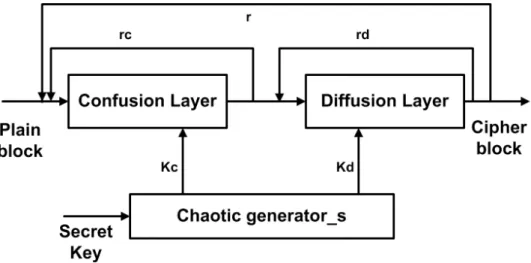
All chaos-based and non chaos cryptosystems must achieve the confusion and diffusion effects. The confusion effect is measured by how much a change in the secret key affects the ciphered message. The diffusioneffects is measured by how much a change in the plain message affect the ciphered message. In the literature, there are mainly two types of chaos-based cryptosystems. The structure of the first type is composed of two layers: a confusion layer followed by a diffusion layer that work separately (see in Figure 1.1). The confusion process is applied rc times on the block (or on the whole image), then the diffusion process is applied rd times on the output of the confusion process, and finally, the two processes are repeated r times. Both layers required image-scanning (for rc = rd = r =1). Most of chaos-based cryptosystems of first type are considered insecure upon chosen/known plain text attacks. El Assad et al. [42] gave in their paper an overview of main chaos-based cryptosystems of first type. The structure of the second type of cryptosystems is similar to the structure of the first type of cryptosys-tems, but the confusion and diffusion processes are performed sequentially on each pixel of the plain block or plain image as shown in Figure1.2. This type of cryptosystems are more efficient, in terms of security and speed performance, than the first type of cryptosystems. Indeed, first, the diffusion process at the pixel level is governed by the confusion process, second, a single scan of plain image pixels is needed to perform the confusion and diffusion effects.
26 CHAPTER 1. STATE-OF-THE-ART
Figure 1.1 – General structure of chaos-based cryptosystems
Yang et al. [38], used a permutation operation, as a confusion layer, achieved by a modified
Figure 1.2 – Dependent diffusion structure of chaos-based cryptosystems
standard map to avoid the problem of permutation of the corner pixel (s = 0, t = 0), while using a logistic map as a diffusion layer. In addition a keyed hash function is used to generate a 128 − bit hash value from both the plain image and the secret hash keys. The hash value plays the role of the key for encryption and decryption while the secret hash keys are used to authenticate the decrypted image. In their paper, Wang et al.[40] introduced the idea of mixing the two layers of permutation and diffusion into a single layer of dependent permutation-diffusion. As a result, one image scanning is required in-stead of two scanning stages, to accelerate the encryption algorithm.
In Zhang’s model [41], two cryptosystems were designed based on the architecture of Figure1.2. The first one consists of a dependent diffusion layer based on the reverse 2-D cat map. The second algorithm presents new conversion from a pseudo-random position to another pseudo-random one for the confusion effect. The diffusion layer in the cryptosystems is based on the logistic map. In these versions, Zhang tried to achieve the confusion and the diffusion effects sequentially. Farajallah [1,39] proposed an efficient cryptosystem with a very high speed compared to the main chaos-based cryptosystem of the literature.
1.3.2
Stream ciphers
A typical stream cipher encrypts plaintext one byte at a time, although a stream cipher can be designed to encrypt one bit at a time or on units larger than a byte at a time. Figure1.3 represents a stream cipher
1.3. ENCRYPTION SCHEMES 27
Pseudo Random Generator (Key stream generator)
Plain Text + K Key Cipher Text Pseudo Random Generator (Key stream generator)
K Key + Plain Text
Encryption
Decryption
Figure 1.3 – Stream cipher diagram.
structure diagram. In this structure, a key is an input to a pseudo-random bit generator that produces a stream of specified bit numbers that are apparently random. The output of the generator, called a keystream sequences, combines one byte at a time with the plaintext stream using the bitwise exclusive-OR (XOR) operation to produce a ciphertext. Three design considerations must be taken into account when we design a stream cipher algorithm [43]:
1. The keystream sequence should have a large period. A pseudo-random number generator uses a function that produces a deterministic stream of bits that may repeat. The longer the period of repeat the more difficult it will be to do cryptanalysis.
2. The more random the keystream is, the more randomized the ciphertext is, making cryptanalysis more difficult.
3. The key needs to be sufficiently long in order to guard against brute-force attacks.
In the following we recall the main related works in standard and chaos-based stream ciphers. 1.3.2.1 AES-CTR and eSTREAM software
AES-CTR Mode
Counter mode, a standard introduced by Diffie and Hellman in 1979, is one of the best known modes used for stream ciphers. Counter mode switches a block cipher into a stream one. It generates the next keystream block by encrypting successive values of a counter. After each block encryption, the counter must be different and this can be done simply by incrementation of the counter by some constant, typically one. CTR mode has significant efficiency advantages over the Cipher Feedback (CFB) and Output Feed-back (OFB) modes without weakening the security. In particular its tight security has been proven. On the other hand most of the perceived disadvantages of CTR mode are not valid criticisms, but rather caused by a lack of knowledge [44].
28 CHAPTER 1. STATE-OF-THE-ART
Rabbit
Rabbitis a stream cipher algorithm developed in 2004 as a fast software encryption method. It is one of the most effective algorithm proposed in the eSTREAM project. Rabbit is directed to be used in both software and hardware applications. The Rabbit algorithm takes a 128-bit key and a 64-bit IV vector as input. At each iteration, it generates a 128-bit output. The output is pseudo-random in its nature. The heart of this cipher consists of 513 internal state bits. clearly the output generated in each iteration is some com-bination of these state-bits. The 513 bits are divided into eight 32-bit state variables, eight 32-bit counters and one counter carry bit. The state functions which update these state variables are non-linear and thus build the basis of the security provided by this cipher [45,46]. The designers provided the security analysis considering several possible attacks: algebraic, correlation, and statistical attacks. They conclude that no huge weakness of Rabbit has been found. However in 2009, Kircanski and Youssef in their paper [47] provide a differential fault analysis attack on Rabbit algorithm. The fault model in which they analyse the cipher is the one in which the attacker is assumed to be able to fault a random bit of the internal state. The attack requires around 128-256 faults, a precomputed table of size around 241.6 bytes, and enables to recover the complete internal state of Rabbit in about 238steps.
Salsa20/r
Salsa20/ris one of the eSTREAM finalist algorithms for software implementation, where r = 8, 12, 20 represents the number of iterations of the round function. The algorithm is constructed on a pseudo-random function based on a 32-bit addition, bitwise XOR and rotation operations, which maps a 256-bit key, a 64-bit nonce (IV initial vector), and a 64-bit stream position to a 512-bit output [46, 48]. The Salsa20/8 version is very fast but not secure enough. Its weakness comes from a differential cryptanalysis performed by Tsunoo et al. [49]. Salsa20/12 and Salsa20/20 algorithms seem to be secure so far, because no better attack than the brute-force attack has been reported.
HC-128 and HC-256
HC-128 is an efficient software stream cipher, which consists of two secret tables, each one with 512 32-bit elements. At each step they update one element from one of the two tables using a non-linear feed-back function. All the elements of the two tables are updated every 1024 steps. At each step, one 32-bit output is generated from the non-linear output function. HC-256 is a new version that differs from HC-128 by the size of secret tables which is 1024 32-bit elements instead of 512 32-bit ones. All the elements of the two tables are updated every 2048 steps. At each step, HC-256 produces one 32-bit output [46,50,51]. However, in 2010, the authors in [52] provide a differential fault analysis attack on HC-128. The attack is based on the fact that, some of the inner state words of HC-128 may be exploited several times without being updated. Consequently, the complete internal state is recovered using about 7968 faults.
SOSEMANUK
SOSEMANUK is a software stream cipher that has a key length ranging from 128 to 256 bits. It takes an initial value IV vector of 128 bits, and has two main components: a linear feedback register (LFSR) and a finite state machine (FSM). The LFSR operates on 32-bit words and at every clock a new 32-bit word is computed. The FSM has two 32-bit memory registers: at each step the FSM takes an input word from the LFSR, updates the memory registers and produces a 32-bit output [46,53]. In 2011 the authors in [54] made a differential attack on SOSEMANUK. The attack needed around 6144 faults to recover the secret inner state of the cipher.
1.3. ENCRYPTION SCHEMES 29 1.3.2.2 Chaos-based stream ciphers related work
Abderrahim et al.[55] in their paper proposed a chaos-based stream cipher based on symbolic dynamic description and synchronization. Their main contribution concerns a pseudo-random number gen-erator (PRNG) based on an appropriate mixture of perturbed chaotic maps. The synchronization of the emitter/receiver is performed by a symbolic dynamic-based method. One of the characteristics of their pro-posed stream cipher is that the chaotic symbolic dynamic sequences are easy to produce. The obtained bit rate, with an Intel Core i7 processor clocked at 3.5 GHz, and 8Gb of RAM is 10 Mbps.
Lu et al.[56], proposed a one-way-coupled chaotic map lattice for cryptography of a self-synchronizing stream cipher. The system performs the computation into real numbers, and incorporates some algebraic operations on integer numbers. The encryption/decryption operations is done in parallel using multiple chaotic maps. The authors claim that the system has a good security level, and good reliability against strong channel noise. They provide an encryption speed (around 914 Mbps on a 2 GHz CPU).
In 2007 li et al. [57] published a stream cipher also based on a spatiotemporal chaotic system as done previously in [56]. The chaotic system uses coupled logistic maps, and simple algebraic computations. The system produces parallel keystreams for encrypting plaintexts via bitwise XOR. The encryption speed is 700 Mbits in a computer with a 1.8 GHz CPU and 1.5 GB RAM. Security analysis is performed to prove the robustness of the system. However, the cryptosystem displays weakness in the keystream generation [57]. The encryption is made by generating a keystream mixed with blocks generated from the plaintext. The obtained keystream remains identical for every encryption procedure. Moreover, its generation does neither depend on the plaintext nor on the ciphertext, that’s to say, the keystream remains unmodified for every plaintext with the same length. Knowing the keystream leads to guessing the key. These drawbacks are detailed in [58].
Shubo et al. [59] presented an improved chaos-based stream cipher algorithm based on discrete chaotic maps. In this algorithm, one logistic chaotic system generates the random changing parameter to control the parameter of the other. The algorithm only disturbs the control parameter of the chaotic system. The VLSI architecture with low hardware cost and fast speed is designed, and the FPGA realization is shown. The encryption speed is 571.429 Mbps with an AMD Athlon(tm) 64 X2 Dual Core processor.
In 2007, Fu et al. [60] designed a chaotic stream cipher relies on logistic map. They claimed that this cipher could resist various common attack methods. In [61], the security of Fu’s chaotic cipher is analysed and the information leak of chaotic map is indicated. They succeeded to guess the initial state and obtained two sampling quantified sequences which are generated by other two chaos initial states. A compression attack is proposed to recover the chaos initial state from sampling quantified sequence.
Yin et al. [62] published a new stream cipher with the discretized coupled map lattices (CML) which operates on binary numbers. CML have been recently used to construct ciphers. However, the complicated operations on real numbers make these CML-based ciphers difficult to analyze.
In 2016, Jalloulli et al. [63] part of our research team members in IETR laboratory, proposed a Pseudo random chaotic generator (PCNG). In the following subsections we will provide in detail the structure and the computation performance of this PCNG.
1.3.2.3 Jallouli et al. PCNG
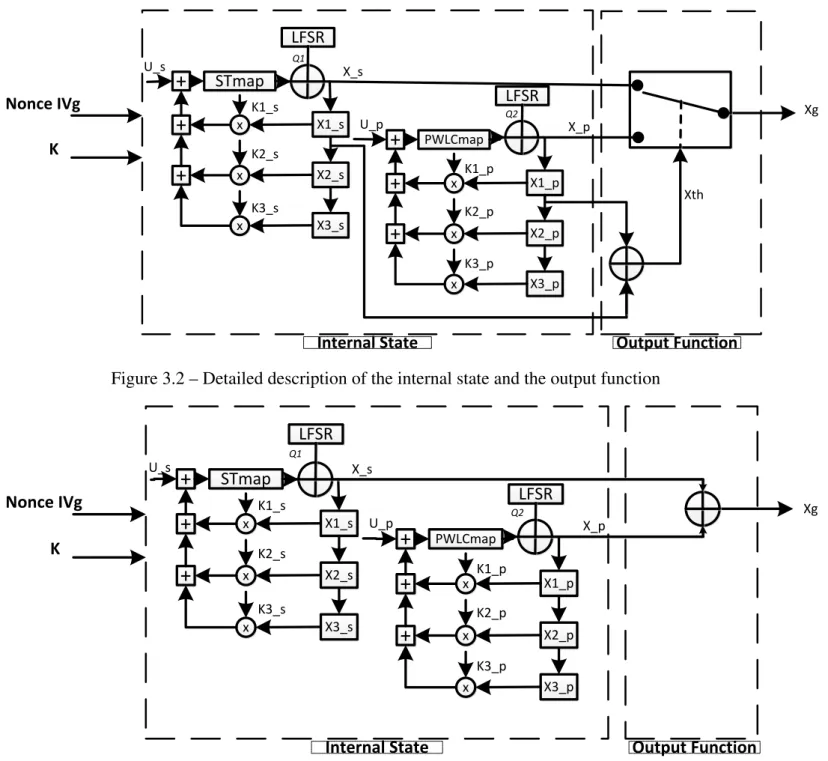
The structure of the PCNG is presented in Figure1.4. It uses four coupled chaotic maps (two PWLCM maps, STmap and Logistic map) and includes a multiplexing chaotic technique [63]. The secret key of the system is formed by:
— The initial conditions Xp1, Xs, Xp2 and Xl of the four chaotic maps: (PWLCmap1, STmap, PWLCmap2 and Logistic respectively), ranging from 1 to 2N-1,
— The control parameter Pp1, Ps and Pp2 of PWLCmap1, STmap and PWLCmap2, in the range [1, 2N −1− 1], [1, 2N − 1] and [1, 2N −1− 1] respectively.
30 CHAPTER 1. STATE-OF-THE-ART
Figure 1.4 – The architecture of the PCNG2.
— First, the initial values Xp1(0), Xs(0), Xp2(0) and Xl(0) of the four chaotic maps (PWLCmap1, STmap, PWLCmap2 and Logistic respectively) are calculated by:
Xp1(0) = Xp ⊕ IV p1 Xs(0) = Xs ⊕ IV s Xp2(0) = Xp ⊕ IV p2 Xl(0) = Xl ⊕ IV l (1.1) where IV p1 = lsb(IV ) IV s = Lcir[lsb(IV ), 3] IV p2 = Lcir[IV s, 3] IV l = Lcir[lsb(IV ), 2] (1.2)
with ⊕ denotes the XOR operator, lsb(IV ) is the 32 least significant bits of IV and Lcir[S, q]
performs the q-bits left circular shift on the binary sequence S.
— Second, the four chaotic maps are coupled by a binary diffusion matrix to produce the future samples Xp1(n), Xs(n), Xp2(n) and Xl(n) from which the output function produces the output sequence X(n), by using a chaotic switching technique.
The equation of the system is given by: Xp1(n) Xs(n) Xp2(n) Xl(n) = D F p[Xp1(n − 1)] F s[Xs(n − 1)] F p[Xp2(n − 1)] F l[Xl(n − 1)] . (1.3)
where D is the binary diffusion matrix:
D = 1 1 1 0 1 1 0 1 1 0 1 1 0 1 1 1 . (1.4)
and is the operator defined as we can see in the following equation : Xp1(n) Xs(n) Xp2(n) Xl(n) = F p[Xp1(n − 1)] ⊕ F s[Xs(n − 1)] ⊕ F p[Xp2(n − 1)] F p[Xp1(n − 1)] ⊕ F s[Xs(n − 1)] ⊕ F l[Xl(n − 1)] F p[Xp1(n − 1)] ⊕ F p[Xp2(n − 1)] ⊕ F l[Xl(n − 1)] F s[Xs(n − 1)] ⊕ F p[Xp2(n − 1)] ⊕ F l[Xl(n − 1)] . (1.5)
1.3. ENCRYPTION SCHEMES 31 The obtained samples of the sequence X(n) are controlled by the chaotic switching technique, using the obtained sample Xl(n) and two threshold T h1 and T h2, defined as follows:
X(n) = Xp1(n), if 0 < Xl(n) < T h1 Xs(n), if T h1 ≤ Xl(n) < T h2 Xp2(n), otherwise (1.6) where T h1 = 0.8 × 2N and T h2 = 0.9 × 2N. Computing performance
The experiment is made using a two 32-bit multicore Intel Core(TM) i5 processors running at 2.60 GHz with 16 Gb of main memory. This hardware platform was used on top of an Ubuntu 14.04 Trusty Linux distribution, and the programming is performed in C code. Authors provide, for different sizes of data bytes, the average generation time in micro second GT(µs), the average bit rate en Mega bit par second BR(Mbit/s), and the average of the needed number of cycles to generate one byte, NCpB(Cycles/B). The average is calculated by using 100 different secret keys. The results obtained in Table1.1has a little bit better computing performance than our proposed generator of Chapter3 since our PCNG uses a recursive cell structure with one order (delay 1).
Table 1.1 – Computation performance.
Data (Bytes) GT(µs) BR(M bit/s) NCpB(Cycles/B)
64 2 171.81 121.06 128 4 212.44 97.91 256 8 255.36 81.45 512 13 306.12 67.9 1024 23 348.445 59.69 2048 46 349.11 59.58 4096 52 621.07 33.49 16384 196 666.35 31.21 32768 338 774.13 26.87 65536 654 801.61 25.95 125000 1179 804.68 25.95 196608 1600 982.54 21.17 393216 2801 1122.67 18.53 786432 4237 1484.75 14.01 3145728 16727 1504.48 13.83 12582912 66666 1509.95 13.78 Structure of the Jallouli et al. PCNG
We first present the structure of the Jallouli et al. PCNG, then we discuss its computing performance and finally present its security analysis. We report below the security analysis in terms of key size, keystream attack and key sensitivity attack.
The Key size of the PCNG composed of all initial conditions and parameters is large enough to resist the brute force attack. |K| = 4 × 32 + 32 + 2 × 31 = 222 bits.
32 CHAPTER 1. STATE-OF-THE-ART In order to verify key sensitivity, they calculate the Hamming Distance (HD) of two sequences gen-erated with only one bit change (lsb bit) in the parameter X_p. The calculation is performed between two sequences over 100 random secret keys.
The obtained average value of Hamming distance is equal to 0.499887. This value is close to the optimal value of 50%, which indicated the high sensitivity on one bit change in the secret key.
Mapping and Histogram
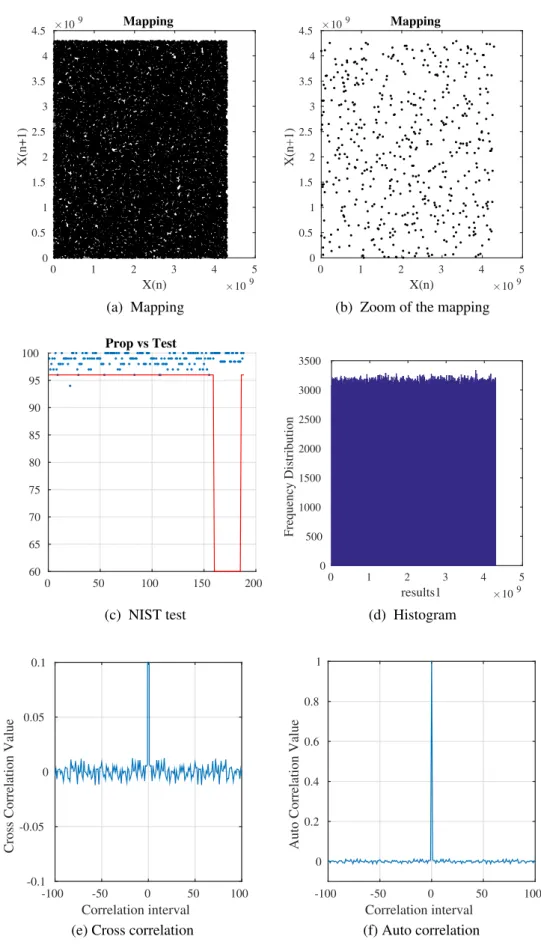
The Mapping indicates the dynamic attitude of the system. The resulting mapping of a given produced sequence appears random in comparison with a mapping nature of a known map (see Figure1.5).
A practical PCNG must produce sequences that have uniform distribution in the whole phase space. Visu-ally, the obtained histogram in Figure1.5for a given generated sequence is uniform. To confirm this result they applied the Chi-Square and they obtained 1030.832 as an experimental value, which is smaller than the theoretical value 1073.642651, then the histogram is uniform. Notice that, the uniformity of a sequence generated by our proposed PCNG of Chapter3, is better than one produced by Jalloulli et al. PCNG. Indeed, when the experimental value of Chi-Square is smaller than the theoretical one; this means that the uni-formity of the generated sequence is better.
Auto and Cross-correlation
One of good property of a PCNG is that, the generated sequences must be uncorrelated. Thus, the cross-correlation of two sequences x and y (generated with slightly different keys) must be close to zero (addi-tional details are reported in Chapter 3). Figure1.5 shows that the sequences produced by Jalloulli et al. PCNGare not correlated.
NIST Test
The National Institute of Standards and Technology (NIST) test is a statistical package that consists of 188 tests and sub-tests that were proposed in order to confirm the randomness of an arbitrarily long binary sequences (more details regarding NIST test are clarified in Chapter 3). Figure 1.5 gives the results for sequences generated by Jalloulli et al. PCNG. As we can see only one sub-test is not passed. In contrast, sequences in our proposed PCNG of Chapter 3 have successfully passed all the NIST tests. Therefore, the proposed chaotic generator PCNGs of Chapter 3 is robust against statistical attacks and its security performance are better than the Jallulli et al. PCNG.
1.4
Real time applications
A real-time application (RTA) is an application software that works within a time frame that the user senses as immediate or current. Thus, time expressed as a resource of fundamental concern in real-time systems, and tasks must be scheduled and executed to meet their timeliness concerns. Examples of such RTA resources are IP-telephony, XoIP, video conferencing, Video on Demand (VOD) and Audio Video on Demand(AVOD). Real-time system software’s are more and more often. In this case, one of the crucial challenges is to synchronize multiple concurrent tasks. Additionally, many real-time systems play a high impact role in their environments and failure to perform correctly may result in significant costs or human risks. Thus, real-time systems must also be highly reliable (i.e., they must be deployed correctly), and available (i.e., they must work continuously) [64,65,66].
Furthermore, many real-time systems is that they are belong to embedded systems, i.e., they are ingredients of a larger system that contacts with the physical world. This is often the main source of complexity in
1.4. REAL TIME APPLICATIONS 33 X(n) ×109 0 1 2 3 4 5 X(n+1) ×109 0 0.5 1 1.5 2 2.5 3 3.5 4 4.5 Mapping (a) Mapping X(n) ×109 0 1 2 3 4 5 X(n+1) ×109 0 0.5 1 1.5 2 2.5 3 3.5 4 4.5 Mapping
(b) Zoom of the mapping
0 50 100 150 200 60 65 70 75 80 85 90 95 100 Prop vs Test (c) NIST test results1 ×109 0 1 2 3 4 5 Frequency Distribution 0 500 1000 1500 2000 2500 3000 3500 (d) Histogram Correlation interval -100 -50 0 50 100
Cross Correlation Value
-0.1 -0.05 0 0.05
0.1
(e) Cross correlation
Correlation interval
-100 -50 0 50 100
Auto Correlation Value
0 0.2 0.4 0.6 0.8 1 (f) Auto correlation
34 CHAPTER 1. STATE-OF-THE-ART real-time systems.
An embedded system is an integration between electronic and computer system designed to serve a par-ticular purpose, like microwave ovens, washing machines, dishwashers, pacemakers and digital cameras. The most important hardware components are the processing elements that are responsible both for control-ling and driving the embedded system, and for performing its computation. For complicated and intensive systems, like audio and video Digital Signal Processing (DSP) systems, specialized processors with a high computational power for a limited cost are used. The first embedded systems were composed of differ-ent hardware compondiffer-ents, and were used only for military and space exploration projects. Progressively, the miniaturization of integrated circuits led to the integration of more and more hardware components within a single chip called a System-on-Chip (SoC). Nowadays, embedded systems are often based on het-erogeneous Multiprocessor Systems-on-Chips (MPSoCs). An hethet-erogeneous MPSoC interconnect all the elements of an embedded system. In RTA the system must perform its function within specified time limits. Moreover, it should be reactive. The system is continuously responding to events from the external environ-ment. Multi-threading approach aims to increase utilization of a single core by using thread-level as well as instruction-level parallelism. For that reason we will use parallel and efficient implementation techniques to develop new cryptosystems for image/video encryption that are suitable for RTA [67,68,69,70,71].
1.5
High efficiency video coding (HEVC)
High Efficiency Video Coding (HEVC)is the last video coding standard issued by the ITU-T Video Cod-ing Experts Group (VCEG) and the ISO/IEC MovCod-ing Picture Experts Group (MPEG) [2, 72]. The main objective of the HEVC standardization efforts is to enable 50% bitrate reduction for similar video quality [73], compared to its predecessor H.264/AVC [74]. In the upcoming years, HEVC is expected to replace the previous video coding standards in the emerging applications, such as High Dynamic Range (HDR), Virtual Reality (VR), High Frame Rate (HFR), High Resolutions (4K, 8K), etc. In such applications, multimedia contents security and confidentiality are of paramount importance for copyright and privacy protection. Thus, a huge work has been devoted for these purposes in the last decade [19, 20,21, 75, 76, 77, 78, 79, 80,81]. In this section we provide a brief overview on HEVC encoder and we recall some work directed to encrypt video in HEVC codec.
1.5.1
HEVC tools
Several tools defined in the HEVC standard enable a bit-rate saving of 50%-60% with respect to the H.264/AVC. These new tools provide larger coding blocks, quad-tree block partitioning, more accurate Intra and Inter predictions, optimized entropy coding and the new in-loop Sample Adaptive Offset (SAO) filter. Video compression consists in removing spatial and temporal redundancies in the video and thus, it considerably decreases the required data to represent the video. The video compression processes in HEVC is shown in Figure1.6. The HEVC frame is split into coding tree units (CTUs) of fixed sizes, from 16x16 up to 64x64. Each CTU can be recursively split in a quad-tree structure to Coding Units (CU)s. CUs are the basic unit of the prediction in HEVC. These CUs are composed of three Coding Blocks CBs (one luma, and two chroma) in 4:2:0 colour format representation. Figure1.7demonstrates the partitioning process in HEVC. The decision to use intra or inter prediction is performed at the CU level. CUs are predicted in intra mode from reconstructed neighbouring samples in the same slice. For I slices, only intra prediction mode is used, while in P and B slices CUs can be in intra or inter prediction mode [2, 82]. In our thesis work, we focus on three used tools in HEVC, including entropy coding, Intra prediction mode and parallel tools in HEVC (tiling concept). In Chapter4we will use these three tools to provide a selective encryption for video contents.
1.5. HIGH EFFICIENCY VIDEO CODING (HEVC) 35
Figure 1.6 – HEVC video encoder [2].
1.5.1.1 Intra prediction
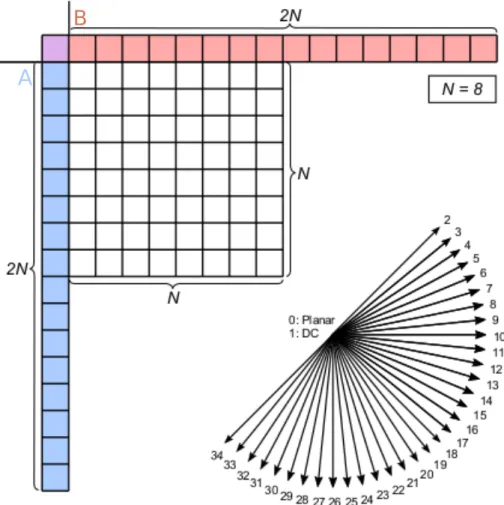
HEVC encoder enables higher compression efficiency partly by offering 35 intra prediction modes (IPM). As illustrated in Figure1.8, these modes are composed of 33 Intra_Angular prediction modes (from 2 → 34), the Intra_Planer mode (mode 0) and the Intra_DC prediction mode (mode 1). For an efficient coding of the 35 IPMs, a list of the Most Probable Mode (MPM) is defined in HEVC. This list of three modes is derived from the Intra prediction modes of the neighbouring blocks. Three syntax elements are used to signal the Intra prediction mode for luma prediction block in the bitstream. The first flag is signalled to determine if one of the MPM is used. In this case, the second flag (one bit for the first MPM and two bits for the two last MPMs) is signalled to indicated which of the last MPM is selected. The 32 remaining modes outside the MPM list are coded by a fixed-length 5-bin value that are bypass coded. Table1.2provides the coded scheme for the luma IPMs, MPM0, MPM1 and MPM2 coded by 2, 3, and 3 bits respectively, the first bit in red color is codded using a CABAC context and other bins are bypassed.
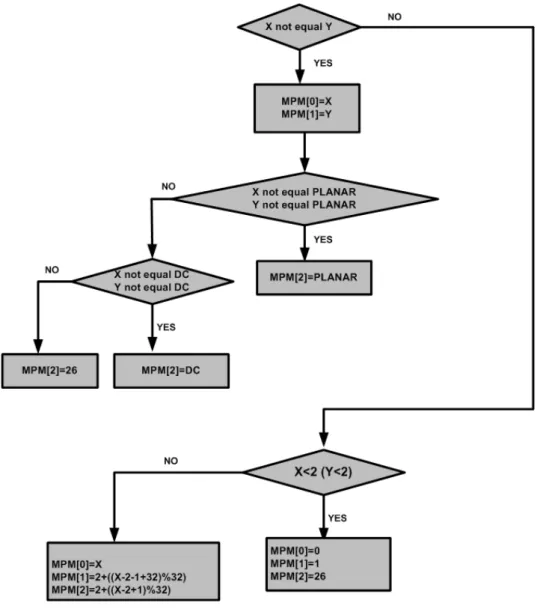
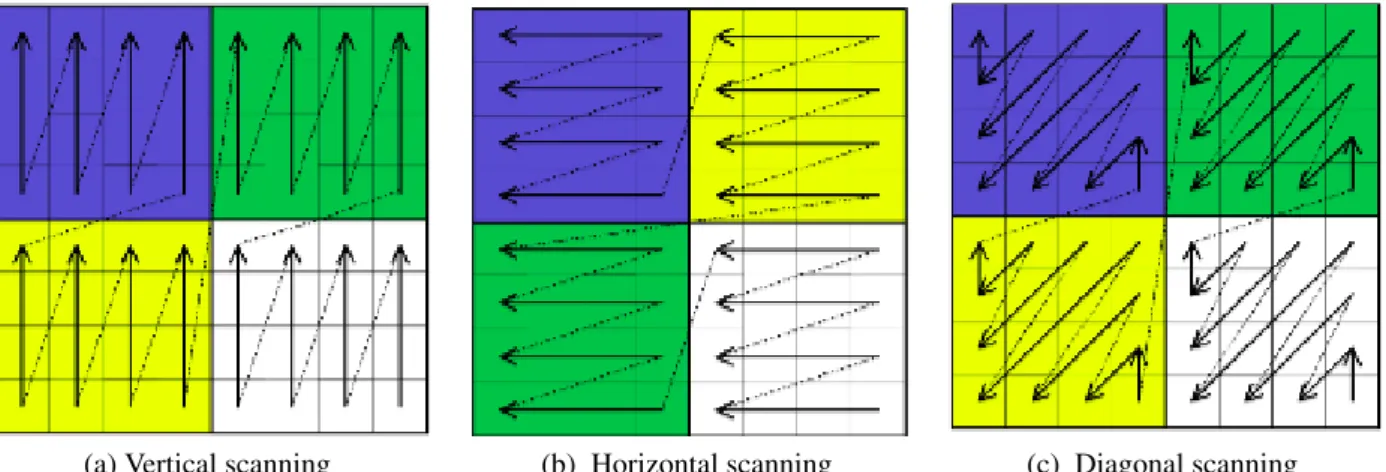
Figure1.9indicates the neighboring intra prediction mode of left and top prediction unit (PU), the two MPM are X and Y in case of X equal to Y, and the third MPM is planar in case of neither of X or Y is planar, otherwise is set to DC in case of neither X and Y is DC, otherwise is set to intra angular 26. In case that X equal to Y and X,Y greater than 2 (not angular), the three MPM are set to Planar, DC, 26 [2]. An adaptive scanningmethod is applied in the HEVC for transform coefficients, which is used with the block sizes of 4 × 4 and 8 × 8 to benefit from the statistical distribution of the active coefficients in 2-D transform blocks. Angular (6-14) modes use vertical scan, Angular (22-30) modes use Horizontal scan, and the other modes refer to diagonal scanning (see Figure1.10). The derivation process of chroma IPMs may come from the luma one, as clarified in Table1.3 [2,83].
1.5.1.2 Inter prediction
Inter predictionuses available reconstructed pictures before as an indicator for motion compen-sation which is the key tool to represent the video contents. Using the block-wise displacements between
36 CHAPTER 1. STATE-OF-THE-ART
1.5. HIGH EFFICIENCY VIDEO CODING (HEVC) 37
A
B
Figure 1.8 – Intra prediction modes on HEVC.
Table 1.2 – Used coding scheme for IPMs in HEVC. The first bit is coded using a CABAC context. Number of bits Code Coded Mode
2 10 MPM0 3 110 MPM1 3 111 MPM2 000000 6 ... 32 remaining IPMs 011111
positions in the current picture and previously encoded one we can determine the changes between suc-cessive pictures. Motion estimation is the process of finding the best match choices between the current Prediction Block (PB) and an area in previous or following frames. The encoder may choose to do this in order to predict the same picture with different weights (weighted prediction). HEVC uses candidate list indexing. Motion Vector MV is a vector which specifies the moving direction of the predicted block, by calculating the difference between the current PB and the reference one. There are two Motion Vector (MV prediction modes): Merge and AMVP (advanced motion vector prediction) [2].
1.5.1.3 Transformation and Quantization
Transformation and quantization on HEVC are determined using fixed-point integer oper-ations with output and intermediate values not being more than 16-bit word length. HEVC have four
38 CHAPTER 1. STATE-OF-THE-ART
Figure 1.9 – Derivation process of the three most probable modes. Table 1.3 – Derivation process of the chroma intra prediction mode
Intra_chroma_pred_mode Luma Intra Pred Mode
0 26 10 1
Planar (i.e., mode-0) 34 0 0 0 Angular (i.e., mode-26) 26 34 26 26
Angular(i.e., mode-10) 10 10 34 10 DC (i.e., mode-1) 1 1 1 34 Derived (i.e., use the luma mode) 0 26 10 1
transform sizes: 4x4, 8x8, 16x16 and 32x32. Like AVC, the transforms are integer transforms based on the Discrete Cosine Transform (DCT). The derivation process of the 4 × 4 luma intra-prediction is based on the Discrete Sine Transform (DST). The basis matrix uses coefficients requiring seven bits storage, so it is more accurate than AVC. HEVC introduces several new features and tools for the trans-form coefficient coding to help improve upon H.264/AVC: dependent coefficient scanning, last significant
1.5. HIGH EFFICIENCY VIDEO CODING (HEVC) 39
(a) Vertical scanning (b) Horizontal scanning (c) Diagonal scanning
Figure 1.10 – Scanning mode on the HEVC .
coefficient coding, multilevel significance maps, improved significance flag context modeling, and sign data hiding. HEVC followed a development process in which it was iteratively refined to improve coding effi-ciency and suitability for hardware and software implementation. The quantization process in the HEVC uses the same scheme as the one used in the AVC: Uniform Reconstruction Quantization (URQ)scheme. This scheme is controlled by the Quantization Parameter (QP) [2].
1.5.1.4 HEVC entropy coding
HEVC performs entropy coding using Context based adaptive binary arithmetic (CABAC). The CABAC mechanism consists of three main functions: binarization, context modeling and arithmetic coding [84]. The binarization function in first step converts syntax elements to binary symbols (bin). Subsequently, the context modeling updates the probabilities of bins, and finally the arithmetic coding compresses the bins into bits according to the estimated probabilities. Five binarization methods are used in HEVC: Unary (U), Truncated Unary (TU), Fixed Length (FL), Truncated Rice code with an adap-tive context p (TRp) and the kth-order Exp-Golomb(EGk) codes. The arithmetic coder can be performed either by a context coded which is the estimated probability of a syntax element or by bypass coded that considers equal probability of 0.5 for each bin.
The three main functions of the CABAC are shown in Figure1.11. As illustrated in this figure, the for-mat compliant selective encryption (encrypt the sensitive inforfor-mation of the video contents), is performed between binarization and arithmetic coding.
Binarization Context Modeling Context Bypass Arithmetic coding Syntax elements bins Bitstream


![Figure 1.6 – HEVC video encoder [2].](https://thumb-eu.123doks.com/thumbv2/123doknet/14495170.718181/36.892.94.794.85.515/figure-hevc-video-encoder.webp)