HAL Id: tel-03200707
https://hal.archives-ouvertes.fr/tel-03200707
Submitted on 16 Apr 2021HAL is a multi-disciplinary open access archive for the deposit and dissemination of sci-entific research documents, whether they are pub-lished or not. The documents may come from teaching and research institutions in France or
L’archive ouverte pluridisciplinaire HAL, est destinée au dépôt et à la diffusion de documents scientifiques de niveau recherche, publiés ou non, émanant des établissements d’enseignement et de recherche français ou étrangers, des laboratoires
encryption
Zongchao Qiao
To cite this version:
Zongchao Qiao. Nonlinear dynamics, applications to chaos-based encryption. Cryptography and Security [cs.CR]. École centrale de Nantes, 2021. English. �NNT : 2021ECDN0016�. �tel-03200707�
T
HESE DE DOCTORAT DE
L'ÉCOLE
CENTRALE
DE
NANTES
ECOLE DOCTORALE N°601
Mathématiques et Sciences et Technologies de l'Information et de la Communication
Spécialité : Automatique, Productique et Robotique
Nonlinear dynamics, applications to chaos-based encryption
Thèse présentée et soutenue à Nantes, le 25 Février 2021
Unité de recherche : Laboratoire des Sciences du Numérique de Nantes (LS2N) UMR CNRS 6004 Par
Zongchao QIAO
Rapporteurs avant soutenance :
Danièle FOURNIER-PRUNARET Professeure des universités, INSA Toulouse
Moulay AZIZ-ALAOUI Professeur des universités, Université Le Havre Normandie
Composition du Jury :
Président : Christophe GUYEUX Professeur des universités, IUT Belfort-Montbéliard, Belfort
Examinateurs : Safwan EL ASSAD Maître de conférences HDR, Polytechnique Nantes
Danièle FOURNIER-PRUNARET Professeure des universités, INSA Toulouse
Moulay AZIZ-ALAOUI Professeur des universités, Université Le Havre Normandie
Mazen SAAD Professeur des universités, École Centrale de Nantes
Ina TARALOVA Maître de conférences, École Centrale de Nantes
Dir. de thèse : Mazen SAAD Professeur des universités, École Centrale de Nantes
First and foremost, I would like to express my deepest gratitude to my superior, Asso-ciate Professor Ina Taralova, for her patience, warm encouragement and helpful guidance during the three years of my PhD study at Ecole Centrale de Nantes. I would also like to thank my director of the thesis, Professor Mazen Saad, for all his help and guidance. Their positive feedback always motivated me to pursue the best.
Many thanks to Professor Safwan El Assad who gave me lots of help and valuable suggestions. Also, I would like to thank Professor Danièle Fournier-Prunaret for her useful remarks in the frame of the CST (Comité de Suivi de Thèse).
I would also thank all my colleagues and staffs in group COMMANDE (Control) and laboratory LS2N for their help and support. Thank Ecole Centrale de Nantes that provided me with a great environment for working with the excellent researchers. Many thanks to my friends for their warm company and encouragement.
Besides, I would like to thank China Scholarship Council (CSC) for giving me the precious opportunity to work on such an interesting topic, and also Chinese Embassy for the care and concern during the three years, especially when we were under the threaten of COVID-19 pandemic.
I would also like to thank the reviewers of my thesis : Prof. Fournier-Prunaret and Prof. Alaoui, for their invaluable time, helpful comments and suggestions.
Finally, my sincere gratefulness goes to my family, especially my husband, for his un-conditional love, continuous support, and constant encouragement, which makes me brave and confident to face the challenges in my academic research.
Les systèmes chaotiques présentent des comportements dynamiques non-linéaires com-plexes. Leurs propriétés spécifiques, comme l’ergodicité, la propriété de mélange topolo-gique, les caractéristiques proches de celles d’un signal aléatoire, la forte sensibilité aux conditions et paramètres initiaux correspondent aux les exigences cryptographiques fon-damentales des algorithmes de cryptage sécurisés, c’est-à-dire la confusion et la diffusion, selon la théorie de la sécurité de l’information de Shannon. De ce fait, la cryptographie ba-sée sur le chaos est un excellent candidat pour la conception de crypto systèmes modernes, sécurisés et fiables.
Dans cette thèse, les spécificités des systèmes chaotiques, ainsi que les méthodes et outils pour leur analyse tels les points fixes et périodiques, les attracteurs chaotiques, les diagrammes de bifurcation, les bassins d’attraction, les exposants de Lyapunov etc, ont été revus du point de vue de la cryptographie. Grâce à cette analyse, nous avons souligné que dans le cas des applications cryptographiques, certaines caractéristiques spécifiques de ces systèmes, comme la chaoticité et la sensibilité aux conditions initiales doivent être amplifiées, tandis que d’autres caractéristiques comme certaines singularités (points fixes) doivent être évitées, ou remodelées (densité de probabilité de la fonction chaotique) pour satisfaire aux critères de sécurité.
Les crypto systèmes basés sur le chaos tirent pleinement parti de la dynamique chao-tique pour obtenir des performances de confusion et de diffusion satisfaisantes. La confu-sion signifie une relation complexe entre le texte chiffré, la clé secrète et le texte, tandis que la diffusion souligne la grande sensibilité du texte chiffré au texte original. Cela si-gnifie qu’un petit changement dans le texte original (par exemple, un pixel dans l’image originelle) entraînera une différence significative dans le texte chiffré.
Les crypto systèmes basés sur le chaos peuvent être classés en chiffrement par flux et chiffrement par blocs. Les chiffrements par blocs chiffrent le texte bloc par bloc pour ob-tenir de bonnes performances de confusion et de diffusion. Le flux de clés produit par un Générateur de Nombres Pseudo-Chaotiques (PCNG) est utilisé pour supporter les opéra-tions de confusion et de diffusion. Un chiffrement par bloc sécurisé nécessite une structure complexe de confusion et de diffusion et un PCNG cryptographique qui peut générer des
nombres pseudo-chaotiques avec des caractéristiques souhaitées, à la fois chaotiques et pseudo-aléatoires. En revanche, les chiffrements par flux chiffrent le texte en continu en le masquant à l’aide de l’opérateur XOR avec un flux de clé généré par un PCNG. Outre la sécurité, la vitesse élevée est l’autre exigence majeure d’un chiffrement par flux.
Ces dernières années, bien qu’un certain nombre de crypto systèmes basés sur le chaos aient été proposés dans la littérature, beaucoup d’entre eux se sont avérés vulnérables à certains types d’attaques. Les problèmes existent principalement dans les aspects suivants : Pour les chiffrements par blocs basé le chaos, d’une part, des niveaux insuffisants de confusion et de diffusion font que le processus de confusion et de diffusion doit être itéré plusieurs fois pour obtenir des performances de sécurité satisfaisantes, ce qui est inefficace car le message doit être traité plus d’une fois et donc la faible efficacité empêche en principe les chiffrements par blocs d’être appliqués dans les applications en temps réel. D’autre part, une stratégie de confusion et de diffusion pas assez complexe laisse une porte ouverte aux attaquants qui peuvent profiter de ce point faible pour éliminer l’effet de la confusion ou de la diffusion. Cependant, il a été prouvé qu’un schéma de diffusion uniquement ou un schéma de confusion uniquement peut être facilement craqué.
Pour les chiffrements par blocs basés sur le chaos et les chiffrements par flux basés sur le chaos, le PCNG joue un rôle crucial dans leur sécurité, notamment pour le chiffre-ment par flux dont la sécurité dépend fortechiffre-ment du PCNG cryptographique. Un PCNG est conçu sur la base d’opérations appropriées sur plusieurs cartes chaotiques. Il doit conser-ver des caractéristiques chaotiques, i.e. comportement pseudo-aléatoire et forte sensibilité à la clé secrète (composée des conditions initiales et des paramètres des cartes chaotiques adoptées), et présenter un comportement pseudo-aléatoire pour aider les chiffrements à ré-sister à l’attaque en clair choisi, à l’attaque différentielle et à l’attaque statistique. En plus, un PCNG cryptographique nécessite également à un grand espace clé pour contrecarrer l’attaque de force brute. Cependant, dans la littérature existante, certains crypto systèmes publiés basés sur le chaos présentent des failles de sécurité : le flux de clés n’est pas produit par un PCNG et donc le flux de clés ne possède pas de caractéristiques aléatoires, ce qui provoque une fuite d’informations de la clé secrète et conduit ainsi à des failles de sécurité. En outre, certaines PCNGs proposées manquent d’analyse de sécurité complète d’un point de vue cryptographique. Par conséquent, ces PCNG ne peuvent pas être applicables aux crypto systèmes.
Pour tous les crypto systèmes basés sur le chaos, il est inévitable que les cartes chao-tiques utilisées fonctionnant avec précision finie dans les appareils numériques présentent
une dégradation dynamique. Comme la majorité des cartes chaotiques sont basées sur des nombres réels, la plupart des PCNGs proposées utilisent les notations à virgule flottante. Cependant, ce type de données, en particulier format double précision, présente les incon-vénients d’un coût de calcul élevé et d’une utilisation inefficace des ressources. En outre, en raison de la haute sensibilité des systèmes chaotiques et de la nature de précision finie des plates-formes logicielles et matérielles, les erreurs de troncature ou d’arrondi peuvent entraîner une grande différence dans la périodicité des nombres générés, ce qui peut nuire à la fiabilité de la sécurité du PCNG.
En résumé, les problèmes évoqués ci-dessus existent principalement dans la stratégie de confusion et de diffusion, la conception de PCNG cryptographique, et la question de la mise en œuvre (concernant le type de données des cartes chaotiques utilisées et le problème de la dégradation dynamique). Ces trois aspects fonctionnent conjointement pour influencer la qualité d’un crypto système basé sur le chaos.
Dans cette thèse, nous nous concentrons sur la question de l’utilisation de la dyna-mique chaotique en cryptographie visant à proposer de nouveaux crypto systèmes basés sur le chaos et de PCNGs qui soient sécurisés et fiables. Les contributions principales sont résumées ci-dessous.
1. Pour éviter les erreurs de quantification, de troncature ou d’arrondi lors de l’applica-tion numérique, les cartes chaotiques en une dimension (1D) fréquemment utilisées, y compris la carte logistique, la carte de la tente asymétrique, la carte chaotique li-néaire par morceaux (PWLCM) et la carte chaotique d’ordre 3 de Chebyshev ont été reformulés sur un corps fini de N (N = 32) bits. La dégradation dynamique due à la précision finie a été analysée en termes de performances statistiques (période et histogramme) et de la contribution d’espace clé.
Du point de vue de la mise en œuvre, par rapport aux crypto systèmes et PCNGs les plus fréquents qui utilisent les nombres réels avec une double précision, les nou-veaux crypto systèmes et PCNG conçus basés sur les cartes chaotiques d’entiers 32 bits reformulées peuvent non seulement réduire les coûts de calcul et les ressources matérielles, mais également garantir que ces systèmes peuvent être implémentés dans différentes plates-formes d’exploitation en évitant les problèmes de quantification. 2. Un nouveau chiffrement par flux efficace basé sur le chaos a été développé et évalué
dans [ii,iii]. Il est basé sur un nouveau PCNG sécurisé qui est construit à partir de les fonctions chaotiques reformulées utilisant des nombres entiers, i.e. la carte logistique,
la carte de la tente asymétrique et PWLCM. Le PCNG proposé n’utilise que quatre opérateurs XOR et un mécanisme de multiplexage pour pallier le problème de la dégradation dynamique. Ce PCNG innovant s’avère efficace et facile à mettre en œuvre.
Les tests effectués ont confirmé que le PCNG proposé possède de bonnes propriétés cryptographiques et passe avec succès le test des signaux aléatoires du NIST. En outre, le chiffrement par flux a été vérifié pour être sûr et fiable.
3. Un crypto système basé sur le chaos sécurisé et robuste basé sur des composants chaotiques et la S-box de AES (Advanced Encryption Standard) a été proposé dans [iv]. Il comprend un nouveau PCNG efficace, une diffusion globale et un chiffrement par blocs.
Premièrement, ce PCNG est fondé sur la carte de la tente asymétrique et la carte chaotique d’ordre 3 de Chebyshev. Il peut éliminer le danger caché de détériora-tion de la sécurité causée par la dégradadétériora-tion dynamique et produire le flux de clés pour le schéma de confusion et de diffusion avec de bonnes caractéristiques cryp-tographiques, tels le grand nombre de clés pour empêcher l’attaque par force brute, la haute sensibilité à la clé secrète et le pseudo-aléatoire pour dissimuler la relation entre la clé secrète, le texte et le texte chiffré.
En second lieu, la diffusion globale adopte une diffusion d’addition horizontale (HVD) et une diffusion d’addition verticale (VAD) suivie une cat map deux dimensions (2D) modifiée, qui réalise un bon niveau de diffusion.
De plus, le chiffrement par bloc est basé sur une couche de confusion en utilisant l’AES S-box et une couche de diffusion qui est construite sur la cat map 2D modi-fiée et une opération d’addition clé. Il fonctionne en mode de chaînes de blocs de chiffrement (CBC), ce qui améliore les propriétés de confusion et de diffusion. Les analyses de sécurité et les résultats expérimentaux ont démontré que le crypto système proposé basé sur le chaos a des performances de confusion et de diffusion sécurisées et complexes, et il peut résister aux principales attaques connues avec succès.
4. Le PCNG est crucial pour la sécurité d’un crypto système basé sur le chaos. En dehors de cela, un PCNG est essentiellement un Générateur de Nombres Pseudo-Aléatoires (PRNG). Les PRNG sont des outils importants dans de divers domaines de
l’ingé-nierie. Ainsi, nous avons proposé une méthode de conception de PRNG universel qui est fondée sur un couplage innovant exploré en utilisant des cartes chaotiques sur le champ entier de 32 bits [v].
Cette méthode est fondée sur un couplage innovant. Nous avons analysé des matrices de couplage efficaces pour les schémas de couplage en 2D et 3D, qui « cassent » les orbites originales des cartes chaotiques adoptées et rendent leurs périodes très longues ce qui permet d’améliorer le caractère aléatoire et surmonter efficacement la dégradation dynamique due à l’implémentation numérique.
De plus, deux méthodes de contrôle de sortie, i.e. des méthodes de contrôle de sor-tie alternatives et dynamiques, ont été proposées pour augmenter la complexité des PCNG et améliorer l’imprévisibilité et les caractéristiques aléatoires des nombres pseudo-aléatoires produits.
En outre, étant donné que les PCNG basés sur le schéma de couplage 2D ont la faiblesse d’un nombre de clés réduit, une stratégie de conception de PCNG dont l’espace clé est extensible a été proposée fondée sur la carte de la tente asymétrique. L’espace clé étendu peut aider le crypto système à améliorer la capacité de résistance à l’attaque par force brute [vi,vii].
En résumé, nous avons analysé dans cette thèse les problèmes existants dans les crypto-systèmes basés chaos dans la littérature. Nous avons proposé de nouvelles idées et de nou-veaux schémas pour les surmonter. Les études réalisées ont démontré la sécurité et la fiabi-lité des solutions proposées.
Chaotic systems exhibit complex nonlinear dynamical behavior. Their attractive charac-teristics, such as ergodicity, topological mixing property, random-like behavior, high sensi-tivity to initial conditions and parameters are highly consistent with the primitive cryptogra-phic requirements for secure encryption algorithms, i.e. confusion and diffusion, according to Shannon’s theory of information security, which renders the chaos-based cryptography an excellent candidate for the designs of secure cryptosystems.
In this thesis, the specificities of chaotic systems, together with the methods and tools for their analysis such as fixed and periodic points, chaotic attractors, basins of attraction, bifurcation diagrams, Lyapunov exponents etc have been analyzed and redefined from the perspective of cryptography. Thanks to this analysis, we have pointed out that for cryptogra-phic applications, some specific features of these systems, such as chaoticity and sensitivity to initial conditions must be enhanced, whereas other features related to some singularities (fixed points and their preimages) must be avoided, or reshaped (e.g. unsatisfactory density of probability of the chaotic map) to satisfy the security criteria.
Chaos-based cryptosystems take full advantage of chaotic dynamics to achieve satis-factory confusion and diffusion performances. Confusion means a complex relationship between the ciphertext, the secret key, and the plaintext, while diffusion underlines the high sensitivity of the ciphertext to the plaintext. It means a tiny change in the plaintext will make a significant difference in the ciphertext.
Chaos-based cryptosystems can be classified into block ciphers and stream ciphers. Block ciphers encrypt the plaintext block by block to achieve high confusion and diffusion performance. The key stream produced by a pseudo-chaotic number generator (PCNG) is used to support the confusion and diffusion operations. A secure block cipher requires a complex confusion and diffusion structure and a cryptographic PCNG which can generate pseudo-chaotic numbers with desired chaotic features and pseudo-randomness. By contrast, stream ciphers encrypt the plaintext continuously by masking it using the XOR operator with a key stream generated by a PCNG. Apart from the security, high speed is the other major requirement of a stream cipher.
the literature, many of them have been verified to be vulnerable to certain kinds of attacks. The problems mainly exist in the following aspects.
For chaos-based block ciphers, firstly, the insufficient level of confusion and diffusion makes the confusion and diffusion scheme have to be looped a couple of rounds to achieve a satisfactory security performance, which is inefficient for a block cipher because the plaintext needs to be scanned more than once. Therefore, the low efficiency hinders the block ciphers to be applied in real-time applications. Secondly, an insecure and not complex enough strategy of confusion and diffusion leaves an open door to attackers who can make use of this drawback to remove the confusion or diffusion effect. However, it has been proven that a diffusion-only scheme or a confusion-only scheme can be cracked easily.
For both chaos-based block ciphers and stream ciphers, the PCNG plays a crucial role in their security, especially for the stream cipher whose security depends strongly on the cryptographic PCNG. A PCNG is designed based on proper operations on multiple chaotic maps. It should maintain chaotic features, i.e. random-like behavior and high sensitivity to the secret key (composed by the initial conditions and parameters of the adopted chaotic maps), and exhibit pseudo-randomness to help the ciphers to resist the chosen-plaintext attack, the differential attack, and the statistical attack. In addition to this, a cryptographic PCNG also calls for a large key space to frustrate the brute-force attack. However, in the existing literature, some published chaos-based cryptosystems have security flaws : the key stream is not produced by a PCNG and thus the key stream does not possess randomness features, which causes information leakage of the secret key and thus leads to security vulnerabilities. Furthermore, some proposed PCNGs lack comprehensive security analy-sis from a cryptographic point of view. Hence, these PCNGs cannot be determined to be applicable to encryption systems.
For all chaos-based cryptosystems, it is inevitable that the used chaotic maps operating with finite precision in digital devices show dynamical degradation. Since the majority of the chaotic maps are based on real numbers, most of the proposed PCNGs use floating-point notations. However, this data type, especially the double precision notation, has disadvan-tages of high computation cost and inefficient resource utilization. Also, due to the high sensitivity of the chaotic systems and the finite precision nature of software and hardware platforms, the truncation or round-off errors may cause a big difference in the generated pseudo-chaotic numbers, which may undermine the PCNG’s security reliability.
To sum up, the problems discussed above mainly exist in the strategy of confusion and diffusion, the cryptographic PCNG design, and the issue of implementation (regarding the
datatype of the used chaotic maps and the problem of dynamical degradation). These three aspects work jointly to influence the quality of a chaos-based cryptosystem.
In this thesis, we focus on the issue of using chaotic dynamics in cryptography aiming to propose new secure and reliable chaos-based cryptosystems and PCNGs. The main work is summarized as follows.
1. To avoid the quantization, truncation, or round-off errors in digital devices, the frequently-used one-dimensional (1D) chaotic maps including the logistic map, the skew tent map, the piece-wise linear chaotic map (PWLCM), and Chebyshev 3rd order chaotic map have been reformulated over an N-bit (N=32) finite integer field. The dynamical degradation caused by the finite precision definition has been analyzed in terms of the statistical (period length and histogram) performances and key space contribution. From the perspective of implementation, the new designed cryptosystems and PCNGs that are built upon the reformulated 32-bit integer chaotic maps can not only reduce the computational cost and hardware resources, but also ensure that these systems can be transplanted into different operation platforms without the quantization pro-blems when compared to the most existing cryptosystems and PCNGs that used the real numbers with double precision.
2. A novel efficient chaos-based stream cipher has been developed and evaluated in [ii,iii]. It is based on a newly designed secure PCNG which is built on the reformula-ted integer chaotic maps, namely, the logistic map, the skew tent map, and PWLCM. The proposed PCNG only uses four XOR operators and a dynamic output control mechanism to palliate the problem of dynamical degradation, which is efficient and easy to implement.
The conducted tests have confirmed that the proposed PCNG possesses good cryp-tographic properties and passes the NIST randomness test successfully. Also, the stream cipher has been verified to be secure and reliable.
3. A secure and robust chaos-based cryptosystem based on chaotic components and the AES (Advanced Encryption Standard) S-Box has been proposed in the work [iv], which is comprised of a new efficient PCNG, a global diffusion, and a block cipher. Firstly, this PCNG is based on the skew tent map and the Chebyshev 3rd order chaotic map. It can remove the hidden danger of deteriorated security caused by the dynami-cal degradation and produce the key stream for confusion and diffusion scheme with
good cryptographic features, such as the large key space to prevent the brute-force attack, the high sensitivity to the secret key and pseudo-randomness to conceal the relationship between the secret key, the plaintext and the ciphertext.
Secondly, the global diffusion adopts a horizontal addition diffusion (HVD) and a vertical addition diffusion (VAD) followed by a modified two-dimensional (2D) cat map, which can accomplish a good diffusion level. In addition, the block cipher is based on a confusion layer using the AES S-Box and a diffusion layer that is built on the modified 2D cat map and a key addition operation. It works in the cipher block chaining (CBC) mode, which enhances the confusion and diffusion properties. The security analyses and the experimental results have demonstrated that the pro-posed chaos-based cryptosystem has secure and complex confusion and diffusion performances, and it can resist the main known attacks successfully.
4. The PCNG is crucial for the security of a chaos-based cryptosystem. Apart from this, a PCNG is basically a pseudo-random number generator (PRNG). PRNGs are impor-tant tools involving various engineering fields. Thus, we have proposed a universal PRNG design framework which is based on an explored smart coupling using chaotic maps over the 32-bit integer field [v].
For the smart coupling, we have analyzed effective coupling matrices for 2D and three-dimensional (3D) coupling schemes. They can break the original orbits of the adopted chaotic maps and make their periods very long, and thus improve the ran-domness and overcome the dynamical degradation effectively.
In addition, two output control methods, i.e. alternate and dynamic output control methods, have been proposed to increase the complexity of the PCNGs and enhance the unpredictability and randomness of the produced pseudo-random numbers. The smart coupling and the output control method compose the PRNG framework, based on which different chaotic maps can be chosen in order to design different PRNGs. NIST test has confirmed the pseudo-randomness of the proposed PRNGs. The results of the key space test and the key sensitivity test have demonstrated that the PRNGs also possess excellent cryptographic performances. Thus, the PRNGs (also can be called "PCNGs") can be used not only in any PRNG required applications, but also in cryptosystem designs.
weakness of small key space, a key space expandable PCNG strategy has been pro-posed based on the skew tent map. The expanded key space can help the cryptosystem to enhance the resistance ability to the brute-force attack [vi,vii].
To end up, this thesis has analyzed the existing problems in the designs of chaos-based cryptosystems in the literature and has proposed new ideas and schemes to overcome them. The conducted analyses and tests have demonstrated the security and reliability of the pro-posed solutions.
i. Desislav Andreev, Simona Petrakieva, Ina Taralova, Zongchao Qiao. "Applying quan-tum machine learning approach for detecting chaotically generated fake usernames of accounts." The 13th International Conference for Internet Technology and Secured Transactions (ICITST – 2018), Dec 2018, Cambridge, United Kingdom
ii. Zongchao Qiao, Ina Taralova, Safwan El Assad. "A robust pseudo-chaotic number generator for cryptosystem based on chaotic maps and multiplexing mechanism." The 14th International Conference for Internet Technology and Secured Transactions (ICITST-2019), Dec 2019, London, United Kingdom
iii. Zongchao Qiao, Ina Taralova, Safwan El Assad. "Efficient pseudo-chaotic number ge-nerator for cryptographic applications." International Journal of Intelligent Computing Research (IJICR). 2020 March Volume 11, Issue 1 :1041-1048.
DOI : 10.20533/ijicr.2042.4655.2020.0126
iv. Zongchao Qiao, Safwan El Assad, and Ina Taralova. "Design of secure cryptosystem based on chaotic components and AES S-Box." AEU-International Journal of Electro-nics and Communications (2020) : 153205
v. Zongchao Qiao, Ina Taralova, Mazen Saad, Safwan El Assad. "Inverse logistic and skew tent map analysis for smart finite field coupling." The 13th CHAOS 2020 Inter-national Conference, June 2020, Florence Italy (turned into a virtual conference due to COVID-19)
vi. Zongchao Qiao, Ina Taralova, Safwan El Assad. "A reliable encryption oriented pseudo-chaotic number generator using a key space expandable strategy." The 15th Internatio-nal Conference for Internet Technology and Secured Transactions (ICITST-2020), Dec 2020, London, United Kingdom (turned into a virtual conference due to COVID-19) vii. Zongchao Qiao, Ina Taralova, Safwan El Assad. "Pseudo-random key stream
genera-tion algorithm for encrypgenera-tion purposes." Internagenera-tional Journal of Chaotic Computing (IJCC), 2020, Volume 7, Issue 1
Résumé 3
Abstract 9
List of Publications 15
Introduction 27
Research background and motivation . . . 27
Organization of the thesis and main contributions . . . 31
1 Nonlinear dynamics and chaotic system 33 1.1 Introduction . . . 33
1.2 Historical perspective of chaotic dynamics . . . 33
1.3 Fundamentals of nonlinear dynamical system . . . 35
1.3.1 Continuous-time system . . . 36
1.3.2 Discrete-time system . . . 36
1.3.3 Notions of dynamical system . . . 37
1.4 Fundamentals of chaotic dynamics . . . 42
1.4.1 Definitions . . . 42
1.4.2 Features . . . 45
1.5 Paradigms of chaotic maps . . . 51
1.5.1 Logistic map . . . 53
1.5.2 Skew tent map . . . 56
1.5.3 Piece-wise linear chaotic map (PWLCM) . . . 58
1.5.4 Chebyshev chaotic map . . . 60
1.5.5 Hénon map . . . 62
1.5.6 Lozi map . . . 63
1.5.7 Arnold’s cat map . . . 63
2 Chaos-based cryptography 67
2.1 Introduction . . . 67
2.2 Introduction to chaos-based cryptosystem . . . 67
2.2.1 Cryptography . . . 67
2.2.2 Cryptosystem . . . 68
2.2.3 Chaos-based cryptosystem . . . 69
2.2.4 Cryptographic attacks . . . 71
2.3 State of the art . . . 73
2.3.1 Chaos-based image cryptosystem . . . 74
2.3.2 Pseudo-chaotic number generator . . . 76
2.3.3 Existing problems and solutions . . . 79
2.4 Conclusion . . . 81
3 One-dimensional chaotic maps over a finite integer field 83 3.1 Introduction . . . 83
3.2 Reformulated chaotic maps over an integer field . . . 84
3.2.1 Logistic map . . . 84
3.2.2 Skew tent map . . . 85
3.2.3 Piece-wise linear chaotic map (PWLCM) . . . 86
3.2.4 Chebyshev chaotic map . . . 87
3.3 Effect of finite precision . . . 87
3.3.1 Period analysis in different precision N . . . 88
3.3.2 Histogram . . . 91
3.4 Key space contribution . . . 94
3.5 Conclusion . . . 95
4 Proposed chaos-based stream cipher 97 4.1 Introduction . . . 97
4.2 Proposed stream cipher . . . 97
4.3 Performance analysis . . . 99
4.3.1 Performance analysis of the proposed PCNG . . . 99
4.3.2 Security analysis of the proposed stream cipher . . . 105
5 Proposed secure and robust chaos-based image cryptosystem 113 5.1 Introduction . . . 113 5.2 Proposed cryptosystem scheme . . . 113 5.2.1 Encryption process . . . 113 5.2.2 Proposed PCNG . . . 114 5.2.3 Global diffusion . . . 115 5.2.4 Block cipher . . . 119 5.2.5 Decryption process . . . 121 5.3 Performance analysis . . . 122 5.3.1 Statistical analysis of the PCNG . . . 122 5.3.2 Security analysis of the cryptosystem . . . 124 5.3.3 Robustness analysis . . . 132 5.3.4 Computation time analysis . . . 135 5.4 Conclusion . . . 136
6 Exploring a smart coupling of chaotic maps for new pseudo-random number
generators (PRNGs) 137
6.1 Introduction . . . 137 6.2 Two-dimensional coupling . . . 141 6.3 Three-dimensional coupling . . . 150 6.4 PRNG scheme based on chaotic coupling . . . 154 6.4.1 Two types of output control . . . 155 6.4.2 PRNG based on two-dimensional coupling . . . 156 6.4.3 PRNG based on three-dimensional coupling . . . 159 6.5 Key space expandable PRNG . . . 162 6.6 Conclusion . . . 165
7 Conclusion and perspectives 167
7.1 Conclusion of contributions . . . 167 7.2 Perspectives of future work . . . 169
1.1 Preimages of the unstable fixed points . . . 40 1.2 Different type of limit cycles1 . . . . 41 1.3 A simple torus2 . . . . 41 1.4 Smale horseshoe map3 . . . . 44 1.5 Numerical simulation of the sensitivity to initial conditions in Lorenz
sys-tem. A tiny change in 4-digit or 5-digital precision will cause qualitatively different orbits as system evolves. . . 45 1.6 Numerical simulation of the sensitivity to initial conditions in the
logis-tic map (1.13). The initial conditions differing by 10−14 will cause a big difference in the produced sequences as the system evolves. . . 46 1.7 Representation of Lyapunov exponent estimation by tracing two orbits ({x0,
x1, ..., xi, ..., xn} and { x 0 0, x 0 1, ..., x 0 i, ..., x 0
n}) evolving from a pair of nearby initial conditions (x0 and x
0
0) differing by δ0 . . . 47 1.8 Time series of each variable . . . 49 1.9 Strange attractor of Lorenz system . . . 50 1.10 Fractal in Julia set and Mandelbrot set4 . . . . 51 1.11 Fractal existed in the bifurcation diagram of logistic map (self-similarity) . 52 1.12 Fractal existed in the strange attractor of Hénon map (self-similarity) . . . . 53 1.13 Lyapunov exponents diagram . . . 54 1.14 Logistic map . . . 54 1.15 A trajectory of the logistic map . . . 55 1.16 Numbers produced by the logistic map . . . 55 1.17 Probability density function . . . 55 1.18 Histogram . . . 55 1.19 Skew tent map . . . 56 1.20 Bifurcation diagram of skew tent map . . . 57 1.21 Lyapunov exponents by parameter p . . . . 57 1.22 A trajectory of the skew tent map . . . 58 1.23 Histogram of a sequence produced by skew tent map . . . 58
1.24 PWLCM . . . 59 1.25 Bifurcation diagram of PWLCM . . . 59 1.26 Lyapunov exponents of PWLCM . . . 59 1.27 A trajectory of PWLCM . . . 60 1.28 Histogram of a sequence produced by PWLCM . . . 60 1.29 Chebyshev maps . . . 61 1.30 Bifurcation diagram of chebyshev map . . . 61 1.31 Lyapunov exponents by parameter γ . . . . 61 1.32 Density diagram . . . 62 1.33 Histogram of 3rd order Chebyshev chaotic map . . . 62 1.34 Bifurcation diagram of Hénon map . . . 63 1.35 Lyapunov exponents of Hénon map . . . 63 1.36 Attractor of Lozi map . . . 64 1.37 Effect of Arnold’s cat map . . . 65 2.1 Encryption and decryption . . . 68 2.2 Cryptographic elements in a symmetric-key cryptosystem . . . 69 2.3 Scheme of the chaos-based cryptosystem . . . 69 2.4 Scheme of the confusion-diffusion in chaos-based cryptosystem . . . 71 3.1 Reformulated logistic map . . . 84 3.2 Reformulated skew tent map . . . 85 3.3 Reformulated PWLCM . . . 86 3.4 Reformulated Chebyshev 3rd order chaotic map . . . 87 3.5 Orbit of a chaotic system with finite precision . . . 88 3.6 Transient length and period length tested in the above reformulated integer
chaotic maps (N = 32) . . . . 90 3.7 Histograms of the above reformulated integer chaotic maps (red curve in
the figure represents the averages of each 100 classes) . . . 93 3.8 Histogram of a sequence generated by logistic map with N = 16 bits finite
precision (Initial condition X(0) = 8323 is created randomly) . . . 94 4.1 The proposed PCNG scheme for the stream cipher . . . 98 4.2 Histogram of the produced key stream . . . 101 4.3 The approximation of the probability density of the key stream X . . . 102
4.4 Proportion of bit 0 and 1 in binary bit stream . . . 103 4.5 Plain and ciphered images and their histograms . . . 106 4.6 Correlation between adjacent pixels of P epper in horizontal (H), vertical
(V) and diagonal (D) directions in plain and ciphered image . . . 109 5.1 Encryption process . . . 114 5.2 Pseudo-chaotic number generator (PCNG) . . . 115 5.3 Horizontal addition diffusion (HAD) and vertical addition diffusion (VAD) 116 5.4 HAD and VAD for processing an image with three color planes . . . 117 5.5 Eight test images with different sizes and features . . . 118 5.6 Mean DH versus the round times rg in global diffusion(%) . . . 119 5.7 CBC mode . . . 120 5.8 Decryption process . . . 122 5.9 Histogram of the produced key stream . . . 123 5.10 The approximation of the probability density of the key stream . . . 123 5.11 Proportion of numbers of bit000 and010 . . . 124 5.12 Plain and ciphered Lena/Goldhill/W hite/Black images and their
histo-grams . . . 127 5.13 Correlation between adjacent pixels of P epper in three directions (H, V,
D) in plain and ciphered image . . . 130 5.14 Hamming distance . . . 130 5.15 Comparison with AES-CBC . . . 130 5.16 Robustness against salt and pepper noise . . . 133 5.17 Robustness against occlusion attack . . . 134 5.18 Encryption time percentage of each component of the proposed
cryptosys-tem for Lena image with size 512 × 512 . . . 136 6.1 Difference between the orbit x1 produced by the coupling scheme (6.3)
and the original chaotic orbit produced by the tent map (6.1). n is the
num-ber of iterations ; the same initial conditions as in the Lozi’s work : x10 = 0.330, x20 = 0.3387564, x30= 0.50492331, x40= 0.0 . . . 139 6.2 x1 in the phase space (x1
n, x1n+1) . . . 140 6.3 Performance of the output sequence y(length of y is 998930 which is produced by
109iterations of x1, x2, x3, x4; the initial condition is : x1
0= 0.330, x20= 0.3387564, x30=
0.50492331, x4
6.4 2D coupling structure . . . 142 6.5 Performance of the output sequence X15 . . . 144 6.6 Performance of the output sequence X1, X26 . . . 145 6.7 Histogram . . . 147
6.8 χ2
exp results versus the coupling parameter e . . . 149
6.9 X1 in the phase space . . . 149
6.10 3D coupling structure . . . 150 6.11 Histogram of X1 generated by "SPC" . . . 152 6.12 χ2exp results in the coupling "SPC" versus the coupling parameter (e1, e2)7 . 153 6.13 Phase space of X1 generated by "SPC"8 . . . 154 6.14 Alternate output control . . . 155 6.15 Dynamic output control . . . 156 6.16 PRNG scheme based on 2D coupling . . . 157 6.17 PRNG scheme based on 3D coupling . . . 160 6.18 Key space expandable PRNG scheme . . . 163
1 A partial list of the relationship between the properties of chaotic system and cryptosystem . . . 28 4.1 Time consuming results . . . 100 4.2 P-value and Proportion results of NIST test . . . 104 4.3 Results of the χ2test and entropy test . . . 107 4.4 Correlation coefficient results . . . 108 4.5 Hamming distance and NPCR/UACI results . . . 110 5.1 DH versus the round times rg in global diffusion(%) . . . 119 5.2 P-values and Proportion results of NIST test . . . 125 5.3 Statistic test results . . . 126 5.4 Correlation coefficient values . . . 129 5.5 NPCR and UACI results . . . 131 5.6 Comparison on confusion property . . . 131 5.7 Comparison on diffusion property . . . 132 5.8 ET and NCpB results . . . 135 6.1 Periods of X1 when e1 = e2 = e3 = e4(using the same conditions with Figure 6.5)144 6.2 Coupling performance9 . . . 147 6.3 Coupling performance of the produced sequence X110 . . . 151 6.4 Security test results . . . 158 6.5 Statistical test results (alternate output method) . . . 158 6.6 Statistical test results (dynamic output method) . . . 158 6.7 NIST test results(coupling "SS") . . . 159 6.8 Security test results . . . 160 6.9 Statistical test results (alternate output method) . . . 161 6.10 Statistical test results (dynamic output method) . . . 161 6.11 NIST test results (coupling "SPC") . . . 161 6.12 NIST test results (coupling "SSS") . . . 162
6.13 Security and statistical test results . . . 164 6.14 NIST test results (j=2,3) . . . 164 6.15 NIST test results (j=4) . . . 165
Research Background and Motivation
Nowadays, the rapid development of information and network technology has brought an era of information explosion. Information security has attracted a high attention. Since the digital images, offering more visual information, are stored or exchanged via not only the insecure public channels such as Internet and mobile networks for personal or company use, but also through satellites in the aerospace domain of research [1], image security has become a crucial issue of great importance. There is an increasing need for secure and efficient cryptosystems.
Different from the text message, digital images have intrinsic features such as the high correlation between the adjacent pixels, bulk data capacity and high redundancy [2]. Amongst the most widely used cryptosystems, AES (Advanced Encryption Standard) and DES (Data Encryption Standard) are authoritative traditional encryption algorithms that play an important role in protecting the information security in the world. But owing to their weak diffusion performance, they are not suitable for image encryption situations [3]. Over the years, chaotic systems appeared as excellent candidates for the designs of secure image cryptosystems.
Chaotic systems exhibit complex nonlinear dynamics. In the 20th century, chaotic dy-namics went through the process of being discovered, being studied, and flourishing. Since 1990s, the interesting relationship between chaotic dynamics and cryptography has achie-ved considerable attention from researchers : the attractive characteristics of chaotic sys-tems, such as ergodicity, topological mixing property, high sensitivity to initial conditions and parameters and random-like behavior are highly consistent with the primitive cryp-tographic requirements for secure encryption algorithms, i.e. confusion and diffusion, ac-cording to Shannon’s theory of information security. Many chaotic properties have their corresponding counterparts in traditional cryptosystems and this can be found in Table 1 [4, 5].
TABLE 1 – A partial list of the relationship between the properties of chaotic system and cryptosystem
Chaotic property Cryptographic property Description
Ergodicity Confusion The output has the same distribution
for any input Topological mixing
pro-perty
Confusion The relationship between input and output is intricate
High sensitivity to initial conditions and parameters
Diffusion A tiny change in the input can cause a big difference at the output Random-like behavior Random-like output Any input can produce a
random-like output Deterministic systems Deterministic encryption/
decryption algorithm
A deterministic scheme can gene-rate pseudo-random outputs Complex nonlinear
dyna-mics
Nonlinear transformation and complex algorithm
A simple system has a high nonli-near dynamical complexity
A secure cryptosystem requires a good quality of confusion and diffusion. That means it demands a nonlinear complex relationship between the ciphered image and the plain image. It is embodied in a uniformly distributed and random-like ciphered image and a high sensitivity of the ciphered image to its plain image and secret key, etc.
Nowadays, chaotic systems have been considered to be promising in the research of image cryptosystems [6]. Many chaos-based cryptosystems have been proposed. They can be classified into chaos-based block ciphers and chaos-based stream ciphers.
A chaos-based block cipher encrypts the input plaintext block by block. The encryption scheme uses chaotic components to achieve the confusion and diffusion. The parameters needed in the encryption come from a key stream which is a pseudo-random sequence generated by a pseudo-chaotic number generator (PCNG). The level of confusion and dif-fusion that the encryption algorithm can achieve and the quality of the PCNG are crucial to the security of a block cipher.
A chaos-based stream cipher encrypts the plaintext continuously by masking it using the XOR operation with the key stream that is produced by a PCNG. The security of the stream cipher depends highly on the cryptographic quality of the chaotic key stream. Apart from the security, high speed is the other main requirement of a stream cipher.
For both types of cryptosystems, the key stream acts a pivotal role in the encryption process. It is produced by a PCNG which is designed based on several nonlinear chaotic maps and can generate pseudo-random numbers with enhanced chaotic features and good randomness. The initial conditions and parameters of the PCNG constitute the secret key of the cryptosystem. To ensure security, besides the randomness, the PCNG should have a large key space to resist the brute-force attack and exhibit high sensitivity to its secret key. That means, including the large key space, the PCNG should possess both chaotic and pseudo-random properties.
According to our knowledge, in the literature, although plenty of chaos-based encryp-tion algorithms have been proposed, many of them have been verified to be vulnerable to certain kinds of attacks. The drawbacks normally lie in the aspects including insecu-rity, inefficiency, high consumption of computation time, difficulties of implementation, etc. More specifically, to pursue high security and robust chaos-based cryptosystems, the existing problems shown in the following cannot be ignored.
(1) Insufficient level of confusion and diffusion causes inefficiency
Confusion and diffusion are two primitive properties for strong encryption algorithms proposed by Claude Shanoon [7]. For this, chaos-based block ciphers are designed using confusion-diffusion scheme. Basically, the good confusion means that the cryptosystem is able to achieve a complicated relationship between the ciphered image, the plain image, and the secret key so as to frustrate the attempts to look for redundancies and statistical patterns by studying the ciphered image. Usually, it can be achieved by the operations of permutation (permute the order of pixels of the plain image) and substitution (substitute the plain image to change its original statistical property). Diffusion operations aim to spread out the influence of each bit of the plain image over as many pixels of the ciphered image as possible in order to increase the sensitivity of the ciphered image to a tiny change of the plain image.
Due to the insufficient level of confusion and diffusion, the confusion-diffusion scheme have to be looped a couple of rounds (iterations) to obtain a satisfactory security level. In each round (iteration), the whole image has to be scanned more than once, which causes low efficiency for the encryption algorithm and thus hinders the cryptosystem to be applied in real-time applications.
(2) Insecure and not complex enough strategy of confusion and diffusion causes an information leakage of the key stream, even the secret key, leading to insecurity
open door to attackers who can remove the confusion effect or diffusion effect and make it easy to crack a diffusion-only or permutation-only scheme [8, 9]. In the analysis of confu-sion or diffuconfu-sion, it is usually possible that the key space can be reduced and the key stream can be recovered, which is not resistant to attacks.
(3) The key stream not produced by a PCNG causes the information leakage of the secret key
The key stream serves the confusion and diffusion operations and it is significant that the key stream is chaotic and pseudo-random. The PCNG has complex inner dynamics that can conceal the relationship between the secret key and the produced key stream. However, many existing designs just use simple mathematical functions or chaotic maps to produce the key stream. This can be easily cracked if the attackers use small size image with special features to disclose the relationship between key stream and the secret key. Besides, if single chaotic maps are used to generate key stream, their functions can be observed by plotting the generated key stream (x) in the phase space (xn, xn+1). Exposing the chaotic functions to attackers also leaves a security hazard.
(4) Lack of cryptographic PCNG for encryption purposes
Majority of proposed PCNGs lack comprehensive security analysis from a cryptogra-phic point of view. Some of them either do not satisfy the randomness test or do not provide the security analysis such as key space and secret key sensitivity analysis. Thus, we can not be sure whether these PCNGs have the potential for the design of secure cryptographic systems [10, 11].
(5) Dynamical degradation of chaotic systems over finite precision platforms
The special features of chaotic systems including random-like behavior and high sensi-tivity to initial conditions render the latter suitable for designing PCNGs and cryptosystems. However, the digital devices which operate with finite precision will not support the theoretical properties of chaotic systems that are exhibited in the infinite precision environ-ment. Thus, dynamical degradation is inevitable. Due to quantization, truncation or round-off errors, the used chaotic maps may lose chaotic features owing to the finite precision. Therefore, they may drop into periodic behavior or even fixed points. As a result, the chao-tic system has a risk of losing randomness, which damages the reliability of the PCNG and leads to a security breach of the cryptosystems.
In addition to this drawback, most of the proposed chaos-based cryptosystems use floating-point numbers. From the hardware perspective, the computation of floating-point numbers has the disadvantages of slow data transfer and inefficient resource utilization
when compared to the fixed-point numbers or integer numbers.
To sum up, the problems primarily exist in the strategy of confusion and diffusion (pro-blems (1) and (2)), PCNG (pro(pro-blems (3) and (4)) and the issue related to implementation (problem (5)). These three aspects work together to influence the quality of a new proposed image cryptosystem. The quality includes the security, performance, and ease of imple-mentation that are exactly the three main criteria to evaluate new cryptosystems proposed by [4].
Secure cryptosystems are always in demand. It is significant to find efficient methods to design new secure cryptosystems. To this end, it is important to explore practical modes for designing cryptographic PCNGs with large key space and good randomness properties. Also, it is necessary to find proper ways to overcome the dynamic degradation of chaotic maps to ensure a high reliability of a cryptosystem.
Organization of the thesis and main contributions
In this section, we will talk about the main content of the thesis. In this process, orga-nization of the thesis and the main contributions will be presented.
The thesis focuses on the issue of using chaotic dynamics to the design of secure chaos-based cryptosystems and PCNGs.
For this, Chapter 1 firstly introduces the basis of nonlinear dynamics and chaotic sys-tems. Chapter 2 gives the introduction to chaos-based cryptography. Also we make a detai-led literature analysis and discuss the existing problems as well as current solutions.
The main contributions are summarized as follows.
(1) Use integer arithmetic to overcome the problems caused by floating-point notation In Chapter 3, to avoid the quantization, truncation or round-offs operations encountered in software or hardware applications, the commonly used one-dimensional (1D) chaotic maps, including logistic map, skew tent map, piece-wise linear chaotic map (PWLCM) and Chebyshev 3rd order chaotic map, are reformulated over an N-bit (N=32) integer field. This not only guarantees the reproducibility of chaotic iterations over any kind of operation platforms with different decimal precision, but also decreases the utilization of hardware resources when compared to the floating-point notation.
(2) Propose a new secure stream cipher
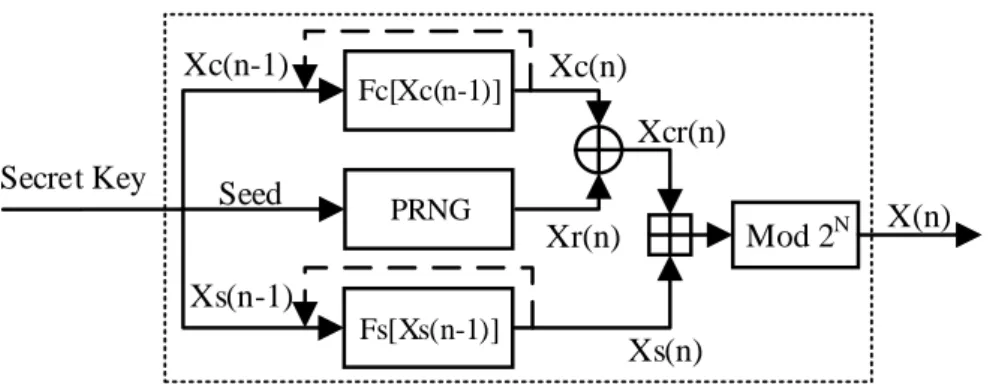
Redefining the chaotic maps over a finite integer field only cannot remove the dyna-mical degradation. To palliate this problem, in Chapter 4, we introduce an original PCNG
scheme which is based on the logistic map, PWLCM and skew tent map. It only uses four XOR operations and a dynamic output control method, which is easy to implement. The proposed PCNG has good cryptographic properties and it can pass the NIST randomness test successfully. Based on this PCNG, a new efficient stream cipher is proposed. This stream cipher shows good statistical and security properties.
(3) Design a new secure and robust chaos-based image cryptosystem (block cipher) with good confusion and diffusion properties
Insufficient level of confusion and diffusion in the encryption algorithm is dangerous for the security of a cryptosystem. In Chapter 5, a secure robust cryptosystem based on chaotic components and the AES S-Box is proposed, which contains an efficient PCNG, a global diffusion and a block cipher. The PCNG, defined over a finite field, eliminates the risk of deteriorated security resulting from the dynamical degradation when chaotic maps defined on real numbers are numerically implemented. The global diffusion increases ef-fectively the diffusion properties among the pixels of an image. The block cipher composed of the AES S-Box works in cipher block chaining (CBC) mode, which reinforces the per-formances of confusion and diffusion.
The proposed chaos-based cryptosystem can resist the main known attacks in the lite-rature successfully, and it is suitable for practical implementations.
(4) Explore a new smart chaotic coupling method for pseudo-random number generator (PRNG) design
A PCNG is important for the security of chaos-based cryptosystems. It is primarily a PRNG. PRNGs are essential tools in a great number of applications. Chapter 6 investigates a new smart coupling for PRNG designs. The PRNG schemes have been proposed based on the smart coupling structure and two output control methods, i.e. alternate and dynamic output control methods. Different coupling combinations of the chaotic maps and two out-put control methods are integrated into a family of PRNGs. Furthermore, a key expandable strategy is presented for expanding the key space to improve the cryptosystem’s resistance to the brute-force attack.
The proposed PRNGs can produce pseudo-random numbers with good cryptographic properties and they can be used in any designs of stream ciphers or block ciphers for en-cryption purposes. In addition to this, it also can be applied in PRNG required applications.
N
ONLINEAR DYNAMICS AND CHAOTIC
SYSTEMS
1.1
Introduction
Chaotic systems exhibit special complex nonlinear dynamic behavior. First of all, the major discoveries in the history of chaotic dynamics will be briefly presented in Section 1.2. Then, we will give the fundamentals of nonlinear dynamical system related to chaotic systems in Section 1.3. After that, Section 1.4 is focused on chaotic systems. Although, up to now, there is not a universally agreed mathematical definition of the chaotic system, three well accepted definitions, that is Li-Yorke, Devaney and Smale definitions, will be introduced in Section 1.4.1. They describe chaotic dynamics from different perspectives for revealing its specific properties. In addition to the definitions, some typical features appear to be important in the study of complex chaotic dynamics. And they will be discussed in detail in Section 1.4.2. After that, several representative low-dimensional chaotic maps will be analyzed in Section 1.5.
1.2
Historical perspective of chaotic dynamics
Chaotic dynamics is considered to be the third major discovery of physics in the 20th century together with the relativity theory and quantum mechanics. Similar to the previous two revolutions, chaos also breaks the canon of Newtonian mechanics. The most passionate advocates of the new science once said : "Relativity, quantum mechanics and chaos are three things in the twentieth-century that science will always remember" [12, 13].
The first discovery of chaotic behavior can be dated back to 1890 when Poincaré, a French mathematician, conducted an in-depth study on the three-body problem. He found that in the there-body problem, the interaction between them showed huge complexity, and
it had no accurate solutions. Besides, by applying relevant knowledge of dynamics and to-pology, he discovered that, within a certain range, the solution of the three-body problem was random [14]. This finding indicated that even in a certain (deterministic) system, the trajectory of the system might be extremely unstable, and any slight change in the initial condition would lead to completely different results. This is the first time that many scien-tists begin to realize that there might exist inherent randomness, i.e. chaotic dynamics, in a deterministic system [15, 16].
The 1960s and 1970s were an era of rapid development in the field of chaotic dynamics research. Around 1960, based on the study of the stability of motion in the Hamiltonian sys-tem, Kolmogorov, Arnold and Moser proposed the famous KAM theorem in hamiltonian mechanics, which laid the foundation for chaos theory [17].
In 1963, Lorenz published an influential paper called “Deterministic nonperiodic flow” in “Journal of the Atmospheric Sciences”. In this paper, he proposed a three-dimensional (3D) autonomous system to describe weather change. This is the famous Lorenz system which is the first chaos model with a mathematical description. He found the evolution of weather was closely related to the initial conditions. In other words, in a deterministic dynamical system, a slight change in the initial condition will cause a significant difference in the output, which is exactly the typical feature of chaos : high sensitivity to the initial condition. He also gave a beautiful metaphor known as “butterfly effect” to describe this behavior [18].
In 1964, Sharkovsky proposed the famous theorem about the coexistence of cycles with different periods in a continuous map of an interval into itself, and he gave also the period ordering [19]. In addition, Hénon proposed a two-dimensional (2D) discrete-time dynamic system, that’s Hénon map, which is one of the most studied chaotic maps. In 1971, D.Ruelle and F.Takens published a famous paper "On the essence of turbulence", which used chaos to explain the nature of turbulence for the first time. They found that the dynamic system has a particularly complex new attractor and they coined it as “strange attractor". Also, they introduced it into the dissipative system and proved that the motion related to this strange attractor is chaotic [20].
Also, in the study of turbulence, Smale discovered a "horseshoe" structure, that is “Smale horseshoe attractor” [21]. It can be seen as taking two arbitrary points on a dough and the dough is stretched and then folded continuously, which makes it intricately nested in itself and thus forms the Smale horseshoe attractor. This figurative metaphor reveals the complex nature of the chaotic system. This is another important chaotic attractor after the
Lorenz attractor.
In the paper of “Period three implies chaos”, Li and Yorke initiated "chaos". Since then, “chaos” has been officially used in the research field [22].
In 1976, May.R published a paper "Simple mathematical models with very complicated dynamics" in "Nature" [23]. In the paper, he analyzed a prey-predator model, i.e. logistic map that was firstly studied by P.J. Myrberg [24]. Also, he pointed out that period-doubling bifurcation and chaos existed in such an apparently simple 1D map. Then, two years later, Feigenbaum proposed two universal constants that lead from period-doubling bifurcation to chaos : the convergence constant δ and the scaling constant α, which laid the foundation for the study of the chaotic behavior of 1D maps.
In 1989, from the perspective of topology, Devaney gave another mathematical defi-nition of chaos, which indicated that a chaotic system should have sensitivity to initial condition, topological transitivity and periodic point density [25, 26]. Up to now, the Deva-ney definition, the horseshoe chaos proposed by Smale and the chaos definition proposed by Li-Yorke are regarded as the three alternative definitions of chaos.
Since the 1990s, the study of chaotic dynamics has developed rapidly. A number of research work has been done to investigate the theoretical properties of chaotic systems [27–30]. Nowadays, theory of chaos is important not only in the field of meteorology, turbulence and biology, but also in many other disciplines, such as mathematics, physics [31], chemistry [32], economics [33, 34], sociology, philosophy, engineering, information science, etc.
1.3
Fundamentals of nonlinear dynamical system
A dynamical system is described by a mathematical model in which the explaining functions represent the evolution of a solution with time and, sometimes, with other va-rying parameters. If a dynamical system can be described using a set of linear functions, it is considered to be a linear dynamical system. However, most phenomena in nature are nonlinear. A nonlinear dynamical system is used to describe a physical model that can be represented by a set of nonlinear equations such as algebraic, differential, integral, functio-nal, difference, or abstract operator equations [35]. In reality, nonlinear dynamical systems can depict a great variety of scientific and engineering phenomena. The theory of nonlinear dynamical system is very important to analyze and solve the problems in various disci-plines including but not limited to mathematics, physics, chemistry, biology, economics,
medicine, and engineering. In this chapter, we just focus on the fundamentals related to chaotic systems and pay special attention to some features which are particularly important from the prospective of cryptography applications.
1.3.1
Continuous-time system
Most continuous-time nonlinear dynamical systems can be described by a differential equation :
˙
x = f (x, t; p) , t ∈ [t0, ∞) (1.1)
where x = x (t) is the state of the system that usually belongs to a bounded region Ωx ⊂ Rr, where n denotes the dimension of state variable x ; the initial time is t0 and the initial condition is x0 = x (t0) ∈ Ωx; p ⊂ Rm is the vector of system parameters that usually varies within a bounded range and often there is m 6 r ; f is a nonlinear or piece-wise linear function that depicts explicitly a specified system defined by physical, technological or other reasons.
1.3.2
Discrete-time system
Different from the continuous-time system where the states vary by continuous time, the discrete-time system, also called the discrete system or map, has its states only at regularly distributed instants. A discrete-time nonlinear dynamical system can be described by a difference equation or a map :
xn+1 = f (xn, n; p) , n = 0, 1, 2... (1.2)
where n is the time index ; n = 0 means the initial time ; x0 is the initial condition for the state x. Other notations are similarly defined as those in the continuous-time system (1.1).
In a discrete-time system, the current state xnis the iteration result of its previous state xn−1 by function f and the previous one xn−1 also has same mode with xn−2, so that the state of the system can be presented by the initial condition x0 :
xn= f (xn−1) = f[2](xn−2) = ... = f[n](x0) = f ◦ · · · ◦ f
| {z }
n times
(x0) (1.3)
We shall see in the following chapters that, in the chaos-based cryptosystems, in theory, both continuous-time and discrete-time systems can be used. However, in reality, digital operating platforms cannot support the continuous nature of the system variables, or si-gnals. So, to perform the continuous-time system on digital devices, discretization of the continuous states or discrete approximations of the system have to be applied. In addition, finding the solutions of differential functions costs computational capacity and hardware resources [11]. By contrast, the discrete-time systems accomplish by iterative functions defined over a discrete time domain. Hence, there are no discretization operations and no heavy computational burden. Thus, discrete systems are more suitable to cryptosystem ap-plications. In this work, we choose to cope with the discrete chaotic maps for encryption design. In the following, we will mainly deal with the discrete systems, but the typical examples using continuous-time systems will be introduced as well in this chapter.
1.3.3
Notions of dynamical system
• Autonomous and Nonautonomous
Definition 1.1. [35] A nonlinear system (1.1), (1.2) is said to be autonomous, if its descri-bing functionf is independent explicitly on time (t in (1.1), n in (1.2)). In this case,
˙
x = f (x; p) (1.4)
xn+1 = f (xn; p) (1.5)
Otherwise, if the describing functionf depends explicitly on time, i.e, (1.1), (1.2), the system is said to be nonautonomous.
It should be noted that, f is not the same function for the continuous system (1.4) and discrete system (1.5).
In this thesis, the dynamical systems we adopted for cryptography are all autonomous. • Phase space
Phase space, also called state space, represents the entire space that comprises all states (x in (1.1),(1.4) and (1.2),(1.5)) of a dynamical system. For an n-dimensional system, the phase space expands by its evolving states x. For a 1D discrete system, phase space can be constructed by the iteration states in the space (xn, xn+1), and the graph shown in the phase space coincides with the graph of the 1D function.
• Orbit
The evolution of a dynamical system is embodied in a trajectory of the states traveled from the initial state x0 in the phase space. This trajectory is called an orbit of the system. The dynamics of the system can be observed by its orbits in phase space.
• Deterministic system
A dynamical system is deterministic, if there is a unique consequence to every change of the system’s parameters or initial conditions. Otherwise, it is stochastic or random, if there exists more than one possible consequence for a change in its parameters or initial conditions according to some probability distribution [35].
Chaotic system is deterministic, which indicates different orbits started from different initial conditions will never intersect (in infinite precision conditions). In other words, it guarantees the uniqueness of the evolution of a system for a given initial condition. This property links chaotic dynamics and cryptography : due to the deterministic dynamics, unique chaotic sequence can be only generated by a chaotic system using unique speci-fic initial condition and parameters. This corresponds the uniqueness of the key stream (pseudo-random numbers from a PCNG) to a specified secret key (initial conditions and parameters).
• Fixed point
Fixed point, also called equilibrium point and invariant point, of a dynamical system is an equilibrium state xf p. According to [36], there are the following definitions and theo-rems.
Definition 1.2. If f is a function and f (c) = c, then c is a fixed point (xf p) off .
For the continuous time system (1.4),
f (xf p; p) = 0 (1.6)
For the discrete time system (1.5), if it describes a 1D chaotic map, the fixed points are the intersections of f (x; p) with the function f (x) = x, meaning the orbits remain locked at the fixed point despite the iteration evolving. That is,
xf p = f (xf p; p) (1.7)
Theorem 1.3. Let I = [a, b] be a closed interval and f : I → I be a continuous function.
Proof. If f (a) = a or f (b) = b, then xf p = a or b. If f (a) 6= a and f (b) 6= b. Let g(x) = f (x) − x. As f (a) 6= a and f (a) ∈ [a, b], f (a) > a. Likewise, f (b) < b. Hence, g(a) = f (a) − a > 0 and g(b) = f (b) − b < 0. Since g(x) is the difference of continuous functions, it is a continuous function. According to the Intermediate Value Theorem (Bol-zano Theorem)1, there existsc ∈ [a, b] such that g(c) = 0. But g(c) = f (c) − c = 0 so that
f (c) = c. Thus, xf p= c. Theorem 1.3 has been proven to be true.
Theorem 1.3 states that if a dynamical system can be described by a continuous function which maps in a closed invariant set, it has at least one fixed point.
Theorem 1.4. Let xf pbe a fixed point of a functionf . f is differentiable at xf pand suppose its derivative f0(x) is continuous. If |f0(x
f p)| < 1, then there exists an open interval U containingxf psuch that wheneverx is in U , then f[n](x) converges to xf pandxf pis said to be a stable fixed point. If|f0(x
f p)| > 1, then there exists an open interval containing xf p such that all points in the interval that are not equal toxf p must leave the interval under iteration off .
Loosely speaking, if the nearby orbits of the fixed point evolve toward it, the fixed point is stable or attractive ; if they move away from it, it is said to be unstable or repulsive.
In the design of chaos-based cryptosystem, both the stable and unstable fixed points must be avoided carefully. Otherwise, the orbits can be locked into the fixed points and lose the chaotic properties, which is an undesired behavior when applying chaotic systems to cryptography.
Definition 1.5. The point x is an eventually fixed point of a function f if there exists N such thatfn+1(x) = fn(x) whenever n > N.
Definition 1.5 states that there exist a type of points that are eventually fixed points. This type of points are preimages (backward iterates) of the fixed points. An example can be found in the logistic map ((1.13) in Section 1.5.1) : xn+1 = f (xn) = µxn(1 − xn). If
µ = 4, the point xn = 0 is an unstable fixed point, while its preimages xn−1 = 1 and
xn−2 = 12 are not fixed points. But f (1) = 0 and f[2](12) = 0. So after one iteration, point xn−1 = 1 is fixed at 0 ; after two iterations, point xn−2 = 12 is fixed at 0. Likewise, the point
1
4 also leads to the fixed point 3
4 after one iteration. Their orbits can be seen in Figure 1.1.
1. Weisstein, Eric W. "Bolzano’s Theorem." From MathWorld–A Wolfram Web Resource. https ://math-world.wolfram.com/BolzanosTheorem.html
FIGURE 1.1 – Preimages of the unstable fixed points
Theoretically, in the logistic map, one fixed point (xf p) corresponds to two preimages. These two preimages correspond to 22 preimages. Therefore, one fixed point (xf p) has 2 + 22+ 23+ 24+ ... + 2n(n backward iterations) preimages, and all of them will lead to the fixed point (xf p). If the initial condition of a chaotic map accidentally (randomly) coincides with one of the preimages of xf p, after a number of iterations, its orbit will be eventually locked into xf p. Since huge amount of preimages of the fixed point exist, ensuring chaotic behavior while avoiding all the preimages is quite a tricky task. This is not specific only for the logistic map, since the majority of 1D chaotic maps show similar cases.
• Periodic point
Definition 1.6. For a discrete dynamical system (1.5), the point x is a periodic point of f with period k if f[k](x) = x. In other words, a point is a periodic point of f with period
k if it is a fixed point of f[k]. The periodic pointx has prime period k0 iff[k0](x) = x and
f[n](x) 6= x whenever 0 < n < k0. That is, a periodic point has prime periodk0if it returns to its starting place for the first time after exactlyk0iterations off [36].
Definition 1.7. The set of the iterates started with a periodic point x is called a periodic orbit or a periodic cycle[36].
Definition 1.8. The point x is eventually periodic of a function f with period k if there existsN such that f[n+k]= f[n](x) whenever n > N [36].