HAL Id: hal-02822186
https://hal.inrae.fr/hal-02822186
Submitted on 6 Jun 2020HAL is a multi-disciplinary open access archive for the deposit and dissemination of sci-entific research documents, whether they are pub-lished or not. The documents may come from teaching and research institutions in France or abroad, or from public or private research centers.
L’archive ouverte pluridisciplinaire HAL, est destinée au dépôt et à la diffusion de documents scientifiques de niveau recherche, publiés ou non, émanant des établissements d’enseignement et de recherche français ou étrangers, des laboratoires publics ou privés.
Languedoc wine cooperatives
Yuna Chiffoleau, Fabrice Dreyfus, Raphäel Stofer, Jean-Marc Touzard
To cite this version:
Yuna Chiffoleau, Fabrice Dreyfus, Raphäel Stofer, Jean-Marc Touzard. Advice networks, innovations and clusters : the case of Languedoc wine cooperatives. 2006, pp.103-129. �hal-02822186�
A paraître dans les Cahiers d’Interactions Localisées, LEREPS-GRES / INRA-SAD, Toulouse, 2005.
Advice networks, innovations and clusters : The case of Languedoc wine co-operatives* Y. Chiffoleau, F. Dreyfus, R. Stofer, J.M. Touzard1 Abstract
Small firms are supposed to benefit from networking and clustering, but research has still to be done on the nature and the relevant forms of these networks. In this paper we propose to combine economics and economic sociology to assess the role of the inter-firm network in a cluster of innovative cooperatives, focusing on the exchanges of advice between managers. Our study is based on the case of 31 cooperatives, constituting a wine cluster around Beziers (South of France). Using both sociometric and economic data, we find correlations between co-operatives’ relational profiles and innovation or economic scores. The co-operatives’ specificity questions the results get in different settings and calls for a comprehensive interactionist approach of firms and clusters.
1. Introduction
Recent studies on clusters and industrial districts stress the key role of local inter-firm networks in both individual and collective performances, thus defining highly competitive firms and areas (Porter, 1998; Antonelli et al., 2002, Becattini, 2004). Local networks are supposed to favour strategic information flows, and then facilitate small firms’ cognitive capacities, innovation and performance (Carbonara, 2002). However, in most of these analyses, inter-firm relations are theoretically supposed, rather than practically demonstrated, or are restricted to institutional and financial ties. In this paper we propose to assess the role of the informal inter-firm networks built by advice exchanges between the managers. We focus our contribution on a case study in the Languedoc region (South of France) where wine co-operatives are innovating and constitute geographical concentrations of small firms, identified as clusters (Chiffoleau et al., 2003). Using both sociometric and economic data, we will show how advice network analysis provides tools to improve economic approaches to innovation in these wine co-operatives, thus proposing a fruitful link between economics and economic sociology (Swedberg, 2003) for a more general interpretation of changes in agricultural co-operatives and clusters. The first section of this paper presents theoretical issues in innovation and the roles of networks in clusters, stressing the promising contribution of economic sociology. In the second section we present the material and the method of our fieldwork on Languedoc wine co-operatives. Both economic and networks data are presented in the third section, then correlated with wine co-operatives’ innovation
*
We thank Alain Degenne (CNRS Lasmas Caen) for his precious help in network analysis.
1
Respectively Researcher in Sociology, Agronomist, Post-Doc and Researcher in Economics ;
National Institute for Agronomic Research, Dpt of Sciences for Action and Development, UMR Innovation, place Viala, 34060 Montpellier, France; [email protected], [email protected], [email protected], [email protected]
and performances data. Empirical, theoretical and operational contributions of the research are discussed in the last section.
1. Theoretical issues
1.1. Innovation within clusters : towards a relational and cognitive approach
Over the past two decades, there has been an increasing interest in geographical concentrations of specialised small firms, not only by economic geographers but also by economists and policy-makers (Saxenian, 1994; Amin, 1999). Inspired by Marshall’s definition of an “industrial district” (1891), many concepts have emerged from this new-found focus, but Porter’s work on “clusters” has proved by far to be one of the most influential. According to him, a cluster refers to “a geographic concentration of small and medium-size firms acting in the same branch, both competing and co-operating, and showing a high level of collective and individual economic performance” (Porter, 1998). The Californian wine industry constitutes a famous example of a cluster, whose efficiency is supposed to be linked with a high degree of interaction between the firms. In the context of a knowledge-based economy, social scientists working on clusters assess innovation as a local learning process (Giuliani, 2003), relying on both intra-firm and inter-firm interactions.
These studies on clusters thus meet the development of innovation economics. In that research field, there has indeed been increasing evidence that close interactions between firms are crucial for technological development and competitiveness (Lundvall, 1993). Assuming an interactionist approach, innovation could be defined as a non-linear process that leads to a structural change in an economic organisation (its products, technologies, rules or frontiers) and is mostly based on the cumulative and path-dependent creation of knowledge (Cohendet et al., 1998). Innovation thus supposes learning by doing, using and interacting. As spatial proximity between firms may be linked with a higher probability of interactions, we have a basic explanation for why clusters can facilitate innovation and allow the production of specific assets (Porter, 1998; Storper, Harrison, 1991).
But the “cluster effect” on innovation and performance couldn’t be explained only by the “agglomeration effect”. It also relies on local institutions and networks, built through these interactions between the firms and/or inherited from the local community. Local networks are supposed to both stimulate competition and facilitate trust and control, allowing combinations of economies of scale and scope (Amin, 1999), reductions of transaction costs (e.g. for local labour markets; Carlsson, 1997), solving of principal-agent problems (Mistri, 1999) or access to “local public goods” (Bellandi, 2002). But which kinds of networks are efficient when innovation and performance are challenged ? Economists focus on several kinds of links as financial ties or formal relations sustaining collective action (Filippi, 2002; Bijman, 2003). They also point out the role of informal and cultural ties, suggested by Marshall (1891) through the notion of “atmosphere”, but without having
any tools to explore these local relationships. A call is thus made to sociologists to progress in the identification of the relevant networks in such phenomena.
1.2. The contribution of economic sociology
Economic sociology may be mobilised to progress in the understanding of the relations between inter-firm networks and innovation processes in clusters. The concept of “embeddedness”, as first evoked by Polanyi (1944) then precised by Granovetter (1985), refers to the process by which social relations shape firms’ economic actions and results, highlighting and specifying social mechanisms that mainstream economic schemes overlook or mis-specify. Uzzi, for instance, shows how firms’ insertions into social ties, also called “relational embeddedness”, constitutes a “social exchange system” which offers opportunities to the firms and increases their economic performance up to a threshold where the positive effect reverses itself (Uzzi, 1996). Another scholar, Burt, highlights the links between a firm’s innovations and performance on the one hand, and their “position” in the socio-economic system in which they are involved on the other. Positions are assessed as specific relational profiles2 towards others : whereas firms in the same position are likely to behave (and innovate) in the same manner (Burt, 1987), those managing “structural holes” (i.e. unconnected contacts) are expected to be more competitive, due to their control of information flows (Burt, 1992).
Moreover, as innovation proceeds from a cognitive process, it prompts us to refer to sociologists who are trying to combine networks and knowledge issues in their analysis. In the current context of uncertainty about markets, Callon highlights the role of “socio-cognitive networks” developed by firms: in theses ties, they both exchange and produce information and values with their environment, that favours the co-operative building of new products fitted with consumers (Callon, 1998). As far as action is concerned, when routine is insufficient and new practices have to be implemented, Lazega underlines the exchanges of advice between “peers”, belonging to the same professional community and developing the same activities (Lazega, 2002). Advice is indeed more than information: it involves the link people make between information and its (past and potential) application and as such, is closer to action. Moreover, advice is laden with trust and value, then may be capitalised on as a useful form of knowledge (Cross et al., 2001). Finally, according to Lazega, exchanges of advice allow peers not only to master their activity when routine practices are challenged, but also to co-ordinate their actions with their colleagues, thus promoting a collective capacity for innovation that may benefit every member of the professional community.
2
These profiles have to be understood in reference to Lorrain and White’s research equating structural equivalence with competition and social influence (1971). As strucural equivalence refers to identical ties with third parties in a network and needs computerization to be assessed, Burt portrays two actors as structurally equivalent in degrees insofar as they posses similar relations with others, thus sharing a similar relational profile.
Within a cluster facing economic uncertainty, amongst all the kinds of ties that may be developed by firms,the advice network between managers may then be assessed as the basic form of inter-firm co-operation and the essential condition for inter-firm and local area innovation and competitiveness. However, advice relations shape an informal hierarchy insofar as people usually refer to others they assess as having a higher status than themselves (Lazega, 2001). The advice network provides crucial resources for innovation and performance, as well as building a system for the distribution of power and authority throughout the social system (Blau, 1964).
1.3. Clusters and agricultural co-operatives
We assume that agricultural co-operatives constitute suitable case studies for the economic and sociological research agenda on clusters and innovations (Draperi, Touzard, 2003).
Economic arguments for the involvement of co-operatives in networks or clusters have been suggested in studies on federal co-operatives (Lazzarini et al., 2001) or strategic alliances in the agri-food sector (Nilsson, Van Dijk, 1997; Guillouzo et al., 2002). Belonging to networks and clusters could allow small and medium co-operatives, in particular, to share skills and advice, making up partially for their difficulties in obtaining external funding for a specific R&D department.
More general studies on the organisation and strategies of operatives also suggest that co-operative’s specific status, values, rules, patronage or origin of its directors influence its management practices and alliances, explaining for instance why co-operatives are more inclined to co-operate with other co-operatives than with investor-owned firms (Mauget, Koulytchizky, 2003). So, on the one hand agricultural co-operatives should take specific advantage of belonging to clusters, while on the other hand these clusters may be influenced by the specific characteristics of the co-operatives. More recently, research on personal interdependencies between co-operatives (Gargiulo, 1993; Bijman, 2003; Chiffoleau et al., 2003) or interlocking directorates (Karantinis, 2003; Filippi, Triboulet, 2003) has been developing, leading to fruitful collaborations between institutional economics and economic sociology.
Thus, a more systematic analysis of the involvement of operatives in clusters is called for by co-operative managers exploring organisational alternatives, as well as by social scientists concerned by the link between clusters and innovations or by the future of these organisations. In this paper we focus our analysis on a “cluster of co-operatives”, exploring how informal inter-firm networks could benefit innovation and performance.
2. Empirical field and method
Our empirical investigation has been carried out in a geographic area located around the city of Beziers, 70 kilometres by 40 kilometres wide. This area was considered in the 70s as the core of the Languedoc table wine industry (Auriac, 1983). Ninety percent of its wine was basic, paid according to its alcohol level, and processed and marketed by 45 village co-operatives’ cellars that had reached a dominant position (80% of the local wine production in 1979). In 2002, the area still specialised in wine (around 85% of local agri-food production) and co-operatives have kept their marketing share (Touzard, 2002). Nevertheless, the local wine industry is radically changing. Vine growers and their co-operatives are following divergent paths. Some of them try to keep producing table wine, but the majority engages in “innovation trajectories” which consists of a large diversity of combinations of new activities (along the processing chain but also in tourism and local development), new wines (“appellation wines” or “cultivar wines”), new internal rules and marketing alliances (Touzard, 2000). In 2003, the area includes 31 co-operative cellars (14 have been involved in mergers since 1988). They are very diverse in terms of size, specialisation and innovation dynamics. Small wine estates and wineries, institutions dedicated to the wine industry (e.g. oenological centre), 11 second step marketing co-operatives, suppliers (e.g. bottles production) and wine merchants are also located in the Beziers area. Some of them have been recently attracted by the development of quality wines.
This area presents the apparent characteristic of a “cluster” as defined by Porter: geographical concentration of specialised small firms, formal institutional ties and a long common history materialised through shared values and rules, testified by historians and experts (Gavignaud-Fontaine, Michel, 2003).
2.2. Economic and technological information
The economic and technological information on co-operative cellars has been collected from the regional census of wine co-operatives in 2002, including the 31 co-operatives of Beziers area: it yielded, through direct enquiry, detailed economic and technical information for the two years 2000 and 2001 (Touzard, 2002). We completed this information by the evaluation of wine co-operatives’ accounts since 1994 (Laporte, Touzard, 1998), selecting the average of 1994 and 1995 as a “starting situation” for our analysis. From this material, we formalised a database on the 31 co-operatives, combining structural criteria, indicators of innovation and ratios of economic performance: Structural criteria describe the size and the specialisation of the co-operatives (number of members, volume, turnover, proportion of table wine or AOC wine in the production…). Indicators of innovation are related with the new production or processing technologies (cooling system, pneumatic press, stainless steel tanks, environment-friendly production, maturing in barrels…), organisational changes (certifications, grape grading, differentiated payment system) and marketing innovations (bottling, new packaging, selling point…). The occurrences of these elementary innovations have been added for each co-operative, thus defining a global score of innovation: three categories have been made (high,
medium, low score). As far as economic performance is concerned, we adopted three kinds of criteria: co-operative turnover growth between 1994 and 2001; average members’ income per hectare of grape, a key issue for the sustainability of both members’ farms and co-operative firm (Touzard et al., 2000); average price of the wine sold by the co-operative, expressing its capacity to add value. These three economic criteria are complementary indicators of performance for traditional farmer owned cooperatives, which are both firms competing in the agri-food sector and associations of members remunerated through the payment for their agricultural delivery.
2.3. Relational information
In order to structure the collection of relational data, we delineate six strategic domains where elementary innovations are implemented and advice is exchanged between the managers (Chiffoleau, 2001):
a) grape production and wine-making (technical process issues), b) grape grading and payment system (organisational innovation), c) merging and formal alliances with other co-ops,
d) marketing (product innovation, pricing strategy, contracts, new selling point…), e) human resources (staff and members) management,
f) landscaping and involvement in local development.
We enquired, in December 2002, into the advice networks of both the CEO and the chairmen of all the co-operatives located in the Beziers area, that represent 67 people. Assuming a “cluster” hypothesis, we supposed the Beziers area as delineating managers’ networks boundaries. People were asked to tell to and from whom they have given and asked advice, for each of the six identified innovation areas, during the last two campaigns (2001, 2002). Following the methodology usually developed in network analysis (Degenne, Forsé, 1994), each interviewee was first asked to explain his/her links with each of the 66 other co-operatives’ managers a priori included in the network. In a second step, they were asked about his/her links with persons outside the 66 managers’ set and/or the Beziers area. Data has also been produced about their possible collection of strategic information from professional press, technical books, trade fairs, travels, etc. Finally, qualitative questions have been developed to assess the point of view of the interviewee on its co-op and on the relevance of each innovation domain. Interviews have been recorded and used for interpretation and control of the relational data.
2.4. Network data processing
The elaboration of the final database required a specific statistical processing of the relational data in order to characterise the advice networks. Relations have been aggregated at the co-operative level,
assuming a complementarity between CEO and chairman ties. Network analysis provides scores or categories that enable us to characterise the cluster as well as each co-op:
- “density index” refers to the ratio between the current ties and all possible ties within the cluster, - “out-degree score” measures the number of asking-advice relations, in each domain and in total, - “in-degree score” measures the number of giving-advice relations, in each domain and in total, - “external openness index” indicates the weight of relations outside the set of the 31 co-ops, - “prestige score” proceeds from the difference between giving- and asking-advice relations;
- “betweenness centrality score” refers to Burt’s structural holes theory and evaluates the propensity of the co-operative to be a compulsory intermediary between others within the cluster,
- “profiles” (approximation of structural equivalence, cf. 2.3) are identified as specific sets of relations with others, taking into account both given and asked ties in and out of the 31 co-ops, - “cliques” feature sub-groups of co-operatives highly connected (n=1) on at least 3 themes.
The final database includes all these relational scores and positions3 and thestructural, innovation and economic indicators, allowing correlation tests and multivariate analyses.
3. Main results
3.1. Innovation and economic performance in the cluster
Firstly, statistical analyses have been made on economic and innovation criteria, without taking into account relational data. These aimed at testing the possible relationships between size, specialisation, innovation scores and economic performances in the cluster of co-operatives (table 1) :
a) The size of the cellars (volume, turnover, number of members) is not correlated with any innovation and performance criteria.
b) The specialisation in “appellation wines” (“AOC”) is correlated with a specific set of innovations (maturing in barrels, wide range of wine, bottling, direct selling) and two performance ratios (wine price and turnover growth): this identifies a technological model that allows the firm to develop through the territorial specification of wine, but it has no specific positive impact on farmer income. c) Among all elementary innovations, only one is correlated with economic efficiency: the level of grape grading. This points out the role of these new rules, distinguishing the quality levels of grape deliveries according to specific criteria: they radically change the relationships between the farmers and their co-operative, for all kinds of co-operative sizes and specialisation.
d) However, combinations of complementary elementary innovations are correlated with all economic performance criteria. We test this proposition with different scores, adding the occurrence of
3 The scores have been calculated by the software “Ucinet”, the profiles have been done through a factorial analysis and the
elementary changes. This result is confirmed by a step by step multiple regression analysis run on the 365 Languedoc wine co-operatives (Chiffoleau et al., 2003).
Then, the first statistical analysis shows that co-operatives are innovating within the cluster and that innovation seems to be efficient whenever it combines elementary innovative items. Nevertheless, the difficulty of identifying structural factors of innovations and performances prompts us to investigate the role of social factors and particularly of inter-firm networks.
3.2. Density of the advice networks
Secondly, we proceeded with the relational data in order to describe the advice networks :
a) 74% of co-operatives’ advice relations (concerning the six domains of innovation) are developed between co-operatives located in the area, tending to prove the existence of a “cluster”. Relations with actors outside the set of 31 co-ops are mainly connected with local institutions or firms, strengthening the evidence of a cluster feature. There are also very few co-ops connected to long distance advisers or involved with professional travels or lectures.
b) From a total number of 1 072 inter-individual relations between managers, ¾ are of intra-status, that is, CEO to CEO or chairman to chairman. This proves a high degree of “homophily” of the advice networks at the inter-individual level of analysis. However, considering the inter-firm level, advice relations link very diverse co-ops, in terms of size or wine specialisation.
c) The density of chairmen and CEO networks (21% and 17%) is lower than the density of inter-co-op networks (33%), implying mainly different advisers for chairmen and CEO in each co-inter-co-op. This may be a source of complementarity or disturbance.
d) However, the density varies according to the domain of advice (table 2). Advice on matters of grape and wine production techniques, as well as on grape grading, are the most developed (density up to 20%) whereas issues about alliances or landscaping are very little discussed.
Domain of innovation grape production and wine-making grape grading and payment system merging, alliances with other co-ops marketing human resources management landscaping Network density 20% 25% 11% 14% 11% 6%
Table 2. - Networks density according to innovation domains (Ucinet)
These results are consistent with our observations on the role of grape grading (see 3.1). But our qualitative approach also points out the different perceptions of managers concerning each domain: technical issues are entering into routines, whereas alliances or commercial items are highly strategic, inducing rivalries and confidentiality. Landscaping is assessed as a secondary item, whereas human resources is evoked as “the most important domain”, but for which “there are no efficient solutions”.
3.3. Relational profiles and cohesive sub-groups within the cluster
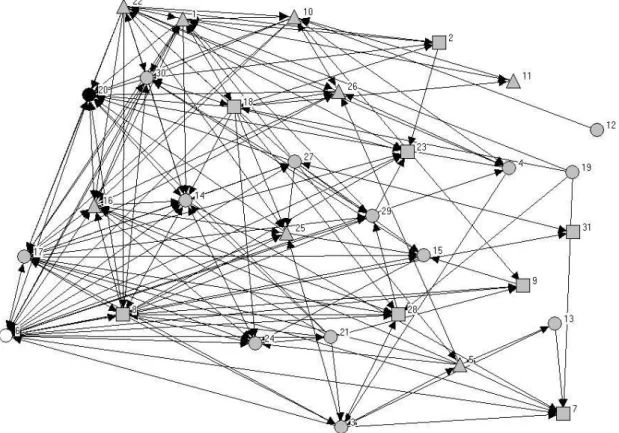
a) From in-degree and out-degree scores, one domain at a time or all categories combined, we can identify polyvalent vs. specialised “experts” (appendix 1). Co-ops 1 and 16, for instance, give advice on every theme and ask for it on relatively few, emerging as polyvalent prestigious advisers. Co-op 20 has a high score of prestige, but mainly due to its advice-giving relations in technical domains (graph 1). Other co-ops do not emerge as prestigious but with a high betweenness centrality, such as co-op 18, whereas others distinguished themselves by their network openness, such as co-op 9. This leads to the identification of several roles in the cluster that we can compare with economic or innovation data. b) Five profiles were then identified, taking into account all advice relations.
Profile 1 2 3 4 5 Co-ops 1,11,22,24,25 18,21,28 2,3,6,8,10,13,17, 19,27 4,5,7,9,14,15,16, 20, 23,29,30,31 12 Main characteristics of the relational profile
Ask and give advice in landscaping, do not ask any advice in human resources Ask advice in human resources and grape grading Ask advice on commercialisation, alliances and grape production
Give advice on grape production and grading, and on human resources
Isolated
Table 3. - Advice relational profiles within the cluster of co-operatives (factorial analysis)
Above all, according to Burt’s theory, these profiles may distinguish co-ops likely to behave in the same manner, especially relative to innovation. This calls for the identification of human resources, landscaping and commercialisation as the current strategic areas where new practices may be implemented, and that are therefore likely to differentiate firms in the near future.
c) Firms of the same relational profile are not assumed to be directly linked. A second approach to the cluster is to identify cliques, as sub-groups of co-ops that are highly interconnected. Two cliques may be identified: the first one is quite dense and gathers the co-ops 14,16,8,24,20 and 6, while the second is weaker and consists of co-ops 1,2,18 and 30. These two cliques appear as groups of geographically close firms, mainly belonging to a common federal co-operative. More generally, co-ops may be classified into six types according to their level of direct connectivity with others in the cluster.
1 2 3 4 5 6 Co-ops involved in a high density clique Co-ops in a medium density clique Co-ops involved in a strong bilateral relation Bridges between cliques Co-ops in periphery of the cliques, weakest connection
Co-ops very little interconnected to others or isolated
6,8,14,16,20,24 1,2,18,30 4,22 17,23,28 3,5,9,10,11,19,21,
25,26,27,29,31
7,12,13,15
Table 4. – Firms’ direct connectivity with the other co-operatives in the cluster (graph analysis)
A firm’s inclusion in a clique may either limit or stimulate its innovative capacity, according to the degree of social pressure and competition inside the group (Burt, 1992), whereas bridges between cliques may allow them to benefit from their strategic position.
3.4. Relational structures, innovations and performances
In order to identify possible relationships between the managers networks and the structure, innovations and performances of their co-operatives, we proceeded with a second correlation test completed by a general discriminant analysis.
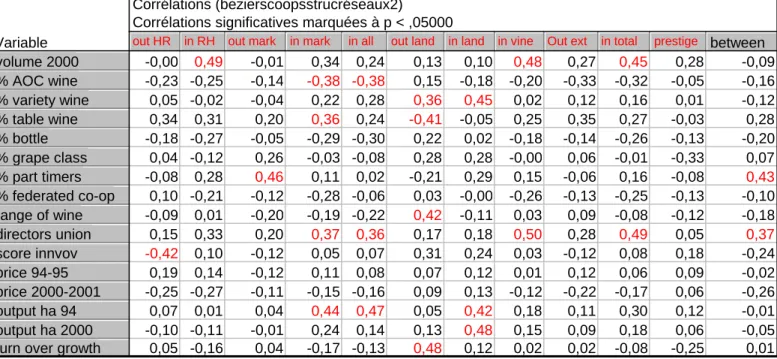
a) Significant correlations were found between relational scores and structural data (see table 5). - Co-operative size is positively correlated with in-degree scores in specific domains: human
resources, grape production. The biggest co-operatives have a specific adviser role in these domains, whereas they have no significant score in matters of global prestige, openness or betweenness centrality.
- Wine specialisation is correlated with several in-degree or out-degree scores: AOC co-ops give less advice than others in the marketing and alliances domains; table wine co-ops appear as not asking advice on landscaping whereas “cultivar wines” co-ops ask and give advice on this topic. - Social structure of the board of directors seems to influence managers’ advice networks. For
instance, the ratio of part-timers in the board is correlated with the out-degree score in marketing issues and the betweenness score of the co-operative.
- The institutional involvements of the managers and the co-operatives present some correlations with relational scores: belonging to an union of CEO is correlated with in-degree scores for technical, marketing and alliances issues, but also with the betweenness centrality. Belonging to a second step marketing co-operative is only correlated with this score.
b) As shown in table 5, we also find significant correlations between relational scores and technical or organisational innovations implemented in co-ops:
- considering the elementary innovations, there is no correlation between the implemented innovation and the scores in the advice network related to the domain of this innovation. However, we note a high correlation between the out-degree score in landscaping and ratios of direct selling, range of wine or grape grading. Grape grading is also positively correlated with the in-degree marketing score. For each domain, it seems that the main innovators are not the main advisers, but that implemented innovations call for new domains of innovation, then for advice-seeking.
- We specify these relationships by a discriminant analysis run on three categories of innovation score: low, medium and high (see graph 2). Low innovation score co-operatives may be identified by their high out-degree score in human resources (an urgent issue for them?), but some of them have few interactions; high innovation score co-operatives have specific requests on “new” domains of innovation (such as landscaping), but only some of them provide advice on innovative domains for which they are supposed to have capacities; medium innovation score co-ops have higher in- and out-degree scores, especially in the technical and marketing domains.
- The strongest correlations are found between performances in 1994-95 and in-degree scores in marketing, alliances or landscaping (in 2002). Thus, previous economic performance seems to have kept influence on current advice networks.
- 2000-2001 farmers income per hectare is only correlated with the landscaping in-degree score, while the 2000-2001 average wine price is negatively correlated with the out-degree score in human resources and betweenness centrality. The turnover evolution is positively correlated with the out-degree score in landscaping, but negatively with openness.
Thus, economic performance seems to be influenced by (or to influence) few relational scores, mainly those that are more highly correlated with innovation scores. Specific positions in the network, materialised by openness, prestige or betweenness scores, seem to have no positive correlation, whereas they are often presented as key factors for innovation and performance.
d) Finally, we test the possible influence of relational profiles and degrees of connectivity on innovation and performance by a general discriminant analysis (table 6, appendix).
- The involvement of co-operatives in a dense clique or a strong dyad is only discriminated by the average wine price in 1994-95. This effect is clear for the dyad (group 3) which associates two elitist AOC co-operatives, having also high scores of innovation and turnover growth. The two central cliques (group 1 and 2) and their peripheral connections (group 5) seem to be very close as far as economic and innovation scores are concerned. The three co-operatives playing a bridge role in the cluster (group 4) are not taking economic advantage of their position. So, except the elitist dyad, the involvement in sub-groups seems to have no influence on innovation or economic differentiation in the cluster.
- Relational profiles seem to have more effects on innovation and performances. Four positions are statistically discriminated by both innovation score and turnover growth. Block 1 is characterised by the highest score of innovation and performance. At the other extreme, block 2 is discriminated by the lowest innovation score and wine price growth, and block 4 (medium innovation score) by the lowest turnover growth. Block 3 presents scores very close to cluster averages.
The number of co-operatives (31) is not sufficient to test the possible complementary effects of both relational profile and degree of direct connectivity with others. No dependence between the firms’ profiles and type of connectivity in the cluster can be found, expressing that numerous profiles are associated with each cohesive clique or degree of connectivity. The cohesive sub-groups seem to be more spaces of information sharing, than spaces of strategic differentiation, except the dyad where the two co-ops stimulate each other to innovation and better performances.
4. Discussion
Advice relations between managers are proved to be an essential component of the co-operatives cluster: these geographically close firms both co-operate and compete by giving, diffusing or asking for at least some advice, more between them than with external actors. They thus assume different roles in the cluster and are connected through different relational sub-structures, like cliques. Moreover, the number and the structure of the advice relations appear to depend on the position of the co-operative in a trajectory of innovation: moderately innovative co-ops are the most involved in local collective learning processes, while co-ops with low and high scores of innovation have a dual behaviour (specific involvement vs isolated strategy). Advice networks thus express and contribute to the co-operatives’ path dependency and differentiation within the cluster.
Furthermore, the wide diffusion of advice about grape and wine production may explain incremental improvements in most of the firms and confirms the recognition by regional and national experts on this area as one of the most advanced in these technical domains. In that sense, advice networks between co-operatives produce collective assets from which every firm eventually benefits, as argued as a positive “cluster effect” by Porter (1998). Nevertheless, as far as human resources or marketing are concerned, the relative lack of relations between managers reveals a strong competition for new markets development, strengthening the power of the traders’ oligopoly. Thus, through these local networks, combination of rivalry and co-operation seems to be efficient for technical innovations but non efficient for marketing innovations.
Our analysis also shows the overlap between informal advice relations and some institutional relations, as common belonging to some marketing co-operative or to managers’ union. The two identified cliques, for instance, clearly overlap with formal producers’ groups, often accused to be “empty structures” dedicated to subsidies capture. In these cases, beyond their formal dimension, these groups distinguish themselves by a specific collective project, which, according to them, is making them closer whereas they were not particularly linked before. Furthermore, beyond these few cliques, co-ops’ advisers appear to vary according to the domain of innovation. This prompts us to a renewed approach to expertise and leadership in a cluster facing the “economy of quality” context. As radical and multidimensional innovations may be performed both in value chains and territories (Allaire, 2002), that stimulates co-operatives to develop complementary skills and networks. It illustrates the principle of “distributed cognition” highlighted by cognitive science in organisational settings (Conein, Jacopin, 1994).
4.2. Network positions and innovation : specific relations in the case of co-operatives ?
As far as innovation and performance are challenged, economic sociologists point out specific positions in social networks. However, in our study case, prestige or betweenness centrality, for instance, are not significantly linked with high levels of innovation and competitiveness. Several hypotheses may be argued, linked with the specificity of wine co-operatives and their managers:
a) co-op managers do not really act and react as the highly strategy-oriented agents, considered by Burt, Uzzi or Lazega, do. They are not involved in a constant quest for relevant social relationships and may not be able nor inclined to use their strategic positions in networks for the interest of their co-op. This prompts us to consider both cultural and human capital issues. Indeed, Lazega stresses the need for a “strategic culture” in the efficient building and management of a relevant social capital (2001), whereas Burt points out the impact of training (1992). In the Beziers cluster, only a few co-op managers, including presidents and CEO, have been trained in firm management ;
b) the exchanged advice have a low quality level and/or are not directly useful. It may express a high level of competition between co-op managers, reluctant to share “what works here”. The numerous historical references to petty local quarrels, as well as the low level of inclusion of the more competitive co-ops in the networks, strengthen this hypothesis. However, in one case, a director coming from Bordeaux and managing a very efficient co-op would like to integrate but is rejected by others who are locally born and established. Human capital and psychology also condition the capacity to be aware and able to share practices or projects ;
c) the advice network between managers is not the most relevant nor efficient social network related to firms innovation and performance. As a co-operative consists of both an enterprise and an association, we chose to assess the networks of its president and CEO, but the board of directors, or even the basic members, could be more efficient at obtaining some information. Our previous works showed indeed the role of part-timers in the development of innovations (Chiffoleau, 2001). Moreover, our current works suggest the impact of another network, built by marketing ties and partnerships with market professionals, ranging from wholesalers to wine writers.
In that sense, the wine co-operative specific feature questions the works developed in economic sociology about links between networks and innovation. However, Podolny, studying the Californian wine cluster characterised by Porter, obtained results more consistent with the hypotheses of network specific positions and management in strategies explanation (Benjamin, Podolny, 1999). Thus, as the Californian cluster is managed by investor-owned firms, the results issued from the Beziers one may be resolutely linked with the specific functioning and types of leaders of its co-operative organisations.
4.3. Advice networks and the challenges of social status and authority
According to Blau (1964) and Lazega (2001), advice relations within a professional community shape the informal hierarchy of power, as well as building social status and authority positions, both due to the authority dimension of knowledge (Conein, 2003) and higher status recognition when asking for advice from someone. In our case, the most competitive and innovative co-operatives do not emerge as particularly prestigious whereas some with low levels of competitiveness do. Consistent with Lazega’s results, our discussions with managers highlight that some of them are preoccupied by their social
status: some of the most efficient clearly consider the others are “below them” and do not even want compliance from them, preferring to build and stabilise their status in other networks. The competitive dyad, for instance, belongs to a club of “big wine producers” gathering co-operatives from the more prestigious vineyards of Bordeaux and Côtes-du-Rhône. On the other hand, managers of co-operatives of low competitiveness recognise that they try to compensate for low performances by giving advice on alliances that they are often envisaging as a solution to their difficult situation, or by spreading advice that they obtain from the cluster, even if they do not apply it in their own co-op.
In the Beziers area, the early involvement of the co-op in the quality revolution appears to be the source of managers’ social status assesment, more than co-ops’ economic assets or results alone. Indeed, the accumulation of experience and the improvement of the wines' reputations (awards, prices) progressively improve managers' identities and status inside the cluster, even if the co-ops’ economic results and prestige (i.e. balance between giving- and asking-advice relations) have not really grown. Taking into account the role of managers’ social status in the real economic dynamics seems relevant in the case of small “village co-operatives”, embedded in social relations based on strong rivalries between individuals and communities. It could also help to understand decisions and behaviours in other forms of co-operatives and organisations, as suggested by Lazega (2001).
5. Conclusion : towards an interactionist approach of agricultural co-operatives and clusters
Assessing the structure of real interactions between managers of wine co-operatives in Languedoc may be a comprehensive interactionist way to analyse how firms and clusters evolve, highlighting both economic and social mechanisms of innovation and networking. The advice network analysis contributes both to the specification of co-operatives’ strategies and to the identification of its embeddedness in local relations, institutions and culture : networking remains globally linked with the position of these firms in trajectories of innovation, even if strategic choices and quest of advices could be influenced by individual social status building and rivalries between comunities or social groups. Our empirical analysis thus shows the need for an interdisciplinary approach to assess the social dynamics underlying changes and collective action in small and local firms like agricultural co-operatives. This approach call for an interactionist model of these firms, inspired by current research in economic sociology, institutional economics and evolutionary economics. The agricultural co-operative could be construed as a set of interaction systems, concerning either production routines or innovation processes, and oriented to both the inside (managers, members, workers) and outside (cluster and industry) of the firm. Our approach also calls for a further investigation, assessing the role of advice networks in various forms of clusters, including other kind of production and firms. Carrying on such empirical evaluations is costly, but it allows to analyse the concrete relationships between the managers, highligting how they connect local human resources and global markets.
Bibliography
Allaire G., 2002. “L’économie de la qualité, en ses secteurs, ses territoires et ses mythes”. Géographie, Economie et Sociétés, 4, 155-180.
Amin A., 1999. “An institutional perspective on regional economic development”. International Journal of Urban and Regional Research, 23, 365-378.
Antonelli C., Gaffard J.L., Quere M., 2002. “Interactive learning and technological knowledge : the localised charactere of innovation processes”. In Rizzello S., Cognitive development in economics, London, Routledge. Auriac F., 1983. Système économique et espace. Paris, Economica.
Becattini, G., 2004. Industrial district. a new approach to industrial change. University of Florence, 224 p. Bellandi M., 2002. External economies and local public goods in clusters and industrial districts. Universita di Firenze, Italy, 25 p.
Benjamin B., Podolny J., 1999. “Status, quality and social order in the California wine industry”, Administrative Science Quarterly, 44, 563-589.
Bijman J., 2003. “Multiple interdependencies : applying the netchain approach to cooperative restructuring”. Euresco Conference on Vertical Markets and Cooperative Hierarchies, Bad Herrenalb, Germany
Blau P., 1964. Exchange and power in social life. New York, John Wiley.
Burt R.S,. 1987. “Social contagion and innovation : Cohesion versus structural equivalence”. American Journal of Sociology 92,1287-1335.
Burt R.S., 1992. Structural holes. The social structure of competition. London, Harvard University Press. Callon M., 1998. The Laws of the Markets. London, Blakwell Publishers.
Carbonara N., 2003. “Innovation processes within geographical clusters : a cognitive approach”. Technovation, 24 (1).
Carlsson B., 1997. Technological systems and industrial dynamics. Boston, Kluwer Academic Publishers Chiffoleau Y., 2001. Réseaux et pratiques de l’innovation en milieu coopératif. Thèse de Doctorat en Sociologie, Université Paris V - René Descartes.
Chiffoleau Y., 2004. “Learning through networks : the development of environment-friendly viticulture”. Technovation, 25 (10), 1193-1204.
Chiffoleau Y., Dreyfus F., Stofer R., Touzard J.M., 2003. “Re-conversion of co-operative wine cellars in Languedoc-Roussillon : the confrontation of three approaches”. International Cooperative Alliance Congress, Victoria, British Columbia, Canada, 28-31 May 2003.
Cohendet P., Llerena P., Stahn H., Umbhauer G., 1998, The economics of networks, Springer Verlag, Berlin. Conein B., 2003. “Communautés epistémiques et réseaux cognitifs : coopération et cognition distribuée”. Revue d’Economie Politique : économie des communautés médiatées, 20 p.
Conein B., Jacopin B., 1994. “Action située et cognition : le savoir en place”. Sociologie du Travail 4, 475-500. Cross R., Borgatti S.P., Parker A., 2001. “Beyond answers : the different dimensions of advice networks”. Social Networks, 23, 3, 115-135.
Degenne A., Forsé M., 1994. Les réseaux sociaux, Paris, Armand Colin.
Draperi J.F., Touzard J.M. (eds), 2003. Coopératives, territoires et mondialisation, Paris, L’Harmattan / IES. Filippi M., 2002. “Les sociétés coopératives agricoles : entre ancrage territorial et intégration économique”. Etudes et Recherche sur les Systèmes Agraires, 33, 25-38.
Filippi M., Triboulet P., 2003. “Modalité d’exercice du pouvoir dans le contrôle mutualiste”. Cahiers du GRES, 2003-12.
Gargiulo M., 1993. “Two-step leverage: managing constraint in organisational politics”. Administrative Science Quaterly, 38, 1-19.
Gavignaud-Fontaine G., Michel H. (eds.), 2003. Vignobles du Sud (XVIe – XXe siècle). Montpellier, Université Paul Valery.
Giuliani E., 2003. “Beyond localisation: the role of knowledge communities in wine clusters”. Paper presented at the Regional Studies Association Conference, April 2003, Italy, Pisa.
Granovetter M., 1985. “Economic action and social structure : the problem of embeddedness”. American Journal of Sociology, 91 (3), 481-510.
Guillouzo R., Perrot P., Ruffio P., 2002. “Alliance stratégiques et structuration des groupes coopératifs agricoles”. Revue Internationale de l’Economie Sociale, 285, 63-74
Karantinis K., 2003. “Cooperative networks”. Euresco Conference on Vertical Markets and Cooperative Hierarchies, Bad Herrenalb, Germany.
Laporte J.P., Touzard J.M., 2001. “Les coopératives vinicoles de l'Hérault”. Agreste série données, Ministère de l’Agriculture, 6, 13-19.
Laumann E. O., Marsden P.V., Prensky D., 1983. The boundary specification problem in network analysis. In R. Burt, M. Minor (eds.), Applied network analysis: A methodological introduction. Beverly Hills, Sage, 18-34. Lazega E., 2001. The collegial phenomenon : the social mechanisms of cooperation among peers in a corporate law partnership. Oxford, Oxford University Press.
Lazega E.,2002, "Réseaux et capacité collective d'innovation : l'exemple du brainstorming et de sa discipline sociale". In Alter N. (dir.), Les logiques de l'innovation, Paris, La Découverte, Coll. Recherches.
Lorrain F., White H.C., 1971. “The structural equivalence of individuals in social networks”. Journal of Mathematical Sociology, 1, 49-80.
Lundvall B.A., 1993. “Exploring inter-firm cooperation and innovation : limits of the transaction-cost approach”. In Grabher G. (ed.), The embedded firm, London, Routledge.
Lazzarini, SG, Chaddad FR, Cook M.L., 2001. “Integrating supply chain and networks analysis”. Journal of chain and networks science, 1 (1).
Mauget R., Koulytchizky S., 2003. “Un siècle de développement des coopératives agricoles en France”. In Draperi J.F., Touzard J.M. (eds.), Coopératives, mondialisation et territoires, Paris, L’Harmattan-IES, 51-76. Marshall A., 1891. Principles of economics. London, McMillan.
Mistri S., 1999. Industrial districts and local governance, Human System Management
Nilsson J., Van Dijk G. (eds), 1997. Strategies and structures in the agro-food industries. Assen, Von Gorcum. Porter; M.E., 1998. “Clusters and the new economics of competition”. Harvard Business Review, 76 (6), 77-90. Saxenian A., 1994. Regional advantage : culture and competition in Silicon Valley and Route 128. Cambridge, Harvard University Press, 240 p.
Storper M., Harrison B., 1991. “Flexibility, hierarchy and regional development : the changing structure of industrial production systems and their forms of governance in the 1990s”. Research Policy, 20 (5), 407-422. Swedberg R., 2003. Principles of Economic Sociology, Princeton university Press
Touzard J.M., 2000. “Coordination locale, innovation et Régulation, l’exemple de la transition vin de masse - vin de qualité”. Revue d'Economie Régionale et Urbaine, 3, 589-605
Touzard J.M., 2002. “Recensement des caves coopératives : diversité des stratégies et des résultats économiques”. Agreste LR, Ministère de l’Agriculture, octobre 2002, 12 p.
Touzard J.M., Bouchier A., Jarrige F., Wadrawane J., 2000. “Méthodes de segmentation de trajectoires et analyse évolutionniste”. Cahiers scientifiques de l’OCVE, 2000-3.
Uzzi B., 1996. “The sources and consequences of embeddedness for the economic performance of organizations: the network effect”. American Sociological Review, 61, 674-698.
Farmer income per hectare
Farmer wine price
Turn over growth Innovation score
Volume (hectolitres) 0.31 -0.04 -0.03 0.03
Turn over (1 000 €) 0.34 0.24 0.19 0.21
Number of members -0.02 0.27 -0.04 0.05
AOC wine (hectolitres) 0.20 0.80** 0.65** 0.53**
variety wine (hectolitres) -0.02 -0.36* -0.26 -0.12
table wine (hectolitres) -0.10 -0.51** -0.36* -0.54**
Area in grape classification 0.46* 0.50** 0.38* 0.32
Score of innovation 0.26 0.61** 0.51** 1.00**
Table 1. - Linear correlations between structural data, innovation and performance * : p < 0,05 ; **: p < 0,01
Table 5. – Correlations between co-operatives structures, innovation scores, performance and networks scores
income per hectare 94-95 income per hectare 00-01 Farmer wine price 94-95 Farmer wine price 00-01 Turn over growth Innovation score
High density clique (G:1) 18500 21644 278* 280* 116 5
Medium density clique (G:2) 22222 21712 276* 288* 106 5
Bilateral relation (G:3) 20050 21304 436* 443* 150 7
Bridges between cliques (G:4) 21700 17528 295* 255* 107 3
Periphery of the cliques (G:5) 18030 20752 278* 331* 103 6
Low connected (G:6) 19747 21641 284* 306* 116 5 Profile 1 18753 21134 295 328* 127* 7* Profile 2 20766 20430 275 265* 114* 3* Profile 3 19102 21200 278 309* 111* 5* Profile 4 19698 20776 297 316* 100* 5* Average 31 co-operatives 19375 20887 291 312 111 5 Corrélations (bezierscoopsstrucréseaux2) Corrélations significatives marquées à p < ,05000
Variable out HR in RH out mark in mark in all out land in land in vine Out ext in total prestige between volume 2000 % AOC wine % variety wine % table wine % bottle % grape class % part timers % federated co-op range of wine directors union score innvov price 94-95 price 2000-2001 output ha 94 output ha 2000 turn over growth
-0,00 0,49 -0,01 0,34 0,24 0,13 0,10 0,48 0,27 0,45 0,28 -0,09 -0,23 -0,25 -0,14 -0,38 -0,38 0,15 -0,18 -0,20 -0,33 -0,32 -0,05 -0,16 0,05 -0,02 -0,04 0,22 0,28 0,36 0,45 0,02 0,12 0,16 0,01 -0,12 0,34 0,31 0,20 0,36 0,24 -0,41 -0,05 0,25 0,35 0,27 -0,03 0,28 -0,18 -0,27 -0,05 -0,29 -0,30 0,22 0,02 -0,18 -0,14 -0,26 -0,13 -0,20 0,04 -0,12 0,26 -0,03 -0,08 0,28 0,28 -0,00 0,06 -0,01 -0,33 0,07 -0,08 0,28 0,46 0,11 0,02 -0,21 0,29 0,15 -0,06 0,16 -0,08 0,43 0,10 -0,21 -0,12 -0,28 -0,06 0,03 -0,00 -0,26 -0,13 -0,25 -0,13 -0,10 -0,09 0,01 -0,20 -0,19 -0,22 0,42 -0,11 0,03 0,09 -0,08 -0,12 -0,18 0,15 0,33 0,20 0,37 0,36 0,17 0,18 0,50 0,28 0,49 0,05 0,37 -0,42 0,10 -0,12 0,05 0,07 0,31 0,24 0,03 -0,12 0,08 0,18 -0,24 0,19 0,14 -0,12 0,11 0,08 0,07 0,12 0,01 0,12 0,06 0,09 -0,02 -0,25 -0,27 -0,11 -0,15 -0,16 0,09 0,13 -0,12 -0,22 -0,17 0,06 -0,26 0,07 0,01 0,04 0,44 0,47 0,05 0,42 0,18 0,11 0,30 0,12 -0,01 -0,10 -0,11 -0,01 0,24 0,14 0,13 0,48 0,15 0,09 0,18 0,06 -0,05 0,05 -0,16 0,04 -0,17 -0,13 0,48 0,12 0,02 0,02 -0,08 -0,25 0,01
Table 6. Innovation and performance scores for each connectivity group and each relational profile Significant variable in discriminant analysis *: p <0.05
Graph 1. – Advice network between co-operatives about grape and wine production Low socre of innovation
Medium socre High score
Graph 2. – Discriminant analysis of low, medium, high innovation score co-ops (G1, G2, G3)
Racin 1 : out-deg human resources (- 0,42), out-deg landscaping (+ 0,32), betweenness score (- 0,29), prestige (+ 0,22) Racin 2 : out-deg marketing (+ 0,29), out-deg landscaping (- 0,29), out-deg alliance (+ 0,22), out-deg ext (+ 0,22)
Graph 3. Cliques within the cluster assessed through thematic networks (graph theory)
Racin1 vs. Racin2 G_1:1 G_2:2 G_3:3 -4 -3 -2 -1 0 1 2 3 4 5 Racin1 -2,5 -2,0 -1,5 -1,0 -0,5 0,0 0,5 1,0 1,5 2,0 2,5 3,0 3,5 4,0 R a c in 2
Appendix 1. Network scores of co-operatives of Beziers cluster
vine-wine clas-pay comm alliances hum res landscaping Total prestige centrality outext openness position connection out in out in out in out in out in out in out in in-out outext/out+outext
1 9 10 13 14 1 10 0 10 0 3 7 4 30 51 21 1,75 9 9,3 1 2 2 4 3 7 3 5 1 2 0 0 1 0 2 18 10 -8 0 10 10,6 3 2 3 7 6 5 8 6 6 6 3 0 0 0 2 24 25 1 5,3 9 9,4 3 5 4 4 4 8 4 1 3 0 2 0 0 1 1 14 14 0 0 5 5,4 4 3 5 6 3 4 7 1 4 0 3 0 1 0 1 11 19 8 0 7 7,6 4 5 6 18 13 19 15 21 5 18 3 2 3 4 2 82 41 -41 18,8 12 12,1 3 1 7 0 7 6 10 1 4 6 4 0 0 0 0 13 25 12 0 6 6,5 4 6 8 11 6 11 9 12 3 12 2 5 2 0 2 51 24 -27 32,3 9 9,2 3 1 9 1 4 0 5 0 5 0 2 0 2 0 0 1 18 17 0 7 14,0 4 5 10 8 5 6 5 8 4 0 3 0 0 0 3 22 20 -2 0 7 7,3 3 5 11 3 2 3 5 3 0 3 1 0 1 3 0 15 9 -6 0 3 3,2 1 5 12 1 0 0 0 1 0 2 0 0 0 1 0 5 0 -5 0 8 9,6 5 6 13 3 1 3 2 3 2 3 2 0 0 0 1 12 8 -4 0 7 7,6 3 6 14 6 12 11 15 4 6 5 4 2 4 4 2 32 43 11 0,84 12 12,4 4 1 15 2 6 9 5 1 4 1 3 0 1 0 3 13 22 9 0 11 11,8 4 6 16 8 13 7 14 1 7 1 6 2 5 0 1 19 46 27 10,9 11 11,6 4 1 17 16 10 5 9 15 4 1 3 4 4 0 1 41 31 -10 6,05 9 9,2 3 4 18 13 5 16 9 7 6 5 5 13 1 7 3 61 29 -32 13,5 14 14,2 2 2 19 4 0 10 1 4 2 4 0 0 1 0 2 22 6 -16 0 7 7,3 3 5 20 3 15 10 16 4 9 4 6 0 4 0 2 21 52 31 8,7 6 6,3 4 1 21 7 1 13 3 0 2 0 2 9 0 0 0 29 8 -21 0 12 12,4 2 5 22 13 5 8 5 1 2 2 1 0 1 12 2 36 16 -20 0 9 9,3 1 3 23 0 7 5 8 7 4 2 4 0 2 0 2 14 27 13 4,9 8 8,6 4 4 24 2 9 9 10 1 6 0 5 0 2 5 3 17 35 18 0,77 7 7,4 1 1 25 2 7 1 10 6 6 5 5 0 1 6 4 20 33 13 0 7 7,4 1 5 26 4 7 9 8 2 4 3 1 0 2 0 1 18 23 5 5,3 9 9,5 4 5 27 10 3 9 2 9 6 6 4 0 1 0 2 34 18 -16 5,3 7 7,2 3 5 28 4 7 9 5 0 5 1 4 8 0 0 1 22 22 0 6,05 9 9,4 2 4 29 5 5 5 10 2 6 2 4 3 2 1 2 18 29 11 0 9 9,5 4 5 30 10 8 12 14 7 7 4 5 1 4 2 4 36 42 6 15,8 13 13,4 4 2 31 2 2 2 4 1 2 1 2 0 1 0 0 6 11 5 0 7 8,2 4 5