HAL Id: tel-01305681
https://hal.archives-ouvertes.fr/tel-01305681v2
Submitted on 28 Nov 2016
HAL is a multi-disciplinary open access archive for the deposit and dissemination of sci-entific research documents, whether they are pub-lished or not. The documents may come from teaching and research institutions in France or abroad, or from public or private research centers.
L’archive ouverte pluridisciplinaire HAL, est destinée au dépôt et à la diffusion de documents scientifiques de niveau recherche, publiés ou non, émanant des établissements d’enseignement et de recherche français ou étrangers, des laboratoires publics ou privés.
Exploitation, biologie et structure de la population du
denti, Dentex dentex, en Corse (Méditerranée Nord
Occidentale)
Michel Marengo
To cite this version:
Michel Marengo. Exploitation, biologie et structure de la population du denti, Dentex dentex, en Corse (Méditerranée Nord Occidentale). Sciences agricoles. Université Pascal Paoli, 2015. Français. �NNT : 2015CORT0006�. �tel-01305681v2�
UNIVERSITE DE CORSE-PASCAL PAOLI
ECOLE DOCTORALE ENVIRONNEMENT ET SOCIETE
UMR CNRS 6134 SPE
Thèse présentée pour l’obtention du grade de
DOCTEUR EN PHYSIOLOGIE ET BIOLOGIE DES
ORGANISMES - POPULATIONS – INTERACTIONS
Mention : Biologie des populations et écologie
Soutenue publiquement par
MICHEL MARENGO
Le 03 Juillet 2015
__________________________________________________________
Exploitation, biologie et structure de la population du denti,
Dentex dentex, en Corse (Méditerranée Nord Occidentale)
__________________________________________________________
Directeurs :
Mr Bernard MARCHAND, Pr, Université de Corse
Mr Eric D.H. DURIEUX, Dr, Université de Corse
Rapporteurs :
Mr Bernat HEREU, Pr, Universitat de Barcelona
Mr Philippe LENFANT, Pr, Université de Perpignan
Jury
Mr Bernat HEREU, Pr, Universitat de Barcelona
Mr Pierre LEJEUNE, Dr, STARESO
Mr Philippe LENFANT, Pr, Université de Perpignan
Mr Jean-Noël LIVRELLI, Dr, Office de l'Environnement de la Corse
Mr Antoine AIELLO, Pr, Université de Corse
Mr Eric D.H. DURIEUX, Dr, Université de Corse
Mr Bernard MARCHAND, Pr, Université de Corse
Mme Vanina PASQUALINI, Pr, Université de Corse
Remerciements
Tout d’abord, je tiens à remercier mes directeurs de thèse :
- Eric Durieux, pour la qualité de son encadrement, sa disponibilité et sa rigueur scientifique. Il a su me donner un cadre de travail solide tout en me laissant la liberté d’entreprendre dans mes recherches. J’ai beaucoup appris à ses cotés.
- Bernard Marchand, pour ses conseils avisés en parasitologie, et de m’avoir fait partager son expérience pédagogique qui m’a servie pour mes enseignements à l’Université.
Je tiens à remercier les membres du jury qui ont accepté d’évaluer mon travail et qui me font l’honneur de participer.
Je remercie toutes les personnes avec qui j’ai collaboré dans le cadre de cette thèse.
La STARESO, le directeur Pierre Lejeune, Antony Pere, Corine Pelaprat, Adèle Astrou, Michela Patrissi. J’avais effectué mon stage de Licence 3 Biologie au sein de votre structure et c’est l’une des premières expériences qui m’a donné l’envie de poursuivre en thèse. Merci pour cette collaboration sur le denti et les nombreuses discussions que l’on a pu avoir sur les ressources halieutiques et la pêche en Corse. Antho je garde précieusement les otolithes de légine australe que tu m’as ramené au cours de tes expéditions en Antarctique.
La Réserve Naturelle des Bouches de Bonifacio, Jean-Michel Culioli et Marie-Catherine Santoni. Merci pour cette collaboration qui a été très enrichissante, d’avoir partagé vos avis et votre expérience acquise au fil des années sur la pêche artisanale et récréative. Ca été un plaisir de travailler avec vous, j’ai particulièrement apprécié les discussions sur le denti avec la belle vue sur la Rondinara autour des « migliaccioli » à la bonifacienne de Jean-Michel !
Patrick Berrebi, Alexiane Viret (Université de Montpellier) et Matthias Vignon (Université de Pau et des Pays de l'Adour) pour cette collaboration et les nombreux echanges à propos de la génétique des populations et l’analyse de la forme des otolithes.
Marie Baudouin stagiaire de Master 2 qui a contribué efficacement à cette thèse sur les aspects de sclérochronologie et d’analyse de forme des otolithes.
Le Comité Régional des Pêches Maritimes et Elevages Marins de Corse (CRPMEM), son président Gérard Romiti et sa directrice Jessica Dijoux. Merci pour l’aide qu’ils ont pu m’apporter et de m’avoir mis en relation avec les pêcheurs de l’ile.
Les pêcheurs professionnels de Corse d’avoir répondu à mes questions sur le denti, et les pêcheurs de la prud’homie de Bastia/Cap Corse de m’avoir laissé embarquer avec eux sur leurs navires. Un merci particulier à Michel Serreri, Maxime Bianchini, Don Jacques Pompa et à Sebastien Rialland pour avoir contacté toutes les poissonneries/pêcheurs/mareyeurs de Corse pour me trouver des dentis.
Bernard Quilici de l’association de pêche récréative du Cap Corse « Mariadillorma », Gilles du restaurant « Chez Pech » à Ajaccio, le restaurant « Le maquis » à Porticcio, de m’avoir laissé récupérer gracieusement les otolithes et viscères de leurs dentis !
L’association « U marinu » son président Jean-Valère Geronimi, Céline Labbé, Anne Malaspina. Pour les bons moments partagés au cours d’actions de sensibilisation et ce voyage en commun pour la « Festa del mare » en Sardaigne.
Les membres de mon comité de thèse d’avoir donné leurs avis d’experts sur le projet de thèse (ceux que je n’ai pas encore remercié : Henri Farrugio, Patrice Francour et Dominique Ponton).
Ch'ellu sia ringraziatu, qui, u direttori di STELLA MARE Antoine Aiello pà u so accolta, m’hà datu i mezi di travaddà. E dinò u so aiutu cù i so amichi pà a pesca di i denti in San Fiurenzu.
Sylvia Agostini, responsable scientifique de STELLA MARE, de m’avoir impliqué sur le programme MARTE +. Cette expérience a été formatrice, j’ai pu travailler en « immersion » avec les pêcheurs professionnels et récréatifs à travers les enquêtes et embarquements autour de la Corse.
Paul-Antoine Bisgambiglia, directeur de l’UMR SPE pour aide et son soutien.
Sonia Ternengo, responsable pédagogique de la licence Science de la vie à l’Université de Corse, de m’avoir fait confiance pour donner des cours au sein de la licence. Mais aussi de m’avoir initié à la dissection des poissons et à identifier les parasites.
Merci à toute l’équipe de STELLA MARE pour cette bonne ambiance de travail, chacun à sa manière a contribué à cette thèse : Alexandre, Amélie, Anthony, Fabien, Fréderic, Géry, Jean-José, Jean-Sé, Jeremy, Jean-Laurent, Julien Miralles, Julien Mosconi, Julien Vignier, Laure-Hélène, Loriane, Marie, Marie-France, Marion, Nico, Olivia, Pierre-Mattieu, Romain, Sébastien, Sophie, Tony.
Mes amis de « toujours » Alexandre, Dumè, Esteban, Jean-Damien, Jean-Francois, Jean-Mi, Loic, Matthieu, Pedro.
Sabrina, tu m’accompagnes depuis toutes ces années, merci pour tout, simplement...
Mes parents, ma sœur et ma famille. Vous m’avez toujours soutenu et encouragé à suivre ma voie. Je vous en suis reconnaissant, vous me donner la force au quotidien de poursuivre mes rêves.
Sommaire
Chapitre I ... 1
Introduction Générale ... 1
I.1 Le contexte historique de la pêche ... 2
I.2 La situation actuelle des ressources halieutiques au niveau mondial ... 3
I.3 La mer Méditerranée : une biodiversité en danger ... 4
I.4 La gestion des pêches ... 5
I.5 Présentation de l’espèce ... 6
I.6 La Corse: Une montagne dans la mer ... 7
I.7 Contexte de l’étude ... 8
I.8 Objectifs de la thèse ... 9
Chapitre II ... 10
A review of biology, fisheries and population structure of Dentex dentex (Sparidae) ... 10
II.1 Introduction ... 11
II.2 General description ... 12
II.3 Distribution and habitat ... 13
II.4 Feeding and behavioural ecology ... 14
II.5 Reproduction ... 15
II.6 Age, growth and condition ... 16
II.7 Parasitology ... 17
II.8 Stock structure and assessment ... 20
II.9 Fisheries ... 21
II.10 Recreational fishing ... 30
II.11 Regulations and minimum fish sizes ... 31
II.12 Conclusion and directions for future research ... 33
Chapitre III ... 35
Spatio-temporal catch variation and demographic structure of common dentex (Dentex dentex) exploited by Mediterranean artisanal fisheries ... 35
III.1 Introduction ... 36
III.2 Materials and methods ... 37
III.2.1 Study area ... 37
III.2.2 Data collection ... 38
III.2.4 Data analysis ... 39
III.3 Results ... 40
III.3.1 Catch variation... 40
III.3.2 Age structure ... 43
III.3.3 Size distribution ... 43
III.3.4 Spatial distribution of catches ... 44
III.4 Discussion ... 46
III.5 Conclusion ... 50
Chapitre IV ... 51
Comparative analysis of artisanal and recreational fisheries for Dentex dentex in a Marine Protected Area ... 51
IV.1 Introduction ... 52
IV.2 Materials and methods ... 54
IV.2.1 Data collection ... 55
IV.2.2 Artisanal fishing surveys ... 56
IV.2.3 Recreational fishing surveys ... 56
IV.2.4 Estimation of fishing effort and production: Artisanal fishing ... 56
IV.2.5 Estimation of fishing effort and production: Recreational fishing ... 57
IV.2.6 Data analysis... 57
IV.3 Results ... 57
IV.3.1 Time series analyses ... 57
IV.3.2 Catch composition ... 58
IV.3.3 Fishing gears ... 60
IV.3.4 Differences between protection levels ... 61
IV.3.5 Fishing production ... 61
IV.4 Discussion ... 61
Chapitre V ... 67
Comparison of otolith and scale readings for age and growth estimation of Dentex dentex ... 67
Chapitre VI ... 74
Combining microsatellite, otolith shape and parasites community data as a holistic approach to assess population structure of Dentex dentex around Corsica Island ... 74
VI.1 Introduction ... 75
VI.2 Materials and methods ... 77
VI.2.1 Sample collection ... 77
VI.2.3 Genotyping ... 79
VI.2.4 Microsatellites statistical analysis ... 80
VI.2.5 Image acquisition and otoliths shape analysis ... 80
VI.2.6 Otolith statistical analysis... 81
VI.2.7 Parasite extraction and analysis ... 82
VI.2.8 Parasite statistical analysis ... 82
VI.2.9 Combination of microsatellite, otoliths shape and parasites communities markers ... 83
VI.3 Results ... 83
VI.3.1 Microsatellites ... 83
VI.3.2 Otolith shape ... 86
VI.3.3 Parasite communities ... 88
VI.3.4 Combination of microsatellites, otoliths shape and parasites communities markers ... 93
VI.4 Discussion ... 94
VI.4.1 Microsatellites ... 94
VI.4.2 Otoliths shape ... 96
VI.4.3 Parasites communities ... 97
VI.4.4 Combined use of markers ... 99
VI.5 Conclusion ... 100
Chapitre VII ... 102
Synthèse générale, ... 102
Conclusion et perspectives ... 102
VII.1 Synthèse générale ... 103
VII.2 Conclusion et perspectives ... 112
1
Chapitre I
2
I.1 Le contexte historique de la pêche
Au cours de l'histoire, les peuples du monde entier se sont installés le long des côtes pour faire usage des ressources marines vivantes (Lotze et al. 2011). Lorsque la rudesse des conditions venait à menacer les premières populations humaines, les ressources marines ont assuré leurs subsistances (Marean 2010). Mais depuis lors, l’humanité a prospéré et a fortement impacté les espèces et les écosystèmes côtiers, en particulier au cours de ces 150 dernières années (Jackson et al. 2001). Connaître l'ampleur des changements passés est essentiel pour juger de l'état actuel des écosystèmes marins, et comprendre ces phénomènes passés et leurs conséquences sont nécessaires pour atténuer les impacts humains actuels et futurs (Lotze et al. 2011). La pêche est une activité humaine millénaire qui contribue à la culture, l'économie, l'emploi et à l'approvisionnement alimentaire des communautés côtières (Gabriel et al. 2005). A la fin du XIXème siècle, la capacité de
pêche a augmenté de façon exponentielle, et est devenue motorisée dans le début du XXème
siècle (Vrgoc et al. 2004). Sans doute, la pêche industrielle a démarré dans les années 1880, avec le déploiement des premiers chalutiers à vapeur autour de l'Angleterre, qui a annoncé la première utilisation de combustible fossile (charbon) pour cette activité (Anticamara et al. 2011). L'évolution des flottes de pêche au cours du siècle dernier a montré une augmentation brusque de l'effort de pêche, en termes de puissance motrice et de tonnage total (Colloca et al. 2004). Des améliorations technologiques ont intensifié cet effort de pêche, ce qui a conduit à l’apparition de grands navires en capacité de sillonner les océans et pêcher à toutes les profondeurs et latitudes (Gabriel et al. 2005). En effet, alors que des conflits majeurs, tels que les deux guerres mondiales, ont conduit à la réduction temporaire de l'effort, elles ont également contribués à la mise au point de nouvelles technologies qui ont augmenté l'efficacité de l'effort de pêche (ex : radar, sondeur, sonar à balayage latéral et GPS) (Anticamara et al. 2011). Dans les premières décennies après la seconde Guerre mondiale, la croissance des activités de pêche de mer a été très rapide, pour atteindre un niveau maximal à la fin des années 1980 (Colloca et al. 2004). C’est durant cette période qu’a débuté l'industrialisation mondiale de la pêche (Pauly 2009). En effet, cette industrialisation massive a fait passer les captures de 5 millions de tonnes à la fin du XIXème siècle à 86 millions de tonnes à la fin des années 1980 (Revéret and Dancette 2010). Pendant de nombreuses années, les débarquements mondiaux déclarés ce sont stabilisés à environ 80 millions de tonnes par an, avec près de 20 millions de tonnes de captures non déclarées et/ou illégales supplémentaires (Agnew et al. 2009). Cette stagnation s’est produite en dépit d’efforts de pêche accrus, et de l'expansion géographique et bathymétrique des activités de pêche (Swartz et al. 2010). Cependant il faut noter que les variations de production par pays, suivant les zones de pêche et espèces se compensent au niveau
3
mondial du fait d’évolutions inverses selon les pêches. Ainsi au cours de ces 20 dernières années, les captures de plusieurs stocks commerciaux ont fortement décliné (Morales-Nin et al. 2005).
I.2 La situation actuelle des ressources halieutiques au niveau
mondial
Les ressources halieutiques mondiales sont soumises à d’intenses pressions (Pauly et al. 2002). Les stocks de poisson sont une source alimentaire riche en protéines importante pour l'humanité, pourtant ils sont exposés à de fortes pressions comme : la surpêche, le changement climatique mondial, la pollution et la dégradation d'habitat (Klemas 2012). De plus, la demande mondiale pour les produits de la mer est en hausse continuelle, aussi bien dans les pays développés, en raison de l'augmentation du niveau de vie, que dans les pays en voie de développement, dont la population ne cesse de croître rapidement (Pauly and
Froese 2012). Au cours des dernières années, de nombreuses ressources halieutiques ont
été surexploitées, ce qui soulève des doutes quant à la viabilité à long terme de certaines pêcheries (Castilla 2000). Ainsi les pêcheries mondiales sont en crise, et l'état d'exploitation des principaux stocks de poissons dans le monde montre une surexploitation ou la pleine exploitation de la plupart des stocks (Morales-Nin et al. 2010). Par définition, l’abondance des stocks pêchés à un niveau biologiquement non viable à long terme est inférieure au niveau requis pour assurer le rendement maximal durable, ce qui signifie que ces stocks sont surexploités. Le Rendement Maximal Durable (RMD) est une approche qui consiste à ajuster l’effort de pêche et les modalités de captures permettant l’exploitation des ressources halieutiques dans des conditions économiques, environnementales et sociales durables. Ainsi selon la FAO 2014, au niveau mondial 71.2 % des stocks de poissons étaient exploités à un niveau biologiquement viable à long terme en 2011. 61,3 % étaient exploités au maximum et 9,9 % étaient sous-exploités. Il a été estimé que 28,8 % des stocks de poissons étaient pêchés à un niveau biologiquement non viable à long terme et, donc, étaient surexploités. En 2011, les dix espèces les plus productives (l’anchois du Pérou1, le colin
d’Alaska2, la bonite à ventre rayé3, le hareng de l’Atlantique4, le merlan bleu5, le maquereau
blanc6, le chinchard du Chili7, l’anchois du Japon8, le poisson-sabre commun9 et le thon albacore10) ont fourni 24% de la production mondiale de la pêche en mer (FAO 2014). La plupart de leurs stocks sont exploités au maximum, et n’offrent donc aucune possibilité d’accroissement de la production. Les données finales indiquent qu’avec 93,7 millions de
1
Engraulis ringens (Jenyns, 1842) 2Theragra chalcogramma (Pallas, 1814)3 Sarda sarda (Bloch, 1793)4Clupea harengus (Linnaeus, 1758)5Micromesistius poutassou (A. Risso, 1827) 6Scomber japonicus (Houttuyn, 1782) 7Trachurus murphyi (Nichols, 1920)8Engraulis japonicus (Linnaeus, 1758)9 Trichiurus lepturus (Linnaeus, 1758)10 Thunnus albacares (Bonnaterre, 1788)
4
tonnes en 2011, la production mondiale totale de la pêche a enregistré son deuxième record historique, légèrement inférieur à celui de 1996 (93,8 millions de tonnes) (Fig. 1).
De plus, la production de l’année 2012 a encore été exceptionnelle (91,3 millions de tonnes). Ces résultats récents ne doivent pas pour autant nous faire espérer des augmentations importantes des captures. Ils témoignent plutôt du maintien de la situation globalement stable. Il faut noter aussi qu’à l’échelon mondial, l’aquaculture n’a cessé de prendre de l’importance dans l’offre totale de poisson avec une production totale estimée de 66.6 millions de tonnes en 2012 (FAO 2014).
Fig. 1 : Evolution de la production mondiale de la pêche et de l’aquaculture de 1950 à 2012 (FAO 2014).
I.3 La mer Méditerranée : une biodiversité en danger
La mer Méditerranée est considérée comme un haut lieu de la biodiversité marine, étant donné la diversité exceptionnelle d’espèces dont elle regorge (Coll et al. 2010). Une évaluation estime à plus de 8500 le nombre d’espèces marines présentes en Méditerranée, correspondant à peu près entre 4% et 18% des espèces marines mondiales (Bianchi and Morri 2000). On y dénombre actuellement plus de 600 espèces de poissons marins (Abdul Malak et al. 2011). C’est un chiffre remarquable si l'on considère que la mer Méditerranée ne représente que 0,82% en superficie et 0,32% en volume par rapport à la superficie et au volume total de l’ensemble des océans (Bianchi and Morri 2000). Cette grande biodiversité peut s’expliquer notamment par des raisons historiques, paléogéographiques, et écologiques. Dans un même temps, c’est l'une des régions marines les plus menacées au
5
monde (Coll et al. 2010). La Méditerranée a été décrite comme un écosystème "assiégé" (Coll et al. 2012). Les impacts humains sont distribués de manière hétérogène le long de la mer Méditerranée et de nombreuses zones sont soumises à des impacts multiples simultanément (Coll et al. 2014). Ces menaces résultent d'une combinaison de plusieurs facteurs tels que la pollution, la dégradation d'habitat, l'introduction de nouvelles espèces, le changement climatique et l'exploitation (incluant la pêche industrielle, artisanale et récréative) (Coll et al. 2012). Ces impacts ont un effet sur la biodiversité et l'abondance de ressources marines mais aussi une influence sur la structure et le fonctionnement des écosystèmes marins (Worm et al. 2006). Beaucoup d'espèces marines de la Méditerranée sont menacées et certaines sont probablement enclines à l'extinction (Bianchi and Morri 2000). Ainsi en 2011, 52 pour cent des stocks halieutiques évalués de la Méditerranée étaient pêchés à des niveaux non viables, et 48 pour cent exploités au maximum ou sous-exploités (FAO 2014).
I.4 La gestion des pêches
Trouver un équilibre entre la sécurité alimentaire, la santé économique, la durabilité de la pêche, la conservation de la biodiversité et le fonctionnement des écosystèmes marins est un défi (Hobday et al. 2015). La gestion des pêches fait face à la tâche difficile de développer dans un même temps des scénarios pour une exploitation durable, protéger la biodiversité marine et les moyens de subsistance des communautés de pêcheurs (Forcada et al. 2009). Traditionnellement, la gestion des pêches a surtout privilégié l’optimisation de la productivité au niveau de l’espèce et/ou du stock en négligeant la complexité des interactions au sein des écosystèmes marins (Avadí and Fréon 2013). En général, la gestion des pêches applique une combinaison de mesures telles que la réduction de la capacité de pêche par des mesures «traditionnelles» (ex : quotas de débarquement, réduction de l'effort de pêche, réglementation des engins, mise en place d'une taille minimale de débarquement). Une vision plus globale de la gestion des écosystèmes s’est récemment imposée avec l’Approche Ecosystémique des Pêches (AEP): celle d’une exploitation viable des ressources, et respectueuse des écosystèmes marins (FAO 2003). L’AEP intègre les dynamiques spatiales des espèces mais aussi les interactions entre les espèces en tant qu’enjeu pour la gestion des pêcheries (Cury 2013). Plus spécifiquement, plusieurs engagements en relation avec l’AEP ont été pris par l’Union européenne comme : (i) l’application du code de conduite pour une pêche responsable (ii) la réduction significative du taux de perte de la biodiversité, (iii) la restauration des pêcheries à leur niveau de production maximale soutenable (Rendement maximal durable : RMD), (iv) ou encore la création d’un réseau d’aires marines protégées. Aujourd'hui, les aires marines protégées (AMP) sont mises en œuvre dans le
6
monde entier comme l’un des outils majeurs pour une approche écosystémique des pêches (Garcia et al. 2003). Dans ce contexte, les AMP sont de plus en plus considérées comme un outil de gestion important pour réduire, prévenir et/ou inverser le déclin constant de la biodiversité marine (Roberts et al. 2005). Le pourcentage de la surface protégée en mer Méditerranée est de 3,8 % (Abdul Malak et al. 2011). Les AMP facilitent potentiellement la durabilité à long terme de beaucoup de pêcheries (Gell and Roberts 2003). Elles peuvent être décrites comme un outil visant à atteindre des objectifs multiples de conservation et de promotion du développement durable (en tenant compte des aspects sociaux et économiques) (Di Franco et al. 2014a). La gestion de ces zones nécessite des informations spatiales précises sur la distribution des espèces, les habitats, l’exploitation et d'autres caractéristiques écologiques (Costello et al. 2010). Cependant ces informations ne sont que rarement disponibles. Les effets directs et/ou indirects de la pêche menacent beaucoup d'organismes marins (Worm et al. 2006). En Méditerranée, l'exploitation accrue a modifié et simplifié la structure du réseau trophique au fil du temps, notamment en réduisant les proportions de grands prédateurs et poissons de grande taille (Colloca et al. 2013). Dans ce contexte, la reconstruction de la structure de la population est un objectif important pour les stocks méditerranéens tant de nombreuses espèces commerciales ont montré une troncature de leur structure de taille et d’âge résultant d’une surpêche historique (Colloca et al. 2013). Cette reconstruction de la structure de la population combine à la fois des objectifs de gestion monospécifique comme le RMD avec des objectifs spécifiques d’une AEP, tels que le maintien d'une configuration trophique saine et le rôle écologique des différentes espèces (Froese et al. 2008). Il est urgent, par conséquent, d'évaluer l'impact potentiel que les différents types d'activités de pêche peuvent avoir sur la durabilité des ressources côtières et sur le fonctionnement général des écosystèmes côtiers (Albouy et al. 2010). La connaissance de ces impacts est non seulement importante pour une meilleure compréhension des réponses de l’écosystème à ces pressions, mais peut aussi favoriser l’instauration des mesures de gestion efficaces (Batista et al. 2014).
I.5 Présentation de l’espèce
Le denté commun, plus couramment appelé denti, Dentex dentex (Linnaeus, 1758), est un poisson marin côtier (0-200m) emblématique et patrimonial de la Méditerranée. Ce sparidé est communément distribué en Méditerranée et signalé en Mer Noire. En Atlantique on le retrouve depuis les Iles Britanniques, en passant par le Golfe de Gascone, les Iles Canaries jusqu’au sud du Sénégal (Bauchot and Hureau 1986; Morales-Nin and Moranta 1997; Marengo et al. 2014a). Le denti est un poisson de relativement grande taille (jusqu’à 1m et plus de 10 kg) dont la longévité est importante (supérieure à 20 ans) (Fig. 2)
(Morales-7
Nin and Moranta 1997; Chemmam-Abdelkader et al. 2004). Il a une haute valeur commerciale et représente un intérêt économique important pour la pêche artisanale. Le denti est aussi particulièrement ciblé par la pêche récréative. Du fait de sa grande taille, de la qualité de sa chaire et de sa combativité, Il est considéré comme une espèce trophée par cette activité. Il est également considéré comme un candidat potentiel pour l'aquaculture, en raison de sa facilité de reproduction en captivité et de taux de croissance élevés au cours de ses premières années de vie (Rueda and Martinez 2001). Par ailleurs en tant que prédateur supérieur, le denti occupe une position clé au sommet de la pyramide trophique et constitue donc potentiellement une espèce indicatrice de la structure et du fonctionnement des écosystèmes côtiers dont il dépend. Enfin, il présente un statut de conservation en étant classé comme « Vulnérable » par l’Union Internationale pour la Conservation de la Nature (IUCN) dans la liste rouge des espèces menacées (Carpenter and Russell 2014). Malgré son importance écologique et économique, les informations sur cette espèce sont encore limitées. Le denti focalise ainsi des intérêts environnementaux, sociétaux et économiques certains en Méditerranée et en particulier en Corse.
Fig. 2 : Photo (i) d’un juvénile de denti capturé par la pêche artisanale en Corse (à gauche; Nicolas Tomasi, STELLA MARE) ; (ii) d’un spécimen adulte dans l’herbier de posidonies (Posidonia oceanica, L.Delile) (à droite; Christophe Quintin).
I.6 La Corse: Une montagne dans la mer
La Corse se situe dans le bassin nord occidental de la Méditerranée. Elle a une superficie de 8 722 km², c’est la troisième plus grande île méditerranéenne derrière la Sicile et la Sardaigne. Elle a une altitude moyenne de 568 mètres et compte plus de 20 sommets dépassant 2000 m, dont le plus important est le Monte Cinto qui culmine à 2710 m.
Le rivage de la Corse s’étire sur une longueur de 1047 km, ce qui représente plus de la moitié du littoral français de Méditerranée, et 14% des cotes hexagonales. La spécificité du rivage insulaire est due à la forte proportion de côtes rocheuses (71%). Le littoral sableux se
8
concentre essentiellement sur la façade maritime orientale de l’île (Pluquet 2006). Autour de la Corse, la largeur du plateau continental est en général très faible : l'isobathe 200 mètres est à 7 milles du rivage sur la côte orientale, à 5 milles sur la côte nord ouest et à moins de 1 mille de certains points de la côte ouest.
Le nombre de poissons marins recensés en Corse dépasse aujourd’hui les 400 espèces. On note que les deux tiers de ces espèces peuvent être considérées comme rares et le tiers restant comme communes. Les espèces commercialisées sont au nombre de 150.
I.7 Contexte de l’étude
La pêche corse est composée d’une flottille artisanale de 195 unités réparties sur 4 Prud’homies (Ajaccio, Bonifacio, Bastia-Cap Corse et Balagne). L’effort de pêche s’exerce principalement sur une zone côtière comprise entre 0 et 3 milles nautiques, à une profondeur de 0 à 200 mètres. Cette région est considérée comme une zone où la pression de pêche est faible par rapport au reste de la Méditerranée (Relini et al. 1999). Cependant des études ont montrées que les eaux corses ont pu être exposées à des pressions de pêche beaucoup plus importantes que précédemment supposé (Le Manach et al. 2011). Un suivi halieutique des activités de pêche artisanale sur l’ensemble de la Corse est effectué par la Station de Recherche Océanographiques et sous-marines (STARESO). Depuis 2004, les données récoltées se concentraient sur la langouste puis à partir de 2009 la récolte des données s’est élargie à l’ensemble des espèces exploitées. Ainsi avec une production estimée en 2009 à 28,3 tonnes, les captures de denti par la pêche artisanale en Corse sont élevées (Francois 2011). Au carrefour des activités traditionnelles et de celles en voie de développement, la pêche récréative regroupe toutes les activités halieutiques non lucratives. Si les techniques sont connues, l’effort et les captures ont commencé à faire l’objet d’un suivi précis depuis 2005 dans la Réserve naturelle des Bouches de Bonifacio (RNBB), alors qu’un suivi de la pêche artisanale a été commencé dès 2000. Il semblerait qu’il y ait eu au cours de ces dernières années une augmentation de l’effort de pêche. Pour le denti, l’arrivée et le développement de nouvelles techniques telles que la pêche au « Jig » ou « Jigging » a semblé particulièrement affecter cette ressource en Corse. Par conséquent, il a été fait le constat qu’il existait très peu d’informations disponibles sur l’exploitation, la biologie et la structure de population du denti en Corse. C’est dans ce contexte, que ce travail de recherche, initié par l’Université de Corse, a uni en une volonté commune, scientifiques (STARESO), gestionnaires (OEC/RNBB) et pêcheurs, pour améliorer l’état des connaissances.
9
I.8 Objectifs de la thèse
L’objectif principal de cette thèse vise à améliorer l’état des connaissances sur l’exploitation, la biologie et la structure de population du denti en Corse, afin de contribuer à la gestion halieutique durable de cette espèce. Les sept chapitres de ce travail de recherche ont été conçus pour répondre aux objectifs spécifiques suivants :
Le Chapitre I est une introduction générale décrivant le contexte de l’étude, et la problématique de recherche. Le Chapitre II est une synthèse de la littérature sur la biologie, l’écologie, la parasitologie, la structure de population, l’exploitation, et les mesures de gestion associées pour le denti sur l’ensemble de son aire de répartition. Les principales lacunes dans les connaissances actuelles sont identifiées et de futures directions de recherches sont proposées pour résoudre ces questions fondamentales. Le Chapitre III étudie les facteurs (spatio-temporels) qui influencent les captures de denti de la pêche artisanale à l’échelle de la Corse. Des « hot spots » de captures sont identifiés et la structure démographique (taille et âge) de la population exploitée y est décrite. Ensuite (Chapitre IV), il est réalisé une analyse comparative de l’exploitation du denti par la pêche artisanale et récréative dans une aire marine protégée (RNBB). Il y est montré l’influence des mesures de gestions sur les niveaux de captures de ces deux activités. Le Chapitre V compare trois différentes méthodes d’estimation d’âge (écailles, otolithes entiers et sectionnés). L’objectif est de déterminer quelle structure et quelle méthode de préparation est la plus fiable et précise. Mais aussi de définir les paramètres de croissance du denti en Corse. Le Chapitre VI étudie la structure de population du denti autour de la Corse à l’aide d’une combinaison de marqueurs qui ont une échelle d’intégration différente au niveau spatial et temporel (Microsatellites, analyse de la forme des otolithes et les communautés de parasites). Enfin, l’ensemble de ces résultats est discuté dans le cadre d’une discussion générale et des perspectives de recherche inscrites dans la continuité de ces travaux de thèse sont proposées (Chapitre VII).
10
Chapitre II
A review of biology, fisheries and
population structure of Dentex
dentex (Sparidae)
Michel Marengo
1,2, Eric D.H.
Durieux
1,2, Bernard
Marchand
1,2, Patrice Francour
31 University of Corsica Pasquale Paoli, UMR 6134 CNRS-UCPP Science for Environment,
20250 Corte (France)
2 University of Corsica Pasquale Paoli, UMS 3514 CNRS-UCPP Stella Mare Platform, 20620
Biguglia (France)
3 University of Nice-Sophia Antipolis, EA 4228 ECOMERS, Science Faculty, 06108 Nice
Cedex 2
Manuscrit publié dans “Reviews in Fish Biology and Fisheries” en décembre 2014, Volume 24, Issue 4, pp 1065-1088, DOI 10.1007/s11160-014-9363-9
11
II.1 Introduction
The common dentex Dentex dentex (Linnaeus, 1758) is an iconic marine coastal bony fish in the Mediterranean Sea. It holds an important place as a fishery resource for both professional and recreational fishing, and a key position at the top of the food chain in coastal ecosystems. It belongs to the Sparidae family (Bauchot and Hureau 1986), which is represented in the Mediterranean Sea by 10 genera and 22 species that usually inhabit coastal areas (Arculeo et al. 2003). It was first described in the 18th century as Sparus dentex (Linnaeus, 1758), then Sparus cetti (Risso, 1810) or Dentex vulgaris (Cuvier & Valenciennes, 1839) and finally Dentex dentex (Linnaeus, 1758) (Tortonese 1973; Bauchot and Hureau 1986; Bauchot and Hureau 1990). This species is of great economic interest and high commercial value for artisanal fishing (Morales-Nin and Moranta 1997; Loir et al. 2001; Chemmam-Abdelkader et al. 2007). Dentex dentex has a high market value (Chemmam-Abdelkader et al. 2006) with prices currently ranging from a minimum of 15 €/kg for whole fish to a maximum of 38 €/kg for fillets and sliced fish. It is a highly prized catch in recreational fishing (Morales-Nin et al. 2005; Font and Lloret 2011); and is also appreciated by scuba divers (Cadiou et al. 2009). As a top predator, the common dentex is a potential indicator species for the structure and functioning of the coastal ecosystems on which it depends (Macpherson et al. 2002; Seytre and Francour 2008; Valls et al. 2012).
Dentex dentex is classified by the International Union for the Conservation of Nature (IUCN) as “vulnerable” in the Red List of Threatened Species in the Mediterranean Sea (Abdul Malak et al. 2011). There are several reasons for this ranking: the Food and Agriculture Organization (FAO) has reported that landings for this species have steadily declined over a recent 15-year period, from a peak of ~7,000 tons in 1990 to less than 1,000 tons in 2005. In addition, it is a highly sought-after food fish targeted by recreational fishing and is relatively long-lived with populations slow to recover. The common dentex is also considered as a potential candidate for aquaculture, due to its commercial success, ease of reproduction in captivity and high growth rates during the first years (Abellán 2000; Loir et al. 2001; Rueda and Martinez 2001; Giménez and Estévez 2008; Tomas et al. 2009). Accordingly, a considerable number of studies have been published concerning the biology of common dentex in captivity (Rueda and Martinez 2001; Koumoundouros et al. 2004; Suarez et al. 2009; Rigos et al. 2012).
Despite its economic and ecological importance, scientific peer-reviewed papers on the biology of this species in its natural environment are still very scant. The most important studies describe the fishing and biology of Dentex dentex from the Balearic Islands off Mallorca (Morales-Nin and Moranta 1997), and its age and growth on the Tunisian coast (Chemmam-Abdelkader 2004; Chemmam-Abdelkader et al. 2004). While specific studies on
12
this species are scarce, there is piecemeal information in scientific reports and in peer-reviewed papers regarding morphology and geographical distribution (Bauchot and Hureau 1986), the range of habitats occupied (Sempere et al. 1991; Ramos-Esplà and Bayle-Sempere 1991), reproduction and growth (Morales-Nin and Moranta 1997; Chemmam-Abdelkader 2004), parasite communities (Radujkovic and Raibaut 1989; Euzet et al. 1993; González et al. 2004; Bartoli et al. 2005), the fishing gear used (Cetinic et al. 2002; Lelli et al. 2006; Sacchi et al. 2010; Sacchi and Dimech 2011), catches and annual production (FAO 2012), regulations (Cacaud 2003; Sahyoun et al. 2013), and on population structure and stock discrimination (Bargelloni et al. 2003; Palma and Andrade 2004). There is a lack of basic biological studies for the Mediterranean fish populations, and yet this information is most important for the conservation of biodiversity and sustainable fishery management (Tzanatos et al. 2008; Damalas et al. 2010). This review critically evaluates the current literature on D. dentex biology, ecology, stock structure, and fisheries, and suggests future research directions to fill important gaps in current knowledge.
II.2 General description
The common dentex has a rather short compact oval body (Bauchot 1987), with its head profile straight in juveniles and convex in adults (Bauchot 1987; Bayle-Sempere et al. 1991). The oldest specimens have a slight hump at their forehead (Bauchot and Hureau 1986). It has several rows of teeth, with 4–6 well-developed anterior teeth on each jaw (Bauchot 1987), and a succession of canine teeth that are much smaller than the frontal ones (Bayle-Sempere et al. 1991). Its gillrakers are present on the first arch, 9 or 10 lower and 8 or 9 upper (Bauchot and Hureau 1986; Bauchot 1987). Its dorsal fin has 11 spines of increasing length up to the fourth or fifth, and subequal thereafter (Bauchot and Hureau 1986). Ventral fins are characterized by one spine and five radii, the pectoral fins are composed of an average of 15 radii, and the caudal fin present 17 radii (Chemmam-Abdelkader 2004). On the anal fin, there are three spines, and between seven and nine radii (Bayle-Sempere et al. 1991). The lateral line is composed of 62–68 scales to the caudal base (Bauchot and Hureau 1986). Colour changes with age, with the young of the year displaying yellow fins (Louisy 2005) or even appearing entirely yellow (Cheminée 2012); older juveniles are greyish with vertical black bars and are blue-spotted, turning pinkish at maturity, with yellow areas on the ventral part of the head, then grey-blue in the oldest specimens. There are also dorsal spots that are variably shaded with age (Bauchot and Hureau 1986; Bauchot 1987), and green, blue, gold and purple iridescence, especially in the head region (Gonzales 2005). For Sparidae in general and in particular Dentex dentex, there are no characters that distinguish between sexes. The common dentex is often confused,
13
especially in fisheries statistical data, with other Sparidae such as the red porgy (Pagrus pagrus), which resembles it in shape and body colour. This precise morphological description of the species can be a reliable tool for its identification, for both biologists and Marine Protected Area (MPA) managers.
II.3 Distribution and habitat
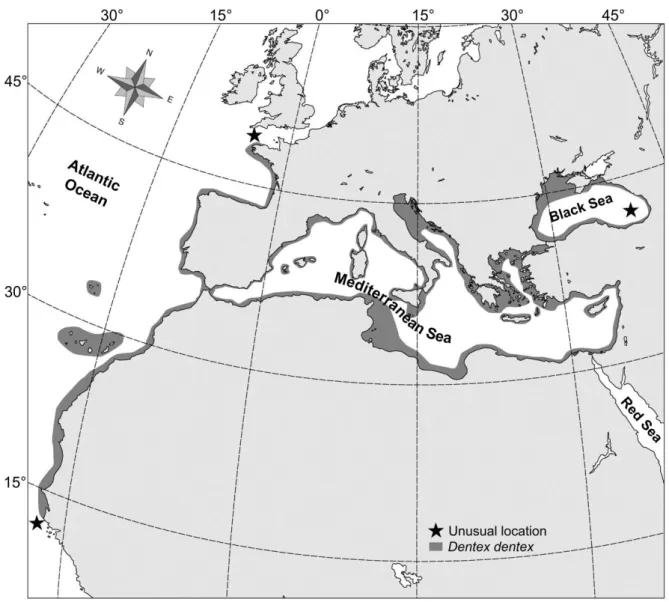
Dentex dentex is a Mediterranean and Atlantic species (Bayle-Sempere et al. 1991). It inhabits the Mediterranean Sea most frequently south of 40°, is found occasionally in the Black Sea, and occurs in the Atlantic Ocean (occasionally around the British Isles), and also Cape Blanc, the Bay of Biscay, Madeira, the Canary Islands and southward to Senegal (Fig. 1) (Bauchot and Hureau 1986; Morales-Nin and Moranta 1997; Bat et al. 2005). In 2008, small juvenile Dentex dentex were observed in the Arcachon basin (Quero et al. 2009), implying that common dentex may spawn in the Bay of Biscay. Presence in this region has been reported 12 times in all: five times in the 19th century with large individuals, six times in the 20th and once in the 21st century also with the presence of juveniles (<20 cm) in the Basque country (Quero et al. 2009). Dentex dentex is a demersal fish found from 0 to 200 m depth, living on various substrates such as Posidonia oceanica meadows (L.) Delile, rocky bottom with P. oceanica patches, coastal detritic areas, ripples of coarse sand, sandy habitats with Caulerpa and Cymodocea and in the coralligenous community (Ramos-Esplà and Bayle-Sempere 1991; Abellán 2000; Rueda and Martinez 2001; Ballesteros 2006; Stobart et al. 2012). Juveniles of common dentex (20–50 mm TL, during June–August) inhabit shallow water (2–4 m depth), at the interface between Posidonia oceanica meadows and sand, or close to crevices and small caves (Dulcic et al. 2002; Valle and Bayle‐Sempere 2009). The juveniles are gregarious; shoals of Dentex dentex have been observed with individuals of medium size (1–5 kg) especially in summer around rocky outcrops at depths between 20 and 50 m, but they are also found in shallow waters (−8 to −10 m) (Bauchot and Hureau 1986; Bayle-Sempere et al. 1991; Francour 1994; Chemmam-Abdelkader 2004; Sahyoun et al. 2013). Behaviour changes with age; the oldest adults animals are solitary (Bauchot and Hureau 1986).
14
Fig. 1 Global geographical range of Dentex dentex (updated from Bauchot and Hureau 1986; Morales-Nin and Moranta 1997; Bat et al. 2005; FAO 2012a, b)
II.4 Feeding and behavioural ecology
Morales-Nin and Moranta (1997) reported that in the Balearic Islands, the adults feed mainly on fish from the coastal zone (74 %) and on cephalopods (26 %) as secondary prey. The smaller individuals had species from the Posidonia meadow in their stomachs: sparids, clupeids, gadoids, and more frequently labrids such as the peacock wrasse (Symphodus tinca, Linnaeus, 1758, 22.58 %). In larger specimens, fish were the predominant prey, mainly sparids, picarel and anchovy. Whole cephalopods, remains of sepia bone and unidentified beaks were also found (25.62 %). However, their prey species are diverse, and probably depend largely on availability (Morales-Nin and Moranta 1997). On the Tunisian coast the common dentex feeds preferentially on fish (84 %), crustaceans (9 %), cephalopods (5 %) and plant remains (2 %) (Chemmam-Abdelkader 2004). Pelagic fish (e.g. Trachurus sp, Sardina pilchardus, Walbaum, 1792) constitute the majority of prey (56.1 %), compared with
15
other fish. Crustacean preys were primarily the caramota prawn (Penaeus kerathuru, Forsskål, 1775), cuttlefish (Sepia officinalis, Linnaeus, 1758) and the European squid (Loligo vulgaris, Lamarck, 1798) were the main cephalopods, and Posidonia oceanica and species of the Caulerpa genus were the key plants.
The common dentex is a high level tropic predator (trophic level 4.5), and the large size of the adults probably limits the number of predators (Morales-Nin and Moranta 1997; Stergiou and Karpouzi 2001; Froese and Pauly 2011). However, a study on the food and feeding habits of the amberjack Seriola dumerili (Risso, 1810) indicates that the common dentex, probably at the juvenile stage, may be considered as an occasional prey for this species (Andaloro and Pipitone 1997).
II.5 Reproduction
There is almost no information on the reproductive biology of common dentex in the natural environment. Based on the macroscopic examination of gonads from 210 fish caught from the waters off Mallorca, they reported an equal sex distribution (Morales-Nin and Moranta 1997). Seasonal variations in the sex ratio of the common dentex were observed on the Tunisian coasts, with an apparent dominance of females compared with males all year round, and a dominance of males during the spawning period (April-June) (Chemmam-Abdelkader 2004). This dominance of males during the spawning period could explain the fertilization of eggs of one female by several males (Chemmam-Abdelkader 2004). In addition, macroscopic examination of D. dentex gonads throughout its life cycle revealed rare cases of hermaphroditism. In this study 3,727 individuals were examined, and only 14 immature individuals (with sizes between 17.5 and 24.8 cm) were observed with both male and female parts.
The species D. dentex can therefore be characterized by a rudimentary nonfunctional hermaphroditism, which is common throughout sparids. Reproduction (spawning period) occurs from the end of March until June (Morales-Nin and Moranta 1997). In winter most of the specimens are immature, with the development of the gonads starting in January and the first mature specimens appearing in March. The size at which 50 % of the population is mature is estimated at 34.60 cm for females and 52.02 cm for males from the Balearic Islands (Morales-Nin and Moranta 1997), and 23.32 cm for males and 22.58 cm for females from the Tunisian coast (Chemmam-Abdelkader 2004). Along the Tunisian coast, at 26 cm total length (TL), 75 % of the population is mature, and at 33 cm TL 100 % of the population is mature for both sexes (Chemmam-Abdelkader 2004). Maximum maturity occurred in the second quarter of the year, with the first post-spawn specimens appearing in the third quarter (Morales-Nin and Moranta 1997). Examination of the ovaries during the spawning period
16
shows that they have different amounts of oocytes corresponding to different stages of oocyte release (nearly full, half full, almost empty) (Chemmam-Abdelkader 2004). The analysis of the frequency distribution of egg size shows the existence of four modes corresponding to four categories of oocytes laid at four different periods (Chemmam-Abdelkader 2004). The common dentex is a partial spawner, it emits eggs of the same spawning over several days (Chemmam-Abdelkader 2004). Absolute fecundity of Dentex dentex, on average, is equal to 164,195 eggs per fish, and the average relative fecundity is estimated at 217 eggs per gram of fish (Chemmam-Abdelkader 2004).
Concerning the spawning areas, there is no information reported in the literature, however, we collected information in Corsica (France) based on the knowledge of fishers. According to their observations during the spawning period, the populations of common dentex gather periodically on spawning sites at between 40 and 100 m depth to form shoals. These sites are characterized by hard substrates such as rocky outcrops or wrecks. Observations made by seine fishers using sonar suggest that mating occurs mainly during the day, but may also occur at night during the full moon.
II.6 Age, growth and condition
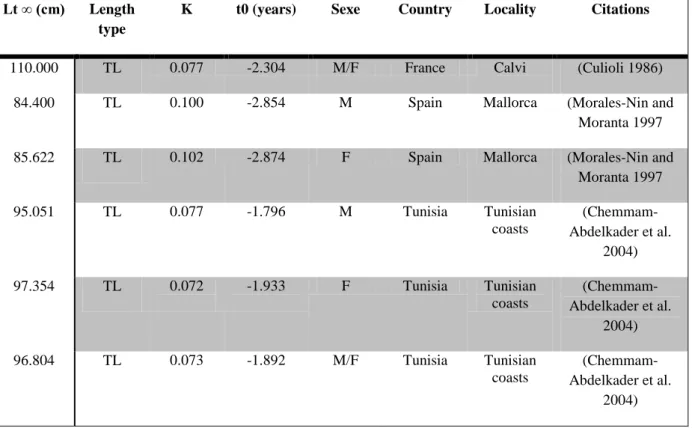
Dentex dentex may reach a maximum length of 100 cm and a weight of 13 kg (Ramos-Esplà and Bayle-Sempere 1991; Morales-Nin and Moranta 1997). There are no morphological differences between the two sexes, and the size-weight relationship is similar in both (Morales-Nin and Moranta 1997). Growth is rapid in the first 2 years of life, with 31 % of the maximum length being reached in the first year (24.1 cm) (Morales-Nin and Moranta 1997) and reported estimates of von Bertalanffy growth parameters similar among studies (Table 1) (Culioli 1986; Morales-Nin and Moranta 1997; Chemmam-Abdelkader et al. 2004). Dentex dentex has the physiological capacity to withstand long periods of fasting, which seems to form part of its life cycle (Navarro and Gutierrez 1995; Vigliano et al. 2002). Several factors, such as seasonal environmental fluctuations, reproduction, including pre-spawning and migration, or availability of prey are responsible for this natural fasting (Pérez-Jiménez et al. 2012). Results suggest that common dentex possess a high capacity to face such nutritional challenges, given that the reduction in body mass induced by prolonged starvation is far lower than that reported for other sparid fish (Pérez-Jiménez et al. 2012). D. dentex are a relatively long-lived species, its maximum lifespan exceeding 20 years (Morales-Nin and Moranta 1997), with up to 33 years reported (Chemmam-Abdelkader et al. 2004). It exhibits a low species-specific production rate per unit biomass (P/B value of 0.24) (Valls et al. 2012) and a low population resilience, with a minimum population doubling time of 4.5–14 years (Froese and Pauly 2011). For these reasons, its populations are considered as
slow-17
recovering (Abdul Malak et al. 2011). However, the calculated values of natural mortality rate (0.201 year−1 for both sexes combined, Morales-Nin and Moranta 1997; 0.24 year−1, Valls et al. 2012) indicate a relatively low natural mortality.
Table 1 Growth parameters of Von Bertalanffy equation estimated for Dentex dentex. Lt∞ = theoretical maximum size, TL = Total Length, K = growth rate, t0 = age at which the length at age t is theoretically equal to 0, M = Male, F = Female, M/F = Male and Female.
II.7 Parasitology
Parasites have been widely used as biological tags to provide information for fisheries management on the movements and population connectivity of their fish hosts (Williams et al. 1992). Just as there is a need to correctly identify a stock before it can be appropriately managed, parasites also need to be correctly identified before they can be used as biological tags (Catalano et al. 2013). The main factor limiting the use of marine parasites as biological tags is insufficient information on their complex biology and ecology (MacKenzie et al. 2008). Numerous investigations concerning the parasite fauna of several sparid fishes from the Western Mediterranean have been published (Brian 1906; Yamaguti 1963; Bartoli et al. 1989; Ternengo et al. 2009; Kaouachi et al. 2010; Marzoug et al. 2012). However, there have been no specific studies on the parasite communities present in the common dentex, but
Lt ∞ (cm) Length type
K t0 (years) Sexe Country Locality Citations
110.000 TL 0.077 -2.304 M/F France Calvi (Culioli 1986)
84.400 TL 0.100 -2.854 M Spain Mallorca (Morales-Nin and
Moranta 1997
85.622 TL 0.102 -2.874 F Spain Mallorca (Morales-Nin and
Moranta 1997 95.051 TL 0.077 -1.796 M Tunisia Tunisian coasts (Chemmam-Abdelkader et al. 2004) 97.354 TL 0.072 -1.933 F Tunisia Tunisian coasts (Chemmam-Abdelkader et al. 2004) 96.804 TL 0.073 -1.892 M/F Tunisia Tunisian coasts (Chemmam-Abdelkader et al. 2004)
18
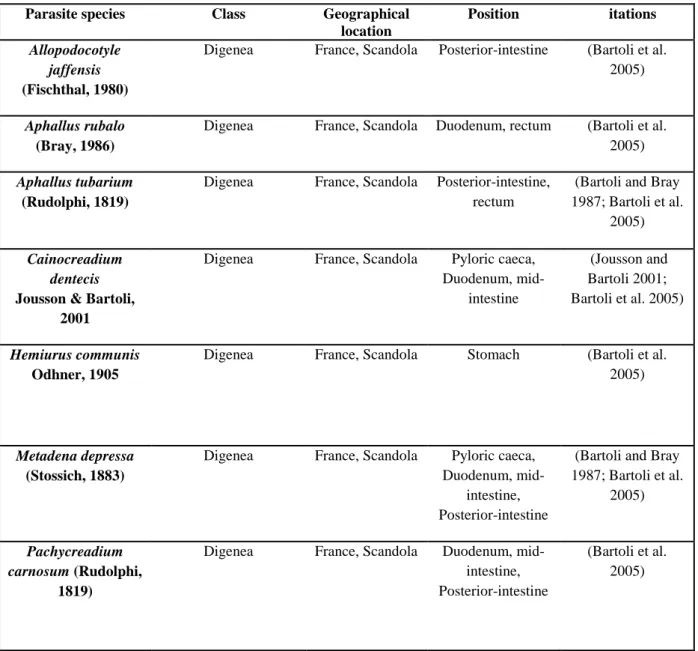
much reported data are nevertheless available (Table 2). These results indicate that the parasite fauna is diverse, most of these species have a wide host spectrum. However some parasite as Cainocreadium dentecis (Jousson and Bartoli 2001) are specific to the common dentex and have it for only host-associated. There are some studies on abundance, intensity, prevalence, and their descriptions for digeneans (Bartoli and Bray 1987; Bartoli et al. 1989; Bartoli et al. 2005; Foata et al. 2012; Greani et al. 2012). For ectoparasites, there are references to the gill parasites, especially copepods (Brian 1906; Raibaut et al. 1998; Bailly 2012), but data on monogeneans are scant (Radujkovic and Raibaut 1989; Euzet et al. 1993; González et al. 2004).
Table 2 Bibliographical review of the known parasites of Dentex dentex; geographical location, position of the parasites and references.
Parasite species Class Geographical location
Position Citations
Allopodocotyle jaffensis
(Fischthal, 1980)
Digenea France, Scandola Posterior-intestine (Bartoli et al. 2005)
Aphallus rubalo
(Bray, 1986)
Digenea France, Scandola Duodenum, rectum (Bartoli et al. 2005) Aphallus tubarium
(Rudolphi, 1819)
Digenea France, Scandola Posterior-intestine, rectum
(Bartoli and Bray 1987; Bartoli et al.
2005) Cainocreadium
dentecis
Jousson & Bartoli, 2001
Digenea France, Scandola Pyloric caeca, Duodenum, mid-intestine (Jousson and Bartoli 2001; Bartoli et al. 2005) Hemiurus communis Odhner, 1905
Digenea France, Scandola Stomach (Bartoli et al. 2005)
Metadena depressa
(Stossich, 1883)
Digenea France, Scandola Pyloric caeca, Duodenum,
mid-intestine, Posterior-intestine
(Bartoli and Bray 1987; Bartoli et al.
2005)
Pachycreadium carnosum (Rudolphi,
1819)
Digenea France, Scandola Duodenum, mid-intestine, Posterior-intestine
(Bartoli et al. 2005)
19
Stephanostomum sp.
(Metacercariae)
Digenea Spain,
Balearic Islands
Gills (González et al. 2004)
Lecithochirium musculus
(Looss, 1907)
Digenea Adriatic Sea (Carreras-Aubets
et al. 2012)
Timoniella imbutiforme
(Molin, 1859)
Digenea Italy, Triest Intestin (Stossich 1905)
Microcotyle erythrini
Van Beneden & Hesse, 1863
Polyopisthocotylea Spain, Balearic Islands
Gills (González et al. 2004) Cathucotyle
acanthura (Parona &
Perugia, 1896) Polyopisthocotylea Mediterranean sea (Euzet et al. 1993) Udonella caligorum Johnston, 1835
Monopisthocotylea Spain, Balearic Islands
Gills (González et al. 2004) Encotyllabe vallei
Monticelli, 1907
Monopisthocotylea Montenegro (Radujkovic and Euzet 1989; Euzet et al. 1993) Dinemoura producta (Mueller, 1785) Copepoda Spain, Balearic Islands
Gills (González et al. 2004) Caligus dakari
Beneden, 1892
Copepoda Montenegro Kotor
Gills (Radujkovic and Raibaut 1989) Caligus diaphanus Von Nordmann, 1832 Copepoda Spain, Balearic Islands
Gills (González et al. 2004) Clavella denticis
(Krøyer, 1863)
Copepoda Montenegro (Yamaguti 1963)
Clavellotis fallax (Heller, 1865) Copepoda Spain, Balearic Islands Montenegro, Kotor
Gills (Radujkovic and Raibaut 1989; Raibaut et al. 1998; González et al. 2004) Colobomatus denticis (Richiardi, 1877) Copepoda Mediterranean sea (Raibaut et al. 1998; Bailly 2012) Caligus vexator Heller, 1865
Copepoda Italy, Genoa Montenegro, Kotor Gills (Brian 1906; Radujkovic and Raibaut 1989; Raibaut et al. 1998; Bailly 2012) Parabrachiella exigua (Brian, 1906) Copepoda Mediterranean sea (Bailly 2012) Ceratothoa parallela (Otto, 1828) Eumalacostraca Isopoda Mediterranean sea (Trilles 1994)
20 Gnathia vorax (Lucas, 1849, praniza larvae) Eumalacostraca Isopoda Spain, Balearic Islands
Gills (González et al. 2004)
II.8 Stock structure and assessment
An important first step toward assessing the sustainability of an exploited population is to define the geographic boundaries, or stock units, for the species (Quinn II and Deriso 1999). Unfortunately, little is known of the global stock structure and movement of D. dentex. There is only one study on the population genetics of D. dentex at the global level. This study describes the phylogeography of three sparids including D. dentex based on three geographic areas: the Northeast Atlantic, and the Western and Eastern Mediterranean Sea (Bargelloni et al. 2003). For D. dentex, mitochondrial DNA and allozymes revealed a higher degree of genetic differentiation between the Atlantic and Mediterranean individuals. A significant degree of morphological dissimilarity between the individuals in this study and a geographical gradient were found (Palma and Andrade 2004). These results are evidence for a sharp phylogeographic break between the Atlantic and the Mediterranean populations of common dentex (Bargelloni et al. 2003; Palma and Andrade 2004).
Reported differences in fish size and growth may be due to fishing pressure, changes in oceanographic conditions, food availability, and season (Shelton and Mangel 2011). There seems to be an effective boundary between the Atlantic and Mediterranean populations of dentex, both morphologically and genetically (Bargelloni et al. 2003; Palma and Andrade 2004). It can be hypothesized that the history of the Mediterranean Sea, combined with the present hydrographic patterns, may have promoted and maintained the differentiation of the Mediterranean sub-population (Bargelloni et al. 2003; Palma and Andrade 2004). However, there is a severe lack of information on population structure, requiring further studies at a higher spatial resolution and using more accurate molecular markers (e.g. microsatellites). To date, the only studies on the stock assessment of common dentex were conducted in Tunisia; three stocks were separately addressed according to different regions: Northern, Eastern and South (Chemmam-Abdelkader 2004; FAO 2008). In the North, the yield per recruit value was below the optimal level suggesting the stock was under-exploited. The exploitation profile in the Eastern region was optimal, and by contrast, the stock of the southern region was strongly overexploited, with a current yield above the optimum performance (Chemmam-Abdelkader 2004). The results obtained in the South Tunisian sector show that fishing is carried out on small size classes composed mainly of juveniles (Chemmam-Abdelkader et al. 2007). The current average age of the stock is estimated at 1.9 years, very low given the longevity of the species, which can be more than 30 years. For losses, the fishing mortality (F: 1.2 year−1) of 63 % outweighed the natural mortality (M:
21
0.18 year−1) of 37 %, most probably due to overfishing (Chemmam-Abdelkader et al. 2007). The Southern stock was characterized by a young average age and a critical size close to that of sexual maturity, reflecting an overfished stock. To remedy this, current fishing effort should be reduced to 44 % compared with the optimal effort (Chemmam-Abdelkader et al. 2007). As a precautionary measure it has already been recommended not to increase fishing effort in either area (FAO 2008). At a global level, efforts need to be made to improve stock assessment of the common dentex, and better understand the stock structure including its movement and how the individuals comprising the various D. dentex aggregations in different localities are related.
II.9 Fisheries
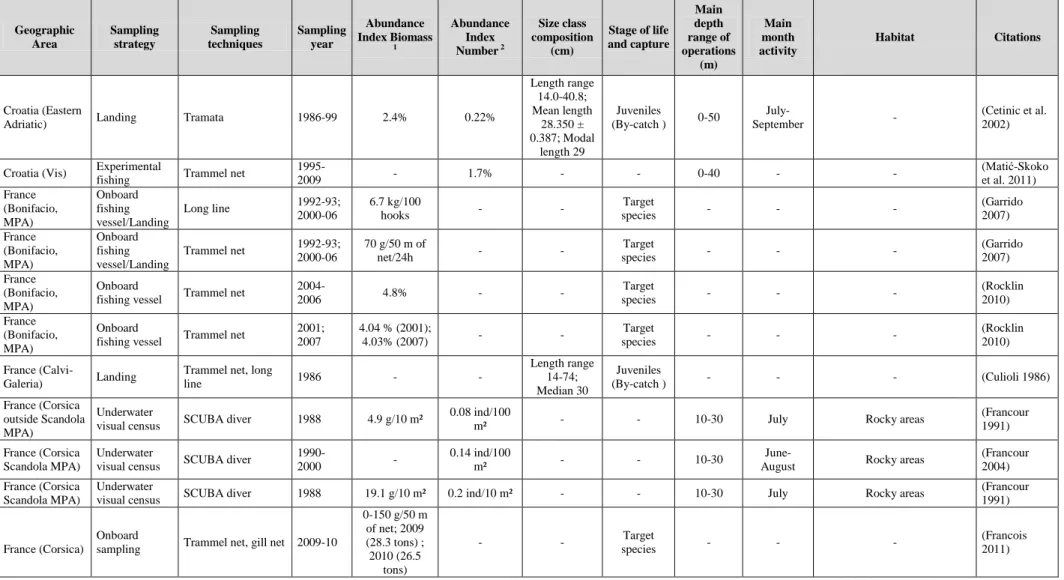
The main fishing gears specifically targeting the common dentex are: bottom long-lines, trammel nets and medium-large mesh gillnets (Morales-Nin and Moranta 1997; Lelli et al. 2006; Vandeperre et al. 2006; Sacchi and Dimech 2011). However, they can also be caught as bycatch, especially at the juvenile stage, by traps nets, fyke net, basket traps, bottom-trawl, purse and beach seines, as well as “Tramata” fishing used only in the eastern Adriatic, or “Gangui” fishing used along Mediterranean north coastline (Cetinic et al. 2002; Akyol 2003; Quero et al. 2009; Vandeperre et al. 2006; Sacchi and Dimech 2011). Trammel nets are gangs of three rectangular nets made up of two outer, large-mesh panels and one inner panel (Goñi et al. 2003). For the common dentex fishery, the smaller mesh panel reaches a size of 40 mm stretched, and the large-mesh up to 150 mm stretched. It is composed of a bottom rope with sinkers, and a head rope equipped with floats (Leleu 2012) to deploy the net vertically (up to 5.8 m) with a length of 500 m (3–4 units per vessel). In addition to wedging, gilling and entangling (i.e., held by teeth, spines or other protrusions), trammel nets also catch fish in the pocket formed by the inner smaller mesh wall of netting being pushed through one of the larger mesh outer walls (Erzini et al. 2006). A trammel net is usually installed in the evening and retrieved at dawn (between 12 and 24 h). Medium mesh size gillnets are built with a single wall of monofilament net with a stretched mesh size of 48– 120 mm, and target medium size fish such as sparids on shallow sandy and mixed sandy rocky bottoms (Lelli et al. 2006). The length of these nets ranges from a few hundred meters to more than 1,000 m (Sacchi and Dimech 2011). Bottom longlines consist of a monofilament mainline to monofilament snoods with hooks about 1 m long, attached at regular intervals (Lelli et al. 2006). The most common gear used is 1.2 mm diameter mainline with 0.6 mm snood and hooks of length 3 cm and width 1.5 cm (Sacchi and Dimech 2011). The bait used is mainly cephalopods and sardines (Sacchi and Dimech 2011). On the same fishing day typical artisanal Mediterranean vessels (generally less than 12 m in length) can deploy more
22
than one longline unit (2–3 per vessel) of 200–300 hooks each, for a length of about 1 km (Lelli et al. 2006). In sum, the common dentex is targeted by artisanal fisheries throughout the year using different gear. We note that there is an alteration and/or combined use of this gear (top three: longline, trammel and gill net), depending on the season, habitat and geographic areas (Table 3). However, for common dentex fishing, peaks of exploitation are observed, with maximum efficiency between May and September by trammel net/gill nets and between September and April by bottom long-line. The fishing depth is mostly in the range 15–80 m, with a mean value around depth 30 m. The composition by size class also shows broad variations in terms of catches (14–83 cm). Juvenile stages (mean value 30 cm) are captured especially on the Posidonia oceanica meadows (by trammel net and gill net) or as by-catch (e.g. Tramata, gangui), whereas adult specimens are caught mainly on the rocky bottoms (by long-line).
23
Table 3 Summary of the exploitation of Dentex dentex (abundance), according to the season, sizes class composition, fishing gears, main depth range of operations and habitat. 1 Contribution to total biomass of the catch %, total biomass kg, tons, CPUE, 2 Occurrence frequencies %, CPUE. Geographic Area Sampling strategy Sampling techniques Sampling year Abundance Index Biomass 1 Abundance Index Number 2 Size class composition (cm) Stage of life and capture Main depth range of operations (m) Main month activity Habitat Citations Croatia (Eastern
Adriatic) Landing Tramata 1986-99 2.4% 0.22%
Length range 14.0-40.8; Mean length 28.350 ± 0.387; Modal length 29 Juveniles (By-catch ) 0-50 July-September - (Cetinic et al. 2002)
Croatia (Vis) Experimental fishing Trammel net 1995-2009 - 1.7% - - 0-40 - - (Matić-Skoko et al. 2011) France (Bonifacio, MPA) Onboard fishing vessel/Landing Long line 1992-93; 2000-06 6.7 kg/100 hooks - - Target species - - - (Garrido 2007) France (Bonifacio, MPA) Onboard fishing vessel/Landing Trammel net 1992-93; 2000-06 70 g/50 m of net/24h - - Target species - - - (Garrido 2007) France (Bonifacio, MPA) Onboard
fishing vessel Trammel net
2004-2006 4.8% - - Target species - - - (Rocklin 2010) France (Bonifacio, MPA) Onboard
fishing vessel Trammel net
2001; 2007 4.04 % (2001); 4.03% (2007) - - Target species - - - (Rocklin 2010) France (Calvi-Galeria) Landing
Trammel net, long
line 1986 - - Length range 14-74; Median 30 Juveniles (By-catch ) - - - (Culioli 1986) France (Corsica outside Scandola MPA) Underwater
visual census SCUBA diver 1988 4.9 g/10 m²
0.08 ind/100
m² - - 10-30 July Rocky areas
(Francour 1991) France (Corsica
Scandola MPA)
Underwater
visual census SCUBA diver
1990-2000 -
0.14 ind/100
m² - - 10-30
June-August Rocky areas
(Francour 2004) France (Corsica
Scandola MPA)
Underwater
visual census SCUBA diver 1988 19.1 g/10 m² 0.2 ind/10 m² - - 10-30 July Rocky areas
(Francour 1991)
France (Corsica)
Onboard
sampling Trammel net, gill net 2009-10
0-150 g/50 m of net; 2009 (28.3 tons) ; 2010 (26.5 tons) - - Target species - - - (Francois 2011)
24
France (Côte
Bleue, MPA) Landing Trammel net 2009-10 - - -
Target species 37.6 (mean value) - - (Leleu 2012) France (Cros de Cagnes) Landing
Trammel net, long line 2002-2005 0.19% - - - (Leroy 2009) France (Lavezzi Islands) Onboard fishing vessel
Trammel net, long
line 1992-93 1316 kg (5.64 %) 0.74 % (n=445) Length range 0-40 (41%); 40-60 (37%); 60-80 (22%) Target species - - - (Culioli 1995) France (National Park of Port-Cros) Underwater
visual census SCUBA diver
1989-1990 92.4 g/10 m²
0.47 ind/100
m² - - 10-30
June-September Rocky areas
(Francour 1992) France (National Park of Port-Cros) Underwater
visual census SCUBA diver
2005-2006 - 0.1 ind/250 m² - - 20-40 April-July Rocky areas
(Francour 2007) France (National
Park of Port-Cros)
Landing Small-scale fisheries
(all gears combined) 2005 1.30 % - - - -
(Cadiou and Bonhomme 2006) France (Var) Experimental
fishing Gangui 2010 - -
Juveniles
(By-catch ) 15-35
January-December Posidonia oceanica meadow
(Sacchi et al. 2010) France (Var) Onboard fishing vessel Angling 2010-2012 14% - - - (Bodilis et al. 2012) France (Var,
Cap Roux Fisheries Reserve)
Experimental
fishing Trammel net
2011-2012 -
0.3 ind/100 m
of net (0.77%) - - 0-40 - Rocky areas and Posidonia (Arceo 2012)
France, Corsica
(NW coast) Landing
Trammel net, long line 1988-1989 3.6% - - - (Riutort 1989) Greece Declarative survey Small-scale fisheries (all gears combined) 1993-99
Winter (1.63%) ; Spring (2.64%) ; Summer (2.13) % ; Autumn (2.37 %); (mean value all
the year 2.27%) - - - - January-December - (Tzanatos et al. 2005) Greece (Korinthiakos) Onboard fishing vessel/ Experimental fishing
Trammel net, gill net 2008-09 - -
Length range 17.1-48.0; Median 28.1 - - June-September - (Moutopoulos et al. 2013) Greece (Patraikos) Onboard
fishing vessel Trammel net 2004-05 - - -
Target species 0-25 September-July - (Tzanatos et al. 2008)