HAL Id: hal-03230842
https://hal.archives-ouvertes.fr/hal-03230842
Submitted on 25 May 2021
HAL is a multi-disciplinary open access
archive for the deposit and dissemination of
sci-entific research documents, whether they are
pub-lished or not. The documents may come from
teaching and research institutions in France or
abroad, or from public or private research centers.
L’archive ouverte pluridisciplinaire HAL, est
destinée au dépôt et à la diffusion de documents
scientifiques de niveau recherche, publiés ou non,
émanant des établissements d’enseignement et de
recherche français ou étrangers, des laboratoires
publics ou privés.
End to end raw audio deep learning of transients,
application to bioacoustics
Maxence Ferrari, Hervé Glotin, Ricard Marxer
To cite this version:
Maxence Ferrari, Hervé Glotin, Ricard Marxer. End to end raw audio deep learning of transients,
application to bioacoustics.
e-Forum Acusticum 2020, Dec 2020, Lyon, France.
pp.3245-3247,
�10.48465/fa.2020.1096�. �hal-03230842�
END TO END RAW AUDIO DEEP LEARNING OF TRANSIENTS,
APPLICATION TO BIOACOUSTICS
Maxence Ferrari
1Herv´e Glotin
1Ricard Marxer
11
Univ. Toulon, Aix Marseille Univ. CNRS, LIS, DYNI, Marseille, France
[email protected], [email protected], [email protected]
1. INTRODUCTION
In this paper, we propose a raw audio deep learning ap-proach to click classification. The advantage of having a neural network that works directly on the audio samples is that there is no need to find manually the best representa-tion (spectrogram, MEL bands, . . . ), and avoids the work needed to tune all the hyperparameters that come with those representations (window size, stride ...). The way in which the information is extracted is learned from the data. The model proposed, named UpDimV2 was built to answer the challenge DOCC10 [1, 2] that we created based on data from the DCLDE challenge [3] and the Sphyrna expedition [4].
2. MATERIAL AND METHOD
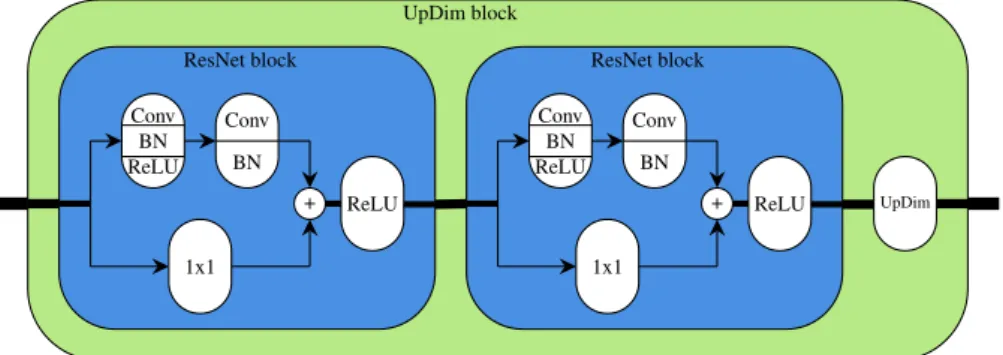
The network is composed of multiple UpDim blocks. As shown in figure 1, an UpDim block is composed of two ResNet blocks [5] followed by the UpDim operation, which adds a dimension (also known as unsqueeze or ex-pand dim). Thus a 1D example with a width and feature dimension with the respective size of w and f will become a 2D example with a height, a width and a feature dimen-sion, with their respective sizes of w, f and 1. The UpDim operator can then be applied once again to turn this 2D ex-ample into a 3D exex-ample.
The DOCC10 dataset consists of clicks centered in a window of 8192 samples. This was motivated by the pos-sibility of analysing clicks in a window of 4096 samples while being able to offset this shorter window. The combi-nation of DCLDE and Sphyrna Odyssey brought this new dataset to a total count of 134,080, that we split into a train-ing set of 113,120 clicks and a test set of 20,960 clicks for the DOCC10 challenge, which produces an approximately 85-15 split. The test set is balanced with 2096 clicks per class. For the challenge, the test set was split into a private test set (90%) and a public test set (10%). This split was done randomly, so that the classes are no longer perfectly balanced to prevent participant to use this information. The training set is also perfectly balanced with 11,312 clicks per class.
3. RESULTS
Since the release of the DOCC10 challenge in early 2020, 28 challengers have participated. The full
up-to-date leaderboard can be found on the Challenge Data website (https://challengedata.ens. fr/participants/challenges/32/ranking/ public). The top two scores were obtained by the same team, who used a semi-supervised approach on the test set, hence the score gap with the other participants.
4. DISCUSSION AND CONCLUSION An alternate version of the DOCC10 dataset, called DOCC7, has been generated. It has the same samples, but restricted to only 7 species, which are Gg, Gma, La, Mb, Me, Pm, and Zc. The reason for the removal of UDA and UDB is more straightforward. When the DCLDE dataset was made, they used clustering methods to detect the var-ious species. These two labels were then given to dol-phin species that could not be identified. We decided to leave them in the DOCC10 challenge since they still repre-sent clicks that belong to groups of dolphins, even if they do not represent only one species, unlike the other labels. These clusters are also useful to train a classifier that would be used after a click detector, and prevent it from classi-fying these dolphin clicks as another species. However, trained networks (with various architectures from various labs) have shown that, unlike the seven other classes in DOCC7, the trained networks had lower accuracy on the UDA and UDB labels. We believe that the networks’ pre-diction might not be wrong, meaning that these classes have a higher label noise. Finally, the Ssp were also re-moved for two reasons. Firstly, Stenella is a genus and not a species unlike the other remaining classes. Secondly, there seems to be a large covariate shift between the train-ing and test sets for this class. A slew of reasons could explain this difference between the training and test set, such as different species, different groups, different types of clicks, or mislabeling. This model was also tested on the DOCC7 database, achieving an accuracy of 95.09%. Applications of this model will be conducted in the CARI-MAM project.
5. ACKNOWLEDGEMENTS
This research was partly funded by AID Agency, Region Haut de France, ANR-18-CE40-0014 SMILES, MARIT-TIMO FEDER GIAS projects on advanced studies on whale-ship anti-collision system, and
+ Conv BN ReLU 1x1 ReLU + Conv BN ReLU 1x1 ReLU UpDim
ResNet block ResNet block
UpDim block
Conv BN
Conv BN
Figure 1. Architecture of an UpDim block
Layer name Input size Kernel Strides Out
features Conv-1D N ∗ 4096 ∗ 1 3 1 32 Conv-1D N ∗ 4096 ∗ 32 3 2 32 Skip N ∗ 4096 ∗ 1 1 2 32 Conv-1D N ∗ 2048 ∗ 32 3 2 64 Conv-1D N ∗ 1024 ∗ 64 3 2 128 Skip N ∗ 2048 ∗ 32 1 4 128 Conv-2D N ∗ 1024 ∗ 128 ∗ 1 3*3 1*1 32 Conv-2D N ∗ 1024 ∗ 128 ∗ 32 3*3 2*2 32 Skip N ∗ 1024 ∗ 128 ∗ 1 1*1 2*2 32 Conv-2D N ∗ 512 ∗ 64 ∗ 32 3*3 2*2 64 Conv-2D N ∗ 256 ∗ 32 ∗ 64 3*3 2*2 128 Skip N ∗ 512 ∗ 64 ∗ 32 1*1 4*4 128 Conv-3D N ∗ 128 ∗ 16 ∗ 128 ∗ 1 3*3*3 1*2*1 32 Conv-3D N ∗ 128 ∗ 8 ∗ 128 ∗ 32 3*3*3 2*2*2 64 Skip N ∗ 128 ∗ 8 ∗ 128 ∗ 1 1*1*1 2*4*2 64 Conv-3D N ∗ 64 ∗ 4 ∗ 64 ∗ 64 3*3*3 2*2*2 128 Conv-3D N ∗ 32 ∗ 2 ∗ 32 ∗ 128 3*3*3 2*2*2 256 Skip N ∗ 64 ∗ 8 ∗ 64 ∗ 64 1*1*1 4*4*4 256 Softmax N ∗ 16 ∗ 1 ∗ 16 ∗ 256 16*1*1 MaxPool N ∗ 16 ∗ 1 ∗ 16 ∗ 256 16*1*1 Flatten N ∗ 1 ∗ 1 ∗ 16 ∗ 256 Dense N ∗ 4096 1024 Dense N ∗ 1024 512 Dense N ∗ 512 7
Table 1. Topology of UpDimV2 model
Dimensions are given in NHWC order. Horizontal lines separate each residual block.
0014-01 national Chair in Artificial Intelligence for Bioa-coustics ADSIL (H. Glotin).
6. REFERENCES
[1] M. Ferrari, H. Glotin, R. Marxer, and M. Asch, “Docc10: Open access dataset of marine mammal transient studies and end-to-end cnn classification,” in IJCNN, 2020.
[2] M. Ferrari, Study of a Biosonar Based on the Mod-eling of a Complete Chain of Emission-Propagation-Reception with Validation on Sperm Whales. PhD thesis, Universit´e de Picardie Jules Verne, Amiens, France, Sept. 2020.
[3] H. Glotin, J. Hildebrand, K. Dunleavy, and M. Roch, “Dclde challenge,” pp. 134, Proceedings of DCLDE2018, Sorbonne Universit´e, Universit´e de Toulon Ed., sabiod.org, 2018.
[4] M. Ferrari, M. Poupard, P. Giraudet, R. Marxer, J.-M. Pr´evot, T. Soriano, and H. Glotin, “Efficient ar-tifacts filter by density-based clustering in long term 3d whale passive acoustic monitoring with five hy-drophones fixed under an autonomous surface vehicle,” in OCEANS 2019-Marseille, pp. 1–7, IEEE, 2019. [5] K. He, X. Zhang, S. Ren, and J. Sun, “Deep
resid-ual learning for image recognition,” in Proceedings of the IEEE conference on computer vision and pattern recognition, pp. 770–778, 2016.