HAL Id: tel-03045951
https://tel.archives-ouvertes.fr/tel-03045951
Submitted on 8 Dec 2020HAL is a multi-disciplinary open access archive for the deposit and dissemination of sci-entific research documents, whether they are pub-lished or not. The documents may come from teaching and research institutions in France or abroad, or from public or private research centers.
L’archive ouverte pluridisciplinaire HAL, est destinée au dépôt et à la diffusion de documents scientifiques de niveau recherche, publiés ou non, émanant des établissements d’enseignement et de recherche français ou étrangers, des laboratoires publics ou privés.
Influence of environmental and individual characteristics
on baseline stress levels, and consequences in a large
mammal, the roe deer Capreolus capreolus
Jeffrey Carbillet Malherbe
To cite this version:
Jeffrey Carbillet Malherbe. Influence of environmental and individual characteristics on baseline stress levels, and consequences in a large mammal, the roe deer Capreolus capreolus. Ecology, environment. Université Paul Sabatier - Toulouse III, 2019. English. �NNT : 2019TOU30284�. �tel-03045951�
This thesis has been funded thanks to a partnership between the Institut National de la
Recherche Agronomique (INRA) and the Institut national d'enseignement supérieur et de
recherche en alimentation, santé animale, sciences agronomiques et de l'environnement
(VetAgro Sup), each provided 50% of the total cost of this work, with. The Office National de
la Chasse et de la Faune Sauvage (ONCFS) also provided funds for this work within the
ONCFS-VetAgro Sup agreement “Stress, physiologie et performances dans les populations de
chevreuils” (CNV 2015/19/6171). This thesis has been realised at the Comportement et
Ecologie de la Faune Sauvage (CEFS) lab, within the INRA centre located in Castanet-Tolosan
(Haute-Garonne). Regular stay have been realised at the Biométrie et Biologie Evolutive (LBBE)
lab located on the Claude Bernard university campus (Lyon 1).
« It's not who I am underneath, but what I do that defines me » - Batman -
Summary
List of articles included in this manuscript ... 8
List of figures ... 10 List of boxes ... 11 Introduction ... 12 1- A dynamic environment ... 13 2- Behavioural adjustments ... 16 2-1 Short-term adjustments ... 16 2-2 Long-term adjustments ... 17 3- Physiological adjustments ... 17 3-1 Catecholamine neurohormones ... 19 3-2 Glucocorticoid hormones ... 19
3-2-1 HPA axis and glucocorticoids secretion ... 20
3-2-2 Baseline glucocorticoids functions ... 22
4- Among-individual differences in glucocorticoid levels ... 23
4-1 Individual sources of variations in glucocorticoid levels ... 23
4-1-1 Age ... 23
4-1-2 Sex ... 24
4-1-3 Body condition ... 24
4-2 Environmental sources of variations ... 27
4-2-1 Quantity and quality of resources ... 27
4-2-2 Predation ... 28
4-2-3 Social interactions ... 28
4-2-4 Human disturbance... 29
5 - Consequences of stress ... 30
5-1 Immune function ... 30
5-2 Reproduction and survival ... 35
5-3 Inter-generational effects ... 37
6- Background synthesis and aims of this thesis ... 39
6-1 Outline ... 41
6-2 Model species ... 42
Chapter 1 : Among-individual differences in baseline stress levels ... 48
The Neutrophil to Lymphocyte ratio indexes individual variation in the behavioural stress response of wild roe deer across fluctuating environmental conditions... 49
Under cover of the night: context-dependency of anthropogenic disturbance on stress levels of wild roe deer Capreolus capreolus ... 90
Chapter 2 : Early-life baseline stress levels and maternal effects ... 126
Human activities and behaviour influence salivary cortisol concentrations during early life of roe deer fawns ... 127
Maternal stress during early gestation does not influence offspring phenotype in fawns of
roe deer ... 152
Chapter 3 : Consequences of baseline stress levels on immunity ... 176
Into the wild of the stress-immunity relationship, a case study on roe deer Capreolus capreolus ... 177
Co-variation between faecal cortisol metabolites, behaviour and immune parameters over time in captive roe deer ... 218
Discussion and conclusion ... 262
1 - Individual and environmental characteristics shape baseline stress levels ... 264
1-1 neutrophils to lymphocytes (N:L) ratio versus faecal cortisol metabolites (FCMs) . 264 1-2 The influence of environmental characteristics on stress levels ... 266
1-3 The influence of individual characteristics on stress levels ... 268
2 - Early-life glucocorticoids and maternal effects ... 273
2-1 Measurement of salivary cortisol in newborns ... 274
2-2 Early-life glucocorticoid variations ... 275
2-3 Effects of maternal glucocorticoids ... 278
3 - Consequences of glucocorticoids on immunity ... 281
3-1 Glucocorticoids and immunity in contrasted environments ... 281
3-2 Glucocorticoids, immunity and behaviour ... 283
3-3 Other possible health consequences of glucocorticoid levels ... 286
References ... 292
Acknowledgment... 312
Appendix 1 ... 322
How and where to measure glucocorticoids? ... 322
Appendix 2 ... 324
Other manuscripts I was involved in ... 324
Abstract ... 403
List of articles included in this manuscript
Chapter 1 -
MS1: The Neutrophil to Lymphocyte ratio indexes individual variation in the behavioural stress response of wild roe deer across fluctuating environmental conditions.
J. Carbillet, B. Rey, T. Lavabre, Y. Chaval, J. Merlet, F. Débias, C. Régis, S. Pardonnet, J. Duhayer, J.M. Gaillard, A.J.M. Hewison, J.F. Lemaître, M. Pellerin, B. Rannou, H. Verheyden, E. Gilot-Fromont
MS2: Under cover of the night: context-dependency of anthropogenic disturbance on stress levels of wild roe deer Capreolus capreolus.
J. Carbillet, B. Rey, R. Palme, N. Morellet, N. Bonnot, Y. Chaval, B. Cargnelutti, A.J.M. Hewison, E. Gilot-Fromont, H. Verheyden
Chapter 2 -
MS3: Human activities and behaviour influence salivary cortisol concentrations during early life of roe deer fawns
J. Carbillet, B. Rey, N. Morellet, Y. Chaval, B. Cargnelutti, M. Hollain, C. Loiseau, A.J.M. Hewison, E. Gilot-Fromont, H. Verheyden
MS4: Maternal stress during early gestation does not influence offspring phenotype in fawns of roe deer
J. Carbillet, B. Rey, R. Palme, Y. Chaval, B. Cargnelutti, M. Hollain, N. Morellet, A.J.M. Hewison, E. Gilot-Fromont, H. Verheyden
Chapter 3 -
MS5: Into the wild of the stress-immunity relationship, a case study on roe deer Capreolus capreolus
M. Hollain, J. Carbillet, B. Rey, R. Palme, M. Pellerin, C. Regis, T. Lavabre, S. Pardonnet, J. Duhayer, F. Debias, J.M. Gaillard, H. Verheyden, J.F. Lemaitre, E. Gilot-Fromont
MS6: Co-variation between faecal cortisol metabolites, behaviour and immune parameters over time in captive roe deer
J. Carbillet, B. Rey, R. Palme, L. Börger, T. Lavabre, M.L. Maublanc, N. Cebe, J.L. Rames, B. Coracin, E. Bideau, B. Lourtet, G. Le Loch, M. Wasniewski, B. Rannou, E. Gilot-Fromont, H. Verheyden
Appendices -
Does body growth impair immune function in a large herbivore?
L. Cheynel, F. Douhard, E. Gilot-Fromont, B. Rey, F. Débias, S. Pardonnet, J. Carbillet, H. Verheyden, A.J.M. Hewison, M. Pellerin, J.M. Gaillard and J.F. Lemaître.
Glucocorticoid level predicts short-term telomere dynamics in wild roe deer
J.F. Lemaître1, J. Carbillet, B. Rey, R. Palme, H Froy, R.V. Wilbourn, S.L. Underwood, L. Cheynel, J.M. Gaillard, A.J.M. Hewison, H. Verheyden, J.F. Débias, J. Duhayer, C. Régis, S. Pardonnet, M. Pellerin, D.H. Nussey, E. Gilot-Fromont
List of figures
Figure 1 - Extended representation of the concept of homeostasis
Figure 2 - Representation of the concept of allostasis
Figure 3 - Representation of the physiological stress responses in vertebrates
Figure 4 - Representation of the hypothalamic-pituitary-adrenal axis
Figure 5 – Major immune mechanisms in vertebrates
Figure 6 - Juxtaposition of stressors that wild animals experience and known effects of similar
duration stressors in domesticated rodents.
Figure 7 - Maternal programming of the offspring phenotype
Figure 8 - Area of distribution of the European roe deer
Figure 9 - A roe deer named Babine feeding in a field of lucerne
Figure 10 - Biological cycle of roe deer
Figure 11 - Female and male roe deer, with the typical shape of their rump patch
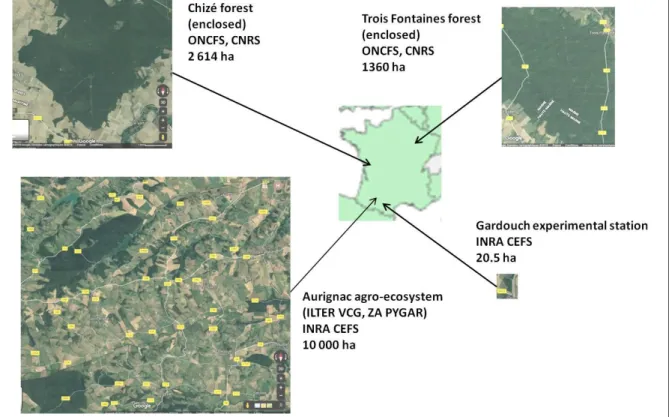
Figure 12 - Location and scaled representation of the four populations studied throughout this
thesis
List of boxes
Box 1 - What is homeostasis?
Box 2 - Physiology of the HPA axis
Box 3 - Behavioural type, coping style, personality... a glossary please
Box 4 - Into the immunity of wildlife…
Box 5 - Biology of the European roe deer (Capreolus capreolus)
1- A dynamic environment
Most people may agree that there is little common ground between a human, a squirrel, a
whale, a flamingo and a tortoise. But there is an obvious one, they all live in a dynamic
environment. No single day is identical to the previous or the next. What makes their
environment so dynamic? For instance, the interactions individuals have with other
organisms, fluctuations in resources quantity, meteorological conditions or seasonal rhythms
are among common factors making the environment dynamic. Some of these variations are
predictable due to environmental cues, allowing individuals to adjust their behaviour and
physiology, as is the case for diurnal rhythms and seasonal cycles. But most of the
environmental changes are not predictable and individuals may not be able to pre-emptively
adjust their behaviour and physiology to these events. These unpredictable events include
(but are not restricted to) social interactions, competition for resources or sexual partners,
predation, diseases, rapid modifications of habitats, or extreme climatic events. In recent
centuries, and even more so in the last decades, unpredictable environmental fluctuations
have increased dramatically, mainly because of the intensification of human activities (Sih et
al., 2011; Hooke et al., 2012), and have become major selective forces for natural populations
(Wingfield and Romero, 2001). Therefore, understanding the potential of wild animals to
respond to these perturbations and their consequences on life history traits and population
dynamics is receiving increasing attention in ecology and conservation biology. Throughout
this manuscript, I will refer to “stressors”, as any changes perceived as a threat to homeostasis
(Box 1) and that trigger a stress response in an individual. The “stress response” will be defined
as a suite of physiological and behavioural responses whose coordination aim at neutralising
evolutionarily to predictable stressors, they must rely on the stress response to adjust their
physiology and behaviour to cope with unpredictable and rapid changes in their environment.
Box 1 - What is homeostasis? (1/2)
According to Walter Cannon (1929), homeostasis is defined as “the coordinated physiological processes which maintain most of the steady states in the organism”. In other words, homeostasis, from the Greek words for "same" and "steady," refers to any process used to actively maintain stable internal conditions necessary for the survival of an organism. For instance, it refers to the processes that allow the maintenance of body temperature, the control of water balance, electrolytes (salt), carbohydrates (sugar), protein, lipids, and oxygen contents in tissues and biological fluids.
Figure 1 - Extended representation of the concept of homeostasis, where the maintenance of the internal state is ensured by influxes and outfluxes brought through behavioural and physiological processes, and under the control of hormones, such as glucocorticoid hormones. The secretion of these hormones is also under the control of environmental conditions. Environmental conditions act as signals for the control mechanism to ensure that the levels of essential elements match the need of the organism according to the current external conditions. (Adapted from Bradshaw, 2003).
Box 1 - What is homeostasis? (2/2)
The concept of homeostasis has been extended by McEwen and Wingfield (2003) to the concept of allostasis, which refers to the maintenance of homeostasis through change. Allostasis explicitly accounts for changes in environmental and life history stage, and therefore for changes in the different levels of essential elements required depending on the environmental context and life history stage of individuals. In other words, homeostatic set points can fluctuate through time. The concept of allostasis includes the state of allostatic load, defined as the addition of the current and anticipated energetic demands an individual is facing (McEwen and Wingfield, 2003), and the state of allostatic overload, defined as a condition where the allostatic load of an individual is exceeding the available resources (McEwen and Wingfield, 2003). Long-term exposure to stressors usually leads to the state of allostatic overload (often referred as chronic stress) that can have deleterious effects on individual’s fitness.
Figure 2 - Representation of the concept of allostasis, with allostatic load (A) and allostatic overload (B) situations. EE represents the energy required for basic homeostasis. EI represents the extra energy required for the individual to forage and assimilate food under favourable conditions and without stressor. EG represents the amount of energy (in food) available in the environment. EO represents the energy required to forage and assimilate nutrients under stressful conditions. In figure A) the energy required to forage and assimilate nutrients under stressful conditions (EO) does not exceed the amount of available energy (EG) and the individual therefore remain in a state of allostatic load. When EO exceeds EG, as it is the case in figure B), the individual reach the state of allostatic overload and remain in this state until the perturbation has stopped or the amount of available energy increased. (Figures from McEwen and Wingfield, 2003).
2- Behavioural adjustments
2-1 Short-term adjustments
In the face of unpredictable events, behavioural stress response serves to redirect an animal’s
attention from behaviours that can be resumed latter (e.g. foraging) to those necessary to
deal with the stressor that threatens immediate survival (e.g. escaping a predator, moving
toward a refuge). These behavioural adjustments are part of what John Wingfield and his
colleagues termed the “emergency life history stage (ELHS)” (1998), and imply that a current
life history stage (e.g. breeding) may be postponed. Besides suppressing some behaviours
such as territoriality, the ELHS triggers behavioural responses that have been divided in three
components by John Wingfield and his colleagues: 1) Moving away from the perturbation; 2)
Seeking refuge; 3) Seeking refuge and moving away. These behavioural responses may be
particularly used in a context of prey-predator interactions as immediate or anticipatory
responses. Indeed, individual may perceive cues from the presence of predators and adjust
their behaviour accordingly. The concept of the landscape of fear has been developed by
Laundré and colleagues (2001) on this basis and predicts that habitat use should differ in
relation to variations in perceived risk. For instance, a higher level of perceived risk of
predation should provoke an elevated level of vigilance from the prey. A famous test of this
prediction was the study from John Laundré and his colleagues (2001), showing that after wolf
reintroduction in the Yellowstone National Park, elk females exhibited significantly higher
levels of vigilance in areas containing wolves than those without. But in the landscape of fear
concept, not only vigilance, but also more global behavioural adjustments occur. For instance,
wild animals exhibit more pronounced modifications in their spatial behaviour as the level of
National Park, Scott Creel and his colleagues (2005) showed that elk tend to move into
wooded areas, which served as a refuge when wolves were present, therefore reducing their
use of more nutritive grassland habitats but that presented higher risks of predation. These
short-term behavioural adjustments might help individuals to mitigate direct exposure to
stressors, and consequently, to limit the amount of energy allocated to the stress response.
2-2 Long-term adjustments
As mentioned earlier, part of the environmental variations are predictable, and individuals
have evolved a large suite of behaviours allowing them to respond to environmental cues of
predictable variations occurring across a long-term timescale. First, to face scarcity of
resources at a given time of the year, individuals may move away a habitat A toward a habitat
B for a certain amount of time in order to find a higher quantity and/or quality of resources,
i.e., migration (Levey et al., 1992). Another behavioural tactic that is widely adopted by wild
animals is dispersal, the movement of an individual from its site of birth to a site of
reproduction, or between sites of reproduction (Clobert et al., 2012). Compared to migration,
this process is not seasonal and can, among others, allow individuals to escape local
unfavourable conditions (e.g. poor quality or quantity of resources or sexual partners,
competition with other individuals) and therefore avoid potential costs (in terms of fitness)
associated with stressful situations.
3- Physiological adjustments
Along with behavioural responses, physiological processes are also stimulated to cope with a
stressor. The two most important, in terms of consequences for individuals, and the most
studied physiological stress responses in vertebrates are the stimulation of the sympathetic
hypothalamic-pituitary-interrenal (HPI) axis in fish (Reeder and Kramer, 2005). Other
pathways are also activated to cope with stressors, and most of these pathways involve the
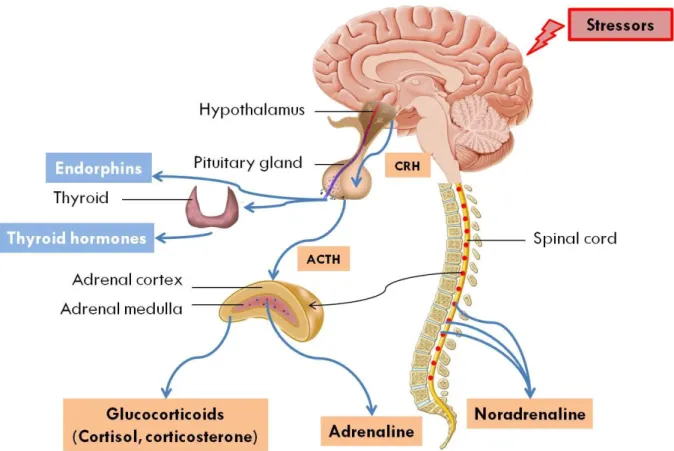
mobilisation of resources to allow the individual to secure or restore homeostasis (Figure 3).
Examples of these other physiological responses include thyroid hormones, that amplify
baseline metabolism, and endorphins that mitigate the perception of pain. Throughout this
manuscript, I will consider only the SNS and the HPA axis.
Figure 3 - Representation of the physiological stress responses in vertebrates. In the face of
stressors, diverse physiological pathways are activated, including the SNS that results in the
secretion of catecholamines (adrenaline and noradrenaline), and the HPA axis that results in
the secretion of glucocorticoid hormones. Endorphins are also secreted by the pituitary gland
along with thyroid hormones. CRH stands for corticotrophin-releasing hormone and ACTH for
adrenocorticotropin hormone. The back arrow corresponds to the neuronal stimulation of the
3-1 Catecholamine neurohormones
Few seconds after the brain identified a stressor, the SNS is activated, resulting in the rapid
secretion of catecholamine neurohormones, namely, adrenaline and noradrenaline (Reeder
and Kramer, 2005). These two neurohormones increase heart rate and provide the required
amount of energy to deal with the current stressor by promoting glycogenolysis (the release
of glucose from the stored glycogen) and lipolysis (the release of fatty acid though breakdown
of triglycerids). This activation of the SNS is part of the so called “fight, flight or freeze”
response firstly describe by Walter Cannon (1929) and the secretion of catecholamines
support these behavioural responses. Secretion of catecholamines is the first physiological
response to stressors, but the release of these neurohormones lasts for no longer than a few
minutes. Due to their rapid onset and disappearance kinetics (instantaneous rise and a short
half-life), measuring these neurohormones is technically very challenging in free ranging
mammals. Therefore, the focus has been on glucocorticoid hormones to study the ecology of
stress.
3-2 Glucocorticoid hormones
Simultaneously with the SNS, the endocrine system and, more specifically, the HPA axis is also
activated under stressful situations (Möstl and Palme, 2002). Activation of this axis results in
the secretion of glucocorticoid hormones, which are mainly corticosterone in birds,
amphibians, reptiles and some rodents, but mainly cortisol in fish and most mammals (some
species produce the two hormones in significant proportions) (Palme, 2019). After exposure
to a stressor, glucocorticoid levels increase markedly and this elevation, usually detectable
within 3 to 5 minutes in vertebrates plasma (De Kloet et al., 2005), lasts from a few minutes
to several hours (Sapolsky, 2000; Wingfield and Romero, 2001). Glucocorticoid levels can also
for more details and a comparison). Thereafter I will refer to the increase of glucocorticoids
following exposure to a stressor as “response levels”, in contrast to “baseline levels”. The
relative ease of measuring glucocorticoids compared to catecholamines, the fact that
glucocorticoids promote or suppress the expression of about 10% of the genome (Le et al.,
2005), and that the suppression of these hormones leads to death (Darlington et al., 1990) led
to call the HPA axis, the stress axis. The measurement of the HPA axis activity is considered as
a true window “to see under the surface of the animal into the functional mechanisms it uses
to cope” with environmental stressors (Boonstra, 2013).
3-2-1 HPA axis and glucocorticoids secretion
The HPA axis is a hormonal cascade (see Box 2 for details) resulting in the secretion of
glucocorticoid hormones. The secretion of these hormones supports the action of
catecholamines by inhibiting energy storage to mobilise lipids, glucose, promote
cardiovascular functions, increase locomotor activity (Sapolsky et al., 2000), and orchestrate
immune redistribution (Dhabhar and McEwen, 1997). These processes help to cope with the
current stressor by making stored energy available, and preparing the organism for a possible
immunologic challenge (e.g. wounding or infection). As glucocorticoid levels increase, the
hormone exerts a negative feedback on its own secretion (Wingfield and Sapolsky, 2003;
Box 2 - Physiology of the HPA axis
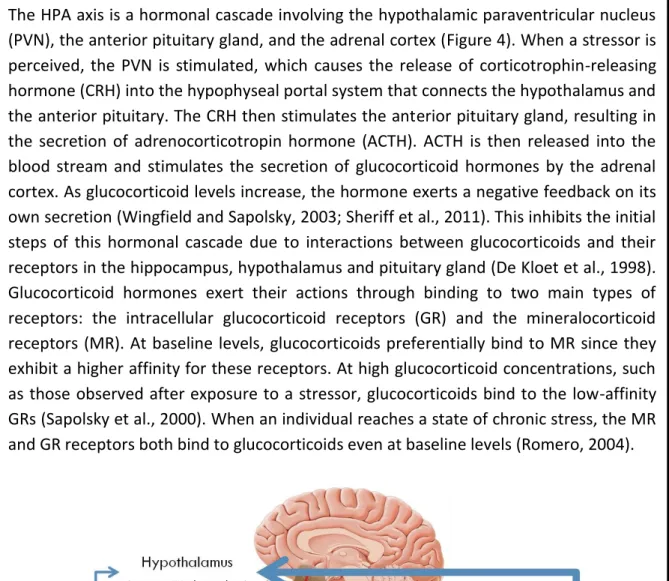
The HPA axis is a hormonal cascade involving the hypothalamic paraventricular nucleus (PVN), the anterior pituitary gland, and the adrenal cortex (Figure 4). When a stressor is perceived, the PVN is stimulated, which causes the release of corticotrophin-releasing hormone (CRH) into the hypophyseal portal system that connects the hypothalamus and the anterior pituitary. The CRH then stimulates the anterior pituitary gland, resulting in the secretion of adrenocorticotropin hormone (ACTH). ACTH is then released into the blood stream and stimulates the secretion of glucocorticoid hormones by the adrenal cortex. As glucocorticoid levels increase, the hormone exerts a negative feedback on its own secretion (Wingfield and Sapolsky, 2003; Sheriff et al., 2011). This inhibits the initial steps of this hormonal cascade due to interactions between glucocorticoids and their receptors in the hippocampus, hypothalamus and pituitary gland (De Kloet et al., 1998). Glucocorticoid hormones exert their actions through binding to two main types of receptors: the intracellular glucocorticoid receptors (GR) and the mineralocorticoid receptors (MR). At baseline levels, glucocorticoids preferentially bind to MR since they exhibit a higher affinity for these receptors. At high glucocorticoid concentrations, such as those observed after exposure to a stressor, glucocorticoids bind to the low-affinity GRs (Sapolsky et al., 2000). When an individual reaches a state of chronic stress, the MR and GR receptors both bind to glucocorticoids even at baseline levels (Romero, 2004).
Figure 4 - Representation of the hypothalamic-pituitary-adrenal axis resulting in the secretion of glucocorticoid hormones. These hormones then support different functions at baseline and stress-induced levels.
In the case of acute stress, and depending on the severity of the stressor and on the species,
glucocorticoid levels generally return to initial baseline level within 1 to 2 hours (De Kloet et
al., 2005) and ensures the maintenance of the energy balance according to an individual’s
needs (see part 3-2-2 for more details). However, when the stressor is persistent (e.g., a long
period of harsh conditions or poor quantity of food) or repeated regularly (e.g., being subject
to daily hunting attempts), the negative feedback becomes less effective and glucocorticoids
secretion is maintained at high levels for a longer period of time. This disruption of negative
feedback under chronic stress inducing an overall increase in glucocorticoids is one of the
reasons why assaying these hormones is more and more used as physiological indices of stress
levels in research (Bonier et al., 2009). However, glucocorticoid hormones are not the only
hormones secreted under stressful situations and it is important to keep in mind that
measuring glucocorticoid levels does not equate to measuring stress hormones (see
MacDougall-Shackleton et al., 2019 for a discussion on this topic).
3-2-2 Baseline glucocorticoids functions
Glucocorticoid hormones are not only secreted in response to a stressor, but are primarily
metabolic hormones. At baseline levels they play a major role in diverse physiological
functions, and ensure the regulation of an individual’s energy though acquisition, storage and
mobilisation (Landys et al., 2006; Busch and Hayward, 2009), for instance by increasing
available energy through gluconeogenesis (synthesis of glucose from non-sugar precursors),
by decreasing glucose utilisation and protein and fat metabolism. Under normal conditions
(i.e., without stressors), the negative feedback of glucocorticoids on their own secretion is
efficient and allows the regulation of the normal circadian rhythm of glucocorticoids release
glucocorticoids are usually found just prior to an individual’s activity peaks, so that they
provide the amount of energy needed for the behaviours that occur when individuals begin
their daily activities, such as an increased locomotor activity, and foraging behaviour (McEwen
et al., 1988, Landys et al., 2006).
4- Among-individual differences in glucocorticoid levels
Baseline as well as response levels of glucocorticoids are dynamic and exhibit changes
throughout the life of an individual. These changes may depend on intrinsic and extrinsic
factors, such as the life history stage of an individual or the availability of resources. For
instance, when resources are scarce baseline levels of glucocorticoids might increase and the
ability to respond efficiently to an unpredictable stressor might be impaired (Romero, 2004).
It is therefore important to consider as many biologically relevant factors as possible when
studying variations in glucocorticoid hormones. Here I will only focus on some of these factors
in the following sections 4-1 and 4-2, but recent reviews discuss several other factors such as
reproductive state, social status and interactions or predation (Hau et al., 2016; Palme, 2019).
4-1 Individual sources of variations in glucocorticoid levels
4-1-1 Age
Effects of advancing age on glucocorticoid levels are different between response and baseline
levels. Response glucocorticoid levels appear to be lowered with increasing age in many
species (Reeder and Kramer, 2005). Alongside this decrease in the reactivity of the HPA axis
with age, impairment in the efficacy of the negative feedback described earlier has been
documented (Romero, 2004). While the effect of age on stress-induced concentrations of
glucocorticoids is very consistent among species, effect of age on baseline levels is not. It is
species (period of hyporesponsiveness of the HPA axis). Most likely, such hyporesponsiveness
period protect growing neurons from the potential adverse effects of high glucocorticoid
levels during growth (Sapolsky and Meaney, 1986). It is less clear how patterns of
glucocorticoids changes with age at adult stages. While some studies found an increase of
baseline glucocorticoid level with age (Sapolsky et al., 1983; Dellu et al., 1996; Bauer, 2005),
some others did not (van der Ohe et al., 2004; MacBeth et al., 2010; Terwissen et al., 2013).
These discrepancies among studies highlight the need to take into account age of individuals
in every studies seeking to evaluate glucocorticoid variations in species where the age effects
remain unknown.
4-1-2 Sex
Variations in glucocorticoid levels between males and females are not consistently biased
toward one sex (Touma & Palme 2005). Some studies found higher glucocorticoid levels in
males (in Steller sea lion (Eumetopias jubatus), domestic chicken (Gallus gallus), Hunt et al.
2004; Rettenbacher et al. 2004), or in females (in arctic ground squirrels (Spermophilus
parryii), Boonstra et al., 2001). No difference between sexes were found in wolves (Canis lupus) or black (Diceros bicornis) and white (Ceratotherium simum) rhinoceros (Sands and
Creel, 2004; Brown et al., 2001). The high interaction between the HPA axis and HPG
(hypothalamic-pituitary-gonadal) axis has been proposed to explain sex differences in
glucocorticoid levels. In particular, actions of sex steroids on the HPA axis vary by sex, and
patterns differ across taxa (Handa and Weiser, 2013; Toufexis et al., 2014).
4-1-3 Body condition
Because of their metabolic function, it is not surprising that glucocorticoid levels have been
birds (but see Moore et al., 2000 for an example on reptile), with results showing a negative
relationship between baseline corticosterone levels and body condition indices (Kitayski et al.,
1999; Sockman and Schwabl, 2001; Angelier et al., 2009; Fokidis et al., 2011). The tight link
between body condition and baseline glucocorticoid levels is probably one of the reasons why
these hormones are increasingly used as physiological indices of the relative condition and
health of individuals and populations (Walker et al., 2005; Wikelski and Cooke, 2006). In
contrast, patterns are less clear for response corticosterone levels, which appeared to be
either positive (Fokidis et al., 2011) or negative (Angelier et al., 2009) depending on studies.
This diversity of patterns have been hypothesised to be due to the environmental context, but
also the life-history stage of the individual.
4-1-4 Behaviour
It is a fact that marked differences in behaviour exist among individuals. In the past two
decades, the study of animal personality (Box 3) has attracted many biologists and has led to
a growing body of literature on the subject (Gosling, 2001; Sih et al., 2004a; Dingemanse and
Réale, 2005; Réale et al., 2007; Réale et al., 2010; Stamps and Groothuis, 2010; DiRienzo and
Montiglio, 2015; Roche et al., 2016). Interestingly, this large literature showed that personality
can be linked to fitness. For example, boldness is positively related to the lifetime reproductive
success (Réale et al., 2009) and survival (Réale and Festa-Bianchet, 2003) of bighorn sheep
(Ovis canadensis). However this relationship may be modulated by the environmental context,
so that some behavioural phenotypes may perform better in some contexts than in others
(Dingemanse et al., 2004). In addition, personality has been linked to the HPA axis, and more
precisely to glucocorticoid levels under laboratory conditions (Koolhaas et al., 1999) and in
the wild (Montiglio et al., 2012; Montiglio et al., 2015). Typically, individuals exhibiting high
thorough explorers, and particularly attentive to changes in their environment. Conversely,
individuals exhibiting low glucocorticoid levels are more likely to be bold, aggressive, actively
explore their environment and follow routines (Koolhaas et al., 1999; Sih et al., 2004a). The
existence of a relationship between the HPA axis and behavioural traits has been found in
diverse taxa including mammals (Koolhaas et al., 1999), birds (Groothuis and Carere, 2005),
fish and reptiles (Øverli et al., 2007), suggesting that the relationship has been conserved
through evolutionary times. As stated above, stress response is composed of behavioural and
physiological responses. Therefore the existence of a close relationship between these two is
not surprising and the manner an individual faces stressful situation on both of these
responses forms what Jaap Koolhaas and his colleagues (1999) have qualified: a coping style
(Box 3). However, this framework has been recently questioned, and Jaap Koolhaas and his
colleagues (2010) proposed a second framework suggesting the relationship between
physiological and behavioural responses to stressors would be more complex. This recent
“two-tier model” of coping styles suggests that the behavioural response to stressor would be
primarily linked to the sympathetic stress response (release of catecholamines), but would be
independent from the HPA axis activity (release of glucocorticoids). Although recent studies
seem to support this alternative view of coping styles in wild populations (Qu et al., 2018;
Westrick et al., 2019), further work is needed to assess the importance of these two models
4-2 Environmental sources of variations
4-2-1 Quantity and quality of resources
Food availability and quality have been demonstrated to influence glucocorticoid levels and
act as stressors in vertebrates (Kitaysky et al., 2007). Numerous studies have reported
elevated baseline glucocorticoid levels in individuals exposed to poor food availability in some
years (Hellgren et al., 1993), adverse weather conditions (Huber et al., 2003), or poor overall
habitat quality (Marra and Holberton, 1998). In addition, this relationship between
environmental context in terms of resources and glucocorticoid levels is not necessarily linked
to body condition (Fokidis et al., 2012).
Box 3 - Behavioural type, coping style, personality... a glossary please
Animal personality: Consistent among-individual differences in behaviour over time and/or across contexts (Réale et al., 2007).
Behavioural syndrome: Consistent co-variation between a suite of behaviours across contexts (e.g. predator avoidance or reaction to novelty) or situations (e.g. different levels of predation) (Sih et al., 2004a).
Behavioural type: Within a behavioural syndrome (e.g. boldness, aggressiveness), individuals have a behavioural type (e.g. shy versus bold, more versus less aggressive) (Sih et al., 2004b).
Coping style: Characterises the association between the behavioural and physiological responses of individuals to stressful situations (Koolhaas et al., 1999). The coping style continuum ranges from reactive to proactive individuals, with reactive individuals being typically shy and exhibiting a high reactivity of the HPA axis. Conversely, proactive individuals are typically bold and exhibit a low reactivity of the HPA axis (Koolhaas et al., 1999; Sih et al., 2004a). An alternative view states that a close relationship exist between reactive-proactive behavioural response and SNS axis (Koolhass et al. 2010).
4-2-2 Predation
The effects of predation on glucocorticoid levels in vertebrates have been reviewed by
Michael Clinchy and his colleagues (2013) and usually lead to a negative effect. For example,
on a study of wild European rabbits (Oryctolagus cuniculus), Raquel Monclùs and her
colleagues (2008) showed that glucocorticoid levels were positively correlated with indexes
of presence of mammalian carnivore predators. In a previous experimental study, the same
authors showed than not only presence of predators, but also simulated presence of a
predator through odour cues resulted in an increase in glucocorticoid levels (Monclùs et al.,
2006). Similarly, Rudy Boonstra and his colleagues (1998) showed that snowshoe hare (Lepus
americanus) were chronically stressed by predation risk, as indicated by higher levels of free
cortisol and reduced maximum corticosteroid-binding capacity during periods of population
decline (high predation risk), compared to population low (low predation risk).
4-2-3 Social interactions
Social interactions with conspecifics are another factor that has been shown to influence
glucocorticoid levels (see Creel, 2001 for a review). Numerous studies have investigated the
relationship between glucocorticoid levels and the dominant-subordinate status and found
contradictory results. While most of the primary works in the field showed higher
glucocorticoid levels in subordinates (see Sapolsky, 1992 for a review), others found no
relationship (Bercovitch and Clarke, 1995), or higher glucocorticoid levels in dominant
individuals (Creel, 2005). A possible explanation to these mixed observations is the stability of
the hierarchy in the group and associated predictability of stressors. In groups with stable
hierarchies, high-ranking individuals usually have control over a wide range of situations,
with unstable hierarchies, the dominance position may be regularly threatened, leading to an
absence of control, high rate of agonistic interactions with other individuals, and consequently
higher glucocorticoid levels.
4-2-4 Human disturbance
In the last centuries, and even more during the last few decades, human activities have
intensified and brought Crutzen and Stoemer (2000) to name the modern area the
“Anthropocene”. Through the change in land use that has fragmented more than 50% of the
earth’s land surface (Hooke et al., 2012), or recreational activities such as hunting or
snowmobile activity, human induced disturbance is now widespread and have become a
major selective force in natural populations (Wingfield and Romero, 2001). Several studies
have focused on the effects of this kind of stressor on baseline glucocorticoid levels and
consistently showed clear elevations in response to human disturbance (e.g., Dantzer et al.,
2014; Rehnus et al., 2014; Jachowski et al., 2015; Formenti et al., 2018). For instance, Bateson
and Bradshaw (1997) showed that blood cortisol concentrations were 70% higher in a group
of red deer (Cervus elephus) that underwent prolonged chases during hunts compared to a
group of non-hunted. Another example of the effects of recreational activities is the
association between areas and times of heavy snowmobile use on cortisol levels of wolves
and red deer of the Yellowstone National Park (Creel et al., 2002).
Despite the obvious effect of the different environmental and individual factors mentioned
above on glucocorticoid levels, very few studies are able to consider these factors together in
the same study due to field constraints. Consequently, taking them into account when
evaluating glucocorticoid level variations, and their potential effects on diverse functions,
5 - Consequences of stress
If individuals are transiently exposed to stressors, glucocorticoid levels do not remain elevated
in the blood. On the opposite, when individuals are persistently or regularly exposed to
stressors, glucocorticoid levels remain elevated in the blood. This difference may lead to
different consequences. When individuals reach the state of allostatic overload, also referred
to as a chronic stress state, several negative consequences are commonly observed such as
decreased immune response and increased susceptibility to disease (Dhabhar, 2014), reduced
growth and a decrease in reproductive performance (Sapolsky et al., 2000). These adverse
effects impact individual fitness (Romero et al., 2009), have long-lasting consequences on the
offspring through maternal stress effect, and, ultimately, affect population dynamics
(Wingfield and Sapolsky, 2003).
5-1 Immune function
Pathogens occupy an important place in living systems, and all organisms have been, are, or
will be infected at least once in their life. Consequently, pathogens represent a major selective
force affecting hosts fitness (Anderson and May, 1982; Møller et al., 1990). To resist or
eliminate pathogens, organisms have evolved barriers (such as skin) and a physiological
mechanism, the immune system. The immune system is particularly elaborated and complex
in vertebrates. It is composed of numerous cells and effectors, and can be divided in two
complementary arms, the innate and the adaptive immune system (Box 4). However, this
efficient system is costly in terms of energy (Lochmiller and Deerenberg, 2000; Demas, 2004),
even if the costs appear arm-specific. Roughly, innate immunity is thought to have low
immunity would be more energetically costly to develop (due to the diversification process of
specific cells, such as lymphocytes) but would have a low cost of use (Lee, 2006).
Box 4 - Into the immunity of wildlife…
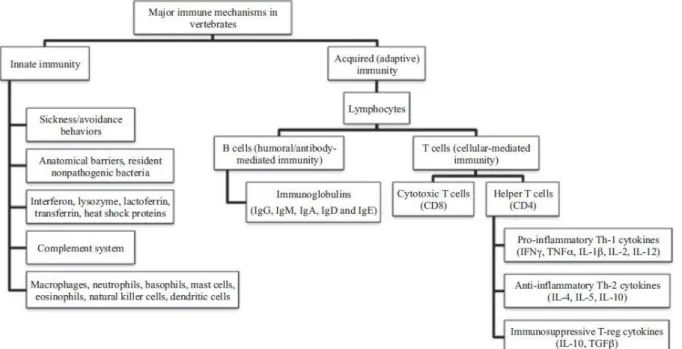
The immune system of vertebrates is composed of the innate and the adaptive arms, which are complementary, but have each specific functions and effectors (Figure 5). Overall, the immune system is composed of specialised cells whose function is to differentiate “self” from “non-self” and to eliminate any foreign “non-self” substance than could damage the host.
Innate immunity: This component of the immune system represent the first line of defence of an organism and is relatively rapid to set up (hours), but not specific to pathogens. Such defences include anatomical barriers (e.g., mucus membranes or skin), humoral factors such as lysozyme, complement and acute phase proteins, but also cellular responses such as phagocytic cells (e.g. neutrophils, monocytes and macrophages), inflammatory mediators produced by basophils and eosinophils, and natural killer cells. The complement system includes enzymes that promote inflammatory response. In addition, complement is important for stimulating the adaptive immune responses (Dempsey et al., 1996). Developmental costs of innate immunity are thought to be relatively low in terms of energy, while activation costs are particularly high (McDade et al., 2016).
Adaptive immunity: This component of the immune system comes as an additional line of defence. It is typically slower than the innate immunity (days) at first exposure to a given pathogen, but is pathogen-specific with longer lasting effects and a higher efficiency and rapidity upon secondary exposure. Such defences are mediated by lymphocyte cells that subsequently develop into B cells, T cells or NK cells. B cells produce antibodies that neutralise pathogens and their products, block binding of parasites to host cells, stimulate the complement system, promote cell migration to infection sites and enhance phagocytosis, among other actions (Demas et al., 2011). T cells do not produce antibodies but require direct contact with an infected cell to eliminate it. T cells can be further divided into different subtypes, including cytotoxic T cells, which recognize and destroy cells with intra-cellular pathogens, helper T cells which coordinate immune response to infection, and regulatory T cells which play a key role in maintaining peripheral immunological tolerance by actively suppressing the immune response (Demas et al., 2011). Compared to innate immunity, this arm is known to have particularly high developmental costs, but relatively low energy costs of activation (McDade et al., 2016).
Figure 5 - Major immune mechanisms in vertebrates (extracted from Demas et al., 2011).
A central assumption in ecology is that trade-offs should exist between immune defences and
any other functions that share a common source of energy and that contribute to an
individual’s fitness. This assumption has been the basis for many hypotheses and researches
on the potential link between glucocorticoid levels and efficiency of immune responses (Lee,
2006 ; Martin, 2009). However, most of our knowledge on this topic comes from the
biomedical litterature. The commonly accepted findings is that chronically elevated
glucocorticoid levels are immunosuppressive (Dhabhar and McEwen, 1997; Sapolsky et al.,
2000; Dhabhar, 2009), while transient response levels can enhance immune functions
(Dhabhar, 2014), in both innate and adaptive arms (Dhabhar, 2002). In response to an acute
stressor, glucocorticoids elevation initiates a cascade of events and induces the trafficking of
immune cells (e.g., neutrophils and lymphocytes) out of compartments such as the spleen,
bone marrow, and lymph nodes into the blood, to ultimately reach target organs where an
individual is most likely to be injured (e.g. skin, gastrointestinal track, or lungs) (Dhabhar et
glucocorticoid levels has been linked to impaired immune response to vaccination, and
delayed healing after standardised wound inductions (Glaser et al., 1998; Glaser et al., 1999).
Based on these results from the biomedical field, it has been generalised that, in wild
conditions, chronic stress would be detrimental to the immune system of individuals while
acute stress would improve it (Figure 6 extracted from Martin, 2009). However, natural
conditions differ from laboratory, and domesticated animals do not react to the same stimuli
than wild animals. In free ranging conditions, short term elevations of glucocorticoid levels
can suppress, enhance, or have no measurable effects on immune functions of wild animals
(Delehanty and Boonstra, 2009; Matson et al., 2006; Merrill et al., 2012). Regarding the effects
of long term elevations and maintenance of elevated baseline glucocorticoid levels,
researches on wild avian species showed that corticosterone levels may differentially affect
different components of the immune response (Bourgeon and Raclot, 2006). For instance, Kim
Silvana Stier and her colleagues (2009) experimentaly demonstrated in barn owl (Tyto alba)
nestlings that elevated corticosterone levels affected the adaptive response through reduced
production of antibodies, but did not significantly affect agglutination scores, a component of
the constitutive innate immunity. However, patterns are not consistent among studies, for
example a group of Belding’s ground squirrels (Urocitellus beldingi) that underwent
experimentaly elevated cortisol levels exhibited a lower bacteria killing ability, another
component of the constitutive innate immune response, compared to a control group (Brooks
and Mateo, 2013). To date, the understanding of the relationship between stress and
Figure 6 - Juxtaposition of stressors that wild animals experience and known effects of similar
duration stressors in domesticated rodents. In response to stressors lasting minutes to hours,
such as failed predation events, a concomitant enhancement in most immune processes,
particularly inflammatory ones has been noticed. Longer duration stressors such as adverse
weather conditions (days to weeks) and habitat changes (weeks to months) have been
correlated with the reduction of most immune processes. Here, the down regulation of
immune functions may either represent an adaptive energy saving mechanism or may be the
consequence of allostatic overload (McEwen and Wingfield, 2003). Red dashed line depicts
changes in immune function as a consequence of stressors of various durations. Shaded area
depicts potential long-term increase or decrease in sensitivity to stressors driven by
experience. Plain text indicates variety of possible stressors. Italicized text below x-axis
5-2 Reproduction and survival
The consequences of short- and long-term glucocorticoids elevation on survival and
reproductive success have been the focus of numerous investigations because of their
consequences on population dynamics. Stress response is adaptive, and seeks to enhance
immediate survival in the face of stressful situations (Romero and Wingfield, 2001). However,
as pointed out in a recent review (Breuner et al., 2008), few studies have examined the link
between short-term elevation of glucocorticoids and fitness measures. In this review, only 11
studies over the past 20 years have evaluated the effects of short-term elevation of
glucocorticoids and direct measures of fitness. It is also worth mentioning that over the 62
studies considered in this review, only one was conducted on amphibians, three on mammals,
three on fishes, and 14 on reptiles, while 41 have been conducted on birds. Overall, results of
the studies suggest that short-term elevation of glucocorticoid levels is positively linked to
survival, at the expense of current reproduction. However, the only two studies examining a
link between direct survival measures and short-term elevation of glucocorticoid levels found
a negative relationship. A recent study on North American red squirrels (Tamiasciurus
hudsonicus) also found different results. In this study, a short-term experimental increase in
glucocorticoids impaired adrenal gland function but had no effect on body mass or survival of
adults and offspring (Van Kesteren et al., 2019).
Due to their role in the metabolism and maintenance of the energy balance, it has been
hypothesised that high baseline glucocorticoid levels (as a result of encountering a challenging
conditions) would be linked to low reproductive success and survival rates (Bonier et al.,
2009). A comprehensive review from Frances Bonier and her colleagues (2009) focused on
this topic and showed that the empirical data did not strongly support this hypothesis. Of the
relationship between glucocorticoid levels and reproductive success or survival. For the
studies showing a significant relationship, most results were not consistent, with negative as
well as positive relationships. As for the review on the effect of response levels of
glucocorticoids, it is worth to note that most of the studies considered where carried on birds
(70%). This discrepancy between studies can be explained by differences between
environmental contexts, but also a lack of information regarding some elements such as the
life history stage. For instance, a recent study on tree swallows (Tachycineta bicolour) showed
that females with low corticosterone levels during the incubation period had a higher
reproductive success. However, during the provisioning period, there was a trade-off between
baseline and response levels of corticosterone. Indeed, reproductive success was higher
among females that maintained low baseline corticosterone levels while having strong
response levels, but also among females with high baseline corticosterone levels while having
weak response levels (Vitousek et al., 2018).
This brief overview of the literature highlights the complexity of the relationships between
glucocorticoid levels and fitness, and the importance of considering additional parameters
when studying this relationship, such as life history stages or environmental conditions. Taking
into account these potential mediators of the glucocorticoid levels-fitness relationships, a
recent phylogenetic meta-analysis across vertebrates revealed that response as well as
baseline levels of glucocorticoids were consistently linked to lower reproductive success.
However the relationships were much more complex with respect to survival. These
relationships were highly context-dependent and differed according to life history strategies,
5-3 Inter-generational effects
Maternal stress effects occur when maternal stress hormones alter offspring phenotype (Love
et al. 2013). Exposure to maternal glucocorticoids can originate from the placenta or the milk
in mammals and the yolk in non-mammalian vertebrates (Seckl and Meaney, 2004; Sullivan et
al., 2011; Almasi et al., 2012). Detrimental effects of elevated maternal glucocorticoid levels
on the offspring phenotypes (body mass, growth, behaviour, physiology) have been
hypothesised. Again, these predictions were largely based on the biomedical literature
(Barbazanges et al., 1996; Seckl and Meaney, 2004; Meaney et al., 2007; Weinstock, 2008),
but several studies conducted on wild animals also found decreased birth body size, body
mass and growth rate of offspring from mothers exhibiting high glucocorticoid levels (Saino et
al., 2005; Meylan and Clobert, 2005; Sheriff et al., 2009; Meylan et al., 2012). In addition to
direct effects of maternally-derived glucocorticoids on the offspring phenotype, indirect
effects can originate from a reduction of maternal care due to high glucocorticoid levels (Love
et al., 2013). Usually, the observed changes in offspring phenotype occur through epigenetic
changes in the brain and result in a change in neural development and the alteration of the
HPA axis of the offspring, resulting for instance in offspring with elevated glucocorticoid levels
(Hayward and Wingfield, 2004; Seckl and Meaney, 2004). However, elevated maternal
glucocorticoid levels do not always lead to poorer quality offspring. For instance, Michael
Sheriff and his colleagues (2017a) showed that although glucocorticoid levels were higher in
offspring of females arctic-ground squirrels coming from a site where they exhibited higher
glucocorticoid levels, maternal glucocorticoid levels had no effect on offspring’s size at either
of the two sites. Another result that contradicts this theory is the famous experimentation
conducted by Ben Dantzer and his colleagues (2013) on red squirrels which showed that
offspring with a higher growth rate than controls. As for the fitness consequences of elevated
glucocorticoid levels, these mixed results could be explained by the environmental context,
timing of measures (i.e. how young are the offspring and how independent of their mother
they are). For instance, hatchlings from corticosterone injected eggs of house wrens
(Troglodytes aedon) were lighter than controls, but were heavier at fledging due to a
compensatory growth mechanisms (Strange et al., 2016). In addition, stating that a reduced
size, or growth rate, of offspring is maladaptive (i.e. reduced fitness) is not necessarily true
without taking into account the long-term consequences of this phenotype, for the mother as
for the offspring. This more integrative view have been proposed by Michael Sheriff and his
colleagues (2017b) and suggests that modulation of the offspring phenotypes by mother’s
glucocorticoids could prepare them for their post-natal environment, and therefore be
beneficial to offspring. In other words, when the environment of the mother and the future
environment of the offspring match, maternal stress can be adaptive (Sheriff and Love, 2013).
This new framework therefore emphasises the importance of considering past, present and
future environment of the mothers and offspring to improve our understanding of the
Figure 7 - The environment experience by mothers during reproduction can either be
unstressful (leading to the dashed arrow pathway) or stressful (leading to the pathway
represented by solid arrows), with the latter occurring when stress hormone levels of mothers
increase beyond some threshold of normal baseline (1). This dichotomy leads to “unaltered”
offspring phenotypes or “altered” offspring phenotypes in response to elevated maternal
stress (2). These offspring then have the potential to also encounter two different
environments; an “unstressful” environment, or, alternatively, a “stressful” environment (3),
and their fitness value will depend upon the interaction between their phenotype and the
environment they experience (4). Additionally, the adaptive potential of maternal stress to
maternal (inclusive) fitness can also be evaluated within this framework if the end fitness
outcomes (4) are that of the mother (i.e., do mothers survive better and have greater future
reproduction if they raise altered offspring in a stressful environment as opposed to
attempting to raise unaltered offspring?). (Extracted from Sheriff et al. 2018).
6- Background synthesis and aims of this thesis
In the wild, animals adapt to unpredictable events through physiological and behavioural
adjustments, most of which are mediated by glucocorticoid hormones. Wide
among-individual variability in glucocorticoid levels occurs and different consequences on fitness are
expected. However, to which extent these variations are consistent over time and what are
the drivers of these observed variations and their consequences on fitness remains poorly
understood. Most studies investigating changes in glucocorticoid level have considered
environmental and individual characteristics separately. Studies aiming to understand the
influence of environmental context often include variables such as sex or age in their analyses,
response to stressors. Conversely, studies of the relationship between behavioural response
to stressors and glucocorticoid levels rarely consider the environmental context. The general
aim of this thesis is to use a comprehensive approach to identify the main determinants of
glucocorticoid levels and to investigate their consequences in a long-lived mammal, the roe
deer.
The first aim of this thesis (chapter I) was to investigate simultaneously individual and
environmental drivers of stress levels in wild animals. First, I investigated whether there were
consistent among-individual differences in baseline stress levels, and what are the
environmental and individual drivers of these among-individual variations. I use a
comprehensive approach including environmental (spatial and temporal variations in
resources quantity and quality) and individual (sex, age, body mass, behavioural response to
a stressor) characteristics in three wild populations of roe deer. Second I specifically
investigated the interaction between spatial behaviour and physiological stress response in
one population benefiting from an intensive monitoring of spatial behaviour. I tested whether
spatial and temporal behavioural adjustments allowed individuals to mitigate the elevation of
baseline glucocorticoid levels observed in a human dominated landscape.
While the first chapter of this thesis focuses on among-individual variations in adults, the
second chapter aims to investigate some of the fitness outcomes of elevated glucocorticoid
levels, with a focus on mother-offspring relationships (chapter II). Indeed, while the factors
underlying among-individual variations of glucocorticoids in the adult stage are well
described, the literature on this subject is almost non-existent in the offspring. First, I aimed
to understand among-individual variations of glucocorticoid levels in offspring. Second, I
investigated the consequences of elevated maternal glucocoticoid levels on maternal
In a third time (chapter III), I addressed other potential consequences of elevated
glucocorticoid levels, focussing on their interaction with immune functions. While a
framework with strong and several testable hypotheses have been proposed (Martin, 2009),
few studies have examined this relationship in wild populations. In particular, most studies
have focused on one arm of the immune system, the innate or the adaptive one, but have
rarely considered the effects of glucocorticoids on both. Therefore, the goal of this last chapter
was twofold. First, I investigated the relationship between baseline glucocorticoid levels and
baseline levels of eleven immune parameters reflective of both the innate and adaptive arms
as well as inflammatory markers in three different populations of wild roe deer. Second, I used
an experimental approach to understand how variations in glucocorticoid levels could induce
variations in immune parameters, while considering among-individual differences in the
behavioural response to a stressful situation.
6-1 Outline
The work presented in my thesis can therefore be summarised with the following questions:
Chapter I: What are the drivers of baseline stress levels in wild populations?
a) Do consistent among-individual differences in baseline stress levels exist?
b) To what extent behavioural and physiological stress responses are linked and may
form a coping-style?
c) How spatial behaviour can mitigate the elevation of glucocorticoids in the face of
human disturbance?
Chapter II: What are the drivers of baseline stress levels in offspring in wild populations? And
what are the consequences of higher maternal baseline glucocorticoid levels?
a) To which extent behavioural and physiological responses to stressors are linked in
b) Are glucocorticoid levels of offspring linked to maternal glucocorticoid levels?
c) Does maternal stress influence offspring’s phenotype?
Chapter III: What are the consequences of baseline glucocorticoid levels on immunity, both
the innate and adaptive arms?
a) Are baseline glucocorticoid levels negatively linked to immune parameters in wild
populations? (Observational approach)
b) Are variations of baseline glucocorticoid levels related to variations in immune
parameters of both arms? (Experimental approach)
6-2 Model species
In order to investigate these questions, I used the European roe deer (Capreolus capreolus)
(Box 5) as a study model focusing on four different populations (Box 6). The European roe deer
has largely increased its distribution in the recent years and is now widespread across the
European continent, with the exception of Ireland, Cyprus, Corsica, Sardinia, Sicily, and most
of the smaller islands (Figure 8). Primarily considered a forest species, the roe deer exhibits a
high behavioural plasticity and has now colonised a wide variety of habitats (Andersen et al.,
1998). From forest, roe deer expended to agricultural, mountain, Mediterranean garrigue and
moorland environments (Andersen et al., 1998). This diversity of new habitats increases the
variety of potential stressors for this species. In particular, humans-related stressors are
increasingly prevalent since the roe deer can occupy large agricultural plains without refuges
such as woodland patches (Cibien et al., 1989), with meadows and cultivated crops providing
particularly abundant and rich food resources, but also leading to an exposition to
anthropogenic disturbance (Hewison et al., 2001). In addition to its exposition to a wide range
body and can only rely on the current food resources to achieve its life cycle. This characteristic
makes this species particularly sensitive to availability and quality of resources, the scarcity of
which can rapidly become a source of stress, revealing trade-off between glucocorticoid
elevation and other functions. Another interesting feature regarding roe deer is that this
species is particularly prone to fluctuation in environmental conditions such that under
favourable conditions, females may give birth at one year old (Hewison, 1996) whereas under
poor conditions first reproduction is often delayed to the age of 3 years old (Gaillard et al.,
1992; Hewison, 1996). Reproductive success can therefore depend on environmental
conditions, and glucocorticoid levels appear to be a possible underlying cause of these
among-individual differences. Finally, spatial proximity of roe deer with domestic fauna makes this
model interesting. Being exposed to both wild and domestic fauna, roe deer are exposed to a
wide range of pathogens and therefore rely heavily on their immune system to persist (Jolles
et al., 2015).
Figure 8 - Area of distribution of the European roe deer. Map from the IUCN (International
Union for Conservation of Nature) Red List of Threatened Species. Version 2019-2. In orange:
Box 5 - Biology of the European roe deer (Capreolus capreolus) (1/2)
Basic information
Class: Mammalia Order: Artiodactyla Family: Cervidae Genus: Capreolus Withers height: 60 to 80 cm Total length: 1 to 1.30 mWeight: 20 to 30 kg with males weighting 2 to 3 kg more than females Presence of antler in males that can reach about 30 cm
Biology of the species
Roe deer can be considered as a crepuscular species, with activity peaks at the sunrise and sunset, even though it can exhibit lower activity peaks during the rest of the day. It is a solitary species most of the year, but form small groups during winter. While the size of the groups can reach about 200 individuals in large plains, in more forested environments the group is often composed of one or a few adult females with their offspring and yearling daughters, and some time one or two adult males. It is an herbivore which feeds on a large number of plant species depending on the habitat where it lives. Diet is mainly composed of shrubs, trees and forbs in forest, but also crop plants in cultivated habitats, and various plant parts such as buds, leaves, flowers, fruits and seeds (R. Andersen et al., 1998; Tixier and Duncan, 1996; Cornelis et al., 1999). Cultivated leaves and seeds, as well as acorn constitute a particularly nutritive food for roe deer (Abbas et al., 2011).
In roe deer natal dispersal occurs at approximately 8 months of age for approximately 33% of the animals, both males and females. Adult roe deer may exhibit migratory behaviour with seasonal non-overlapping home range (Cagnacci et al., 2011) or multi-range space use throughout the year (Couriot et al., 2018), but with a high degree of spatial fidelity all their life long (Hewison et al., 1998).
Figure 9 - A roe deer named Babine feeding in a field of lucerne (Medicago sativa) near the village of Fabas.