HAL Id: tel-02286031
https://tel.archives-ouvertes.fr/tel-02286031
Submitted on 13 Sep 2019HAL is a multi-disciplinary open access archive for the deposit and dissemination of sci-entific research documents, whether they are pub-lished or not. The documents may come from teaching and research institutions in France or abroad, or from public or private research centers.
L’archive ouverte pluridisciplinaire HAL, est destinée au dépôt et à la diffusion de documents scientifiques de niveau recherche, publiés ou non, émanant des établissements d’enseignement et de recherche français ou étrangers, des laboratoires publics ou privés.
Abood Mourad
To cite this version:
Abood Mourad. The synchronization of shared mobility flows in urban environments. Infrastructures de transport. Université Paris Saclay (COmUE), 2019. English. �NNT : 2019SACLC041�. �tel-02286031�
Th
`ese
de
doctor
at
NNT
:
2019SA
CLC041
flows in urban environments
Th `ese de doctorat de l’Universit ´e Paris-Saclay pr ´epar ´ee `a CentraleSup ´elec Ecole doctorale n◦573 interfaces : approches interdisciplinaires, fondements, applications et innovation (Interfaces)
Sp ´ecialit ´e de doctorat : Ing ´enierie des Syst `emes Complexes
Th `ese pr ´esent ´ee et soutenue `a Gif-sur-Yvette, le 14 juin 2019, par
A
BOODM
OURADComposition du Jury : Vincent Mousseau
Professeur, Universit ´e Paris Saclay
Laboratoire MICS, CentraleSup ´elec Pr ´esident Roberto Wolfler Calvo
Professeur, Universit ´e Paris 13
Laboratoire d’Informatique de Paris Nord (LIPN) Rapporteur Caroline Prodhon
Professeur associ ´e, Universit ´e de Technologie Troyes (UTT) Rapporteur Tom Van Woensel
Professeur, Technische Universiteit Eindhoven (TUe) Examinateur Jakob Puchinger
Professeur, Universit ´e Paris Saclay
Laboratoire G ´enie Industriel & IRT SystemX Directeur de th `ese Chengbin Chu
Professeur, Universit ´e Paris-Est
Doctoral Thesis
The synchronization of shared mobility flows
in urban environments
Author:
Abood Mourad
Supervisor: Prof. Jakob Puchinger Prof. Chengbin Chu
A thesis submitted in fulfillment of the requirements for the degree of Doctor of Philosophy
in the
approches interdisciplinaires, fondements, applications et innovation École Doctoral INTERFACES
“The future belongs to those who believe in the beauty of their dreams.”
Eleanor Roosevelt
“Je n’échangerai pas les rires de mon cœur contre toutes les richesses du mondes. Je n’éprouverais aucune joie à convertir mes larmes en quiétude, si mon être angoissé m’y invitait.”
Abstract
The rise of research into shared mobility systems reflects emerging challenges, such as rising urbanization rates, traffic congestion, oil prices and environmental concerns. The opera-tions research community has turned towards more sharable and sustainable systems of transportation. Although shared mobility comes with many benefits, it has some challenges that are restricting its widespread adoption. More research is thus needed towards de-veloping new shared mobility systems so that a better use of the available transportation assets can be obtained. This thesis aims at developing efficient models and optimization approaches for synchronizing people and freight flows in an urban environment. As such, the following research questions are addressed throughout the thesis:
Q1: What are the variants of shared mobility systems and how to optimize them?
Q2: How can people trips be synchronized and what gains can this synchronization yields? Q3: How can people and freight flows be combined and what impacts uncertainty can have on such systems?
First, we review different variants of the shared mobility problem where either (i) travel-ers share their rides, or (ii) the transportation of passengtravel-ers and freight is combined. We then classify these variants according to their models, solution approaches and application context and we provide a comprehensive overview of the recently published papers and case studies. Based on this review, we identify two shared mobility problems, which we study further in this thesis. Second, we study a ridesharing problem where individually-owned and on-demand autonomous vehicles (AVs) are used for transporting passengers and a set of meeting points is used for synchronizing their trips. We develop a two-phase method (a pre-processing algorithm and a matching optimization problem) for assessing the shar-ing potential of different AV ownership models, and we evaluate them on a case study for New York City. Then, we present a model that integrates freight deliveries to scheduled lines for people transportation where passengers demand, and thus the available capacity for transporting freight, is assumed to be stochastic. We model this problem as a two-stage stochastic problem and we provide a MIP formulation and a sample average approximation (SAA) method along with an Adaptive Large Neighborhood Search (ALNS) algorithm to solve it. We then analyze the proposed approach as well as the impacts of stochastic passen-gers demand on such integrated system on a computational study. Finally, we summarize the key findings, highlight the main challenges facing shared mobility systems, and suggest potential directions for future research.
Keywords: urban mobility, synchronization, passenger and freight transportation, rideshar-ing, autonomous vehicles, optimization, uncertainty, heuristic approaches.
Avec l’augmentation progressive de la population dans les grandes villes, comme Paris, nous prévoyons d’ici 2050 une augmentation de 50% du trafic routier. En considérant les em-bouteillages et la pollution que cette augmentation va générer, on voit clairement la nécessité de nouveaux systèmes de mobilité plus durables, comme le covoiturage, ou plus générale-ment toute la mobilité partagée. En parlant de mobilité partagée, ce n’est pas seulegénérale-ment le partage de trajets de personnes qui ont le même itinéraire au même temps, elle inclut aussi les marchandises. Cette thèse aborde le défi de la synchronisation des flux de passagers et de marchandises dans les systèmes de mobilité urbaine et elle vise à développer des méthodes d’optimisation pour que cette synchronisation dans la mobilité partagée soit réalisable. Plus précisément, elle aborde les questions de recherche suivantes:
Q1: Quelles sont les variantes des systèmes de mobilité partagée et comment les optimiser? Q2: Comment synchroniser les déplacements de personnes et quels gains cette synchronisa-tion peut-elle générer?
Q3: Comment combiner les flux de passagers et de fret et quels sont les effets de l’incertitude sur ces systèmes?
Dans un premier temps, nous étudions les différentes variantes des systèmes de mobilité partagée et nous les classifions en fonction de leurs modèles, caractéristiques, approches de résolution et contextes d’application. En nous basant sur cette revue de littérature, nous identifions deux problèmes de mobilité partagée, que nous considérons en détails dans cette thèse et nous développons des méthodes d’optimisation pour les résoudre. Pour synchro-niser les flux de passagers, nous étudions un modèle de covoiturage en utilisant les véhicules autonomes, personnels et partagés, et des points de rencontre où la synchronisation entre passagers peut avoir lieu. Pour cela, une méthode heuristique en deux phases est proposée et une étude de cas sur la ville de New York est présentée. Ensuite, nous développons un modèle d’optimisation qui combine les flux de passagers et de marchandises dans une zone urbaine. Le but de ce modèle est d’utiliser les capacités disponibles sur une ligne de trans-port fixe pour transtrans-porter les passagers et des robots transtrans-portant des petits colis à leurs destinations finales en considérant que la demande de passagers est stochastique. Les résul-tats obtenus montrent que les solutions proposées par ces deux modèles peuvent conduire à une meilleure utilisation des systèmes de transport dans les régions urbaines.
Mots-clés: mobilité urbaine, synchronisation, transport de passagers et de marchandises, covoiturage, véhicules autonomes, optimisation, incertitude, méthodes heuristiques.
Acknowledgements
I would like to express my gratitude to all the people who contributed in one way or another to the completion of this thesis.
First, I would like to thank my dear supervisors Jakob Puchinger and Chengbin Chu, who guided me through these three years of research. Their ideas, questions and advices greatly helped me in improving the quality of the work I have been doing as well as learning many things on the professional and personal scales throughout this adventure. Thank you for your time and patience spent on building this thesis piece by piece.
During my PhD I had the great honor to work with Tom Van Woensel, who supervised my work during my three-month stay at OPAC, Eindhoven, the Netherlands. Thank you for your great guidance and for sharing your knowledge with me.
I kindly thank professors Roberto Wolfler Calvo and Caroline Prodhon for being a part of my thesis committee. Thank you for your valuable comments, which have significantly improved the quality of the thesis.
I’m grateful to all my current and former colleagues at the LGI research lab and the Anthropolis Chair at IRT-SystemX. Especially, I would like to thank Ouail Al Maghraoui, Reza Vosooghi and Flore Vallet with whom I shared many memorable moments and fruitful discussions during my PhD life. Without you, this thesis would not have been as good as it is. I’m also grateful to Fabio Antonialli, Naouress Fatfouta, Lara Qasim, Islam Abdin, Tasneem Bani Mustafa, Sarra Fakhfakh, Bruna Cavazza, Shaohua Yu, Haythem Selmi, Selmen Boubaker, Hichem Benbitour and Gustavo Santamaria for being like my big family at LGI.
I would like to thank all my OPAC colleagues, who made my stay in Eindhoven great. Thank you, Fardin Dashty, Sami Ozarik, Cansu Altintas, Vincent Karels, José van Dijk-Kok and Prince Singh, for all the good times we spent together and for sharing your knowledge and experience with me.
In addition, I would like to thank my special friends, back in Damascus and from all around the world, who were a great source of support and cheerfulness during this period. Thank you, George Abo Naser, Ghazi Al Shammat, Reem Moamar, Radia Saffa, Nataliya Storozhylova, Faek Houssin, Ekaterina Arafailova, Matthieu David and Marek Rozniak, for being there for me despite the distances.
Special thanks go to my family for their unlimited love and support. Mom, Dad, Amer and Reem, this thesis is our common achievement. Thanks to your constant support that cheers me up in difficult moments, this dream becomes true. I promise you that this journey will continue towards greater achievements knowing that you will always be by my side!
Abood Mourad Palaiseau, June 2019
To the soul that never left me, and the ideal that always inspired me,
Dad . . .
To the living angel, and the endless source of love and care,
Mom . . .
To every spirit praying for peace & prosperity in my beloved homeland,
Syria . . .
Contents
Abstract v
Résumé vii
Acknowledgements ix
Table of contents xv
List of figures xviii
List of tables xix
1 Introduction 1
1.1 Motivation and research context . . . 2
1.2 The Anthropolis research chair . . . 4
1.3 Overview of the thesis . . . 5
2 Shared mobility systems 9 2.1 Introduction . . . 10
2.2 Shared mobility problems . . . 12
2.2.1 Background . . . 12
2.2.2 Modeling and features . . . 17
2.2.3 Objective functions . . . 21
2.2.4 Computational complexity and solution approaches . . . 23
2.3 People sharing rides . . . 24
2.3.1 Planning and potential benefits . . . 25
2.3.2 Real-time ridesharing . . . 26
2.3.3 Ridesharing with autonomous vehicles . . . 28
2.3.4 Case studies . . . 32
2.4 People and goods sharing rides . . . 36
2.4.1 Setting the context: planning city logistics . . . 36
2.4.2 Combining people and freight transportation . . . 39
2.4.3 Case studies . . . 45
3 Synchronizing people transportation flows 47
3.1 Introduction . . . 48
3.2 Background . . . 49
3.3 Problem description . . . 51
3.3.1 Notation and parameters . . . 53
3.3.2 Definition of a feasible match . . . 53
3.3.3 Matching problem . . . 56
3.4 Solution approach . . . 56
3.4.1 Determine feasible meeting point arcs for a rider . . . 57
3.4.2 Generate feasible matches for a one-way trip . . . 58
3.4.3 Generate feasible matches for a round trip . . . 59
3.4.4 Algorithm . . . 60
3.4.5 Early checking for feasible matches . . . 61
3.5 Results and discussions . . . 62
3.5.1 Parameters and instance generation . . . 62
3.5.2 Performance . . . 66
3.5.3 Experiments . . . 66
3.6 Conclusions . . . 74
4 Synchronizing people and freight transportation flows 75 4.1 Introduction . . . 76
4.2 Background . . . 78
4.3 Problem Description . . . 80
4.3.1 The first-stage model . . . 83
4.3.2 The second-stage decisions . . . 87
4.4 Solution Approach . . . 89
4.4.1 The sample average approximation method . . . 89
4.4.2 ALNS heuristic . . . 91
4.5 Computational study . . . 93
4.5.1 Parameters and instance generation . . . 94
4.5.2 Scenario generation . . . 96
4.5.3 Experiments . . . 96
4.6 Conclusion . . . 104
5 Conclusions 105 5.1 Key findings and contributions . . . 106
5.2 Challenges . . . 108
A Appendix A: Algorithms 111
A.1 Ch. 3: Find-Owner-Feasible-Matches Algorithm . . . 111
A.2 Ch. 3: Match-Generation Algorithm . . . 112
A.3 Ch. 4: Calculate-Recourse-Cost Algorithm . . . 113
A.4 Ch. 4: ALNS-Heuristic Algorithm . . . 114
A.5 Ch. 4: Sample-Average-Approximation Algorithm . . . 114
B Appendix B: Data 115 B.1 Ch. 3: NYC taxicab trip datasets . . . 115
B.2 Ch. 3: NYC meeting points . . . 115
C Appendix C: Résumé étendu 117
List of Figures
1.1 Urban passenger and freight demand - 2050 projection (OECD, 2017) . . . 2
1.2 Main categories of shared mobility systems . . . 3
2.1 Shared mobility - Problem variants . . . 13
2.2 Consolidated Distribution Center (CDC) with vehicle deliveries . . . 37
2.3 Single-tiered and two-tiered transportation systems . . . 40
2.4 An illustrative example of the SARP and the FIP (Li et al., 2014) . . . 41
3.1 Different ownership models . . . 52
3.2 Distance feasible match - Positive distance saving . . . 55
3.3 Generating feasible matches . . . 57
3.4 Algorithm 1 - Find-Owner-Feasible-Matches . . . 58
3.5 Generating feasible matches for a round trip . . . 59
3.6 Algorithm 2 - Match-Generation . . . 60
3.7 Early checking - infeasibility check of a match . . . 61
3.8 Generating meeting points and AV depots . . . 65
3.9 Results of testing instances with different owner-to-rider ratios . . . 68
3.10 Participant and Distance per Vehicle (%) . . . 69
3.11 Average Distance Saving (%) . . . 71
3.12 Average Extra Travel Time per Participant (mins) . . . 72
4.1 Request service modes: direct & indirect delivery . . . 80
4.2 Scheduled line with four replicated transfer nodes . . . 82
4.3 An example network with s replicated nodes and two requests . . . 83
4.4 Calculate-Recourse-Cost Algorithm . . . 88
4.5 Sample Average Approximation (SAA) Algorithm . . . 90
4.6 Adaptive Large Neighborhood Search (ALNS) Algorithm . . . 91
4.7 Instances with different network topologies and request distributions . . . . 94
4.8 SAA scenario generation . . . 96
4.9 Passengers demand analysis . . . 101
4.10 SL frequency analysis . . . 102
List of Tables
1.1 Overview of the thesis . . . 6
2.1 Shared mobility variants for people transportation - Different characteristics 16 2.2 Shared mobility - Ridesharing systems . . . 29
2.3 Case studies - Ridesharing systems . . . 33
2.4 Case studies - Shared autonomous mobility . . . 35
2.5 Shared mobility - Combined people-and-freight systems . . . 44
3.1 Base case instance characteristics . . . 62
3.2 Instances with different owner-to-rider ratio . . . 63
3.3 Base case instance with different usage scenarios and 1-to-1 replacement rate 64 4.1 Notations and Variables . . . 84
4.2 Set of parameters used in the computational study . . . 95
4.3 Analyzing ALNS performance . . . 98
4.4 The performance of removal operators . . . 99
4.5 The performance insertion operators . . . 99
Chapter 1
Introduction
The aim of this chapter is to introduce the research context of the thesis, the motivation behind it, and the key research questions addressed. The main challenges that are limiting the deployment of new urban mobility services are investigated and the potential benefits of shared mobility concepts are highlighted. The chapter also introduces the research project where the thesis takes place along with the industrial partners. Finally, an overview of the thesis, introducing the objective and the main contribution of each chapter, is given.
1.1
Motivation and research context
Since the birth of the first civilized community, a set of basic human activities has emerged. In order to fulfill these activities, the need for transportation has arose and evolved over the years. Transportation can be defined as the continuous movement of people and goods from one place to another. This movement, which was mainly based on human or animal-powered transport, has witnessed a major breakthrough especially after the industrial revolution in the second half of the 18th century. With the invention of steam engines, rail transport, and aerial transport some years later, new ways for transporting both people and goods have emerged. These inventions provided more efficient and reliable means of transportation and, at the same time, played an essential role in the development of modern societies. With the opportunities that were generated by these inventions, a large portion of the world’s population has been gradually moving from rural to urban areas resulting in very high urbanization rates nowadays.
(a) Urban passengers demand by mode (b) Urban freight road activity Figure 1.1: Urban passenger and freight demand - 2050 projection (OECD,
2017)
This considerably growing population in urban areas, which is expected to represent more than 70% of the world’s population by 2050 (United Nations, 2017), is also associated with a swift growth in people demand for goods and transportation. According to OECD, 2017, the demand for urban travel will grow, with up to 95% in 2050 compared to that of 2015, reaching more than 50 000 billion passenger-kilometres in that year (Figure 1.1a). Relatively, mobility by car will continue to grow leading to more cars driving on already congested roads. The demand for freight, represented by vehicle-kilometres in Figure 1.1b, is also expected to increase yielding additional loads to road traffic in urban areas. In addition to traffic issues, the emissions from road transport, both freight and passenger, will lead to increasingly inflated levels of pollution in big cities. Indeed, as cities become more populated, the daily demand for goods and transportation, and thus CO2 emissions,
increases giving rise to many challenges that need to be faced by local authorities and transport operators. Besides increasing demand for transport, the technological advances and innovations represent another important factor which is generating both opportunities and challenges for transportation systems (Savelsbergh and Van Woensel, 2016). These
innovations have the potential to enhance the transportation service provided, but might require new regulations and infrastructures to adapt their deployment.
That said, an increasing amount of research has been directed towards either improving the existing transportation systems or introducing new, and more sustainable, ones that can answer to the rising challenges while taking into account the economical, social, and environmental concerns. These new systems must, on the one hand, provide a more effi-cient choice of transport mode that can adapt new technologies and services and, on the other hand, limit emissions and energy consumption. One of these innovative ideas is to synchronize people and freight transportation flows, referred to as shared mobility, so that their demands are met using less transportation resources. The concept of shared mobility refers to the shared use of available transportation resources (Laporte et al., 2015). With the emergence of many new shared mobility services (e.g. Vélib, Autolib and others), shared mobility has attracted the attention of the operations research community in recent years. This is due to the set of benefits that can be obtained from applying this sharing concept in real-life transportation systems.
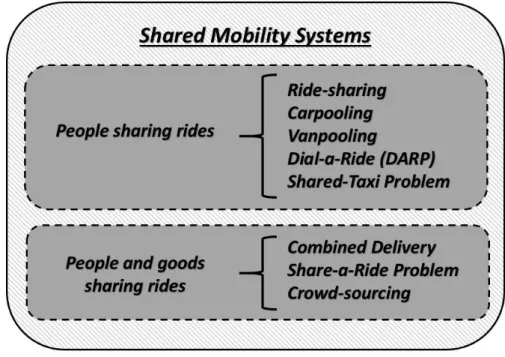
Figure 1.2: Main categories of shared mobility systems
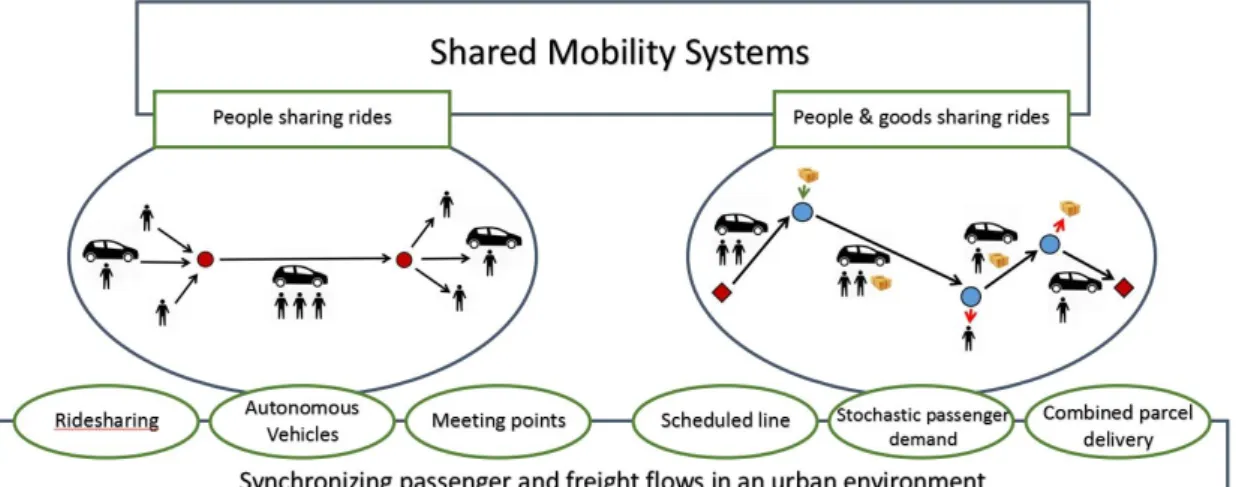
As the concept of shared mobility contains a wide variety of systems, we propose to classify these systems in two main categories (Figure 1.2). In the first category, we consider shared mobility systems where people, with similar itineraries and time schedules, share their daily trips so that their travel costs are reduced. On the other hand, shared mobility systems in the second category are those where the transportation of passengers and freight is combined. In both cases, the synchronization of different transportation streams is a critical task that need to be addressed carefully in order to achieve the intended service performance. The aim of this thesis is thus to study shared mobility systems whether they are referred to people sharing their daily trips or to combining people and freight transportation. More precisely, we address the following research objective:
Research objective: Develop efficient models and optimization approaches for syn-chronizing people and freight flows in urban mobility systems.
In order to achieve the aforementioned objective, a set of research questions are identified and addressed in the corresponding chapters of the thesis. The research questions are formulated as follows:
Research question 1: What are the different variants of shared mobility systems and what methods are used to optimize them?
Research question 2: How can people trips be synchronized in a ridesharing system with autonomous vehicles and what gains can this synchronization yield?
Research question 3: How can people and freight flows be combined and what are the impacts of stochastic passenger demands on planning such a combined system?
A more detailed overview on how these research questions are addressed in each one of the chapters is given in Section 1.3.
1.2
The Anthropolis research chair
This thesis is conducted as part of the Anthropolis research chair which is a research project that aims at developing human-centered approaches for urban mobility. The An-thropolis chair was established in 2015 thanks to the collaboration between the Institute for Technological Research SystemX (IRT-SystemX) and the Industrial Engineering Laboratory (LGI) of Ecole CentraleSupélec.
In addition, the Anthropolis chair is partially funded by five industrial partners which are: ALSTOM, ENGIE, Renault Group, RATP and SNCF. These partners are important actors of urban mobility in the greater Paris region. On their route towards an urban mobility transformation that meets the evolving transportation needs of inhabitants and the emerging technological advances, the industrial partners have several challenges that need to be considered. This justifies the industrial interest in the Anthropolis chair which aims to give a better understanding of these challenges and suggest solutions that can help the partners in the development of future urban mobility systems. For example, the future deployment of autonomous mobility services and their implication for people transportation as well as last-mile deliveries is one of the major points of industrial interest that we consider in this thesis (as we will see in the following chapters).
The research carried out within the Anthropolis chair can be summarized in three main research topics. These are:
• Topic 1 : User research, a traveler-centered approach of urban mobility issues. • Topic 2 : Disruptive technologies and innovation, a technological watch of urban
• Topic 3 : Impact assessment, a measure of the impact of new solutions on business models and urban systems.
As part of the third research topic (Topic 3 ), this thesis aims at being a bridge between the industrial needs and the real-life application of new shared mobility systems in urban areas. This is done by (i) bringing insights that can help the industrial partners to tackle the increasing demand for transportation and innovation challenges in their future shared mobility systems, and (ii) developing new tools (i.e. models and optimization approaches) to operate them efficiently.
1.3
Overview of the thesis
In chapter 2, we review different variants of the shared mobility problem in which either (i) travelers share their rides for the sake of reducing travel costs, usually called ridesharing problem, or (ii) passengers and freight transportation flows are combined. These involve real-time shared mobility systems, shared autonomous mobility and crowd-sourced logistics. We classify these variants according to their models, features, solution approaches and application context. We observe that although their application contexts might be different, these variants can share similar modeling features, formulations and solution approaches. We then provide a comprehensive overview of the recently published papers and case studies and we summarize their different models, features and objectives. Based on this review, we identify two shared mobility problems, which we study further in this thesis, and we develop models and optimization approaches for solving them.
In chapter 3, we study a ridesharing system where individually-owned and on-demand autonomous vehicles (AVs) are used for serving passengers and the concept of meeting points is used for synchronizing their trips. We then develop a two-phase method (a pre-processing algorithm and a matching optimization problem) for assessing the sharing potential of differ-ent AV ownership models and we evaluate their matching rates and potdiffer-entially saved vehicle kilometers. We analyze these ownership and sharing scenarios on a case study for New York City. The results demonstrate that sharing AV trips has the potential of increasing the system-wide matching rate as well as saving up to 23% of the overall traveled distance.
In chapter 4, we present a system that integrates freight deliveries to a scheduled line for people transportation where the aim is to use the underused capacity to transport freight simultaneously with passengers. We assume passenger demand, and thus the number of available places for transporting freight, to be stochastic. We then model this problem as a two-stage stochastic problem and we provide a MIP formulation and a sample average approximation (SAA) method along with an Adaptive Large Neighborhood Search (ALNS) algorithm to solve the stochastic optimization problem. In addition, we perform a com-putational study to evaluate the proposed approach as well as the impacts of stochastic
passengers demand on such integrated system. The results show that the proposed heuris-tic approach can return solutions that are within 0.6% of the optimal solutions. The analysis also revealed that an average of 3.3% extra costs can be observed when stochastic passengers demand is realized which reflect the effect of uncertainty on the total transportation costs. In chapter 5, we summarize the key findings and contributions of the thesis, highlight the main challenges facing shared mobility systems, and suggest potential directions for future research.
To help clarity, Table 1.1 summarizes the overview of the thesis. Column “Context” indicates the considered research context, “Methodology” gives the type of algorithm used to solve the considered problem, “Stochastic” indicates whether uncertainty is considered in the problem, and finally “Research questions” indicates which specific research questions is addressed in the corresponding chapter.
Chapter Context Methodology Research questions
1 2 3
2 Survey - X -
-3 People Preprocessing algo. & matching problem - X
-4 People & freight ALNS within SAA - - X
Table 1.1: Overview of the thesis The chapters of the thesis are based on the following papers:
Chapter 2: A. Mourad, J. Puchinger and C. Chu, A survey of models and algorithms for optimizing shared mobility, Transportation Research Part B, 2019.
https://doi.org/10.1016/j.trb.2019.02.003.
Chapter 3: A. Mourad, J. Puchinger and C. Chu, Owning or sharing autonomous ve-hicles: comparing different ownership and usage scenarios, Minor revision in European Transport Research Reviews, 2019
Chapter 4: A. Mourad, J. Puchinger, T. Van Woensel, Integrating autonomous deliv-ery service into a passenger transportation system, Submitted to International Journal of Production Research, 2019
In addition, the different elements of the research conducted in this thesis are presented in the following conferences:
A. Mourad, J. Puchinger, C. Chu. Privately owned autonomous vehicles in a ride-sharing application. 18ème Conférence annuelle de la Société Française de Recherche Opérationnelle et d’Aide à la Décision (ROADEF), 2017, Metz, France.
A. Mourad, J. Puchinger, C. Chu. Owning or sharing autonomous vehicles: compar-ing different ownership and usage scenarios. Vehicle Routcompar-ing and Logistics optimization (VeRoLog), 2017, Amsterdam, Netherlands.
A. Mourad, J. Puchinger, T. Van Woensel. Combining people and freight flows using a scheduled transportation line with stochastic passenger demands. 20ème Conférence an-nuelle de la Société Française de Recherche Opérationnelle et d’Aide à la Décision (ROADEF), 2019, Le Havre, France.
A. Mourad, J. Puchinger, T. Van Woensel. Combining people and freight flows using a scheduled transportation line with stochastic passenger demands. 7th INFORMS Trans-portation Science and Logistics Society Workshop (TSL), 2019, Vienna, Austria.
O. Al Maghraoui, R. Vosooghi, A. Mourad, J. Kamel, J. Puchinger, F. Vallet, B. Yannou. Shared Autonomous Vehicle Services and User’s Taste Variation: A Survey and Model Applications. 22nd EURO Working Group on Transportation Meeting (EWGT), 2019, Barcelona, Spain.
Chapter 2
Shared mobility systems
The rise of research into shared mobility systems reflects emerging challenges, such as rising traffic congestion, rising oil prices and rising environmental concern. The operations research community has turned towards more sharable and sustainable systems of transportation. Shared mobility systems can be collapsed into two main streams: those where people share rides and those where parcel transportation and people transportation are combined. This chapter sets out to review recent research in this area, including different optimization approaches, and to provide guidelines and promising directions for future research. It makes a distinction between prearranged and real-time problem settings and their methods of solution, and also gives an overview of real-case applications relevant to the research area.
2.1
Introduction
The concept of shared mobility has gained popularity in recent years, attracting atten-tion from the operaatten-tions research community, especially after the world of transportaatten-tion witnessed a mini-revolution with the launch of shared mobility services like Vélib, Autolib, Zipcar, Car2Go and others. Emerging challenges, such as growing levels of traffic congestion and limited oil supplies with their increasing prices, together with the rising environmental concerns have pushed research towards more sharable and sustainable systems of trans-portation. Applying this sharing concept in real-life transportation systems is expected to afford a set of potential benefits, whether for people sharing their daily trips or for combined passenger and freight transportation.
Shared mobility comes with many benefits, such as decreasing congestion and pollution levels and reducing transportation costs for both people and goods, but it also has challenges that are holding back widespread adoption. Furuhata et al., 2013 identified three major challenges for agencies providing shared rides to passengers. These are: designing attractive mechanisms, proper ride arrangement, and building trust among unknown passengers in online systems. Thus, in order to be adopted more widely, a shared mobility service should be easy to establish and provide a safe, efficient and economical trip. As such, it should be able to compete with the immediate access to door-to-door transportation that private cars provide (Agatz et al., 2012).
Another important aspect is the emergence of autonomous mobility services and their potential application to existing shared mobility systems. Fully autonomous vehicles are expected to reduce traveling costs and provide a safer and more comfortable and sustainable mode of transportation (Meyer et al., 2017). If those assumptions translate to reality, autonomous vehicles will dramatically change the urban landscape, and if they can be used as a shared transportation service, they could reshape the future of shared mobility systems (Chen et al., 2016b).
From a logistics system perspective, swiftly-growing urbanization rates, and conse-quently the potential change in people’s demands for goods in urban areas, justify the need to develop new urban logistics systems. These new systems should ensure efficient urban mobility, not just for people, but for goods as well (Fatnassi et al., 2015). Thus, much of the recent research has focused on increasing the sustainability of mobility systems. Projects have focused on improving existing transportation systems and service quality and designing new systems that can offer a more sustainable and ecological approach and thus contend with rising urban challenges. One innovative idea is to combine individual freight and passenger transportation streams in an urban area, prompting efforts to study the effi-ciency gains made when people and goods share rides and identify the potential challenges facing this combination.
sustainable and innovative shared mobility systems is coupled with the need to develop new operations research models and optimization approaches. An increasing amount of research is thus directed towards building new models and methods that can efficiently operate these systems. Reviewing the literature on shared mobility systems for passenger transporta-tion, Furuhata et al., 2013 surveyed the existing ridesharing systems and identified their key challenges. The paper also classified these systems according to their different features, matching search strategies, pricing methods and target demand segments. Agatz et al., 2012 surveyed the different operations research models that allow travelers (drivers and riders) to be matched in time, and reviewed the optimization challenges that arise in such real-time systems and the methods used to operate them. A more recent survey by Molenbruch et al., 2017 reviewed the literature on demand-responsive ridesharing systems, called dial-a-ride problems (DARPs). The authors introduce a taxonomy classifying the reviewed papers according to their real-time characteristics, service design, and solution methods. Similarly, Ho et al., 2018 presented an up-to-date review of recent studies on dial-a-ride problems (DARPs) with their different variants and solution methodologies. Moreover, the paper introduced references to benchmark instances, investigates their application areas, and sug-gests directions for future research. City logistics is a major field of innovation in freight transportation, so the rising importance of sharing aspects in last mile distribution makes it equally important to investigate the latest developments in city logistics. Savelsbergh and Van Woensel, 2016 reviewed the most recent trends and challenges in city logistics and iden-tified opportunities for research. Sampaio Oliveira et al., 2017 studied the crowd-sourcing logistics model, which aims to use available capacity on trips already taking place, called the crowd, to deliver goods in urban areas. The paper reviewed the latest developments in crowd logistics along with their different features, applications, deployment issues and impacts on city logistics.
Whereas these reviews on shared mobility have focused on either people or freight trans-portation considering one variant of the problem (dynamic ridesharing systems and carpool-ing services (Agatz et al., 2012; Furuhata et al., 2013), DARPs (Molenbruch et al., 2017; Ho et al., 2018), city logistics (Savelsbergh and Van Woensel, 2016), crowd-logistics (Sampaio Oliveira et al., 2017) and other variants), here we review different variants of the shared mo-bility problem for both people and goods. We thus focus on shared momo-bility systems where (i) travelers share their rides to reduce travel costs, usually called ridesharing systems, or where (ii) passenger and freight transportation are combined. We find that although the different variants can share similar modeling features, formulations and solution approaches, their context of application varies. For example, A DARP-based formulation can be used to model both types of shared mobility systems, but some of its features can vary depending on the context in which it is applied. We thus study these variants according to their mod-eling choices, defining features and solution methods, and we identify their common and varying characteristics. This survey brings several key contributions: (1) a comprehensive
overview of recent papers on shared mobility for transportation of people and goods, (2) an extensive study of the different variants of the problem based on their application contexts, models, features and solution approaches, (3) an overview of the latest trends in research on real-time shared mobility systems, shared autonomous mobility and crowd-based logis-tics, (4) a tabulated overview for each section summarizing the reviewed papers and their problem characteristics and solution methods, and (5) a review of recent shared mobility case studies analyzed and classified according to their scope and the approaches used.
This chapter is organized as follows. In section 2.2, we present the different variants of the shared mobility problem, study their different features and modeling approaches, and explain how we build on them. In section 2.3, we focus on mobility systems that allow people to share their rides, including those with real-time settings and those that consider shared autonomous vehicles. In section 2.4, we investigate the latest developments in city logistics and go on to review the integrated passenger and freight transportation problem with its solution methods and applications. This review of the literature on ridesharing and combined systems is split into two separate sections to facilitate the organization of the survey and help readers easily identify the parts of the literature that interest them most. In addition, each section comes with a set of case studies on the relevant shared mobility topics. Finally, in section 2.5, we summarize the key findings and suggest directions for future research.
2.2
Shared mobility problems
In this section, the different variants of shared mobility systems are reviewed and clas-sified according to their application context (section 2.2.1). Then, an extensive review of their modeling features (section 2.2.2), objectives (section 2.2.3) and solution approaches (2.2.4) is provided.
2.2.1 Background
As introduced earlier, the concept of shared mobility applies not just to people trans-portation but also to combined people and freight transtrans-portation to make better use of available transportation resources. The literature has introduced a number of variants of the shared mobility problem for people and freight transportation (Figure 2.1). Shared mobility systems for people transportation aim to minimize the number of vacant seats in vehicles in order to reduce the number of used vehicles, and thus traffic congestion and pollution. This can be achieved using a number of concepts, such as; ridesharing, car-pooling, vanpooling, car-sharing, dial-a-ride and others. Ridesharing allows people with similar itineraries and time schedules to share a vehicle for a trip so that each person’s travel costs (i.e. fuel, toll, parking expenses, etc.) are reduced (Furuhata et al., 2013). Based on this definition, we use the term "ridesharing" throughout the thesis to represent
Figure 2.1: Shared mobility - Problem variants
this category of systems in which people share their rides. The idea of ridesharing has many benefits including reducing travel cost and time, decreasing fuel and energy consumption, al-leviating traffic congestion and thus reducing air pollution. There are several variants of the ridesharing problem, most of which develop efficient mobility systems that allow travelers to share their trips and thus enhance their travel experience (Agatz et al., 2012). Planning for rideshared trips can be categorized into ’prearranged’, or ’static’ ridesharing, and ’dynamic’ ridesharing. In prearranged ridesharing, travelers’ demand (drivers and riders) is known beforehand (i.e. travelers’ origins, destinations, and departure and arrival times are given in advance) and can thus be used to plan their shared trips. Such prearranged services are mainly used for planning regular commuter trips as well as shared long-distance trips (e.g. inter-city trips). However, long-distance trips generally have more flexible time schedules than commuting trips. Dynamic ridesharing focuses on matching drivers and riders on-the-fly. In other words, new drivers, offering rides, and riders, requesting rides, can enter and leave the system at any time, and the system then tries to match their trips at short notice (or even en-route). In their review of dynamic ridesharing systems, Agatz et al., 2012 focused on the optimization problem of efficiently matching drivers and passengers. This ride-matching problem has two steps. First, it determines efficient vehicle routes, and then it assigns passengers to those vehicles taking into consideration the conflicting objec-tives of maximizing the number of matched travelers and minimizing the operation cost and passenger inconvenience (these real-time systems are further explored in section 2.3.2).
was first introduced by large companies in an effort to encourage their employees to pick up colleagues while driving to/from work. The idea was to minimize the number of cars traveling to their sites every day (Baldacci et al., 2004). Carpooling is generally used for commuting but has become increasingly popular for longer one-off journeys. The carpooling problem aims to determine the subsets of travelers that will share the same trip and the paths these shared trips should follow in order to maximize sharing and minimize travel costs. In order to increase the flexibility of carpooling services, which are usually prearranged, the concept of flexible carpooling has been introduced (Shaheen et al., 2016). Flexible carpooling, also called casual carpooling or slugging, is a semi-organized service in which destination, meeting point and departure times are all known in advance among potential participants. The main difference is that rideshares are formed spontaneously at the meeting point on a first-come first-served basis (Chan and Shaheen, 2012). This enhanced flexibility opened the door to deploying new carpooling services, not only for daily commutes but for long-distance trips as well (see SlugLines, SmartSlug and KangaRide for example). Along similar lines, Kaan and Olinick, 2013 consider the vanpooling problem with its optimization models and solution algorithms. In this problem, commuters in the vanpool drive to an intermediate location, called a park-and-ride location, and then take a van and ride together to the target destination. Car/vanpooling, which can be operated on daily or long-term bases (Wolfler Calvo et al., 2004), provide regular and cost efficient means of transportation, they do not accommodate unexpected changes of schedule. By contrast, the dial-a-ride (DARP)provides shared trips between any origin and destination in response to advanced passenger requests within a specific area (see Molenbruch et al., 2017; Ho et al., 2018 for recent review). The DARP models a demand-responsive transportation mode in which the aim is to define a set of routes in order to satisfy passenger requests at minimized costs (Masson et al., 2014; Ritzinger et al., 2016). Each request consists of transporting a passenger from his/her origin location to his/her destination location where passengers with similar route and time preferences can share the same vehicle as long as there is capacity. As such, solving the DARP is about minimizing the total travel distance, and thereby travel time, while respecting rider-specified time restrictions and any vehicle restriction constraints (more problem features and objectives are discussed in sections 2.2.2 and 2.2.3 respectively). These demand-responsive systems often focus on providing service to people with reduced mobility (e.g. elderly, handicapped etc.). The main difference between a DARP and a dynamic ridesharing problem is that a driver in the DARP can provide service to a wide set of passengers, as the drivers in this case are part of the service, and thus have less restrictions regarding route and time. In contrast, a driver in a dynamic ridesharing context can only provide service to passengers with similar route and time schedules to the driver (Gu et al., 2016). In other words, in DARP, all drivers are professional and typically operate out of one or more depots, whereas in dynamic ridesharing each driver is often an individual who has a specific origin and destination and may have preferences to be considered (like a maximum
detour time, maximum number of stops, etc.).
Another variant of the ridesharing problem is the shared-taxi problem introduced by Hosni et al., 2014 as a multi-vehicle dynamic DARP. In the shared-taxi problem, passen-gers indicate their desired pickup and drop-off locations, their earliest/latest acceptable pickup/drop-off time, and a maximum trip time. Solving the shared-taxi problem aims to optimally assign passengers to taxis and determine the optimal route for each taxi, which means this problem shares the same characteristics, such as demand-responsiveness, as the DARP. However, the main difference is that most shared-taxi services aim to minimize the response time to passenger requests whereas dial-a-ride systems aim to minimize vehicle operating cost by reducing the number of vehicles used to serve given passenger demands (Jung et al., 2016). When considering ridesharing variants, it is important to differentiate ridesharing from carsharing, which is a different concept. Carsharing is a car rental service in which people who are interested in making only occasional use of a vehicle can rent cars for short periods of time (Agatz et al., 2012). Although carsharing shares the aim of reducing car usage and increasing mobility with ridesharing, the optimization challenges that arise in both systems are different. Those challenges include, determining depot locations and assigning and redistributing vehicles among these depots. Although the carsharing concept allows people to occasionally use a network of vehicles for short periods of time, they do not necessarily share their trips with other travelers, which rules carsharing systems outside the scope of this review. Here we use the different variants of ridesharing introduced so far to classify recent studies on shared mobility systems for people transportation (see section 2.3).
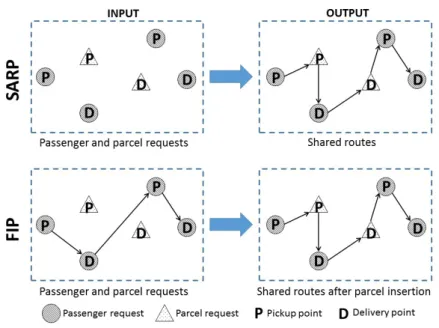
On the other hand, combining passenger and freight flows has the potential to improve the performance of existing transportation services as their needs can be satisfied with fewer resources (Trentini et al., 2015). In this kind of combined delivery system, spare capacity in public transport systems can be used for retail store replenishment, or taxis can move or deliver freight when carrying a passenger or during idle time. In an integrated system, when transporting freight, we need to decide whether to use a pure freight or people transportation network or a combination of the two (Savelsbergh and Van Woensel, 2016). This choice depends on the origin location, destination, and due time of freight. In this chapter, the focus is on systems in which people and freight transportation are combined. Li et al., 2014 introduced the share-a-ride problem (SARP) in which people and parcels are handled in an integrated way by the same taxi network. In this problem, a number of taxis drive around in an urban area to serve passenger requests but can also deliver some freight (parcels), from their origins to their final destinations, as long as these deliveries do not add significant extra time to their passengers’ trips. Further, Ghilas et al., 2016c explored an integrated solution for simultaneous passenger and freight transportation so that fewer vehicles are required. In their problem, a set of pickup and delivery vehicles is used to serve a set of parcel delivery requests where a part of the delivery process is
carried out on a scheduled passenger transportation service. Trentini et al., 2015 introduced another integrated system in which goods are transported in city buses, which have some spare capacity, from a distribution center to a set of bus stops before they can be delivered to final customers by a fleet of near-zero emissions city freighters.
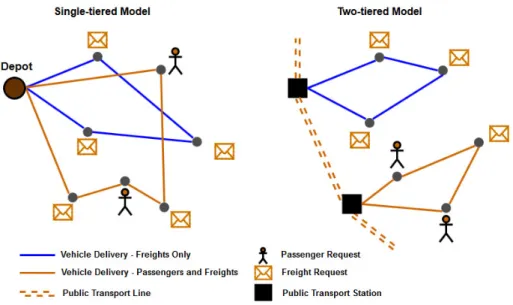
Increasing interest in such combined systems has led to the concept of crowd-sourced delivery. Crowd-sourcing allows activities that were traditionally performed by a certain agent or company to be outsourced to a large pool of individuals (Goetting and Han-dover, 2016), which aligns it to the concept of sharing economy. Crowd-sourced delivery, or crowd-shipping, is based on sharing excess and underused assets, which here trans-lates as using excess capacity on journeys already taking place in order to make deliveries. As such, crowd-sourced delivery could revolutionize delivery by increasing operational effi-ciency and reducing transportation costs. The problem of combining passenger and freight transportation shares many features with the ridesharing problem where only passengers are considered. However, it has some complicating features as well, such as transfers, syn-chronization, capacity constraints, multiple echelons, etc. (Savelsbergh and Van Woensel, 2016). The key to successfully combining passenger and freight transportation is to ensure there is no significant negative effect on people when goods are transported or delivered during their journey. We explore and discuss these combined systems in section 2.4.
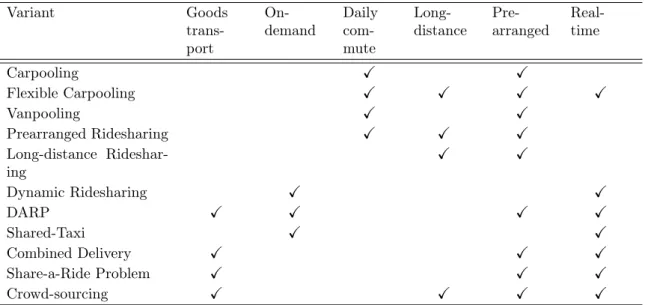
Variant Goods trans-port On-demand Daily com-mute Long-distance Pre-arranged Real-time Carpooling X X Flexible Carpooling X X X X Vanpooling X X Prearranged Ridesharing X X X Long-distance Rideshar-ing X X Dynamic Ridesharing X X DARP X X X X Shared-Taxi X X Combined Delivery X X X Share-a-Ride Problem X X X Crowd-sourcing X X X X
Table 2.1: Shared mobility variants for people transportation - Different characteristics
Table 2.1 gives a roll-up summary of the different variants of recent shared mobility prob-lems. Below we give a more detailed analysis of these variants and the modeling approaches and optimization methods commonly used.
2.2.2 Modeling and features
In the shared mobility problem, a set of transportation requests, representing passengers or passengers-plus-goods, need to go from their origins to their destinations while satisfying certain criteria and respecting certain service specifications. The service provider receives these different requests and then arranges with its available transportation resources (vehi-cles, car parks, drivers etc.) for the delivery process. This planning of shared trips is one of the main tasks in shared mobility. In this problem, the service is shared in the sense that multiple requests might be serviced using the same resource (e.g. vehicle) at the same time. In order to establish this shared service, a set of features and constraints should be considered. Shared mobility problems are usually modeled using different vehicle routing problem (VRP) formulations that represent these features as a set of additional constraints characterizing each variant of the problem. Many of these features can be found in both ridesharing systems and systems combining passenger and freight transportation, but other features can relate to either ridesharing systems or combined systems, but not both. In the following, we summarize the different types of features and constraints reported in the literature for the shared mobility problem. Furthermore, we identify problem variants that consider each type of constraint discussed in order to get a clear picture of these variants and their common and different characteristics.
Routing constraints (RC):
In shared mobility systems, every request needs to be transported from its origin to its destination, and the origin location has to be visited first. This feature applies to both passengers and goods but can have some variations. For example, in some ridesharing ap-plications, a passenger can be picked up or dropped off at an intermediate location, usually called meeting point, which can lead to shorter detours (Stiglic et al., 2016a). Another exam-ple is found in multi-echelon transportation systems where goods are transported through a scheduled line to a public transport station and then delivered by vehicle to their final des-tination (Ghilas et al., 2016b). While most models insist that each transportation request is served by one vehicle at most (as in Hosni et al., 2014 for a shared-taxi problem and Li et al., 2014 for a multi-echelon combined system), some models allow these requests to be transferred using multiple vehicles (as in Herbawi and Weber, 2011 for a dynamic multi-hop ride-sharing problem and Masson et al., 2014 for a DARP with transfers).
Furthermore, in demand-responsive transportation systems (including DARP and shared-taxi systems) and many logistics systems in which a fleet of vehicles is located at specific locations (depots) and ready for service, there is an additional constraint imposed on the route each vehicle will follow: each vehicle should return to one of the depots when its trip is finished. In some simplified problem settings, a vehicle might have to return to the same depot from which it started its trip. Moreover, any shared mobility model must ensure each vehicle reaches and leaves a corresponding location (request origin or destination, depot,
intermediate meeting point or a public transport station). This constraint ensures conser-vation of flow, and is very common in shared mobility problems. In some combined systems, passenger requests are given higher priority when building routes to serve both passengers and goods (Li et al., 2014). The routes are first constructed based on passenger requests, then freight requests are only inserted when passenger trips are not significantly affected. Routing constraints are usually considered hard constraints, because violating them might lead to detached vehicle routes or a request being picked up but not delivered to destination. Thus, these constraints need to be strictly respected when modeling and solving a shared mobility problem.
Time constraints (TC):
Besides indicating where a transportation request needs to be picked up and where it should be transported to, a shared trip must also indicate when this process can take place. This is usually done by associating a time window with each transportation request, whether for a passenger or freight. In ridesharing systems, this time window is usually given by each passenger indicating the earliest departure time from his/her origin and the latest arrival time at his/her destination. Thus, in order for a passenger to participate in a shared trip, he/she should be picked up at origin and dropped off at destination within the time window he/she has specified (Stiglic et al., 2016a). Like passenger requests, freight delivery requests may also be associated with a time window. In some cases, two time windows are used to represent these time restrictions: a pickup time window, indicating when a request should be picked up, and a drop-off time window, indicating when it should be delivered (Ghilas et al., 2016c).
In addition, there could be added restrictions on the duration of the shared trips. In most ridesharing systems, a set of drivers, offering rides, and riders, looking for rides, are matched to share their trips. In order to accommodate the riders, the driver might have to make a detour from his original itinerary and make some extra stops (Furuhata et al., 2013). The length of this potential detour depends on how far the driver is willing to extend his/her trip time. Moreover, if drivers have sufficient time flexibility, they might provide rides to multiple riders simultaneously. Of course, pick-up and drop-off of several riders in a single trip adds layers of complexity to the planning decisions (Agatz et al., 2011). Thus, a successful ridesharing respects the departure and arrival times for all participants, as well as the maximum detour time for the driver. In DARP-like systems, drivers are employed by the service provider (like in shared-taxi services), and thus have no preferences in terms of departure, arrival and detour times. In such systems, other time restrictions might be considered, such as: maximum working hours for drivers, a maximum response time for processing a passenger request, and the maximum service time for vehicles, which is usually related to recharging and maintenance operations (Li et al., 2014). Most of the previous scheduling constraints also apply to combined systems transporting passengers
and goods through the same network. One difference is that in combined systems, every participant specifies a trip excess time which indicates his/her readiness to extend the trip in order to pick up and deliver some goods (Li et al., 2016a). Thus, successful integration of passengers and goods in a shared trip should respect the maximum extra time that participating passengers are ready to accept.
Unlike routing constraints, time constraints, also called scheduling constraints, are con-sidered soft constraints, because violating them might not detach vehicle routes or intercept the flow, but may result in passengers or freight arriving late to their destinations, especially in real-world conditions. Violating these constraints may thus be allowed if it increases the likelihood of finding a solution, but discouraged through a penalty cost.
Capacity constraints (CC):
A capacity constraint is a factor that prevents a shared transportation resource from being overused. In ridesharing systems, a capacity constraint limits the number of pas-sengers sharing the same vehicle at the same time to the number of vacant seats in that vehicle (Santos and Xavier, 2015). Besides limiting the maximum number of passengers, many vanpooling systems also require a minimum number of passengers to form a vanpool for a shared trip (Kaan and Olinick, 2013). Number of participants in a shared vanpooling trip must therefore be within these two limits. In logistics systems, a capacity constraint ensures that the volume of goods to be transported does not exceed the available space pro-vided by the transportation service (Savelsbergh and Van Woensel, 2016). This constraint holds valid whether goods are transported using a fleet of vehicles (Li et al., 2014), public transport (Behiri et al., 2018) or any other transportation service. In addition, in integrated models where passengers and goods are transported together, constraints on both capacities may need to be considered. This is because most of the reviewed literature assumes that passengers and goods are transported in separate compartments (Ghilas et al., 2016a). In an uncertain environment, where passenger or freight demand is stochastic, these capacity constraints might be violated, and should thus be treated using stochastic approaches.
Cost constraints (OC):
In some problem settings, a ridesharing participant may specify a maximum travel cost that he/she is willing to pay for the shared trip, and should thus be matched to shared trips that stay under the maximum amount specified. Furthermore, in order to attract more participants, travel costs in ridesharing systems should be competitive with other modes of transportation. A good example can be found in vanpooling systems where passengers are only assigned to vanpools that are cheaper than their current commuting costs (Kaan and Olinick, 2013). However, integrating goods delivery with passenger trips that already take place could decrease travel costs for participants and transportation costs for goods (Crainic and Montreuil, 2016). Even if passengers would have longer detours when freight
delivery is added to their trip, they would still get lower travel cost than if no deliveries are added. However, the bulk of research on these combined systems does not consider travel and transportation cost as a feature or constraint in the system but more as an objective to be minimized given its importance for service operators (as we will see in Section 2.2.3).
Synchronization constraints (SC):
Many recent research papers have focused on studying different synchronization con-straints in shared mobility problems. An extensive review by Drexl, 2012 identified five different types of synchronization constraints for VRPs. The first type of synchronization constraint, called task synchronization, is required when multiple transportation units are capable of serving a task (i.e. a transportation request). In other words, a task synchro-nization constraint ensures that each request (passenger or freight) is served exactly once by one or more vehicles (Fink et al., 2018). Furthermore, when the operations performed by different transportation units need to be coordinated in terms of space and time, oper-ation synchronizoper-ation is required. In other words, a schedule for a vehicle in a shared mobility system should be built to take into account the schedules of other vehicles, so their schedules need to be synchronized. Logistics systems offer good examples of when operation synchronization is needed: for example, a system where two different vehicles arrive at different customer locations, one delivering the product and the other carrying the crew to install it (Hojabri et al., 2018), or a system in which multiple vehicles cooperate in order to transport one big-size cargo (Hu and Wei, 2018). Another type of synchronization constraints is called movement synchronization. In some ridesharing systems where pas-sengers are allowed to transfer from one vehicle to another on the way to their destination, the arrival and departure of vehicles to and from transfer points need to be synchronized (see Masson et al., 2014 for an example). Another example is found in multi-echelon sys-tems where goods are transported with passengers through a scheduled transport line after being collected by a fleet of vehicles. Such systems also need to ensure synchronization between requests and the collecting vehicles, and between requests and the scheduled line departures (Ghilas et al., 2016b). Load synchronization ensures that the right amount of load is collected and delivered to a customer, or in other words, no load is lost when transferred between different transportation units. This is the case when deliveries are done using two distinct fleets of vehicles where a request is transferred from one vehicle to an-other at satellite locations before it can be delivered to a customer (Grangier et al., 2016). The same load synchronization constraint is needed when deliveries are transferred between pickup and delivery vehicles and a public transport line in a multi-echelon transportation system. Finally, resource synchronization ensures that the use of resources common to different transportation units is limited to availability (Drexl, 2012). Number of drivers, vehicle fleet size, available parking slots, vacant seats for riders to share, and the available space and capacity in transportation units in both ridesharing and combined systems are
all examples of limited resources whose use needs to be synchronized. Xiang et al., 2006 considered a DARP with passenger-driver and passenger-vehicle compatibility constraints. They classified passengers into different levels, and ruled that vehicles could only accommo-date passengers of corresponding levels, i.e. a passenger can only use a vehicle of the same or higher level. As a rule, modeling synchronization constraints yields more complex and non-linear mathematical formulations (e.g. implications) which need to be handled using linearization techniques. However, these constraints are important for modeling realistic settings and, from an algorithmic perspective, can be used to decompose hard problems (e.g. they can be used as coupling constraints in a column generation based approach; see Fink et al., 2018).
2.2.3 Objective functions
Most objectives that shared mobility problems aim to optimize can be classified into two main categories; operational objectives and quality-related objectives. Operational objectives are usually about optimizing system-wide operating costs, such as minimizing vehicle miles and transportation time, maximizing the number of serviced requests, mini-mizing the number of required vehicles, and others. Quality-related objectives are about enhancing the quality of service provided. For example, minimizing total passenger ride or waiting time might yield a better performance from the passenger perspective but not from a system-wide perspective. Furthermore, minimizing system-wide travel time does not nec-essarily mean shorter travel times for every passenger. This difference between collective and individual perspectives in shared mobility systems justifies the need for methods that consider both operational and quality-related objectives. A good example can be found in Kalczynski and Miklas-Kalczynska, 2018 where a decentralized approach takes carpool participant preferences into account while maintaining the same system-wide savings that can be obtained in centralized approaches.
Much of the research on shared mobility is focused on optimizing a single operational ob-jective, but there are papers that consider multiple-objective systems combining operational with quality-related objectives. In single objective systems, service quality considerations are represented as constraints in the model to ensure a minimum service level (Molenbruch et al., 2017). In other words, a set of constraints limiting passenger extra ride times, caused by deviations from their original routes, are added when optimizing the system. Likewise, most of ridesharing research has focused minimizing the system-wide travel distance (vehi-cle miles) or total travel time. For example, in Wolfler Calvo et al., 2004, the system-wide travel time in a carpooling system is minimized with an added penalty cost for unserved requests. In a dynamic environment, where transportation demand is revealed in real-time, satisfying full demand may not be attainable, in which case it becomes pertinent to max-imize the number of served requests as it extends the reach of the transportation service (Berbeglia et al., 2012). Some studies have considered maximizing the total profit obtained
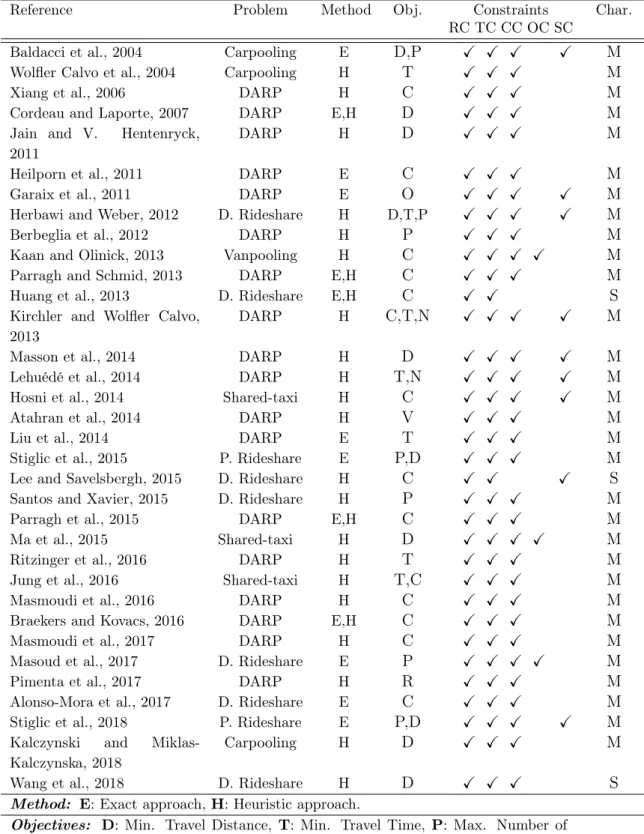
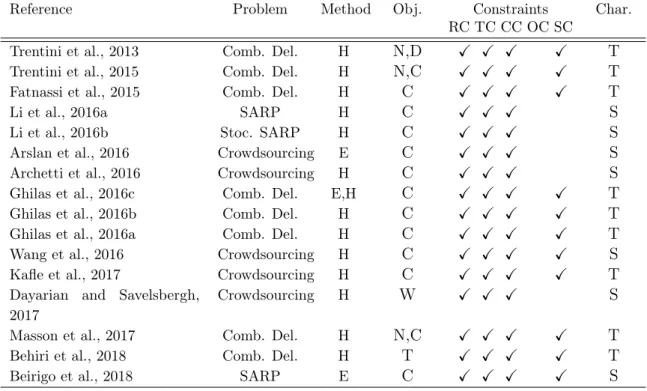
from the ridesharing system (see Hosni et al., 2014 for a shared-taxi problem and Parragh et al., 2015 for a DARP) or minimizing the total cost of operating it (see Kaan and Olinick, 2013 for a vanpooling problem and Braekers et al., 2016 for a DARP). Moreover, some more problem-specific objectives have been considered in the literature, such as; minimizing the number of required vehicles (Guerriero et al., 2013), minimizing vehicle emissions (Atahran et al., 2014), maximizing passenger occupancy rate (Garaix et al., 2011), minimizing staff workload (Lim et al., 2017), and maximizing system reliability (Pimenta et al., 2017). Most studies on combined crowd-sourced systems have focused on either maximizing the profit obtained by integrating passenger and freight flows (Li et al., 2014) or minimizing the oper-ational cost of these systems (Ghilas et al., 2016c), but there have been efforts to consider additional objectives, such as minimizing the number of vehicles required to operate the system (Trentini et al., 2015) and minimizing the total wait time of demands before being serviced (Behiri et al., 2018). The recent shared mobility studies listed in Table 2.2 and 2.5 have been classified using these different objectives.
As mentioned above, multi-objective systems consider a combination of two or more of the above-listed single objectives. Solving multi-objective problems requires different meth-ods to those employed for solving single-objective problems. The literature identifies three main techniques for dealing with multi-objective problems. The first, and most popular ap-proach is to aggregate the different objectives into a weighted-sum objective with different measures. In this approach, a weight has to be defined for each of the combined objectives. As such, the relative importance of each objective needs to be quantifiable and well-defined. A good example can be found in Kirchler and Wolfler Calvo, 2013 who used an aggregated objective function combining six different objectives: minimizing routing cost, excess ride time, passenger waiting time, route durations, early arrival times at pickup and delivery nodes, and number of unserved requests. Another example of a weighted-sum objective can be found in Lehuédé et al., 2014. One drawback of the weighted-sum approach is that it might not be able to find the full set of non-dominated solutions for optimization problems in which some variables are constrained to be integers (i.e. non-convex optimization prob-lems). In addition to weighted-sum approach, some papers consider a hierarchical, also called lexicographical, objective function. In this approach, the different objectives are ordered according to their importance, and first the main objective is optimized to generate a set of solutions, then a secondary objective is optimized whenever two solutions with the same quality, in terms of the main objective, are obtained. Stiglic et al., 2016a considered a ridesharing system with a lexicographic objective function. First, the system generates solutions that maximize the number of matched participants and then the secondary objec-tive is used to select solutions that maximize the distance savings (see also Schilde et al., 2014). This approach is therefore efficient in problems where the different objectives can be classified into main and secondary objectives. Finally, the third approach for dealing with multi-objective problems is to obtain the set of non-dominated solutions in terms of