HAL Id: hal-00304246
https://hal.archives-ouvertes.fr/hal-00304246
Submitted on 9 Jun 2008HAL is a multi-disciplinary open access
archive for the deposit and dissemination of sci-entific research documents, whether they are pub-lished or not. The documents may come from teaching and research institutions in France or abroad, or from public or private research centers.
L’archive ouverte pluridisciplinaire HAL, est destinée au dépôt et à la diffusion de documents scientifiques de niveau recherche, publiés ou non, émanant des établissements d’enseignement et de recherche français ou étrangers, des laboratoires publics ou privés.
Tropical cyclogenesis in a tropical wave critical layer:
easterly waves
T. J. Dunkerton, M. T. Montgomery, Z. Wang
To cite this version:
T. J. Dunkerton, M. T. Montgomery, Z. Wang. Tropical cyclogenesis in a tropical wave critical layer: easterly waves. Atmospheric Chemistry and Physics Discussions, European Geosciences Union, 2008, 8 (3), pp.11149-11292. �hal-00304246�
ACPD
8, 11149–11292, 2008 Tropical cyclogenesis in tropical waves T. J. Dunkerton et al. Title Page Abstract Introduction Conclusions References Tables Figures ◭ ◮ ◭ ◮ Back CloseFull Screen / Esc
Printer-friendly Version Interactive Discussion
Atmos. Chem. Phys. Discuss., 8, 11149–11292, 2008 www.atmos-chem-phys-discuss.net/8/11149/2008/ © Author(s) 2008. This work is distributed under the Creative Commons Attribution 3.0 License.
Atmospheric Chemistry and Physics Discussions
Tropical cyclogenesis in a tropical wave
critical layer: easterly waves
T. J. Dunkerton1,2, M. T. Montgomery2, and Z. Wang2
1
NorthWest Research Associates, Bellevue WA, USA 2
Naval Postgraduate School, Monterey CA, USA
Received: 3 January 2008 – Accepted: 28 January 2008 – Published: 9 June 2008 Correspondence to: T. J. Dunkerton ([email protected])
ACPD
8, 11149–11292, 2008 Tropical cyclogenesis in tropical waves T. J. Dunkerton et al. Title Page Abstract Introduction Conclusions References Tables Figures ◭ ◮ ◭ ◮ Back CloseFull Screen / Esc
Printer-friendly Version Interactive Discussion
Abstract
The development of tropical depressions within tropical waves over the Atlantic and eastern Pacific is usually preceded by a “surface low along the wave” as if to suggest a hybrid wave-vortex structure in which flow streamlines not only undulate with the waves, but form a closed circulation in the lower troposphere surrounding the low. This 5
structure, equatorward of the easterly jet axis, resembles the familiar critical layer of waves in shear flow, a flow configuration which arguably provides the simplest concep-tual framework for tropical cyclogenesis resulting from tropical waves, their interaction with the mean flow, and with diabatic processes associated with deep moist convec-tion. The critical layer represents a sweet spot for tropical cyclogenesis in which a 10
proto-vortex may form and grow within its parent wave. A common location for storm development within the critical layer is given by the intersection of the wave’s critical latitude and trough axis, with analyzed vorticity centroid nearby. The wave and vor-tex live together for a time, and initially propagate at approximately the same speed. In most cases this coupled propagation continues for a few days after a tropical de-15
pression is identified. For easterly waves, as the name suggests, the propagation is westward. It is shown that in order to visualize optimally this “marsupial paradigm” one should view the flow streamlines, or stream function, in a frame of reference translating horizontally with the phase propagation of the parent wave. This translation requires an appropriate “gauge” that renders translating streamlines and isopleths of translating 20
stream function approximately equivalent to flow trajectories. In the translating frame, the closed circulation is stationary, and a dividing streamline effectively separates air within the critical layer from air outside. The critical layer equatorward of the east-erly jet axis is important to tropical cyclogenesis because it provides (i) a region of cyclonic vorticity and weak deformation by the resolved flow, (ii) containment of mois-25
ture entrained by the gyre and/or lofted by deep convection therein, (iii) confinement of mesoscale vortex aggregation, (iv) a predominantly convective type of heating pro-file, and (v) maintenance or enhancement of the parent wave until the vortex becomes
ACPD
8, 11149–11292, 2008 Tropical cyclogenesis in tropical waves T. J. Dunkerton et al. Title Page Abstract Introduction Conclusions References Tables Figures ◭ ◮ ◭ ◮ Back CloseFull Screen / Esc
Printer-friendly Version Interactive Discussion
a self-sustaining entity and emerges from the wave as a tropical depression. These ideas are formulated in three new hypotheses describing the flow kinematics and dy-namics, moist thermodynamics and wave/vortex interactions comprising the marsupial paradigm. A survey of 55 named tropical storms in 1998–2001 reveals that actual crit-ical layers sometimes resemble the ideal east-west train of cat’s eyes, but are usually 5
less regular, with one or more recirculation regions in the translating frame. It is shown that a “wave gauge” given by the translation speed of the parent wave is the appropriate choice, as well, for isolated proto-vortices carried by the wave. Some implications for entrainment/containment of vorticity and moisture in the cat’s eye are discussed from this perspective, based on the observational survey.
10
1 Introduction
The genesis of tropical cyclones, hurricanes and typhoons is one of the most impor-tant unsolved problems in dynamical meteorology (Emanuel, 2005) and climate (Gore, 2006). As for why the problem remains unsolved, after decades of research, it is un-fortunately true that in situ observations of genesis are mostly lacking over remote 15
tropical oceans, that field campaigns are too few while operational efforts generally tar-get mature storms, that critically important processes and their multi-scale interactions are challenging to model and observe. Nature in some cases provides little advance warning of these storms and prediction of genesis beyond 48 h is generally too uncer-tain to be useful. Funding and technological resources are needed to remedy these 20
deficiencies, to the extent they can be remedied, but – to be honest – it is unlikely that fundamental progress will be made without a quantum leap in theoretical under-standing as well. As will be demonstrated in this paper and the sequels, available observations on the synoptic scale need to be analyzed in a manner that is consistent with the Lagrangian nature of tropical cyclogenesis. As a moist diabatic vortex, the 25
tropical cyclone, through its lifecycle from genesis to intensification, represents a co-herent interaction between potential vorticity (PV) and moist entropy, both of which are
ACPD
8, 11149–11292, 2008 Tropical cyclogenesis in tropical waves T. J. Dunkerton et al. Title Page Abstract Introduction Conclusions References Tables Figures ◭ ◮ ◭ ◮ Back CloseFull Screen / Esc
Printer-friendly Version Interactive Discussion
adiabatic invariants, i.e., material properties of a conservative flow. In the earliest stage of genesis, the fluid motion is mostly horizontal and quasi-conservative, punctuated by intermittent deep convection, a strongly diabatic and turbulent process, to be sure. In order to fully appreciate the transport of PV and moist entropy by the flow, their inter-action with one another, the impacts of deep convective transport and protection of the 5
proto-vortex from hostile influences requires, among other things, an understanding of material surfaces and Lagrangian boundaries in the horizontal plane. This viewpoint, although used subconsciously by forecasters1, is invisible to researchers working with standard meteorological products in an Eulerian framework. For tropical cyclogenesis it is necessary to understand the morphology of Lagrangian transport, and it is desir-10
1
The elusive but sometimes exposed “low cloud swirls” and other stratiform cloud or water vapor anomalies represent Lagrangian entities to the extent that these features are passively advected by the flow. Feature-tracking provides instantaneous Eulerian winds (e.g., Velden et al., 1997, 2005), while animation of the accumulated horizontal displacement of cloud or water vapor anomalies (away from their sources and sinks: viz., deep convection and other regions of moist ascent) effectively provides a Lagrangian view. So the geostationary imagery are helpful in this respect, whereas standard meteorological charts in the Earth-relative frame and infre-quent snapshots from polar orbiting satellites are not. Surface winds from scatterometry are indisputably valuable, but it is unnecessary for such images (as from QuikSCAT or ASCAT) to display a closed circulation in order for a closed circulation to exist in a Lagrangian sense (see Appendix A). A morphed animation of total precipitable water from microwave imagery (begin-ning in 2006) is proving very helpful for analysis and prediction of moist tropical waves in the lower troposphere (http://cimss.ssec.wisc.edu/tropic2). Forecasters are now using this product to detect, locate and extrapolate the position of wave troughs. By viewing the sequence of frames, the viewer obtains a sense of Lagrangian horizontal motions weighted by the vertical profile of moisture, together with the impacts of convective moistening and horizontal entrain-ment. Extraction of quantitative Lagrangian information from sequential imagery is far from trivial, but a worthwhile goal. When it comes to closed circulations in propagating waves, the difference between Eulerian and Lagrangian flow is critically important, as will become clear in this paper. Forecasters deal simultaneously with both viewpoints in their arsenal of observa-tions, yet (to our knowledge) without a clear differentiation between them.
ACPD
8, 11149–11292, 2008 Tropical cyclogenesis in tropical waves T. J. Dunkerton et al. Title Page Abstract Introduction Conclusions References Tables Figures ◭ ◮ ◭ ◮ Back CloseFull Screen / Esc
Printer-friendly Version Interactive Discussion
able to know whether, and how, suitable information for this purpose can be obtained from an intelligent manipulation of Eulerian data.
Compounding the problem is that multiple pathways to genesis exist. Four plausible pathways identify one or more of the following as key ingredients: (i) tropical waves, (ii) monsoon troughs, (iii) extratropical disturbances and (iv) topographic flows2. For 5
each pathway we can imagine a theoretical paradigm that provides conceptual step-ping stones along the path. In tropical waves, a sweet spot for development evidently exists along the wave, associated with a region of low pressure in the lower tropo-sphere. Having such a sweet spot does not guarantee genesis, of course, because other environmental factors also play in important role in deciding whether or not a 10
storm may form. Many individual wave-troughs occur in a single hurricane season but only a fraction – approximately 10% in the eastern and central Atlantic (Simpson et al., 1968) – contribute to the formation of a tropical depression-strength vortex (defined hereafter as “genesis”). Among those disturbances that produce depressions almost all have a “surface low along the wave” in the forecaster’s familiar parlance. Few are 15
thought to have a mid-level cyclonic vortex without the surface signature, a negligible fraction of the original wave count. Mid-level vortices without a discernable surface cir-culation are indeed observed in the tropics, increasingly so as satellite remote sensing improves, and in regions of frequent deep convection, such as the ITCZ. Some have suggested that tropical mesoscale convective systems produce mesoscale convective 20
vortices initially without a cyclonic circulation near the surface (Bister and Emanuel, 2
The third and fourth pathways do not represent TC genesis in the pure sense of the term. The third pathway is not entirely tropical, and the fourth pathway is not entirely oceanic. There-fore if one is interested in pure tropical cyclogenesis, the problem reduces to (i) a tropical-wave pathway and (ii) a geophysical turbulence pathway. The latter may be subdivided into quasi-2-D and rotating 3-D-convective pathways to highlight the role of horizontal circulations and deep moist convection in a rotating environment, respectively. One can then appreciate the fuzzy nature of the classification scheme, as waves and turbulence generally coexist (Lilly, 1983; McWilliams, 1984; McIntyre, 2003). Genesis is not a question about which of these mecha-nisms is acting in a particular situation, but rather, how much of each, and how they interact.
ACPD
8, 11149–11292, 2008 Tropical cyclogenesis in tropical waves T. J. Dunkerton et al. Title Page Abstract Introduction Conclusions References Tables Figures ◭ ◮ ◭ ◮ Back CloseFull Screen / Esc
Printer-friendly Version Interactive Discussion
1997; Ritchie and Holland, 1997) and that this may be a reason why only a small frac-tion of disturbances become tropical depressions (E. Zipser, personal communicafrac-tion; Harr and Elsberry, 1996). It will be shown here that for storms originating in tropical waves, the synoptic wave itself plays a vital role in the near-surface circulation. In our proposed tropical-wave scenario the relevant theoretical paradigm is the formation of 5
a closed proto-vortex within the wave in the lower troposphere and subsequent eddy shedding whereby the vortex, energized further by deep convective heating, becomes detached from the wave and begins to control its own destiny. In what follows we re-fer to this sequence of events as the marsupial paradigm. Central to our presentation of the marsupial paradigm is a rudimentary understanding of the Lagrangian flow and 10
its dynamical and thermodynamical properties in the neighborhood of the developing storm.
Our series on TC genesis, of which this paper is the first, addresses the tropical wave pathway and variations thereof (easterly wave propagation, tropical depression disturbances, instability of the ITCZ, and trapped equatorial modes) and the ability of 15
these disturbances to create a closed gyre or “pouch” and subsequently within the pouch, a proto-vortex or “embryo” favorable for hurricane formation3. We are con-cerned also with the monsoon trough pathway (e.g., Harr and Elsberry, 1996; Simpson et al., 1997). But for TC genesis, environmental conditions in the monsoon trough (McBride and Zehr, 1981) appear favorable over a larger area, providing a diverse set 20
of flow configurations in the lower troposphere (shear line, confluence, gyre; Ritchie 3
The “embryo” is borrowed from other authors (Emanuel, 1993, 2007; M06) so to be consis-tent with the marsupial paradigm we might refer to the proto-vortex as a “joey”. Extending the analogy, a female joey provides a second “baby pouch” for convective organization at smaller scales. Observations sometimes suggest multiple low-level circulation centers in systems that are still becoming organized. Forecasters and scientists alike want to know more about these proto-structures; e.g., their role in Ekman pumping and convective triggering. For now and the foreseeable future, the LT in developing environments remains a mysterious realm frequently obscured by patches of deep convective cloud and stratiform anvils. Geostationary microwave technology, needed to penetrate this environment continuously, is ∼20 years away.
ACPD
8, 11149–11292, 2008 Tropical cyclogenesis in tropical waves T. J. Dunkerton et al. Title Page Abstract Introduction Conclusions References Tables Figures ◭ ◮ ◭ ◮ Back CloseFull Screen / Esc
Printer-friendly Version Interactive Discussion
and Holland, 1999) and making the role of tropical waves (with their sweet spot) more challenging to ascertain – although precursor waves of one type or another can be seen in many of these cases. Genesis by spontaneous aggregation (now a popular subject of research: e.g., Emanuel and Nolan, 2004; Nolan et al., 2006; Held, 2007; Borth, 2007; Schecter and Dunkerton, 2007, 20084) may be regarded as a limiting 5
case of the monsoon trough pathway in which no particular region is favored, but con-ditions are rendered more favorable, e.g., by cranking up the underlying SST. In the real world, spontaneous aggregation is likely nature’s last resort5. En route to storm formation, the tropical atmosphere almost always provides a sweet spot or more ex-tensive region favorable to genesis. We believe this fact has important implications for 10
the study of tropical cyclogenesis in climate change. Whereas an increase of SST is expected naively to increase the intensity of mature tropical cyclones, the effects of climate change on tropical cyclogenesis will be felt more immediately by modulation of
local environments that are already favorable for genesis in the current climate; effects
that will be manifested, for instance, in a changed morphology of tropical waves, mon-15
soon troughs and their favorable regions, as well as changes of large-scale circulation and ITCZ that affect storm tracks and ambient environment (Frank and Young, 2007; Vecchi and Soden, 2007; Ventham and Wang, 2007; Vimont and Kossin, 2007; Wing et al., 2007) possibly directing storms into regions of warmer SST6.
4
Schecter, D. A. and Dunkerton, T. J.: Hurricane formation in diabatic Ekman turbulence, Q. J. Roy. Meteor. Soc., submitted, 2008.
5
As also the case in the “real world” of 3-km simulations performed on Earth Simulator (Matsuno, 2006, 2007) which indicate a crucial role of tropical easterly waves for TC genesis in the present climate.
6
The role of off-equatorial circulations as a link between hurricanes and climate change is recognized in the papers cited. These two topics, along with air quality, are the most important in contemporary atmospheric science and their relationship deserves scrutiny at a dynamical, not merely statistical, level of understanding. The effect of climate change on hurricanes is not simply to increase the potential intensity (PI) of a hurricane and thereby increase hurricane intensity ipso facto. Leaving aside frontier matters concerning the formulation and accuracy of
ACPD
8, 11149–11292, 2008 Tropical cyclogenesis in tropical waves T. J. Dunkerton et al. Title Page Abstract Introduction Conclusions References Tables Figures ◭ ◮ ◭ ◮ Back CloseFull Screen / Esc
Printer-friendly Version Interactive Discussion
In the study by Montgomery et al. (2006b; hereafter M06) the TC genesis problem was posed as the metamorphosis of a mid-level mesoscale convective vortex (MCV) current PI theory (Emanuel, 2005; Montgomery et al., 2006a; Smith et al., 2007) actual hurri-cane intensities form a continuous probability distribution function (PDF) bounded above by a limiting intensity. SST is but one of several factors explaining the PDF and its variation (DeMaria et al., 2005) so it is not merely a question of how PI varies with SST. Nor can we ignore the num-ber of storms reaching tropical depression status and how this might change in the future; the percentage of developers versus wave-troughs is small in the present climate – nowhere near saturation. Though little attention has been given to the issue, perhaps for lack of evidence, the
number of storms generated is an integral part of the climate-change question. We consider
it unlikely that nature will somehow produce more storms of high intensity without producing more storms at all levels of intensity (although this point was disputed by Held, 2007, based on results obtained with a simple GCM; see also Benggston et al., 2007; Knutson, 2007; Knutson et al., 2007, 2008). Two reasons underlying this “common sense” viewpoint are (i) it is likely for physical and statistical reasons that if more storms are generated, the number of intense storms will increase; and (ii) regions of genesis and highest intensity are (for the most part) well separated spatially, thanks to the zonal motion of storms, restricting the ability of intense storms to suppress new storms in their wake. In this respect, storms of the real world differ from those of a horizontally periodic geometry, in which the suppression can be significant. Genesis depends on the spatial pattern as well as amplitude of underlying SST, and most SST varia-tions are contained in coupled patterns of atmosphere-ocean variability that oscillate with time. Even if one could somehow isolate a simple-pattern/secular-trend of SST variation and study its effect on the general circulation (as done by Magnusdottir, 2001, for the NH winter season) the effect on genesis is non-trivial. Consider the following: a horizontally uniform change in underlying SST, e.g., the simplest of all changes in an altered world, would be superposed on the existing distribution that is a strong function of latitude (responsible, among other things, for the latitude of the ITCZ). The impact of a uniform change is therefore also a function of latitude owing to the strong nonlinearity of the Clausius-Clapeyron relation. With changes in SST and ITCZ come changes in the tropical waves and instabilities (hence, hurricanes) that depend, di-rectly or indidi-rectly, on the structure and stability of circulations associated with the ITCZ. Such changes impact the hydrological cycle on a global scale, with regional consequences (IPCC, 2007).
ACPD
8, 11149–11292, 2008 Tropical cyclogenesis in tropical waves T. J. Dunkerton et al. Title Page Abstract Introduction Conclusions References Tables Figures ◭ ◮ ◭ ◮ Back CloseFull Screen / Esc
Printer-friendly Version Interactive Discussion
with weak cyclonic circulation at the ocean surface into a self sustaining warm-core tropical depression vortex. The initial MCV embryo was assumed to be a by-product (e.g., Emanuel, 1993; Bister and Emanuel, 1997; Raymond et al., 1998) of one or more mesoscale convective systems (MCSs) that form and evolve within the trough region of an African easterly wave in the Atlantic basin, or monsoon trough in the western 5
Pacific basin. The hurricane embryo problem was examined using a non-hydrostatic full physics cloud model (RAMS) at 2 km and 3 km horizontal grid spacing for realistic sea surface temperatures (SSTs) and thermodynamic vertical profiles of moist static energy within the low pressure region of a tropical disturbance. M06 obtained new insight on convective and mesoscale processes operating within such an idealized 10
pre-genesis environment. In the absence of hostile influences, such as strong vertical wind shear or dry air intrusions, M06’s high-resolution simulations demonstrated an up-scale cloud/mesoup-scale mechanism for building the incipient tropical storm vortex. This mechanism was shown to operate on realistic time scales and, equally important, to
precede the wind-speed/evaporation feedback believed to govern the intensification of
15
an already formed tropical depression strength surface vortex (Rotunno and Emanuel, 1987; Emanuel, 1989).
Within the convectively unstable and cyclonic-vorticity rich environment of the ini-tial MCV embryo, horizontally small-scale warm-core updrafts possessing intense cy-clonic vorticity in their cores (“vortical hot towers”; VHTs) emerged spontaneously as 20
the dominant coherent structures. As often observed in real developing storms, the most prominent VHTs were triggered at a finite radius from the proto-circulation center, consistent with the expected radial dependence of Ekman-like pumping in a geophys-ical vortex boundary layer (Smith, 1968; Eliassen and Lystad, 1977). Concurrent with this low-level vortex spin-up process are localized downdrafts and spreading gust front 25
boundaries. Minima in equivalent potential temperature occur in association with local-ized downdrafts that import low equivalent potential temperature from the middle tro-posphere into the surface boundary layer. Unlike warm season continental or maritime mesoscale convection that often favors linear propagating structures (squall lines), the
ACPD
8, 11149–11292, 2008 Tropical cyclogenesis in tropical waves T. J. Dunkerton et al. Title Page Abstract Introduction Conclusions References Tables Figures ◭ ◮ ◭ ◮ Back CloseFull Screen / Esc
Printer-friendly Version Interactive Discussion
spreading gust front boundaries were confined laterally, to some extent, by the near-surface cyclonic circulation and the low-level inflow generated by the mean latent heat-ing in the vortex towers. M06 showed that this low level inflow was reasonably well captured by the axisymmetric Eliassen balanced circulation (Shapiro and Willoughby, 1982; Wirth and Dunkerton, 2006) driven primarily by the mean (temporally and az-5
imuthally averaged) heating rate of the vortex towers. The rotational confinement of these gust front boundaries appears important for sustained deep convective activity within the MCV embryo and surface spin-up.
The numerical experiments of M06 demonstrated a plausible vortex assembly pro-cess that can occur within a local MCV environment possessing a small but finite am-10
plitude cyclonic surface circulation. Yet to be answered, however, is how this embryonic circulation is created in the first place and whether it can survive long enough in realis-tic environments (e.g., with verrealis-tical shear or dry air intrusions) to enable the transition to a self-sustaining warm-core vortex. Because of the strongly helical nature of the VHTs, another aspect not yet investigated concerns the role of helicity (Moffat, 1969) 15
in stabilizing the upscale cascade (Lilly, 1986a, b; Herring and McWilliams, 1989; Weis-man and Rotunno, 2000; Kurgansky, 2006), a process that occurs generically within the MCV, parent synoptic wave, or monsoon trough. A major objective of our series on TC genesis is to explain the generation and maintenance of the hurricane embryo within its parent synoptic-scale wave or monsoon trough environment. Another is to 20
advance beyond M06 and understand more completely the role of moist convective (helical) turbulence that operates within the embryo.
The first three papers of the series are concerned exclusively with the tropical wave pathway to genesis, a pathway that involves
(i) the familiar easterly waves of the Atlantic (e.g., Carlson, 1969; Burpee, 1974; 25
Reed et al., 1977; Thorncroft and Hodges, 2001) and Pacific basins (Chang et al., 1970; Raymond et al., 1998);
(ii) the less familiar (mixed) Rossby-gravity waves of the central and far eastern Pa-cific Oceans (Hendon and Liebmann, 1991; Dunkerton, 1993; Dunkerton and Baldwin,
ACPD
8, 11149–11292, 2008 Tropical cyclogenesis in tropical waves T. J. Dunkerton et al. Title Page Abstract Introduction Conclusions References Tables Figures ◭ ◮ ◭ ◮ Back CloseFull Screen / Esc
Printer-friendly Version Interactive Discussion
1995; Molinari, 2004); and
(iii) the so-called “tropical depression” disturbances of the western tropical Pacific (Liebmann and Hendon, 1990; Lau and Lau, 1990; Takayabu and Nitta, 1993; Dunker-ton, 1993; Dunkerton and Baldwin, 1995; Wheeler and Kiladis, 1999; Sobel and Bretherton, 1999; Wheeler et al., 2000).
5
These wave types comprise a range of ground-based periods from 2.5–9 days. Slower waves such as moist Kelvin waves (Dunkerton and Crum, 1995; Wheeler et al., 2000), equatorial Rossby waves (Molinari et al., 2006) and Madden-Julian os-cillation (Maloney and Hartmann, 2000) also modulate tropical cyclogenesis and TD disturbances (Maloney and Dickinson, 2003). Tropical waves in the 2.5–9 day band 10
may originate from convective coupling (Hayashi, 1970; Lindzen, 1974), lateral forc-ing (Wilson and Mak, 1984; Randel, 1992; Zhang and Webster, 1992), hydrodynamic instability of the ITCZ (Hack et al., 1989; Schubert et al., 1991; Wang and Magnus-dottir, 2005, 2006) or fully developed TCs and their associated “Rossby wave wakes” (McWilliams and Flierl, 1979; Montgomery et al., 1999; Ritchie and Holland, 1999). 15
The role of equatorially trapped waves in tropical cyclogenesis requires knowledge of their latitudinal structure and cross-equatorial symmetry, while that of TD disturbances requires that we account for a significant meridional component of propagation. These wave types are examined separately. Excluded from consideration in our first three papers are
20
(iv) tropical storms originating from extratropical upper-level PV anomalies in a moist baroclinic environment (Montgomery and Farrell, 1993) and/or stalled frontal zones in the subtropics (the so-called tropical transition pathway: e.g., Davis and Bosart, 2004) and topographic effects (Zehnder et al., 1999; Chang et al., 2003).
Neither of these pathways (TT or topography) are purely tropical and oceanic. We 25
note, however, that a key ingredient of TC genesis (formation of a closed recirculation region) also pertains to many examples of subtropical development in the central and western Pacific that we have encountered in our preliminary survey. A fourth paper will examine these cases.
ACPD
8, 11149–11292, 2008 Tropical cyclogenesis in tropical waves T. J. Dunkerton et al. Title Page Abstract Introduction Conclusions References Tables Figures ◭ ◮ ◭ ◮ Back CloseFull Screen / Esc
Printer-friendly Version Interactive Discussion
Local instability of the ITCZ as a direct pathway to genesis is possible, although more commonly, the waves produced thereby propagate downstream into regions more fa-vorable to genesis: e.g., with warmer water or larger absolute vorticity. Storms gen-erally do not originate within the locus of ITCZ convection, but cause a significant poleward distortion or obliteration of the ambient ITCZ (Dunkerton, 2006). Signifi-5
cant storms in the historical record affecting coastal regions of the southeastern US and Gulf states have originated from within tropical waves in the eastern and central Atlantic (the “main development region” or MDR) notwithstanding a few spectacular storms originating in the western Atlantic monsoon trough and the Gulf of Mexico. Ow-ing to their quasi-monochromatic nature and relative simplicity, we begin our genesis 10
study in the context of Atlantic easterly waves (Kiladis et al., 2006; Hall et al., 2006) and their eastern Pacific extension, although the papers to follow will extend this line of research to other types of tropical waves and instabilities relevant to other ocean basins (Bessafi and Wheeler, 2006; Frank and Roundy, 2006; Molinari et al., 2006). To isolate key elements of the various sub-types of tropical-wave cyclogenesis cited above, we 15
begin our discussion in Sect. 2 with a conceptually simple scenario in which hydrody-namically neutral waves emerge from an unstable source region upstream, propagate westward into the domain of interest, and create regions favorable for genesis; re-gions which may, in turn, maintain or enhance the neutral waves via convective heating against dissipation while propagating across the basin. This scenario is most relevant 20
to the Atlantic sector, wherein easterly waves generated by moist hydrodynamic insta-bility over Africa (that is, over land, where TCs cannot form owing to surface friction and absence of sustained latent heat fluxes) or by other means propagate westward into a warm ocean, providing seedlings for possible genesis. It is also relevant to other basins, such as the eastern tropical Pacific or mid-Atlantic, but we recognize that in 25
such regions (over ocean, where surface friction is relatively small and latent heat is plentiful), instability of the ITCZ may sometimes lead directly to genesis (Hack et al., 1989; Schubert et al., 1991; Wang and Magnusdottir, 2005, 2006). Some of the events occurring in our time period of interest may belong to this category; they are more akin
ACPD
8, 11149–11292, 2008 Tropical cyclogenesis in tropical waves T. J. Dunkerton et al. Title Page Abstract Introduction Conclusions References Tables Figures ◭ ◮ ◭ ◮ Back CloseFull Screen / Esc
Printer-friendly Version Interactive Discussion
to instability than the neutral wave propagation imagined in our ideal scenario.
Section 2 outlines the basic theoretical concepts underlying our analysis, while Sect. 3 describes the datasets used and analysis methods. Section 4 illustrates the morphology of waves and convection in relation to the mean flow and embedded crit-ical layers, in various representative cases, while Sect. 5 affords a closer look at the 5
3-D structure and evolution of the critical layer, closed material contours, and diabatic vortices in one of these cases. The time period of interest encompasses the peak hurricane seasons of 1998–2001 the years when the two primary datasets used in our study (ERA-40 and TRMM) overlap.
2 Conceptual fundamentals of the marsupial paradigm
10
Whether hydrodynamic instability plays an immediate role in TC genesis (as sometimes observed in the eastern Pacific and mid-Atlantic) or excites waves that later become instrumental in genesis downstream (as in the African/Atlantic sector) there is a fluid dynamical situation arising in both scenarios that is relevant to genesis for reasons to be enumerated below. This situation involves the familiar critical layer of waves in 15
shear flow, wherein parcels experience irreversible displacements and trapping about the wave’s critical level, viz., the location where mean flow and wave phase speeds are equal7. In the so-called “cat’s-eye” of the critical layer where trapping of parcels takes place, the fluid becomes isolated from its surroundings on either side of the critical layer as parcels outside this layer are advected in opposite directions. The Lagrangian mean 20
flow is asymptotically discontinuous on the edges of the critical layer and its horizontal profile consists of three components: two are in opposite directions outside the layer on either side, while the middle is stationary with respect to the cat’s-eye pattern (Andrews and McIntyre, 1978). The latter is equivalent to a statement that the Lagrangian mean
7
The critical level is generally a surface in three dimensions, but the word level or line has been used in the literature to represent any of these dimensions, e.g., latitude or altitude.
ACPD
8, 11149–11292, 2008 Tropical cyclogenesis in tropical waves T. J. Dunkerton et al. Title Page Abstract Introduction Conclusions References Tables Figures ◭ ◮ ◭ ◮ Back CloseFull Screen / Esc
Printer-friendly Version Interactive Discussion
flow in the critical layer is zero in a frame of reference moving with the critical layer itself: i.e., at the phase speed of the wave. Here we take the Lagrangian mean to be a spatial average in the direction of the Eulerian mean flow, which we also assume to be the direction of wave propagation, as shown in Fig. 1. This simplifying assumption will motivate our discussion of the role of the critical layer in TC genesis, but it should be 5
borne in mind we are always concerned with the actual direction of wave propagation in relation to the mean flow, regardless of their azimuthal directions, and will define the critical level generally in terms of the locus of points where the wave intrinsic frequency goes to zero.
2.1 An idealized easterly jet 10
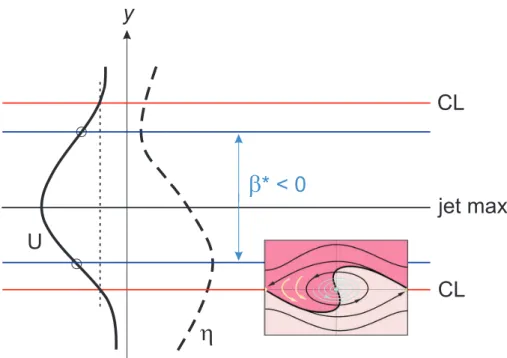
To fix ideas, consider a zonally uniform easterly jet at tropical latitudes off the equator. For simplicity, assume a barotropic jet structure as depicted in Fig. 2. There is cyclonic shear equatorward of the easterly jet maximum, and anticyclonic shear poleward of the jet maximum. Equatorward of the jet core the cyclonic shear vorticity is enhanced by the planetary vorticity, while poleward of the jet core, the anticyclonic shear vortic-15
ity and the planetary vorticity tend to compensate. The absolute vorticity poleward of the jet core is therefore weakly negative or close to zero. Since the meridional gra-dient of the absolute vorticity changes sign both poleward and equatorward of the jet core, the mean flow satisfies one of the necessary (Rayleigh) conditions for barotropic instability. It has been long recognized in the literature that the African easterly jet 20
is unstable to disturbances which might be described as a moist barotropic instabil-ity or mixed barotropic/baroclinic instabilinstabil-ity8. More recently it has been suggested that
8
The critical level plays a central role in such instabilities, enabling phase-locking of counter-propagating Rossby waves in adjacent regions of opposite meridional PV gradient (Hoskins et al., 1985; Heifetz et al., 1999) or, in linear ray theory, as the locus of wave overreflection (Lindzen and Tung, 1978; Lindzen et al., 1983). Either of these mechanisms leads to wave growth if certain conditions are met. One of these conditions is the existence of a critical level within the zone of reversed PV gradient.
ACPD
8, 11149–11292, 2008 Tropical cyclogenesis in tropical waves T. J. Dunkerton et al. Title Page Abstract Introduction Conclusions References Tables Figures ◭ ◮ ◭ ◮ Back CloseFull Screen / Esc
Printer-friendly Version Interactive Discussion
synoptic-scale instability by itself may be too slow to explain easterly wave disturbances in the African sector (Hall et al., 2006). In either event, if we assume that the locus of wave instability or excitation lies upstream, i.e., that the region of interest is stable with respect to exponential growth, it may be inferred that the phase speed of waves gen-erated upstream lies outside the range of mean flow speeds in the region of reversed 5
PV gradient, as depicted in Fig. 2. The alternative – a critical level within the zone of reversed gradient – would likely cause unstable growth. For an easterly jet north of the equator, the critical level (hereafter, critical “latitude”) therefore resides a bit south of the southernmost latitude where the effective beta is zero.
A second critical latitude also exists north of the jet axis, north of the northernmost 10
latitude where the effective beta is zero again, on the opposite side of the jet. As al-ready noted, however, the shear vorticity of the mean flow is cyclonic south of the jet and anticyclonic to the north. If a critical layer of finite width were to form at the location of either critical latitude as a result of wave propagation into the region of interest, the sense of rotation in the cat’s eye would be the same as that of the mean relative vor-15
ticity. For TC genesis we are obviously interested in cyclonic rather than anticyclonic vorticity in the lower troposphere and therefore regard the southern, not northern, crit-ical layer as a possible locus of TC formation. Moreover, we should not imagine that actual wave disturbances and the critical layers they generate are exactly symmetric or antisymmetric about the jet axis9. For the case of an idealized unstable easterly 20
jet, Thorncroft and Hoskins (1994a) showed that the most unstable wave disturbance south of the jet is centered equatorward of the southernmost latitude where the effec-tive beta changes sign. Their maximum amplitude is near the critical latitude, in accord with our propagating-wave scenario (as might be expected from consideration of linear parcel displacements, which maximize at the critical latitude or level). This asymme-25
try of wave amplitude about the axis of the jet, favoring the southern or equatorward 9
The north-south symmetry of the basic state about the jet axis is broken by mean absolute vorticity, which is asymmetric, and a meridional gradient of moisture, if one exists. Further asymmetry may arise from wave sources upstream.
ACPD
8, 11149–11292, 2008 Tropical cyclogenesis in tropical waves T. J. Dunkerton et al. Title Page Abstract Introduction Conclusions References Tables Figures ◭ ◮ ◭ ◮ Back CloseFull Screen / Esc
Printer-friendly Version Interactive Discussion
side, also emphasizes the cyclonic critical layer at the expense of the anticyclonic one. For the case of an exponentially stable jet flow, discrete neutral or slowly decaying “quasi-mode” wave packets (Reasor and Montgomery, 2001; Schecter et al., 2002) – stimulated, perhaps, by mesoscale processes within the trough region of the wave en-velope (Berry and Thorncroft, 2005; Hall et al., 2006) – should possess similar phase 5
speed and wave maxima characteristics as their unstable counterparts. Our immediate concern is not with wave sources, which lie outside the scope of this paper, but with downstream propagation of neutral waves on an easterly jet as depicted in Fig. 2. We simply consider the consequences of wave propagation for TC genesis.
2.2 Three new hypotheses regarding the wave-vortex hybrid 10
One of these consequences was noted above: cyclonic roll-up of mean vorticity in the southern critical layer favors TC genesis in the sense that this “synoptic” concentra-tion10 of cyclonic vorticity provides a seedling for amplification by mesoscale convec-tive processes (M06) which, as we now argue, might occur preferentially in the critical layer. As shown in Fig. 1, the longitudinal center of the cat’s eye corresponds to the 15
trough of the wave, a region favorable for deep moist convection in observations. Con-centration of cyclonic vorticity by (i) critical layer development on the synoptic scale, and (ii) convective enhancement and up-scale aggregation of cyclonic vorticity on the mesoscale, is a plausible outcome of the neutral wave propagation depicted in Fig. 2. Important to this sequence of events is that the easterly jet is located in the lower, not 20
middle, troposphere and that lower tropospheric vorticity is immediately amplified. In real life the waves and their effects are more complicated than in our ideal scenario; actual waves are local, episodic, and vary from one trough to the next. This variability, in fact, is so important to genesis that NHC/TPC forecasters (for better or worse) in
10
Following convention, 2.5–9 day moist tropical waves relevant to TC genesis occur on
synoptic spatial scales (2000–8000 km or so) while cat’s eyes and closed recirculation regions
develop at meso-α (200–2000 km). Proto-vortex development occurs at meso-β (20–200 km),
ACPD
8, 11149–11292, 2008 Tropical cyclogenesis in tropical waves T. J. Dunkerton et al. Title Page Abstract Introduction Conclusions References Tables Figures ◭ ◮ ◭ ◮ Back CloseFull Screen / Esc
Printer-friendly Version Interactive Discussion
their online discussion regard each individual trough as a “tropical wave”. We do not expect a uniform train of cyclonic cat’s eyes but rather a zonally nonuniform pattern of cyclonic eddies – eddies which, in some sense, are “shed” from the AEJ as a result of the wave propagation and interaction with the mean flow at the critical latitude. Our first hypothesis concerning the role of the tropical wave critical layer in TC genesis is 5
therefore
H1. Proto-vortex cyclonic eddies instrumental in TC formation are intimately associ-ated with the parent wave’s critical latitude in the lower troposphere. The critical layer, formed as a result of the wave’s finite-amplitude interaction with its own critical latitude, is a region of cyclonic rotation and weak straining/shearing deformation in which syn-10
optic and mesoscale anomalies move together and amplify on a nearly zero relative mean flow. This multi-scale interaction provides a dynamical pathway to “bottom-up” development of the proto-vortex from below.
The notion of bottom-up development (Halverson et al., 2007) is advanced as a counterpart to the more familiar “top-down” scenario advocated by Bister and Emanuel 15
(1997) and Ritchie and Holland (1997), respectively; see also Ritchie et al. (2003). (This perspective was in vogue when M06 was written. The two scenarios are not mutually exclusive, as emphasized by Halverson et al., 2007) The top-down pathway begins with a recognition of the “top-heavy” nature of moist convective heating profiles in the presence of combined convective and stratiform precipitation processes. A top-20
heavy heating profile in a rotating environment necessarily leads to the conclusion that cyclonic vorticity is first concentrated in the middle troposphere by the induced vertical profile of convergence and must therefore find a way subsequently to burrow downward into the lower troposphere in order to provide the surface development needed for warm-core TC genesis. This pathway is inefficient (Tory and Montgomery, 2006) and 25
invites a more direct route to genesis if one could be found, particularly in sectors where development is marginal to begin with. Observational findings of the top-down school were biased to the western Pacific warm pool, but in light of forecaster’s experience we are inclined to regard this pathway as largely irrelevant to the Atlantic and eastern
ACPD
8, 11149–11292, 2008 Tropical cyclogenesis in tropical waves T. J. Dunkerton et al. Title Page Abstract Introduction Conclusions References Tables Figures ◭ ◮ ◭ ◮ Back CloseFull Screen / Esc
Printer-friendly Version Interactive Discussion
Pacific sectors outside the ITCZ11. The genesis of depressions in this region of the world is almost always associated with a surface low along the wave (see Reasor et al., 2005, for a case study); examples of mid-level cyclonic vortices in developing tropical systems, without a corresponding cyclonic signature near the surface, are evidently rare. Bottom-up development is inextricably linked to column moistening, which favors 5
convective over stratiform heating as the leading contribution to the vertical heating profile. Column moistening, in turn, is naturally favored in a cyclonic critical layer. Our next hypothesis expands on this theme:
H2. The critical layer of the parent wave provides a set of quasi-closed material contours inside of which air is repeatedly moistened by convection, protected to some 10
degree from lateral intrusion of dry air and impinging vertical shear, and (thanks to its location near the critical latitude) able to keep pace with the parent wave until the proto-vortex has strengthened into a self-maintaining entity.
This hypothesis is obviously a “coin with two sides,” combining the notion of repeated column moistening with the equally important notion that the critical layer is protected 15
from lateral entrainment of air – air which, in the case of the AEJ, is often dry and dusty if associated with the Saharan Air Layer in the lower free troposphere (Thorncroft et al., 2003; Dunion and Velden, 2004; Wong and Dessler, 2005). Hypothesis 2 also adds the notion of rapid vertical transport by convection to what otherwise has been, in our discussion thus far, a description of moist barotropic or shallow-water disturbances su-20
perposed on an easterly off-equatorial jet. These quasi-2-D disturbances organize the flow laterally via parcel displacement and create kinematic boundaries to lateral mix-ing; they also organize moist convection that lofts moisture into the free troposphere. Such convection, of course, is ubiquitous in the tropics and represents the primary mechanism of vertical transport that is rapid in comparison to other vertical motions 25
such as isentropic up-glide along frontal zones and diabatic subsidence in the Hadley 11
Although the single developing system (Guillermo) observed during TEXMEX in the eastern Pacific was originally thought to contain a low-level anticyclone in its earliest stage, subsequent analysis revealed a cyclonic circulation all the way to the surface (Raymond et al., 1998).
ACPD
8, 11149–11292, 2008 Tropical cyclogenesis in tropical waves T. J. Dunkerton et al. Title Page Abstract Introduction Conclusions References Tables Figures ◭ ◮ ◭ ◮ Back CloseFull Screen / Esc
Printer-friendly Version Interactive Discussion
circulation caused by radiative cooling. In cases where the ambient cyclonic vortic-ity and moisture are positively correlated above the boundary layer, gyre formation is accompanied by horizontal entrainment of moisture, shortening the time required to approach column saturation. The “quasi” closure of streamlines or trajectories in H2 conveys two important caveats that will apply in all of the discussion to follow: (i) there 5
is always a temporal development of the closure, as local wave amplitude grows and parcels become irreversibly entrained in the gyre, and (ii) there is often a nonzero di-vergent component of motion across the outer edge of a “closed” gyre as defined by the bounding contour of (nondivergent) stream function. We have greater confidence in the rotational component of motion than the divergent part, quantitatively speaking, 10
and therefore attach greater significance to the appearance of a closed gyre in stream
function. This is not to say that the analyzed divergent wind is unreliable; its sign
usu-ally agrees with the expected inflow (outflow) of mass in the lower (upper) troposphere in the neighborhood of a developing storm. At lower levels the divergent component of motion therefore contributes to the entrainment of vorticity and moisture as does the 15
temporal development of the rotational component.
We do not limit deep convection to the critical layer (!) but advance the notion that convection within the critical layer is likely to create a vertical profile of diabatic heating with a lower- to mid-tropospheric maximum (Tory et al., 2006a, b, 2007) instead of the more widely observed “top-heavy” heating profile of canonical mesoscale convective 20
systems (Houze, 1989; Mapes and Houze, 1995). The canonical profile represents a combination of convective and stratiform effects in which evaporative cooling in ad-jacent stratiform anvil regions offsets the low-level heating in deep convective cores. These two components superpose constructively in the mid- to upper troposphere. A top-heavy profile is important to the tropical general circulation (Hartmann et al., 1984), 25
the mature phase of MJO (Lin et al., 2004) and generation of stratospheric gravity waves (D. Ortland, personal communication) but inimical to tropical cyclogenesis. The argument favoring a convective heating profile in TC genesis rests on an inference by Tory et al. (2007) that simulated storms initialized in actual environments (real-life
ACPD
8, 11149–11292, 2008 Tropical cyclogenesis in tropical waves T. J. Dunkerton et al. Title Page Abstract Introduction Conclusions References Tables Figures ◭ ◮ ◭ ◮ Back CloseFull Screen / Esc
Printer-friendly Version Interactive Discussion
examples) are accompanied by such a profile when development ensues, and vice versa. This profile also can be inferred indirectly from the observed divergent circula-tion response (Sect. 5.3) or “directly” from TRMM retrievals in the re-circulating gyre (Dunkerton et al., 2008a12). The heating profile is tightly coupled to column moisten-ing, and vice versa. As a region of re-circulating quasi-horizontal flow, the critical layer 5
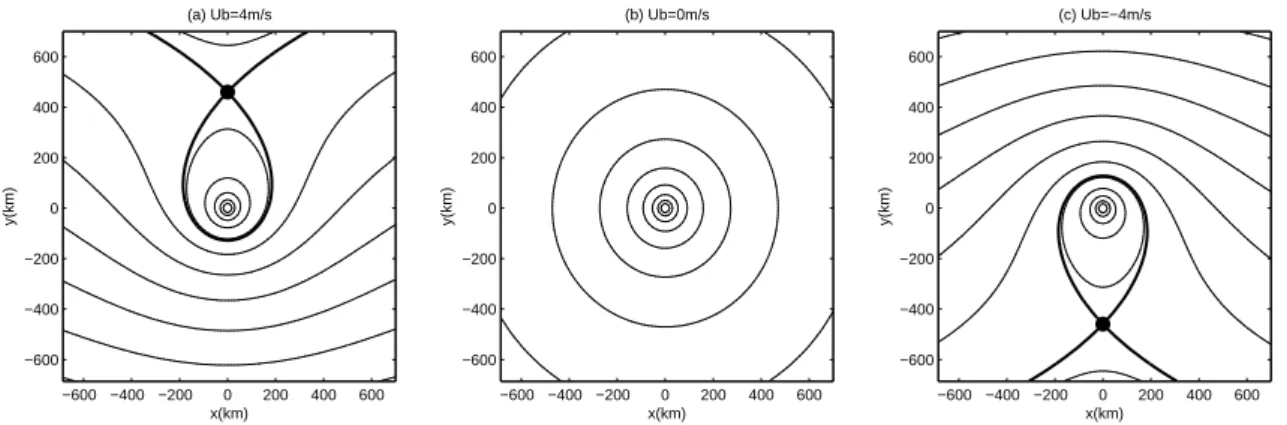
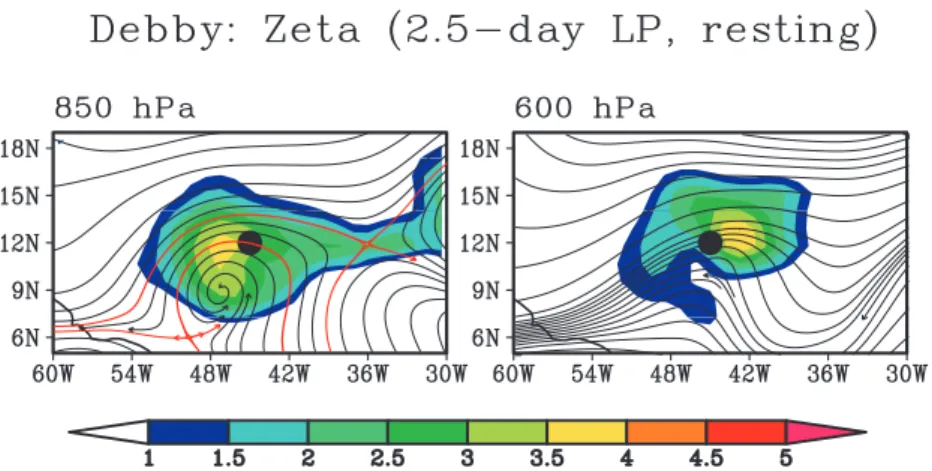
is bounded by closed material contours – a Lagrangian concept that provides a more general definition of the TC “pouch” in cases where a critical layer is not well defined or consists of a solitary shed vortex (as illustrated in Fig. 3; for further commentary on this figure see Sect. 3). The critical layer is expected to trap, that is, to contain moisture or moist entropy lofted by convection. The net heating and its vertical profile depends, 10
in turn, on the amount of moisture lofted. Lower tropospheric air close to saturation is less likely to experience evaporative cooling, and the critical layer (for purely kinematic reasons) favors maintenance of nearly saturated conditions, especially if there exists a concentrated and sustained population of shallower “congestus” type convection in such a region, as suggested by some recent observations. For low-level mass conver-15
gence and vorticity amplification, a convective type of heating profile in the LT critical layer, without significant stratiform heating/cooling – or with less stratiform component than typical elsewhere – favors bottom-up development (M06) and concentration of up-ward mass flux in the lower troposphere (Raymond and Sessions, 2007). This is not to say that mid-level spin-up might not also occur in such cases, but to suggest that a 20
low-level scenario is plausible in which the mid-level spin-up is unnecessary or of sec-ondary importance to TC genesis13. This theoretical notion and its implications agree with forecaster’s experience and their common observation of a “surface low along the
12
Dunkerton, T. J., Lussier III, L. L., Montgomery, M. T., Wang, Z., and Tory, K. J.: Spatial and statistical distribution of convective and stratiform clouds in the gyre-pouch of incipient tropical cyclones, J. Geophys Res., in preparation, 2008a.
13
ERA-40 data examined here suggest, for what it is worth, that mid-level convergence re-solved by the analyses occurs in developing systems but is secondary to low-level convergence chronologically as the proto-vortex develops upward.
ACPD
8, 11149–11292, 2008 Tropical cyclogenesis in tropical waves T. J. Dunkerton et al. Title Page Abstract Introduction Conclusions References Tables Figures ◭ ◮ ◭ ◮ Back CloseFull Screen / Esc
Printer-friendly Version Interactive Discussion
wave” in the development of a tropical depression.
Routine inspection of satellite water vapor imagery suggests that genesis is always associated with a relatively moist free troposphere as observed in the 6.7 micron band. There are many dynamical mechanisms governing the distribution of moisture; forma-tion of a closed gyre in a tropical wave critical layer is but one of these. Quasi-staforma-tionary 5
tropical features and extratropical disturbances also play a role. As already noted, the developing gyre entrains whatever moisture exists in the adjacent environment. De-pending on whether or not this environment is dry or wet, the gyre itself may or may not be primarily responsible for self-moistening via deep moist convection within. Once moistened, it is desirable that the gyre (or some portion of it) remain so in order to 10
facilitate TC formation. A key property of the proto-vortex required for subsequent de-velopment is its resilience to lateral intrusions of dry air which are common throughout the Atlantic during the hurricane season and at other times and places. The proto-vortex of a nascent TC, however, lacks a strong transport barrier (cf. McIntyre, 1989, 1993; Montgomery and Kallenbach, 1997; Bassom and Gilbert, 1999; Moulin and Flor, 15
2005), is vulnerable to dry-air intrusion and vertical shear (e.g., Reasor et al., 2004) and therefore needs help from the parent wave. The critical latitude within the low pressure region of the wave ensures weak relative flow between the wave-spawned proto-vortices and the local mean flow. This implies a reduction of dry air intrusions from outside (Tuleya and Kurihara, 1981) and a tendency for the heat released by cu-20
mulus convection to be retained in a relative frame of reference moving with the wave (Krishnamurti et al., 1994). The latter observation by Krishnamurti et al. (1994) is in-corporated in a third hypothesis (below).
According to the marsupial paradigm, the critical layer guarantees some measure of protection from intrusion. But actual flow fields are transient and contain mesoscale 25
finestructure, making the Lagrangian kinematics rather messy. A group of smaller vor-tices, e.g., will entrain the surrounding air more readily than a single larger vortex14.
14
Relevant to this discussion are two studies outside the atmospheric literature. The effects of entrainment on the buoyancy of rotating B ´enard convection were discussed by Julien et
ACPD
8, 11149–11292, 2008 Tropical cyclogenesis in tropical waves T. J. Dunkerton et al. Title Page Abstract Introduction Conclusions References Tables Figures ◭ ◮ ◭ ◮ Back CloseFull Screen / Esc
Printer-friendly Version Interactive Discussion
As for how these smaller vortices are created in the first place, there are essentially two possibilities: (i) upscale aggregation of mesoscale convective vortices associated with MCSs and/or VHTs, and (ii) eddy shedding that works its way to smaller scales via a forward enstrophy cascade, such as might be associated with wave breaking at the critical layer. Tropical cyclogenesis evidently represents a kind of process in which the 5
inverse energy and forward enstrophy cascades (originating respectively from cloud system and synoptic scales) collide at some intermediate scale to form a diabatic vor-tex larger in horizontal scale than the vortices associated with individual cloud systems but substantially smaller in scale than the mother pouch created by the synoptic wave. This GFD aspect is perhaps the most fascinating and daunting of TC genesis; one that 10
has not yet been fully explored (owing to limitations of horizontal resolution in observa-tions or models) but may be advanced as a framework for understanding the multi-scale nature of the problem. Of relevance to H2 are the following considerations: (i) A group of cloud-system vortices at meso-γ may delay saturation of the column by a single
mas-ter VHT, by mixing drier area within the pouch with moismas-ter air lofted by the VHT. (ii) A 15
group of mesoscale vortices (resulting either from dry or moist processes at meso-β)
may entrain drier air from outside the pouch via chaotic advection, partially offsetting the cumulative moistening of this area by persistent deep convection. Requirements for horizontal resolution differ depending on which of these mechanisms is more relevant; they are less stringent for chaotic advection than for upscale aggregation.
20
A third hypothesis is motivated by the fact that a critical layer is where local sources or sinks of momentum and entropy are amplified owing to the fact that parcels spend a considerably longer time in such regions compared to those outside the critical layer. In linear theory the net effect of fixed sources and sinks is inversely proportional to intrinsic frequency. This response, as noted by Held and Ting (1990), contrasts sharply with 25
topographic wave excitation in which the response is proportional to the mean flow speed relative to the obstacle. It exists for purely kinematic reasons and is entirely al. (1999). Organization of deep ocean convection by mesoscale eddies was examined by Legg et al. (1998).
ACPD
8, 11149–11292, 2008 Tropical cyclogenesis in tropical waves T. J. Dunkerton et al. Title Page Abstract Introduction Conclusions References Tables Figures ◭ ◮ ◭ ◮ Back CloseFull Screen / Esc
Printer-friendly Version Interactive Discussion
independent of any presumed relationship between the wave and induced sources or sinks. In fact, since the wave trough is a preferred region for diabatic heating in tropical waves, and its longitude is at the center of the cat’s eye (Fig. 1) the effect of diabatic heating due to deep moist convection is doubly amplified in the critical layer. (i) The heating is stronger here (owing primarily to mesoscale processes that favor convection 5
in the trough) and (ii) its rectified effect on the wave is also stronger owing to the kinematics of parcel motion in the critical layer. Hence we propose that
H3. The parent wave is maintained and possibly enhanced by diabatically amplified eddies within the wave (proto-vortices on the mesoscale), a process favored in regions of small intrinsic phase speed.
10
This hypothesis, incidentally, agrees with the common observation that a tropical wave is considerably weakened or eliminated when the diabatic vortex leaves the pouch, having acquired its own identify and propagation characteristics independent of the parent wave. A typical scenario15 is that a westward propagating wave carries its proto-vortex for a time, and if a depression ensues, the strengthened and enlarged 15
vortex acquires a poleward component of propagation while its zonal component be-gins to slow relative to the phase speed of the parent wave. The parent wave continues its westward motion at more or less the same speed it originally had, but with severely diminished amplitude. In the Atlantic sector the wave speed is typically 4–6◦ per day westward, while the vortex speed is ∼2◦per day west-northwestward. Individual cases 20
may resemble this scenario or differ considerably; nevertheless, the basic description is robust.
The observed combination of westward moving tropical wave and incipient vortex evokes a “marsupial” paradigm for TC genesis, as charmingly illustrated in the popu-lar online encyclopedia16. In contemporary jargon the marsupial paradigm combines 25
elements of a diabatic Rossby wave (Wernli and Kenzelmann, 2006) with those of a 15Sometimes two or more visible proto-vortices are involved, a scenario may be more com-mon in the western Pacific com-monsoon trough environment (Edson and Lander 2006).
16
ACPD
8, 11149–11292, 2008 Tropical cyclogenesis in tropical waves T. J. Dunkerton et al. Title Page Abstract Introduction Conclusions References Tables Figures ◭ ◮ ◭ ◮ Back CloseFull Screen / Esc
Printer-friendly Version Interactive Discussion diabatic Rossby vortex (Moore and Montgomery, 2004, 2005, 2006). We suggest that
the diabatically activated easterly wave is a hybrid wave/vortex structure, particularly in cases leading to formation of a tropical depression17.
2.3 The role of vertical shear
A final element of the marsupial paradigm is the role of mean vertical shear in TC gen-5
esis. It is widely appreciated, especially by forecasters, that strong vertical shear is in-imical to genesis. This fact is thought to account for the reduction of Atlantic hurricanes in warm ENSO events, as the eastern Pacific “warm pool” forces upper-level wester-lies over the Caribbean (Gray, 1984a, b; Goldenberg and Shapiro, 1996). Although reasons suggest themselves, none are entirely convincing. Vertical shear in the UT is 10
sometimes imagined to “ventilate” deep convection, but since the water content is very small at these altitudes, thermodynamic consequences arising from the phase change of water in the UT are likely to be very small as well. Similarly, the clear-sky radiative impacts of water vapor redistribution in the UT are probably too slow to affect genesis on time scales of 1–2 days, although their effects on longer time scales (e.g., MJO) 15
may be significant. An indirect effect of vertical shear, if westerly, is an implied wave duct for quasi-stationary waves of midlatitude origin in the tropical upper troposphere. This dynamical opening between tropics and extratropics (Webster and Holton, 1982) is responsible for the appearance of synoptic-scale troughs sometimes observed to
17
It is noteworthy that most tropical depressions become named storms, although the rea-sons are unclear. The cumulative experience of forecasters is evidently important in assigning depression status and in knowing at what formative level further development is virtually as-sured. This property of tropical depressions suggests a finite-amplitude instability for cyclogen-esis above a certain threshold amplitude (e.g., Emanuel, 1989). As to what the relevant criteria are, they likely include some measure of tangential circulation strength and persistence of deep convection near the center. Such criteria, in any case, must be invariant under a Galilean trans-formation, that is, Lagrangian properties of the flow. A coordinate-dependent Eulerian measure (e.g., westerlies south of center, in the resting frame) is inadequate.
ACPD
8, 11149–11292, 2008 Tropical cyclogenesis in tropical waves T. J. Dunkerton et al. Title Page Abstract Introduction Conclusions References Tables Figures ◭ ◮ ◭ ◮ Back CloseFull Screen / Esc
Printer-friendly Version Interactive Discussion
penetrate the tropics in the hurricane season. If this condition persists over a substan-tial part of the season it may ostensibly suppress genesis in some years (e.g., as in Atlantic 2006). The extratropical disturbances themselves may enhance genesis (TT pathway: Davis and Bosart, 2001; Hendricks et al., 2004; Hidalgo, 2007) or suppress it (via dry air intrusion or cyclonic flow aloft) so their net effect is not obvious and may be 5
sensitive to the juxtaposition between upper- and lower-level disturbances (Davis and Bosart, 2004; Bosart, 2006).
It is well-known that vertical shear can be detrimental to hurricane intensification; the strongest and most circularly symmetric storms have little environmental shear or shear tendency. It is precarious, however, to take whatever mechanisms are responsi-10
ble for the effects of shear on hurricane-strength vortices and assign them to the pre-depression stage. Whereas in a mature system, vertical shear interacts with a single large vortex, in genesis, the shear is interacting with one or more deep convecting ele-ments, rotating or not (Frank and Johnson, 1969; Gentry et al., 1970; Hendricks et al., 2004; M06; Hendricks and Montgomery, 2006). At this stage, the effects of shear are 15
more likely to be felt in convective organization rather than via the dynamics of a single large vortex. We speculate that strong shear in the genesis stage (i) may lead to linear rather than circular organization, and that (ii) longitudinally radiating gravity waves or density currents coupled to convection are more likely to be excited when the LT shear is strong (LeMone et al., 1998). Mechanisms of convective organization in vertical 20
shear were studied by Corbosiero and Molinari (2002) and Molinari et al. (2004, 2006); interest in this aspect of the problem extends back to Ritchie and Holland (1997) and others. In any event, it is safe to say that vertical shear has important consequences for genesis and that none of its mechanisms in this stage are well understood. Fore-casters’ experience notwithstanding, we cannot be certain that genesis is optimized in 25
exactly zero vertical shear. If it were, the fact that easterly-wave amplitudes maximize near the altitude of AEJ maximum (∼600 hPa) would be convenient to the marsupial paradigm because wave + mean vertical shear is zero at this altitude, by definition. We suspect that the role of vertical shear in the marsupial paradigm, if any, is more subtle.
ACPD
8, 11149–11292, 2008 Tropical cyclogenesis in tropical waves T. J. Dunkerton et al. Title Page Abstract Introduction Conclusions References Tables Figures ◭ ◮ ◭ ◮ Back CloseFull Screen / Esc
Printer-friendly Version Interactive Discussion
3 Data and methodology
3.1 Datasets and filters
The time period of interest encompasses the peak hurricane seasons (August and September) of 1998–2001, the years when the two primary datasets used in our study overlap: (i) ERA-40 6-hourly re-analyses were used to derive tropical wave distur-5
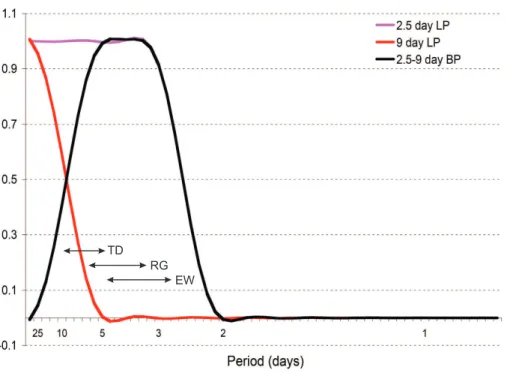
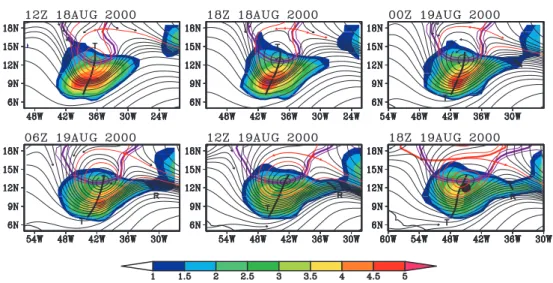
bances. The data are available from NCAR at multiple pressure levels in T106 spectral resolution (∼1.125×1.125◦). Properties of ERA-40 and other analyses (e.g., circula-tions and physical fluxes) were recently evaluated and compared by Grotjahn (2007). A 2.5–9 day band-pass filter (Doblas-Reyes and Deque, 1998) was applied to the origi-nal data to extract wave propagation sigorigi-nals, while a 2.5-day low-pass filtered wind field 10
was used to define the total flow (i.e., wave + mean fields). The response functions of the filters are shown in Fig. 4. It is important to note that the band-pass data supply information on wave packet structure and propagation, while the total flow (except for its high-frequency component) defines critical layers, stream function or streamlines, Lagrangian boundaries, and so forth. Low-frequency data (periods longer than 9 days) 15
were used casually to estimate the mean flow and its critical latitudes as seen by the waves, not by individual parcels, which respond instead to the total flow sans high fre-quency component. (Parcel displacements are relatively insensitive to high frefre-quency oscillations because they are inversely proportional to intrinsic frequency in linear the-ory.) (ii) Rainfall data from TRMM 3B4218, available every 3 h and having a spatial res-20
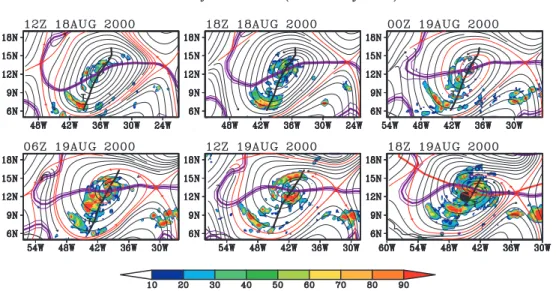
olution of 0.25×0.25◦, were used in the study as a proxy for indicating deep moist con-vection. The level 3 gridded data are convenient for this purpose but occasionally suffer gaps in coverage owing to the satellite orbit. ERA-40 re-analyses and TRMM rainfall are independent data. The time period of ERA-40 used in this study (1998–2001) de-rives from Stream 1 (1987–2002) which incorporates satellite data from ATOVS, SSM/I 25
and ERS, in addition to satellite data from VTPR, TOVS and cloud motion winds used 18
ACPD
8, 11149–11292, 2008 Tropical cyclogenesis in tropical waves T. J. Dunkerton et al. Title Page Abstract Introduction Conclusions References Tables Figures ◭ ◮ ◭ ◮ Back CloseFull Screen / Esc
Printer-friendly Version Interactive Discussion
in Stream 3 (1972–1988). ERA-15 analyses for tropical waves were validated against rawinsonde data by Dunkerton and Baldwin (1995). We consider the ECMWF product to be optimum for synoptic-scale waves, particularly for the rotational component of horizontal winds in the lower and upper troposphere and (presumably) for the associ-ated horizontal transports of moisture in the lower troposphere as analyzed in Stream 5
1. The divergent component is problematic in global analyses, whether from ECMWF or elsewhere, particularly when associated with deep convection. Vertical motions are not observed directly, but are obtained from a cumulus parameterization. Regions of deep convection, moreover, tend to concentrate vertical motions at the grid scale, mak-ing the resultmak-ing maximum upward velocities resolution-dependent (in such a way as 10
to conserve approximately the vertical flux of mass, which is driven by the cumulus scheme). Convective precipitation from TRMM is a derived product which we employ here, not for quantitative precipitation, but for geolocation of convecting features relative to the ECMWF product. It was shown by Julian (1984) that a deep cloud proxy (OLR) is quantitatively correlated with upper tropospheric divergence. Needless to say, the 15
TRMM geolocation (∼25 km) is accurate enough for the purpose at hand. We there-fore regard the juxtaposition of ERA-40 and TRMM data to be a useful way of relating actual convection (an indicator of TD development) to actual waves, in the discussion to follow. Forecaster’s best-track data provide a third independent source for genesis location and storm track although as we will argue, their identification of genesis time 20
is sometimes delayed, perhaps owing to a conservative mindset19. Storm geolocation based on geostationary imagery is accurate to within the nominal 4 km pixel resolution at the sub-satellite point, superior to any of the other products used in our analysis. August and September were chosen because they represent the peak of the Atlantic hurricane season (Kimball and Mulekar, 2004).
25
19
The best-track (retrospective) estimate of genesis time can be earlier than the initial (real-time) estimate by as much as 2 days. Our point is that, in some cases, even the best-track estimate is late, relative to the analyzed Lagrangian criteria.