HAL Id: hal-00301341
https://hal.archives-ouvertes.fr/hal-00301341
Submitted on 9 May 2005HAL is a multi-disciplinary open access
archive for the deposit and dissemination of sci-entific research documents, whether they are pub-lished or not. The documents may come from teaching and research institutions in France or abroad, or from public or private research centers.
L’archive ouverte pluridisciplinaire HAL, est destinée au dépôt et à la diffusion de documents scientifiques de niveau recherche, publiés ou non, émanant des établissements d’enseignement et de recherche français ou étrangers, des laboratoires publics ou privés.
The Indian summer monsoon rainfall: interplay of
coupled dynamics, radiation and cloud microphysics
P. K. Patra, S. K. Behera, J. R. Herman, S. Maksyutov, H. Akimoto, T.
Yamagata
To cite this version:
P. K. Patra, S. K. Behera, J. R. Herman, S. Maksyutov, H. Akimoto, et al.. The Indian summer monsoon rainfall: interplay of coupled dynamics, radiation and cloud microphysics. Atmospheric Chemistry and Physics Discussions, European Geosciences Union, 2005, 5 (3), pp.2879-2895. �hal-00301341�
ACPD
5, 2879–2895, 2005 Supression of monsoon rainfall by aerosols P. K. Patra et al. Title Page Abstract Introduction Conclusions References Tables Figures J I J I Back Close Full Screen / EscPrint Version Interactive Discussion
EGU
Atmos. Chem. Phys. Discuss., 5, 2879–2895, 2005 www.atmos-chem-phys.org/acpd/5/2879/
SRef-ID: 1680-7375/acpd/2005-5-2879 European Geosciences Union
Atmospheric Chemistry and Physics Discussions
The Indian summer monsoon rainfall:
interplay of coupled dynamics, radiation
and cloud microphysics
P. K. Patra1, S. K. Behera1, J. R. Herman2, S. Maksyutov1, H. Akimoto1, and T. Yamagata3,1
1
Frontier Research Center for Global Change/JAMSTEC, Yokohama 2360001, Japan
2
NASA Goddard Space Flight Center, Greenbelt, Maryland 20771, USA
3
Dept. Earth and Planetary Science, University of Tokyo, Tokyo 113-0033, Japan Received: 28 January 2005 – Accepted: 1 April 2005 – Published: 9 May 2005 Correspondence to: P. K. Patra ([email protected])
ACPD
5, 2879–2895, 2005 Supression of monsoon rainfall by aerosols P. K. Patra et al. Title Page Abstract Introduction Conclusions References Tables Figures J I J I Back Close Full Screen / EscPrint Version Interactive Discussion
EGU
Abstract
The Indian summer monsoon rainfall (ISMR), which has a strong connection to agricul-tural food production, has been less predictable by conventional models in recent times. Two distinct years 2002 and 2003 with lower and higher July rainfall, respectively, are selected to help understand the natural and anthropogenic influences on ISMR. We 5
show that heating gradients along the meridional monsoon circulation are reduced due to aerosol radiative forcing and the Indian Ocean Dipole in 2002. An increase in the dust and biomass-burning component of the aerosols through the zonal monsoon cir-culation resulted in reduction of cloud droplet growth in July 2002. These conditions were opposite to those in July 2003 which led to an above average ISMR. In this study, 10
we have utilized NCEP/NCAR reanalyses for meteorological data (e.g. sea-surface temperature, horizontal winds, and precipitable water), NOAA interpolated outgoing long-wave radiation, IITM constructed all-India rainfall amounts, aerosol parameters as observed from the TOMS and MODIS satellites, and ATSR fire count maps. Based on this analysis, we suggest that monsoon rainfall prediction models should include 15
synoptic as well as interannual variability in both atmospheric dynamics and chemical composition.
1. Introduction
The Indian summer monsoon is a giant feedback system involving interactions between land, ocean, and atmosphere. Efforts to understand its behaviour are scientifically 20
challenging and date back to over a century (Walker, 1910; Bjerknes, 1969; Lighthill and Pierce, 1981; Hastenrath, 1988; Pant and Rupakumar, 1997; Webster et al., 1998). The Indian summer monsoon rainfall (ISMR), defined here as the cumulative rainfall over continental India during June-July-August (JJA), also has important implications for the socio-economic system of the subcontinent. For example, the domestic crop 25
ACPD
5, 2879–2895, 2005 Supression of monsoon rainfall by aerosols P. K. Patra et al. Title Page Abstract Introduction Conclusions References Tables Figures J I J I Back Close Full Screen / EscPrint Version Interactive Discussion
EGU
agricultural sector accounts for about a quarter of India’s gross domestic product and 60 percent of the labour force. The JJA rainfall in 2002 was only about 78% of the seasonal average (679.2 mm, for the period 1871–2002) (Parthasarathy et al., 1995). This resulted in almost a 40% drop in groundnut production according to AgJournal (http://www.agjournal.com) and a 13% reduction in rice production according to the 5
Food and Agriculture Organization of the United Nations (http://www.fao.org). This is one of the highest deficit monsoon rainfall years in the last hundred years, second only to 1972.
The dynamical link between below normal rainfall years and the positive phase of El Ni ˜no/Southern Oscillation (ENSO) (see Webster et al., 1998, for a review) and the 10
negative phases of Indian Ocean Dipole (IOD) has been addressed earlier (Ashok et al., 2001) as has the high stability condition over the Arabian Sea (Narayanan et al., 2004). These impact studies considered only the dynamical aspect of the Indian sum-mer monsoon system (ISMS), as does the statistical ISMR prediction model employed by the Indian Meteorological Department (IMD) (Gowariker et al., 1991; Rajeevan et 15
al., 2004). However, statistical models for rainfall prediction based on several dynami-cal predictors have not been successful in foreseeing the 2002 summer rainfall deficit (Rajeevan et al., 2004). The situation using numerical climate prediction models was also not encouraging for this particular monsoon prediction failure (discussed in Gadgil et al., 2002). Therefore, we believe the dynamical conditions related to Indian summer 20
monsoon do not account fully for total seasonal precipitation. Thus, the focus of this study is to analyze the radiative and microphysical aspects of the ISMS arising from interannual variability in aerosol content over the Indian subcontinent.
Aerosol particles (with residence times ranging from days to weeks) can absorb or reflect incoming solar radiation to exert a large radiative cooling (up to 30 W m−2) at 25
the earth’s surface (Satheesh and Ramanathan, 2000). Recently, it has also been suggested that different aerosol types of continental origin (e.g. dust, biomass burning) could affect the growth of cloud droplets and thereby the rainfall intensity (Rosenfeld et al., 2001; Andreae et al., 2004). All the above mentioned processes could coherently
ACPD
5, 2879–2895, 2005 Supression of monsoon rainfall by aerosols P. K. Patra et al. Title Page Abstract Introduction Conclusions References Tables Figures J I J I Back Close Full Screen / EscPrint Version Interactive Discussion
EGU
affect the ISMS by reducing evaporation from the water and land surfaces, weakening the pressure gradients between the African high and Tibetan low (zonal/transverse monsoon component) as well as the cross-equatorial/lateral circulation of the monsoon (ref. Webster et al., 1998), and inhibiting the growth of cloud droplets.
2. Materials and method
5
The aerosol index (for dust and smoke; positive values) acquired from the Total Ozone Mapping Spectrometer (TOMS) (Herman et al., 1997), are used in this study to de-pict the source and transport of aerosols. Several studies have shown that the TOMS AI is proportional to aerosol optical depth (AOD) measured using different techniques over various parts of the world (Torres et al., 2002; source: ftp://toms.gsfc.nasa.gov; 10
accessed: May 2004). The all-India rainfall is constructed by the Indian Institute of Tropical Meteorology (IITM), based on rain gauge measurements at 306 stations (http://www.tropmet.res.in, see Data link). For the spatial distribution and high fre-quency time series of rainfall over our study region we have used the Tropical Rain-fall Measuring Mission (TRMM) satellite observations (version: 3B42; source: ftp:
15
//lake.nascom.nasa.gov). The meteorological datasets (horizontal winds, surface tem-perature, precipitable water content) datasets from the NCEP/NCAR reanalysis and NOAA interpolated outgoing long-wave radiation (OLR) (Kalnay et al., 1996; source:
http://www.cdc.noaa.gov) are used to depict the mean state of the atmosphere and its deviations during the two distinct years of 2002 and 2003. The analysis of these years 20
is to a great extent restricted by the unavailability of simultaneous microphysical data. The AOD and several aerosol parameters are from MODIS onboard the Terra satellite (King et al., 2003). The monthly global fire maps (night time only) are obtained from the ATSR World Fire Atlas (Algorithm 1), European Space Agency - ESA/ESRIN (via Galileo Galilei, Italy;http://dup.esrin.esa.int/ionia/).
ACPD
5, 2879–2895, 2005 Supression of monsoon rainfall by aerosols P. K. Patra et al. Title Page Abstract Introduction Conclusions References Tables Figures J I J I Back Close Full Screen / EscPrint Version Interactive Discussion
EGU
3. Results and discussion
It is seen from the ISMR variability for the period 1871–2003 and the ENSO index that the deficit ISMR years were strongly linked to the El Ni ˜no (positive SSTA) years for the period 1871–1978 (Pearson’s correlation coefficient r=−0.43, sample size n=53). This coupling has weakened substantially (r=−0.15, n=15) in the past few decades (period: 5
1979–2002), with the most prominent deviation occuring in 2002, when a large negative ISMR anomaly was observed during a weak El Ni ˜no event.
Human activities have influenced the Earth’s climate system, an effect that has esca-lated over the past few decades (IPCC, 2001). Thus, the break down of the dynamical link between ISMR and ENSO could possibly be a manifestation of chemistry-climate 10
interaction in the ‘Anthropocene’ era. At the same time, human capability to probe our atmosphere has also increased significantly from the time of pioneering work by Gilbert Walker and Jacob Bjerknes. In Fig. 1, we show the variability in TOMS AI and rainfall over India. The interannual variations in JJA mean of AI and ISMR are strongly anti-correlated (r=−0.66, n=19) for the period 1978–2002. This anti-correlation has be-15
come increasingly prominent in recent years. Figure 1 also shows a gradual increase in AI over the Indian region, which is probably caused by increased industrialization in the developing world over the past 2–3 decades (Akimoto, 2003) and by increasing deforestation (Rosenfeld et al., 2001). An analysis of the long-term trends in individual monthly mean rainfall over India for the period 1870–2003 (from linear fits) produces 20
negative slopes (average=0.09 mm/year) for June, July and September. A significant positive slope of similar value is obtained for August only. The cause for such long-term trends is beyond the scope of this study (only interannual variability in rainfall is discussed here). The climate response to aerosol direct and indirect effects in a transport-radiation-cloud microphysics model also produces a reduction in precipita-25
tion over the Indian subcontinent during the period 1850 and 2000 (Takemura et al., 2005).
ACPD
5, 2879–2895, 2005 Supression of monsoon rainfall by aerosols P. K. Patra et al. Title Page Abstract Introduction Conclusions References Tables Figures J I J I Back Close Full Screen / EscPrint Version Interactive Discussion
EGU
3.1. Salient features of the July 2002 and 2003 monsoons
Now we focus our discussion on the years 2002 (56% less July rainfall than average) and 2003 (15% more July rainfall than average) to demonstrate the possible impacts of atmospheric dynamics, radiation and cloud microphysics on ISMR. Figure 2 illus-trates the differences in OLR and horizontal winds during June and July of 2002 and 5
2003. As expected from the ISMR anomaly, the positive OLR (clearer sky) anomalies are widespread in July 2002 over the western Indian Ocean and the Indian subcon-tinent, and relatively lower OLR values (cloudier sky) are found in the eastern Indian Ocean and southeast Asia. The opposite is true in 2003 with a much stronger am-plitude. This East-West oscillatory feature over the Indian Ocean is referred to as the 10
Indian Ocean dipole (IOD) (Saji et al., 1999). The distributions of sea-surface temper-ature (SST; Fig. S1, Supplement: http://www.copernicus.org/EGU/acp/acpd/5/2879/
acpd-5-2879-sp1.pdf) suggest that the centres of surface warming (0.5–1.5◦C above average) were located around 80–90◦E and south of 5◦S during June–July 2002, and that temperatures over the Arabian Sea region were about the climatological average 15
(∼28◦C). In June 2003, larger surface temperatures (anomalies of up to+1.5◦C) were observed over the northern Arabian Sea. We suggest that this cooling anomaly over the northern Arabian Sea is a result of aerosol radiative forcing (higher AI and lower SST in 2002 and vice versa; ref. Fig. S2). Thus the IOD and aerosol forcing jointly caused the changes in the cross-equatorial SST gradients that could have modified 20
the strength of the lateral monsoon circulation; i.e. weaker in 2002 and stronger in 2003. The Arabian Sea warming also supplied more water vapour to the ISMS in 2003 and greater rainfall was observed in July.
ACPD
5, 2879–2895, 2005 Supression of monsoon rainfall by aerosols P. K. Patra et al. Title Page Abstract Introduction Conclusions References Tables Figures J I J I Back Close Full Screen / EscPrint Version Interactive Discussion
EGU
3.2. Monsoon rainfall and related aerosol parameters 3.2.1. Monthly anomalies and aerosol sources
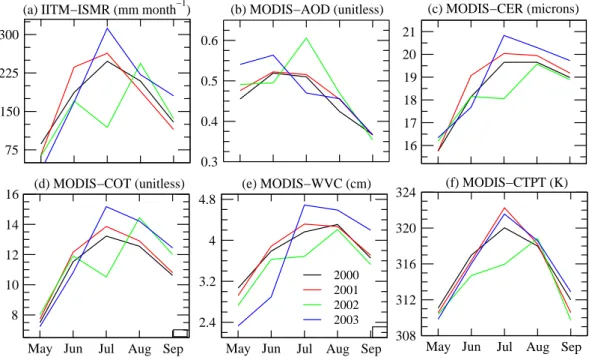
Figure 3 shows the interannual variation in ISMR during the May-September period along with several other physical-chemical parameters obtained from MODIS-Terra satellite instruments in the period 2000–2003. In general, 2000 and 2001 represent 5
fairly normal summer monsoon conditions (July rainfall deficit smaller than 10%), 2002 was a high deficit rainfall year, and 2003 was an excess rainfall year. The low (high) July rainfall corresponds well with more (less) AOD over India. However, the effects of aerosols on the radiation balance and cloud microphysics, to a large extent, de-pend on their chemical properties. The analyses of daily TOMS-AI (not shown here) 10
and chemistry-transport model (CTM) simulations of a CO-like tracer emitted from fires defined by monthly ATSR Global Fire Maps for the period 2000–2003 illustrate that the main source of aerosols over north-western India during the Indian summer is the Middle-East and north African region (Fig. S3). The amount of carbonaceous aerosols (biomass burning byproducts) transported to the Indian region from the Middle-East 15
was greater during July 2002 due to changes in the pattern of fires (count distribution) and more importantly to the regional meteorology associated with dynamical oscil-lations. Aerosols of north African origin consist mainly of desert dust (no fires are detected by ATSR). Note that the observed AOD/AIs over India are typically higher in JJA months relative to the drier seasons (e.g., May) indicating an external source of 20
aerosols. This issue is addressed later in more detail using daily observations of rainfall and aerosols.
3.2.2. On cloud droplet growth and precipitation
It is further noted that aerosol parameters in July, the month most important for agricul-ture in India, differed significantly in 2002 and 2003. In July 2002, the ISMR was only 25
compo-ACPD
5, 2879–2895, 2005 Supression of monsoon rainfall by aerosols P. K. Patra et al. Title Page Abstract Introduction Conclusions References Tables Figures J I J I Back Close Full Screen / EscPrint Version Interactive Discussion
EGU
nent of biomass burning products, CER was smallest, and COT and WVC were lowest over the Indian region. On the contrary, all the physical-chemical parameters in July 2003 were out of phase with those in 2002 (Fig. 3c–f). The aerosol parameters appear to be near their averages during 2000 and 2001. The reduction of cloud-droplet growth in July 2002 is suggested to be an effect of the aerosols on cloud microphysical prop-5
erties. Rosenfeld et al. (2001) and Andreae et al. (2004) have clearly demonstrated that aerosols of desert dust and biomass burning origin inhibit cloud droplet growth; they thereby cause an increase in the droplet residence time, so that there is a lower probability of warm rain as the cloud droplets attain higher altitude. These results elu-cidate the cloud microphysical impacts of continental aerosols on the ISMS through 10
the transverse monsoon circulation. Figure S4 clearly demonstrates that during July 2002 the maximum reductions in CER and ISMR occurred in the northwestern part of India, where the aerosols from the Middle-East and North Africa first enter the Indian summer monsoon domain.
In this context one may argue that water vapour availability might have played a 15
greater role than the aerosol inhibition of cloud droplet growth. However, recent anal-ysis has suggested that liquid water content (LWC) within convective clouds is not the main control on increasing drop diameter (Andreae et al., 2004). They have clearly demonstrated that larger droplet sizes can be formed at lower LWC in cleaner envi-ronments. In fact our results indicate a similar situation. Though WVC were observed 20
to be less in June 2003, we did not find a significant difference in rainfall compared to June 2002. On the other hand, from June to July in 2002, WVC increased slightly, CER decreased slightly, but ISMR decreased significantly. This suggests that IMSR is not very closely linked with water vapour availability.
3.2.3. Possible effect of aerosol on radiation budget and monsoon dynamics 25
Next we shall focus on the role of dynamics on ISMR. The CTPT plots (Fig. 3f) suggest that heating of the middle troposphere (650–500 hPa height) due to convective precip-itation over India was lowest in 2002, and would further weaken the monsoon-Hadley
ACPD
5, 2879–2895, 2005 Supression of monsoon rainfall by aerosols P. K. Patra et al. Title Page Abstract Introduction Conclusions References Tables Figures J I J I Back Close Full Screen / EscPrint Version Interactive Discussion
EGU
circulation (a positive feedback process for sustenance of the ISMS). As discussed ear-lier, the convective precipitation amount depends on the strength of the south-to-north monsoon circulation (heating gradients) and warm rain cloud formation. The cloud top pressures were lower by about 100 hPa during July 2002 over the Indian domain, indicating a larger role of convection for the maturity of the ISMS that produces the 5
heaviest monthly-mean rainfall in July. In July 2002 anomalous surface winds were found to be northerly over the Arabian Sea (Fig. 1), a signature of a weaker monsoon circulation. During June–July 2002 a larger amount of absorbing aerosols were found over the northern Arabian Sea (Fig. S2), so that an anomalous cooling of the sea sur-face is expected (Fig. S1). This radiation balance condition, in addition to the negative 10
IOD phase, is proposed as the mechanism for dynamical weakening of the ISMS.
3.2.4. High frequency variation in aerosols, rainfall and other meteorological parame-ters: assertion of cause and effect
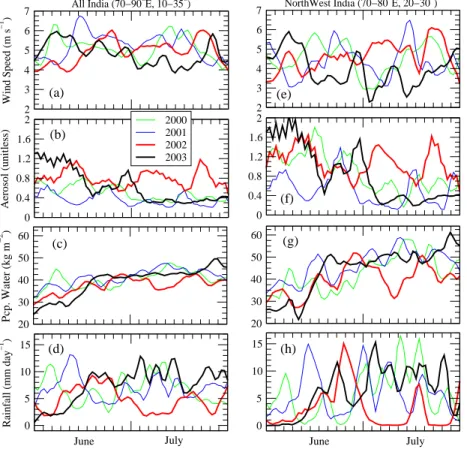
Lastly, we show the 3-day average variation in TRMM rainfall, TOMS aerosol index, and NCEP/NCAR surface wind speed over All-India (70–90◦E, 10–35◦N) and the northwest 15
(NW) India (70–80◦E, 20–30◦N) region (Fig. 4). This is to establish that the aerosol content over India during June and July was not directly linked to the rainfall amount, and is mainly transported through its western boundary. The overall features in the plots for All-India and the NW-India are very similar, but the signals are much amplified over NW-India region. Note here that the aerosols from Africa-Arabia region first arrive 20
in the NW-India region, and thus, larger variations are observed. It is well known that stronger surface winds help to produce aerosols in most environments (marine or land) (Parameswaran et al., 1995). Figure 4 also exhibits a some degree of correlation between wind speed and aerosol index. It should be clarified here that aerosols of marine origin are mostly sulphate and belong to the non-absorbing category in the 25
definition of TOMS AI retrieval. In this study we have used only the absorbing aerosol index (positive values only), which mostly correspond to dust and smoke.
ACPD
5, 2879–2895, 2005 Supression of monsoon rainfall by aerosols P. K. Patra et al. Title Page Abstract Introduction Conclusions References Tables Figures J I J I Back Close Full Screen / EscPrint Version Interactive Discussion
EGU
Case 1. for stronger wind speeds and larger aerosol amount (14–16 July 2001 and 23– 25 July 2002), and Case 2. for weaker wind speeds and lesser aerosol amount (2–4 July 2003 and 13–15 July 2003). This analysis suggest that very strong westerly winds prevailed over the NW of India (and its western side) during Case 1 periods at 850 hPa height (see Fig. S5). In July 2002 the winds speeds were typically higher on most days 5
(Fig. 4e) over NW India, and the aerosol content was greater over both NW India and All India regions. The strengthening of zonal circulation brings continental aerosol from Africa and the adjoining Arabian penninsular towards the NW-India region. It should be noted here that higher aerosol periods are more episodic than periods with stronger winds. For example, the aerosol index fell sharply after 25 July 2002 even though the 10
winds were stronger (Fig. 4e, f).
It is also seen that on many occasions larger aerosol amounts and stronger wind speeds are coincident with less rainfall, particularly for the periods of Case 1. But no clear dependency of rainfall (Fig. 4d, h) and NCEP/NCAR reanalysed precipitable water amount in the atmosphere (Fig. 4c, g) can be established. For instance after 1 15
July 2002, the rainfall decreased dramatically (consistent with an increase in aerosol content presumably due to transport) but the precipitable water amount stayed at a higher level till about 6 July 2002. The situation was similar for low rainfall amounts during 14–16 July 2001 where there was barely a sign of less precipitable water in the atmosphere when larger amounts of aerosol were present. These results suggest an 20
apparent influence of aerosols on cloud microphysics and a reduction in ISMR through inhibition of cloud droplet growth.
4. Conclusions and outlook
The above observations on atmospheric dynamics, chemical compositions and radi-ation budgets, mainly during 2002 and 2003, lead us to suggest qualitatively that all 25
three components interactively control the ISMR. The pathway for aerosol influence on July 2002 rainfall might have followed this sequence: 1) the prevailing dynamics
(con-ACPD
5, 2879–2895, 2005 Supression of monsoon rainfall by aerosols P. K. Patra et al. Title Page Abstract Introduction Conclusions References Tables Figures J I J I Back Close Full Screen / EscPrint Version Interactive Discussion
EGU
trolled by IOD/ENSO etc.) brought more aerosol to the northern Arabian Sea and NW India, 2) the thicker layer of absorbing aerosols produced SST cooling in the northern Arabian Sea, 3) the aerosols inhibited cloud-droplet growth and suppressed rainfall in-tensity. Negative IOD conditions in the equatorial Indian Ocean and cooler northern Arabian Sea weakened the south-to-north component of the monsoon circulation and 5
thus there was less convective activity over India. A quantitative estimate of their rel-ative contributions can be attempted with the help of a general circulation model that includes cloud microphysics (e.g. Menon et al., 2002; Takemura et al., 2005). Take-mura et al. (2005) have clearly shown that from the pre-industrial period (year 1850) to the present day (year 2000), there has been a decrease in cloud-drop effective radius 10
as well as in precipitation due to an increase in aerosol loading over the Indian sub-continent. Their model results support our hypothesis of a reduction in ISMR due to aerosol-induced cloud microphysics. However, a more realistic representation of the in-terannual variability in aerosol distribution is necessary and will soon become possible as the characterization of aerosols become available over the Indian monsoon domain 15
such as those obtained using ground-based instruments (e.g. Babu et al., 2004) and from satellites. Our identification of an on aerosol-induced reduction of rainfall over In-dia during the summer may provide critical information for monsoon rainfall prediction models. We also suggest an indirect role for dynamical oscillations, through chang-ing the transport of aerosols into the Indian monsoon domain and in regional rainfall 20
patterns, so that their total impact is larger than was thought previously.
Acknowledgements. P. K. Patra and S. K. Behera appreciate intense discussion on ISMR
pre-diction during the INDOCLIM symposium, which led us to this work. P. K. Patra acknowledges a series of discussions with O. Wild at various stages of this work and invaluable help by cor-recting the language. We appreciate comments from K. Rupa Kumar on an early version of the 25
manuscript. Thanks are also due to the MODIS, TOMS, TRMM, ATSR, NCEP/NCAR reanalysis data, and NOAA OLR data processing team members.
ACPD
5, 2879–2895, 2005 Supression of monsoon rainfall by aerosols P. K. Patra et al. Title Page Abstract Introduction Conclusions References Tables Figures J I J I Back Close Full Screen / EscPrint Version Interactive Discussion
EGU
References
Akimoto, H.: Global Air Quality and Pollution, Science, 302, 1716–1719, 2003.
Andreae, M. O., Rosenfeld, D., Artaxo, P., Costa, A. A., Frank, G. P., Longo, K. M., and Silva-Dias, M. A. F.: Smoking Rain Clouds over the Amazon, Science, 303(5662), 1337–1342, 2004.
5
Ashok, K., Guan, Z., and Yamagata, T.: Impact of the Indian Ocean Dipole on the Relationship between the Indian Monsoon Rainfall and ENSO, Geophys. Res. Lett., 28(23), 4499–4502, 2001.
Babu, S. S., Moorthy, K. K., and Satheesh, S. K.: Aerosol black carbon over Arabian Sea during intermonsoon and summer monsoon seasons, Geophys. Res. Lett., 31, L06104, 10
doi:10.1029/2003GL018716, 2004.
Gadgil, S., Srinivasan, J., Nanjundiah, R. S., Kumar, K. K., Munot, A. A., and Rupa Kumar, K.: On forecasting the Indian summer monsoon: the intriguing season of 2002, Current Science, 83, 394–403, 2002.
Gowariker, V., Thapliyal, V., Kulsheshtra, S. M., Mandal, G. S., Sen Roy, N., and Sikka, D. R.: 15
A power regression model for long range forecast of southwest monsoon rainfall over India, Mausam, 42, 125–130, 1991.
Hastenrath, S.: Prediction of Indian Monsoon Rainfall: Further Exploration, J. Climate, 1(3), 298–305, 1988.
Herman, J. R., Bhartia, P. K., Torres, O., Hsu, C., Seftor, C., and Celarier, E.: Global distribution 20
of UV-absorbing aerosol from Nimbus 7/TOMS data, J. Geophys. Res., 102(D14), 16 911– 16 922, 1997.
IPCC, Climate Change 2001: The Scientific Basis, Contribution of Working Group I to the Third Assessment Report of the Intergovernmental Panel on Climate Change, edited by: Houghton, J. T., Ding, Y., Griggs, D. J., Noguer, M., van der Linden, P. J., Dai, X., Maskell, 25
K., and Johnson, C. A., Cambridge University Press, Cambridge, UK, 881, 2001.
Kalnay, E., Kanamitsu, M., Kistler, R., et al.: The NCEP/NCAR 40-Year Reanalysis Project, Bull. Amer. Meteor. Soc., 77, 437–471, 1996.
King, M. D., Menzel, W. P., Kaufman, Y. J., Tanr ´e, D., Gao, B. C., Platnick, S., Ackerman, S. A., Remer, L. A., Pincus, R., and Hubanks, P. A.: Cloud and Aerosol Properties, Precipitable 30
Water, and Profiles of Temperature and Humidity from MODIS, IEEE Trans. Geosci. Remote Sens., 41, 442–458, 2003.
ACPD
5, 2879–2895, 2005 Supression of monsoon rainfall by aerosols P. K. Patra et al. Title Page Abstract Introduction Conclusions References Tables Figures J I J I Back Close Full Screen / EscPrint Version Interactive Discussion
EGU
Lighthill, M. J. and Pierce, R. P.: Monsoon Dynamics, Cambridge University Press, 1981. Narayanan, M. S., Rao, B. M., Shah, S., Prasad, V. S., and Bhat, G. S.: Role of atmospheric
stability over the Arabian Sea and the unprecedented failure of monsoon 2002, Current Sci-ence, 86, 938–947, 2004.
Pant, G. B. and Rupakumar, K.: Climates of south Asia, John Wiley Sons, 320, 1997. 5
Parameswaran, K., Vijayakumar, G., Krishna Murthy, B. V., Krishna Moorthy, K.: Effect of Wind Speed on Mixing Region Aerosol Concentrations at a Tropical Coastal Station, J. Appl. Me-teorol., 34, 1392–1397, 1995.
Parthasarathy, B., Munot, A. A., and Kothawale, D. R.: Regression model for estimation of Indian food grain production from Indian summer rainfall, Agric. Forest Meteorol., 42, 167– 10
182, 1988.
Parthasarathy, B., Munot, A. A., and Kothawale, D. R.: All India monthly and seasonal rainfall series: 1871–1993, Theor. and Appl. Climatol., 49, 217–224, 1995.
Rajeevan, M., Pai, D. S., Dikshit, S. K., and Kelkar, R. R.: IMD’s new operational models for long-range forecast of southwest monsoon rainfall over India and their verification for 2003, 15
Current Science, 86, 422–431, 2004.
Rosenfeld, D., Rudich, Y., and Lahav, R.: Desert dust suppressing precipitation: A possible desertification feedback loop, Proc. Nat., Acad. Sci., 98(11), 5975–5980, 2001.
Saji, N. H., Goswami, B. N., Vinayachandran, P. N., and Yamagata, T.: A dipole mode in the tropical Indian Ocean, Nature, 401, 360–363, 1999.
20
Satheesh, S. K. and Ramanathan, V.: Large differences in tropical aerosol forcing at the top of the atmosphere and Earth’s surface, Nature, 405, 60–63, 2000.
Takemura, T., Nozawa, T., Emori, S., Nakajima, T. Y., and Nakajima, T.: Simulation of climate response to aerosol direct and indirect effects with aerosol transport-radiation model, J. Geo-phys. Res., 110, D02202, doi:10.1029/2004JD005029, 2005.
25
Torres, O., Bhartia, P. K., Herman, J. R., Sinyuk, A., and Holben, B.: A long term record of aerosol optical thickness from TOMS observations and comparison to AERONET measure-ments, J. Atmos. Sci., 59, 398–413, 2002.
Webster, P., Maga ˜na, V., Palmer, T., Shukla, J., Thomas, R., Yanai, M., and Yasunari, T.: Monsoons: Processes, predictability, and the prospects for prediction, J. Geophys. Res., 30
ACPD
5, 2879–2895, 2005 Supression of monsoon rainfall by aerosols P. K. Patra et al. Title Page Abstract Introduction Conclusions References Tables Figures J I J I Back Close Full Screen / EscPrint Version Interactive Discussion EGU −2 −1 0 1 2 3
Sea Surface Temperature Anomaly (SSTA, in
o C) 1980 1985 1990 1995 2000 Calendar Year −50 −25 0 25
Rainfall Anomaly over India (mm mon
−1 ) Rainfall (5−pt mean) −0.2 0 0.2 0.4 0.6 0.8
TOMS Aerosol Index (unitless)
AI (5−pt mean)
SSTA
Fig. 1. Month-mean timeseries of anomalies in TOMS measured Aerosol Index (AI; values greater than 0.4; area averaged: 70–90◦E, 10–35◦N) and IITM rainfall over India. The AI values are measured from Nimbus 7 and Earth Probe satellites for the periods November 1978– May 1993 and July 1996–August 2003, respectively. Since late 2001, Earth Probe TOMS instrument is experiencing wavelength-dependent calibration drift (http://toms.gsfc.nasa.gov); thus trends in AI are suspect after December 2001 but the relative shape can be trusted (shown as dashed-red line). The ENSO index based on Japan Meteorological Agency’s sea surface temperature anomalies are depicted in the background (grey shading; source:ftp://www.coaps. fsu.edu/pub). A long-term average seasonal cycle is removed from the respective ISMR and AI timeseries to calculate the monthly anomalies.
ACPD
5, 2879–2895, 2005 Supression of monsoon rainfall by aerosols P. K. Patra et al. Title Page Abstract Introduction Conclusions References Tables Figures J I J I Back Close Full Screen / EscPrint Version Interactive Discussion
EGU
Fig. 2. Anomalies in the NOAA interpolated OLR (shaded) and surface wind vectors from the NCEP/NCAR reanalysis dataset. The climatological mean are taken for the period 1979–2002 and then subtracted from June (left panels) and July (right panels) distributions of two distinct IOD years (2002: negative phase and 2003: positive phase) to calculate the anomalies.
ACPD
5, 2879–2895, 2005 Supression of monsoon rainfall by aerosols P. K. Patra et al. Title Page Abstract Introduction Conclusions References Tables Figures J I J I Back Close Full Screen / EscPrint Version Interactive Discussion EGU 16 17 18 19 20 21 75 150 225 300
May Jun Jul Aug Sep 8 10 12 14 16 0.3 0.4 0.5 0.6 2000 2001 2002 2003
May Jun Jul Aug Sep 2.4
3.2 4 4.8
May Jun Jul Aug Sep 308
312 316 320 324
(a) IITM−ISMR (mm month−1) (b) MODIS−AOD (unitless) (c) MODIS−CER (microns)
(d) MODIS−COT (unitless) (e) MODIS−WVC (cm) (f) MODIS−CTPT (K)
Fig. 3. Monthly-mean time series for May-September months in the period 2000–2003 of (a) ISMR, regionally averaged values of MODIS/Terra derived parameters: (b) aerosol opti-cal depth (AOD),(c) combined phase cloud effective radius (CER), (d) cloud optical thickness (COT), (e) water vapour column (WVC) and (f) cloud top potential temperature (CTPT) are shown. The MODIS aerosol parameters are averaged over 10–35◦N, 70–90◦E region. Read-ers are referred to Fig. S4 for the patterns in CER and ISMR spatial distributions for the period 2002–2004.
ACPD
5, 2879–2895, 2005 Supression of monsoon rainfall by aerosols P. K. Patra et al. Title Page Abstract Introduction Conclusions References Tables Figures J I J I Back Close Full Screen / EscPrint Version Interactive Discussion EGU 0 5 10 15 Rainfall (mm day −1 ) 0 0.4 0.8 1.2 1.6 2 Aerosol (unitless) 2000 2001 2002 2003 0 5 10 15 0 0.4 0.8 1.2 1.6 2 2 3 4 5 6 7 Wind Speed (m s −1 ) 2 3 4 5 6 7 20 30 40 50 60 Pcp. Water (kg m −2 ) 20 30 40 50 60 NorthWest India (70−80oE, 20−30o)
June July June July
All India (70−90oE, 10−35o) (g) (a) (b) (c) (f) (e) (d) (h)
Fig. 4. Three-day average timeseries of wind speed, TOMS aerosol index, NCEP/NCAR
precipitable water and Tropical Rainfall Measuring Mission (TRMM) satellite rainfall over the Indian region(a, b, c, d) and north-west India (e, f, g, h) are shown for June and July months. The north-west Indian domain is assumed to be the gateway for the aerosol transport from the African-Arabian continents to the Indian domain. Tick marks are given every 3 days and major tick marks are at day 1 of month. Thick lines are used for 2002 and 2003 as those years are major focus of this study.