Connectibles: Tangible Social Networking
by
Jeevan James Kalanithi
B.S. in Symbolic Systems, Stanford University, 2000
Submitted to the Program in Media Arts and Sciences,
School of Architecture and Planning,
in partial fulfillment of the requirements for the degree of
Master of Science in Media Arts and Sciences
at the
MASSACHUSETTS INSTITUTE OF TECHNOLOGY
September 2007
@
Massachusetts Institute of Technology 2007. All rights reserved.
Author
Jeevan James Kala thi
Program in Media Arts and Sciences
August 10, 2007
Certified by
V. Michael Bove, Jr.
Principal Research Scientist
Program in Media Arts and Sciences
Thesis Supervisor
Accepted by
-o/'rof. Deb Roy
Chairperson, Departmental Committee on Graduate Students
MASSACHUS INSTMJTE
Program in Media Arts and Sciences
OF TECHNOLOGY
SEP 1 4
2007
ROTCH
Connectibles: Tangible Social Networking
by
Jeevan James Kalanithi
Submitted to the Program in Media Arts and Sciences, School of Architecture and Planning,
on August 10, 2007, in partial fulfillment of the requirements for the degree of
Master of Science in Media Arts and Sciences
Abstract
This thesis presents "Connectibles," an instantiation of a tangible social network, a new type of social network application rooted in physical objects and real world so-cial behavior. This research is inspired by soso-cial signaling and object theory, which together suggest that gifts act as physical symbols and constructors of social relation-ships. The Connectibles system leverages these gift-giving practices, presenting users with customizable gift objects ("connectibles") that they exchange with one another. These objects form always-on communication channels between givers and receivers. As a user collects more and more of these objects, she begins to acquire a dynamic, physical representation of and interface to her social network. The community of users' interactions implicitly represent the structure of the social network; these data can be accessed with a GUI application, allowing users to explore and interact with their social network. The overarching goal is to examine how a set of devices might naturally and harmoniously interface the physical, virtual and social worlds.
Thesis Supervisor: V. Michael Bove, Jr.
Connectibles: Tangible Social Networking
by
Jeevan James Kalanithi
The following people served as readers for this thesis:
Thesis
Reader
Pr essor of Media
Program in Media
Judith Donath
Arts and Sciences
Arts and Sciences
Associate
Thesis Reader
Hiroshi Ishii
Professor of Media Arts and Sciences
Program in Media Arts and Sciences
Acknowledgements
Thanks to my advisor, Mike Bove, for advice, guidance, and the opportunity to spend a wonderful couple years at the Media Lab.
Thanks to my thesis readers, Hiroshi Ishii and Judith Donath, for your insight and outlook; you have outfitted me with a set of intellectual and aesthetic tools that will come in handy in all my future work. Thanks also to Pattie Maes and John Maeda, who graciously allowed me to work with their students and get involved in their initiatives. The third floor is one of the best floors out there.
Many thanks to my fellow students and collaborators at the Lab, and in my group in particular: Jim Barabas, Dan Smalley, Quinn Smithwick and Brandon Taylor. I could put down a long list of all the folks who have inspired me here, but I must give special thanks to Dave Merrill, friend and chief reason I got to the Media Lab at all. To all I had a chance to work with and talk to, you were the main attraction.
A special "no thanks," however, to Brandon Roy, my sworn enemy, who one day is
going to get it.
Thanks to my family for their love and for their support of all the inscrutable and mysterious endeavors I pursue. Finally, special ultra thanks to Emily Costello, who will be my wife when this thesis hits the library shelves. Your faith and love
-and your selfless support of my decision to come up to Boston for two years - made this all possible.
Contents
1 Introduction 17
1.1 Social Objects and Social Networks . . . . 18
1.2 Thesis Roadmap . . . . 19
1.2.1 Background and Motivation . . . . 20
1.2.2 D esign . . . . 21
1.2.3 Evaluation . . . . 21
1.2.4 Appendix: Connectibles Technology . . . . 22
2 Social Signals, Social Networks, Social Objects 23 2.1 Signaling Theory . . . . 24
2.1.1 What Signals Are, And What They Do . . . . 25
2.1.2 Reliable Signals . . . . 26
2.1.3 Signals and Cost . . . . 28
2.1.4 Signals and Relationships.. . . . . . . . 30
2.2 Object Theory . . . . 31
2.2.1 Object Value . . . . 32
2.2.2 From Commodity to Memento . . . . 33
2.2.3 Social Objects are a Kind of Memento . . . . 35
2.3 Tying it Together: Signals, Objects and Gifts . . . . 36
2.4 Defining a Tangible Social Network . . . . 38
2.5 Function Follows Form: Supporting Social Networks . . . . 39
2.5.1 Tangible Media as Mementos . . . . 40
2.5.2 Virtual Signals and Virtual Social Networks . . . . 45
2.6 Why are Tangible Social Networks Interesting? . . . . 51
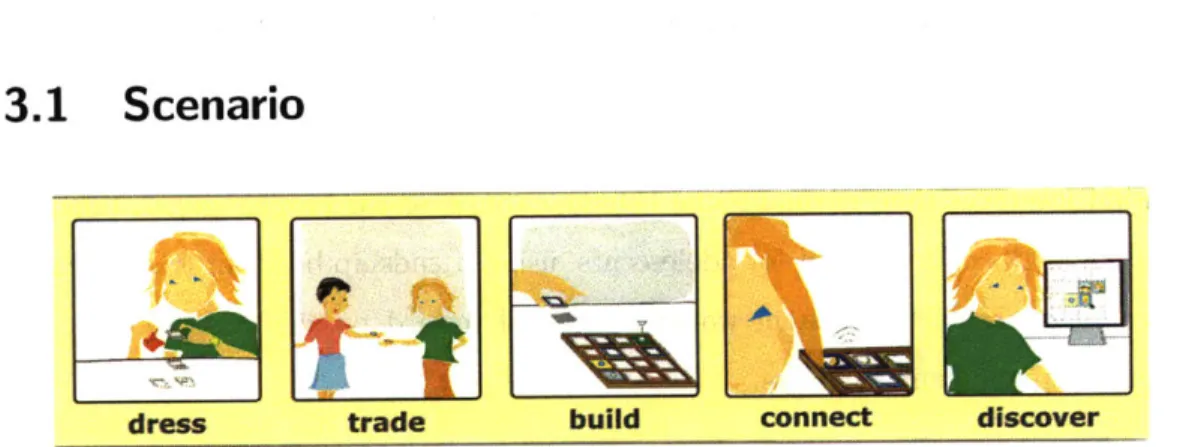
3 Connectibles: A Tangible Social Network 53 3.1 Scenario . . . . 54
3.2 Two Design Principles... . . . . . . . . 59
3.2.1 User Generated Semantics . . . . 59
3.2.2 Low Floor, High Ceiling . . . . 60
3.3 Connectibles Metaphors . . . . 61 3.4 Semantics of Arrangement . . . . 63 3.5 Semantics of Communication . . . . 68 3.5.1 Buttons . . . . 68 3.5.2 K nobs . . . . 69 3.5.3 P ics . . . . 70 3.5.4 G lints . . . . 71 3.6 Semantics of Exchange . . . . 71 3.6.1 Customization . . . . 73
3.7 The Visual Application . . . . 73
3.8 Network Architecture . . . . 76
3.9 Summary . . . . 77
4 Evaluating Connectibles 79 4.1 Mapping the Social to the Physical . . . . 80
4.1.1 R esults . . . . 83
4.2 Short-term use of Connectibles . . . . 87
4.3 Long-term use of Connectibles . . . . 89
4.4 Future Work.... . . . . . 97
4.4.1 New Connectibles . . . . 98
4.4.2 Ambient Sensing . . . . 99
4.4.3 New Form Factors . . . . 100
4.4.4 DIY Connectibles . . . . 102
4.4.5 Enriching the Visual application . . . . 102
4.5 Summary . . . . 104
5 Conclusion 105 A Appendix: Connectibles Technology 109 A.1 Hardware . . . . 110
A.1.1 Connectibles . . . . 110
A.1.2 friendFrame . . . . 112
A.2 Network Messages . . . . 114
A.3 Tier One . . . . 116
A.3.1 Enumeration . . . . 117
A.3.2 Sending and Receiving Messages . . . . 118
A.4 Tier Two . . . . 119
A.4.1 Sending Messages . . . . 120
A.4.2 Receiving Messages . . . . 120
A.4.3 Visual application communication . . . . 121
A.5 Pairing . . . . 122
List of Figures
The venomous coral snake The harmless milk snake Object Values . . . . inTouch . . . . Story Beads . . . . LinkedIn List of Friends . Facebook gifts . . . .
Connectibles Cartoon . . . .
Commonly exchanged items Connectibles Version 1 . . .
Connectibles Version 2 . . .
Connectibles Final Version . The Interaction Space . . .
Connectible types . . . . Customizing connectibles . . The Visual Application . . .
2-1 2-2 2-3 2-4 2-5 2-6 2-7 3-1 3-2 3-3 3-4 3-5 3-6 3-7 3-8 3-9 4-1 4-2 4-3
Evaluation One: Cardboard Prototypes . . .
Evaluation One: Cardboard Prototype Units Evaluation One: The Pistol Arrangement . .
. . . . . . . . . . . 26 . . . . 27 . . . . 33 . . . . 4 1 . . . . . . . . . . . . . . . . . . . . . . 5 4 . . . . 6 2 . . . . 6 4 . . . . 6 5 .. . . . . . 6 7 . . . . 6 9 . . . . 7 0 . . . . 7 3 . . . . 7 4 . . . . . . . .
4-4 Evaluation Two: A Subject using Connectibles . . . . 87
4-5 Imperative messages . . . . 94
A-1 Network Protocol . . . . A-2 Connectible Hardware . . . . A-3 Connectible and friendFrame pin out
A-4 A Message . . . .
A-5 Pairing two connectibles . . . .
110 111 113 114 122 . . . . . . . . . . . . . . . . . . . .
Chapter 1
Introduction
The taonga [gifts] are strongly linked to the person, the clan, and the earth, at least in the theory of Maori law and religion. They are the vehicle for its mana, its magical, religious and spiritual force. ... The taonga and all goods termed strictly personal possess a hau, a spiritual power. ... What imposes obligation in the present received and exchanged, is the fact that the thing received is not
inactive1. ... This is because the taonga is animated by the hau of the forest, its
native heath and soil. It is truly 'native': the hau follows after anyone possessing the thing.
Marcel Mauss, "The Gift" [40]
A couple Christmases ago, I bought a Fuji Finepix digital camera for my fianc6e,
Emily. She has a great eye but didn't need anything fancy; I knew she'd like something that's cute and stylish without sacrificing picture quality. Soon after New Year's, we went to the Natural History Museum in New York. She made sure to bring the camera along. Before we entered the Rose Space Center, Emily excused herself to the women's room.
A minute later, she emerged, distraught. She had dropped her purse with the
camera inside; the camera now wouldn't turn on. It was definitely broken. She apol-ogized and apolapol-ogized. She knew, of course, that exchanging it would be trivial. She was disconsolate not over any time or money lost, but because she had let something
I had given her break. The camera, as a tool, was a thing with which to take pictures - and that sort of thing was eminently replaceable. But the camera as a gift was an
expression of our social relationship. It represented, in part, our knowledge of and investment in each other. To damage the object is to damage the relationship; that's why Emily felt so bad when she dropped the camera. (She now assiduously protects its replacement with a thick wool sock.)
Emily and I are certainly not unique; physical objects acquire symbolic power for people across cultures. The magical items in the Maori tradition take the metaphorical value of objects to a natural conclusion: instead of merely providing a representation of a social link between two people, these talismans provide a literal link between them.
The vision of this thesis is rooted in the magical social object: a physical ob-ject that both symbolizes a relationship between two people, and provides an active channel between them. This research examines how groups of so-called magical social objects might be used to yield new kinds of social networking applications, rooted in the real, physical world: "tangible social networks."
1.1
Social Objects and Social Networks
People across cultures use physical objects as touchstones for others in their lives.
[17] They use these social objects to represent social relationships. Gifts in particular
wedding ring - contains information about the relationship between the giver and the receiver. First and foremost, each gift denotes the existence of a social link between two people. Second, the cost of the gift - how much time, money and knowledge is required to acquire and present it - represents the strength of that relationship.
Gifts thus sketch out the links of a social network. If we could capture this in-formation, we might expose social networks that have both more detail and greater consonance with a user's "reality-based" social network than current internet-based social network applications. We would also be able to build up social networks au-tomatically, without forcing users to build their networks from scratch - something internet-based social networks now require. These features remove the barriers to en-try and use that PC-based social networks entail, and may thus allow the natural integration of social networking into a larger group of people's lives. Further, if we could capture this information with the implicit permission of the user, we would avoid the privacy problems raised by data-mining methods for social network discov-ery. [22] Finally, a system that consists of magical social objects "closes the loop" on our social networking application: instead of just allowing people to observe social network structures, we can provide a medium for social communication and display. Such a system provides a complete social network application: a medium for exploring
and building social networks. It is hoped that this thesis will help sketch out
possibil-ities for tangible social networks, and explore how they compare to and complement (hugely popular) internet-based social network applications.
1.2
Thesis Roadmap
This section will present a brief outline of the contents and structure of this thesis. The thesis consists of three main chapters: chapter two provides theoretical back-ground and motivation for the tangible social network concept; chapter three describes
"Connectibles," an instantiation of a tangible social network; chapter four discusses three evaluations of Connectibles, and explores possibilities for future implementa-tions. This thesis includes an appendix discussing the technologies implemented in this research.
A few notes about terminology: I will use the term "Connectibles," with a
cap-ital "C," to refer to the entire system implemented, including the physical objects, networking infrastructure, and visual application. I will use the term "connectibles," with a lower case "c," to refer to a particular set of physical connectible objects.
1.2.1 Background and Motivation
Signaling theory and object theory together form a theoretical foundation on which to design, build and evaluate tangible social networks. Signaling theory provides prin-ciples that describe how people and animals communicate with one another; it specif-ically provides principles with which to evaluate the reliability and meaning of these social signals. Object theory suggests how physical objects become endowed with per-sonal meaning and social significance. That is, it describes how objects can become social objects. These two theories together suggest that gifts act as both symbols and shapers of social relationships.
Chapter two will review this theoretical background, and suggest how it can be used to derive design principles for social technologies in general, and tangible social networks in particular. This chapter will also discuss related work in social technolo-gies, ranging from internet-based social networks to remote awareness applications. This chapter concludes with an explicit comparison between virtual social networks and tangible social networks.
1.2.2
Design
Based on the theoretical framework explained in chapter 2, a tangible social network is defined to be a system that:
(1) consists of social objects,
(2) augments those social objects to enable direct channels between the people represented by them,
(3) digitally captures and displays social link information inherent in those
ob-jects.
A tangible social network is thus a collection of "magical social objects" that,
in aggregate, map out the social network of all of the people with whom they are associated.
Chapter three will explain the design iterations of Connectibles in terms of these three requirements. Importantly, this explanation will discuss the design process, and how decisions were made to support the conceptual needs of a fully realized tangible social network as well as the practical needs of a small scale prototype.
1.2.3
Evaluation
The Connectibles concept was subject to three separate evaluations. The first evalua-tion was conducted with a cardboard prototype. It addressed requirement (1) above: can collections of physical objects construct and represent social relationships in the first place, and if so, how? In particular, it attempted to answer this question with different physical design possibilities. The second evaluation was conducted with a working prototype in small groups over a short period of time. This evaluation ad-dressed whether the design decisions positively contributed to the requirements of a
tangible social network, specifically, whether (1) the connectibles indeed represented and constructed social relationships, (2) whether arrangements of the connectibles contained any particular meaning. The third evaluation traded number of users for length of use: it evaluated the system with a set of users over a week long period, and attempted to answer the same questions as the second evaluation. This was done to separate the system's properties from the evaluation conditions.
This chapter will also briefly discuss design studies and evaluations conducted
by Hallmark, Inc. to evaluate the Connectibles concept.
This chapter will explain these evaluations in detail, as well as their results. These results suggest a set of features that would better serve a future implementation of the tangible social network concept.
1.2.4
Appendix: Connectibles Technology
The appendix will discuss the technologies involved in Connectibles in more depth, devoting particular attention to the network design. It describes a novel way in which devices can be exchanged and paired over a distance without requiring any spe-cial behaviors from the users, such as physically connecting the devices during ex-change.
Chapter 2
Social Signals, Social Networks,
Social Objects
This bracelet exchange was not motivated by desire for fine jewelry; it was an ex-pression of allegiance, a way of giving shape and substance to the intersection of three kindred women. My bracelet grounds me in an invisible social firmament, where Irene and Irma are stars in the constellations of descent and affinity. I feel the their reassuring presence when the weight of the bracelet is on my wrist
and I understand what it means to wear your wealth.
Irene Castle McLaughlin, "The Bracelet" [58]
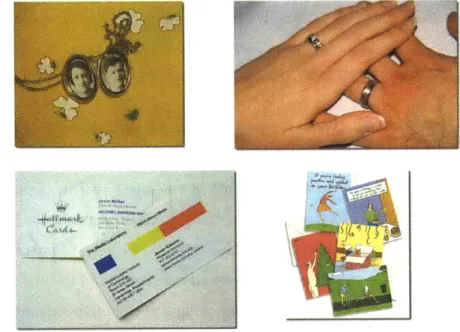
How do people use physical objects to represent social relationships? Thinking of examples is easy: people keep photos of loved ones in lockets, on mantles and in wallets; they care for heirlooms as a way of maintaining a link to their ancestors; they wear wedding rings that symbolize their marital vows.
Signaling theory and object theory suggest that gifts in particular act as both symbols and shapers of social relationships. [20] This chapter will discuss these
theo-ries, apply them to the tangible social network concept, and review related research and applications. Using this foundation, the chapter then explicitly defines the term "tangible social network."' The chapter concludes with an explicit comparison of tan-gible versus virtual social network technologies, enumerating specific contributions provided by tangible social networks.
2.1
Signaling Theory
Signaling theory includes a large body of literature, ranging from sociology to biology to economics, that couches both human and animal communication in terms of costs and benefits. (e.g., [41] [63] [60]) It assumes that organisms exist in a competitive
Darwinian environment which pressures creatures to expend less energy in their pur-suit of survival than their competitors do. This pressure shapes how animals receive and transmit information about the environment and each other, especially when that information is not available by direct observation. Signaling theory chiefly concerns itself with the reliability of the information sent and received, and the forces shape that reliability.
Signaling theory provides a powerful tool to examine human communication. We exist in a world awash in social signals. We are constantly creating signals in order to produce desirable effects in others; we are constantly interpreting signals in order to learn more about their transmitters' qualities. I wear the right kind of sneakers to impress my fashion-conscious friends; I get a sense of a boss's personality by checking out what kind of car he drives. Signaling theory provides a framework with which to understand all these types of behaviors.
'We should note now that we will generally use the term "tangible social network" as a shorthand for "tangible social network application." Of course, a social network and a tool with which to interact with one are different things, but the above terminology follows normal usage. For example, MySpace is often referred to as a "social network," even though it is technically a social network application.
This section will summarize some of the key aspects of signaling theory, laying important groundwork that will help us analyze how different kinds of technologies allow or inhibit reliable transmission of social signals. This foundation will specifically examine how different technologies (un)reliably indicate the existence of social rela-tionships among groups of people; that is, it will allow us to analyze how technologies mediate the formation and display of social networks.
2.1.1
What Signals Are, And What They Do
A classic example from signaling theory may help illustrate some of its key points.
Keep in mind that this example illustrates only one general class of signal: signals that may be unreliable (see 2.1.2). Since this thesis is concerned with signals of this kind, the following example does not provide a more comprehensive overview of signaling theory. (For such an overview, see [20].)
Certain species of animal exhibit brightly colored exteriors which serve to warn predators of their dangerousness. This phenomenon is known as "aposematism." [50]
[53] The coral snake is an aposematic species - its bright, salient bands of colored
scales provide a reminder to would-be predators of its venomous bite. [50]
Signaling theory would describe the snake's coloration is a signal that indicates a quality of the snake - its venomousness. Predators learn the meaning of this signal, perhaps by experiencing an unpleasant bite, and thus learn to avoid snakes with red, yellow and black bands. Both the signaler (the snake) and the receiver (the would-be predator) profit from this signaling system: the predator can avoid risking a poisonous bite, and the snake can avoid a violent confrontation. The signal thus aids the survival of both participants in the system.
Figure 2-1: The venomous coral snake. Note the aposematic bands of red, yellow and black.
like the coral snake. Many are not. This lack of a tight relationship between this signal and quality is an important feature of this signaling system, as is discussed in the next section. Indeed, signaling theory is largely concerned with articulating the ways in which signals and qualities are connected, and in general how tight these connections are.
2.1.2
Reliable Signals
The coral snake's signaling system would seem to be a stable and profitable one. If a predator sees a snake with yellow, red and black bands, it will keep its distance. Coral snakes don't get eaten; predators don't get poisoned: a good deal for both parties. Unfortunately for the coral snakes and their potential predators, there exists another kind of snake, called the milk snake. This snake is about the same size as a the coral, and is colored in much the same way. The milk snake, however, is not poisonous.
The milk snake mimics the coral signal. Because the coral colors indicate danger to predators and thus save the coral from harm, it is profitable for the milk snake to
send the same signal - even though it lacks the quality associated with that signal (venomousness). The milk snake is thus sending a deceptive signal.
Figure 2-2: The harmless milk snake. Note the deceptive aposematic bands of red, black and yellow.
Indeed, there is selective pressure favoring the existence of deceptive signalers. In general, the deceivers get the benefits of the signal without having to "pay" for the quality they are falsely signaling. In this case, the milk snake as a species devotes none of its energy to the development and maintenance of venom glands and injection mechanisms, but it gains the benefit of scaring off predators afraid of a poison bite. Though the accounting occurs in the relatively abstract sense of evolutionary fitness, the milk snake is getting the benefit of a signal without paying for it - clearly an advantageous thing to do.
If the deceivers appear in large numbers relative to the honest signalers, the entire signaling system can break down. If a predator encounters coral snakes much more often than milk snakes, any attack it initiates on a red, black and yellow banded snake is likely to result in a nasty bite: the bands reliably signal venomousness. However, if the population of milk snakes increases relative to the coral snakes, the reliability of the signal decreases. At a certain point, the predator will have a lot of positive
experiences attacking banded snakes, since they will usually be the non-venomous, tasty milk snakes. The predator will thus learn to always attack any banded snakes. The coral snakes have now lost the ability to induce behavior in the predators; they lose the benefits of the signaling system. Since receivers ignore all signals, both honest and deceptive, the deceptive milk snakes lose the benefit of the system too: their bands no longer scare off predators. The signal has become totally unreliable. In a real sense, the bands have ceased to be a signal at all.
Of course, real signals of this kind will have some degree of reliability, somewhere
in between total unreliability and total reliability. How is this balance struck? Signal-ing theory describes how signalSignal-ing systems maintain reliability, despite the presence of deceivers. It does so through the concept of "signal cost."
2.1.3
Signals and Cost
Signaling theory researchers have described a host of mechanisms that keep signals sufficiently reliable, and thus keep signaling systems stable. These mechanisms are underpinned by the notion of signal cost. The concept is simple: How hard is it for a signaler to produce a signal? If it is sufficiently beneficial for the honest signaler to produce a signal, and sufficiently costly for a deceptive signaler to produce the same signal, the signal should remain reliable. Signals that are costly in the domain of the quality being signaled are called "handicap" signals. [63] "Conventional" signals, which signal qualities in a basically arbitrary way agreed upon by a community, can be made reliable making the signal costly for deceivers; for example, a system of investigation and punishment might serve to deter potential deceivers. [20] Much of human communication, including most spoken language acts, are conventional signals.
be-hind and take an example from our own domain. Let's take an example inspired by Thorsten Veblen's "The Theory of the Leisure Class," an early and influential text of signaling theory. [60] Imagine you meet two identically dressed and manicured men; both verbally claim to be wealthy. You know in advance that one is rich and the other is not. Who is whom? Unfortunately, you can not easily tell - merely saying "I am wealthy" does not reliably indicate actual wealth, since spoken words are very inex-pensive signals. Spoken words are typically conventional signals, and in this special case, you do not have the investigative means to discover and punish the deceiver, and the deceiver knows this. Anyone can utter the statement "I am wealthy," and one's ability to produce that utterance is very much independent of one's wealth. All things being equal, cheap signals are unreliable.
Now imagine the two men are forced to show you their respective cars. The first man drives a Honda, the second a Ferrari. It is suddenly a lot easier to guess who is whom: the second man with the Ferrari must be the rich one. It seems like a trivial conclusion, but that conclusion is based on the signaling cost embedded in the cars. Owning a Ferrari is a handicap signal - only the honest signaler can afford to produce it. The deceiver, while he had the resources to say that he is wealthy, lacks the resources to purchase a six-figure sports car. Indeed, Veblen argues that luxury items' whole purpose is to indicate wealth by pricing out the deceivers.
Importantly, signal cost can be the sum of many factors, not just money - signal cost is a function of any scarcity in the domain in which the signal exists. [20] [30] The scholar can signal his expertise with a stack of peer-reviewed publications and a PhD diploma; a charlatan masquerading as a scholar would have to go to great lengths to produce a comparable signal. In this case, the scarcity is in time and perhaps talent; the honest signaler has the time and skill to produce the signal, whereas the deceiver does not. Other factors influence the signal cost as well - the ability for the honest signalers and receivers to punish the deceivers, for example, increases the signal cost.
2 If the deceiver did go to great lengths, by getting a PhD, writing a number of
scholarly papers, and getting them accepted by peer-reviewed journals, he would by all rights now be honestly indicating his status as a scholar!
2.1.4
Signals and Relationships
In human societies, there is often a need to indicate one's social status and group membership: is that person a member of my religion? Does that person root for my sports team? Is that person single? [38] These relational qualities can be signaled just like any other quality, and are thus subject to the rules outlined above. The more costly signals are more likely to be honest. Joe might say he is my friend (a cheap, unreliable signal); I am more likely to believe him if he produces a more costly signal (picking me up from the airport at 5AM). Does Bill really like Sue, or is he just using her? He can show Sue that he is truly interested by investing the time to plan a date at her favorite restaurant. [30] In this case, it may not be costly for the honest Bill to choose a restaurant Sally would like, given that he knows her. However, the deceptive Bill does not care much about Sally and is not going to be willing to learn much about her; he thus could not effectively plan a date she would like. We note this explicitly since reliable signals rely not so much on how difficult it may be for the honest signaler to produce a signal, but how costly it is for the deceptive signaler to produce that same signal. Of course, it may not be the case that we are constantly, consciously testing others to determine the strength of our social relationships. Nonetheless, such signals do act to symbolize and reinforce social relationships over time.
This research is specifically concerned with the reliable signaling of social rela-tionships. It will examine how different media implicitly support different signal cost structures, and thus do or do not support the reliable signaling of the strength of
2
It has become somewhat common to read news stories in which institutions have forced officials to resign because these officials were dishonest about the degrees they had earned (or not earned).
social relationships.
2.2 Object Theory
We project our thoughts onto the physical world; more properly, our thoughts and the physical world are always intensely tangled together. Thinkers throughout history and across disciplines have elaborated this idea: Freud discusses the transposition of the mental onto the physical in chapter three of Totem and Taboo, "Animism, Magic and the Omnipotence of Thought." [25] More recently, the philosopher Andy Clark proposed that the physical world in general and technology in particular act as extensions to human cognition. [16] Papert emphasize the importance of physical objects in the cognitive development of children. [48] Hiroshi Ishii and the Tangible User Interface community emphasize humans' natural abilities to "think with things," building artifacts that couple everyday graspable objects with digital information and actions [32]. These scholars and researchers all stress the deep interconnection between thinking and the physical, manipulable world.
Of course, thought about the meaning of physical objects - what we are calling "object theory" - is so general as to stretch from Plato to Marx to Baudrillard. [39] [35] [2] Our scope will be limited by the specifics of this research: we will lay groundwork sufficient to sketch out how objects can acquire symbolic value, particularly in terms of representing other people and social relationships.
Our formulation is a simplifying adaptation of previous scholarly work and an attempt to distill some basic notions that are relevant to this research; we hope that the claims are straightforward and uncontroversial. We use the term "object theory" as a convenient shorthand to describe our formulation, freely admitting that it does not the meet the rigor or depth the common use of the term "theory" implies. This
formulation essentially summarizes and adapts work which characterizes the meaning of things in terms of sets of values an object can attain in relation to a subject or group of subjects.
2.2.1
Object Value
Richins provides a succinct system with which to understand the interactions between people and physical objects. [52] This system describes how objects can acquire mean-ing for groups or individuals as a function of different types of "values," buildmean-ing on Marxian ideas [39], Baudrillard's theories of object value [2], and work by Csikszent-mihalyi and Rochberg-Halton [17]. We can slightly modify her system within the specific context of this research, and describe a simple system for determining the values an object can acquire:
(1) Use Value: What does the object do, and how well does it do it? For example,
does my car run, and how well does it drive?
(2) Exchange Value: What can I trade for the object, in terms of other objects
or currency? If I traded in my car, what kind of car could I receive in return, or how much money could I sell it for?
(3) Symbolic Value: What is the meaning of the object within either the larger
cultural context, or within my specific personal context? Do my peers consider my car
"cool," and a positive reflection on my taste and personality? Have I had particularly
good or bad personal experiences with this car? That is, with what memories is this car associated?
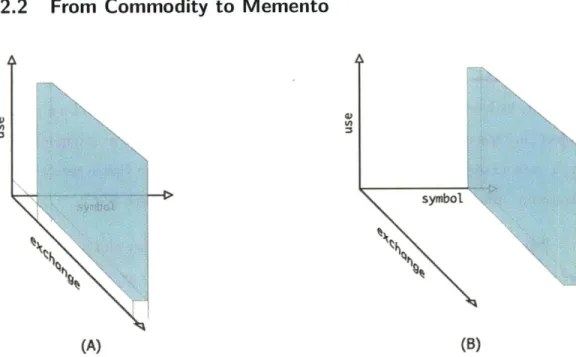
A given object's value is multidimensional in the space of these three axes: a
particular fountain pen on my desk can have a utilitarian value in terms of how well it writes, an exchange value in terms of what I could sell it for on eBay, and a
symbolic value in terms of my experiences with it over time (have I used it to craft some illustrations I am particularly fond of?) and its relationship to other people in my life (was it a graduation gift from my parents?). The ways in which these values interact and influence one another is the subject of a great deal of scholarly and empirical work; the interactions of these values result in a particular set of meanings associated with an object. We can point out two broad categories, occupying disjoint areas in the value space: commodities and mementos.
2.2.2
From Commodity to Memento
L4)
symbol
(A) (B)
Figure 2-3: Object values of commodities, (A), and mementos, (B). While these graphs are a highly schematic way to visualize the values an object can attain, they illustrate that commodities and mementos inhabit a disjoint space. Note that mementos need not have a use value, while commodities should. Also note that while a mementos may have a variety of possible exchange values, they are not generally considered (by their owners) exchangeable. See text.
A commodity can be defined in two mutually reinforcing ways: (1) a commodity
is a fungible object. That is, a person would be equally happy with any instance of that object. If I have a can of Coke, and you trade me your can of Coke for mine, I
won't mind: both objects have equal value to me. (2) A commodity has a clear use value and a clear exchange value, but little symbolic value.
Indeed, exchangeability3 and symbolic value are often mutually opposed. As an
object acquires symbolic value, it becomes rarer, and will often become unique. This is easy to see: if my grandfather gives me a baseball mitt, that mitt and that mitt only is associated with that gift act. The mitt has symbolic value in terms of my relationship to my grandfather. Few if any other mitts can claim that value, and thus few if any other mitts can be suitably exchanged for the one given to me by my grandfather. Symbolic values are often specific to particular objects and particular people.
Mementos, as opposed to commodities, have a great deal of symbolic value,
and thus little exchangeability. A memento can therefore be defined to be a physical object that has acquired a unique meaning specific to some person or group of people, such that no object could be easily substituted for it. (van den Hoven uses the term
"souvenir" roughly synonymously with the term "memento," see [59].)
What forces cause an object to become the locus for memory and meaning? Why are some objects commodities, and others mementos? Simply put, mementos acquire and retain symbolic value, while commodities do not. There are myriad ways for objects to acquire symbolic value, of course, but two in particular stand out.
First, an object may become correlated with salient life events. That is, an object may become associated with specific memories or feelings. A diary is a fairly literal example of this; it is inscribed with marks made by an individual over time. These marks provide a record of that person's thoughts and feelings, physically instantiating them. A diary begins as a blank set of pages, easily exchanged for another set of blank
3
"Exchangeablity" and "exchange value" are different. Exchange value describes, fairly literally, how much something is worth in dollars or trade value. Exchangeability describes whether something is exchangeable at all, especially in the context of the current owner. A treasured heirloom may thus be regarded as "priceless."
pages. But over time, as the writer fills in these pages with specific words, the diary loses its status as a commodity and becomes a memento. Certainly, no other object will have the same value as one's diary, once it is filled up.
An object can also acquire symbolic value by being part of a cultural practice. Note this force need not be opposed to the previous one. The two often reinforce one another. For example, the college diploma has symbolic value in the context of the cultural practice of institutional education; this symbolic value is at the same time derived from the specific experience of an individual receiving a diploma, forming a specific memory for that person.
2.2.3
-
Social Objects are a Kind of Memento
Social objects are a kind of memento in which the symbolic value of the object lies
in how it represents a social relationship or relationships. A wedding ring is a fine example: its role is chiefly symbolic, and it symbolizes the commitment two spouses make to one another. A wedding ring, once given, is certainly not a commodity
-I would deservedly invite the wrath of my spouse if -I were to trade my ring for
another, or, heaven forbid, sell it. A social object can also symbolize wider group membership; fraternity pins, military dog tags and safety pins (for punks) all have this function.
At this point, we should stress that symbolic objects are not just representative, but performative. The Object-Relations school, including psychoanalytic thinkers such as Melanie Klein and D.W. Winnicott, describe people primarily in terms of their relationships to outside entities, not in terms of a set of internal drives. [29] While these thinkers typically use the term "object" to describe another person, Sherry Turkle suggests that we read "object" as a physical thing. [58] A principal insight from this reading is that objects are not simply targets of a desire, but help
construct that desire. [29] That is, an object need not just symbolize a relationship
-it will also necessarily help construct that relationship.
In an essay in Turkle's "Evocative Objects," Susan Pollak neatly captures the ways in which social objects both represent and build relationships. She writes about her rolling pin, which was inherited from her deceased grandmother [58]:
As I bake, I often tell my children stories about Grandma Tilly. ... As I use her rolling pin and feel its texture and weight against my floured hands, I think of the hundreds of pies and cookies it helped create. It anchors me in the past, yet continues to create memories for the future.
Social objects are thus intimately entwined with our social lives; they serve as physical referents to our relationships and influence how we construct and maintain those relationships.
2.3
Tying it Together: Signals, Objects and Gifts
What does signaling theory have to say about object theory, and vice-versa? Object theory tells us that physical objects can contain rich meaning for individuals - they can acquire symbolic value. In particular, some symbolic objects are social objects: they represent and construct social relationships. Signaling theory then suggests that these social objects symbolize social relationships with differing levels of reliability, depending on the signaling cost spent in the object's creation and upkeep. Specifi-cally, since physical objects typically have higher inherent costs than other types of signals - spoken words, emails - they can function as more reliable indicators of social relationships. We will discuss these differing costs in the next section. But in short,
social objects, precisely because of their physicality, are likely to be reliable signals of the existence and nature of social relationships.
Using social signaling and game theory, Colin Camerer points out a specific type of object that is likely to shape social relationships: gifts. [13] Gifts can be treated as signals of one's investment in another person. [13] To repeat, a key concept from signaling theory is that a sender's message must be sufficiently costly to produce in order for the receiver to assume it is reliable. [20] [63] The more costly the gift, in terms of money, time, skill or some other limited resource, the stronger the indicated relationship. Gifts also signal the strength of the relationship by demonstrating an-other scarce resource: knowledge of the receiver's tastes. [13] Not everyone is going to know what music I like; givers that send me CD's of my favorite bands show off their knowledge of me, and thus their investment in our relationship. (Again, these gifts do not simply represent the relationship; the act of giving strengthens the re-lationship.) Cheap gifts signal weak relationships (unsigned, mass-mailed Christmas Cards), expensive gifts signal strong relationships (handmade scarves, engagement rings).
Again, we must emphasize that signal cost rests with scarcity in the domain being signaled, not simply monetary cost. If a rich dad buys a Humvee for his Green Party member daughter, the gift will involve a significant monetary cost, but it does not demonstrate much knowledge of the recipient. The quality being signaled here is the strength and depth of the relationship, which is characterized by knowledge of the recipient's personality as well as the time one is willing to invest in the relationship. This knowledge and dedication cost something to acquire, and these costs typically play out more in how much time one spends on a relationship, as opposed to how much money one spends on it. Once acquired, this knowledge may allow the honest signaler to produce a signal that does not cost him a lot. It may not be particularly arduous for a more sensitive father to buy a few acres of rainforest on behalf of his daughter through a non-profit website. The important thing is that this knowledge is not available to a deceptive signaler, and would be costly for him to acquire.
Marcel Mauss' work prefigures Camerer's conclusions from an anthropological standpoint. [40] In writing about pre-market societies, Mauss contends that gifts instantiate social relationships and social obligations. Mauss even goes so far as to say that, in certain cultures, gifts take on almost magical properties:
The circulation of goods follows that of men, women and children, of festival ritual, ceremonies and dances, jokes and injuries. Basically they are the same. If things are given and returned it is precisely because one gives and returns 'respects' and 'courtesies'. But in addition, in giving them, a man gives himself, and he does so because he owes himself - himself and his possessions - to others. The gift object becomes endowed with the traits of the giver, and it travels along the the giver's social links - and it creates and reinforces these links as well.
Physical objects acquire symbolic meaning in a host of often idiosyncratic ways.
[58] However, gift objects have a specific function - to signal and reinforce social
relationships. In so doing, gifts become a class of physical objects that are almost always social objects.
2.4
Defining a Tangible Social Network
Based on the theoretical framework just put forward, a tangible social network is defined to be a user interface system that:
(1) consists of social objects,
(2) augments those social objects to enable direct channels between the people represented by them,
Condition (1) ensures that there is a strong metaphorical relationship between the objects that make up the interface and the things they represent - in this case, people and social relationships. Condition (2) is driven by the vision of "magical so-cial objects." Again, "magical soso-cial objects" act as literal channels between people, instead of just symbolic ones. These objects extend the role and function of the social objects that inhabit our everyday lives, serving to reinforce the metaphorical rela-tionship required by condition (1). Most importantly, social networking tools derive much of their value from the way in which they support communication and display; a tangible social network should support this as well. We can kill two birds with one stone by using the objects themselves as the medium for communication. 4 Fi-nally, the definition is extended by the realization that large collections of "magical social objects" implicitly embody social networks. Condition (3) ensures that groups of magical social objects could be naturally used as a tangible interface for modeling as well as interacting with one's social network.
The next section will review related work through the lens of this definition and the theoretical framework just established.
2.5
Function Follows Form: Supporting Social
Net-works
How do different technologies support understanding of and access to social networks? Vast amounts of commercial and research work have gone into addressing this prob-lem. We will review a small selection of this work, with this question in mind: How do different types of media support the reliable signaling of the existence of social
4
Using our previous definitions, we could condense conditions (1) and (2) into (1*): "A tangible social network is defined to be a user system that (1*) consists of magical social objects." Separating this point into two statements, however, yields a clearer definition that is a bit less dependent on terms coined for this thesis.
relationships, and how do different types of media support the reliable construction of social relationships? To answer this question, we will compare virtual versus tangible media forms. This comparison will attempt to distill properties that might affect the way in which these two forms might reliably support social network behavior.
2.5.1 Tangible Media as Mementos
This section reviews research that explores how physical objects form (intimate) chan-nels between two people, and how physical objects can be associated with symbolic information. In other words, it reviews work that is relevant to magical social objects and mementos.
Tangible Media and Intimate Communication
Human-Computer Interaction researchers have created alternatives to the currently dominant communication technologies (phone, email, chat) in an attempt to better capture the wide range of social behaviors people exhibit. In particular, they note that typical audio/visual communication technologies poorly support the kinds of subtle, intimate signals people use in face-to-face communication. These signals include, for example, facial expressions, eye contact, posture and touch. [26] [19]
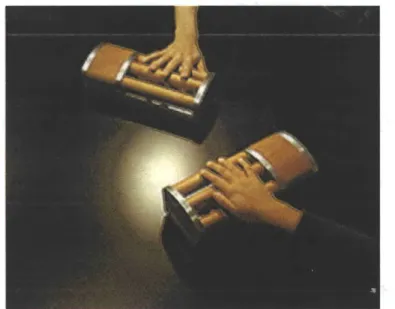
Many researchers in the Tangible User Interface community point out the posi-tive influence tactility has on intimate communication. InTouch is one of the seminal pieces of research in this area. [11] Brave et. al.'s inTouch provides a physical, syn-chronous connection between two people in the form of wooden rollers that reflect their movement to a set of counterpart rollers. If one user pushes a roller clockwise, the second user can see and feel this motion on the counterpart roller. If this sec-ond user pushes back on the roller, rotating it counterclockwise, the first will feel
the resistance created by this movement. In this way, inTouch provides a non-verbal, non-graphical link between two people, instantiated by a physical object.
Figure 2-4: inTouch support synchronous, analog, tactile communication between two peo-ple.
Chang et. al. explore this idea further with "LumiTouch." [14] Recognizing that photographs often act as social objects, Chang et. al. embedded tactile and visual affordances into a photo frame. A user can touch force-sensitive pads on the frame, causing different patterns of light to appear on a partnered frame. In this way, two people can connect over distance through objects that represent their relationship. LumiTouch thus reinforces the metaphorical role photographs already occupy.
Unlike inTouch, LumiTouch frames are explicitly coupled with particular people
- those represented by photographs in the LumiTouch frame. Indeed, this project
forms a canonical example of a magical social object. Tangible social networks can be seen as extending the closed, dyadic relationship supported by LumiTouch: tangible social networks allow many users to participate in a networked system, consisting of many such objects connecting many people.
as inTouch. [26] Gibbs et. al. point out the need for technologies that support inti-macy and social bonding, which they call "phatic technologies." They contrast such technologies with those designed for information exchange. The term "phatic tech-nologies" could be used to describe the function of magical social objects proposed here.
While Gibbs et. al.'s work does not directly contribute to the research of intimate communication in terms of implemented technologies, it does highlight the growing interest in this field. It also attempts to apply some theory to the burgeoning list of
"phatic technologies" research. (see, e.g., [15], [33], [4], [45])
Augmenting Mementos
Elise van den Hoven and others has recently argued that tangible interface research should include personal objects, or souvenirs. [59] (These terms are roughly equivalent to the term "memento" used here.) Her work includes both theoretical discussions of this argument, as well as experiments with tangible interfaces that include mementos. Mugellini et. al.'s Memodules is one of the first research projects that explicitly cites these arguments. [46]
Memodules lets users associate mementos with digital media. RFID tags are applied to a memento (for example, a seashell from a vacation to the beach). Using an RFID reader and a visual PC application, the object can be associated with arbitrary content. When placed on the reader later on, the object will conjure up that media based on the associations it has previously acquired. For example, a user could associate the seashell with sounds of the ocean and beach pictures; when the seashell was held over the memodules reader, the system would play back the ocean
sounds and display the beach pictures. The Memodules system represents an attempt to augment mementos: instead of conjuring up memories in the mind of the user, the
mementos can conjure media in the user's physical environment.
While memodules attempts to augment pre-existing, inert physical objects, Barry's Story Beads introduces a new kind of object that has memento-like qualities. [1] Story Beads consists of small beads, each which contain some static EEPROM memory which is used to store images. These beads can be strung together. A larger amulet bead can be connected with the image beads; this amulet includes a LCD screen and a simple interface. This interface allows the user to view the images stored on the beads. Importantly, the beads can be traded among users, and images can be trans-ferred from bead to bead. A desktop GUI lets users transfer fresh images onto the beads themselves, as well as associate the images with metadata.
Figure 2-5: Girls arranging a Story Bead necklace.
This work seeks to establish a link between the physical beads and the narrative data they contain, as well as to explore how groups of beads can both be viewed as whole narratives and be used to build new narratives. In this sense, Barry is exploring how physical objects can be associated with personal, social information, and how the physical objects might afford ways of understanding and manipulating that information. While the Story Beads need not represent social relationships, and
they do not function to create communication channels between users, they occupy the same symbolic space as magical social objects.
Kikin-Gil created a design prototype for a bead system that supports social communication. [36] Her "BuddyBeads" are strung together as a bracelet. Each bead is associated with either a person or an agreed-upon message. A group of people wear bracelets with similar message beads, and person beads for each member of the group.
A user can make the message beads of different members of the group vibrate by
pressing on message and person beads on her bracelet. These beads thus act somewhat like magical social objects: while the beads physically decouple the representation of people and messaging among them, as a whole they act to link a network of people via dedicated physical objects. While it does not purport to allow users to explore social links beyond those in their bracelet, the BuddyBeads concept partially fulfills the first two conditions of the tangible social network definition. Unfortunately, it is not clear whether the BuddyBeads system was implemented. Still, it provides direct inspiration for the Connectibles concept.
As a class project, Norton, Liu and Laibowitz prototyped a system that also provides direct inspiration for Connectibles; indeed, they coined the term "tangible social network." [47] Their "Clique" system consisted of customizable, tradable dolls, each doll representing its creator. These dolls were to be exchanged among a group of friends. These dolls thus act as social objects, by both explicitly representing their
creators, and by being gifts.
The dolls would be placed on a special table that could take note of their relative positions, and project this information onto a nearby wall or screen. Users could associate data with the dolls, as well as turn the doll's heads, perhaps to indicate their current feelings about the represented friends. The "Clique" system represents a first prototype of a tangible social network. Indeed, the Connectibles system is in some ways an elaboration and fuller implementation of some of the ideas latent in
the Clique prototype.
Physical Objects Are Costly Signals
All of the above work implicitly recognizes that certain properties of the physical
world naturally contribute to intimate communication. In "The Last Farewell," Ishii notes how paper and ink encode individual traits of the writer - his stroke and erasures. Susan Yee makes the same observation in reference to her examination of the handwritten notes of Corbusier. [58] Even the paper itself - how it ages, what kind of material it is composed of - contain traces and clues about the writer.
Both Ishii and Yee note that physical matter supports rich associations precisely because it can not be copied with complete fidelity or with great ease, and precisely because it acquires specific marks and wear over time. [31] Put another way, physical matter can embody signals that are hard to fake, simply because the cost to copy them is so high. The same is not true of digital media. The next section reviews social network applications that exist primarily within the digital realm.
2.5.2 Virtual Signals and Virtual Social Networks
Social networking is a potent buzzword today, and is a huge part of the Web 2.0 move-ment. There has been an explosion of internet-based, PC-mediated social networking applications, some with millions of users, some valued in the billions of dollars. We will refer to these internet-based, PC-mediated applications as virtual social networks, since the interactions are mediated via the pixel and the screen.
'It must be noted that the use of the term "virtual" is not meant to suggest that the social behavior mediated by these applications is somehow less "real" than that performed in the physical world. "Online" and "offline" could have been used instead of "virtual" and "physical," though these terms seem to positively bias online, mediated environments.
Even a cursory review of the current virtual social networks is outside the scope of this thesis. We'll focus instead on analyzing how such applications support social behavior in terms of signal cost. We pay special attention to how these applications allow users to construct and display social links.
Virtual Friends
How do users create a social network using a web-based application? The way in which users form links varies from application to application, and the signaling cost varies as well. In general, though, link formation is mediated by an explicit invitation process. 6 A user first creates a profile, filling in personal information and the like.
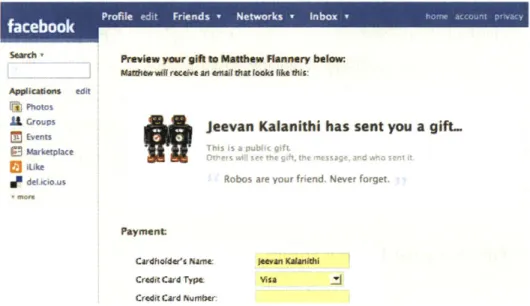
-She can then invite friends: the user types in a potential friend's email address and invite them to join her social network by clicking a button. The recipient will receive the invitation, usually via email, and can choose to accept or decline the link, also via a button click. The cost to produce a link then, is relatively low: a few clicks by both users, plus their willingness to send and accept the invitation. Declining links, however, is often perceived as rude. [51] [8] This fact tends to positively bias the creation of social links; users would rather live with a weak link in their profile than upset the inviter.
Donath and Boyd provide trenchant analyses of link formation, noting that the "friendships" formed on social networking sites are not equivalent to those found in the physical social milieu. [9] [18] Boyd has listed thirteen factors people give for forming links, or "Friending," only three of which involve actual acquaintance with the person to-be-linked. What forces, then, cause people to form links on social networking sites?
In general, because the links are publicly viewable, linking serves to create a
6
LiveJournal is an exception. This site supports a one-way linking process. A user can link to a person without that person's permission. [51]