HAL Id: halshs-00803852
https://halshs.archives-ouvertes.fr/halshs-00803852
Submitted on 23 Mar 2013
HAL is a multi-disciplinary open access
archive for the deposit and dissemination of
sci-entific research documents, whether they are
pub-lished or not. The documents may come from
teaching and research institutions in France or
abroad, or from public or private research centers.
L’archive ouverte pluridisciplinaire HAL, est
destinée au dépôt et à la diffusion de documents
scientifiques de niveau recherche, publiés ou non,
émanant des établissements d’enseignement et de
recherche français ou étrangers, des laboratoires
publics ou privés.
A pigment-processing slab from La Crozo de Gentillo (or
La Grotte de Combe-Cullier, Commune de Lacave (Lot).
Sophie A. de Beaune
To cite this version:
Sophie A. de Beaune. A pigment-processing slab from La Crozo de Gentillo (or La Grotte de
Combe-Cullier, Commune de Lacave (Lot).. Bulletin of Primitive Technology, Society of primitive technology,
2002, pp.62-64. �halshs-00803852�
A Pigment
Processing SIab
from La
Crozo
de
Gentillo
(or
La
Grotte
de
Combe-Cullier),
Commune
de
Lacaves
By
Sophie
A.
De
Beaune,
Translated by
Randall
White
The Sandstone Plaquette
ln the first publication on the site, Vire (1908:416)
men-tions 10 fragments of fine and hard-grained sandstone prob-ably from the Brive area. The largest piece measured 10 x 7 x 2 cm. They all had surfaces polished by use and, in some
cases, sloped toward
the
center.
We
assume
that
the plaquette presented here (and the two others originally ac-quired by Beloit College) was part of this groupof objects. We have no knowledge as to the
whereabouts
of the
remainder
of
the
plaquettes
or the
limestone grinding stonesalso mentioned by Vire.
This iron-rich sandstone plaquette, broken in
two
fragments,was glued
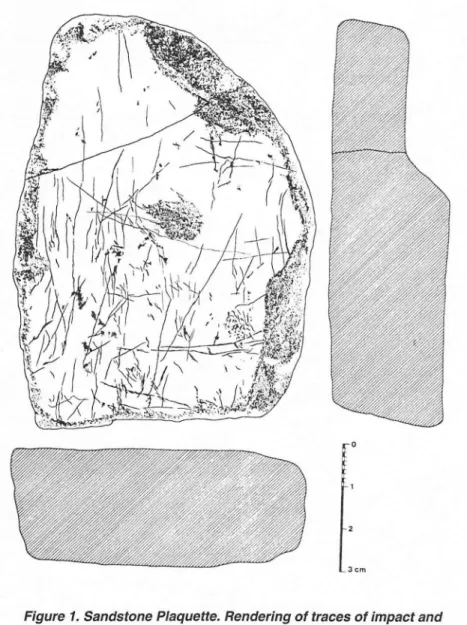
back together. lt exhibits two other ancient fracture surfaces, which seem to predate the traces of use. The plaquette measures 96.4 x 70.3 mm in its cur-rent state, and its maximum thickness is 28.8 mm.The entire plaquette is coated with red ochre (Figure 2a). The upper surface, perfectly flat, shows numerous traces of scraping easily vis-ible to the naked eye and under the binocular microscope.These stigmata are oriented
par-allel and oblique to
the
long axis, which im-plies that the object was used ina
more-or-less constant position.
ln
addition,
the
plaquette
shows some
impactscars,
mostabundant near
the
middle ofthe
upper sur-face. These scars were created bya
direct, localized blow (Figure 1). The opposing face seems not to have been employed in the same way, but it is missing a fragment and, unfortu-nately, the part that remains intact has been coated with a deposit of glue, thereby obscur-ing any traces of use (Figure 2b).Was this implement used in an active or
a passive fashion? lts size does not help us much, being perfectly compatible with use as
a working platform or with use as a hand-held, mechanically active implement. lts shape, and more specif ically the flatness of its upper face, suggests active use. Normally, in the case of passive use, we expect to see a concave sur-face. The traces of pigment which penetrate
every surface of the piece argue in favor of
active use, since an immobile platform has a better chance of remaining pristine on its bot-tom surface than an object that can be rotated
in
the
hand, inthis
case perhapsa
hand coatedwith
pig-ment. The scrapes also suggestan
active use, since theirorientation corresponds very well to what we would expect of
a
hand-held implement, in which the longitudinal axis is al-ways slightly oblique to arm movement.Nevertheless, the impact scars distributed across the
sur-face, but somewhat more abundant near the center of the
Figure
1. Sandstone Plaquette.Rendering
of
tracesof impact and
scraping visible
on
the uppersurtace. Longitudinal and
transverse profiles
of
theplaquette are
alsoillustrated.
Drawing by
S.A. de Beaune.upper face could just as easily result from passive as active
use. lf they are related to the use of pigment, as one might imagine, they were perhaps created during the breaking down
of pigment fragments, the plaquette serving as a passive plat-form
for the
applicationof
a
hard, pointed rock suchas
ahammerstone
or
a
stone pickto
reducethe
pigment frag-ments.One
can
also imagine
the
active application
of
the plaquette (percussion posee) as a mulling implement for treat-ing a particular surface (wood, bone, hide, etc.) with pigment and being used secondarily as a kind of hammer (percussion lancee).This
is in
linewith
certain composite implements which combine the two types of percussion (de Beaune 1989).The relative weight of arguments in favor of one or the
other use of
this
plaquette permit usto
conclude that this was an implement mainly used for spreading pigment, per-haps on solid but supple surfaces such as animal hides. ln addition, the plaquette was occasionally used in forceful per-cussion, either as an active or passive element.Mullers are well known in the Paleolithic, but never very abundant in a given site. There are several types: Circular or oval ones similar to those found among more recent
agricul-turalists; Globular pebbles often with intersecting wear-fac-ets; lrregularly-shaped plaquettes, like the one described here, showing use on one or more of their surfaces; Cobbles wlth one or more of their extremities heavily worn, related to grind-ing stones when use striae are perpendicular to the long axis
of the cobble. Elsewhere (de Beaune 1989)
we
have pre-sented a preliminary classification of these implements.Plaquettes of the type presented here, while not abun-dant, are found in a variety of sites. Their lack oT abundance
RËFÉRENCES
Beaune, S A. de
1987
Lampes et godets au Paléolithique. Paris: XXlllrd supplement to Gollia Préhistoire.1989
Ëssai d'une classification typologique des galets et plaquettes utilisés au Paléolithique. GalliaPréhistoire 31: 27-64.
Lorblanchet, M.
1969
Apercu sur le Magdalénien moyen etsupérieur du Haut-Quercy. Congres Préhistorique de France XIX: 256-283.
Lorblanchet, M., Delpech, E, Rensult, P. and C. Andrieux
1973
La grotte de Sainte-Eulalie a Esoagnac (Loil. Gallia Préhistoire 16 (1): 3-62 and 16 (2): 233-325.Lotblanchet, M. and A.C. Welte
1990
llart mobilier paléolithique du Quercy: Chronologie et thémes. L'Art des Objets au Palolithique, Vol. 1. Foix: Ministére de Culture, pp. 31-64.Viré, A
1908
La Crozo de Gentillo ou grotte de "Combe-Cullier." commune de Lacave.L'Anthropologie 1 9: 409-424.
is perhaps best explained by their irregular and largely unal-tered form, which led to their neglect and abandonment
dur
ing older excavations.
As
a
result,they
have seldom been published or even mentioned in the literature.Small plaquettes covered with ochre are frequently noted,
(morr)
A
plaquette carrying accession number 12527 and described as a "molette de ares rouge" is one of three such objects housed in the Logan
Museum of Anthropology
at
Beloit College. We have been unable to locate the other two, but we know that one of the three was displayed in the Museum in 1954. The object studied here comesfrom the site of Crozo de Gentillo (or the Grotte de Combe-Cullier), commune de Lacave (Lot) and was sold to the Museum in June, 1926 by Armand
Vire.
The
Logan Museum accession
card
indicates...that the object is Aurignacian.[Subsequent analysis has determined that] the tool assemblage from this site can be
attrib-uted entirely
to
Magdalenian
ll to
lV,
andLorblanchet notes that this is precisely the chro-nological position to which it was attributed suc-cessively by the Abbe Breuil, Denis Peyrony and
A. Cheynier (Lorblanchet 1969: 259).
Nevefihe-less, improvements in excavation techniques al-lowing for recovery oI microliths, which were
of-ten passed over in older excavations, have led,
in
many cases,to a
re-examinationof
assem-blages traditionally attributedto
Magdalenianll/
lll. This is
especiallytrue
of
recent findings atReignac
and Gare
de
Conze. Moreover, new excavations...have yielded two groups of levels,both of them attributable to
a
late Magdalenianwithout harpoons.
Thus, the question remains unresolved; and we still do not know if we are dealing with a middle
Magdalenian
or a
special
facies of the
finalMagdalenian. Just recently, Lorblanchet informed
us
that
hestill
attributesthe
Combe-Cullier in-dustry, as he did in 1969, to a Magdalenian withtriangles, subsequent
to
the
Magdalenian withraclettes but prior to
the
Magdalenian with har-poons. He added that Carbon 14 dating seemed to confirm this attribution as levelt
has now beendated
to
15030 BP+
330,a
date that corrobo-rates the presence of Saiga antelope in the fau-nal assemblage.* Originully published in: French Paleolithic Collections
in the Logan Museum, R.andall White and L.B. Breitborde Editors ktgan Museum Bulletin (new series),
Beloit, Wiscortsin, vol. l, no. 2, 1992.
Figure
2.
SandstonePlaquette.Top
and
bottomsurtaces.Traces oî scraping
and
impact are visible on
the uppersurtace,
asis
theochre which
impregnates the entire
sur'îace.Photo by R.
White.and we have seen many unpublished examples in public and
private collections during previous research
on
Paleolithic lamps and bowl-like stone objects.End Notes
1. I wish to thank Randall White, who gave permission
to study and publish this object (and who was kind enough to translate this article).