ORIGINAL PAPER
Reproductive strategy and singing activity: blue tit and great
tit compared
Valentin Amrhein&Lars Erik Johannessen&
Lena Kristiansen&Tore Slagsvold
Received: 6 September 2007 / Revised: 5 March 2008 / Accepted: 8 April 2008 / Published online: 4 June 2008
# Springer-Verlag 2008
Abstract The costs and benefits of bird song are likely to vary among species, and different singing patterns may reflect differences in reproductive strategies. We compared temporal patterns of singing activity in two songbird species, the blue tit (Cyanistes caeruleus) and the great tit (Parus major). The two species live side by side year round, and they have similar breeding ecology and similar rates of extra-pair paternity. However, they differ in two aspects of reproductive strategy that may have an influence on song output: blue tits are facultatively polygynous and have a fairly short breeding season with almost no second broods, whereas great tits are socially monogamous but more commonly raise second broods. We found that great tit males continued singing at high levels during the egg-laying and incubation periods, while monogamously paired blue tit males strongly reduced singing activity after the first days of egg-laying by their female. Since males of both species sang much more intensely shortly before sunrise than after sunrise, at midday or in the evening, this difference was most conspicuous at dawn. No differences in singing activity were found within species when testing for male age. We
suggest that in contrast to blue tits, great tit males continued singing after egg-laying to defend the territory and to encourage the female for a possible second brood.
Keywords Reproductive strategy . Singing activity . Dawn chorus . Blue tit . Great tit
Many animal activities take place in social contexts, and seasonal and diel patterns of activity are often linked to changes in the social environment (Helm et al. 2006). For example, during the reproductive season of songbirds, temporal patterns of territory defense and mate attraction activity may depend not only on external factors like food supply (Mace 1989a; Cuthill and Macdonald 1990), but also on the behavior of rivals (Davies and Houston 1984; Hyman et al. 2004) and on the availability of potential mates (Hasselquist and Bensch 1991). Furthermore, the value that a breeding territory has for a male songbird, and consequently the vigor with which he defends his territory, may depend greatly on the reproductive stage of his mate, e.g., if the territory serves as a paternity guard (Tobias and Seddon2000).
To defend their territory, songbirds often use song, which furthermore can serve mate attraction and mate guarding (Catchpole and Slater 1995). In several bird species, the function of singing different songs or of singing at different times of the day has been investigated by comparing vocal behavior of paired and unpaired males. In some wood warblers, for example, males were found to reduce the use of songs of a particular category once paired, indicating that this song category is more important in mate attraction than in territory defense (Spector1992). Similar-ly, unpaired nightingales (Luscinia megarhynchos) sing their highly variable song both at night and during the day,
Communicated by J. Podos
V. Amrhein
:
L. E. Johannessen:
L. Kristiansen:
T. Slagsvold Centre for Ecological and Evolutionary Synthesis (CEES), Department of Biology, University of Oslo,Oslo, Norway V. Amrhein
Research Station Petite Camargue Alsacienne, Rue de la Pisciculture,
68300 Saint-Louis, France V. Amrhein (*)
Zoological Institute, University of Basel, 4051 Basel, Switzerland
but males no longer produce nocturnal song after pair formation, indicating a role of nocturnal song in mate attraction; diurnal song, however, is sung throughout the breeding season in both paired and unpaired males (Amrhein et al.2002,2004a).
The costs and benefits of song are likely to differ not only between paired and unpaired males of the same species, but also between males of different species. Thus, a study comparing singing activity between species would be the obvious next step to investigate temporal patterns of singing activity (Mace1987a). Interspecific variation in diel patterns of vocalizing may be attributable to differences in social systems (Staicer et al.1996). A particularly suitable pair of study species seems to be the blue tit (Cyanistes caeruleus) and the great tit (Parus major). Although not as closely related as previously thought (Gill et al.2005), they are ecologically similar to the point that young can be reared by parents of the other species without any apparent influence on individual recruitment to the local breeding population in the following year (Slagsvold et al. 2002; Hansen and Slagsvold 2003; see also Dhondt 1987). The two species live side by side year round, and the similarities in ecology include fairly equal levels of extra-pair paternity as documented both in the present study population (Johannessen et al. 2005) and in another Norwegian population (Krokene et al.1998).
However, blue tits and great tits show at least two differences in reproductive strategy that are of potential importance to song output: (1) The great tit is socially monogamous in Europe (Dhondt1987; Cramp and Perrins
1993), whereas the blue tit can be seen as the only member of the Paridae that is regularly polygynous (up to 20% of males engaging in polygynous mating; Kempenaers1994). In our study population, bigamy has never been observed in great tits but occurs regularly in blue tits (see methods). (2) In northern Europe, second broods are much more common in great tits than in blue tits (De Laet and Dhondt 1989; Glutz von Blotzheim1993; Slagsvold and Rohwer2000). In 11 years of study in a Belgian population, between 10% and 50% of great tit females were found to start regular second clutches each year, as compared to a total of only three blue tit females (De Laet and Dhondt1989). Blue tits may regularly have two broods in southern Europe (e.g., in Hungary; Sasvári 1986), but in our Norwegian study population and in contrast to great tits, regular second broods have never been found (Slagsvold and Rohwer
2000). The high investment blue tit females may place in their single clutches is reflected in clutch size: No other western palearctic tit species lays more eggs in the first clutch (Glutz von Blotzheim 1993; up to 13 eggs in our study population). In Belgium, the average weight loss in blue tit females feeding nestlings was about twice that in great tit females (8.6% versus 4.0% of the initial weight),
and on average, blue tit females raised as many young in one single brood (8.9) as great tit females did in two broods (8.8; De Laet and Dhondt 1989). In our Norwegian study population, in a few blue tit pairs for which second broods were induced through experimental reduction of the size of first broods, only female parents were observed to feed second-clutch young, perhaps because the male gave priority to molt (Slagsvold and Rohwer 2000). In contrast, in great tit pairs facing experimental brood reduction of the first clutch, also males were observed feeding second-clutch young. It has been shown that late breeding causes delayed molt and reduces winter survival in blue tits (Nilsson and Svensson1996), which may explain why second broods are rare in northern populations of that species (Slagsvold and Rohwer2000).
Here, we investigated temporal patterns of singing activity in blue tit and great tit males across the breeding cycle, from nest building to egg laying and through incubation. If song serves mainly to attract additional social mates, we predicted that blue tit males but not great tit males would maintain high singing activity beyond nest-building and egg-laying. In contrast, if song serves mainly to maintain a territory for a possible second brood, we predicted great tit males but not blue tit males to continue singing after the initial egg-laying period had finished.
In both tit species, singing at dawn seems to be influenced by the behavior of the female (Hinde 1952; Mace 1986; Gorissen and Eens 2004) and has also been suggested to be confined to the time shortly before and during egg laying (the fertile period: Mace 1987a, b; Foerster et al.2002). Because blue tits and great tits do not only sing at dawn but also at other times of the day (Hinde
1952), and because the degree to which the social context influences singing activity may vary depending on time of day (Amrhein et al. 2004a), we investigated seasonal changes of singing activity at four different times of the day: before sunrise, after sunrise, at midday, and in the evening.
Methods Study population
The study was conducted under licenses from the Direc-torate for Nature Management and the National Animal Research Authority in Norway. Data were collected in a nest-box plot of 1.6 km2at Dæli, near Oslo, Norway, from 1999 to 2007, with most observations made in 2005. Throughout the predominantly deciduous forest, about 450 nest boxes have been provided. Each year, about 70–80 great tit and 80–100 blue tit pairs nest in these nest boxes, along with similar numbers of pied flycatchers (Ficedula
hypoleuca) and a few nuthatches (Sitta europaea) and coal tits (Parus ater). Nest boxes were checked on a regular basis, at least twice a week, from early spring to the end of the nestling period, to record the stages of the breeding cycle. Similarly, singing males and their mates were identified and regularly checked by reading the codes of their color rings at the whole study plot and throughout the breeding season. For the present study, the age of most of our subjects was known because they had been ringed as nestlings; in the case of immigrant birds, the age class was determined following Jenni and Winkler (1994) as being 1 year (yearlings) or older. The nestlings were ringed with a metal ring and one or two color rings. Most recruits were caught at feeding sites in fall and given unique combina-tions of color rings.
At the study site, interspecific cross-fostering has been carried out between several passerine species since 1995 (Slagsvold et al.2002; Hansen and Slagsvold2003). In the present study, we focused on control blue tit and great tit males that were not cross-fostered (immigrants from outside the study area, or raised within the study area, but by conspecific parents). In 2005, all of the 57 control great tit males breeding in the study area were socially monoga-mous, while seven of the 74 control blue tit males were simultaneously bigamous. In fact, non-crossfostered great tits have never been observed to mate bigamously at the study site or, to our knowledge, in other European study populations (Dhondt 1987; Cramp and Perrins 1993). In our study population, about 30% of blue tit and great tit broods contained at least one extra-pair young, and 7% of all blue tit young and 9% of all great tit young were extra-pair young (Johannessen et al.2005).
In great tits, during the period from 1999 to 2007, five confirmed instances of regular second broods were recorded at the study site (i.e., clutches laid after successful fledging of one or more chicks from a previous clutch). During the same period, no regular second broods were recorded in blue tits. These numbers most likely underes-timate the occurrence of regular second broods, as surveillance of the nest boxes was usually less regular late in the season; however, they are consistent with the findings of an earlier study (1995 to 1996) on the same population where the nest boxes were inspected frequently also late in the breeding season and where some regular second broods were found in great tits but none in blue tits (Slagsvold and Rohwer 2000). In this earlier study, only after experimental reduction of first broods down to two nestlings did four blue tit females produce second broods. Singing activity
Four rounds of inspection were made on the study site each day throughout the breeding season from 12 April to 10
June 2005. For the analyses of seasonal patterns of singing activity, we considered the pre-laying, egg-laying, and incubation periods of regular first broods. Data were collected from 14 April to 26 May for blue tits, and from 13 April to 28 May for great tits. Singing activity of a male is expressed as the number of rounds per day or per period of the breeding season on which it was heard singing (Amrhein et al. 2002, 2004a, b). For the rounds of inspection, we alternated between two fixed routes from day to day, so that singing activity data for a subject were collected every other day. The two routes were 1.9 and 2.1 km in length, and the duration of each round was about 30 min. The directions of the rounds were alternated on a daily basis, i.e., on a given day all four rounds of a particular route were made in the same direction, and 2 days later all four rounds of the same route were made in the opposite direction. During each round, a male was recorded as having sung only if it sang during a period of 30 s while we were passing by its territory (Amrhein et al.
2004a). Each day, the dawn round was made from 30 min before sunrise until sunrise, the morning round started 30 min after sunrise, the midday round started at 13:19 h CEST (halfway between sunrise and sunset) throughout the field season, and the evening round started 2 h before sunset (due to the long daylight periods in northern latitudes, there was hardly any singing activity around sunset; see Mace1989b). The minutes of sunrise and sunset were taken as given at http://www.sunrisesunset.com for Oslo, Norway.
Singing activity data are from 19 blue tit males (15 immigrants, 4 raised within the study area by conspecific parents; 7 yearlings, 10 older birds, 2 birds of unknown age) and from 15 great tit males (11 immigrants, 4 raised within the study area by conspecific parents; 3 yearlings, 10 older birds, 2 birds of unknown age). Additionally, we had data on singing activity from two simultaneously bigamous blue tit males, but we excluded those birds from the analysis since the males sang in enlarged territories, and their singing activity could therefore not be reliably checked. Hence, in the present analysis, all data are from socially monogamous males.
The 19 females of our blue tit subjects laid their first egg on 30 April ±4.7 days (mean ± SD), and the 15 great tit females laid their first egg on 2 May ±5.4 days. For the analyses of seasonal patterns of singing, the pre-laying period of the breeding season was defined as starting 11 days before the first egg was laid, so that, because rounds were done every other day, for every subject there were 5 days with census data before the start of egg-laying. The egg-laying period was defined as lasting from the day the first egg was laid until the day the penultimate egg was laid. Clutch sizes ranged from 7 to 11 (mean ± SD=9.3± 1.4) for the 19 blue tits and from 5 to 10 (7.2±1.4) for the
15 great tits. In both species, females usually laid one egg per day, but six blue tit females and one great tit female made longer pauses between laying of two eggs or between the end of egg-laying and the start of incubation. The number of census days in the egg-laying period ranged from 3 to 10 (5.2±1.5) for blue tits and from 3 to 9 (4.1± 1.5) for great tits. The data for the incubation period were collected during a period of 10 days starting the day the last egg was laid (with the exception of the females that delayed the start of incubation after laying the last egg), so that again there were 5 days with census data per subject after the clutch was completed.
Start of dawn singing
Differences in singing activity before sunrise between the two study species could potentially be due to species-specific differences in start of singing before sunrise. For example, one species might sing for a shorter time period before sunrise, or show a different seasonal development in start time than the other species, in which case our measure of singing activity would be biased. We therefore studied how the seasonally changing start times of dawn singing differed between the two tit species. Data on the start of dawn singing were obtained between 22 April and 29 May in three different years (2002, 2003 and 2005). To record dawn song, we were present near the territory of a focal male well before the start of dawn singing and noted the hour and minute the male started to sing. Data were pooled from the 3 years, but all data points were independent, i.e., were obtained from different individuals, and, within years, we obtained data from only one individual per day. Because older males may start singing earlier before sunrise than yearling birds (Poesel et al.2006), we only considered data on non-crossfostered yearling males. Data are from 9 blue tits and from 10 great tits.
Data analysis
Data analysis was done using R 2.5.1 (R Development Core Team 2007). Model simplification was done using backward deletion following Crawley (2007). From the maximal models including all factors and second-order interactions, we removed non-significant (P>0.05) terms, starting with the least significant second-order interactions. For the analysis of the start of dawn singing, we used ANCOVA, and the response variable (minute relative to sunrise) was square root transformed. In the analyses of the singing activity data, we accounted for the repeated sampling of the same individuals, and thus, the non-independence of data points, by using mixed effects models with individual subject as a random factor. The response variable (singing activity) was binary (a bird either did or
did not sing), and to account for the binomial error distribution we fitted generalized linear mixed models (GLMM) using the lmer function in R (package lme4, version 0.99875-1). The species (blue tit or great tit) was included as a fixed factor, and time of season and time of day were included as ordered fixed factors. For the parameter estimates from the fitted GLMM, we obtained 95% confidence intervals using Markov Chain Monte Carlo methods (mcmcsamp function in R, package lme4). In the figures, we give the mean values of singing activity with bootstrapped 95% confidence intervals (10,000 iterations).
Results Singing activity
To test for an effect of male age on singing activity, we fitted a first generalized linear mixed model (GLMM) using a reduced data set in which two great tits and two blue tits of unknown age were excluded. None of the two-way interactions were significant (species × age,χ2=1.12, df=1, P=0.29; time of day × age,χ2=4.14, df=3, P=0.25; season × age,χ2=2.89, df=2, P=0.24), nor was the main effect of age significant (χ2=0.06, df=1, P=0.80). Because yearling males and older birds seemed not to differ with respect to singing activity, we excluded the variable‘age’ and included the birds of unknown age in all further analyses of singing activity.
In a GLMM using data from all subjects (Table 1), the interactions season × time of day (χ2=9.87, df=6, P=0.13) and species × time of day (χ2
=7.01, df=3, P=0.07) were not significant, indicating that seasonal patterns of singing activity, when averaged across species, did not vary strongly with time of day and that diel patterns of singing activity were similar in both species. However, the interaction species × season was significant (χ2
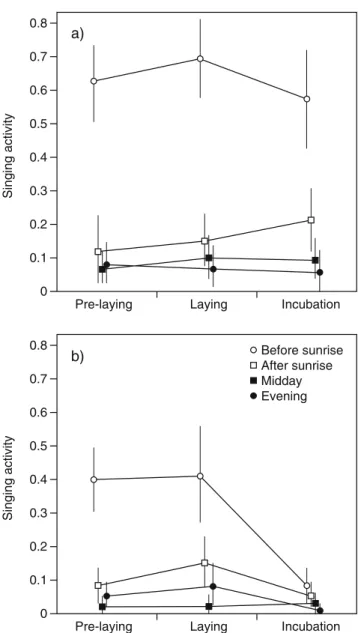
=15.94, df=2, P<0.001), reflecting the finding that in contrast to great tits, blue tits strongly reduced their singing activity during the incubation period, particularly before sunrise (Fig.1). The main effect of time of day on singing activity was significant (χ2
=349.52, df=3, P<0.001): both the blue tits and the great tits had a peak of song before sunrise but strongly reduced singing activity later during the day (Fig. 1).
When averaged across species and times of the season, male tits sang during 45% of the census rounds before sunrise and during 13% of the rounds shortly after sunrise, but only during 5% of the afternoon rounds and during 6% of the evening rounds. Thus, when including the afternoon and evening rounds into the analysis, the variation in singing activity among the seasonal periods and between the species was hard to detect because with almost no
singing activity, there was also almost no variation in singing activity during those hours. Indeed, when including only data from the two morning rounds into the model (Table 2), all three two-way interactions were significant: the diel patterns of singing activity were different between the species, with great tits singing more before sunrise than blue tits (Fig.1; species × time of day:χ2=6.78, df=1, P= 0.009), and the seasonal patterns differed between times of the day (season × time of day: χ2=7.28, df=2, P=0.026) and between species (species × season: χ2=13.66, df=2, P=0.001), again reflecting the finding that in contrast to great tits, blue tits reduced their singing activity during the incubation period particularly before sunrise (Fig.1).
A day-by-day analysis showed the difference in seasonal patterns of singing between blue tits and great tits on a finer scale (Fig.2): the only time that blue tits seemed to sing about as much as great tits was on the day or on the day after their females laid the first egg. After that, singing activity soon dropped to low levels in blue tits but stayed high or even increased in great tits until the first days of incubation.
Start of dawn singing
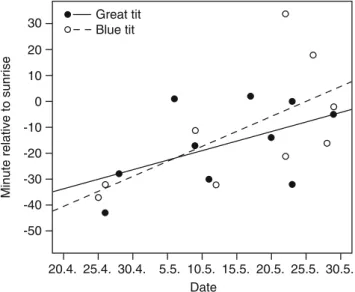
We used an ANCOVA to examine how the start time of dawn singing (minute relative to sunrise) was related to time of the season (date) or differed between yearling blue tits and great tits (species). We found no significant difference in the slopes of the regressions of start time on date between the two species (interaction date × species, F1,15=0.08, P=0.78), indicating that the seasonal patterns in the start of dawn singing were similar for both species (Fig.3). Furthermore, we found no significant differences in start time between blue tits and great tits (main effect species, F1,16=0.11, P=0.74). In our remaining minimal adequate
model (r2=0.42), start time of dawn singing depended on the date (F1,17=12.19, P=0.003), with later start times relative to sunrise as the season progressed (Fig.3).
Dawn singing also occurred well before the onset of breeding. For example, on 22 March 2006, a day with heavy snow cover at the study site, four great tit males started to sing between 25 and 6 min before sunrise (mean ± SD=14.5±7.8), and four blue tit males started to sing between 14 and 2 min before sunrise (7.7±6.1).
Discussion
Seasonal patterns of singing differed between species: blue tit males strongly reduced singing activity after the first days of egg-laying by their females, while great tit males continued singing at high levels during the egg-laying and incubation periods. Since males of both species sang much more intensely shortly before sunrise than at other times of the day, this difference between the species was most conspicuous with respect to dawn singing activity.
The decreasing dawn singing activity in blue tits that we found in our study could be due to two potentially confounding factors. First, the low dawn singing activity after the first days of egg-laying could be due to blue tits starting to sing much later than great tits in the mornings and shifting their peak of singing activity to a time of the day that was not covered by our rounds of inspection. However, the start of dawn singing relative to sunrise was similar in both species, and although the males started to sing relatively later as the season progressed, this pattern was the same in blue tits and great tits. Second, the facultatively polygynous blue tit subjects might have stopped singing in the focal territory after the fertile period of their females to sing in another territory. However, we
Table 1 Parameter values for the minimal adequate GLMMaof singing activity of n=15 great tit males and n=19 blue tit males as a function of time of season, species, and time of day (all four times of day included)
Fixed effects Estimate SE z P CIb
Intercept −1.51 0.14 −11.06 <0.001 −1.78 −1.27 Season (L)c 0.05 0.18 0.31 0.76 −0.32 0.44 Season (Q) −0.19 0.19 −0.99 0.32 −0.57 0.23 Time of day (L) −2.11 0.16 −13.11 <0.001 −2.47 −1.81 Time of day (Q) 1.00 0.17 5.93 <0.001 0.67 1.36 Time of day (C) 0.03 0.18 0.20 0.84 −0.29 0.39 Species −1.27 0.19 −6.52 <0.001 −1.67 −0.93 Season (L) × Species −1.08 0.29 −3.68 <0.001 −1.74 −0.49 Season (Q) × Species −0.58 0.27 −2.16 0.03 −1.18 −0.04 BICd=493, scale parameter =1.02; random effects (variance): individual subject=0.09, subject × season=0.10
a
Generalized linear mixed model fit using Laplace
b
Lower and upper limits of 95% confidence intervals using Markov Chain Monte Carlo methods
c
Polynomial contrasts: L linear, Q quadratic, C cubic
d
regularly checked the identity of all singing males at the study site, and we doubt that many blue tit males could have defended a second territory without our knowledge; moreover, at our study site, the mates of bigamous blue tit males usually breed within the same, enlarged territory, as has been recorded in a Belgian study population (Kempenaers 1994).
We propose that the patterns we found truly indicate a reduction of singing activity in blue tit males after the first days of egg laying. We suggest that the different singing patterns reflect differences in the reproductive strategies of the species. Blue tit males are facultatively polygynous, and in fact, seven of 74 males at our study site had two social mates at the same time. However, the monogamously
paired blue tit subjects in our study apparently did not use high singing activity after the egg-laying period of their first mate in an attempt to attract additional social mates. Bigynous blue tit males may be paired to both females already before egg-laying by the first female commences, or they may obtain the second female from a neighboring couple of which the male died (Kempenaers1994). Hence, also in cases in which males are bigynous, high song output may not be needed in male blue tits over an extended period of time because most females in our population start egg laying rather synchronously. In 2005, the mean interval between start of egg-laying of the two mates of seven bigynous males was only five (SD=5.6) days.
In contrast, the great tit males, although considered strictly socially monogamous (Dhondt 1987; Cramp and Perrins1993), continued singing after the egg-laying period of their mates. Therefore, singing after the fertile period of the female would presumably not serve to attract additional social mates in either species. Rather, singing late in the season might at least in great tits serve to defend the territory or to encourage the female for subsequent breeding attempts. In northern latitudes, a general difference between the species seems to be that great tits have more potential for a second brood than blue tits (De Laet and Dhondt
1989; Slagsvold and Rohwer2000). Blue tits, on the other hand, seem to invest more resources into one single breeding attempt: In a Belgian population with regular second broods in great tits, blue tits have been shown to raise as many young in one single brood as great tits do in two broods (De Laet and Dhondt 1989). The potential of great tits to lay a second clutch may explain why, after the first clutch is laid, great tits seem to be more closely attached to their territory than blue tits (Hinde 1952), and why they continue to sing at high rates (this study). The early reduction of singing in blue tits seems to fit with the observations by Slagsvold and Rohwer (2000) that in contrast to great tit males, blue tit males did not feed young in the few second broods that were found at our study site (induced by experimental brood reduction), and that moult starts earlier in blue tit males than in great tit males. During feeding the fledglings, great tit parents usually remain on or near their territory (Hinde 1952), so the territory may still be defended using song because it is important for providing food for the current or subsequent broods. In contrast, after fledging of the young, blue tit families may be less dependent on feeding in the nesting area than great tits, and thus, blue tit males may have less motivation for singing late in the breeding season. A few observations from our study area in the post-fledging period suggest that blue tit families forage farer away from their recent nesting site than great tits, but more data are needed to make firm conclusions. Alternatively, song after the start of egg laying may be important to encourage and retain the
Pre-laying Laying Incubation 0 0.8 0.7 0.6 0.5 0.4 0.3 0.2 0.1 Singing activity
Pre-laying Laying Incubation 0 0.8 0.7 0.6 0.5 0.4 0.3 0.2 0.1 Singing activity a) b) Before sunrise After sunrise Midday Evening
Fig. 1 Singing activity of a great tit (n=15) and b blue tit (n=19) males during three periods of the breeding cycle, at four different times of the day. Singing activity of a male is expressed as the proportion of rounds per period on which it was heard singing (mean and bootstrapped 95% confidence interval)
female (Slagsvold and Rohwer2000; Amrhein et al. 2002; Verhulst2003). Indeed, great tit females are more likely to start a second clutch when their mate sings at high rates while rearing the first brood (Verhulst2003).
Singing after the start of egg laying in both species could also serve to protect paternity by repelling rival males or by stimulating the mate to solicit copulations (Mace 1987b; Pinxten and Eens 1998). In fact, the day-by-day analysis showed that blue tit males had a peak of singing shortly before and during the first few days of egg-laying, which are generally considered the fertile period of females and which coincide with the highest frequency of copulations in that species (Kempenaers et al.1995). Particularly singing at dawn has been interpreted as a signal towards the mate or towards extrapair mates in several species of tits (Welling et al.1997; Poesel et al.2006); for example, female great tits
vocally interact from inside the nest box with their singing mate at dawn (Gorissen and Eens 2004). However, we stress that dawn singing could still be important as a male– male signal. Great tits, blue tits, and other tit species generally stop dawn singing when the mate leaves the nestbox around sunrise (Mace 1986; Welling et al. 1997; Gammon 2004; Poesel et al.2004), but sing for a longer time when their females are experimentally held in their nestboxes (Mace 1986; Welling et al. 1997). This is consistent with the hypothesis that dawn song is directed towards other males but, during the fertile period, stops after the female leaves the nest box because mate guarding or within-pair copulations actually conflict with singing (Morse1989; Slagsvold et al.1994). Dawn singing in great tits and blue tits was suggested to be confined to the time shortly before and during egg laying (Mace 1987a, b;
Table 2 Parameter values for the minimal adequate GLMMaof singing activity of n=15 great tit males and n=19 blue tit males as a function of time of season, species, and time of day (only two times of day included: before sunrise and after sunrise)
Fixed effects Estimate SE z P CIb
Intercept −0.59 0.16 −3.68 <0.001 −0.91 −0.30 Season (L)c 0.20 0.22 0.89 0.37 −0.27 0.69 Season (Q) −0.20 0.23 −0.83 0.41 −0.70 0.30 Time of day (L) −1.64 0.17 −9.48 <0.001 −2.01 −1.32 Species −1.18 0.23 −5.15 <0.001 −1.66 −0.78 Time of day (L) × Species 0.67 0.26 2.60 0.009 0.16 1.18 Season (L) × Time of day (L) 0.60 0.23 2.65 0.008 0.16 1.06 Season (Q) × Time of day (L) 0.16 0.21 0.74 0.46 −0.26 0.58 Season (L) × Species −1.15 0.34 −3.39 <0.001 −1.92 −0.48 Season (Q) × Species −0.58 0.32 −1.82 0.07 −1.28 0.09 BICd=320, scale parameter =0.97; random effects (variance): individual subject=0.11, subject × season=0.13
Superscripts are as in Table1
0 0.5 0.4 0.3 0.2 0.1 Singing activity 1 -1 3 5 7 9 11131517192123252729 -9 -7 -5 -3
Day relative to first egg
Great tit Blue tit
Fig. 2 Singing activity relative to egg laying by the mate in great tit (n=15) and blue tit (n=19) males. Singing activity of a male is expressed as the proportion of four rounds per day on which it was heard singing (mean and bootstrapped 95% confidence interval). Data were collected every other day, so that day=1 is the day the first or the second egg was laid, and day=−1 is the last or the second-last day before the first egg was laid
-50 30 20 10 0 -10 -20 -30 -40
Minute relative to sunrise
30.5. 25.5. 20.5. 15.5. 10.5. 5.5. 30.4. 25.4. 20.4. Date Great tit Blue tit
Fig. 3 Start of dawn singing through the season. Regressions of start time (minute relative to sunrise) on date for yearling great tit (n=10) and blue tit (n=9) males
Foerster et al.2002); however, our study shows that dawn singing starts well before the fertile period of females and is, at some level, continued also after that period, which argues against an exclusive role of dawn singing as a means for mate guarding. Furthermore, a female removal experi-ment showed that unpaired male great tits, having no mate to guard, sing as much at dawn as paired males (Slagsvold et al.1994; see also Liu2004).
In this study, we found differences in seasonal singing activity patterns between blue tits and great tits. We attributed those differences to the different reproductive strategies. Follow-up studies might focus on song patterns in more southern areas where blue tits do have second broods, and compare singing activity of monogamously and bigamously paired blue tits. There may be great differences even between closely related species with respect to the functions of song depending on the time of day or season. Singing during the dawn chorus may be directed mainly to males or to females depending on the species. For example, the hour of the dawn chorus in the superb fairy wren (Malurus cyaneus) is used by females to prospect for extrapair mates (Double and Cockburn2000), while in the nightingale (Luscinia megarhynchos) it is used by males to prospect for territories (Amrhein et al. 2004b). There is some evidence that male and female great tits visit other territories after sunrise (Kacelnik and Krebs1983; Otter et al. 1999). Investigating whether prospecting in males or females occurs also before sunrise could give further insight into the possible addressees of dawn song in the blue tit and the great tit.
Acknowledgements We thank Jo Franckx, Eirik Grønningsæter and Dávid Kováts for help in the field, and the Haakonsen, Johnsen, Johnsrud and Vestgård families for kind permissions to work on their premises. Bo Terning Hansen, Pius Korner, Fraenzi Korner-Nievergelt and Hans-Rudolf Roth gave invaluable comments during field work and data analysis. The research was funded by grants to V.A. from the Swiss National Science Foundation, the Nikolaus und Bertha Burckhardt-Bürgin-Stiftung and the Basler Stiftung für experimentelle Zoologie.
References
Amrhein V, Korner P, Naguib M (2002) Nocturnal and diurnal singing activity in the nightingale: correlations with mating status and breeding cycle. Anim Behav 64:939–944
Amrhein V, Kunc HP, Naguib M (2004a) Seasonal patterns of singing activity vary with time of day in the Nightingale (Luscinia megarhynchos). Auk 121:110–117
Amrhein V, Kunc HP, Naguib M (2004b) Non-territorial nightingales prospect territories during the dawn chorus. Proc R Soc Lond B (Suppl.) 271:S167–S169
Catchpole CK, Slater PJB (1995) Bird song: biological themes and variations. Cambridge University Press, Cambridge
Cramp S, Perrins, CM (eds) (1993) The birds of the Western Palearctic, vol 7. Oxford University Press, Oxford
Crawley MJ (2007) The R Book. Wiley, Chichester
Cuthill IC, Macdonald WA (1990) Experimental manipulation of the dawn and dusk chorus in the blackbird Turdus merula. Behav Ecol Sociobiol 26:209–216
Davies NB, Houston AI (1984) Territory economics. In: Krebs JR, Davies NB (eds) Behavioural ecology: an evolutionary approach. 2nd edn. Sinauer, Sunderland, Massachusetts, pp 148–169 De Laet JF, Dhondt AA (1989) Weight loss of the female during the
first brood as a factor influencing second brood initiation in great tits Parus major and blue tits Parus caeruleus. Ibis 131:281–289 Dhondt AA (1987) Polygynous blue tits and monogamous great tits: does the polygyny-threshold model hold? Am Nat 129:213–220 Double M, Cockburn A (2000) Pre-dawn infidelity: females control extra-pair mating in superb fairy-wrens. Proc R Soc Lond B 267:465–470
Foerster K, Poesel A, Kunc H, Kempenaers B (2002) The natural plasma testosterone profile of male blue tits during the breeding season and its relation to song output. J Avian Biol 33:269–275 Gammon DE (2004) Black-capped chickadee dawn chorus and
subsequent sexual activity. Wilson Bull 116:252–256
Gill FB, Slikas B, Sheldon FH (2005) Phylogeny of titmice (Paridae): II. Species relationships based on sequences of the mitochondrial cytochrome-b gene. Auk 122:121–143
Glutz von Blotzheim UN (ed) (1993) Handbuch der Vögel Mitteleuropas, Band 13/1. AULA-Verlag, Wiesbaden
Gorissen L, Eens M (2004) Interactive communication between male and female great tits (Parus major) during the dawn chorus. Auk 121:184–191
Hansen BT, Slagsvold T (2003) Rival imprinting: interspecifically cross-fostered tits defend their territories against heterospecific intruders. Anim Behav 65:1117–1123
Hasselquist D, Bensch S (1991) Trade-off between mate guarding and mate attraction in the polygynous great reed warbler. Behav Ecol Sociobiol 28:187–193
Helm B, Piersma T, Van der Jeugd H (2006) Sociable schedules: interplay between avian seasonal and social behaviour. Anim Behav 72:245–262
Hinde RA (1952) The behaviour of the great tit (Parus major) and some other related species. Behav Suppl 2:1–207
Hyman J, Hughes M, Searcy WA, Nowicki S (2004) Individual variation in the strength of territory defense in male song sparrows: correlations of age, territory tenure, and neighbor aggressiveness. Behaviour 141:15–27
Jenni L, Winkler R (1994) Moult and ageing in European passerines. Poyser, London
Johannessen LE, Slagsvold T, Hansen BT, Lifjeld JT (2005) Manipulation of male quality in wild tits: effects on paternity loss. Behav Ecol 16:747–754
Kacelnik A, Krebs JR (1983) The dawn chorus in the great tit (Parus major): proximate and ultimate causes. Behaviour 83:287–309
Kempenaers B (1994) Polygyny in the blue tit: unbalanced sex ratio and female aggression restrict mate choice. Anim Behav 47:943– 957
Kempenaers B, Verheyen GR, Dhondt AA (1995) Mate guarding and copulation behaviour in monogamous and polygynous blue tits: do males follow a best-of-a-bad-job strategy? Behav Ecol Sociobiol 36:33–42
Krokene C, Rigstad K, Dale M, Lifjeld JT (1998) The function of extrapair paternity in blue tits and great tits: good genes or fertility insurance? Behav Ecol 9:649–656
Liu W-C (2004) The effect of neighbours and females on dawn and daytime singing behaviours by male chipping sparrows. Anim Behav 68:39–44
Mace R (1986) The importance of female behaviour in the dawn chorus. Anim Behav 34:621–622
Mace R (1987b) The dawn chorus in the great tit Parus major is directly related to female fertility. Nature 330:745–746 Mace R (1989a) The relationship between daily routines of singing
and foraging: an experiment on captive Great Tits Parus major. Ibis 131:415–420
Mace R (1989b) A comparison of great tits' (Parus major) use of time in different daylengths at three European sites. J Anim Ecol 58:143–151
Morse DH (1989) Song patterns of warblers at dawn and dusk. Wilson Bull 101:26–35
Nilsson J-Å, Svensson E (1996) The cost of reproduction: a new link between current reproductive effort and future reproductive success. Proc R Soc Lond B 263:711–714
Otter K, McGregor PK, Terry AMR, Burford FRL, Peake TM, Dabelsteen T (1999) Do female great tits (Parus major) assess males by eavesdropping? A field study using interactive song playback. Proc R Soc Lond B 266:1305–1309
Pinxten R, Eens M (1998) Male starlings sing most in the late morning, following egg-laying: a strategy to protect their paternity? Behaviour 135:1197–1211
Poesel A, Dabelsteen T, Pedersen SB (2004) Dawn song of male blue tits as a predictor of competitiveness in midmorning singing interactions. Acta Ethol 6:65–71
Poesel A, Kunc HP, Foerster K, Johnsen A, Kempenaers B (2006) Early birds are sexy: male age, dawn song and extrapair paternity in blue tits, Cyanistes (formerly Parus) caeruleus. Anim Behav 72:531–538
R Development Core Team (2007) R: A language and environment for statistical computing. R Foundation for Statistical Computing, Vienna, Austria.http://www.R-project.org
Sasvári L (1986) Reproductive effort of widowed birds. J Anim Ecol 55:553–564
Slagsvold T, Rohwer S (2000) Sexual conflict in birds with biparental care: should a parent desert a brood with low reproductive value? Ornis Norvegica 23:38–49
Slagsvold T, Dale S, Sætre G-P (1994) Dawn singing in the great tit (Parus major): mate attraction, mate guarding, or territorial defence? Behaviour 131:115–138
Slagsvold T, Hansen BT, Johannessen LE, Lifjeld JT (2002) Mate choice and imprinting in birds studied by cross-fostering in the wild. Proc R Soc Lond B 269:1449–1455
Spector DA (1992) Wood-Warbler song systems - A review of paruline singing behaviors. Curr Orn 9:199–238
Staicer CA, Spector DA, Horn AG (1996) The dawn chorus and other diel patterns in acoustic signaling. In: Kroodsma DE, Miller EH (eds) Ecology and evolution of acoustic communication in birds. Cornell University Press, Ithaca, New York, pp 426–453 Tobias J, Seddon N (2000) Territoriality as a paternity guard in the
European robin, Erithacus rubecula. Anim Behav 60:165– 173
Verhulst S (2003) Song as a signal to negotiate a sexual conflict? Anim Biol 53:159–171
Welling P, Koivula K, Orell M (1997) Dawn chorus and female behaviour in the willow tit Parus montanus. Ibis 139:1–3