https://doi.org/10.4224/8914267
READ THESE TERMS AND CONDITIONS CAREFULLY BEFORE USING THIS WEBSITE.
https://nrc-publications.canada.ca/eng/copyright
Vous avez des questions? Nous pouvons vous aider. Pour communiquer directement avec un auteur, consultez la première page de la revue dans laquelle son article a été publié afin de trouver ses coordonnées. Si vous n’arrivez pas à les repérer, communiquez avec nous à [email protected].
Questions? Contact the NRC Publications Archive team at
[email protected]. If you wish to email the authors directly, please see the first page of the publication for their contact information.
NRC Publications Archive
Archives des publications du CNRC
For the publisher’s version, please access the DOI link below./ Pour consulter la version de l’éditeur, utilisez le lien DOI ci-dessous.
Access and use of this website and the material on it are subject to the Terms and Conditions set forth at
Addressing the Problem of Finding a Single Vital Edge in a Maximum
Flow Graph
Barton, Alan
https://publications-cnrc.canada.ca/fra/droits
L’accès à ce site Web et l’utilisation de son contenu sont assujettis aux conditions présentées dans le site LISEZ CES CONDITIONS ATTENTIVEMENT AVANT D’UTILISER CE SITE WEB.
NRC Publications Record / Notice d'Archives des publications de CNRC:
https://nrc-publications.canada.ca/eng/view/object/?id=033a53c8-1641-405b-af69-ce51ac53cab4
https://publications-cnrc.canada.ca/fra/voir/objet/?id=033a53c8-1641-405b-af69-ce51ac53cab4
National Research Council Canada Institute for Information Technology Conseil national de recherches Canada Institut de technologie de l'information
Addressing the Problem of Finding a Single
Vital Edge in a Maximum Flow Graph*
Barton, A.
November 2005
* published as NRC/ERB-1129. 4 pages. NRC 48305.
Copyright 2005 by
National Research Council of Canada
Permission is granted to quote short excerpts and to reproduce figures and tables from this report, provided that the source of such material is fully acknowledged.
National Research Council Canada Institute for Information Technology Conseil national de recherches Canada Institut de technologie de l'information
Addre ssing t he Proble m of
Finding a Single V it a l Edge in
a M a x im um Flow Gra ph
Barton, A.
November 2005
Copyright 2005 by
National Research Council of Canada
Permission is granted to quote short excerpts and to reproduce figures and tables from this report, provided that the source of such material is fully acknowledged.
ERB-1129
Addressing the Problem of
Finding a Single Vital Edge in a Maximum Flow Graph
∗Alan J. Barton
†Integrated Reasoning Group Institute for Information Technology National Research Council Canada
Ottawa, Canada, K1A 0R6
[email protected]
ABSTRACT
A first attempt is made to understand some of the theoreti-cal considerations in the design of a solution to the problem of finding a vital edge in a flow graph G. Examples are used to conjecture the existence of four equivalence classes for the set of all possible flow graphs; both of which (counter examples and partitions) are presented in sufficient detail as to allow the possibility of potentially deriving a specific algorithm and hence implementation.
Keywords
vital edge, maximal flow, algorithm design
1.
INTRODUCTION
The maximal flow problem [3] was formulated by T. Harris as follows:
Consider a rail network connecting two cities by way of a number of intermediate cities, where each link of the network has a number assigned to it representing its capacity. Assuming a steady state condition, find a maximal flow from one given city to the other.
Which states that a linear programming problem formula-tion could be made [3], and thus solved (not necessarily most efficiently in all cases) by the simplex method [2].
2.
PROBLEM STATEMENT
∗Problem from Assignment 2 for the course COMP5703 en-titled Design and Analysis of Algorithms at Carleton Uni-versity
†Master of Computer Science (in progress)
This paper attempts to propose a solution to the problem as stated by Prof. Maheshwari: Assume that we have a network flow graph G = (V, E) with positive capacities on each of the edges and two specified vertices s and t. Suggest an efficient algorithm to find an edge in E, such that setting its capacity to zero (i.e. deleting this edge) will result in the largest decrease in the maximum flow in the resulting graph.
2.1
Related Problems
It was found after the assignment submission, that i) the search for an optimal arc can be restricted to one of the n − 1 arcs in any maximal spanning tree[1] and ii) in the network inhibition problem[5], we wish to find the most cost-effective way to reduce the ability of a network to transport a commodity. Potential applications include disabling pol-luting pipe systems, military supply lines, and illicit drug networks. We wish to compute a fixed-budget attack strat-egy which will maximally inhibit a network’s capability. Further, a related problem to the one of vital edge deletion, is one of vital node deletion[4], which can be stated more formally [4] as follows: In an undirected, 2-node connected graph G=(V,E) with positive real edge lengths, the distance between any two nodes r and s is the length of a shortest path between r and s in G. The removal of a node and its incident edges from G may increase the distance from r to s. A most vital node of a given shortest path from r to s is a node (other than r and s) whose removal from G results in the largest increase of the distance from r to s.
3.
CONSIDERATIONS
Four cases will be considered, from simple, to more complex, in the design of a solution for the stated problem. Counter examples will be used in an attempt to justify the consid-eration of more complex scenarios in the design. All cases and examples will be fully explicated to the best of the au-thor’s ability under the constraints imposed by the scope and duration of the course.
In all descriptions, there exist unique nodes s and t, called the source and sink respectively, where flow (measured as the quantity fi) emanates from s and is attracted to t. The
restriction is imposed that not too much flow can move at any given time along an edge ei; which is called the capacity
s
t
f
1/c
1f
2/c
2f
n/c
ne
1e
2e
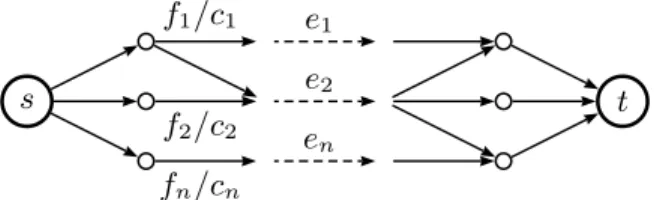
nFigure 1: Case 1: Flow comes out of the source s and moves to the sink t. As soon as the flow splits to one of the incident edges, it never joins again until t is reached.
s
t
f
1/c
1f
2/c
2f
n/c
ne
1e
2e
nFigure 2: Case 2: Flow emanates from s and moves towards t, but may join or split with other flow zero or more times after leaving s.
3.1
Case I: No Cycles, Disjoint Paths
Case I is the simplest case in which all paths from s to t are disjoint, as can be seen in Fig-1. For the i-th path between s and t (call it Pi) the flow fiwill be equal to the mine∈P{ce},
where cerepresents the capacity of the edge e on the path Pi.
Intuitively, this is due to the fact that no more flow than the smallest capacity edge along the path can be pushed from s to t.
This leads to the possibility that not all edges need to be con-sidered when attempting to determine the vital edge ev for
deletion. Perhaps, only those incident to s are the only po-tential vital edges because if such an incident edge is deleted, then necessarily the flow must decrease by the capacity of that edge. This leads to the following algorithm:
Find-A-Vital-Edge(G = (V, E) and s, t ∈ V ) 1 Find the outgoing edge e of s with largest flow 2 Return e as the vital edge ev
3.2
Case II: No Cycles, Overlapping Paths
Case II relaxes the restriction that paths must be disjoint; Fig-2 provides a visual representation of this case.
When Fig-3 is used as input for Find-A-Vital-Edge, it can be clearly seen to be incorrect. A modified version of the al-gorithm could be constructed in order to take this new exam-ple into account. The new version, Find-A-Vital-Edge(2),
is as follows:
Find-A-Vital-Edge(2)(G = (V, E) and s, t ∈ V ) 1 Find the outbound edge esof s with largest flow
2 Find the inbound edge etof t with largest flow
3 Return the larger flow of esand et as the vital edge ev
However, Find-A-Vital-Edge(2)performs incorrectly when
s
t
1/1
1/1
1/1
1/1
2/2
e
1Figure 3: Counter Example: Find-A-Vital-Edge cannot find the vital edge e1 because it is not
in-cident to s and participates in two paths simultane-ously, breaking the assumption of Case I.
s t 1/1 1/1 1/1 1/1 1/1 1/1 1/1 1/1 1/1 1/1 1/1 1/1 1/1 1/1 1/1 1/1 1/1 2/2 e1
Figure 4: Counter Example: Find-A-Vital-Edge(2)
cannot find the vital edge e1 because it is neither
incident to s nor t. In this case e1 has the highest
capacity of all edges, but it need not. For example, change the capacity of one of the incident edges to s to 3 and the flow of G will be the same, but e1 will
now not have maximum capacity over G.
Fig-4 or Fig-5 is given as input. The observation is that if there exists a path from s to t that goes through one edge, then certainly that one edge would be a candidate for dele-tion. In the case of Fig-5, two such vital edges exist (e1
and e2) that would both reduce the maximum flow by two
and that are both not incident to either s or t. The intu-ition is that the disjoint parts of the paths are being ignored with only the paths as a whole being considered, thereby, in some sense, reducing this example to one that could fit into the Case I analysis. Put another way, we need to some-how collapse Case II down to Case I via equivalence classes, and we can do this when they share an edge. This leads to Find-A-Vital-Edge(3):
Find-A-Vital-Edge(3)(G = (V, E) and s, t ∈ V )
1 Find all paths from s to t
2 Put all paths into the same equivalence class if they share edge ei
3 Return the equivalence class with highest flow as the vital edge ev(break ties arbitrarily)
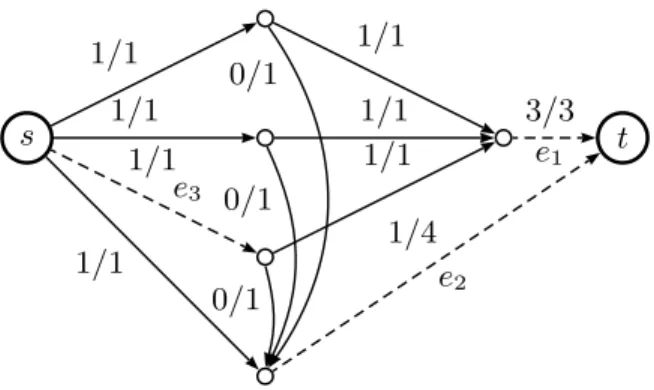
When Find-A-Vital-Edge(3) is given Fig-6 as input, it
would fail, because e1 would be reported as the vital edge
but e1 or e2 are certainly vital edges. What is different
be-tween e1 and e2 that makes deletion of e1 have no effect
on the maximum flow of the graph G? The capacity of e1
is 3, which is the same as the in-degree of the node at the start of the edge e1 (i.e. a difference of 0). The capacity of
e2 is 4, which is the same as the in-degree of the node at
the start of the edge e2 (i.e. again, a difference of 0). But
we notice that if e1 is deleted, then all of the flow can be
s
t
1/1
1/1
1/1
1/1
1/1
1/1
1/1
1/1
1/1
1/1
1/1
1/1
1/1
1/1
1/1
1/1
2/2
e
12/2
e
2Figure 5: Counter Example: Find-A-Vital-Edge(2) cannot find one of the vital edges e1 or e2 because
both are not incident to either s or t.
s
t
1/1
1/1
1/1
1/1
1/1
1/1
0/1
0/1
0/1
3/3
e
11/4
e
21/1
e
3Figure 6: Counter Example: deletion of e1 would
not disrupt the maximum flow, whereas deletion of e2 or e3 would certainly decrease the flow by 1. In this case, the vital edge is not the highest flow edge, but is the highest capacity edge.
flow of G. How do we know that the edges e1 and e2 have
such a re-routing property? Certainly our initial, somewhat na¨ıve algorithm Find-A-Vital-Edge would be guaranteed to reduce the flow in these cases, but the reduction in flow would not necessarily be the maximum achievable.
And what about if the paths shared a vertex, rather than an edge? Fig-7 shows that the vital edges in G are dependant on the flow and the capacity, because changing the capacity values for the edges, changes whether the edges are vital or not.
One conjectured way to simplify G, when multiple edges enter and leave a vertex, would be to split off a new vertex v, and attach a subset of the incoming and outgoing edges to v as is illustrated in Fig-8. This new artificially constructed vertex, may (hypothesis) help simplify the analysis of the resultant graph G′
. More specifically when referring to Fig-8, if fi = fj′ then we can construct a new node v to form
a new, simpler graph G′
when attempting to find a vital edge ev. In general, we may need l in-edges with flow fip,
for p ∈ [1..l] to match (i.e. equal sum flow totals) with k
u x y v 1/1 1/1 1/1 1/1 2/c1 2/c2 2/c3 2/c4 1/1 1/1 1/1 1/1
Figure 7: Observation: The edges ux, uy, xv and yv may or may not be vital edges, because they depend on the capacity values c1, c2, c3 and c4. For example,
if c1 = c2= c3 = c4 = x and x = 2 then the edges will
be vital, but if x = 4 then no one edge is vital.
u u v f1/c1 f2/c2 f3/c3 fn/cn f′ 1/c ′ 1 f′ 2/c ′ 2 f′ 3/c ′ 3 f′ m/c ′ m {fi/ci} f1/c1 f2/c2 fn′/cn′ {f′ j/c ′ j} f′ 1/c ′ 1 f′ 2/c ′ 2 f′ m′/c ′ m′
Figure 8: Idea: Construct a new node in order to simplify the paths.
out-edges with flow fj′q, for q ∈ [1..k].
A specific example of simplifying G is given in Fig-9. The idea is to collapse paths p1 = {e1, e3} and p2 = {e2, e4}
between nodes u and v because they all have the same flow and so none of the edges will be a unique vital edge. That is, collapse paths if and only if the max flow along each path between two vertices is equal. This could also be stated as collapsing triangles composed of k vertices.
3.3
Case III: Cycles, Disjoint Paths
u x y v 1/1 1/1 1/1 1/1 1/1 1/1 1/1 1/1 1/1 1/1 1/1 1/1 2/2 ev 1/1e1 1/1 e2 1/1 e3 1/1e4
Figure 9: Simplification Conjecture: Collapse u v into one node when two distinct paths exist between u and v that all have the same flow.
s
t
1/1
e
11/1
e
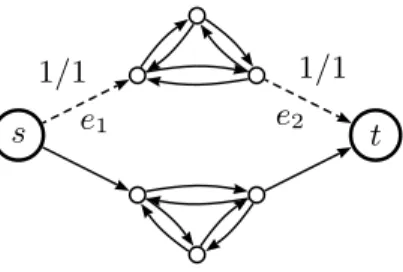
2Figure 10: Case 3: The addition of cycles onto dis-joint paths.
u
e
v
i
e
jFigure 11: Idea: Entering (ei) and exiting (ej) edges
are vital edge candidates.
The addition of cycles on a path from s to t means that there is still exactly one edge entering the cycle and one edge leaving the cycle, as in, for example, Fig-10, where e1
enters and e2 exits the cycle. This is a generalization from
that of entering (exiting) a set of nodes through one edge, as is depicted in Fig-11, which was the key observation for Case I.
3.4
Case IV: Cycles, Overlapping Paths
The most complex flow graph has vertex and edge sharing on overlapping paths containing cycles. The cumulative de-scriptions given, may help derive an algorithm for Case IV, as depicted, simplistically, in Fig-12.
4.
CONCLUSIONS
The simplification of the problem of determining the most vital edge in an input graph G through the construction of equivalence classes (partitions) on the set of all possible in-put graphs has been proposed. The specific graph G may be transformed through simplification transformations in order to determine its equivalence class. Such simplifications may aid the more efficient determination (rather than the na¨ıve brute force approach) of a vital (not necessarily unique) edge
s
t
1/1
e
11/1 e
21/1
e
31/1
e
4Figure 12: Case 4: e1, e2, e3, and e4are the only edges
that would definitely cause flow to decrease. This example could also be viewed as having two edges incident to a cycle, both entering and leaving.
of G. Detailed analysis and practical implementation, in-cluding specifying algorithms for cycle and path overlap de-tection, are left for future work. A generalization of the presented problem (suggested briefly by Prof. Maheshwari) would be to find k vital edges that maximally reduce the maximum flow of the graph G.
5.
ACKNOWLEDGMENTS
The author would like to thank i) Prof. Maheshwari for teaching the course, ii) NRC-IIT-IR group for supporting attendance at this course, in particular, the following people from NRC: Julio J. Vald´es, Bob Orchard and Fazel Famili, and iii) CISTI for supplying research materials.
6.
REFERENCES
[1] Y. P. Aneja, R. Chandrasekaran, and K. P. K. Nair. Maximizing residual flow under an arc destruction. Networks, 38(4):194–198, November 2001.
[2] G. B. Dantzig. Maximization of a linear function of variables subject to linear inequalities: Activity analysis of production and allocation. 1951. Cowles Commission.
[3] L. Ford and D. Fulkerson. Maximal flow through a network. Canadian Journal of Mathematics, 8(3):399–404, 1956.
[4] E. Nardelli, G. Proietti, and P. Widmayer. Finding the most vital node of a shortest path. Theoretical
Computer Science, 296(1):167–177, 2003.
[5] C. A. Phillips. The network inhibition problem. In STOC ’93: Proceedings of the twenty-fifth annual ACM symposium on Theory of computing, number
ISBN:0-89791-591-7, pages 776–785, New York, NY, USA, 1993. ACM Press. Sponsored by SIGACT: ACM Special Interest Group on Algorithms and