Bimetallic Salen-Based Compounds and Their Potential Applications
Alba Finelli, Sarah-Luise Abram, Nelly Hérault, Aurélien Crochet, and Katharina M. Fromm
*
ABSTRACT: The new bimetallic coordination compounds
[LNiAg(NO3)], [LCuMn(NO3)2], [LCuCu(NO3)2],
[LCuZn-(NO3)2], and [{LCuBi(NO3)3}(ACN)] have been synthesized
from a salen-type ligand L containing two distinct coordination
sites to accommodate (different) metal ions M1 and M2. In the
solid state, the formation of 1:1 compounds (LCu:M2) is always observed, but interactions between the compounds lead to
differences in packing. For example, a head-to-tail arrangement
along the crystallographic b-axis is observed in the case of the LCuBi compound, and the LNiAg compound is polymeric, while its Cu homologue LCuAg forms a discrete dimer. Given the inherent potential of the preorganizing, two metal ions using L
could be used to synthesize nanoscale copper−bismuth and
−manganese mixed metal oxides as a function of the temperature.
The combination of different bioactive metal ions within one
ligand system was furthermore explored for antimicrobial
efficiency.
■
INTRODUCTIONArranging different metal ions in space and number through
compartmentalization in a ligand is essential in materials
science and in biology.1−3The close association of at least two
metal ions can enhance existing properties or even lead to new
features4 in compounds such as coordination polymers,5
multimetallic complexes,6,7 or mixed metal oxide materials,8
thus opening new routes to multifunctional materials.9Among
these, mixed metal oxides are nowadays especially sought for
their magnetic,10superconducting,11 catalytic,12and optical13
properties. They are typically synthesized through solid-state reactions requiring high temperatures, or by milder methods
such as sol−gel techniques14or metal organic chemical vapor
deposition ((MO−)CVD),15 for which volatile metal
com-pounds such as alkoxides or diketones are needed.16However,
oligomerization and the lack of metal ion control, together
with insufficient volatilities and stabilities, can be major
limitations of these procedures.17 Therefore, the idea to
compartmentalize the metal ions within a single-source
precursor (SSP),18 such as salen-derivatives, is an attractive
alternative.19The use of such multitopic precursors allows an
intimate and organized mixing of the metal ions at the molecular level, facilitating the crystallization process of the mixed metal oxides under mild conditions and decreasing the
formation of side products.20 This synthetic strategy often
leads to monodisperse and phase-pure nanocrystals with
particular morphologies.21
Another application that we are interested in in the context of multimetallic compounds is the combat against bacterial
infections.22 Recently, considerable efforts have been
under-taken to develop metal-based antimicrobially active com-pounds that could serve as alternatives to traditional antibiotics regarding the rise in infections caused by multidrug-resistant
bacteria.23 It has, for example, been shown that the
combination of different metal ions lowered the bactericidal
concentrations, thus overcoming toxicity limitations known for
metal based drugs.24 Such synergistic effects have also been
reported for associations of metal ions with classical
anti-biotics25 or organic acids.26 As a result, the combination of
different drugs has turned out to be an efficient tool to broaden
the therapeutic window of a given antibiotic compound.27
For such biological applications, but also to obtain mixed
metal oxide materials, the design and development of specific
ligand systems are thus crucial for the formation of precise and
clean multimetallic compounds.28 Salen-type ligands can
efficiently bind to transition-metal ions in a tetradentate
mode through their N2O2site to form very stable complexes.
They are versatile chelating ligands in coordination chemistry
http://doc.rero.ch
Published in "Crystal Growth & Design 20(8): 4945–4958, 2020"
which should be cited to refer to this work.
thanks to their tunable design,29,30 and multiple functional compartments can be created by simple substitution of the ligand, generating macrocycle-type compounds for the
coordination of different metal ions.31,32
Here, we report the study of bimetallic compounds based on
a salen-derivative, H2L, possessing two distinct coordination
sites. We have previously studied the structural trends of LCu and LNi compounds in combination with alkali and alkaline earth metal ions, and found that the Cu-compounds formed mostly chains with alternatingly arranged LCu-moieties, while the Ni-analogues had the LNi entities arranged on the same
side of the polymeric chain.33Now, the greater interest in the
optical, conductive, and catalytic properties of copper−
manganese and copper−bismuth oxides,34,35 as well as the
efficient antimicrobial properties of silver, copper, zinc, and
bismuth ions, encouraged us to combine LCu(II) with Ag(I), Mn(II), Cu(II), Zn(II), Bi(III), and, for comparison, LNi(II) with Ag(I) as bimetallic compounds. A structural study of the
different compounds was carried out by single crystal X-ray
diffraction, and their potential as single-source precursors for
the generation of nanoscale, mixed-metal oxides has been investigated together with their potential antimicrobial proper-ties.
■
EXPERIMENTAL SECTIONMaterial and Methods. All experiments were performed in air and at RT. Ligand H2L was prepared according to the procedure
reported by Avecilla et al. previously.36Monometallic complex ligands LCu, LNi, and LZn were prepared as described in the literature.37,38 All chemicals were commercial products of reagent grade and were used without further purification. For the numbering of the obtained compounds, we chose to start with the lowest charged M2, hence Ag(I) compounds, then the M(II) ions as they come in the periodic table, and finally the example with a M(III) ion as M2. Elemental analyses for C, H, and N were carried out using a FLASH 2000 Organic Elemental Analyzer. Some of the results indicate residual solvent, e.g., water, after drying. In most cases, the values found for hydrogen content are lower than expected despite trying many times, and this phenomenon may be due to the possible interferences with the diverse metal ions during the mineralization. Indeed, the elemental analysis can be affected by the incomplete conversion of the compounds or by the formation of compounds leading to the corrosion of analytical instruments, both possibly leading to underestimated results. However, mass spectra (ESI-TOF, positive mode) for all compounds could be recorded with a Bruker esquire HCT spectrometer with a DMF/ACN mixture as solvent. The crystallographic data of single crystals were collected with Mo Kα radiation (λ = 0.71073 Å). All measurements were performed at 250 or 200 K, with Stoe IPDS-II or IPDS-II T diffractometers equipped with Oxford Cryosystem open-flow cryostats.39
Single crystals were picked under the microscope, and placed in inert oil. All crystals were mounted on loops, and all geometric and intensity data were taken from one single crystal. The absorption corrections were partially integrated in the data reduction procedure.40 The structures were solved and refined using full-matrix least-squares on F2 with the
SHELX-2014 package.41 All atoms (except hydrogen atoms) were refined anisotropically. Hydrogen atoms were refined when possible, and otherwise added using the riding model position parameters. Crystallographic data can be found in the Supporting Information
(see Table S1). CIF files can be obtained from the Cambridge Crystallographic Data Centre, CCDC-1860979(1), CCDC-1861009
(2), CCDC-1860982(3), CCDC-1860981(4), CCDC-1860983(5), and CCDC-1860980 (6). Additional crystal structures with similar metal ion combinations but different counterions or solvent
(CCDC-1861005 (LCuMn Cl2), CCDC-1861004 (LCuMn ClO4), and
CCDC-1861006 (LCuMn OAc) can be found in the Supporting
Information(Figures S3−S5, Table S4). Copies of these data can be
obtained free of charge from the Cambridge Crystallographic Data Centre throughwww.ccdc.cam.ac.ukor e-mail,[email protected]. uk. Powder X-ray diffractograms were collected on a Stoe STADIP
using Cu Kα1 radiation (1.5406 Å) using a Mythen detector (Figures S6−S10). TGA were recorded on a Mettler Toledo TGA/SDTA851. Being paramagnetic,1H NMR measurements could not be performed
on compounds 1−6. The ligand H2L and the complex LCu obtained
by chelating the ligand to the copper ion were synthesized as described in the literature.36,37Specific surface areas of the samples were determined using the Brunauer−Emmett−Teller (BET) method by performing nitrogen sorption measurements using a Micromeritics ASAP 2010 instrument. The adsorption and desorption experiments were carried out at 77 K after initial pretreatment of the samples by degassing at 250°C for 3 h.
Synthesis of LCuAg (1). A solution of AgNO3 (41.61 mg, 0.245
mmol) in acetonitrile/ethanol (7:3, 30 mL) was added to a solution of LCu (100 mg, 0.245 mmol), previously dissolved in a mixture of acetonitrile/ethanol (7:3, 30 mL). After stirring overnight at room temperature, the precipitate was collected and dried under vacuum to afford compound 1 (119.32 mg, 0.212 mmol, 87%). After few days, red, block-like single crystals suitable for X-ray crystallographic analysis were obtained by slow evaporation of the mother liquor. ESI-MS (m/z): 558.95 [M + H]+, where M corresponds to “LCuAg”.
Anal. Calcd for C18H18AgCuN3O7, corresponding to“LCuAg” (5): C,
38.62; H, 3.24; N, 7.51%. Found: C, 38.65; H, 1.80; N, 7.42%. Synthesis of [LNiAg(NO3)] as “LNiAg” (2), [LCuMn(NO3)2] as
“LCuMn” (3), [LCuCu(NO3)2] “LCuCu” (4), [LCuZn(NO3)2] as “LCuZn”
(5), or [{LCuBi(NO3)3}(ACN)] “LCuBi” (6). These compounds were
prepared by the same method as described above, by reacting LCu in an acetonitrile/ethanol (7:3) solution with 1 equiv of the appropriate metal salt. The metal salts used were as follows: AgNO3(41.61 mg,
0.245 mmol) for 1 and 2, Mn(NO3)2·4H2O (61.49 mg, 0.245 mmol)
for 3, Cu(NO3)2 (45.95 mg, 0.245 mmol) for 4, Zn(NO3)2 (46.40
mg, 0.245 mmol) for 5, and Bi(NO3)3·5H2O (118.84 mg, 0.245
mmol) for 6.
Data for LNiAg (2). Orange needle-like single crystals suitable for X-ray crystallographic analysis were obtained by slow evaporation of the mother liquor. Yield: 82% (0.201 mmol, 111.48 mg). ESI-MS (m/ z): 553.95 [M + H]+, where M corresponds to“LNiAg”. Anal. Calcd
for C18H18AgCuN3O7(5): C, 38.62; H, 3.24; N, 7.51%. Found: C,
38.65; H, 1.80; N, 7.42%.
Data for LCuMn (3). Red plate-like single crystals suitable for X-ray crystallographic analysis were obtained by vapor-phase diffusion of diethyl ether into the mother liquor of the reaction in a long tube. Yield: 90% (0.225 mmol, 125.43 mg). ESI-MS (m/z): 506.95 [M-NO3]+, where M corresponds to “LCuMn”. Anal. Calcd for
C18H20CuMnN4O11, corresponding to “LCuMn” (3) with one
molecule of water: C, 36.8; H, 3.44; N, 9.36%. Found: C, 36.8; H, 1.7; N, 9.49%.
Data for LCuCu (4). Purple plate-like single crystals suitable for X-ray crystallographic analysis were obtained by vapor phase diffusion of diethyl ether into the mother liquor of the reaction. Yield: 82% (0.201 mmol, 116 mg). ESI-MS (m/z): 513.95 [M − NO3]+, where M
corresponds to “LCuCu”. Anal. Calcd for C18H18Cu2N4O10,
corresponding to “LCuCu” (3): C, 37.44; H, 3.14; N, 9.70%. Found: C, 37.09; H, 2.48; N, 9.45%.
Data for LCuZn (5). Purple plate-like single crystals suitable for X-ray crystallographic analysis were obtained by slow evaporation of the mother liquor reaction. Yield: 91% (0.223 mmol, 129.15 mg). ESI-MS (m/z): 577.96 [M + H]+, where M corresponds to the asymmetric unit of“LCuZn”. Anal. Calcd for C18H18CuN4O10Zn, corresponding
to the asymmetric unit of“LCuZn” (4): C, 37.32; H, 3.13; N, 9.67%. Found: C, 37.44; H, 2.27; N, 9.25%.
Data for LCuBi (6). Green needle-like single crystals suitable for X-ray crystallographic analysis were obtained by vapor phase diffusion of diethyl ether into the mother liquor of the reaction. Yield: 88% (0.215 mmol, 169.22 mg). ESI-MS (m/z): 722.00 [M− NO3]+, where M
corresponds to “LCuBi” without ACN molecule. Anal. Calcd for C18H20BiCuN5O14, corresponding to“LCuBi” with one molecule of
water (2): C, 26.93; H, 2.51; N, 8.72%. Found: C, 26.33; H, 1.24; N, 8.37%.
Thermal Processes. Samples of the two compounds 3 and 6 were heated under air to four different temperatures: 300, 400, 500, and 600 °C during 4 h. The morphology and the composition of the obtained materials were explored by scanning electron microscopy (SEM) and powder X-ray diffraction (PXRD). Average crystallite sizes were estimated using the Scherrer method. Using BET, the surface area (SBET) and pore size distribution (VBJH) were calculated.
In order to follow the decomposition of 3 and 6 upon heating, the thermal behavior of the mixed metal compounds 3 and 6 was studied by TGA over a range of 30−600 °C in air.
As both compounds 3 and 6 were prepared from nitrate salts, for comparison, a mixture of stoichiometric amounts (1:1) of Cu(NO3)2
and Mn(NO3)2or Bi(NO3)3was ball-milled and heated at 600°C in
order to compare the results with the mixed metal oxides resulting from the combustion of our single-source precursors.
Agar Diffusion Test. An overnight culture of Escherichia coli 25922 (E. coli) in Müller-Hinton (MH) broth was diluted to the concentration of 1× 10⁶cfu/mL using the McFarland standard. 100
μL were spread on 8.5-cm-diameter MH agar dishes. After 5 min drying, pellets of the compounds were placed on the agar and gently pressed with sterile tweezers. The agar plates were incubated upside down at 37°C overnight. The diameter of the inhibition zone (ZOI) was measured using ImageJ on photographs of the agar plates with the diameter of the plates as the reference scale. The initial diameter of the pressed pellets is subtracted before dividing by two for the ZOI radius.
Broth Microdilution Test. An overnight culture of E. coli in Müller Hinton (MH) broth was diluted to 1 × 10⁷cfu/mL using the
McFarland standard. The powders of the compounds or the respective nitrate salts were suspended by sonication in MH broth and diluted to create a concentration series that was then inoculated with the overnight E. coli culture to reach afinal inoculum of 1 × 10⁶
cfu/mL. Duplicates of 0.5 mL for each concentration were incubated
in suitable well plates for 24 h at 37°C while shaking at 160 rpm. 100 μL of each well was spread directly on MH agar dishes for MBC determination, and a second 100μL aliquot was diluted 1:1000 before spreading on agar for MIC determination, as any optical detection of bacterial growth was impeded by the turbidity of the compound suspensions. The agar dishes were incubated overnight and checked for bacterial colonies. The MIC corresponds to the lowest tested concentration where the bacterial growth did not exceed the starting inoculum of 1 × 10⁶ cfu/mL. The MBC is defined as the lowest
concentration without visible bacterial growth on the agar dishes. All compounds were tested against at least three independent E. coli cultures.
■
RESULTS AND DISCUSSIONSynthesis. The salen-based ligand H2L has been
synthe-sized following the literature procedure36by a straightforward
synthetic route involving 2-hydroxy-3-methoxybenzaldehyde
(o-vanillin) and ethane-1,2-diamine (Scheme 1).
The ligand system (H2L) is composed of an imine-based
recognition site, N2O2, typically able to coordinate transition
metal ions after deprotonation. This coordination preorganizes
the ligand in aΩ-shape and allows the formation of a neutral
compound “LM1”, providing an additional coordination site,
O2O2. With two phenol and two methoxy groups, the newly
generated compartment allows the binding of further metal ions. Throughout this study, Cu(II) and Ni(II) metal ions
have been used tofit into the N2O2cavity of H2L, yielding the
previously reported LCu and LNi complexes,37 which were
then employed as metallo-ligand for the coordination of additional metal ions. New mixed metal compounds have then been synthesized from LCu in combination with Mn(II), Cu(II), Zn(II), or Bi(III) ions. The previously known
Scheme 1. (a) Synthetic Route of H2L and (b) Its Two Potential Coordination Sites
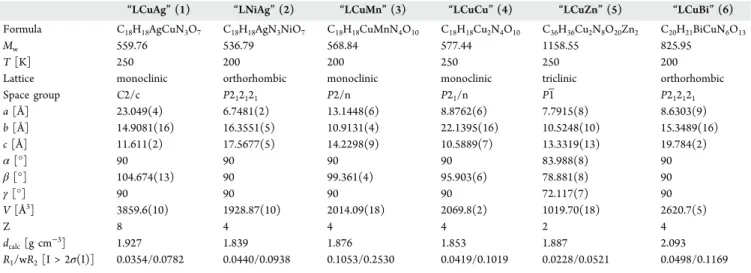
Table 1. Crystallographic Data of 1−6
“LCuAg” (1) “LNiAg” (2) “LCuMn” (3) “LCuCu” (4) “LCuZn” (5) “LCuBi” (6) Formula C18H18AgCuN3O7 C18H18AgN3NiO7 C18H18CuMnN4O10 C18H18Cu2N4O10 C36H36Cu2N8O20Zn2 C20H21BiCuN6O13
Mw 559.76 536.79 568.84 577.44 1158.55 825.95
T [K] 250 200 200 250 250 200
Lattice monoclinic orthorhombic monoclinic monoclinic triclinic orthorhombic Space group C2/c P212121 P2/n P21/n P1̅ P212121 a [Å] 23.049(4) 6.7481(2) 13.1448(6) 8.8762(6) 7.7915(8) 8.6303(9) b [Å] 14.9081(16) 16.3551(5) 10.9131(4) 22.1395(16) 10.5248(10) 15.3489(16) c [Å] 11.611(2) 17.5677(5) 14.2298(9) 10.5889(7) 13.3319(13) 19.784(2) α [°] 90 90 90 90 83.988(8) 90 β [°] 104.674(13) 90 99.361(4) 95.903(6) 78.881(8) 90 γ [°] 90 90 90 90 72.117(7) 90 V [Å3] 3859.6(10) 1928.87(10) 2014.09(18) 2069.8(2) 1019.70(18) 2620.7(5) Z 8 4 4 4 2 4 dcalc[g cm−3] 1.927 1.839 1.876 1.853 1.887 2.093 R1/wR2[I > 2σ(I)] 0.0354/0.0782 0.0440/0.0938 0.1053/0.2530 0.0419/0.1019 0.0228/0.0521 0.0498/0.1169
http://doc.rero.ch
bimetallic copper−silver compound42has also been taken into account during this study, as well as its new nickel analogue for comparison.
Description of the Crystal Structures. In order to explore the coordination mode of the metallo-ligand LCu with
the different metal ions (and LNi with Ag(I)), single crystal
X-ray analysis was performed on all compounds. The crystal structures are described below following the charge of the M2 as well as the ionic radii of the cation, starting thus from Ag(I)
and ending by Bi(III). [{LCuAg (NO3)}2] is thereafter
abbreviated as “LCuAg” (1) and [LNiAg(NO3)] as “LNiAg”
(2), [LCuMn(NO3)2] as “LCuMn” (3), [LCuCu(NO3)2] as
“LCuCu” (4), [LCuZn(NO3)2] as “LCuZn” (5), and
[{LCuBi(NO3)3}(ACN)] as “LCuBi” (6) (Table 1) (bond
lengths are gathered in theSupporting Information, Table S3).
Single crystals of the six compounds were obtained from the reaction between LCu/LNi with the corresponding metal ion nitrate salt. Each crystal structure reveals a 1:1:1 stoichiometry
of the LM1M2 compound. In each compound, Cu(II)/Ni(II)
as M1 is coordinated in a square planar fashion by the
phenolate and imine groups of the N2O2chelating site of the
ligand, with angle sums close to 360°.
In the already known LCuAg bimetallic compound (1),
Ag(I) is coordinated by all four oxygen atoms of the ligand.42
It is found ca. 0.3 Å out of the Cu−N2O2mean plane of the
metalloligand and oriented toward the silver ion of an antiparallel neighbor moiety. The silver ion completes its coordination sphere by two O-atoms O5 and O6 belonging to one nitrate anion. O5 further coordinates to the copper ion of a neighboring entity; the copper ion thus reaching a bond
valence sum of 1.96.42 The coordination of Ag(I) with LCu
leads to dimers by symmetry (inversion center in the middle of
the Ag(I)−Ag(I) contact) with a head-to-tail sandwich-type
arrangement through Cu1−O5 bonds and Ag1···Ag1
inter-actions (2.516(4) Å and 3.053(7) Å, respectively) (Figure
1A).43,44
Interestingly, our new compound LNiAg (2) does not present the same structural characteristics as its Cu-analogue. Compound 2 is composed by a Ni(II) cation coordinated by two O-atoms, O2 and O3, and two N-atoms, N1 and N2, in a perfect square planar fashion and with a Ag(I) cation
Figure 1.(a) Head-to-tail sandwich type arrangement of the known LCuAg 1 (top left,#2(1/2−x, 1/2−y, −z)) showing Cu1−O5 and Ag(I)··· Ag(I) interactions (purple dashed bond) and the packing arrangement (bottom left,#3(1/2−x, −1/2+y, 1/2−z), #4(x, −y, −1/2+z), #5(x, 1−y, −1/2+z), #6(1/2−x, 1/2+y, −1/2−z)) showing Cu1−O7 interactions (green dashed bonds) along the b-axis. (b) Crystal structure of the asymmetric unit of compound LNiAg 2 (top right). Packing of the complex moieties in the unit cell (bottom right,#2(−1+x, y, z), #3(−2+x, y, z), #4(5/2−x, 1−y, −1/2+z), #5(3/2−x, 1−y, −1/2+z), #6(1/2−x, 1−y, −1/2+z)) showing the Ag(I)···C6 and Ni(II)···O7 interactions (green dashed bonds, bottom) along the b-axis and c-axis, respectively. H-atoms are omitted for clarity.
occupying the O2O2 cavity. The silver cation completes its
coordination sphere with two O-atoms, O5−O6, from the nitrate counterion. In contrast to 1, Ni(II) reaches a bond
valence sum of 1.99 solely by the O2N2donors and hence does
not need to complete its coordination sphere through additional coordination, as already observed in previous
studies with alkali metal ions.33This leads to an offset parallel
arrangement of the complex moieties into a 1D coordination
polymer along the crystallographic b-axis, governed by Ag1−
C6 interactions of 2.690(1) Å. This interaction further leads to a nonplanarity of the ligand, with the two aromatic rings
forming an angle of 17.04°. The packing of these 1D strands in
the unit cell is defined by a very weak coordination of the third O-atom of the anion, O7, to the Ni(II) with a distance of
3.020(9) Å along the crystallographic c-axis (Figure 1B).
In compound LCuMn (3), the asymmetric unit is composed of two halves of two distinct complexes, named complex A for the one containing Cu1, and B for the one containing Cu2.
The entire units are obtained through a C2 rotation axis
running through the Cu(II) and Mn(II) ion, in which the Cu(II) ions are coordinated by the N and O atoms of the
imine and the phenoxy groups, while the Mn(II) atoms fit
Figure 2.Structure of the two distinct units A (top left) and B (top right) of compound LCuMn 3 (top) and its antiparallel packing (#2(3/2−x, y, 3/2−z), #3(1−x, 1−y, 1−z), #4(1+x, y, z), bottom), showing the π−π interactions (blue dashed bonds) and Cu2···C5 interactions (green dashed bonds). H-atoms have been omitted for clarity.
perfectly into the O2O2cavity provided by the phenoxy and
the methoxy groups. Complex A differs from the B-complex in
the coordination of Mn(II). Thus, Mn1 in A is slightly more out of the aromatic plane with a distance of ca. 0.19 Å (compared to ca. 0.04 Å for Mn2 in the B-complex) and has a longer Mn1−O1 distance to the methoxy group (2.481(7) Å)
than the equivalent bond in the Cu2-complex (Mn2−O3
2.475(6)). Contrarily, the distance Mn1−O2 distance to the
phenoxy group is shorter in A than in B (see Supporting
Information). The coordination sphere of the Mn(II) ions is further completed by four O-atoms of two symmetry equivalent nitrate ions (O5 and O6 and their symmetry equivalents for Mn1, and O8 and O9 and their symmetry
equivalents for Mn2). The Mn−nitrate distances in complex B
are longer and more asymmetric than the equivalent distances in complex A. In both LCuMn complexes, the bond valence sum for Cu(II) is around 1.95, while it is ca. 2 for Mn(II) in A and 1.96 in B. The packing of these moieties is controlled by
Cu1−C14, Cu2−C5, and π−π interactions (3.502(8) Å,
3.317(7) Å, and 3.497(2) Å, respectively) along the
crystallo-graphic c-axis, leading to alternating antiparallel strands (Figure
2).
After changing the counterions to chloride, perchlorate, and acetate, water-containing compounds were obtained as
described inTable S4 and Figures S3−S5.
In compound LCuCu (4), Cu1 has the known square planar environment, while the second copper cation Cu2 is bound by
all four O-atoms of the O2O2 compartment of the
metal-loligand LCu. Its coordination sphere is completed by three
further O-atoms belonging to two different nitrate anions (O5,
O6, and O8) found in the axial positions of a distorted octahedron. One nitrate moiety is on a roughly 50:50 split
position (refined at 51.5(9)% and 48.5(9)%), and Cu2 is then
connected to O8 with a distance of 1.933(9) Å or to O8A at 1.942(8) Å. Compound 4 is not completely planar, as the angle
between the two aromatic rings of the ligand of 3.8° indicates.
This slight distortion can be explained by an antiparallel arrangement of the moieties, allowing Cu1 to interact with
neighboring entities by Cu1−C4 interactions (3.249(2) Å),
while the opposite aromatic rings stack as well with π−π
interactions of 3.622(2) Å (ring-center to ring-center) along
the crystallographic a-axis (Figure 3).
Compound LCuZn (5) adopts a similar structure to 4, with
Zn(II) being perfectly lodged in the O2O2 cavity. The main
difference with 4 is that the zinc ion completes its coordination
sphere with three O-atoms from two nitrate ions, both adopting two distinct orientations with respective occupancy of
2/3 and 1/3 (refined to 67.8(9)% for the form N3 and N4 and
of 32.2(9)% for the form N3A and N4A). The zinc cation is thus bound by O5, O6, and O8 or by O5A, O8A, and O9A depending on the occupancy. The two aromatic rings of the
complex entity form an angle of 7.81°, and LCuZn is thus not
completely planar. This effect is probably again induced by an
antiparallel arrangement of the moieties, which leads to alternating strands through Cu1−C14 and Cu1−C4
inter-actions as well as π−π interactions (3.397(3) Å, 3.463(2) Å,
Figure 3.Crystal structure of the asymmetric unit of LCuCu 4 (top) and the antiparallel packing arrangement (bottom,#2(1/2 + x, 3/2 − y,1/2 + z),#3(−1/2 + x, 3/2 − y, 1/2 + z), #4(−1 + x, y, z)) showing the π−π interactions (blue dashed bonds) and Cu1−C4 interactions (green dashed bonds) along a-axis. The minor-occupancy atoms and the H-atoms have been omitted for clarity.
and 3.500(2) Å, respectively) along the crystallographic c-axis (Figure 4).
In compound LCuBi (6), the bismuth ion is coordinated by
all four O-atoms of the O2O2chelating site of L and completes
its coordination sphere with six oxygen atoms from three
different nitrate ions, as it is charged 3+. Being furthermore
much larger than, e.g., Mn(II) (ionic radii 67 pm for Mn(II),
low spin, and ca. 100 pm for Bi(III)45), Bi(III) is ca. 0.438 Å
out of the Cu−N2O2mean plane, thus disturbing the planarity
of the metallo-ligand as evidenced by the angle of 5.16°
between the two aromatic rings of the ligand. This in turn leads
to a weaker coordination of the N2O2cavity with the Cu(II),
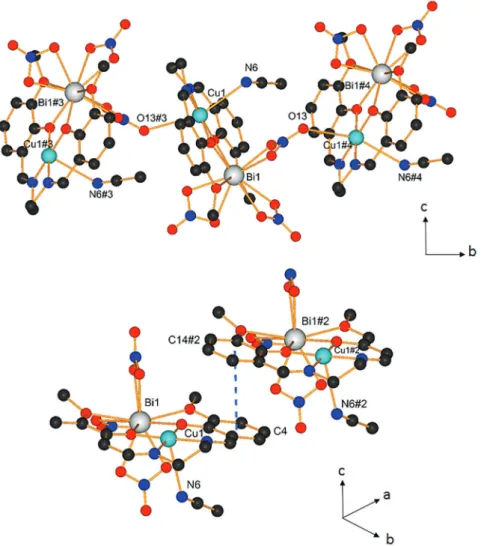
as shown by a lower bond valence sum than in the other compounds, reaching only 1.90. As a consequence, a close interaction between Cu(II) and N6 of a solvent molecule of acetonitrile (2.810(2) Å) acting as a terminal ligand and O13 of a nitrate anion (2.940(2) Å), which acts as bridging ligand
between copper and bismuth ions of neighboring entities, is observed. Cu(II) has thus a distorted octahedral geometry, as expected from the Jahn−Teller effect. Moreover, the elongated bond generated by the nitrate bridging ligand produces then an alternating head-to-tail arrangement of the units along the b-axis. This compound features a parallel arrangement based on π−π interactions between neighbor complex entities along the
a-axis (Figure 5).
The formation of 1:1:1 complexes (L:M1:M2) is always
observed in the solid state. As already observed previously,33
LCuM2 with M2, being a third row element, can lead to alternating arrangements of the LCu entities in order to allow interactions of the Cu(II) with anions, but also parallel
arrangements with Cu(II)−π interactions are observed. For
the heavier cations, packing with a head-to-tail arrangement into coordination polymers along the crystallographic b-axis is found in the case of LCuBi; discrete antiparallel dimer
Figure 4.Crystal structure of the asymmetric unit of LCuZn 5 (#2(1−x, 1−y, −z), #3(1−x, −1−y, 1−z), #4(x, y, 1+z), #5(−1+x, y, 1+z), #6(−x, 1−y, 1−z), #7 (−1+x, y, z), #8(−x, 1−y, −z), top) showing the π−π interactions (blue dashed bonds, bottom) and Cu(II)···C4/Cu(II)···C14 interactions (green dashed bonds, bottom). H-atoms are omitted for clarity.
formation in the case of LCuAg occurs. These results can be explained by the fact that larger cations are slightly pushed out
of the O2O2 plane, distorting the LCu moiety to a certain
extent. This affects the charge compensation (BVS) of the
copper ion in the respective LCu entities, inducing further interactions of the Cu(II) ions with neighboring anions (in both, LCuAg and LCuBi) and solvent molecule coordination as in the case of LCuBi. This phenomenon is not observed in our Ni(II)-silver analogue (2) where the BVS of the Ni(II) is
close to 2, such that additional bonds to satisfy the coordination of Ni(II) are not needed.
Precursors for Mixed Metal Oxides. As mentioned in the Introduction, we are particularly interested here in the generation of mixed metal oxides and antimicrobial properties
for the specific series of compounds presented here. For the
LCuMn (3) and LCuBi (6) compounds, mixed metal oxides
can be of interest, as copper−manganese oxides showed
promising properties as selective absorber coatings for solar
applications46and exhibited efficient catalytic activity for CO
Figure 5.Crystal structure of LCuBi 6 presents an antiparallel head-to-tail arrangement (top,#3(1−x,1/2+y, 3/2−z), #4(1−x, −1/2+y, 3/2−z)) by Cu1−N6 and Cu1−O13 additional bonds and a parallel arrangement of the complexes (bottom, #2(1−x, 1−y, −z)) through π−π packing (blue dashed bonds) along the a-axis. All H-atoms have been omitted for clarity.
Figure 6.PXRD analysis of (a) LCuMn (3) and (b) LCuBi (6) upon thermal decomposition at 300, 400, 500, and 600°C.
oxidation at ambient temperature,35while copper and bismuth
containing oxides were investigated for their optical,47
conductive,34 and magnetic48 properties, and as catalyst for
organic pollutants.48,49 We therefore tested the compounds
LCuMn (3) and LCuBi (6), in which the metal ions are already prearranged in close proximity, as single-source
precursors for these mixed metal oxides at different
temper-atures, following the evolution of the morphology and microstructure of the oxides.
For LCuMn (3), the TGA displayed a one-step
decom-position process starting at around 300°C that is completed at
approximately 400°C at a heating speed of 5 °C/min (Figure
S1). The total observed weight loss of 71.7% could be matched
with the decomposition of the organic ligand and the nitrate moieties, with the expected value for that being a weight loss of 72%.
Powder X-ray diffraction studies demonstrated that the
pyrolysis of 3 leads to polycrystalline, spinel-type Cu1.5Mn1.5O4
as the only crystalline phase (100%) at all tested temperatures.
Cu1.5Mn1.5O4belongs to the oxide family of the composition of
CuxMn3‑xO4(x = 1.5) and has the copper ion coordinated by
four O-atoms in a tetrahedral fashion, while the manganese has
a distorted octahedral environment.50 As hoped for, the
stoichiometry of the final oxide corresponds to the metal ion
ratio present in the molecular precursor (Figure 6a), and the
distances in thefinal Cu1.5Mn1.5O4 of Cu−O and Mn−O are
2.0989 and 1.9166 Å, respectively, similar to the distances
found in compound 3.51An increase of the peak intensities and
narrowing of their widths was observed gradually as the combustion temperature increased, giving an increasing
average crystallite size from 13.5 nm at 300°C to 125 nm at
600 °C (Table S1). The surface morphologies of all samples
(300, 400, 500, and 600°C) exhibited a porous, foam-like
3D-network composed of multiple pores and channels, likely
induced by the gas release during the pyrolysis of 3 (Figure 7).
The N2 adsorption−desorption analysis (Table 2)
demon-strated that the calcination product of LCuMn (3) at 300°C
possesses the largest specific surface area and pore volume
which both decreased with increasing combustion temperature. These results are in agreement with the increase of the crystallite sizes obtained as temperature increased.
Interestingly, and in order to compare our precursor with this classical synthesis method, heating a ball-milled 1:1
Cu(NO3)2/Mn(NO3)2mixture to 600°C led to a mixture of
CuO and the spinel-like CuMn2O4 phase (CuxMn3‑xO4,
copper content x = 1) with crystallite sizes of 58 nm. The SEM images of this sample showed the aggregation of irregular
particles. Hence, the Cu1.5Mn1.5O4cannot be produced under
such mild conditions starting from simple precursors. Indeed,
traditionally, the spinel-type oxides Cu1.5Mn1.5O4 and
CuMn2O4are prepared from oxides or carbonates of copper
and manganese in solid state reactions at around 900 °C
during 24 h.52Hence, using the precursor 3 clearly presents an
advantage for the low-temperature generation of nanoscale
Cu1.5Mn1.5O4.
For LCuBi (6), the TGA measurement showed that a first
mass loss of 2.4% beginning at approximately 100 °C is
observed that correlates with the loss of residual acetonitrile.
The further decomposition behavior of LCuBi is different from
LCuMn and starts at around 150 °C with three consecutive
weight losses representing approximately a total of 35.5%: 9%
correspond to one NO3 at 150 °C, 13% correspond to two
NO3 at 200 °C, and 13.5% are part of the organic ligand,
occurring at 300°C. To sum up, this does not correspond to
the expected total decomposition of the organic material which
would be on the order of 60% weight loss (Figure S2). The
PXRD analysis of the powders obtained from compound
annealing at different temperatures revealed the formation of
Figure 7. SEM images (with a zoom at 2 μm) of LCuMn (3) (top, left) and the mixture of Cu(NO3)2 and Mn(NO3)2 after the thermal
decomposition (top, right), as well as SEM images of samples of LCuMn after the thermal decomposition at 300, 400, 500, and 600°C for 4 h (bottom).
Table 2. Surface Area and Cumulative Pore Volume Measurements at Different Temperatures
For Compound LCuMn (3) Calcination
temperature
Surface area, SBET
[m2/g] Cumulative pore volume, V[cm3/g] BJH
300°C 35 0.14 400°C 21 0.12 500°C 16 0.10 600°C 5 0.02
For compound LCuBi (6) Calcination
temperature
Surface area, SBET
[m2/g] Cumulative pore volume, V[cm3/g] BJH
600°C 2 0.006
the BiCu2O4 phase, but also of Bi2O3, CuO, and amorphous
material in different proportions depending on the combustion
temperature (Figure 6b). The intensity of the peaks
corresponding to the mixed metal oxide phase increases
progressively with the temperature, reflecting an increase of its
purity. The combustion at 300 °C yields the tetragonal
CuBi2O4 spinel-type structure only in 53% (together with
amorphous material and Bi2O3), whereas at 600 °C it is
obtained as the principal crystalline phase with CuO detectable
in ca. 4% relative abundance (Table S2). While the starting
material contains a 1:1 ratio of Cu:Bi, thefinal identified mixed
metal oxide has a ratio of 1:2, explaining the simultaneous formation of copper oxide. The crystallite sizes estimated with the Scherrer equation ranged from 90 to 430 nm, increasing with temperature as already observed for the combustion of LCuMn (3). The stoichiometry of the mixed metal material and the ratio of the phases observed upon combustion of the bimetallic precursor LCuBi (6) correspond to the published
binary phase diagrams of this system, in which the CuBi2O4
oxide is the only stable ternary phase.53
The SEM images of the samples annealed at different
temperatures displayed leaf-like 2D nanosheets with various sizes depending on the temperature. Gradually, as the
crystallites grow with temperature, they separate from each other, revealing a lace-like surface, which might be due to the
fact that two different phases are formed in this process (Figure
8).
The spinel-type CuBi2O4material (with the corresponding
valences Cu2+and Bi3+) is usually synthesized by a solid state
reaction or a hydrothermal process, both involving
stoichio-metric proportions of CuO and Bi2O3at 973 K for 24 h in air53
and producing mostly spherical nanoparticle morphology.54In
contrast, the pyrolysis of the Cu(NO3)2/Bi(NO3)3mixture at
600 °C led to the formation of a mixture of CuBi2O4
(crystallite size 90 nm) and two different Bi2O3phases. The
SEM image of this combination shows aggregated nano-particles. For precursor 6, the advantage of using a single source compound is not as evident as for compound 3, but still
allows one to obtain a quite pure spinel phase at 600 °C,
bringing down the synthesis temperature by ca. 300°C.
These studies showed that the use of our new compound LCuMn 3 and, to a lesser extent, LCuBi 6, as single-source
precursors afforded the expected mixed metal oxides, avoiding
the formation of carbonates upon combustion in air. The compounds decompose gradually, generating (neat) nanoscale bimetallic oxides under mild conditions and exhibiting
Figure 8.SEM images (with a zoom at 2μm) of the ligand LCuBi (6) (top, left) and the mixture of Cu(NO3)2and Bi(NO3)3after the thermal
decomposition (top, right) as well as SEM images of samples of LCuBi after the thermal decomposition at 300, 400, 500, and 600°C (bottom).
Figure 9.Antimicrobial activity against E. coli of different mono- and bimetallic compounds of the ligand H2L and the respective controls (nitrate
salts and ligand alone) by agar diffusion assay. All compounds were used in form of pressed pellets containing 0.05−0.06 mmol. The table shows the radii of the inhibition zones (ZOI) in mm measured from the edge of the pellet to the beginning of the bacterial growth.
evolutive morphologies together with the increase of the temperature when compared to solid state synthetic routes.
Antimicrobial Properties. Based on the fact that silver,
copper, zinc, and bismuth possess antimicrobial properties,55
the compounds LCuAg (1) and LNiAg (2), LCuCu (4), LCuZn (5), and LCuBi (6) were studied for their antibacterial
potential. As reference materials, the ligand H2L, the
monometallic complexes LCu, LNi, and LZn,37,38 as well as
the simple metal nitrate salts were investigated for comparison
and as negative and positive controls. Infirst experiments, the
compounds were tested in an agar diffusion assay by placing
pressed pellets of the same molar amounts (0.05 mmol) of
compound on agar dishes spread with a 1 × 10⁶ cfu/mL
Escherichia coli 25922 (E. coli) culture. After 24 h, a small zone of inhibition (ZOI) was perceived for the protonated ligand alone, while the monometallic complexes LCu, LZn, and LNi
did not induce any bactericidal effect. Large inhibition zones
were observed for the bimetallic compounds and the nitrate
salts, proving a strong antimicrobial activity (Figure 9). The
size of the ZOI decreased in the order LCuCu > LCuZn > LCuBi > LCuAg > LNiAg, with the same order found for the
nitrate salts. For all the different metal ions, the inhibition zone
of the nitrate salt was slightly larger than that for the respective compound.
These observations might be explained by the fact that the compounds LCu, LNi, and LZn are overall neutral with an organic shell, and thus highly insoluble in aqueous media. The square planar M1 ions in LM1 could at best accommodate
solvent molecules as axial ligands, which is likely not sufficient
to render the complexes soluble, hence they do not diffuse on the agar plate. The second metal ion M2 induces an additional charge to the LM1 complex, giving, depending on M2,
[LM1M2]+/2+/3+. This charge is compensated by rather loosely
bound nitrate anions. Compared to the free metal nitrates, the coordination with the ligand seems to reduce the bioavail-ability of the coordinated metal ions M1, while keeping the second metal ion M2 still antimicrobially active. Indeed, the
blue diffusion halo around LCuCu indicates the presence of
hydrated Cu(II) ions, whereas this is not at all observed for LCu alone. Similarly, LCuZn shows a colorless halo and LCuBi a yellow halo that resembles the one seen in zinc and bismuth nitrate, respectively. The fact that LCuAg and LNiAg have a
low effect in this test might be because such agars for growing
bacteria typically contain NaCl (5 g/L), and hence insoluble
AgCl is likely to be formed. This is confirmed by the pellet of
AgNO3around which a brownish precipitate is visible after 24
h.
In order to determine their minimum bactericidal concentration, the bimetallic compounds LCuAg (1), LNiAg (2), LCuCu (4), LCuZn (5), and LCuBi (6) were suspended as powders by sonication in the bacterial growth medium (MH broth) and diluted to create a concentration series that was
then inoculated with E. coli at afinal inoculum of 1 × 10⁶cfu/
mL. The antimicrobial effect was determined by taking aliquots
after 24 h of incubation and spreading them for bacterial count on agar plates after another incubation time. All compounds were tested in duplicate against at least three independent E.
coli cultures.Table 4comprises the active concentration ranges
for the compounds and nitrate salts for comparison. Again, the
antimicrobial efficacy is similar for the bimetallic compounds
and their respective nitrate salts of M2, but contrary to the agar
diffusion test, the silver compounds were the most active
followed by Cu(II), Zn(II), and Bi(III). The bactericidal concentrations of the Ag(I) compounds were found to be 2 orders of magnitude lower than for the other compounds or salts, which is in good correspondence to the minimum inhibitory or bactericidal concentrations found in the literature
(MICs24 0.06 mM Ag(I) versus 2 mM Zn(II) and 4 mM
Cu(II)) (Table 4). This can be explained by the fact that the
MH broth does not contain chloride additives; hence, no AgCl is formed during these measurements, and the silver ion can act as an excellent antimicrobial agent, as shown for other silver
compounds previously.56
Overall, the envisaged synergistic effect of the two
coordinated metal ions could not be confirmed by the
performed tests, but nevertheless, a strong antimicrobial activity could be observed for the all compounds in the same extent as also shown for the respective nitrate salts. These
results confirm that the salen-type ligand L is a strong binder
for Cu(II) and that LCu by itself is not active, although the
ligand itself and Cu(NO3)2are both antimicrobial. The second
metal ion M2, however, is more loosely bound, as exemplified
by the longer M2−O bonds (as compared to M1−O/N, due
to the fact that LCu acts as a neutral ligand toward M2) and can be easily released in biological media where biomolecules can act as competing ligands. Although the initial goals of
detecting synergic effects could not be achieved, these results
can nevertheless contribute to the elaboration of salen-based surface anchors allowing the immobilization of bioactive metal ions for the design of antimicrobial surfaces. In this respect, future studies should include a long-term investigation of the ion release and stability of the ligand system and the antibacterial properties under biologically relevant conditions, and also of the cytocompatibility with eukaryotic cells.
■
CONCLUSIONIn this study, five new bimetallic compounds have been
synthesized and their structural arrangements have been studied in the solid state, showing the formation of 1:1
compounds (LCu:M2). Moreover, their properties as oxide
precursors and as antimicrobial agents have been investigated. The heterometallic compounds LCuMn and LCuBi have been used as single-source precursors (SSP) to successfully
synthesize mixed metal oxides CuBi2O4and Cu1.5Mn1.5O4 in
good yields and at lower temperatures than in classic solid-state syntheses, excluding the formation of carbonates upon Table 4. Antimicrobial Active Concentrations for the LCu Complexes Coordinating Another Antimicrobial Active Metal Ion
M2 by Broth Microdilutiona
LCuCu Cu(NO3)2 LCuZn Zn(NO3)2 LCuBi Bi(NO3)3 LCuAg AgNO3
MIC [mM] 6 5.3−7.9 2 2 7 7 0.03 0.04−0.08 MBC [mM] 12 7.9−10.1 4.5 3 11 12.5 0.04 0.04−0.08
aThe minimum inhibitory concentration (MIC) corresponds to the lowest concentration where the bacterial growth did not exceed the starting
inoculum. The minimum bactericidal concentration (MBC) is defined as the lowest concentration without visible bacterial growth on the agar dishes. The concentrations represent the middle concentration out of three independent experiments performed in duplicates.
combustion in air. Nanoscale materials with different particle sizes were obtained as a function of the temperature. We are now working on further substitutions of the ligand in order to
accommodate three different metal ions.
Based on the well-known biocidal activities of some of the chosen metal ions, the bimetallic compounds LCuAg, LNiCu, LCuCu, LCuZn, and LCuBi were investigated for their antimicrobial properties. Tests against E. coli cultures showed a strong antimicrobial activity, suggesting the release of the
second metal ion M2, and conferring them interesting
antimicrobial effects. The relative antimicrobial effects
depended furthermore on the performed test, i.e., agar
diffusion versus solution. These exciting results can lead to
the creation of salen-based compounds that are attachable to
specific surfaces for the binding of bioactive metal ions in order
to open therapeutic windows with the elaboration of new biocidal surfaces.
This research enriches the vast chemistry of salen-type
compounds, offering new bimetallic structures with exciting
properties and providing further insight for the design of new compartmental ligands and their wide range of applications.
■
ASSOCIATED CONTENT*
sı Supporting InformationThe Supporting Information is available free of charge at
https://pubs.acs.org/doi/10.1021/acs.cgd.9b01610.
General; Synthesis procedure of H2L and LCu
compounds; TGA analysis of compound 3 and 6; Crystallographic data; Additional structures; XPRD of
complexes 2−6 (PDF)
Accession Codes
CCDC1860979−1860983, 1861004−1861006, and 1861009
contain the supplementary crystallographic data for this paper.
These data can be obtained free of charge via
www.ccdc.ca-m.ac.uk/data_request/cif, or by emailing data_request@ccdc. cam.ac.uk, or by contacting The Cambridge Crystallographic Data Centre, 12 Union Road, Cambridge CB2 1EZ, UK; fax: +44 1223 336033.
■
AUTHOR INFORMATION Corresponding AuthorKatharina M. Fromm − Department of Chemistry, University of
Fribourg, 1700 Fribourg, Switzerland;
orcid.org/0000-0002-1168-0123; Email:[email protected]
Authors
Alba Finelli − Department of Chemistry, University of Fribourg,
1700 Fribourg, Switzerland;
orcid.org/0000-0002-0273-9613
Sarah-Luise Abram − Department of Chemistry, University of
Fribourg, 1700 Fribourg, Switzerland;
orcid.org/0000-0001-8555-9898
Nelly Hérault − Department of Chemistry, University of
Fribourg, 1700 Fribourg, Switzerland;
orcid.org/0000-0001-8986-7759
Aurélien Crochet − FriMat, Department of Chemistry, University of Fribourg, 1700 Fribourg, Switzerland;
orcid.org/0000-0002-4763-2764
Complete contact information is available at:
https://pubs.acs.org/10.1021/acs.cgd.9b01610
Notes
The authors declare no competingfinancial interest.
■
ACKNOWLEDGMENTSThis work was supported by the Swiss National Science Foundation (grant number 200020_152777), by the Fribourg Center for Nanomaterials FriMat, the NCCR Bioinspired Materials, and the University of Fribourg.
■
REFERENCES(1) Lehn, J.-M. Toward Self-Organization and Complex Matter. Science 2002, 295, 2400−2403.
(2) Sharma, S. S.; Dietz, K.; Mimura, T. Vacuolar Compartmental-ization as Indispensable Component of Heavy Metal Detoxification in Plants. Plant, Cell Environ. 2016, 39, 1112−1126.
(3) Akine, S.; Matsumoto, T.; Nabeshima, T. Overcoming Statistical Complexity: Selective Coordination of Three Different Metal Ions to a Ligand with Three Different Coordination Sites. Angew. Chem., Int. Ed. 2016, 55, 960−964.
(4) Wezenberg, S. J.; Kleij, A. W. Material Applications for Salen Frameworks. Angew. Chem., Int. Ed. 2008, 47, 2354−2364.
(5) Datta, A.; Das, K.; Massera, C.; Clegg, J. K.; Sinha, C.; Huang, J.-H.; Garribba, E. A Mixed Valent Heterometallic CuII/NaI
Coordination Polymer with Sodium−phenyl Bonds. Dalt. Trans. 2014, 43, 5558−5563.
(6) Gschwind, F.; Crochet, A.; Maudez, W.; Fromm, K. M. From Alkaline Earth Ion Aggregates via Transition Metal Coordination Polymer Networks towards Heterometallic Single Source Precursors for Oxidic Materials. Chimia 2010, 64, 299−302.
(7) Frischmann, P. D.; MacLachlan, M. J. Metallocavitands: An Emerging Class of Functional Multimetallic Host Molecules. Chem. Soc. Rev. 2013, 42, 871−890.
(8) Knizhnik, A.; Shter, G. E.; Grader, G. S.; Reisner, G. M.; Eckstein, Y. Interrelation of Preparation Conditions, Morphology, Chemical Reactivity and Homogeneity of Ceramic YBCO. Phys. C 2003, 400, 25−35.
(9) Andruh, M. The Exceptionally Rich Coordination Chemistry Generated by Schiff-Base Ligands Derived from o-Vanillin. Dalt. Trans. 2015, 44, 16633−16653.
(10) Gayathri, N.; Raychaudhuri, A. K.; Tiwary, S. K.; Gundakaram, R.; Arulraj, A.; Rao, C. N. R. Electrical Transport, Magnetism, and Magnetoresistance in Ferromagnetic Oxides with Mixed Exchange Interactions: A Study of the La0.7Ca0.3Mn1−xCoxO3System. Phys. Rev.
B: Condens. Matter Mater. Phys. 1997, 56, 1345.
(11) Maeda, H.; Tanaka, Y.; Fukutomi, M.; Asano, T. A New High-Tc Oxide Superconductor without a Rare Earth Element. Jpn. J. Appl. Phys. 1988, 27, L209.
(12) Wachs, I. E. Recent Conceptual Advances in the Catalysis Science of Mixed Metal Oxide Catalytic Materials. Catal. Today 2005, 100, 79−94.
(13) Blasse, G. On the Eu3+Fluorescence of Mixed Metal Oxides.
IV. The Photoluminescent Efficiency of Eu3+-activated Oxides. J.
Chem. Phys. 1966, 45, 2356−2360.
(14) Veith, M.; Mathur, S.; Lecerf, N.; Huch, V.; Decker, T.; Beck, H. P.; Eiser, W.; Haberkorn, R. Sol-Gel Synthesis of Nano-Scaled BaTiO3, BaZrO3 and BaTi0.5Zr0.5O3 Oxides via Single-Source
Alkoxide Precursors and Semi-Alkoxide Routes. J. Sol-Gel Sci. Technol. 2000, 17, 145−158.
(15) Holonyak, N., Jr; Kolbas, R. M.; Dupuis, R. D.; Dapkus, P. D. Room-temperature Continuous Operation of Photopumped MO-CVD AlxGa1−xAs-GaAs-AlxGa1−xAs Quantum-well Lasers. Appl. Phys.
Lett. 1978, 33, 73−75.
(16) Hubert-Pfalzgraf, L. G. Metal Alkoxides andβ-diketonates as Precursors for Oxide and Non-oxide Thin Films. Appl. Organomet. Chem. 1992, 6, 627−643.
(17) Marchand, P.; Carmalt, C. J. Molecular Precursor Approach to Metal Oxide and Pnictide Thin Films. Coord. Chem. Rev. 2013, 257, 3202−3221.
(18) Gschwind, F.; Sereda, O.; Fromm, K. M. Multitopic Ligand Design: A Concept for Single-Source Precursors. Inorg. Chem. 2009, 48, 10535−10547.
(19) Tahir, A. A.; Molloy, K. C.; Mazhar, M.; Kociok-Köhn, G.; Hamid, M.; Dastgir, S. Synthesis and Structural Characterization of a New Heterobimetallic Coordination Complex of Barium and Cobalt for Use as a Precursor for Chemical Vapor Deposition. Inorg. Chem. 2005, 44, 9207−9212.
(20) Ould-Ely, T.; Thurston, J. H.; Whitmire, K. H. Heterobimetallic Bismuth−transition Metal Coordination Complexes as Single-Source Molecular Precursors for the Formation of Advanced Oxide Materials. C. R. Chim. 2005, 8, 1906−1921.
(21) Patil, R.; Kelkar, S.; Naphade, R.; Ogale, S. Low Temperature Grown CuBi2O4 with Flower Morphology and Its Composite with
CuO Nanosheets for Photoelectrochemical Water Splitting. J. Mater. Chem. A 2014, 2, 3661−3668.
(22) Gkaniatsou, E. I.; Banti, C. N.; Kourkoumelis, N.; Skoulika, S.; Manoli, M.; Tasiopoulos, A. J.; Hadjikakou, S. K. Novel Mixed Metal Ag(I)-Sb(III)-Metallotherapeutics of the NSAIDs, Aspirin and Salicylic Acid: Enhancement of Their Solubility and Bioactivity by Using the Surfactant CTAB. J. Inorg. Biochem. 2015, 150, 108−119.
(23) Wright, G. D. Bacterial Resistance to Antibiotics: Enzymatic Degradation and Modification. Adv. Drug Delivery Rev. 2005, 57, 1451−1470.
(24) Garza-Cervantes, J. A.; Chávez-Reyes, A.; Castillo, E. C.; García-Rivas, G.; Ortega-Rivera, O. A.; Salinas, E.; Ortiz-Martínez, M.; Gómez-Flores, S. L.; Peña-Martínez, J. A.; Pepi-Molina, A.; et al. Synergistic Antimicrobial Effects of Silver/Transition-Metal Combi-natorial Treatments. Sci. Rep. 2017, 7, 903.
(25) Varisco, M.; Khanna, N.; Brunetto, P. S.; Fromm, K. M. New Antimicrobial and Biocompatible Implant Coating with Synergic Silver−vancomycin Conjugate Action. ChemMedChem 2014, 9, 1221−1230.
(26) Zhitnitsky, D.; Rose, J.; Lewinson, O. The Highly Synergistic, Broad Spectrum, Antibacterial Activity of Organic Acids and Transition Metals. Sci. Rep. 2017, 7, 44554.
(27) Cottarel, G.; Wierzbowski, J. Combination Drugs, an Emerging Option for Antibacterial Therapy. Trends Biotechnol. 2007, 25, 547− 555.
(28) Gavrilova, A. L.; Bosnich, B. Principles of Mononucleating and Binucleating Ligand Design. Chem. Rev. 2004, 104, 349−384.
(29) Akine, S.; Akimoto, A.; Shiga, T.; Oshio, H.; Nabeshima, T. Synthesis, Stability, and Complexation Behavior of Isolable
Salen-Type N2S2 and N2SO Ligands Based on Thiol and Oxime
Functionalities. Inorg. Chem. 2008, 47, 875−885.
(30) Kleij, A. W. Zinc-Centred Salen Complexes: Versatile and Accessible Supramolecular Building Motifs. Dalt. Trans. 2009, 38, 4635−4639.
(31) Modak, R.; Sikdar, Y.; Cosquer, G.; Chatterjee, S.; Yamashita, M.; Goswami, S. Heterometallic CuII−DyIII Clusters of Different Nuclearities with Slow Magnetic Relaxation. Inorg. Chem. 2016, 55, 691−699.
(32) Lü, X.; Wong, W.; Wong, W. Self-Assembly of Luminescent Platinum-Salen Schiff-Base Complexes. Eur. J. Inorg. Chem. 2008, 2008, 523−528.
(33) Finelli, A.; Hérault, N.; Crochet, A.; Fromm, K. M. Compartmentalization of Alkaline Earth Metals in Salen-type Cu-and Ni-Complexes in Solution Cu-and in the Solid State. ACS Omega 2019, 4, 10231−10242.
(34) Lyskov, N. V.; Metlin, Y. G.; Belousov, V. V.; Tretyakov, Y. D. Microstructure Evolution and Conductivity of Bi2CuO4−Bi2O3
Composites Nearby the Eutectic Point. Solid State Ionics 2004, 173, 135−139.
(35) Njagi, E. C.; Chen, C.-H.; Genuino, H.; Galindo, H.; Huang, H.; Suib, S. L. Total Oxidation of CO at Ambient Temperature Using Copper Manganese Oxide Catalysts Prepared by a Redox Method. Appl. Catal., B 2010, 99, 103−110.
(36) Correia, I.; Pessoa, J. C.; Duarte, M. T.; da Piedade, M.; Jackush, T.; Kiss, T.; Castro, M.; Geraldes, C. F. G. C.; Avecilla, F.
Vanadium (IV and V) Complexes of Schiff Bases and Reduced Schiff Bases Derived from the Reaction of Aromatic O-Hydroxyaldehydes and Diamines: Synthesis, Characterisation and Solution Studies. Eur. J. Inorg. Chem. 2005, 2005, 732−744.
(37) Majumder, S.; Koner, R.; Lemoine, P.; Nayak, M.; Ghosh, M.; Hazra, S.; Lucas, C. R.; Mohanta, S. Role of Coordinated Water and Hydrogen-Bonding Interactions in Stabilizing Monophenoxido-Bridged Triangular CuIIMIICuII Compounds (M= Cu, Co, Ni, or
Fe) Derived from N, N′-Ethylenebis (3-methoxysalicylaldimine): Syntheses, Structures, and Magnetic Propert. Eur. J. Inorg. Chem. 2009, 2009, 3447−3457.
(38) Sarkar, S.; Nayak, M.; Fleck, M.; Dutta, S.; Flörke, U.; Koner, R.; Mohanta, S. Syntheses, Crystal Structures and Mass Spectrometry of Mononuclear NiIIInclusion Product and Self-Assembled [2× 1+ 1
× 2] NiII
3MII(M= Cu, Ni, Co, Fe or Mn) Cocrystals Derived from N,
N′-Ethylenebis (3-ethoxysalicylaldimine). Eur. J. Inorg. Chem. 2010, 735−743.
(39) Cosier, J. t; Glazer, A. M. A Nitrogen-Gas-Stream Cryostat for General X-Ray Diffraction Studies. J. Appl. Crystallogr. 1986, 19, 105− 107.
(40) Blanc, E.; Schwarzenbach, D.; Flack, H. D. The Evaluation of Transmission Factors and Their First Derivatives with Respect to Crystal Shape Parameters. J. Appl. Crystallogr. 1991, 24, 1035−1041. (41) Sheldrick, G. M. SHELX-97, Program for the Solution and Refinement of Crystal Structures; University of Göttingen, Germany. 1997.
(42) Biswas, A.; Mondal, S.; Mandal, L.; Jana, A.; Chakraborty, P.; Mohanta, S. Exploration of Heterometallic Systems Containing Silver(I) in Acyclic Schiff Base Ligands: Finite and Infinite Self-Assemblies as a Result of Silver(I)−carbon Bond and Silver(I)··· Silver(I) Interaction. Inorg. Chim. Acta 2014, 414, 199−209.
(43) Liu, W.; Thorp, H. H. Bond Valence Sum Analysis of Metal-Ligand Bond Lengths in Metalloenzymes and Model Complexes. 2. Refined Distances and Other Enzymes. Inorg. Chem. 1993, 32, 4102− 4105.
(44) Kriechbaum, M.; Hölbling, J.; Stammler, H.-G.; List, M.; Berger, R. J. F.; Monkowius, U. Unprecedented Large Temperature Dependence of Silver(I)−Silver(I) Distances in Some N-Heterocyclic Carbene Silver(I) Complex Salts. Organometallics 2013, 32, 2876− 2884.
(45) Shannon, R. D. Revised Effective Ionic Radii and Systematic Studies of Interatomic Distances in Halides and Chalcogenides. Acta Crystallogr., Sect. A: Cryst. Phys., Diffr., Theor. Gen. Crystallogr. 1976, 32, 751−767.
(46) Ma, P.; Geng, Q.; Gao, X.; Yang, S.; Liu, G. Aqueous Solution-Chemical Derived Spinel Cu1.5Mn1.5O4Thin Film for Solar Absorber
Application. Mater. Lett. 2016, 179, 170−174.
(47) Abdulkarem, A. M.; Li, J.; Aref, A. A.; Ren, L.; Elssfah, E. M.; Wang, H.; Ge, Y.; Yu, Y. CuBi2O4Single Crystal Nanorods Prepared
by Hydrothermal Method: Growth Mechanism and Optical Proper-ties. Mater. Res. Bull. 2011, 46, 1443−1450.
(48) Janson, O.; Rosner, H. Electronic Structure and Magnetic Properties of Bi2CuO4. Phys. C 2007, 460, 458−459.
(49) Anandan, S.; Lee, G.-J.; Yang, C.-K.; Ashokkumar, M.; Wu, J. J. Sonochemical Synthesis of Bi2CuO4 Nanoparticles for Catalytic
Degradation of Nonylphenol Ethoxylate. Chem. Eng. J. 2012, 183, 46−52.
(50) Martin, B. E.; Petric, A. Electrical Properties of Copper− manganese Spinel Solutions and Their Cation Valence and Cation Distribution. J. Phys. Chem. Solids 2007, 68, 2262−2270.
(51) Ismail, F. M.; Hamad, F. F.; Faraj, H. S. Electrical Conductivity of Some Copper Manganites. Z. Phys. Chem. 2003, 217, 667−676.
(52) Gupta, M.; Yadav, P.; Khan, W.; Azam, A.; Naqvi, A. H.; Kotnala, R. K. Low Temperature Synthesis and Magneto Resistance Study of Nano La1‑xSrxMnO3(X= 0.3, 0.33, and 0.4) Perovskites. Adv.
Mater. Lett. 2012, 3, 220−225.
(53) Hallstedt, B.; Risold, D.; Gauckler, L. J. Thermodynamic Evaluation of the Bi-Cu-O System. J. Am. Ceram. Soc. 1996, 79, 353− 358.
(54) Arai, T.; Yanagida, M.; Konishi, Y.; Iwasaki, Y.; Sugihara, H.; Sayama, K. Efficient Complete Oxidation of Acetaldehyde into CO2
over CuBi2O4/WO3Composite Photocatalyst under Visible and UV
Light Irradiation. J. Phys. Chem. C 2007, 111, 7574−7577.
(55) Turner, R. J. Metal-based antimicrobial strategies. Microb. Biotechnol. 2017, 10, 1062−1065.
(56) Hérault, N.; Wagner, J.; Abram, S.-L.; Widmer, J.; Horvath, L.; Vanhecke, D.; Bourquin, C.; Fromm, K. M. Silver-Containing Titanium Dioxide Nanocapsules for Combating Multidrug-Resistant Bacteria. Int. J. Nanomed. 2020, 15, 1267−1281.