Core-periphery markers of longitudinal BCI from multiplex brain networks
M.-C. Corsi1,2, M. Chavez2, D. Schwartz2, N. George2, L. Hugueville2, A.E. Kahn3, S. Dupont, D.S.2 Bassett4, F. De Vico Fallani1,2
1Inria Paris, Aramis project-team, Paris, France 2Paris Brain Institute, Inserm, U 1127, CNRS, UMR 7225, Sorbonne Université, Paris, France 3Department of Bioengineering, School of Engineering and Applied Science, University of Pennsylvania, Philadelphia, USA 4Department of Neurology, Perelman School of Medicine, Department of Physics and Astronomy, College of Arts and Sciences, Department of Electrical and Systems Engineering, School of Engineering and Applied Science, Department of Psychiatry, Perelman School of Medicine, University of Pennsylvania, Philadelphia, USA; Santa Fe Institute, Santa Fe, USA
The existence of a core surrounded by a poorly connected periphery is crucial for the integration of information between remote network components. The identification of core-periphery structures in brain networks can be significantly enriched by adding multiple levels of connectivity. In particular, combining multimodal neuroimaging data from a network perspective can reveal higher-order topological properties that cannot be detected by simple single-layer network approaches [1]. Magnetoencephalography (MEG) and electroencephalography (EEG) are complementary notably in terms of sensitivity towards source depths and conductivity. As a result, their combination could provide valuable information, and has proven to enhance subjects' mental state discrimination in cognitive tasks such as brain-computer interfaces (BCI) [2]. BCIs constitute a promising tool for communication and control. However, mastering non-invasive BCI remains a learned skill that is difficult to develop for a non-negligible proportion of users. Notably the involved learning process induces brain network reorganization that remains poorly understood [3].
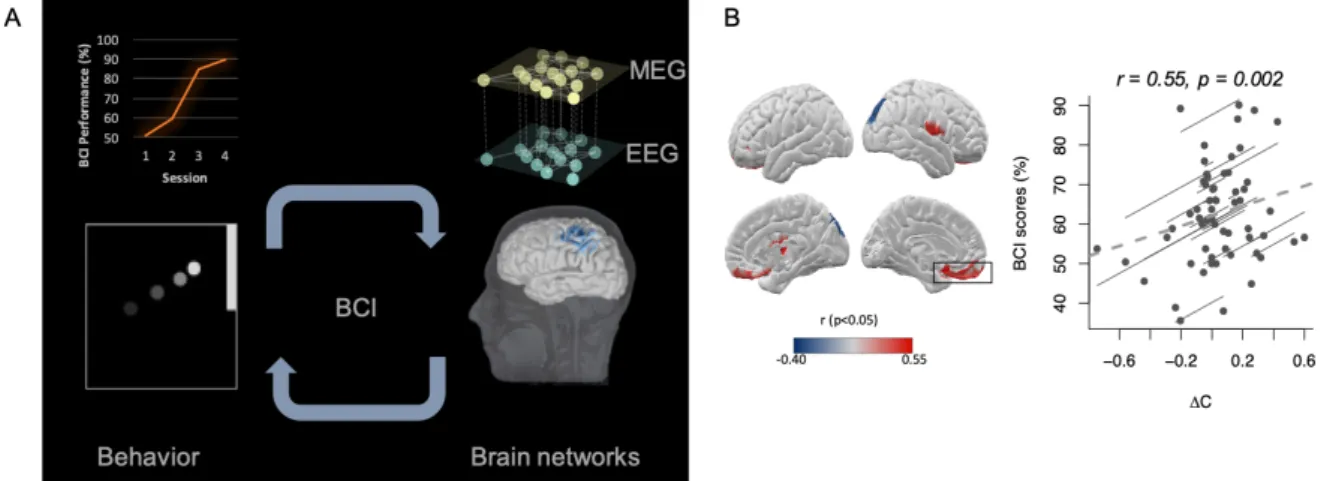
Therefore, to address this inter-subject variability, we adopted a multilayer approach to integrate brain network properties from EEG and MEG data resulting from a four-session BCI training program followed by a group of healthy subjects (see Fig. 1A). Our method gives access to the contribution of each layer to multilayer network that tends to be equal with time.
We show that regardless the chosen modality, a progressive increase in the integration of somatosensory areas in the alpha band was paralleled by a decrease of the integration of visual processing and working memory areas in the beta band. Notably, only brain network properties in multilayer network correlated with future BCI scores in the alpha2 band: positively in somatosensory and decision-making related areas and negatively in associative areas (see Fig. 1B).
Our findings cast new light on neural processes underlying BCI training. Integrating multimodal brain network properties provides new information that correlates with behavioral performance and could be considered as a potential marker of BCI learning.
Fig. 1 Core-periphery properties as markers of BCI performance. (A) Illustrative representation of the experimental protocol and analysis. (B) Repeated correlations between BCI performance of the subsequent session and the multiplex relative coreness in the alpha2 band (p < 0.01). The dashed line represents the overall regression plot and the paralleled lines correspond to the fit to each subject's data taken separately.
References
[1] Battiston Federico, Guillon Jeremy, Chavez Mario, Latora Vito, and De Vico Fallani Fabrizio, “Multiplex core–periphery organization of the human connectome,” J. R. Soc. Interface, vol. 15, no. 146, p. 20180514, Sep. 2018, doi:
10.1098/rsif.2018.0514.
[2] M.-C. Corsi et al., “Integrating EEG and MEG Signals to Improve Motor Imagery Classification in Brain–Computer Interface,” Int. J. Neural Syst., vol. 29, no. 01, p. 1850014, Apr. 2018, doi: 10.1142/S0129065718500144.
[3] J. Gonzalez-Astudillo, T. Cattai, G. Bassignana, M.-C. Corsi, and F. D. V. Fallani, “Network-based brain computer interfaces: principles and applications,” J. Neural Eng., 2020, doi: 10.1088/1741-2552/abc760.