Publisher’s version / Version de l'éditeur:
Home Builder, 21, November 6, p. 10, 2008-11-01
READ THESE TERMS AND CONDITIONS CAREFULLY BEFORE USING THIS WEBSITE.
https://nrc-publications.canada.ca/eng/copyright
Vous avez des questions? Nous pouvons vous aider. Pour communiquer directement avec un auteur, consultez la
première page de la revue dans laquelle son article a été publié afin de trouver ses coordonnées. Si vous n’arrivez pas à les repérer, communiquez avec nous à [email protected].
Questions? Contact the NRC Publications Archive team at
[email protected]. If you wish to email the authors directly, please see the first page of the publication for their contact information.
NRC Publications Archive
Archives des publications du CNRC
This publication could be one of several versions: author’s original, accepted manuscript or the publisher’s version. / La version de cette publication peut être l’une des suivantes : la version prépublication de l’auteur, la version acceptée du manuscrit ou la version de l’éditeur.
Access and use of this website and the material on it are subject to the Terms and Conditions set forth at
Turning drain water into wealth Armstrong, M. M.; Burrows, J.
https://publications-cnrc.canada.ca/fra/droits
L’accès à ce site Web et l’utilisation de son contenu sont assujettis aux conditions présentées dans le site LISEZ CES CONDITIONS ATTENTIVEMENT AVANT D’UTILISER CE SITE WEB.
NRC Publications Record / Notice d'Archives des publications de CNRC:
https://nrc-publications.canada.ca/eng/view/object/?id=b2852925-9009-43bd-9c8b-420ea9671e87 https://publications-cnrc.canada.ca/fra/voir/objet/?id=b2852925-9009-43bd-9c8b-420ea9671e87
http://irc.nrc-cnrc.gc.ca
Tur ning dra in w a t e r int o w e a lt h
N R C C - 5 1 2 1 3
A r m s t r o n g , M . ; B u r r o w s , J .
N o v e m b e r 2 0 0 8
A version of this document is published in / Une version de ce document se trouve dans:
Home Builder, v. 21, no. 6, November 2008, pp. 10
The material in this document is covered by the provisions of the Copyright Act, by Canadian laws, policies, regulations and international agreements. Such provisions serve to identify the information source and, in specific instances, to prohibit reproduction of materials without written permission. For more information visit http://laws.justice.gc.ca/en/showtdm/cs/C-42
Les renseignements dans ce document sont protégés par la Loi sur le droit d'auteur, par les lois, les politiques et les règlements du Canada et des accords internationaux. Ces dispositions permettent d'identifier la source de l'information et, dans certains cas, d'interdire la copie de documents sans permission écrite. Pour obtenir de plus amples renseignements : http://lois.justice.gc.ca/fr/showtdm/cs/C-42
Turning Drain Water into Wealth
By Marianne Armstrong and John Burrows
This article reviews the results of studies on drain water heat recovery conducted at the Canadian Centre for Housing Technology.
The energy used to heat water for the home is usually wasted when the water is discharged after use. The feasibility of recovering this heat was studied at the Canadian Centre for Housing Technology (CCHT).
Drain water heat recovery takes advantage of the fact that water clings to the sides of vertical drain pipes due to surface tension, facilitating heat capture from the drain pipe. Testing by CCHT showed that drain water heat recovery is effective in reducing the amount of energy needed to produce hot water for showers and for prolonging the availability of hot water during periods of high demand or continuous shower use.
The study produced a standard test that will allow manufacturers and utilities to compare the performance of the several commercially available heat recovery products. Most important for builders, the study led to the development of a web-based calculator that can be used to calculate payback.
The proprietary heat recovery units tested were 900 to 1,500 mm (36 to 60 in.) long and
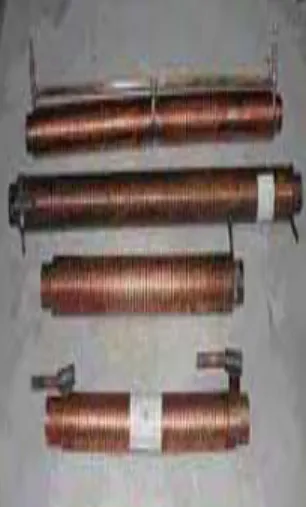
generally consisted of 76 mm (3 in.) copper drain pipe wrapped with 9.5 or 12.7 mm (3/8 or 1/2 in.) soft copper pipe through which water was circulated to extract heat from the drain water . Some of the units tested are shown in Figure 1.
Figure 1 – Typical drain water heat recovery devices
Experiments were performed using two different flow configurations, three different flow rates and three different shower temperatures. The daily natural gas savings from three different units in two plumbing configurations were measured for four daily schedules of hot and cold water draws. Effectiveness testing was also done on a total of five units. Although the devices tested
were very similar, performance varied depending on the way in which the soft copper tubing is shaped and wrapped around the drain pipe section.
In most homes, water uses include cold water only (toilets), both hot and cold water (sinks, clothes washers and baths/showers) and hot water only (dishwashers). Some uses involve
simultaneous hot water draws and warm water discharges (sinks and showers), and some involve delays between hot water draws and warm discharges (clothes washers, dishwashers and baths). The testing examined the impact of intermittent flows on energy savings and determined that the best heat recovery is obtained from long, simultaneous uses, such as showers. The heat recovered from non-simultaneous uses was found to be inconsequential. This means that households with high shower use will obtain more benefit from installing a drain water heat recovery unit than households where bathing is more prevalent.
The study findings have been incorporated into a web-based energy savings calculator that estimates the energy cost savings that can be expected from simultaneous shower flows by using drain water heat recovery (http://ceatech.ca/calculator/). As shown in the screen capture, the calculator determines energy savings depending on city location (for cold water supply
temperature and energy cost), length, temperature and number of showers, type of showerhead (water flow), type of hot water heating and type of heat recovery unit. The types of drain water recovery units for which the calculator applies are described in the definitions folder.
The on-line calculator includes a correction for seasonal temperature changes in cold water supply. It defaults to energy costs that existed when the calculator was developed, but a user can alter unit costs for electricity, oil and natural gas prices. The recent spike in crude oil prices means that potential savings for a typical household from the installation of drain water heat recovery can be $150 per year and more, depending on local conditions.
For more information about this drain water heat recovery project, readers can view a CMHC Research Highlight at http://www.cmhc.ca/odpub/pdf/65680.pdf
Marianne Armstrong is a research officer in the Building Envelope and Structure program of the NRC Institute for Research in Construction. John Burrows is an engineer and technical writer.