Analysis of On-premise to Cloud Computing Migration
Strategies for Enterprises
By
MASSACHUSETTS INSTITUTE
Ashok Dhiman
OF TECHNOLOGYBachelors in Electronics Engineering
8 2G12
Shivaji University, 1993
L B
RA R I ES
Submitted to the System Design and Management Program
ARCHIVES
in Partial Fulfillment of the Requirements for the Degree of
Master Of Science In Engineering And Management
Massachusetts Institute Of Technology
December 2010
© 2010 Ashok Dhiman. All rights reserved.
The author hereby grants to M.I.T. permission to reproduce and to distribute publicly paper and electronic copies of this thesis document in whole and in part in any medium now known or hereafter created.
Thesis Advisor
Prof. Michael Cusumano
SMR Distinguished Professor of Management & Engineering Systems
Group Faculty Director, M.S. in Management Studies Program
MIT Sloan School Management
Signature of Author
Ashok Dhiman
System Design and Management Program
Certified by
Michael Cusumano
Thesis Supervisor, MIT Sloan School of Management
Accepted by_
Pat Hale
Director, System Design and Management Program
Abstract
In recent years offering and maturity in Cloud Computing space has gained significant momentum. CIOs are looking at Cloud seriously because of bottom line savings and scalability advantages. According to Gartner's survey in early 2010 of 1600 CIOs around the world, Cloud computing and virtualization were on top of their list. This interest has also resulted in slew of products and services from existing IT players as well as new comers which promise to offer many solutions to pave the path towards Cloud computing adoption by enterprises.
As organizations get on to the Cloud computing bandwagon they are looking at their current IT setup and looking at the best way they can take advantage of what Cloud has to offer. For a given enterprises, getting on to Cloud might be a complete new start from scratch, a limited deployment of new applications or migration of part of existing applications integrating backwards with on-premise applications. To take advantage of the Cloud, enterprise will need to define their short and long term Cloud strategy. They will need to consider factors specific to their businesses and determine their requirements, risks and benefits. Proper investigation by the enterprise will give them insight in to the benefits and specific strategy they need to follow to gain the said benefits from Cloud.
This Thesis analyzes specific strategies which enterprises can adopt, both from business and technology perspective to make sure the migration and integration between on-premise and Cloud happens with minimal disruption to business and results in maximum sustainable cost benefit. It presents the current state of On-Premise IT and Cloud Computing space and then compares them to come up with enterprise specific variables based on which one can make Cloud migration decisions. Finally, Thesis presents the broad frameworks for "migration to Cloud" and confirms the same by interviewing enterprise managers involved in Cloud migration. There are various ways to slice and approach the Cloud migration - but all should take in to consideration the business processes, architecture of existing systems, architecture of available Cloud services, interoperability between on-premise and Cloud applications, maturity of Cloud and standards, short and long term cost savings, sustainability, data/security/regulation, user adoption, available Service Level Agreements (SLAs) and business criticality.
Acknowledgements:
First and foremost I would like to thank Professor Michael Cusumano for his guidance and direction during the process of writing this Thesis. He has been very accommodating and always given timely feedback. Cloud computing is a complex space, his papers and guidance has given me needed direction to be able to finish this work.
I would like to express my heartfelt thanks to all who took time to interview with me and give their precious thoughts, data and vision of Cloud computing in their organizations. There would have been no way for me to verify real world Cloud computing migration strategies without the insight which I got after talking to IT leaders in two pharmaceutical and one retail giant.
I would like to thank Pat Hale, the director of Systems Design and Management Program who has always been there to answer questions and take care of any roadblocks. Thanks to Bill Foley and all the staff in SDM office who were always there to help and answer our questions. I'm grateful to be part of SDM program where I learned so much over last three years from my professors, the institute and peers.
I would like to thank all my managers, peers and friends at GlaxoSmithKline for their help while I was juggling work and SDM program, they were always there for me and supported me all the way.
I would like to say special thanks to all my friends who cheered me in this endeavor, my parent's family and in-laws who offered inspiration and helping words to make my journey through SDM worry free.
Finally, I dedicate this Thesis to my wife Shalini and my two beautiful kids Saachi and Daksh. They have been on a three year journey with me and have given their time, patience and help all the way. I would not be writing this if it was not for their help, love and dedication.
Table of Contents
ABSTRA CT ... 3
A CK N O W LED G EM ENTS:... 4
CH A PTER 1: INTR O DUCTIO N ... 8
M OTIVATION:... 9
THESIS STATEM ENT & PRIMARY RESEARCH OBJECTIVES: ... ... 9
RESEARCH M ETHODS & APPROACHES ... 10
THESIS STRUCTURE...10
CH A PTER 2: STATE O F O N-PREM ISE IT ... 12
H ISTORY ... 12
O N-PREM ISE SOFTW ARE DEVELOPMENT AND LIFECYCLE...14
Current State of On-Prem ise IT:...17
CASE FOR KEEPING IN-PREMISE IT... 19
Technical perspective...19
Business perspective ... 20
CHAPTER 3: STATE OF CLOUD COMPUTING ... 21
D EFINED...21
BRIEF H ISTORY ... 21
LAYERS OF CLOUD COMPUTING STACK ... ... 23
Opportunities in Cloud ... 25
Cloud Computing Concerns and Roadblocks ... ... 27
DEVELOPMENT LIFECYCLE IN CLOUD...31
M ATURITY AND HORIZON ... 33
TECHNICAL CASE FOR CLOUD ... 37
BUSINESS CASE FOR CLOUD ... 40
CH A PTER 4: M IG RA TIO N TO CLO UD ... 42
D ECISION FRAM EW ORK...43
M IGRATION FRAMEW ORK ... 46
CLOUD A RCHITECTURES ... 52
CH A PTER 5: CASE STUDIES...55
SAACHI PHARMACEUTICAL'S CLOUD STRATEGY ... 56
S-MART'S MOVE TO CLOUD INFRASTRUCTURE ... 61
REMEDY PHARMACEUTICAL'S MOVE TO CLOUD BASED EMAIL ... ... 64
SUM M A RY A ND CO NCLUSIO N ... 67
A PPEN D IX A ... 69
A PPEND IX B ... 70
G LO SSARY ... 71
Table of Figures
FIGURE 1: EVOLUTION OF COM PUTING ... 13
FIGURE 2: SOFTWARE DEVELOPMENT IN ENTERPRISE... ... ... 14
FIGURE 3: C LOUD COM PUTING STACK ... 24
FIGURE 4: CLOUD MARKETS AND CAPABILITIES ... 26
FIGURE 5: RELATIVE MATURITY OF VARIOUS CLOUD COMPUTING LAYERS...33
FIGURE 6: CURRENT ADOPTION AND HORIZON OF CLOUD IAAS IN ENTERPRISES AND SMBS...35
FIGURE 7: M ATURITY OF SOFTWARE-AS-A-SERVICE... 36
FIGURE 8: COMPARISON BETWEEN CLOUD SERVICE AND THE CONVENTIONAL COMPUTING MODELS ... 36
FIGURE 9: ECONOMIES OF SCALE AND SKILL MATRIX ... 39
FIGURE 10: COMPARISON OF RETURN ON IT ASSETS BETWEEN TRADITIONAL IT AND CLOUD...41
FIGURE 11: CLOUD MIGRATION DECISION FRAMEWORK ... 43
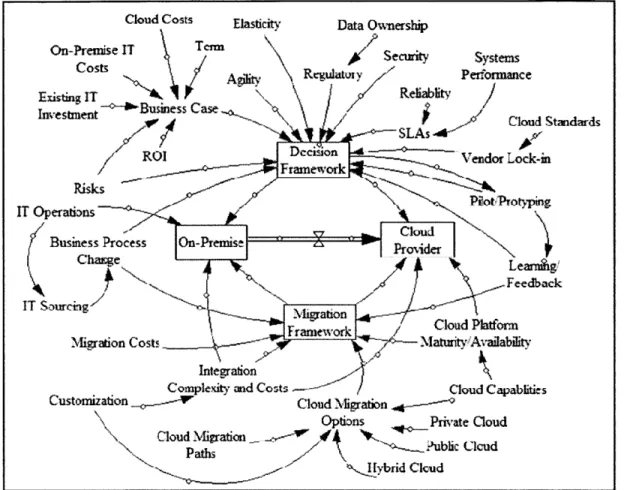
FIGURE 12: SYSTEMS DYNAMICS DEPICTION OF VARIOUS PARAMETERS INFLUENCING CLOUD DECISION FRAMEWORK AND THE CLOUD MIGRATION STRATEGY ... 47
FIGURE 13: CLOUD M IGRATION PATHS FOR ENTERPRISES ... 48
FIGURE 14: CLOUD MIGRATION PATHS FOR ENTERPRISES ... ... 49
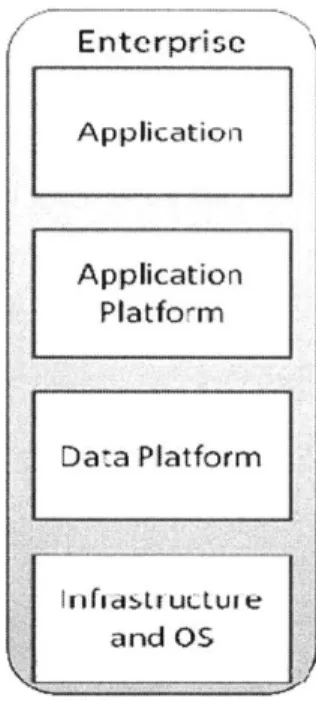
FIGURE 15: LAYERED ARCHITECTURE IN A TYPICAL ENTERPRISE IT APPLICATION...52
FIGURE 16: DATA CLASSIFICATION AT SAACHI PHARMACEUTICAL... 59
FIGURE 17: CLOUD INFRASTRUCTURE MIGRATION PROCESS ADOPTED AT S-MART ... ... 61
FIGURE 18: WHAT'S TRIGGERING MOVING EMAIL APPLICATIONS TO CLOUD ... 64
FIGURE 19: COST COMPARISON OF HOSTING EMAILS IN DIFFERENT MODELS...66
Chapter 1: Introduction
Information Technology is again going through a critical shift as it has gone through in the past half century - eras of mainframes, PCs, client/server, web and now Cloud Computing. Theory around Cloud computing is pointing towards its success and most of the technological and business factors are also on its side. There has seen increased investment and shifting strategies by big players and appearance of large number of Small and Medium Businesses (SMBs) in the Cloud space. Research and market prediction indicate that Cloud computing will be a 42 billion industry by 2012 which is driving lot of attention towards it (Gens, 2008). That being said it still has lot of roadblocks to cross related to security, data ownership, privacy, standards etc. Enterprises are going through testing and assessing what Cloud services are out there which can improve their bottom line and business effectiveness. A crucial step in this Cloud journey will be the Cloud Migration which will need well drawn out strategy, detailed planning and tested migration path.
At high level enterprise will need to:
- Understand the concept of Cloud computing, its architecture, what it can offer and
associated risks.
- Evaluate the models, architectures, technologies and best practices to adopt Cloud computing.
- Classify the Business processes which are good candidates for Public/Private Cloud.
- Depending on the case use Private Cloud as the stepping stone.
- Analyze how Cloud and on-premise IT mix will affect short and long term business strategy.
Motivation:
In my fifteen years of work in Information Technology space I have seen couple of technology shifts which have changed the way businesses implement and use Information technology. Namely the move from Host based systems to Client/server to Web based systems. Each of these changes have opened up the possibilities for businesses to do more but at the same time also have created challenges for their IT departments to continuously adopt and generate better value for business at lower costs. We are currently going through another such shift called Cloud computing. I got chance to be involved in two Cloud related lab projects in my previous semesters to do some in-depth reading, analysis and interviews which has rooted my interest in this topic. I see migration from on-premise to Cloud computing to be one of the next important areas, hence my interest in doing more research on it. I also see this as an opportunity for me to apply what I have learnt at MIT and at my job to create a sound base for something I see myself working on post graduation.
Thesis Statement & Primary Research Objectives:
Enterprises are standing at a juncture where soon they will have to decide which applications they want to move in to the Cloud. When enterprises are ready to move, they will have to create a roadmap of their migration strategy, and depending on the business and applications there will be various paths, challenges and risks.
Research objectives of this Thesis are:
- Research and contrast On-premise IT with Cloud Computing solutions leading to
variables for business case for migration to Cloud.
- Analyze the business and technical implications, challenges and rewards of
migrating from on-premise setup to Cloud computing.
- Create broad frameworks for "migration to Cloud" and confirm the same by
interviewing enterprise managers involved in Cloud migration.
- Apply lenses from learning at MIT and capture industry perspective by
Research Methods & Approaches
- Data Collection via online/book literature research.
- Data Collection via interviewing IT managers in enterprises. - Analysis, Classification and documentation of findings.
- Use of personal experience, learning at MIT and inputs from professors.
Thesis Structure
This Thesis assumes that migration to Cloud computing is inevitable and sooner or later enterprises will have to go through the decision and migration frameworks to decide what to move to Cloud and when. There is substantial amount of investment and good level of confidence in current On-premise IT solutions - the business processes, partnerships, technology maturity and sense of security, all are on the side of On-premise IT. Best way then to analyze the Cloud migration strategy is to contrast current state of On-Premise IT and Cloud Computing space to get the parameters on which business decision can be made.
This Thesis starts by looking at current state of On-Premise IT, including how enterprise IT got to where it is today and what is driving the consolidation and move to the Cloud. We look at advantages and problems with On-premise IT. Then we talk about Cloud computing - the opportunities it offers, roadblocks which need to be cleared yet and its maturity. Comparing both gives us the clear picture, which forms the foundation for Cloud migration decision process. Cloud Migration chapter looks at various frameworks which can be customized for a given enterprise and used to facilitate the decision making process on what to move to Cloud and when. We also look at various
Thesis ends with real world Cloud migration strategies adopted by two pharmaceutical giants and one retail giant. The real world scenarios confirm the migration strategies listed in this Thesis, plus present added perspectives on the role of current economic conditions, innovation, and centralization wave on Cloud migration decision. Interviews with IT leaders in these companies confirmed that migration to Cloud is happening, companies are experimenting - its matter of time when during next refresh cycle of an application, enterprise IT leadership will think, does it make sense to move this application to Cloud?
Chapter 2: State of On-Premise IT
Cloud computing is presenting enterprises with new ways to implement IT solutions allowing them to access services cost effectively and flexibly. It is a promising space but before enterprises can start taking advantage of Cloud computing they have to look at their current IT implementations and surrounding business processes to find out how they can move effectively to the Cloud computing space without compromising current investments and security. It is prudent to contrast advantages and disadvantages of On-premise IT solution with the pros and cons of Cloud computing space. This chapter looks at current state of On-premise IT including history of how we got here. We'll also look at Software Development lifecycle (SDLC) and sourcing models so that we can weigh their benefits and pain points against Cloud computing solutions later in this document.
History
Before we get to current state of On-premise computing and Cloud computing it's important to know how we got here. How has modern computing made its way to businesses over the years and evolved since its inception almost six decades back.
Looking at the history of computing there are couple of themes which are visible right away. The advances in computer technology have made new products bigger, faster, cheaper and better. Bigger in terms of computing power, storage space etc., faster in terms of bus and network 1/0, cheaper in terms of cost (per given computing parameter) and better in terms of reliability and usability (Skamarock B. G.). Processing power, Network speed and Memory capacity have been rising at a steady pace resulting in better speeds and performance while their costs are steadily falling. Software programs have also become more sophisticated to make use of available expanding computing resources.
Finally there has been the theme of centralization and decentralizations. Initial mainframe systems were central with all computing and storage in a single large location. Advent of PCs and client server computing systems brought in the decentralized computing. With time the IT management vows of dispersed systems has again resulted in centralization of some of the resources. Cloud computing is yet another step towards recentralization of computing resources, brining the pendulum back.
Table in Figure 1 below shows, how computing has evolved over the past half century and which companies have led the computing evolution. The major evolution is from data center applications to today's service delivery models. The service-oriented computing is the result of fundamental paradigm shifts in all areas of
technology-starting with the kind of hardware, applications, methodologies, algorithms, and the nature of applications (Nagaraju Pappu, 2007).
1960s - 1970s Evolution of Mainframe based
Computing computing IT Companies IBM IndustryMantra EDP, Requirements Innovations Structured Programming Programming Procedure Oriented Software Non-existent Engineering
Evolution of Electronic Data Applications Processing;
Turnkey projects Evolution of The developers Users and usage were also the
users
Evolution of Programming in
Development the Lab
Nature of Backroom Apps
Applications Mid 90s - 2003 Web based computing Amazon, Yahoo Distributed Systems Standards and Environments Object Oriented CMM like Processes Content Management and Delivery The customer becomes the user Programmingin the Large Process Automation
On-Premise Software development and lifecycle
Software Development Life Cycle processes found way in to enterprises because of the requirement of customization of software to fulfill specific business needs in the organization; generic software from bundled sources was unable to meet specific needs unique to individual companies. "Business need" took the form of software requirements which were fed through the steps of analysis, development, testing and deployment to a working product (as shown in Figure 2 below).
PRODUCT
IT Resource Pool
Figure 2: Software Development in Enterprise
The first formal Software Development Life Cycles were sequential as they went from one step to next till reaching the final step, also known as "Waterfall model". It is still one of the most used methodologies of SDLC in organizations. In Waterfall model completion of each step leads to the next till end is reached. Reviews may occur before moving to the next phase which allows for checks and possible changes; the phase completion criteria are also referred to as a "gate" that the project must pass through to move to the next phase, hence the term "Phase-Gate". In true waterfall making any big change or going back the gates to prior phases is discouraged once it's complete. This "inflexibility" is inherent to the model and has given rise to other more "flexible" models discussed later. For long time waterfall methodology of SDLC was only way project managers used to develop the software systems. This did work for some but most of the projects either wasted lot of resources in terms of money and people or were delivered too late to make business impact or did not give the intended business benefit. In Waterfall Software development is tied to the project metrics more than the business benefit metrics causing conflict in the success of end product.
Soon development teams realized that to create a software product with frozen requirements does not work most of the time. This gave rose to Iterative software development methodologies which assumed that it is impossible to know all requirements for a successful application before development starts. Development is evolutionary consisting of much small, scoped, feature-based iteration that deliver a product which is closer to the customer's vision. In recent years iterative methodoligies has made great in-roads in to the software development teams in enterprises because of the cost savings and accurate product development. Iterative methodologies have taken away lot of rework and wastage of resources which were typical in waterfall. In addition the end product is more close to what customer actually desires. Iterative projects enable an organization to build a project in an incremental way while staying in the comfort zone of a sequenced method. An iterative method is a sequenced, product-based method. (Hotle, 31 March 2010)
Agile is iterative approach with collection of methodologies which include Scrum, Feature-Driven Development, Extreme Programming, Test-Driven Design etc. Agile needs tight collaboration between business and the software development teams to get product closer to the intended business need. Agile methods are very useful where the business has little to no understanding of its requirements (which is normal in new products or new business processes), or where the business process changes rapidly by nature. Iterative software development methods are base of Cloud software development.
Developing software in house let's you customize it and gives the ability to integrate it better with existing systems but it comes with following shortcomings.
" Dedicated teams: Usually enterprises keep a dedicated team of developers. Resources are retained even when project has finished, this to make sure they have needed resources in hand for possible forthcoming projects. This adds to the ongoing operations cost.
e High Cost: Apart from some small rapid delivery projects, the cost of developing systems in house is usually more than a similar off the shelf system.
* Late deliveries: Traditional in-house software development is known for either missing on scope or time leading to missed business opportunities.
* Product quality: In enterprises it's common to hear users complaining about the quality, performance and bugs in in-house built software systems. Releasing a below par product to end project within budget might lead to higher support costs later.
Current State of On-Premise IT:
Currently enterprises are going through consolidation to reduce their operations footprint. They are becoming leaner to maintain their competitive advantage by putting more of their available resources in their core business as oppose to IT operations.
Following are some of the current trends in On-Premise Enterprise IT:
a. Application consolidation - Over the years On-Premise IT in most enterprises have been embedded with business making it easier to better understand the business requirements. This though has created overlapping systems where one or more departments in an enterprise have applications which do similar function. As part of consolidation enterprises are creating central pool of applications which can be accessed by business across organization. Consolidation of applications is driving lot of advantages namely, small footprint of applications to save on maintenance costs, more streamlined IT operations and improved support.
b. Outsourcing - Consolidation has made it easier to pick up a pool of applications and outsource them easily. In recent years boundaries of what can/should be outsourced in enterprises has been pushed further because of better performance, cost savings and improved Service Level Agreements (SLAs) with sourcing partners. This is an important point when considering Cloud computing - as enterprises have already used vendors outside their premises to maintain and support their business critical applications, the pro-Cloud group in enterprise is asking the question why can't we to the same by moving applications to Cloud.
c. Support - IT support has become more streamlined through adoption of processes like ITIL and COBIT. In-house support has taken a new role of managing the relationships while most of ground work done by outsourcing partner. This trend is because of the maturity in off-shoring support models which provide better
d. Application development - More and more organization are going towards off the shelf systems with minimal customizations. This again has happened through business process changes in the enterprises which have streamlined the systems requirements for given business process. This shift in enterprise IT is key to Cloud adoption as most of the Cloud offerings are standards with minimal front end customization.
e. Datacenter consolidation - Datacenters throughout organizations are
implementing server consolidation projects by going towards blade servers. This has reduced the space and energy footprint in datacenters. Datacenter consolidation presents first wave of IT operations cost savings to enterprises, building the confidence to riove infrastructure boundaries to Cloud infrastructure options.
f. Back-office -Enterprises are outsourcing non-core package back-office needs like emails and teleconferencing to vendors. Complete Email outsourcing has seen rise because it's one clearly demarcated large chunk which can be picked and outsourced.
Trend in consolidation and outsourcing of non-core business processes in enterprises will continue and will make IT departments leaner with time. On the other hand IT giants are continuing to acquire more and more service specific vendors to widen their service spectrum. Future points towards handful of large players which will offer IT services on Cloud at a price point which will push enterprises to consider moving considerable part of their IT operations to Cloud.
Case for keeping On-Premise IT
Enterprises have been moving their business processes, IT development and support outside their perimeter. Last decade saw an exponential increase in outsourcing of non-core IT services and business processes. The trend still continues with enterprises pushing boundaries of what to outsource or host external to the organization. While CIOs are making these decisions, they are presented with opportunities in Cloud computing area, they are confronted with the question like, how can they realize cost and performance benefits out of it. That being said, traditional in-house systems even with their big price tag and high ongoing expenditure seem safe because of the control they provide. These benefits and merits do come in to the decision process when IT managers think about migrating to Cloud.
Technical perspective
1. Data storage and location: Having infrastructure inside your walls gives you the control over servers and data they hold. You know where your data is.
2. Security: Having your own infrastructure within your premise gives you the sense and control of security. You can be flexible with securing your applications and data depending on the criticality.
3. Architecture: On-premise systems give applications high architectural flexibility. Having control over infrastructure, application platforms and development resources, the applications can be customized to better fit the user's needs (albeit at additional costs).
4. Hardware dependencies: Dependencies between different architecture layers can be controlled better in On-premise systems by making needed adjustments and fixes.
Business perspective
1. Ownership of data: Knowing the location and condition of your data gives businesses in enterprise the sense of confidence and control (which is lost when one moves to Cloud). In On-premise systems, enterprise owns the data and can change, use, purge it when they like - they own it.
2. Regulatory Issues: Sometimes enterprises might want to move data outside their perimeter for cost and performance benefit but regulatory requirements might not allow them to do so. For example, "electronic patient data" regulation might not allow a pharmaceutical company to host patient data in the Cloud even though technical and business perspective it might make perfect sense to host it in Cloud.
3. Privacy issues: Having your data hosted out on vendors' machine might make it open to government agencies who might be allowed access based on legislative acts. Having data on-premise gives the control in the hands of enterprise allowing them to take actions best in the interest of company and its customers.
4. Cost/Benefit: There have been various models in support of cost benefit of outsourcing, hosting and Cloud computing but depending on the utilization and scenarios there might be some cases where on-premise IT can be implemented in a way to justify its cost given other benefits it gives of data control and security.
5. Change management: Sometimes making decision to move perfectly running systems and application outside enterprise does not make sense as the move might cause change in business processes, user behavior and system integration nightmares. Change management is the key when planning for Cloud migration.
Chapter 3: State of Cloud Computing
Defined
Cloud computing is a style of computing where scalable and elastic IT-enabled capabilities are delivered "as a service" to external customers using Internet technologies (Cearley, 2010).
In Cloud computing the infrastructure and software details are abstracted behind the service interfaces. What the service does is more important than how the technology behind the scene is used to implement the solution. This is moving towards simplifying the customer facing interface and only presenting what customer needs, hiding all the complexities behind. Cloud is based on multi-tenancy which means that multiple services used by customers tap the same shared pool of resources, creating economies of scale. Another important characteristic of Cloud is Elasticity, which is ability to ramp up and down the resources assigned to a service on-demand. Services in the Cloud are delivered using internet technologies and follow the utility model where customers pay based on the usage metrics.
Brief History
Cloud computing is a progression of decade old concepts which have finally become cheap and fast enough to be bundled in to services for enterprises. Past computing trends which led to on-premise computing of today also created technologies which are now the foundations of Cloud Computing technology - namely virtualization, multiprocessing, parallel processing, abstraction, utility computing (time sharing) etc. The concept of time-sharing and virtualization has been around since the days of IBM, both of these concepts were used in early IBM machines. There were in fact companies like Tymshare which sold computer time by giving access to its mainframes via dialup lines (Krishnan, 2010). Mainframes were also one of the first systems which utilized the concept of a central,
reliable, robust computing resource used by many machines. In addition, the concept of Grid computing has been there since 90s which in many ways a precursor to Cloud computing.
Virtualization of servers in datacenters in this decade has acted as a stepping stone towards Cloud computing. The server consolidation using virtualization has given enterprises taste of how much cost savings can be done using Cloud technologies which is leading them to pilot projects in Cloud.
Amazon pioneered the infrastructure Cloud space in 2002 with introduction of Amazon Web Services (AWS) and later launched S3 (Cloud storage offering with "pay per use" model) in 2006. Same year EC2 was launched making core computing infrastructure available. Salesforce provided the other two pieces of Cloud the SaaS (Software as a Service) offering and later offering of PaaS (Platform as a Service) in the form of Force.com. Google entered in to the space in 2008 with launch of Google apps followed by Microsoft and other companies. In recent years there have been lots of big and small players offering different layers and services of Cloud spectrum.
Cloud computing has long way to go before it crosses the roadblocks around standards, security and data ownership. Till then there will be pieces of Cloud computing which will be packaged and sold by different companies to suit different enterprises. These intermediate steps will increase the knowledge and confidence of enterprises leading to increasing degree of adoption by them.
Layers of Cloud Computing Stack
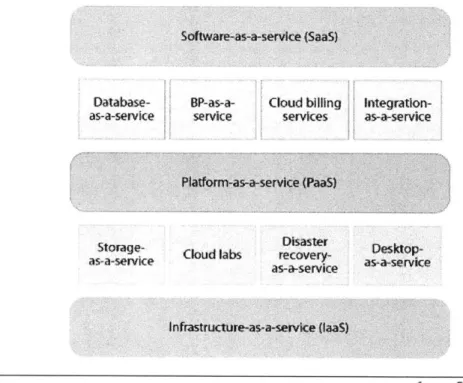
At a high level, Cloud can be viewed as a combination of Software as a Service (SaaS), Platform as a Service (PaaS) and Infrastructure as a service (IaaS). Web based service offerings have served as a prelude to current Cloud offerings and is base of Cloud services. At a high level all the current Cloud offerings can be classified in following four categories (Roehrig, 2009) :
Web-based service offerings are Rich Internet Applications (RIA) which provides a specific service via the web. Examples are Facebook, Zillow, Google Apps and Flickr. Many of the IT service providers are not in the business of providing Web-based services, but they are aligning to help clients implement these offerings by taking common applications across organizations and offering them via web - Travel reservation system for enterprise travel is one example.
Software-as-a-service offerings include complete applications that can be customized by clients and delivered over the Internet. Salesforce.com is an example where a complete CRM application is offered as a service, clients do not have to worry about infrastructure and software licenses they just pay monthly usage charge to Salesforce.com depending on their agreement.
Platform-as-a-service offerings are externally hosted services providing complete platforms to create, run, and operate applications, including development tools, management tools and user-management services. These services include offerings such as Google App Engine and Force.com (for customizing salesforce.com SaaS offering). Apart from some exceptions like IBM currently most of the IT service providers don't really play in PaaS space but many firms do offer consulting and development support to help clients leverage platforms provided by other firms.
Infrastructure-as-a-service includes both full infrastructures on which clients can deploy applications as well as separate infrastructure services (e.g., virtual computing capacity, virtualized hosting, utility storage, etc.). Most of the Cloud providers currently
either have existing IaaS offerings (Amazon, Rackspace etc.) or are well on the way to developing as-a-service offerings for processing, storage, networking and so on.
Software-as-a-service (SaaS)
Database- BP-as-a- Cloud billing Integration-as-a-service service services as-a-service
Ptatformn-as-a-service (PaaS)
Storage-
~
Disaster Dstpas-oase~c Cloud labs recovery- asa-serice
as-a-service as-a-service
I nfrastruture-as-a-servie
daaS)
Source: Forrester Research, Inc.
Figure 3: Cloud vomnputing stack
There are some services within the Cloud layers mentioned above that do not fit clearly in to one of the bins but are discrete services that can be consumed standalone, such as storage as- a-service or IT functions such as "disaster recovery" delivered as an on-demand Cloud service (see Figure 3). Similarly there are application services which are Cloud services that provide a discrete middleware function but are not complete, standalone applications. Examples include Cloud databases like Microsoft SQL Azure, billing systems like Amazon DevPay, and integration services like Boomi (Staten, TechRadar For Infrastructure Operations Professionals:Cloud Computing, 2009).
Opportunities in Cloud
There are many opportunities in Cloud which makes it an attractive option for enterprises. Research indicates that roughly 5% of the sourcing budget in an enterprise is applied to transformation types of services, while efficiency and enhancement types of services command roughly 80% and 15% of the sourcing budget respectively, indicating that major portion of the budget is applied towards keeping the systems up and running as oppose to transformational undertakings. Adoption of Cloud-based solutions will increase the relative participation of transformational services because of innovative business models and transformed business processes (Dreyfuss, Feb 2010).
Economics: Cloud services offer reduced entry and exit barriers, allowing enterprises to react quickly to business changes. The IT spending pattern with Cloud is very predictable as enterprise cash-out for services. Cloud also reduces unnecessary cost arising due to unused licenses and features, as you only pay for what you use. Appendix A shows price comparisons of computing resources of some of the current Cloud players in the market.
Agility: Cloud enables organizations to be agile with their IT infrastructure and software needs by adding, removing IT resources on-demand due to elasticity and use of shared resources inherent in the Cloud implementations. In Cloud, scalability, flexibility and elasticity are service attributes that positively contribute to business process value by reducing cycle times and accommodating volume fluctuations.
Simplicity: The whole process of infrastructure provisioning and running applications is simple in Cloud space. Cloud offers simple provisioning, ramp-up and decommissioning which makes it easier for businesses to get better turnaround and test their ideas at a much cheaper and faster pace.
Composite applications: In Cloud users can leverage the flexibility of dynamically accessing anything, and the diversity of available functionalities arising from composite applications. These new applications promise to provide users with simpler interfaces with better business integration and simpler support models.
Application development: Cloud platforms fixes lot of constraints inherit in the traditional software development. Cloud will move most of the responsibility of creating services with desired functions to providers making it easier and less expensive for enterprises to consume them.
Apart from visible opportunities Cloud computing also brings capabilities to enterprise at each layer. Cloud computing spans a wide range of IT-enabled capabilities, from low-level infrastructures to high-low-level business processes. As seen in the diagram below more discrete categories appear as we go deeper including sub divisions of the high level classification of Infrastructure, Platform and Software including additional services used to manage and monitor the overall Cloud environment (David W. Cearley, March 2009):
Level of sharing Public Cloud at global provider
Virtual Dynamic Integration- Dynamk
Dynarnk BPO pivate infrstructure as-a-service application services
Clud servkces servkces (on-demand
at dedirated (on-demand portion of BPO)
provider
Private n r
Cloud vrulzto itaiain vru to
at in-house tostostos data center
Infrastructure Middleware Applications Information Business and processes value
Cloud Computing Concerns and Roadblocks
Cloud brings lot of opportunities and capabilities to the table but it does come with its share of concerns around data security, data ownership, reliability and lack of standards. These roadblocks will inhibit the adoption of Cloud till they have been cleared through technology or business process re-engineering. At a high level these inhibitors can be divided in to two - the internal factors which are related to technology and business process (within a given enterprise) and the external ones which are due to the factors external to the enterprise like regulatory, privacy and legal concerns. To carve a way towards smooth Cloud adoption, both the internal and external inhibitors will need to be tackled in parallel.
Security: Security and Privacy are current top reasons for not adopting Cloud. Most concerns center around data protection, system integrity (access controls and vulnerabilities), and availability, but privacy is of course also a key concern. There is also notion that business-critical data is outside the perimeter of enterprise, creating perception of unmanageable business risk. This definitely comes in CIO discussions and draws comparisons with security comfort with data on on-premise systems (EUROPE, 2009).
Reliability and Performance: Performance and availability of the applications are important criteria for enterprises. With On-Premise systems there is sense of control on which is lost when their applications are hosted on the infrastructure of Cloud provider. Systems uptime with Cloud providers is not as robust as with on-premise vendors. SLAs with most of the current Cloud vendors are generic with little room for customization which creates anxiety in the IT group. Additionally for applications which have part of the system in Cloud and part in-house face integration and performance issues.
Lock-in: There are no Cloud computing standards today to promote a common way of developing and migrating applications to Cloud. Enterprises have to adapt the standard offered by their vendors and get in to the risk of lock-in with a specific vendor thus
giving away economies of multi-vendor models. In addition, there are very few vendors who offer full range of Cloud computing capabilities pushing enterprises to adopt different Cloud services from different vendors each using different standards. Level of lock-in might differ depending on what slice of Cloud computing paradigm an enterprise is getting in to - Infrastructure-as-a-service providers like Amazon have low lock-in because of well defined infrastructure standards and pretty common implementation by other IaaS providers, but platform and application providers like salesforce.com have high lock-in.
Change in existing Business processes: Cloud space provides wide range of capabilities from agility, flexibility to economies but to take true advantage of these opportunities it demands more-responsive organizational and change management processes. This creates need for enterprises to re-engineer their business processes in order to take advantage of all what Cloud has to offer.
Legacy applications: A big challenge for large enterprises planning to move their applications to Cloud is the fact that their business processes are aligned with legacy systems which are decades behind in terms or technology and performance. Linking legacy systems with related applications in Cloud pose integration and performance challenges. To take true advantage of Cloud, legacy applications need to be rewritten. For most enterprises rewriting the legacy applications will be a multi-year long process which will result in parallel systems and business processes between traditional and Cloud platforms, and that can become very problematic.
Losing existing investments in on-premise IT: Large enterprises have already invested in their own data centers. Their current business processes can leverage existing investments in datacenter better. Hence it's important for organizations to see when they
Regulatory/Legal issues: Regulatory and legal concerns are external factors which might hinder the Cloud adoption by a given organization. For example it is technically feasible and also might make business sense to host patient data in the Cloud but the regulatory authorities (like FDA) might not allow the same due to privacy and security concerns.
Compliance: Lack of control over where that data may be physically located in Cloud is a nonstarter for some enterprises. Cloud services scenarios get complicated and worrisome when you consider the legal implications of data that's not locked down into a specific physical space. Some governments also impose limits on what kinds of data can cross national boundaries, and this will further inhibit the economies of scale that enable the Cloud services model to be commercially viable (Roehrig, 2009).
Maturity: There is lack of maturity on two sides of the line, lack of maturity of enterprises prevents them from incorporating more Web-based solutions in their IT application portfolios, and the lack of maturity of Cloud solution providers which prevents them from appropriately defining the exact features they want to provide in a given service at a given price point (Dreyfuss, Feb 2010).
Lack of Standardization in Cloud space: Cloud computing standards are yet far from reality. This creates multi vendor solutions with proprietary implementations causing some enterprises to only do a limited move to Cloud and wait for their bigger move till standards are in place. Lack of standards feed in to vendor lock-in and complexity.
Lack of transparency: Many of the Cloud solutions currently available are often provided as "plug-and-play" offerings that apparently need little or no attention and can be implemented immediately. Such products still are essentially "black boxes" that remain poorly understood by buyers and users. There is lack of transparency with this new business model which means new business risks that must be assessed and properly managed (Dreyfuss, Feb 2010).
Licensing approaches: License models in the "pay as you model" of Cloud computing are totally different than the traditional licensing models. One major challenge for organizations looking for Cloud computing will be adapting new licensing structures in Cloud and look-out for the possibility of variable charges. Perhaps licensing based on the concurrent users will prevail but there are still lot of variables like software usage based on CPU, Bandwidth and time which can complicate the licensing approaches. Appendix-B shows where various licensing model falls in the spectrum of type of software packaging and various software pricing models.
Service Level Agreements (SLAs): With new tools, standards, and continuing provider maturity, IT service management practices have advanced significantly over recent years. But existing service-level agreements (SLAs) and delivery processes for Cloud services lack the detail and maturity of traditional SLAs in large enterprises. Current Cloud vendors only provide standard SLAs with no customization. SLAs are critical to the success of Cloud computing and it's expected that in future through technology advances and competition SLAs will evolve to ensure higher confidence level of quality of service.
Fog in Cloud value proposition: Cost savings in Cloud has been put out there as one of the main attractions of Cloud computing. There are lots of questions though around whether savings claims are valid. One of the reports published by McKinsey in mid 2009 (McKinsey & Co. Report: Clearing the Air on Cloud Computing) asserts that, "Current Cloud computing offerings are not cost-effective compared to large enterprise data centers." Even though providers are claiming savings of 20% to 50% beyond traditional delivery methods for Cloud-enabled delivery, enterprise ROI models break down often because they either don't know true current costs or don't have models in place to assess true value of moving to Cloud. Enterprise will only be able to understand the economics of Cloud computing by modeling their specific scenarios and cost points in detail.
Development lifecycle in Cloud
Cloud computing represents parallel paths of evolutions at different levels of the technology stacks (Infrastructure, Platform and Application). Many of these offerings are modular by design and enable developers to pick and choose which services to incorporate when building a solution and to combine these with on-premises based functions and subsystems (Valdes, November 2008).
Application development lifecycle in Cloud is little different than the traditional one. The release cycles tend to be small in Cloud because of the need of feature addition in shorter intervals. Development methodologies like Agile cater themselves nicely to the frequent feature development and release model and are being used in Cloud Application development. Cloud Software development Platforms are used for developing, deploying, hosting, and maintaining Cloud-based Web services and applications. The platform offerings typically include development tools, management tools, and a runtime environment within which custom applications execute in the Cloud. Applications created for Cloud take advantage of available elasticity and processing resources to be more productive. Cloud Application Development platforms also provide high degree of infrastructure abstraction than traditional web development, thus easing developer concern of resource scalability and component distribution (Eric Knipp, September 2009). Due to the need to move towards creating apps providing standard services, the service providers will take ownership of a larger part of the software development life cycle than they have taken in traditional on-premises hosted models.
Enterprises are observing if some of the existing on-premises platforms can be extended to add the support for Cloud computing. Most of the near term software development lifecycle will be associated with moving, integrating on-premise applications in Cloud. This will cause current on-premise software development methodologies to continue till the time when enterprise decide to subscribe to a replacement service from Cloud or decide to rewrite the on-premise application to take advantage of scale and performance of Cloud. A dramatic shift is under way in the
enterprise-software industry as established vendors embrace services in the wake of declining product revenues. It remains to be seen whether life-cycle dynamics or business-model choices are behind the long-term trend (Cusumano M. A., 2008).
Below is an example of steps involved in a typical Web browser-based, integrated Cloud environment for rapid Cloud Application Development (Kumar, 2009):
1. Create Forms: The Composer enables users to create rich Web UI forms (web pages) by dragging and dropping from a wide variety of UI widgets such as text, date, currency, number, check boxes, picture fields etc.
2. Create Application Objects (Tables): When a user creates a form, optionally, application objects can be created by the system automatically to persist the information entered in the forms.
3. Create Business Process Models (BPM): System enables users to create business process models through modeling.
4. Consume Web Services: It is easy to consume third party Web services such as those exposed by Google, Sales Force, other applications, etc.
5. Build Reports and Charts: Ability to enable end-users to create reports and charts instantly in various formats.
Modular development examples like these are typical of development models in Cloud. Enterprise can start integrating some of business benefits of what Cloud has to offer with on-premise applications and then with time assess if it makes sense to move other applications to the Cloud.
Maturity and Horizon
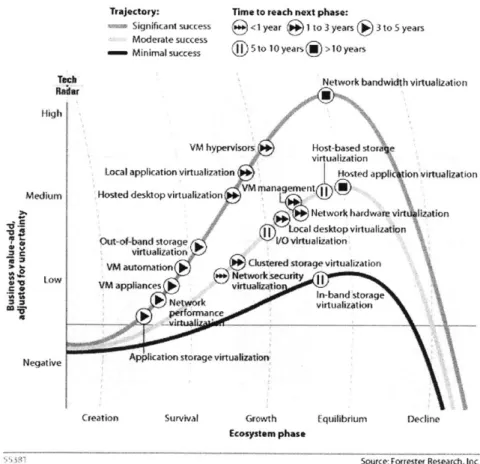
Cloud computing package standardized IT services into optimized and automated solutions enabling economies of scale that most on-premise IT operations envy. Enterprise need to research, test and decide which services to pick, customize, and implement to most cost-effectively leverage the benefits of Cloud. While most Cloud services are immature today and thus really only best applied to new applications and services, as they mature, their applicability to existing applications and equipment will increase. Enterprise also need to understand that not every application, middleware, or infrastructure can (or should) be delivered as a Cloud service, and some areas of service are simply too new to categorize. Diagram below from research shows the current maturity and trajectory of Cloud computing components (Staten, TechRadar For Infrastructure Operations Professionals:Cloud Computing, 2009).
Trajectory:
=m
Significant success Moderate successm Minimal success
Time to reach next phase:
S <1 year 1to 3 years 3 to 5 years 101 5 to 10 years >10years
Network bandwidth virtualization
Creation Survival Growth Equilibrium Decline Ecosystem phase
Source: Forrester Research. Inc.
Figure 5: Relative niaturity of various (luId ctmnputing avcrs
Teth Radar Hligh
I
Medium , Low Ce a tiv NegativeIt's clear from the graph in Figure 5 that that there is still lot of maturity road to travel as most of the current offerings are very limited in their function. Only IaaS and SaaS offerings have seen significant success but they are early on their growth trajectory and so will take another 5 years to get to a substantial acceptance from enterprises. Important services for enterprises like Integration as a Service and Business Process as a Service have only seen moderate adoption and even they have lot of catching up to do before any serious adoption by the customers.
Additional visible points about Cloud maturity are:
a. Enterprise Confidence Lags: Capabilities of Cloud computing are clear but due to lack of experience in Cloud implementations and lack of greater success data, it makes enterprises nervous to move anything business critical to Cloud.
b. Application immaturity: Many applications and service offerings cannot be moved today to Cloud due to risk of lock-in stemming from lack of standardization or just the fact the some of the services cannot be effectively coded for Cloud given the immaturity of the Cloud development platforms.
c. Players in Cloud: Cloud offerings are littered with small vendors which might not be too attractive to enterprises given most of their on-premise applications are on major vendors like Microsoft, IBM and Oracle. Enterprises are awaiting Cloud maturity from major IT vendors to see if their offerings will make it easier for them to port their existing on-premise applications to Cloud.
Let's look at adoption of one of the accepted Cloud layers, Infrastructure as a Service (Staten, TechRadar For Infrastructure Operations Professionals:Cloud Computing, 2009).
"What are your firm's plans to adopt pay-per-use hosting of virtual servers (also known as cloud computing) at service providers such as Amazon Web Services, Savvis, or Rackspace/Mosso?" Don't Not interested Planning to Planning to U Implemented, a Expanding/ know interested but no implement implement not expanding upgrading
plans in a year or in the next implementation more 12 months
3%
5MB 3% 45% 40% 5% 2%
Enterprise 4% 41% 44% 5% 2%
Base 593 SMB hardware deislon-makers, 679 enterprise hardware decision-makers Source; Enterprise And sMB Hardware Survey, North America And Europe, Q3 2009
Source: Forrester Resea rch, Inc igiure 6: Current adoption and orizon of Cloud laaS in enterprises and S MBs
As seen from in Figure 6 most of the firms are either waiting on the side or have no immediate plans (85-90%) to implement Cloud infrastructure offering. Only 10% are either planning or have implemented IaaS offering. This again points to the lack of maturity of Cloud offerings and cautious adoption from enterprise.
As seen in the Figure 7 below, Software as a Service has been more accepted in certain segments but still seeking broader acceptance and maturity in wider application categories. While it is relatively easy for a software product company to create a hosted version of its products, delivering these products over a SaaS platform (like Amazon, Google, Microsoft Azure) requires rewriting of major portion of code to user interfaces
Software-as-a-servke
Why the Growth
phase?
Business value-add,
adjusted for uncertainty
Time to reach next phase
Trajectory known
or prospective)
SaaS, now 10 years old, has become an established software delivery model for certain segments of the market. Forrester survey data shows that fully 20%of enterprises and SMBs have implemented or are piloting at least one SaaS solution. All major enterprise ISVs have SaaS offerings, and all major Sis are building large SaaS practices.
Medium. Not al applications are suited to SaaS delivery, and not even all implementations of SaaS-suited software are appropriate for a SaaS delivery.
5 to 10 years. SaaS maturity varies widely across application categories, which
suggests a long simmer before SaaS reaches equilibrium. Plus, wholly half of Forrester survey respondents in 2008 showed no interest In deploying SaaS or were unaware of
it.
Signifcant success. SaaS has the potential to significantly reduce operational and maintenance costs for customers, has dramatically faster tine to deployment, and can deliver richer functionality to the customer at a much faster rate. Where suitable, SaaS holds significant potential for improving corporate productivity and efficiency.
sALP
Figure 7: Maturity of Software-as-a-Service
Source: Forrester Research. Inc.
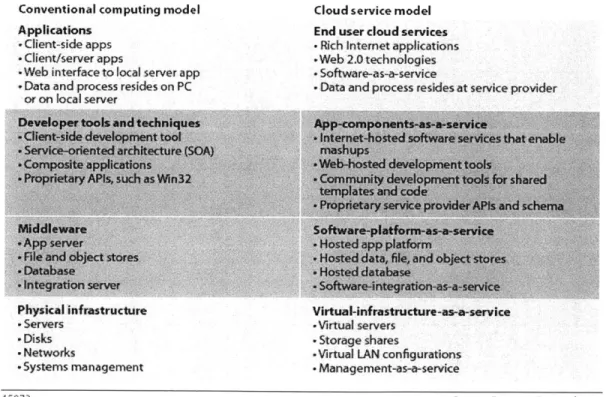
Figure 8 below shows how Cloud service model compares to the traditional on-premise IT service model. Most of the services in Cloud service model might not cater for an easy transition from conventional service models due to difference in the development models and architectures.
Conventional computing model
Applications
" Client-side apps * Client/server apps
-Web interface to local server app
-Data and process resides on PC or on local server
Cloud service model End user cloud services
.Rich Internet applications -Web 2.0 technologies * Software-as-a-service
*Data and process resides at service provider
Physical infrastructure Virtual-infrastructure-asa-service
Technical case for Cloud
Traditional IT is under pressure of delivering more with same or less resources in an ever changing computing landscape. In most of the enterprises, IT operations take 70% of the IT budget, leaving very little for any technological innovation implementation within organization. IT departments are trying hard to keep up with fulfilling their business demands with the resources they have in hand. Traditional IT systems implementations have not been scalable and only stand for 3-5 years for a given requirement before they are upgraded or replaced with something new. This all creates spaghetti of overlapping systems which do not deliver needed business benefits and require constant maintenance and upgrade. Following are some of the technical vows of IT departments in enterprises which keep them awake at night:
a. Low business demand response time: IT departments today cannot keep up with the new business systems demand. Current processes and implementations are resource heavy and costly; yet do not deliver the needed requirements in time to the business. This is a strategic disadvantage as competitors who are able to tap in to cheap and better computing alternatives get advantage over time to market and processes efficiencies.
b. Procurement/Provision Process overload: Traditional IT work on "Procurement and Provisioning" models which are dreaded with long approvals and actions causing delays in a simple request like getting a server to test a new business idea. c. Capacity Planning problems: Business needs in an enterprise are complex and dynamic. It's an uphill battle for most enterprise IT to keep their capacity in sync with the business demands and deliver needed services in time.
d. Complex Business needs: Business needs in enterprises are not clearly prioritized. This makes it difficult for IT to manage assignment of resources to business which needs them most. IT asset utilization with true business need has always been a challenge in enterprise IT.
e. Adhoc needs: There are large numbers of business requests which are mainly proof of concept and these requests do not come from traditional provisioning process creating a tension between IT and business. IT wants to make sure their resources are used for prioritized business need and business wants to test something new which might give them an edge over competitor.
f. High Performance Computing (HPC) needs: Last five years have seen a huge amount of unstructured data piling within various business areas of enterprises which can be mined to get useful information leading to strategic advantage. Systems required to mine through large amount of unstructured data can be costly affair if done on-premise - Cloud presents an attractive alternative. Like unstructured data mining there are other applications in various organizations which need HPC and it's very difficult for on-premise IT to compete with Cloud on price, performance and time.
Cloud computing implementation either using public, private or hybrid could be the answer. Following are some of the opportunities in Cloud space which might make some of the problems listed above disappear easing some of the pain which IT organizations and their business have been going through till now.
a. Better way to provision Infrastructure: Infrastructure services in Cloud are standardized that allow on the fly elastic scaling of services. IT departments can take advantage of Infrastructure service through private or public Cloud and ease some of their pain points related to ad-hoc business demand or seasonal requirements which cannot be dealt with agility by on-premise IT.
c. Project funding and resourcing: Because of pay as you model of Cloud the upfront IT costs are less, which speeds innovation and increases the number of projects that can be funded. Resourcing of needed skill sets for a given project is not an issue in Cloud as Cloud providers do most of the weight lifting leaving only customization to the enterprise project team. Diagram below in Figure 9 shows various IT models and how economies of scale and skill in Cloud Computing will drive its adoption compared to other computing services (James Staten, 2009).
High Coloction services comptingloud
Economies
of scale
Low On-premise
Low High Economies of skill
Source: Forrester Research, Inc.
Figure 9: Ecunomies of scale and skill natrix
d. Architecture simplicity: As most of the Cloud offerings are services as oppose to systems, the IT architects need not worry about the systems behind the abstraction, they can just represent that as a box with business inputs and service outputs. This model works best for applications/services which need no or little customization. In most implementations there are no software or hardware requirements at the customer end or specialized tools needed to deploy the
application.
e. Speed: Cloud gives enterprise IT the leverage to take on business requests (or give them direct access to provider through in-houses processes) as they come and thus be more agile in fulfilling business demands. The speed to conceive, test and deploy business solutions in Cloud is fast because Cloud-based solutions start