The MIT Faculty has made this article openly available. Please share how this access benefits you. Your story matters.
Citation Frumin, Michael, Jinhua Zhao, Nigel Wilson, and Zhan Zhao.
“Automatic Data for Applied Railway Management.” Transportation Research Record: Journal of the Transportation Research Board 2353, no. -1 (September 26, 2013): 47–56.
As Published http://dx.doi.org/10.3141/2353-05
Publisher Transportation Research Board of the National Academies
Version Original manuscript
Citable link http://hdl.handle.net/1721.1/92767
Terms of Use Creative Commons Attribution-Noncommercial-Share Alike Detailed Terms http://creativecommons.org/licenses/by-nc-sa/4.0/
3
Michael Frumin, Jinhua Zhao, Nigel Wilson, Zhan Zhao 4
5
Michael Frumin 6
Systems Engineering Manager 7
Metropolitan Transportation Authority Bus Customer Information Systems 8
2 Broadway, 27th Floor, New York, NY 10004, USA 9 Tel: 646-252-1117 10 Email: [email protected] 11 12
Jinhua Zhao (Corresponding Author) 13
Assistant Professor 14
Department of Civil Engineering / School of Community and Regional Planning 15
University of British Columbia 16
#2007 - 6250 Applied Science Lane, Vancouver, B.C. V6T 1Z4, Canada 17 Tel: 604-822-2196 18 Fax: 604.822.6901 19 Email: [email protected] 20 21 Nigel Wilson 22 Professor 23
Department of Civil and Environmental Engineering 24
Massachusetts Institute of Technology 25
1-238, 77 Massachusetts Avenue, Cambridge, MA 02139, USA 26 Tel: (617) 253-5046; (612) 626-1341 27 Email: [email protected] 28 29 Zhan Zhao 30 Master Candidate 31
Department of Civil Engineering 32
University of British Columbia 33
2002 – 6250 Applied Science Lane Vancouver, B.C. V6T 1Z4, Canada. 34 Tel: 778-881-3735 35 Email: [email protected] 36 37 38 Number of words: 6118 39
Number of tables and figures: 9 40
41 42
Abstract 43
In 2009, London Overground management implemented a new tactical plan for AM and PM 44
Peak service on the North London Line (NLL). This paper documents that tactical planning 45
intervention and evaluates its outcome in terms of certain aspects of service delivery (the 46
operator’s perspective on system performance) and service quality (passenger’s perspective). 47
Analyses of service delivery and quality, and passenger demand contribute to the development, 48
proposal, and implementation of the new tactical plan. It is found that NLL trains were routinely 49
delayed en route and excessive dwell time is major cause. Near-random passenger incidence 50
behavior suggests an even headway service may be more appropriate for NLL. The confluence 51
of these analyses is confirmed by the corresponding excess journey time (EJT) results. Based on 52
longitudinal analysis, evaluation shows that on-time performance increased substantially and 53
observed journey time (OJT) decreased with the introduction of the new plan. EJT decreases by 54
substantially more than OJT for the line as a whole. Overall, the effects of this implementation 55
appear to have been positive on balance. This case study thus demonstrates the applicability of 56
automatic data generally, and certain measures and techniques in London Overground 57
specifically, to support tactical planning of an urban railway. 58
1. INTRODUCTION 60
The London Overground network is for the most part circumferential, primarily orbiting 61
London to the North and West, and is very much part of the integrated network of Transport for 62
London (TfL) and National Rail services. Since the Oyster system, TfL’s automatic fare 63
collection (AFC) smartcard system, controls entry to and exit from the public transport network, 64
the individual passenger journey data it collects can potentially provide useful assistance for 65
tactical planning for the London Overground. 66
Tactical planning for the Overground is a shared responsibility between TfL and London 67
Overground Rail Operations Limited (LOROL), the contract operator of the London Overground. 68
From 2008 to 2009, London Overground management researched, designed, and implemented a 69
new tactical plan for AM and PM Peak service on the North London Line. This paper documents 70
that tactical planning intervention and evaluates its outcome in terms of certain aspects of service 71
delivery (the operator’s perspective on system performance) and service quality (passenger’s 72
perspective). 73
Frumin (1) proposes various methods based on smartcard data for origin-destination (OD) 74
matrix estimation, passenger incidence behavior analysis, and service quality measurement. The 75
goal of this paper is to illustrate automatic data and these methods can be used to contribute to 76
real-world tactical planning processes considering a range of decision factors and variables. It is 77
presented as a case study in that most of the work it describes was conducted by other analysts 78
and professionals. It depends heavily on in-person and e-mail interviews with key Overground 79
managers and on research conducted for those managers by an industry consultant. It is 80
descriptive in nature, rather than prescriptive. 81
Section 2 describes some aspects of the service plan, passenger demand, and operating 82
performance on the North London Line at the time of the tactical planning exercise. Section 3 83
describes how understanding of and relationships between these factors was synthesized to guide 84
the development of a revised tactical plan. Section 4 evaluates the outcomes of the 85
implementation of this plan using longitudinal before-and-after analysis. Section 5 draws some 86
conclusions regarding this evaluation, including its use of service delivery and service quality 87
measurements. 88
89
2. THE NORTH LONDON LINE: SPRING 2008 90
This section describes some relevant information about the North London Line as of the 91
Spring of 2008, first in terms of the existing service plan, next in terms of passenger demand, and 92
last in terms of operating performance as expressed by different measures of service delivery and 93
service quality. 94
95
2.1 The Service Plan
96
The North London Line (NLL) is the backbone of the London Overground network. It 97
serves 23 stations running 28 kilometers circumferentially around central London from Stratford 98
in the northeast to Richmond in the southwest. It connects to the Gospel Oak to Barking Line 99
(GOB) at Gospel Oak station (GPO) and to the Watford DC Line (WAT) and West London Line 100
(WLL) at Willesden Junction station (WIJ). It is by far the busiest Overground line, with the 101
most frequent service and an estimated 58% of all Overground boardings (2). The NLL runs four 102
(end-to-end) trains per hour (tph) over most of the day, with some segments receiving six tph 103
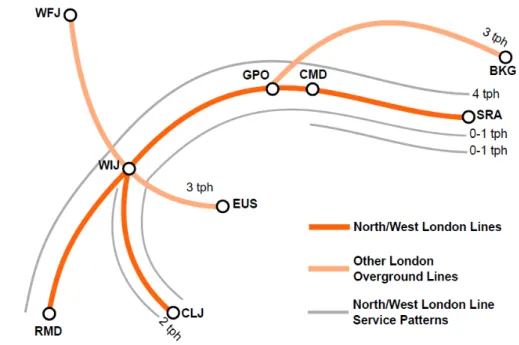
during the peak periods. Figure 1 schematically illustrates the AM Peak (07:00 – 10:00) service 104
patterns and frequencies on the NLL (and other Overground lines) in Spring 2008. 105
106
107
FIGURE 1 London Overground Spring 2008 AM Peak service patterns and frequencies 108
109
Figure 2 uses a time-distance plot to show the published AM Peak timetable for the NLL 110
in Spring 2008. This plot shows a regular 15 minute headway (4tph) service making all stops 111
westbound from Stratford to Richmond and eastbound from Richmond to Stratford. This regular 112
service is augmented by occasional irregular additional services that split some of the 15 minute 113
headways into two smaller headways. These irregular services include 114
• “Camden shuttles” that run approximately hourly between Stratford (SRA) and 115
Camden Road (CMD) (departing Stratford at 07:59 and 09:31); 116
• “Clapham specials” that run approximately hourly between Stratford and Clapham 117
Junction (CLJ), diverting from the NLL to the WLL (not shown in plot) at Willesden 118
Junction (departing Stratford at 07:11 and 08:30); 119
• one full NLL service from Stratford to Richmond (RMD) at 09:02. 120
This timetable was developed before TfL and LOROL controlled the Overground 121
network, when it was a standard National Rail concession operated by the Silverlink TOC. David 122
Warner (3), a planner in TfL London Rail, noted that the Camden shuttles were added in 2004, 123
and the Clapham specials in 2006. Oliver Bratton (4), Head of Performance and Planning for 124
LOROL, noted that “TfL was getting concerned about the overcrowding on the NLL. It therefore 125
agreed to ‘buy’ additional services from Silverlink for the peaks.” To add the additional trips, 126
Silverlink planners “put them into the existing schedule ... amongst the 15 minute service when 127
appropriate.” 128
Describing the origins of this timetable, Warner (3) noted that “the service was entirely 129
driven by the rolling stock available, and the incremental nature in which additional trains were 130
added to the timetable. An overall view was not taken.” Bratton (4) discussed the timetable 131
development process for the National Rail network more generally, noting that “typically, a 132
timetable evolves. As more and more trains run, the timetable tends to ossify, becoming harder 133
and harder to alter.” It appears from these comments that the highly irregular NLL peak period 134
timetable was in place largely as a historical artifact. It was not the product of an analytical or 135
data-driven tactical planning process. 136
137
FIGURE 2 North London Line Spring 2008 AM Peak timetable 138
139
2.2 Passenger Demand 140
2.2.1 NLL AM Peak Origin-Destination Matrix
141
Passenger demand for a public transport network can be expressed as a matrix of 142
passenger origin-destination (OD) flows (an OD matrix). A methodology is developed to 143
estimate OD matrices for railway networks from multiple automatic data sources, including 144
passenger journey data from the Oyster smartcard ticketing system, automatic entrance counts 145
from selected station gatelines, and on-board passenger loads estimated from loadweigh data (1). 146
By applying this method to the London Overground network, a segment-level AM Peak OD 147
matrix for the NLL is estimated and shown in Table 1. This matrix includes journeys that 148
interchange with the NLL, but it “clamps” those journeys to the point at which they would make 149
that interchange. 150
151
TABLE 1 Segment Level NLL AM Peak Origin-Destination Matrix 152
Origin Segment
Destination Segment
Total
NLLE GPO* NLLC WIJ* NLLW
NLLE 9,390 369 1,848 392 517 12,435 GPO* 158 356 94 145 753 NLLC 1,362 268 778 596 1,019 4,023 WIJ* 524 83 465 808 1,880 NLLW 687 63 678 359 1,234 3,021 Total 12,040 783 4,125 1,441 3,723 22,112
Cells highlighted in grey depend only on NLL service West of Willesden Junction 153
* Includes flows interchanging between NLL and other Overground lines at these interchanged stations. 154
155
It is estimated that a total of 37,124 passengers use the London Overground on an 156
average weekday AM Peak period. The NLL OD matrix in Table 1 shows that 22,112, or 60%, 157
of all AM Peak Overground passengers use the NLL for some portion of their journey. The cells 158
of Table 1 highlighted in grey indicate passenger flows which use the NLL only between 159
Willesden Junction and Richmond (RMD), inclusive. They total 5,510 AM Peak passengers, or 160
25% of total NLL AM Peak patronage. In other words, 75% of all AM Peak NLL passengers use 161
the NLL only between Stratford and Willesden Junction, inclusive. 162
163
2.2.2 Aggregate Load Profiles (NLL AM Peak)
164
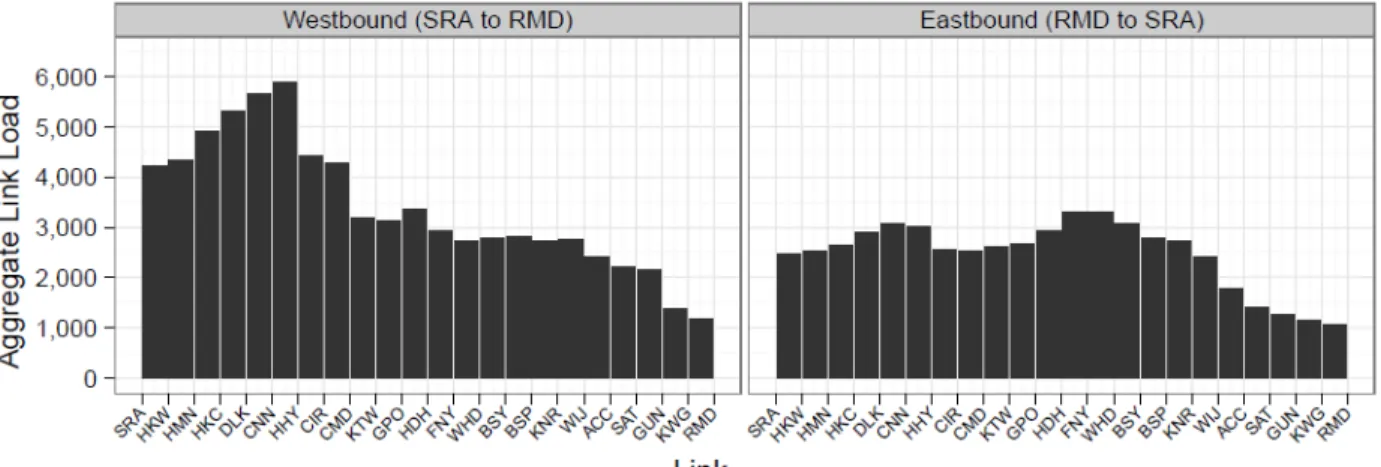
Figure 3 plots the aggregate load profile for the NLL. The most salient observation to be 165
drawn from these plots is that by far the largest aggregate link loads on the NLL during the AM 166
Peak are westbound between Stratford and Highbury & Islington (HHY). The aggregate load 167
starts at over 4,000 total passengers out of Stratford and grows at each successive station, 168
peaking at close to 6,000 total passengers between Canonbury (CNN) and Highbury & Islington. 169
170
171
FIGURE 3 NLL AM Peak load profile 172
173
2.2.3 Passenger Incidence Behavior
174
Passenger incidence behavior refers to the act or event of being incident to a public 175
service with intent to use that service. Frumin and Zhao (5) proposed a method to estimate 176
incidence headway and waiting time by integrating disaggregate smartcard data with published 177
time tables using schedule-based assignment and applied it to stations in the entire London 178
Overground to demonstrate its practicality. The method was implemented in the free/open source 179
software library Graphserver (6), which reads timetables in the widely used General Transit Feed 180
Specification (GIFS) (7). In result, it is found that the temporal distribution of passenger demand 181
on the North London Line was much less timetable-dependent than on the other London 182
Overground lines. That is, passenger incidence behavior was more random on the NLL and less a 183
function of the timetable. Figure 4 illustrates the difference of passenger incidence behavior 184
between the NLL and the GOB in terms of the respective distributions of passenger incidence 185
times (over a given headway) in the AM Peak. 186
The implications of these distributions in terms of their effects on passenger waiting time 187
(with respect to the timetable) are also quantified. It found that the dependence on the timetable 188
observed on the GOB in the AM Peak reduced waiting time by 29% compared with purely 189
random passenger incidence. On the NLL the comparable reduction was only 7.2%. 190
191
192
FIGURE 4 AM Peak passenger incidence on NLL and GOB 193
194
2.3 Operating Performance: Service Delivery and Quality 195
196
2.3.1 Public Performance Measure (PPM)
197
On-time performance (OTP), the fraction of services with schedule deviation within some 198
threshold (8), is a widely used measure to characterize service delivery. Under the name of 199
Public Performance Measure (PPM), this is the current measure of performance on the London 200
Overground and all other National Rail services in the UK, with a train considered “on time" if it 201
is less than 5 minutes late at the destination terminal (9). PPM is analyzed for the 52 weekdays 202
from 31 March, 2008 through 10 June, 2008, inclusive. PPM for the NLL over this range of 203
dates was 83% for the AM Peak period and 89% for the whole weekday. This was the worst of 204
all of the Overground lines. 205
206
2.3.2 Running and Dwell Times
207
ACT, A British railway consultancy, was retained by LOROL to study operations on the 208
NLL (10). They used automatic train movement data from the network's signaling and control 209
system to analyze running and dwell times from April, 2007 through March, 2008, inclusive. As 210
TfL and LOROL took control of the Overground network in November of 2007, this study 211
included a period of substantial institutional and branding change on the NLL. 212
• Over the course of the study period, increases in terminal-to-terminal running times 213
were observed in the AM and PM Peak periods in both directions. 214
• For both directions in the peak periods, the 80th
percentile running time is between the 215
running time in the timetable and the PPM threshold (i.e. timetable plus five minutes); 216
the 90th percentile running time is above the PPM threshold. 217
• At the 80th
and 90th percentiles, the peak period running time westbound (i.e. from 218
Stratford) exceeds the peak period eastbound running time by just over two minutes. 219
• Dwell times increased (by an unspecified amount) over the course of the study period, 220
especially during the peak periods. 221
• As measured during only the first quarter (i.e. January through March) of 2008, there 222
was substantial “dwell time loss” - station dwell times in excess of those specified in 223
the working timetables. Nine out of the top ten westbound (i.e. from Stratford) 224
scheduled services in terms of average dwell time loss were in the AM Peak period. 225
Likewise, nine out of the top ten eastbound (i.e. from Richmond) scheduled services 226
in terms of average dwell time loss were in the PM Peak period. 227
• A statistical correlation was found, for individual station stops by individual 228
scheduled services, between the length of the leading headway and the station dwell 229
time. 230
From these observations, the consultants drew two important conclusions regarding 231
service delivery on the NLL. Firstly, that running times in the timetable are insufficient, 232
particularly for the AM and PM Peak periods. Secondly, that dwell times, and corresponding 233
dwell time losses, were driven by passenger demand. The consultants provided only this analysis 234
of current conditions and their conclusions as to what may have been causing those conditions. 235
They did not offer any explicit recommendations on what actions should be taken to improve 236 those conditions. 237 238 2.3.3 Train Congestion 239
Two types of train congestion were also observed on the London Overground network - 240
that between Overground trains, and that between Overground trains and freight trains on the 241
NLL. Bratton (4) noted that “turning trains at Camden was causing congestion on the network” 242
between Overground services. This congestion has not been studied or quantified directly, only 243
reported anecdotally by Overground management and operational staff. However, based on 244
examination of the timetable in Figure 2, it is not hard to believe that such congestion was 245
occurring. The two Camden shuttles that depart Stratford at 07:59 and at 09:31 both arrive at 246
Camden Road within a few minutes of an eastbound train from Richmond. Under these 247
circumstances, even slight deviations from schedule could cause congestion and delays to the 248
trains from Richmond, to the Camden shuttle on its return trip to Stratford, and to the subsequent 249
westbound train from Stratford. 250
It is of course also possible that the NLL suffered from additional types and instances of 251
train congestion, especially at other junctions and at terminals. Congestion between Overground 252
trains at Camden Road and other locations could have been identified and studied in further 253
detail through the use of time-distance plots (11, 12, 13, 14). Such plots can be generated from 254
automatic train movement data recorded by the Overground network's signaling and control 255
systems (that were used to study running and dwell times), rather than from timetables as in 256
Figure 2. 257
258
2.3.4 Excess Journey Time
259
Wilson et al. first proposed a measure called “excess waiting time” (EWT) to indicate the 260
waiting time experienced by passengers beyond what they would have waited had all headways 261
been exactly as scheduled (15). London Transport then extend the EWT concept to the entirety 262
of journeys, using “excess journey time” (EJT) to represent the difference between actual 263
passenger journey times and journey times implied by the published timetable (16). Using a 264
unified estimator of EJT developed by Zhao et al. (17), which is unbiased at the aggregate level 265
regardless of the passenger incidence behavior (random incidence, scheduled incidence, or a 266
mixture of both), EJT for the NLL as of the Spring of 2008 was examined in detail. The relevant 267
results can be summarized as follows. 268
• The NLL in the AM Peak had by far the most total EJT of any Overground line in any 269
time period, followed by the NLL in the PM Peak. 270
• In terms of mean EJT (i.e. after normalizing by number of passengers) the AM Peak 271
was the worst time period for the NLL. 272
• In terms of total and mean EJT, the NLL in the AM Peak had over twice the EJT in 273
the westbound direction (i.e. Stratford to Richmond) as in the eastbound direction. 274
• Total EJT was severely unbalanced among individual westbound AM Peak scheduled 275
services on the NLL. The five scheduled services with the highest total EJT were, in 276
descending order, the 08:22, 07:52, 07:07, 08:52, and 07:37 trains from Stratford. 277
These services had full 15 minute headways (at Stratford) and had substantially more 278
total EJT than their respective shorter-headway leaders and/or followers. 279
• Mean EJT on the NLL was somewhat linearly correlated with PPM. However, the 280
relationship was weaker in the AM Peak than for the whole day, and in the AM Peak 281
for lower PPM values. 282
283
3. TACTICAL PLANNING INTERVENTION: THE CASE FOR EVEN 284
INTERVALS 285
This section synthesizes the results of the previous section to explain the thinking behind 286
a specific tactical planning intervention that was implemented on the NLL. It does so primarily 287
from the perspective of the London Overground manager who was the driving force behind this 288
change. This manager was influenced by the results of some of the early research from Frumin 289
(1), and used some of these results to make the case to his stakeholders. 290
Certain factors in the decision to implement this change, such as complete costs and 291
benefits, were not available for this case study. In addition, the manager's perspective is 292
supplemented here by analysis drawn from the final results of this paper. In that sense, the case 293
this section makes for the tactical planning change is not precisely the case that was made in 294
practice. Nevertheless, it provides a context in which to illustrate the value of the methods used 295
in this paper for using automatic data to support the tactical planning of an urban railway. 296
Of the results and analyses discussed in the previous sections of this paper, the key points 297
that influenced the tactical planning intervention on the NLL are as follows. They are focused on 298
the AM Peak period, in which, as of Spring 2008, the trains were routinely delayed en route, as 299
reflected by running times substantially in excess of the timetable and by low PPM on-time 300
performance scores. Excessive dwell times were found to be a major cause of en route train 301
delays. Evidence existed to support the judgment that these dwell times were primarily a 302
function of passenger volumes. Near-random passenger incidence behavior suggested an 303
explanation for uneven passenger volumes and resultant uneven dwell times - when passengers 304
arrive (even approximately) randomly, services with longer headways will serve proportionally 305
more passengers. The confluence of these analyses is confirmed by the corresponding EJT 306
results. 307
As described in Section 2.1, the typical approach to tactical planning on this network was 308
to update the timetable incrementally. It became evident that more drastic measures were needed 309
in this case. Specifically, that the timetable should be revised wholesale to provide as even 310
headways as possible. Under the circumstances, it was proposed to achieve this by combining the 311
NLL and WLL during the AM and PM Peak periods into an even 10 minute headway (6tph) 312
service between Stratford and Willesden Junction. From Willesden, alternating trains would go 313
on the NLL to Richmond and the WLL to Clapham Junction. This was referred to as the “3 + 3” 314
service. 315
The core idea behind this strategy was to balance passenger volumes across trains, thus 316
reducing dwell times and train and passenger delays. It was expected that passenger volumes 317
would increase on some trains (i.e. those with longer headways than in the current plan) and 318
decrease on others (i.e. those with shorter headways). While the change was not expected to 319
materially affect the total volume of passengers, the outcome was expected to be positive on 320
balance. The reasons for this are twofold. 321
Firstly, dwell times have been found to have a non-linear relationship to passenger 322
volumes (18, 19). This implies that, holding the total volume of passengers constant, the 323
decreases in dwell times on trains losing passengers (i.e. the existing 15 minute headway services) 324
would be larger than the increases in dwell times on trains gaining passengers (i.e. the shorter 325
headway services). Consequently, overall delays should decrease. Secondly, consistent with the 326
hypothesis of unbalanced on-train loads, it was anecdotally reported that some passengers were 327
unable to board overcrowded trains, and were be left behind on the platform. The most crowded 328
trains (with larger headways) would be less crowded and allow more (or all) passengers to board. 329
Passengers currently denied boarding by overcrowded trains would thus benefit substantially 330
while other passengers would benefit (from less crowded trains) or suffer (on more crowded 331
trains) to a lesser degree. 332
333
3.1 “3+3” Service on the North London Line 334
3.1.1 Headway Adjustment and Frequency Reallocation
335
The new tactical plan resulting from the above analysis was referred to as the “3 + 3” 336
service because it integrated the NLL and WLL into a single trunk-and-branch service for the 337
AM and PM Peak periods. It is effectively an even 20 minute headway (3tph) service between 338
Stratford and Richmond superimposed with an identically spaced service between Stratford and 339
Clapham Junction. The two services are offset by 10 minutes, yielding an even 10 minute 340
headway (6tph) trunk service between Stratford and Willesden Junction. 341
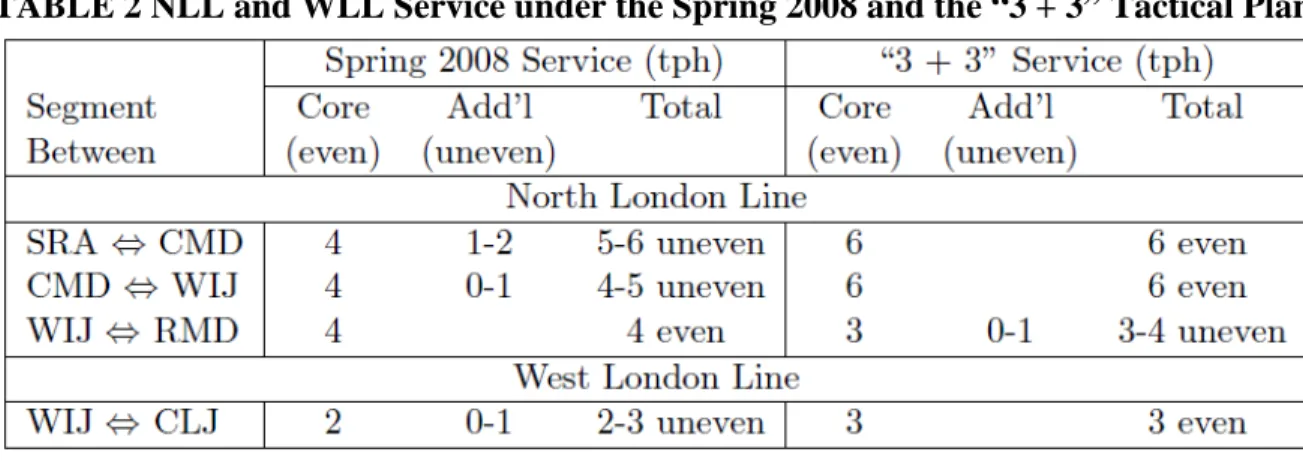
Figure 4 uses a time-distance plot to show the corresponding published AM Peak 342
timetable for the NLL. Table 2 summarizes the changes in the evenness and frequency of service 343
for each segment of the NLL and WLL. 344
345
TABLE 2 NLL and WLL Service under the Spring 2008 and the “3 + 3” Tactical Plans 346
347 348
The only part of the WLL and NLL to lose any service frequency under this reallocation 349
was the western end of the NLL between Willesden Junction and Richmond. One additional 350
shuttle trip over this segment was added for the entire peak period, but overall the headway 351
increased from 15 minutes to 20 minutes (4tph to 3tph). Not surprisingly, this was the most 352
contentious aspect of this plan. However, the OD matrix estimated in Section 2.2 shows that only 353
25% of the NLL passengers using the NLL in the AM Peak used this segment of the line. The “3 354
+ 3” tactical plan thus reallocated service such that more passengers gained service than lost it. 355
In doing this, it was able to establish a service pattern with even headways throughout the 356
network that was easier for customers and operators to understand, remember, and use. 357
358
3.1.2 Running Time Adjustment
359
In addition to the headway and frequency changes, timetable running times were also 360
adjusted. Bratton (4) described conventional practice in National Rail timetable development 361
being to add running time between the penultimate and final stations on a line. This increases 362
PPM scores (i.e. on-time performance) and increases the chance that a train will be in place for 363
the beginning of its next trip, but has little effect on the fidelity of the timetable to actual 364
operating conditions on most of the line. 365
In the new timetable, the running time between Stratford and Camden Road was 366
shortened by 1-2 minutes on the basis that evening the headways would drastically reduce dwell 367
times. The running time between Camden Road and Richmond was lengthened by 3-4 minutes to 368
account for discrepancies found in the study by ACT (10). Both changes were effected through 1 369
minute adjustments en-route rather than in large blocks of time at the end of the line or segment 370
of the line. The total running time between Stratford and Richmond was lengthened by 371
approximately 3 minutes on average over the AM Peak period. 372
373
374
FIGURE 5 North London Line “3+3” timetable 375
376
3.1.3 Costs
377
Bratton (20) noted that the changes in service described here were for all intents and 378
purposes cost-neutral. The reallocation of service frequencies and adjustments in running times 379
were such that the “3 + 3” service could be operated at approximately the same costs as the 380
existing timetable. No new rolling stock was required and only two additional crew members - 381
conductors at an annual salary of $23 thousand each - were needed to fully staff the new 382 timetable. 383 384 4. EVALUATION 385
“3 + 3” service went into effect on the NLL and WLL on Monday, 20 April, 2009. This 386
section evaluates the outcomes of this tactical planning intervention, primarily through 387
longitudinal analysis of measures of service delivery and service quality. These measures are 388
taken for a period directly after the implementation, and compared to two periods before the 389
implementation - one directly before and one a year earlier. The goal of this evaluation is to 390
assess, to the degree possible, the causal effects on passengers and on the operation of changing 391
the tactical plan. However, despite the large amount of data available, any number of 392
uncontrolled factors may confound this analysis. 393
Because this evaluation is of a major change to the timetable, it is important to evaluate 394
service quality in absolute as well as relative terms. Consequently, total observed journey time 395
(OJT) is analyzed along with EJT. All else being equal, any change in OJT should be reflected in 396
an equal change in EJT. However, any adjustment to the timetable will break this link. 397
Service delivery is evaluated primarily in terms of PPM and dwell times, the latter of 398
which was analyzed in a follow-up study by ACT (21). Interviews with London Overground 399
management are also considered. 400
This evaluation is focused on the NLL, and uses the GOB as a control since there were no 401
substantial changes to the GOB timetable over this period. The GOB is not a perfect control in 402
that it has different service and demand characteristics from the NLL, but it should be subject to 403
similar universal influences such as weather, overall economic conditions, etc. The NLL is 404
evaluated as a whole (including passengers in both directions) and also for the core market 405
passengers traveling between Stratford and Camden Road in the westbound direction (i.e. 406
towards Camden Road). This “NLL Core” market is analyzed separately because it is the only 407
section of the line for which there was only a change in the evenness of headways in the peak 408
hours and not a change in the overall frequency of service. 409
410
4.1 Evaluation Data 411
The following three study periods are analyzed to evaluate the effects of introducing “3 + 412
3” service. They are determined in part by data availability. 413
After2009: Weekdays from 20 April through 15 May and 1 June through 5 June, 2009,
414
inclusive. This is 5 out of the first 7 weeks directly following the introduction of “3 + 3” service. 415
Before2009: Weekdays from 2 March through 13 March, 2009. This is a period of two
416
weeks shortly before the introduction of “3 + 3” service. 417
Spring2008: Weekdays from 21 April through 16 May and 2 June through 6 June, 2008,
418
inclusive. These are the weeks in 2008 corresponding to the weeks in the After2009 period. 419
Complete PPM and timetable data were available for these study periods. Observed and 420
excess journey times (i.e. OJT and EJT) are measured from Oyster journey data. At first glance 421
the numbers in this table indicate increasing weekly ridership. However, this interpretation does 422
not account for changes in the Oyster penetration rate among Overground riders. An increasing 423
penetration rate would result in increasing volumes of Oyster data despite static volumes of 424
overall ridership. This evaluation does not explicitly analyze total ridership on the Overground 425
network or lines in question. 426
Line and segment running time analysis is drawn from the report by ACT (21). 427
Unfortunately, ACT reported on changes in median rather than mean dwell times. Median values 428
mask the effects of large outliers, which for a nonlinear phenomena such as dwell time are 429
expected to be quite important, so changes in dwell time are not directly analyzed here. 430
431
4.2 Evaluation Results 432
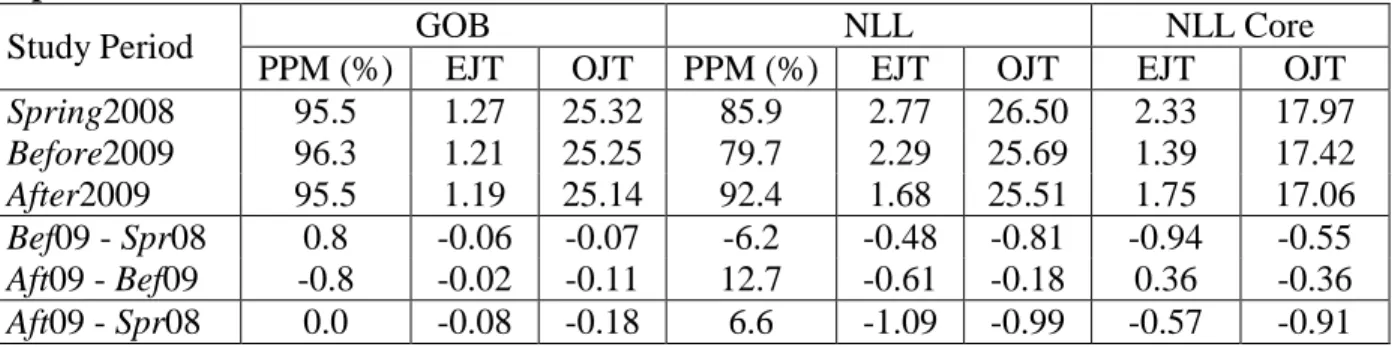
Table 3 shows PPM, EJT, and OJT results for the three network segments for the three 433
study periods. It shows the difference from Spring2008 to Before2009 to indicate the changes in 434
performance between the time the tactical planning analysis was done and just before “3 + 3” 435
was implemented. It shows the difference from Before2009 to After2009 with the hope of 436
isolating the effects of introducing the “3 + 3” service. 437
The differences in EJT and OJT were tested in a single-sided difference of means t-test. 438
All differences on the NLL and NLL Core were statistically significant at the 1% level. 439
Differences on the GOB between After2009 and Spring2008 were significant at the 5% level, but 440
between intermediate periods were not significant even at the 10% level. 441
On the GOB, the changes in all three measures were small - PPM fluctuated by 0.8% and 442
returned to its original value of 95.5%, while EJT and OJT decreased by 0.08 minutes (6.3%) 443
and 0.18 minutes (0.7%), respectively, between the initial and final study period. It is not 444
unexpected that OJT and EJT did not vary by the exact same amount. While the changes to the 445
GOB timetable were minor, OJT could be affected by slight shifts in (i) passenger incidence 446
behavior, since EJT is calculated against scheduled waiting time; or (ii) the temporal distribution 447
of ridership over the AM Peak, since running times in the timetable do vary slightly over the AM 448
Peak. This illustrates some of the factors that may confound the longitudinal analysis for the 449
NLL, if only to a small degree. 450
451
TABLE 3 PPM and Passenger Journey Time Results and Comparisons for “3 + 3” 452
Implementation 453
Study Period GOB NLL NLL Core
PPM (%) EJT OJT PPM (%) EJT OJT EJT OJT
Spring2008 95.5 1.27 25.32 85.9 2.77 26.50 2.33 17.97 Before2009 96.3 1.21 25.25 79.7 2.29 25.69 1.39 17.42 After2009 95.5 1.19 25.14 92.4 1.68 25.51 1.75 17.06 Bef09 - Spr08 0.8 -0.06 -0.07 -6.2 -0.48 -0.81 -0.94 -0.55 Aft09 - Bef09 -0.8 -0.02 -0.11 12.7 -0.61 -0.18 0.36 -0.36 Aft09 - Spr08 0.0 -0.08 -0.18 6.6 -1.09 -0.99 -0.57 -0.91 454
On the NLL as a whole, changes may be observed in all the calculated measures. PPM 455
decreased (i.e. worsened) between the Spring2008 and Before2009 study periods by nearly 6 456
percentage points. ACT (21) found that over this time average train journey time from Stratford 457
to Richmond increased by about 30 seconds. 458
OJT and EJT decreased (i.e. improved), by 0.81 minutes (3.1%) and 0.48 minutes 459
(17.3%), respectively, over the 9 months between the first two study periods. For the NLL Core 460
passengers, OJT and EJT decreased by 0.55 minutes (3.1%) and 0.94 minutes (40.3%), 461
respectively. It is interesting to note in these cases that the changes in EJT and OJT, measures of 462
relative and absolute service quality, were directionally opposite of the changes in PPM, a 463
measure of service delivery. 464
It appears that there were substantial improvements to absolute and relative service 465
quality on the NLL as experienced by passengers before the implementation of the “3 + 3” 466
service. Bratton (20) attributes this primarily to “higher performing Network Rail infrastructure.” 467
The 2008 TfL Investment Programme (22) indicates that $56.9 million of infrastructure upgrades 468
were planned during this period. Much of this investment was in support of capacity on the NLL 469
to an eventual 12tph. It is difficult to separate these capacity upgrades from investments that 470
would improve infrastructure performance at the same level of throughput, but this figure 471
indicates the intensity of the work that was done. 472
For the NLL, the comparison between the Before2009 and After2009 study periods 473
should give the clearest insight into the direct effects of introducing the “3 + 3” service. PPM 474
increased by over 12 percentage points while the average running time from Stratford to 475
Richmond increased by just under 20 seconds. Unfortunately, ACT (21) did not report on the 476
distributions of running times, so it is impossible to say how much the change in PPM is a result 477
of improved service delivery as compared to the more generous standard set by lengthening the 478
running time in the timetable. During this period, the average train running time from Stratford 479
to Camden Road decreased by 50 seconds. 480
OJT decreased by an additional 0.18 minutes (0.7%) for the NLL as a whole and 0.36 481
minutes (2.1%) for the NLL Core, indicating improved passenger journey times. The changes in 482
EJT, like those in PPM, are more difficult to interpret. For the NLL Core, EJT worsened (i.e. 483
increased away from zero) while PPM and OJT both improved. This is not a surprise, as the 484
running time between Stratford and Camden Road was shortened in the new timetable. OJT 485
decreased but the scheduled journey times (SJT) decreased even more, so EJT increased. This 486
illustrates one of the disadvantages of timetable-based measures of service quality such as EJT. 487
Given the substantial changes to the timetable, the effects of introducing “3 + 3” service 488
may best be judged in terms of absolute service quality. The decreases in OJT suggest that the 489
tactical planning intervention improved the experience of NLL passengers. The changes in OJT 490
are 22.2% and 65.4% of the changes observed on the NLL and NLL Core, respectively, between 491
the Spring2008 and Before2009 study periods. 492
Figure 6 plots total EJT by scheduled service for westbound passenger journeys on the 493
NLL between Stratford and Willesden Junction in the Spring2008 period and the After2009 494
period. A comparison between the two shows a more even distribution of EJT across scheduled 495
services during the height of the peak period. For example, in After2009 the differences between 496
the services with the highest total EJT (the 08:09 and 08:39 trains from Stratford) and their 497
respective leaders and followers is smaller, even in relative terms, than the same differences for 498
the services with the highest EJT in Spring2008 (the 07:52 and 08:22 trains from Stratford). 499
Because the timetable and headways changed between these two study periods, incidence 500
behavior was also examined, but no noticeable change in overall incidence behavior is found. 501
Mean scheduled waiting time (which is part of the scheduled journey time against which EJT is 502
measured) decreased by 0.1 minutes on the NLL Core and increased by approximately the same 503
amount over the entire NLL. These changes appear to be a function primarily of the changes to 504
the timetable rather than changes in incidence behavior. 505
Abdul Salique (23), a TfL contract manager who represents TfL in its relationship with 506
LOROL, was interviewed about the effects of introducing the “3 + 3” service. It should be noted 507
that it is his job to hold LOROL to their contractual responsibilities while considering the 508
experience of the Overground's passengers to whom TfL is ultimately accountable. He noted that 509
“overall it is good for passengers... There has been a lot of good passenger benefit to a greater 510
number of passengers than those that have been disadvantaged”. “It has also improved train 511
performance and has made the timetable more robust and easier to recover from... Overall I 512
would say we could move more people during the peaks when we were a bit constrained before.” 513 514 515 516 (a) Spring2008 517 518 519 (b) After2009 520
FIGURE 6 Total EJT by scheduled service, westbound, after “3+3” implementation 521
522
5. CONCLUSIONS 523
The case study presented in this paper, provided a rich example of the use of automatic 524
data to support tactical planning on the North London Line (NLL) of the Overground network. 525
The analyses of this paper contributed to both the development of the new tactical plan for the 526
NLL and to the evaluation of the implementation of that plan. The effects of this implementation 527
appear to have been positive on balance. This case study thus demonstrates the applicability of 528
automatic data generally, and the data and methods used in London Overground specifically, for 529
tactical planning of an urban railway. 530
Various measures of service delivery and service quality, all generated from automatic 531
data sources, contributed to the tactical planning exercise that led to the “3 + 3” service. In terms 532
of service delivery, dwell times, running times, and on-time performance were analyzed using 533
train signaling and control data. They indicated that running times in operation were substantially 534
longer than in the timetable, and that excess dwell time, particularly on certain scheduled 535
services and at certain locations, was one of the main causes of increased running times. Service 536
quality was analyzed primarily in a relative sense in terms of EJT as measured using Oyster 537
journey data and the published timetable. EJT was found to add an element of the passenger's 538
perspective to the tactical planning process. It can focus tactical planning attention to the 539
segments of passengers who need it most, and can support and enhance analyses that have been 540
initiated from the operator's perspective. 541
Two analyses of passenger demand also contributed to the tactical planning process. 542
Passenger incidence behavior on the NLL was analyzed using Oyster journey data and the 543
published timetable. It was found to be substantially more random than previously assumed, 544
contributing to the decision to move the NLL to an even headway service. Also analyzed was 545
the origin-destination matrix of overall AM Peak passenger demand on the Overground network, 546
estimated from aggregate Oyster passenger volumes, automatic gateline entry counts, and 547
manual on-board passenger counts. This OD matrix indicated that the proposed reallocation of 548
some service frequency away from the western end of the NLL towards the eastern end would 549
benefit more passengers than it would harm. 550
The confluence of these analyses contributed to the development, proposal, and 551
implementation of the even headway “3 + 3” service on the NLL and West London Line (WLL) 552
in the AM and PM peak periods. The development of the timetable for this service was also 553
influenced by the key concept inherent in the idea of measuring EJT - that standards can be set 554
and lateness can be measured at the level of individual passenger journeys or OD flows. This led 555
the developers of the timetable to adjust running times throughout the length of the NLL rather 556
than only at the end of the line as was typical on the National Rail network. In this sense, EJT 557
can be a useful tool to help shift tactical planning practices which may be less oriented towards 558
the passenger's perspective than is desired. 559
Service delivery and quality on the NLL were analyzed longitudinally to evaluate the 560
effects of introducing the “3 + 3” service on passengers and on the operation. Because the 561
timetable changed so drastically in the “3 + 3” implementation, an additional measure of 562
absolute service quality was included in the evaluation. Observed journey time (OJT) was 563
estimated using only Oyster journey data. This and other measures were analyzed before and 564
after the introduction of “3 + 3” service. PPM increased substantially and OJT decreased (i.e. 565
they both improved). EJT decreased by substantially more than OJT for the line as a whole and 566
in fact increased for the core portion of the line, which was the portion towards which the “3 + 3” 567
service was targeted. 568
These discrepancies were found to be because the “3 + 3” timetable had lengthened 569
running times over the whole line and shortened them over the core portion. This highlights the 570
relative nature of EJT, illustrating its value as a relative rather than absolute measure. EJT 571
provides good information about how the passenger experience compares to the timetable, but 572
not necessarily a clear picture of how it has changed in an absolute sense. It is thus similar to on-573
time performance, but measured for and weighted by individual passenger journeys. 574
575
ACKNOWLEDGEMENT 576
This paper is partly based on the first author’s master thesis in Massachusetts Institute of 577
Technology (1). The authors thank Transport for London for providing the financial and 578
institutional support for this research, the opportunity to work in the agency and the access to the 579
data used in this paper, and specifically Oliver Bratton at London Overground Rail Operations 580
LTD for insight into the issues and dynamics of the London Overground network. 581
582
REFERENCE 583
1. Frumin M. Automatic Data for Applied Railway Management : Passenger Demand, 584
Service Quality Measurement, and Tactical Planning on the London Overground Network. 585
Master thesis, Massachusetts Institute of Technology; 2010. 586
2. Smales C. Unpublished interviews and electronic communications with Carol Smales, 587
Chief Transport Economist, TfL London Rail. 2010; 588
3. Warner D. Unpublished interviews and electronic communications with David Warner, 589
Senior Business Analyst, TfL London Rail. 2010; 590
4. Bratton O. Unpublished interviews and electronic communications with Oliver Bratton, 591
Deputy Operations Director, London Overground Rail Operations LTD. 2009; 592
5. Frumin M, Zhao J. Analyzing passenger incidence behavior in heterogeneous transit 593
services using smartcard data and schedule-based assignment. Transportation Research 594
Record: Journal of the Transportation Research Board (Accepted) 2012; 595
6. Graphserver. Graphserver: The Open-Source Multi-Modal Trip Planner [Internet]. 596
2009;Available from: http://bmander.github.com/graphserver/ 597
7. Google. General Transit Feed Specification [Internet]. 2009;Available from: 598
http://code.google.com/transit/spec/transit_feed_specification.html 599
8. Kittelson & Associates. A Guidebook for Developing a Transit Performance-600
Measurement System. Transportation Research Board, Washington D.C.: 2003. 601
9. Office of Rail Regulation. National rail trends yearbook, 2007-2008, Technical Report. 602
2008; 603
10. ACT. North London Line performance review for London Overground Rail Operations 604
Limited (LOROL). Consultant’s unpublished report: 2008. 605
11. Rahbee A. Rail transit operations analysis: Framework and applications. Mater thesis, 606
Massachusetts Institute of Technology: 1999. 607
12. Rahbee A. Rail operations analysis and strategies for service quality improvement, 608
Technical report, Chicago Transit Authority. 2006; 609
13. Vescovacci MA. Junction capacity and performance in rail transit. Mater thesis, 610
Massachusetts Institute of Technology: 2001. 611
14. Lee DS-M. Understanding capacity and performance of urban rail transit terminals. 612
Master thesis, Massachusetts Institute of Technology: 2002. 613
15. Wilson NHM, Nelson D, Palmere A, Grayson T, Cederquist C. Service-Quality 614
Monitoring for High-Frequency Transit Lines. Transportation Research Record 1992;3–11. 615
16. London Transport. Journey Time Metric (JTM): An Overview. 1999. 616
17. Zhao J, Frumin M, Wilson N, Zhao Z. Unified estimator for excess journey time under 617
heterogeneous passenger incidence behavior using smartcard data. Transportation 618
Research Part C (under review; submitted in July 2012); 619
18. Wilson N, Lin T. Dwell-time relationships for light rail system. Transportation Research 620
Record 1993;1361:296–304. 621
19. Puong A. Dwell time model and analysis for the MBTA Red Line. Unpublished report: 622
2000. 623
20. Bratton O. Unpublished interviews and electronic communications with Oliver Bratton, 624
Deputy Operations Director, London Overground Rail Operations LTD. 2010; 625
21. ACT. North London Line performance review for London Overground Rail Operations 626
Limited (LOROL). Consultant’s unpublished report: 2009. 627
22. Transport for London. Investment programme 2008: 2005/06 to 2009/10. 2007. 628
23. Salique A. Unpublished interviews and electronic communications with Abdul Salique, 629
Plan Delivery Manager, TfL London Rail. 2010; 630
631 632
ABBREVIATION GLOSSARY 633
AFC Automatic fare collection PPM Public performance measure CLJ Clapham Junction station RMD Richmond station
CMD Camden Road station SJT Scheduled journey time
EJT Excess journey time SRA Stratford station
EWT Excess waiting time TfL Transport for London
GOB Gospel Oak to Barking Line tph Trains per hour
GPO Gospel Oak station WAT Watford DC Line
LOROL London Overground Rail Operations Limited
WIJ Willesden Junction station WLL West London Line
NLL North London Line OJT Observed journey time OTP On-time performance 634