Publisher’s version / Version de l'éditeur:
Vous avez des questions? Nous pouvons vous aider. Pour communiquer directement avec un auteur, consultez la première page de la revue dans laquelle son article a été publié afin de trouver ses coordonnées. Si vous n’arrivez Questions? Contact the NRC Publications Archive team at
[email protected]. If you wish to email the authors directly, please see the first page of the publication for their contact information.
https://publications-cnrc.canada.ca/fra/droits
L’accès à ce site Web et l’utilisation de son contenu sont assujettis aux conditions présentées dans le site LISEZ CES CONDITIONS ATTENTIVEMENT AVANT D’UTILISER CE SITE WEB.
Symposium on Building Envelope Sustainability: The Future is in the Balance
[Proceedings], pp. 1-12, 2009-04-30
READ THESE TERMS AND CONDITIONS CAREFULLY BEFORE USING THIS WEBSITE.
https://nrc-publications.canada.ca/eng/copyright
NRC Publications Archive Record / Notice des Archives des publications du CNRC :
https://nrc-publications.canada.ca/eng/view/object/?id=ffc1a509-9588-4660-9ae5-b6823fdcfed9 https://publications-cnrc.canada.ca/fra/voir/objet/?id=ffc1a509-9588-4660-9ae5-b6823fdcfed9
NRC Publications Archive
Archives des publications du CNRC
This publication could be one of several versions: author’s original, accepted manuscript or the publisher’s version. / La version de cette publication peut être l’une des suivantes : la version prépublication de l’auteur, la version acceptée du manuscrit ou la version de l’éditeur.
Access and use of this website and the material on it are subject to the Terms and Conditions set forth at
Evaluating window-wall interface details for risk of condensation on
windows
http://www.nrc-cnrc.gc.ca/irc
Eva lua t ing w indow -w a ll int e rfa c e de t a ils for risk of c onde nsa t ion on
w indow s
N R C C - 5 1 1 6 6
L a c a s s e , M . A . ; M a r e f , W . ; E l m a h d y , A . H . ;
A r m s t r o n g , M . M .
F e b r u a r y 2 0 1 0
A version of this document is published in / Une version de ce document se trouve dans:
Building Envelope Sustainability: the future is in the balance, Marriott Wardman
Park, Washington, April 30-May 1, 2009, pp. 1-12
The material in this document is covered by the provisions of the Copyright Act, by Canadian laws, policies, regulations and international agreements. Such provisions serve to identify the information source and, in specific instances, to prohibit reproduction of materials without written permission. For more information visit http://laws.justice.gc.ca/en/showtdm/cs/C-42
Les renseignements dans ce document sont protégés par la Loi sur le droit d'auteur, par les lois, les politiques et les règlements du Canada et des accords internationaux. Ces dispositions permettent d'identifier la source de l'information et, dans certains cas, d'interdire la copie de documents sans permission écrite. Pour obtenir de plus amples renseignements : http://lois.justice.gc.ca/fr/showtdm/cs/C-42
Evaluating Window-Wall Interface Details for
Risk of Condensation on Windows
Michael A. Lacasse1, Ph.D., P.Eng., Wahid Maref, Ph.D. and Hakim Elmahdy, Ph.D., P.Eng, and Marianne Armstrong, M.Sc.
The development of alternative details to manage water intrusion at the window-wall interface has produced a number of novel approaches to detailing the interface between the window and adjacent wall assembly. Many of these approaches advocate the need to provide drainage at the rough opening of the window subsill given that the window components themselves are susceptible to water entry over their expected life. Depending on the types of windows used and the cladding into which the windows are installed, there arise different methods to provide drainage that may also affect air leakage through the assembly. This in turn may give rise to the formation of condensation along the window at the sill or along the window sash and glazing panels. Hence there is a need to determine if, under cold weather conditions, specific interface details that incorporate sill pans provide potential for condensation on the window components in which air leakage paths may be prominent at the sill or elsewhere on the window assembly. The paper reports on a laboratory evaluation of the formation of condensation at the window frame perimeter of the interface assembly as a function of both temperature deferential and air leakage rate across the test assembly. A summary of the laboratory test protocol is provided that includes a description of the test set-up and apparatus, fabrication details of the specimen and information on instrumentation and calibration. Results on the potential for the formation of condensation at the window are given in terms of temperature differentials as well as specific air leakage paths and rates of air leakage across the specimen.
1 Michael A. Lacasse is a Senior Research Officer at the Institute for Research in Construction, National Research Council Canada (NRCC), 1200 Montreal Rd., Building M20, Ottawa, ON, Canada K1A 0R6; Wahid Maref is an Associate Research Officer, at the Institute for Research in Construction, NRCC; Hakim Elmahdy is a Principle Research Officer at the Institute for Research in Construction, NRCC; Marianne Armstrong is a Research Council Officer at the Institute for Research in Construction, NRCC.
Evaluating Window-Wall Interface Details for
Risk of Condensation on Windows
Michael A. Lacasse1, PhD, P.Eng., Wahid Maref, Ph.D. and Hakim Elmahdy, Ph.D., P.Eng, Marianne Armstrong, M.Sc.
ABSTRACT
The development of alternative details to manage water intrusion at the window-wall interface has produced a number of novel approaches to detailing the interface between the window and adjacent wall assembly. Many of these approaches advocate the need to provide drainage at the rough opening of the window subsill given that the window components themselves are susceptible to water entry over their expected life. Depending on the types of windows used and the cladding into which the windows are installed, there arise different methods to provide drainage that may also affect air leakage through the assembly. This in turn may give rise to the formation of condensation along the window at the sill or along the window sash and glazing panels. Hence there is a need to determine if, under cold weather conditions, specific interface details that incorporate sill pans provide potential for condensation on the window components in which air leakage paths may be prominent at the sill or elsewhere on the window assembly. The paper reports on a laboratory evaluation of conditions suitable for the formation of condensation at the window frame perimeter of the interface assembly as a function of both temperature deferential and air leakage rate across the test assembly. A summary of the laboratory test protocol is provided that includes a description of the test set-up and apparatus, fabrication details of the specimen and information on instrumentation and calibration.
INTRODUCTION
There exist several standard laboratory test methods for determining the potential for the formation of condensation on windows, as provided in Table 1, however the essential aspects of the method were first proposed by Sasaki [Sasaki, 1971] and the standardisation work carried out in AAMA [AAMA, 1972; AAMA, 1998], ASTM [ASTM, 2000] and CSA [CSA, 2008] follows on these initial efforts.
Table 1 – List of standards for determining condensation potential of windows
Org. Standard
designation
Room side Temp. (°C)
Cold side
Temp. (°C) Test period
Pressure / %RH AAMA AAMA 1502.3 /
AAMA 1503-98 21.1 (70°F) -17.8 (0°F) Nil / <15%
ASTM ASTM C1199-00 21.1 (70°F) -17.8 (0°F) Nil / <15%
CSA CSA A440.2-04 20 ± 1 -30 ± 1 5h (< 1 °C) 0 ± 5 Pa / <15% There also exist simulation tools that could be used to assess the potential for window condensation such as, e.g., FRAME4.0 [Frame1996] and VISION 4.0 [VISION 1996]. Provided details of the window profile are available in the format accessible by the simulation software, such tools permit standard window types to be readily assessed from known boundary conditions and rapid evaluations on the energy efficiency as well as condensation potential are possible. However, such software is not typically adaptable to measuring the performance of window installations in which non-standard conditions and different approaches might be of interest as, for example, where air leakage is considered a testing and evaluation parameter [McGowan McGowan1998].
1 Michael A. Lacasse is a Senior Research Officer at the Institute for Research in Construction, National Research Council Canada (NRCC), 1200 Montreal Rd., Building M20, Ottawa, ON, Canada K1A 0R6; Wahid Maref is an Associate Research Officer, at the Institute for Research in Construction, NRCC; Hakim Elmahdy is a Principle Research Officer at the Institute for Research in Construction, NRCC.
Method for determining condensation potential
The essential elements of the method, briefly described, consist of testing a window in a hotbox chamber, measuring the window and frame surface temperatures at specified locations on the window, and calculating a weighted average of the interior surface temperature. The “Temperature index” ( I ) is then determined based on the following relationship:
I = (Ts–To) ÷ (Ti– To) x 100 ... (1) where Tiand Toare the indoor and outdoor air temperatures in °C, and Tsis the average room-side
surface temperature measured in the test.
The Temperature Index is non-dimensional, and represents the interior surface temperature relative to the interior and exterior air temperatures. I = 0 implies Ts= –17.8°C, which is the same as
having no window at all (because the interior surface temperature is the same as the outdoor temperature). I = 100 indicates that Tsis +21.1°C, the same as the room-side air temperature thus
providing the best possible rating. Based on equation 1, I may range between 0 and 100, with a typical value for a clear double-glazed window having a metal frame being ca. I 40. Thus using Equation (1) to predict condensation potential of a given window in a room, the following information is required:
• The I (temperature index) value for the window;
• The indoor room air temperature (Ti) and outdoor temperature (To) at the location of interest
• The relative humidity or dew point temperature of the room air.
Based on this information, the estimated room-side surface temperature (Ts) can be determined
and thereafter compared to the dew point temperature. If the value of Ts is less than that of the dew point
temperature inside the room then condensation on the window is expected.
Overview of standards
AAMA — The American Architectural Manufacturers Association (AAMA) developed and published a standard for rating windows in terms of a condensation resistance factor (CRF) in 1972 in their standard AAMA 1502.3 [AAMA 1972]. This test method uses thermocouples to measure multiple interior surface temperatures of the frame and glass of standard-sized window specimens. The dimensionless CRF number is then computed based on the ratio of the numerical difference between the average measured inside surface temperature of either the frame or the glass and the cold side air temperature and the difference between the warm side air temperature and the cold side air temperature. Based on these tests, the CRF number is determined for both the glass and the frame.
Since publication of the original standard, several changes have been made [AAMA 1998], and currently the test is conducted with a warm side air temperature of 70°F (21.1°C), a cold side air temperature of 0°F (-17.8°C), a 15 mph (25 km/h) perpendicular air flow on the cold side, a natural convection air flow on the interior, and less than 15 % RH on the warm side [Kudder et al. 2005]. The test is performed without a differential air pressure across the window specimen, which in effect, eliminates air infiltration and any influence it might have on the thermal and condensation performance of the window. The requirement for low relative humidity is to ensure that if indeed window or frame temperatures are sufficiently low for condensation to occur, that condensation will not in fact become evident at
thermocouple locations as this would adversely affect temperature readings.
ASTM — The ASTM Subcommittee C16.30 focused on thermal measurement is developing a new standard test method for determining the condensation resistance of fenestration products [ASTM 2000]. The test method specifies the necessary measurements to be made using a “Hot Box Method” for the determination of fenestration system thermal transmittance as described in (Standard Test Method for Measuring the Steady-State Thermal Transmittance of Fenestration Systems Using Hot Box Methods). The condensation resistance is determined for a single set of environmental conditions. Based on the comparative rating of the CR value, the potential for evaluating condensation formation on the interior surfaces of a product under other environmental conditions (ambient temperature conditions and indoor relative humidity) can be assessed. The test method is limited to evaluating and rating the condensation resistance of, residential and commercial windows, doors, curtain wall systems, site-built products, skylights, and other related fenestration products. However, it does not cover the effect of air leakage nor degradation in the performance of fenestration products.
CSA — The CSA A440 Standard describes a method of rating a window’s condensation potential that in most elements is similar to that provided by ASTM and AAMA other than, as shown in Table 1, the cold side room temperature is –30 °C as compared to ca. –20 °C specified in the other relevant
standards. Additionally, the CSA A440.2 refers to the use of NRC’s Calibration Transfer Standard given by Bowen [1988] to calibrate the hotbox.
Overview
The development of alternative details to manage water intrusion at the window-wall interface has produced a number of new approaches to detailing the interface between the window and adjacent wall assembly. Many of these approaches advocate the need to provide drainage at the rough opening of the window sill given that the window components are susceptible to water entry over their expected life. Depending on the types of windows used and the cladding into which the windows are installed, there arise different methods to provide drainage that may also affect air leakage through the assembly. This in turn may give rise to the formation of condensation along the window at the sill or along the window sash and glazing panels. Hence there is a need to determine if, under cold weather conditions, specific interface details that incorporate sill pans provide potential for condensation on the window components in which air leakage paths may be prominent at the sill or elsewhere on the window assembly.
As has been shown, several methods have been devised to evaluate the potential for condensation at the window proper; however, there have not yet been any methods specially derived for evaluating the formation of condensation at windows given different window installation details. Such a method would permit determining if a window installation provides adequate thermal resistance and reduced risk to the formation of condensation. It would also permit comparative evaluations amongst different installation methods using the same window and cladding types in a given wall assembly. It may also offers a means to benchmark the results of a field-testing method, should one be developed in the future.
This paper reports on a laboratory evaluation of conditions suitable for the formation of
condensation at the window frame perimeter of the interface assembly as a function of both temperature deferential and air leakage rate across the test assembly. A summary of the laboratory test protocol is provided that includes a description of the test set-up and apparatus, fabrication details of the specimen and information on instrumentation and calibration.
OUTLINE OF EVALUATION PROGRAM
The test is to provide surface temperature measurements on specific components of a window that thereafter permit determining whether there exist conditions suitable for the formation of condensation given specified interior and exterior conditions. A guarded hotbox is used to subject a suitable specimen, incorporating a window and related interface details, to temperature differentials specified for the
purposes of the test. A description of the hotbox is provided by Brown in [Brown et al. 1961] and the test method described in CSA A440 is to be used to subject specimens to temperature differences. Details on the experimental procedure, the calibration of the hotbox, specimen instrumentation and data acquisition are provided in subsequent sections.
Given that the primary interest was to determine whether different window installation details affect the potential risk to the formation of condensation on a window, the different issues arising from this relate to the following:
• Selection of type of wood frame assembly and assembly components including size of frame, sheathing board, insulation and window types,
• Location of window in window opening
• Choice of installation details, including, sill pan flashing, other flashing • Incorporation of “deficiencies” in the specimen
One might consider that in North America a typical wood frame assembly for cold climates would consist of a 6-in wood stud wall, sheathed with an OSB panel and incorporating a polyolefin sheathing membrane, mineral fibre insulation, polyethylene vapour barrier, and interior gypsum board finish. This was assumed to be a representative assembly in which fixed (non-operable) PVC windows of two different types were installed: windows incorporating a fixing (installation) flange (i.e. flanged window),
and those not having a flange (i.e. box window). PVC windows were selected as these were considered to be the most commonly specified in large commercial housing projects.
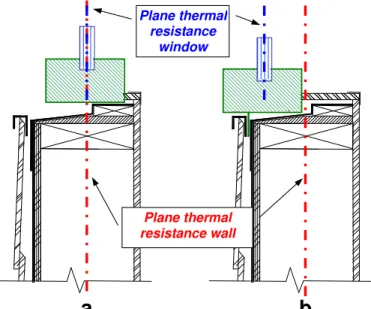
For flanged windows, the location of the window is fixed in relation to the plane of thermal
resistance of the wall whereas in the case of the box window, the variations in installation include having the window installed either in the same plane as the average thermal resistance of the wall (neutral) or installed forward of that plane or some other location that may compromise the overall thermal resistance at the opening. Plane thermal resistance window Plane thermal resistance wall
Figure 1 – Schematic of (a) box and (b) flanged window installation in window opening showing the respective planes of thermal resistance of window in relation to that of nominal wall assembly
a
b
In regard to installing either the fixed flange or box window in the wall opening, the location of the window in the opening will necessarily affect the overall thermal insulance (RSI-value) at the opening. In principle, windows are installed with the intent of ensuring that the plane of thermal resistance of the window is located in line with, or in close proximity to, the plane of thermal resistance of the wall in which it is installed as illustrated in Figure 1a. However, when a window incorporating a fixed flange is installed, as shown in Figure 1b, the location of the plane of thermal resistance is predetermined, based on the location of the flange in relation to the windowpane and window frame. In this instance, the plane of thermal resistance of this window may very well be forward of that of the nominal plane of thermal insulance of the wall.
As the difference between the locations of these two planes increases, so too does the likelihood for the formation of condensation on the window or frame, for windows installed in cold climates. This is due to the fact that there is less thermal insulance in the cavity between the window and the window opening as compared to the wall proper thus giving rise to decreases in surface temperature of the window or window frame on the interior in relation to the interior room temperature. The continuity of the thermal plane at the window interface with the wall must, in principle, be reconciled; nonetheless, this is limited by the amount of space in which insulation can be applied even though the products typically used have themselves high thermal resistance.
In respect to the choice of installation details, consideration was only given to those details that had in a previous study [Lacasse et al., 2007; Lacasse et al. 2005] demonstrated an ability to adequately manage rainwater entry. Such installation details typically include a sloped sill with sill pan flashing incorporating a back dam.
Finally, given the interest in using installation details that include a sill pan, thought was given to possible paths of air leakage through the assembly at the sill and the type of deficiencies that might arise at these locations due to improper installation of components or premature failure of seal components. Two possible paths were considered: a short path at the sill and another longer path along the interior jamb that enters the room side at the window head.
Detailed information is provided in the subsequent section on the configuration of the different test specimens, the window installation and location of the window in the specimen, and the incorporation of deficiencies in the specimens to simulate air leakage problems.
EXPERIMENTAL SET-UP AND PROCEDURES
Configuration of Test specimen and mounting specimen in test assembly
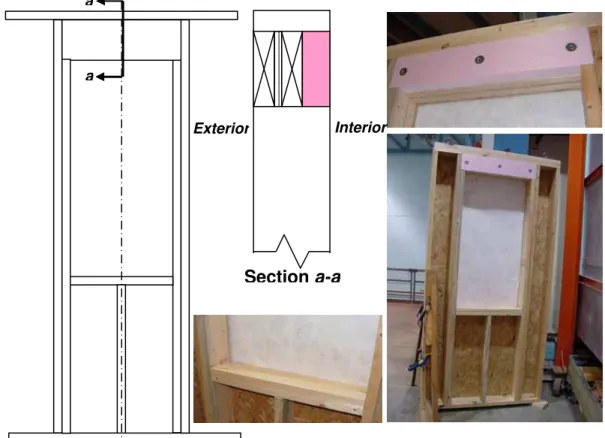
Two (2) sets of individual test specimens were prepared; each test set having one wall-window interface detail as shown in Figure 2. The nominal size of a single window-wall interface test specimen is 1.22-m (4-ft.) wide by 2.44-m (8-ft.) high. The test assembly was intended to be representative of typical North American wood frame construction practice. The wall assembly was framed with 51 by 152-mm (2 by 6-in.) SPF lumber in the configuration shown in Figure 2. The exterior cladding of the assembly was hardboard wood composite siding, installed in accordance with current building practice, and directly to the sheathing membrane (spun bonded polyolefin). The membrane overlays an oriented strand board (OSB; 11-mm) sheathing panel affixed over the wood frame. Fibreglass batt type insulation was placed in the stud cavities adjacent to the window opening and the interior finish was gypsum board (12.7-mm).
As previously mentioned, two (2) types of fixed (non-operable) PVC windows were used: windows
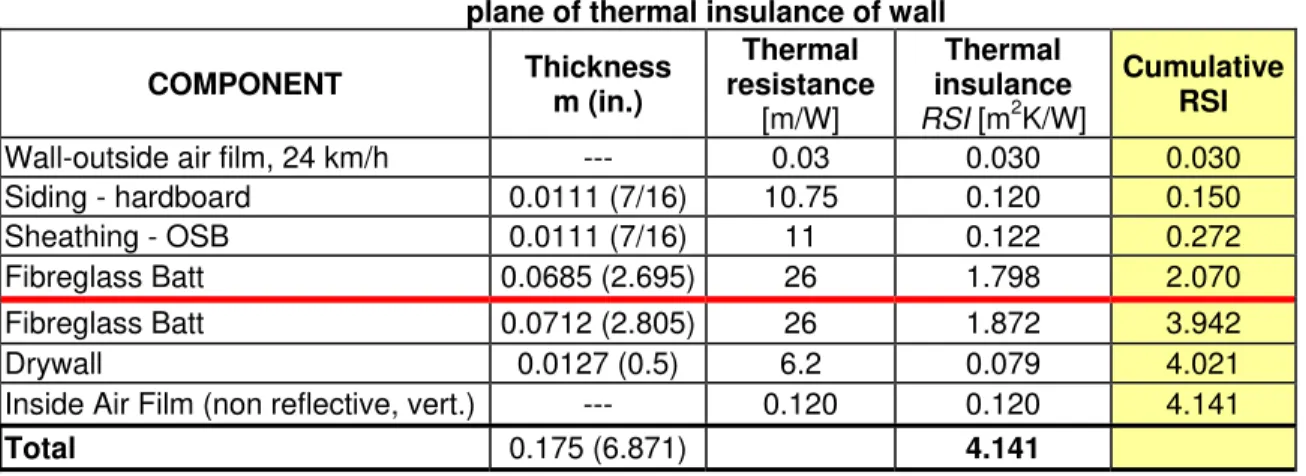
incorporating a fixing (installation) flange (i.e. flanged window), and those not having a flange (i.e. box window). The 610-mm by 1220-mm windows were centered vertically within the specimen. The location of a flanged window in the window opening, as was previously discussed, is necessarily predetermined by the configuration of the flange in the window frame. However, the location of a box window in the opening can in principle be located in a forward or neutral position or towards the back of the window opening. Given that in this research program there was interest in comparing the differences in condensation potential arising from installing windows at different locations in the opening, consideration was given to determining the location of the plane of thermal resistance of the wall; the plane of thermal resistance of the window was assumed to fall along the center line of the glass lite. Table 2 provides information on the respective values of RSI for each of the relevant wall components from which the location of the plane of thermal resistance was determined; the red line in the table, indicates the point at which the cumulative RSI up to the depth indicated for the fibreglass batt (i.e. 2.695-in.) is equal to the remaining portion of the assembly. Although the fibreglass batt is described as two individual components, it is in fact a single component of the wall having an overall thickness of ca. 140 mm (5.5 in.). This batt is described as such to highlight the line demarking the plane of equal thermal resistance that passes through the batt.
Figure 3 shows the location of the plane of thermal resistance of the wall in relation to that of a box window installed along the same plane (Figure 3a), and a flanged window (Figure 3b). As shown in the Figure, the respective planes of thermal resistance are displaced in respect to one another and the plane of thermal resistance of the window closer to the exterior of the wall as compared to that of the plane of thermal resistance of the wall.
Table 2 – RSI value of wall components and calculation location of plane of thermal insulance of wall
COMPONENT Thickness m (in.) Thermal resistance [m/W] Thermal insulance RSI [m2K/W] Cumulative RSI
Wall-outside air film, 24 km/h --- 0.03 0.030 0.030 Siding - hardboard 0.0111 (7/16) 10.75 0.120 0.150 Sheathing - OSB 0.0111 (7/16) 11 0.122 0.272 Fibreglass Batt 0.0685 (2.695) 26 1.798 2.070 Fibreglass Batt 0.0712 (2.805) 26 1.872 3.942
Drywall 0.0127 (0.5) 6.2 0.079 4.021
Inside Air Film (non reflective, vert.) --- 0.120 0.120 4.141
Total 0.175 (6.871) 4.141
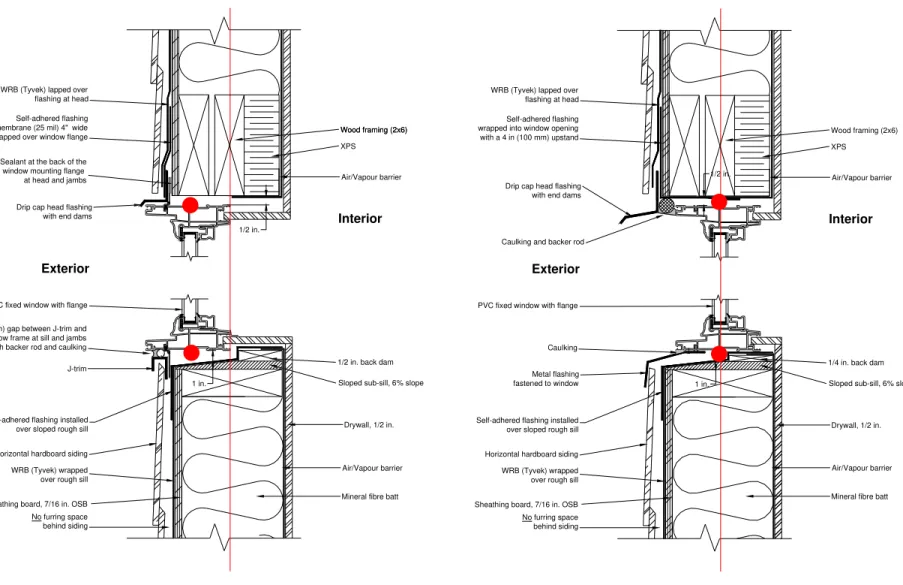
The installation details incorporated pan flashing, sloped sill, up-stand or related component details that help promote drainage of water from the windowsill if subjected to advertent water entry are shown in Figure 4 and Figure 5; information in Figure 4 relates to the installation of a flanged window and that in Figure 5 for a box window installation.
6
Figure 2 – Nominal test specimen set-up showing size and location of non-operable vinyl window in wood frame assembly
Figure 3 – Sectional view of (a) box window and (b) flanged window showing location of plane of thermal resistance of window as compared to that of wall
a a Interior r Exterio
Section a-a
1 in. 1-¾-in. 2-in. 1 in. 1-¾-in. 2-in.2.695 in.
2.695 in.
a b
WRB (Tyvek) wrapped over rough sill 1/8" (3 mm) gap between J-trim and
window frame at sill and jambs filled with backer rod and caulking
Self-adhered flashing installed over sloped rough sill
No furring space behind siding Sheathing board, 7/16 in. OSB Horizontal hardboard siding J-trim WRB (Tyvek) lapped over flashing at head
Sealant at the back of the window mounting flange at head and jambs
PVC fixed window with flange
Exterior
Sloped sub-sill, 6% slope
Drywall, 1/2 in.
Interior
Wood framing (2x6)
Drip cap head flashing with end dams Self-adhered flashing membrane (25 mil) 4" wide lapped over window flange
1/2 in. back dam 1 in.
1/2 in.
Mineral fibre batt Air/Vapour barrier Air/Vapour barrier Wood framing (2x6) XPS
WRB (Tyvek) lapped over flashing at head
Drip cap head flashing with end dams
Exterior
PVC fixed window with flange Self-adhered flashing wrapped into window opening with a 4 in (100 mm) upstand
WRB (Tyvek) wrapped over rough sill Self-adhered flashing installed over sloped rough sill
Sheathing board, 7/16 in. OSB Horizontal hardboard siding
No furring space behind siding Caulking
Interior
1/2 in.
Sloped sub-sill, 6% slope
Drywall, 1/2 in. 1/4 in. back dam
Wood framing (2x6)
1 in. Metal flashing
fastened to window Caulking and backer rod
Air/Vapour barrier XPS
Air/Vapour barrier
Mineral fibre batt
Figure 4 – Vertical Section of W1 showing installation details for non-operable Fixed – flanged window– vertical line through section indicates plane of thermal resistance of wall; position of thermocouples in cavity shown in red
Figure 5 – Vertical Section of W2 showing installation details for non-operable boxed window – vertical line through section indicates plane of thermal resistance of wall; position of thermocouples in cavity shown in red
The introduction of deficiencies at the wall-window interface provides a means to evaluate whether air leakage across different components of the window assembly cause condensation to form on the warm side of the wall assembly when leakage is induced in the test assembly. The intent is to
demonstrate the vulnerability of the assembly to the formation of condensation on the interior in instances where, for example, a deficiency is located at the:
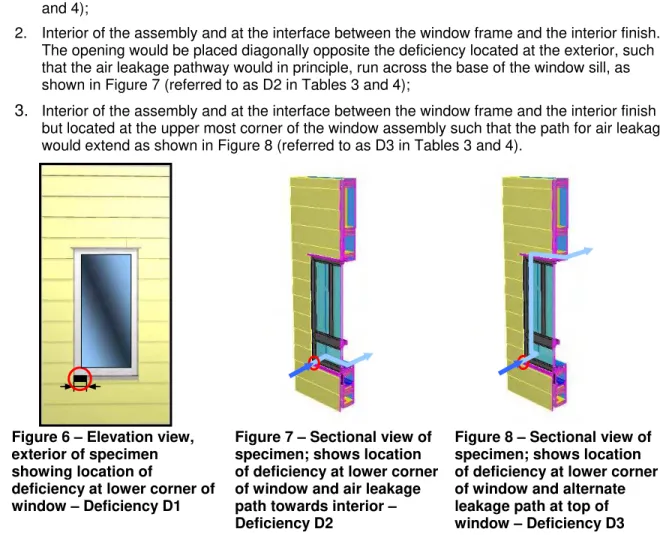
1. Exterior of the wall-window interface and at the juncture of the cladding and window frame at the lower extreme comer of the window, as shown in Figure 6 (referred to as D1 in Tables 3 and 4);
2. Interior of the assembly and at the interface between the window frame and the interior finish. The opening would be placed diagonally opposite the deficiency located at the exterior, such that the air leakage pathway would in principle, run across the base of the window sill, as shown in Figure 7 (referred to as D2 in Tables 3 and 4);
3. Interior of the assembly and at the interface between the window frame and the interior finish but located at the upper most corner of the window assembly such that the path for air leakage would extend as shown in Figure 8 (referred to as D3 in Tables 3 and 4).
Figure 6 – Elevation view, exterior of specimen showing location of
deficiency at lower corner of window – Deficiency D1
Figure 7 – Sectional view of specimen; shows location of deficiency at lower corner of window and air leakage path towards interior – Deficiency D2
Figure 8 – Sectional view of specimen; shows location of deficiency at lower corner of window and alternate leakage path at top of window – Deficiency D3
A summary of the different interface details for either the box of flanged windows are given in Tables 3 and 4, in which information is provided on the:
• Type of window (box or flanged) and the position of the window in the rough opening;
• Use, or not, of insulation and the type of insulation used when specified; as well as,
• Incorporation, or not, of deficiencies in the assembly; nominally, there were three (3) deficiencies in any given test set-up – only one deficiency is tested in any given test trial. In the Tables, “Position” refers to the position of the window in the rough opening;
• Neutral implies the plan of thermal resistance of the window is aligned with that of the wall assembly;
• Fixed implies that the plane is determined on the basis of where the flange of the window is located in relation to the respective planes of thermal resistance;
The insulation, type and location refers to the use, or not, of insulation in the cavity between the window proper and the rough opening:
• “Batt” refers to fibreglass batt insulation; whereas the
• SIF designation indicates that PUR spray-in-place-foam is to be used in the same cavities located between the window opening and window frame.
Nominal Test Series for
Evaluating Window Condensation Potential of
Wall-Window Interface Installation Details
Table 3 – Test series for Box window installation with window in line with plane of thermal Resistance
Box window installation Test Set 1 Test Set 2 Test Set 3
T1 T2 T3 T4 T5 T6 T7 T8 T9 T10 T11 T12
Position Neutral Neutral
Insulation type NO NO NO NO Batt Batt Batt Batt SIF SIF SIF SIF
Deficiency type / location NO YES YES YES NO YES YES YES NO YES YES YES
D1 D2 D3 D1 D2 D3 D1 D2 D3
Table 4 – Test series for flanged window configuration
Flanged installation Test Set 4 Test Set 5 Test Set 6
T13 T14 T15 T16 T17 T18 T19 T20 T21 T22 T23 T24
Position Fixed Fixed
Insulation type NO NO NO NO Batt Batt Batt Batt SIF SIF SIF SIF
Deficiency type / location NO YES YES YES NO YES YES YES NO YES YES YES
Instrumentation and Data Acquisition
Measurement of Temperatures and Relative Humidity — The chamber environmental conditions are to be monitored continuously over the course of a test sequence; likewise surface temperatures on the interior and exterior surface of the window and window frame are to be measured; the following provides information on accuracy of measurements and the means of capturing data.
(1) Monitoring chamber conditions — Both the temperature and relative humidity (RH) is to be continuously monitored over the course of a test sequence in the warm side chamber and only temperature in the cold side chamber. Measurements of temperature should be made to an accuracy of ± 1.5 °C and that of relative humidity to ± 1 % RH. The data is to be recorded on the data acquisition system to subsequently be used to ensure that steady state conditions have been maintained over the course of a test sequence. (2) Monitoring and recording surface temperature conditions — Surface temperature conditions on either side
of the window (i.e. exterior and interior) and on specified window components (e.g. window lite; window frame at sill, frame at jambs, etc.) will be continuously monitored with the use of a set of forty 40 thermocouples, 20 to be used on the exterior, and 20 on the interior of the specimen. Measurements of temperature will be made to an accuracy of ± 0.5 °C. The location of each of these thermocouples on the interior and exterior face of the specimen (glass lite and frame) follows that which is specified in standard CSA A440.2-04 as given in Figure 9. The nominal location of thermocouples placed within the cavity between the window frame and window opening is provided in Figures 4 and 5; the intent of placing
thermocouples at these locations is to monitor the temperature in the space, and in proximity to the window frame, along the path of expected air leakage and through which cold air is to migrate.
Figure 9 – Nominal location of thermocouples on exterior and interior face of test specimen
In addition to continuous monitoring of surface temperature conditions, an IR camera is to be used to scan the surface temperature of the widow frame. The data will thereafter be compared to that provided by the thermocouples. Acquiring an IR scan of the interior of the window requires the use of a baffle to minimize variations in surface conditions that may results from the presence of a camera operator in the warm side room.
Measurement of Pressure Differentials and Airflow — Tests to be carried out under a pressure differential require that the pressure difference across the test assembly be continuously monitored during the test
sequence. A pressure transducer having a 250 Pa range (1-in. water) and accuracy of ± 1 Pa will be placed in the warm side chamber. Additionally, a pressure transducer may also be used to monitor the pressure in the interstitial space between the window frame and window opening. The requirement for a specified pressure differential across the test assembly necessitates the use of an air pump that will expel air from the warm side
chamber. The amount of airflow will not be monitored, however the flow will be adjusted to accommodate the specified pressure differential.
Experimental Procedures
The basis for this test is observation of surface temperatures sufficient to cause the formation of
condensation on window components located on the warm side of the test assembly. Actual visual observation of condensation is not required nor desired as the formation of condensation on thermocouples can affect measurements taken of affected sensors. Hence temperatures measurements on the warm side are undertaken in conditions where the humidity levels are sufficiently low to preclude the formation of condensation.
Calibration of Test facility — The guarded hotbox test facility is calibrated according to the protocol described in Bowen [1985]. The film heat transfer coefficient on the room-side and weather-side surfaces shall be determined from the calibration of the hot box with use of the Calibration Transfer Standard (CTS). For calibration, the CTS shall be mounted flush with the room-side surface of the surround panel.
Test procedure under no pressure differential — The tests in this instance are carried out in isobaric conditions. The temperature differential for the initial test is set at 50 °C ± 1.5 °C and the temperature sensor measurements are recorded once steady state conditions have been achieved following a period of 15 minutes in these conditions (20 °C – (–30 °C) = 50 °C). This test represents standard test conditions as described in CSA A440.2 [CSA 2004]. The humidity on the warm side chamber is maintained at 5 % RH to ensure that no condensation will occur on any of the interior exposed surfaces of the widow frame. A time recorded scan using the Infra Red (IR) camera is taken for later analysis.
The test is repeated at a lower temperature differential of 45 °C and thereafter at 40°C to investigate the extent to which such conditions alter the surface temperatures on the warm side of the window assembly. These test conditions may not be repeated in subsequent tests if it can be shown that sufficient information regarding condensation at the window frame can be obtained from a single test at a specified temperature differential. As was the case for the test conducted in standard conditions, temperature sensor measurements are recorded once steady state conditions have been achieved following a period of 15 minutes in these conditions and as well, the humidity on the warm side chamber is maintained at 5 % RH to ensure that no condensation occurs. As before, a time recorded Infra Red (IR) camera scan is taken for subsequent analysis.
Test procedure when applying a pressure differential
The procedure for the test conducted under pressure differential first includes incorporating deficiencies of known type, size and location in the specimen as previously described. Once this has been completed, the prescribed temperature differential under no pressure differential is first attained and thereafter, differential pressure is slowly applied to the chamber by evacuating the warm side chamber to reach an initial pressure differential of 5 Pa ± 0.5 Pa. Following which, further depressurisation of the chamber is made until, as proposed by Cornick [2008], a threshold of 50 Pa ± 1 Pa is achieved; this may initially be conducted in multiple pressure steps to determine the most effective pressure levels at which to extract information. The intent of taking measurements at two different pressure levels is to gain insight into the effect of greater pressure differences across the envelope to increasing the risk to the formation of condensation at the window. As was the case for the test conducted in standard conditions, temperature sensor measurements are recorded once steady state conditions have been achieved following a period of 15 minutes in these conditions.
SUMMARY
A test protocol has been proposed to determine the condensation potential of windows based on existing CSA A440 test standard but that also includes a means to determine the effects of air leakage on the risk to condensation on windows. The windows were installed in a 2-ft. by 4-ft. opening of a 2-in. by 6-in. wood frame assembly typical of cold climate North American construction practice. The installation details were those that promote the management of rainwater entry and incorporate such features as sloped sill, sill pan flashing membrane, and back dam. Air leakage across the wall-window interface may increase the likelihood that condensation may form on the window. Hence, deficiencies simulating either the improper installation of
components or the premature failure of critical seals have been included in the evaluation to verify the degree to which such openings influence the risk to condensation. The risk to condensation is first determined in
conditions where no deficiencies are present at the wall-window interface and thereafter, a series of defects are included that permit air, in varying degrees, to penetrate the interface. In each instance, the surface
temperatures of the window are monitored to establish any changes in comparison with the instance where no defects are present. This series of experiments are first conducted with no insulation in the cavity between the window unit and the openings and thereafter with batt insulation and PUR spray-in-place foam. This permits
12
comparing the relative importance of insulating the cavity on the performance in regard to the risk to
condensation of these approaches to window installation practice. This information developed from these tests should provide guidance to window manufactures, window installers and knowledgeable practitioners
investigating window deficiencies, and the effects of such deficiencies on thermal performance.
ACKNOWLEDGEMENTS
The authors wish to thank the Canada Mortgage and Housing Corporation for partial funding of the project and acknowledge the contributions of Mr. Silvio, Plescia, Senior Researcher, to the present contribution.
REFERENCES
Sasaki, J.R. (1971), "Developing a standard test for window condensation performance," Materials Research and Standards, 11, (10), pp. 17-20, October, 1971 (NRCC-11847) (DBR-RP-473)
AAMA (1972), Architectural Aluminium Manufacturers Association, “Voluntary Test Method for Condensation Resistance of Windows, Doors and Glazed Window Sections,” Publication No. AAMA 1502.3-1972, 1972.
AAMA (1998), Architectural Aluminium Manufacturers Association, “Voluntary Test Method for Thermal Transmittance and Condensation Resistance of Windows, Doors and Glazed Wall Sections”, Publication No. AAMA 1503-98
ASTM (2000), ASTM C1199-00 “Standard Test Method for Measuring the Steady-State Thermal Transmittance of Fenestration Systems Using Hot Box Methods”, ASTM Book of Standards, Vol. 04.06, ASTM
Publications, PA, USA, 19 p.
CSA (2004), Energy performance of windows and other fenestration systems/User guide to CSA A440.2-04, Energy performance of windows and other fenestration systems, Canadian Standards Association, Mississauga, Ontario, August, 108 p.
Frame (1996), FRAME 4.0 “CANMET Computer Program to Evaluate Thermal Performance of Window Frame Systems”, Enermodal Engineering Limited, March 1996
VISION (1996), VISION 4.0 “CANMET Program to Evaluate the Thermal Performance of Innovative Glazing Systems”, University of Waterloo, 1996
McGowan, A. G.; Wright, J.L. (1998), Computer simulation of window condensation potential, proceedings of the conference on :"Thermal performance of the exterior envelopes of buildings VII", Sheraton Sand Key Hotel, Clearwater Beach, Florida USA, , American Society of Heating, Refrigerating and Air Conditioning Engineers (ASHRAE), Atlanta
Kudder, R. J., Babich, S. K. and Johnson, D. K. (2005),” Effect of Installation Details on the Condensation Performance of Window Frames”, Journal of ASTM International, November/December 2005, Vol. 2, No. 10, 15 p.
Brown, W.P., K. R. Solvason, and A.G. Wilson (1961), A unique hot-box cold-room facility. ASHRAE Trans., V. 67, 1961, pp. 561-577
Lacasse, M.A.; Manning, M.M.; Rousseau, M.Z.; Cornick, S.M.; Plescia, S.; Nicholls, M.; Nunes, S.C. (2007), "Results on assessing the effectiveness of wall-window interface details to manage rainwater," 11th Canadian Building Science and Technology Conference (Banff, Alberta, March 22, 2007), pp. 1-14, March 22, 2007 (NRCC-49201)
Lacasse, M.A.; Rousseau, M.Z.; Cornick, S.M.; Plescia, S. (2005), "Assessing the effectiveness of wall-window interface details to manage rainwater," 10th Canadian Conference on Building Science & Technology (10BS&T) (Ottawa, ON, May 12, 2005), pp. 127-138, May 01, 2005 (NRCC-47685)
Bowen, R.P. DBR's Approach for Determining the Heat Transmission Characteristics of Windows, Building Research Note, 234, 12 p., November, 1985 (BRN-234)
Cornick, S.M. Task 5: Proposed Test Protocol for Walls of Houses in Extreme Cold Regions. Part 1: Defining Exterior Conditions, pp. 47, March 27, 2008 (B-1239.5)