25
ISSN 0619-4324
April 2001
Contents
Cover: Hindeodus parvus (Kozur and Pjatakova 1976). Specimen number GSC 101761, from the basal Triassic Otoceras woodwardi beds of Lalung, Spiti.
Editor
Dr. Wolfram M. Kürschner, Laboratory of Palaeobotany and Palynology, Utrecht University, Budapestlaan 4, 3584 CD Utrecht, The Netherlands, [email protected];
Editorial Commitee
Dr. Aymon Baud, Musee de Geologie, BFSH2-UNIL, 1015 Lausanne, Switzerland, [email protected];
Prof. Dr. Hans Kerp, WWU, Abt. Palaeobotanik, Hindenburgplatz 57, 48143 Münster, Germany, [email protected];
Dr. Spencer G. Lucas, New Mexico Museum of Natural History, 1801 Mountain Road N. W., Albuquer-que, NM 87104, USA, [email protected];
Dr. Mike Orchard, Geological Survey of Canada, 101-605 Robson Street, Vancouver, British Columbia, V6B 5J3, Canada, [email protected];
Dr. E. T. Tozer, Geological Survey of Canada, 101-605 Robson Street, Vancouver, British Columbia, V6B 5J3, Canada, [email protected];
Prof. Dr. Henk Visscher, Laboratory of Palaeobotany and Palynology, Utrecht University, Budapestlaan 4, 3584 CD Utrecht, The Netherlands, [email protected].
Executive Notes
From the Chair From the Secretary From the Editor
Reports
S. G. Lucas & P. J. Hancox: Tetrapod-based correlation of the non-marine Upper Triassic of Southern Africa
M. J. Orchard, J. P. Zonneveld, M. J. Johns, C. A. McRoberts, M. R. Sandy, E. T., Tozer & G. G. Carrelli: Fossil succession and sequence stratigraphy of the Upper Triassic of Black Bear Ridge, northeast British Columbia, a GSSP prospect for the Carnian-Norian boundary. T. Jinnan, Z. Jianjun & Z. Laishi: Report on the Lower Triassic of Chaohu, Anhui Province, China.
Y. D. Zakharov, A. V. Ignatiev, N. G. Boriskina, T. A. Velivetskaya, O. P. Smyshlyaeva, K. Tanabe, Y. Shigeta, H. Maeda, A. M. Popov, V. V. Golozubov, T. B. Afanasyeva & K. Moriya: Palaeozoic and Mesozoic Carbon-isotopic macrorythms and macrocycles of solar activity.
New Triassic Literature
W.M.Kürschner, H. Visscher, H. Kerp, G. Warrington, S.G. Lucas: Triassic Bibliography G. Warrington British Triassic Literature: Supplement 25
Meetings
Guidlines for the submission of manuscripts
The primary aim of ALBERTIANA is to promote the interdisciplinary collaboration and understanding among members of the I.U.G.S. Subcommission on Triassic stratigraphy. Within this scope ALBERTIANA serves as the newsletter for the announcement of general information and as a platform for discussion of developments in the field of Triassic stratigraphy. ALBERTIANA thus encourages the publication of anouncements, literature reviews, progress reports, preliminary notes etc. - i. e. those contributions in which information is presented relevant to current interdisciplinary Triassic research.
Pages 3 3 4 5 10 23 28 36 48 49 53
Executive Notes
From the Chair
On the occasion of this, my first report to the STS membership, I would like to take the opportunity to thank our past-Chairman, Maurizio Gaetani, our re-tiring vice-chair, Hans Rieber, and the past-editor of Albertiana, Hans Kerp, for their service to the Subcommision. As the new Chair and Editor take up their positions, we should see some changes in both the composition of the STS, and the dissemi-nation of information via the web. As far as the mem-bership is concerned, as you should all be aware, I have spent the winter soliciting members for their current research interests and seeking renewal of the voting slate and a broader geographic and spe-cialist representation amongst the corresponding membership. I hope this will lead to both greater participation and opportunities for voting member turnaround. This exercise is largely complete and I plan to publish the new STS membership and their research interests in the next Albertiana. At this stage, I would like to thank those titular members who volunteered to step down and allow this first phase of renewal to proceed smoothly.
The business of boundary definition is moving along. The basal Triassic GSSP drawn at the appearance of the conodont Hindeodus parvus at Meishan in China is now ratified by the IUGS. Yin Hongfu led the working group that finally agreed on this defini-tion and he is to be congratulated for providing us with our first formal stadial definition. Yuri Zacharov is active in leading deliberations on the Induan-Olenekian boundary, which now has three prospects, the Abrek Bay and the Tri Kamnya Cape - Orel sec-tions in Russia, and a soon to be described section in South China; Himalayan sections may also pro-vide a further candidate. The working groups on boundaries of the Middle Triassic, which Maurizio Gaetani continues to lead, are more advanced. The Olenekian-Anisian and Anisian-Ladinian boundaries, with candidates in Romania, Italy and Hungary, have been the focus of intense study in recent years and we must soon come to a final decision on them. The Ladinian-Carnian boundary has a formal candi-date in Italy, but new data is anticipated from the Himalaya and North America. I have recently begun work on gathering data for Carnian-Norian boundary candidates, with prospects identified in both Europe and North America. The Norian-Rhaetian boundary has as yet no formal working group. I urge all mem-bers to contribute data and opinion about all of these boundaries, ideally through the medium of Albertiana,
From the Secretary
Know Your Neighbours
STS members working around the upper and lower boundaries of the Triassic should note the following changes in the IUGS subcommissions for the Jurassic and the Permian.
Triassic-Jurassic Boundary Working Group The STS Secretary was also the Secretary of the Triassic-Jurassic Boundary Working Group (TJBWG) of the IUGS International Subcommission on Jurassic Stratigraphy (ISJS), the body charged with the selection of a candidate GSSP for the base of the Hettangian Stage and, inter alia, the top of the Triassic System. He was recently asked to become Convenor of the TJBWG and a Voting Member of the ISJS; the new Secretary of the TJBWG is:
Dr G. Bloos
Staatliches Museum für Naturkunde, Rosenstein 1, D-70191 Stuttgart, Germany, Phone +49 (0)711 8936 143, Fax: +49 (0)711 8936 100, E-mail: [email protected]
The ISJS publishes a newsletter; for further information contact the Secretary of the ISJS:
Professor P. L. Smith
Department of Earth & Ocean Sciences, University of British Columbia, 6339 Stores Road, Vancouver, British Columbia V6T 1Z4, Canada, Phone: 1 604 822 6456, Fax: 1 604 822 6088
E-mail: [email protected]
Mike Orchard
so that we may soon accomplish some standard-ization of our scientific language.
Subcommission on Permian Stratigraphy The IUGS Subcommission on Permian Stratigra-phy (SPS) now has a new Secretary:
Dr C. Henderson Department of Geology & Geophysics, University of Calgary, Calgary, Alberta T2N1N4, Canada, E-mail: [email protected]
The SPS publishes a newsletter (Permophiles); for further information contact the Secretary of the SPS.
G. Warrington
From the Editor
This is for me the first time serving you, STS members, as the editor of ALBERTIANA and I would like to take the opportunity to thank you and particularly the former editor, Hans Kerp, for your confidence passing this task into my hands. It is a great pleasure for me to present you the new issue of ALBERTIANA in a new layout. Please note that I have written NEW guidlines for the submission of manuscripts at the end of this volume. These are the times of electronic publishing and the internet. It opens not only the possibility of faster distribution of information but also gives way to for more sophisticated data presentations with coloured figures / photographic pictures and computer animations. Thus, Albertiana has not only received a new outfit but is from now on also available as PDF file on our www-server (www.bio.uu.nl/~palaeo). Manuscripts should be submitted as email attachments. Alternatively, you may also transfer your contributions that exceed the email attachment size limit to our ftp server. Our address is ftp://131.211.28.160, userID “alb” and the password “alb”. Finally, electronic distribution may help us also to reduce the high production and mailing costs. Therefore I would like to ask you to let me know whether or not you prefer to receive ALBERTIANA in future only electronically. Gückauf!
Introduction
The classic nonmarine Triassic section in the Ka-roo basin of southern Africa yields tetrapod fossils of the Lystrosaurus and Cynognathus assemblage zones of the Lower-Middle Triassic. These assem-blage zones are the standard by which other tetra-pod-bearing units of the Lower Triassic are corre-lated (Ochev & Shishkin, 1989; Hancox & Rubidge, 1997; Lucas, 1998). More problematic for correla-tion are the younger Triassic nonmarine strata in southern Africa assigned to the Molteno and Elliot formations (of the now defunct “Stormberg Group”). Here, we review tetrapod-based age assignments of the Molteno and Elliot formations.
Molteno Formation
The lowest formation of the Stormberg Group is the Molteno Formation, which rests unconformably on the Permo-Triassic Beaufort Group (Fig. 1). The youngest strata of the Beaufort Group beneath this unconformity belong to the Burgersdorp Formation, which yields a tetrapod assemblage near its top that includes the Perovkan (early Anisian) index taxon
Shansiodon (Hancox & Rubidge, 1997; Hancox,
1998, 2000). The Molteno Formation in the Karoo basin attains a maximum thickness of around 600-650 m in the Cape Province, and gradually thins northward to less than 30 m across Lesotho into Natal and the Free State; it is mostly fluvial/alluvial plain deposits with minor coal beds (Turner, 1984; Hancox, 1998).
Whereas fossil plants, insects and conchostracans are locally abundant in the Molteno Formation (Cairncross et al., 1995), vertebrate body fossils are scarce, and represented only by specimens of semionotid fishes (Jubb, 1973). Based on the com-position of palynomorph and megafossil plant
as-semblages (“Dicroidium flora”), Anderson and Ander-son (1993; AnderAnder-son et al., 1998) regarded the Molteno to be of Carnian (undivided) age. Hancox (2000) also concluded that at least the lower half of the Molteno Formation is Carnian.
The only tetrapod fossils from the Molteno Forma-tion are footprints. Raath et al. (1990) and Raath (1996) documented small theropod dinosaur tracks (ichnogenus Grallator) from the upper part of the for-mation. The oldest records of dinosaur fossils are Otischalkian (late Carnian: Lucas, 1998), so the Molteno dinosaur tracks suggest late Carnian as a maximum age for the upper part of the formation. Of course, a younger, Norian age cannot be excluded based on the footprint evidence.
Elliot Formation
The Molteno Formation is disconformably overlain by mudrock-dominated facies of the lower Elliot Formation (Fig. 1). Earlier claims of a lateral equiva-lence of the upper Molteno and Lower Elliot are not supported by field evidence (Hancox, 1998). Indeed, the change in fossil representation and the major facies change at the top of the Molteno Formation argue against its lateral equivalence to the Lower Elliot.
The Elliot Formation approaches a maximum thick-ness of around 500 m in the southern area of the Karoo basin, and thins to less than 200 m north of Lesotho, following the generalized isopach trend of the underlying Molteno Formation (Visser, 1984; Hancox, 1998, 2000). The lower Elliot contains a tetrapod fossil assemblage (Fig. 1) dominated by prosauropod dinosaurs (common Euskelosaurus, rare Melorosaurus and Blikinasaurus). The assem-blage also includes a dinosaur incertae sedis (Aliwalia), rare temnospondyls (a large chigutisaurid), a traversodontid (Scalenodontoides) and the possible rauisuchian Basutodon (Haughton, 1924; Heerden, 1979; Hopson, 1984; Kitching & Raath, 1984; Crompton & Ellenberger, 1957; Galton, 1985a, b; Galton & Heerden, 1985, 1998; Gow & Hancox, 1993; Heerden & Galton, 1997). The lower Elliot also contains a tetrapod ichnofauna (Ellenberger, 1970) that, according to Olsen & Galton’s (1984) revision, includes Brachychirotherium (“thecodont”), Tetrasauropus (prosauropod dinosaur),
Grallator (theropod dinosaur) and a form of
uncer-tain affinity, Pentasauropus. Note that although
Pentasauropus is only toe imprints, and Ellenberger
originally condsidered it prosauroropd, Olsen & Galton (1984) identified it as a dicynodont footprint, a conclusion generally followed by later workers (e.g., Anderson et al., 1998).
The lower Elliot assemblage (“Euskelosaurus range
Tetrapod-Based Correlation of
the Nonmarine Upper Triassic
of Southern Africa
S. G. Lucas & P. J. Hancox
Tetrapod fossils suggest the Molteno Formation in southern Africa is no older than late Carnian, whereas the overlying lower Elliot Formation is most likely Norian in age. However, these are not strong correlations, and additional data are needed to confirm correlation of the southern African Upper Triassic strata.
zone” of Kitching & Raath, 1984) has either been assigned a Carnian or a Norian age (see review by Hancox, 1998, 2000). Cooper (1982) assigned it to the late Norian, based largely on correlating
Euskelosaurus and the German late Norian
prosauropod Plateosaurus. Olsen & Galton (1984) reviewed previous ideas about the correlation of the
Stormberg Group and concluded that the lower Elliot Formation is of Carnian-Norian age, and that the middle-upper Elliot Formation is Early Jurassic. However, Gauffre (1993) assigned the lower Elliot a Carnian age simply because it contains a traversodontid. Thus, Gauffre (1993:148) incorrectly believed “that traversodontids are unknown above
Figure 1: Stratigraphic distribution of tetrapod taxa in the Stormberg Group of southern Africa (based on Kitching & Raath, 1984 and other sources cited in the text) and age assignments based on these taxa.
chigutisaurid rauisuchids? prosauropods (mostly Euskelosaurus ) Syntarsus proganochelyid brachyopid crocodilians pedeticosaurids Sphenosuchus Massospondylus Geranosaurus Lanasaurus Abrictosaurus Heterodontosaurus Lycorhinus fabrosaurids Megazostrodon Erythrotherium Trithelodon Pachygenelus Tritylodon/T ritylodontoideus Scalenodontoides Tritylodon
acme zone
EARL
Y
JURASSIC
LA TE TRIASSICELLIOTT
FORMA
TION
MOLTENO
FORMATION
CLARENS FORMA
TION
UPPER
MIDDLE
LOWER
UPPER
MIDDLE
LOWER
;; yy GrallatorBURGERSDORP
FORMATION
;;; yyy Shansiodon,and other Perovkan-age tetrapods Euskelosaurus range zone
Massospondylus
range zone
MIDDLE TRIASSIC subzone C of Cynognathus zoneBrachychirotherium Tetrasauropus Pentasauropus
Aliwalia
?
CARNIAN
NORIAN
beds dated as Carnian.” Gauffre (1993:148) further argued for “a lower Carnian age for the Ischigualasto, Santa Maria and Lower Elliot Formation with their traversodonts-rauisuchians-rhynchosaurs assem-blage.” There are clearly three problems here: (1) traversodontids are known through the Rhaetian (Hahn et al., 1988; Lucas & Hunt, 1994; Godefroit & Battail, 1997); (2) the Ischigualasto and upper Santa Maria assemblages are late Carnian (Lucas, 1998); and (3) no taxa are shared between Ischigualasto-Santa Maria and the lower Elliot, so their correlation lacks any basis.
Warren & Damiani (1999) assigned a Carnian age to the lower Elliot Formation, following some of the earlier workers. Galton & Heerden (1998) simply accepted the correlation of Gauffre (1993) that the lower Elliot Formation is Carnian, possibly early Carnian. They concluded, therefore, that it includes the oldest record of articulated prosauropods and the first evidence of the diversification of the group. The Euskelosaurus range zone of the lower Elliot must be Triassic as it includes fossils of rauisuchians and traversodontids, taxa not known from post-Triassic beds. The fauna is dominated by prosauropod dinosaurs and thus resembles two other Late Triassic prosauropod-dominated faunas of Norian age—that of the German Knollenmergel and that of the Los Colorados Formation in Argentina. Furthermore, the tetrapod footprint ichnofauna of the lower Elliot Formation is very similar to the footprint ichnofauna of the Rock Point sequence of the Chinle Group, strata of Norian-Rhaetian? age ( Lockley & Hunt, 1995).
Furthermore, note that if the Lower Elliot is assigned a Carnian age, then there must be a substantial unconformity representing a hiatus of at least 20 million years between it and overlying Lower Juras-sic strata of the Middle Elliot. However, field evi-dence does not indicate such an unconformity. We thus assign the lower Elliot Formation a Norian age because: (1) the only other prosauropod-domi-nate Late Triassic faunas are Norian; (2)
Euskelosaurus may be an ecological vicar of Plateosaurus, as Cooper argued; (3) its footprint
ichnofauna is closest to Norian ichnofaunas; and (4) Lower Jurassic strata directly overlie the lower Elliot. However, none of these arguments is incon-trovertible.
The middle and upper Elliot contains a more diverse tetrapod assemblage that Kitching & Raath (1984) defined as the “Massospondylus range zone.” The combined assemblage is dominated by the tritylodontid Tritlyodon, which occurs with rare brachyopid amphibian remains, a proganochelyid turtle (Gaffney & Kitching, 1994), sphenosuchian
archosaurs
(Sphenosuchus and “pedeticosaurids”), a variety of dinosaurs (the prosauropod Massospondylus, a coelurosaur referred to cf. Syntarsus, and several ornithischians), other cynodonts including
Pachygenelus and Tritheledon, and the mammals Megazostrodon and Erythrotherium (Kitching &
Raath, 1984). The Tritylodon acme zone is interpreted as a reworked paleosol (Smith & Kitching, 1996, 1997), and is widely, and we believe correctly, as-signed an Early Jurassic age. The age of the
Massospondylus range zone between the Euskelosaurus range zone and the Tritylodon acme
zone is unclear and we conservatively assign it an Early Jurassic age (Fig. 1).
The overlying Clarens Formation contains a limited fauna that includes taxa of mostly ornithischian di-nosaurs and cynodonts common to the underlying upper Elliot assemblage and also is of Early Juras-sic age. Olsen & Galton (1984) described the upper Stormberg footprint fauna to include Batrachopus (crocodylomorph), theropod tracks referable to
Grallator (Anchisauripus) and Grallator (Eubrontes), Anomoepus sp. (Ornithschia), Ameghinichnus sp.
(tritylodontid?), and the enigmatic Episcopopus
ventrosus Ellenberger.
References
Anderson, J. M. & Anderson, H. M. 1993. Terrestrial flora and fauna of the Gondwanan Triassic. Part 1., occurrences. New Mexico Museum of Natural History Science Bulletin, 3:3-12.
Anderson, J. M., Anderson, H. M. & Cruickshank, A. R. I. 1998. Late Triassic ecosystems of the Molteno lower Elliot biome of southern Africa. Palaeont., 41:387-421.
Cairncross, B., Anderson, J. M. & Anderson, H. M. 1995. Palaeoecology of the Triassic Molteno For-mation, Karoo basin, South Africa—sedimentologi-cal and paleontologiAfrica—sedimentologi-cal evidence. S. Afr. J. Geol., 98: 452-478.
Cooper, M. R. 1982. A mid-Permian to earliest Jurassic tetrapod biostratigraphy and its significance. Arnoldia Zimbabwe, 9:77-104. Crompton, A. W. & Ellenberger, F. 1957. On a new
cynodont from the Molteno beds and the origin of the tritylodontids. Ann. South Afr. Mus., 44:1-14. Ellenberger, P. 1970. Les niveaux paléontologiques
de première apparition des mammifères primordiaux en Afrique du Sud et leur ichnologie: Establissement de zones stratigraphiques detaillées dans le Stormberg du Lesotho, (Afrique du Sud) (Triassique supérieur à Jurassique; in Haughton, S. H. (ed.), International Union of Geo-logical Sciences, Second Symposium on Gondwana Stratigraphy and Paleontology. Pretoria,
Council for Scientific and Industrial Research, p. 347-370.
Gaffney, E. S. & Kitching, J. W. 1994. The most ancient African turtle. Nature, 369: 55-58. Galton, P. M. 1985a. Notes on the Melanorosauridae,
a family of large prosauropod dinosaurs (Saurischia: Sauropodomorpha). Geobios, 18: 671-676.
Galton, P. M. 1985b. The poposaurid thecodontian
Teratosaurus suevicus v. Meyer, plus referred
specimens mostly based on prosauropod dino-saurs, from the Middle Stubensandstein (Upper Triassic) of Nordwurttemberg. Stuttgart. Beitr. Naturk. B, 116: 1-29.
Galton, P. M. & Heerden, J. van. 1985. Partial hindlimb of Blikanasaurus cromptoni n. gen. and n. sp., representing a new family of prosauropod dinosaurs from the Upper Triassic of South Africa. Geobios, 18: 509-516.
Galton, P. M. & Heerden, J. van. 1998. Anatomy of the prosauropod dinosaur Blikanosaurus cromptoni (Upper Triassic, South Africa), with notes on the other tetrapods from the Lower Elliot Formation. Paläont. Zeitschr., 72: 163-177.
Gauffre, F. -X. 1993. Biochronostratigraphy of the lower Elliot Formation (southern Africa) and preliminary results on the Maphutseng dinosaur (Saurischia: Prosauropoda) from the same formation of Lesotho. New Mex. Mus. Nat. Hist. Sci. Bull., 3:147-149.
Godefroit, P. & Battail, B. 1997. Late Triassic cynodonts from Saint-Nicolas-de-Port (north-east-ern France). Geodiversitas, 19:567-631.
Gow, C. E. & Hancox, P. J. 1993. First complete skull of the Late Triassic Scalenodontoides (Rep-tilia, Cynodontia) from southern Africa. New Mex. Mus. Nat. Hist. Sci. Bull., 3: 161-168.
Hahn, G., Lepage, J. C. & Wouters, G. 1988. Traversodonten-Zahne (Cynodontia) aus der Ober-Trias von Gaume (Sud-Belgien). Bull. Inst. Roy. Sci. Nat. Belg. Sci. Terre, 58:177-186.
Hancox, P. J. 1998. A stratigraphic, sedimentologi-cal and paleoenvironmental synthesis of the Beau-fort-Molteno contact in the Karoo basin. Unpub-lished Ph.D. dissertation, University of the Witwatersrand, Johannesburg, 520 p.
Hancox, P. J. 2000. The continental Triassic of South Africa. Zbl. Geol. Paläont. Teil I, 11-12:1285-1324. Hancox, P. J. & Rubidge, B. A. 1997. The role of fossils in interpreting the development of the Ka-roo basin. Palaeont. Afr., 33: 41-54.
Haughton, S. H. 1924. The fauna and stratigraphy of the Stormberg Series. Ann. South Afr. Mus., 12:323-497.
Heerden, J. van 1979. The morphology and taxonomy of Euskelosaurus (Reptilia: Saurischia; Late Triassic) from South Africa. Navors. Nas. Mus., 4: 21-84.
Heerden, J. van & Galton, P. M. 1997. The affinities of Melanorosaurus, a Late Triassic prosauropod dinosaur fromn South Africa. N. Jb. Geol. Paläont. Abh., 1997:39-55.
Hopson, J. A. 1984. Late Triassic traversodont cynodonts from Nova Scotia and southern Africa. Palaeont. Afr., 25:181-201.
Jubb, R. A. 1973. Brief synthesis of present infor-mation on the geographical and stratigraphical dis-tribution of fossil fishes within the Stormberg Se-ries, South Africa. Palaeont. Afr., 16:17-23. Kitching, J. W. & Raath, M. A. 1984. Fossils from
the Elliot and Clarens formations (Karoo sequence) of the northeastern Cape, Orange Free State and Lesotho, and a suggested biozonation based on tetrapods. Palaeont. Afr., 25: 111-125.
Lockley, M. G. & Hunt, A. P. 1995. Dinosaur tracks and other fossil footprints of the western United States. New York, Columbia University Press, 338 p.
Lucas, S. G. 1998. Global Triassic tetrapod bios-tratigraphy and biochronology. Palaeogeog., Palaeoclimat., Palaeoecol., 143: 347-384. Lucas, S. G. & Hunt, A. P. 1994. The chronology
and paleogeography of mammalian origins; in Fraser, N. C. & Sues, H.-D. (eds.), In the shadow of the dinosaurs. Cambridge, Cambridge University Press, p. 335-351.
Ochev, V. G. & Shishkin, M. A. 1989. On the principles of the global correlation of the continental Triassic on the tetrapods. Acta Palaeont. Pol., 34: 149-173.
Olsen, P. E. & Galton, P. M. 1984. A review of the reptile and amphibian assemblages from the Stormberg of South Africa, with special emphasis on the footprints and the age of the Stormberg. Palaeont. Afr., 25: 87-110.
Raath, M. A. 1996. Earliest evidence of dinosaurs from central Godwana. Mem. Queensland Mus., 39:703-709.
Raath, M. A., Kitching, J. W., Shone, R. W. & Rossow, G. J. 1990. Dinosaur tracks in Triassic Molteno sediments: The earliest evidence of dino-saurs in South Africa. Palaeont. Afr., 27: 89-95. Smith, R. & Kitching, J. 1996. Sedimentology and
vertebrate taphonomy of the Tritylodon acme zone: A reworked palaeosol in the Lower Jurassic Elliot Formation, Karoo Supergroup, South Africa. Mus. North. Ariz. Bull., 60: 531-532.
Smith, R. & Kitching, J. 1997. Sedimentology and vertebrate taphonomy of the Tritylodon acme zone: A reworked palaeosol in the Lower Jurassic Elliot Formation, Karoo Supergroup, South Africa. Palaeogeog., Palaeoclimat., Palaeoecol., 117: 81-104.
Turner, B. R. 1984. Paleogeographic implications of braid bar deposition in the Triassic Molteno Formation in the eastern Karoo basin, South Africa. Palaeont. Afr., 25: 29-38.
Visser, J. N. J. 1984. A review of the Stormberg Group and Drakensberg volcanics in southern Africa. Palaeont. Afr., 25: 5-26.
Warren, A. & Damiani, R. 1999. Stereospondyl amphibians from the Elliot Formation of South Africa. Palaeont. Afr., 35: 45-54.
Introduction
This article summarizes the biostratigraphy of one of several important Triassic outcrops on the shores of Williston Lake in northeast British Columbia. This region has produced much of the data on which North American Upper Triassic biochronology is based (e.g. see Tozer, 1967, 1994; Orchard, 1983, 1991b; Orchard and Tozer, 1997). Considerable progress has been possible since the Peace River was dammed in 1967 and its valley was flooded to form Williston Lake. New Triassic outcrops along the
perimeter of the lake were first noted by Tozer in 1979, and in subsequent years (chiefly 1980-1983) Tozer and Orchard examined most of these and made large collections of ammonoids and con-odonts. This work continued sporadically through the 1990s and was supplemented by stratigraphic studies by Gibson (e.g. Gibson and Edwards, 1992; 1995) and Zonneveld (e.g. Zonneveld and Gingras, 2000; Zonneveld et al., 1997a, b), and paleontologi-cal work by M.J. Johns (ichthyoliths, Johns et al., 1997), C. McRoberts (bivalves), and M. Sandy (bra-chiopods). G. Muttoni also undertook a magnetostratigraphic study but found the Triassic polarity overprinted (Muttoni et al., in press). The Black Bear Ridge section lies on the north shore of Williston Lake (Fig. 1), 4 km northeast of the mouth of Nabesche River (NTS Map 94 B/3; zone 10, UTM 497670E, 6215500N). The section begins within the Upper Carnian Ludington Formation, ex-tends through the largely Norian Pardonet tion, and ends in the Lower Jurassic Fernie Forma-tion. The entire Pardonet Formation is exposed with the exception of a small covered interval. The steeply dipping beds are locally disturbed but there is no major structural complexity.
Of the several chronostratigraphic boundaries rec-ognized in this section, the Carnian-Norian bound-ary interval offers the most continuous and fossilif-erous succession, particularly for conodonts. As such, it is presented as a potential GSSP candi-date section (see also Orchard et al., 2000). In the following text, responsibility of individual authors is indicated in parentheses.
Stratigraphy (JPZ/GGC/MJO)
The Black Bear Ridge section has been described in a number of field guides (e.g. Gibson and Edwards, 1992; 1995; Zonneveld et al., 1997; Zonneveld and Gingras, 2000), not all of which have been published; the following stratigraphic summary draws freely on these guides.
The Ludington Formation at Black Bear Ridge con-sists of approximately 40 meters of interlaminated siltstone, dolostone and minor limestone. These strata are generally laminated to ribbon-bedded, al-though convolute bedding and slumping also occur. A large olistolith and numerous smaller intraclasts occur at the base of the outcrop. The Ludington is characterized by a comparably clean outcrop gamma profile. Calcite, chert and quartz-lined vugs, many of which are filled with pyrobitumen are also com-mon. The Ludington Formation was deposited on the western Pangea slope, far offshore of the conti-nental coastline (Gibson and Edwards, 1995; Zonneveld and Gingras, 2000). Individual beds and Black Bear Ridge on Williston Lake is one of
sev-eral important North American reference sections for intercalibrating the ranges of Upper Triassic am-monoids, conodonts, bivalves, ichthyoliths, and bra-chiopods. The section, largely comprising the Ludington and Pardonet formations, consists of four sequences (BB-I through IV) spanning the upper-most Carnian through Hettangian of the Lower Ju-rassic. These sequences record deposition on the distal slope and adjacent abyssal plain, west (sea-ward) of the Pangaean continental shelf. Fossil fauna and sequence stratigraphy serve to identify signifi-cant biological and sedimentary events in the his-tory of the Late Triassic. Each of the four sequences consists of a comparably coarse- grained lowstand succession which grades up through a thick trans-gressive succession marked by peak abundances of the conodont Norigondolella and ichthyolith
Birgeria. Highstand systems tracts within the study
interval are thin, consisting of condensed intervals with few fossiliferous limestone beds. The Carnian-Norian boundary interval lies within sequence BB-1 and the transitional beds between the Ludington and Pardonet Formations, wherein a lineage of several
Metapolygnathus conodont species provide two
po-tential datums for boundary definition: the base of the Communisti and Primitius zones. Within the same interval, several ammonoids and bivalves oc-cur, and there are several changes in the ichthyolith fauna.
Fossil succession and
se-quence stratigraphy of the
Upper Triassic of Black Bear
Ridge, northeast British
Colum-bia, a GSSP prospect for the
Carnian-Norian boundary.
M.J. Orchard, J.P. Zonneveld, M.J.
Johns, C.A. McRoberts,
bed-sets represent deposition by various submarine mass transport mechanisms including slumping, debris flows and turbidity currents. These deposits represent thanatocoenoses in which individual taxa from shallower settings are brought together in a more distal setting by sedimentary processes. The Ludington Formation represents the deep water equivalent of the primarily shallow water Baldonnel Formation and the primarily marginal marine Charlie Lake Formation.
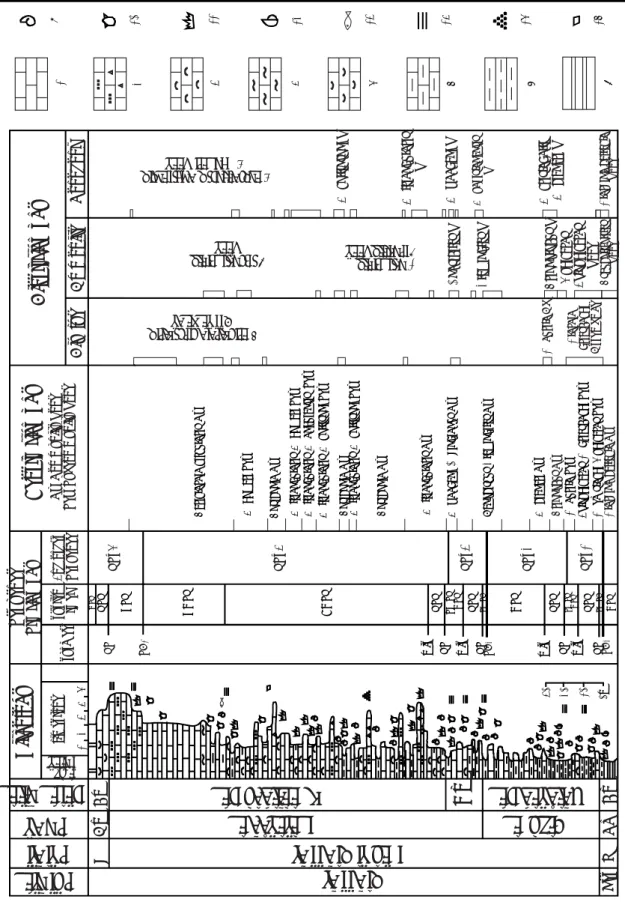
At Black Bear Ridge, the Ludington Formation is overlain by the Pardonet Formation. Gibson and Edwards (1995) drew the base of the Pardonet For-mation between his units 3 and 4 (Fig. 2), where dominantly dolostone beds grade into bioclastic, brachiopod grainstone/packstone layers containing rare ammonoids, halobiids, and the calcite spheres or “pseudo-oolites” that characterize the Pardonet Formation elsewhere on Williston Lake. This study recognizes a transitional zone, approximately 28 meters thick, where clean, silty dolostone is inter-calated with dark grey, carbonaceous limestone (Gibson units 4 and 5, Fig. 2). Prior to revision of Upper Triassic lithostratigraphy, these strata had been incorporated into the Baldonnel Formation, subjacent to the base of the Pardonet Formation (Gibson and Edwards, 1992). Outcrop gamma mea-surements support the transitional nature of this in-terval between the Ludington and Pardonet Forma-tions (Fig. 2). Deposition within this transitional in-terval is also dominated by submarine mass trans-port mechanisms, primarily turbidity currents. Nu-merous sharp-based bioclastic grainstone/packstone beds in this interval likely represent individual cal-careous turbidites. Like those discussed above, bioclastic accumulations in this interval are
thanatocoenoses rather than biocoenoses trans-ported basinward from a variety of settings on the shelf and proximal slope. The monotypic brachio-pod packstone beds that characterize this interval may represent a series of events sourced from bra-chiopod banks on the shelf, similar to those de-scribed from the Middle Triassic (Ladinian) Liard Formation (Zonneveld et al., 1997; Zonneveld, in press).
The Pardonet Formation consists of carbonaceous silty limestone, calcareous and dolomitic siltstone and shale, and densely packed bioclastic grainstone beds composed primarily of whole and unabraded bivalve shells. Limestone concretions are common throughout the Pardonet Formation and often con-tain ammonoids and scattered ichthyosaur bones. The Pardonet Formation is rich in organic carbon-aceous matter and has a strong fetid sulphurous odour. Radioactive uranium bound within this or-ganic material has resulted in the jagged, relatively high, gamma ray profile (Figs. 2, 3).
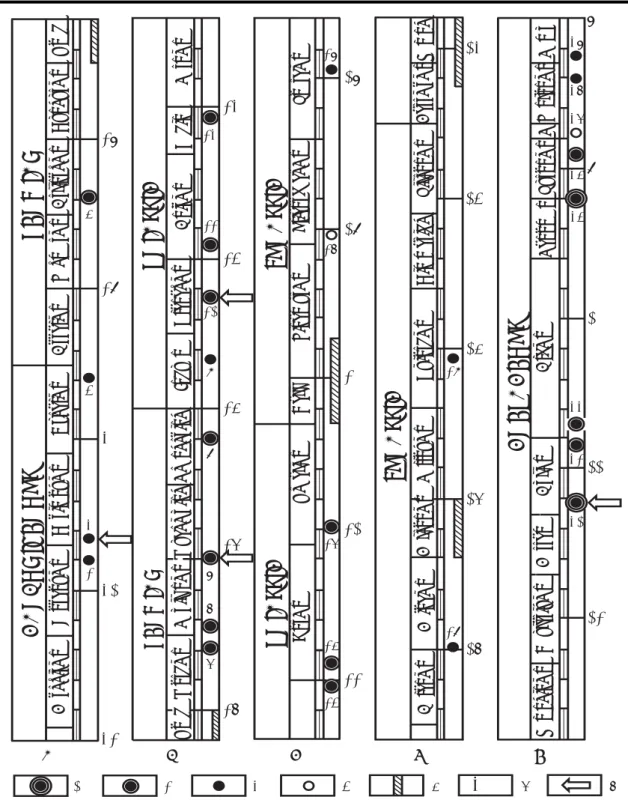
Limestone beds and concretions rich in ammonoids and belemnoids (including Aulacoceras) associated with abundant ichthyosaur bones and horizons rich in pseudo-oolites occur approximately 10-20 m above the ‘Pardonet gash’, a 30 cm thick shale bed characterized by high gamma radiation that occurs near the top of the transitional zone (Fig. 2). These fossil beds are recrystallized and macrofossil ex-traction is difficult. Overlying beds are silty and sparsely fossiliferous. Richly fossiliferous limestone beds do not occur again until just below (east of) a covered beach interval at 162 metres (Fig. 3). West of the beach, stratigraphically higher strata contain many rich fossil horizons yielding excellent
97 97 29 Mackenzie Chetwynd Hudson Hope Dawson Creek Fort St. John Williston Lake Halfway R. S uk unka Peace R. 0 50 km R. Pine Pass
Black Bear
Ridge
Triassic outcrop
ammonoid faunas and a succession of wavy, crenu-lated, bivalve grainstone beds (Fig. 3). Although much of the upper Pardonet is fossiliferous, the best preservation occurs in rare limestone concretions. The distinctive Monotis beds comprise much of the
upper 30 m of the Triassic section. They are ex-tremely rich in organic residue, contain a monotypic assemblage of Monotis subcircularis and are vari-ably dolomitic, calcareous, silty and shaly.
The Pardonet Formation at Black Bear Ridge was
Figure 2: Schematic section of the Upper Carnian-Lower Norian part of the Black Bear Ridge section showing occurrence and distribution of conodonts, ammonoids, ichthyoliths, bivalves, and brachiopods within the Ludington and lower Pardonet formations. The larger dots show the position of abundant specimens of the named taxon. Also shown are units differentiated by Gibson and Edwards (1992). On the left are shown lithostratigraphic and sequence stratigraphic units within the study interval as well as general lithology and outcrop gamma patterns measured with a Scintrex BGS-4 hand-held gamma ray scintillometer. Numbered samples which were taken for conodonts and/or ammonoids, and bivalves (CM) are shown to the right of the lithology column. Ichytholith fauna was recovered from the former. See text for lithological descriptions.
30 40 50 60 80 90 100 110 120 130 70 Ludington Fm. ;; 12 11 10 9 8 7 6 5 4 3 ;; ;; ;; ;; ;; ;; ;; ;; ;; ;; ;; ;; ;; ;; ;; ;; ;; ;; ;; ;; ;; ;; ;; ;; ;; ;; ;; ;; ;; ;; ;; ;; ;; ;; ;; ;; ;; ;; ;; ;; ;; ;; ;; ;; ;; ;; ;; ;; ;; ;; ;; ;; ;; ;; ;; ;; ;; ;; ;; ;; ;; ;; ;; ;; ;; ;; ;; ;; ;; ;; ;; ;; ;; ;; ;; ;; ;; ;; ;; ;; ;; ;; ;; ;; ;; ; ;; ;; ; ;; ;; ; ;; ;; ; ;; ;; ; ;; ;; ; ;; ;; ; ;; ;; ; ;; ;; ; ;; ; ;; ;; ;; ;; ;; ;; ;; ;; ;; ;; ;; ;; ;; ;; ;; ;; ;; ;; ;; ;; ;; T ransitional Beds P ardonet F ormation Metapolygnathus aff . pr imitius Birger ia sp . Actinopter ygian T ype A6 F ragilicorona Glabr isubcorona Halobia or natissima Halobia be yr ichi Halobia cordiller ana Nor igondolella na vicula 0 100 200 Total Gamma
Gibson & Edw
ards metres Lithostratigraph y Sequence Stratigraphy Litholog y Conodonts Ammonoid s Ichthyoliths Biv alv es Zones Samples Conodont Ammonoid
(counts per second)
Epigondolella tr iangular is Epigondolella quadr ata -99BBR5 -99BBR4 -92BBR10 (= 82BBR5) -92BBR9 (= 81-309B) -82BBR3 -92BBR7 -92BBR6 -92BBR4 (= 81-310A) -92BBR3 (= 81-310B) -99BBR1 (= 81-311A) -92BBR2 (= 99BBR0) -82BBR2 -92BBR5 -82BBR1 -92BBR8 -82BBR6 -93PS01 (= 93PS02) -82BBR7 -92BBR11-82BBR8 -99BBR2 -81-307A -99BBR3 ;; ;; ;; ;; ;; (= 81-309A) -99CM4 -99CM3 -99CM2 -99CM1 -99CM5 -99CM6 -99CM7 -99CM8 -99CM9 -82BBR33 (=82BBR4) Mala yites Gonionotites Anatropites ? Ganoid Scale sp . 1 Halobia cf . superba Metapolygnathus comm unisti Metapolygnathus pr imitius Ganoid Scale sp . 2
Metapolygnathus sameli Metapolygnathus pseudoechinatus
Labascicorona alata Synechodus v
olaticus Labascicorona medifle xur a Synechodus m ultinodosus Min uticorona sp . other elasmobr anchs Metapolygnathus z oae Thisbites W eller i Nodosus Macrolobatus Comm unisti U U L K err i Pr imitius Da wsoni Quadr ata Magn us T riangular is Metapolygnathus nodosus -brachiopods -crinoids -ammonoids -bivalves LST TST HST Sequence BB-I LST TST Sequence BB-II Synechodus incrementum (1992) unit s
deposited in a deep water setting, likely on the dis-tal slope or abyssal plain, well offshore of the west Pangaea coastline. Its deposition followed a major transgression and represents the deepest water deposition in the Upper Triassic of western Canada. Lithological and faunal attributes are consistent with
a deep water, restricted anoxic basin environment well below storm wave-base.
Few, if any, of the bioclastic beds in the Pardonet represent in situ communities. Bioclastic material in most of these beds consists of a mix of whole
Figure 3: Schematic section of the Middle-Upper Norian and younger part of the Black Bear Ridge section showing occurrence and distribution of conodonts, ammonoids, ichthyoliths, and bivalves within the upper Pardonet and lowest Fernie formations. Other features as in Figure 2.
16 15 14 17 18 19 20 21 22 ;; ;; ;; ;; ;; ;; ;; ;; ;; ;; ;; ;; ;; ;; ;; ;; ;; ;; ;; ;; ;; ;; ;; ;; ;; ;; ;; ;; ;; ;; ;; ;; ;; ;; ;; ;; ;; ;; ;; ;; ;; ;; ;; ;; ;; ;; ;; ;; ;; ;; ;; ;; ;; ;; ;; ;; ;; ;; ;; ;; ;; ;; ;; ;; ;; ;; ;; ;; ;; ; ; ; ;; ;; ;; ;; ;; ;; ;; ; ; ;; ;; ;; ;; ; ; ;; ;; ;; ; ; ; ;; ;; 0 100 200 Total Gamma 150 160 170 180 190 200 210 220 230 240 Jurassic P ardonet F o rmation F e rnie Fm. metres Lithostratigraph y Sequence Stratigraphy Epigondolella matthe wi Epigondolella m ultidentata Litholog y -81-241A -81-305A -81-240A -81-241B (=93-108A) -81-240B (=93-109A) -82-BBR31 -82-BBR30 -82-BBR29 -82-BBR28 -82-BBR22 (=81-242A) -82-BBR26 -82-BBR25 -82-BBR24 -82-BBR23 (=81-303B) -82-BBR17 -82-BBR21 -82-BBR18 -82-BBR19 -82-BBR20 -82-BBR15 -82-BBR16 (=81-305A) 99-BBR9 99-BBR8 -82-BBR9 -99-BBR6 -99-BBR7 -82-BBR10 -82-BBR10 -82-BBR11 -82-BBR13(=81-305B) -81-306A (=82-BBR12) -81-306B (=82-304C) -82-BBR14 -82-BBR32 (=99-BBR11) -81-302A -93-BF -99 CM13B -99 CM14 -99 CM15 -99 CM16 -99 CM18 -99 CM17 -99-CM19B -99 CM13 -99 CM10 -99 CM12 -99 CM11 (=82-304A) -99-CM19 (=81-302B) (=81-304B) (=81-304A 13 ;; Nor
igondolella steinbergensis Epigondolella poster
a Epigondolella serr ulata Epigondolella bidentata Lissonites
}
Eosteinmannites P a raguembiites Pseudosirenites Birger ia sp . Glabr isubcorona Halobia be yr ichi Halobia cordiller ana Halobia cf . fallax Conodonts Ammonoid s Ichth yolith s Bivalves Epigondolella spiculata Epigondolella sp . indet. F ragilicorona Halobia f allax Eomonotis scutif or mis Otapir ia n. sp . Eomonotis pinensis Monotis subcircular is Zones Rutherf ordi Multidentata / Spiculata Columbian us P oster a Cordiller an us Bidentata Amoen um? Mosher i? Serr ulata Samples Conodont Ammonoid(counts per second)
140 TST HST Sequence BB-II TST TST LST HST HST Sequence BB-III Sequence BB-IV LST Synechodus incrementum III I II IV
Gibson & Edw
ards (1992) unit
s
and fragmentary material which is oriented primarily parallel to bedding. In rare cases, the bioclasts (am-monoids and bivalves alike) exhibit crude imbrica-tion. Many of these beds are sharp based and are ungraded to normally graded. These beds are inter-preted as calcareous turbidites deposited on the distal slope and abyssal plain below the Pangaean continental shelf (Zonneveld and Gingras, 2000). The absence of coarse (sand-sized or larger) clastic material reflects deposition during a period of sedi-ment starvation on the shelf and slope. The origin of the dense Monotis beds is interpreted to result from similar processes. Although the Monotis shells are primarily whole and unabraded, they occur primarily in a convex-up orientation (>80% of valves), impli-cating current processes in the development of these deposits.
Triassic strata in the Western Canada Sedimentary Basin (WCSB) have been subdivided into three “fa-cies assemblages” reflecting large scale cycles in regional sea level; I) Early Triassic (Griesbachian through Spathian), II) Middle Triassic (Anisian through early Carnian) and III) Late Triassic (Carnian through Rhaetian) (Gibson and Barclay, 1989). The study interval comprises the upper portion of the last of these large scale cycles. It comprises an overall aggradational succession of four third-order se-quences (BB-I, BB-II, BB-III, and BB-IV) based on lithologic criteria, outcrop gamma characteristics and correlation with other outcrop sections (Figs. 2 and 3). Fluctuations in sea-level responsible for these sequences and their bounding surfaces were likely driven by both eustatic and regional tectonic influ-ences. Each of the four sequences identified here has been separated into lowstand, transgressive and highstand systems tracts (Figs. 2 and 3). Evidence of subaerial exposure was not noted at any of the sequence boundaries. These surfaces are inter-preted to represent the basal, conformable equiva-lents to subaerial unconformities landward (east) of the study area.
In general, lowstand systems tracts in the study interval consist of aggradational successions of cal-careous turbidites and (in the case of sequence BB-I) by debris flows and slumping. These intervals generally include the coarsest sediment in the study interval and are characterized by relatively clean (low) outcrop gamma patterns (Figs. 2 and 3).
Transgressive systems tracts within the study in-terval are characterized by outcrop gamma profiles that are increasingly spiky upwards (Figs. 2 and 3). These intervals represent periods of relative sedi-ment starvation in the basin. Although bioclastic turbidites do occur, these intervals are dominated primarily by suspension deposition and may be con-sidered to be condensed intervals. Increasing
wa-ter depth in these inwa-tervals is supported by spikes in the quantity of Norigondolella and Birgeria ele-ments (Figs. 2 and 3). Highstand systems tracts in the study interval occur as relative sea-level reached a maximum and sedimentation in the basin gradu-ally began to outpace the increase in accommoda-tion space. These intervals are generally much thin-ner than subjacent transgressive systems tracts. The contact between highstand and overlying lowstand systems tracts are picked where the pro-portion and thickness of coarser bioclastic beds shows a sharp increase.
Embry (1997) identified four globally correlatable sequences and sequence boundaries in the study interval: 1) near Carnian-Norian boundary; 2) mid-Norian boundary; 3) near mid-Norian-Rhaetian boundary; and 4) near Triassic-Jurassic (Rhaetian-Hettangian) boundary. The base of sequence BB-I occurs be-neath the study interval, within the upper Carnian and may be equivalent to the global near Carnian-Norian sequence boundary. Two mid-Carnian-Norian se-quence boundaries (BB-I\BB-II and BB-II\BB-III) are interpreted to occur within the Black Bear Ridge section. Additional work is needed to ascertain which, if either, is correlative to the globally recog-nized sequence boundary.
The upper surface of the top Monotis bed contains small, discontinuous patches of phosphatic gran-ules. This surface has previously been interpreted as an erosional unconformity and interpreted as both the Fernie-Pardonet lithostratigraphic contact and the Triassic-Jurassic contact (Gibson and Edwards, 1992). However, evidence of an erosional unconformity at this boundary is not evident and the presence of conodonts and possible Rhaetian bivalves in dolomitic siltstone beds immediately above this surface demonstrates a Triassic age for some of these strata. The Triassic-Jurassic contact oc-curs somewhere within the dolomitic siltstone inter-val between 233 and 236 meters (Fig. 3), the level of the lowest reported Hettangian ammonoids (see Tozer, 1982). The surface at the top of the abundant
Monotis beds is here interpreted as a transgressive
surface, below wave base and may represent sedi-ment starvation in a deep water setting. The bound-ary between sequence BB-III and sequence BB-IV apparently occurs near the Rhaetian-Norian bound-ary and may be coeval with the global boundbound-ary dis-cussed in Embry (1997). A sequence boundary equivalent to the Triassic-Jurassic boundary has not been observed within the study area.
Gibson and Edwards (1992; 1995) measured a total of about 212 m for the Black Bear Ridge section, with the Pardonet Formation attaining a thickness of about 182 m and the Ludington about 30 m. Cu-mulative thicknesses in Figures 2 and 3 were
com-piled over several visits, most recently May, 2000. The zero datum used here has been chosen a few meters below a large olistolith within the Ludington Formation, 40 meters below the base of the Ludington-Pardonet transitional facies. The total outcrop thickness as presented here is 245 meters (Ludington, 40 meters; transitional zone, 28 meters; Pardonet, 180 meters). Discrepancies between this and earlier studies are the result of shifting beach outcrops between successive visits, inclusion here of lower Jurassic strata into the Pardonet Forma-tion, and the transitional nature of the Ludington-Pardonet lithostratigraphic contact. Reliable datums include the main brachiopod bed near the base of the section (~39 meters), the radioactive ‘gash’ within the lower section (~66 meters, Fig. 2), and the base and top of the Monotis beds in the upper part of the section (~203 and ~232 respectively, Fig 3).
Conodonts (MJO)
Conodont faunas have been collected from through-out the Black Bear Ridge section and provide a rather complete framework for Late Carnian through Late Norian time. The lowest conodont faunas come from the turbiditic shell beds of the ‘transitional facies’. The lowest fauna (Fig. 2, 92BBR-1) contains pre-dominantly unornamented to weakly nodose metapolygnathids assigned to the Metapolygnathus ex gr. nodosus Hayashi. More ornate forms corre-spond to Metapolygnathus samueli Orchard and rarely M. zoae Orchard. This association identifies the Upper Nodosus Zone of Orchard (1991a). Sev-eral samples taken across 1 m of shell beds con-taining brachiopods and rare halobiids and am-monoids reveal a major diversification of the con-odont fauna characterized as the base of the Communisti Zone (Fig. 2, 92BBR-2).
Metapolygnathus communisti Hayashi appears
con-currently with a variety of M. pseudoechinatus Kozur morphotypes, regarded as a proxy for the Communisti Zone in western Canada. Both
Metapolygnathus ex gr. nodosus and M. samueli
occur at this level but amongst the former consider-able variety leads to the recognition of several morphotypes, one of which is here called M. aff.
primitius (Mosher). Unlike the index of the
succeed-ing zone, this distinctly nodose form lacks the con-sistent node differentiation and low posterior plat-form of M. primitius as shown by Orchard (1991a, Pl. 3, F) but the trend toward that species is clear. Above the brachiopod beds (Fig. 2, 92BBR-5, 6, 7), the sharp-noded species disappear, and most col-lections are dominated by Metapolygnathus ex gr.
nodosus through to near the top of the siliceous
fa-cies (lower Unit 5 sensu Gibson). At this level (92BBR-8), a major faunal shift is evident and M.
primitius becomes the dominant metapolygnathid. A little higher (92BBR-9), within the typical concre-tionary facies of the Pardonet Formation,
Norigondolella navicula (Mosher) appears. This
da-tum marks the base of the “Upper” Primitius Zone in the Williston Lake exposures (Orchard, 1983), but the taxon is rare at first and occurs sporadically through the Primitius Zone, as it does elsewhere (Carter and Orchard, 2000; Orchard et al., 2000). Peak abundance of Norigondolella navicula occurs only in higher collections from the Aulacoceras-bear-ing pseudo-oolite beds collections near the top of the Primitius Zone (Fig. 2). Overlying strata is char-acterized by siltier and less fossiliferous beds but single conodont collections nevertheless document the succeeding Lower Norian Quadrata and Trian-gularis zones (99BBR-3, 4).
Richly fossiliferous limestone beds re-appear in the Middle Norian (Fig. 3). The Multidentata Zone is succeeded by the Spiculata, Postera, and Serrulata zones in succession (Orchard, 1991b). The first two imply levels corresponding to the Rutherfordi and Columbianus I ammonoid zones although neither macrofauna is certainly identified at Black Bear Ridge. The Postera Zone, which occurs through 10+ m of section with ammonoids of Columbianus Subzone II, is characterized by abundant specimens of Norigondolella steinbergensis (Mosher), the sec-ond such ‘flood’ of the genus in the Black Bear Ridge section. Conodonts of the Serrulata Zone are asso-ciated with the overlying species of Eomonotis bivalves.
Upper Norian Monotis coquina and associated strata extend through about 30 m of section at Black Bear Ridge (Fig. 3). The Bidentata Zone fauna occurs both with Monotis bivalves and more abundantly in limestone concretions with the ammonoid
Paraguembilites. Variation in the conodont faunas
are noted: abundant Norigondolella steinbergensis occurs in the lower part of the Monotis coquina, but indices of Epigondolella dominate the limier am-monoid beds. The stratigraphically highest con-odonts occur in a small limestone concretion sitting directly above the youngest bedding surface of
Monotis. These are examples of Epigondolella ex
gr. bidentata Mosher, including a few large elements resembling the younger E. mosheri Kozur and Mostler (Orchard, 1994). This species is known overlying Monotis strata at a single locality elsewhere on Williston Lake (Ne Parle Pas Point), that is in the “Rhacophyllites beds” assigned to the Rhaetian Amoenum Zone. The data is sparse but provides an indication of Rhaetian strata.
Well preserved and locally abundant ammonoids occur in the Middle and Upper Norian, and in the overlying Lower Jurassic strata at the Black Bear Ridge section. Ammonoids also occur in Upper Carnian and Lower Norian but they are less com-mon and difficult to separate from the matrix. Many of these ammonoid faunas are reported by Tozer (1994, p. 344-5, indicated below as * ; see also Tozer, 1982). The notable features of the ammonoid suc-cession are the several levels of the Columbianus Subzone II fauna, and the superimposition of two
Eomonotis faunas and two subzones of the Upper
Norian Cordilleranus Zone. The Lower Jurassic (Hettangian) succession is also unique (currently under study by R. Hall, U. of Calgary). Available data are summarized in ascending stratigraphic or-der below with both field numbers (see Fig. 1) and GSC locality numbers indicated. These data en-able the other faunal elements to be calibrated with the standard Triassic ammonoid biochronology. 99-BBR0 = GSC loc. C-304377. Ammonoid indet. 81-310A = GSC loc. 98555. Ammonoids indet. 82-BBR1 = GSC loc. C-101002. Thisbites sp. indet. 92-BBR5 = GSC loc. C-201931. Anatropites sp. indet.
81-309B = GSC loc. 98554. Gonionotites sp. indet. 81-307A = GSC loc. 98553. cf. Malayites dawsoni McLearn. Approximates 82-305B = 98872. 81-306B = *GSC loc. 98552. Pseudosirenites
pardoneti (McLearn), Mesohimavatites columbianus
(McLearn), Distichites canadensis McLearn,
Leiodistichites ursidens Tozer, Helicites decorus
McLearn. Repeated as 82-304C = 98770.
81-306A = *GSC loc. 98551. Pseudosirenites
pardoneti (McLearn), Himavatites multiauritus
McLearn, Distichites canadensis McLearn, Helicites
decorus McLearn, Episculites teres (McLearn).
81-305B = *GSC loc. 98550. Pseudosirenites
pardoneti (McLearn), P. pressus (McLearn), Distichites canadensis McLearn, Leiodistichites ursidens Tozer, Helicites decorus McLearn.
Re-peated as 82-304A = 98868.
81-305A = *GSC loc. 98549. Eosteinmannites
orientalis Tozer, Himavatites appinatus Tozer, Helicites decorus McLearn, Parajuvavites canadensis Tozer. Repeated as 82-303A = 98867.
81-304B = GSC loc. 98548. Eomonotis scutiformis (Teller)
81-304A = GSC loc. 98547. Eomonotis pinensis (Westermann)
81-303B = GSC loc. 98546. Eomonotis pinensis
(Westermann)
81-242A = *GSC loc. 98534. Paraguembilites
ludingtoni Tozer, Monotis sp. Repeated as 82-301A
= 98865.
81-302A = *GSC loc. 98545. Lissonites sp. indet.,
Monotis sp.
81-305A = GSC loc. 98871. Primapsiloceras? sp. 81-240A = GSC loc. 98531. Psiloceras calliphyllum (Neumayr), phylloceratids (Tozer, 1982).
81-240B = GSC loc. 98532; 93-109A = GSC loc. C-209258. Curviceras sp.
81-241B = GSC loc. 98533; 93-108A = GSC loc. C-209257. Caloceras sp.
82-316F = GSC loc. 98894. Schlotheimia sp. 82-316G = GSC loc. 98895. Pseudaetomoceras sp.
In addition to these levels, Tozer collected faunas of both the Juvavites magnus Subzone 2 and Columbianus 3 from talus on the west slope of Black Bear Ridge prior to dam construction and flooding. These are respectively:
64-137D = *GSC loc. 64636. Dimorphotoceras
caurinum (McLearn), D. ursinum Tozer, Juvavites concretus McLearn.
64-138C = *GSC loc. 64638. Paragymnites
symmetricus (Mojsisovics), Steinmannites
sp. indet.
McLearn (1960) also collected several rich examples of the Columbianus Subzone 2 fauna (*GSC locs. 9741, 9744, 9745; see Tozer, 1994, p. 295-6).
Bivalves (CAM)
The continuous sequence of the Pardonet Forma-tion and its transiForma-tional facies at Black Bear Ridge provides documentation of a Halobia and Monotis succession unparalleled throughout the North Ameri-can Cordillera. Biostratigraphic resolution is best in the lower and uppermost parts of the Pardonet Formation in which diagnostic halobiid and monotid species occur. In particular the succession of
Halobia ornatissima Smith overlain by H. beyrichi
(Mojsisovics) indicates the traditional Carnian/Norian stage boundary which, based on Halobia species, lies between beds 99CM-2 and -3 (Fig. 2). Halobia
beyrichi (H. alaskana Smith is considered a junior
synonym) is known to occur throughout the Cordil-leran terranes from Alaska to Nevada. It is well
rep-resented from Vancouver Island and the Queen Char-lotte Islands of British Columbia (Tozer, 1967; Carter et al., 1989; and undescribed GSC collections), southeast Alaska (Muffler, 1967), as well as from the Wallowa Terrane Oregon (McRoberts, 1993), and the Shoshone Mountains of Nevada where it occurs with the ammonoid Stikinoceras kerri (Silberling, 1959; and Silberling and Tozer, 1968, Kristan-Tollmann and Kristan-Tollmann, 1983). In the Tethys realm and the western Pacific regions the place of H.
beyrichi is replaced by H. styriaca (Mojsisovics), a
key zonal fossil of the earliest Norian which is con-spicuously absent from North America (e.g. Gruber, 1976).
In the higher parts of the Pardonet Formation, H.
cordillerana Smith together with H. beyrichi indicates
the probable occurrence of the Dawsoni and Magnus zones. Halobia cordillerana is known from through-out the Cordillera with significant occurrences in Nevada (H. hochstetteri Mojsisovics listed by Kristan-Tollmann and Kristan-Tollmann (1983) from the Luning For-mation is here treated as a synonym for H. cordillerana), California, possibly northeast Oregon, and southern, eastern, and arctic Alaska (see McRoberts, 1997). In British Columbia, this spe-cies was known as Halobia pacalis McLearn, which is now considered a junior synonym.
The bivalve succession in the Middle Norian Columbianus Zone and the Upper Norian Cordilleranus Zone is demonstrated in the succes-sion of Eomonotis and Monotis species. Eomonotis
pinensis (Westermann) is the more common Middle
Norian species (Fig. 3, 99CM-17, -18), but earlier collections made by E.T. Tozer (see above) also in-cluded a lower horizon with E. scutiformis (Teller) (Fig. 3, 81-304B); both species apparently occur within the upper range of Halobia fallax Mojsisovics.
Eomonotis is well known from numerous middle
Norian localities elsewhere in northeastern British Columbia (e.g. Westermann, 1962) as well as in several allochthonous terranes such as the Nixon Fork and Alexander terranes of central and south-ern Alaska (see Silberling et al., 1997). In all of these localities it occurs in the upper part of the Middle Norian Columbianus Zone where is often associated with the ammonoid Himavatites (see for example Tozer, 1979; Silberling et al., 1997). At Black Bear Ridge, the Eomontis pinensis beds are overlain by beds dominated by Upper Norian
Monotis subcircularis Gabb, perhaps one of the most
abundant of monotids in the North American Cordil-lera and eastern Asia (see for example Tozer, 1982; Silberling et al., 1997). The first appearance of
Monotis subcircularis is taken as the base of the
Cordilleranus Zone. Overlying the uppermost Monotis
subcircularis bed occur a probably new and
undescribed species of Otapiria. While several spe-cies of Otapiria are well known from the Norian and Rhaetian of the circum-Pacific (e.g. New Zealand, Japan, and Russia) and Tethys (e.g. Austria) they become increasingly common in Lower Jurassic strata. The specimens recovered from Black Bear Ridge are Rhaetian or Hettangian.
The transitional beds from the Pardonet Formation to the Jurassic Fernie Formation contain abundant specimens belonging to at least two pectinacean genera, Entolium and Agerchlamys. Similar pectinacean specimens occur from approximately the same stratigraphic horizon elsewhere in north-eastern British Columbia (e.g. Ne Parle Pas Point, Pine Pass; Tozer, 1982), where some appear to be Triassic. A complete taxonomic assessment of these “Pecten Beds” awaits further study.
Ichthyoliths (MJJ)
The study of ichthyolith distributions in the Upper Triassic strata of northeastern British Columbia (Johns et al., 1997) suggest that ichthyoliths are longer ranging in deeper water facies (e.g. outer shelf to slope Pardonet Fm.) but far more variable and abundant in the shallower and thicker Baldonnel Formation and its equivalents (Johns et al, 1999, 2000a,b, 2001). The section at Black Bear Ridge provides an excellent opportunity to compare what appear to be more distal ichthyolith assemblages in the sub-Pardonet transitional beds (Fig. 2) to more proximal assemblages to the north and east. Ichthyoliths recovered from the transitional beds between the Ludington and Pardonet formations (Nodosus and Communisti conodont zones) at Black Bear Ridge are abundant and diverse. The lowest level, corresponding to the Upper Nodosus conodont Zone (Fig. 2, 81-311A & 99BBR-1), contains abun-dant actinopterygian (bony fish) teeth and ganoid scales in addition to abundant Labascicorona
mediflexura Johns and a variety of other
elasmo-branch (shark) scales and teeth (Johns et al., 1997). The next ichthyolith-rich and distinct level occurs in the Communisti Zone (Fig. 2, 81-310B, 82BBR-1, 92BBR-2, 3 & 4). It is marked by a peak abun-dance of the elasmobranch tooth Synechodus
multinodosus Johns, Minuticorona scales,
actinopterygian teeth and scales, and other ichthyoliths; this interval represents the type local-ity for the S. multinodosus concurrent-range ichthyolith Zone (Johns et al., 1997). Just above this level (Fig. 2; 92BBR-5) there is a change in the distribution of ichthyoliths. Birgeria sp., Type A6, and ganoid scale sp. 1 are abundant and there are only a few small elasmobranch scales. These beds show a shallower water S. multinodosus
assem-blage followed by a deeper water Birgeria-abundant assemblage.
Sample 82BBR-2 contains an odd diversity and abun-dance of ichthyoliths including: 1) elasmobranch scales commonly observed from shallow water and older rocks in the region that do not occur in the Nodosus and Communisti zones (see Johns et al., 1997, p. 112 and compare to p. 100-107); 2) other actinopterygian and elasmobranch ichthyoliths that are commonly found in the Communisti Zone (Fig. 2); and 3) an absence of diagnostic taxa of the S.
multinodosus ichthyolith Zone (including S. multinodosus, Minuticorona, and Labascicorona alata). Just above this level (Fig. 2; 92BBR-6), no
elasmobranch teeth or scales were recovered and actinopterygian scales and teeth were common to abundant in the sample. The mixing of shallower water ichthyoliths presumably arose from downslope transport in turbidites during the system lowstand and deeper water ichthyoliths (92BBR-6) returned during the transgressive system tract. Above, in sample 92BBR-7, a new ichthyolith assemblage occurs: it includes the last examples of the elasmo-branchs present in older units, and is correlative to the uppermost Baldonnel Formation at other loca-tions.
Ichthyoliths in the Pardonet Formation throughout northeastern British Columbia predominantly con-tain Birgeria. However, in at least three levels at Black Bear Ridge, the Synechodus incrementum assemblage (from shallower water than the Birgeria assemblage) occurs, that is within the Quadrata, Multidentata/Spiculata and Postera conodont zones. In sample 92BBR-8 (Fig. 2), Birgeria and ganoid scale sp. 1 are very abundant. For about 30 addi-tional metres of strata, fish diversity remains low (Fig. 2). Near the top of the Upper Primitius Zone (Fig. 2, 82BBR-8) there is another peak abundance of Birgeria sp. and ganoid scale sp. 1 in addition to a rare occurrence of ganoid scale sp. 2 (Fig. 2). Higher strata in the Pardonet Formation (Fig. 2, 99BBR-3, 82BBR-33) contain the first new elasmo-branchs typical of the Norian (Johns et al., 1997), including Synechodus incrementum Johns, and form species of Fragilicorona, and Glabrisubcorona. The
S. incrementum assemblage repeats in 99-BBR-8,
and in the set of samples 82BBR-10, 82-BBR-12, 81-306A, -306B, -305B, and 82-BBR-14 and 15 (Fig. 3) in the Postera conodont zone. The remaining Upper Norian strata at Black Bear Ridge mainly contain Birgeria ichthyoliths. Some new ichthyoliths were found in the ?Rhaetian (Fig. 3; 93-BF).
Brachiopods (MRS)
Low diversity brachiopod faunas are known from a number of localities on Williston Lake, and the Up-per Carnian fauna at Black Bear Ridge has counter-parts at the nearby Brown Hill and Pardonet Hill. The brachiopods are generally very well preserved in carbonates, often “popping out” of the sediment; only the high level of induration of some of the car-bonate layers prevents their easy removal from ma-trix for study. The Black Bear Ridge brachiopod fauna is concentrated in several layers within a 60 cm bed and is composed of monotypic rhynchonellids referred to Piarorhynchia winnemae (Smith).
Although the brachiopods have yet to be subjected to detailed taxonomic investigation, the species has been interpreted as quite varied morphologically. Other authors have considered that varieties or sub-species may be present. Ager and Westermann (1963) recorded two species, P. winnemae and P.
hamiltonensis, from the Carnian of Caribou Ridge in
the Mount Laurier area of northeastern British Co-lumbia; these are thought to be probable synonyms. Their material was composed of smaller specimens compared with that of Smith (1927), who first re-corded the species from the Hosselkus Limestone of Brock Mountain in Shasta County, California. The material from the rhynchonellid horizons at Williston Lake show both small and larger forms, and some of these resemble other species that Smith identi-fied; it seems likely that these are also synonyms of P. winnemae. There have been no other records of the taxa in North America to date.
Although first described from the Jurassic,
Piarorhynchia is known to range into the Triassic.
The genus has been identified from the latest Trias-sic of southern Europe, and Dagys (1974) recorded the range as Carnian - Rhaetian. Ager and Westermann (1963) regarded the British Columbian occurrences of Piarorhynchia winnemae as Lower Carnian although this was not substantiated. The occurrences at Black Bear Ridge and elsewhere on Williston Lake are high in the Carnian.
Intercalibration and Summary
An integrated bio- and sequence-stratigraphic sum-mary of the Black Bear Ridge section is summa-rized below in point form emphasizing the essential features of the succession.
1. The base of the section occurs within the upper Ludington Formation. A relatively low diversity as-sociation of Upper Nodosus Zone conodonts occurs at the top of the Ludington Formation (Fig. 2). Ichthyoliths are both diverse and abundant and
in-clude the elasmobranch Synechodus multinodosus and a peak abundance of ganoid scale sp. 2.
2. The upper Ludington Formation and the base of the Ludington-Pardonet transitional interval is inter-preted as a lowstand succession characterized by event beds deposited by a variety of submarine mass transport mechanisms including turbidity currents, slumps and debris flows. Monotypic, brachiopod-bearing, bioclastic limestone beds within this suc-cession likely represent faunas transported basinward by turbidity currents.
3. The study interval represents deposition on the slope and abyssal plain west of the Pangaean con-tinental shelf. It has been subdivided into four se-quences (BB-I, BB-II, BB-III and BB-IV, Figs. 2 and 3), bound by the basinward conformable equivalents to subaerial unconformities. Although, with the ex-ception of bioclastic material, the entire succession is fine-grained, sequence boundaries can be identi-fied by an increase in the proportion of sharp-based bioclastic beds (calcareous turbidites). These sur-faces are readily identified on outcrop gamma pro-files by an abrupt decrease in gamma radiation. Transgressive systems tract are characterized by a gradually upward increasing gamma profile and a decrease in the quantity of bioclastic turbidites. Highstand systems tracts are characterized by fine-grained deposits and high gamma radiation.
4. At 43 m, Communisti Zone conodonts appear with rare Macrolobatus Zone ammonoids in bioclastic grainstone beds of Piarorhynchia
winnemae brachiopods. This level marks the peak
abundance of Synechodus multinodosus and
Minuticorona ichthyoliths. Halobia ornatissima
ranges within the upper part of the Communisti Zone, where several changes in ichthyolith fauna are noted.
5. At ~56 m, Primitius Zone conodonts appear above the commonly cherty beds and at the base of the concretionary beds of the Pardonet Formation. As-sociated ichthyoliths are abundant, low diversity actinopterytgian teeth and ganoid scales, with most of the older elasmobranch teeth and scales having disappeared. This interval occurs within the early transgressive systems tract of sequence BB-I. A little higher Halobia beyrichi appears.
6. From ~70 m - ~80 m, there is a peak abundance of Norigondolella navicula within the Primitius Zone. This interval includes rich ammonoid and belemnoid
beds that also contain “pseudo-oolites”. Extremely abundant actinopterygian ichthyoliths occur at 38 m. Dawsoni Zone ammonoids and Halobia cf.
superba are identified within these strata, which are
thought to represent an interval of sediment starva-tion in the basin during maximum transgression.
7. From ~115 m through ~144 m, monotonous, generally unfossiliferous strata bear uncommon lev-els of Lower Norian Quadrata and Triangularis Zone conodonts, and the bivalve Halobia cordillerana. New elasmobranchs - Synechodus incrementum,
Fragilicorona, and Glabrisubcorona - occur within
the Quadrata Zone. Fossiliferous strata become more common in Middle Norian Multidentata and Spiculata zones, which include the last Halobia
beyrichi. This interval occurs within the late lowstand
and early transgressive system tracts of sequence BB-II
8. At ~160 m - ~194 m, diverse ammonoids of Columbianus Subzone 2, Postera Zone conodonts, the bivalves Halobia cordillerana and H. cf. fallax, and abundant ichthyoliths of the Synechodus
incrementum Zone occur in limestone nodules. From
~178 m through the end of the Postera Zone, a peak abundance of Norigondolella steinbergensis is in-terpreted to represent another interval of sediment starvation in the basin during maximum transgres-sion of sequence BB-III.
9. Between ~194 m and ~202 m, a succession of
Eomonotis scutiformis followed by E. pinensis
oc-curs within the range of Halobia fallax. Serrulata Zone conodonts are associated with the lower part of this succession.
10. Above ~203 m, Upper Norian Monotis grainstone/ packstone beds and Bidentata Zone conodonts oc-cur together throughout a succession that includes two ammonoid faunas characterized by
Paraguembilites ludingtoni and Lissonites sp. These
represent the Cordilleranus subzones 1 and 2.
Norigondolella is very common in the lower 5 m of
the Monotis beds, reflecting deposition during con-tinued trasnsgression.
11. Above ~232 m, a very thin Rhaetian succession is tentatively identified on the basis of Otapiria sp. and possible Mosheri Zone conodonts that abruptly overlie Monotis grainstone/ packstone beds. The upper surface of the top Monotis bed is interpreted