HAL Id: hal-03094416
https://hal.archives-ouvertes.fr/hal-03094416
Submitted on 5 Jan 2021HAL is a multi-disciplinary open access archive for the deposit and dissemination of sci-entific research documents, whether they are pub-lished or not. The documents may come from teaching and research institutions in France or abroad, or from public or private research centers.
L’archive ouverte pluridisciplinaire HAL, est destinée au dépôt et à la diffusion de documents scientifiques de niveau recherche, publiés ou non, émanant des établissements d’enseignement et de recherche français ou étrangers, des laboratoires publics ou privés.
Navigation by Honey Bees
Naila Even, Olivier Bertrand, Mathieu Lihoreau
To cite this version:
Naila Even, Olivier Bertrand, Mathieu Lihoreau. Navigation by Honey Bees. Jennifer Vonk; Todd Shackelford. Encyclopedia of Animal Cognition and Behavior, Springer, pp.1 - 9, 2020, 978-3-319-47829-6. �10.1007/978-3-319-47829-6_623-1�. �hal-03094416�
Navigation by honey bees
1 2
Naïla Even1, Olivier Bertrand2, Mathieu Lihoreau3
3 4
1 Institut National Polytechnique, Ecole Nationale Superieure d’Ingénieur en Art
5
Chimique et Technologique (ENSIACET), Toulouse, France 6
2 Neurobiology and Center of Cognitive Interaction Technology (CITEC), Bielefeld
7
University, Bielefeld, Germany 8
3 Research Center on Animal Cognition (CRCA), Center for Integrative Biology (CBI);
9
CNRS, University Paul Sabatier - Toulouse III, France 10
11
Corresponding author: [email protected] 12
13
Definition
14 15
Navigation by honey bees refers to the cognitive and behavioural mechanisms bees 16
of the genus Apis use to move between a location and one or multiple goals. These 17
involve the evaluation and integration of direction and distance cues as well as the 18
learning of specific places. For honey bees, goals can be as diverse as the colony nest, 19
a foraging site, a new potential nesting site, or an open-air mating area. 20
21
Introduction
22 23
The vast majority of the about 20,000 known bee species are central place foragers: 24
adults collect and bring back resources (flower nectar and pollen, water, resins) in a 25
stable nest where they raise their progeny (Michener, 2007). Foraging requires 26
navigation skills to locate resources, travel between them, and return to the nest. Many 27
bees must also navigate at some point in their life to find mating partners, a new 28
suitable nesting site, or even to orient inside their dark nests. 29
About a century of research on insect navigation, starting with pioneering work 30
of the Nobel Prize recipient Karl von Frisch (von Frisch, 1967), shows that these 31
navigation behaviours are sustained by a cognitive “toolkit” (Wehner 2009) involving 32
celestial cues (typically a sun compass), a distance estimator (odometer), a system 33
for integrating both information (path integrator), and the ability to learn visual 34
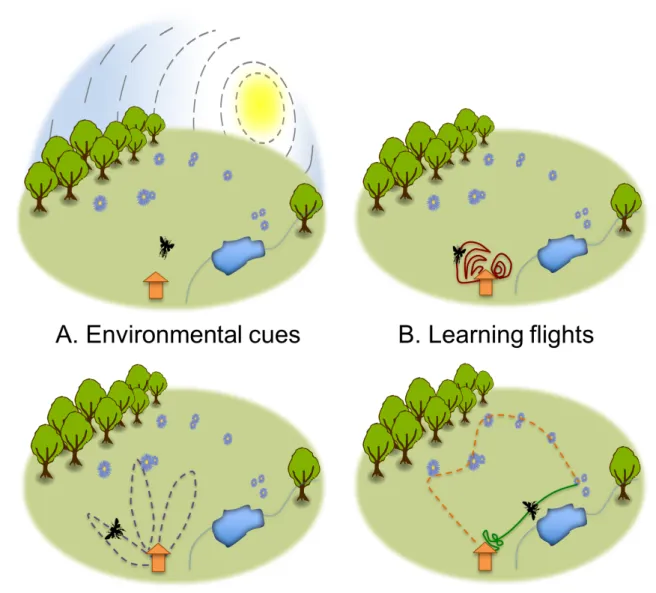
landmarks and specific places (see Figure 1A and Glossary). For bees, these
35
mechanisms sustain the expression of different types of spatial behaviours that change 36
as individuals learn and gain experience with their environment. 37
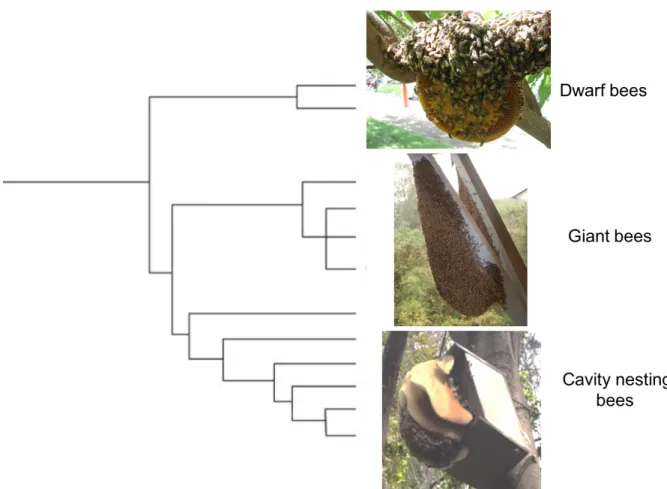
In this chapter we describe these spatial behaviours in honey bees (Figure 2), 38
a group of 11 species and 44 subspecies (Lo et al., 2010) exhibiting some of the most 39
advanced levels of social forms in the animal kingdom characterised by a reproductive 40
division of labour (fertile queens and drones, sterile workers), cooperative breeding 41
and overlapping generations of adults. Navigation skills are required by individuals of 42
the different castes (Seeley, 2012). The foragers collect food, water and resins from 43
plants. The scouts must find new nesting sites. The reproductives must find mating 44
partners for reproduction. And the in-hive workers move between important places in 45
the nest, such as brood cells, honeycombs and the nest entrance. All these tasks 46
require the ability to explore the environment, identify and learn places of interest and 47
sometimes communicate spatial information to nestmates. 48
Here we focus in particular on the Western honey bee (Apis mellifera) as this 49
species has a long history of domestication for honey production and crop pollination 50
and is a model for the study of insect navigation. We discuss the different types of 51
flights exhibited by foragers because they have been best described, especially since 52
the development of automated tracking systems that record bee movements over 53
several hundred meters (e.g. harmonic radar: Riley et al. 1996). However similar 54
behaviours are expected by scout and reproductive bees. In-hive navigation has been 55
less studied and is therefore not discussed. 56
57
Exploration flights
58 59
Western honey bees hatch in a dark nest, visually isolated from the outside 60
environment. After about two weeks, they become foragers, which mean that they 61
collect plant resources, sometimes scattered over several kilometers around the nest, 62
to provision the colony. While foraging, the bee engages in different types of 63
exploration flights during which it acquires visual memories of salient features of its 64
environment, presumably in the form of snapshot memories (Collett et al., 2013), to 65
guide future foraging trips. 66
On its first few excurions outside the colony nest, a bee engages in peculiar 67
flight sequences known as ‘learning flights’ (Figure 1B), during which the bee learns 68
the skyline panorama and visual landmarks associated with its nest location (Zeil, 69
2012). Learning flights are composed of many convoluted manoeuvers, loops, arcs, 70
and zigzags during which the bee faces the nest. During the initial learning flight, the 71
bee slowly increases the radii of the loops and arcs, distancing itself from the colony 72
nest until a point when it returns home without bringing back any resources. On the 73
next few flights, the bee flies a bit further, slowly gaining experience with the outside 74
environment. 75
Once a visual memory of the nest location is acquired, the bee engages in 76
‘orientation flights’ (Figure 1C), this time turning back to the nest. The bee flies along 77
extended loops anchored at the nest location and covering a narrow angular sector in 78
a given direction. Successive orientation flights are longer loops covering other sectors 79
of the environment until every direction has been covered (Capaldi et al., 2000). During 80
this process, the bee orients itself and searches for flower sites. If the bee is caught 81
and released at an unfamiliar location outside the area covered by its previous flights, 82
it engages in an extended search for its nest. By contrast, if the bee is released at a 83
familiar location, it flies straight back home (Degen et al., 2016). Drones (males) have 84
also been shown to be faster to relocate the colony nest after several exploration 85
flights, allowing them to come back home from the drone congregation area if they 86
failed to mate a queen. 87
Exploration flights are not exclusive to first trips outside the nest, but also occur 88
during the foraging process. For instance, once a food resource is found, a forager 89
may exhibit learning flights to learn the visual scene surrounding this new site so that 90
it can more easily return to this site on subsequent foraging trips (Robert et al. 2018). 91
When a resource is depleted, the bee searches for an alternative site through longer 92
flights centered at the familiar depleted location. These exploration flights, composed 93
of straight segments and turns, have Lévy characteristics, meaning that there is a 94
larger proportion of long flight segments than one would expect from a normal 95
distribution (i.e. a Brownian search) (Reynolds, 2008). This type of random search 96
pattern is expected to be optimal to locate patchily distributed food sources, like plants, 97
for animals with little knowledge of their environment. 98
99
Homing flights
100 101
At the end of every foraging trip, a forager must navigate back to its nest to unload its 102
crop and feed the colony. ‘Homing flights’ are composed of two phases : a straight line 103
flight to return to the nest area, and a convoluted flight to pinpoint of the nest entrance 104
(Figure 1D). 105
To return home, the bee uses its estimation of directions and distances of the 106
often turtuous inbound path toward a goal (e.g. feeding site) and integrates both 107
information using a path integrator. In honey bees, directions are primarily estimated 108
through the position of sun in the sky, constituting a sun compass. When the sun is 109
not directly visible (e.g. during cloudy days), this information can be retrieved from the 110
pattern of polarized light. Distances are estimated using an odometer through the 111
quantity of visual information perceived on the retina of the compound eye while flying. 112
It is possible to study this mechanism in bees by making them fly in narrow tunnels 113
with black and white strips of different widths, thereby making them under- or over-114
evaluate their real flight distances (Srinivasan et al., 2012). 115
When the crop (stomach) of the bee is full of nectar or its tarses are packed with 116
pollen grains, its motivation to return home sets a new directional aim: the nest. A 117
straight line return (also called ‘beeline’) is then indicated by the opposite of the 118
integrated vector during the inbound journey. During the homing flight, the bee also 119
integrates the distance and direction travelled, shrinking the integrated vector pointing 120
to the nest. A central part of the bee brain, called the ‘central complex’, receives and 121
integrates inputs of directions and distances from diverse internal senses like eyes, 122
body hair, wing muscles, and other brain parts, and allows all these neural 123
computations (Stone et al. 2017). The integration process is subject to noise 124
accumulation during the journey of the bee. To reduce this error, foragers also refer to 125
visual landmarks learned during previous flights to pinpoint directions and goals
126
(Srinivasan 2011). Anything salient in the environment can be used as visual 127
landmarks, even elongated structures on the ground such as rivers, edges and paths 128
(Menzel et al. 2019). 129
The last bit of the homing flight (also known as ‘view-based homing’) is guided 130
by visual landscape cues. Since the seminal experiment of Niko Tinbergen (another 131
Nobel Prize recipient) showing that digger wasps locate their nest entrance with 132
surrounding visual cues (Tinbergen 1932), bees have been challenged to pinpoint their 133
home in a plethora of scenarios. Objects may be displaced closer to or further away 134
from their nest, displaced to a new location, replaced with smaller or differently 135
coloured one, or even camouflaged (Dittmar et al., 2010). Based on these studies, we 136
know that bees learn relations between a myriad of visual cues and their nest entrance. 137
These relations are not necessarily explicit. Indeed, the use of panoramic skyline 138
snapshots around the nest entrance is sufficient to guide a simulated bee toward its
139
home (Towne et al., 2017). 140
Two navigational routines, path integration and visual guidance, jointly lead a 141
bee home (Hoinville et al., 2018), but the importance of the routines depends on the 142
context, such as the foraging experience of an individual bee. For instance, path 143
integration tends to be preferred over visual landmarks in a novel environment.
144
However when both navigational routines are conflicting, visual landmarks are 145
favoured (Kheradmand and Nieh, 2019). 146
147
Route following
148 149
After several foraging trips, foragers tend to develop routes to efficiently return to 150
known profitable feeding sites. Bees can famously be trained to learn straight line 151
outbound paths between the nest and a feeder providing large amounts of sucrose 152
solution (von Frisch, 1967). However, in many natural conditions, bees may visit 153
hundreds of flowers, sometimes dispersed over several kilometers, to fill their crop with 154
nectar (honey bees have been observed homing after being released 11km from their 155
nest (Pahl et al., 2011)). When this is the case, foragers therefore need to develop 156
more complex circuits between multiple goals, a routing challenge analogous to the 157
well-known Traveling Salesman Problem (TSP) in mathematics. 158
A naive honey bee forager first visits flowers in an unorderly sequence as it 159
discovers them. However with experience, the bee can develop a stable route linking 160
multiple flowers, a behaviour described in many other pollinators (e.g. bumblebees, 161
bats, hummingbirds) and known as trapline foraging (an analogy of the routes used 162
by trappers to check their traps; Figure 1D). This behaviour was discovered by 163
observing individual bees foraging in small arrays of artificial flowers within 100m from 164
the hive (Buatois and Lihoreau, 2016). As long as the artificial flowers were regularly 165
replenished with a sucrose reward, the bees learned to revisit them and adjusted their 166
visitation sequence in order to minimise overall travel distances, ultimately selecting 167
the shortest possible route (i.e. thus solving the TSP). 168
Computational models attempting to decipher the cognitive mechanisms 169
underpinning this navigational feat show that trapline development and optimisation 170
can emerge based on the ability of bees to learn sequences of places using visual 171
memories (Collett et al., 1993) and estimate travel distances with path integration 172
(Srinivasan, 2011). According to these models, at the end of its foraging trip the bee 173
may sum the straight line distances between successively visited flowers and derive 174
the net length of the entire route. By comparing successive routes, the bee could thus 175
increase its probability of re-using the vectors composing the shortest experienced 176
route (Lihoreau et al., 2012). Through trial and error, this simple learning process may 177
enable the development of good (if not optimal) routes in environments with different 178
numbers and spatial configurations of feeding sites (Reynolds et al., 2013). 179
180
Place communication
181 182
Once back in the hive, the honey bee forager can communicate the direction, distance 183
and quality of a discovered feeding site via a sequence of movements known as the 184
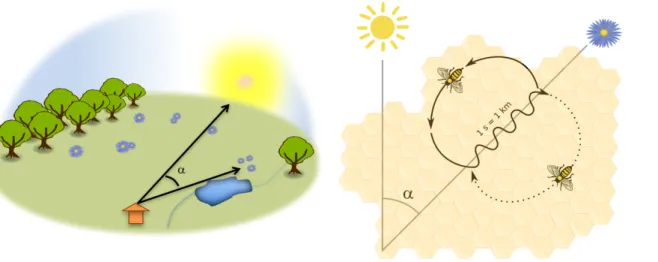
‘waggle dance’ (von Frisch, 1967; Figure 3). Scout bees also use this communication 185
system to indicate the location of a suitable nesting site (e.g. cavity, hive) to reach a 186
consensus about the best available site before swarming (Seeley, 2012). 187
While this ability to recruit nestmates for profitable places was discovered by 188
naturalists long ago (e.g. Aristotle), the symbolic meaning of the dance was finally 189
decoded by Karl von Frisch. In 1919, von Frisch trained bees to forage on feeders 190
containing sucrose solution placed around the hive. He observed that the foragers 191
returning to the hive performed energetic rounds and were occasionally followed by 192
other bees who would then fly to the communicated feeder. von Frisch described two 193
types of behaviours referring them as “dances” depending on the distance of the food 194
source to the hive. For feeders within 90 meters the hive, foragers performed a round 195
movement, where for longer distances they performed a waggled movement following 196
a eight-shaped figure. It is now acccepted that both dances are in fact a single 197
behaviour, whose precision varies with the distance of the food source to the hive 198
(Griffin et al. 2012). 199
During the waggle dance, the forager waggles its abdomen and moves towards 200
the direction of the food relative to the sun. In cavity nesting honey bees, like the 201
Western honey bee, the invisible sun in the dark hive is encoded by the vertical vector 202
facing up (i.e. against gravity). Therefore, the angle between the waggle trajectory and 203
the vertical of the comb represents the angle of the food source and the sun. In open 204
nesting honey bees, however, the dance occurs horizontally on the top of the single 205
frame and the dancing bee faces directly the direction of the food or the future nest. In 206
both open nesting and cavity nesting honey bees, the distance of the food source is 207
communicated via the duration of the waggle movement that correlates with a distance 208
in meters. This correlation and the precision of the duration slightly varies between 209
species and subspecies of honey bees (Beekman et al. 2015). The rewarding value of 210
the resource is communicated by the total duration that the bee performs repeating the 211
eight-shape dance. Dancing for a longer time increases the probability to recruit 212
foragers susceptible to be interested by the navigation instructions for a new resource 213 (Seeley 2012). 214 215 Migration 216 217
Several Apis species from tropical Asia, such as the cavity nesting honey bee (e.g. 218
Apis cerana), the giant honey bee (Apis dorsata) or the dwarf honey bee (Apis florea),
do not remain in a stable nest but can abandon the nest or migrate over long distances 220
to respond to local food shortage (Oldroyd 2009, Figure 2). Giant honey bees, for 221
instance, have been reported to migrate to destinations up to 200 km away, stopping 222
over in bivouac congregations to rest and forage. These bees can even sometimes 223
return to the exact same tree after the migration period. During migration, Asian honey 224
bees use dance communication to orient the swarm departure in the correct direction 225
towards a new nest. In the case of long distance migrations, especially in open nesting 226
giant honey bees, the direction is communicated but the distance is only indicated by 227
a very long waggle signaling (Dyer and Seeley 1994). Sensory mechanisms used to 228
migrate to a new location are similar to those used by honey bee foragers, including 229
the sun compass, the optic flow, and the learning of visual landscape cues. 230
231
Concluding remarks
232 233
Honey bees share with other insects numerous sensory abilities and navigational 234
strategies (see Glossary). Thus, they are key model species to study insect navigation. 235
Understanding how a tiny brain, with about one million neurons, uses computations to 236
navigate efficiently in three dimensions over large spatial scales, finds direct 237
applications in algorithmic and robotics and may help understand how these 238
mechanisms evolved in the more complex brains of vertebrates (Chittka and Niven, 239
2009). Some features described in mammal navigation studies, like the hypothesis of 240
the representation of the global surrounding in a single mental map (i.e. cognitive map), 241
influence debates about mental representations of space in insects (Menzel 2019). 242
Even though no consensus has been yet reached, most studies show that path 243
integration and visual guidance are sufficient to explain the complex spatial behaviour
244
exhibited by honey bees and other insects (Webb 2019). 245
The study of the neural mechanisms underlying navigation in the insect brain 246
may adress this important knowledge gap and clarify whether honey bees use 247
cognitive maps. Deep brain structures start to be linked to navigational functions such 248
as the central complex for path integration and the mushroom bodies for visual 249
memories (Webb and Wystrach, 2016). Exploring brain function in vivo in a flying insect 250
in its natural environment is still out of reach. However, recent advances in virtual 251
reality setups (e.g. Buatois et al., 2018) and onboard neuron-stimulator or recorders 252
(e.g. Sato et al., 2015) increase the possibilities to study navigation under tightly 253
controlled, yet ecologically relevant, conditions while exploring brain function. 254 255 References 256 257
Beekman, M., Makinson, J. C., Couvillon, M. J., Preece, K., Schaerf, T. M. 2015. 258
Honeybee linguistics—a comparative analysis of the waggle dance among 259
species of Apis. Front Ecol Evol 3, 11. 260
Buatois, A., Lihoreau, M., 2016. Evidence of trapline foraging in honeybees. J Exp Biol 261
219, 2426–2429. 262
Buatois, A., Flumian, C., Schultheiss, P., Avarguès-Weber, A., Giurfa, M. 2018. 263
Transfer of visual learning between a virtual and a real environment in honey 264
bees: the role of active vision. Front Behav Neurosci 12,139. 265
Capaldi, E.A., Smith, A.D., Osborne, J.L., Fahrbach, S.E., Farris, S.M., Reynolds, D.R., 266
Edwards, A.S., Martin, A., Robinson, G.E., Poppy, G.M, Riley, J.R. 200. 267
Ontogeny of orientation flight in the honeybee revealed by harmonic radar. 268
Nature 403, 537-540. 269
Chittka, L., Niven, J. 2009. Are bigger brains better ? Curr Biol 19,R995-R1008. 270
Collett, M., Chittka, L., Collett, T.S. 2013. Spatial memory in insect navigation? Curr 271
Biol. 23, R789,R800. 272
Degen, J., Kirbach, A., Reiter, L., Lehmann, K., Norton, P., Storms, M., Koblofsky M, 273
Winter, S., Georgieva, P.B., Nguyen, H., Chamki, H., Meyer, H., Singh, P.K., 274
Manz, G., Greggers, U., Menzel, R. 2016. Honeybees learn landscape features 275
during exploratory orientation flights. Curr Biol. 26, 2800-2804. 276
Dittmar, L., Stürzl, W., Baird, E., Boeddeker, N., Egelhaaf, M. 2010. Goal seeking in 277
honeybees: matching of optic flow snapshots? Journal Exp Biol 213, 2913– 278
2923. 279
Dyer, F. C., Seeley, T. D. 1994. Colony migration in the tropical honey bee Apis dorsata 280
f. (Hymenoptera: Apidae). Insectes Soc 41,129-140. 281
Collett, T.S., Fry, S.N., Wehner, R., 1993. Sequence learning by honeybees. J Comp 282
Physiol A 172, 693–706. 283
Griffin, S. R., Smith, M. L., Seeley, T. D. (2012). Do honeybees use the directional 284
information in round dances to find nearby food sources?. Anim Behav, 83, 285
1319-1324. 286
Kheradmand, B., Nieh, J.C. 2019. The role of landscapes and landmarks in bee 287
navigation: A review. Insects 10, 342. 288
Lihoreau, M., Raine, N.E., Reynolds, A.M., Stelzer, R.J., Lim, K.S., Smith, A.D., 289
Osborne, J.L., Chittka, L. 2012. Radar tracking and motion-sensitive cameras 290
on flowers reveal the development of pollinator multi-destination routes over 291
large spatial scales. PLoS Biol 10, e100139. 292
Lo, N., Gloag, R. S., Anderson, D. L., Oldroyd, B.P. 2010. A molecular phylogeny of 293
the genus Apis suggests that the Giant Honey Bee of the Philippines, A. 294
breviligula Maa, and the Plains Honey Bee of southern India, A. indica Fabricius,
295
are valid species. System Entomol, 35, 226-233. 296
Menzel, R. 2019. The waggle dance as an intended flight: A cognitive 297
perspective. Insects, 10, 424. 298
Menzel, R., Tison, L., Fischer-Nakai, J., Cheeseman, J.F., Sol Balbuena, M., Chen, X., 299
landgraf, T., Petrasch, J., Polster, J., Greggers, U. 2019. Guidance of navigating 300
honeybees by learned elongated ground structures. Front Behav Neurosci 301
12,322. 302
Michener, C.D., 2007. The Bees of the World. The Johns Hopkins University Press, 303
Balitmore, MA. 304
Oldroyd, B. P., Wongsiri, S. 2009. Asian Honey Bees: Biology, Conservation, and 305
Human Interactions. Harvard University Press. 306
Pahl, M., Zhu, H., Tautz, J., Zhang, S. 2011. Large scale homing in honeybees. PloS 307
One 6,e19669. 308
Reynolds, A.M., 2008. Optimal random Lévy-loop searching: New insights into the 309
searching behaviours of central-place foragers. Europhys Lett article 20001. 310
Reynolds, A.M., Lihoreau, M., Chittka, L., 2013. A simple iterative model accurately 311
captures trapline formation by bumblebees across spatial scales and flower 312
arrangements. PLoS Comp Biol 9, e1002938. 313
Riley, J.R., Smith, A.D., Reynolds, D.R., Ewards, A.S, Osborne, J.L., Williams, I.H., 314
Carreck, N.L., Poppy, G.M. 1996. Tracking bees with harmonic radar. Nature 315
379, 29-30. 316
Robert, T., Frasnelli, E., Hempel de Ibarra, N., Collett, T.S. 2008. Variations on a 317
theme : Bumblebee learning flights from the nest and from flowers. J Exp Biol 318
221: jeb172601 319
Sato, H., Vo Doan, T.T., Kolev, S., Huynh, N.A., Zhang, C., Massey. T.L., van Kleef, 320
J., Ikeda, K., Abbeel, P., Maharbiz, M.M. 2015. Deciphering the role of a 321
coleopteran steering muscle via free flight stimulation. Curr Biol 25, 798–803. 322
Seeley, T.D., 2010. Honeybee Democracy. Princeton University Press, Princeton, NJ. 323
Srinivasan, M.V. 2011. Honeybees as a model for the study of visually guided flights, 324
navigation, and biologically inspired robotics. Physiol Rev 91, 413–460. 325
Stone, T., Webb, B., Adden, A., Ben Weddig, N., Honkanen, A., Templin, R., Wcislo, 326
W.T., Scimeca, L., Warrant, E., Heinze, S. An anatomically constrained model 327
for path integration in the bee brain. Curr Biol 27, 3069-3085. 328
Tinbergen, N. 1932.Über die orientierung des bienenwolfes (Philanthus triangulum 329
Fabr.). Z vergl Physiol 16, 305-334. 330
Towne, W. F., Ritrovato, A. E., Esposto, A., Brown, D. F. 2017. Honeybees use the 331
skyline in orientation. J Exp Biol 220, 2476-2485. 332
von Frisch, K., 1967. The Dance Language and Orientation of Bees. Harvard 333
University Press, Cambridge, MA. 334
Webb, B. 2019. The internal maps of insects. J Exp Biol 222: jeb188094 335
Webb, B., Wystrach, A. 2016. Neural mechanisms of insect navigation. Curr Opin 336
Insect Sci 15,27-39. 337
Wehner, R., 2009. The architecture of the desert ant’s navigational toolkit. Myrmec 338
News. 12, 85–96. 339
Zeil, J. 2012. Visual homing: An insect perspective. Curr Opin Neurobiol 22, 285–293. 340
341 342
Glossary: The honey bee navigation ‘toolkit’. Concepts defined below are
343
highlighted in bold in the main text. 344
345
Central place foraging: Foraging behaviour consisting in collecting resources in the 346
environment and carrying them back home. In the case of honey bees, foragers make 347
back and forth trips between resource sites (food, water, resin) and their nest to feed 348
the colony. 349
350
Odometer: Mechanism enabling animals to estimate travel distances. In honey bees, 351
distance estimation is mediated by the apparent motion of surrounding objects on the 352
retina of the compound eye, also called ‘optic flow’. 353
354
Panorama: Piece of visual information corresponding to a global visual cue, such as a 355
landscape or a skyline. A panorama can also correspond to a combination of several 356
visual landmarks (e.g. trees, buildings, rivers). Honey bees use panoramas for learning 357
places such the location of their colony nest or a profitable food site. 358
359
Path integration: Method used by an animal for knowing its current position from a 360
reference point, also known as ‘dead reckoning’. Honey bees integrate odometry cues 361
(distances) and sun compass (directions) to compute the vector pointing to a reference 362
point (e.g. the nest) from their current position. This computation allows a honey bee 363
to come back to the nest in a straight line. 364
365
Polarized light patterns: Rayleigh scattering creates patterns of polarized sunlight 366
which are distributed in the sphere of the sky following concentric circles with the sun 367
as a center (see Figure 1A). With photorecepteurs located in the dorsal area of their 368
compound eyes, honey bees can detect direct sunlight as being the unpolarised area 369
of the sky and can sense that polarisation increases when the e-Vectors (electric 370
vectors of light) are further away from the sun along the concentric circles. 371
372
Snapshot: Learning of a 2D image at one point in time. For a honey bee, the 373
memorised view corresponds to a specific orientation of the bee relative to the image, 374
similarly to a camera objective taking a snapshot from a specific angle. 375
376
Sun compass: Utilisation of the sun’s position in the sky as a directional guide. For 377
honey bees, the position of the sun can be perceived directly (when the sun is visible) 378
or indirectly through the pattern polarized light (when the sun is not visible). To orient 379
when the sun is visible, bees can use the light intensity (higher closer to the sun) and 380
the chromatic gradients (toward green in solar region to UV in the antisolar region). 381
382
Trapline: Repeatable sequence of flower visits, staring and ending at the nest. With 383
experience, honey bee foragers tend to develop traplines minimising overall travel 384
distances between familiar feeding sites. These routes are based on individual 385
experience. 386
Visual landmark: Salient feature in the visual scene. Honey bees can use many types 388
of landmarks sapnning from 3D trees or buildings to 2D elongated patterns on the 389
ground (e.g. paths, edges, rivers, roads). 390
391 392 393
Figures
394 395
396 397
Figure 1. A. Environmental cues used by honey bees to navigate. Bees use the
398
position of the sun in the sky (or polarized light dashed lines under cloudy conditions, 399
dashed lines) as compass. They learn visual landmarks (e.g. trees, rivers, paths) and 400
views of broader visual cues like panoramas and skyline (i.e. snaphots). When closer 401
to the goal, bees use local available information to pinpoint the goal (e.g. shape, colour, 402
odours). B-D. Hypothetical examples of flight sequences performed by a forager as it 403
gains experience. B. Learning flights: during its first excursions outside the hive the 404
bee learns the visual scene caracterising the nest entrance using concentric circles 405
increasing in size (red plain lines). C. Orientation flights : after a few trips, the bee starts 406
exhibiting sequential exploration of sectors around the nest (orange dashed line) to 407
find flower patches. D. Route following and homing: once experienced, the bee follows 408
a multi-destination route (trapline) learnt from previous foraging trips (dashed orange 409
line). The bee returns home following a home vector computed throug path integration 410
(inbound in green). At the end of this homing flight the bee corrects eventual path 411
integration errors through small search loops to precisely locate the nest entrance. 412
413 414
415
416 417
Figure 2. Honey bees contain 11 species. Dwarf open nesting honey bees like Apis
418
florea are the most basal group and live mostly in Asia and Middle East. The open
419
nesting giant honey bees like Apis dorsata are found only in Asia. The most recently 420
derived group are the cavity nesting honey bees represented by six species: five of 421
which are distributed in Asia. Apis mellifera has a natural distribution in Africa, Europe 422
and the Middle East, but has been domesticated and distributed throughout the 423
world. It is now found in the wild on all continents except Antarctica. Photo 424
credits: Dwarf and cavity bees from Naïla Even, giant bees from Benjamin Oldroyd. 425 426 427 428 429 430 431 432 433 434 435 436 437 438
439
Figure 3. The waggle dance. Upon returning to the colony nest following a successful
440
foraging trip, a honey bee forager can communicate the location of the discovered food 441
site to its nestmates by performing a waggle dance. The bee communicates the 442
direction of the resource by waggling in the direction of the resource relative to its angle 443
with the sun ( ). The duration of the waggling movement is proportional to the distance 444
of the food. The bee repeats the waggling movement coming back from the left and 445
then from the right drawing the figure height. The more the dance is repeated the higher 446
the quality of the resource. Any bee following the dance can thus integrate the 447
information and leave the hive using the instruction from the dance. The waggle dance 448
is also performed by scout honey bees to communicate the location of new nest site 449
before swarming. Modified from Emmanuel Boutet (CC BY-SA 2.5). 450
451 452
Crosslink references (highlighted in yellow in the main text)
453 454 • Foraging by Honeybees 455 • View-Based Homing 456
• Central Place Foraging 457 • Insect Navigation 458 • Travel Salesman 459 • Cognitive Map 460 • Dead reckoning 461 462 463 464