Clean data with dirty surfaces in electrokinetics
The MIT Faculty has made this article openly available.
Please share
how this access benefits you. Your story matters.
Citation
Bazant, Martin Z. "Clean data with dirty surfaces in electrokinetics."
Physics 3, 18 (2010. c 2010 American Physical Society
As Published
http://dx.doi.org/10.1103/Physics.3.18
Publisher
American Physical Society
Version
Final published version
Citable link
http://hdl.handle.net/1721.1/63132
Terms of Use
Article is made available in accordance with the publisher's
policy and may be subject to US copyright law. Please refer to the
publisher's site for terms of use.
Physics 3, 18 (2010)
Viewpoint
Clean data with dirty surfaces in electrokinetics
Martin Z. Bazant
Departments of Chemical Engineering and Mathematics, Massachusetts Institute of Technology, Cambridge, Massachusetts 02139, USA
Published February 22, 2010
Experiments now quantitatively confirm the standard model of electrokinetics, in which electric fields drive the flow of electrolytes, potentially leading to better sensors and biomedical diagnostic devices.
Subject Areas:Fluid Dynamics, Chemical Physics, Interdisciplinary Physics
A Viewpoint on:
Induced Charge Electro-osmosis over Controllably Contaminated Electrodes
Andrew J. Pascall and Todd M. Squires
Phys. Rev. Lett. 104, 088301 (2010) – Published February 22, 2010
The field of electrokinetics, or electrically driven mo-tion of particles and fluids, recently celebrated its 200th birthday [1, 2] and yet it remains a frontier of theoreti-cal physics. Stringent tests of the standard model used by workers in this field are now possible in microflu-idic devices using alternating-current [3] or induced-charge electro-osmotic (ICEO) flows [4]. Unlike clas-sical electro-osmosis, where the electric field acts on ions in the double layer screening a surface of fixed charge, ICEO flows involve electrically induced, rather than chemically derived, diffuse charge near polarizable (e.g., metal) surfaces, and this enables more direct tests of the theory. In most experiments, however, the model tends to under-predict observed velocities, sometimes by orders of magnitude [5]. Remarkably, the first quan-titative agreement between theory and experiment, now reported in Physical Review Letters[6] by Andrew Pascall and Todd Squires at the University of California, Santa Barbara, involves the use of dirty metal surfaces, “con-trollably contaminated” by thin oxide films (Fig 1). Be-sides its fundamental significance, this work suggests that surface treatment may be the key to developing ro-bust ICEO-based microfluidic devices.
Classical “fixed-charge” electrokinetic phenomena are linear in the applied voltage, since the electric field acts on pre-existing equilibrium double-layer charge to drive fluid flow. As such, Pascall and Squires de-scribe the classical theory (developed by Helmholtz and Smoluchowski) as “interpretative” but not “predictive,” since the surface charge (or zeta potential) is a fitting pa-rameter. In contrast, ICEO flows result from electrostat-ically induced charge, set by the applied voltage, and in the standard model for an ideally polarizable surface (at constant potential without passing current), there are no adjustable parameters, except for a parasitic surface capacitance, to represent a solvation (Stern) layer or di-electric coating. This model has predicted many new phenomena, such as flows around metallic particles [7],
FIG. 1: (a) The experimental setup, with a 50-micron-wide pla-nar gold strip, coated with a silicon oxide film, on the floor of a elastomeric (polydimethylsiloxane-PDMS) microchannel, along which an alternating electric field is applied. (b) Simu-lation of the two rolls of induced-charge electro-osmotic flow generated above the gold strip, whose velocity along the sur-face is measured by image correlations observed with particle-image velocimetry (PIV). (Adapted from Ref. [6].) (Carin Cain)
mixing by metallic posts [8], transverse electrophoresis of metal/dielectric Janus particles [9], and pumping by microelectrode arrays [10], but it lacks quantitative ac-curacy and fails to predict some features, such as flow reversal and solution dependence [5].
Pascall and Squires developed a new experimental platform to study ICEO flows with unprecedented con-trol [Fig. 1, panel (a)]. Their setup is similar to that of Levitan et al.[11], who reconstructed the ICEO flow around a platinum cylinder by particle-image velocime-try, but with two crucial innovations: (i) They used a
DOI: 10.1103/Physics.3.18
URL: http://link.aps.org/doi/10.1103/Physics.3.18
c
Physics 3, 18 (2010)
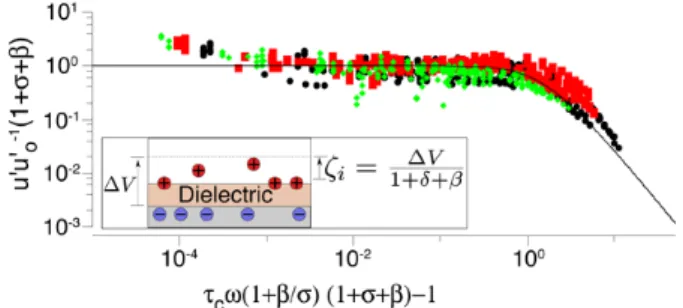
FIG. 2: Plot of flow velocity scaled to account for surface chem-istry and capacitance versus the normalized field frequency. The graph shows collapsed data for 987 different conditions of voltage, frequency, salt concentration, and oxide film thick-ness, using the theoretically predicted scalings and only one adjustable parameter (the “buffer capacitance” for ion adsorp-tion on the surface). (Adapted from Ref. [6], which contains definitions of the parameters and variables shown.) (Carin Cain)
flat gold stripe on the floor of the channel, which has a much simpler, linear velocity profile in the microscope focal plane [Fig. 1, panel (b), and Video 1], and (ii) they coated the metal with evaporated silica films of precisely controlled thickness. The latter resulted in a known film capacitance in series with the double-layer capac-itance, which allowed reasonable prediction of 987 dif-ferent conditions of film thickness, voltage, frequency, and (dilute) NaCl or KCl concentration. An even better collapse of the data (Fig. 2) resulted from also fitting a parallel “buffer capacitance,” representing the dissocia-tion of protons from silanol groups on the silica surface. The collapse of such a wide range of data with only two parameters, each of which can be estimated sepa-rately, convincingly establishes the validity of the stan-dard model, at least for small diffuse-layer voltages. These results also show that more attention must be paid to electrochemical boundary conditions. The buffer capacitance is usually neglected, and a recent theoretical study has also demonstrated the importance of account-ing for the surface adsorption of ions [12].
For both fundamental and practical reasons, the next steps should be to reduce the film thickness and explore other interfacial chemistries, which enable faster flows, by reducing the voltage drop across the surface coating. The observed flows are hundreds of times slower than the state of the art in ac electro-osmotic pumping by bare gold microelectrodes [13]. Such devices transmit much larger voltages (100 times the thermal voltage, 25mV) to the double layer, which may lead to ion crowding and other electrochemical processes, not described by the standard model [5]. These effects may be responsible for the practical limitation of ICEO flows to dilute
solu-tions (<10 mM of simple salts in water), which does not seem to be overcome by the silica coating. Arguably, the ”holy grail” would be a surface treatment that allows
VIDEO 1: Fluid flow in an induced current electro-osmosis experiment with a 50-micron-wide electrode covered with a 33 nm silica coating. An ac electric field (150 V/cm, 500 Hz) is applied horizontally in a solution of 10 micromolar NaCl. (Movie by A. Pascall and T. Squires, University of California, Santa Barbara.) Video available at: http://physics.aps.org/ articles/v3/18#video.
robust, fast ICEO flows in 1 M physiological solutions, since this could enable portable or implantable biomed-ical lab-on-a-chip devices. What the field needs now is equally clean data for less dirty surfaces.
References
[1] F. F. Reuss, Memoires de la Societe Imperiale des Naturalistes de Moscou 2, 327 (1809).
[2] J. Lyklema, Colloids Surf. A 222, 5 (2003).
[3] A. Ramos, H. Morgan, N. G. Green, and A. Castellanos, J. Colloid Interface Sci. 217, 420 (1999).
[4] M. Z. Bazant and T. M. Squires, Phys. Rev. Lett. 92, 066101 (2004). [5] M. Z. Bazant, M. S. Kilic, B. Storey, and A. Ajdari, Adv. Colloid
Interface Sci. 152, 48 (2009).
[6] A. J. Pascall and T. M. Squires, Phys. Rev. Lett. 104, 088301 (2010). [7] V. A. Murtsovkin, Colloid J. 58, 341 (1996).
[8] C. K. Harnett, J. Templeton, K. A. Dunphy-Guzman, Y. M. Senousya, and M. P. Kanou, Lab Chip 8, 565 (2008).
[9] S. Gangwal, O. J. Cayre, M. Z. Bazant, and O. D. Velev, Phys. Rev. Lett. 100, 058302 (2008).
[10] V. Studer, A. Pépin, Y. Chen, and A. Ajdari, Analyst 129, 944 (2004).
[11] J. A. Levitan, S. Devasenathipathy, V. Studer, Y. Ben, T. Thorsen, T. M. Squires, and M. Z. Bazant, Colloids Surf. A 267, 122 (2005). [12] Y. K. Suh and S. Kang, Phys. Rev. E 79, 046309 (2009).
[13] C. C. Huang, M. Z. Bazant, and T. Thorsen, Lab Chip 10, 80 (2010).
DOI: 10.1103/Physics.3.18
URL: http://link.aps.org/doi/10.1103/Physics.3.18
c
Physics 3, 18 (2010)
About the Author
Martin Z. Bazant
Martin Z. Bazant is an Associate Professor of Chemical Engineering and Applied Mathe-matics at the Massachusetts Institute of Technology. After completing a Ph.D. in condensed matter physics at Harvard University in 1997, he joined the MIT faculty in applied math-ematics in 1998 and in chemical engineering in 2008. He has held the Paris Sciences Chair and Joliot Chair at Ecole Supérieure de Physique et Chimie Industrielles, he received an Early Career Award from the Department of Energy in 2002, and was among the “Bril-liant Ten” scientists selected by Popular Science Magazine in 2007. His research focuses on electrokinetics, microfluidics, and electrochemical systems.
DOI: 10.1103/Physics.3.18
URL: http://link.aps.org/doi/10.1103/Physics.3.18
c