HAL Id: hal-02419691
https://hal.archives-ouvertes.fr/hal-02419691
Submitted on 19 Dec 2019
HAL is a multi-disciplinary open access
archive for the deposit and dissemination of
sci-entific research documents, whether they are
pub-lished or not. The documents may come from
teaching and research institutions in France or
abroad, or from public or private research centers.
L’archive ouverte pluridisciplinaire HAL, est
destinée au dépôt et à la diffusion de documents
scientifiques de niveau recherche, publiés ou non,
émanant des établissements d’enseignement et de
recherche français ou étrangers, des laboratoires
publics ou privés.
using integral experiments. application to jeff3 library.
A. Santamarina, D. Bernard
To cite this version:
A. Santamarina, D. Bernard. Re-estimation of nuclear data and reliable covariances using integral
experiments. application to jeff3 library.. MandC2017 - International Conference on Mathematics and
Computational Methods Applied to Nuclear Science and Engineering, Apr 2017, Jeju, Corée du Sud.
�hal-02419691�
Re-Estimation of Nuclear Data and Reliable Covariances using Integral Experiments. Application to JEFF3 Library
A. Santamarina, D. Bernard
Commissariat à l’Energie Atomique et aux Energies Alternatives CEA, DEN, DER, SPRC, Cadarache
F-13108 Saint-Paul-Lez-Durance, France. [email protected]
Abstract - Differential measurements of Nuclear Data (ND) are not enough accurate to meet the
target-accuracy required by reactor design calculation. Therefore, integral experiments are needed to improve nuclear data files and to derive reliable covariance matrices. This paper describes the ND re-estimation process based on targeted experiments. The uncoupling between capture, fission and multiplicity data is obtained through French Post-irradiation experiments and critical regular LWR cores in EOLE. JEFF3.1.1 improvement trends as well as associated covariances are summarized for the main actinides.
I. INTRODUCTION
Differential measurements of Nuclear Data (ND) are not enough accurate in order to meet the target-accuracy required by reactor design calculation [1]. Moreover, the uncertainties associated with the various ND evaluations are inconsistent. Therefore, integral experiments are needed to improve nuclear data files and to derive reliable covariance matrices.
Experimental validation of international ND files is generally based on critical Keff measurements [2], using
mainly the International Handbook of Benchmark Experiments ICSBEP [3]. Although it is satisfactory for Criticality-Safety calculation codes [4], this validation is insufficient for Reactor Physics; indeed, nuclear data of minor actinides (238-241-242Pu, 237Np, 241-243Am, 244-245Cm) have to be validated, particularly for fuel depletion and cycle length calculations [5]. Thus, spent fuel chemical assays also have to be considered in the validation process.
The international library JEFF3.1.1 [6] is currently used in France both in the safety-criticality package CRISTAL [7] and in the EDF [8] and AREVA [9] LWR calculation packages. Therefore, it is essential to validate the main evaluations of this library and to determine the associated realistic uncertainties.
In order to improve the JEFF3.1.1 library and to obtain reliable covariance matrices, targeted experiments are required. Critical experiments such as ICSBEP benchmarks are useful; however the rigorous uncoupling between capture, fission and multiplicity data can be met only through the addition of Post-irradiation experiments (PIE).
From the French experimental database including critical LWR cores and PWR spent fuel chemical analyses, using the ND re-estimation method, this study provides the ND improvement trends as well as the JEFF3.1.1 covariance matrices for the main nuclides.
II. THE INTEGRAL EXPERIMENTAL DATABASE
The selected Keff and Buckling measurements in
Low-Enriched UO2 lattice experiments cover a wide range of
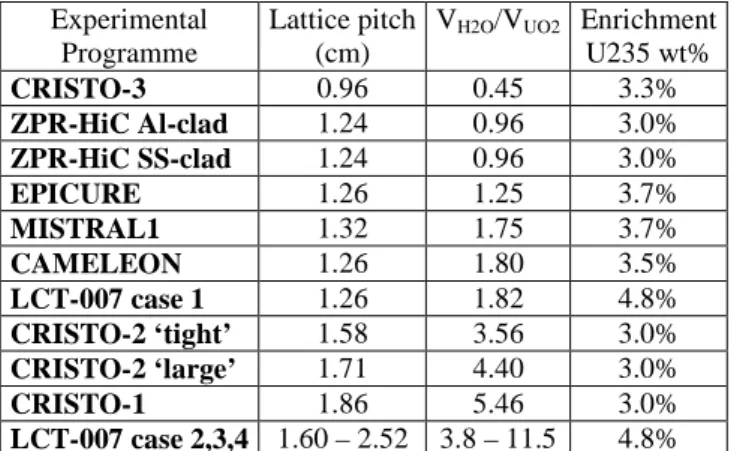
moderation ratios. Most of them are LWR-type and have been carried out in the EOLE zero-power reactor at CEA-Cadarache. They are completed by the ZPR-HiC under-moderated experiment, and the LCT-007 experiments carried out at CEA-Valduc, from the ICSBEP handbook. The main characteristics of these LWR-UOX type cores are summarized in Table I, from the harder spectrum (CRISTO3 tight lattice) to well thermalized spectrum(LCT-007case4). Concerning the reactivity of MOX lattices, the EPICURE-MH1.2 core in EOLE was used (MOX 7%Pu fuel pins in 1.26 cm pitch lattice).
Table I. Keff measurements in LWR regular lattices included
in the ND re-estimation Experimental
Programme
Lattice pitch (cm)
VH2O/VUO2 Enrichment
U235 wt% CRISTO-3 0.96 0.45 3.3% ZPR-HiC Al-clad 1.24 0.96 3.0% ZPR-HiC SS-clad 1.24 0.96 3.0% EPICURE 1.26 1.25 3.7% MISTRAL1 1.32 1.75 3.7% CAMELEON 1.26 1.80 3.5% LCT-007 case 1 1.26 1.82 4.8% CRISTO-2 ‘tight’ 1.58 3.56 3.0% CRISTO-2 ‘large’ 1.71 4.40 3.0% CRISTO-1 1.86 5.46 3.0% LCT-007 case 2,3,4 1.60 – 2.52 3.8 – 11.5 4.8% To uncouple Capture / Fission / Multiplicity, and derive reliable trends on nuclear data, we used isotopic ratios measured in French PWR spent fuels. These PIE experiments on fuel rod cuts consist of measuring the relative concentration of nuclides after irradiation. The samples to be analyzed are extracted from the assembly at each end of cycle. After cooling and transportation, samples are dissolved in a hot acid solution and analyzed mainly by
mass spectrometry. These measurements provide isotopic ratios Ni / NU238 of the isotope i for several burn-up values (the calculated integrated fission rate is normalized to the measured NNdj/NU8 neodymium indicators).
Measured actinides are : U234,235,236, Np237, Pu238,239,240,241,242, Am241,242m,243, Cm243,244,245,246. Each experimental value can be considered as an individual integral measurement : more than 400 C/E values from UOX, Enriched Reprocessed Uranium URE and MOX assemblies have been used. Burnup of UOX fuels ranges from 12 up to 85 GWd/t, with the ALIX fuels analyzed after 5, 6 and 7 irradiation cycles [10]. Table 2 summarizes the P.I.E measurements included in the ND re-estimation. Table II. Spent Fuel measurements used in the ND re-estimation Fuel UOX PWR name U enricht U235 wt % Number of samples Burnup range (GWd/t) Bugey-3 Cruas-4 URE Gravelines-2 Gravelines-3 Grav-5 ALIX 3.10% 3.56% 4.50% 4.50% 4.50% 7 6 4 4 4 20 – 39 12 – 36 26 – 60 50 – 61 64 – 85 Fuel MOX PWR name Pu enricht Pu wt % Number of samples Burnup (GWd/t) Dampierre-2 Tricastin-1 5.3% 6.7% 9.8% 2 2 2 52 ; 60 53 ; 58 43 ; 56
III. CALCULATION METHODS AND C/E RESULTS
To avoid calculation biases linked to deterministic calculations, Keff values of LWR experimental benchmarks
were computed by 3D continuous-energy TRIPOLI4 Monte-Carlo code [11]. An example of TRIPOLI4 geometry is shown in Figure 1 for the Valduc experiment.
Fig. 1. TRIPOLI4 axial cut-off of the LCT-007 core n°4.
Calculation-Experiment comparison, based on JEFF3.1.1 library, is presented in Table III versus the slowing-down density (neutron fraction slowed below thermal cut-off E=4eV).
Table III. C/E bias in LWR UO2 lattices
Experimental Programme Slowing-down Q∞ C-E [pcm] Exp Unc. 1σ [pcm] CRISTO-3 0.37 +520 700 ZPR-HiC Al-clad 0.47 -420 500 ZPR-HiC SS-clad 0.49 + 98 500 EPICURE 0.51 +330 280 MISTRAL1 0.53 +220 220 CAMELEON 0.57 +290 300 LCT-007 case 1 0.59 -210 140 CRISTO-2 ‘tight’ 0.75 -200 400 LCT-007 case 2 0.78 -100 100 CRISTO-2 ‘large’ 0.80 - 80 400 CRISTO-1 0.89 -110 400 LCT-007 case 3 0.92 -250 100 LCT-007 case 4 0.95 -300 100 Isotopic ratios calculations were performed with the deterministic transport code APOLLO2.8 [12] and its CEAv5 library also based on JEFF3.1.1. The SHEM 281-group [13] structure is used, that accounts for detailed description of the first main resonances and avoid self-shielding formalism approximations. 281-group assembly calculations are performed in the exact-2D geometry using the Method Of Characteristics (Figure 2). The validation of this SHEM-MOC scheme was carried out against TRIPOLI4 on extensive PWR numerical benchmarks, which demonstrated that APOLLO2.8 calculations are within 0.3% accuracy for the flux in any fuel pin.
PIE depletion calculations, as well as Keff predictions,
are involved in the experimental validation of PWR parameters; therefore the C/E values are reported in the Validation Report of APOLLO2.8 [14].
IV. THE RE-ESTIMATION PROCESS
We developed the RDN code (Nuclear Data Re-estimation) based on a non-linear regression method.
q integral measurements are described by the random vector Yi (i=1,…q) of experimental values. Y=n+єY, with n
a vector containing the "true" integral and єY a random
vector normally distributed, representing the experimental errors. The covariance matrix ΣY is associated to єY.
The p microscopic data mj (j=1,…p) are the unknown
parameters of the problem, described by X=m+ єX, where
the random vector єX is also centered, normally distributed
and associated to ND covariance matrix ΣX.
The formal relationship between n and m is: n = f(m). The f function relates integral values to the microscopic nuclear data (Boltzmann and Bateman equations).
The mathematical expression can be written as :
Z = η(m) + є (1) with: X Z Y = ( ) ( ) m m n f m η = = X Y ε ε ε = (2)
This problem is viewed in the RDN method as a non-linear regression problem with known covariance matrix.
In order to maximize the Likelihood function, the Gauss-Newton method is used for the minimization of the non-linear square sum. The iterative technique needs a good
m0 initial estimation for parameter m. Each iteration consists
in replacing the η function by the approximate formula near the mk current estimated value:
) )( ( ) ( ) (m =η mk +Dη mk m−mk η (3)
Dη(mk) is the Jacobian matrix, also called “generalized
sensitivity matrix”.
At every step k, the new estimation mk+1 is given by:
{
( ) 1 ( )}
1 ( ) 1( ( )) 1 k t k k t k k k m D m D m D m Z m m+ = + η Σ− η − η Σ− −η (4)and the posterior covariance matrix of the re-estimated m is:
{
1 1}
1 ˆ ( ) ( ) − − − + Σ Σ = Σ Y k t k X m Df m Df m (5)V. SENSITIVITIES AND PRIOR COVARIANCES
Keff sensitivity profiles to cross sections / multiplicities
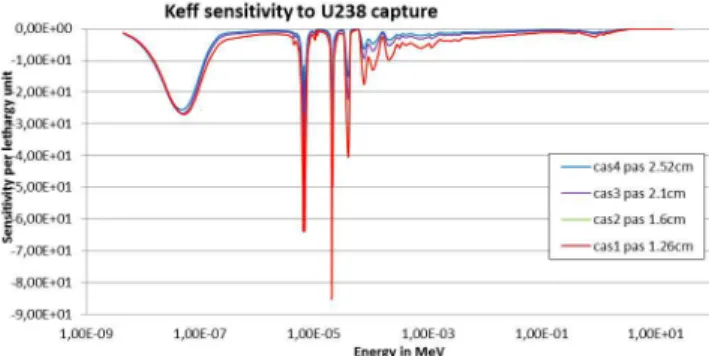
have been obtained with APOLLO2.8 using the Standard Perturbation Theory. These 281-group sensitivities were checked against TRIPOLI4/JEFF3.1.1 continuous-energy sensitivity profiles obtained by the IFP method [15]. Keff sensitivities to 235U fission are compared for PWR-type regular cores in Figure 3. Sensitivities to 238U capture for the four LCT007 cores are compared in Figure 4. Sensitivity coefficients on the JEF 15-group structure [16] were derived by integration.
Fig. 3. Sensitivity profiles to 235U(n,f) (UH1.2, PWR-4.7%, Mistral1, LCT007-case1)
Fig. 4. Sensitivity profiles to 238U(n,γ) for the 4 LCT7 cores
Concerning isotopic ratios, 15-group sensitivity coefficients at every burn-up were obtained by direct APOLLO2 calculations.
In the re-estimation process we paid attention to use realistic ND prior uncertainties to be associated with the JEFF3.1.1 evaluations. The 235U prior covariance matrix was already available from a previous study [17] : Fission and Capture covariance matrices are plotted in Figures 5 and 6. The 238U, 239Pu, 240Pu, 241Am prior covariance matrices were extracted from the Cadarache COMAC-V0 file [18]. Covariance matrices of Pu, Am and Cm minor actinides, were derived from the validation work on previous JEF2.2 library [6].
Fig. 5. Prior covariance for 235U(n,f)
Fig. 6. Prior covariance for 235U(n,γ)
VI. RE-ESTIMATION RESULT AND JEFF3 TRENDS
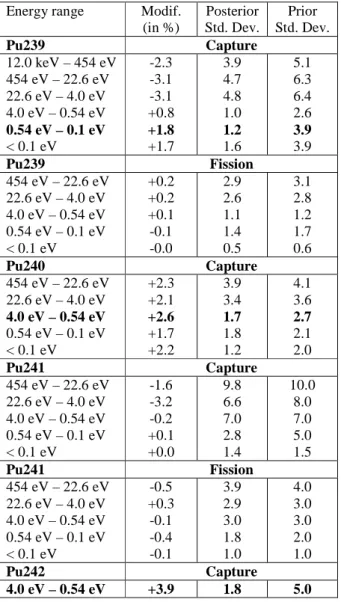
The JEFF3.1.1 re-estimation results in the relevant groups are summarized in Tables IV (uranium isotopes) and V (plutonium). In these tables, nuclear data modifications in bold are considered to be significant : the uncertainty after re-estimation is significantly reduced, and on the other hand lower (or similar magnitude) than the data modification.
Table IV points out that 235U JEFF3.1.1 evaluation is particularly satisfactory for fission and multiplicity. Posterior standard deviation (3rd column) is the reliable uncertainty to be used in JEFF3.1.1 covariance matrix and propagation uncertainty in LWRs ; it is strongly reduced to
±0.2% for thermal neutrons, thanks to accurate LWR core benchmarks. The re-estimation suggests that 235U capture resonance integral could be increased by about +2% ± 3%.
238U capture cross-sections [19] are satisfactory, and the
associated uncertainties are provided by RDN.
A trend to increase 236U(n,γ) is obtained: +3.8%±3.5% on the ER=5.4eV resonance.
Table IV. ND modification and uncertainty (%) for Uranium Energy range Modif.
(in %) Posterior Std. Dev. Prior Std. Dev. U235 capture 12.0 keV – 454 eV 454 eV – 22.6 eV 22.6 eV – 4.0 eV 4.0 eV – 0.54 eV 0.54 eV – 0.1 eV < 0.1 eV +1.5 +3.4 +2.1 +2.0 +0.9 +0.3 7.2 3.6 2.7 2.5 1.1 0.7 8.0 5.0 4.0 3.7 1.6 1.0 U235 fission 454 eV – 22.6 eV 22.6 eV – 4.0 eV 4.0 eV – 0.54 eV 0.54 eV – 0.1 eV < 0.1 eV -1.3 -0.9 -0.8 +0.0 +0.1 2.2 2.1 2.0 0.6 0.3 2.6 2.4 2.4 0.8 0.5 U235 ννννt 22.6 eV – 4.0 eV 4.0 eV – 0.54 eV 0.54 eV – 0.1 eV < 0.1 eV +0.26 +0.27 +0.22 +0.22 0.47 0.34 0.27 0.18 0.7 0.6 0.5 0.4 U236 capture 12.0 keV – 454 eV 454 eV – 22.6 eV 22.6 eV – 4.0 eV +0.6 +5.3 +3.8 9.9 +8.1 3.5 10.0 10.0 5.0 U238 capture 12.0 keV – 454 eV 454 eV – 22.6 eV 22.6 eV – 4.0 eV -0.0 -0.1 +0.2 2.1 1.7 1.2 2.2 2.0 1.5 U238 Fission 6.1MeV – 2.2 MeV -0.9 2.4 2.5 U238 n,2n 19.6MeV-6.1MeV +3.2 2.6 10.0
Table V shows that JEFF3.1.1 evaluations of Pu isotopes are satisfactory, particularly 239Pu [20] and 241Pu [21]. It can be noted that 239Pu(n,γ) post-uncertainty (3rd column) is lower than thermal/epithermal values in international covariance files.
The following improvements could be introduced in future evaluations:
- a slight increase of 239Pu capture in the thermal/epithermal range : +1.8% ± 1.2% in the 0.3eV resonance ; on the contrary the resonance integral could be decreased by 2-3%, - an increase by about +2% of the 240Pu capture in the resolved resonance range, in agreement with the analysis of MOX sample reactivity worth in EOLE and DIMPLE [22], - an increase by +3.9% ± 2% of the 242Pu ER=2.7eV
resonance integral.
Table V. ND modification and uncertainty (%) for Pu Energy range Modif.
(in %) Posterior Std. Dev. Prior Std. Dev. Pu239 Capture 12.0 keV – 454 eV 454 eV – 22.6 eV 22.6 eV – 4.0 eV 4.0 eV – 0.54 eV 0.54 eV – 0.1 eV < 0.1 eV -2.3 -3.1 -3.1 +0.8 +1.8 +1.7 3.9 4.7 4.8 1.0 1.2 1.6 5.1 6.3 6.4 2.6 3.9 3.9 Pu239 Fission 454 eV – 22.6 eV 22.6 eV – 4.0 eV 4.0 eV – 0.54 eV 0.54 eV – 0.1 eV < 0.1 eV +0.2 +0.2 +0.1 -0.1 -0.0 2.9 2.6 1.1 1.4 0.5 3.1 2.8 1.2 1.7 0.6 Pu240 Capture 454 eV – 22.6 eV 22.6 eV – 4.0 eV 4.0 eV – 0.54 eV 0.54 eV – 0.1 eV < 0.1 eV +2.3 +2.1 +2.6 +1.7 +2.2 3.9 3.4 1.7 1.8 1.2 4.1 3.6 2.7 2.1 2.0 Pu241 Capture 454 eV – 22.6 eV 22.6 eV – 4.0 eV 4.0 eV – 0.54 eV 0.54 eV – 0.1 eV < 0.1 eV -1.6 -3.2 -0.2 +0.1 +0.0 9.8 6.6 7.0 2.8 1.4 10.0 8.0 7.0 5.0 1.5 Pu241 Fission 454 eV – 22.6 eV 22.6 eV – 4.0 eV 4.0 eV – 0.54 eV 0.54 eV – 0.1 eV < 0.1 eV -0.5 +0.3 -0.1 -0.4 -0.1 3.9 2.9 3.0 1.8 1.0 4.0 3.0 3.0 2.0 1.0 Pu242 Capture 4.0 eV – 0.54 eV +3.9 1.8 5.0
Table VI summarizes the re-estimation results for minor actinides :
- due to the under-prediction of 238Pu content in UOX irradiated fuels, an increase of the 237Np epithermal capture is proposed; however, compared to the ±5% posterior uncertainty, this +3% modification is not a reliable trend, - a trend to increase by +2.4% ± 2.4% the 241Am epithermal capture is obtained, in agreement with measurement [23], - an increase trend by +4.3% ± 2.8% on the 243Am large resonance (ER=1.4eV) is raised,
- 244Cm evaluation in JEFF3.1.1 is very satisfactory, particularly for the ER=7.7eV resonance integral,
- 245Cm(n,γ) thermal value can be improved by a +8% ± 3.8% increase.
Table VI. ND trends and uncertainties (%) for Np, Am, Cm Energy range Modif.
(in %) Posterior Std. Dev. Prior Std. Dev. Np237 Capture 4.0 eV – 0.54 eV 0.54 eV – 0.1 eV < 0.1 eV +3.2 +2.5 +0.4 6.4 4.4 2.9 7.0 5.0 3.0 Am241 Capture 22.6 eV – 4.0 eV 4.0 eV – 0.54 eV 0.54 eV – 0.1 eV < 0.1 eV +3.2 +2.5 +2.3 +1.5 3.4 2.4 2.4 3.9 4.9 3.7 3.7 4.5 Am243 Capture 22.6 eV – 4.0 eV 4.0 eV – 0.54 eV +1.6 +4.3 6.9 2.8 7.0 5.0 Cm244 Capture 454 eV – 22.6 eV 22.6 eV – 4.0 eV +0.3 +0.8 8.9 3.2 9.0 6.0 Cm245 Fission < 0.1 eV -0.1 2.6 2.7 Cm245 Capture < 0.1 eV +8.1 3.8 5.0
Concerning H2O cross-sections, small modifications were
suggested : -0.7% ± 0.7% for the thermal scattering in the 0.5-4 eV energy range, and -0.16% ± 0.28% for the thermal capture.
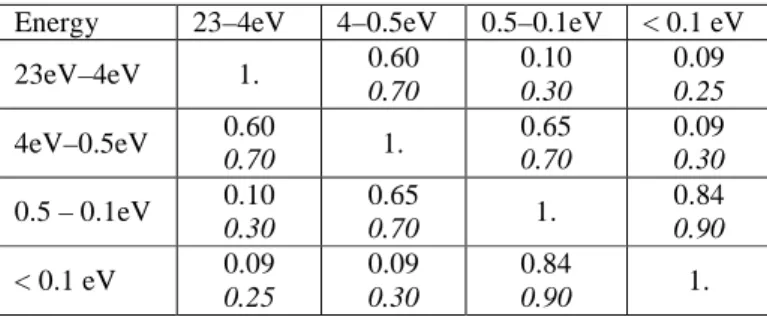
Furthermore, uncertainty correlation between energy groups is strongly reduced, compared to prior correlation matrix, thanks to integral measurements in various spectra. Prior and posterior correlations are compared in Table VII for
235U capture cross-section in the epithermal/thermal energy
range: uncertainty correlations between groups are reduced by about a factor 2. Concerning 235U fission cross-section, prior and posterior correlations are compared in Table VIII.
Table VII. Posterior and Prior correlations for 235U(n,γ) Energy 23–4eV 4–0.5eV 0.5–0.1eV < 0.1 eV 23eV–4eV 1. 0.37 0.70 0.07 0.50 0.13 0.50 4eV–0.5eV 0.37 0.70 1. 0.45 0.70 0.10 0.50 0.5 – 0.1eV 0.07 0.50 0.45 0.70 1. 0.44 0.70 < 0.1 eV 0.13 0.50 0.10 0.50 0.44 0.70 1.
Table VIII. Posterior and Prior correlations for 235U (n,f) Energy 23–4eV 4–0.5eV 0.5–0.1eV < 0.1 eV 23eV–4eV 1. 0.60 0.70 0.10 0.30 0.09 0.25 4eV–0.5eV 0.60 0.70 1. 0.65 0.70 0.09 0.30 0.5 – 0.1eV 0.10 0.30 0.65 0.70 1. 0.84 0.90 < 0.1 eV 0.09 0.25 0.09 0.30 0.84 0.90 1. VII. CONCLUSION
This paper has described the ND re-estimation process based on targeted experiments. The use of integral measurements in the re-estimation of JEFF3.1.1 evaluations has provided some ND improvement trends. The uncoupling between capture, fission and multiplicity data was obtained through French Post-irradiation experiments and critical regular LWR cores in EOLE and Appareillage-B. Realistic covariance matrices were derived for the main isotopes, that allows reliable uncertainty propagation studies.
ACKNOWLEDGMENTS
This work was supported by CEA, EDF and AREVA. The authors are grateful to Drs P. Blaise, P. Leconte, F. Nguyen, J-M. Palau, B. Roque, C. Vaglio, J-F. Vidal from the APOLLO validation CEA team for their contribution to the C/E calculations.
REFERENCES
1. A. SANTAMARINA, “From Integral Experiments to Nuclear Data Improvement,” Proc. Int. Conf. on Nuclear
Data ND2007, Nice (France), April 23-27, 2007.
2. S.C. VAN DER MARCK, “Criticality safety benchmark calculations with MCNP-4C3 using JEFF3.1”, JEFF
Meeting, JEFDOC-1107, Paris, November 28-30, 2005.
3. B. BRIGGS (Ed.), “International Handbook of Criticality Safety Benchmark Exp., NEA/NSC/DOC (95)03, 2006. 4. A. SANTAMARINA, “The JEFF3.1.1 Library for Accurate Criticality-Safety Calculations,” Proc. ICNC2011, Edinburgh (UK), September 19-23, 2011.
5. A. SANTAMARINA, P. BLAISE, P. LECONTE, C. VAGLIO, J-F. VIDAL, “Validation of the new code package APOLLO2.8 for accurate BWR calculations,”
Proc. PHYSOR2016, Sun Valley (USA), May 1-5, 2016.
6. A. SANTAMARINA et al., “The JEFF-3.1.1 Nuclear Data Library. Validation results from JEF-2.2 to JEFF-3.1.1,” JEFF Report 22, OECD/NEA Data Bank 2009. 7. J.M. GOMIT et al., “CRISTAL V2.0: a new-generation criticality package”, Proc. ICNC 2015, Charlotte (USA), September 13-17, 2015.
8. A. CALLOO et al., “validation of the SPn depletion schemes of the EDF tools,” Proc. PHYSOR2016, Sun Valley (USA), May 1-5, 2016.
9. D. PORSH, M. LEBERIG et al., “Status of V & V of AREVA’s ARCADIA System for PWR Applications,”
Proc. PHYSOR2012, Knoxville (USA), April 15-20, 2012.
10. C. VAGLIO, A. SANTAMARINA , D. BERNARD, “JEFF3.1.1 validation of the fuel inventory calculation for high burn-up PWR fuel,” Proc. ICAPP2011, Nice (France), May 2-5, 2011.
11. E. BRUN et al., “Overview of TRIPOLI-4”, Proc.
ICAPP2011, Nice (France), May 2-5, 2011.
12. R. SANCHEZ, “APOLLO2 Year 2010,” Nucl. Eng. & Technology, Vol 42 n°5, pp.474-499 (2010).
13. N. HFAEIDH, A. SANTAMARINA, “Determination of the Optimized SHEM Mesh for Neutron Transport Calculation,” Proc. M&C2005, Avignon, Sept 12-15, 2005. 14. A. SANTAMARINA, D. BERNARD et al., “Validation of the new code package APOLLO2.8 for accurate PWR neutronics calculations,” Proc. M&C2013, Sun Valley (USA), May 5-9, 2013.
15. G. TRUCHET, P. LECONTE, A. SANTAMARINA, E. BRUN, F. DAMIAN, A. ZOIA, “Computing adjoint-weighted kinetics parameters in TRIPOLI-4® by the Iterated Fission Probability method”, Ann. Nucl. Energy,
85, 17-26 (2015).
16. A. SANTAMARINA et al., “Nuclear Data Uncertainty Propagation on Power Maps in large LWR Cores,” Proc.
PHYSOR2014, Kyoto (Japan), Sept 28-30, 2014.
17. D. BERNARD, L. LEAL, A. SANTAMARINA. “U235 Covariance Matrix associated with JEFF-3.1.1 evaluation”, Paris, December 1-3, 2010, JEFF/DOC-1360.
18 C. DE SAINT JEAN, P. ARCHIER et al., “Estimation of multi-group cross section covariances”, Proc.
PHYSOR2012, Knoxville (USA), April 15-20, 2012.
19. A. COURCELLE, H. DERRIEN, N. LARSON, L.C. LEAL, A. SANTAMARINA, “Evaluation of 238U resonance parameters from 0 to 20 keV”, Proc. Int. Conf. on Nuclear Data ND2004, Santa Fe (USA), 26 Sept-1 Oct, 2004.
20. D. BERNARD, E. FORT, A. SANTAMARINA, G. NOGUERE, “239Pu data improvement in thermal and epithermal ranges”, Proc. ND2007, Nice, April 23-27, 2007. 21. H. DERRIEN, A. COURCELLE, L.C. LEAL, A. SANTAMARINA, “Reevaluation and Validation of 241Pu Resonance Parameters in the Energy Range Thermal to 20 eV”, Nucl. Sci. and Eng, 150, 109-114 (2005).
22. P. LECONTE et al., “Feedback on 239Pu and 240Pu nuclear data and associated covariances through the CERES integral experiments”, Proc. PHYSOR2014, Kyoto (Japan), Sept 28-30, 2014.
23. G. NOGUERE et al., “Improved mixed oxide fuel calculations with the evaluated nuclear data library JEFF3.2”, Nucl. Sci. and Eng, 182, 135-150 (2016).