Analyzing the impact of course structure on electronic
textbook use in blended introductory physics courses
The MIT Faculty has made this article openly available. Please share
how this access benefits you. Your story matters.
Citation
Seaton, Daniel T., Gerd Kortemeyer, Yoav Bergner, Saif Rayyan, and
David E. Pritchard. “Analyzing the Impact of Course Structure on
Electronic Textbook Use in Blended Introductory Physics Courses.”
American Journal of Physics 82, no. 12 (December 2014): 1186–
1197.
As Published
http://dx.doi.org/10.1119/1.4901189
Publisher
American Institute of Physics (AIP)
Version
Author's final manuscript
Citable link
http://hdl.handle.net/1721.1/99204
Terms of Use
Creative Commons Attribution-Noncommercial-Share Alike
Daniel T. Seaton,1, ∗ Gerd Kortemeyer,2 Yoav Bergner,1, † Saif Rayyan,1 and David E. Pritchard1
1Department of Physics and Research Laboratory for Electronics, Massachusetts Institute of Technology, Cambridge, Massachusetts 02139, USA
2
Lyman Briggs College and Department of Physics and Astronomy, Michigan State University, East Lansing, Michigan 48825, USA
(Dated: August 20, 2014)
How do elements of course structure (i.e., the frequency of assessments, as well as the sequenc-ing and weight of course resources) influence the usage patterns of electronic textbooks (etexts) in introductory physics courses? We are analyzing the access logs of courses at Michigan State Univer-sity and the Massachusetts Institute of Technology, which deployed etexts as primary or secondary texts in combination with different formative assessments (e.g., embedded reading questions) and different summative assessment (exam) schedules. As such studies are frequently marred by ar-guments over what constitutes a “meaningful” interaction with a particular page (usually judged by how long the page remains on the screen), we are considering a set of different definitions of “meaningful” interactions. We find that course structure has a strong influence on how much of the etexts students actually read, and when they do so: particularly courses that deviate strongly from traditional structures, most notably by more frequent exams, show consistently high usage of the materials with far less “cramming” before exams.
PACS numbers: 01.40.-d, 01.40.Di, 01.40.Fk, 01.50.H-, 01.50.ht
I. INTRODUCTION
A. Log Analysis
The increasing availability of electronic learning re-sources is providing instructors unique opportunities to explore new course materials and methods of instruc-tion. However, decisions for the adoption of these re-sources, in particular electronic texts (etexts), are fre-quently driven by external factors rather than peda-gogical considerations: advances in e-reader and web-based technologies,[1, 2] changing student preferences,[3, 4] increasing availability of open educational resources (OERs),[5] the emergence of MOOCs,[6, 7] and the cost of traditional textbooks.[8] Research regarding the effec-tiveness of physical textbooks in introductory courses shows generally low use and poor correlations with performance.[9–12] It is doubtful that simply switching the medium will result in any positive effects on educa-tional effectiveness if no other changes are made.
While student self-reported surveys [13, 14] have been the primary means of analyzing use of physical textbooks, Learning Management Systems (LMSs) provide an at-tractive and more reliable alternative in stored digital records of all student interactions with etexts. Each time a student accesses a page, an event is recorded containing the student ID, page accessed, and a timestamp. From
∗E-mail: [email protected]; now at Davidson College, Davidson,
NC 28035, USA
†now at Educational Testing Service, Princeton, New Jersey 08541,
USA
these records, one can describe etext use metrics such as the overall use and the associated temporal pattern, providing an attractive alternative to student surveys. These records provide a unique window into the learning behavior of students [15–19] during activities tradition-ally performed beyond the instructor’s scope, e.g., read-ing the textbook before lecture.
The LON-CAPA [20] learning management system provides a platform for disseminating etexts (along with other course resources), while also keeping rich data de-scribing student interactions. An etext in LON-CAPA is a collection of HTML pages containing primarily textual material, typically split into short pages meeting digi-tal standards [21]. Equally important is LON-CAPA’s legacy over more than a decade of having delivered re-sources in over 7,700 blended and online courses to over 960,000 student course enrollments. Student activity records from LON-CAPA courses have provided in-depth insight into student problem-solving behavior,[17, 22, 23] but little work has been aimed at interactions with etexts.
B. Effects of Course Structure
Course structure is an important feature of any course, encompassing, the types of learning activities, their frequency, sequence, and overall weight toward final grade. Much work has been aimed at elucidating the relationship between course structure/context and stu-dent outcomes in introductory science courses (e.g. [24– 30]). Improved performance and attitudes have been shown to accompany changes from traditional to fre-quent exam formats, as well as the replacement of tradi-tional lectures with active-learning activities.[29–34]
Ad-ditional research shows positive outcomes when replac-ing physical-text pre-lecture activities with online media modules.[12, 35–37] Each of these studies involves linking course structure and student outcomes, but with few ex-ceptions (e.g. [24, 25]) overlooks particular aspects of how students adapt their behavior to be successful in a given course. The relationship between course structure and student behavior is a necessary link for understanding learning, as well as in providing instructors information about their teaching strategies.
C. Massed Versus Distributed Practice: “Cramming”
Results from our log analysis on etext usage can have implications for course design: once connections between course structure and learning behavior have been identi-fied, course structures can be modified to foster construc-tive and discourage counter-producconstruc-tive behaviors. When it comes to reading the textbook, we were not only inter-ested in the question whether the materials were used in the first place, but even more so in the question of when and how they were used. Of particular interest to us was “cramming,” i.e., the attempt to concentrate reading and studying materials into the very last days leading up to an exam. Cramming can be a short-term successful strat-egy in getting good grades, but it has long been known that cramming has detrimental effects on long-term re-tention (e.g., studies on “forgetting curves” as early as 1938.[38, 39]) Essentially, cramming (or “massed prac-tice”) stores information in short-term memory with lit-tle long-term benefits. The findings have been confirmed over the decades, and strategies for providing opportu-nities for distributed practice have found their way into classrooms (e.g. Refs. [40, 41]).
D. Challenges of Analyzing Electronic Log Files
While in many respects, analyzing the use of electronic texts is easier and more straightforward than doing the same for physical texts, there are still challenges that make this endeavor more challenging than it first ap-pears: while we know when a learner opened a page, we have no automated way of finding out what he or she did with that page: did the student simply flip past the page, look up a formula or definition, or did he or she carefully read the text? For lack of these insights, timing information becomes a crucial clue, and we need to care-fully look at the deployed time windows (“cutoffs”). As we will find, some measures are highly sensitive to the choice of cutoffs (but in a predictable way), while some of the qualitative results are surprisingly robust.
Fortunately, we have a large data set at our dis-posal. We analyze retroactive data from one Mechanics-reform course at the Massachusetts Institute of Technol-ogy (MIT), and nearly a decade of large-lecture courses
from Michigan State University (MSU). Based on the as-signment of the etext, exam frequency, and integration of homework within the etext, three categories of course-structure emerge: Supplementary, Traditional, and Re-formed. We present background for our categorization and give necessary insight into the courses. After defining our methodologies, we present tools that illuminate both the overall amount and the temporal pattern of etext use. In all subsequent analyses, we highlight differences in etext use through the lens of variations in course struc-ture. Discussion and conclusions follow.
II. ELECTRONIC TEXTS AND COURSE STRUCTURE
We have analyzed etext use in nearly a decade of large-lecture introductory-physics courses at MSU and in one spring semester instance of a Mechanics reform course at MIT. The MSU courses were chosen due to their use of a single etext volume designed by the MultiMedia Physics group at MSU,[42] while the MIT course was analyzed be-cause of the authors’ involvement with implementing its etext as part of the RELATE group’s Integrated Learn-ing Environment for Mechanics.[43]
A. MSU Multimedia Physics Electronic Text
The MMP etext covers traditional physics courses at MSU, whose mechanics (1st semester) volume contains approximately 330 HTML pages, and approximately 30 other e-resources (videos, simulations, etc.). A number of courses at MSU have utilized this etext, and the ma-jority of pages have stayed true to their original design. The etext has an algebra-based and a calculus-based vari-ant for the respective courses. Instructors do have some freedom in which portions of the etext are presented to students. Hence, for certain metrics, we only compare those etext resources that are identical between courses.
B. MIT RELATE Electronic Text
The RELATE etext covers a calculus-based course on introductory mechanics, representing one component of the Integrated Learning Environment for Mechanics.[23, 43] The etext contains 255 HTML pages, and 40 other e-resources (videos, simulations, etc.). The text intro-duces the Modeling Applied to Problem Solving (MAPS) pedagogy,[44, 45] which provides a framework for build-ing expert-like problem solvbuild-ing skills. Mechanics topics begin with Newton’s Laws rather than kinematics (1D, 2D motion), meaning topics are discussed in a different sequence compared to a traditional introductory mechan-ics course. Additional effort has been given to adapting the etext around non-traditional course design.[45] This
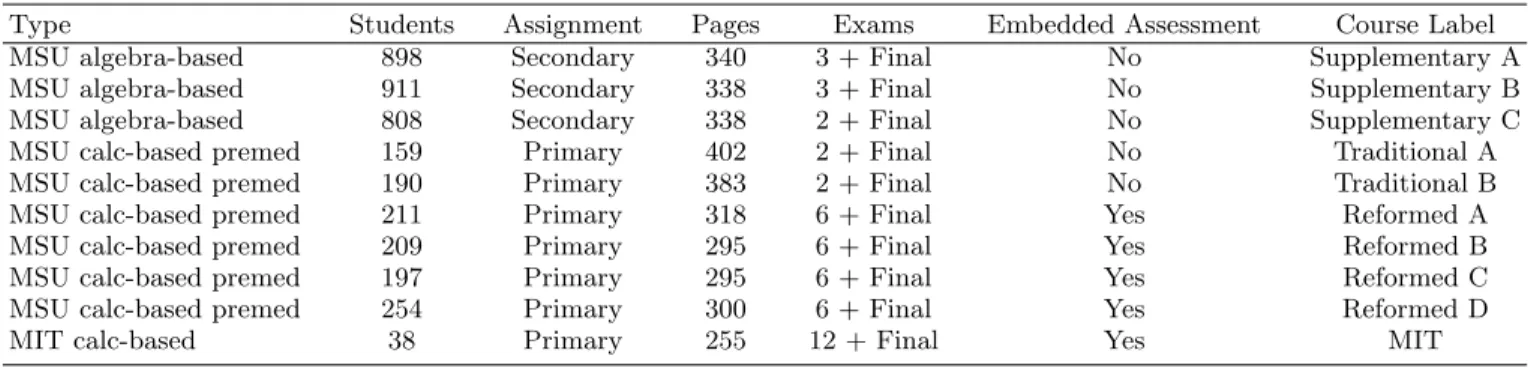
TABLE I: : Course structure features for all studied courses. Three major categories emerge based on implementation of the etext and overall course structure: Supplementary, Traditional, and Reformed.
Type Students Assignment Pages Exams Embedded Assessment Course Label
MSU algebra-based 898 Secondary 340 3 + Final No Supplementary A
MSU algebra-based 911 Secondary 338 3 + Final No Supplementary B
MSU algebra-based 808 Secondary 338 2 + Final No Supplementary C
MSU calc-based premed 159 Primary 402 2 + Final No Traditional A
MSU calc-based premed 190 Primary 383 2 + Final No Traditional B
MSU calc-based premed 211 Primary 318 6 + Final Yes Reformed A
MSU calc-based premed 209 Primary 295 6 + Final Yes Reformed B
MSU calc-based premed 197 Primary 295 6 + Final Yes Reformed C
MSU calc-based premed 254 Primary 300 6 + Final Yes Reformed D
MIT calc-based 38 Primary 255 12 + Final Yes MIT
same etext also provides the base of the MITx Mechanics Review MOOC.[7, 46, 47]
C. Course Structure 1. MSU Algebra-Based Course
The algebra-based course at MSU is a large lecture in-troductory mechanics course for students throughout the university. A typical course consists of multiple sections with multiple instructors. We study three instances of this course, whose combined enrollment reaches approx-imately 2400 students. During the three years of these courses, overall structure and etext resources saw mini-mal changes, however, instructors changed. The course structure consisted of weekly homework, 2 to 3 midterms and a final exam, and no embedded assessment in the reading.
Although the etext was a very visible part of the stu-dent experience (available for free in the same system as the free online homework), the syllabus for each course described an optional physical textbook available for pur-chase at the university bookstore. Hence, we infer that the etext played a supplementary role in the student ex-perience.
2. MSU Calculus-Based for Mostly Premedical Students
The calculus-based physics at MSU, one of two types, caters mainly to premedical students. We have analyzed six fall semester instances of this course, all with a sin-gle instructor. The total student population reached ap-proximately 1200 students, and in all courses, the etext was the only textual-based resource provided. During the first two years, these courses followed a traditional course structure: weekly homework, 3 midterms and a final exam, and no embedded assessment in the reading. The final four courses were restructured to 6 midterms and a final, as well as embedded graded assessment within the etext (in addition to the mostly unchanged
end-of-chapter homework). Both embedded and end-of-end-of-chapter problems had (for the most part) the same point-values per problem, however, there were about five times more end-of-chapter than embedded problems. Overall, the data sets are providing a distinct transition in course-structure from traditional settings with a homogenous student population over all courses.
3. MIT Course
For comparison with the MSU data, where appropri-ate, we investigate student interactions with the RE-LATE etext in one spring mechanics course with an en-rollment of 38 students. Typically, this student popula-tion did not receive a passing grade in the institute-wide fall-semester mechanics course. Hence, the majority of these students have just finished a full mechanics course, giving them a working knowledge of many basic physics concepts. The course adapts to this knowledge base, fo-cusing more on problem-solving skills and a refined view of mechanics. The RELATE etext is the only textual reference provided to the students. The course structure was flipped [48], and included weekly homework (post-class), weekly reading assignments with embedded as-sessment (pre-class), weekly quizzes, and a final exam.
The MIT course has both a very different population and pedagogy (see Section II B) than the MSU courses, so it is of particular interest how well results transfer be-tween these educational venues — are the findings limited to the MSU courses or more widely applicable?
4. Categorization
All courses in this study utilized LON-CAPA to deliver an etext and weekly homework assignments. The etext and homework components of the courses were both eas-ily navigable, and students could freely navigate between etext resources and homework, i.e., they were not forced into accessing them in a certain sequence. However, the courses differed in a number of respects, which we will
refer to as “course structure:”
Nature of etext assignment: In most courses, the etext was the primary textual reference, i.e., there was no physical textbook. Alternatively, some of the MSU courses assigned the etext as a secondary text alongside a primary physical textbook, giv-ing students choice on which resource to use. Un-fortunately, all courses with primary etext assign-ments were calculus-based, while all courses with secondary etext assignments were algebra-based; thus, some possible population effects cannot be excluded.
Exam frequency: The number of exams varied from traditional, two or three midterms and a final, to reformed, weekly or bi-weekly midterms and a fi-nal. The reformed structure in all cases was chosen to provide more opportunities for formative assess-ment and remediation.
Embedded assessment: For some courses, online for-mative assessment was embedded into the etext material, while for others it was not.
To reflect these differences in course structure with re-spect to etext assignment and assessment, we define the following categories for the purposes of this study:
Supplementary: optional etext alongside optional physical textbook, traditional exam structure, no embedded assessment.
Traditional: primary etext, traditional exam structure, no embedded assessment.
Reformed: primary etext, frequent exam structure, in-cludes embedded assessment.
MIT: the MIT comparison course, which according to our course structure criteria is most closely related to the MSU Reformed courses.
By necessity, this focussed categorization ignores several other aspects of the courses which may be considered “traditional” or “reformed,” for example the style of lec-ture presentation, the use of peer-instruction, etc. (for an overview of the wider spectrum of course reform, see for example MacIsaac and Falconer [49] and Pollock [28]). Table I details our categorization and provides descrip-tive statistics for each course; the course label in the rightmost column provides a unique identifier that will be used to reference courses when presenting data.
III. METHODOLOGIES
LON-CAPA generates server logs containing informa-tion on all student-resource interacinforma-tions. Parsing these logs allows one to extract meaningful metrics on resource
use and student behavior.[17, 22, 50, 51] A single student-resource interaction contains at least the student ID, the ID of the accessed resource, and a time-stamp with a resolution in seconds. These tags allow us to count the number of accesses each student has with a given re-source. In this study, our focus is on analysis of etext use, but additional data are available for other resource types, e.g., problem interactions allow analysis of student performance (e.g., correctness, number of tries, etc.).
As part of the human subject research procedure, the MSU logs were de-identified and no enrollment or grade book information was available. Without this additional information, we were not able to distinguish students in the course from course personnel and potential guests (i.e., course personnel and guests were just another undis-tinguishable data point). In order to isolate the student populations, we used attempts on homework and exams to filter out users falling below an adequate minimal level of participation. These filters removed users not attempt-ing at least 25% of all required homework problems, and, if the information was present, not attempting at least 25% of the exams. Note that these filters rely only on participation, not performance. Typically <10% of the users were removed from each course, accounting for early withdrawals, guests allowed to observe the course, and TAs. The MIT course, for which we had access to the ac-tual enrollment table and grade book, provided a means of crosschecking our filters: the students that were fil-tered out by these participation criteria where indeed students who did not attend the course for credit.
Another limitation of our log file analysis method is that we can only consider pages within etexts that have been accessed at least once by any user over the duration of the course. In other words, we do not know about the existence of any pages that have never been accessed by anybody. This limitation is however not serious, as likely such a page would need to be several links removed from the table of contents.
A. Time Estimates and Cutoffs
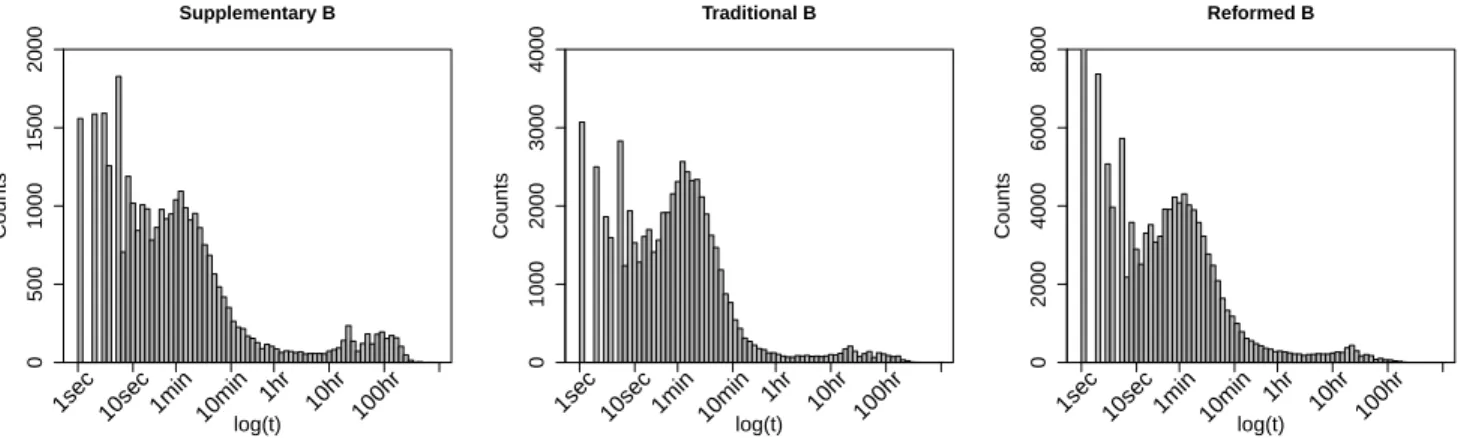
In analyzing access logs of course management sys-tems, a persistent question is what constitutes a valid interaction with a resource (e.g. [17]) — simply access-ing a page does not necessarily mean that the learner meaningfully interacted with it. Similar to triggers in a high energy detector, we need to filter out noise and non-events. We address this issue by calculating the time spent on a resource as the time difference between two subsequent interactions. As an example, Fig. 1 shows the distribution of measured interaction times ∆t with the etext in three of the ten courses that we considered, providing a general means for interpreting the types of etext interactions in a given course.
Referencing Fig. 1, one can make assumptions that ex-tremely low time durations (between 0 and 10 seconds) merely constitute navigational events (e.g., flipping past
0 500 1000 1500 2000 Supplementary B log(t) Counts
1sec 10sec 1min 10min 1hr 10hr 100hr
0 1000 2000 3000 4000 Traditional B log(t) Counts
1sec 10sec 1min 10min 1hr 10hr 100hr
0 2000 4000 6000 8000 Reformed B log(t) Counts
1sec 10sec 1min 10min 1hr 10hr 100hr FIG. 1: Distribution of the logarithm of time spent (seconds) interacting with the etext pages. Examples are given for the courses Supplementary B, Traditional B, and Reformed B (see Table I). We indicate three prominent features: large-noisy bins between 0 and 10 seconds, a peaked distribution between 10 seconds and 1 hour, and a delayed peak around 24 hours — students returned to the system on the next day.
a page), and that extremely long times (≈ 24 hours) indi-cate that the student may have simply walked away from the session or closed the window or tab (for which we do not have log entries, as no server transaction would have been triggered). For intermediate time differences (between ten seconds and about one hour), one could as-sume that the student actually spent that time reading the content. However, all of these are assumptions, and one can easily find counter arguments: a very short ac-cess time could still be meaningful if the student quickly looked up a formula or definition that he or she had al-ready accessed. A presumably meaningful access time of five minutes may in fact be meaningless if the student spent the vast majority of the time getting a coffee or doing social networking (we do not know what happens in other browser windows or tabs). On the other hand, an apparently “too long” interaction time could be mean-ingful if the student left pages open in a browser window or tab and then proceeded to flip back and forth be-tween those for reference — something we would not see in server logs. Any imposed cutoffs then seem somewhat arbitrary, and we need to consider the influence of these cutoffs on the number of considered events. At best, we would find that the results are robust with respect to these choices.
Our hope is that the results are robust against the choice of cutoff times. To see if that is the case, we analyzed the data with four different cutoff ranges: No cutoffs For this analysis, we imposed no cutoffs and
treated all access events equally. However, as the system logs out any session that is inactive for more than 24 hours, there is an implicit upper limit of one day for the length of a transaction.
Wide cutoffs : For this analysis, we applied cutoffs of tlow = 3 sec and thigh = 3600 sec. These were
motivated by the fact that on the average it takes at least three seconds for a page to completely build up in the browser, and any shorter time indicates
that the student moved past the page without even waiting for it to completely load. The upper limit of three hours is a rough estimate of how much time a student might reasonably spend on uninterrupted study.
Narrow cutoffs: For this analysis, we applied narrower cutoffs of tlow= 10 sec and thigh= 1800 sec. These
cutoffs should filter out all navigational events and also all page accesses that take longer than the reading of any of the pages in the course would require.
Stringent cutoffs: For this analysis, we applied nar-rower cutoffs of tlow= 30 sec and thigh = 600 sec.
These cutoffs focus solely on the maximum appar-ent in Fig. 1.
IV. RESULTS A. Activity
To start exploring the impact of course structure on the usage of the etext, we look at etext usage over time. As expected, particular results will depend on the cutoff ranges used. Figures 2 and 3 show an analysis of time series for the three of the ten courses considered in our study, namely Supplementary B, Traditional B, and Re-formed B. These courses are representative of what we find in other courses with the same structure.
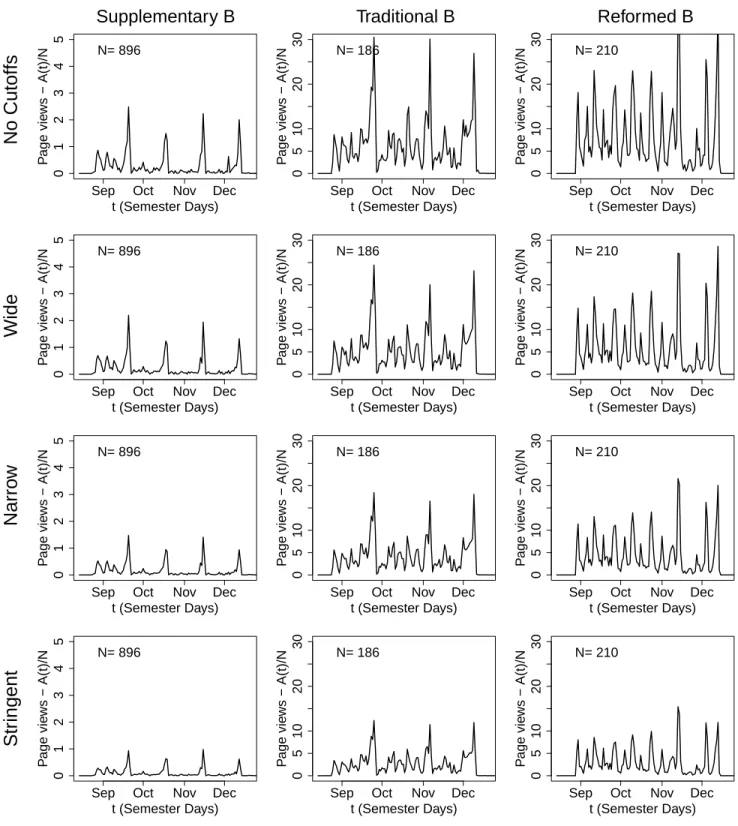
Figure 2 shows the daily page-views per student (A(t)/N ) for different cutoff choices. Note the change in scale between between supplementary courses on the one hand and traditional and reformed courses on the other.
Independent of chosen cutoff range, not only the to-tal number of daily page accesses but also their time-dependence varies greatly with changing course
struc-ture. In Supplementary and Traditional courses, promi-nent spikes represent activity immediately before exams (exam frequency given in Tab. I), implying that the ma-jority of students access the etext only days before ex-ams. For example, in the Supplementary course, one can clearly see the three spikes corresponding to the three midterms, as well as the fourth spike before the final. The same is true for the Traditional course with its two midterms and a final. This is typical “cramming” be-havior, and not very surprising — except for just how clearly the data reflect it! In Reformed courses, “cram-ming” spikes associated with biweekly exams are also still present, but they are far less pronounced and there is a more constant “background” of activity throughout the weeks. In other words, students were working more con-sistently also in off-exam weeks.
It is interesting to note the the cutoffs influence the total number of considered page accesses, but the overall time structure of the peaks is independent of the cho-sen cutoffs — the findings are robust with respect to the cutoff ranges.
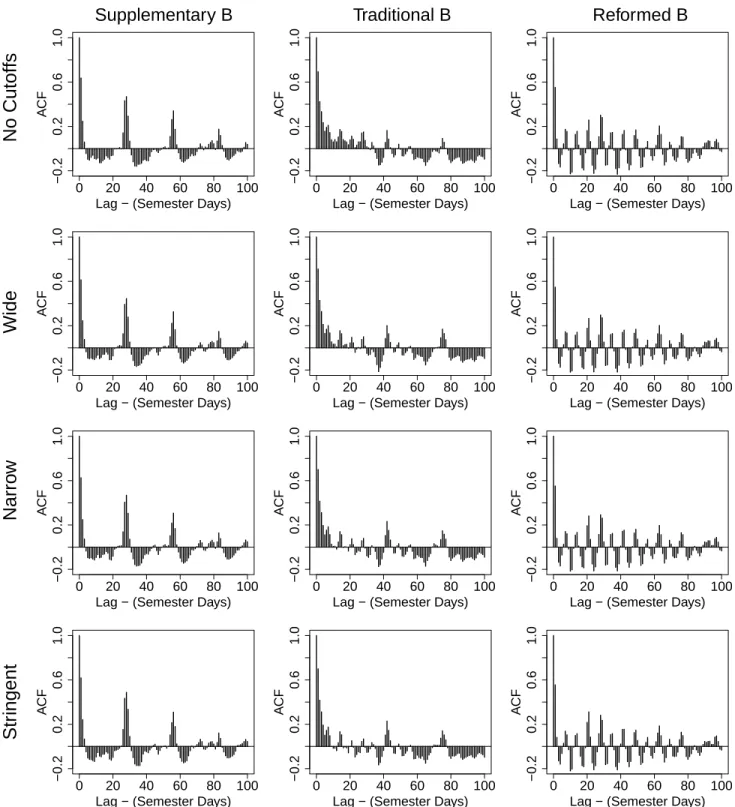
Conceptualizing the daily page accesses as a time se-ries, the autocorrelation function (ACF), shown in Fig. 3, provides further illumination of the underlying periodic-ity in the daily page-view activperiodic-ity. It is given by
ACF(n) = 1 N − n N −m−1 X i=0 a(i)a(i + n) , (1)
where N is the total number of days in the course, a(j) is the number of accesses per student on a given day j, and n is the number of days time lag considered (plotted on the abscissa of Fig. 3) .
Supplementary B and Traditional B have significant correlation occurring at 28 and 42 day lags, respec-tively. Both lags correspond to the approximate time be-tween examinations and both curves lack an instructor’s “expected” periodicity associated with weekly suggested readings. In other words, in these two courses, students read just before exams, not when they are supposed to do the readings — typical “cramming.” Reformed B differs greatly from these two curves, maintaining a consistent weekly periodicity for both small and large lag times. A valid concern is that the weekly peaks might still be a signal of “cramming” before exams that take place only every other week if a holiday or break period introduced one-week shifts in the schedule at some points during the semester (i.e, three weeks between exams instead of two). However, while an uneven number of such week-long shifts could indeed produce a weekly periodicity for long lag times, it would not explain the observed strong weekly peaks for short lag times. Thus, students in the Reformed course are indeed mostly using the etext weekly (as expected by the instructor) versus just immediately before exams.
Of some interest is the decrease in daily activity fol-lowing the first exam in Supplementary B. This signal occurs in all Supplementary courses (not just the shown
course Supplementary B), as well as in Traditional A. Apparently, in these courses, after the first exam, the students gave up on even the little regular reading they used to do. There may be several reasons for giving up on reading:
• Students might have given up on reading the text-book because they deemed it not worthwhile, as it might not have helped them much with the exams given in those courses; students might be “optimiz-ing” their learning for grades [24].
• Students might have experienced “burnout” after the first wave of midterm exams throughout their courses — if that is the case, providing more lower-stakes midterms might have exempted the reformed courses from burnout. It was found earlier that in-creasing exam frequency in a physics course indeed leads to higher student satisfaction and a more pos-itive attitude toward the course [29].
• Students in the non-reformed courses might have experienced the typical “epistemology decay” in at-titudes and expectations related to diligence [52, 53].
Based on log-analysis alone, the reason for this behav-ior cannot be determined, however, it is evident that the reformed structure counteracts it. Similar dependen-cies of course material accesses (lecture slides and course notes) were found in other studies of similar courses from MSU [29], as well as in online courses of varying format.[7, 46]
All courses show peak activity before the final exam, an assessment format common to all of them. One would have hoped that the reformed course would show a less pronounced final sprint, as students hopefully would have gained more confidence through more consistent study-ing throughout the semester, but the effect is minimal. On the other hand, it is probably too much to expect such short-term effects, and the hope is that through less cramming students carry more physics understanding be-yond the final exam.
B. Fractional Usage
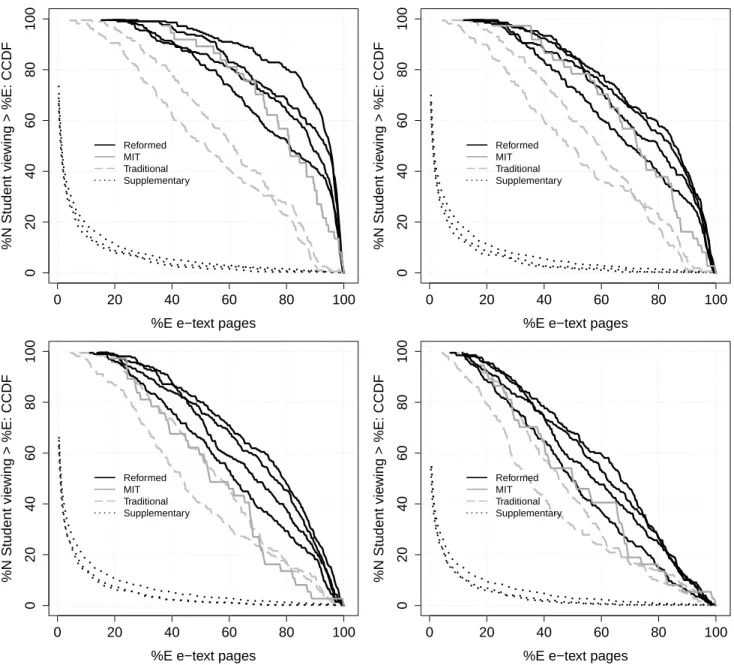
Fractional usage, i.e., how much of the etext individual students accessed, provides another indicator of course structure effects. Fig. 4 depicts complimentary cumula-tive distributions of unique etext pages viewed by stu-dents in each of the studied courses (Table I). This method of plotting allows for etext use in all courses to appear in a single plot, where each curve is read as the percentage of students %N having accessed greater than %E percentage of the available etext pages.
The influence of course structure (as indicated by the different lines types in Fig. 4) is striking:
0 1 2 3 4 5 t (Semester Days) P age vie ws − A(t)/N
Sep Oct Nov Dec
N= 896 0 5 10 20 30 t (Semester Days) P age vie ws − A(t)/N
Sep Oct Nov Dec
N= 186 0 5 10 20 30 t (Semester Days) P age vie ws − A(t)/N
Sep Oct Nov Dec
N= 210 0 1 2 3 4 5 t (Semester Days) P age vie ws − A(t)/N
Sep Oct Nov Dec
N= 896 0 5 10 20 30 t (Semester Days) P age vie ws − A(t)/N
Sep Oct Nov Dec
N= 186 0 5 10 20 30 t (Semester Days) P age vie ws − A(t)/N
Sep Oct Nov Dec
N= 210 0 1 2 3 4 5 t (Semester Days) P age vie ws − A(t)/N
Sep Oct Nov Dec
N= 896 0 5 10 20 30 t (Semester Days) P age vie ws − A(t)/N
Sep Oct Nov Dec
N= 186 0 5 10 20 30 t (Semester Days) P age vie ws − A(t)/N
Sep Oct Nov Dec
N= 210 0 1 2 3 4 5 t (Semester Days) P age vie ws − A(t)/N
Sep Oct Nov Dec
N= 896 0 5 10 20 30 t (Semester Days) P age vie ws − A(t)/N
Sep Oct Nov Dec
N= 186 0 5 10 20 30 t (Semester Days) P age vie ws − A(t)/N
Sep Oct Nov Dec
N= 210
Supplementary B
Traditional B
Reformed B
Str
ingent
Narro
w
Wide
No Cutoffs
FIG. 2: Daily page-view activity per student A(t)/N for different courses, employing different cutoff ranges.
• Supplementary courses (dotted) have the lowest etext use. For example, only about 10% of the stu-dents have accessed more then 20% of the pages.
• Reformed courses (solid black) have the highest overall use, with the majority of the students ac-cessing the majority of the materials.
• Traditional courses (dashed gray) exist between low and high use.
• The MIT course (solid gray) resides entirely within the MSU regime of courses that also had primary etexts, which may be taken as an indicator that the stark distinction between primary and secondary
0 20 40 60 80 100
−0.2
0.2
0.6
1.0
Lag − (Semester Days)
A CF 0 20 40 60 80 100 −0.2 0.2 0.6 1.0
Lag − (Semester Days)
A CF 0 20 40 60 80 100 −0.2 0.2 0.6 1.0
Lag − (Semester Days)
A CF 0 20 40 60 80 100 −0.2 0.2 0.6 1.0
Lag − (Semester Days)
A CF 0 20 40 60 80 100 −0.2 0.2 0.6 1.0
Lag − (Semester Days)
A CF 0 20 40 60 80 100 −0.2 0.2 0.6 1.0
Lag − (Semester Days)
A CF 0 20 40 60 80 100 −0.2 0.2 0.6 1.0
Lag − (Semester Days)
A CF 0 20 40 60 80 100 −0.2 0.2 0.6 1.0
Lag − (Semester Days)
A CF 0 20 40 60 80 100 −0.2 0.2 0.6 1.0
Lag − (Semester Days)
A CF 0 20 40 60 80 100 −0.2 0.2 0.6 1.0
Lag − (Semester Days)
A CF 0 20 40 60 80 100 −0.2 0.2 0.6 1.0
Lag − (Semester Days)
A CF 0 20 40 60 80 100 −0.2 0.2 0.6 1.0
Lag − (Semester Days)
A
CF
Supplementary B
Traditional B
Reformed B
Str
ingent
Narro
w
Wide
No Cutoffs
FIG. 3: Autocorrelation function ACF of the daily activity (Fig. 2) for different courses, employing different cutoff ranges.
etexts is not entirely population-dependent (see Sect. II C 4).
The results show remarkable consistency between courses that share the same structure: Supplemental course show very little variation between semesters, and the regimes of Traditional and Reformed courses are clearly separated — by a wide margin from the Supplemental courses, but
also from each other.
Some of this signal gets lost when applying stricter and stricter cutoff ranges, as can be seen by the curves moving closer together. Particularly the MIT compari-son course appears clearly within the regime of Reformed courses when no cutoff is applied, but for stricter cutoffs, this distinction gets lost. However, the overall structure
is encouragingly robust: no matter what criteria you apply for “meaningful” interaction with the pages, the regimes of the different course structures overall remain separated. The fact that stricter “noise” cutoffs lead to less signal could mean that even short interactions with a page might have meaning. This could be particularly true in physics, where complex relationships are expressed in succinct formula terms, which do not require a lot of read-ing time. From experience, for better or worse, even when reading a traditional physics book, eyes frequently gravi-tate toward the formulas while skimming or skipping the narrative. The MIT etext even supported this by hav-ing cascadhav-ing explanation and derivation boxes that only open on demand, so the gist of the page can be seen at a glance; this feature may have contributed to its sensi-tivity regarding cutoffs.
C. Cumulative Usage
A common lore among instructors is that students “just don’t read the book.” Can we find evidence of this in the online realm? Hence, we are looking at the data to find out how much of the etext the students actually accessed at least once in a “meaningful” way. As Table I shows, all courses have a large number of pages, but students only look at a fraction of them. As Fig. 5 shows, this percentage strongly depends on the course type. Where the etext is only used as a secondary text, students on the average look at less than 10% of the pages, quite independent of the cutoff ranges set for “meaningful” interactions. For traditional courses with the etext as primary resource, the percentage varies be-tween 30% and 60%, while for reformed courses, the per-centage is between 50% and 90%. While the quantitative results depend on cutoff choices, the relative results do not: the realms of the different course structures remain clearly separated for any definition of “meaningful” in-teraction.
In summary, do students “read the book?” For sec-ondary electronic texts in traditional settings, the answer is indeed “no,” as students on the average only look at about 5% of what is offered. For primary electronic texts, students read about half of it in Traditional courses, and three quarters in Reformed courses.
D. Views per Page
How often do students return to the same page? Do they return to what they have read before? Fig. 6 shows the average number of views per page in the courses, which has to be correlated with how much of the mate-rial the students access at least once to begin with (see Fig. 5).
For Supplementary courses, the average number of times a page in the etext is accessed by a particular stu-dent is about 1.3 times, i.e., for the most part, stustu-dents
look at the pages exactly once.
The picture changes when looking at Traditional and Reformed courses, where the etext is the primary re-source. On average, course pages are read more than once, students keep returning to the same pages. The separation between Traditional and Reformed courses is essentially non-existent. While overall, students look at less pages in traditional than in reformed courses, they return to these fewer pages about as often as students in the reformed courses: about 2.5 times. Students might be using these pages for review.
Of all considered interaction characteristics, the views per page most strongly depends on the cutoff range cho-sen. While the results remain qualitatively consistent, in absolute terms, factors of three to four between the range choices are observed. This dependency is dominated by the lower cutoff, which could have two reasons:
• We simply see the effect of “flipping pages back and forth,” students navigating past pages they have already seen — arguably, these events should be discarded.
• We see the effect of quickly looking up a fact or a formula, students coming back to a page exactly knowing what they are looking for — these are meaningful events.
Both categories of events may take place simultaneously, but an indicator for their relative weight may be that of the different course types, the reformed courses, i.e., those with the strongest assessment components, show the strongest dependency (solid black lines in Fig. 6), and students in these courses might more frequently quickly look up details of known relationships (desirable behav-ior) or hunt for quick answers (undesirable behavbehav-ior). One might argue that these short page accesses also con-stitute a type of “cramming” (in this case for homework rather than for exams), however, it is probably too much to expect that students would suddenly become com-pletely intrinsically motivated learners who flip around the pages of their physics text for the sheer joy of learn-ing. Instead, one can hope that this externally motivated frequent searching for information to solve homework is the type of frequent-enough “cramming” that actually constitutes distributed practice.
E. Time-On-Task Reading
The last considered quantity is how much time on av-erage students interact with the etext. Fig. 7 shows the average total time students spent with the etext (left panel) and particular pages in the etext. As expected, this quantity strongly depends on the choice of cutoff ranges, however, the only real outlier is the “no cutoff” result: since timeouts can be up to one day per interac-tion, the average reaches 300 hours for some courses and 100 minutes per page — this is obviously not how much
0 20 40 60 80 100 0 20 40 60 80 100 %E e−text pages %N Student vie
wing > %E: CCDF ReformedMIT Traditional Supplementary 0 20 40 60 80 100 0 20 40 60 80 100 %E e−text pages %N Student vie
wing > %E: CCDF ReformedMIT Traditional Supplementary 0 20 40 60 80 100 0 20 40 60 80 100 E−text CCDF − OTIME_tcut_10_and_1800 %E e−text pages %N Student vie
wing > %E: CCDF ReformedMIT Traditional Supplementary 0 20 40 60 80 100 0 20 40 60 80 100 E−text CCDF − OTIME_tcut_30_and_600 %E e−text pages %N Student vie
wing > %E: CCDF ReformedMIT Traditional Supplementary
FIG. 4: Figure depicting the %N of students who have accessed greater than %E pages of their respective etext for no cutoffs (upper left panel), wide cutoffs (upper right panel), narrow cutoffs (lower left panel), and stringent cutoffs (lower right panel). The curves correspond to all considered courses (see Table I), and the line types correspond to different categories of courses (see Section II).
time the students actually spent, these averages are ar-tificially inflated by abandoned windows or tabs, or by sessions that only 24 hours later ran against the timeout. As soon as any cutoffs are imposed, the results become reasonable, underlining the importance of thigh.
Overall, students in supplementary courses spent on the average between one and two hours with the etext, while students in traditional and reformed course in-vested one magnitude more time — about 10 to 20 hours. Looking at particular page views, results indicate an average of about two to three minutes per page, indepen-dent of the course type. However, somewhat puzzling are the two courses Supplementary A and Supplementary B,
the older ones of the three supplementary courses, where depending on the cutoffs, students spend almost double the time per page. It might be explained by the fact that the students also look at the pages less frequently by about a factor two (see Fig. 6), and thus might spend more time with the page when they do, but that would not explain why Supplementary C does not follow this pattern. All three courses had different instructors, but used the same primary text. The only real difference is that Supplementary A and B had one more midterm than Supplementary C. However, time per page may not be very meaningful in courses where the etext is the sec-ondary resource, as students might use both the physical
0 10 20 30 40 50 60 70 80 90 100
Av
e.
P
er
ce
nt
P
ag
es
V
ie
w
ed
No Cutoff Wide Narrow Stringent
FIG. 5: Average percentage of pages in the online text actu-ally viewed by students. The line types indicate the course types, i.e., Supplementary (dotted), Traditional (dashed gray), and Reformed (solid black). The percentage is given for all considered cutoff ranges (see Subsection III A), and standard errors of the mean are indicated.
1 1.5 2 2.5 3 3.5
Av
e.
V
ie
w
s
pe
r P
ag
e
No Cutoff Wide Narrow Stringent
FIG. 6: Average views per page, i.e, how often students re-turned to the same page. The line types indicate the course types, i.e., Supplementary (dotted), Traditional (dashed gray), and Reformed (solid black). The figures are given for all considered cutoff ranges (see Subsection III A), and stan-dard errors of the mean are indicated.
and electronic text in parallel, and web pages may linger on the screen longer while students are reading the book. Overall, with those two exceptions, rather independent of cutoff range and course structure, students take about two to three minutes to read a page — which makes sense, given that due to the desire to avoid excessive amounts of scrolling, online pages are rather short. If, however, the cutoff range is chosen too stringently, the average time on task per page will necessarily converge toward the cutoff limits times the average views per page — we already observe the onset of this artifact as the graphs get squeezed in toward more stringent cutoffs.
V. DISCUSSION
At least in the United States, most introductory physics course are using and following textbooks, yet ac-tual usage of these books is rarely tracked: as they are used outside of classrooms, the only way to assess their usage is learner self-reported surveys which are not al-ways very reliable. The courses we have been analyzing open a window into student-usage of textbook content, as the employed electronic format provides detailed access logs. Those logs still need to be approached with cau-tion, as we do not know how the learners interact with the pages they access, but we are encouraged that our results are robust with respect to any reasonable choice of criteria for “meaningful” accesses.
Our results reveal that course structure is an impor-tant factor governing how students interact with textual resources:
Primary versus secondary text: The courses that used the electronic text as secondary text saw hardly any use of this resource (courses Supplemen-tary A, B, C in Fig. 2; note, again, the change of scale). At first glance, this result may not be sur-prising, however:
• in these courses students were given the option of buying a physical textbook (homework was offered for free in the online system). Instruc-tors are often puzzled that students would pay for a physical textbook over a free electronic text, and we acknowledge this to be an inter-esting area of study.
• the starkness of the result is puzzling since the courses had online homework within the same online system as the secondary electronic text was offered — the students did not even have the inconvenience of having to log into a separate system to access it.
We do not know how much the primary physical textbook was used (or even bought in first place) by the learners; maybe it also saw very little use. However, the result may indicate how much stu-dents (and possibly the instructors) cling to the textbook. In most any other part of the World, physics courses are not run based on a particular textbook,[54] and in fact, they do not need to: all of the knowledge required for introductory physics is available in any physics book printed within the last century and also freely available online. Not clinging to a particular textbook, even though it is very costly, may move students in the United States too far outside their comfort zone.
Frequent and embedded assessment: With the available data, it was impossible to decouple the effects of exam frequency and embedded assessment due to their introduction in the same
0.3 3 30 300
Av
e.
T
im
e-‐
on
-‐T
as
k
(H
ou
rs
)
No Cutoff Wide Narrow Stringent 1
10 100
Av
e.
T
im
e-‐
on
-‐T
as
k
pe
r P
ag
e
(Mi
nu
te
s)
No Cutoff Wide Narrow Stringent
FIG. 7: Average time-on-task in the course (left panel) and per page (right panel). The line types indicate the course types, i.e., Supplementary (dotted), Traditional (dashed gray), and Reformed (solid black). The figures and standard errors of the mean are given for all considered cutoff ranges (see Subsection III A)
course year. Introduction of either or both led to a reduction of “cramming,” which is widely consid-ered an unproductive study strategy with negative effects on coherence and longterm retention of knowledge. While to some level, students were simply forced to abandon last-minute cramming in favor of more constantly keeping up with the course, simply due to the assessment schedule, it is our hope that the effect is deeper, as evidenced also by results showing a link between frequent exams and gains in performance and attitudes in introductory science in general [30, 33] and physics in particular.[29] Embedded assessment may also play an important role, particularly when considering how the assessment is integrated into the software, leading to online peer-teaching.[55] Due to embedded assessment, more students may read more of the pages than they would otherwise (Figs. 4 and 5).
VI. OUTLOOK
We believe that these initial metrics will encourage fu-ture researchers and instructors to compare how their students behave within our framework, providing further links between course structure and student behavior in their own courses. We are currently pushing these com-parisons further by comparing recent online courses at MIT with blended and online courses from MSU.[56]
A major issue touched upon in this study is the role of the etext in regard to student habits. We have shown that review of the etext occurs before exams in all courses, and in the presence of bi-weekly exams and embedded as-sessment, students shift to accessing etexts weekly. This points toward a possible connection that student consider the etext to be a review tool. This is particularly
in-teresting when considering instructor perceptions of the textbook, where the majority of classes are prescribed daily or weekly readings in preparation for learning ac-tivities. Our results point toward a possible follow-up study analyzing students perception of etext (or text-books) and their general habits of incorporating them into their learning processes.
We were unable to truly understand the role of elec-tronic texts as supplements to physical texts, since we had no handle on the usage of the latter. Combining student surveys and interviews with tracking data in fu-ture courses should shed more light on this issue.
Another interesting feature involves activity plots (Figs. 2 and 3) showing large spikes prior to exams. These peaks are actually indicative of signals seen in analysis of online-social networks,[57, 58] where dynamic classes form according to varying external stimuli. In the case of etext use before exams, we see behavior similar to time-reversed exogenous peaks. Modeling etext activ-ity in this way could allow researchers to gain general perspectives into human behavior and reactions to exam deadlines. An equally interesting feature of the activity plots is the decrease in etext use after the first exam, which could be correlated to a number of factors: stu-dents may find the etext less useful after the first major assessment, student course balance equilibrates after the first exam, perspective on book use changes to it being used primarily as a review tool, etc.
When it comes to studying the effect of cutoff ranges, one may argue that applying the same cutoff to all course pages is overly simplistic: some pages are long and com-plex, other pages are short and straightforward. A future study may incorporate a more data-driven per-page ap-proach, where the average access time for each page is computed and the “meaningfulness” of an access is de-fined on a per-page base within standard deviations of this average reading time.
VII. CONCLUSIONS
Online logs offer a window into how students are us-ing electronic text resource throughout physics courses, data which is not readily available for physical textbooks. However, even with this readily available data source, some caution is warranted, as not every access to an elec-tronic page indicates that the student actually interacted with the page. Thus, we found it necessary to use differ-ent definitions of “meaningful” transactions throughout the study, but were encouraged that the majority of qual-itative results are robust against the particular choice of these cutoffs.
We analyzed etext usage in one fall semester instance of an MIT Mechanics reform course and nearly a decade of large lecture introductory physics courses from MSU. We are encouraged that many of the results are indepen-dent of the difference in course population and pedagogy between the MSU and MIT courses, which indicates that we are indeed seeing effects of course structure. Many of the results are not necessarily surprising per se, but what is surprising is the clarity of their signatures: course structure indeed has profound impact on the usage of electronic texts and by extension likely traditional text-books.
We found that courses where the electronic text was not a primary resource saw very little usage, particularly after the first exam. The students did not appear to find this additional free resource useful, even though buying the primary textbook was optional and the homework was offered in the same system online and for free, and even though a variant of the same online text was used as primary resource in other courses. Students appear to cling to the primary resource.
Where the online text was the primary resource, not surprisingly, usage was a lot higher. However, in courses that were otherwise taught traditionally with conven-tional assessments (weekly end-of-chapter online home-work and a small number of midterms), access logs show
a strong pattern of “cramming” before exams — in spite of weekly homework, the text is not used consistently throughout the semester. Also, students in these courses read the online text selectively, simply ignoring some of the content.
This changes when introducing assessment embedded in the electronic text, combined with frequent summa-tive assessment: students read the electronic text more consistently throughout the semester, signatures of cram-ming are reduced (except right before the final exam), and overall more students read more of the text. As cramming is associated with steeper “forgetting curves,” the hope is that retention is increased though the re-formed course structure. Combined with earlier results that the reformed course structure leads to a more posi-tive attitude toward the course in general and less unpro-ductive problem-solving behavior,[29] more frequent as-sessment appears to lead to both qualitatively and quan-titatively more effective learning environments.
As instructors, we strive to understand how learning materials and course activities should be tailored to max-imize individual student learning. Our results show a significant link between elements of course structure and student electronic textbook use, motivating us to plan future studies of how student behavior impacts student outcomes. It is unclear how much of the results for elec-tronic textbooks transfer to traditional textbooks, but it is probably reasonable to assume that learners are also not using these resources in the way that their instructor expects or intends.
Acknowledgments
This work is partially supported, but is not endorsed by, NSF grant DUE-1044294 and Google. We thank Sarah C. Seaton for reviewing our article. We would also like to thank the anonymous reviewers of this journal for their helpful comments and suggestions.
[1] D. Butler, The textbook of the future, Nature 458, 0 (2009), ISSN 0028-0836, URL http://www.nature.com/ doifinder/10.1038/news.2009.202.
[2] P. Arroway, E. Davenport, and G. Xu, Fiscal Year 2009 Summary Report (2010).
[3] S. D. Smith and J. B. Caruso, Key Findings The ECAR Study of Undergraduate Students and Information Tech-nology , 2010 Key Findings, pp. 1–13 (2010).
[4] S. D. Smith and J. B. Caruso, What Are Stu-dents Doing with Technology? (Educause, 2010), URL http://anitacrawley.net/Resources/Reports/ ECARstudyhighlights.pdf.
[5] G. Kortemeyer, Ten years later: Why open educational resources have not noticeably affected higher education, and why we should care, EDUCAUSE Review (2013). [6] J. G. Mazoue, The mooc model: Challenging traditional
education, EDUCAUSE Review (2013).
[7] D. T. Seaton, Y. Bergener, I. Chuang, P. Mitros, and D. E. Pritchard, Who does what in a massive open online course?, Accepted - Communications of the ACM (2013). [8] E. F. Gehringer, B. L. Golub, R. Cohen, D. M. Arnow, and C. A. Shaffer, in SIGCSE ’13 Proceeding of the 44th ACM technical symposium on Computer science educa-tion (2013), pp. 633–634.
[9] K. C. S. U. Cummings, T. Y. U. French, and P. J. M. U. Cooney, Student Textbook Use in Introductory Physics, Proceedings of the Physics Education Research Confer-ence (2002).
[10] B. D. Smith and D. C. Jacobs, TextRev: A Window into How General and Organic Chemistry Students Use Textbook Resources, Journal of Chemical Education 80, 99 (2003), ISSN 0021-9584, URL http://pubs.acs.org/ doi/abs/10.1021/ed080p99.
of College Physics Textbooks: Students and Instructors May Not See Eye to Eye, The Physics Teacher 44, 338 (2006), ISSN 0031921X, URL http://link.aip.org/ link/PHTEAH/v44/i6/p338/s1\&Agg=doi.
[12] T. Stelzer, G. Gladding, J. P. Mestre, and D. T. Brookes, Comparing the efficacy of multimedia mod-ules with traditional textbooks for learning introductory physics content, American Journal of Physics 77, 184 (2009), ISSN 00029505, URL http://link.aip.org/ link/AJPIAS/v77/i2/p184/s1\&Agg=doi.
[13] T. Peckham and G. McCalla, in 5th International Con-ference on Educational Data Mining (2012).
[14] A. J. Rockinson- Szapkiw, J. Courduff, K. Carter, and D. Bennett, Electronic versus traditional print text-books: A comparison study on the influence of uni-versity students’ learning, Computers & Education 63, 259 (2013), ISSN 03601315, URL http://linkinghub. elsevier.com/retrieve/pii/S0360131512002953. [15] P. M. Kotas, J. E. Finck, and M. Horoi, Homework Habits
Of College Physics Students, 1, 53 (1998).
[16] L. Jiang, J. Elen, and G. Clarebout, The relationships between learner variables, tool-usage behaviour and per-formance, Computers in Human Behavior 25, 501 (2009), ISSN 07475632, URL http://linkinghub.elsevier. com/retrieve/pii/S0747563208002057.
[17] G. Kortemeyer, Gender differences in the use of an on-line homework system in an introductory physics course, Physical Review Special Topics - Physics Education Re-search 5, 1 (2009), ISSN 1554-9178, URL http://link. aps.org/doi/10.1103/PhysRevSTPER.5.010107. [18] D. J. Palazzo, R. Warnakulasooriya, and D. E. Pritchard,
Patterns, correlates, and reduction of homework copying, Physical Review Special Topics Physics Education Re-search 6, 1 (2010), ISSN 15549178, URL http://link. aps.org/doi/10.1103/PhysRevSTPER.6.010104. [19] R. Phillips, M. Dorit, W. Cumming-potvin, P. Roberts,
J. Herrington, G. Preston, M. Elizabeth, and L. Perry, in Proceedings ascilite 2011 (Hobart, Australia, 2011), pp. 997–1007.
[20] Learning online network - computer assisted personal ap-proach (2013), URL http://www.loncapa.org.
[21] R. Mayer, Multim´edia Learning (University Press, 2001), ISBN 9780521787499, URL http://books.google.com/ books?id=ymJ9o-w\_6WEC.
[22] B. Minaei-Bidgoli, Ph.D. thesis, Michigan State Univer-sity (2004), URL http://www.lon-capa.org/papers/ BehrouzThesisRevised.pdf.
[23] R. E. Teodorescu, D. T. Seaton, C. N. Cardamone, S. Rayyan, J. E. Abbott, A. Barrantes, A. Pawl, and D. E. Pritchard, in AIP Conference Proceedings (2012), vol. 1413, pp. 81–84, ISSN 0094243X, URL http://link. aip.org/link/?APCPCS/1413/81/1.
[24] H. Lin, Learning physics vs. passing courses, Phys. Teach. 20, 151 (1982).
[25] V. L. Dickinson and L. B. Flick, Beating the System: Course Structure and Student Strategies in a Traditional Introductory Undergraduate Physics Course for Nonma-jors, School Science and Mathematics 98, 238 (1998). [26] E. F. Redish, Teaching Physics (Wiley, 2003), ISBN
0-471-39378-9.
[27] N. Finkelstein, Learning Physics in Context: A study of student learning about electricity and magnetism, Inter-national Journal of Science Education 27, 1187 (2005). [28] S. Pollock, in AIP Conf. Proc. (2005), vol. 790, p. 137.
[29] J. T. Laverty, W. Bauer, G. Kortemeyer, and G. West-fall, Want to Reduce Guessing and Cheating While Mak-ing Students Happier? Give More Exams!, The Physics Teacher 50, 540 (2012), ISSN 0031921X, URL http: //link.aip.org/link/?PHTEAH/50/540/1.
[30] S. Freeman, D. Haak, and M. P. Wenderoth, Increased course structure improves performance in introductory biology., CBE life sciences education 10, 175 (2011), ISSN 1931-7913, URL http://www.pubmedcentral. nih.gov/articlerender.fcgi?artid=3105924\&tool= pmcentrez\&rendertype=abstract.
[31] P. W. Laws, Millikan Lecture 1996: Promoting active learning based on physics education research in introduc-tory physics courses, American Journal of Physics 65, 14 (1997).
[32] R. K. Thornton and D. R. Sokoloff, Assessing student learning of Newtons laws: The Force and Motion Con-ceptual Evaluation and the Evaluation of Active Learning Laboratory and Lecture Curricula, American Journal of Physics 66, 338 (1998).
[33] D. C. Haak, J. HilleRisLambers, E. Pitre, and S. Free-man, Increased structure and active learning reduce the achievement gap in introductory biology., Science (New York, N.Y.) 332, 1213 (2011), ISSN 1095-9203, URL http://www.ncbi.nlm.nih.gov/pubmed/21636776. [34] L. Deslauriers, E. Schelew, and C. Wieman, Improved
learning in a large-enrollment physics class., Science (New York, N.Y.) 332, 862 (2011), ISSN 1095-9203, URL http://www.sciencemag.org/content/332/6031/ 862.abstract.
[35] G. M. Novak, A. Gavrin, and C. Wolfgang, Just-in-time teaching: Blending active learning with web technology (Prentice Hall PTR, 1999).
[36] H. Sadaghiani, Using multimedia learning modules in a hybrid-online course in electricity and magnetism, Phys-ical Review Special Topics - Physics Education Research 7, 010102 (2011), ISSN 1554-9178, URL http://link. aps.org/doi/10.1103/PhysRevSTPER.7.010102. [37] H. Sadaghiani, Controlled study on the effectiveness
of multimedia learning modules for teaching mechanics, Physical Review Special Topics - Physics Education Re-search 8, 1 (2012), ISSN 1554-9178, URL http://link. aps.org/doi/10.1103/PhysRevSTPER.8.010103. [38] C. I. Hovland, Experimental studies in rote-learning
the-ory. i. reminiscence following learning by massed and by distributed practice., Journal of Experimental Psychology 22, 201 (1938).
[39] C. I. Hovland, Experimental studies in rote-learning the-ory. vi. comparison of retention following learning to same criterion by massed and distributed practice., Jour-nal of Experimental Psychology 26, 568 (1940).
[40] G. D. A. B. R. Seabrook and J. E. Solity, Distributed and massed practice: from laboratory to classroom., Applied Cognitive Psychology 19, 107 (2005).
[41] N. Cepeda, N. Coburn, D. Rohrer, J. Wixted, M. Mozer, and H. Pashle, Optimizing distributed practice: Theo-retical analysis and practical implications., Experimental Psychology 56, 236 (2009).
[42] Multimedia physics (2013), URL http://www.pa.msu. edu/~bauer/mmp/.
[43] R. E. Teodorescu, A. Pawl, S. Rayyan, A. Barrantes, D. E. Pritchard, C. Singh, M. Sabella, and S. Rebello, in Proceedings of the Physics Education Research Confer-ence (2010), pp. 321–324, URL http://link.aip.org/
link/APCPCS/v1289/i1/p321/s1\&Agg=doi.
[44] A. Pawl, A. Barrantes, D. E. Pritchard, M. Sabella, C. Henderson, and C. Singh, in Proceedings of the Physics Education Research Conference (2009), pp. 51– 54, URL http://link.aip.org/link/APCPCS/v1179/ i1/p51/s1\&Agg=doi.
[45] S. Rayyan, A. Pawl, A. Barrantes, R. Teodorescu, D. E. Pritchard, C. Singh, M. Sabella, and S. Rebello, in Pro-ceedings of the Physics Education Research Conference (2010), pp. 273–276, URL http://link.aip.org/link/ APCPCS/v1289/i1/p273/s1\&Agg=doi.
[46] C. Fredericks, S. Rayyan, R. Teodorescu, T. Balint, D. Seaton, and D. E. Pritchard, in Accepted to the Sixth Conference of MIT’s Learning International Net-work Consortium (2013).
[47] D. T. Seaton, J. Reich, S. O. Nesterko, T. Mullaney, J. Waldo, A. D. Ho, and I. Chuang, 8.mrev mechanics review mitx on edx course report - 2013 spring, MITx Working Paper #12 (2014).
[48] D. Riendeau, Flipping the Classroom, The Physics Teacher 50, 507 (2012).
[49] D. MacIsaac and K. Falconer, Reforming Physics In-struction Via RTOP, The Physics Teacher 40, 479 (2002).
[50] E. Moran, Logging : The Dark Art of Tracking and In-terpreting Interaction with Hypermedia CALL Materials, CALL-EJ Online 6, 1 (2004), ISSN 1442-438X.
[51] L. P. Macfadyen and S. Dawson, Mining LMS data to develop an early warning system for educators: A proof
of concept, Computers & Education 54, 588 (2010), ISSN 03601315, URL http://linkinghub.elsevier. com/retrieve/pii/S0360131509002486.
[52] E. F. Redish, R. N. Steinberg, and J. M. Saul, Student expectations in introductory physics, Am. J. Phys. 66, 212 (1998).
[53] G. Kortemeyer, The challenge of teaching introductory physics to premedical students,, The Physics Teacher 45, 552 (2007).
[54] C. Cabolis, S. Clerides, I. Ioannou, and D. Senft, A text-book example of international price discrimination, Eco-nomics Letters 95, 91 (2007).
[55] G. Kortemeyer, Correlations between student discussion behavior, attitudes, and learning, Phys. Rev. ST-PER 3, 010101 (2007).
[56] D. Seaton, Y. Bergner, and D. Pritchard, in 6th Interna-tional Conference on EducaInterna-tional Data Mining (2013). [57] R. Crane and D. Sornette, Robust dynamic classes
re-vealed by measuring the response function of a social sys-tem, Proceedings of the National Academy of Sciences of the United States of America 105, 15649 (2008), URL http://arxiv.org/abs/0803.2189.
[58] R. Crane, F. Schweitzer, and D. Sornette, New Power Law Signature of Media Exposure in Human Response Waiting Time Distributions, Physical Review E - Statis-tical, Nonlinear and Soft Matter Physics 81, 4 (2010), URL http://arxiv.org/abs/0903.1406.