HAL Id: cea-02435062
https://hal-cea.archives-ouvertes.fr/cea-02435062
Submitted on 10 Jan 2020
HAL is a multi-disciplinary open access
archive for the deposit and dissemination of
sci-entific research documents, whether they are
pub-lished or not. The documents may come from
teaching and research institutions in France or
abroad, or from public or private research centers.
L’archive ouverte pluridisciplinaire HAL, est
destinée au dépôt et à la diffusion de documents
scientifiques de niveau recherche, publiés ou non,
émanant des établissements d’enseignement et de
recherche français ou étrangers, des laboratoires
publics ou privés.
reactivity coefficients
Laurent Buiron, Danièle Plisson-Rieunier
To cite this version:
Laurent Buiron, Danièle Plisson-Rieunier. Nuclear data propagation with burnup : impact on SFR
reactivity coefficients. ICAPP17, Apr 2017, Fukui-Kyoto, Japan. �cea-02435062�
April 24-28, 2017 - Fukui and Kyoto (Japan)
NUCLEAR DATA PROPAGATION WITH BURNUP: IMPACT ON SFR REACTIVITY COEFFICIENTS
Laurent BUIRON, Danièle PLISSON-RIEUNIER
CEA, DEN, DER, Cadarache, 13108 Saint-Paul-Lez-Durance Cedex France [email protected]
For the next generation fast reactor design, the Generation IV International Forum (GIF) defined global objectives in terms of safety improvement, sustainability, waste minimization and non-proliferation. Among the possibilities studied at CEA, Sodium cooled Fast Reactor (SFR) are studied as potential industrial tools for next decade’s deployment. Many efforts have been made in the last years to obtain advanced industrial core designs that comply with these goals. Concerning safety issues, particular efforts have been made in order to obtain core designs that can be resilient to accidental transients. The “safety” level of such new designs is often characterized by their “natural” behavior under unprotected transients such as loss of flow or hypothetical transient over power. Transient analysis needs several accurate neutronic input data such as reactivity coefficient and kinetic parameters. Beside estimation of the level of “absolute” values, associated uncertainties have also to be evaluated for the whole set of relevant data. These estimations have to be performed for different core state such as end of cycle core for feedback coefficient. This means that uncertainties have to be obtained not only a fixed time but also have to be propagated all through irradiation. To do so, we need to couple Boltzman and Bateman equations at sensitivities level. The coupling process could be done with the help of the perturbation theory which gives adapted framework suited for deterministic calculation codes. This coupling is currently in progress in ERANOS code system. The actual implementation gives access to estimation of sensitivities for both reactivity coefficients and mass balance.
After a brief theoretical description of Boltzman/Bateman coupling capabilities in ERANOS, the study presented in this paper focuses on sensitivity and uncertainties estimation for the main feedback coefficients involved in fast reactor transients: the thermal sodium expansion coefficient and the Doppler Effect. Using these sensitivities, a global evaluation of impact of the fuel depletion can be quantified for these reactivity effects at core scale for end of cycle state. An illustration is given for a GEN IV SFR industrial core design (SFR V2B). A first glance at preliminary uncertainty level is presented using current covariance matrices available at CEA.
I. INTRODUCTION
Recent studies on wide range of Sodium Fast Reactor (SFR) problematic have led the CEA to set its own vision of a GEN IV SFR that can show enhanced safety (reduced sodium void effect) and self-sustainability (internal breeding gain close to zero). The main objective of these investigations and design process was to go as far as possible to naturally safe core, i.e to obtain core designs that can show good behavior under unprotected transient such as loss of flow or transient over power. Ideally, these designs should avoid any configuration that lead to severe accident. Several industrial designs were proposed toward these objectives.
First came the SFR V2B (Ref 1), an “evolutive” SFR compared to EFR core, based on oxide fuel that can minimize the risk of inadvertent reactivity insertion in a significant way together with a positive (but near zero) breeding gain.
Reducing the sodium volume fraction and increasing the fuel volume fraction is highly attractive for the three following key variables: sodium void effect, Doppler effect, reactivity swing and breeding gain. The corresponding power density is quite low compared to existing past concepts (EFR).
In the recent years, an innovative core design, named Low Void Core (Ref 2), based on axial and radial heterogeneous geometry configuration, has been proposed to go beyond that design in order to reach a near zero sodium void reactivity effect at end of equilibrium cycle while preserving advanced features of the SFR V2B.
For these designs, the “robust” demonstration of enhanced safety features needs accurate evaluation of core final state for a selected number of representative unprotected transients. For sodium fast pool reactors, the loss of flow triggered by loss of primary and/or secondary cooling pumps and reactivity insertion (transient over power) are the main initiators to be studied. The inherent safety level of the core can be investigated with simple indicators such as:
• Maximum core fuel temperature, which drives the core ability to avoid fuel melting,
• Maximum core sodium outlet temperature, which gives information on the core ability to avoid sodium boiling.
Transient analysis needs several accurate neutronic input data:
• Feed-back coefficients, i.e reactivity effects due to change in material temperature or density, • Kinetic parameters, mainly neutron delayed
neutron fraction and core neutrons life time, • Power peaking factor, for maximum fuel
temperature estimation, • Control rod worth.
Improved accuracy in the estimation of these feedback coefficients relies on best estimate calculation schemes and numerical methods. Work has been done at CEA to asses this concern using advanced numerical approach for core flux computation (Ref 3). The “safety” analysis also needs confidence level on the associated estimators such as temperature peaks and comprehensive uncertainty study needs to be performed involving neutronic and thermalhydraulic input parameters. For neutronic aspects, the origins of the uncertainty come from different areas:
• uncertainty coming from nuclear data,
• uncertainty coming from manufacturing process (fuel and structural material)
• uncertainty on computational methods and calculation schemes.
Concerning nuclear data, the general frame of the perturbation theory gives access to keff and reactivity
effect sensitivities relative to cross sections. It was widely used in the pass to assess uncertainty level and to identify main contributors (isotopes and relevant cross sections) in order to design dedicated experiments, to improve measurements and/or develop theoretical nuclear models. However, past evaluations were performed at end of equilibrium cycle without taking into account the impact of these uncertainties with irradiation. Indeed, as heavy nuclei depletion process is sensitive to flux and cross sections, comprehensive uncertainty quantification has to deal with this phenomenon.
To do so, the coupled Boltzman/Bateman sensitivity approach has been used in order to reach this goal. It enables us to identify the impact of the irradiation process, its main contributors and to estimate the global change on reactivity effects such as feedback coefficients. After a theoretical view on the coupled Boltzman/Bateman sensitivity approach, application will be performed on sodium void worth effect and Doppler effect for the SFR V2B core at end of equilibrium cycle.
II. COUPLED BOLTZMAN/BATEMAN SENSITIVITIES
II.A. Theoretical considerations
Uncertaintiy levels are usually computed using the Perturbation Theory (Ref 4 & 5) approach allowing estimation of sensitivity factors for any linear and bilinear functional of the flux such as multiplication factor or reaction rates (derived from Boltzman equation only). These estimations usually used “static” hypothesis: the state of core (irradiated or not) is always considered at a specific time.
As macroscopic cross sections are dependant of the irradiation time, the coupling of Boltzman and Bateman equations is required to have global uncertainties propagation with irradiation. The inherent change on Ni,
the concentration of isotope i, under irradiation by flux level φ is driven by the Bateman equation:
∑
∑
≠ → ≠+
−
+
−
=
i j j i j i i i j j c j i a i iN
N
N
N
dt
dN
φσ
φσ
λ
λ
(1) with σa and σc the absorption and capture cross sectionsrespectively, and λ the decay constant of isotope i. Equation (1) can also be rewritten as follows:
N M N D R dt N d = + = ) (
φ
(2)where N stands for isotopic vector and M the Bateman operator splitted into cross sections operator (R) and decay constant operator (D). The effective coupling is performed by building a functional linking Boltzman equation, Bateman equation, direct and adjoint flux renormalization by mean of Lagrange multipliers (N+,Γ,Γ+,P+). The minimization of this functional with
respect to Lagrange multipliers leads to the most general form of the sensitivity S of an integral value R relative to parameter p: ∂ ∂ + ∂ ∂ Γ + ∂ ∂ Γ + ∂ ∂ + ∂ ∂ = + + + + +
∫
φ φ φ φ N p H p P p H p p p H dt N p R p N p R p R p R S 1 ) , ( (3)where brackets stands for integration on space, and energy and H is the Boltzman operator (H=A-F/k).
The first term in equation (3) is the direct sensitivity and second one is the Bateman sensitivity. The third and fourth ones are relatives to direct and adjoint flux dependence of R, while the last one corresponds to power renormalisation. In the second term appears a term N+
April 24-28, 2017 - Fukui and Kyoto (Japan) + + − = M N dt N d t (4)
For the “direct” concentration, the adjoint concentration N+ plays a similar role as the adjoint flux toward the direct flux. For a final isotope i at some specific irradiation time, it represents the “weight” of the n previous isotopes (“fathers”) which lead to i by nuclear reactions presents in the operator M. This adjoint depletion occurs backward in time from a final state (t=tF)
to the origin of the direct irradiation (t=0). The final adjoint concentration associated to the integral value R is given by the following formula:
( )
N
R
t
N
F
∂
∂
=
+ (5)If R is a concentration or a linear combination of isotopic concentrations R=<u,N> with u the vector of individual isotopic weight, the adjoint concentration is u itself. The Lagrange multiplier P+ plays a role which is analog to
adjoint concentration density toward the global core thermal power. Each power renormalisation used for concentration depletion leads to adjoint power estimation and give additional sensitivity terms as stated in equation (3). The expression of P+ is given the following expression: dt N R N P P+=−1
∫
+(φ ) (4)with R the cross section operator that appears in the Bateman equation.
For concentration and reactivity effects, only Γ+ needs to be estimated using the adjoint importance calculation as follows: 0 = + + Γ+ + +
∫
N RN dt P N H σ
P (5)where σP stands for “power” cross section. This
importance gives the “weight” of any change in the “flux structure” for the considered integral value R.
II.B. Deterministic implementation
New developments in the ERANOS (Ref 6) code system have been performed in order to solve Bateman ajdoint equation and to compute all terms of the general sensitivity expressed in equation (3). In addition, initialisation of adjoint concentration is available for R corresponding to:
• Any linear isotopic concentration combination • multiplication factors such as single keff or
reactivity effect ∆ρ=∆k/k2 (using Equivalent
General Perturbation Theory assumptions). The last three terms of equation (3) imply obtention of parameters Γ,Γ+ and P+ that are solutions of source
calculations (analog to importance calculation) involving complex combination of direct and adjoint concentrations.
Thanks to the perturbation tools available in the ERANOS code package, the implementation of such source calculation was obtained with limited code modifications. The depletion scheme usually used for burnup calculation is based on quasi-static assumption in which flux and power remain constant all along a defined period. In that approach, the flux update and associated power renormalisation occur only at specific time. Thus Γ,Γ+ and
P+ need to be estimated for a reduced number of “steps”
in the calculation so that the total sensitivity S can be easily obtained by sequential process. The present code implementation has been validated on the basis of available benchmarks and publications (Ref 7). It appears to give good agreement on heavy nuclei densities as well as keff for pin cell calculation.
Finally, the uncertainty level ε corresponding to the value
R is evaluated using the well known “sandwich” formula:
( ) ( )
RVS R S R = t ) (ε
(6)where V is the nuclear data variance-covariance matrix.
III. APPLICATION TO SFR CORE DESIGN
III.A. SFR core description
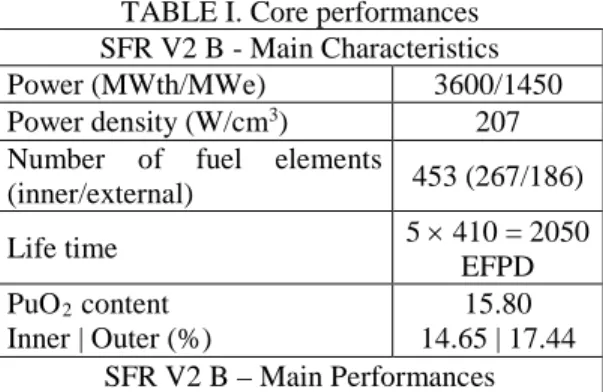
The design of the reference SFR 3600 MWth MOX core (named SFR V2B hereafter) has been widely described in the past. The design of the fuel assembly is based on a concept with large pins (10.73mm diameter) and a spacer wire of small diameter (1 mm).
The nominal performances of the core reach a burn-up of 100 GWd/t with a residence time of fuel of approximately 2000 EFPD and a null internal breeding gain (IBG), this last point being an design goal. As the tightening of the pin bundle in the fuel assembly requires a cladding material which does not swell significantly to reach the expected burn-up, an advanced ferritic steel (ODS) is considered.
TABLE I. Core performances SFR V2 B - Main Characteristics
Power (MWth/MWe) 3600/1450
Power density (W/cm3) 207
Number of fuel elements
(inner/external) 453 (267/186) Life time 5 × 410 = 2050 EFPD PuO2 content Inner | Outer (%) 15.80 14.65 | 17.44 SFR V2 B – Main Performances
LHR MAX (W/cm) 420 ∆ρ cycle (pcm) / (pcm/EFPD) -450/-1.1
BUmoy /BUmax (GWd/t) 99/139
Sodium Void Worth (EOC +1980 pcm
Doppler Constant -795 pcm
The reference core design is presented briefly in Table I. These performances have been obtained by considering a mixed oxide fuel on the basis of a plutonium isotopic vector of the “Pu2035” type judged representative what one could lay out around 2035 (see Table II) in the frame of the French Fleet.
TABLE II. MOX isotopic content
Element Isotope Content
(%w) Uranium U 235 U238 0.25 99.75 Plutonium Pu238 Pu239 Pu240 Pu241 Pu242 Am241 3.57 47.39 29.66 8.23 10.37 0.78
III.B. Calculation hypothesis
Calculations were performed using the ECCO/ERANOS code package based on the JEFF3.1.1 library (Ref 8). The transport option (Bistro S8) has been used for all calculations with a 33-group working library which has been generated from a 1968-group master library. For comparison, fine-group (1968 groups) ECCO cell calculations were also performed, and provide an accurate description of the reaction thresholds and resonances. The fine-group calculation has been performed for the 2-dimensional description of a sub-assembly. Because the broad 33-group library has been generated from this master fine group library, it has been found that differences on the core parameters are small.
For the core geometry model of the core, a cylindrical (RZ) model is adopted. Validity of the RZ model was assessed against the results of heterogeneous (hexagonal-Z) calculation using the TGV/VARIANT 3-dimensional nodal transport code. Heavy nuclei depletion calculations are performed with an extended chain from Th230 up to Cf252 isotope for a total of 33 heavy nuclei. A
simplified model is used for fission product description: a set of 15 lumped fission product for major isotopes (U isotopes, Pu isotopes, Am isotopes, Np237, Cm243, Cm244,
Cm245) for which an effective capture cross section has
been settled to be representative of real isotopic fission yield distribution.
Core depletion is performed using a simplified averaged irradiation scheme, so mass balance will be
estimated between beginning of life (full core loading) and end of life (full core unloading). Using this hypothesis leads to quite good accuracy on core average mass balance at the end of irradiation since it preserves total core fluence. It does also provide good insight of global value for feedback coefficients estimation both at beginning and end of equilibrium cycle.
IV. SENSITIVITY ANALYSIS
Core behavior under unprotected transient is driven by the level of the reactivity coefficients as well as the kinetic parameters. Uncertainty analysis of the core transient involves quite accurate coupled neutronic-thermalhydraulic study. The impact of the nuclear data propagation with burnup during the whole time set of the relevant transient is not an easy task even with nowadays computing resource. Here, a simplified approach has been based on two reactivity coefficients:
• the Sodium Void Reactivity Effect (SVRE) which usually gives a estimation of the maximum reactivity effect for the loss of flow transients
• The fuel temperature effect by mean of the Doppler constant
The following sections focus on the impact of the Boltzman/Bateman coupling on end of equilibrium cycle (EEOC) associated sensitivities.
IV.A. Sensitivity on Sodium Void Worth
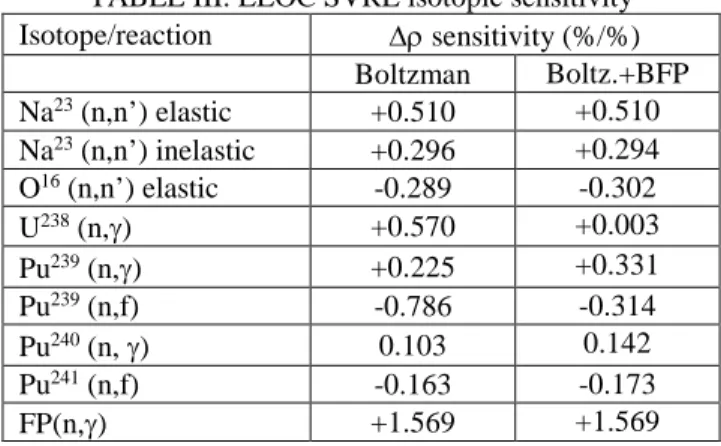
Table III shows the effect of the Bateman, Power and Flux (BPF) coupling terms on the one group sensitivity for sodium void reactivity effect. The Boltzman column stands for “traditional” estimation without burnup propagation while Boltz+BPF stands for ful Boltzman/Bateman coupling involving terms in the sensitivity. Only isotopes with relevant sensitivity level are displayed.
TABLE III. EEOC SVRE isotopic sensitivity
Isotope/reaction ∆ρ sensitivity (%/%) Boltzman Boltz.+BFP Na23 (n,n’) elastic +0.510 +0.510 Na23 (n,n’) inelastic +0.296 +0.294 O16 (n,n’) elastic -0.289 -0.302 U238 (n,γ) +0.570 +0.003 Pu239 (n,γ) +0.225 +0.331 Pu239 (n,f) -0.786 -0.314 Pu240 (n, γ) 0.103 0.142 Pu241 (n,f) -0.163 -0.173 FP(n,γ) +1.569 +1.569
April 24-28, 2017 - Fukui and Kyoto (Japan) Here FP stands for sum over all pseudo-fission
products at the end of equilibrium cycle.
The main changes appear for U238 and Pu239 isotopes
since those isotopes are the main heavy nuclide contributors to sodium void effect by mean of weights in adjoint concentrations in equation (5), and total core power in the last term of equation(3). Slight effects are seen for O16 and Na23, by means of contributions coming
from “flux” term involving the Γ+ importance estimation.
Even if sensitivity of capture reaction for fission product is quite large, no significant impacts are observed with coupling.
The main effect of burnup propagation can be seen for U238(n,γ) and Pu239(n,f) cross sections. For U238(n,γ),
the effect of the coupling tends to reduce the one group sensitivity to almost a zero value while the Pu239(n,f) one
is reduced by half.
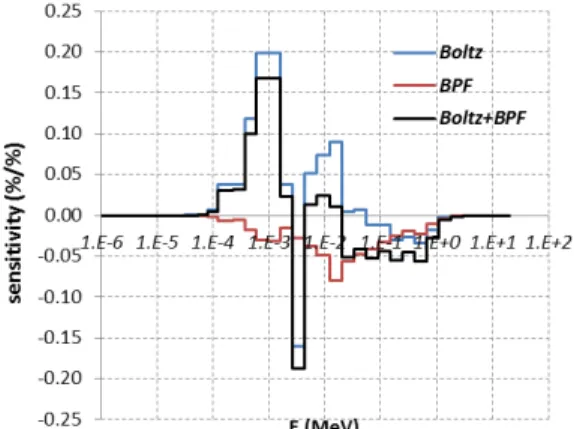
Fig. 1. Core SVRE sensitivity profile relative to U238
capture cross.
The energy dependence of these sensitivity changes, which is displayed on Fig 1, gives more detail on modifications coming from coupling process. For U238
capture cross section, the BPF contribution is negative all through the energy domain. The total sensitivity is then a sum of positive and negative contributions that lead to near zero value.
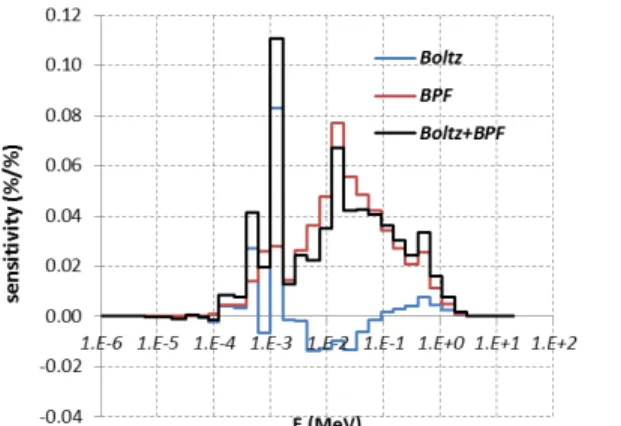
For Pu239 capture cross section, the BPF contribution
is positive and leads to increase the total sensitivity (see Fig 2).
Fig. 2. Core SVRE sensitivity profile relative to Pu239
capture cross section.
For Pu239 fission cross section, the BPF contribution is
also positive and leads to increase in a significant way the sensitivity for incident neutron energies beyond 10 keV (see Fig. 3).
Fig. 3. Core SVRE sensitivity profile relative to Pu239
fission cross section.
IV.B. Sensitivity on Doppler constant
Table IV shows the effect of coupling term on the one group sensitivity for Doppler effect. The Boltzman column stands for “traditional” estimation without burnup propagation while Boltz+BPF stands for ful Boltzman/Bateman coupling involving terms relative to Bateman, power and flux contributions (BPF) in the sensitivity. Only isotopes with relevant sensitivity level are displayed.
The main impacts are observed for U238, Pu239 and
Pu241 isotopes. For U238 (n,γ), there is a large increase on
global sensitivity. For fission cross section, Pu239 and
Pu241 do also exhibit significant increase in absolute
TABLE IV. EEOC Doppler isotopic sensitivity Isotope/reaction ∆ρ sensitivity (%/%) Boltzman Boltz.+BFP Na23 (n,n’) elastic +0.292 +0.298 O16 (n,n’) elastic +0.711 +0.749 U238 (n,γ) +0.071 +0.623 Pu239 (n,γ) -0.267 -0.334 Pu239 (n,f) -0.847 -1.293 Pu241 (n,f) -0.081 -0.148
For U238 capture cross section, the BPF contribution
is positive and is one order of magnitude higher (in absolute value) than the original Boltzman sensitivity for incident neutron energy beyond 1 keV which leads to a drastic change (see Fig. 4).
Fig. 4. Core Doppler sensitivity profile relative to U238
capture cross.
Fig. 5. Core Doppler sensitivity profile relative to Pu239
fission cross section.
For Pu239 and Pu241 fission, the “BPF” contribution is
negative and leads to decrease the sensitivity beyond 1 keV. However, contrary to what has been observed for U238 capture, the “BPF” level is somehow small compared
to original Boltzman values.
Fig. 6. Core Doppler sensitivity profile relative to Pu241
fission cross section.
IV.C. Conclusion on coupled sensitivity
For the two “representative” reactivity effects chosen here, the Boltzman/Bateman coupled approach shows significant modifications for a restricted number of isotopes and cross sections. The main impact relies on U238(n,γ) and Pu239 (n,f) for which drastic changes can be
observed. Depending on the feedback considered, these changes could decrease of increase the original Boltzman value.
V. Uncertainty level
V.A. Nuclear Variance-Covariance Data
Uncertainties’ calculation needs a set of variance-covariance covering the widest range of isotopes and associated cross-sections. At international level, several teams devoted to nuclear data work on cross section evaluation and associated variance-covariance data. In the frame of current reactor design as well as future GEN IV concept, CEA is involved in that process and does produce new measurements and/or evaluations on some energy range of interest for both LWR and Fast Reactors.
In neutron induced reactions between 0 and 20 MeV, knowledge of cross sections is based for experimentalists on the finest microscopic experiments and smartest integral experiments (related issues are then systematic uncertainties…) and for theoreticians on the knowledge of nuclear reaction models (related issues are then use of systematics and a proper parameters uncertainty evaluation).
Thus, a general problem arises during the evaluation: the analysis may be done independently between the resolved resonance range, the unresolved resonance range and the continuum. Several inconsistencies could be detected such as mismatches at
April 24-28, 2017 - Fukui and Kyoto (Japan) the boundaries for punctual cross section or larger
uncertainties on boundary and no cross-correlations between high energy domain and resonance range. In addition, good overall integral behaviors with deviations among evaluations due to compensating effects were seen on major isotopes. Uncertainties must reflect the lack of knowledge, inconsistencies as well as advances. In these energy ranges, the knowledge of neutron induced cross section is based on microscopic and integral experiments as well as nuclear reaction models. Models parameters, necessary ingredients of nuclear reaction models, are not always predicted by theory. The key point of any parameters estimation (resonance parameters, optical models, fission barrier, average width, multigroup cross sections…) is to add physical constraints to properly find the most physical values. These constraints are in traditional evaluation microscopic experiments and in some extent integral experiments, in conjunction with theoretical considerations.
Methodologies to treat systematic experimental uncertainties were given in the past to avoid unrealistic low parameters uncertainties at the end of the evaluation process but with only one nuclear reaction model. Recent work (Ref 9) shows the effect of experimental normalization uncertainty on two models (R-Matrix and Optical Model) and their related energy domains. It creates correlations on cross sections between these energy domains. A whole covariances evaluation was made with this methodology on sodium for JEFF-3.2 (Ref 10). All these methods tend to create more information and more correlated matrices between cross sections. Thus, an increase of propagated uncertainties to nuclear reactor integral parameters has been observed. In this paper, the use of integral experiment during the evaluation process as another source of constraints will be investigated. Comparisons between data assimilation of these experiments to nuclear reaction model parameters and multigroup cross section will be shown.
Fig. 7. General scheme of the variance-covariance and multigroup cross sections data library.
For variance-covariance estimation, the iterative process is schematically described in Fig. 7. Two types of calculation scheme were used. The a priori covariances
on parameters and multigroup cross sections are consistent. The first calculation type is based on the use of nuclear reaction model parameters as vectors for the data assimilation on a chose set of experiment such as JEZEBEL, GODIVA, etc... After the adjustment, an a
posteriori multigroup cross section covariance matrix is
calculated with the new parameters set. The second calculation type involves only multigroup cross sections as vector for the data assimilation.
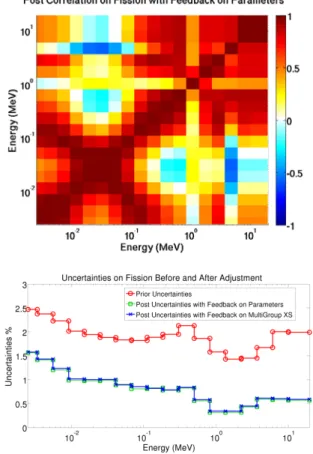
For instance using JEZEBEL experiment, related nuclear reaction parameters can be adjusted. The Fig. 8 shows the results obtained on the final fission multigroup cross section correlations illustrates also a good agreement between both schemes.
Fig. 8. Effect of constraint evaluation process on fission cross section and associated correlations.
The result of such process leads to the CEA COMAC set which gather the most important isotopes and reaction related to LWR and FR concerns. Ultimately, the last COMAC version is relevant to the JEFF3-2 cross section library. Here, we used an intermediate version labelled COMAC V1.0 relevant to the JEFF-3.1.1 cross section library on which the core calculations were based on.
V.A. Uncertainty on Sodium Void Reactivity Effect
Tables V and VI summarize the 1σ uncertainties level (in %) on end of equilibrium cycle for sodium void reactivity effect. Table V deals with traditional Boltzman sensitivity while Table VI refers to coupled one. Only relevant contributions are displayed. Total values correspond to the quadratic sum of individual contribution. Negative terms that can be seen correspond to imaginary values coming from the impact of negative correlations for the associated reactions. Uncertainties from ν and fission spectrum have not been presented since the impact of coupled sensitivities is quite small. As pseudo-fission product depletion chain has been used, they were not taken into account for uncertainty quantification, only heavy nuclides and structural isotopes were used.
TABLE V. Isotopic contribution to total SVRE uncertainty using Boltzman sensitivity
Capt. Fiss. Elas. Inela Total
O16 0.21 0.31 0.36 Na23 0.69 1.38 0.74 1.71 U238 1.23 0.06 0.06 1.18 1.71 Pu239 0.88 3.07 3.23 Pu240 0.35 0.10 0.05 0.43 Pu241 0.18 0.30 0.42 Total 1.82 3.08 1.46 1.41 4.16
TABLE VI. Isotopic contribution to total SVRE uncertainty using coupled sensitivity
Capt Fiss Elas Inela Total
O16 0.21 0.31 0.37 Na23 0.69 1.38 0.74 1.71 U238 1.35 -0.08 0.17 1.15 1.79 Pu239 1.11 2.87 3.12 Pu240 0.67 0.22 -0.11 0.74 Pu241 0.28 0.30 0.25 Total 2.10 2.90 1.46 1.38 4.15
One can notice that the impact of the propagation with burnup is quite low. For heavy nuclei, there is a slight increase relative to capture cross section. Despite a reduced value of the U238(n,γ) sensitivity in the coupled
case, the associated uncertainty is higher than the one obtained with the solely Boltzman term.
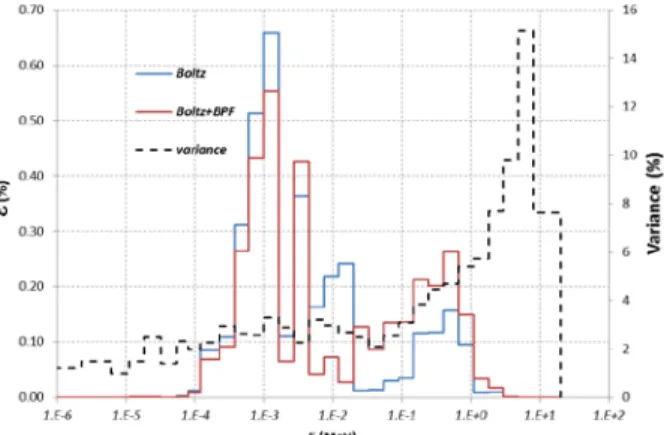
As shown in the previous section, the coupling process leads to a redistribution of the sensitivity with the incident energy. As an illustration, Fig 9 shows the contribution of the U238(n,γ) uncertainty ε with energy
assuming no correlations. The coupled sensitivity tends to decrease contributions for incident neutron energies lower to 30 keV while it increases them beyond this threshold.
Fig. 9. SVRE U238(n,γ) uncertainty profile with incident
neutron energy assuming no correlation using coupled and Boltzman sensitivities.
Quadratic sums for both hypothesis leads to roughly the same uncertainty level: 1.07% for Boltzman and 1.01% for coupled approach. The use of correlations leads to other crossed contributions that enhanced the uncertainty level in different ways depending on the sensitivity profile modifications. The effect of correlations can also be seen for U238(n,f) and Pu240(n,n
inelastic) uncertainties for which
contribution are becoming imaginary (the associated variance is negative).
If some small effects can be seen for the major heavy nuclides, the total uncertainty level remains unchanged due to compensations.
V.B. Uncertainty on Doppler Effect
The same exercise has been performed for the core Doppler effect. Tables VII and VIII summarize the 1σ uncertainties level (in %). Table V deals with traditional Boltzman sensitivity while Table VI refers to coupled one. Only relevant contributions are displayed.
TABLE VII. Isotopic contribution to total Doppler uncertainty using Boltzman sensitivity
Capt. Fiss. Elas. Inela Total
O16 0.15 0.69 0.70 Na23 -0.02 0.76 0.76 U238 0.40 -0.10 0.14 1.59 1.67 Pu239 1.03 1.02 -0.06 0.16 1.67 Pu240 0.76 1.57 -0.03 -0.21 1.78 Pu241 0.18 0.13 0.37 Total 1.41 1.88 1.22 1.60 3.25
April 24-28, 2017 - Fukui and Kyoto (Japan) TABLE VIII. Isotopic contribution to total Doppler
uncertainty using coupled sensitivity
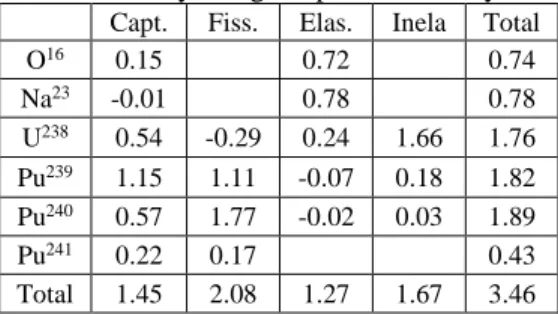
Capt. Fiss. Elas. Inela Total
O16 0.15 0.72 0.74 Na23 -0.01 0.78 0.78 U238 0.54 -0.29 0.24 1.66 1.76 Pu239 1.15 1.11 -0.07 0.18 1.82 Pu240 0.57 1.77 -0.02 0.03 1.89 Pu241 0.22 0.17 0.43 Total 1.45 2.08 1.27 1.67 3.46
Here, the impact of the coupled sensitivity on uncertainty level is very isotope dependent. The global trend observed gives limited enhanced contributions for capture cross and fission section for heavy nuclides except for Pu240(n,f) and U238(n,γ). Just as in the case of
SVRE, Fig 10 show the contribution of the U238(n,γ)
uncertainty ε with energy assuming no correlations. The coupled sensitivity tends to increase in the whole neutron incident energies range. Using these assumptions give almost a factor two on the quadratic sum. Once again correlations have an impact as we can notice a global change from 0.40% to 0.54% in Table VII and VIII.
Fig. 10. Doppler U238(n,γ) uncertainty profile with
incident neutron energy assuming no correlation using coupled and Boltzman sensitivities.
The effect of correlations is also quite significant for the uncertainty level associated to Pu240(n,n
inelastic).
If some small effects can be seen for the major heavy nuclides, the total uncertainty level remains almost unchanged due to compensations.
VI. CONCLUSIONS
Next generation reactor design will face new challenges in terms of safety demonstration. From the neutronic point of view it will require to be able to characterize the different core states (nominal as well as under protected and unprotected transients) with enhanced
accuracy. The estimation of uncertainty levels would help quantified margins of the design towards relevant estimators such as maximum fuel or coolant temperature from a set of representative transients.
For neutronic aspects, the origins of the uncertainty come from different areas:
• uncertainty coming from nuclear data,
• uncertainty coming from manufacturing process (fuel and structural material),
• uncertainty coming from computational methods and calculation schemes.
Regarding nuclear data, the approach of the perturbation theory gives access to keff and reactivity effect
sensitivities relative to cross sections. It was widely used in the pass to assess uncertainty level and to identify main contributors (isotopes and relevant cross sections) in order to design dedicated experiments, to improve measurements and/or develop theoretical nuclear models. As the most penalizing core configuration involves irradiated fuel and uncertainty propagation with burnup is needed to get a comprehensive handling of the problematic. To do so, the coupled Boltzman/Bateman sensitivity approach has been implemented in the ERANOS code package used in order to reach this goal. It enables us to identify the impact of the irradiation process, its main changes and contributors and to estimate the global change on reactivity effects such as feedback coefficients.
The coupled Boltzman/Bateman sensitivity approach, has been applied to the SFR V2B industrial core design at the end of equilibrium cycle. The impact of the Boltzman/Bateman coupling has been studied for the core sensitivities relatives to the sodium void reactivity effect as well as the Doppler effect which both play an important role in the core behavior under unprotected transients.
The main impact has been observed for capture and fission core sensitivities for a few heavy nuclei isotopes: namely the U238, Pu239, Pu240 and Pu241. If global
sensitivities could change by an order of magnitude with coupling, it appears the redistribution against incident neutron energy must be analyzed with care and general conclusions can not be drawn at this preliminary stage. Convolution of such sensitivities with up to date variance-covariance data leads to restricted global change on uncertainty level as compensation between contributions occurs. The role of correlations is also important and must be quantified in depth. For the two reactivity effects studied here, the impact of burnup propagation has been found to be relatively small.
This approach needs to be extended to all neutronic parameters (keff, power peak, feedback coefficients, etc…) in order to identify contributors to the uncertainty level and also to be able to performed neutronic-thermalhydraulic coupled uncertainty propagation for safety analysis purpose of current fast reactor designs.
ACKNOWLEDGMENTS
The authors would like to thank Jean Tommasi for his theoretical support and advices during the code implementation phase of the Boltzman/Bateman coupling.
REFERENCES
1. P. SCIORA, et al., « A break even oxide fuel core for an innovative french sodium-cooled fast reactor : neutronic Studies Results »- Proceedings of GLOBAL
2009, Paris, France, Sept. 6-11, 2009.
2. P. SCIORA and al., “Low void effect core design applied on 2400 MWth SFR reactor”, Proceedings of
ICAPP 2011, Nice, France, May 2-5, 2011.
3. C. BOURET, “Etudes des contre-réactions dans un réacteur à neutrons rapides à caloporteur sodium: impact de la conception et de la neutronique sur les incertitudes,” PhD thesis, University of Clermont-Ferrand, (2014).
4. A. GANDINI, “Time-Depend Generalized
Perturbation Methods for Burn-up Analysis”,
Comitato Nazionale per l’Energia Nucleare, 1975.
5. M.L. WILLIAMS, “Development of Depletion Perturbation Thoery for Coupled Neutron/Nuclide Fields Feasibility”, Nucl. Sci. Eng., 118, pp. 14-25, (1978) .
6. G. RIMPAULT, “The ERANOS Code and Data System for Fast Reactor Neutronic Analyses,” Proc.
of the PHYSOR2002, Seoul, Korea, October 7-10,
2002.
7. T. ZU, C. YANG, L. CAO, and H. WU, “Nuclear data uncertainty propagation analysis for depletion calculation in PWR and FR pin-cells,” Annals of
Nuclear Energy, Volume 94, pages 399–408, 2016.
8. A. KONING et al, “The JEFF-3.1 Nuclear Data Library,” Nuclear Energy Agency Data Bank, OECD, JEFF Report 21, NEA N° 6190 (2006).
9. C. DE SAINT JEAN, et al, “Evaluation of Cross-Sections Uncertainties using Physical Constraints Focus on Integral experiments,” Nuclear Data Sheet, Volume 123, pages 178-184, 2015.
9. P. ARCHIER et al, “New JEFF-3.2 sodium induced cross-sections evaluation for neutron fast reactors applications: from 0 to 20 MeV”, Nuclear Data