
HAL Id: hal-02315681
https://hal.archives-ouvertes.fr/hal-02315681
Submitted on 14 Oct 2019
HAL is a multi-disciplinary open access archive for the deposit and dissemination of sci-entific research documents, whether they are pub-lished or not. The documents may come from teaching and research institutions in France or abroad, or from public or private research centers.
L’archive ouverte pluridisciplinaire HAL, est destinée au dépôt et à la diffusion de documents scientifiques de niveau recherche, publiés ou non, émanant des établissements d’enseignement et de recherche français ou étrangers, des laboratoires publics ou privés.
Effect of the Anode Placement on the Antagonist
Muscles Recruitment: Implication for the Interpolated
Twitch Technique Outcome
Enzo Piponnier, Ashref Thorkani, Firas Zghal, François Cottin, Vincent
Martin
To cite this version:
Enzo Piponnier, Ashref Thorkani, Firas Zghal, François Cottin, Vincent Martin. Effect of the Anode Placement on the Antagonist Muscles Recruitment: Implication for the Interpolated Twitch Technique Outcome. Journal of Sports Science and Medicine, University of Uludag, 2019, 18, pp.674 - 679. �hal-02315681�
Received: 05 July 2019 / Accepted: 21 August 2019 / Published (online): 01 December 2019
`
Effect of the Anode Placement on the Antagonist Muscles Recruitment:
Implication for the Interpolated Twitch Technique Outcome
Enzo Piponnier 1, Ashref Thorkani 2, Firas Zghal 3, François Cottin 4 and Vincent Martin 1
1 Université Clermont Auvergne, Laboratoire des Adaptations Métaboliques à l’Exercice en conditions Physiologiques et
Pathologiques (AME2P), Clermont-Ferrand, France; 2 Université d’Evry-Val-d’Essonne/Genopole, Unité de Biologie
In-tégrative des Adaptations à l’Exercice, Evry, France; 3 Université Nice Sofia Antipolis, Laboratoire Motricité Humaine
Expertise Sport Santé (LAMHESS), Nice, France; 4 Université Paris-Sud, Laboratoire Complexité, Innovations, Activités Motrices et Sportives (CIAMS), Orsay, France
Abstract
The aim of the present study was to compare the recruitment of the antagonist muscles and its effect on the measurement of the voluntary activation level (VA) of the knee extensor (KE) mus-cles for different anode placements used to stimulate the femoral nerve. We hypothesized that when the anode is positioned over the gluteal fold (GF), the antagonist muscles recruitment would be greater and, thus the VA overestimated, than when the anode is placed midway between the greater trochanter and the lower border of the iliac crest (Midtroc-iliac). Thirteen healthy men (23 ±
4 yr) were tested in both conditions (GF vs. Midtroc-iliac) in a
ran-domized order. Recruitment curves were performed to determine the optimal stimulus intensity (Iopt) and quantify antagonist
mus-cles recruitment (i.e. biceps femoris M-wave). Participants per-formed maximal voluntary isometric contractions (MVIC) and the interpolated twitch technique was used to measured VA. An-tagonist muscles recruitment was greater when the anode was placed over the GF than Midtroc-iliac. The Iopt was also lower for
GF than Midtroc-iliac placement. However, no significant effect of
anode placement was found for the interpolated twitch technique outcome. When the anode was placed over the GF, antagonist muscles recruitment was greater, inducing optimal stimulus in-tensity underestimation. However, it did not affect VA assess-ment. To fully avoid this potential limitation, Midtroc-iliac anode
placement should nevertheless be preferred for the KE neuromus-cular function assessment, owing to the reduced recruitment of the antagonist muscles.
Key words: Voluntary activation level, electrical nerve stimu-lation, recruitment curve, knee extensors, knee flexors, electro-myography.
Introduction
Electrical nerve stimulation is commonly used to evaluate neuromuscular function in the context of training, fatigue, disuse/pathology or rehabilitation (Millet et al., 2011). This technique produces highly reproducible data and allows a distinction between the peripheral (muscular), and the cen-tral (nervous) aspects of force production. The cencen-tral com-ponent is generally evaluated with the interpolated twitch technique, consisting of stimulation of the nerve during a voluntary contraction (Merton, 1954). This technique can offer a valuable approach to evaluate the voluntary activa-tion level providing that methodological issues have been addressed (Taylor, 2009). Indeed, the detection of small
activation deficits requires high resolution measurement of force and careful consideration of numerous experimental details such as the site of stimulation, stimulation intensity and the crosstalk contamination of twitches from the stim-ulation of the antagonist muscles (Gandevia, 2001; Shield and Zhou, 2004). Contamination may result from the place-ment of the stimulating electrodes close to the antagonist muscles and/or from the use of high intensities of stimula-tion (Awiszus et al., 1997).
Using cross talk-contaminated twitches severely af-fects twitch-interpolation results, as these twitches exhibit a nonlinear relationship between twitch amplitude and vol-untary torque. Such a nonlinear relationship in turn, com-plicates estimations of the amount of voluntary activation. Indeed, while the small twitch torques evoked from the an-tagonist muscles may only slightly reduce the amplitude of control twitches, it may completely mask the small force increments evoked from the agonist muscles during maxi-mal voluntary efforts (Awiszus et al., 1997). From these data, one would then falsely conclude that agonist muscles are fully activated. Furthermore, during the determination of the optimal stimulation intensity, the recruitment of an-tagonist muscles may contribute to the early plateauing of the evoked torque. This recruitment response suggests that agonist muscles are fully activated, whereas the intensity needed to fully activate the agonist muscles is actually un-derestimated. Such underestimation of the optimal stimu-lation intensity may lead to an overestimation of the level of activation, as the stimulation intensity may not be able to evoke maximal superimposed twitches.
To overcome the simultaneous activation of agonist and antagonist muscles during the evaluation of the elbow flexors activation level, Awiszus et al. (1997) suggested the use of a sub- rather than supra-maximal stimulation inten-sity. However, Burke and Gandevia (1998) argued that us-ing a submaximal stimulation was not a suitable alterna-tive, as it would not allow overcoming the activity-depend-ent hyperpolarization of motor axons (Burke, 2002). In-deed, the error produced by changes in axonal excitability would result in fewer recruited motor axons, and thereby a smaller evoked twitch, which would be difficult to recog-nize and measure. Rather, Burke and Gandevia (1998) sug-gested that the solution to limit the stimulation of the an-tagonist muscles might be to direct attention toward more selective nerve stimulation techniques. This may be achieved by manipulating the spatial disposition of the
Piponnier et al. 675
stimulating electrodes, especially on large muscle groups such as the knee extensor (KE) muscles.
In the literature, two electrode placements have been used for the stimulation of the KE muscles. The anode may be positioned either over the gluteal fold (GF) (Martin et al. 2004) or midway between the greater trochanter and the lower border of the iliac crest (Midtroc-iliac) (Desbrosses
et al., 2006). In both cases, the cathode is placed in the fem-oral triangle, over the femfem-oral nerve. The GF placement could favor the recruitment of the knee flexors (KF), since the anode is situated close to the sciatic nerve. In contrast, the Midtroc-iliac placement would limit the simultaneous
ac-tivation of agonist and antagonist muscles, and would then provide a better estimate of the muscle activation level. To date, anode placement comparisons have not been assessed experimentally. Therefore, the purpose of this experiment was to test the effect of the spatial disposition of the anode on the recruitment of the antagonist muscles, and thereby on the outcome of the twitch-interpolation technique on the KE muscles. We hypothesized that when the anode is po-sitioned over the gluteal fold (GF), the antagonist muscles recruitment would be greater and, thus the VA overesti-mated, than when the anode is placed midway between the greater trochanter and the lower border of the iliac crest (Midtroc-iliac).
Methods
Participants
Thirteen healthy men (age: 23 ± 4 years, height 1.78 ± 0.07 m, body mass 73.1 ± 12.6 kg) volunteered to participate. Participants were either sedentary or active in recreational sports but none had engaged in a specific training. No par-ticipant had any orthopedic or neuromuscular disorders. The local ethic committee approved the study (AU 1163) and all procedures were conducted according to the Decla-ration of Helsinki. Before the experimental session, all par-ticipants provided written informed consent.
Experimental design
Each participant was tested for the KE muscles during a single session, after a preliminary familiarization session, separated at least by 48h. During the familiarization ses-sion, participants’ data on physical characteristics (height and body mass) were collected. The participants were miliarized with the experimental procedures: they were fa-miliarized with electrical stimulation on the resting muscle and then were trained to perform reproducible maximal voluntary isometric contractions ( MVIC) with and without superimposed stimulations.
During the testing session, the recruitment curves were randomly and successively acquired for the anode GF and Midtroc-iliac placements, by progressively increasing the
electrical nerve stimulation intensity (minimal intensity: 10 mA; intensity increment: 5 mA, number of trials per inten-sity: 2; rest: 10 s). The optimal intensity (Iopt) was
deter-mined from recruitment curves [the intensity where unpo-tentiated single twitch (Qtwunpot) and concomitant
com-pound muscle action potential (M-wave) amplitudes reached their maximal values and started to plateau].
A supramaximal intensity (Isup), set at 150 % of Iopt, was
then used during subsequent experimental procedures. Then, participants performed two sets of two 3-s MVIC of the KE muscles, separated by 2 min of rest. For each set, randomly, one MVIC was tested with the GF and the other with Midtroc-iliac anode placement. To maximize
MVIC, strong verbal encouragement and visual feedback about force development were given to the participants during each MVIC and the best trial within each set was used for further analysis.
Instrumentation
Participants were seated comfortably in a dynamometer equipped with strain gauges (Good Strength, Metitur, Fin-land) with the trunk-thigh angle set at 90° and the knee flexed at 120° (180° = full extension). Each participant was strapped to the chair via two safety belts across the thorax, one across the hip and the lever arm was attached 2 cm above the lateral malleolus with Velcro straps.
After femoral nerve detection with a ball probe cathode (Medfit, Finland) pressed into the femoral triangle, electrical stimulation was applied percutaneously to the motor nerve via a self-adhesive electrode pressed manually (10-mm diameter, Ag-AgCl, Skintact FS 50, Austria). The anode, a 9 × 5 cm self-adhesive stimulation electrode (Saint Cloud, France), was placed either over the gluteal fold (GF) or midway between the greater trochanter and the lower border of the iliac crest (Midtroc-iliac). A constant
cur-rent stimulator (DS7A, Digitimer, United Kingdom) was used to deliver a square-wave stimulus of 1000 µs duration with maximal voltage of 400 V.
The detection of the electromyographic signal (EMG) was performed through pairs of silver chloride sur-face electrodes (N-00-S, Blue Sensor, Denmark) during the MVIC and electrical nerve stimulation. The recording elec-trodes were taped lengthwise on the skin over the bellies of the vastus lateralis (VL), vastus medialis (VM), rectus fem-oris (RF) and biceps femfem-oris (BF) muscles, according to SENIAM (Surface ElectroMyoGraphy for the Non-Inva-sive Assessment of Muscles) recommendations (Hermens et al. 2000), with an interelectrode distance of 20 mm. The reference electrode was attached to the patella. Low imped-ance (Z < 5 k) at the skin-electrode surface was obtained by abrading the skin with thin sand paper and cleaning with alcohol. Myoelectrical signals were amplified with a band-width frequency ranging from 10 Hz to 1000 Hz (common mode rejection ratio = 100 dB; impedance = 200 MΩ; gain = 1000; Octal BioAmp, AD Instruments, Australia).
Mechanical and electrical signals were recorded with an A/D board (Power Lab 8/30, AD Instruments, Aus-tralia), at a sampling frequency of 2 kHz and analyzed with Labchart 7.2 software (AD Instruments, Australia).
Data analysis
The Qtwunpot and the peak-to-peak M-waves amplitudes of
the VL, VM, RF and BF muscles, evoked during the re-cruitment curves, were measured.
Twitch interpolation technique was used as reliable method (Behm et al., 1996) to determine voluntary activa-tion level (VA). Superimposed single twitch (Qtws) was
evoked at Isup during MVIC and after the force had reached
a plateau. A second stimulation was delivered 3s after the end of the MVIC to evoke a potentiated single twitch
(Qtw-pot). Then, VA was estimated as proposed by Merton
(1954):
𝑉𝐴 1 𝑄𝑡𝑤 /𝑄𝑡𝑤 100
Peak-to-peak M-waves amplitudes of the VL, VM, RF and BF muscles, evoked at Isup were also measured
dur-ing and after the MVICs.
Statistical analysis
Qtwunpot and M-waves amplitudes were linearly
interpo-lated between the nearest values at 30, 40, 50, 60, 70, 80, 90, 100, 110, 120 and 130% of the Iopt to compare the
ef-fect of the anode placements (GF vs. Midtroc-iliac) through
the recruitment curves.
The normality of data distribution was checked with the Shapiro-Wilk normality test and homogeneity of vari-ances was checked with the Bartlett test. The Qtwunpot and
M-waves amplitudes obtained during the recruitment curves were compared between anode placement using a two-way analysis of variance (ANOVA) (anode placement stimulation intensity). When an ANOVA revealed sig-nificant effects or interactions between factors, a Tukey’s honestly significant difference post hoc test was applied to test the differences between means. The effect size and sta-tistical power were also reported when significant main or interaction effects were detected. The effect size was as-sessed using the partial eta-squared (2) and ranked as
fol-lows: 0.01 = small effect, 0.06 = moderate effect, and ≥ 0.14 = large effect (Cohen, 1969). A Student bilateral t-test for paired samples was conducted to identify the effect of the anode placement (GF vs. Midtroc-iliac) on the Iopt, Isup and
the parameters obtained during MVIC. The effect size was assessed using the Cohen’s d and ranked as follows: 0.20 = small effect, 0.50 = moderate effect, and ≥ 0.80 = large effect (Cohen, 1969). For all statistical analyses, a p-value of 0.05 was accepted as the level of significance. The sta-tistical analyses were performed with Statistica 9.0 soft-ware (Statsoft, USA). All descriptive statistics presented in the text and figures are mean values standard deviation.
Results
Recruitment curves
Student bilateral t-tests revealed that Iopt and Isup were
sig-nificantly lower for GF than Midtroc-iliac placement (Iopt:
40.8 ± 11.5 and 49.6 ± 10.1 mA, respectively, t-value(12) = 2.46, p < 0.05, Cohen’s d: 0,85; Isup: 62.3 ± 12.2 and 70.0
± 11.7 mA, respectively, t-value(12) = 2.45, p < 0.05, Co-hen’s d: 0,67).
ANOVA results showed an interaction (anode placement stimulation intensity) for Qtwunpot values
[F(10,120) = 5.79, p < 0.001, 2 = 0.33, power = 0.99]. Qtw un-pot values were significantly greater for anode placed Mid-troc-iliac than over the GF at 30 and 40% of the Iopt (Figure
1A). No difference was found for Qtwunpot at Iopt between
GF and Midtroc-iliac placements. A significant stimulation
in-tensity effect was found for VL, VM and RF M-waves amplitudes [F(10,120) = 7.32, p < 0.001, 2 = 0.38, power =
0.99; F(10,120) = 13.80, p < 0.001, 2 = 0.53, power = 1.0;
F(10,120) = 8.85, p < 0.001, 2 = 0.42, power = 1.0,
respec-tively]. No significant difference was reported for VL, VM and RF M-waves amplitudes between GF and Midtroc-iliac
placements (Figure 1B, C and D). In contrast, ANOVA re-sults revealed significant anode placement stimulation intensity effect for BF M-wave amplitude [F(10,120) = 23.17,
p < 0.001, 2 = 0.66, power = 1.0]. Significantly greater BF
M-waves were recorded for GF than Midtroc-iliac anode
placement between 60 and 130% of the Iopt (p < 0.001;
Fig-ure 1E).
Maximal voluntary isometric contractions
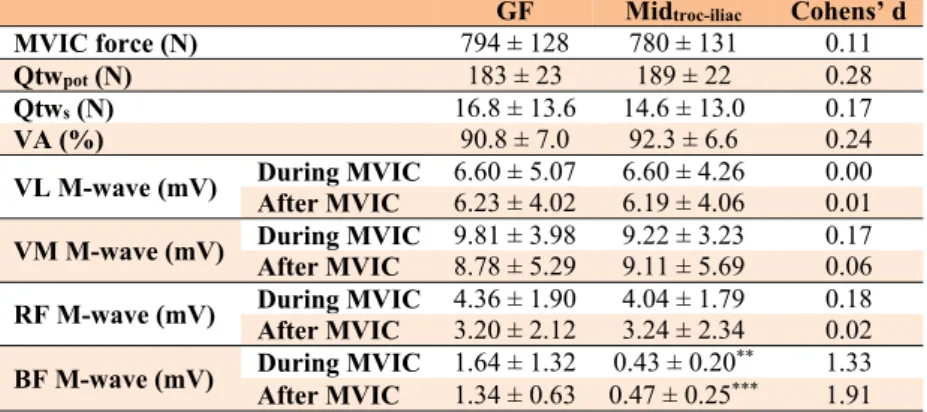
All parameters obtained during and after MVIC are re-ported in the Table 1. Difference between the two MVICs was 3.7 ± 3.1% and was not statistically significant. Qtwpot,
Qtws and VA did not differ between Midtroc-iliac and GF
placements. No significant differences were reported for VL, VM and RF M-wave amplitudes, during and after MVIC, between anode placements. However, BF M-wave amplitudes were greater for GF than Midtroc-iliac anode
placement during superimposed and rest stimulations (at least p < 0.01). No significant difference of BF M-wave amplitudes was found between superimposed and rest stimulations, regardless of anode placement (Table 1).
Discussion
The aim of the present study was to compare the recruit-ment of the antagonist muscles and its effect on the VA when the anode was positioned over the GF or Midtroc-iliac.
We hypothesized that for anode placed over the GF, the antagonist muscles would be more recruited, and thereby the VA would be overestimated. The results of the present study partially confirmed this assumption, since the antag-onist muscle’s recruitment was affected by the anode placement, but not VA.
The anode placement did not affect the recruitment of the agonist muscles, as observed by the lack of differ-ence in VL, VM and RF M-waves amplitudes, obtained during the recruitment curves and during/after MVIC for anode placed over the GF and Midtroc-iliac. However, the
re-cruitment of the antagonist muscles was significantly af-fected by the anode placement. BF M-wave was greater for GF than Midtroc-iliac for submaximal, optimal and
supramax-imal stimulation intensities (60-130% of the Iopt, Figure
1E). Greater recruitment of the antagonist muscles for GF than Midtroc-iliac anode placement was also observed during
and after MVIC (stimulus intensity: 150% of the Iopt).
Nev-ertheless, it is possible to argue that this increased BF M-wave amplitude may result from cross-talk contamination of the EMG signal from agonist muscles (Koh and Grabi-ner, 1992, Avrillon et al., 2018). If so, it should also have been observed for Midtroc-iliac placement. However, this was
not the case in the present study. It is then reasonable to consider that the M-wave recorded on the BF muscle re-flects recruitment of the antagonist muscles by electrical nerve stimulation when the anode was placed over the GF. These results could be explained by the fact that the GF placement could favor the recruitment of the KF, since the anode is situated close to the sciatic nerve. This pattern of recruitmentb of bantagonist muscles may translate into the
Piponnier et al. 677
Figure 1. (A) Unpotentiated single twitch (Qtwunpot); (B)
vastus lateralis (VL), (C) vastus medialis (VM), (D) rectus
femoris (RF), (E) biceps femoris (BF) M-waves amplitudes
re-cruitment curves, obtained with the anode placed over the gluteal fold (GF) and midway between the greater trochanter and the lower border of the iliac crest (Midtroc-iliac). ***:
Signif-icant difference at p < 0.001.
early plateauing of the evoked force, as observed in the pre-sent study. Indeed, Iopt was lower for GF than Midtroc-iliac
anode placement, suggesting that agonist muscles were fully activated earlier for GF placement, despite the fact that VL, VM and RF M-wave amplitudes did not differ be-tween anode placements. It is therefore reasonable to sug-gest that the intensity needed to evoke a maximal twitch force was actually underestimated, since antagonist mus-cles recruitment may blunt the twitch increment (Awiszus et al., 1997). Furthermore, the lower Qtwunpot for anode GF
placement at submaximal intensities (Figure 1A) suggested that agonist muscles M-wave threshold was higher for GF than Midtroc-iliac anode placement. This higher threshold
should translate into late plateauing of the Qtwunpot.
How-ever, the opposite was observed in the present study (lower Iopt for anode placed over the GF than Midtroc-iliac),
suggest-ing that the greater recruitment of the antagonist muscles impaired the net force production during the recruitment curve.
Alternatively, one may argue that (i) KF are weaker than KE (Szpala et al., 2015) and (ii) the antagonist recruit-ment was too weak, as evidenced by the small BF M-wave amplitudes (Fig. 1E), to influence the force output during the recruitment curve. The fact that anode placement did not affect Qtws, Qtwpot and VA estimation could support
this possibility. Additionally, the use of supramaximal stimulus intensity (150% of the Iopt) during the interpolated
twitch technique may ensure that agonist muscles are fully stimulated by electrical nerve stimulation (Millet et al., 2011). Then, the underestimation of the Iopt for GF anode
placement could be overcome by the use of supramaximal stimulus intensity when assessing Qtws, Qtwpot and VA.
With the current experimental approach, it is thus difficult to draw conclusions on the actual impact of KF recruitment on the reliability of KE VA and contractile properties at rest. However, it could be hypothesized that when KE force output is reduced but not KF, such as after a fatiguing protocol of the KE muscles, the effect of re-cruitment of the antagonist muscles on twitch amplitudes and VA could be more pronounced. Further studies are needed to confirm this assumption. In the meantime, to avoid the potential confounding effect of antagonist mus-cles recruitment, Midtroc-iliac anode placement should be
preferred to evaluate neuromuscular function of the KE muscles, owing to the reduced recruitment of the antago-nist muscles.
The interpolated twitch technique is a valid and re-liable method to estimate the voluntary activation (Behm et al., 1996), however this technique has some limitations. Methodological aspects should be considered, such as tim-ing of the superimposed stimulus, potentiation and type of the superimposed stimulus (single, doublet or multiple pulses) (Folland and Williams, 2007). While no difference in sensitivity of the interpolated twitch technique has been reported between single and doublet pulses (Behm et al., 1996), the signal to noise ratio in the present study could have been increased by using doublet stimulation (Place et al., 2007). In addition, in the present study the VA could be biased by the low sensitivity of the interpolated twitch technique at near maximal contractions intensities (Herbert
and Gandevia, 1999) and by the participants’ anticipation of the electrical stimulation that could result in lower MVIC level (Button and Behm, 2008). Nevertheless, it is unlikely that these limitations inherent in the interpolated
twitch technique would have biased the comparison be-tween the two anode placements or question the present conclusions since measurements were performed in the same conditions.
Table 1. Parameters obtained during and after maximal voluntary isometric contraction (MVIC) when the anode was positioned over the gluteal fold (GF) or midway between the greater
tro-chanter and the lower border of the iliac crest (Midtroc-iliac).
GF Midtroc-iliac Cohens’ d
MVIC force (N) 794 ± 128 780 ± 131 0.11
Qtwpot (N) 183 ± 23 189 ± 22 0.28
Qtws (N) 16.8 ± 13.6 14.6 ± 13.0 0.17
VA (%) 90.8 ± 7.0 92.3 ± 6.6 0.24
VL M-wave (mV) During MVIC 6.60 ± 5.07 After MVIC 6.23 ± 4.02 6.60 ± 4.26 6.19 ± 4.06 0.00 0.01 VM M-wave (mV) During MVIC 9.81 ± 3.98 After MVIC 8.78 ± 5.29 9.22 ± 3.23 9.11 ± 5.69 0.17 0.06 RF M-wave (mV) During MVIC 4.36 ± 1.90 After MVIC 3.20 ± 2.12 4.04 ± 1.79 3.24 ± 2.34 0.18 0.02 BF M-wave (mV) During MVIC 1.64 ± 1.32 After MVIC 1.34 ± 0.63 0.47 ± 0.250.43 ± 0.20***** 1.33 1.91
Qtwpot: Potentiated single twitch; Qtws: Superimposed single twitch; VA: Voluntary activation level; VL: Vastus lateralis; VM: Vastus medialis; RF: Rectus femoris; BF: Biceps femoris; ** and ***: Significant different from values for anode placed over the GF at p < 0.01 and p < 0.001, respectively.
Conclusion
Anode placement had an effect on the recruitment of an-tagonist muscles but not on VA during neuromuscular function assessment of the KE by electrical nerve stimula-tion. When the anode was placed over the GF, antagonist muscles recruitment was significant, inducing optimal in-tensity underestimation, but this placement did not affect the twitch interpolation outcome. However, to avoid any confounding influence of the recruitment of the antagonist muscles on the KE neuromuscular function assessment, Midtroc-iliac should be preferred to GF anode placement.
Acknowledgements
The authors are grateful to Pr. Geraldine Naughton for language edition and valuable comments during the preparation of the manuscript. The ex-periments comply with the current laws of the country in which they were performed. The authors have no conflict of interest to declare.
References
Avrillon, S., Hug, F. and Guilhem, G. (2018) Between-muscle differences in coactivation assessed using elastography. Journal of Electro-myography and Kinesiology 43, 88-94.
Awiszus, F., Wahl, B. and Meinecke, I. (1997) Influence of stimulus cross talk on results of the twitch-interpolation technique at the biceps brachii muscle. Muscle & Nerve 20(9), 1187-1190.
Behm, D.G., St-Pierre, D.M. and Perez, D. (1996) Muscle inactivation: assessment of interpolated twitch technique. Journal of Applied Physiology 81(5), 2267-2273.
Burke, D. (2002) Effects of activity on axonal excitability: implications for motor control studies. Advances in Experimental Medicine and Biology 508, 33-37.
Burke, D. and Gandevia, S.C. (1998) Influence of stimulus cross talk on results of the twitch-interpolation technique at the biceps brachii muscle. Muscle & Nerve 21(7), 970-971.
Button, D.C. and Behm, D.G. (2008) The effect of stimulus anticipation on the interpolated twitch technique. Journal of Sports Science & Medicine 7(4), 520-524.
Cohen, J. (1969) Statistical power analysis for Behavioral sciences. Aca-demic Press.
Desbrosses, K., Babault, N., Scaglioni, G., Meyer, J.-P. and Pousson, M. (2006) Neural activation after maximal isometric contractions at
different muscle lengths. Medicine and Science in Sports and Ex-ercise 38(5), 937-944.
Folland, J.P. and Williams, A.G. (2007) Methodological issues with the interpolated twitch technique. Journal of Electromyography and Kinesiology 17(3), 317-327.
Gandevia, S.C. (2001) Spinal and supraspinal factors in human muscle fatigue. Physiological Reviews 81(4), 1725-1789.
Herbert, R.D. and Gandevia, S.C. (1999) Twitch interpolation in human muscles: mechanisms and implications for measurement of vol-untary activation. Journal of Neurophysiology 82(5), 2271-2283. Hermens, H.J., Freriks, B., Disselhorst-Klug, C., and Rau, G. (2000)
De-velopment of recommendations for SEMG sensors and sensor placement procedures. Journal of Electromyography and Kine-siology 10(5), 361-374.
Koh, T.J. and Grabiner, M.D. (1992) Cross talk in surface electromyo-grams of human hamstring muscles. Journal of Orthopaedic Re-search 10(5), 701-709.
Martin, V., Millet, G.Y., Martin, A., Deley, G., and Lattier, G. (2004) As-sessment of low-frequency fatigue with two methods of electri-cal stimulation. Journal of Applied Physiology 97(5), 1923-1929. Merton, P.A. (1954) Voluntary strength and fatigue. The Journal of
Phys-iology 123(3), 553-564.
Millet, G.Y., Martin, V., Martin, A., and Vergès, S. (2011) Electrical stim-ulation for testing neuromuscular function: from sport to pathol-ogy. European Journal of Applied Physiology 111(10), 2489-2500.
Place, N., Maffiuletti, N.A., Martin, A., and Lepers, R. (2007) Assessment of the reliability of central and peripheral fatigue after sustained maximal voluntary contraction of the quadriceps muscle. Muscle & Nerve 35(4), 486-495.
Shield, A. and Zhou, S. (2004) Assessing voluntary muscle activation with the twitch interpolation technique. Sports Medicine 34(4), 253-267.
Szpala, A., Rutkowska-Kucharska, A. and Stawiany, M. (2015) Sym-metry of electromechanical delay, peak torque and rate of force development in knee flexors and extensors in female and male subjects. Acta of Bioengineering and Biomechanics 17(1), 61-68.
Taylor, J.L. (2009) Point: the interpolated twitch does/does not provide a valid measure of the voluntary activation of muscle. Journal of Applied Physiology 107(1), 354-355.
Piponnier et al. 679
Key points
Stimulation of the femoral nerve is commonly used to assess the neuromuscular function of the knee exten-sor muscles.
Anode placement over the gluteal fold favors the re-cruitment of the antagonist muscles (knee flexors) as compared to a placement midway between the iliac crest and the greater trochanter.
Anode placement over the gluteal fold induces an un-derestimation of the optimal stimulation intensity but as no effect on the determination of the maximal vol-untary activation level.
Dr. Enzo Piponnier
Université Clermont Auvergne - Laboratoire AME2P, 3 rue de la Chébarde, 63178 Aubiere Cedex, France
AUTHOR BIOGRAPHY
Enzo PIPONNIER Employment
Research engineer at the AME2P labor-atory, Clermont Auvergne University Degree
PhD
Research interests
The plasticity of the neuromuscular sys-tem in response to acute and chronic challenges such as growth and obesity. E-mail: [email protected] Ashref THORKANI
Employment
Physical education teacher in Tunisia. Degree
MSc
Research interests
The plasticity of the neuromuscular sys-tem in response to exercise
E-mail: [email protected] Firas ZGHAL
Employment
Teaching and research assistant at Côte d'Azur University in Nice.
Degree PhD
Research interests
The acute and chronic adaptations of neuromuscular system in sedentary indi-viduals, athletes and specific popula-tions such as elderly and individuals with intellectual disabilities.
E-mail:
[email protected] François COTTIN
Employment
Professor, at Paris Sud University. He’s currently the dean of the Faculty of Sport Sciences.
Degree PhD
Research interests
The acute and chronic adaptations and discrepancies during exercise and rest, under different environmental condi-tions, from interaction and analysis of the variability of physiological signals. E-mail: [email protected] Vincent MARTIN
Employment
Assoc. Prof., at Clermont Auvergne University. He’s currently the head of the AME2P laboratory.
Degree PhD
Research interests
The plasticity of the neuromuscular sys-tem in response to acute and chronic challenges such as growth, metabolic diseases, training and exercise-induced fatigue.

![[PDF] Eléments de programmation en Delphi](data:image/gif;base64,R0lGODlhAQABAIAAAP///wAAACH5BAEAAAAALAAAAAABAAEAAAICRAEAOw==)