The MIT Faculty has made this article openly available.
Please share
how this access benefits you. Your story matters.
Citation
Mieloszyk, Rebecca J., George C. Verghese, Kenneth Deitch,
Brendan Cooney, Abdullah Khalid, Milciades A. Mirre-Gonzalez,
Thomas Heldt, and Baruch S. Krauss. "Automated Quantitative
Analysis of Capnogram Shape for COPD–Normal and COPD–CHF
Classification." IEEE Transactions on Biomedical Engineering,
(Volume:PP, Issue:99). p.1-9.
As Published
http://dx.doi.org/10.1109/TBME.2014.2332954
Publisher
Institute of Electrical and Electronics Engineers (IEEE)
Version
Author's final manuscript
Citable link
http://hdl.handle.net/1721.1/88620
Terms of Use
Creative Commons Attribution-Noncommercial-Share Alike
Abstract—We develop an approach to quantitative analysis of carbon dioxide concentration in exhaled breath, recorded as a function of time by capnography. The generated waveform – or capnogram – is currently used in clinical practice to establish the presence of respiration as well as determine respiratory rate and end-tidal CO2 concentration. The capnogram shape also has
diagnostic value, but is presently assessed qualitatively, by visual inspection. Prior approaches to quantitatively characterizing the capnogram shape have explored the correlation of various geometric parameters with pulmonary function tests. These studies attempted to characterize the capnogram in normal subjects and patients with cardiopulmonary disease, but no consistent progress was made, and no translation into clinical practice was achieved. We apply automated quantitative analysis to discriminate between chronic obstructive pulmonary disease (COPD) and congestive heart failure (CHF), and between COPD and normal. Capnograms were collected from 30 normal subjects, 56 COPD patients, and 53 CHF patients. We computationally extract four physiologically based capnogram features. Classification on a hold-out test set was performed by an ensemble of classifiers employing quadratic discriminant analysis, designed through cross-validation on a labeled training set. Using 80 exhalations of each capnogram record in the test set, performance analysis with bootstrapping yields areas under the Manuscript received March 25, 2014; revised June 3, 2014; accepted June 12, 2014.
R.J. Mieloszyk and G.C. Verghese are with the Research Laboratory of Electronics and the Department of Electrical Engineering and Computer Science, Massachusetts Institute of Technology, Cambridge, MA 02139 USA (e-mails: [email protected]; [email protected]).
K. Deitch, B. Cooney, and A. Khalid are with the Department of Emergency Medicine, Einstein Medical Center, Philadelphia, PA 19141 USA (e-mails: [email protected]; [email protected]; [email protected]).
M.A. Mirre-González was with the Department of Emergency Medicine, Einstein Medical Center, Philadelphia, PA 19141 USA. He is now with the School of Medicine, Universidad Iberoamericana, Santo Domingo, Dominican Republic (e-mail: [email protected]).
T. Heldt is with the Institute for Medical Engineering and Science, the Research Laboratory of Electronics, and the Department of Electrical Engineering and Computer Science, Massachusetts Institute of Technology, Cambridge, MA 02139 USA (e-mail: [email protected]).
*B.S. Krauss is with the Division of Emergency Medicine, Boston Children’s Hospital, and the Department of Pediatrics, Harvard Medical School, Boston, MA 02115, USA (e-mail: [email protected]).
Copyright (c) 2013 IEEE. Personal use of this material is permitted. However, permission to use this material for any other purposes must be obtained from the IEEE by sending an email to [email protected].
receiver operating characteristic (ROC) curve of 0.89 (95% CI: 0.72-0.96) for COPD/CHF classification, and 0.98 (95% CI: 0.82-1.0) for COPD/normal classification. This classification performance is obtained with a run-time sufficiently fast for real-time monitoring.
Index Terms—Capnography, classification, ensemble learning, chronic obstructive pulmonary disease (COPD), congestive heart failure (CHF).
I. INTRODUCTION
APNOGRAPHY measures the partial pressure of carbon dioxide in exhaled breath (PeCO2) as a function of time or
exhaled volume. Capnography is an essential element of modern anesthesia and respiratory care, and is available in every operating room, intensive care unit, emergency department, and ambulance system in the United States and Canada. We consider only time-based capnography, which is the predominant form. This requires breathing normally with a nasal cannula, and is thus noninvasive and effort-independent. The resulting waveform, or capnogram, provides a graphic representation of PeCO2 as a function of time.
The capnogram is currently used to establish the presence of respiration and to determine respiratory rate and end-tidal PeCO2. However, the capnogram also exhibits a characteristic
shape related to ventilation and perfusion characteristics of the lung [1]–[3]. While visual inspection of capnogram shape can discern gross changes, it cannot reliably recognize and therefore systematically leverage small gradations in shape that may have diagnostic value.
Computational analysis of the capnogram was considered as early as the 1950s, but computing resources were not sufficient to support the endeavor [4]. Later studies largely focused on isolated evaluation of various numerical parameters and indices describing capnogram shape [5], [6].
We develop quantitative methods suited to automated real-time capnogram analysis, and apply these to distinguishing two of the most common cardiorespiratory diseases: chronic obstructive pulmonary disease (COPD) and congestive heart failure (CHF) [7]. COPD results from resistive obstruction to airflow on exhalation [8]. CHF is primarily a cardiac disease that can result in fluid buildup in the lungs, thus restricting
Automated Quantitative Analysis of
Capnogram Shape for
COPD–Normal and COPD–CHF Classification
Rebecca J. Mieloszyk, Student Member, IEEE, George C. Verghese, Fellow, IEEE, Kenneth Deitch,
Brendan Cooney, Abdullah Khalid, Milciades A. Mirre-González,
Thomas Heldt, Senior Member, IEEE, Baruch S. Krauss*
lung volume and movement, and impeding gas exchange [9]. Capnograms of obstructive lung disease (e.g., COPD and asthma) exhibit a characteristic “shark’s fin” shape, marked by significant curvature [5], [10], [11] that is thought to result from the staggered arrival of alveolar gas [3]. Comparatively little is known about capnogram morphology in spontaneously breathing patients with acute CHF and other restrictive lung diseases.
COPD and CHF present with similar symptoms, such as dyspnea, but have different pathophysiology and therefore require different clinical management [12]. In the clinical context, and especially in pre-hospital and emergency settings where determination of CHF and COPD may not be straightforward, a diagnostic test for rapid and accurate classification is crucial for initiating effective treatment. Current methods rely on history and physical examination, a non-point-of-care biomarker [13] when available, and spirometry, which requires forced exhalation and can be difficult to perform in children and patients with acute respiratory distress. Also of interest clinically is a noninvasive screening test, to distinguish between COPD and normal capnograms, for use in primary care and pre-operative testing. Here, we evaluate capnography as a noninvasive, real-time, and effort-independent approach to respiratory disease classification or screening.
Section II of the paper describes our data collection and partitioning procedures. Section III addresses capnogram preprocessing and classifier design using the training set. Performance results on the hold-out test set are described in Section IV. Finally, Section V concludes with a discussion of our results.
II. DATA COLLECTION AND PARTITIONING
A. Patient Population
Data were collected prospectively on a convenience sample of patients over a seven-year period (June 2006-April 2013) at three sites. Data on normal, healthy subjects were collected at Boston Children’s Hospital (BCH) and Massachusetts Institute of Technology (MIT), Cambridge, Massachusetts. The data collected at Einstein Medical Center, Philadelphia, Pennsylvania, were from COPD and CHF patients presenting to the emergency department (ED) with acute respiratory exacerbation. The study protocols for each site were approved by the applicable Institutional Review Boards.
B. Data Collection
Adult patients over 18 years old presenting to the Einstein Medical Center ED with a chief complaint of moderate to severe dyspnea underwent initial clinical assessment, including history, physical examination, and vital signs. Those who met the COPD or CHF eligibility criteria detailed in the Appendix were enrolled, and informed consent was obtained. These patients were seated and connected by nasal cannula to a portable capnograph (Capnostream 20, Oridion Medical, Needham, Massachusetts, USA), for a single recording of 10-30 minutes. The capnograph collects a continuous sample at a flow rate of 50 mL/min and records the instantaneous PeCO2
every 50 ms.
After informed consent was obtained from the normal subjects at BCH and MIT, the subjects were seated and connected by nasal cannula to a Capnostream 20 for a single recording (3 minutes at BCH; 15 minutes at MIT).
C. Data Partitioning
The data were collected, de-identified, and made available for analysis in two stages. Capnograms from the first stage constituted the training set; they were tagged with the appropriate labels (COPD, CHF, or normal) and used to develop and train our COPD/CHF and COPD/normal classification algorithms. Records from the second stage constituted the test set; the labels on these were initially withheld to permit blinded application of our algorithms to these records, and then revealed to allow final evaluation of performance. Analysis of the data from each stage was only undertaken after data collection for that stage was complete.
The labeled training set comprised 20 normal, 31 CHF, and 33 COPD subjects recorded in the first phase of data collection (Table I). The initially unlabeled hold-out test set comprised 10 normal, 22 CHF, and 23 COPD subjects. Four patients who presented with a mixed COPD/CHF picture were excluded, as prescribed by our criteria (see the Appendix).
III. PREPROCESSING AND CLASSIFIER DESIGN
A. Preprocessing
The steps involved in quantifying a capnographic record comprised: preprocessing to mark the onset and offset of each exhalation; construction of a template representing the average exhalation profile in the record; removal of outlier exhalations based on deviation from the template; and extraction of selected physiologically based features from each exhalation.
PATIENT NUMBERS AND DEMOGRAPHICS BY CLASS
Class Number of Records (Training/Test) Median Age (Years) Age Range (Years)
3
% Female
Normal 30 (20/10) 24 18 – 59 36.7
COPD 56 (33/23) 58 50 – 82 60.9
The onset and offset of each exhalation segment in every record were recognized algorithmically by the start of the positive and negative slope, respectively. A template exhalation was then constructed by superposing exhalations, each anchored at a PeCO2 of 15 mm Hg (a value that each
valid exhalation trace is expected to cross early in exhalation), and then computing the mean at each time point. The range of variation from the template was determined by computing, at each time point, the standard deviation of the superposed exhalations. An example template is shown in Figure 1.
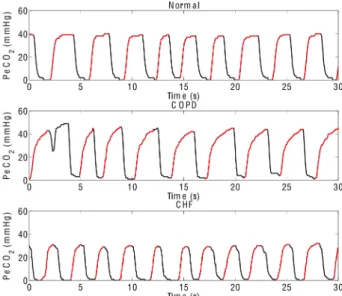
Atypical exhalations were recognized and excluded from consideration by using the capnogram template as an exemplary breath. Each exhalation was scored based on an aggregate measure of its deviation from the template exhalation, referenced to the appropriate standard deviation. Exhalations whose aggregate deviation exceeded a specified amount were excluded from analysis and classification. Results of preprocessing are illustrated in Figure 2, which shows sample capnograms from each class of subjects. The detected exhalation segment for each breath is highlighted.
After automated preprocessing of each record to eliminate outlier exhalations, the first 80 valid exhalations in each record were used for subsequent analysis. Typically, three to five outlier exhalations (but sometimes as many as 30) were eliminated from a record in the course of accumulating these 80 valid exhalations.
B. Feature Selection and Classifier Design
A classifier in the setting of this work is an algorithm that examines selected features of a capnographic record to decide which of two possible classes the record falls into. Our classification of the capnogram, as COPD versus CHF or as COPD versus normal, uses an ensemble-based method [14], [15] that aggregates the individual classifications or “votes” of 50 separate classifiers, referred to as “voters”. Each of these voters is designed or “trained” using a different subset of the training set. The aggregation of the votes of the 50 individual voters then generates the final classification of each record, via a threshold comparison of the relative numbers of votes for each class.
The individual voter's classification rule was obtained by quadratic discriminant analysis (QDA) [16], using features
extracted from 80 consecutive valid exhalations in each of a designated subset of the records in the training set. QDA generates a quadric surface in the feature space to separate the two classes. (In a 3-dimensional feature space, for instance, the separating surface would be some form of ellipsoid, paraboloid or hyperboloid.)
A voter designed through QDA is determined by its training data and a single design parameter. In a probabilistic setting, where two-class QDA corresponds to minimum-error-probability classification of samples from two multivariate Gaussian sub-populations, this parameter would reflect the relative prior probabilities or prevalences of the two classes. However, we used it only as a convenient tuning parameter.
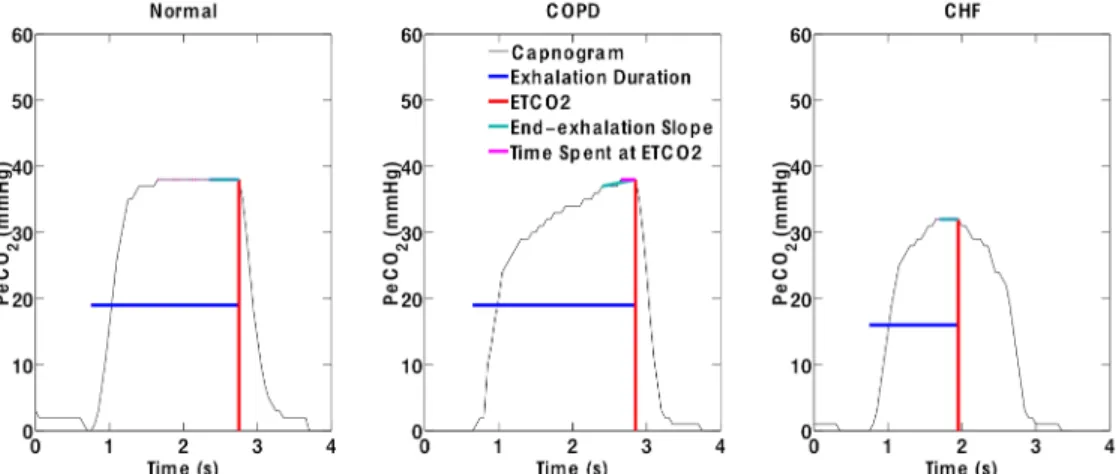
The four physiologically based features used for our voter design were selected through the cross-validation analysis described below, and comprised: exhalation duration; maximum PeCO2, or end-tidal PeCO2 (ETCO2); time spent at
ETCO2; and end-exhalation slope. Exhalation duration is the
time from exhalation onset to offset. Maximum PeCO2 is the
PeCO2 value at exhalation offset. Time spent at ETCO2 is the
duration for which PeCO2 remains at its maximum value. The
end-exhalation slope was computed as the slope of a straight line fit to the last five PeCO2 values of the exhalation. These
features are marked in the exhalations in Figure 3.
The training and voting for each voter take place in the four-dimensional space defined by the features. We pursued two approaches to this training and voting. In the
breath-by-breath approach, the features of each exhalation in the set of
breaths under consideration contribute a point to the feature space, so there are as many points as there are exhalations. In the feature-mean approach, the values of these respective features are averaged across all the exhalations under consideration in a given record to define a single point in the feature space.
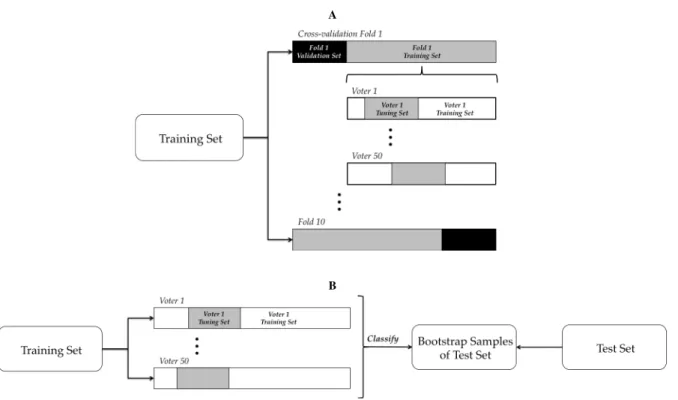
Classifier performance during the design stage was assessed using a 10-fold cross-validation strategy on the training set, as summarized in Figure 4A. A distinct 10% subset of the full training data was held out for validation in each fold, and an ensemble of voters was developed using the remaining 90% of
Fig. 1. Template exhalation from a COPD capnogram. Capnogram exhalations (blue) are aligned at 15 mmHg PeCO2 and then vertically
averaged to construct the capnogram template (red).
Fig. 2. Representative normal, COPD, and CHF capnograms, with the segment between each detected exhalation onset and offset highlighted in red.
the training data in the fold. Each of the 50 voters in the fold was designed using a randomly selected 70% of the available records in the fold, with the remaining 30% reserved for tuning of the parameter for that voter, to obtain minimum misclassification. The classification performance of the ensemble of trained voters on each fold was then evaluated on the held-out 10% validation set for the fold, using both the breath-by-breath approach and the feature-mean approach. The performance statistics over the 10 folds then defined the expected range of performance of our classification methodology.
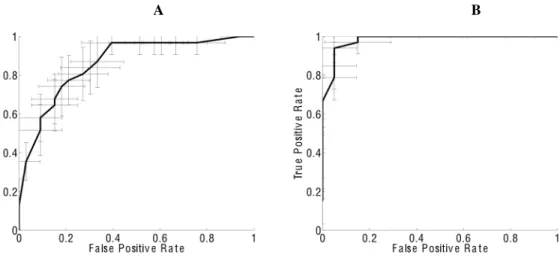
The receiver operating characteristic (ROC) curve for COPD/CHF classification on the training data was obtained by varying the voting threshold in 5% increments and plotting the fold-averaged sensitivity for CHF detection (versus COPD) as a function of the fold-averaged specificity, [17]. The results for the breath-by-breath approach using 80 exhalations are shown in Figure 5A. The indicated vertical and horizontal error bars show, for each threshold and across all folds, the minimum and maximum sensitivities and specificities, respectively. The area under the ROC curve (AUROC) is 0.87; the AUROCs across all cross-validation folds are in the range 0.80–0.94. Similarly, the ROC curve for COPD/normal classification on the training data (Figure 5B) shows sensitivity for COPD detection (versus normal) as a function of specificity. The AUROC is 0.98, with a range of 0.95–1.
The computations for preprocessing, feature extraction, 10-fold cross-validation, and ROC construction across the entire training set took under 2.7 minutes on a 2012 MacBook Pro laptop (Apple, Cupertino, California) with 4 GB RAM and a 2.2 GHz Intel Core i7 processor running MATLAB 2013a (MathWorks, Natick, Massachusetts).
C. Final Classifier Design
Having used cross-validation to delineate the expected range of performance of our classifiers, we constructed a final ensemble of 50 voters for classification of the hold-out test set in our COPD/CHF and COPD/normal applications. This ensemble was designed by the same process used during the cross-validation phase. However, now we employed the entire training set, rather than just a 90% cut associated with a fold (see the left half of Figure 4B).
The voting thresholds required to complete the specifications of the final COPD/CHF and COPD/normal classifiers were chosen using the training-set ROC curves (Figure 5). To minimize the dependence of classification accuracy on prevalence of the respective classes within the test set, we picked a threshold that yielded approximately equal sensitivity and specificity. The motivation for this is the following expression for the probability of correct classification:
P
C= (Sensitivity ⋅ P
+) + (Specificity ⋅ P
−)
(1)where P+ is the prevalence of the positive class and P− that of the negative class (soP++ P−= 1). If we choose an operating
point that corresponds to equal sensitivity and specificity, then
P
C= Sensitivity ⋅ (P
++ P
−) = Sensitivity = Specificity
(2)regardless of prevalence.
Accordingly, a threshold of 60% (corresponding to a sensitivity and specificity of approximately 0.78) was picked for COPD/CHF classification; this is the minimum percentage of votes that need to be CHF in order to classify a record as CHF (versus COPD). Similarly, a threshold of 50% (corresponding to a sensitivity and specificity of approximately 0.88) was picked for COPD/normal classification; this is the minimum percentage of votes that need to be COPD in order to classify a record as COPD (versus normal).
For comparison and as a benchmark, we also specified classifier thresholds for the ideal case in which we assume knowledge of the relative prevalences of the two classes within the test set (i.e., 22 CHF to 23 COPD, and 23 COPD to 10 normal). If the relative prevalences of the two classes are known, then it turns out that PC is maximized by choosing an operating point for which a line of slope P−/ P+ is tangent to the ROC curve [18]. Accordingly, the threshold in this case was chosen so that a line of appropriate slope (i.e., 23/22 and 10/23 respectively for COPD/CHF and COPD/normal classification) was tangent to the nominal training-set ROC
Fig. 3. Four features extracted from the capnogram and used for classification. These comprise exhalation duration, end-tidal CO2 (ETCO2), end-exhalation
slope, and time spent at ETCO2.
curve. This resulted in a threshold of 60% for COPD/CHF and 40% for COPD/normal.
IV. CLASSIFIER PERFORMANCE
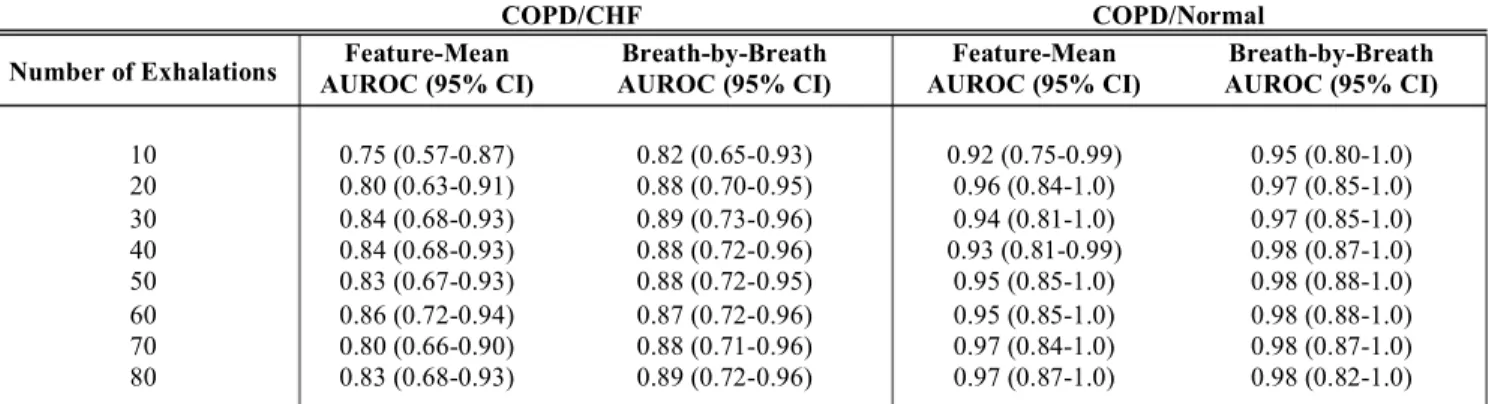
The performance of the final classifier was evaluated on the hold-out test set. The various results described below are summarized in Tables II and III.
Bootstrapping [19] (see the right side of Figure 4B) was used to generate ROC curves with associated confidence intervals to delineate the expected range of classifier performance. Running the classifiers using the breath-by-breath approach with 80 exhalations on 1,000 bootstrapped samples of the test set for 5% increments in threshold generated the ROC curve for COPD/CHF classification (Figure 6A), with an AUROC of 0.89 (95% CI: 0.72–0.96). The ROC curve for COPD/normal classification (Figure 6B) had an AUROC of 0.98 (95% CI: 0.82–1.0).
When the threshold was picked to yield approximately equal sensitivity and specificity on the training set (thus minimizing the dependence on prevalence), accuracy on the test set for COPD/CHF classification was 75.6% (95% CI: 62.2%-86.7%). Accuracy for COPD/normal classification was 93.9% (95% CI: 81.8%-100%). These performance metrics were computed over 1,000 bootstrap samples of the test set.
For comparison, picking a threshold under the ideal assumption that the relative class prevalences are known resulted in a COPD/CHF classification accuracy of 80.0% (95% CI: 66.7%-88.9%), while COPD/normal classification accuracy remained at 93.9% (95% CI: 81.8%-100%).
The computation of the final voter ensembles, followed by feature extraction, preprocessing, bootstrap resampling, and evaluation across the entire test set to produce the results in
Table II took under 1.5 minutes using the same computing platform as for training.
We also explored the variation in performance that resulted when the classifiers were designed and tested using fewer exhalations and more aggregated (i.e., feature-mean rather than breath-by-breath) measures of the features, see Table III. The indicated number of exhalations was used in each case for both classifier design and testing. Note for example that with just 30 exhalations, and using the feature-mean approach, we obtained an AUROC of 0.84 (95% CI: 0.68-0.93) for COPD/CHF classification and 0.94 (95% CI: 0.81-1.0) for COPD/normal classification.
V. DISCUSSION AND CONCLUSION
We have developed an automated approach to quantitative capnogram analysis and classification. Capnograms were characterized through selected physiologically based features, which were then used by an ensemble of classifiers to distinguish COPD, CHF, and normal records. This approach exhibited good classification performance and a run-time sufficiently fast for real-time monitoring.
Although several morphologies of the capnogram have been observed and correlated with pulmonary function tests [11], [20], automated preprocessing, analysis, and classification based on these features have not been developed. While prior studies have focused on obstructive lung disease, the capnogram in acute CHF has not previously been quantitatively characterized.
Our approach differs from prior approaches in several distinctive ways. A record-specific template for preprocessing contrasts with the use of fixed, pre-defined cutoffs on duration and amplitude of the capnogram [5]. The template used in our
A
B
Fig. 4. Cross-validation for classifier design (A) and bootstrapping for final classifier evaluation (B).
work enables adaptation to individual variations and permits a wider range of capnograms to be analyzed.
Previous work relied on features such as slopes, angles, and curvature measures localized around the transition between the ascending phase and the alveolar plateau of the capnogram [5]. In contrast, we used features that capture different aspects of the entire expiratory phase. In addition to ETCO2, our
cross-validation analysis extracted three features (end-exhalation slope, (end-exhalation duration, and time spent at ETCO2) from the candidate set, selected for their effectiveness
in distinguishing among COPD, CHF, and normal subjects. Though we explored several machine learning approaches for classification, the QDA framework for voter design, combined with ensemble classification, consistently performed well and required only a modest amount of training data. Such voting methods are known to enhance effectiveness over that of a single classifier alone [14], [15]. Bootstrapping allowed the final performance to be assessed statistically, thus providing bounds on classification accuracy [19]. There are several potential limitations to this study. In patients
presenting with a mixed picture of CHF and COPD, clinical assessment (medical history, physical examination, and diagnostic testing) was made to determine whether the current exacerbation was primarily CHF or COPD. Patients for whom such a determination could not be made were excluded from the study. Further investigation of such indeterminate presentations will be necessary for potential application in the clinical setting.
In our database, the age distribution of subjects varied across classes (Table I). While COPD and CHF subjects tend to be older, normal subjects in our database had a median age of 24 years (range 18–59 years). However, the capnography literature makes no reference to age dependence of the normal capnogram in this range or older, for adults with normal lung function in the absence of cardiopulmonary disease [10, 21, 22].
The analysis framework presented in this paper is aimed at automated real-time discrimination of cardiopulmonary diseases by capnogram shape. The computational approach allows small gradations in shape to be recognized and applied
A B
Fig. 5. Training-set ROC curves (obtained by varying the voting threshold in 5% increments) using breath-by-breath classification on 80 consecutive valid exhalations, and an ensemble of 50 voters. (A) COPD/CHF classification (AUROC 0.87) and (B) COPD/normal classification (AUROC 0.98).
A B
Fig. 6. Test-set ROC curves (obtained by varying the voting threshold in 5% increments) using breath-by-breath classification on 80 consecutive valid exhalations, and an ensemble of 50 voters. (A) COPD/CHF classification (AUROC 0.89) and (B) COPD/normal classification (AUROC 0.98).
to capnogram characterization and classification. Future work should extend this approach to enable tracking of changes in disease severity and response to treatment over time. A further task is to expand the application of this framework to other cardiorespiratory disorders. Our results suggest that automated capnogram analysis has the potential to be useful in clinical settings as a noninvasive, real-time, and effort-independent diagnostic and screening tool.
APPENDIX:PATIENT ENROLLMENT CRITERIA
1) COPD
For COPD enrollment, inclusion was based on having at least one of the following: history of COPD diagnosis, history of wheezing, chronic cough, chronic sputum production, dyspnea on exertion, long term bronchodilator use, or long-term exposure to tobacco smoke or occupational dusts. Exclusion criteria were intubation, clinical signs of cardiopulmonary instability, major trauma, shock, sepsis, pregnancy, or a hospital discharge diagnosis that did not include COPD.
We recorded physical examination findings, vital signs at time 0 and 30 minutes, the Medical Research Council breathlessness scale for COPD, clinical assessment of severity, medications given and interventions done prior to and during data collection, and discharge diagnosis. We also verified that the diagnosis was supported by inpatient pulmonary function testing.
2) CHF
For CHF enrollment, inclusion criteria were a b-type natriuretic peptide (BNP) level exceeding 100 pg/mL, and meeting two of the major Framingham criteria (or one major and two minor criteria, provided the minor ones could not be attributed to another medical condition) [23]. Exclusion criteria were intubation, clinical signs of cardiopulmonary instability, echocardiographic changes inconsistent with CHF or left ventricular dysfunction, major trauma, shock, sepsis, pregnancy, or a hospital discharge diagnosis that did not include CHF.
We recorded demographic data, physical examination findings, vital signs at time 0 and 30 minutes, the New York Heart Association criteria of heart failure, clinical assessment of severity, BNP levels, medications given and interventions done prior to and during data collection, and discharge diagnosis. We also verified that the diagnosis was supported by inpatient echocardiography and cardiac catheterization, when performed.
In patients presenting a mixed picture of CHF and COPD, clinical assessment was made as to whether the current exacerbation was primarily CHF or COPD. Patients for whom such a determination could not be made were excluded from the study.
3) Normals
For the BCH normals study, subjects were enrolled from ED staff at the hospital. Normal, healthy subjects (as
TABLEII
SUMMARY OF TRAINING-SET AUROCVALUES FOR AND TEST-SET AUROC AND ACCURACY VALUES
TRAINING TESTING
Classification Task AUROC (Range) AUROC (95% CI) Accuracy (95% CI)
Diagnostic (COPD/CHF) 0.87 (0.80–0.94) 0.89 (0.72–0.96) 75.6% (62.2%–86.7%)
Screening (COPD/Normal) 0.98 (0.95–1.0) 0.98 (0.82–1.0) 93.9% (81.8%–100%)
The summarized results were obtained through breath-by-breath classification of 80 consecutive exhalations. TABLEIII
TEST-SET AUROCVALUES FOR DIFFERENT NUMBERS OF EXHALATIONS
COPD/CHF COPD/Normal
Number of Exhalations AUROC (95% CI) Feature-Mean AUROC (95% CI) Breath-by-Breath AUROC (95% CI) Feature-Mean AUROC (95% CI) Breath-by-Breath
10 0.75 (0.57-0.87) 0.82 (0.65-0.93) 0.92 (0.75-0.99) 0.95 (0.80-1.0) 20 0.80 (0.63-0.91) 0.88 (0.70-0.95) 0.96 (0.84-1.0) 0.97 (0.85-1.0) 30 0.84 (0.68-0.93) 0.89 (0.73-0.96) 0.94 (0.81-1.0) 0.97 (0.85-1.0) 40 0.84 (0.68-0.93) 0.88 (0.72-0.96) 0.93 (0.81-0.99) 0.98 (0.87-1.0) 50 0.83 (0.67-0.93) 0.88 (0.72-0.95) 0.95 (0.85-1.0) 0.98 (0.88-1.0) 60 0.86 (0.72-0.94) 0.87 (0.72-0.96) 0.95 (0.85-1.0) 0.98 (0.88-1.0) 70 0.80 (0.66-0.90) 0.88 (0.71-0.96) 0.97 (0.84-1.0) 0.98 (0.87-1.0) 80 0.83 (0.68-0.93) 0.89 (0.72-0.96) 0.97 (0.87-1.0) 0.98 (0.82-1.0)
The same number of exhalations is used in both training and testing, and for both breath-by-breath and feature-mean classification. The computed 95% confidence intervals after bootstrapping the test set are also listed.
expiratory flow measurement in most cases) without a history of asthma or smoking were enrolled, and informed consent obtained. For the MIT normals study, subjects were enrolled from students at the university. Normal, healthy subjects without a history of asthma or smoking were enrolled, and informed consent obtained.
ACKNOWLEDGMENTS
R.J.M.’s work was supported by an ASEE NDSEG fellowship. She thanks J.V. Guttag, R.G. Mark and Y.- C. Kuo of MIT for helpful conversations. G.C.V. and T.H. are grateful for sustained support and encouragement by T. Kailath of Stanford University.
REFERENCES
[1] W. Fowler, “Lung function studies III: Uneven pulmonary ventilation in normal subjects and in patients with pulmonary disease,” J. Appl. Physiol., vol. 2, pp. 283–299, 1949.
[2] R. Sikand, P. Cerretelli, and L. E. Farhi, “Effects of Va and Va/Q distribution and of time on the alveolar plateau,” J. Appl. Physiol., vol. 21, no. 4, pp. 1331–1337, 1966.
[3] A. DuBois, R. Fowler, A. Soffer, and W. Fenn, “Alveolar CO2 measured by expiration into the rapid infrared gas analyzer,” J.
Appl. Physiol., vol. 4, pp. 526–534, 1952.
[4] J. W. Bellville and J. C. Seed, “Respiratory carbon dioxide response curve computer,” Science, vol. 130, pp. 1079–1083, 1959. [5] B. You, R. Peslin, C. Duvivier, V. D. Vu, and J. P. Grilliat,
“Expiratory capnography in asthma: Evaluation of various shape indices,” Eur. Respir. J., vol. 7, pp. 318–323, 1994.
[6] C. V Egleston, H. Ben Aslam, and M. A. Lambert, “Capnography for monitoring non-intubated spontaneously breathing patients in an emergency room setting,” J. Accid. Emerg. Med., vol. 14, pp. 222– 224, 1997.
[7] J. B. West, Pulmonary Pathophysiology: The Essentials, Lippincott Williams & Wilkins, 2011.
[8] P. J. Barnes, “Chronic obstructive pulmonary disease,” N. Engl. J.
Med., vol. 343, no. 4, pp. 269–280, 2000.
[9] M. Jessup and S. Brozena, “Heart failure,” N. Engl. J. Med., vol. 348, no. 20, pp. 2007–2018, 2003.
[10] B. Smalhout and Z. Kalenda, An Atlas of Capnography, Netherlands: Kerckebusch Zeist, 1975, p. 111.
[11] J. E. Kelsey, E. C. Oldham, and S. M. Horvath, “Expiratory carbon dioxide concentration curve a test of pulmonary function,” Chest, vol. 41, no. 5, pp. 498–503, 1962.
[12] N. M. Hawkins, M. C. Petrie, P. S. Jhund, G. W. Chalmers, F. G. Dunn, and J. J. V McMurray, “Heart failure and chronic obstructive pulmonary disease: diagnostic pitfalls and epidemiology,” Eur. J.
Hear. Fail., vol. 11, pp. 130–139, 2009.
[13] A. S. Maisel, P. Krishnaswamy, R. M. Nowak, J. McCord, J. E. Hollander, P. Duc, T. Omland, A. B. Storrow, W. T. Abraham, A. H. B. Wu, P. Clopton, P. G. Steg, A. Westheim, C. W. Knudsen, A. Perez, R. Kazanegra, H. C. Herrmann, and P. A. McCullough, “Rapid measurement of b-type natriuretic peptide in the emergency diagnosis of heart failure,” N. Engl. J. Med., vol. 347, pp. 161–167, 2002.
[14] T. G. Dietterich, “Ensemble methods in machine learning,” Lect.
Notes Comput. Sc., vol. 1857, Springer, pp. 1–15, 2000.
[15] R. E. Schapire, Y. Freund, P. Bartlett, and W. S. Lee, “Boosting the margin: A new explanation for the effectiveness of voting methods,”
Ann. Stat., vol. 26, no. 5, pp. 1651–1686, Oct. 1998.
[16] C. M. Bishop, Pattern Recognition and Machine Learning, Springer, 2006, p. 738.
[17] T. Fawcett, “An introduction to ROC analysis,” Pattern Recogn.
Lett., vol. 27, pp. 861–874, 2006.
[18] T. K. Moon and W. C. Stirling, Mathematical Methods and
Algorithms for Signal Processing, Prentice Hall, 2000, p. 202.
[19] A. C. Davison and D. V Hinkley, Bootstrap Methods and Their
Application, Cambridge Univ. Press, 1997, p. 216.
Schmitt, and J. L. Falk, “Capnogram shape in obstructive lung disease.,” Anesth. Analg., vol. 100, no. 3, pp. 884–888, 2005. [21] R. D. Miller, Miller's Anesthesia, Elsevier Health Sciences, 2010. [22] P. G. Barash, B. F. Cullen, and R. K. Stoelting. Clinical Anesthesia.
Lippincott Williams & Wilkins, 2012.
[23] P. A. McKee, W. P. Castelli, P. M. McNamara, and W. B. Kannel, “The natural history of congestive heart failure: the Framingham study,” N. Engl. J. Med., vol. 285, no. 26, pp. 1441–1446, 1971.
Rebecca J. Mieloszyk (M’07) received
the B.S. degree in electrical and computer engineering from Carnegie Mellon University, Pittsburgh, PA, in 2010 and the S.M. degree in electrical engineering and computer science from the Massachusetts Institute of Technology (MIT), Cambridge, MA, in 2012.
Since 2011, she has been a graduate student researcher in the Computational Physiology and Clinical Inference Group at MIT. Her research interests include automated learning from medical data and physiological modeling. In 2010, she was awarded the National Defense Science and Engineering Graduate Fellowship.
George C. Verghese (M’74–SM’78–
F’98) received the B.Tech. degree from the Indian Institute of Technology, Madras, India, in 1974, the M.S. degree from the State University of New York, Stony Brook, in 1975, and the Ph.D. degree from Stanford University, Stanford, CA, in 1979, all in electrical engineering.
Since 1979, he has been with the Massachusetts Institute of Technology, Cambridge, where he is now the Henry Ellis Warren (1894) Professor of Electrical and Biomedical Engineering in the Department of Electrical Engineering and Computer Science, and a MacVicar Faculty Fellow. He is also a member of MIT's Research Laboratory of Electronics. His research interests and publications are in the areas of dynamic systems, modeling, estimation, signal processing, and control, and their applications in biomedicine and power systems.
Dr. Verghese has served as an Associate Editor for the IEEE Transactions on Automatic Control and the IEEE Transactions on Control Systems Technology, and has co-authored a textbook and co-edited a monograph in the area of power electronics.
Kenneth Deitch received the B.A. degree
in Government from St. Lawrence University, Canton, NY, in 1992, and the Doctor of Osteopathic Medicine from the Western University Of Health Science, College of Osteopathic Medicine of the Pacific, Pomona, CA, in 1999. He completed a residency in Emergency Medicine at Einstein Medical Center, Philadelphia, PA, in 2003.
Since 2003, he has remained at Einstein Medical Center as an Attending Physician, and was Research Director from 2010-2014, and a member of the IRB from 2006-2013. He is an associate professor of emergency medicine at Thomas Jefferson University, Philadelphia, PA. His research interests and publications are in the areas of procedural sedation and analgesia in the emergency department, safety monitoring during sedation, capnography, and clinical adverse event prediction modeling. Dr. Deitch has served as a reviewer for the Annals of Emergency Medicine, Academic Emergency medicine, and Pediatrics.
Brendan Cooney received the B.A.
degree in Biology from La Salle University in 2006, and the M.D. degree from Jefferson Medical College, Philadelphia, PA, in 2010.
From 2010 to 2013, he worked at Einstein Medical Center, Philadelphia, PA, as a Lead Research Coordinator. He is currently working in industry with a concentration on Phase I oncology research.
Abdullah Khalid received his bachelors in medicine (MBBS) from Nishtar Medical College, Multan, Pakistan. He worked at Einstein Medical Center, Philadelphia, PA, as a Research Coordinator.
He is currently completing his Internal Medicine residency training at the University of Pittsburgh Medical Center (UPMC) Mercy Hospital, Pittsburgh, PA.
Milciades A. Mirre-‐González obtained
his M.D. degree at Universidad Nacional Pedro Henríquez Ureña, Santo Domingo, Dominican Republic, in 2005. Since then, he has worked in primary and tertiary settings, medical education, research, health information technology, and volunteer settings. He served on the faculty of the medical school at Universidad Iberoamericana (UNIBE) in Santo Domingo for 5 years. From 2011 to 2013, he worked as Research Associate and Research Coordinator at Einstein Medical Center Philadelphia’s Emergency Medicine Department. Currently, he is on the faculty at O&M Medical School (allied with Partner's Harvard Medical International) and at UNIBE, both in Santo Domingo. His research interests are in clinical practices in emergency and critical care medicine, as well as medical education.
Thomas Heldt (M'06–SM'11) studied
physics at Johannes Gutenberg-‐ Universität, Mainz, Germany, Yale University, New Haven, CT, and the Massachusetts Institute of Technology (MIT), Cambridge, MA. In 2004, he received the Ph.D. degree in Medical Physics from the Harvard University-‐ MIT Division of Health Sciences and Technology, and commenced postdoctoral training at MIT's Laboratory for Electromagnetic and Electronic Systems.
He joined the MIT faculty in 2013 as the Hermann L.F. von Helmholtz Career Development Professor in the Institute for Medical Engineering and Science and as Assistant Professor of Electrical and Biomedical Engineering. Prior to joining the MIT faculty, he was a Principal Research Scientist at MIT's Research Laboratory of Electronics. His research interests focus on signal processing, mathematical modeling, and model identification to support real-‐time clinical decision making.
Dr. Heldt serves as Associate Editor of the Cardiovascular & Respiratory Systems Engineering Theme for the annual IEEE Engineering in Medicine and Biology Conference and is a member of the Cardiopulmonary Systems Technical Committee.
Baruch S. Krauss received the A.B.
degree from Sarah Lawrence College, Bronxville, NY, the Ed.M. degree from Harvard Graduate School of Education, Cambridge, MA, and the M.D. degree from State University of New York at Stony Brook, NY. He is a fellow of the American Academy of Pediatrics and of the American College of Emergency Physicians.
He was elected to the American Pediatric Society in 2010. He is currently a pediatrician at Boston Children's Hospital and an Associate Professor of Pediatrics at Harvard Medical School. His research interests include procedural sedation in children and diagnostic monitoring with capnography in children and adults.