HAL Id: tel-01127487
https://tel.archives-ouvertes.fr/tel-01127487
Submitted on 7 Mar 2015HAL is a multi-disciplinary open access archive for the deposit and dissemination of sci-entific research documents, whether they are pub-lished or not. The documents may come from teaching and research institutions in France or abroad, or from public or private research centers.
L’archive ouverte pluridisciplinaire HAL, est destinée au dépôt et à la diffusion de documents scientifiques de niveau recherche, publiés ou non, émanant des établissements d’enseignement et de recherche français ou étrangers, des laboratoires publics ou privés.
services : Application to interoperability problems
Mayleen Lacouture
To cite this version:
Mayleen Lacouture. A chemical programming language for orchestrating services : Application to interoperability problems. Software Engineering [cs.SE]. Ecole des Mines de Nantes, 2014. English. �NNT : 2014EMNA0011�. �tel-01127487�
Mayleen L
ACOUTURE
Mémoire présenté en vue de l’obtention du
grade de Docteur de l’École nationale supérieure des mines de Nantes
sous le label de l’Université de Nantes Angers Le Mans
École doctorale : Sciences et technologies de l’information, et mathématiques Discipline : Informatique et applications, section CNU 27
Unité de recherche : Laboratoire d’informatique de Nantes-Atlantique (LINA) Soutenue le 31/10/2014
Thèse n°: 2014 EMNA 0011
A Chemical Programming Language for
Orchestrating Services
Application to Interoperability ProblemsJURY
Rapporteurs : MmeIsabelle BORNE, Professeur des universités, Université de Bretagne-Sud
M. Pascal POIZAT, Professeur des universités, Université Paris Ouest Nanterre la Défense
Examinateurs : M. Achour MOSTEFAOUI, Professeur des universités, Université de Nantes
M. David BROMBERG, Maître de conférences, LABRI – Université de Bordeaux Segalen
Directeur de thèse : M. Mario SÜDHOLT, Professeur de l’Institut Mines-Télécom, Ecole des Mines de Nantes Co-directeur de thèse : M. Hervé GRALL, Chargé de Recherche, Ecole des Mines de Nantes
Acknowledgments xi
Introduction xiii
1 Towards an Orchestration Language 1
1.1 From Distributed Computing to Service-Oriented Computing 2
1.1.1 Fundamentals of Distributed Computing. . . 3
1.1.1.1 Communication Models . . . 4
1.1.1.2 Fault Tolerance . . . 7
1.1.2 Distributed Programming . . . 9
1.1.2.1 Communication and Synchronization . . 10
1.1.2.2 Parallelism . . . 12
1.1.2.3 Fault Tolerance . . . 15
1.1.2.4 Implementation Pitfalls . . . 16
1.1.3 Service-Oriented Computing . . . 18
1.1.3.1 Basic Concepts . . . 19
1.1.3.2 Interoperability in Service-Oriented Com-puting. . . 22
1.2 Working With Data: How to Represent Resources . . . . 26
1.2.1 Inductive Data Types . . . 28
1.2.2 The Relational Model . . . 30
1.2.3 Semistructured Data . . . 33
1.3 Specification of an Orchestration Language . . . 39
1.3.1 Requirements for Service Orchestration . . . 40
1.3.2 Service Orchestration in Practice . . . 45
2 Starting point: The Heta-calculus 51 2.1 Background . . . 52
2.1.1 Formal Models for Service-Oriented Computing . . 52
2.1.2 Foundations of the Heta-calculus . . . 57
2.1.3 Logic Programming . . . 59
2.2 Design Decisions . . . 60
2.3 A Chemical Calculus for Orchestration . . . 68
2.3.1 Introspective Chemical Abstract Machine . . . 70
2.4 Validation against Requirements . . . 79
2.4.1 Distribution and Concurrency. . . 79
2.4.1.1 Global Message Passing Architecture . . 80
2.4.1.2 Local Shared Memory Architecture . . . 82
2.4.1.3 Fault Tolerance . . . 83
2.4.2 Parallelism . . . 83
2.4.3 Services and Resources. . . 91
3 Criojo: the Heta-calculus made concrete 95 3.1 Programming with Criojo in Scala . . . 95
3.1.1 Defining Agent Behavior. . . 96
3.1.1.1 Agent Introspection . . . 98
3.1.1.2 CriojoAdapters . . . 99
3.1.1.3 Modularity and Composition . . . 101
3.1.2 Distribution in Criojo . . . 102
3.1.3 More Examples . . . 104
3.1.3.1 Concurrent programming: the π-calculus 104 3.1.3.2 Functional Programming . . . 106
3.1.3.3 Sequential Programming: a Variant of Di-jkstra’s Guarded Commands Language . 108 3.1.3.4 Logic programming . . . 110
3.2 Towards an Efficient Implementation . . . 112
3.2.1 Hierarchy of Communicating Agents . . . 113
3.2.2 Chemical Evaluation of Local Reduction Rules . . 116
3.2.2.1 From the Operational Semantics to an Eval-uation Algorithm . . . 117
3.2.2.2 Rule Evaluation with Automata . . . 119
3.3 Implementation Details . . . 123
3.3.1 Rule Reification . . . 124
3.3.2 Implementing Criojo’s Adapters . . . 125
3.3.3 Type System . . . 125
3.3.4 Communication Layer . . . 128
4 Pivot for Interoperability 133 4.1 The Pivot Architecture. . . 134
4.2 Pivot Architecture . . . 135
4.2.1 Adaptation: the Adapter Pattern . . . 136
4.2.2 Integration: the Facade Pattern. . . 140
5 Conclusion 147
5.1 Future work . . . 150
A R´esum´e ´Etendu 155 A.1 Introduction. . . 155
A.1.1 Contributions . . . 157
A.2 Vers un Langage pour l’Orchestration de Web Services . . 159
A.2.1 Exigences pour Orchestration de Service . . . 159
A.2.1.1 Orchestration des services dans la pratique162 A.3 Le Heta-calcul . . . 164
A.4 Criojo Pratique . . . 167
A.4.1 Programmation avec Criojo en Scala . . . 167
A.4.1.1 D´efinition des Agents . . . 167
A.4.2 Vers une implementation efficace . . . 169
A.5 Une Solution Pivot pour les Probl`emes d’Interop´erabilit´e. 172 A.5.1 L’architecture Pivot . . . 173
A.5.2 Impl´ementation avec Criojo . . . 173
A.5.2.1 Adaptation : le Patron Adaptateur . . . 174
A.5.2.2 Coordination : le Patron Mediateur . . . 175
A.6 Les Travaux `a Venir . . . 177
A.6.1 La causalit´e et la communication synchrone . . . . 177
A.6.2 Parall´elisation. . . 177
A.6.3 Ex´ecution de r`egles optimales . . . 177
A.6.4 Int´egration . . . 178
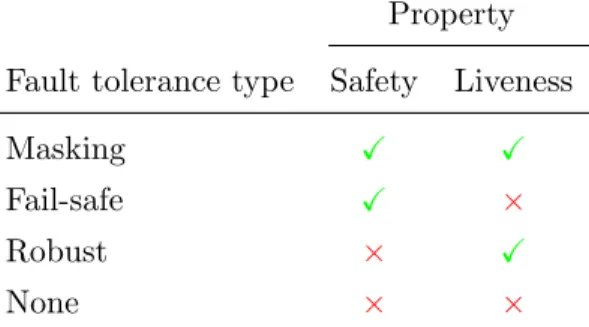
1.1 Fault tolerance type according to whether safety and
live-ness are preserved. . . 8
1.2 Variations of message passing and shared memory commu-nication models. . . 10
1.3 Parallelism in Programming Languages. . . 15
1.4 Requirements for Service Orchestration . . . 46
1.5 Satisfaction of the Requirements in Practice . . . 49
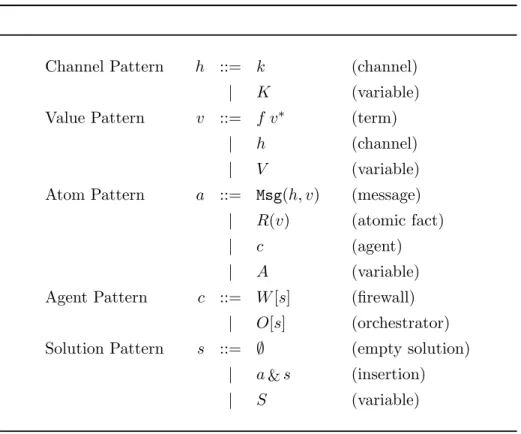
2.1 Introspective Chemical Abstract Machine – Syntax . . . . 71
2.2 Introspective Chemical Abstract Machine – Semantics . . 73
2.3 Heta-calculus – Syntax . . . 75
2.4 Heta-calculus – Semantics – Generic Rules for Communi-cation . . . 75
2.5 Heta-calculus – Semantics – Local Rules . . . 76
5.1 Heta-calculus – Validation against Requirements . . . 149
5.2 Criojo– Validation against Requirements . . . 151
A.1 Satisfaction des Exigences en Pratique . . . 163
A.2 Machine Chimique Abstraite Introspective – Syntaxe . . . 164
A.3 Machine Chimique Abstraite Introspective – S´emantique . 165 A.4 Heta-calculus – Validation contre les Besoins . . . 166
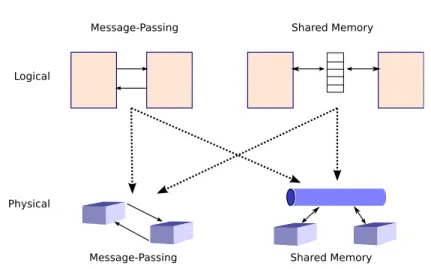
1.1 Languages based on message-passing can be implemented on a hardware system with shared memory, and vice-versa. 3
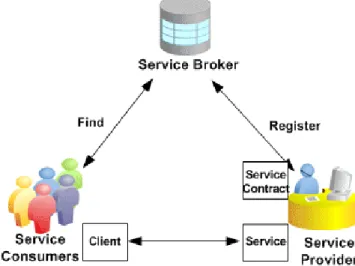
1.2 Discovery (Credit: Oracle) . . . 5
1.3 Dynamic topology . . . 18
1.4 Enterprise Service Bus (Credit: MIT Press [GP09]) . . . . 25
3.1 A Sierpinski triangle generated with sierpinskiAgent . . 102
3.2 Class Diagram – Components of the Architecture. . . 113
3.3 The state machine corresponding to the rule A(x) & B(x, y) → C(x, y) after receiving the atoms B1(a, b), A2(c), and A3(a). . . . 122
3.4 General schema for rule definition and execution. . . 123
3.5 Regular Atoms and Native Atoms. . . 126
3.6 Criojo’s Term Grammar . . . 126
3.7 Communication Model – Example with HTTP . . . 129
3.8 Implementation of communication layer. . . 130
4.1 YQLQuery Execution . . . 137
4.2 Adaptation: Criojo Component Replacing YQL Service . 137 4.3 Detail of the Criojo Component . . . 138
4.4 Integrating Picasa and Flickr.. . . 146
4.5 Coordinating a YQL script and a Haskell program with Criojo. . . 146
A.1 Diagramme de Classes – Composants de l’Architecture. . 169
A.2 La machine d’´etats correspondant `a la r`egle A(x) & B(x, y) → C(x, y) apr`es avoir re¸cu les atomes B1(a, b), A2(c), et A3(a). . . . 171
A.3 YQL Execution de la Requˆete . . . 174
A.4 Adaptation: Le Composant Criojo Remplace le Service YQL174 A.5 D´etail du Composant Criojo . . . 175
I would specially like to thank my advisor Herv´e Grall for his expertise, understanding, and patience. I appreciate his participation in all the stages of my research project always providing his help and advice. I would like to thank all the members of the Ascola team for their support. A very special thanks go to Mario S¨udholt who accepted to be my director of thesis, whose advice and support were important for the real-isation of this thesis.
I must also thank Isabelle Borne and Pascal Poizat who participated as reviewers of my thesis, providing valuable remarks and suggestions. I would like to thank Achour Mostefaoui and David Bromberg for their participation as examiners.
Special thanks also to the secretary staff for all the moments in which their assistance helped me along the way.
Finally, I would like to thank my family for the understanding and support they provided, specially my husband, Vincent, whose love and encouragement helped the completion of this thesis.
With the emergence of cloud computing and mobile applications, it is possible to find a web service for almost everything. A service is a com-puter program that provides a set of operations accessible from a network address. Client programs on the web interact with the service using HTTP messages. Thanks to the variety of available web services, developers can create complex applications by combining several independent ser-vices, whose arrangement and execution can be automated with the aid of orchestration languages.
Nevertheless, the diversity of technologies and the lack of standardiza-tion can hinder the collaborastandardiza-tion between services. Imagine for instance that you are writing a mobile application that allows users to publish, manage and share their photos. For storing and managing the photos there are several online services, with Flickr being one of the most pop-ular. By using the Flickr application programming interface, you im-plement an application that communicates with this service. But once the application gains in popularity, more and more users would like to be able to use other alternative services like Picasa. However, Flickr and Picasa differ not only in the way photos are organized, but also on the protocols and technologies they use to provide their services. By protocols we mean the way in which messages are organized to complete common tasks, like searching and editing: while Flickr directly provides a variety of more or less complex operations, Picasa relies on client libraries that perform the same tasks by combining the basic HTTP methods GET, POST, etc. From a technological point of view, although both services provide REST programming interfaces, Flickr also allows clients to use SOAP and XML-RPC.
Thus, we face interoperability problems due to the heterogeneity of the different services. In this respect, we have identified three types of problems, namely adaptation, integration and coordination, that can be described using the photo management example.
Adaptation: the client application that orchestrates Flickr services must be adapted to orchestrate the services supplied by Picasa
or other providers.
Integration: the client application has to orchestrate both Picasa and Flickrservices by defining a common data model and interface. Coordination: from the point of view of the languages used in the
or-chestration of web services, existing scripts written in different lan-guages need to be coordinated for cooperating in the orchestration of the services provided.
Middleware infrastructures are usually proposed for solving interop-erability problems in the form of bus architectures with a central compo-nent that translates messages. Nevertheless, a complete solution requires a universal representation of resources. Our approach, analogous to these works, consists of a pivot architecture that integrates different orches-tration languages with heterogeneous service providers around a pivot language, thus allowing the implementation of typical programming pat-terns: the adapter pattern for solving adaptation problems, the facade pattern for solving integration problems, and the mediator pattern for solving coordination problems. The challenge remains to find the ade-quate orchestration language that can be used as a pivot language.
The thesis of this dissertation is that the chemical programming paradigm, which has already been studied as a solution for service oriented program-ming [BP09], can provide the foundations for an orchestration language in a pivot architecture. Concretely,
• we present a new orchestration language, called Criojo, which im-plements and extends an original calculus1 based on a chemical abstract machine (cham) dedicated to service-oriented computing,
• we show how the orchestration language can be used to define a pivot architecture.
The consequence of adopting the approach we have developed would be an improvement in the interoperability of services and orchestration languages, thus easing the development of composite services. The high level of abstraction of Criojo could allow developers to write very con-cise programs since message exchanges are represented in a natural and
1
The calculus, called Heta-calculus, has been designed by Thesis Adviser Herv´e Grall.
intuitive way. These programs could be used not only as effective orches-trations, replacing orchestrations written in traditional languages, but also as prototypal orchestrations, giving a clear specification for concrete orchestrations written in traditional languages. Moreover, the formal foundations of Criojo provide a specification of the core of an orchestra-tion language for a pivot architecture, which leads to many advantages, not only during the development phase of the language but also during the specification and the validation phases of orchestrations written in the language.
• The formal specification being clear and concise eases the language implementation, avoiding the pitfalls often encountered in stan-dards, as in the orchestration language BPEL [HHH10];
• The formal specification provides the theoretical basis of useful tools for specifying, testing and verifying orchestrations.
Organization of the dissertation. We have organized this disserta-tion as follows.
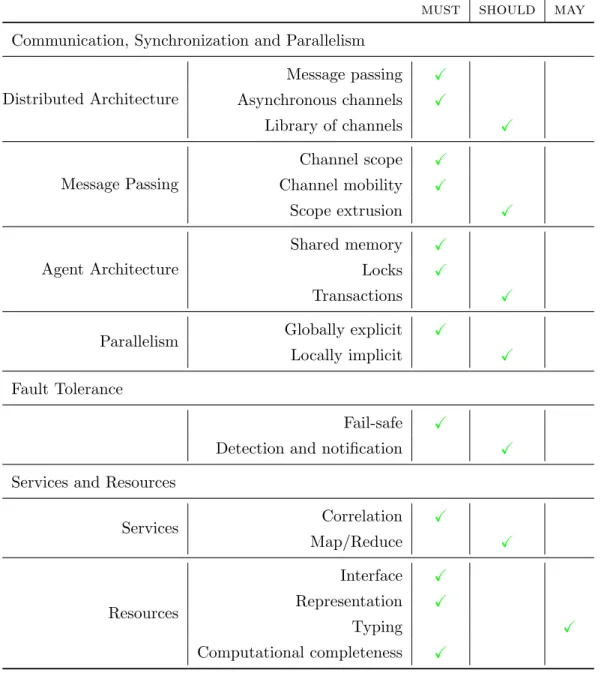
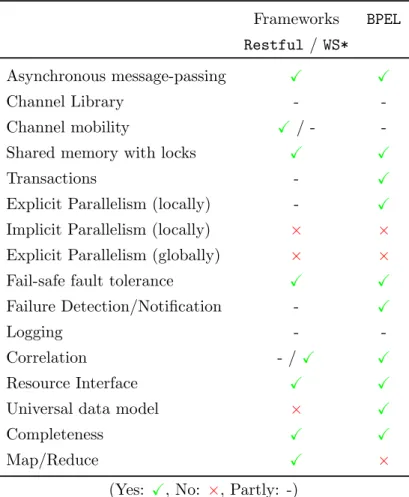
• In Chapter1, we give an overview and a state of the art of service-oriented computing. We begin with the fundamental concepts of distributed computing that lead later to service oriented comput-ing, with the objective of finding the required characteristics that a language for the orchestration of web services must have. We finish the chapter with a specification, in the form of a list of re-quirements for an orchestration language, integrating aspects for service-oriented computing and data computing.
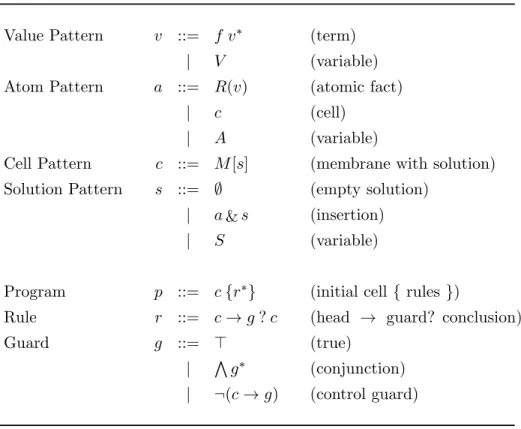
• In Chapter2, we present the chemical calculus, called Heta-calculus. After the specification given in th previous chapter, we describe the development process, following a standard V-model. After a state of the art presenting previous works that led to the Heta-calculus, the chapter presents
– the design decisions that have been made,
– the calculus, with its syntax and its chemical semantics, – the validation against the requirements.
• In Chapter 3, we show how the theoretical concepts of the Heta-calculus lead to practical applications in the form of a programming language called Criojo, which we describe as a language for writing chemical reaction rules. The practical aspects of Criojo are treated from the point of view of the developer, in the form of a tutorial, and from the point of view of the implementer with a set of guidelines for possible implementations in different host languages.
• In Chapter4, we continue with the practical aspects of the language, by showing the real applicability of the prototype in the context of web services. With the aid of Criojo as the language at the core of a pivot architecture, we solve interoperability problems in the case of photo management with web applications like Picasa and Flickr. We present an example for each of the problems listed above, and propose a solution based on a design pattern whose implementation is eased by the pivot architecture.
• The last chapter concludes with a discussion of our results, what we have learnt and the perspectives that arise from the results of our work.
Contributions. Finally, this dissertation makes the following contri-butions:
• a well-reasoned definition of a set of requirements for an orchestra-tion language,
• the formulation of all the design decisions that have been made for the design of the chemical calculus and its validation against re-quirements, in addition to the presentation of the original calculus,
• a prototype implementation of an orchestration language called Criojo, based on the theoretical foundation given by the chemi-cal chemi-calculus, described from the points of view of a programmer and an implementer respectively,
• especially, a set of helpful extensions that ease the programming of real world applications, like the ability to interface with external functions and resources,
• a method for the development of different solutions to interoper-ability problems, in the form of a pivot architecture using Criojo as a pivot language.
Towards an Orchestration
Language for Web Services
Orchestration is the automated arrangement and execution of different autonomous processes. Accordingly, an orchestration language for web services allows to program new web services by specifying the composition and coordination of existing services. In this chapter we study the state of the art on service-oriented computing with the objective of defining a solution space from which the requirements for an orchestration language can be drawn.
The first part of this chapter is dedicated to languages for service-oriented programming. Actually, we start with the basis of distributed computing, since distributed computing provides the foundations for service-oriented computing. Indeed, service-service-oriented computing can be consid-ered as a ”computing paradigm that utilizes services as fundamental ele-ments to support rapid, low-cost development of distributed applications in heterogeneous environments. The promise of Service-Oriented Com-puting is a world of cooperating services that are being loosely coupled to flexibly create dynamic business processes and agile applications that may span organizations and computing platforms, and can adapt quickly and autonomously to changing mission requirements” [GP09, chap. 1]. With the advent of the Web, and the associated Web services, service-oriented computing now represents a new generation platform for distributed com-puting. It is the reason why we study some fundamental notions for dis-tribution, like the different communication and synchronization models, key elements in the definition of the language.
The second part covers another important aspect of any program-ming language, which is the representation of data and the computation over these representations. Concretely, we focus on the representation of resources, which can be accessed and manipulated via services.
Finally, from the state of the art we draw a set of requirements for an orchestration language, integrating aspects for service-oriented computing
and data computing. These requirements form the specification for the development of the Heta-calculus and of Criojo, presented in the next chapters.
1.1
From Distributed Computing to Service-Oriented
Computing
Distributed computing deals with computations that involve multiple agents, in other words, with distributed computations involving communication. These agents are in fact autonomous computation units which collab-orate with each other to form a distributed system. According to the mechanism used to collaborate, there exist two models for distributed computing: one is based on message-passing, the other is based on shared memory. Distributed computing introduces new concerns that cannot be tackled with traditional sequential programming. Therefore distributed programming requires programming languages dedicated to distribution. On the logical level, languages for distributed programming are based on one of the two models of distributed computing, but distribution also occurs at other levels: hardware, systems and middleware over which programs will execute. Hence an important implementation issue is that the distribution model of the concrete and logical level may differ, and different combinations between models at the concrete and logical level are possible, as shown in Figure 1.1: a language based on a message-passing model can be implemented on a system with shared memory and vice-versa.
Before coming into the core of the section, it is important to note the difference between concurrency, parallelism, and distribution, three concepts that somehow overlap. Parallelism is the property of multi-ple activities executing simultaneously. Concurrency is a more general concept than parallelism, where activities may not execute at the same physical time, but execute at the same logical time: it is a form of virtual parallelism. Clearly, distribution implies both parallelism and concur-rency: activities are distributed over agents executing in parallel, and at the same time each agent may execute in a concurrent way, when deal-ing with communications and local computations. For instance, consider an agent that sends a request to the Picasa server and continues to op-erate while waiting for a response. When the answer finally arrives, it has to deal with both the incoming message and current computations.
Message-Passing Shared Memory
Message-Passing Shared Memory Physical
Logical
Figure 1.1: Languages based on message-passing can be implemented on a hardware system with shared memory, and vice-versa.
However, distributed programming is traditionally regarded as indepen-dent from concurrent and parallel programming since each of these forms addresses different kinds of problems. Distributed programming tackles communication, synchrony and fault tolerance problems, while concur-rent programming addresses problems related to resource sharing, and parallel programming addresses problems related to performance. Never-theless, in this thesis we adopt a different point of view since we consider that distributed programming encompasses concurrent and parallel pro-gramming.
Finally, distributed computing leads to service-oriented computing. Contrary to a class of distributed systems, which are built from highly coupled components to solve a specific computational problem, service-oriented systems are more loosely coupled and more open: they allow complex applications to be built by combining several independent com-ponents called services. Thus, service-oriented computing is a specific instance of distributed computing.
1.1.1 Fundamentals of Distributed Computing
A distributed system is a set of autonomous computational units, here called agents, that collaborate to give the aspect of a single coherent system [TS06, p.2]. To collaborate, it is necessary to establish a com-munication mechanism between agents. To act as a coherent system,
agents must be synchronized [LL90]. To be reliable, the system needs to continue functioning in the presence of faults. Thus, the design of distributed systems relies on three fundamental aspects: communication, synchronization and fault tolerance.
1.1.1.1 Communication Models
In the mainstream models of distributed computing, a system is repre-sented as a set of autonomous nodes or agents, which execute in paral-lel and interact with each other by exchanging messages [LL90]. These are called message-passing models. Other models of distributed comput-ing represent communication between agents via a shared memory space. These are called shared-memory models.
Shared-Memory Models. In the literature, shared-memory models relate mostly to parallel or concurrent computing. Nevertheless, shared-memory computing is sometimes treated as a particular case of highly coupled distributed computing. In a shared-memory model agents com-municate by writing and reading registers in a shared memory space, which can be centralized or distributed. Access to the shared memory can be uniform (UMA), with all the processors having the same oppor-tunity and access time, or non-uniform (NUMA). An important issue in shared-memory models is to ensure the mutual exclusion between critical sections, namely to prevent two agents from accessing the same shared register at the same time.
Message-Passing Models. In message-passing models, the system is represented as a communication graph, where arcs between nodes cor-respond to communication links between agents, called channels. Two nodes connected by a link can send messages directly to one another. Communication graphs can be directed or undirected, representing one-way or two-one-way communications, respectively. A typical implementation resorts to firewalls for controlling communication: a firewall may for-bid communication over some channels. Moreover, some models assume that the topology of the system changes dynamically as new links are created between nodes thanks to discovery and redirection. We refer to this as channel mobility, a notion introduced by the π-calculus [MPW92a,
One good example of channel mobility is a discovery scenario in a service-oriented architecture, as presented in Figure1.2. Whenever a client agent needs a service, it sends a look-up request to the broker managing a ser-vice registry and providing the run-time discovery of serser-vices. In this way, the location of a service can change without affecting the clients. However, channel mobility raises the problem of channel scopes with
re-Figure 1.2: Discovery (Credit: Oracle)
spect to firewalls: if a channel traverses as data a firewall that forbids any communication over this channel, then either the firewall maintains the prohibition, or it drops it, allowing scope extrusion [MPW92a, Ex. 3].
Message-passing models abstract away from the details of communi-cation, which can be decomposed into five steps.
Production: A source agent produces a message. Emission: The same agent sends the message.
Routing: The network routes the message to its destination. Reception: The target agent receives the message.
Consumption: The same agent consumes the message.
A latency between production and emission, during routing and between reception and consumption is possible and can be modeled as a relation
between agents clocks and communication delays. If the total delay is unbounded, communication is said asynchronous. If it is (logically) null, communication is said synchronous. As a result of the distinction between production and emission on the one hand, and reception and consumption on the other hand, communication is often modeled with buffers to hold input and output messages. Buffers can be finite or infinite, depending on their capacity to hold messages. Infinite buffers is the most common assumption given the great capabilities of real systems. Synchronization is necessary in distributed systems, as in any concurrent system, as agents need to be coordinated to achieve a specific goal. Assume for instance a task A that must be executed only after a task B has executed (serial-ization). In a centralized context, synchronization depends on schedulers based on a centralized clock, which rule the execution of agents. How-ever, in a distributed system this is impossible, since each process has its own clock, which may drift from other agents’ clocks. Thus, distributed systems are by definition asynchronous. Nevertheless, it is possible to establish relations between the independent times of agents by means of communication. The more restrictive form of synchronization is syn-chronous communication, where sending and receiving events occur at the same theoretical time. Since this simultaneity is impossible due to physical conditions, synchronous communication is rather defined as a communication where the sender remains blocked waiting for its request to be accepted. It is therefore possible to simulate synchronous com-munication with asynchronous comcom-munication. The problems related to this translation and its inverse are discussed later in Section 1.1.2.4. The more liberal form of synchronization is asynchronous communication: it allows to assert that the emission event has happened before the reception event, and nothing else. There are intermediate forms of synchronization, allowing the preservation of the order between messages from production to consumption. Thus, the causal order is preserved when the buffers im-plement a first-in first-out (FIF0) discipline and the network imim-plements a synchronous communication [MF95].
As an example of a message passing system, think of a client agent that communicates with a Flickr or Picasa server agent. To retrieve a list of photos from the server, the client sends a message containing a user identifier, some search criteria, and the location of the channel where it would like to receive the answer. Thanks to the channel information, the server knows where to send the response directly to the client. The
communication is asynchronous, since the delay between the request and the response is unbounded. Nevertheless, if the client agent has previously sent a message to assign tags to some of the photos, producing an effect over the search result, the preservation of the order between the two messages is necessary to maintain consistency.
Finally, shared memory models can be implemented with message-passing, by having one or more processes that control the access to shared variables. Then, variables can be accessed with request and response messages. Nevertheless, the fault tolerance of the system can be compro-mised since the halting of any process managing shared variables implies the halting of the complete system.
1.1.1.2 Fault Tolerance
Fault tolerance, or the capacity of functioning in the presence of faults, is an important aspect of distributed systems, since they are inherently er-ror prone: faults can have many origins, either agents or the network. In a distributed system, the behavior of a process can be modeled as a tran-sition system led by communication events. A fault is then represented as a transition firing an error, which may lead to a deviation with respect to the specification of the system [G¨99], in other words, to a failure. Let us illustrate these terms with an example. Consider the function
int f( ) { x: = 1 ; y: = 0 ;
return x + ( x/y ) ; }
There is a fault in the program since variable y is initialized with zero while being a divisor. This fault produces an execution error if the func-tion is called, leading eventually to a failure which is the interrupfunc-tion of the program. According to G¨artner, a model for fault tolerance is based on some class of faults and offers some level of tolerance with respect to the faults in the class. Traditional classes consider Byzantine, omis-sion and crash faults respectively [LL90]. Byzantine faults are arbitrary faults: they can model any fault, which occurs due to the misbehavior of a process or of the network. An omission fault occurs when a process fails to communicate due to problems in the communication network. A crash fault occurs when a process stops working, reaching an invalid state from which it cannot recover. Mechanisms for fault tolerance aim at avoiding
failures, in other words at satisfying all the properties required by the specification of the system, despite faults. It is possible to classify these mechanisms by resorting to a current decomposition of these specifica-tion properties: indeed they can be subsumed under the conjuncspecifica-tion of a safety property and a liveness property [AS85], where the safety property asserts that nothing bad ever happens and the liveness property asserts that something good will eventually happen [Lam77]. For instance, a safety property can be defined as a conjunction of local invariants, but also as a global invariant. A typical example is consistency, a property as-serting that for all the clients of a resource, their own view of the resource and its original value are consistent: if a client modifies a resource, any subsequent request sees the modification. A liveness property is often de-fined as a termination property or an availability property. For example, in a client-server interaction, it can assert that any request terminates with a response, in other words, that the service is always available.
The decomposition into safety and liveness directly leads to four types of fault tolerance, according to whether the safety and liveness properties are preserved or not respectively. The resulting combinations are shown in Table1.1.
Property Fault tolerance type Safety Liveness
Masking X X
Fail-safe X ×
Robust × X
None × ×
Table 1.1: Fault tolerance type according to whether safety and liveness are preserved.
The strongest form of fault tolerance is masking fault tolerance, which transparently preserves the safety and liveness of the system in the pres-ence of a fault. On the other hand, the weakest form of fault tolerance is to do nothing, which does not guarantee any property. The remaining two intermediate forms guarantee either only safety or only liveness. These are called fail-safe and robust fault tolerance, respectively. The preservation of both safety and liveness may require a trade-off: thus, serializability
(or linearizability), a strong notion of consistency, and availability are incompatible for a service [GL12]. Either a weaker notion of consistency must be adopted or availability must be sacrificed.
The protection mechanisms for fault tolerance are mainly based on redundancy, used for detection and correction [G¨99]. Redundancy essen-tially avoids the loss of resources to be fatal: it corresponds not only to replications [CBPS10] but also to superfluous additions, like logging or different kinds of checks. Detection and correction allow errors to be circumvented. Precisely, error detection enables an erroneous state to be identified; error correction enables to recover from an error, either by bringing the system to a correct state in a backward or forward way, or by compensating the error. For example, in a transaction management system, a protection mechanism is to keep a log of the modifications sus-tained by the system during a transaction. When an error is detected before the transaction is committed, the log is used to correct the error by reverting the modifications. In this way the system returns to a correct state.
1.1.2 Distributed Programming
Distributed programming differs in many aspects from sequential pro-gramming. For this reason, specialized languages have been designed to handle communication and synchronization between computation units that execute in parallel, and to handle detection and recovery of errors, which are more prone to happen in distributed applications. Thus, the aspects of distributed computing that we discussed before translate into essential requirements that languages for distributed programming must satisfy:
• mechanisms for communication and synchronization,
• mechanisms for parallel execution, and
• a support for error detection and recovery [Bal90].
One additional question that is treated in the more general context of concurrent programming is the sharing of resources when multiple clients try to access and modify the same resource. This translates into an additional requirement related to communication and synchronization: a concurrency control mechanism.
From the implementation point of view, programming languages must deal with the configuration of the execution level, which not always matches the choices made for communication, parallelism and fault toler-ance at the language level. We begin by presenting the different alterna-tives for fulfilling the different requirements and conclude by discussing the issues related to the implementation at the execution level.
1.1.2.1 Communication and Synchronization
In the previous section we presented the two main communication models for distributed systems: message-passing and shared-memory. There are several variations of the two models implemented by existing languages for distributed programming, as shown in Table 1.2.
Communication Message Passing Synchronous Rendez-Vous RPC Asynchronous Shared Memory Variables Tuples Logical variables
Table 1.2: Variations of message passing and shared memory communi-cation models.
Message-passing. Message passing can be synchronous or asynchronous. In synchronous message-passing, the sender and the receiver synchronize at some point during their execution, corresponding to a rendez-vous or a Remote Procedure Call (RPC). In the rendez-vous model, first intro-duced by the Ada programming language, the sender and the receiver synchronize at specific interaction points, where they can exchange infor-mation synchronously. Afterwards, both participants continue their ex-ecution in parallel. RPC is a procedure call between distributed agents, where the sender invokes a procedure and rests blocked during the exe-cution of the procedure. Unlike rendez-vous, the receiver does wait for the invocation to occur. An example of RPC is Java’s Remote Method Invocation [WRW96].
In asynchronous message passing, the sender does not wait for its message to be accepted. The communication can be point-to-point or broadcast. A point-to-point communication is a direct exchange between sender and receiver. Hewitt’s actor model [HBS73] is an example of asyn-chronous point-to-point communication: actors are logical entities that execute in parallel and communicate by directly sending messages to one another via mailboxes. Messages are stored in mailboxes in the same order they arrive, waiting to be retrieved by the actor. The actors model is im-plemented by languages like Erlang, and more recently Scala. Contrary to point-to-point communication is broadcast communication, where a sender publishes a message for several known (multicast) or unknown re-cipients. The idea of broadcast programming was introduced by Gehani in his Broadcasting Sequential Processes (BSP) [Geh84], where agents communicate by broadcasting in order to implement a particular pro-gram. Broadcasting is often used in algorithms for game programming such as the alpha-beta algorithm, where a set of slave agents is in charge of calculating all possible moves.
Shared memory. The alternative to message-passing is communica-tion via variables in a shared memory space. The advantage of this type of communication is that modifications have immediate effect, contrary to message-passing, where there is a delay between sending and receiving of a message. Moreover, messages can be broadcasted as multiple agents can access the same variable. Nevertheless, languages based on shared memory must provide mechanisms to avoid race conditions. Efficient for avoiding race conditions, mutual exclusion is often implemented with the help of locks. To enter into a critical section, the lock protecting a re-source must be free: it then becomes acquired. At the end of the critical section, the lock is released. Beyond critical sections, transactions allow sequences of actions to become an atomic, indivisible, action. There are two classical approaches for implementing transactions. The pessimistic approach prevents conflicts from happening. There are two predominant solutions, the first one based on locks and a two-phase protocol [BHG87, chap. 3], the second one based on timestamps [BHG87, chap. 3]: in both cases, at each access, a control is done, possibly resulting in blocking or aborting. The optimistic approach [Her90] is more liberal. During the execution, initial read accesses are effectively executed whereas write ac-cesses are virtually executed over a copy. At the commit time, there is
a validation phase, followed if it is successful by a write phase perform-ing the real write accesses. These approaches are effectively applied in software transactional memory [LR06], that is memory equipped with a software transactional mechanism, as in database management systems.
Shared-memory architectures are typical of sequential programming languages providing a notion of threads, like Java or Haskell: a program decomposes into multiple threads that execute concurrently or even in parallel on multicore machines, and share a memory space. We now focus on shared memory in a distributed context.
One example is Linda’s tuple space (TS) [ACG86], where information is stored in the form of tuples that can be added and retrieved by process with the three following operations:
out ("foo", 42) Adds the tuple to TS. The tuple can then be queried by any of its components. in ("foo", int x) Removes the tuple from TS. In this case the
first parameter “foo” serves as key. read("foo", int x) Consults the tuple without removing it. Conflicts are avoided as tuples cannot be modified in situ: a tuple can be read by multiple agents, but modified only by the process that removes it from the TS. Thus, no blocking is needed.
Another example of shared variables are logical shared variables, which are used in logic languages like Concurrent Prolog [Sha86]. In this model agents communicate via logical variables, which are assigned a value by unification during goal reduction. Binding is irreversible and once a value is assigned to a variable, it cannot be changed. For example, the following two agents communicate and synchronize with the variable X:
A( X ? , Y ) , C ( X ) .
Note that only process C is allowed to bind X, while A can only read the variable. Thus a variable in a shared memory is transformed into a communication channel.
1.1.2.2 Parallelism
The most common way to express parallelism is by representing each par-allel task as a virtual process, executing on a sequential processor with its own state. At the opposite side, sequential tasks can be composed as a unique virtual process, sequentially executing. Generally speaking,
the execution of tasks can be abstracted as a graph of task dependen-cies: there is a link from task T1 to task T2 if the execution of T1 must immediately precede the execution of T2. A task can be executed if all preceding tasks have been executed.
Parallel tasks can be expressed in the form of statements, objects, functions, logical clauses or processes.
• Statements can be grouped to execute in parallel. An example of this approach is Occam [BEZ92], a language based on CSP. In an Occam program each line or statement corresponds to a process. The keywords SEQ and PAR allow the programmer to specify which statements execute sequentially or in parallel:
SEQ PAR
x := x + 1 x := z + 1
y := x * x y := z * z
More recently, the languages Java and Scala provide a framework for parallel collections, with the statement granularity1.
• Objects are analogous to processes in that they have an internal state and data. Thus, objects can be allowed to execute in parallel, and to send and receive messages. This representation is exemplified by the actors model implemented in an object-oriented language like Scala.
• Functions in pure functional languages can be executed in paral-lel, provided they do not have data dependency, thanks to refer-ential transparency. Nevertheless, this approach on its own may be inefficient, since forking on small calculations produces an un-necessary overhead. Thus, constructs for explicit parallelism and explicit sequentiality may be necessary. This is the case of Parallel Haskell[JS08]:
(1) par f g (2) seq f g
1
In the first expression f is sparked, i.e. queued to execute as a new thread, while g is evaluated immediately. Alternatively, the second expression forces f to be evaluated before g.
• Logical clauses allow the expression of parallelism due to their declar-ative nature. Take for instance the following program in Concurrent Prolog:
A :- B, C, D.
A :- E, F.
The procedural interpretation of this expression is: to prove goal A it is necessary to prove subgoals B,C and D or subgoals E and F. In Concurrent Prolog, these clauses are also interpreted in terms of processes: each goal is a process, and each conjunction of goals forms a network of processes that communicate via shared vari-ables. Parallelism is achieved by reducing several processes in par-allel (AND-parpar-allelism), or by trying in parpar-allel each clause, in order to reduce a process (OR-parallelism).
• Processes are coarse-grained parallel tasks. They can be heavy, as in operating systems, or light like threads in many programming languages like Java or Haskell.
Note that it is possible for a programming language to combine different methods for expressing parallelism. In the case of Parallel Haskell, in addition to the par and seq functions, the language provides a threading control function called forkIO that runs an expression as a new thread. Another example is Smalltalk [GR83], an object oriented language based on message-passing: in this language parallel tasks correspond to either processes or objects.
Parallelism can be explicit or implicit. In a programming language, parallelism is said explicit if there is a construct that is directly interpreted as a parallelization in the graph of task dependencies; it is said semi-explicit if it may be interpreted as a parallelization; it is said implicit otherwise, which means that parallelism only appears at the execution level. The languages cited above generally use a sequential model as the default model. Then explicit or semi-explicit parallelism is added. For instance, Ada, Scala or Concurrent Prolog explicitly declare parallelism. For Parallel Haskell, parallelism can also be semi-explicit, as it is the
runtime that actually handles parallelism: it decides, for instance, if the expressions in a par function are actually worth being executed in parallel or not. Thus, the common model for parallelism is an evolution of the sequential model, which describes the default behaviors, while the parallel behaviors result from extensions, with explicit parallelism expressed using dedicated primitives.
Explicit parallelism often results in a state-space explosion, which makes programs hard to understand and to debug. Indeed, the observed behavior results from the interleaving of fine-grained atomic actions, in a non-deterministic way. To get a correct behavior, programmers need to restrict the state-space, by building critical sections from the atomic actions, while avoiding deadlocks. Implicit parallelism then appears as an alternative: compilers guess and translate implicit parallelism into explicit one at the machine level, without the involvement of program-mers. However, the degree of parallelism obtained is often too weak to get significant improvements. Indeed, given a sequential algorithm, the opportunities for parallelization may be limited. A better but challeng-ing solution is to define an equivalent parallel algorithm, if possible, since some problems do not have known efficient parallel algorithms.
Table 1.3 sums up the different forms for expressing parallelism, ex-plicitly and imex-plicitly. It shows the possibilities for parallelism at different levels in a programing language.
Parallelism Implicit Explicit Statements Objects Functions Logical clauses Processes
Table 1.3: Parallelism in Programming Languages.
1.1.2.3 Fault Tolerance
Languages for distributed programming provide fault tolerance following two ways. They differ by the responsibility assigned to the developer. Detection and Notification. The language run-time system detects
er-rors with constructs provided by the language. Constructs include atomic transactions and error handling routines that are executed automatically in case of errors. Atomic transactions is the most common construct for fault tolerance. Composed with multiple op-erations, they have the all or nothing property: either all the oper-ations of the transaction are executed or nothing is done. Atomic transactions are supported by languages like Argus [Lis88], in the form of actions and nested sub-actions. Sub-actions are commit-ted, eventually performing updates, only when the parent action is committed. An example of error handling routines is SR (Synchro-nizing Resources) [AO93], which allows the programmer to define exception handlers that manage errors detected by the run-time.
Transparent Fault Tolerance. It is the run-time system that handle faults. To counter crash failures, some languages like Fault Tol-erant Concurrent C [CGR88] allow programmers to decide which processes are to be replicated. For instance, the following line indi-cates that the process master is replicated twice:
create master(parameters) copies(3)
1.1.2.4 Implementation Pitfalls
The implementors of orchestration languages must deal with the restric-tions imposed by the execution level, specially when the model for com-munication, synchrony and topology does not match the choices made for the language. A translation from one model to the other is possible in most of the cases. However, it is important to consider the possible effects that any translation may have on fault tolerance and performance.
Communication model. In the best scenario, the communication model at the logical level coincides with the model at the execution level. How-ever this is not always the case. As we saw in section 1.1.1.1, a shared memory is implemented over message-passing with one of the agents tak-ing care of the shared variables, with the drawback of compromistak-ing fault tolerance. Another form of implementation is distributed shared-memory, where the memory is distributed over the agents. Nevertheless, one of the issues of a distributed shared-memory is keeping the consistency of
the memory. Thus a consistency model is necessary to define how vari-ables are updated and read. Implementing message-passing over shared-memory is also possible. An example are Message Oriented Middlewares (MOM). A MOM is a messaging infrastructure that handles the communica-tion between different agents, guaranteeing the reliability of exchanges. To ensure that messages are effectively transmitted, communication with a MOM is made in two phases: send and forget, and store and forward. In the first phase the sender transmits the message to the MOM and continues with its operation without waiting for an answer. In the second phase the MOM repeatedly tries to forward the message to the receiver until it succeeds. The middleware is analogous to a shared memory space where agents deposit and retrieve messages.
Synchronization. It is possible to implement asynchronous commu-nication over a synchronous execution level and vice-versa by specifying suitable communication protocols [CBMT96]. The flexibility of the asyn-chronous model eases its implementation over a synasyn-chronous execution level: buffers can be used to store messages and allow the sender to con-tinue its execution, assuming that the buffers are big enough to avoid overflowing. Synchronous communication over asynchronous systems can be implemented by using acknowledgment messages which are sent back to the sender, which rests blocked waiting for the notification. HTTP is an interesting example to illustrate both translations. The HTTP protocol is based on a request-respond client-server model, thus on a synchronous communication. Nevertheless, Internet is built on top of an asynchronous communication protocol, the Internet Protocol (IP), whose only task is to deliver packets of data from one host to the another. Therefore HTTP relies on a transport protocol as TCP, which ensures the synchronization between the client and the server. TCP makes sure that every packet sent will arrive and that their order is preserved by using acknowledgment mes-sages between each packet, a counter to keep track of sent packets, and timers to detect timeouts. At the same time it is possible to implement asynchronous communication over HTTP, thanks to long live connections and WebSockets, which provide a two-way communication between client and server over a single TCP connection.
Topology. One final problem, which is not often treated in literature, relates to the topology of the execution level. As we saw in section1.1.1.1,
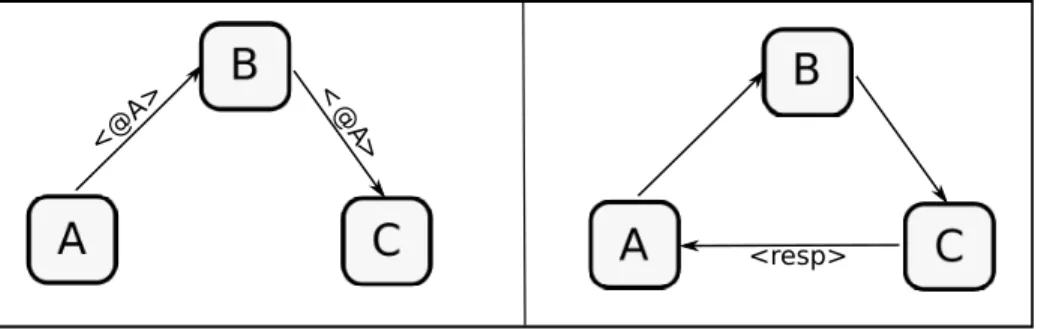
the topology of the system can be described by a communication graph, which can evolve as new channels between nodes are dynamically cre-ated. Imagine for instance the topology of Figure 1.3, where there are channels between A and B, and B and C; but not between A and C. The topology evolves as A sends its location to B, which then forwards it to C. Afterwards C can respond directly to A, creating a new channel be-tween them. Nevertheless, in network configurations where some nodes
<@A>
< @
A>
<resp>
Figure 1.3: Dynamic topology
stand behind firewalls or NATs (Network Address Translators), there is no way of implementing a dynamic topology without some kind of NAT traversal solution. Approaches include specialized protocols such as the Simple Transversal of UDP Through NAT(STUN) [RWHM03], and more recently the Interactive Connectivity Establishment (ICE) [Ros10].
To summarize, implementing one model over another is never straight-forward. Fault tolerance can be compromised when a shared memory is implemented over a message passing model, and vice-versa. The commu-nication protocol becomes more complex when synchronous communica-tion is implemented over an asynchronous execucommunica-tion level. The reverse direction requires buffers which add an overhead for the agents. Finally, implementing a dynamic topology in a configuration with a restricted visibility for some nodes implies an overhead on the communication as additional steps are needed in the routing of messages.
1.1.3 Service-Oriented Computing
Distributed computing takes another dimension with the emergence of Internet. Therefore it is important to make the difference between tra-ditional distributed systems and network-based systems. In a restricted sense conforming to the tradition, distributed systems aim at emulating
the behavior of a centralized system by hiding the fact that multiple col-laborating computation units work in parallel from different locations. Network-based systems, on the other hand, are implemented in a net-work environment, and users may be aware of this [Fie00]. Network-based systems lead to Service Oriented Computing, which we discuss in this section.
1.1.3.1 Basic Concepts
With the introduction of service-oriented computing, distributed systems evolved from monolithic structures to loose coupled organization of au-tomated agents that communicate with each other by exchanging mes-sages [HS05]. Each agent can assume the role of a server, providing some service to other agents or of a client consuming services from other agents. When it plays both roles, it becomes an orchestrator, consuming services and providing a new (composed) service. The services provided by agents are software components, available at some location in the network, that manipulate information, represented by resources, in response to requests. The underlying software components are considered as black boxes: their implementation may evolve without any functional effect over the service. To date, there are two popular – and often antagonistic – models for service-oriented computing [PZL08]. One is based on the WS* standards, the other based on the REST architectural style, already instantiated with the HTTP protocol. We refer to the WS* model as the process-oriented model and to the Restful model as the resource-oriented model, respec-tively.
First, interoperability and integration issues have led to the develop-ment of WS*-services technology, mainly based on XML technology. Mes-sages are exchanged between service consumers and providers in the form of XML documents. The operations offered by a service, along with the expected structure of messages, are defined using the Web Service De-scription Language (WSDL), which allows services to be independent of the underlying communication protocol. Another optional but widely used component is the Simple Object Access Protocol (SOAP), which is used to encapsulate the XML message, in order to separate it from other infrastructure information, like routing. However, services are not to be confused with distributed objects since there is no notion of objects, object references or factories in WS* [Vog03]. Upon services, orchestra-tors are defined with orchestration languages, like the Business Process
Execution Language for Web Services (BPEL), which is a standard. To establish a relationship between messages that are shared between sep-arate processes, the BPEL specification includes the notion of correlation sets, which can be extended to reflect different collaboration scenarios. As processes are central in this model (WS*), we say that this model is process-oriented.
More recently, the REST paradigm has emerged as an alternative, of-fering light and easy to implement web services. Restful web services manipulate resources via four basic operations: create, read, update and delete, known as CRUD operations. Although REST is independent from the underlying protocol, it is usually associated with HTTP. Restful Web services return to the original design principles of the World Wide Web, and the REpresentational State Transfer (REST) architectural style for-malized by Fielding [Fie00]. The REST architectural style lies on four principles.
(i) Resources can be identified with logical names. Restful web ser-vices represent these identifiers as URIs (Uniform Resource Identi-fiers), defined in a standard dedicated to a language for universal naming.
(ii) Resources are manipulated with a uniform interface composed of actions or methods that have a universal semantic interpretation, that is have the same meaning for all resources. In the case of RestfulWeb services, these actions essentially correspond to HTTP’s methods PUT, GET, POST and DELETE.
(iii) Messages are self-descriptive, containing information about the pur-pose of the message and control data, like cachability2. Since re-sources can be represented with multiple formats (Html, XML, pdf, jpeg, etc.), messages can contain information about the expect-ed/actual representation of the resource.
(iv) Interactions are stateless. Thus messages are self-containing: no context information is stored in the server. Therefore each message from the client contains the information required to understand the request. It is thus the responsibility of the client to keep the rela-tionship between messages.
2
Since clients can cache responses, messages can explicitly indicate if they can be cached or not.
Since resources are central in this model (Restful), we say that the model is resource-oriented.
It is possible to design a uniform model for both service models [All14,
ADG+12]: it is a message-passing model. Precisely, distributed agents acting as orchestrators provide services while requiring other services that are consumed. In accordance with the black-box principle, an agent is an abstraction that hides all the implementation details: it is composed with an interface and an abstract state that evolves during its execution. The interface is composed of provided or required services. Each service is a set of channels to receive incoming messages or to send messages over the network. The execution is described by the parallel composi-tion of agents: while updating their internal state, agents asynchronously exchange messages, without sharing memory or without synchronizing the sending and the receiving of messages in a rendez-vous. The differ-ence between the process-oriented model (WS*) and the resource-oriented model (Restful) essentially corresponds to different decompositions of messages into a channel and a content (traditionally called a payload). In the Restful model, the channel describes the resource and the in-voked operation, which belongs to the uniform interface, while the con-tent describes the arguments of the operation. In the WS* model, the channel describes the whole service while the content describes not only the invoked operation but also its arguments. Thus the payload with WS* services is largely greater than with Restful services: it is one of the main reason why WS* services are qualified as heavyweight or as big. Another interesting point is that the two main requirements of the uni-fied model, asynchronous communication and true concurrency, has led its authors [All14, ADG+12] to resort to a chemical model: the thesis directly extends the unified model as it can be considered as a concrete realization of the unified model.
Due to the existence of a unified model, all the properties described for distributed computing, and especially for message-passing models, also apply to service-oriented computing. Likewise, all the requirements for a language dedicated to distributed programming are still valid for service-oriented programming. However, there is a new requirement that we need to emphasize. Indeed, the loose-coupled nature of web services, contrary to tightly bounded systems where persistent connections are established between components, requires a mechanism for establishing relationships between the different messages exchanged in a collaboration.
Thus, correlation, defined as a common value shared by messages that are related, is a fundamental requirement of service-oriented computing regardless of the model.
Finally, despite of the possibility of a conceptual unified model, the diversity of models for service-oriented computing leads to new questions when it comes to the orchestration of services, questions about interop-erability.
1.1.3.2 Interoperability in Service-Oriented Computing
Interoperability is the capacity of two or more systems to exchange in-formation and to be able to use this inin-formation3. In service-oriented computing, interoperability is an important concern since collaborations between agents that differ in the service model they use, in their data interface or in their communication protocol are not uncommon. For instance, organizations like WS-I (Web Service Interoperability)4 search to promote standards for the development of interoperable web services through the publication of guidelines, or profiles. However, despite these efforts, interoperability remains a challenge.
The challenge essentially consists in solving coordination problems and adaptation problems. Following the classical definition of Malone and Crowston [MC94], generally speaking, ”Coordination is managing dependencies between activities”, which gives in the area of programming, following Carriero and Gelernter[GC92]: ”Coordination is the process of building programs by gluing together active pieces.” Following the seminal paper of Yellin and Strom [YS97], adaptation aims at eliminating mismatches between software components that do not fit together.
In the following, we review research work over adaptation, in the con-text of service-oriented computing. The other question, coordination, is dealt with in Chapter 2. Traditionally, in the service-oriented comput-ing field, coordination is split into two related notions, orchestration and choreography. An orchestration defines the behavior of an agent while a choreography specifies or describes from a global point of view the exe-cution of the orchestrations involved in the collaboration of agents. As Chapter 2presents the foundations of our orchestration language, this is the natural place to deal with coordination.
3
According to the IEEE Standard Computer Dictionary.
4
The mismatches that adaptation aims at eliminating happen when the required and the provided services that have to be bound do not fit together. These mismatches can be classified into five general cate-gories [BBG+06].
• Technique: for instance because of different communication proto-cols
• Signature: mismatch between the type of the channels
• Protocol: mismatch between the expected sequences of messages • Concept: given ontologies describing concepts, mismatch between
the concepts associated as meta-information to the services
• Quality: mismatch between quality attributes (dealing with some notion of quality of services) associated to services
Here, we focus on signature and protocol mismatches, following our pro-gramming perspective.
A natural solution to eliminate mismatches is to promote types not only for interfaces, as usual, but also for communication protocols. While interface types avoid signature mismatches, they do not guarantee the absence of protocol mismatches: components can interoperate incorrectly, since undesired deadlocks may occur. Protocol types ensures not only type safety but also deadlock freeness. Different formalisms have been proposed for extending interface types with protocol information: see for instance the review of Brogi et al. [BCP07] or more recently the state of the art report of the project Betty [Pro14]. Typically, they are based on finite automata or process calculi.
When a mismatch is detected, adaptation can be derived following two main approaches [CMP06]: the restrictive approach aims at ruling out the behaviors causing the mismatch, while the generative approach aims at defining an intermediate adaptor used to compose the mismatching behaviors.
Behavioral type systems, like session type systems [DCd10], use a restrictive approach. Yellin and Strom [YS97] initially promote the gen-erative approach, more liberal. For instance, a solution is given by model-driven engineering techniques, as exemplified by the Starlink framework [BGR11,
BGRB11]. This work in particular focuses on the problem of interoper-ability between protocols that have a similar functionality, for example
between SLP (Service Location Protocol) and SSDP (Simple Service Dis-covery Protocol). The objective is to allow the communication between components using different protocols, e.g. between a SLP client and a SSDP server. Interoperability is only possible if there exists a translation from the messages of one protocol into the other. Nevertheless, the translation in some cases is more complex than a one-to-one mapping. For example, to accomplish task A, protocol P1 requires a single message, while protocol P2requires two messages. They are interoperable if a translation is possi-ble. In order to ease the translation between two interoperable protocols, their behavior is represented by two automata representing the sequence of messages, where states are labeled according to different aspects of the communication protocol, such as message sequence, ports used, and syn-chrony. Then, the coordination of both automata is driven by a merge automaton, finally implemented by a middleware layer.
The main drawback of generative adaptation comes from its possible complexity: if n agents must fit with p agents, n.p adaptors are required. The solution is to deploy an adaptive middleware, specially those based on messaging, like Message Oriented Middleware (MOM). The complexity can then reduce to n + p: it suffices to adapt each agent to the middle-ware. Thus, the middleware layer acts as an integration layer. Indeed, this kind of infrastructures offers several possibilities for solving interop-erability problems in the form of integration patterns, where the Message Bus [HW03, p.137] is one of the most used. Also known as Enterprise Service Bus (ESB) [Erl09, p. 704], the message bus pattern relies on a communication component (bus) that carries messages between the con-nected agents, which can disconnect from the bus at any time without disrupting the functioning of the system. See Figure 1.4for a typical ar-chitecture, where an enterprise service bus connects diverse applications and technologies through service interfaces. An enterprise service bus also requires an intermediary protocol comprising a common data model and a common command structure. Thus, messages transmitted by agents are translated into an intermediary protocol and then, translated back into the protocol used by each consumer agent. The main difficulty lies on finding the correct intermediary protocol.
Another middleware-oriented solution for interoperability problems between web services is the architecture proposed by Wang and Pazat [WP13], based on a chemical model. In this architecture the orchestration and choreography of web services is performed in an intermediate component
Figure 1.4: Enterprise Service Bus (Credit: MIT Press [GP09])
called the chemical middleware. Services are abstracted as chemical so-lutions, where floating molecules represent the meta-data of the service. Orchestrations and choreographies are written in a chemical programming language in the form of reaction rules that model the data flow between services. This work, which is closely related to our own approach, shows the interest raised by the chemical paradigm as a way of expressing or-chestrations in service-oriented computing.
Finally, the preceding solutions can be considered as variations of a pivot architecture, a possible solution for interoperability problems, as we have shown [LGL10]. Concretely, we have proposed the implementa-tion of some design patterns to solve interoperability problems, following a well-known trend [BBG+06]. The pivot architecture allows the imple-mentation of such patterns by combining different orchestration languages with heterogeneous service providers around a pivot language5.
It remains that a complete solution to the interoperability issue re-quires a universal representation of resources: this is the subject of the next section.
5
The implementation of the pivot architecture with Criojo is further developed in Chapter4.
![Figure 1.4: Enterprise Service Bus (Credit: MIT Press [GP09])](https://thumb-eu.123doks.com/thumbv2/123doknet/7805834.260984/44.918.174.665.165.459/figure-enterprise-service-bus-credit-mit-press-gp.webp)
![Table 2.2: Introspective Chemical Abstract Machine – Semantics The main differences with the standard framework [BB90] are the following.](https://thumb-eu.123doks.com/thumbv2/123doknet/7805834.260984/92.918.160.687.365.831/introspective-chemical-abstract-machine-semantics-differences-framework-following.webp)