Crowd-Powered Systems
by
Michael
Scott
Bernstein
ARCHIVE
IMASSACHUSETTS
ISTRE ^ OF TECHNOLOGYJUL 0
1
2012
IBRARIES
S.M., Massachusetts Institute of Technology, 2008
B.S., Stanford University, 2006
Submitted to the Department of
Electrical Engineering and Computer Science
in partial fulfillment of the requirements for the degree of
Doctor of Philosophy
at the
MASSACHUSETTS INSTITUTE OF TECHNOLOGY
June 2012
@
Massachusetts Institute of Technology 2012. All rights reserved.
A4 * --* a
A uthor ...
Certified by...
C ertified by ...
/
Department of
Electrical Engineering and Computer Science
May 22, 2012
D00iavid R. Karger
Professor
Thesis Supervisor
IAccepted by ...
Robert C. Miller
Associate Professor
Thesis Supervisor
Leslfe
Y.
Kolodziejski
Crowd-Powered Systems
by
Michael Scott Bernstein
Submitted to the Department of Electrical Engineering and Computer Science
on May 23, 2012, in partial fulfillment of the requirements for the degree of
Doctor of Philosophy
Abstract
Crowd-powered systems combine computation with human intelligence, drawn from
large groups of people connecting and coordinating online. These hybrid systems en-able applications and experiences that neither crowds nor computation could support alone.
Unfortunately, crowd work is error-prone and slow, making it difficult to incor-porate crowds as first-order building blocks in software systems. I introduce com-putational techniques that decompose complex tasks into simpler, verifiable steps to improve quality, and optimize work to return results in seconds. These techniques develop crowdsourcing as a platform so that it is reliable and responsive enough to be used in interactive systems.
This thesis develops these ideas through a series of crowd-powered systems. The first, Soylent, is a word processor that uses paid micro-contributions to aid writing tasks such as text shortening and proofreading. Using Soylent is like having access to an entire editorial staff as you write. The second system, Adrenaline, is a camera that uses crowds to help amateur photographers capture the exact right moment for a photo. It finds the best smile and catches subjects in mid-air jumps, all in realtime. Moving beyond generic knowledge and paid crowds, I introduce techniques to motivate a social network that has specific expertise, and techniques to data mine crowd activity traces in support of a large number of uncommon user goals.
These systems point to a future where social and crowd intelligence are central elements of interaction, software, and computation.
Thesis Supervisor: David R. Karger Title: Professor
Thesis Supervisor: Robert C. Miller Title: Associate Professor
Acknowledgments
This thesis is dedicated to a crowd of indispensable individuals:
" my wife Adi, who was also thanked in my undergraduate and masters theses,
and who deserves the appreciation even more in this one;
" my parents Neila and Andy and my sister Corinne, who know more about
computers than they admit;
" my advisors David Karger and Rob Miller, always willing to listen to crazy
ideas;
" Terry Winograd, Scott Klemmer, Bj6rn Hartmann, and Jeff Shrager, who got
me into this business in the first place;
" my mentors and role models, Mark Ackerman, Desney Tan, and Ed Chi; " more colleagues and collaborators than I should have probably enlisted as a
graduate student - Adam Marcus, Andres Monroy-Hernindez, Bongwon Suh, Drew Harry, Greg Little, Greg Vargas, Eric Horvitz, Hiroshi Ishii, Jaime Teevan, Jilin Chen, Joel Brandt, Katrina Panovich, Kurt Luther, Lichan Hong, Mary Czerwinski, Max Van Kleek, mc schraefel, Paul Andr6, Sanjay Kairam, Susan Dumais, and Xiao Xiao;
" the community and friends in the Haystack and User Interface Design groups
at MIT's Computer Science and Artificial Intelligence Laboratory;
" and the participants on Amazon Mechanical Turk and other crowdsourcing platforms, who both make this research possible and keep it interesting.
I was supported by a National Science Foundation Graduate Research Fellowship,
a Microsoft Research PhD Fellowship, a Xerox Fellowship, and some generous advi-sors. These projects were supported in part by NSF grant IIS-1111044. You all make graduate school possible - thanks.
Contents
1 Introduction
1.1 Interactive Systems Powered by Crowds . . . .
1.1.1 Realtime Crowdsourcing Platform and Modeling . . . .
1.1.2 Realtime Crowd-Powered Systems . . . .
1.1.3 Beyond Generic Paid Crowds: Targeted Information Needs . .
1.2 Contributions . . . . 1.2.1 Design of Crowd-Powered Systems . . . . 1.2.2 Computational Techniques to Guide Crowds . . . .
1.2.3 Generalization to Unpaid Crowds and Specific Needs . . . . .
1.3 Thesis O verview . . . .
2 Related Work
2.1 Crowdsourcing . . . .
2.1.1 Definitions and Design Space . . . . 2.1.2 Voluntary Crowdsourcing . . . .
2.1.3 Paid Crowdsourcing . . . .
2.2 Crowd-Powered Systems . . . . 2.2.1 Soylent . . . . 2.2.2 Adrenaline and Realtime Crowd-Powered Systems .
2.3 Crowds and Algorithms . . . .
2.4 Social Network-based Crowds . . . .
2.5 Mining Crowd Data . . . . 2.6 C onclusion . . . . 19 21 22 23 24 26 27 27 28 28 30 . . . . 30 . . . . 31 . . . . 33 . . . . 34 . . . . 37 . . . . 39 . . . . 40 . . . . 41 . . . . 42 . . . . 44 . . . . 44
3 Soylent: A Word Processor with a Crowd Inside
3.1 Soylent . . . .
3.1.1 Shortn: Text Shortening ...
3.1.2 Crowdproof: Crowdsourced Copyediting . . . .
3.1.3 The Human Macro:
Natural Language Crowd Scripting . . . .
3.2 Techniques for Programming Crowds . . . .
3.2.1 Challenges in Programming with Crowd Workers
3.2.2 The Find-Fix-Verify Pattern . . . .
3.3 Im plem entation . . . . 3.4 Evaluation . . . . 3.4.1 Shortn Evaluation . . . .
3.4.2 Crowdproof Evaluation . . . . 3.4.3 Human Macro Evaluation . . . . 3.4.4 Impact of Price on Wait Time . . . .
3.5 D iscussion . . . . 3.6 Conclusion . . . .
4 Realtime Crowdsourcing: Platform and Model
4.1 The Retainer Model . . . . 4.1.1 Retainer Design and Wait Time 4.1.2 Retainer Field Experiments . . 4.2 Queueing Theory Model . . . . 4.2.1 Model Formalization . . . . 4.2.2 Optimal Retainer Pool Size
4.2.3 Worker Abandonment...
4.2.4 Limited Retainer Lifetimes . . .
4.3 Application to Common Crowdsourcing Tasks
45 47 . . . . 48 . . . . 50 . . . . 51 . . . . 53 . . . . 53 . . . . 56 . . . . 61 . . . . 61 . . . . 62 . . . . 66 . . . . 68 . . . . 71 . . . . 73 . . . . 73 75 77 78 78 84 84 90 92 93 93
4.4 Improvements to Crowdsourcing Platforms . . . . 95
4.4.1 Retainer Subscriptions . . . . 95
4.4.2 Global Retainer Pools . . . . 96
4.4.3 Precruitment: Predictive Recruitment . . . . 100
4.4.4 Evaluation . . . . 101
4.5 D iscussion . . . . 104
5 Realtime Crowdsourcing: Systems 106 5.1 A drenaline . . . . 107
5.2 Rapid Refinement: Coordinating Synchronous Crowds for Fast Results 109 5.2.1 Algorithm Design . . . . 110
5.3 Evaluation . . . . 112
5.3.1 M ethod . . . . 112
5.3.2 R esults . . . . 114
5.4 Realtime Crowd-Powered Creativity . . . . 117
5.5 D iscussion . . . . 119
5.5.1 Realtime Crowd-Powered Systems . . . . 120
5.5.2 Rapid Refinement . . . . 120
5.6 C onclusion . . . . 121
6 Beyond Generic Paid Crowds: Specific Data Needs 123 6.1 Friendsourcing . . . . 124
6.1.1 Collabio: Social Friend-Tagging . . . . 125
6.1.2 FeedMe: A Friendsourced Recommender System . . . . 141
6.1.3 Systems Powered by Friendsourcing . . . . 152
6.1.4 Conclusion: Friendsourcing . . . . 158
6.2 Data Mining . . . . 159
6.2.1 Tail Answers . . . . 159
6.2.3 Filtering Answer Candidates . . . . 6.2.4 Extracting the Tail Answer . . . .
6.2.5 Implementation . . . .
6.2.6 Evaluation . . . .
6.2.7 D iscussion . . . .. . . .
6.2.8 Data Mining Extensions: Al, Snippets, and More Answer
6.2.9 Conclusion: Data Mining . . . .
6.3 Conclusion: Beyond Generic Crowds . . . .
7 Discussion:
Framework, Limits, Ethics
7.1 Deployable Wizard-of-Oz Prototypes . . . .
7.2 Design Framework and Tradeoffs
7.2.1 Crowd Design Tradeoffs
7.2.2 User Design Tradeoffs
7.3 Limitations of Crowdsourcing
7.3.1 Limits to Crowd Cognition
7.3.2 Stifling Individual Abilities
7.3.3 Scale . . . . 7.3.4 Cost . . . . 7.3.5 Privacy . . . . 7.3.6 Legal Ownership . . . . . 7.3.7 Collusion . . . . 7.4 Ethics . . . . 7.4.1 W ages . . . . 7.4.2 Power Imbalance between 7.4.3 Crowdsourcing for Evil? 7.4.4 Cyber-Taylorism vs. Rethi 7.4.5 The Water Cooler for the
Encouraging Social Interac and . . . . . . . . . . . . Crowd Work . . . . . . . . . . . . .. . . . .. . . . . . . . . . . . . . . . . . . . Types 163 166 168 170 176 177 179 180 182 182 183 184 187 189 189 190 191 192 192 193 194 194 195 195 196 197 197
Aorkers and Requesters
nking the Design Process Crowd:
7.4.6 Career Advancement . . . .
8 Conclusion
8.1 Summary of Contributions . . . .
8.2 Impact and Recent Developments . . . .
8.3 Future Work . . . .
8.3.1 Hybrid Crowd-A.I. Systems . . . .
8.3.2 Crowdsourcing Markets . . . .
8.3.3 A Science of Crowdsourcing . . . .
8.3.4 Autonomous, Self-Correcting Crowds . . . .
8.3.5 Large-Scale Systems . . . .
8.4 Looking Ahead . . . .
A Soylent Evaluation Texts
A.1 Shortn inputs . . . .
A .1.1 Blog . . . ...
A.1.2 Classic UIST Paper [92] . . . . .
A.1.3 Draft UIST Paper [194] . . . . .
A.1.4 Rambling Enron E-mail . . . . .
A.1.5 Technical Writing [5]
A.2 Crowdproof inputs . . . .
A.2.1 Passes Word's Checker . . . .
A.2.2 English as a Second Language . . A.2.3 Notes from a Talk: NoSQL in the
A.2.4 Bad Wikipedia Page . . . . Cloud
A.2.5 Draft UIST Paper [194]
208 . . . . 208 . . . . 208 . . . . 209 . . . 210 . . . 212 . . . 213 . . . . 214 . . . . 214 . . . . 215 . . . 215 . . . 215 . . . 216 198 199 199 202 203 203 204 205 206 206 207
List of Figures
1-1 Soylent guides crowd workers to support new kinds of interactions in traditional user interfaces such as the word processor. Here, crowd workers have suggested multiple shorter rewrites of a paragraph, and the user adjusts the length of the paragraph via a slider. Red text indicates locations where rewrites have occurred, in addition to any cuts. Tick marks represent possible lengths, and the blue background bounds the possible lengths. . . . . 21 1-2 Find-Fix-Verify improves work quality for open-ended tasks such as
text shortening by decomposing open-ended tasks into more directed
steps... ... 22
1-3 Adrenaline's realtime crowds operate a camera shutter by choosing the most photographic moment seconds after it happens. Crowd members' current votes on the best frame appear as colored triangles below the tim elin e. . . . . 24 1-4 Rapid refinement repeatedly shrinks the working area for all workers
when it detects that several independent workers are exploring the sam e area. . . . . 25
2-1 Crowd contributions make small improvements to correctly transcribe messy handwriting. While few individuals could transcribe this text correctly, the crowd gets it mostly correct (errors underlined): "You misspelled several words. Please spellcheck your work next time. I also notice a few grammatical mistakes. Overall your writing style is a bit too phoney. You do make some good points, but they gotlost amidst the writing. (signature)." The missed words: flowery, get, verbiage,
and B -. [130]. . . . . 31
2-2 Amazon Mechanical Turk presents a list of tasks and payment for each. The list can be sorted by price, number of tasks, and recency. Workers accept a task, complete it, and submit it to the requester for review. . 34
2-3 The Sheep Market is an art piece exploring crowd-authored creativity. This image shows a small subset of the 10,000 sheep drawn by workers on M echanical Turk [107]. . . . . 37
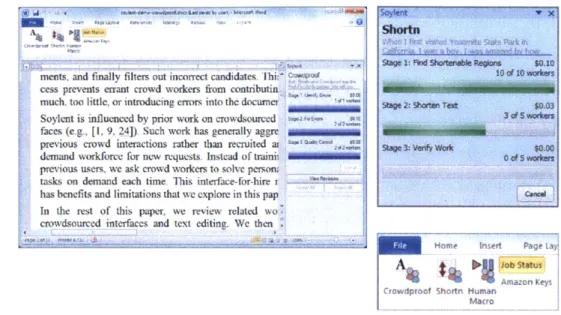
3-1 Soylent adds a set of commands and a status bar to Microsoft Word. We envision that these same concepts could be translated to many sim ilar system s. . . . . 48
3-2 Shortn allows users to adjust the length of a paragraph via a slider. Red text indicates locations where rewrites have occurred, in addi-tion to any cuts. Tick marks represent possible lengths, and the blue background bounds the possible lengths. . . . . 49
3-3 Crowdproof is a human-augmented proofreader. The drop-down ex-plains the problem (blue title) and suggests fixes (gold selection). . . 50
3-4 The Human Macro allows users to request arbitrary tasks over their document. Left: user's request pane. Right: worker task preview, which updates as the user edits the request pane. . . . . 52 3-5 Find-Fix-Verify identifies patches in need of editing, recruits workers
3-6 Find-Fix-Verify proceeds in three stages. Tasks for each stage are compressed into one page here. The top task is Find, the middle one is Fix, and the bottom one is Verify. . . . . 58 3-7 A group of workers always accepted the Find or Fix task while it was on
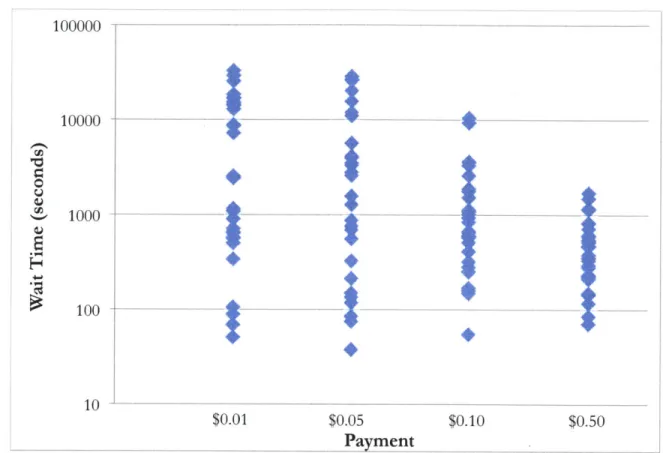
the homepage, roughly within two-three minutes of posting. Raising the price sped up the arrival of the rest of the workforce, but did not impact these early workers . . . . 72 4-1 When a worker accepts a task with a retainer, the system displays an
explanation of the maximum retainer time as well as a preview of the task that will eventually appear. . . . . 79
4-2 When a task arrives, a Javascript alert 0 draws the worker's attention to the application tab so they can begin. . . . . 80
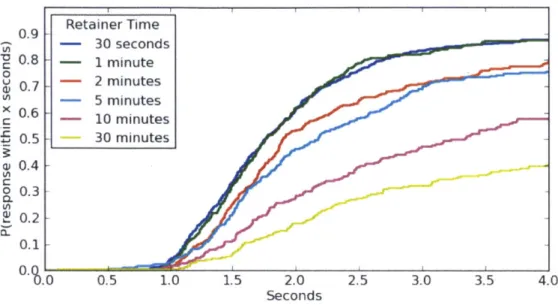
4-3 For retainer times under ten minutes, a majority of workers responded to the alert within two seconds and three-quarters responded within three seconds. N=1442 . . . . 81
4-4 A small reward for fast response (red) led workers in a ten-minute re-tainer to respond as quickly as those on a two-minute rere-tainer without reward (Figure 4-3, red). Other conditions included no alert (blue), an alert without bonus payment (purple), and a game to keep workers entertained (green). N=1913. . . . . 83
4-5 Graphs that visualize the relationships between retainer pool size, traf-fic intensity, and (a) cost, (b) probability of a task waiting, and (c) ex-pected wait time. In the graph of exex-pected wait time, we set A = 1, so
p
= P'. When p > c, there are often not enough workers on retainer to service all tasks. As a result, wait time goes up, but cost goes down. 88 4-6 By calculating cost and the probability of a task needing to wait for
integer values of c (E [1, 15], we can visualize the relationship between
4-7 By assigning a dollar value to missed tasks, we can visualize the rela-tionship between retainer size and total cost. Assuming traffic intensity
p = 1 and retainer wage s = 1, these curves demonstrate the trade-off between more missed tasks on the left part of the graph and higher retainer costs on the right. . . . . 91
4-8 A task routing scenario where a typical randomized approach would lead to poor results. t1 would receive relatively few workers. Depending
on the values of pi, each task type could find itself in this starved state. 99 4-9 To test precruitment, workers participated in retainer tasks that
chal-lenged them to play a game of Whack-A-Mole and click on the mole as soon as it appeared. . . . 102 4-10 The median length of time between the mole image appearing and the
workers moving to click on it was 0.50 seconds. So, a platform can recall retainer workers early and get crowds in half a second instead of waiting for the workers to respond to the retainer alert. . . . 103 4-11 The median length of time between the mole image appearing and the
workers clicking on it was 1.12 seconds. . . . 103
5-1 Adrenaline is a camera that uses crowds to find the right moment for a
picture by capturing ten-second movies. It looks for early agreement to filter the timeline down quickly to a single frame. A photo is typically ready about one second after the user reviews the movie. . . . 108
5-2 Rapid refinement repeatedly shrinks the working area for all workers
when it detects that several independent workers are exploring the sam e area. . . . 111
5-3 Rapid refinement consistently completed quickly. Generate One
some-times located a fast worker, but often did not, so it has a larger timing variance. . . . 115
5-4 Timeline of the median Adrenaline execution. Each bar length repre-sents the median length of time for that stage. For example, enough crowd members typically arrived 2.6 seconds after the request was made, and agreement on the first refinement typically took 4.7
sec-onds... ... 116
5-5 Photos from the Adrenaline study. The examples are good, typical, and bad photos that rapid refinement recommended. The computer vision and photographer columns demonstrate how other approaches performed on the same movie. . . . . 118 5-6 More good, typical, and poor photos selected by Rapid Refinement. . 118 5-7 Puppeteer allows an artist or designer to generate a group of articulated
figures quickly, and to interact with workers as they work. a) The user demonstrates control points. b) Workers move control points to match a request, like "make the person look excited!" c) The user watches incoming results and interacts with workers. d) The final result in
Photoshop. ... ... 119
6-1 The user has guessed several tags for Greg Smith, including band, poker and stanford. Tags guessed by Greg's other friends are hidden by dots until the user guesses them. . . . . 126 6-2 The landing page for Collabio. All application activity occurs on three
tabs: Tag!, My Tags, and Leaderboard. The leaderboard is typically below the instructions, shown in Figure 6-5. . . . . 127 6-3 The tag cloud begins completely obscured. The player guesses harvard,
receives 12 points for agreeing with eleven other players and reveals Harvard as a large tag. Faulkner is next; it does not match existing tags and is added to the cloud. . . . . 128
6-4 The My Tags page allows the user to view their own tag cloud com-pletely uncovered. Not shown: the top 10 scorers list and a complete listing of each tag's authors. . . . . 129
6-5 Collabio leaderboards feature the friends with the most tags (left) and
the friends who have tagged the most others (right). . . . . 130 6-6 The design space of social tagging applications. Collabio's choices are
highlighted in blue . . . 132
6-7 A bar chart representation of Table 6.2 indicates that all three classes
of tags were rated above neutral (4) on average as accurate descriptors. 136
6-8 A bar chart representation of Table 6.3, focusing on the Facebook
con-dition. Popular Tags tended to have evidence available on the profile; Middling Tags and Uncommon Tags were much less likely to. There was considerable variance in ratings. . . . 139
6-9 The FeedMe plug-in for Google Reader suggests friends, family, and
colleagues who might be interested in seeing the post that you are reading. This user has selected johnOdoe.com and maryQemail.com out of the list of 5 recommendations. The "Now" button sends an e-mail immediately; the "Later" button queues the item in a digest of m ultiple m essages. . . . 141 6-10 Load indicators reflect the number of items sent today (left) and whether
the receiver has seen the post already (right). . . . 143
6-11 The One-Click Thanks leaderboard gives sharers and recipients a chance
to see how many other people have enjoyed that sharer's content. . . 144
6-12 FeedMe's evaluation was a 2x2 design. Recommendation features could
be turned on or off, and the social awareness features could be turned
on or off.. . . . ... 145
6-13 Typically, users shared with small numbers of individuals and
ad-dressed each message to one recipient . . . 147 6-14 After the initial rush of activity, participants continued to use FeedMe
to send a consistent percentage of posts viewed. . . . . 148
6-15 Participants reported a significant preference for the recommendation
6-16 Collabio QnA is a question and answer system that uses Collabio tags
to find friends and friends-of-friends who can answer your questions. . 153
6-17 A tag cloud comparing users tagged with \,Ino to users tagged
with georgia tech in Collabio Clouds. . . . . 155 6-18 Tail Answers are inline direct responses for search results. This Tail
Answer addresses recipe substitutes for molasses. . . . . 160 6-19 Tail Answers address less common information needs. These examples
(including errors) were produced by the data mining and crowdsourcing processes described in the paper. They trigger on related queries, e.g.,
apple calories. . . . . 160
6-20 An overview of the three phase Tail Answers creation process, which
involves 1) identifying answer candidates, 2) filtering the candidates to ones that address "answerable" needs, and 3) extracting the Tail Answer content. Steps that are implemented via data mining are indi-cated in blue, and those implemented via crowdsourcing are indiindi-cated
in . . . . . . 16 2
6-21 In this example workers extracted all of the text when an inclusion/exclusion
lists was not used. Orange text is the same answer with inclusion/exclusion lists. . . . . 16 7 6-22 The Tail Answers crowd extraction algorithm (bottom) can suggest
replacements for result snippets (top). . . . . 178 6-23 Code tutorial answers. Within a domain, Tail Answers like these can
specialize their user interface. . . . . 180 8-1 As described in Chapter 1, the question of user agency leads to a
design axis. At the ends are completely user-controlled interactions and completely system-driven interactions. Designs sometimes split the difference, for example with interactive machine learning [52]. . . 200
8-2 Crowd-powered systems add an additional dimension to the design
space: crowds may take on tasks that systems cannot perform reliably yet. Soylent relies mostly on crowd contributions, but the system takes initiative in choosing rewrites. There are many under-explored areas of this design space, especially ones that more closely link the crowd to system initiative and artificial intelligence. . . . . 200
List of Tables
3.1 Our evaluation run of Shortn produced revisions between 78%-90% of the original paragraph length on a single run. The Example Output
column contains example edits from each input. . . . . 63
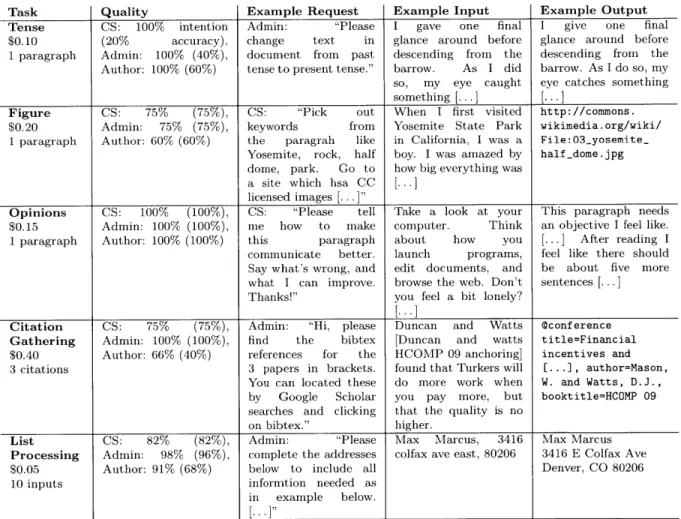
3.2 A report on Crowdproof's runtime characteristics and example output. 67 3.3 The five tasks in the left column led to a variety of request strategies. Terse, typo-filled user requests still often led to success. . . . . 69
4.1 A tabular representation of Figure 4-3. . . . . 81
4.2 A tabular representation of Figure 4-4. . . . . 83
4.3 A/B captures quick crowd votes. . . . . 94
5.1 Rapid Refinement was the fastest algorithm and had the lowest timing variance. . . . . 115
5.2 Rapid Refinement produced higher-quality photos than Computer Vi-sion, faster than Generate and Vote, and with less variance than Gen-erate O ne. . . . . 117
6.1 A breakdown of information type by tag bucket. Affiliation and interest categories were the most popular among the three categories. . . . . . 134
6.2 User ratings of how accurate and widely known the tag buckets were, on 7-point Likert scale (1=very inaccurate
/
not widely known, 7 = very accurate/
widely known). . . . . 1356.3 Mean ratings applied to tags, from 1 (no evidence to support tag) to 7 (tag appeared verbatim). . . . . 138
6.4 Confusion matrix of rater bucketing decisions. Raters were accurate at identifying Popular Tags and Fake Tags, but less so at Middling Tags and Uncommon Tags . . . . 139 6.5 Pages with high destination probability, queries to them, and their
crowd-voted answer category. All but the bottom row had a ques-tion query: the lack of a quesques-tion signals that Pandora would not be appropriate for an answer. . . . . 163
6.6 Hand-labeled writing and correctness ratings. . . . . 171
6.7 Examples of common errors in Tail Answers. . . . . 171
6.8 Mean Likert scale responses to: "This is a very useful response for the
query." . . . . 174
6.9 Mean Likert scale responses to: "This page contains everything I need
to know to answer the query without clicking on a link." . . . . 174
6.10 An automated question-answering system proposed Tail Answers and
crowds filtered them . . . . 178 7.1 Design dimensions for creating the crowd. . . . . 184
Chapter 1
Introduction
As far back as Doug Engelbart's NLS [50] and Ivan Sutherland's Sketchpad [188], human-computer interaction has been structured around a tradeoff between user con-trol and system automation. The user has deep context and understanding of the task, but limited memory and speed. The system has limited context and under-standing, but powerful algorithmic resources. As a result, where the system cannot succeed reliably, the user steps in to guide the process manually.
This tradeoff between the system and the user both defines and limits human-computer interaction. If the system cannot reliably support a task or goal, and if the user is unwilling to do it manually, the user may abandon the system. As a result, most interactive systems only attempt tasks they can safely automate. For example, consider the word processor - likely one of the most heavily-used and heavily-designed interactive systems of all time. While it supports secondary tasks like layout and spelling, the word processor has limited support for the primary task it was designed for: writing. Issues such as expressiveness, clarity, and cutting text are beyond the abilities of the system, and thus left entirely to the user.
This thesis proposes that combining computing with the intelligence of crowds -large groups of people connecting and coordinating online - allows the creation of hybrid human-computer systems that overcome the limits of the user-system tradeoff. These crowd-powered systems do not only rely on the cognitive abilities of the user, but also reach out to the aggregate knowledge, cognition, and perception abilities of
many individuals. These crowds may be paid, incentivized through social interac-tion, or mined from activity traces. This thesis will demonstrate that crowd-powered systems let us re-envision classic interactive computing systems such as the word processor and digital camera. I will also describe how computation can help guide crowds to complete more complex tasks, faster. If successful, this research agenda will impact areas of computing ranging from hybrid crowd-artificial intelligence systems [94, 24, 62] and open-world databases [56, 137, 157] to the broader social science and management disciplines [140].
While large groups are increasingly adept at completing straightforward parallel tasks [187, 67, 95], they can struggle with complex work. Participants vary in quality, well-intentioned contributions often introduce errors, and errors are amplified as they propagate through the crowd. The resulting output is typically poor or incomplete. Without higher-level coordination, many tasks are beyond the ability of crowds today. Moreover, crowds that can generate the necessary information might not even exist yet, or their knowledge might be distributed across the web.
This dissertation develops computational techniques for high-quality, low-latency crowdsourcing. First, the Find-Fix- Verify design pattern decomposes complex tasks into simpler, verifiable steps. Second, the retainer model of recruitment returns on-demand human results in seconds. Third, we introduce a queueing theory model to optimize the correct crowd size given task requirements. Fourth, we incentivize the collection of specific information needs that generic crowds cannot support. These contributions are critical to the creation of crowd-powered systems: they advance crowdsourcing from a batch platform to one that is interactive and realtime.
The core idea of this thesis is a set of architectural and interaction patterns for integrating crowdsourced human contributions directly into interactive systems. The thesis accomplishes this goal by developing a series of interactive prototypes, each of which advance crowdsourcing further as a platform to support high-quality, fast, or personally-targeted interactivity.
This paper presents Soylent, a word processing interface that uses crowd workers to help with proofreading document shortening editing and commenting tasks Soytent is an example of a new
kind of interactive user interface m which the end user has direct access to a crowd of workers for assistance with tasks that require human attention and common sense. Implementing these kinds of interfaces requires new programming patterns for interface software since crowds behave differently than computer systems We have introduced one important pattern Find-Fix-Verify, which splits complex editing tasks into a series of
identificabon, generation and verfication stages that use
independent agreerent and voting to produce retiable results Wei
evaluated Soylent with a range of editing tasks finding and correcting 82% of grammar errors when combined with automatic checking, shortening text to approximately 85% of onginal length
per iteration and executing a vanety of human macros successfully
Future work faIls in three categories First are new crowd-driven
features for word processing such as readability analysis smart find-and-replace (so that renaming Michae to Michene also
changes he" to she"), and figure or citation number checking. Second are new techniques for optimizing crowd-programmed algorithms to reduce wait time and cost Finally we believe that our research points the way toward integrating on-demand crowd work into other authoring interfaces particularly in
creative domains tike image editing and programming
This paper presents Soylent a word processing interface that uses crowd workers to help with proofreading, document shortening editing and commenting tasks Soylent is an example of a new lnd of interactive user interface in which the end user has direct access to a crowd of workers for assistance with tasks that require
human attention and common sense. Implementing thesedkind5 of interfaces requires new gimninggttosfoteorfgc
iste~sap since crowds behave differently than computer systems We have introduced one important pattern, Find-Fix-Verify, which splits complex editing tasks into a series of
identification generation, and verification stages thatygg
indepeandent agreement and voting to produce reliable results We evaluated Soytent with a range of editing tasks, finding and correcting 82% of grammar errors wh ombn with autotatic
checking, shortening text to approximately 85% of onginal length per iteration. and executing a variety of human macros successfully
Future work falls in three categones First are new crowd -driven
features for word processing, such as readability analysis smart
find-and-replace (so that renaming Mchae to Mchelle also changes "he" to "she). and figure or citation number checking. Second are new techniques for optimizing crowd-programmed algorithms to reduce wait time and cost Finally, we believe that our research points the way toward integrating on-demand crowd work into other authoring interfaces. particularly in creative domains like image editing and programming
This paper presents Soyent a word processing interface that uses crowd woikers to help witrioofreading. document shorterng.
ehrig and commenting tasks Soylent is armamiii kric oita cye user interface in which te aid user has diree
access to a crowd of workers for assistance with tasks that require human attenbon and common sense implementng marekends of
interfaces requires new grrMgrammidtrtir rlersce
ng.wa sice crowds behave differ ently ia compuerl systems We have introduced one impoant pattem Find-Fx-Ven, which spits ccnplex editig tasks mio a series of
identifcatron, generation. and veniication stages that use mdecndent aarcoment and oing to produce reliabloe results we
evaiuated Soylent with a range of editng tasks. fing and
comrecting 82% of grammar errors itombloedmithautomara.
r%&rg, shortenig text to approximately 85% of original teigth per iteration and execuing a varniity of human macros successfully
This paper presents Soylent a word processing interface that uses iowd workers tc hep with proofreading, document shortuen,
editig arid commenting tasks Soyient is asgr fpiVilrw adifrinrctie;kv user interface in which the end user has direct
aooss tI a arowd of workers for assistance' with tasks 'hat require humanr attenton arid common sense. implementing tieskxSc cf
nierfaces requires new softwar orogramm paitomi since
crowds behave ailferently than compiter systems we have
introduced one important patter, Find-ix-Verify, which splits complex editing tasks into a series of identification generation
and veriicahon stages ibat ideuramcuentragies r nt and vuog to produce relibe resalts We evAuated sayent with a range of editing tasks. idineg and conecing 82% of grammar eriors, shortening iext to approximately 85% of ongmal leingth per
iteraion, and executing a varety of human macros suacessfully
This paper presents Soylent. a word processing interface thal uses cowd workers to help with proofreading document shoitening
editing and commening tasks Soylent is -rmmetoirgi user
interface in wrich the end user has direct access to a crowd of workers for assistance with tasks that require human attenion iad
common sense hmpiementng riuc interfaces requiies new prograirmiig pattems since crowds behave diferently than compaer systems We have introduced one important pattern
Find-Fx-Venfy which spkts complex editing tasks into a series of
idenfication, generation, and verification stages to produce rehable resulswe evauated Soytent wth a range of editig
tasks finding and correctmg 82% of grammar errors, shortenig
tex to appoximateiy 85% of orginallenth per iteration. ad executig a variety of human macros successfiity
Figure 1-1: Soylent guides crowd workers to support new kinds of interactions in traditional user interfaces such as the word processor. Here, crowd workers have sug-gested multiple shorter rewrites of a paragraph, and the user adjusts the length of the paragraph via a slider. Red text indicates locations where rewrites have occurred, in addition to any cuts. Tick marks represent possible lengths, and the blue background bounds the possible lengths.
1.1
Interactive Systems Powered by Crowds
Soylent is a crowd-powered word processor that uses paid micro-contributions to help
with writing tasks. Using Soylent is like having an editorial staff available as you write. For example, crowds can shorten the user's writing by finding wordy text and offering alternatives that the user might not have considered. The user selects from these alternatives using a slider that specifies the desired text length (Figure 1-1). Soylent shortens text up to 85% of its original length on average while preserving its meaning.
By using tighter wording rather than wholesale cuts, the system shortens papers by
lines or pages within minutes. Soylent also offers human-powered proofreading and natural-language macros.
On-demand crowds cost money and can be error-prone; to be worthwhile to the
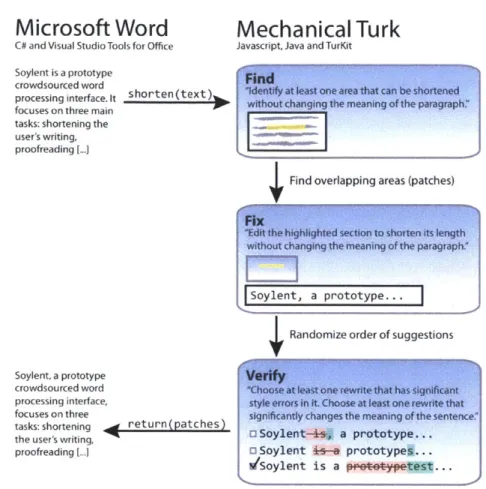
Find Fix Verify
"Identify at least one area that can he shortened Edit the highlighted section to shorten its length - "Choose at least one rewrite that has significant without changing the meaning of the paragraph. without changing the ieaning of the paragraph. style errors in it. Choose at least one rewrite that
significantly changes the meaning of the sentence
C Soylent-4-* a prototype...
_______ aprototype...__ C3Soylent W*i- prototypes...
a prototype... Soylent is a peetetyptest...
Find overlapping areas Randomize order of suggestions
Figure 1-2: Find-Fix-Verify improves work quality for open-ended tasks such as text shortening by decomposing open-ended tasks into more directed steps.
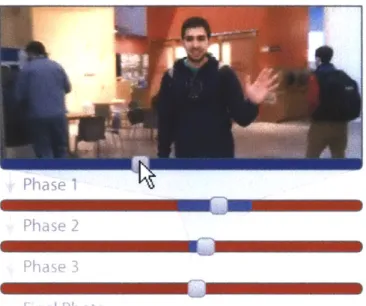
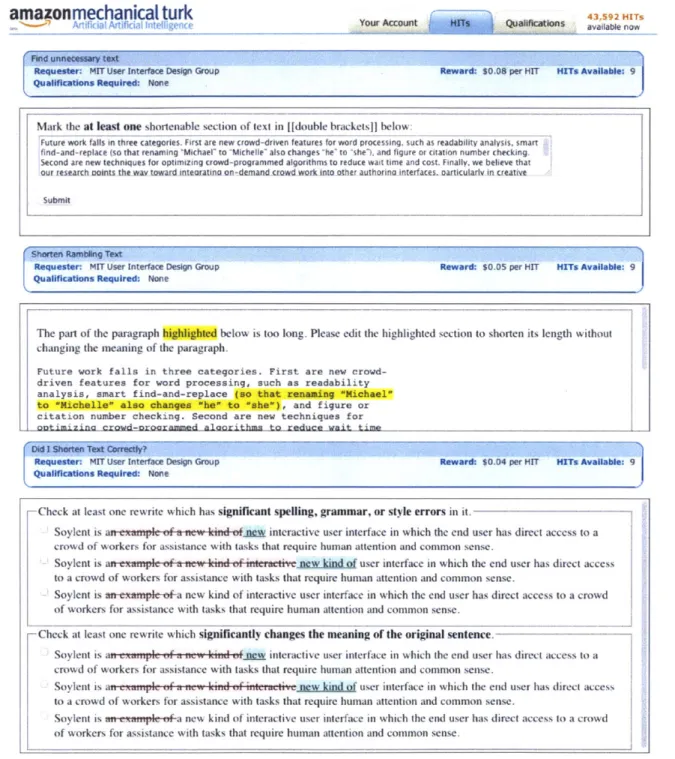
user, the system must control costs and ensure correctness. To solve this problem, Soylent introduces a crowd programming pattern called Verify. Find-Fix-Verify (Figure 1-2) splits complex tasks into simpler, verifiable steps that utilize independent agreement and voting to produce reliable results. Rather than ask a single crowd worker to read and edit an entire paragraph, for example, Find-Fix-Verify recruits one set of workers to find candidate areas for improvement, then collects a set of candidate improvements, and finally filters out incorrect candidates. This process prevents errant crowd workers from contributing too much or too little, and from introducing errors into the document. This technique guides workers through open-ended editing processes in Soylent. Other researchers have adapted Find-Fix-Verify for object identification in images [152], map labeling [185], and crowd programming languages [145].
1.1.1
Realtime Crowdsourcing Platform and Modeling
Soylent opens a design space of systems that draw on crowd contributions, but existing crowdsourcing platforms are orders of magnitude too slow to provide interactive-speed responses. Many crowd-powered systems need responses in seconds, not minutes or hours. Suppose a developer wanted to build a crowd-powered digital camera. Several-minute response times would be unacceptable, because digital camera users want to see their photos almost immediately.
In response, we introduce the retainer model for crowdsourced recruitment, which pays workers a small wage to be on call and respond quickly when asked. This technique cuts wait times for a crowd down from minutes or hours to a median wait
time of just two seconds.
To optimize the tradeoff between recruiting too many workers and having too few workers to manage the incoming requests, I develop a mathematical model of retainer recruitment using queueing theory. This model leads to a straightforward maximiza-tion algorithm for balancing crowd size against loss rate and cost. A platform running this model can also pursue predictive recruitment by recalling workers in expectation that work will arrive by the time the worker arrives: this technique returns feedback from the crowd just 500 milliseconds after a request.
1.1.2
Realtime Crowd-Powered Systems
Realtime crowds give system designers the ability to recruit crowds for interactive systems within seconds, but work time can still be slow. The next challenge is to guide these crowds quickly as they work, and to demonstrate how realtime crowdsourcing opens opportunities for interactive systems.
Adrenaline is a realtime crowd-powered system: a smart camera shutter powered
by crowd intelligence (Figure 1-3). Its goal is to find the right moment to take a
photo. Instead of taking a single shot, Adrenaline captures a short video. Video capture allows the user to move around the scene, the subject to strike multiple poses, or action in the scene to unfold unpredictably. Then, Adrenaline identifies the best moment as a still photo about ten seconds later. Low latency means that users can preview and share photos they just took, like they would with any other digital camera.
To deliver realtime results, Adrenaline introduces rapid refinement, the first design pattern for synchronous crowds. Synchronous crowds are crowds where members ar-rive and work simultaneously. The retainer model makes it straightforward to recruit synchronous crowds. The fundamental insight behind rapid refinement is that syn-chronicity enables an algorithm to recognize crowd agreement early. Rapid refinement quickly reduces a large search space by focusing workers' attention on areas where they are beginning to agree independently (Figure 1-4). Repeatedly narrowing the
Figure 1-3: Adrenaline's realtime crowds operate a camera shutter by choosing the most photographic moment seconds after it happens. Crowd members' current votes on the best frame appear as colored triangles below the timeline.
forces independent agreement between workers. It also allows the interface to provide incremental, trustable feedback before a final answer is available. Critically, rapid refinement leads to fast results: faster than approaches that keep workers separate, and faster on average than even the fastest individual worker.
1.1.3
Beyond Generic Paid Crowds: Targeted Information
Needs
On-demand paid crowds are appropriate for many systems, but a large number of other systems have information needs that generic crowd members may not know. We broaden the scope of crowd-powered systems by demonstrating how social networks and crowd activity traces can support interactive systems where generic paid crowds would struggle.
Friendsourcing
When only a small number of individuals might know the relevant information, social computing design can motivate members of that connected, highly-qualified crowd to contribute. Friendsourcing is the use of motivations and incentives over a user's social network to collect information. This technique enables crowd-powered systems that rely on information that generic crowds cannot or do not know. In particular, friendsourcing motivates members of a social network to share accurate information
Phase 2
Figure 1-4: Rapid refinement repeatedly shrinks the working area for all workers when it detects that several independent workers are exploring the same area.
about the interests, hobbies, and preferences of people they know. This information can be used to power a personalized system, for example to aid question-answering for topics comprehensible only to a few of a user's friends.
Friendsourcing can either involve creating new kinds of online interactions, or it can facilitate existing information-rich social interactions. Collabio is an example of the first class of application, creating new social interactions: it is a social tagging application that has gathered tens of thousands of tags on individuals in a social network. The game collects information that friends know about one another, such as peoples' personalities, expertise, artistic and musical tastes, topics of importance, and even quirky habits. FeedMe is an example of the second class of application, facilitating informational social interactions that are already happening. It helps the minority of individuals who consume lots of information on the web share that content with their friends and colleagues, then learns content preferences based on what is shared with each individual.
Mining Crowd Activity Traces
It is not always necessary to motivate or pay crowds to support an interactive system. In many cases, crowds of users have already left activity traces such as browser logs, and this crowd data enables systems to support a large number of less popular user goals. While most system designers focus the design on main user needs, crowd data lets the system adapt dynamically to a vast number of less common needs.
Specifically, search engines can aggregate crowd knowledge to improve broad ele-ments of the search user experience. Tail Answers are automatically generated search engine results that support a large set of less common information needs. Examples of uncommon information needs include the normal body temperature for a dog, sub-stitutes for molasses, and the currency in Ireland. Each of these needs may occur thousands of times per year, but are too far in the tail of query traffic to be worth as-signing programmers, designers, testers, and product management staff to create and maintain answers. Tail Answers aggregates the knowledge of thousands of everyday web users. Search and browsing patterns suggest web pages where people are finding information to satisfy their original queries, and query logs help identify the specific need. Paid crowds then assist with the final step, extracting the relevant information from the page and promoting it as a direct answer in the search results.
1.2
Contributions
The core contribution of this thesis is the combination of crowdsourcing and com-putation for interactive systems. Computation helps guide crowds to accomplish tasks that they could not succeed at normally because they struggle with quality or latency. Reciprocally, crowds help interactive systems support a broad new class of applications, tasks, and goals. The sections below synthesize these contributions
1.2.1
Design of Crowd-Powered Systems
This thesis provides evidence that interactive systems can draw on crowd intelligence to support a wide range of user goals and activities. The systems in this disserta-tion demonstrate that crowd-powered systems re-open investigadisserta-tion in many areas of human-computer interaction design. For example, Soylent introduces new interactive techniques such as direct-manipulation text shortening, augments existing artificial intelligence systems by supporting copyediting, and supports natural-language com-mands across text. Adrenaline demonstrates that these concepts work in realtime, for example that a user might take a short video and see the crowd return with the best photographic moment seconds later. These designs give rise to other prototypes that use crowds to generate on-demand designs and vote between alternatives in seconds.
1.2.2
Computational Techniques to Guide Crowds
Crowd-powered systems demonstrate that crowds can participate as first-order ele-ments of interactive software. However, crowds may produce sub-par, high-latency results. This thesis introduces techniques to guide crowds toward higher-quality, faster responses. These techniques are useful across many application contexts, and begin to build a science of software engineering with crowds.
The Find-Fix-Verify design pattern decomposes open-ended tasks such as text editing and shortening into iterative stages. These stages are better-scoped for crowd work, easier to verify, and reduce variance in quality. The pattern is used in Soylent for both proofreading and text shortening.
To produce realtime crowds, the retainer model introduces a new recruitment approach. It hires workers in advance and pays them a small extra wage in exchange for coming back quickly when a task arrives. Empirically, workers return just two seconds after a request is made. We introduce a model of retainer recruitment using queueing theory that allows platforms to directly optimize the tradeoff between crowd size (cost) and expected latency. Retainers currently recruit realtime crowds for Adrenaline, for quick opinion polls, and for crowd-aided design support in photoshop.
Realtime crowds arrive quickly, but they work at a slower pace. So, we introduce rapid refinement, an algorithm that coordinates realtime crowds as they work. Rapid refinement observes early signs of agreement in synchronous crowds and dynamically narrows a continuous search space to focus on promising directions. This approach produces results that, on average, are faster and more reliable than the fastest crowd member working alone.
1.2.3
Generalization to Unpaid Crowds and Specific Needs
Unpaid crowds can extend the reach of these ideas to systems that require specific do-main knowledge. This thesis proposes two approaches to engage with non-paid crowd intelligence: designing social computing platforms that motivate domain experts to participate, and mining activity traces from large numbers of users.
Friendsourcing allows systems to target specific populations and create crowds with domain expertise. The technique gathers information using social networks by incentivizing friends and colleagues to share useful information about each other. For example, one friendsourcing application collected over ten thousand tags about friends in a social network. The information in these tags is both accurate, and not
available anywhere else on the internet.
By mining activity traces from large numbers of users, systems can recognize and
then directly support a large number of less common, long-tail goals. Tail Answers aggregates browsing and searching behavior from millions of sessions in order to find informational queries that are relatively common but have no specific interface designed to respond. It then authors specific, direct results for these queries.
1.3
Thesis Overview
To begin, Chapter 2 provides an introduction to the major research challenges in crowd computing and places this dissertation in the context of related research.
The core of this thesis introduces powered systems through paid crowd-sourcing platforms:
" Chapter 3 introduces the Soylent word processor. Soylent demonstrates how
classic interfaces like the word processor can be reinvigorated by including crowds as core elements of the software, for example enabling interactive text shortening, proofreading, and natural language macro commands. Crowds' poor performance on open-ended tasks like document editing motivates the develop-ment of the Find-Fix-Verify design pattern, which decomposes open-ended tasks and leads to higher-quality results.
" Chapter 4 focuses on platform support for realtime crowdsourcing. It presents
the retainer model for recruiting realtime workers, which can recruit crowds two seconds after a request. It then details a mathematical model of retainers using queueing theory and an optimization algorithm for managing the tradeoff
performance guarantees vs. crowd size and cost.
" Chapter 5 uses this platform support to create realtime crowd-powered
sys-tems. It introduces Adrenaline, a camera that captures short videos and then coordinates crowds to select the best photographic moment within ten seconds later. Adrenaline's realtime constraints lead to the rapid refinement algorithm, which guides realtime crowds to work quickly by focusing their efforts on areas of emerging agreement.
Chapter 6 moves beyond generic paid crowds to explore how designing social computing platforms and data mining can support systems that paid crowdsourcing would find very difficult. It introduces friendsourcing: the use of motivations and incentives over a user's social network to collect information or produce a desired outcome. It also demonstrates how interactive systems can tap into the large-scale activity traces that crowds leave as they browse the web or use social media.
Finally, the concluding chapters reflect on the opportunities and challenges that this research raises. Chapter 7 puts forth a framework for choosing between different types of intrinsically and extrinsically motivated crowds for an application, the limits
of crowdsourcing, and ethical considerations. Chapter 8 reviews the contributions of the dissertation and articulates a vision for the future of crowd computing.
Chapter 2
Related Work
Crowdsourcing is a growing area of research in computer science. Its successes impact areas across the discipline - for instance, artificial intelligence and machine learning, database systems, and human-computer interaction - as well as other disciplines such as management science, economics, and the natural sciences. This chapter lays out the crowdsourcing literature in computer science and related disciplines. Its goal is to lay the groundwork for crowd-powered systems and demonstrate the growth in the area which has followed the systems in this thesis.
2.1
Crowdsourcing
Crowdsourcing is asking a large group of people to help complete a task. It aims to
capitalize on the wisdom of crowds [187]: that, under the right conditions, aggregate crowds can be smarter than the single most intelligent person in the group. Crowd-sourced tasks can be as large as translating every page on the internet
[73]
or as small as transcribing a single paragraph of handwriting (Figure 2-1, [130]); as complex as writing a Wikipedia article [104] or as simple as verifying a database entry [201]. The main challenges in any crowdsourcing task are: 1) motivating participation, 2) designing how participants will interact, 3) identifying high-quality answers, and 4) combining individual submissions to complete high-level work.Figure 2-1: Crowd contributions make small improvements to correctly transcribe messy handwriting. While few individuals could transcribe this text correctly, the crowd gets it mostly correct (errors underlined): "You misspelled several words. Please spellcheck your work next time. I also notice a few grammatical mistakes. Overall your writing style is a bit too phoney. You do make some good points, but they got lost amidst the writing. (signature)." The missed words: flowery, get, verbiage, and B-. [130].
computation and human participation. Can algorithms act as management structures and guide crowds through complex work and large-scale tasks [104, 114, 42, 3]? How might crowds and artificial intelligence trade off each others' strengths [94]? What kinds of volunteer, social, monetary, or game incentives will drive participation [199,
198, 141, 37, 109]? How can systems separate high-quality work from low-quality
work without being sure of the correct answer on most tasks [124, 174, 203]? Finally, the question that this thesis poses: what are the opportunities and techniques for building deployable interactive software with crowds inside?
2.1.1
Definitions and Design Space
Jeff Howe introduced the term crowdsourcing to draw comparisons to outsourcing, or pushing work beyond a company's walls [85, 86]. Where outsourcing pays a few external contractors, crowdsourcing makes an open call to the public for help'. Simul-taneously, the academic literature has given rise to related concepts such as human
computation [199], collective intelligence [132], and social computing [158]. While each
of these concepts has meaningful distinctions from crowdsourcing - human compu-'Admittedly, paid crowdsourcing platforms such as Amazon Mechanical Turk have since muddled this distinction.
tation sees humans as computational elements [122], social computing concerns itself with large-scale human phenomena online, and collective intelligence restricts itself to intelligent behavior - I will use the term crowdsourcing for much of this thesis2. When I want to stress that computation and algorithms are guiding the crowd, I will use the term crowd computing.
Law and von Ahn [122], Malone et al. [132], and Quinn and Bederson [161] offer overviews of the crowdsourcing literature. Quinn frames the design space as decisions over motivation, quality control, aggregation policy, expertise, computer-human or-der, and task-request cardinality. Law and von Ahn add that task routing, algorithm, and task design also play an important role. Malone simplifies the design space into questions of 1) What?, 2) Why?, 3) How?, and 4) Who? Techniques in this thesis such as Find-Fix-Verify cross several dimensions: they aim to improve quality control through algorithmic processes and task design. However, each dimension individually receives attention in the research literature. For example, quality control processes and spam detection are common in the literature: some example techniques involve estimating worker quality jointly with the answer [174], using gold-standard questions [124], and providing multiple parallel task pathways [68].
In When Computers Were Human [67], David Alan Grier makes the case that distributed human computation reaches at least as far back as the 18th century. The British Astronomer Royal began recruiting colleagues to help perform calculations for nautical charts and traded calculation tables through the mail. This original instan-tiation of human computation reached its height in the 1930's with a Works Progress Administration organization called the Mathematical Tables Project. The project primarily created large almanacs for the values of mathematical functions, but also aided in the computation of ballistics tables. The Mathematical Tables Project hired roughly 450 so-called human computers without significant mathematical expertise, then simplified and structured the process to get accurate results. Human computers are actually the source of the term computer that we use today: electronics took over 2Quinn suggests one organizing set of definitions for crowdsourcing, human computation, and social computing [161].
these responsibilities from the original computers.
2.1.2
Voluntary Crowdsourcing
Many popular crowdsourcing platforms depend on volunteerism or other non-monetary incentives for participation. For example, volunteer crowds have:
" Authored Wikipedia3
, the largest encyclopedia in history,
" Helped NASA identify craters on the moon [95],
" Surveyed satellite photos for images of a missing person [81],
* Held their own in chess against a world champion [148],
" Solved open mathematics problems [38],
* Generated large datasets for object recognition [168, 199],
" Collected eyewitness reports during crises and violent government crackdowns [153], and
" Generated a large database of common-sense information [179].
Each of these successes relied on the individuals' intrinsic motivation to participate in the task.
Beginning with Luis von Ahn's ESP Game [199], games have proven themselves to be a powerful mechanism to attract crowds. Games with a Purpose [198] require that the designer turn a task that is useful to computers but typically boring, such as labeling images [199], rating photos [72], or building 3D models [193], into one that is completed as the side effect of a game. By designing the game correctly, researchers can support scientific discovery. For example, FoldIt discovered the structure of proteins that stumped scientists for fifteen years [37].
3
amazonmechanical turk MIT User Interface Design Group I ,
All HITs
1-10 of 2177Result
Sort by: HITs Avaiable (most first 0 Shcw al detais Hde a' detai.s 1 2 4 -N n gg
3 auestionh about your dy UNDER 230,000 population only -50,17 (nowaft) C .altatiD (Why?) I View a H1T in this group
Requester WSQVC CO HIT Expiration Date: May 31, 2012 (4 weeks) Reward: $0.00 Time Allotted: 2 hours HITs Available: 23327
Provide the Good~e Search Ranking farmSarl~ifed URL (CAl iNot Qualified to work on this HIT (Why?) I View a HIT in this group Requester CrowdSource HIT Expiration Date: May 3, 2013 (52 weeks) Reward: $0.05
Time Allotted: 30 minutes HITs Available: 15004
Provide the Gooule Search Rankino for a Soecified URL (US) View a MIT in Jtisarup Requester CrowdSource HIT Expiration Date: May 3, 2013 (52 weeks) Reward: $0.05
Time Allotted: 30 minutes HITs Available: 15003
Give Your Goinion -Simnpe and Ouick! NSI View a Ir this 9rou)
Requester: CrowdSource HIT Expiration Date: May 3, 2013 (52 weeks) Reward: $0.16 Time Allotted: 32 minutes HITs Available: 15002
Is this Twitter account for an IndividualVe aHIints
Requester CrowdFlowe HIT Expiration Date: May 9, 2012 (6 days 8 hours) Reward: $0.06 Time Allotted: 60 minutes HITs Available: 7855
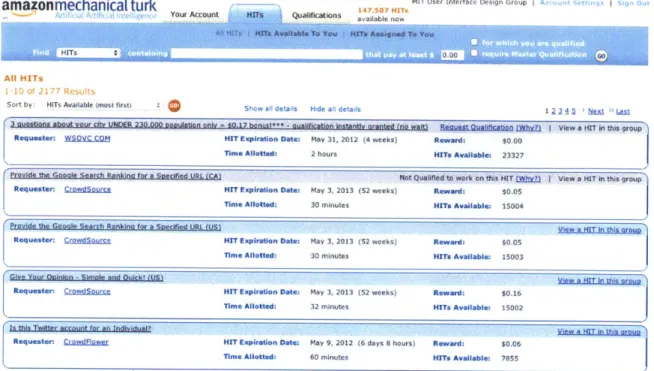
Figure 2-2: Amazon Mechanical Turk presents a list of tasks and payment for each. The list can be sorted by price, number of tasks, and recency. Workers accept a task, complete it, and submit it to the requester for review.
Other non-monetary incentives are possible as well. Duolingo' aims to help people learn - in particular learn a language - and translate the web into many languages as a side effect. Crowds will complete tasks as part of a web security measures such as CAPTCHAs [200], or share their expertise in response to rewards tuned to the local community [80].
2.1.3
Paid Crowdsourcing
While voluntary [179] and game-based participation [198, 37] spawned academic in-terest in crowdsourcing, paid microwork platforms have helped broaden it. Paid crowdsourcing markets allow requesters to post tasks and offer monetary incentives.
By solving the motivation question through extrinsic incentives, these platforms
al-low researchers to study how crowds act without needing to design games or tap into volunteerism.
4
http://www.duolingo. com