HAL Id: hal-02956728
https://hal.archives-ouvertes.fr/hal-02956728
Submitted on 14 Oct 2020
HAL is a multi-disciplinary open access
archive for the deposit and dissemination of
sci-entific research documents, whether they are
pub-lished or not. The documents may come from
teaching and research institutions in France or
abroad, or from public or private research centers.
L’archive ouverte pluridisciplinaire HAL, est
destinée au dépôt et à la diffusion de documents
scientifiques de niveau recherche, publiés ou non,
émanant des établissements d’enseignement et de
recherche français ou étrangers, des laboratoires
publics ou privés.
Graph Rewriting Rules for RDF Database Evolution
Management
Jacques Chabin, Cédric Eichler, Mirian Halfeld-Ferrari, Nicolas Hiot
To cite this version:
Jacques Chabin, Cédric Eichler, Mirian Halfeld-Ferrari, Nicolas Hiot. Graph Rewriting Rules for
RDF Database Evolution Management. International Conference on Information Integration and
Web-based Applications & Services, 2020, Chiang Mai (On line), Thailand. �hal-02956728�
Graph Rewriting Rules for RDF Database Evolution
Management
Jacques Chabin
Université d’Orléans, INSA CVL, LIFO EA Orléans, France
Cédric Eichler
[email protected] INSA CVL, Université d’Orléans, LIFO EA
Bourges, France
Mirian Halfeld-Ferrari
Université d’Orléans, INSA CVL, LIFO EA Orléans, France
Nicolas Hiot
[email protected] Université d’Orléans, INSA CVL, LIFO EA
Orléans, France
ABSTRACT
This paper introduces SetUp, a theoretical and applied framework for the management of RDF/S database evolution on the basis of graph rewriting rules. Rewriting rules formalize instance or schema changes, ensuring graph’s consistency with respect to given con-straints. Constraints considered in this paper are a well known variant of RDF/S semantic, but the approach can be adapted to user-defined constraints. Furthermore, SetUp manages updates by ensuring rule applicability through the generation of side-effects: new updates which guarantee that rule application conditions hold. We provide herein formal validation and experimental evaluation of SetUp.
CCS CONCEPTS
• Information systems → Graph-based database models; • Theory of computation→ Rewrite systems.
KEYWORDS
Graph rewriting, Database Management, Update, Constraints
ACM Reference Format:
Jacques Chabin, Cédric Eichler, Mirian Halfeld-Ferrari, and Nicolas Hiot. 2020. Graph Rewriting Rules for RDF Database Evolution Management. In Proceedings of iiWAS ’20: International Conference on Information Integration and Web-based Applications & Services (iiWAS ’20). ACM, New York, NY, USA, 10 pages. https://doi.org/XXX
1
INTRODUCTION
Graph rewriting concerns the technique of transforming a graph. It is thus natural to conceive its application in the evolution of graph databases. This paper shows the utility of this formal tool into a practical and useful application, by proposing a framework
Permission to make digital or hard copies of all or part of this work for personal or classroom use is granted without fee provided that copies are not made or distributed for profit or commercial advantage and that copies bear this notice and the full citation on the first page. Copyrights for components of this work owned by others than ACM must be honored. Abstracting with credit is permitted. To copy otherwise, or republish, to post on servers or to redistribute to lists, requires prior specific permission and/or a fee. Request permissions from [email protected].
iiWAS ’20, November 30– December 02, 2020, Chiang Mai, Thailand © 2020 Association for Computing Machinery.
ACM ISBN 978-1-4503-XXXX-X/18/06. . . $15.00 https://doi.org/XXX
which ensures the consistent evolution of RDF (Resource Descrip-tion Framework) databases. Indeed, being a graph database, RDF management inspires the use of graph oriented tools.
Initially just a part of the semantic web stack, RDF is currently largely used for representing high-quality connected data. “Repre-senting data in RDF, in an integrated way, allows information to be identified, disambiguated and interconnected by software agents and various systems to read, analyze and act upon” [1]. Data should above all else be usable and therefore satisfy the various semantics and constraints requirement applications may have.
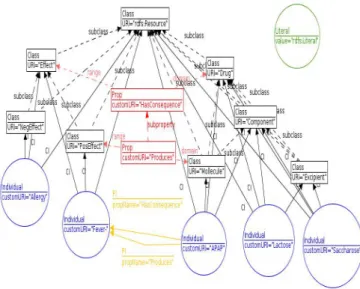
In the last decade, ontology-based systems have addressed knowl-edge representation by following the Open World Assumption (OWA) semantics where a statement cannot be inferred as false on the basis of failures to prove it. In this paper, we consider databases satisfying integrity constraints (IC) and the Closed World Assump-tion (CWA) semantics. Indeed, the OWA is not adapted to data-centric applications needing complete and valid knowledge [36]. A database where we want to ensure that every drug is associated to a molecule should be considered inconsistent if the drugd has not its associated molecule. Currently working in the pharmacology domain, the following example illustrates our motivation.
Example 1.1 (Motivating Example.). Fig. 1 shows a complete RDF/S graph database consistent w.r.t. to the RDF/S constraints. We are concerned by the problem of updating this database, keeping it consistent. Firstly, suppose an instance update: the insertion of ASA (acide amino-salicylique) as a class instance of Molecule. How can we guarantee that ASA will be also an instance of all the super-classes of Molecule? Then, consider a schema evolution: the inser-tion of provokeReacinser-tion as sub-property of HasConsequence. How can we perform this change ensuring that provokeReaction will have its domain and range as sub-classes of those of HasConsequence? □ This paper proposes SetUp (Schema Evolution Through UPdates), a maintenance tool based on graph rewriting rules for RDF data graph enriched with integrity constraints. Consistency is estab-lished according to the CWA semantics and ensures data quality for querying systems requiring reliable information. Constraints considered in this paper are those defining RDF/S semantics, but the approach adapts to other constraints, in particular user-defined ones. SetUp ensures sustainability since it offers the capability of dealing with evolution of data instance and structure without violating the semantics of the RDF model.
SetUp summarized in two main steps
(1) Firstly we formalize updates as graph rewriting rules encompass-ing integrity constraints. An Update is a general term and can be classified through two different aspects: on one hand, as insertions or deletions and, on the other hand as instance or schema changes. Each update is formalized by a graph rewriting rule whose appli-cation necessarily preserves the databases validity. To perform an update, the applicability conditions of the corresponding rule are automatically checked. When all conditions of a rule hold, the rule is activated to produce a new graph which takes into account the required update and is necessarily valid if the graph was valid prior to the update. Graph rewriting rules ensure consistency preserva-tion in design time – no further verificapreserva-tion is needed in runtime. (2) Secondly, if the applicability condition of a rule does not hold, the update is rejected. SetUp provides the possibility to force its (valid) application by performing side-effects. Indeed, in our method, side-effects are new updates that should be performed to allow the satisfaction of a rule’s condition. Side-effects are implemented by procedures associated to an update type, and thus, to some rewrit-ing rules. When an evolution is mandatory, we enforce database evolution by performing side-effects (i.e., triggering other updates or schema modifications which will render possible rule application). SetUp’s main characteristics.
• SetUp main goal is to ensure validity when dealing with the evolution of an RDF/S data graph which represents a set of RDF (the instance) and RDFS (the schema) triples respecting semantic constraints as defined in [9].
• SetUp deals with complete instances, i.e., constraint satisfaction is obtained only when the required data is effectively stored in the database.
• SetUp implements deterministic rules. Arbitrary choices have been made when non-deterministic options are available. • SetUp takes into account the user level. Only database adminis-trators may require updates provoking schema changes.
Paper Organization. After some related work in Section 2, Section 3 sets up work context. Section 4 formalizes updates by rewriting rules, Section 5 deals with side-effects and Section 6 shows our experiments. Conclusions and perspectives are drawn in Section 7.
2
RELATED WORK
Consistent database updating has been considered in different con-texts, always with two main goals: database evolution (by allowing changes) and constraint satisfaction (by keeping consistency w.r.t. the given rules). In this context, two aspects of our work can be considered as particularly original: (i) the use of graph rewriting techniques and (ii) the adoption of CWA with RDF data. Concern-ing the first aspect, to generalize and abstract consistent updatConcern-ing methods, different works have used formalisms such as tree au-tomata or grammars for XML ([28, 37] as surveys) or first order logic for relational (such as [38]) and, currently, graph databases (e.g., [7, 9, 15]).
In spite of the importance of graphs in RDF and ontology repre-sentation, the use of formal graph rewriting techniques to model RDF evolutions is still mildly studied in this context. Formal graph rewriting techniques are usually based on category theory, an ab-stract way to deal with different algebraic mathematical structures
(here, the graphs) and the relationships between them. Algebraic ap-proaches of graph rewriting allow a formal yet visual specification of rule-based systems characterizing both the effect of transfor-mations and the contexts in which they may be applied. Studying the use of graph rewriting techniques to deal with graph models is the kernel of our motivation. Few approaches relying on graph rewriting to formalize ontology evolutions have already been pro-pose [8, 25, 31]. They usually focus on formalization but do not provide an implementation. To the best of our knowledge, only [24] proposes an implementation of an approach where graph rewriting is used to model ontology updates. Its objective is to tackle the evo-lution, alignment, and merging of OWL ontologies (see also [25]) with OWA under some consistency constraints. Nested and general application conditions are not considered in [24], thus, constraints relative to transitive properties are not tackled; their proposal can-not offer guarantees we can (e.g., the absence of cycles in subclass relationships).
Concerning the second aspect, since RDF data, in the web se-mantic world, is usually associated to the OWA, having CWA as the basis of our RDF database maintenance may be seen as atypical. In this paper, the goal is to use RDF to represent connected data in a data-centered application. We intend to present a general method which apply to any graph databases where consistency has to be preserved. Thus, here, RDF is one possible graph data model. In this context it is worth mentioning, that work such as [4, 33, 36] brings back IC and CWA to the OWL world (sometimes through a hybrid approach), stressing the importance of our proposal.
Now, to position our work in regards to other updating ap-proaches, the following points deserve attention. Differences be-tween update and revision are usually considered (we refer to [17] for an overview). These differences are the consequence of different views of the problem and influence the semantic of changes of each particular proposal. As in [7, 15], we consider updates as changes in the world rather than as a revision in our knowledge of the world ([17, 18]). In such update context, the chase procedure is usually as-sociated to the generation of side-effects imposing extra insertions or deletions (w.r.t. those required by the user) to preserve consis-tency. Clearly, constraints are expected not only to be inherently consistent (e.g., a set of constraints generating contradictory side effects for the same updateu is not acceptable) but also to avoid contradicting the original intention of the user’s update. The theory of consistency enforcement in databases has been the subject of, for instance, [21, 22]. In this paper, we only deal RDF/S constraints whose consistency is ensured; but our approach could be extended to deal with user-defined constraints.
Several recent works focus on consistent graph databases. The approach in [26] differs from ours, by proposing a semantic mea-sure based on the difference between original and updated RDF sub-graph. Both [7, 10] consider RDF updating methods, but the for-mer goes deeper in the study of null values. A parallel can be done between saturation in [10], the chase in [7, 9, 15] and SetUp. Authors in [7, 9, 10, 15] offer home-made procedures to implement their methods: [10] deals only with the RDF instance constraints (Fig. 2); in [7, 9], constraints are user’s tuple-generating-dependencies. In-complete information and updates are the focus of [7, 15]. Schema evolution is mentioned in [9, 10]. More expressive constraints rep-resent a barrier to the update determinism: guarantee in [16] due
Graph Rewriting Rules for RDF Database Evolution Management iiWAS ’20, November 30– December 02, 2020, Chiang Mai, Thailand
Figure 1: RDF schema and instance.
to simple rules and in [9] due to a total ordering (which may be considered similar to the priority method in this paper).
Our RDF update strategy is different from proposals such as [3, 12] where constraints are just inference rules in OWA. Although some RDF technologies such as ShEx [34], SPIN [19], and SHACL [20] already take constraints into account, the originality of SetUp is in relying on well-studied graph rewriting techniques to ensure database consistent evolution, providing a useful and modern appli-cation for these formal tools. SetUp represents a test-bed for new database applications on the basis of graph rewriting.
3
RDF DATABASES AND UPDATES
A collection of RDF statements intrinsically represents a typed attributed directed multi-graph, making the RDF model suited to certain kinds of knowledge representation [2]. Constraints on RDF facts can be expressed in RDFS (Resource Description Framework Schema), the schema language of RDF.
In [9] we find a set of logical rules expressing the semantics of RDF/S (rules concerning RDF or RDFS) models. Let AC and AV be disjoint countably infinite sets of constants and variables, respec-tively. A term is a constant or a variable. Predicates are classified into two sets: (i) SchPred = {CL, Pr,CSub, Psub, Dom, Rnд}, used to define the database schema, standing respectively for classes, properties, sub-classes, sub-properties, property domain and range, and (ii) InstPred = {CI, PI, Ind}, used to define the database in-stance, standing respectively for class and property instances and individuals. An atom has the formP(u), where P is a predicate, and u is a list of terms. When all the terms of an atom are in AC, we have a fact.
Definition 3.1 (Database). An RDF databaseD is a set of facts composed by two subsets: the database instanceDI(facts with pred-icates in InstPred) and the database schemaDS(facts with predi-cates in SchPred). We note G = (V, E) the typed graph that repre-sents the same database.V are nodes with type in {CL, Pr, Ind, Lit }
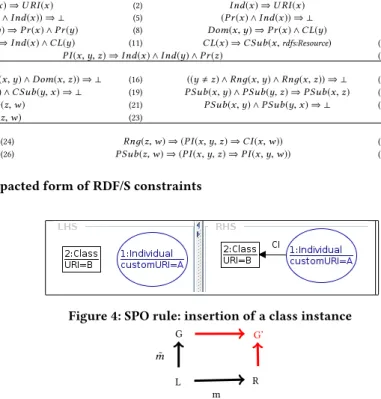
and E are edges having type in {Dom, Rnд, PSub, CSub, CI, PI }. The notationD/G designates these two formats of a database. □ Fig. 1 shows an RDF instance and schema as a typed graph whose specifications are available in [6]1. The schema specifies that Has Consequence is a property having class Drug as its domain and the class Effect as its range. Property Produces is a sub-property of Has Consequence while PosEffect is a sub-class of Effect. Class “rdfs:Resource" symbolizes the root of an RDF class hierarchy. The instance is represented by individuals which are elements of a class (e.g.,APAP is an instance of class Mollecule) and their relationships (e.g., the property instance Produces, betweenAPAP and Fever−). The logical representation of this database is a set of facts. For instance facts such as CL(Drug) or CSub(Drug, rdfs:Resource) are for the schema description and Ind(Saccharose) or CI(Saccharose, Excipient) are for the instance description. Constraints presented in [9] are those in Fig. 2 which is borrowed from [16]. We recall from [9] that these constraints capture the RDF/S semantics and the restrictions imposed by [30] whose model’s goal is to provide sound and complete algorithm for RDF/S query containment and minimization. That model imposes a semantics having character-istics such as: role distinction between types (classes, properties and individuals), unique domains and ranges for properties and no cycles in subsumptions. These constraints (that we denote by C ) are the basis of our RDF semantics. For instance, the schema constraint (20) establishes transitivity between sub-properties and the instance constraint (27) ensures this transitivity on instances of a property (ifz is a sub-property of w, all z’s instances are prop-erty instances ofw). We are interested in database that satisfy all constraints inC .
Definition 3.2 (Consistent database (D, C )). A database D is con-sistent if it satisfies all constraints inC (i.e., in this paper, those in
Fig. 2). □
As already mentioned, this paper adopts the closed world as-sumption (CWA) where constraints are not just inferences - they impose data restrictions.
Definition 3.3 (Update). LetD/G be a database. An update U on D is either (i) the insertion of a fact F in D (an insertion is denoted byF ) or (ii) the removal of a fact F from D (a deletion is denoted by ¬F ). To each update U corresponds a graph rewriting rule r. An updateF is intrinsically inconsistent if ∄D, F ∈ D ∧ (D, C ). An update is consistent if it is not intrinsically inconsistent. □ Updates can be classified according to the predicate ofF , i.e., the insertion (or the deletion) of a class, a class instance, a property, etc. For each update type, a rewriting ruler describes when and how to transform a graph database. This paper aims at proposing a set of graph rewriting rules, denoted by R, which ensures consistent transformations on G due to any atomic update U . The set R is defined on the basis ofC as illustrated in Fig. 3: on the logical level, (D, C ) expresses consistent databases; on the data graph level, (G, R) expresses graph evolution with rules in R encompassing constraints fromC . The idea is: given D/G for (D, C ) and update
1Roughly, nodes and edges are typed (represented with a unique combination of shape and color, e.g., an individual node is a blue oval) and attributed to indicate a name or value when relevant.
•Typing Constraints:
CL(x) ⇒ U RI (x) (1) Pr (x) ⇒ U RI (x) (2) I nd(x) ⇒ U RI (x) (3)
(CL(x) ∧ Pr (x)) ⇒ ⊥ (4) (CL(x) ∧ I nd(x)) ⇒ ⊥ (5) (Pr (x) ∧ I nd(x)) ⇒ ⊥ (6)
CSub(x, y) ⇒ CL(x) ∧ CL(y) (7) PSub(x, y) ⇒ Pr (x) ∧ Pr (y) (8) Dom(x, y) ⇒ Pr (x) ∧ CL(y) (9)
Rnд(x, y) ⇒ Pr (x) ∧ CL(y) (10) CI (x, y) ⇒ I nd(x) ∧ CL(y) (11) CL(x) ⇒ CSub(x,rdfs:Resource) (12)
I nd(x) ⇒ CI (x,rdfs:Resource) (13) P I (x, y, z) ⇒ I nd(x) ∧ I nd(y) ∧ Pr (z) (14)
•Schema Constraints:
Pr (x) ⇒ (∃y, z)(Dom(x, y) ∧ Rnд(x, y)) (15) ((y , z) ∧ Dom(x, y) ∧ Dom(x, z)) ⇒ ⊥ (16) ((y , z) ∧ Rnд(x, y) ∧ Rnд(x, z)) ⇒ ⊥ (17)
CSub(x, y) ∧ CSub(y, z) ⇒ CSub(x, z) (18) CSub(x, y) ∧ CSub(y, x) ⇒ ⊥ (19) PSub(x, y) ∧ PSub(y, z) ⇒ PSub(x, z) (20)
Psub(x, y) ∧ Dom(x, z) ∧ Dom(y, w) ∧ (z , w) ⇒ CSub(z, w) (21) PSub(x, y) ∧ PSub(y, x) ⇒ ⊥ (22)
Psub(x, y) ∧ Rnд(x, z) ∧ Rnд(y, w) ∧ (z , w) ⇒ CSub(z, w) (23)
•Instance Constraints:
Dom(z, w) ⇒ (P I (x, y, z) ⇒ CI (x, w)) (24) Rnд(z, w) ⇒ (P I (x, y, z) ⇒ CI (x, w)) (25)
CSub(y, z) ⇒ (CI (x, y) ⇒ CI (x, z)) (26) PSub(z, w) ⇒ (P I (x, y, z) ⇒ P I (x, y, w)) (27)
Figure 2: Simplified and compacted form of RDF/S constraints
D satisfy constraints C
⇕ ↾⇂
G evolution constrained by R
Figure 3: Rewriting rules R and constraints C .
U corresponding to rule r ∈ R; if G’ is the result of applying r on G then our goal is to have (D′, C ) for D′/G′.
4
GRAPH REWRITING FOR CONSISTENCY
MAINTENANCE
In our proposal, rewriting rules formalize both graph transforma-tions and the context in which they may be applied. These rules may be fully specified graphically, enabling an easy-to-understand yet formal graphical view of the graph transformation. To prevent the introduction of inconsistencies during updates, we 1) formally specify rules of R formalizing atomic G evolution and 2) prove that every rule in R ensures the preservation of every constraints in C . In our approach each type of atomic update corresponds to one of the 18 rules in R. The kernel of R’s construction lies on the de-tection of constraints inC impacted by an update: an insertion F (respectively, a deletion ¬F ) impacts constraints having the predi-cate ofF in their left-hand side (respectively, in their right-hand side). Consider for instance constraint (11): ifCI(A, B) is in D, then D should also contain a class B and an individual A. Hence, the graph rewriting rule formalizing the insertion ofCI(A, B) is de-signed so that it is applicable only in a database respecting these conditions.
Clearly, in this paper, it is not possible to present each rule. All rules and proofs are available in [6]. The following presents the background on graph rewriting illustrated by a single rule of R. We adopt the Single Push Out (SPO) formalism [23] to specify rewriting rule as well as several of its extensions to specify additional applica-tion condiapplica-tions and restrict rule applicability: Negative Applicaapplica-tion Conditions (NACs) [13], Positive Application Conditions (PACs), and General Application Conditions (GACs) [27].
Example 4.1. Consider the graph database of Fig. 1 and assume node Allergy exists in G but is only connected to node rdf:ressource and not to nodes such as Effect. In this context, consider the inser-tion ofCI(Allerдy, E f f ect), i.e., we want to update G by inserting Allergy as an instance of class Effect. As the update is the insertion of a class instance, the rule to be considered isrCI(Fig. 4). □
Figure 4: SPO rule: insertion of a class instance
L R
G G’
m ˜
m
Figure 5: Push-Out, application of SPO rules
The SPO approach is an algebraic approach based on category theory. A rule is defined by two graphs – the Left and Right Hand Side of the rule, denoted by L and R – and a partial morphism m from L to R (i.e., an edge-preserving morphism m from an induced subgraph of L to R ).2
Fig. 4 formalizes the SPO core ofrCIrule: L has one class-typed node with an attribute URI whose value is B and one individual-typed node with URI A, while R has the same two nodes and an edge from Ind(A) to CL(B). By convention, an attribute value within quotation mark (e.g. “NegEffect") is a fixed constant, while a value noted without quotation mark (e.g. A) is a variable whose value may be given as an input or assigned according to the context. The partial morphism from L to R is specified in the figure by tagging graph elements - nodes or edges - in its domain and range with a numerical value. An element with valuei in L is part of the domain ofm and its image by m is the graph element in R with the same valuei. For instance, in Fig. 4, the notation 1: for the individuals on L and R indicates that they are mapped through m.
A graph rewriting ruler = (L, R,m) is applicable to a graph G iff there exists a total morphism ˜m from L to G. The two morphisms m : L → R and ˜m : L → G are shown in black in the diagram of Fig. 5. The object of its push-out,G′, depicted in red, is the result of the application ofr to G with regard to ˜m.
Informally, the application ofr to G with regard to ˜m consists in modifyingG by (1) removing the image by ˜m of all elements of L that are not in the domain of m (i.e., removing ˜m(L\Dom(m))); (2) removing all dangling edges (i.e., deleting all edges that were
2To avoid multiplying notation, we use notation L and R for every rule, even those in the logical formalism, sometimes with an index indicating the rule name.
Graph Rewriting Rules for RDF Database Evolution Management iiWAS ’20, November 30– December 02, 2020, Chiang Mai, Thailand
(a) (b)
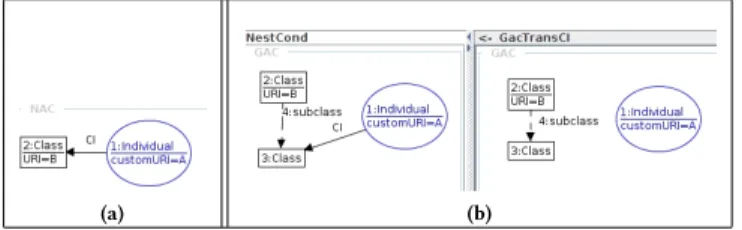
Figure 6: NAC and GAC for the SPO rule in Fig 4.
incident to a node that has been suppressed in step (1)); (3) adding an isomorphic copy of all elements of R that are not in the domain ofm.
Example 4.2. In Fig. 4, the rule is applicable to any graph contain-ing a class node with a URIB and an individual node with an URI A. Its application consists in adding a class instance edge from the individual to the class. Assuming that A and B are given as input, this rule is thus a first way of formalizing the addition of a class instance relation. It is therefore the basis for including Allergy as an instance of Effects. However, this a naive rule: for instance, the node could already exist as an instance for the same class, creating a duplicate. To avoid this kind of situations, the rule applicability must be further restricted. □
NACs and PACs are well-studied extensions that restrict rule ap-plication by, respectively, forbidding or requiring certain patterns in the graph. A NAC or a PAC for a ruler is defined as a constraint graph which is a super-graph of Lr. An SPO ruler = (L, R,m) with NACs and PACs is applicable to a graph iff: (i) there exists a total morphism ˜m : L → G (this is the classical SPO application condition); (ii) for all PACs P (resp. NACs N ) associated with r, there exists a total morphism (resp. there exists no total morphism)
¯
m : P → G whose restriction to L is ˜m. By convention, since NACs and PACs are super-graphs of L unnecessary parts of L are not depicted when illustrating a NAC or a PAC. Graph elements that are common to L and the depicted part of the NAC are identified by a numerical value similarly to elements mapped by the morphism between L and R .
Example 4.3. Fig. 6a specifies a NAC for the rule in Fig. 4. It forbids the application of the rule ifCI(A, B) already exists in the database but, it does not guarantee the satisfaction of propagation of class instances to super-classes. □
GACs. The more classical application conditions, be it NACs or PACs, are defined as a constraint graphC and an injective partial morphism (in that case, the identity function) fromC to L. From this observation, nested application conditions [11, 14] are introduced allowing the definition of conditions on the constraint graphs. A condition over a graphG is of the form true or ∃(a,c) where a : G → C is a graph morphism from G to a condition graph C, and c is a condition overC. Now, a PAC P over a rule (L, R,m) can be seen as a condition (a, true), with a being the identity morphism from L to P while a NAC N can be seen as a condition ¬(a, true) with a similar definition ofa. GACs [27] are a combination of nested application condition allowing the definition of complex application conditions for SPO rules. A GAC of a rule (L, R, m) is a condition over L that may be quantified by∀ and combined using ∧ and ∨.
The rule (L, R, m) with GAC∃(a, c) is applicable to a graph G with regard to a morphism ˜m if there is an injective graph morphism
¯
m : G → C such that ¯m ◦ a = ˜m and ¯m satisfies c.
Example 4.4. Fig. 6b specifies a GAC of form∀(a, c) for rCI. The morphisma from L to GacTransCI is depicted on the right part of Fig. 6b. GacTransCI contains L plus a subclass edge from the class node of L to a new class node n. The condition c is∃(b, true), with b the morphism from GacTransCI to NestCond (left part of Fig. 6b): NestCond is itself a super-graph of GacTransCI and comports one more CI edge from the individual node ton. Due to this GAC, the rule is applicable to a graphG with regard to a morphism ˜m only if for all morphism ¯m from GacTransCI to G whose restriction to L is
˜
m, there also exists at least a morphism from NestCond to G which restriction toGacTransCI is ¯m. In other word, this GAC ensures that if the rule is applicable, then∀C, CL(C) ∧ CSub(B, C) ⇒ CI (A, C). Indeed, if there is a mapping from L to the database graph, the rule is applicable only if, for each matching ofGacTransCI (i.e., for all classC that is a super-class of B) there is a matching of NestCond (i.e., there must be an edge of type CI fromInd(A) to CL(C)). □
To prove that rulerCI, defined by the SPO core of Fig. 4 and application conditions of Fig. 6, preserves consistency, we consider the impacted constraints inC , namely: 11 and 26 in Fig 2 (having atoms withCI on their L). The SPO part of rCI ensures that the insertion of a class instance is performed only when the individual and its type already exist in the database (constraint 11). According torCI’s GAC,rCIis applicable only ifA is an instance of all super-classes ofC (ensuring constraint 26). The correctness of all other rewriting rules is proved in a similar way (available in [6]). Based on that work we can also prove the following lemma.
Lemma 4.5 (Correctness of rewriting rules). LetU be a consistent update,F the fact being inserted (resp. deleted) and r ∈ R the corresponding rewriting rule. Let G/D be a consistent database, G’ be the result of the application of r on G (we write G′ = r(G)), andD′the database defined by G’/D’. Then (1) G′is consistent, i.e., (D’,C ) and (2) F ∈ D′
(resp.F < D′). □
5
SIDE-EFFECTS AND CONSISTENT
DATABASE EVOLUTION
Traditionally, whenever a database is updated, if constraint viola-tions are detected, either the update is refused or compensation actions, which we call side-effects, must be executed in order to guarantee their satisfaction. In our approach, each updateU is for-malized by a rewriting rulerU ∈ R. If applicability conditions of rU are not respected, our algorithm generates new updates capable of changing G into a new graph Gnon whichrU can be applied to produce G′. These new updates are called side-effects ofU .
Example 5.1. LetD/G be the database as the one in Fig. 1, but without NegEffect and its incident edges. In this context, consider that U is the insertion of class instance CI(Allerдy, NeдE f f ect) and rCI ∈ R the corresponding rule (Fig. 4). The rule cannot be applied on G since it requires the existence of both the class and the individual which we want to “link together”. Thus, two side-effects are generated: (U1) the insertion of an individual
Allergy and (U2) the insertion of class NegEffect. The corresponding
Update Type Conditions
CI(Xi,XC) Indiv (Xi); CL (XC) ∨ (XC = Ressource); ∀ YC CSub (XC, YC) then CI(Xi, YC) CL(A) ¬Pr(A); ¬Indiv(A);
CSub(A, Resource); Uri(A)
¬ Pr(P) ∀ Xsp PSub(Xsp, P) then ¬ PSub(Xsp, P) ∀ XP PSub(P, XP) then ¬ PSub(P, XP) ∀ XD Dom (P, XD) then ¬ Dom (P, XD) ∀ XR Rng (P, XR) then ¬ Rng (P, XR) ∀ Xi, Yi PI (Xi, Yi, P) then ¬ PI (Xi, Yi, P)
Figure 7: Extract of UpdCond table.
them to class rdfs:Resource. RulerCI is then applied, giving the graph of Fig. 1, except for a missing subclass edge between Effect and NegEffect and a missing CI edge from Allergy to Effect. □ Roughly, SetUp is an algorithm allowing the interaction between a graph rewriter and a side-effect generator. The latter, producing new updates to be treated by the former, can follow different politics in ordering and in authorizing the treatment of these new updates. In our approach, different levels of users are considered: those authorized to trigger side-effects or provoke schema changes and those for whom only instance updates respecting R are allowed. Algorithm 1 summarizes our approach for authorized users.
Given a databaseD/G and an update U , Algorithm 1 transforms G following rules in R. Denote by rU ∈ R the rewriting rule as-sociated toU . When rU cannot be applied on G, SetUp computes, recursively, all updates necessary to change G so that rU is appli-cable. Here, it is worth noting the design flexibility imposed by the update scenario: either imposed by the intrinsic non-determinism of consistency maintenance or by side-effect ordering.
Indeed, on line 1 of Algorithm 1, each conditionc, necessary for applyingrU on G, is added to PreConditions. Function FindPred-Cond2ApplyUpd works on table UpdCond [6] indexed by the update type. Fig. 7 shows an extract of UpdCond (e.g., from the first row, we know that the insertion ofCI(A, B), depends on the existence ofA as an individual, B as an class and the respect of hierarchical constraints). Roughly, to design UpdCond for an insertionP, we consider all constraintsc ∈ C (Fig. 2) having atoms with the predi-cate ofP in Lc(its body) and we build updates corresponding to the atoms in Rc(its head). Deletions are treated in a reciprocal way: we look from the predicate ofP on the heads of constraints and define the new updates based on the atoms in their bodies. Unfortunately, a deletion may engender non-deterministic side-effects. Consider for instance the deletion of a class instanceCI(A, B). Constraint 26 inC (Fig. 2) indicates two possible side-effects in this case: deleting A as a class instance of all super-classes of B or breaking the class hierarchy. In this paper, we deal with non-determinism in an arbi-trary way: when a choice is needed, the priority is given to updates on the instance, leaving the schema unchanged. Thus, in the above example, side-effect updates are: ¬CI(A,yc), for eachycwhich is a super-class ofB. When non-determinism is over two side-effects implying changes on the schema, the priority is to break the highest hierarchical link.
Then, on line 2 of Algorithm 1, each conditionc is considered. The order in which eachc is treated impacts the order in which new updates are applied to the database and gives rise to different approaches. PreConditions can be seen as a set (updates treated on
any order) or as a list ordered according to a particular method. Our prototype uses an arbitrarily pre-defined order. Arbitrary choices are seldom the best solution: we are currently working on a cost function to guide our choices both for update ordering and non-deterministic choices.
Algorithm 1:SetUp (G, R, U )
Input:Graph database G, set of rewriting rules R, update U Output: New graph database G
1: PreConditons:= FindPredCond2ApplyUpd(G, R, U ) 2: for all conditionc in PreConditons do
3: ifc is not satisfied in G then 4: U′:=Planner2FitGraphInCond (G, c) 5: for allupdateu′inU′ do 6: G := SetUp (G, R, u′) 7: G := GraphRewriter(G, R, U ) 8: return G
Once a conditionc is chosen, Planner2FitGraphInCond (line 4) generates a new update setU′(i.e., side-effects forU ). Recursive calls (line 6) ensure that each side-effectu′∈U′is treated in the same way. When conditions for a rewriting ruleru′hold, function
GraphRewriter appliesru′and the graph evolves. Eventually, ifU
is not intrinsically inconsistent, we obtain a new graph on which rU is applicable. Indeed, some updatesU related to a fact F may be intrinsically inconsistent as illustrated in the following example.
Example 5.2. Trying to perform SetUp (G, R, CI(Sweetener, Sweetener)), an inconsistent update, Algorithm 1, line 1, produces two pre-conditionsc1 : Ind(Sweetener) and c2 : CL(Sweetener).
- c1 is not satisfied in G, line 4 produces side-effect Ind(Sweetener), which is inserted in the graph by line 6 with no more side-effect.
- c2 is not satisfied in G line 4 produces side-effect CL(Sweetener), line 6 deletes Ind(Sweetener) before applying the rulerCL and insertCL(Sweetener)in G.
Conditionsc1andc2having been handled,rCIis invoked but it can-not be applied: there is no individual node Sweetener; the algorithm
stops. □
The current version of SetUp is simple and avoids loops in the treatment of intrinsically inconsistent updates. It performs updates according to a pre-established order without any backtracking. Therefore, once a rule is activated for side-effecte1of updateu1it
will not be activated again for the same updateu1. The resulting
graph, in this case, does not change, but stays consistent.
Lemma 5.3 (SetUp Correction). Let G be a consistent graph and R our set of graph rewriting rules. Let U be a consistent update, F the fact being inserted or deleted. LetD′/G′be the database such that G′= SetUp(G, R,U ). Then, (1) SetUp terminates and (2) if U is an insertionF ∈ D′, otherwise, ifU is a deletion F < D′. □
Proof. (sketch, full proof available in [6]) For each type of up-date we prove that we have a finite number of side-effects and thus recursive calls terminate. □
Graph Rewriting Rules for RDF Database Evolution Management iiWAS ’20, November 30– December 02, 2020, Chiang Mai, Thailand
6
EXPERIMENTAL EVALUATION
SetUp is implemented in Java and relies on AGG (The Attributed Graph Grammar System) [35], one of the most mature and cited development environment supporting the definition and application of typed graph rewriting systems [29]. Its current version –available online [5]– provides a textual interface and offers different updating modes, according to the user level. This section experimentally investigates SetUp in various update scenarios, evaluating their execution time and the number of generated side-effects.
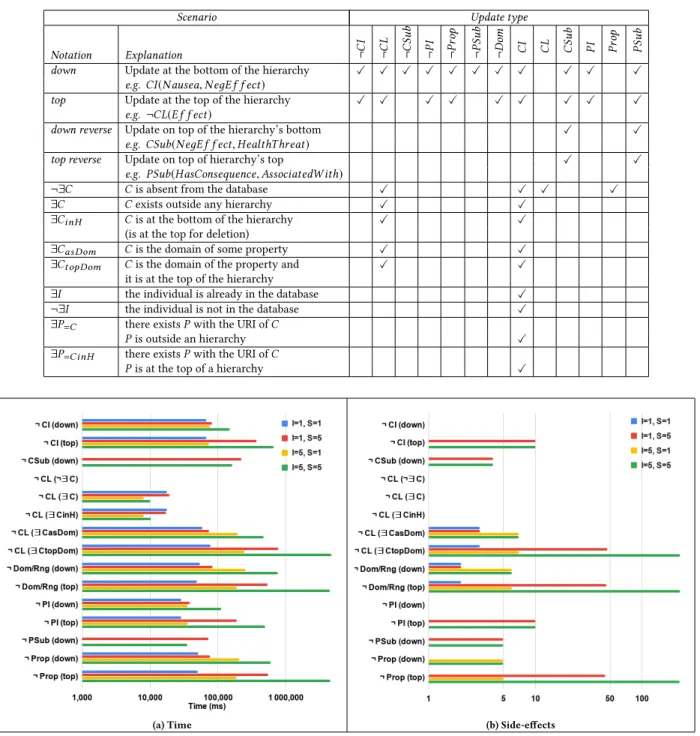
Figure 8: Experimental graph withI = 1 and S = 2 Datasets.The impact of the schema complexity (particularly, the complexity of the hierarchy set up in a schema) on the performance of our method is non-negligible. Thus, although there are many open RDF datasets available, our experiments are conducted on synthesised RDF/S graphs, allowing us to analyse results according to changes on the schema hierarchy. A simplified example is pro-vided in Fig. 8 with the aforementioned graphical representation for typed edges and nodes. Experimental graphs are composed of: (A) Schema: (i) a minimal schema with no hierarchy (a property with two dom/rng classes and a class, illustrated in red and black in the upper right part of Fig. 8) plus (ii) a simple hierarchy ofS classes and properties (illustrated in the bottom part of the figure). (B) Instances of all these classes and properties (in blue and yellow in the figure). Concepts outside or at the bottom of the hierarchy haveI instances, the next has 2 ∗I instances, etc (so that the top of the hierarchy has S*I instances). The values of (I, S) used in experiments are (1, 1), (1, 5), (5, 1), and (5, 5) which correspond to graphs with (|V |, |E|) equal to (16, 24), (44, 152), (40, 80), and (116, 480), respectively. Experimental scenarios.Experiments consist in facts insertions and deletions as summarized in Table 1. They are categorized ac-cording to the update type and the database configurations, since the impact of an update is intrinsically related to these two factors. Every case having a check-mark indicates a scenario taken into account in our experiments, for the referenced update. As an exam-ple, consider the insertion of an instance of classC. If C is not yet in the base but a propertyP with the same URI is, then P (and all its instances) are deleted to allowC’s insertion. Different scenarios are defined according to the position ofP in the hierarchy (lines with∃P=Cand∃P=CinH).
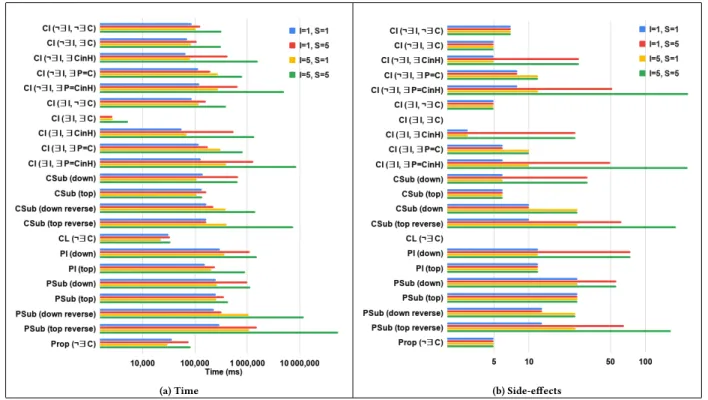
Experimental results.Figs. 9 and 10 show the results of our ex-periments for deletions and insertions, respectively. The time is measured with JMH [32] on 3 forks of 10 warmups and 50 measure iterations with a mean of 150 op./iteration.
Side-effects tackled by the GraphRewriter are not taken into ac-count: for instance, the deletion of a class at the top of the hierarchy is reported with 0 side-effect since deletion of relevantCI and CSub are handled by the GraphRewriter through the removal of dangling edges. On the contrary, those generated by SetUp are counted even if they do not need to be applied due to the database configuration. For instance the insertionCL(A) has two side-effects (¬Pr(A) and ¬Ind(A)) that are included even if the original database does con-tain neither such a property nor such an individual. The number of generated side-effects varies according to the update type and the scenario. For instance,CL(A) always generates the 2 aforemen-tioned side-effects. AsCSub and CI relationships are suppressed by the GraphRewriter, update ¬CL(C) generates 0 side-effects in sce-narios ¬∃C, ∃C, and ∃CinH. However, in the scenario ¬Dom/Rnд
top, 2, 46, 6, and 226 are generated with (I, S) = (1, 1), (1, 5), (5, 1), and (5, 5), respectively. The first generated side-effect is ¬Pr(P) withP the property whose domain or range is suppressed. It it-self generatesS ∗ I ¬PI (one per instance of P) that need to be enforced beforehand. In turn, each ¬PI triggers the suppression of instances ofP′s sub-properties with the same owner and value. Hence, the number of generated side-effects increases linearly with S and quadratically with I.
Execution time grows with the size of the knowledge graph, as it impacts the pattern matching and the verification of rule appli-cability phases. The scale of this impact varies depending on the complexity of the applied graph rewriting rules.CL(A), for example, triggers the same number of side-effects by both SetUp and the GraphRewriter (which is CSub(A, “rd f s : Resource”)) regardless of I and S. The applicability conditions of the corresponding rule are quite simple (two NACs) and the impact is thus marginal: it takes 31, 5s and 34, 4s withS = 1, I = 1 and S = 5, I = 5, respectively. This corresponds to a 9% execution time increase for a graph containing roughly 7 times more vertices and 20 times more edges. On the contrary, consider ¬CI(top) whose rule contains complex GACs. Side-effects depends solely onS and, with S = 5 and 10 side-effects, the execution time goes up by 79% fromI = 1 (368, 5s) to I = 5 (660, 5s). By roughly tripling the size of the graph, each update ¬CI takes almost 72% more time to be executed.
The second factor impacting time is the number of generated side-effects, as they triggers calls to the pattern matching and graph rewriting algorithms. For instance, configuration (I, S) = (1, 5) is bigger than (5, 1) as it as almost as many nodes but twice as many edges. Yet, ¬Dom/Rnд (top) is almost three times longer on the sec-ond configuration (190, 5s and 538s, respectively). This is due to the number of side-effects going from 6 to 46. Notably, side-effects han-dled by the GraphRewriter mildly impact execution time. ¬Cl, for example, has almost the same execution time with configurations ∃C and ∃CinH (10, 0 and 10, 3s respectively withI = S = 5), even tough the latter implies the suppression ofS CSub relationships.
7
CONCLUSIONS AND PERSPECTIVES
SetUp is a theoretical and applied framework for ensuring con-sistent evolution of RDF graphs. Its originality lies in the use of a typed graph rewriting system ; each atomic update is formal-ized using a graph rewriting rule whose application necessarily preserves constraints. If an update cannot be applied, SetUp may
Table 1: Experiment scenarios (C is a class, P a property and I an individual.)
Scenario Update type
Notation Explanation ¬C I ¬ C L ¬ C Su b ¬ PI ¬ Pr op ¬ PS ub ¬ D om C I C L C Su b PI Prop PSub down Update at the bottom of the hierarchy ✓ ✓ ✓ ✓ ✓ ✓ ✓ ✓ ✓ ✓ ✓
e.g.CI(Nausea, NeдE f f ect)
top Update at the top of the hierarchy ✓ ✓ ✓ ✓ ✓ ✓ ✓ ✓ ✓ e.g. ¬CL(E f f ect)
down reverse Update on top of the hierarchy’s bottom ✓ ✓ e.g.CSub(NeдE f f ect, HealthThreat)
top reverse Update on top of hierarchy’s top ✓ ✓
e.g.PSub(HasConsequence, AssociatedW ith)
¬∃C C is absent from the database ✓ ✓ ✓ ✓
∃C C exists outside any hierarchy ✓ ✓
∃CinH C is at the bottom of the hierarchy ✓ ✓ (is at the top for deletion)
∃CasDom C is the domain of some property ✓ ✓ ∃CtopDom C is the domain of the property and ✓ ✓
it is at the top of the hierarchy
∃I the individual is already in the database ✓ ¬∃I the individual is not in the database ✓ ∃P=C there existsP with the URI of C
P is outside an hierarchy ✓
∃P=CinH there existsP with the URI of C
P is at the top of a hierarchy ✓
(a) Time (b) Side-effects
Figure 9: Experimental results for fact suppression.
generate additional consistency preserving updates to ensure its applicability.
The importance of SetUp is in its originality of using graph rewriting techniques under the closed world assumption to set an updating system. Even if it is unfit for on-the-fly automated up-dates, SetUp is satisfactory for interactive command line updates and can also be used for offline modifications. Not only can SetUp
be used as a test-bed for updating approaches but also for further database applications. In particular, we plan to use it on offline RDF graph anonymization, where a snapshot of a RDF graph is anonymized and openly published. In this context, a separate entity triggers updates in SetUp to conform to a privacy model such as k-anonymity or differential privacy. The advantage of SetUp to con-duct such operations is threefold. First, even though the produced
Graph Rewriting Rules for RDF Database Evolution Management iiWAS ’20, November 30– December 02, 2020, Chiang Mai, Thailand
(a) Time (b) Side-effects
Figure 10: Experimental results for fact insertion.
graph is ultimately perturbed and not a “real" database, constraint satisfaction and property preservation is paramount. Indeed, any inconsistency may give indication to potential attackers and there-fore jeopardyze privacy. We believe that graph rewriting rules are appropriate to guarantee constraint and property preservation, as seen in this paper. Secondly, since requested updates are required to conform to the chosen anonymity model, it is important to even-tually guarantee their applications. Hence, refusing an update is not acceptable in this context, justifying they need of side-effect management as handled by the proposed framework. Thirdly, even if most works related to RDF updates adopt the open world as-sumption, the closed world assumption adopted by SetUp allows a better understanding and management of the published knowledge, which is crucial for anonymisation. Note that this is not inconsis-tent with the primary advantages of linked data; once published, the database can be subject to inference rules or linked to other knowledge-bases. Indeed, privacy models (e.g., approaches based on differential privacy) do not necessarily make hypothesis on the attackers’ auxiliary knowledge. Rather, they only focus on the re-leased data and privacy guarantees stand regardless of existing and accessible data related to the published data base.
Acknowledgement:Work supported by the French National Re-search Agency, under grant ANR-18-CE23-0010 and developed in the context of DOING@DIAMS group.
REFERENCES
[1] [n.d.]. https://www.ontotext.com/knowledgehub/fundamentals/what-is-rdf/. [2] Serge Abiteboul, Ioana Manolescu, Philippe Rigaux, Marie-Christine Rousset,
and Pierre Senellart. 2011. Web data management. Cambridge University Press.
[3] Albin Ahmeti, Diego Calvanese, and Axel Polleres. 2014. Updating RDFS ABoxes and TBoxes in SPARQL. CoRR abs/1403.7248 (2014).
[4] Karlis Cerans, Guntis Barzdins, Renars Liepins, Julija Ovcinnikova, Sergejs Rika-covs, and Arturs Sprogis. 2012. Graphical schema editing for StarDog OWL/RDF databases using OWLGrEd/S. 849 (01 2012).
[5] Jacques Chabin, Cédric Eichler, Mirian Halfed Ferrari, and Nicolas Hiot. 2019. SetUp: a tool for consistent updates of RDF knowledge graphs. https://owncloud.insa-cvl.fr/s/4w8eiqO2xDPBDiS.
[6] Jacques Chabin, Cédric Eichler, Mirian Halfed Ferrari, and Nicolas Hiot. 2020. Graph rewriting system for consistent evolution of RDF databases. Technical Report. LIFO, Université d’Orléans, INSA Centre Val de Loire. hal.archives-ouvertes.fr/hal-02560325v3
[7] Jacques Chabin, Mirian Halfeld Ferrari, and Dominique Laurent. 2019. Consistent Updating of Databases with Marked Nulls. Knowledge and Information Systems (2019).
[8] Pieter De Leenheer and Tom Mens. 2008. Using Graph Transformation to Support Collaborative Ontology Evolution. In Applications of Graph Transformations with Industrial Relevance, Andy Schürr, Manfred Nagl, and Albert Zündorf (Eds.). Springer Berlin Heidelberg, Berlin, Heidelberg, 44–58.
[9] Giorgos Flouris, George Konstantinidis, Grigoris Antoniou, and Vassilis Christophides. 2013. Formal foundations for RDF/S KB evolution. Knowl. Inf. Syst. 35, 1 (2013), 153–191.
[10] François Goasdoué, Ioana Manolescu, and Alexandra Roatiş. 2013. Efficient query answering against dynamic RDF databases. In Proceedings of the 16th International Conference on Extending Database Technology. ACM, 299–310.
[11] Ulrike Golas, Enrico Biermann, Hartmut Ehrig, and Claudia Ermel. 2011. A Visual Interpreter Semantics for Statecharts Based on Amalgamated Graph Transforma-tion. ECEASST 39 (01 2011).
[12] Claudio Gutierrez, Carlos A. Hurtado, and Alejandro A. Vaisman. 2011. RDFS Update: From Theory to Practice. In The Semanic Web: Research and Applications -8th Extended Semantic Web Conference, ESWC, Greece, Proceedings, Part II. 93–107. [13] Annegret Habel, Reiko Heckel, and Gabriele Taentzer. 1996. GRAPH GRAMMARS WITH NEGATIVE APPLICATION CONDITIONS. Fundam. Inf. 26, 3,4 (Dec. 1996), 287–313.
[14] Annegret Habel and Karl-heinz Pennemann. 2009. Correctness of High-level Transformation Systems Relative to Nested Conditions. Mathematical. Structures in Comp. Sci. 19, 2 (April 2009), 245–296.
[15] Mírian Halfeld Ferrari, Carmem S. Hara, and Flavio R. Uber. 2017. RDF Updates with Constraints. In Knowledge Engineering and Semantic Web - 8th International
Conference, KESW, Szczecin, Poland, Proceedings. 229–245.
[16] Mirian Halfeld Ferrari and Dominique Laurent. 2017. Updating RDF/S Databases Under Constraints. In Advances in Databases and Information Systems - 21st European Conference, ADBIS, Nicosia, Cyprus, Proceedings. 357–371.
[17] Sven Ove Hansson. 2016. Logic of Belief Revision. In The Stanford Encyclopedia of Philosophy (winter 2016 ed.), Edward N. Zalta (Ed.). Metaphysics Research Lab, Stanford University.
[18] Hirofumi Katsuno and Alberto O. Mendelzon. 1991. On the Difference between Updating a Knowledge Base and Revising It. In Proc. of the 2nd Int. Conf. on Principles of Knowledge Representation and Reasoning (KR’91). Cambridge, MA, USA, April 22-25. 387–394.
[19] H. Knublauch, J. A. Hendler, and K. Idehen. 2011. SPIN - Overview and Motivation. W3C Member Submission. http://www.w3.org/Submission/2011/SUBM-spin-overview-20110222.
[20] H. Knublauch and A. Ryman. 2017. Shapes Constraint Language (SHACL). W3C First Public Working Draft, W3C. http://www.w3.org/TR/2015/WD-shacl-20151008/..
[21] Sebastian Link. 2002. Towards a Tailored Theory of Consistency Enforcement in Databases. In Foundations of Information and Knowledge Systems, Second Interna-tional Symposium, FoIKS, Germany, Proceedings. 160–177.
[22] Sebastian Link and Klaus-Dieter Schewe. 2002. An Arithmetic Theory of Consis-tency Enforcement. Acta Cybern. 15, 3 (2002), 379–416.
[23] Michael Löe. 1993. Algebraic approach to single-pushout graph transformation. Theoretical Computer Science 109, 1âĂŞ2 (1993), 181 – 224.
[24] Mariem Mahfoudh. 2015. Adaptation d’ontologies avec les grammaires de graphes typés: évolution et fusion. (Ontologies adaptation with typed graph grammars : evolution and merging). Ph.D. Dissertation. University of Upper Alsace, Mulhouse, France.
[25] Mariem Mahfoudh, Germain Forestier, Laurent Thiry, and Michel Hassenforder. 2015. Algebraic graph transformations for formalizing ontology changes and evolving ontologies. Knowledge-Based Systems 73 (2015), 212 – 226.
[26] Pierre Maillot, Thomas Raimbault, David Genest, and Stéphane Loiseau. 2014. Consistency Evaluation of RDF Data: How Data and Updates are Relevant. In Tenth International Conference on Signal-Image Technology and Internet-Based Systems, SITIS 2014, Marrakech, Morocco, November 23-27, 2014. 187–193. [27] Olga Runge, Claudia Ermel, and Gabriele Taentzer. 2012. AGG 2.0 – New Features
for Specifying and Analyzing Algebraic Graph Transformations. In Applications of Graph Transformations with Industrial Relevance. Springer Berlin Heidelberg,
Berlin, Heidelberg, 81–88.
[28] Thomas Schwentick. 2007. Automata for XML - A survey. J. Comput. Syst. Sci. 73, 3 (2007), 289–315.
[29] Sergio Segura, David Benavides, Antonio Ruiz-Cortés, and Pablo Trinidad. 2008. Automated Merging of Feature Models Using Graph Transformations. Springer Berlin Heidelberg, Berlin, Heidelberg, 489–505.
[30] Giorgos Serfiotis, Ioanna Koffina, Vassilis Christophides, and Val Tannen. 2005. Containment and Minimization of RDF/S Query Patterns. In The Semantic Web -ISWC 2005, 4th International Semantic Web Conference, -ISWC 2005, Galway, Ireland, November 6-10, 2005, Proceedings (Lecture Notes in Computer Science, Vol. 3729), Yolanda Gil, Enrico Motta, V. Richard Benjamins, and Mark A. Musen (Eds.). Springer, 607–623.
[31] Arash Shaban-Nejad and Volker Haarslev. 2015. Managing changes in distributed biomedical ontologies using hierarchical distributed graph transformation. Inter-national Journal of Data Mining and Bioinformatics 11, 1 (2015), 53–83. [32] Aleksey Shipilev, Sergey Kuksenko, Anders Astrand, Staffan Friberg, and Henrik
Loef. 2007. OpenJDK Code Tools: JMH. https://openjdk.java.net/projects/code-tools/jmh/
[33] Evren Sirin, Michael Smith, and Evan Wallace. 2008. Opening, Closing Worlds -On Integrity Constraints. In Proceedings of the Fifth OWLED Workshop on OWL: Experiences and Directions, collocated with the 7th International Semantic Web Conference (ISWC-2008) (CEUR Workshop Proceedings, Vol. 432), Catherine Dolbear, Alan Ruttenberg, and Ulrike Sattler (Eds.). CEUR-WS.org.
[34] H. Solbrig and E. Prud ´hommeaux. 2014. Shape Expressions 1.0 Definition. W3C Member Submission. http://www.w3.org/Submission/2014/SUBM-shex-defn-20140602.
[35] Gabriele Taentzer. 2003. AGG: A Graph Transformation Environment for Model-ing and Validation of Software. In AGTIVE.
[36] Jiao Tao, Evren Sirin, Jie Bao, and Deborah L. McGuinness. 2010. Integrity Constraints in OWL. In Proceedings of the Twenty-Fourth AAAI Conference on Artificial Intelligence, AAAI 2010, , USA, Maria Fox and David Poole (Eds.). AAAI Press.
[37] Joe Tekli, Richard Chbeir, Agma J. M. Traina, and Caetano Traina Jr. 2011. XML document-grammar comparison: related problems and applications. Central Eur. J. Comput. Sci. 1, 1 (2011), 117–136.
[38] Marianne Winslett. 1990. Updating Logical Databases. Cambridge University Press, New York, NY, USA.