HAL Id: hal-00298215
https://hal.archives-ouvertes.fr/hal-00298215
Submitted on 3 Apr 2008HAL is a multi-disciplinary open access
archive for the deposit and dissemination of sci-entific research documents, whether they are pub-lished or not. The documents may come from teaching and research institutions in France or abroad, or from public or private research centers.
L’archive ouverte pluridisciplinaire HAL, est destinée au dépôt et à la diffusion de documents scientifiques de niveau recherche, publiés ou non, émanant des établissements d’enseignement et de recherche français ou étrangers, des laboratoires publics ou privés.
Borehole paleoclimatology ? the effect of deep lakes and
”heat islands” on temperature profiles
V. T. Balobaev, I. M. Kutasov, L. V. Eppelbaum
To cite this version:
V. T. Balobaev, I. M. Kutasov, L. V. Eppelbaum. Borehole paleoclimatology ? the effect of deep lakes and ”heat islands” on temperature profiles. Climate of the Past Discussions, European Geosciences Union (EGU), 2008, 4 (2), pp.415-432. �hal-00298215�
CPD
4, 415–432, 2008 Borehole paleoclimatology V. T. Balobaev et al. Title Page Abstract Introduction Conclusions References Tables Figures ◭ ◮ ◭ ◮ Back CloseFull Screen / Esc
Printer-friendly Version Interactive Discussion
Clim. Past Discuss., 4, 415–432, 2008 www.clim-past-discuss.net/4/415/2008/
© Author(s) 2008. This work is distributed under the Creative Commons Attribution 3.0 License.
Climate of the Past Discussions
Climate of the Past Discussions is the access reviewed discussion forum of Climate of the Past
Borehole paleoclimatology – the effect of
deep lakes and “heat islands” on
temperature profiles
V. T. Balobaev1, I. M. Kutasov2, and L. V. Eppelbaum3 1
Permafrost Institute, Siberian Branch of the Russian Academy of Sciences, Yakutsk 677018, Russia
2
Pajarito Enterprises, 640 Alta Vista, Suite 124, Santa Fe, NM 87505, USA
3
Dept. of Geophysics and Planetary Sciences, Raymond and Beverly Sackler Faculty of Exact Sciences, Tel Aviv University, Ramat Aviv 69978, Tel Aviv, Israel
Received: 29 February 2008 – Accepted: 10 March 2008 – Published: 3 April 2008 Correspondence to: L. V. Eppelbaum ([email protected])
CPD
4, 415–432, 2008 Borehole paleoclimatology V. T. Balobaev et al. Title Page Abstract Introduction Conclusions References Tables Figures ◭ ◮ ◭ ◮ Back CloseFull Screen / Esc
Printer-friendly Version Interactive Discussion
Abstract
It is known that changes in ground surface temperatures could be caused by many non-climatic effects. In this study we propose a method based on utilization of Laplace equation with nonuniform boundary conditions. The proposed method makes possible to estimate the maximum effect of deep lakes and “heat islands” (areas of
deforesta-5
tion, urbanization, farming, mining and wetland drainage) on the borehole temperature profiles.
1 Introduction
At present many efforts are made to determine the trends in ground surface tem-perature history (GSTH) from geothermal surveys. In this case accurate subsurface
10
temperature measurements are needed to solve this inverse problem – estimation of the unknown time dependent ground surface temperature (GST). The variations of the GST during the long term climate changes resulted in disturbance (anomalies) of the temperature field of formations. Thus, the GSTH can be evaluated by analyz-ing the present precise temperature-depth profiles. The effect of surface temperature
15
variations in the past on the temperature field of formations is widely discussed in the literature (Cermak, 1971; Lachenbruch and Marshall, 1986; Beltrami et al., 1992; Shen and Beck, 1992; Mareschal and Beltrami, 1992; Wang, 1992; Shen et al., 1992, 1995; Bodri and Cermak, 1995, 1997; Kukkonen et al., 1994; Harris and Chapman, 1995; Huang et al., 1996; Huang and Pollack, 1998; Huang et al., 2000; Pollack and
20
Huang, 2000; Majorowicz and Safanda, 2005; Hamza et al., 2007). Earlier the forward calculation approach (FCA) was used to the analysis and interpretation of borehole temperatures in terms of a GSTH (Eppelbaum et al., 2006). Three groups based on the geographical proximity were formed. Fifteen borehole temperature profiles from Europe (5), Asia (4) and North America (6) were selected (Huang and Pollack, 1998;
25
CPD
4, 415–432, 2008 Borehole paleoclimatology V. T. Balobaev et al. Title Page Abstract Introduction Conclusions References Tables Figures ◭ ◮ ◭ ◮ Back CloseFull Screen / Esc
Printer-friendly Version Interactive Discussion
warming rates in 20th century by the FCA method and comparing with those obtained by the few parameter estimation (FPE) technique (Huang et al., 1996; Huang and Pol-lack, 1998). It was reasonable to assume that for close spaced boreholes, the values of the warming rates obtained by the two inversion methods, should vary in narrow limits. The results of inversions (FCA) have shown that for boreholes in North
Amer-5
ica the current warming rates vary in the 0.41–2.45 K/100 a range. The wide range for the warming rate of 0.33–2.48 K/100 a was also determined for boreholes in Eu-rope. Interesting results we obtained (Eppelbaum et al., 2006) for four boreholes in Asia (China). In this case the warming rate varies in relatively narrow limits (1.16– 1.59 K/100 a). The warming rate estimated by the FPE technique (Huang and Pollack,
10
1998) varied in wide ranges: 0.38–2.49 K/100 a (North America); 0.21–3.75 K/100 a (Europe), and 0.30–2.53 K/100 a (Asia). Thus we can conclude that for boreholes in North America and Europe both approaches provide practically the same ranges of warming rates. For Asian boreholes the FCA approach gives a more consistent (nar-row) range of warming rates (1.16–1.59 K/100 a). The results of temperature inversion
15
by both techniques indicate that probably some of non-climatic effects (vertical and horizontal water flows, steep topography, lakes, vertical variation in heat flow, lateral thermal conductivity contrasts, thermal conductivity anisotropy, deforestation, forest fires, mining, wetland drainage, agricultural development, urbanization, etc.) may have perturbed the borehole temperature profiles (e.g., Carslaw and Jaeger, 1959;
Lachen-20
bruch, 1965; Kappelmeyer and Haenel, 1974; Blackwell et al., 1980; Lewis and Wang, 1992; Majorowicz and Skinner, 1997; Powell et al., 1988; Guillou-Frottier et al., 1998; Lewis and Wang, 1998; Kohl, 1999; Safanda, 1999; Pollack and Huang, 2000; Cermak and Bodri, 2001; Lewis and Skinner, 2003; Gosselin and Mareschal, 2003; Gruber et al., 2004; Bodri and Cermak, 2005; Mottaghy et al., 2005; Nitoiu and Beltrami, 2005;
25
Taniguchi, 2006; Chouinard and Mareschal, 2007; Hamza et al., 2007; Safandra et al., 2007).
We should note that all climate reconstruction methods are based on one-dimensional heat conduction equation. It is assumed that a uniform boundary condition
CPD
4, 415–432, 2008 Borehole paleoclimatology V. T. Balobaev et al. Title Page Abstract Introduction Conclusions References Tables Figures ◭ ◮ ◭ ◮ Back CloseFull Screen / Esc
Printer-friendly Version Interactive Discussion
is applied on a plane surface, the formation is a laterally homogeneous medium, and the thermal properties can only depend on a depth. For this reasons any subsurface temperature variations arising from conditions that depart from that theoretical model have the potential to be incorrectly interpreted as a climate change signature (Pollack and Huang, 2000). As was mentioned by Nitoiu and Beltrami (2005) from over 10 000
5
borehole temperature logs worldwide (The International Heat Flow Commission global geothermal data set), only about 10% of these data are currently used for climate stud-ies because a number of known non-climatic energy perturbations are superimposed on the climatic signal.
Therefore, an extreme caution should be used in selection of temperature-depth
10
profiles for inferring the ground surface temperature histories. To demonstrate the well selection procedures we briefly present two examples. In the study conducted by Guillou-Frottier et al. (1998), only 10 from 57 temperature profiles were selected for inversion of past ground surface temperatures.
The following criteria were considered in rejecting boreholes from the study: steep
15
topography, proximity of lakes, water circulation, instrumental problems, other identifi-able terrain effects (such as heat refraction, permafrost effects), and recent changes in surface conditions (clearing of trees). For most of the boreholes that were discarded, the shallowest part of the temperature profile is perturbed. As was mentioned by co-authors these perturbations are often similar to the perturbations due to changes in
20
surface temperature. If the terrain conditions had not been considered, warming would have been inferred for 25 boreholes. Ten boreholes show apparent cooling, and only one shows no difference. To screen out borehole temperature data from Eastern Brazil with indications of possible perturbations arising from non-climatic effects, the following quality assurance conditions were imposed (Hamza et al., 2007):
25
1. The borehole is sufficiently deep that the lower section of the temperature-depth profile allows a reliable determination of the geothermal gradient, presumably free of the effects of recent climate changes. Order of magnitude calculations indicate that surface temperature changes of the last centuries would penetrate
CPD
4, 415–432, 2008 Borehole paleoclimatology V. T. Balobaev et al. Title Page Abstract Introduction Conclusions References Tables Figures ◭ ◮ ◭ ◮ Back CloseFull Screen / Esc
Printer-friendly Version Interactive Discussion
to depths of nearly 150 m,
2. The time elapsed between cessation of drilling and the temperature log is at least an order of magnitude large compared to the duration of drilling,
5
3. The temperature-depth profile is free from the presence of any significant non-linear features in the bottom parts of the borehole, usually indicative of advection heat transfer by fluid movements, either in the surrounding formation or in the borehole itself,
10
4. The elevation changes at the site and in the vicinity of the borehole are relatively small so that the topographic perturbation of the subsurface temperature field at shallow depths is not significant, and
5. The lithologic sequences encountered in the borehole, have relatively uniform
15
thermal properties, and are of sufficiently large thickness that the gradient changes related to variations in thermal properties do not lead to systematic errors in the procedure employed for extracting the climate related signal.
Out of a total of 129 temperature logs only 17 were found to satisfy the above set of
20
quality assurance conditions (Hamza et al., 2007). Corrections can be applied, for example, to correct borehole temperature profiles for the effect of topography (Lachen-bruch, 1965; Blackwell et al., 1980; Safanda, 1994, 1999). However, this is rarely done because the amplitude of the climatic signals is often smaller than the uncer-tainty on these corrections (Chouinard and Mareschal, 2007). Safandra et al. (2007)
25
presented interesting results of repeated temperature logs from Czech, Slovenian and Portuguese borehole climate observatories within a time span of 8–20 yr. The repeated
CPD
4, 415–432, 2008 Borehole paleoclimatology V. T. Balobaev et al. Title Page Abstract Introduction Conclusions References Tables Figures ◭ ◮ ◭ ◮ Back CloseFull Screen / Esc
Printer-friendly Version Interactive Discussion
logs revealed subsurface warming in all the boreholes amounting to 0.2–0.6◦C below 20 m depth. The warming rate of 0.05◦C/yr. at the Czech observatory (located in a park within the campus of the Geophysical Institute in Prague) was estimated. This warm-ing rate is two times more than the simulated value (uswarm-ing the surface air temperature as a forcing function). It was assumed that subsurface temperature at the station is
5
influenced by new structure built within the campus of the Geophysical Institute within the last 10–20 yr and/or by other components of infrastructure built 40–50 yr ago. The authors (Safandra et al., 2007) conducted a quantitative analysis of these effects by solving numerically the heat conduction equation in a three dimensional geothermal model of the borehole site. It was found out that the mentioned anthropogenic
struc-10
tures influence the temperature in the borehole quite strongly.
Nitoiu and Beltrami (2005) attempted to correct borehole temperature data for the ef-fects of deforestation. The authors simulated the ground surface temperature changes following deforestation by using a combined power exponential function describing the organic matter decay and recovery of the forest floor after a clear-cut (Covington,
15
1981). The presented examples demonstrate that application of this correction could allow incorporate many borehole data into the borehole climatology database (Nitoiu and Beltrami, 2005).
In his study Taniguchi (2006) attempted to attribute the rise in ground surface tem-perature in Bangkok as a result of both global climate change and urbanization. As
20
was mentioned by Taniguchi (2006) the “heat island effect” on subsurface temperature due to urbanization is one of the global environmental issues. It was determined that the magnitude of surface warming, evaluated from subsurface temperature in Bangkok, was 1.7◦C which agreed with the meteorological data during the last 50 yr. The results show that the expansion of urbanization in Bangkok reaches up to 80 km from the city
25
center (Taniguchi, 2006).
Thus by analyzing the regional temperature profiles one should be aware that changes in GST could be caused by many non-climatic effects. These effects need to be documented since they produce distortions of the borehole temperature profiles
CPD
4, 415–432, 2008 Borehole paleoclimatology V. T. Balobaev et al. Title Page Abstract Introduction Conclusions References Tables Figures ◭ ◮ ◭ ◮ Back CloseFull Screen / Esc
Printer-friendly Version Interactive Discussion
similar to those produced by climate change (Chouinard and Mareschal, 2007). In this study we make an effort to estimate the maximum effect of deep lakes and “heat is-lands” on the borehole temperature profiles. We will consider areas of deforestation, urbanization, farming, mining and wetland drainage as “heat islands”. In all cases we will assume that surface temperature anomalies (due to lakes) and the above
men-5
tioned non-climatological factors existed for a very long time. Therefore, the Laplace differential equation can be utilized to evaluate the maximum impact of deep lakes and “thermal islands” on borehole temperature profiles.
The ultimate objective of this study is to assist in choosing drilling sites for borehole climate observatories where the effect of lakes and non-climatological factors will be
10
minimal. A simulated example that demonstrates the effect of a deep lake on temper-ature profiles of wellbores located within 300 m (400 m from the center of the lake) is presented.
2 Working equations
Let us assume that the well site is located within or outside of a deep lake. In our case
15
the term “deep lake” means that the long term mean annual temperature of bottom sediments can be considered as a constant value. We will assume that z=0 is the vertical coordinate of the lake’s bottom.
The temperature regime of formations in this area (within and outside of the lake) is subjected to the thermal influence of the lake. The extent of this influence depends
20
mainly on the lake’s dimensions, on the current depth, the distance from the lake, and on the difference between the long term mean annual temperature of bottom sediments and the long term mean annual temperature of surrounding lake formations (at z=0). We will assume that the island existed for an infinitely large period of time.
The following designations will be used below:
25
ρ, φ, z are the cylindrical coordinates (ρ is the distance from the z axis, φ describes the angle from the positive xz-plane to the point, and z is depth); Ti s is the long term
CPD
4, 415–432, 2008 Borehole paleoclimatology V. T. Balobaev et al. Title Page Abstract Introduction Conclusions References Tables Figures ◭ ◮ ◭ ◮ Back CloseFull Screen / Esc
Printer-friendly Version Interactive Discussion
mean annual temperature of bottom sediments; and Totis the long term mean annual temperature of surrounding lake formations at z=0. Firstly, let consider a lake of an arbitrary contour (Fig. 1).
The Laplace equation for the semi-infinite solid area is
∂2T ∂ρ2 + 1 r ∂T ∂ρ+ 1 ρ2 ∂2T ∂ϕ2 + ∂2T ∂z2 = 0 (1) 5
The boundary conditions are:
T(ρ, φ, z = 0) = Ti s within the lake area
T(ρ, φ, z = 0) = Tot outside the lake area
T(ρ = ∞, φ, z) = Tot+ Γz
where Γ is the regional (outside the lake area) geothermal gradient.
10
The solution of Laplace equation is possible by division of an arbitrary contour lake into sectors. However, the solution is expressed through a complex Poisson integral and fairly elaborate and time-consuming computations are needed (Balobayev and Shastkevich, 1974).
Let ρmaxbe the maximum value of the set ρ1, ρ2, . . . . ρn (Fig. 1). By introducing a
15
safety factor (the maximum thermal effect of the lake on temperature profiles) we can assume that the lake has a circular shape with a radius Ri=ρmax. In some cases the
radius of the lake can be approximated by
Ri =
r
S π
where S is the surface area of the lake. Now the Laplace equation and boundary
20 conditions are ∂2T ∂ρ2 + 1 r ∂T ∂ρ+ ∂2T ∂z2 = 0, (2)
CPD
4, 415–432, 2008 Borehole paleoclimatology V. T. Balobaev et al. Title Page Abstract Introduction Conclusions References Tables Figures ◭ ◮ ◭ ◮ Back CloseFull Screen / Esc
Printer-friendly Version Interactive Discussion
T(ρ, z = 0) = Ti s, ρ ≤ Ri, T(ρ, φ, z = 0) = Tot, ρ > Ri, T(ρ = ∞, z) = Tot+ Γz.
The solution of Eq. (2) is following (Balobayev and Shastkevich, 1974):
T(ρ, z) = Tot+ Γz + M (Ti s−Tot) (3) 5 M(ρ, z) = 1 − A1 h A2Π(α12, k) + A3Π(α22, k) i (4) A1= z π q z2+ (R i + ρ)2 ; A2= p z2+ ρ2−R i p z2+ ρ2+ ρ (5) A3= p z2+ ρ2+ R i p z2+ ρ2−ρ ; α21= 2ρ r + ρ; α 2 2= − 2ρ r − ρ (6) r2= ρ2+ z2; k2= 4ρRi z2+ (R i + ρ) 2 (7) where Π(α12, k) and Π(α 2
2, k) are the complete elliptical integrals of the third order
10
(Abramowitz and Stegun, 1965).
At all climate reconstruction methods the reduced temperatures, TR(ρ, z), are uti-lized.
From Eq. (3) we obtain
TR(ρ, z) = T (ρ, z) − Tot−Γz = M(Ti s−Tot) (8)
15
It is easy to see that the Eqs. (3–8) can be also used to describe the effect of “heat islands” on borehole temperature profiles. In this case Ri is the radius of the “heat
island” (for example, area of deforestation), Ti sis its surface temperature, and Totis the
land’s (outside of the “heat island”) surface temperature. Both values (Ti s and Tot) are temperatures at the depth with practically zero oscillation of the annual temperature.
CPD
4, 415–432, 2008 Borehole paleoclimatology V. T. Balobaev et al. Title Page Abstract Introduction Conclusions References Tables Figures ◭ ◮ ◭ ◮ Back CloseFull Screen / Esc
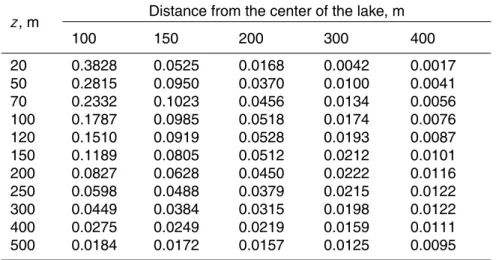
Printer-friendly Version Interactive Discussion
3 Example of calculations
Consider a 30 m deep lake with a radius of Ri=100 m and Ti s=10 ◦
C. The regional geothermal gradient is Γ=0.0300◦C/m and Tot=20
◦
C. The drilling sites of 5 wellbores (500 m deep each) are located at distances from 100 m to 400 m from the center of the lake (Table 1).
5
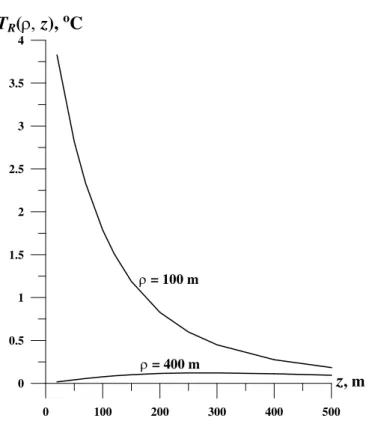
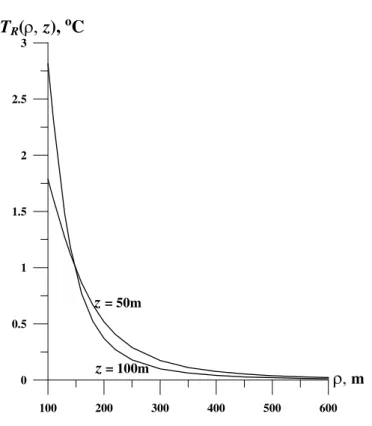
What are the magnitudes of the formation temperature perturbations (expressed through the reduced temperatures) caused by the lake? The results of calculations after Eqs. (4) and (8) are presented in Table 1 and Figs. 2 and 3. We have to note that bottom of the lake has a coordinate z=0 and because of this the actual depth is
z∗=z+30 m. In our case Ti s−Tot=−10◦C and the lake has a cooling effect on the
tem-10
perature profiles. The values of TR(ρ, z) are decreasing with depth and practically can
be neglected for radial distances of 550–600 m from the center of the lake (Figs. 2 and 3). A commercially available software, Maple 7 (Waterloo Maple 2001), was utilized to compute the function M(ρ, z).
4 Conclusions
15
A proposed method allows to estimate the maximum effect of deep lakes and “heat islands” (areas of deforestation, urbanization, farming, mining and wetland drainage) on the borehole temperature profiles. An example of calculations is presented which shows to what extent the proximity of a deep lake affects the borehole temperature profiles.
CPD
4, 415–432, 2008 Borehole paleoclimatology V. T. Balobaev et al. Title Page Abstract Introduction Conclusions References Tables Figures ◭ ◮ ◭ ◮ Back CloseFull Screen / Esc
Printer-friendly Version Interactive Discussion
References
Abramowitz, M. and Stegun I.: Handbook of Mathematical Functions, Dover Publications Inc., New York, 1965.
Balobayev, V. T. and Shastkevich, Y. G.: The estimation of the talik zones configuration and the steady temperature field of rocks beneath the lakes of arbitrary contour, In: Lakes of the 5
Siberia Cryolithozone, Novosibirsk, Nauka, 116–127, 1974 in Russian.
Beltrami, H., Jessop, A. M., and Mareschal, J.-C.: Ground temperature histories in eastern and central Canada from geothermal measurements: Evidence of climate change, Palaeogeogr. Palaeocl., 98, 167–183, 1992.
Blackwell, D. D., Steele J. L., and Brott, C.A.: The terrain effect on terrestrial heat flow, J. 10
Geophys. Res., 85(B9), 4757–4772,1980.
Bodri, L. and Cermak, V.: Climate change of the last millennium from borehole temperatures: results from the Czech Republic – Part I, Global Planet. Change, 11, 111–125, 1995. Bodri, L. and Cermak, V.: Climate change of the last two millennia inferred from borehole
temperatures: results from the Czech Republic – Part II, Global Planet. Change, 14, 163– 15
173, 1997.
Bodri, L. and Cermak, V.: Borehole temperatures, climate change and the pre-observational surface air temperature mean: Allowance for hydraulic conditions, Global Planet. Change, 45, 265–276, 2005.
Carslaw, H. S. and Jaeger, J. C.: Conduction of Heat in Solids, Oxford University Press, New 20
York, 1959.
Cermak, V.: Underground temperature and inferred climatic temperature of the past millennium, Palaeogeogr. Palaeocl., 10, 1–19, 1971.
Cermak, V. and Bodri, L.: Climate reconstruction from subsurface temperatures demonstrated on example of Cuba, Phys. Earth Planet. In., 126, 295–310, 2001.
25
Chouinard, C. and Mareschal, J.-C.: Selection of borehole temperature depth profiles for re-gional climate reconstructions, Clim. Past, 3, 297–313, 2007,
http://www.clim-past.net/3/297/2007/.
Covington, W. W.: Changes in the forest floor organic matter and nutrient content following clear cutting in northern hardwoods, Ecology, 62, 41–48, 1981.
30
Eppelbaum, L. V., Kutasov, I. M., and Barak, G.: Ground surface temperatures histories inferred from 15 boreholes temperature profiles: comparison of two approaches, Earth Sci. Res. J.,
CPD
4, 415–432, 2008 Borehole paleoclimatology V. T. Balobaev et al. Title Page Abstract Introduction Conclusions References Tables Figures ◭ ◮ ◭ ◮ Back CloseFull Screen / Esc
Printer-friendly Version Interactive Discussion
10(1), 25–34, 2006.
Gruber, S., King, L., Kohl, T., Herz, T., Haeberli, W., and Hoelzle, M.: Interpretation of geothermal profiles perturbed by topography: the Alpine permafrost boreholes at Stocko-horn plateau, Switzerland, Permafrost Periglac., 15, 349–357, 2004.
Gosselin, C. and Mareschal, J-C.: Variations in ground surface temperature histories in the 5
Thompson Belt, Manitoba, Canada: environment and climate changes, Global Planet. Change, 39, 271–284, 2003.
Guillou-Frottier, L., Mareschal, J-C., and Musset, J.: Ground surface temperature history in central Canada inferred from 10 selected borehole temperature profiles, J. Geophys. Res., 103(B4), 7385–7397, 1998.
10
Hamza, V. M., Cavalcanti, A. S. B., and Benyosef, L. C. C.: Surface thermal perturbations of the recent past at low latitudes – inferences based on borehole temperature data from Eastern Brazil, Clim. Past, 3, 513–526, 2007,
http://www.clim-past.net/3/513/2007/.
Harris, R. N. and Chapman, S. D.: Climate change on the Colorado Plateau of eastern Utah 15
inferred from borehole temperatures, J. Geophys. Res., 100, 6367–6381, 1995.
Huang S., Shen, P. Y., and Pollack, H. N.: Deriving century – long trends of surface temperature change from borehole temperatures, Geophys. Res. Lett., 23, 257–260, 1996.
Huang, S., Pollack, H. N., and Shen, P. Y.: Temperature trends over past five centuries recon-structed from borehole temperatures, Nature, 403, Feb. 17, 756–758, 2000.
20
Huang, S. and Pollack, H. N.: Global Borehole Temperature Database for Climate Recon-struction, IGBP PAGES/World Data Center-A for Paleoclimatology Data Contribution Series #1998-044. NOAA/NGDC Paleoclimatology Program, Boulder CO, USA, also available at:
http://www.geo.lsa.umich.edu/∼climate), 1998.
Huang, S., Shen, P.Y., and Pollack, H. N.: Deriving century – long trends of surface temperature 25
change from borehole temperatures, Geophys. Res. Lett., 23, 257–260, 1996.
Kappelmeyer, O. and Haenel, R.: Geothermic with Special Reference to Application, Gebruder Borntrager, Berlin, 1974.
Kohl, T.: Transient thermal effects below complex topographies, Tectonophysics, 306(3–4), 311–324, 1999.
30
Kukkonen, I. T., Cermak, V., and Safanda, J.: Subsurface temperature–depth profiles, anoma-lies due to climatic ground surface temperature changes or groundwater flow effects, Global Planet. Change, 9, 221–232, 1994.
CPD
4, 415–432, 2008 Borehole paleoclimatology V. T. Balobaev et al. Title Page Abstract Introduction Conclusions References Tables Figures ◭ ◮ ◭ ◮ Back CloseFull Screen / Esc
Printer-friendly Version Interactive Discussion
Lachenbruch, A. H.: Rapid Estimation of the Topographic Disturbance to Superficial Thermal Gradients, Rev. Geophys., 6, 365–400, 1965.
Lachenbruch, A. H. and Marshall, B. V.: Changing climate: Geothermal evidence from per-mafrost in the Alaskan Arctic, Science, 234, 689–696, 1986.
Lewis, T. J. and Wang, K.: Influence of terrain on bedrock temperatures, Palaeogeogr. 5
Palaeocl., 98, 87–100, 1992.
Lewis, T. J. and Wang, K.: Geothermal evidence for deforestation induced warming: implica-tions for the climatic impact of land development, Geophys. Res. Lett., 25, 535–538, 1998. Majorowicz, J. A. and Skinner, W. P.: Potential causes of differences between ground and
sur-face air temperature warming across different ecozones in Alberta, Canada, Global Planet. 10
Change, 15, 79–91, 1997.
Majorowicz, J. and Safanda, J.: Measured versus simulated transients of temperature logs – a test of borehole climatology, J. Geophys. Eng., 2, 291–298, 2005.
Mareschal, J.-C. and Beltrami, H.: Evidence for recent warming from perturbed geothermal gradients: examples from Eastern Canada, Clim. Dynam., 6(3-4), 135–143, 1992.
15
Mottaghy, D., Schellschmidt, R., Popov, Y. A., Clauser, C., Kukkonen, I. T., Nover, G., Mi-lanovsky, S., and Romushkevich, R. A.: New heat flow data from immediate vicinity of the Kola super-deep borehole: Vertical variation in heat flow confirmed and attributed to advec-tion, Tectonophysics, 401, 119–142, 2005,
Nitoiu, D. and Beltrami, H.: Subsurface thermal effects of land use changes, J. Geophys. Res., 20
110, F01005, doi:10.1029/2004JF000151, 2005.
Pollack, H. N. and Huang, S.: Climate reconstruction from subsurface temperatures, Ann. Rev. Earth Planet. Sci., 28, 339–65, 2000.
Powell, W. G., Chapman, D. S., Balling, N., and Beck, A. E.: Continental Heat-Flow Density, in: Handbook of Terrestrial Heat-Flow Density Determination, edited by: Haenel, R., Rybach, L., 25
and Stegena, L., Kluwer Academic Publishers, Dordrecht/Boston/London, 167–222, 1988. Safanda J.: Effects of topography and climatic changes on the temperature in borehole GFU-1,
Prague, Tectonophysics, 239, 187–197, 1994.
Safanda J.: Ground surface temperature as a function of slope angle and slope orientation and its effect on the subsurface temperature field, Tectonophysics, 306(3–4), 367–376, 1999. 30
Safandra, J., Rajver, D., Correia, A., and Dedecek, P.: Repeated temperature logs from Czech, Slovenian and Portuguese borehole climate observatories, Clim. Past, 3, 453–462, 2007,
CPD
4, 415–432, 2008 Borehole paleoclimatology V. T. Balobaev et al. Title Page Abstract Introduction Conclusions References Tables Figures ◭ ◮ ◭ ◮ Back CloseFull Screen / Esc
Printer-friendly Version Interactive Discussion
Shen, P. Y. and Beck, A. E.: Paleoclimate change and heat flow density inferred from tem-perature data in the Superior Province of the Canadian Shield, Palaeogeogr. Palaeocl., 98, 143–165, 1992.
Shen, P.Y., Wang, K., Beltrami, H., and Mareschal, J.-C.: A comparative study of inverse meth-ods for estimating climatic history from borehole temperature data, Global Planet. Change, 5
98, 113–127, 1992.
Shen, P. Y., Pollack, H. N., Huang, S., and Wang, K.: Effects of subsurface heterogeneity on the inference of climate change from borehole temperature data: model studies and field examples from Canada, J. Geophys. Res., 100, 6383–6396, 1995.
Taniguchi, M.: Anthropogenic effects on subsurface temperature in Bangkok, Clim. Past Dis-10
cuss., 2, 832–846, 2006,
http://www.clim-past-discuss.net/2/832/2006/.
Wang, K.: Estimation of ground surface temperatures from borehole temperature data, J. Geo-phys. Res., 97, 2095–2106, 1992.
Waterloo Maple: Maple 7 Learning Guide, Waterloo Maple Inc., Waterloo, Canada, 2001. 15
CPD
4, 415–432, 2008 Borehole paleoclimatology V. T. Balobaev et al. Title Page Abstract Introduction Conclusions References Tables Figures ◭ ◮ ◭ ◮ Back CloseFull Screen / Esc
Printer-friendly Version Interactive Discussion
Table 1.Function M(ρ, z) for five boreholes.
z, m Distance from the center of the lake, m 100 150 200 300 400 20 50 70 100 120 150 200 250 300 400 500 0.3828 0.2815 0.2332 0.1787 0.1510 0.1189 0.0827 0.0598 0.0449 0.0275 0.0184 0.0525 0.0950 0.1023 0.0985 0.0919 0.0805 0.0628 0.0488 0.0384 0.0249 0.0172 0.0168 0.0370 0.0456 0.0518 0.0528 0.0512 0.0450 0.0379 0.0315 0.0219 0.0157 0.0042 0.0100 0.0134 0.0174 0.0193 0.0212 0.0222 0.0215 0.0198 0.0159 0.0125 0.0017 0.0041 0.0056 0.0076 0.0087 0.0101 0.0116 0.0122 0.0122 0.0111 0.0095
CPD
4, 415–432, 2008 Borehole paleoclimatology V. T. Balobaev et al. Title Page Abstract Introduction Conclusions References Tables Figures ◭ ◮ ◭ ◮ Back CloseFull Screen / Esc
Printer-friendly Version Interactive Discussion
CPD
4, 415–432, 2008 Borehole paleoclimatology V. T. Balobaev et al. Title Page Abstract Introduction Conclusions References Tables Figures ◭ ◮ ◭ ◮ Back CloseFull Screen / Esc
Printer-friendly Version Interactive Discussion 0 100 200 300 400 500 0 0.5 1 1.5 2 2.5 3 3.5 4
z
, m-T
R(
z
),
oC
= 100 m = 400 mCPD
4, 415–432, 2008 Borehole paleoclimatology V. T. Balobaev et al. Title Page Abstract Introduction Conclusions References Tables Figures ◭ ◮ ◭ ◮ Back CloseFull Screen / Esc
Printer-friendly Version Interactive Discussion 100 200 300 400 500 600 0 0.5 1 1.5 2 2.5 3 m z= 50m z= 100m -TR( z), oC