JUL
31 1968
BUILDING SYSTEMS DESIGN FOR HIGHER EDUCATION FACILITIES
by
LASZLO IMRE NEMETH
B. Arch., University of Manitoba, 1965
SUBMITTED IN PARTIAL FULFILLMENT
OF THE REQUIREMENTS FOR THE DEGREE OF
MASTER OF ARCHITECTURE
at the
MASSACHUSETTS INSTITUTE OF TECHNOLOGY
June, 1967
(
Signature of Author Certified by Accepted by Department of AchitecfureThesis Sup vis or
June, 1967
Lawrence B. Anderson, Dean
School of Architecture and Planning Massachusetts Institute of Technology Cambridge, Massachusetts
Dear Dean Anderson:
In partial fulfillment of the requirements for the degree of Master of Architecture I hereby submit this thesis entitled "Building Systems Design for Higher Education Facilities".
Respectfully,
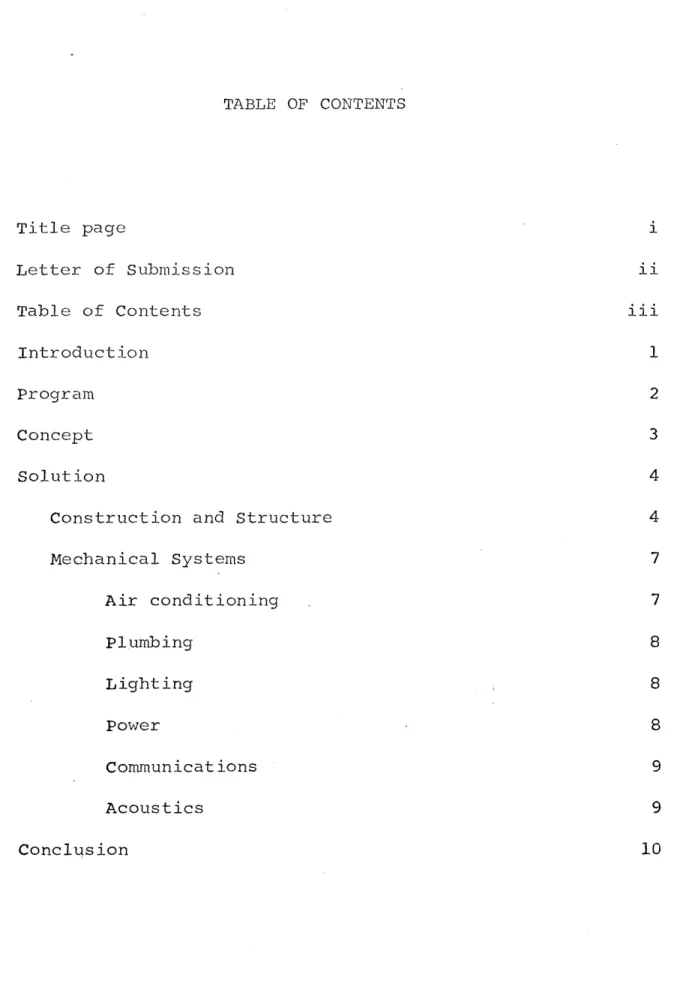
TABLE OF CONTENTS
Title page
Letter of Submission ii
Table of Contents iii
Introduction
Program 2
Concept 3
Solution 4
Construction and Structure 4
Mechanical Systems 7 Air conditioning 7 Plumbing 8 Lighting 8 Power 8 Conmnunicat ions 9 Acoustics 9 Conclusion 10
The new age is indeed a challenge to the architect. Rapid
growth with its concomitantly rapidly changing value systems
make the architect face formidable problems which demand the
exploration of new and meaningful solutions. This project is
concerned with the development of an organic set of systems
reproducible in any juxtaposition relative to the variability
of three factors - site, program, existing structures.
Programmatic requirements applied to the system are the accommodation of college and university functions, normally
found in classroom, lecture hall and laboratory. The final
intent of the second semester is to test this set of
require-ments in a real situation, that is, to subject the system to
utilization that will improve the contemporaneous haphazard blossoming of educational facilities. Ultimately, as it is
PROGRAM.
The problem advanced is the design of a building system
of construction that is capable of flexible expansion, growth
and change that would accommodate the various departments of
a college or university. This system is to accommodate any type
of space up to a medium sized auditorium or cinema.
The programmatic restrictions are self- imposed, or set
secondarily (by consideration of width, parking space under
the building, elevator and fire exit regulations, etc.) ;
therefore, the building which will arise can take any size or
form. On the other hand, certain restrictions are evident
from the outset. In accordance with code requirements, the
exits, elevator capacities and toilets are calculated on (150 ft2)
gross area per person. In addition to these requirements, the
building would have to provide space suitable for the following
activities: 1. classrooms 2. laboratories - industrial research testing 3. workshops 4. seminar rooms 5. small auditoriums 6. studies 7. drafting rooms 8. departmental libraries
10. faculty and assistants' offices 11. lounges 12. restrooms 13. exhibition spaces 14. storage 15. maintenance 16. mechanical equipment 17. parking CONCEPT
The resultant design is limited in its height by one
factor - the size of support.
Internal flexiblity and ability to expand are major
considerations. Large and small spaces could be used for a
variety of purposes at any given time. Expansion may occur
within the building itself, that is, there may be shifts in
the spatial needs of various departments within the building.
Consequently, it must be possible to introduce partitioning
into large spaces. The design of systems of this nature are
rooted in the modular proportioning of spaces. The module
developed in this project is dependent upon a number of
con-siderations. Primary consideration was its fitness to function,
in this case, that of educational facilities. The module was
obliged to respect the ordering influence of systematic
development, to accord fully with today's technology of
construction and to recognize the demands on mechanical services
use of spaces change.
SOLUTION
Construction and Structure. Inherent in the very nature
of the university is the fact that its growth can have no finite limits. This idea was an important factor in the solution. The
basic unit has a self sufficiency - geometrically, structurally,
and mechanically. This unit is based on the core which is the permanent element in the building. There is a hierarchy in
the components of the structure. Columns, girders, main
mecha-nical branches are more permanent than the secondary elements
-beams, joists, mechanical fixtures. The secondary elements are readily accessible for service. That the buildings permit their easy expansion and removal is essential.
Construction speed was kept in mind as an economic
con-sideration in view of two factors - limited human resources
and interference with the existing life around the building. The system is designed to be built entirely in precast concrete, except for special situations such as footings, cores and
topping. Precast, prestressed concrete was chosen for the best appearance and most efficient use of materials. It can
cope better with shrinkage and creep; the minimized effect of
cost relative to other materials will be balanced, however, over an assumed large quantity of units needed.
A one-way system was selected for the following reasons:
a one-way system is more flexible inasmuch as structural
continuity is not required; a one-way system is more efficient
over a-given way and uses less materials; moreover, the one-way
system has less critical connections than the two-way system.
The structural system is a very simple arrangement of double
girders and columns, which can either be precast on the site
or be delivered from the factory and assembled by cranes. First,
the upside-down L-shaped column girders are erected with a
long central connecting unit which serves as a guide for
attachment and reaches a few stories in height. When the column
girders are in place, a simple supported girder 30'0" long is
placed between them. The connection is made at zero moment, at
the length of the L-shaped rigid column girder. This arrangement
facilitates longer column-to-column spans as well as lighter
cross sections of the girders.
With the columns and the girders in place, the simple
spanning members are lowered onto the two parallel girders and
the erection of the floor is completed.
The 60'0" long spanning members are in the shape of an inverted "Y". The shape is the result of the analysis of the
standard "T" section affords an equal amount of depth to both
the visual and the service parts of the ceiling. The inverted "Y" shape reduces the visual part while greatly increasing the
mechanical service part of the floor structure. The shape is
derived from the structural analysis of the "T" shape where the lower leg of the "T" is simply spread and pretensioned
with high strength steel wires. As for the upper part, it
remains practically the same as the "T" when the topping
diaphragm is poured, only to become stronger by forming a series of parallel box beams all integrally connected. At every 5"O", the dimension which is the optimum condition for the structural and modular breakdown of the interior spaces, the spanning
member occurs. To prevent further spread, there are diaphragms
inside the spread legs of the "T". This diaphragm creates a modular ceiling pattern, which incorporates all mechanical and
lighting equipment, and receives the interior partitioning. The
cores are cast in place as the permanent elements of the structure. They act as wind bracing with the reinforced topping slab which acts as a diaphragm against the cores.
The building height is limited only by the size of sup-ports. The ten stories are considered as the optimum condition.
Mechanical Systems. The primary aim of the design
was to develop an integrated framework of structures and
services that would permit the use of several different
mechanical systems depending on the development of the technology
of the future. The mechanical system is fed from the cores,
independent of the structural system. This I felt was necessary
because of the changeable nature of the structural system.
The design premise was based on the minimum planning module
of 5'0" X 10'0", the smallest room that would require supply
or return of air, light, plumbing, power and communications,
and acoustical control.
The source of all these services would be the mechanical
room adjacent to the core, either in the penthouse or in the basement.
Air Conditioning. The overall system is based on a
high velocity dual duct system which is brought up vertically
throughthe cores, distributed horizontally between pairs of girders and fed into diffusers through the mixing boxes
between the spanning members. The diffusers would be part of a panel that fits into the openings in the side walls of the inverted "Y's". These panels are easily removed for servicing.
supply and return ducts were calculated as to the necessary
size under the given velocities. The perimeter is controlled
withthe same IVDD system forcing the air upward through floor diffusers.
PIubing_. All plumbing is supplied from the cores
and runs in much the same pattern as the air distribution in
alternate chases with the air ducts.
Lighting. Each module carries its own diffuser light
fixture containing two 4 foot, 30 watt fluorescent lamps
generating a 65 foot candle light level in an average
class-room. Additional light can be obtained individually from the
floor mounted power supply. Natural lighting is also possible
by large skylight areas taken from absent flanges of spanning
members.
Power. Normal 110 AC power willbe distributed from the
garage mechanical room vertically in core chases with a breaker
panel at each floor serving each typical bay. Horizontal
distribution goes through major ducting between girders to
secondary conduits in the floor which run at the center of
Communications. Telephone distribution will be similar
to electrical, using a panel board in the core for an
in-dividual bay with distribution in the floor conduits. Telephone
equipment rooms would be located in the mechanical floors. Special signal, intercom and television wiring will be distributed from the cores in conduits as piping.
Acoustics. The demand for reverberation noise control
is extremely important in an exposed concrete building.
Reverberation is controlled by the acoustically absorbent panels
in the spanning members. There will a great deal of sound diffu-sion inasmuch as the ceiling is not a flat plane but an
irregular surface which has different sized components that operate at sound levels roughly equivalent to the wavelength of normally spoken and machine made noises.
Added absorption can be obtained by means of floor
carpeting and soft furnishings. Drapery and wall coverings are also feasible. Longitudinal and transverse sound transmission is secured by the floor structure and by the exposed webs of the spanning members which provide the anchorage point for the top of the partitions attached there with resilient mounting clips.
CONCLUSION
The challenge to the architect lies only partially in the analysis of the use of various supporting facilities and
the resolution of their interrelationships, as it was attempted
in this project. The further challenge lies in the shaping
of an environment which is efficient in, and around the
building, and which will eloquently state, to those who use
it and to those who only see it, that the purposes of
education and the benefit of mankind are inextricably linked.
We are at the beginning of a new and revolutionary era.
It is for architecture - the mirror of man's achievments and~
aspirations - to interpret and to interpolate the needs and
the means of the era in terms of function and of form, and
to combine in a unique way both the highly aesthetic and
the fully practical in one working whole.
It is hoped that the system developed will be a useful tool
An Urban University in Downtown Montreal
A contemporary urban university acquires sixty-five acres
of land proximal to the heart of Montreal. Its purpose is to
develop a new campus.
Today confronts us with a tremendous challenge - the task
of the provision of a cultural and intellectual focal point for
the entire community.. Things that happen in a university are
analogous to occurrences in a city. For example, a university
is comparable to a city inasmuch as it is a place where many
people work. It is a place, moreover, for research, for
contin-uous communication, for the development of social contacts, and
for the simultaneous movement of many people in many directions
by many varied means. To the extent that the university emulates
the functions of the city, it may serve as a laboratory for the
testing of multifarious design concepts which subsequently will
be applicable to all future magna scale complexes, including
cities, that must be built if mankind is to survive.
In this particular instance, the development will provide
the urban university the opportunity of more meaningful parti-cipation in the life of the city. In a similar way, the city will
benefit from its involvement with the university. This intent
psychological attitude but by the physical fact of the
uni-versity as well.
The area where the university for 5,800 students is to
locate is in a dense, extremely urban section of downtown
Mon-treal. It is surrounded by four major arteries (Sherbrooke,
Saint Catherine's, Peel and Guy Streets). It straddles a presently
underdeveloped section of Burnside Street. The buildings located
on the periphery of the site are of considerable historic
impor-tance. They are part.of the long tradition of Montreal, and, more
important, they establish the 'imagd' of the streets which they border.
These buildings that sustain the life of the streets and help to
structure the city will be retained under university control in
their present form. Essentially, the university will occupy the
area over Burnside Street, between the buildings that are being
preserved.
The first floor of the university will be utilized for activities which contribute to the life and to the economic
health of the city, at the same time as they fulfill the academic
functions of the university. Here, commercial areas, professional
offices, and services, along with public educational facilities,
libraries and galleries will provide student-"city people" melting pots. To support this intention physically, this area
will be a purely pedestrian one, with great variety in the
The complex is served by the existing subway stations at
both ends of Burnside Street. Burnside Street will become a
linear spine, which, like a backbone links all the various
elements without itself being impeded in respect of
enlarge-ment - unlike the rigid system of various satellite centers
around a concentric core. It will become a new kind of "Street"
that will not rupture the texture of the city but enhance it
with playful variations. There arc two levels of parking under
the whole complex providing facilities not only for the whole university but for the immediate neighborhood in urgent need
of them.
The upper level of parking is considered a potential
area of expansion for the university. The ceiling height is
greater.therefore on the upper level.
The first level above the ground floor is considered a
platform for the major part of student movement. It is the level
where students arrive directly through bridges which connect
the surrounding blocks and residential districts with the
university and which traverse the streets and their motor traffic.
This student level will contain all the essential major spaces
necessary for student academic functions but will, at the same
time, be acutely aware of the availability of these functions
to the general public. By comparison, certain activities tend to be located peripherally in both horizontal and vertical
positions. These are:
1) Teaching facilities with low density and low frequency
of change-over; those which are peculiar to specialized
courses of study or dependent upon frequent delivery of
bulk equipment and supplies.
2) Such non-teaching facilities as research laboratories and offices for faculty members.
The vertical circulation is the essential connector of
the movement platforms with the parking levels and the upper
levels serving academic and research functions. The cores occur
at regular intervals creating a strong, clearly understandable
spine for the university. These cores carry the network of
utilities from the mechanical rooms for horizontal distribution.
In developing this concept for the University full use
was made of the structural system developed in the first semester.
The flexibility of the system to adapt to full three-dimensional changes can be utilized most efficaciously in the university
which is active, dynamic and responsive to the changes not only
of the academic life therein, but also to the changes in society.
Such a university can be a testing ground experimentation in
urban environments, a manifestation of the idea of a continuous and responsive building as opposed to the fixed, object buildings
to the progress of humanity through the exploration of physical and psychological connotations of the environment.
Growth and change will reflect a hierarchical system in the structure of the university. The cores and the circulatory system are the most permanent elements. The academic and city life is closely linked to these modes of circulation. Within the hierarchical ordering, the resulting circulation system in terms of both size and location becomes a reflection of
desire lines. Like the transportation arteries of the metropolis they become more dense, more prominent and more space consuming at the core.
Sizes of the buildings around the periphery of the univer-sity, directly juxtaposed to the preserved structures will retain the existing architectural character by their sizes, their bulk and by the open spaces which they create. Moreover, the use of materials will reflect a continuation of the city texture.
All roofs are accessible as public or private terraces.
The entrances to the university are defined by architectural events which are varied in character. At the main parking
entrances there is a visual connection between motor and pedes-trian levels, and between these and the exterior spaces through means of light penetration. There are numerous pedestrian entrances between the new and the existing buildings which are outgrowths
back lanes. Irregardless of this ready accessibility, there
is obvious predominance of the important arrival point, which
leads to the center of gravity, the central square of the
complex. This center is determined not only by its physical
size and location but by the general collective activities
that it serves. The hierarchy of spaces leading to the central
square as the pedestrian circulation reflects the life intensity
that it directly supports.
The delight and special flavor of an urban environment derive
from its compaction and its contrast, established by the
compo-sition, variety and the sequence of the exterior spaces created
by the buildings. The sequence of stations or plazas can serve
as stations or plazas, shorten distances, provide elements of
reference, provide appropriate intensity or serenity, transform
lineal circulations into multidimensional movements as climaxes
and subclimaxes. The spatial sequence can facilitate a maximum
interaction between the life and movement of the city and the
university campus.
This scheme is an attempt to discover structuring principles which might be applicable to the organization of the physical
environment, The university as a place and as an active operation.
Many of its functions are known; others are not. My supposition
is that its principal function is to encourage exchange between
of human knowledge. I have tried to imagine a synthesis
where all the faculties would be associated and where the
psychological barriers that separate one from another would
not be reinforced by physical barriers, where the identity of
the whole would not be subjugated to the identity of the parts.
The design of the university is not intended to show pre-cisely the location of each room. This is a temporary condition.
In conformity with contemporary research, the new university
must enable a many-sided collaboration of the various branches
of science and arts. Consequently, in the structural planning
demarcation lines between faculties have not been taken into account. The solution tends to show that the building system is flexible enough to permit within its free envelope the location
and the number of rooms requisite for various purposes at any
time in its life span. Experience has shown that the constant
changes in educational systems - growth and the creation of new
jJ3 ID
LM
]
EF
1Wi
~
7 I~
~
0I T E P L A N MASTER OF ARCHITECTUREMI. T SPING 1967
IASZLO I M NE NEMETH
E~HH ~H
Eg
E
_ -m -t fII M TII L I 17 IEm T L I 71 ti 1171 111FF I 1 Li WV 1 r--- r-1--- -- -An hT In rT TTi Tr SmHl I11m.n ---'FrI
~
~
L ]IFI 1F rIT F r THHrrlI1Ilml ( 7lF ITIM nr HIHI~l7Hl EFr l T~ T LLIL L~
~
~
I pLL j- -4 T1 T n -r-Lm
M FtT -TjM r I I l 1Fr1 'I6 r TZI r l 11! 1L I I I I I~Ffl tTTTFF1JTT~rIIIFFIIIIFI 71 1 II .E 111Il l1l1i LEUU E.111
t
1'
T I -T r71
11
n T T HI uE 1 E Tm 7.11 1 [n ;;l L i l uunI t171Mu71111 r n n mL 4 1 r m mU 1 1 1 rm umna unmui -EK
LI
a U -z CLmuseum & gallery r cial dining