READ THESE TERMS AND CONDITIONS CAREFULLY BEFORE USING THIS WEBSITE.
https://nrc-publications.canada.ca/eng/copyright
Vous avez des questions? Nous pouvons vous aider. Pour communiquer directement avec un auteur, consultez la
première page de la revue dans laquelle son article a été publié afin de trouver ses coordonnées. Si vous n’arrivez pas à les repérer, communiquez avec nous à [email protected].
Questions? Contact the NRC Publications Archive team at
[email protected]. If you wish to email the authors directly, please see the first page of the publication for their contact information.
NRC Publications Archive
Archives des publications du CNRC
This publication could be one of several versions: author’s original, accepted manuscript or the publisher’s version. / La version de cette publication peut être l’une des suivantes : la version prépublication de l’auteur, la version acceptée du manuscrit ou la version de l’éditeur.
Access and use of this website and the material on it are subject to the Terms and Conditions set forth at Heritage Recording Applications of High Resolution 3D Imaging Taylor, John; Beraldin, Jean-Angelo
https://publications-cnrc.canada.ca/fra/droits
L’accès à ce site Web et l’utilisation de son contenu sont assujettis aux conditions présentées dans le site LISEZ CES CONDITIONS ATTENTIVEMENT AVANT D’UTILISER CE SITE WEB.
NRC Publications Record / Notice d'Archives des publications de CNRC: https://nrc-publications.canada.ca/eng/view/object/?id=aab339bd-d8a8-46fe-9a7a-1cedb7bb67d5 https://publications-cnrc.canada.ca/fra/voir/objet/?id=aab339bd-d8a8-46fe-9a7a-1cedb7bb67d5
National Research Council Canada Institute for Information Technology Conseil national de recherches Canada Institut de Technologie de l’information
Heritage Recording Applications of High Resolution
3D Imaging*
J.M. Taylor, and J.-A. Beraldin March 2001
Copyright 2001 by
National Research Council of Canada
Permission is granted to quote short excerpts and to reproduce figures and tables from this report, provided that the source of such material is fully acknowledged.
*published in Proceedings of the Electronic Imaging and the Visual Arts (EVA) 2001 Conference, Florence, Italy. March 26-30, 2001. NRC 44179.
Heritage Recording Applications of High Resolution 3D Imaging J.M. Taylor and J-A Beraldin,
National Research Council of Canada Ottawa, Canada, K1A OR6
([email protected]) ([email protected])
Abstract
The National Research Council of Canada (NRC) has developed three high resolution 3D imaging systems which have been applied to a variety of museum and heritage recording applications. The purpose of this paper is to present an overview of the heritage recording applications demonstrated to date.
1. Introduction:
Dating back to 1984, the Visual Information Technology Group of NRC
(http://www.vit.iit.nrc.ca/) has collaborated with several national and international cultural agencies on the development of the museum and heritage applications of NRC's patented 3D laser scanner imaging technology. We have reported on the museum applications at previous EVA and related conferences (1-6). The term "museum applications" refers to 3D imaging of ethnographic collections, paintings and objects typically housed in a museum.
We have also undertaken several demonstration projects to test the technology for "heritage recording" applications. "Heritage recording" refers to scanning archaeological site features, architectural elements on historic buildings and larger sculptures generally found in the built environment, which require a portable imaging system. These projects have shown that the 3D data can be used for a number of heritage recording applications including archival
documentation, research, conservation, replication and interactive 3D VR Theatre applications. 2. NRC 3D Imaging Technology for Heritage Recording:
Three systems, the High Resolution Laser Scanner, the Biris 3D Laser Camera and the Large Field of View Laser Scanner, each designed for different imaging applications, have been for heritage recording applications. The systems use a low power laser light to digitize sequential overlapping images from multiple points of view over the surface of an object or site. Once scanned, data modeling and display software is used to integrate the multiple view data sets into a seamless archival quality high resolution 3D digital model of the object.
2.1 High Resolution Laser Scanner:
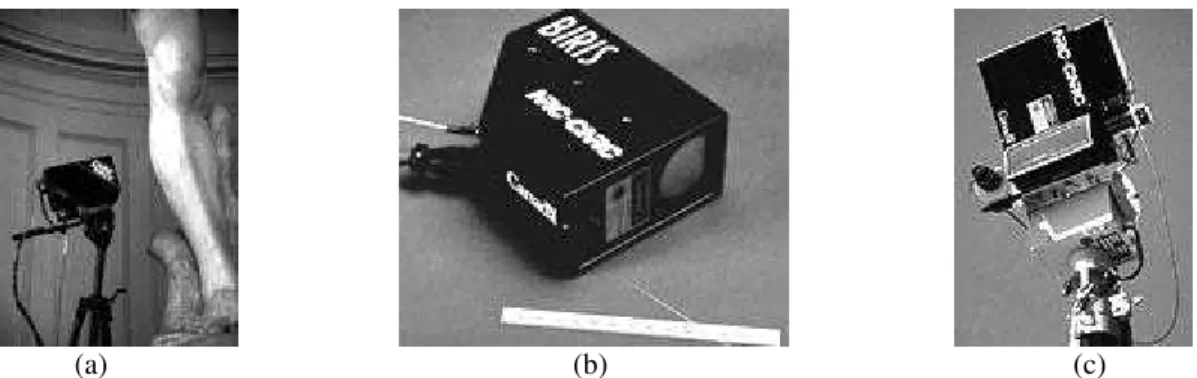
The High Resolution Laser Scanner (Figure 1a), was originally developed for digitizing a range of "traditional" museum objects including archaeological and ethnographic collections, paintings, small sculptures and natural history specimens in color. For museum applications, this scanner is mounted on a non-portable three-axis translation system. It digitizes the 3D shape and color simultaneously with high-resolution and in prefect registration (7). For heritage recording applications that require high resolution imaging of details on a small area, this camera can be mounted on a tripod and operated in monochrome mode. In its maximum resolution
is sufficient to record and examine fine brush stroke details on paintings as well as tool mark features on sculptures and archaeological objects.
The color system is currently being developed commercially by Arius3D
(http://www.arius3d.com). Arius plans to open a series of Archivist Scanning Centres for museum and heritage imaging.
(a) (b) (c)
Figure 1. The High Resolution Laser Scanner (a), shown imaging the right leg of Michelangelo's David, can be mounted on a tripod for high resolution monochrome imaging of details such as tool marks. The Biris 3D Laser Camera (b) can be mounted on either a conventional tripod or on a linear translation stage for scanning. The Large Field of View Laser Scanner (c) can be mounted on a telescoping tripod and raised to a height of 10 m to scan large objects such as outdoor sculpture.
2.2 The Biris 3D Laser Camera:
The Biris 3D Laser Camera (Figure 1b) is a portable digital 3D monochrome imaging system and is ideally suited for field recording applications, where a record of the
three-dimensional shape of an object or feature is required (9). It has a maximum range of 2 m and an accuracy of 80 microns at a range of 0.3 m and 1.8 mm at 1 m. This system has been used to digitize architectural building elements and sculptures in Italy, a section of a Hieroglyphic Stairway at the Peabody Museum and archaeological sites in China. Shape Grabber Inc., (www.shapegrabber.com) manufactures the camera commercially as the ShapeGrabber™ . Innovision Géomatique provides a commercial heritage scanning service
(www.innovision.qc.ca).
2.3 The Large Field of View Laser Scanner:
The Large Field of View Laser Scanner is a research prototype system under development for high-resolution monochrome 3D digitization of large structures at a standoff distance from 50 cm to 10 m (9). The scanner can be mounted on a conventional photographic tripod or on a custom designed telescoping tripod, which can be raised to a height of 10 m (Figure 1c). At a standoff of 50 cm, it provides a resolution of 70 microns and at 10 m, the resolution is 2 cm.The system has been used to demonstrate applications for recording archaeological sites in Israel as well as for digitizing large sculptures at the Canadian Museum of Civilization. This system is not commercially available.
2.4 Data Modeling and Display Software:
For the modeling and display of 3D image data recorded using these systems, we have
collaborated with InnovMetric Software Inc., (www.innovmetric.com) on the development of the suite of PolyWorks™ software tools. Using PolyWorks on a Unix or Windows platform, the
multiple view data sets recorded by the scanner are merged into a seamless archival quality high resolution 3D digital model of the object. PolyWorks also contains editing and data compression tools and a module, which enables the creation of texture maps for reduced models from the color scanner. It also enables the 3D model to be transferred into different formats and used for a variety of heritage recording applications (10).
3.0 Heritage Recording Applications:
The demonstration projects undertaken to date can be divided into two general categories -"feature/detail" projects and "site/object" projects. In the -"feature/detail" category, as part of a larger project to record a large site or object, the systems have been used to provide a high-resolution monochrome record of specific features or details, rather than of the entire site itself. Examples include the interior of St-James Tomb in Israel, tool mark details on Michelangelo's scupltures and architectural elements on the facade of the 8th century Abbey of Pomposa, near Ferrara. In the "site/object" category, an entire site or object has been digitized. Examples
include the sculpture Mythic Messengers at the Canadian Museum of Civilization, archaeological sites in China and a section of the Hieroglyphic Stairway at the Peabody Museum in Boston. Irrespective of the type of the project, the advantage of a high-resolution record of a site or feature is that the data provides an archival record that can be used for conservation, research, replication and display applications.
3.1 Hertiage Site "Feature/Detail" Recording Applications:
The three imaging systems described above have all been used to demonstrate the applications for recording specific features or details on larger heritage sites.
In 1997, in collaboration with the University of Padova, the Biris system was used to digitize the sculpture Madonna col Bambino by Pisano, two bas-reliefs by Donatello as well as
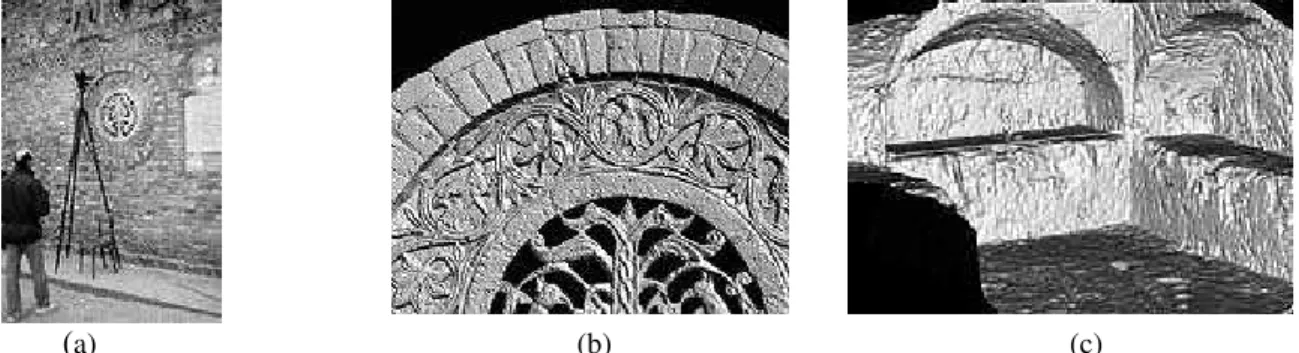
deteriorating architectural elements at the Palazzo Della Ragione in Padova. In 1998, in collaboration with the University of Ferrara, it was used to digitize a number of architectural building elements, including a rosone (Figure 2 a,b), on the facade of the 8th century Abbey of Pomposa, near Ferrara. The 3D image data provided an archival quality record of the condition of the rosone and other elements which can be used for conservation applications to monitor changes as well as to make a replica if needed (11).
In 1996, in collaboration with the Israel Antiquities Authority, a pilot project to demonstrate the heritage recording applications the Large Field of View System was undertaken in Israel. The system was used to scan the Tomb of St. James in Jerusalem (Figure 2c) as well as several archaeological and architectural site features at Caesarea (12). The image data provided a
detailed record of the rough and irregular shape of the Tomb for conservation purposes as well as data for a 3D VR display of the Tomb.
(a) (b) (c)
Figure 2. The Biris camera mounted on a conventional tripod (a) was used to scan a rosone on the façade at the 8th century Abbey of Pomposa near Ferrara, Italy. The digital model (b) provies a record of the surface shape and condition after 1100 years exposure to the elements. A section of the digital model of the 2 m x 2 m x 1.8 m St. James’ Tomb in Jerusalem recorded with the Large Field of View camera is shown in (c). In addition to recording the irregular shape details with accuracy for heritage preservation documentation, the digital model data can also be used to prepare 3D Virtualized Reality displays for VR theatre applications.
In February 1999, in collaboration with the Digital Michelangelo Project, the High-Resolution Laser Scanner was brought to Florence and used to provide high-resolution
monochrome images of specific surface details on seven on Michelangelo’s sculptures, including the David. High-resolution images of tool marks were taken on selected 5 cm x 5 cm areas of the sculptures. Data points were recorded at intervals of 50 microns in the x and y directions with a depth or z measurement resolution of approximately 10 microns. The resulting data provided a detailed representation of the shape of the tool marks (13).
3.2 Heritage "Site/Object" Recording Applications:
Both the Biris Camera and the Large Field of View System have been used to record complete archaeological site features as well large outdoor sculptures.
(a) (b) (c)
Figure 3. The Biris camera mounted on a linear translation stage (a) was used to scan the 3.4 m wide x 2.3 m high Hieroglyphic Stairway at the Peabody Museum in Boston to produce a 3D digital model (b). The software also enables the data to be used for research applications. Similar to the use of raking light to examine details on works of art, researchers can interactively move the light source to any angle and zoom in to examine features such details on the steps (c).
In 1998, for the purpose of digitizing the section of the Mayan Hieroglyphic Stairway in the the Peabody Museum at Harvard University, NRC loaned a Biris Camera system to Innovision Géomatique Inc., one of our industrial partners. In collaboration with Heritage 3D, Innovision scanned the Stairway during a one-week visit to the Museum. The primary objective was to provide an accurate high resolution digital model which could be used to fabricate a replica of the Stairway. In addition to the replica, the data can be used for 3D VR theatre display of the
object as well as for research applications (Figure 3c). Innovision is currently developing a stand alone commercial system for recording archaeological sites in the Three Gorges area of China along the Yangtzee River.
As a final example, to demonstrate the application for recording large outdoor sculpture, the Large Field of View System was used to digitize a sculpture Mythic Messengers by the artist Bill Reid at the Canadian Museum of Civilization. The sculpture measures 9 m long x 1.2 m wide and is mounted 4 m above ground level on an exterior wall at the Museum. The objective was to prepare an accurate scale replica of the sculpture.
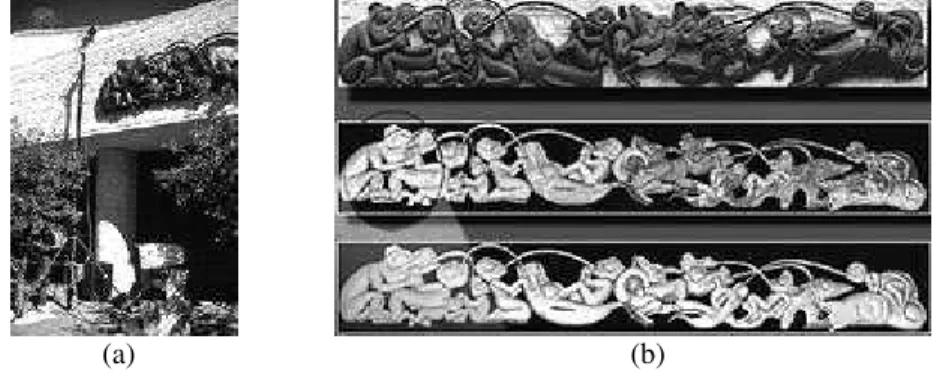
To scan Mythic Messengers, the camera, attached to a remote controlled pan and tilt unit, was mounted on a custom designed telescopic tripod which enables it to be raised to a height of 10 m (Figure 4a). Scans of over 100 different views of the sculpture were recorded at a resolution in the order of 1 mm. The multiple view scans were then merged into a single 3D digital model (Figure 4b), which was used by one of our industrial partners to prepare a scale replica.
(a) (b)
Figure 4. The Large Field of View camera is shown (a) mounted on a telescoping tripod to scan the sculpture
Mythic Messengers at the Canadian Museum of Civilization. The sculpture, shown in (b, top), is mounted 4 m
above ground on an exterior wall and measures 9 m long x 1. 2 m high. Over 100 scans were recorded as shown in the colour-coded image (b, middle) and merged into a 3D model (b, bottom). The data was then used to fabricate an accurate scale replica.
4.0 Conclusions:
The projects undertaken to date were all unique research and development pilot projects directed towards demonstrating the applications of the technology for heritage recording. We are continuing to develop these applications as part of our ongoing R&D activity and are pleased to note our continuing collaboration with our colleagues in Italy. One clear concern in the heritage community, which has limited the application of 3D imaging on a more widespread use, is the cost. The costs of advanced 3D systems as well as the expertise required to operate them clearly limits the application for general day to day museum and heritage site imaging applications at present. However, based on our experience to date, there are several instances where the costs associated with recording a site can be justified. These include recording (1) significant sites that are clearly in danger, (2) for digital repatriation applications, (3) collections of "national or international treasure" status during a major retrospective such that the image data can be used for a variety of long term income stream applications and, (4) in the instances where the 3D record provides information unatainable by other imaging and/or examination techniques.
References
1. Baribeau, R., Taylor, J.M., Rioux, M. and Godin, G., “Color and Range Sensing for Hypermedia and Interactivity in Museums”, Hypermedia and Interactivity in Museums, Archives and Museum Informatics Technical Report No. 14, ISSN 1042-1459, Proceedings of an International Conference, Pittsburg. (October 14-16, 1991), 265 - 275.
2. Taylor, J., Forester, G., Livingstone, F. and Baribeau, R., “AMUSE: 3-D Colour Imaging, Remote Access and Display”, Electronic Imaging and the Visual Arts, EVA’96 London Conference Proceedings, 25 July, 1996. 9.1- 9.10.
3. Livingstone, F., Evans, K., Taylor, J., Rioux, M., and Arsenault-Desfossés, H., “The 3rd Dimension: A New Way of Seeing in Cyberspace”, Electronic Imaging and the Visual Arts, EVA’97 Paris, Musée du Louvre, Conference Proceedings, 2 Septembre, 1997, 10.1 - 10.13.
4. Baribeau, R., Cournoyer, L., Godin, G.and Rioux, M. “Colour Three-Dimensional Modelling of Museum Objects”, Imaging the Past, Electronic Imaging and Computer Graphics in Museum and Archaeology, British Museum, Occasional Paper Number 114, 1996, London, 199 - 209.
5. Baribeau, R., Rioux, M. and Godin, G., “Recent Advances in the use of a Laser Scanner in the Examination of Paintings”, Restoration’ 92, Amsterdam 1992, pp. 69-73.
6. Additional information on museum applications can be found on our web site at:
http://www.vit.iit.nrc.ca/Pages_Html/English/museum_heritage.html
7. Baribeau, R., Rioux M. and Godin G., “Color Reflectance Modelling Using a Polychromatic Laser Range Sensor”. IEEE Trans. Pattern Anal. Machine Int., 14(2): (1992), 263-269.
8. Beraldin, J.-A., Blais, F., Cournoyer, L., Rioux, M., Bernier, F., and Harrison, N., “Portable Digital 3-D Imaging System for Remote Sites”, 3D Data Modelling and Imaging, The 1998 IEEE International Symp. On Circuit and Systems, Monterey, CA, USA: 326-333. May 31-June 3, 1998.
9. Rioux, M., Beraldin, J.-A., Blais, F., Godin, G.and Cournoyer, L., “High Resolution Digital 3-D Imaging of Large Structures”, Three-Dimensional Image Capture, SPIE Proceedings, Volume 3023, 11 February, 1997, San Jose, CA, 109 - 118.
10. Soucy, M., Godin, G., Baribeau, R., Blais, F. and Rioux, M. “Sensors and Algorithms for the Construction of Digital 3-D Colour Models of Real Objects”, ICIP-96 Proceedings, 1996 IEEE International Conference on Image Processing, Vol. II of III, Lausanne, Switzerland, 16-19 September, 1996, 409-412.
11. See: Imaging for Rapid Response on Remote Sites on our web site at
http://www.vit.iit.nrc.ca/Biris_Italy/3dima.htm.
12. See: Demonstration of Heritage 3-D Imaging Applications in Israel on our web site at
http://www.vit.iit.nrc.ca/Israel/Israel.html.
13. See: Participation in the Digital Michelangelo Project on our web site at