HAL Id: hal-02273355
https://hal-amu.archives-ouvertes.fr/hal-02273355
Submitted on 28 Aug 2019HAL is a multi-disciplinary open access archive for the deposit and dissemination of sci-entific research documents, whether they are pub-lished or not. The documents may come from teaching and research institutions in France or abroad, or from public or private research centers.
L’archive ouverte pluridisciplinaire HAL, est destinée au dépôt et à la diffusion de documents scientifiques de niveau recherche, publiés ou non, émanant des établissements d’enseignement et de recherche français ou étrangers, des laboratoires publics ou privés.
Copyright
Differential QS modulation by QslA
Sana Tg, R Lomas, Gimenez Mr, Aurélie Laubier, C Soscia, Claire Chauvet,
Ana Conesa, R. Voulhoux, Bérengère Ize, Sophie Bleves
To cite this version:
Sana Tg, R Lomas, Gimenez Mr, Aurélie Laubier, C Soscia, et al.. Differential modulation of Quorum-Sensing signaling through QslA in Pseudomonas Running title: Differential QS modulation by QslA. Journal of Bacteriology, American Society for Microbiology, 2019. �hal-02273355�
1
Differential modulation of Quorum-Sensing signaling through QslA in Pseudomonas 2
aeruginosa strains PAO1 and PA14 3
4
Running title: Differential QS modulation by QslA 5
6
7
Sana TG1,2*, Lomas R3, Gimenez MR1, Laubier A1, Soscia C1, Chauvet C1, Conesa A4, 8
Voulhoux R1, Ize B1, and Bleves S1* 9
10
1 LISM (Laboratoire d’Ingénierie des Systèmes Macromoléculaires-UMR7255), IMM (Institut 11
de Microbiologie de la Méditerranée), Aix-Marseille Univ and CNRS, 31 chemin J. Aiguier, 12
Marseille 13402 Cedex 20, France. 13
2 Present address: Laboratory of Molecular Microbiology, Global Health Institute, School of 14
Life Sciences, Station 19, EPFL-SV-UPBLO, Ecole Polytechnique Fédérale de Lausanne 15
(EPFL), 1015, Lausanne, Switzerland. 16
3 Genomics of Gene Expression Laboratory Centro de Investigación Príncipe Felipe, Valencia, 17
Spain. 18
4 Microbiology and Cell Science, IFAS, Genetics Insitutte, University of Florida, Gainesville, 19
FL, United States 20
21
*Corresponding authors: Thibault G Sana. Email address: [email protected] 22
Sophie Bleves. Email address: [email protected] 23
24 25
26
Abstract 27
Two clinical isolates of the opportunist pathogen Pseudomonas aeruginosa named PAO1 and 28
PA14 are commonly studied in research laboratories. Despite being closely related, PA14 29
exhibits increased virulence compared to PAO1. To determine which players are responsible 30
for the hypervirulence phenotype of the PA14 strain, we elected for a transcriptomic approach 31
through RNA sequencing. We found 2029 genes that are differentially expressed between the 32
two strains, including several genes that are involved with or regulated by Quorum-Sensing 33
(QS), known to control most of the virulence factors in P. aeruginosa. Among them, we chose 34
to focus our study on QslA, an anti-activator of QS whose expression was barely detectable in 35
the PA14 strain according our data. We hypothesized that lack of expression of qslA in PA14 36
could be responsible for higher QS expression in the PA14 strain, possibly explaining its hyper-37
virulence phenotype. After confirming QslA protein was highly produced in PAO1 but not in 38
the PA14 strain, we provided evidence showing that a PAO1 deletion strain of qslA has faster 39
QS gene expression kinetics compared to PA14. Moreover, known virulence factors activated 40
by QS such as (i) pyocyanin production, (ii) H2-T6SS (Type VI Secretion System) gene 41
expression, and (iii) Xcp-T2SS (Type II Secretion System) machinery production and secretion 42
were all lower in PAO1 compared to PA14 strain, due to higher qslA expression. However, 43
biofilm formation and cytotoxicity towards macrophages, although increased in PA14 44
compared to PAO1, were independent of QslA control. Altogether, our findings implicated 45
differential qslA expression as a major determinant of virulence factor expression in P. 46
aeruginosa strains PAO1 and PA14. 47
48
Importance 49
Pseudomonas aeruginosa is an opportunistic pathogen responsible for acute nosocomial 50
infections, and chronic pulmonary infections. P. aeruginosa strain PA14 is known to be hyper-51
virulent in different hosts. Despite several studies in the field, the underlining molecular 52
mechanisms sustaining this hyper-virulent phenotype remain enigmatic. Here, we provide 53
evidence that the PA14 strain has faster Quorum-Sensing (QS) kinetics compared to the PAO1 54
strain, due to the lack of QslA expression, an anti-activator of QS. QS is a major regulator of 55
virulence factors in P. aeruginosa, therefore we propose that the hyper-virulent phenotype of 56
PA14 strain is, at least partially, due to the lack of QslA expression. This mechanism could be 57
of great importance, as it could be conserved amongst other P. aeruginosa isolates. 58
Introduction 59
Pseudomonas aeruginosa is an ubiquitous Gram-negative opportunistic pathogen 60
responsible for various nosocomial infections in immunocompromised or intubated-ventilated 61
patients, as well as chronic respiratory infections in cystic fibrosis sufferers (1). Its genome 62
encodes a myriad of virulence factors and regulatory mechanisms that allow the pathogen to 63
adapt efficiently to various hostile environments and to cause distinct infections (2). Virulence 64
gene expression in P. aeruginosa is under a sophisticated and dynamic regulation network, and 65
responds to largely unidentified environmental signals. This complex regulatory network 66
involves alternative sigma factors, dozens of two-component systems, and Quorum-Sensing 67
(QS) systems (3). 68
QS is a cell density-based interbacterial communication system that involves the 69
diffusion of small autoinducer molecules that are used to coordinate gene expression (4–6). 70
Once a crucial threshold concentration of signal molecules has been reached, QS target genes 71
can be either activated or repressed. In P. aeruginosa there are two QS systems based on acyl 72
homoserine lactones (HSL) signaling: the LasR/3-oxo-C12-HSL and RhlR/C4-HSL systems. 73
The las system is placed above the rhl system in the HSL-dependent QS hierarchy, since 74
LasR/3-oxo-C12-HSL activates both rhlR and rhlI (7, 8). These two QS systems control the 75
expression of about 6% of genes encoded on P. aeruginosa genome (9–11). Among them, QS 76
activates the expression of many genes encoding virulence factors, like the elastase LasB 77
secreted by the Type II Secretion System (T2SS) (12, 13), two Type VI Secretion Systems 78
(T6SS) named H2- and H3-T6SS (14–16), the pyocyanin (17) and biofilm maturation (18). In 79
addition to the HSL-mediated QS, P. aeruginosa also produces the Pseudomonas quinolone 80
signal (PQS: 2-heptyl-3-hydroxy-4-quinolone) (19). The quinolone signaling system is 81
intertwined in a hierarchical manner to the HSL-based QS systems of P. aeruginosa, as LasR 82
and RhlR respectively positively and negatively control the levels of PQS by binding the 83
promoter region of pqsR regulator gene (20, 21). In regards to regulation of the QS systems, 84
there are several QS regulators described in the literature, such as MvaT (22), CdpR (23), the 85
IQS system (24), QscR (25), QteE (26), and QslA (27). QscR, QteE, and QslA are thought to 86
play crucial roles in determining the activation threshold of QS (25–27). 87
In laboratory settings, two clinically isolated strains of P. aeruginosa, named PAO1 88
and PA14, are principally studied and are noteworthy for their differences in virulence. While 89
the PAO1 strain displays moderate virulence in most model systems, PA14 is highly virulent 90
in mouse, nematode, and plant models of infection (28); for the historical discovery of PA14 91
strain, see (29)). Studies aimed at identifying the determinants mediating PA14 hypervirulence 92
have found that the PA14 genome has two pathogenicity islands (108 kb and 11 kb in size), 93
called PAPI-1 and PAPI-2 (P. aeruginosa Pathogenicity Island-1 and 2 respectively) (30). 94
These pathogenicity islands encode virulence factors such as the type III secretion system 95
(T3SS) effector ExoU, a potent and detrimental cytotoxin producing rapid cell death (31, 32). 96
Nonetheless, enhanced PA14 virulence is not only a consequence of genomic acquired 97
virulence determinants (33). In addition to the pathogenicity islands, the PA14 strain has a 98
mutated version of the ladS gene (34), encoding a sensor of the RetS/LadS/GacS signaling 99
cascade, which is associated with virulence and the switch between acute and chronic 100
infections of P. aeruginosa (35, 36). This mutation leads to derepression of the T3SS regulon 101
and thus higher cytotoxicity towards mammalian cells (34). More recently, differences in the 102
expression of the three T6SSs have also been highlighted in PA14 compared to PAO1 and PAK 103
backgrounds, presumably because of the ladS mutation (37). Finally, PA14 strain has been 104
shown to secrete high levels of pyocyanin compared to PAO1, which is another important 105
virulence factor of P. aeruginosa (38). 106
To better understand the divergent virulence profiles between PAO1 and PA14 and 107
determine if there are other unknown players that are involved in this complex mechanism, we 108
chose to perform an unbiased transcriptomic approach using high-throughput RNA sequencing 109
(RNAseq). From RNAseq data, we found significant differences in the expression of many QS 110
targets; overall, QS-activated genes were overexpressed in PA14, while QS-repressed genes 111
were overexpressed in PAO1 strain. Interestingly, the expression of qslA, encoding a QS 112
inhibitor (27), is only detectable in PAO1 strain. QslA (QS LasR-anti-activator) is known to 113
bind LasR, and disrupt LasR dimerization, preventing its binding to target promoters (27, 39). 114
Since many virulence factors are activated by QS in P. aeruginosa, we hypothesized that 115
decreased expression of qslA in PA14 strain would drive increased QS gene expression and 116
subsequently overexpression of QS target genes, thus leading to the hyper-virulent phenotype 117
of PA14. To test this hypothesis, we first demonstrated that the QslA protein is indeed readily 118
produced in PAO1 strain while it is undetectable in PA14. We further confirmed that genes 119
encoding QS systems are upregulated in PA14 strain compared to PAO1, and that it is due to 120
lower level of QslA. Next, we provided evidence that many QS activated genes encoding 121
important P. aeruginosa virulence factors are differentially regulated between these two 122
strains, such as pyocyanin production, H2-T6SS gene expression, XcpP production, and Xcp-123
dependent secretion of the elastase LasB. Finally, we observed that whereas biofilm formation 124
and cytotoxicity towards macrophages were higher in PA14, this was independent of qslA 125
expression. Altogether, the level of the QslA protein and presumably the expression level of 126
the qslA gene is a key player in QS target genes expression, which consequently contributes to 127
higher pathogenic potential of the PA14 strain. 128
129
Results 130
Global comparison of PAO1 and PA14 RNAseq transcriptomes 131
To determine if virulence factor genes are differentially expressed between the PAO1 132
and PA14 P. aeruginosa strains, we performed RNAseq on mRNAs extracted from cultures 133
grown in rich medium at the transition between exponential and stationary phase, in which 134
most of the virulence factors are expressed (see Materiel and Methods). 2029 genes were 135
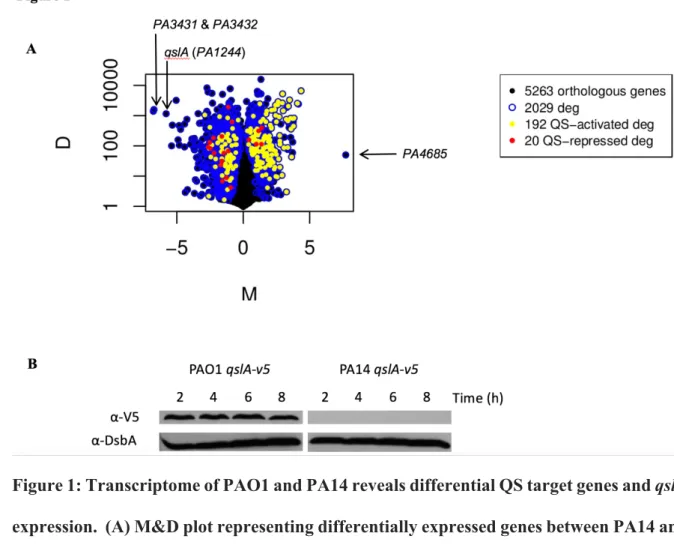
identified as significantly and differentially regulated between the two strains (Figure 1A and 136
Table 1), which represents about 39% of the P. aeruginosa genome, suggesting a massive gene 137
expression variation between both isolates. Among the genes differentially expressed, 138
PA3431/PA3432 expression levels were increased by respectively 108.7 and 105.3-fold in 139
PAO1 (Table S1). However, we decided not to follow up on these genes encoding hypothetical 140
proteins here. Further work will be required to address this interesting observation, more 141
particularly as PA3431/PA3432 may constitute a holin-/antiholin-like system as PF04172 and 142
PF03788 domains, are respectively present in PA3431 and PA3432, suggesting a potential role 143
in bacterial lysis (40). Two other genes whose expression was very different between the two 144
strains drew our attention: PA4685 and PA1244 (qslA). Expression of PA4685 was not 145
detectable in PAO1, while expression of qslA was barely detectable in PA14 (Table S1 and 146
Table 1). 147
Since we did not detect any PA4685 transcript in our PAO1 transcriptomic data (Table 148
S1), we first decided to test whether the gene was present in the PAO1 genome. PAO1 is one 149
of the most commonly P. aeruginosa strain used in research and is derived from the original 150
Australian PAO isolate, isolated from a wound 50 years ago in Melbourne, and distributed 151
worldwide to laboratories. Over decades, discordant phenotypes of PAO1 subcultures emerged 152
(41). Notably, there is a 1 kb deletion within the PA4684 and PA4685 genes present in the 153
Washington Genome Center PAO1 strain compared to the published PAO1 sequence (42) 154
(which served as a reference for our in silico analysis). To test whether this locus deletion is 155
present in the PAO1 strain used in this study (named “PAO1 Marseilles”), PCR was performed 156
using pairs of oligonucleotides hybridizing to the coding sequence of PA4685 (TSO116-157
TSO117) or outside thereof (CCO1, CCO2) (Figure S1A). As shown, our results revealed that 158
PA4685 is absent in the PAO1 Marseilles strain, but present in the PA14 strain used in this 159
study (Figure S1B). This explains the non-expression of PA4685 in PAO1 Marseilles strain 160
observed in our RNAseq transcriptome. 161
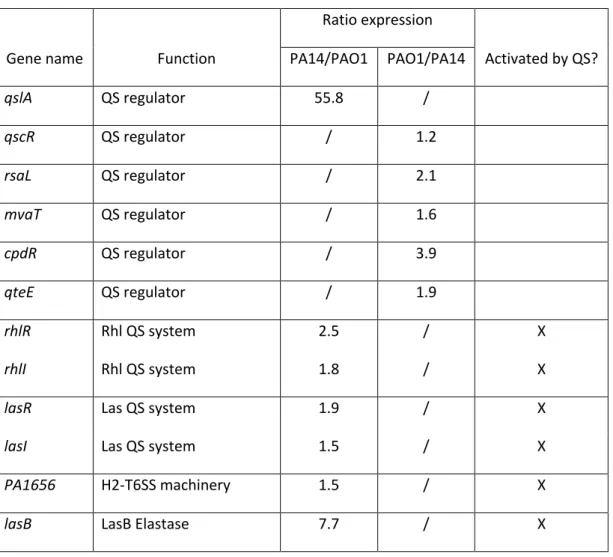
The expression of qslA gene is increased by 55.8-fold in the PAO1 strain (Table 1). 162
Interestingly, this gene encodes an anti-activator of QS, named QslA (27), and led us to 163
hypothesize that the expression of QS-regulated genes may be different between the two 164
isolates. As a result, we decided to look at the expression of all of the QS regulated genes in 165
our RNAseq transcriptomic data. Interestingly, among the 353 genes known to be regulated by 166
QS in P. aeruginosa (315 activated and 38 repressed (9)), 212 were significantly and 167
differentially regulated between both strains (Figure 1A). Overall, QS activated genes were 168
overexpressed in PA14 (shown as yellow dots) whereas QS repressed genes were 169
overexpressed in PAO1 (shown as red dots), suggesting a major differential QS-dependent 170
expression pattern (Figure 1A). All together these observations led us to hypothesize that the 171
difference in QS target genes expression between these two strains could be mediated by the 172
modulation of qslA expression levels. 173
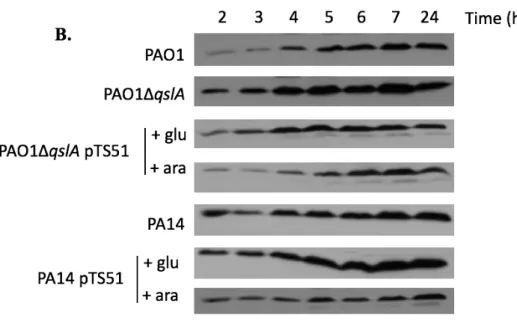
To first demonstrate a correlation between levels of qslA expression and QslA 174
production, we engineered chromosomally encoded QslAV5 translational fusions in both the 175
PAO1 and PA14 strains. The production of QslAV5 could be monitored and analyzed by 176
Western blotting and immunodetection with an anti-V5 antibody (Figure 1B). The results for 177
the PAO1 strain reflected a constant level of QslA during growth, whereas QslA was not 178
detected under the same conditions in PA14, which coincides with our transcriptomic data. 179
180
qslA expression level drives gene expression of HSL-based QS regulators 181
Then, we asked whether this QS-dependent global differential expression could be due 182
to differential expression of qslA. We reasoned that abolishing qslA expression in the PAO1 183
background may mimic the PA14 profile whereas QslA overproduction in the PA14 strain may 184
resemble the PAO1 pattern. Our transcriptomic data indicate an increased expression of genes 185
encoding the two HSL-based QS systems in PA14. Indeed, rhlR, rhlI, lasR, and lasI were 186
respectively 2.5, 1.8, 1.9, and 1.5-fold more expressed in the PA14 strain (Table 1). 187
Therefore, we decided to measure the relative levels of lacZ transcriptional fusions to 188
lasR, rhlR and rhlI promoters (7) in strains PAO1, PA14, PAO1ΔqslA, PAO1ΔqslA carrying 189
plasmid pTS51 encoding qslA to complement the qslA deletion, and PA14 overproducing QslA 190
from the pTS51 (Table 2). In PAO1, deletion of qslA gene increased the expression level of 191
QS regulator genes by 2 to 3-fold (Figure 2A, C, & E). WT level expression was restored by 192
complementation of the mutation in trans (compare columns 3 and 4, repression and activation 193
respectively of qslA, in graphs 2A, 2C & 2E). Overproduction of QslA caused a significant 194
decrease (1.5 to 2.5-fold) in β-galactosidase activities measured for all three of the 195
transcriptional fusions made in the PA14 strain (Figure 2B, D, &F). Thus, the expression levels 196
of lasR, rhlR, and rhlI were correlated in a dose-dependent manner with QslA production in 197
both P. aeruginosa strains. Interestingly, the increased fold expression in PA14 measured for 198
lasR, rhlR, and rhlI (Figure 2), recapitulates the increased fold expression of these genes in our 199
transcriptomic data between two strains (Table S1), suggesting that modulation of qslA 200
expression is solely responsible for this differential expression of QS genes. 201
202
Biosynthesis of pyocyanin depends on qslA expression levels 203
We next hypothesized that differential expression of qslA could explain the differential 204
expression of QS-regulated genes between PAO1 and PA14 strains. To test this hypothesis, we 205
chose to compare the expression level or production profile of several QS activated virulence 206
factors gene in both strains, producing or not QslA. 207
Pyocyanin is a blue, redox-active phenazine that contributes to P. aeruginosa virulence 208
by inhibiting the oxidative burst of host phagocytic cells, by inducing apoptosis in host cells 209
and through antibiotic activities. This respiratory pigment also participates in the reduction of 210
iron and functions as an intracellular redox buffer (43). As the regulation of pyocyanin 211
expression is both mediated by HSL- and PQS-based QS (17, 20), the study of its production 212
is then a perfect example of the intrinsic and complex relationship between regulations by HSL- 213
and PQS-based QS. Furthermore, in our transcriptomic data, expression of the operon phz 214
encoding the genes involved in the production of pyocyanin, were 10 to 20-fold increased in 215
PA14 (Table S1). 216
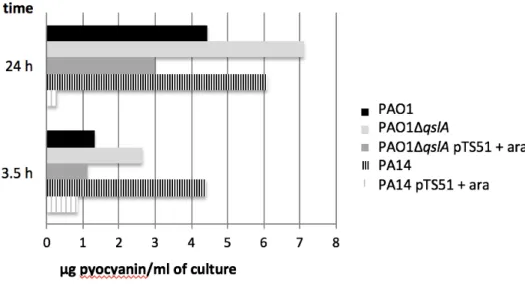
The production of pyocyanin was monitored after 3.5 and 24 hours of growth (Figure 217
3). Pyocyanin concentrations were higher in PA14 than in PAO1 reflecting the lack of 218
expression of qslA. Moreover, the overproduction of QslA in PA14 led to a major decrease in 219
pyocyanin production (5.2- and 22.4- fold at 3.5 and 24 hours) whereas the qslA deletion in 220
PAO1 produced a significant increase (2- and 1.6- fold at 3.5 and 24 hours) that could be 221
restored to WT PAO1 level by complementation. Therefore, the increased pyocyanin 222
production in PA14 strain (38) is due to low qslA expression in this strain. 223
224
H2-T6SS expression is driven by QslA levels 225
The H2-T6SS machinery is a virulence factor of P. aeruginosa that is known to be 226
activated by QS in both PA14 and PAO1 strains (14, 15). Our transcriptomic data indicates a 227
1.5-fold increased expression of the first gene of the H2-T6SS operon (PA1656) in PA14 228
(Table 1). P. aeruginosa utilizes H2-T6SS to invade epithelial cells by manipulating the 229
microtubular network and host kinase pathways (44–46) and to promote autophagy (44, 47– 230
49). H2-T6SS also mediates antibacterial activity (44, 47–49), making it a trans-kingdom cell 231
targeting machinery (48, 50). We used a lacZ transcriptional fusion of H2-T6SS promoter 232
region to evaluate its expression in these strains (Figure 4). Strain PAO1∆qslA presented a 1.8-233
fold increase in the expression of H2-T6SS compared to the PAO1 WT strain. Moreover, 234
production of QslA in the mutant strain was able to decrease H2-T6SS expression to 235
comparable level than the WT strain. Similarly in PA14, overproduction of QslA significantly 236
reduced the expression of H2-T6SS. The expression of H2-T6SS machinery genes was thus 237
controlled at a transcriptional level by QslA in both strains. 238
239
Production of XcpP depends on qslA expression levels 240
XcpP is an inner membrane protein of the P. aeruginosa Xcp T2SS machinery, known 241
to secrete various virulence factors (51). XcpP interacts with the outer membrane secretin 242
XcpQ, which forms the pore through which the secreted protein reaches the extracellular 243
medium (52–54) and is therefore an essential component of the T2SS process. The two operons 244
encoding the Xcp machinery are activated by HSL-based QS (13), and our transcriptomic data 245
indicates that xcp genes are upregulated in PA14 in comparison to PAO1 in transition phase 246
(Table S1). We thus asked whether QslA levels could modulate XcpP production, using 247
immunodetection at different time of the growth (Figure 5). Whereas XcpP could be readily 248
detected after 2 hours of growth of the PA14 strain, the same level of proteins was obtained 249
two hours later in PAO1. Moreover, the deletion of the qslA gene in PAO1 led to an earlier 250
synthesis of XcpP and to higher levels of the protein that can be restored to a PAO1 WT profile 251
by complementation. Accordingly, overproduction of QslA in the PA14 strain showed a PAO1-252
like pattern of XcpP. These data corroborated our hypothesis that the T2SS machinery is 253
dependent on QslA for an optimal production. 254
255
Elastase secretion is dependent on qslA expression level 256
The elastase is an Xcp T2SS-secreted protease, encoded by the lasB gene. It degrades 257
elastin, a major component of lung tissue, and cleaves a surfactant protein (SP-D), involved in 258
several immune functions (55). The expression of elastase coding gene is activated by QS (12), 259
and we measured an 7.7 fold increased expression of lasB in PA14 in comparison to 260
PAO1during early stationary phase in our RNAseq analysis (Table 1). To measure the impact 261
of QslA on this T2SS substrate, the secretion into the extracellular medium and the extracellular 262
activity of elastase were monitored (Figure 6). The secretion of LasB was analyzed by 263
Coomassie blue staining of the extracellular fraction at different growth times (Figure 6A). As 264
expected, the deletion of qslA in PAO1 altered the kinetics, allowing earlier LasB secretion; 265
after 4 and 6 hours of growth, LasB secretion was significantly higher in the mutant 266
PAO1ΔqslA than in the WT PAO1 strain. This phenotype is restored to a WT phenotype by 267
trans complementation since the protein profile observed for the PAO1ΔqslA strain producing 268
QslA was identical to that observed for the WT PAO1 strain (Figure 6A, compare first and 269
fourth lines). In contrast in PA14, overproduction of QslA led to a delayed and decreased 270
secretion of LasB compared to the PA14 WT strain (Figure 6A, compare fifth and sixth lines). 271
These data were also confirmed by monitoring the LasB protease activity by observing 272
the formation of a protein degradation halos on skim-milk plates (Figure 6B). We noticed an 273
earlier halo in PA14 strain compared to PAO1 (Figure 6B, compare first and fourth lines). In 274
addition, the delay of halo formation in PAO1 can be visualized in a qslA mutant strain (Figure 275
6B, compare first and second lines). As negative controls, we used mutants in T2SS Xcp 276
machinery for both strains (Figure 6B, third and fifth lines). As shown, the halo was weak after 277
35 hours. 278
Altogether these data demonstrated that the functionality of the Xcp T2SS machinery 279
measured by the secretion and extracellular activity of the protease LasB is higher in the PA14 280
strain, due to the decreased expression of qslA in this strain. 281
282
QslA does not control biofilm formation by P. aeruginosa 283
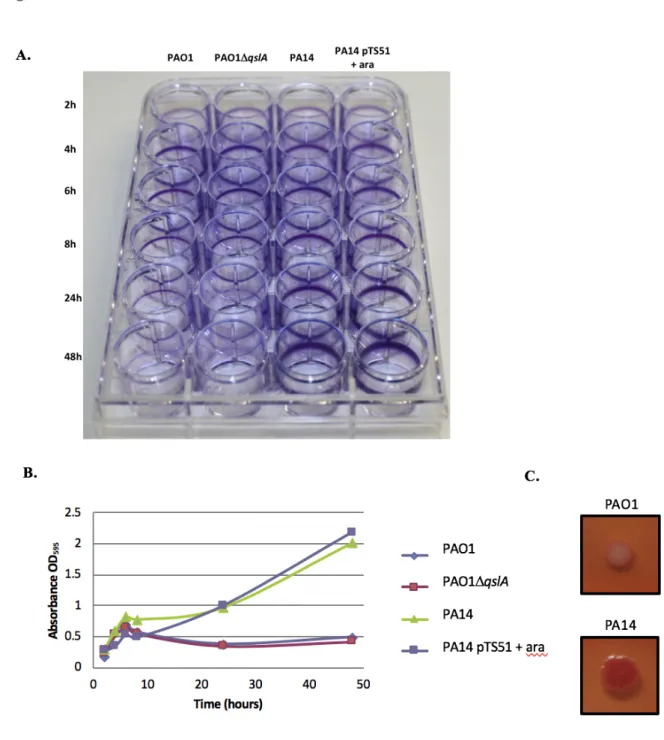
P. aeruginosa ability to form biofilm is a crucial virulence determinant, mainly 284
regulated by QS (18). To assess if QslA has a role during biofilm formation, bacterial adherence 285
to abiotic surface of various strains was visualized (Fig 7A) and quantified using crystal violet 286
staining (Fig 7B). The production of exopolysaccharides, a main biofilm component, was also 287
visualized on Congo red-containing plates (Fig 7C). As expected from the literature, the ability 288
of the PA14 strain to form biofilm was higher than for PAO1, the exopolysaccharide staining 289
(Fig 7C, the PA14 strain is red on Congo-red plates) being consistent with adherence assay 290
(Fig 7A and 7B). A clear difference in the adherence capacities was observable after 8h (Fig 291
7A, compare line 1 with line 3 at 8h) and was even greater at 48h (Fig 7A, compare line 1 with 292
line 3). However, profiles of the PAO1 strains, WT or ΔqslA, mutant and of the PA14 strains, 293
WT or overproducing QslA, were the same, suggesting that QslA is dispensable for biofilm 294
formation (Fig. 7A and 7B). Therefore, these results tend to suggest that QslA is not implicated 295
in controlling biofilm formation of P. aeruginosa. 296
297
Cytotoxicity towards macrophages is not dependent on QslA 298
Finally, we tested the cytotoxicity of the various strains on J774 macrophages. Indeed 299
while PA14 is highly cytotoxic due to the T3SS effector ExoU (31), PAO1 is considered an 300
invasive and poorly cytotoxic P. aeruginosa strain. Nevertheless both strains display T3SS-301
mediated antiphagocytic functions and the T3SS machinery and effector encoding genes are 302
regulated by HSL-mediated QS(56) and PQS. Due to the hyper-cytotoxic phenotype of the 303
PA14 strain, we used two infection conditions according to the two backgrounds (PAO1 and 304
PA14) (Fig. 8). As expected even with longer infection times, the PAO1 strain is poorly 305
cytotoxic compared to PA14 (Fig. 8, compare line 1 and 3). However, the cytotoxicity levels 306
of the PAO1 strains, WT or ΔqslA mutant and of the PA14 strains, WT or overproducing QslA, 307
were the same suggesting that the cytotoxicity of P. aeruginosa is not dependent on QslA. 308
309
Discussion 310
PAO1 and PA14 are two stains of P. aeruginosa that are broadly studied throughout 311
the Pseudomonas research community. Interestingly, the PA14 strain is more virulent than the 312
PAO1 strain in different model infection systems (28, 33, 57, 58). Several studies have been 313
conducted to try to decipher why PA14 strain exhibits higher pathogenicity compared to PAO1. 314
While previous groups have found that pathogenicity island-I and II are present only in the 315
PA14 genome and encodes virulence factors (33), and the ladS gene is mutated in PA14 strain, 316
making T3SS and T6SSs more effective (34, 37), we speculated that other determinants might 317
be involved in the differential in virulence between these two strains. 318
As a result, we decided to use a global transcriptome RNA sequencing approach to 319
highlight new factors that might explain the virulence divergence between these two strains. 320
The transcriptomic data revealed lower expression of the QS regulator qslA in PA14 strain than 321
in PAO1, which we further confirmed at a protein level. Given the fact that QslA is highly 322
produced in PAO1 (Figure 1B) and plays a crucial role in determining the activation threshold 323
of QS (27), we hypothesized that QS regulon expression will occur earlier and would be higher 324
in PA14 in comparison to PAO1. To test this hypothesis, we constructed a deletion mutant of 325
qslA in PAO1 as well as a plasmid allowing overexpression of qslA from a PBAD promoter in 326
PA14 strain (Table 2). This allowed us to investigate whether deletion of qslA in PAO1 can 327
mimic the higher QS activation found in PA14, and conversely, if overproduction of QslA in 328
PA14 will lead to the lower QS activation observed in PAO1. We then focused our study on 329
well-known QS-regulated virulence factors. We were able to confirm that the expression level 330
of genes encoding QS system as well as QS gene targets are differentially regulated depending 331
on the expression level of qslA in both strains, except for biofilm and cytotoxicity phenotypes. 332
Considering that a large set of genes encoding virulence factors are regulated by QS in P. 333
aeruginosa, and that their expression levels are increased in PA14 compared to PAO1, this 334
could partially explain the hyper-virulent phenotype of PA14. Moreover, a qslA mutant in 335
PAO1 strain is more virulent than the wild-type PAO1 strain in a Caenorhabditis elegans 336
model (27). These results combined with our findings suggest that the high expression of qslA 337
in PAO1 strain is one of the major factors of its decreased virulence compared to PA14, and 338
vice versa for the PA14 strain. 339
From our results, we questioned whether such mechanisms could be conserved 340
amongst other isolates of P. aeruginosa. To that end, a previous study showed significant 341
differences in QS regulon expression between seven clinical and environmental strains of P. 342
aeruginosa, this supporting the notion that different isolates of P. aeruginosa have defined 343
regulation networks (59). These findings indicate a role for QS in the extension of the range of 344
habitats in which a species can thrive, including the host. Based on this, one can ask whether 345
the differential regulation of QS between the different strains of P. aeruginosa is causing 346
different levels of virulence that can be observed between different isolates (33). If so, it would 347
be interesting to investigate qslA expression levels in different clinical isolates of P. 348
aeruginosa. However, our data concerning biofilm formation and cytotoxicity towards 349
macrophages suggest that the QslA-regulon does not overlap completely the QS-regulon. One 350
explanation could be that another QS regulator is important for controlling biofilm and 351
cytotoxicity. 352
Interestingly, the expression of other known QS regulator genes such as qscR, rsaL, 353
mvaT, cdpR and qteE was respectively 1.2, 2.1, 1.6, 3.9, and 1.9-fold increased in PA14 (Table 354
1), which is not comparable to the 55.8 fold increased expression of qslA in PAO1. This, along 355
with our data concerning the differential modulation of QS, H2-T6SS, pyocyanin, Xcp-T2SS, 356
and LasB, suggests that the modulation of QS between two strains is mostly due to the 357
differential expression of qslA. One could ask what is the molecular mechanism underlining 358
this differential expression of qslA? We performed a simple BLASTn comparing the upstream 359
500 bp sequence of qslA in PAO1 and PA14, but there was only one nucleotide difference, 360
hardly explaining the differential expression of qslA in both strains. Further studies will be 361
needed to elucidate the exact mechanism of qslA expression in these two strains. Altogether, 362
we propose that differential expression of qslA in PAO1 and PA14 leads to modulation of QS 363
signaling. Since QS is a major regulator of virulence factors in P. aeruginosa, it is tempting to 364
speculate that QslA could be a key player in the hyper-virulence phenotype of PA14, along 365
with LadS (34), PAPI-1 and PAPI-2 (30). 366
367
Material and Methods 368
Bacterial strains, culture conditions, plasmids and oligonucleotides 369
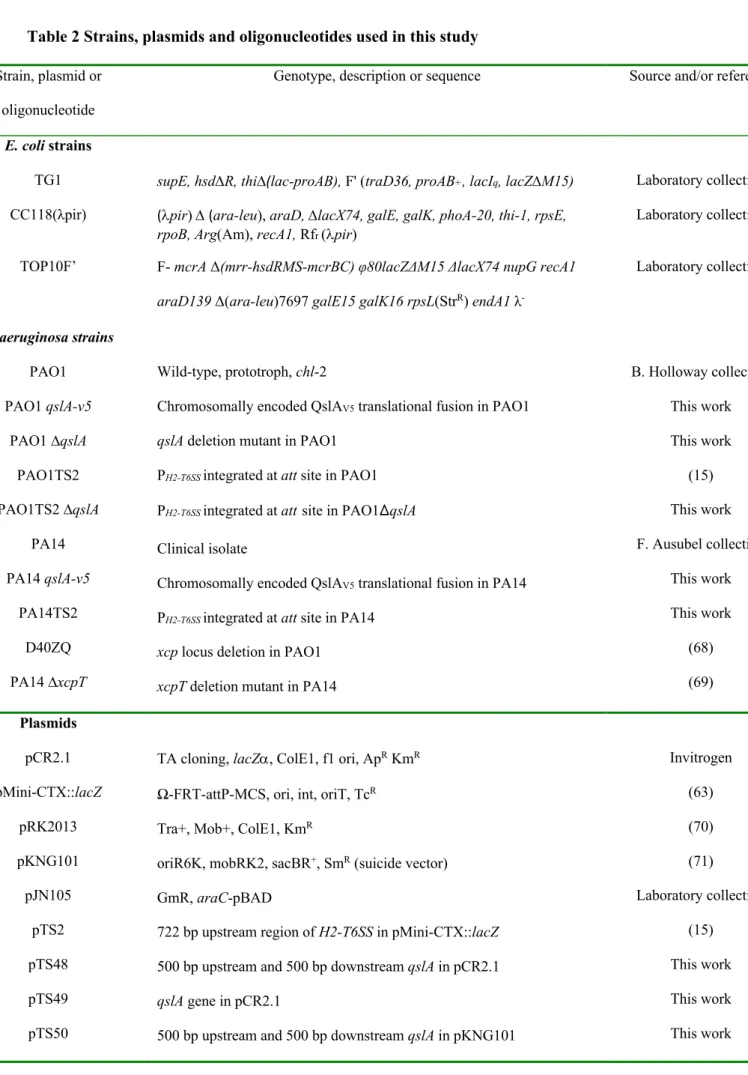
The bacterial strains, plasmids and oligonucleotides used in this study are described in Table 370
2. LB (Lysogeny broth), PIA (Pseudomonas isolation agar), and TSB (Tryptic soy broth) broths 371
and agar were used for the growth of P. aeruginosa and Escherichia coli strains at 37°C. 372
Cultures were inoculated at an optical density at 600 nm (OD600) of 0.1 with overnight cultures, 373
and strains were grown at 37°C with aeration in TSB. Recombinant plasmids were introduced 374
into P. aeruginosa strain PAO1 and PA14 by conjugation using pRK2013 mobilization 375
properties, as described previously (60). The antibiotic concentrations were as follows: for E. 376
coli, ampicillin (50 µg ml–1), kanamycin (25 µg ml–1), tetracycline (15 µg ml–1), gentamicin 377
(10 µg ml–1), streptomycin (100µg ml-1); for P. aeruginosa, tetracycline (200 µg ml–1 for 378
plates or 50 mg ml–1 for liquid growth), gentamicin (50 µg ml–1), streptomycin (1000µg ml-379
1). Expression of the qslA gene under the control of a PBAD promoter in pTS51 was induced or 380
repressed by addition of arabinose or glucose respectively at a final concentration of 0.5% after 381
1h30 of growth. 382
383
Transcriptional analysis of Pseudomonas aeruginosa PA14 and PAO1 384
To determine if virulence factor genes were differentially expressed between the PAO1 and 385
PA14 P. aeruginosa strains, we performed RNAseq on mRNA extracted from cultures of both 386
strains grown in rich media (LB) to early stationary phase. Total RNA was isolated from cell 387
pellets equivalent to 2 OD600 units of bacterial culture using SV total RNA isolation system 388
(Promega) following the manufacturer's instructions. Once isolated and prior to the library 389
preparation, the integrity of RNA samples was assessed with a Bioanalyzer system. Barcoded, 390
strand-specific, cDNA libraries were constructed, pooled and sequenced in an Illumina HiSeq 391
2000, single-end 50 bp reads by BGI-Hong Kong. Illumina reads were mapped to the P. 392
aeruginosa genome PAO1 (AE004091.2 (61)) and PA14 (NC_008463.1 (33)) by Bowtie 393
(version Bowtie1 v0.12.9 (62)), indicating strand-specific sequencing. Quantification of gene 394
expression was determined by the HTSeq package (63) using the GeneBank P. aeruginosa 395
PA14 and PAO1 annotations files and discarding multimapped reads. Data were normalized 396
by RPKM and filtered to the 5,263 orthologous genes conserved between the P. aeruginosa 397
strains PA14 and PAO1. Two biological replicates were performed per condition. Differential 398
expression analysis was analyzed using the Bioconductor package NOISeq version 2.22.1 (64), 399
a non-parametric approach suitable for lowly replicated data, and using a q-value of 0.99 for 400
strong control of false positives. 401
402
cDNA library preparation 403
The RNA was fragmented with RNase III. Then the 5'PPP structures were removed from the 404
RNA samples using RNA 5' polyphosphatase (Epicentre) and subsequently, the RNA was poly 405
(A)-tailed using poly (A) polymerase. Then an RNA adapter was ligated to the 5´-phosphate 406
of the RNA fragments. First-strand cDNA synthesis was performed using an oligo (dT)-adapter 407
primer and M-MLV reverse transcriptase. The resulting cDNA was PCR-amplified to about 30 408
ng/µl using a high fidelity DNA polymerase. The cDNA was purified using the Agencourt 409
AMPure XP kit (Beckman Coulter Genomics). 410
411
Construction of the ∆qslA mutant 412
To generate qslA deletion strain, 500 bp upstream and 500 bp downstream of the qslA gene 413
were amplified by overlapping PCR with High Fidelity DNA polymerase (Roche Applied 414
Science) using TSO108, TSO109, TSO110 and TSO111 primers (see Table 2). The PCR 415
product was cloned in pCR2.1 (TA cloning kit; Invitrogen) giving pTS48, which was then 416
sequenced (GATC) and subcloned in pKNG101 suicide vector giving the mutator pTS50. 417
pTS50, maintained in the E. coli CC118 λpir was further conjugated in P. aeruginosa strain 418
PAO1 using protocol previously described (60). The mutant, in which the double 419
recombination events occurred and resulted in the nonpolar deletion of qslA gene were verified 420
by PCR using external primers TSO112–TSO113. 421
422
Construction of the chromosomic qslAV5 recombinant gene 423
PAO1 strains chromosomally encoding QslAV5 translational fusion was engineered by 424
exchanging the qslA stop codon with the sequence encoding the V5 tag followed by a stop 425
codon. This was achieved by overlapping PCR of the 500 bp upstream and downstream regions 426
of the native stop codon of qslA with the High Fidelity DNA polymerase (ROCHE) using 427
primers TSO103, TSO104, TSO105 and TSO106 (Table 2). The PCR product was cloned in 428
pCR2.1 (TA-cloning KIT, Invitrogen), which was then sequenced (GATC) and subcloned in 429
pKNG101 suicide vector giving the pTS52. pTS52, maintained in the E. coli CC118λpir strain, 430
was mobilized in the wild type P. aeruginosa strain PAO1 or PA14. The strains, in which the 431
double recombination events occurred and resulted in the chromosomic tagging of qslA with 432
V5, were verified by PCR using primers TSO58 and TSO107. 433
434
lacZ reporter fusion and β-galactosidase assay 435
For PH2-T6SS-‘lacZ, the promoter fragment was integrated at the CTX phage attachment site in
436
PAO1 or PA14 and isogenic mutants using established protocols (65). For PrhlR-‘lacZ, PrhlI
-437
‘lacZ, PlasR-‘lacZ, plasmids carrying promoter fragment were conjugated in PAO1 or PA14 and
438
isogenic mutants using established protocol (60). Overnight culture, grown in TSB 439
supplemented with tetracyclin, was diluted in TSB to OD600= 0.1. Growth and ß-galactosidase 440
activity were monitored by harvesting samples at different time intervals. ß-galactosidase 441
activity was measured according to Miller, as described previously (16), and based on 442
onitrophenyl-b-D-galactopyranoside hydrolysis. ß-galactosidase activities were expressed in 443 Miller units. 444 445 Pyocyanin production 446
Pyocyanin was extracted from the extracellular medium by adding an equal volume of 447
chloroform (CHCl3) and vigorous vortexing as previously described (66). The lower 448
pyocyanin-containing organic layer was then taken and vortexed with an equal volume of 0.2 449
M HCl. The pink pyocyanin-containing aqueous layer resulting from the previous step was 450
then taken, and its absorbance at 520 nm (OD520) was read. Concentrations expressed as 451
micrograms of pyocyanin produced per ml of culture supernatant were determined by 452
multiplying the OD520 by 17.072. 453
454
SDS-PAGE and immunoblotting 455
Proteins from the extracellular medium were loaded at an equivalent of 1.0 OD600 unit, while 456
proteins from cellular extracts were loaded at an equivalent of 0.1 OD600 unit. Proteins were 457
then separated on SDS gels containing 11 or 15% acrylamide depending on the size of the 458
proteins being further detected. 459
For Western blotting, proteins were transferred from gels onto nitrocellulose membranes. After 460
30 min to overnight saturation in Tris-buffered saline (TBS) (0.1 M Tris, 0.1 M NaCl, pH7.5), 461
0.05% (v/v) Tween 20 and 5% (w/v) skim milk, the membrane was incubated for 1 h with anti-462
V5 (diluted 1:2500), anti-XcpP (1/2000) or anti-DsbA (1:25000); washed three times with 463
TBS, 0.05% Tween 20; incubated for 45 min with goat anti-rabbit immunoglobulin G (IgG) 464
antibodies (Sigma) diluted 1:5000; washed three times with TBS, 0.05% Tween 20; and then 465
revealed with a Super Signal Chemiluminescence system (Pierce). 466
467
Adherence assay on inert surfaces and exopolysaccharide production 468
The adherence assay was performed as previously described in (67) with some modifications. 469
Cultures inoculated at OD600=0.05 with O/N cultures were grown at 37°C with aeration in LB 470
with appropriate antibiotics. Induction of the promoter arabinose (PBAD) was done at OD600=0.6 471
with 0.2% arabinose for 1.5 hours. 24-well polystyrene microtitre plates were then inoculated 472
at OD600=0.2 in 1 ml of MM63 medium supplemented with casamino acids 0.5%, 1 mM 473
MgSO4 and glucose or arabinose 0.2% for 2 to 48 hours at 30°C. Bacteria were stained with 474
0.1% crystal violet for a period of 10 min and washed twice with water. The stain was then 475
dissolved in ethanol and absorbance was measured at 595 nm. 476
Congo red assay was performed as previously described to measure the production of 477
exopolysaccharides (68). 478
479
Cytotoxicity towards macrophages 480
The cytotoxicity of P. aeruginosa strains grown to mid-log phase in LB broth was assayed 481
using J774 macrophages as described in (69) except that macrophages were infected for 45 min 482
or 2.5 hr at a multiplicity of infection (MOI) of 20 for the PAO1 and PA14 strains respectively. 483
The percentage of LDH release was calculated relatively to that of the uninfected control, 484
which was set at 0% LDH release, and that of uninfected cells lysed with Triton X-100, which 485
was set at 100% LDH release. 486
487
Statistical analysis 488
For multigroup comparisons, a main P value was calculated by ANOVA (Stat Plus software) 489
and unpaired Student’s t tests were performed using Excel software (Microsoft) for two-group 490
comparisons. On the figures, asterisks indicate statistical significance. 491
492
Acknowledgements 493
We are very grateful to Kyler A. Lugo and Lilian H. Lam for careful reading of the manuscript. 494
We also thank Steve Garvis for advice on RNA preparation and Vertis Biotechnologie AG 495
(Freising-Weihenstephan, Germany) for RNA sequencing. We are grateful to I. Bringer, A. 496
Brun and O. Uderso for technical assistance. T.G.S. and M.R.G. were supported by a Ph.D. 497
fellowship from the French Research Ministry and with a “Teaching and Research” fellowship 498
from Aix-Marseille University. A.L. was financed with a PhD fellowship from “Vaincre La 499
Mucoviscidose” (RF20120600685 and RF20130500911). This work was supported by 500
recurrent funding from the CNRS and Aix-Marseille University, and from “Pathomics” ERA-501
net PATHO Grant ANR-08-PATH-004-01. The funders had no role in study design, data 502
collection and interpretation, or the decision to submit the work for publication. 503
504
Author contributions 505
T.G.S. and S.B. designed and conceived the experiments. T.G.S., R.L., M.R.G., A.L., C.S., 506
C.C., and B.I. performed the experiments. T.G.S. and S.B. supervised the execution of the 507
experiments. T.G.S., R.L., A.C., B.I. and S.B. analyzed the data and discussed with M.R.G., 508
A.L and R.V. T.G.S. and S.B. wrote the paper with contribution from B.I. and reading from 509 R.L., A.C., M.R.G. and R.V. 510 511 Bibliography 512
1. Govan JRW, Deretic V. 1996. Microbial Pathogenesis in Cystic Fibrosis: Mucoid Pseudomonas 513
aeruginosa and Burkholderia cepacia. MICROBIOL REV 60:36. 514
2. Stover CK, Pham XQ, Erwin AL, Mizoguchi SD, Warrener P, Hickey MJ, Brinkman FSL, 515
Hufnagle WO, Kowalik DJ, Lagrou M, Garber RL, Goltry L, Tolentino E, Westbrock-Wadman 516
S, Yuan Y, Brody LL, Coulter SN, Folger KR, Kas A, Larbig K, Lim R, Smith K, Spencer D, 517
Olson MV. 2000. PAO1, an opportunistic pathogen 406:6. 518
3. Balasubramanian D, Schneper L, Kumari H, Mathee K. 2013. A dynamic and intricate regulatory 519
network determines Pseudomonas aeruginosa virulence. Nucleic Acids Res 41:1–20. 520
4. Fuqua WC, Winans SC. 1994. A LuxR-LuxI type regulatory system activates Agrobacterium Ti 521
plasmid conjugal transfer in the presence of a plant tumor metabolite. J Bacteriol 176:2796– 522
2806. 523
5. Williams P, Cámara M. 2009. Quorum sensing and environmental adaptation in Pseudomonas 524
aeruginosa: a tale of regulatory networks and multifunctional signal molecules. Curr Opin 525
Microbiol 12:182–191. 526
6. Schuster M, Joseph Sexton D, Diggle SP, Peter Greenberg E. 2013. Acyl-Homoserine Lactone 527
Quorum Sensing: From Evolution to Application. Annu Rev Microbiol 67:43–63. 528
7. Latifi A, Foglino M, Tanaka K, Williams P, Lazdunski A. 1996. A hierarchical quorum-sensing 529
cascade in Pseudomonas aeruginosa links the transcriptional activators LasR and RhlR (VsmR) 530
to expression of the stationary-phase sigma factor RpoS. Mol Microbiol 21:1137–1146. 531
8. Pesci EC, Pearson JP, Seed PC, Iglewski BH. 1997. Regulation of las and rhl quorum sensing in 532
Pseudomonas aeruginosa. J Bacteriol 179:3127–3132. 533
9. Schuster M, Lostroh CP, Ogi T, Greenberg EP. 2003. Identification, Timing, and Signal Specificity 534
of Pseudomonas aeruginosa Quorum-Controlled Genes: a Transcriptome Analysis. J Bacteriol 535
185:2066–2079. 536
10. Wagner VE, Bushnell D, Passador L, Brooks AI, Iglewski BH. 2003. Microarray Analysis of 537
Pseudomonas aeruginosa Quorum-Sensing Regulons: Effects of Growth Phase and 538
Environment. J Bacteriol 185:2080–2095. 539
11. Vasil ML. 2003. DNA Microarrays in Analysis of Quorum Sensing: Strengths and Limitations. 540
J Bacteriol 185:2061–2065. 541
12. Gambello MJ, Iglewski BH. 1991. Cloning and characterization of the Pseudomonas aeruginosa 542
lasR gene, a transcriptional activator of elastase expression. J Bacteriol 173:3000–3009. 543
13. Chapon-Herve V, Akrim M, Latifi A, Williams P, Lazdunski A, Bally M. 1997. Regulation of 544
the xcp secretion pathway by multiple quorum-sensing modulons in Pseudomonas aeruginosa. 545
Mol Microbiol 24:1169–1178. 546
14. Lesic B, Starkey M, He J, Hazan R, Rahme LG. 2009. Quorum sensing differentially regulates 547
Pseudomonas aeruginosa type VI secretion locus I and homologous loci II and III, which are 548
required for pathogenesis. Microbiology 155:2845–2855. 549
15. Sana TG, Hachani A, Bucior I, Soscia C, Garvis S, Termine E, Engel J, Filloux A, Bleves S. 550
2012. The Second Type VI Secretion System of Pseudomonas aeruginosa Strain PAO1 Is 551
Regulated by Quorum Sensing and Fur and Modulates Internalization in Epithelial Cells. J Biol 552
Chem 287:27095–27105. 553
16. Sana TG, Soscia C, Tonglet CM, Garvis S, Bleves S. 2013. Divergent Control of Two Type VI 554
Secretion Systems by RpoN in Pseudomonas aeruginosa. PLoS ONE 8:e76030. 555
17. Brint JM, Ohman DE. 1995. Synthesis of multiple exoproducts in Pseudomonas aeruginosa is 556
under the control of RhlR-RhlI, another set of regulators in strain PAO1 with homology to the 557
autoinducer-responsive LuxR-LuxI family. J Bacteriol 177:7155–7163. 558
18. Fazli M, Almblad H, Rybtke ML, Givskov M, Eberl L, Tolker-Nielsen T. 2014. Regulation of 559
biofilm formation in P seudomonas and B urkholderia species: Regulation of biofilm formation. 560
Environ Microbiol 16:1961–1981. 561
19. Pesci EC, Milbank JBJ, Pearson JP, McKnight S, Kende AS, Greenberg EP, Iglewski BH. 1999. 562
Quinolone signaling in the cell-to-cell communication system of Pseudomonas aeruginosa. Proc 563
Natl Acad Sci 96:11229–11234. 564
20. Diggle SP, Winzer K, Chhabra SR, Worrall KE, Cámara M, Williams P. 2003. The 565
Pseudomonas aeruginosa quinolone signal molecule overcomes the cell density-dependency of 566
the quorum sensing hierarchy, regulates rhl-dependent genes at the onset of stationary phase and 567
can be produced in the absence of LasR: PQS regulation of rhl-dependent phenotypes. Mol 568
Microbiol 50:29–43. 569
21. McGrath S, Wade DS, Pesci EC. 2004. Dueling quorum sensing systems in Pseudomonas 570
aeruginosa control the production of the Pseudomonas quinolone signal (PQS). FEMS 571
Microbiol Lett 230:27–34. 572
22. Diggle SP, Winzer K, Lazdunski A, Williams P, Camara M. 2002. Advancing the Quorum in 573
Pseudomonas aeruginosa: MvaT and the Regulation of N-Acylhomoserine Lactone Production 574
and Virulence Gene Expression. J Bacteriol 184:2576–2586. 575
23. Zhao J, Yu X, Zhu M, Kang H, Ma J, Wu M, Gan J, Deng X, Liang H. 2016. Structural and 576
Molecular Mechanism of CdpR Involved in Quorum-Sensing and Bacterial Virulence in 577
Pseudomonas aeruginosa. PLOS Biol 14:e1002449. 578
24. Lee J, Wu J, Deng Y, Wang J, Wang C, Wang J, Chang C, Dong Y, Williams P, Zhang L-H. 579
2013. A cell-cell communication signal integrates quorum sensing and stress response. Nat 580
Chem Biol 9:339–343. 581
25. Ledgham F, Ventre I, Soscia C, Foglino M, Sturgis JN, Lazdunski A. 2003. Interactions of the 582
quorum sensing regulator QscR: interaction with itself and the other regulators of Pseudomonas 583
aeruginosa LasR and RhlR: Interactions of QscR. Mol Microbiol 48:199–210. 584
26. Siehnel R, Traxler B, An DD, Parsek MR, Schaefer AL, Singh PK. 2010. A unique regulator 585
controls the activation threshold of quorum-regulated genes in Pseudomonas aeruginosa. Proc 586
Natl Acad Sci 107:7916–7921. 587
27. Seet Q, Zhang L-H. 2011. Anti-activator QslA defines the quorum sensing threshold and 588
response in Pseudomonas aeruginosa: Quorum sensing anti-activator QslA. Mol Microbiol 589
80:951–965. 590
28. Rahme L, Stevens E, Wolfort S, Shao J, Tompkins R, Ausubel F. 1995. Common virulence 591
factors for bacterial pathogenicity in plants and animals. Science 268:1899–1902. 592
29. Mathee K. 2018. Forensic investigation into the origin of Pseudomonas aeruginosa PA14 — old 593
but not lost. J Med Microbiol 67:1019–1021. 594
30. He J, Baldini RL, Deziel E, Saucier M, Zhang Q, Liberati NT, Lee D, Urbach J, Goodman HM, 595
Rahme LG. 2004. The broad host range pathogen Pseudomonas aeruginosa strain PA14 carries 596
two pathogenicity islands harboring plant and animal virulence genes. Proc Natl Acad Sci 597
101:2530–2535. 598
31. Finck-Barbançon V, Goranson J, Zhu L, Sawa T, Wiener-Kronish JP, Fleiszig SMJ, Wu C, 599
Mende-Mueller L, Frank DW. 1997. ExoU expression by Pseudomonas aeruginosa correlates 600
with acute cytotoxicity and epithelial injury. Mol Microbiol 25:547–557. 601
32. Hauser AR, Kang PJ, Engel JN. 1998. PepA, a secreted protein of Pseudomonas aeruginosa , is 602
necessary for cytotoxicity and virulence. Mol Microbiol 27:807–818. 603
33. Lee DG, Urbach JM, Wu G, Liberati NT, Feinbaum RL, Miyata S, Diggins LT, He J, Saucier 604
M, Déziel E, Friedman L, Li L, Grills G, Montgomery K, Kucherlapati R, Rahme LG, Ausubel 605
FM. 2006. Genomic analysis reveals that Pseudomonas aeruginosa virulence is combinatorial. 606
Genome Biol 14. 607
34. Mikkelsen H, McMullan R, Filloux A. 2011. The Pseudomonas aeruginosa Reference Strain 608
PA14 Displays Increased Virulence Due to a Mutation in ladS. PLoS ONE 6:e29113. 609
35. Ventre I, Goodman AL, Vallet-Gely I, Vasseur P, Soscia C, Molin S, Bleves S, Lazdunski A, 610
Lory S, Filloux A. 2006. Multiple sensors control reciprocal expression of Pseudomonas 611
aeruginosa regulatory RNA and virulence genes. Proc Natl Acad Sci 103:171–176. 612
36. Chambonnier G, Roux L, Redelberger D, Fadel F, Filloux A, Sivaneson M, de Bentzmann S, 613
Bordi C. 2016. The Hybrid Histidine Kinase LadS Forms a Multicomponent Signal 614
Transduction System with the GacS/GacA Two-Component System in Pseudomonas 615
aeruginosa. PLOS Genet 12:e1006032. 616
37. Allsopp LP, Wood TE, Howard SA, Maggiorelli F, Nolan LM, Wettstadt S, Filloux A. 2017. 617
RsmA and AmrZ orchestrate the assembly of all three type VI secretion systems in 618
Pseudomonas aeruginosa. Proc Natl Acad Sci 114:7707–7712.
619
38. Dietrich LEP, Price-Whelan A, Petersen A, Whiteley M, Newman DK. 2006. The phenazine 620
pyocyanin is a terminal signalling factor in the quorum sensing network of Pseudomonas 621
aeruginosa. Mol Microbiol 61:1308–1321. 622
39. Fan H, Dong Y, Wu D, Bowler MW, Zhang L, Song H. 2013. QsIA disrupts LasR dimerization 623
in antiactivation of bacterial quorum sensing. Proc Natl Acad Sci 110:20765–20770. 624
40. Saier MH, Reddy BL. 2015. Holins in Bacteria, Eukaryotes, and Archaea: Multifunctional 625
Xenologues with Potential Biotechnological and Biomedical Applications. J Bacteriol 197:7–17. 626
41. Klockgether J, Munder A, Neugebauer J, Davenport CF, Stanke F, Larbig KD, Heeb S, Schock 627
U, Pohl TM, Wiehlmann L, Tummler B. 2010. Genome Diversity of Pseudomonas aeruginosa 628
PAO1 Laboratory Strains. J Bacteriol 192:1113–1121. 629
42. Dötsch A, Pommerenke C, Bredenbruch F, Geffers R, Häussler S. 2009. Evaluation of a 630
microarray-hybridization based method applicable for discovery of single nucleotide 631
polymorphisms (SNPs) in the Pseudomonas aeruginosa genome. BMC Genomics 10:29. 632
43. Jayaseelan S, Ramaswamy D, Dharmaraj S. 2014. Pyocyanin: production, applications, 633
challenges and new insights. World J Microbiol Biotechnol 30:1159–1168. 634
44. Jiang F, Waterfield NR, Yang J, Yang G, Jin Q. 2014. A Pseudomonas aeruginosa Type VI 635
Secretion Phospholipase D Effector Targets Both Prokaryotic and Eukaryotic Cells. Cell Host 636
Microbe 15:600–610. 637
45. Sana TG, Baumann C, Merdes A, Soscia C, Rattei T, Hachani A, Jones C, Bennett KL, Filloux 638
A, Superti-Furga G, Voulhoux R, Bleves S. 2015. Internalization of Pseudomonas aeruginosa 639
Strain PAO1 into Epithelial Cells Is Promoted by Interaction of a T6SS Effector with the 640
Microtubule Network. mBio 6. 641
46. Sana TG, Berni B, Bleves S. 2016. The T6SSs of Pseudomonas aeruginosa Strain PAO1 and 642
Their Effectors: Beyond Bacterial-Cell Targeting. Front Cell Infect Microbiol 6. 643
47. Jiang F, Wang X, Wang B, Chen L, Zhao Z, Waterfield NR, Yang G, Jin Q. 2016. The 644
Pseudomonas aeruginosa Type VI Secretion PGAP1-like Effector Induces Host Autophagy by 645
Activating Endoplasmic Reticulum Stress. Cell Rep 16:1502–1509. 646
48. Russell AB, LeRoux M, Hathazi K, Agnello DM, Ishikawa T, Wiggins PA, Wai SN, Mougous 647
JD. 2013. Diverse type VI secretion phospholipases are functionally plastic antibacterial 648
effectors. Nature 496:508–512. 649
49. Burkinshaw BJ, Liang X, Wong M, Le ANH, Lam L, Dong TG. 2018. A type VI secretion 650
system effector delivery mechanism dependent on PAAR and a chaperone–co-chaperone 651
complex. Nat Microbiol 3:632–640. 652
50. Bleves S. 2016. Game of Trans-Kingdom Effectors. Trends Microbiol 24:773–774. 653
51. Bleves S, Viarre V, Salacha R, Michel GPF, Filloux A, Voulhoux R. 2010. Protein secretion 654
systems in Pseudomonas aeruginosa: A wealth of pathogenic weapons. Int J Med Microbiol 655
300:534–543. 656
52. Bleves S, Lazdunski A, Filloux A. 1996. Membrane topology of three Xcp proteins involved in 657
exoprotein transport by Pseudomonas aeruginosa. J Bacteriol 178:4297–4300. 658
53. Douzi B, Ball G, Cambillau C, Tegoni M, Voulhoux R. 2011. Deciphering the Xcp 659
Pseudomonas aeruginosa Type II Secretion Machinery through Multiple Interactions with
660
Substrates. J Biol Chem 286:40792–40801. 661
54. Douzi B, Trinh NTT, Michel-Souzy S, Desmyter A, Ball G, Barbier P, Kosta A, Durand E, 662
Forest KT, Cambillau C, Roussel A, Voulhoux R. 2017. Unraveling the Self-Assembly of the 663
Pseudomonas aeruginosa XcpQ Secretin Periplasmic Domain Provides New Molecular Insights
664
into Type II Secretion System Secreton Architecture and Dynamics. mBio 8. 665
55. Kuang Z, Hao Y, Walling BE, Jeffries JL, Ohman DE, Lau GW. 2011. Pseudomonas aeruginosa 666
Elastase Provides an Escape from Phagocytosis by Degrading the Pulmonary Surfactant Protein-667
A. PLoS ONE 6:e27091. 668
56. Bleves S, Soscia C, Nogueira-Orlandi P, Lazdunski A, Filloux A. 2005. Quorum Sensing 669
Negatively Controls Type III Secretion Regulon Expression in Pseudomonas aeruginosa PAO1. 670
J Bacteriol 187:3898–3902. 671
57. Choi JY, Sifri CD, Goumnerov BC, Rahme LG, Ausubel FM, Calderwood SB. 2002. 672
Identification of Virulence Genes in a Pathogenic Strain of Pseudomonas aeruginosa by 673
Representational Difference Analysis. J Bacteriol 184:952–961. 674
58. Tan M-W, Mahajan-Miklos S, Ausubel FM. 1999. Killing of Caenorhabditis elegans by 675
Pseudomonas aeruginosa used to model mammalian bacterial pathogenesis. Proc Natl Acad Sci 676
96:715–720. 677
59. Chugani S, Kim BS, Phattarasukol S, Brittnacher MJ, Choi SH, Harwood CS, Greenberg EP. 678
2012. Strain-dependent diversity in the Pseudomonas aeruginosa quorum-sensing regulon. Proc 679
Natl Acad Sci 109:E2823–E2831. 680
60. Sana TG, Laubier A, Bleves S. 2014. Gene Transfer: Conjugation, p. 17–22. In Filloux, A, 681
Ramos, J-L (eds.), Pseudomonas Methods and Protocols. Springer New York, New York, NY. 682
61. Benson DA, Clark K, Karsch-Mizrachi I, Lipman DJ, Ostell J, Sayers EW. 2014. GenBank. 683
Nucleic Acids Res 42:D32–D37. 684
62. Langmead B, Trapnell C, Pop M, Salzberg SL. 2009. Ultrafast and memory-efficient alignment 685
of short DNA sequences to the human genome. Genome Biol 10:R25. 686
63. Anders S, Pyl PT, Huber W. 2015. HTSeq--a Python framework to work with high-throughput 687
sequencing data. Bioinformatics 31:166–169. 688
64. Tarazona S, Furió-Tarí P, Turrà D, Pietro AD, Nueda MJ, Ferrer A, Conesa A. 2015. Data 689
quality aware analysis of differential expression in RNA-seq with NOISeq R/Bioc package. 690
Nucleic Acids Res gkv711. 691
65. Hoang TT, Kutchma AJ, Becher A, Schweizer HP. 2000. Integration-Proficient Plasmids for 692
Pseudomonas aeruginosa: Site-Specific Integration and Use for Engineering of Reporter and 693
Expression Strains. Plasmid 43:59–72. 694
66. Essar DW, Eberly L, Hadero A, Crawford IP. 1990. Identification and characterization of genes 695
for a second anthranilate synthase in Pseudomonas aeruginosa: interchangeability of the two 696
anthranilate synthases and evolutionary implications. J Bacteriol 172:884–900. 697
67. Vallet I, Olson JW, Lory S, Lazdunski A, Filloux A. 2001. The chaperone/usher pathways of 698
Pseudomonas aeruginosa: Identification of fimbrial gene clusters (cup) and their involvement in 699
biofilm formation. Proc Natl Acad Sci 98:6911–6916. 700
68. Bordi C, Lamy M-C, Ventre I, Termine E, Hachani A, Fillet S, Roche B, Bleves S, Méjean V, 701
Lazdunski A, Filloux A. 2010. Regulatory RNAs and the HptB/RetS signalling pathways fine-702
tune Pseudomonas aeruginosa pathogenesis: P. aeruginosa signalling via HptB, RetS and sRNA. 703
Mol Microbiol 76:1427–1443. 704
69. Soscia C, Hachani A, Bernadac A, Filloux A, Bleves S. 2007. Cross Talk between Type III 705
Secretion and Flagellar Assembly Systems in Pseudomonas aeruginosa. J Bacteriol 189:3124– 706
3132. 707
70. Figurski DH, Helinski DR. 1979. Replication of an Origin-Containing Derivative of Plasmid 708
RK2 Dependent on a Plasmid Function Provided in Trans. Proc. Natl. Acad. Sci. 76 (4), 1648– 709
1652. 710
71. Kaniga K, Delor I, Cornelis GR. 1991. A Wide-Host-Range Suicide Vector for Improving 711
Reverse Genetics in Gram-Negative Bacteria: Inactivation of the BlaA Gene of Yersinia 712
Enterocolitica. Gene 109 (1), 137–141. 713
714 715
Table 1: Highlights from Table S1 of genes of interest 716
Gene name Function
Ratio expression
PA14/PAO1 PAO1/PA14 Activated by QS?
qslA QS regulator 55.8 / qscR QS regulator / 1.2 rsaL QS regulator / 2.1 mvaT QS regulator / 1.6 cpdR QS regulator / 3.9 qteE QS regulator / 1.9 rhlR Rhl QS system 2.5 / X rhlI Rhl QS system 1.8 / X
lasR Las QS system 1.9 / X
lasI Las QS system 1.5 / X
PA1656 H2-T6SS machinery 1.5 / X
lasB LasB Elastase 7.7 / X
717
Table 1: Highlights from Table S1 of genes of interest. Presentation of genes of interests regarding 718
their ratio of expression between strains PAO1 and PA14. 719 720 721 722 723 724 725 726 727
Table 2 Strains, plasmids and oligonucleotides used in this study 728
Strain, plasmid or oligonucleotide
Genotype, description or sequence Source and/or reference
E. coli strains
TG1 CC118(λpir)
TOP10F’
supE, hsdDR, thiD(lac-proAB), F' (traD36, proAB+, lacIq, lacZDM15)
(lpir) D (ara-leu), araD, DlacX74, galE, galK, phoA-20, thi-1, rpsE, rpoB, Arg(Am), recA1, Rfr (lpir)
F- mcrA Δ(mrr-hsdRMS-mcrBC) φ80lacZΔM15 ΔlacX74 nupG recA1 araD139 Δ(ara-leu)7697 galE15 galK16 rpsL(StrR) endA1 λ
-Laboratory collection Laboratory collection Laboratory collection P. aeruginosa strains PAO1 PAO1 qslA-v5 PAO1 ∆qslA PAO1TS2 PAO1TS2 ∆qslA PA14 PA14 qslA-v5 PA14TS2 D40ZQ PA14 ∆xcpT Wild-type, prototroph, chl-2
Chromosomally encoded QslAV5 translational fusion in PAO1 qslA deletion mutant in PAO1
PH2-T6SS integrated at att site in PAO1 PH2-T6SS integrated at att site in PAO1∆qslA Clinical isolate
Chromosomally encoded QslAV5 translational fusion in PA14 PH2-T6SS integrated at att site in PA14
xcp locus deletion in PAO1 xcpT deletion mutant in PA14
B. Holloway collection This work This work (15) This work F. Ausubel collection This work This work (68) (69) Plasmids pCR2.1 pMini-CTX::lacZ pRK2013 pKNG101 pJN105 pTS2 pTS48 pTS49 pTS50
TA cloning, lacZa, ColE1, f1 ori, ApR KmR Ω-FRT-attP-MCS, ori, int, oriT, TcR Tra+, Mob+, ColE1, KmR
oriR6K, mobRK2, sacBR+, SmR (suicide vector) GmR, araC-pBAD
722 bp upstream region of H2-T6SS in pMini-CTX::lacZ 500 bp upstream and 500 bp downstream qslA in pCR2.1 qslA gene in pCR2.1
500 bp upstream and 500 bp downstream qslA in pKNG101
Invitrogen (63) (70) (71) Laboratory collection (15) This work This work This work
pTS51 pTS52 pTS53 pMAL.R pMAL.V pMAL.I qslA gene in pJN105 qslAV5 in pCR2.1 qslAV5 in pKNG101
PlasR-lacZ transcriptional fusion in pMP220 PrhlR-lacZ transcriptional fusion in pMP220 PrhlI-lacZ transcriptional fusion in pMP220
This work This work This work (7) (7) (7) Oligonucleotides TSO58 TSO103 TSO104 TSO105 TSO106 TSO107 TSO108 TSO109 TSO110 TSO111 TSO112 TSO113 TSO114 TSO115 TSO116 TSO117 5’-CCTATCCCTAACCCTCTCCTCGGT-’3 5’-CGACCGCAGTTTTCCAACTGCGGGCCTTCATGGCGG-’3 5’TCACGTAGAATCGAGACCGAGGAGAGGGTTAGGGATAGGCT TACCACCGGAACGTCGAGCGGCTACCAGGCGCTGCTGC-’3 5’GGTAAGCCTATCCCTAACCCTCTCCTCGGTCTCGATTCTACG TGACCCGGCCATGGCGAATGACGCCGGTGGCGTCG-’3 5’-ATGCTCGGCGCGTAGGCATCGTTGTACAGGGCGACG-’3 5’-TGCTTGTCGCCGATGCTCGGC-’3 5’-CAGCGCCCTCTTCGAAGAAGC-’3 5’-ATGGCCGGGTCACACATGACCTGCCGCCTTCGC-’3 5’-GCAGGTCATGTGTGACCCGGCCATGGCGAATGACG-’3 5’-TGCTTGTCGCCGATGCTCGGCGC-’3 5’-AGAAAGGGTTATATCCTTATGC-’3 5’-GGTTCGAGGTCATCCCACAGC-’3 5’-CTCCATCGATTGACAGCGAAGG-’3 5’-TCAACCGGAACGTCGAGAGGC-’3 5’-TCCTCGCACCAGGACCAGTACC-’3 5’-GCGTCTTCCTCGCTCTCTTCGG-’3 (45) This work This work This work This work This work This work This work This work This work This work This work This work This work This work This work 729 730 731
732
733
Figure 1: Transcriptome of PAO1 and PA14 reveals differential QS target genes and qslA
734
expression. (A) M&D plot representing differentially expressed genes between PA14 and
735
PAO1 strains of P. aeruginosa. QS target genes are more expressed in PA14 . (B) QslA is
736
only produced in the PAO1 strain. QslAV5 protein is immunodetected using V5 antibody in
737
cellular extracts obtained after 2, 4, 6 and 8 hours of growth in TSB at 37°C with aeration. 738
DsbA immunodetection is used as a loading control. 739 740 741 742 743 744 745 746
747 748
Figure 2: β-galactosidase activities of transcriptional fusions PlasR-‘lacZ (A,B), PrhlI-‘lacZ 749
(C,D), et PrhlR-’lacZ (E,F). Ratio of expression in parental PAO1 (A,C,E) or PA14 (B,D,F) 750
strain versus expression in referenced strain. Results were obtained after 6 hours of growth at 751
37°C with aeration. Glucose and arabinose were added in the culture medium after 1h30 of 752
growth at a final concentration of 0.5% respectively allowing repression or induction of the 753
PBAD promoter of pTS51 encoding qslA. **, P <0.01, *, P <0.05 and NS, not significant.
754 755 756 757 758 759 760 761 762 763 764 765 766 767 768 769 770 771 772 773 774 775 776 777 778
779
Figure 3: Pyocyanin quantification in the extracellular medium. Pyocyanin was extracted
780
from culture medium as described in the experimental section after 3.5 and 24 hours of growth 781
at 37°C in LB with aeration. Arabinose was added in the culture medium after 1h30 of growth 782
at a final concentration of 0.5% to induce the PBAD promoter of pTS51 encoding qslA.
783
Pyocyanin concentrations are reported as mg of pyocyanin produced per ml of culture. Data of 784
a typical experiment are shown. The experiment has been done in triplicate. 785 786 787 788 789 790 791 792 793 794 795