HAL Id: hal-01319721
https://hal.archives-ouvertes.fr/hal-01319721v2
Submitted on 25 May 2016
HAL is a multi-disciplinary open access
archive for the deposit and dissemination of
sci-entific research documents, whether they are
pub-lished or not. The documents may come from
teaching and research institutions in France or
abroad, or from public or private research centers.
L’archive ouverte pluridisciplinaire HAL, est
destinée au dépôt et à la diffusion de documents
scientifiques de niveau recherche, publiés ou non,
émanant des établissements d’enseignement et de
recherche français ou étrangers, des laboratoires
publics ou privés.
MASTER: A JAVA Based Work-Stealing Technique For
Parallel Contingency Analysis
Siddhartha Khaitan
To cite this version:
Siddhartha Khaitan. MASTER: A JAVA Based Work-Stealing Technique For Parallel Contingency
Analysis. [Research Report] Iowa State University. 2016. �hal-01319721v2�
MASTER: A JAVA Based Work-Stealing Technique
For Parallel Contingency Analysis
Siddhartha Kumar Khaitan
ECE Deptarment, Iowa State University, Iowa, USA.
[email protected]
Abstract—In this paper, we present MASTER, a Java based
multithreaded work-stealing technique for parallel contingency analysis in power systems. MASTER analyzes contingencies using time domain simulation and scales contingency analysis task to multiple cores using multithreading in Java. To achieve load balancing, MASTER uses efficient implementation of work-stealing algorithm. We discuss several implementation issues and design time choices which are crucial for achieving efficient implementation. Experiments performed with contingencies of a 13029 bus power system shows that MASTER provides high computational gains and provides much better load-balancing than the conventional scheduling techniques.
Index Terms—Concurrency, multithreading, work-stealing,
power systems, parallel contingency analysis
I. INTRODUCTION
As power systems are growing in their size and complexity, the probability of critical failures is also increasing. To take preventive and corrective actions towards such disturbances, power system operators rely on obtaining information from analysis of a large number of contingencies. Conventionally, due to the small size of power systems, the number of contingencies to be analyzed has also remained small and hence, sequential computing platforms have fulfilled the com-putational needs of the contingency analysis task. However, with increasing system size and requirements of analyzing higher order (N − x) contingencies, sequential computing platforms are proving to be insufficient in catering to the computational demands of the contingency analysis. Recently, researchers have proposed use of high-performance computing (HPC) resources , however, parallelization also brings the issue of achieving load balancing1 and maximizing resource usage
efficiency [1]. The conventional scheduling approaches (e.g. [2–4]) either provide poor load-balancing or do not scale well to large number of processors. Thus, the state-of-the-art in power systems calls for efficient parallelization of contingency analysis task, in a manner that provides load balancing and resource usage efficiency maximization.
In this paper, we present MASTER, a Java based multithreaded work-stealing technique for parallel contingency analysis in power systems. MASTER conducts time domain simulation of power system for analyzing contingencies. For
1In this paper, we use ‘load-balancing’ as it is used in parallel processing
field (distribution of tasks to threads in a manner that the completion time of different workers is as close as possible) and not as it is used in power-systems.
parallelization of contingency analysis task, MASTER em-ploys multithreading using Java (Section III). To achieve load balancing on the available cores, MASTER uses the work-stealing algorithm (Section IV). While work-work-stealing algorithm has been used in other domains (e.g. [5, 6]), to the best of our knowledge, our work is among the first to implement a multithreaded JAVA implementation of work-stealing to achieve load-balancing in power systems.
While work-stealing is known to be efficient in theory, achieving the expected efficiency in practice requires careful tuning of the parameters depending on the problem domain and the hardware platform used. An inefficient implementation is likely to significantly slow-down the algorithm [7, 8]. For this reason, we explore several algorithmic factors which impact the efficiency of work-stealing implementation and also discuss the actual choices made in MASTER for efficient implementation. We also present the details of MASTER scheduler along with its implementation in Java.
MASTER is envisioned as a security assessment tool for efficiently analyzing a large number of contingencies and assisting the system personnel in power system control centers. By virtue of using JAVA implementation, MASTER is portable and architecture independent. We have evaluated MASTER on a large power system with 13029 buses. Dynamic contingency analysis simulations have been performed on a multicore processor using 2, 4, 8 and 16 threads. The results show that MASTER offers high computational gains and provides much better load-balanced allocation than a conventional scheduling technique, namely centralized task-queue scheduling.
The rest of the paper is organized as follows. Section II discusses the related work in power system contingency analysis and scheduling techniques. Section III presents the design and architecture of MASTER. Section IV discusses the implementation of work-stealing algorithm. Section V presents the experimental results on evaluation of MASTER and comparison with a conventional scheduling approach. The conclusion and the future work are discussed in Section VI.
II. BACKGROUND
High performance computing (HPC) is a promising approach for accelerating computation intensive and performance-critical tasks using parallelization technique [9–11]. However, parallelization also brings the requirement of efficient scheduling for achieving load-balancing [12, 13]. For accelerating contingency analysis using parallelization,
researchers have used different platforms such as MPI (message passing interface) [4] and GPU (graphics processing unit). For parallelization, we use multithreading and discuss the reasoning behind the choice in Section III.
Scheduling techniques for achieving load-balancing in HPC, can be broadly divided into two categories, namely “static” and “dynamic” scheduling. Static scheduling works by using a fixed assignment of tasks on the available processors. The limitation of static scheduling is that when tasks have het-erogeneous execution times, static scheduling fails to achieve load balancing. Work-stealing [14] is a dynamic scheduling method, which works by allocating tasks to worker threads to finish and letting a worker with no pending task (called thief) steal a task from another worker (called victim).
While Mittal et al. [4] perform load-balancing for steady state contingency analysis, we conduct dynamic contingency analysis which requires higher computation time and resources and hence, also imposes larger penalty of load imbalance.
In this paper, we evaluate single-order contingencies, al-though our framework permits analysis of cascading contin-gencies also. Previous work [15, 16] has proposed methods for identifying higher order contingencies and capturing their time delayed cascading effects on the network. Different events of contingencies can be seen as taking place as function of time along the dynamic event tree (DET), which accounts for both slow and fast dynamics. Each of these points along the DET can serve as the initiating event for the contingency analysis in the MASTER framework. These would include low frequency, high impact higher order contingencies. We also allow dynamic updating of system conditions which could make a high order contingency more probable due to changes in system configuration or maintenance. In this way, dependent events can be properly captured in the MASTER framework.
III. MASTER: DESIGN ANDARCHITECTURE
MASTER uses a multithreaded scheduler for implementing work-stealing algorithm. In comparison to multiprocessing, our choice of multithreading is guided by the fact that threads are lightweight compared to processes and hence, thread-switching generally incurs less overhead than thread-switching be-tween the processes. Further, threads share the same address space and hence intercommunication between them is also less expensive than that between processes.
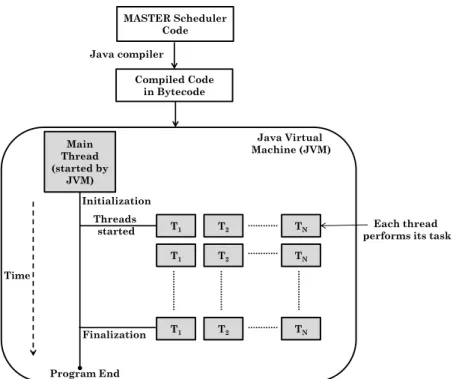
MASTER scheduler is designed using Java. The multi-threading built into the Java language and runtime platform provides support for running multiple concurrent threads. Compared to languages such as C and C++, the benefit of using Java is that it includes multithreading primitives as part of the language itself and as part of its libraries. Thus, a portable implementation of multithreading can be easily achieved. In contrast, languages such as C do not have built-in multithreading capabilities and hence, to implement multithreading, they must make calls to operating system mul-tithreading primitives, which harms efficiency and portability. The work-flow of MASTER is explained in Figure 1. The MASTER code is compiled into platform-independent
byte-code, which runs on the Java virtual machine (JVM). The JVM runs as a single process which internally spawns many threads. When the MASTER code running inside the JVM asks for another thread, JVM starts another thread which can run on a different CPU core. In this manner, multithreading is achieved on a multicore processor. In hardware, the management of threads is done by the operating system (OS), and the JVM uses the facility provided by the OS. More implementation details are provided in Section IV.
GPUs and MPI are other widely-used parallelization plat-forms. However, the limitation of GPUs is that they do not share memory with CPUs and are generally slower than CPUs in executing serial tasks. Hence, a significant fraction of execution time is spent in transferring data from GPU to CPU and vice-versa. Similarly, use of MPI requires reserving the nodes which leads to delays and resource wastage. Also inter-process communication used in MPI is expected to be slower than the inter-thread communication used in multithreading. Further, a common limitation of these platforms is that modern ISOs have simulators with thousands of lines of legacy code and porting them to these platforms will incur significant economic and time overhead. In contrast, MASTER scheduler runs separate to the main application program and provides ability to parallelize. Moreover, MASTER uses multithreading with Java and hence, it can be easily implemented on the commonly available multicore processors.
For contingency analysis, MASTER performs time domain simulation using a high-speed cross-platform power system simulator [17, 18]. The simulator uses efficient numerical algorithms (linear, non-linear and integration solvers) to solve the DAEs (differential and algebraic equations) appearing in power-system modeling [19]. The simulator provides different models of power system components such as governors, ex-citers and generators. The overall contingency analysis steps are explained in Figure 2.
From an architectural perspective, the simulator operates in two modes, namely anticipatory mode and emergency mode. The simulator analyzes most of the critical disturbances in anticipatory mode and storing the results for future use. This helps in providing the power system operator the ability to take timely corrective response at the crucial time after the fault. It provides a cross-platform simulation framework, and has been developed using object-oriented programming (OOP) approach, which facilitates easy development and extension of simulator features.
IV. WORK-STEALINGBASEDSCHEDULING
For achieving load-balancing on available threads, MAS-TER uses work-stealing algorithm. It has been shown in [14], that using work-stealing, the time taken in executing a fully-strict computation2 with P workers is given by:
2Fully-strict computation is one where the data dependencies of a thread
go to its parent only and not to any other thread. Since contingencies are independent and thus, there are no data dependencies. Hence, the theoretical guarantee provided in [14] holds for our experiments also.
MASTER Scheduler Code Compiled Code in Bytecode Java compiler Main Thread (started by JVM) Java Virtual Machine (JVM) T1 T2 TN T1 T2 TN T1 T2 TN Threads started Time Program End Initialization Finalization Each thread performs its task
Fig. 1: Implementation of multithreading in MASTER using Java
Initialization
1. System Model 2. Dynamic and steady state data
Initial state Final state Input DAE Kernel 1. Integrator 2. Nonlinear Solver 3. Linear Solver 1. Stability Analysis 2. Failure Detection Output Time domain Simulation
Fig. 2: Single Contingency Analysis
T = T1/P + O(T∞) (1)
Here T1 denotes the serial execution time and T∞ denotes
the estimated execution time with infinite number of workers. Also, the storage space required scales only linearly with the number of processors [14]. Thus, work-stealing algorithm is efficient in terms of time and space requirement. Work-stealing has been shown to impose low overheads and has good scalability [20–23] and hence, it has been used in several
parallel programming models.
However, due to practical considerations, several algorith-mic factors influence the efficiency of work-stealing imple-mentation [24, 25]. In the following, we discuss them in more detail and also mention the actual choices made in MASTER.
A. Choice of Algorithmic Options
1. Task dependency and ordering: In the applica-tion domains where tasks have interdependence or ordering-constraints (e.g. [26]), scheduling algorithm needs to fulfill these constraints for correctness. In our work, each task represents analysis of a single contingency and hence, tasks are mutually-independent, and maintaining ordering is not required. Further, the policy used for enqueuing tasks in the task-queues also becomes unimportant and hence we safely ignore this factor in the design of MASTER.
2. Organization and management of task-queues: The choice of data-structure used for storing task-queues affects the efficiency of task enqueuing and dequeuing. A na¨ıve approach is to keep a single-ended queue where both owner and thief dequeue from the same end. However, this is likely to lead to contention. Another choice is to keep double-ended queue, where the owner dequeues from one end and the thief dequeues from another [27]. A variant of this is partitioning the per-thread task queue into a private and a public region [26]. The thief only accesses the public region of the queue, while the private region is accessed by the owner thread only. This alleviates the need of providing locks in the private region of the queue. However, this also requires separate management of the private and public region and suitably transferring the task from one region to another, when an imbalance is created. In general, double-ended queues (known as deque) are expected
to be simpler than the queue with private-public region. For this reason, we have used double-ended queues in MASTER. 3. Victim selection: The choice of a victim-selection strat-egy (also called polling stratstrat-egy) impacts the communication overhead incurred in each stealing action. Further, when tasks have ordering-constraints, completing the tasks in a desired order may greatly reduce the overall completion time. Some commonly used victim selection policies are:
1) Fixed: The victim is selected in fixed order (e.g. 1, 2, 3, . . . etc.).
2) Random: Any of the available workers is selected ran-domly as the victim [28].
3) Local: The thief tries to steal from the nearest-neighbor or one of the close neighbors. Guo et al. [29] provision stealing within a pre-defined locality domain. Min et al. [26] propose a “hardware topology-aware hierarchical victim selection” strategy where a victim is selected in hierarchical manner, i.e., victim processor is first searched in the same socket [30] and only if no victim is found, the algorithm searches for victims in other sockets or nodes [30, 31].
4) Circular: The victim is selected in circular manner, i.e., a thief i searches in the order i+1, i+2, . . . , N, 1, . . . , i−1. Of these, MASTER uses circular polling since unlike fixed polling, it does not cause contention on initial threads, viz. 1, 2,3 etc. Further, unlike random polling, it does not require generating random numbers and is likely to spread the stealing requests more uniformly to the available threads, thus reduc-ing contention. Also, since the tasks do not have orderreduc-ing constraints and threads share memory, choosing victim in topology-aware manner is not required.
4. Task-stealing granularity: Task-stealing granularity refers to the number of tasks which are allowed to be stolen in each stealing request. While some implementations pro-vision stealing a fixed number of tasks [29, 32, 33], other implementations allow stealing a variable number of tasks in each stealing action [26, 27, 34], which can be as large as half the number of tasks available on the victim process (termed as “steal-half”). For sake of simplicity, in this paper, we provision stealing only one task at a time. This enables fine-grain load balancing and also keeps the quantum of work stolen small. For higher number of threads, steal-half policy may provide better load-balancing [27]. Exploration of this policy is planned as part of future work with larger number of threads.
5. Proactive task-pushing: A variant of work-stealing al-gorithm provisions actively giving tasks to the starving threads, when the amount of local tasks exceeds a given threshold so that the idle-wait time of the starving threads is reduced [35, 36]. The disadvantage of task-pushing, however, is that it increases communication overhead and causes congestion in the worst case. For this reason, MASTER does not employ proactive task-pushing.
B. Algorithm Pseudo-code
Algorithm 1 depicts the pseudo-code for MASTER schedul-ing algorithm. For sake of simplicity, in this paper, we assume that all the tasks have already arrived, although MASTER works equally well for the case when tasks arrive dynamically. Algorithm 1 MASTER work-stealing algorithm
Input: task-list T
Output: Best effort allocation of tasks to threads isFinished[1:N ]=false, allQueuesEmpty =false CODE FOR MAIN THREAD
Spawn N threads, let H be the list of threads. Allocate task-queues for each thread hi in H.
Assign tasks in T to task-queues of different threads. Start all threads
whiletrue do
Set value of allQueuesEmpty based on status of task-queues of all threads
ifallQueuesEmpty is true then break;
else
sleep 1 second end if
end while
Wait till isFinished[i] is true for all 1≤ i ≤ N Algorithm Terminated. Return
CODE FOR EACH WORKER THREAD i whileallQueuesEmpty is false do
dequeue a task tj from task-queue of i
if tj is NONE then
Choose a victim k
Steal task(s) from from k and enqueue in the task-queue of i
else
Finish the task tj
end if
ifstealing request arrives from q then ifan unstarted task tr is remaining then
return tr to q else return NULL to q end if end if end while isFinished[i]=true
At the time of initialization, MASTER creates a number of threads using the Thread class. All the threads carry the same priority. Each object of the Thread class, encapsulates the data and functions (methods) associated with separate threads of execution. Each of these threads has task queues to which it enqueues the newly created tasks and from which it dequeues the tasks for execution. Since the contingencies can be analyzed independently, the tasks can be executed in any order. Each task is run using exec() command, which
executes a given command in a separate process. Through this command, the MASTER scheduler interfaces with the power system simulator for consistency analysis. This command returns a Process object, which is used by the scheduler for managing the process created, which includes waiting for the process to finish and handling errors (if any) occurred in the process execution.
The task queues are implemented as deques (i.e. double ended queues, which support element insertion and removal at both ends). The worker executes the task from the front side and stealing requests are responded to from the rear side. For this, Java’s BlockingDeque class is used.
A main thread handles initial task distribution and peri-odically checks whether all the task-queues are empty. For implementation of periodic wait, the sleep() method is used which causes a thread to enter the not runnable state until the specified time has expired. Use of sleep() provides an efficient means of making processor resources available to the other threads. Either for polling or stealing, a worker thread needs exclusive and consistent access to the task-queues of the victim thread, while the victim thread itself needs to dequeue the task for execution. To ensure consistency, MASTER uses the built-in mechanism of Java to provide synchronization. The thread which first accesses the deque gets the lock on it and meanwhile, no other thread can acquire the lock.
To avoid the overhead of creating threads for every task and destroying them at the completion of the task, MASTER uses thread pools. The tasks are passed to the thread pool and when a thread becomes idle, the task is assigned to that thread. If no new task arrives, the idle threads wait for a new task. By reusing threads for multiple tasks, the overhead of creation is amortized over many tasks. Further, use of thread-pool enables limiting the number of running threads which helps in avoiding resource thrashing caused by excessive number of threads.
In a multithreaded scheduling algorithm, termination detec-tion requires reading the status of task-queues of all threads. In work-stealing, detecting termination is even more challenging, since threads can steal tasks from other threads, and hence, finishing of the task-queues of a thread does not necessarily imply algorithm termination. To detect termination, MASTER works as follows. The main thread periodically reads the status of all task-queues and when all of queues are empty, it sets
allQueuesEmpty to true. When this is true, all threads stop
trying to steal more tasks. Each thread i, which has finished its tasks, sets isFinished[i] to true. Meanwhile, the main thread periodically checks whether all the threads have finished and when that is true, the algorithm is terminated.
C. Features and Efficiency
From Amdahl’s law [37], the speedup obtained from par-allelizing a program is limited by the fraction of time spent in the sequential part. For this reason, use of a single (global) locked queue might present a scalability bottleneck since the accesses to the global queue are required to be serialized. Since the MASTER scheduler uses work-stealing with distributed
queues, it automatically avoids the need of a global task-queue. Further, since the tasks are allocated from the local task-queue, the latency of access is reduced.
In power systems, contingencies can be analyzed indepen-dent of each other and maintaining an ordering between them is not required. MASTER leverages this fact to further speedup its work-stealing implementation, since regardless of whether other tasks have been completed, MASTER can schedule a task to the first free thread. Also, maintaining a table of completed tasks and reading from it to ensure task-ordering is also avoided, which leads to more optimized implementation. MASTER leverages several features of Java, such as easy memory management, platform-independence and portability. Thus, MASTER can be used on a wide variety of platforms. MASTER has been designed to be thread-safe and thus, the access to shared data (e.g. task-queues) does not cause conflict or race conditions. Also, due to the object-oriented design features of Java, MASTER scheduler can be easily extended.
D. Limitations and Possible Extensions
Multithreading introduces the overhead of thread-switching. When the processor switches from executing one thread to another, the context (e.g. local data and program pointer) of the current thread needs to be saved and the context of next thread needs to be loaded. With increasing number of worker threads, the contention for the shared resources also increases. A possible improvement in load balancing can be done by provisioning stealing of the tasks from the thread with the largest number of remaining tasks. The overhead in this approach is the need of finding lengths of task-queues of all tasks and comparing them to find the largest sized queue. This extension is planned as a part of our future work.
In case different contingencies have different priorities (e.g., due to their severity or probability of occurrence), MASTER can be easily extended to set thread priorities and assigning tasks with high priorities to the workers (threads) with high priorities. Also, by allocating tasks such that the tasks with higher priorities are executed before those with lower priori-ties, task-priorities can be handled.
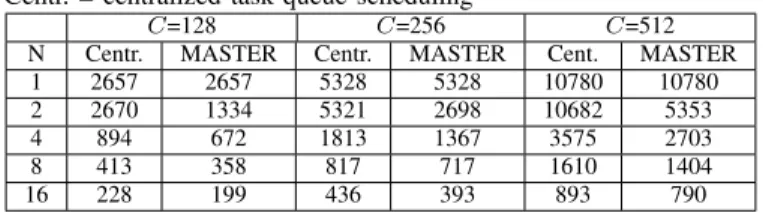
TABLE I: Simulation time (seconds). N=1 refers to serial execution, Centr. = centralized task-queue scheduling
C=128 C=256 C=512
N Centr. MASTER Centr. MASTER Cent. MASTER
1 2657 2657 5328 5328 10780 10780 2 2670 1334 5321 2698 10682 5353 4 894 672 1813 1367 3575 2703 8 413 358 817 717 1610 1404 16 228 199 436 393 893 790 V. RESULTS
Experimental Platform: We simulate a large power system with 13029 buses, 431 generators, 12488 branches and 5950 loads. We show wall-clock time, since it is a metric of rele-vance to end-user. We simulate 128, 256 and 512 contingencies using 2, 4, 8 and 16 threads and compare the results with serial execution. Each contingency models fault occurrence
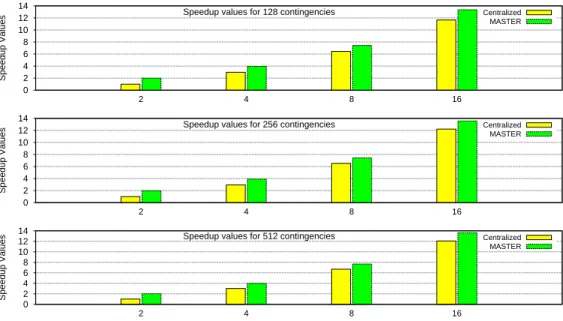
0 2 4 6 8 10 12 14 2 4 8 16 Speedup Values
Speedup values for 128 contingencies Centralized MASTER 0 2 4 6 8 10 12 14 2 4 8 16 Speedup Values
Speedup values for 256 contingencies Centralized MASTER 0 2 4 6 8 10 12 14 2 4 8 16 Speedup Values Number of Threads
Speedup values for 512 contingencies Centralized MASTER
Fig. 3: Speedup Results with MASTER and conventional scheduling techniques for different number of worker threads and contingencies
and clearing in single or multiple system components such as bus and branch. We run the simulations on a multicore processor and different threads run on different cores.
Performance Results: We compare the work-stealing im-plementation to centralized task-queue scheduling where the main thread holds the queue of ready tasks and all worker threads request task from it on finishing their tasks.
Table I summarizes the time taken in simulation of differ-ent contingencies with differdiffer-ent number of threads. Here C denotes the number of tasks (contingencies) and N denotes the number of threads. For C contingencies, let T (C, N ) denote the time taken with N threads and T (C, 1) be the time taken using serial execution. To gain insights into the working of different scheduling methods, we define speedup values S(C, N ), for any scheduling method as follows.
S(C, N ) = T (C, 1)
T (C, N ) (2)
Figure 3 shows these speedup values for different methods. Clearly, MASTER provides highest computational gains and outperforms the conventional techniques. A crucial limitation of centralized task-queue scheduling is that one thread (main thread) becomes busy with the task of allocating the works and performs no useful work.
With higher number of threads, contention increases and resultant synchronization serializes the execution. For this reason, the speedup does not scale linearly with the number of threads. Still, MASTER achieves high computation gains (of the order of 13.5× speedup with 16-threads) and much better load balancing than conventional scheduling techniques.
VI. CONCLUSION
In this paper, we presented MASTER, a multithreaded work-stealing technique for efficient parallelization and load-balancing of contingency analysis task in power systems.
We discussed several design-time choices made for efficient implementation. The experiments show that MASTER offers large computation gains.
REFERENCES
[1] S. K. Khaitan and J. D. McCalley, “Dynamic load balancing and scheduling for parallel power system dynamic contingency analysis,” in High Performance Computing in Power and Energy Systems, 2013, pp. 189–209.
[2] J. Riquelme Santos, A. Gomez Exposito, and J. Martinez Ramos, “Dis-tributed contingency analysis: practical issues,” IEEE TPWRS, vol. 14, no. 4, pp. 1349–1354, 1999.
[3] Q. Morante, N. Ranaldo, A. Vaccaro, and E. Zimeo, “Pervasive grid for large-scale power systems contingency analysis,” IEEE Trans. Ind.
Informat., pp. 165–175, 2006.
[4] A. Mittal, J. Hazra, N. Jain, V. Goyal, D. Seetharam, and Y. Sabharwal, “Real time contingency analysis for power grids,” Euro-Par 2011
Parallel Processing, pp. 303–315, 2011.
[5] K. Zhou, Q. Hou, Z. Ren, M. Gong, X. Sun, and B. Guo, “Renderants: interactive reyes rendering on GPUs,” ACM Transactions on Graphics
(TOG), vol. 28, no. 5, p. 155, 2009.
[6] R. Van Nieuwpoort, T. Kielmann, and H. Bal, “Efficient load balanc-ing for wide-area divide-and-conquer applications,” in ACM SIGPLAN
Notices, 2001, pp. 34–43.
[7] B. Saha, A. Adl-Tabatabai, A. Ghuloum, M. Rajagopalan, R. Hudson, L. Petersen, V. Menon, B. Murphy, T. Shpeisman, E. Sprangle et al., “Enabling scalability and performance in a large scale cmp environ-ment,” ACM SIGOPS OSR, vol. 41, no. 3, pp. 73–86, 2007.
[8] Z. Vrba, P. Halvorsen, and C. Griwodz, “Evaluating the run-time performance of kahn process network implementation techniques on shared-memory multiprocessors,” CISIS, pp. 639–644, 2009.
[9] M. P. Raju and S. K. Khaitan, “Domain decomposition based high performance parallel computing,” International Journal of Computer
Science Issues, vol. 5, 2009.
[10] M. Raju and S. Khaitan, “High performance computing using out-of-core sparse direct solvers,” International Journal of Mathematical, Physical
and Engineering Sciences, vol. 3, no. 2, pp. 377–383, 2009.
[11] S. K. Khaitan, “A Survey Of High-performance Computing Approaches in Power Systems,” in IEEE Power and Energy Society General Meeting
(PES), 2016, pp. 1–5.
[12] S. K. Khaitan and J. D. McCalley, “Dynamic load balancing and scheduling for parallel power system dynamic contingency analysis,” in
High Performance Computing in Power and Energy Systems, ser. Power
[13] S. K. Khaitan and J. D. McCalley, “A High-Performance Parallelization and Load-Balancing Approach for Modern Power-Systems,”
Interna-tional Journal of Business Analytics (IJBAN), vol. 2, no. 2, pp. 62–74,
2015.
[14] R. Blumofe and C. Leiserson, “Scheduling multithreaded computations by work stealing,” Symp. on Foundations of Computer Science, 1994. [15] S. K. Khaitan, “On-line cascading event tracking and avoidance decision
support tool,” Ph.D. dissertation, Iowa State University, 2008. [16] J. McCalley, K. Zhu, and Q. Chen, “Dynamic decision-event trees for
rapid response to unfolding events in bulk transmission systems,” GM, 2001.
[17] S. K. Khaitan and J. D. McCalley, “High performance computing for power system dynamic simulation,” in POWSYS, 2012, pp. 43–69. [18] S. K. Khaitan and J. D. McCalley, “TDPSS: a scalable time domain
power system simulator for dynamic security assessment,” in High
Performance Computing, Networking, Storage and Analysis (SCC), 2012 SC Companion:. IEEE, 2012, pp. 323–332.
[19] S. Khaitan, J. McCalley, and M. Raju, “Numerical methods for on-line power system load flow analysis,” Energy Systems, vol. 1, no. 3, pp. 273–289, 2010.
[20] S. K. Khaitan and J. D. McCalley, “Achieving load-balancing in power system parallel contingency analysis using X10 programming language,” in Proceedings of the third ACM SIGPLAN X10 Workshop, 2013, pp. 20–28.
[21] S. K. Khaitan and J. McCalley, “PARAGON: An Approach for Par-allelization of Power System Contingency Analysis Using Go Pro-gramming Language,” International Transactions on Electrical Energy
Systems, 2014.
[22] R. Hoffmann, M. Korch, and T. Rauber, “Performance evaluation of task pools based on hardware synchronization,” in Proceedings of the 2004
ACM/IEEE conference on Supercomputing, 2004, p. 44.
[23] S. K. Khaitan and J. D. McCalley, “Parallelizing power system contin-gency analysis using D programming language,” in IEEE Power and
Energy Society General Meeting (PES), 2013, pp. 1–5.
[24] S. K. Khaitan and J. D. McCalley, “EmPower: An efficient load balancing approach for massive dynamic contingency analysis in power systems,” in High Performance Computing, Networking, Storage and
Analysis (SCC), 2012 SC Companion:. IEEE, 2012, pp. 289–298. [25] S. K. Khaitan and J. D. McCalley, “SCALE: A hybrid MPI and
multithreading based work stealing approach for massive contingency analysis in power systems,” Electric Power Systems Research, vol. 114, pp. 118–125, 2014.
[26] S. Min, C. Iancu, and K. Yelick, “Hierarchical work stealing on manycore clusters,” PGAS11, 2011.
[27] J. Dinan, D. Larkins, P. Sadayappan, S. Krishnamoorthy, and J. Nieplocha, “Scalable work stealing,” SC, p. 53, 2009.
[28] M. Fluet, M. Rainey, and J. Reppy, “A scheduling framework for general-purpose parallel languages,” ACM Sigplan Notices, vol. 43, no. 9, pp. 241–252, 2008.
[29] Y. Guo, R. Barik, R. Raman, and V. Sarkar, “Work-first and help-first scheduling policies for async-finish task parallelism,” in IPDPS, 2009, pp. 1–12.
[30] H. Matsuba and Y. Ishikawa, “Single IP address cluster for internet servers,” in IPDPS, 2007, pp. 1–10.
[31] R. Rabenseifner, G. Hager, and G. Jost, “Hybrid MPI/OpenMP parallel programming on clusters of multi-core SMP nodes,” in PDP, 2009, pp. 427–436.
[32] M. Frigo, C. Leiserson, and K. Randall, “The implementation of the Cilk-5 multithreaded language,” ACM Sigplan Notices, vol. 33, no. 5, pp. 212–223, 1998.
[33] A. Narang, A. Srivastava, R. Jain, and R. Shyamasundar, “Dynamic distributed scheduling algorithm for state space search,” Euro-Par 2012
Parallel Processing, pp. 141–154, 2012.
[34] G. Cong, S. Kodali, S. Krishnamoorthy, D. Lea, V. Saraswat, and T. Wen, “Solving large, irregular graph problems using adaptive work-stealing,” in ICPP, 2008, pp. 536–545.
[35] M. Wu and X. Li, “Task-pushing: a scalable parallel GC marking algorithm without synchronization operations,” IPDPS, pp. 1–10, 2007. [36] S. K. Khaitan, J. D. McCalley, and A. Somani, “Proactive task schedul-ing and stealschedul-ing in master-slave based load balancschedul-ing for parallel contingency analysis,” Electric Power Systems Research, vol. 103, pp. 9–15, 2013.
[37] G. Amdahl, “Validity of the single processor approach to achieving large scale computing capabilities,” in Spring joint computer conference, 1967.