HAL Id: insu-01764033
https://hal-insu.archives-ouvertes.fr/insu-01764033
Preprint submitted on 11 Apr 2018HAL is a multi-disciplinary open access
archive for the deposit and dissemination of sci-entific research documents, whether they are pub-lished or not. The documents may come from teaching and research institutions in France or abroad, or from public or private research centers.
L’archive ouverte pluridisciplinaire HAL, est destinée au dépôt et à la diffusion de documents scientifiques de niveau recherche, publiés ou non, émanant des établissements d’enseignement et de recherche français ou étrangers, des laboratoires publics ou privés.
ADVANCE DEMAND INFORMATION IN
PRODUCTION/INVENTORY SYSTEMS
Nadia Boudrika
To cite this version:
Nadia Boudrika. ADVANCE DEMAND INFORMATION IN PRODUCTION/INVENTORY SYS-TEMS. 2018. �insu-01764033�
ÉCOLE CENTRALE PARIS, MASTER RECHERCHE CONFERENCE, ECPMR’15
MARCH 2015, PARIS, FRANCE
ADVANCE DEMAND INFORMATION IN
PRODUCTION/INVENTORY SYSTEMS
Nadia BOUDRIKA11Ecole Centrale Paris
ABSTRACT
This paper is a research review, which discusses the impact of using advance demand information on the performance of production/inventory and inventory systems. The aim of this study is to evaluate the benefits of demand information sharing, to identify the current research gaps and to study the future trend in this field. Different types of advance demand information and their potential benefits in production and inventory systems are reviewed. We consider a context where the customers (final clients, assembly lines….) share demand orders in advance of their due dates. We called this type of information, advance demand information (ADI). ADI models can be divided on two classes: Perfect and Imperfect ADI. Imperfect ADI, the supplier has reliable information about the customer demand, so the placed orders cannot be revised. In imperfect ADI, the information is uncertain and can change in any moment. In this study, we focus on the case of perfect advance information and more specifically on the amount of certain advance demand.
Keywords: Advance demand information, Production system, Inventory system 1 INTRODUCTION
It is common practice in supply chain to share information between the actors in order to better manage the production and inventory systems. Sharing advance demand information helps companies to make better decisions in their operation that leads to better estimation of future needs, lower inventory levels and cost reduction. Moreover, it allows companies to be more responsive to customer demand.
Furthermore, developments in supply chain concepts and information technology have improved the flow of information between companies. Today, the information circulates between supply chain partners in more efficient manner. According to the literature, there exist essentially five types of information shared: sales, inventory, order status, production schedule and demand forecast. The information sharing has affected the supply chain management by integrating information in existing production and inventory control policies which leads to new approaches.
The objective of this study is to assess the value of using advance demand information considering various assumptions about the cost of obtaining information in advance and delivery timing requirements. The second part presents the industrial and scientific context of study and gives definitions of basic concepts and issues of the project. In the third part, we propose a conceptual framework and present state of the art works that deal with the perfect and imperfect information.
2 BASIC CONCEPTS AND INDUSTRIAL CONTEXT
In this part, we present the general context of this research by defining some basic concepts relating to the nature of the industrial systems studied and types of information shared. We will then present the industrial context of this study, placing us in the more specific context of Faurecia case.
2.1 Basic concepts: Production and inventory systems
The distinction between production and inventory systems is classic. Production systems are based on production to order which implies the existence of an actual request from a client, prior to any in production. While inventory systems are based on production for stock that is usually based on a projected demand, with all that this implies of uncertainty about the quantities requested and the specific times when the delivery will occur.
2.1.1 Production system
This system is also called manufacturing system on order where production takes place when the final demand is known. This form of production has three advantages: it gives satisfaction to customer demand (the company respond to a specific need), it does not require constitution of excessive stock; it makes sure the sale of the manufactured product. Two notable disadvantages should nevertheless be noticed: the production often requires long production and delivery time, the degree of production capacity utilization changes according to demand flow.
Indeed, in order to avoid excessive inventory and even get to an empty stock situation, a different mode of production management has been developed. It’s a management with tight where the manufacture of a component or product is never anticipated and planned. It is triggered by a request from the center using the component or the customer who wants the product (Abdelakim, 2008). This mode of management led to the JIT. JIT means: producing just the time of ordering and producing just the quantity demanded. The classic stock management policies and policies based on the Kanban system leads to achieve JIT.
2.1.2 Inventory system
This system is also called manufacturing system for stocks where production takes place before knowing the final effective demand and is triggered by anticipation of demand. The advantages of this form of production are numerous: the expensive equipment profitability becomes easier; the immediate availability of the products to the customer's request, the potential distribution of production requested on time.
Flow control policies for inventory systems exploit future demand and thus surround the MRP policy and the management of stocks based on forecasts.
2.2 Industrial context
From a more practical point of view, in order to control the flow in the supply chain it is important to know at every step in the chain (from suppliers to end customer) and for each entity (raw material, component or product finish) when it is necessary to launch an activity (procurement, fabrication, assembly, transport or deployment), and in what quantity.
In this project we will take as a case of study the Faurecia Group, one of the world's leading automotive suppliers. Through its four key businesses such as seats, interior systems, outdoor and exhaust systems, Faurecia supplies numerous vehicles worldwide for most automakers. These activities involve coordination of the different flows within the production systems and sharing of information between different parts of the supply chain and this on the aim to guarantee a certain level of customer service while minimizing costs.
2.2.1 Faurecia case study
The flow management decisions for Faurecia consider several information that we can classify into three types:
• Information on system status and machines • Information on stock level S
• Information on the client's request
If the first two types are internal to the system and can be obtained in various ways, information on customer’s demand is a difficult parameter to identify because it depend on the customer, this parameter has a great influence on the mode of managing supply chain.
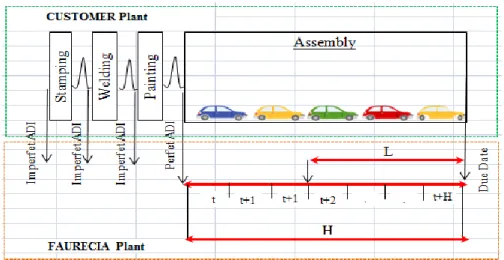
The following Figure shows the main steps by which a car in the customer's manufacturing plant Faurecia passes and the nature of shared information.
Figure 1. Key steps by which a car in the client's manufacturing plant Faurecia passes and nature of information shared
Information shared before stamping, welding and painting are imperfect, it means that the Faurecia customer can order a variable amount of equipment and for a variable duration in time. Whereas when the car is about to enter to the assembly line shared information becomes perfect, it means that the customer orders a fixed amount of equipment for a fixed period of time.
The major challenge for Faurecia is to know the optimal date L on which it has to launch production and the optimum level S of stock desired.
2.2.2 Advance demand information and inventory management
Demand is generally considered as exogenous system processes of production and storage systems, which means that the system does not affect the customer orders. However, in the case of successive stock ruptures that generate non-satisfaction of customer demand, the company may lose customers, the demand can be influenced by the state of the system. The company is therefore obliged to anticipate the needs of its customers and to have the exact advance information to better manage its production and storage systems. (Abdelakim, 2008).
Information on customer needs remains uncertain to the company and its uncertainty decreases with visibility. We can classify demand information into three types (Babai, 2005) as shown in Figure 2, we distinguish then: Firm orders, forecasts and no information in advance on demand.
For procurement, uncertainty generates additional costs related to the existence of safety stocks, stock-outs or temporary mobilization of resources. Thus the relationship between companies and their suppliers have gradually been transformed into partnership agreements to limit the uncertainty on demand and thus reduce costs. This mutation leads companies to change their inventory management policy. Therefore, they move from a classic stock management policy where there's launch of production as the level of stock declines, to a new stock management policy that is based on sharing information and therefore release production according to the previously known demand.
3 STATE OF THE ART AND CONTRIBUTION
In this part we present a classification of work done on demand information sharing in supply chains. There are many articles that examine the value of advance demand information and its interaction with inventory, using analytical models.
3.1 Works Classification
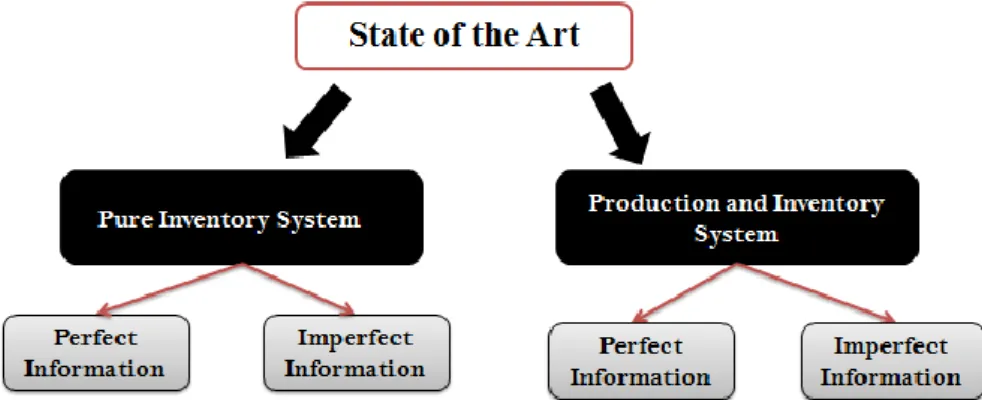
A possible classification of this research can be based on the reliability of the information shared which may be either perfect or imperfect. This classification can also be based on how the underlying power system is modelled. We may face either a supply system with exogenous delivery (pure inventory system), which means the system with unlimited capacity or a supply system with endogenous delivery (production and inventory systems), which means systems with limited capacity. We consider in the present work the following classification presented in Figure 3.
Figure 3. Classification of perfect and Imperfect demand information according to the nature of the supply system
3.1.1 Pure Inventory System
For supply systems with exogenous delivery time, (Hariharan and Zipkin, 1995) model Advance demand information through orders placed in advance and presents a detailed study on the benefits of advance information in continuous time. (De-Croix and Mookerjee, 1997) analyze a periodic system where the provider has the option to purchase information on demand in advance. They characterize
the optimal information acquisition policy and the dynamic value of information purchase in the request. (Gallego and Özer, 2003) show how to integrate optimally the advance demand information in periodic review, for multi-echelon inventory systems. Finally (Karaesmen et al., 2004) estimated the value of using perfect information of advance request by considering various assumptions on the cost of obtaining information, and delivery timing requirements.
3.1.2 Inventory and production systems
For supply systems with endogenous delivery delays, on the one hand (Buzacott and Shanthikumar 1994) present a detailed analysis of a make-to-stock production queue in one step with advance information in the form of firm orders placed in advance of their due date. They then study how the optimal safety stock varies with the time parameter.
On the other hand (Karaesmen et al., 2002) studied the structure of the optimal completion date synchronized with the control and inventory decisions in a make-to- stock queue. While (Liberopoulos and Koukoumialos 2005) made a numerical study of the compromise between the near-optimal base-stock levels, the number of kanban, and planned lead times. (Tan et al., 2009) develop a model that incorporates the imperfect advance demand information with the recovery of the stock orders, decisions and rationing of available stocks, and thus provide an overview of management on the use of advance information.
3.2 Models considered
We consider a system composed of a stock of raw materials of a production unit and a finished product inventory as shown in the following Figure:
Figure 4. Diagram of the production unit
Consider that there are S finished products in stock and that customer demands can happen either periodically or continuously. Each client set the desired amount and the date on which it wishes to receive his order.
In the case where the company receives orders from customers in advance, it may have three options: - Start production whenever a customer arrives and sets its order, in this case there will be plenty of stock due to the accumulation of finished products.
- Start production when the client receives the order it means when the finished goods inventory decreases, in this case it is as if the company has no information on the demand in advance.
- Start production in an intermediate point between the customer's arrival and the due date of their order, it means, start production L time units before the due date. We refer to L by release lead time. The following table summarizes this:
Table 1. Replenishment order according to the different inventory management policies
Policy Assumptions When to produce? How to produce?
Nominal base stock policy
No information in advance
When a request arrives, a replenishment order is triggered Order of replenishment = Customer Demand Modified base-stock policy: (S,L) policy
With the information in advance (visibility Horizon H)
With L units of time before the due date of the customer's order
Order of replenishment = Customer Demand
4 CONCLUSION AND PERSPECTIVES
The evolution of the concepts of supply chain and information technology has improved the flow of information between companies and customers. Therefore when the information is used effectively it allows better management of production and stocks. The purpose of this study was to evaluate the benefits of demand information sharing on the system by considering various assumptions about the cost of obtaining information and delivery timing requirements. The models considered can be divided into two classes: perfect and imperfect.
Through a presentation of the general framework of the study, the industrial context and the state of art that we could resume from different readings of articles and work done, we could then classify the different models depending on the nature of the system and the variability in the time.
The next work will aim to compare the model in which there is no demand information, which is a model of queue of production in pure make-to-stock to the model in which demand information is available in advance.
REFERENCES