Publisher’s version / Version de l'éditeur:
Vous avez des questions? Nous pouvons vous aider. Pour communiquer directement avec un auteur, consultez la première page de la revue dans laquelle son article a été publié afin de trouver ses coordonnées. Si vous n’arrivez pas à les repérer, communiquez avec nous à [email protected].
Questions? Contact the NRC Publications Archive team at
[email protected]. If you wish to email the authors directly, please see the first page of the publication for their contact information.
https://publications-cnrc.canada.ca/fra/droits
L’accès à ce site Web et l’utilisation de son contenu sont assujettis aux conditions présentées dans le site LISEZ CES CONDITIONS ATTENTIVEMENT AVANT D’UTILISER CE SITE WEB.
Paper (National Research Council of Canada. Division of Building Research); no.
DBR-P-1262, 1984-12-01
READ THESE TERMS AND CONDITIONS CAREFULLY BEFORE USING THIS WEBSITE. https://nrc-publications.canada.ca/eng/copyright
NRC Publications Archive Record / Notice des Archives des publications du CNRC :
https://nrc-publications.canada.ca/eng/view/object/?id=63895cb5-0918-44f2-8c49-c9a534150d1c https://publications-cnrc.canada.ca/fra/voir/objet/?id=63895cb5-0918-44f2-8c49-c9a534150d1c
NRC Publications Archive
Archives des publications du CNRC
This publication could be one of several versions: author’s original, accepted manuscript or the publisher’s version. / La version de cette publication peut être l’une des suivantes : la version prépublication de l’auteur, la version acceptée du manuscrit ou la version de l’éditeur.
For the publisher’s version, please access the DOI link below./ Pour consulter la version de l’éditeur, utilisez le lien DOI ci-dessous.
https://doi.org/10.4224/40001728
Access and use of this website and the material on it are subject to the Terms and Conditions set forth at
Radiative ignition of thermoplastic and char-forming materials
Clark, F. R. S.
Ser
THl
N21d
National Research
Conseil national
" O 0 1262
1
$
Council Canada
de recherches Canada
c. 2
RADIATIVE IGNITION OF THERMOPLASTIC AND CHAR-FORMING MATERIALS
by F.R.S. Clark
ANALYZED
Reprinted from Fire and Materials Vol. 8, No. 4, 1984 p. 196
-
198DBR Paper No. 1262
Division of Building Research
Des petits gchantillons de polymGthym6thacrylate, de chene
rouge et possiblement de poly6thylSne basse densitl soumis 2 la
chaleur rayonnante s'enflamment
2une vitesse qui augmente avec
la surface irradi'ee.
Ce ph6nomZne est conforme au principe
voulant que la limite infgrieure d'inflammabilitg des
gazde
pyrolyse soit atteinte pour que l'inflammation se produise.
En
l'absence d'un flux gnerggtique externe, le temps requis pour
l'auto-extinction des petits Echantillons de matgriaux se
carbonisant (poly6thylSne basse densitG, chGne rouge et
possiblement polycarbonate) augmente avec la surface enflammge.
Ce ph6nomSne laisse croire que l'absorptivitl plus grande du
produit de carbonisation augmente l'importance du rayonnement
Radiative Ignition of Thermoplastic and Char-
forming Materials
Ferrers
R.
S. ClarkDivision of Building Research, National Research Council Canada, Montreal Road, Bldg M-59, Ottawa, Canada
K I A OR6
Small samples of poly(methy1 methacrylate), red oak and possibly low-density polyethylene ignite under the influence of thermal radiation with a propensity that increases with the area irradiated, consistent with ignition requiring that the lower hmmability limit of pyrolysis gases be reached. The time to self-extinction of small samples of ebaning, bnrning materials (low-density polyethylene, red oak and possibly polycarbo- nate) in the absence of external radiant flux increases with burning area, suggesting that the increased absorptivity of char increases the importance of radiative feedback.
INTRODUCTION -
When flaming combustion is induced on the upper, horizontal face of a solid, the combustion will continue only if the thermal feedback from the flame to the solid surface generates flammable pyrolysis gases at a sufficient rate.
Thermal feedback in these circumstances can occur by convection and by radiation. Although Spaldingl suggested that all available data could be explained by a convective mechanism, it has been demonstrated that convection is the dominant feedback mechanism only when the area of the burning surface is small. For example, in an experiment conducted by Modak and Croce2 with poly(methy1 methacrylate) (PMMA) burn- ing in a pool configuration, the convective feedback flux was only 0.64 W ~ m - ~ , weakly dependent on the surface area of the fuel and the duration of burning. The convective component of feedback had been pre- dicted to decrease slowly with increased pool size since larger pools have a larger mass transfer rate per unit area and thus more effectively block convective heat transfer. In addition, for laminar flow at a heated horizontal flat plate, the convective heat transfer coefficient is a weak inverse function of scale. How- ever, the burning rate in fact increased as the surface area of the fuel increased. For samples of area 2580 mm2 or larger, radiative transfer dominated the thermal f e e d b a ~ k . ~
Much of the data analyzed by Modak and Croce were for liquid fuel samples or for solids that melt before burning. Their work may not adequately de- scribe solids that do not melt, the burning of which are influenced to a much lesser degree than liquids by edge effects.
The area dependence of bottom surface combustion of small samples of poly(methy1 methacrylate) has been studied r e ~ e n t l y . ~ However, little research has been done on the ignition characteristics of the top surfaces of small samples, a quite common ignition
APPARATUS
The primary requirement for the apparatus was that samples be held horizontally, facing a radiant source mounted above them. A mounting procedure for sam- ples was designed to minimize edge effects. A circular, aluminum block, 126 mm in diameter and 27 mm thick, milled to have a circular depression in the upper face 102 mm in diameter and 13 mm deep, was filled with fine silica sand. The specimens to be tested were pressed into the sand until the top face of the sample was flush with the upper rim of the block. Residual sand granules were carefully brushed off the exposed surface of the sample.
A radiant scnrce, csmprised cf a Sat spia! helix of resistance wire, was supported on a ceramic form so that the radiating area was effectively a circular plate 75 mm in diameter. This source was mounted on a retort stand 80 mm above the sample; once the sample was ignited, the radiant source could be quickly swung away to terminate the exposure. The radiant output of the source was measured as a function of the seDara- tion from the exposed surface of the sample with a radiometer (Hy-Cal model R8015-C-15 with window removed) mounted at the sample position with its sensitive element centrally placed below the centre of the source. A value of 1.7 W cm-2 was obtained aver- aged over the 198 mm2 area of the sensor
MATERIALS
t
Samples of Rohm and Haas Plexiglas G (high molecu- lar weight poly(methy1 methacrylate)), low-density polyethylene, Rohm and Haas Tuffak (polycarbonate) and red oak were used for these experiments, in sizes reported in Table 1. All the synthetic materials were tested as received; the oak was kept at 60 "C for 24 h before storage in a desiccator until exposure.
scenario. This article-reports -the results of simple experiments designed to explore the ignition be-
t In order to adequately describe materials it has been necessary to polymers, some of identify products by the manufacturer's name. Such identification which form liquid pools on heating and some of which does not imply endorsement by the National Research Council
char when exposed to a radiant source. Canada.
RADIATTVE IGNITION OF THERMOPLASTIC MATERIALS
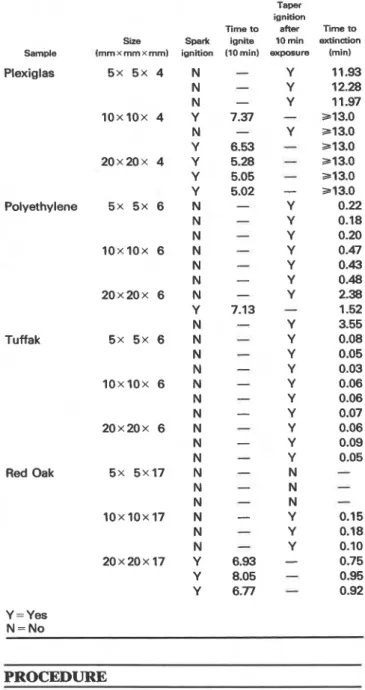
Table 1. Ignition and buming behavior of polymeric materi- als with initial irradiance of 1.7 W CHI-'
Taper ignition Time to after Time to Sue !Spark ignite 10 min extinction Sample (mmx mm x mm) ignition (10 min) exposure (min) Plexiglas 5 x 5 x 4 N N N 10X1OX 4 Y N Y 20X20X 4 Y Y Y Polyethylene 5 x 5 x 6 N N N 1 0 x 1 0 ~ 6 N N N 2 0 x 2 0 ~ 6 N Y N Tuffak 5 x 5 x 6 N N N 10xIOx 6 N N N 2 0 x 2 0 ~ 6 N N N Red Oak 5 x 5x17 N N N 10x10x17 N N N 20X20X17 Y Y Y PROCEDURE
Samples embedded in the sand were exposed to the radiant source. A Tesla coil discharge was applied periodically to the surface of the sample. If after start of radiant heating ignition was not achieved within 10 min, the wooden taper was applied. Once ignition occurred, the radiation source was removed and the time to extinction was recorded. The data obtained are displayed in Table 1.
RESULTS AND DISCUSSION
Effect of surface area exposed to radiation
For all materials used except Tuffak, samples with a small exposed surface area were harder to ignite than those with a larger surface area, although the differ-
ence in ignitability was marginal for polyethylene. Small samples of red oak (5 mm x 5 mm x 17 mm) did not ignite at all. Self-extinction followed ignition rapidly for all materials except Plexiglas, which alone did not char during the experiment; samples of Plexi- glas continued to burn for at least 11 min after ignition (or until the experiment was terminated).
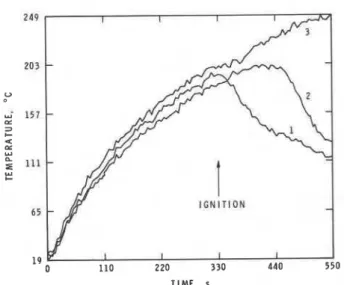
It was with Plexidas that closer examination of the u ignition process was made. To probe possible differ- ences in the rate of heat transfer through large and small samples, the temperatures on the back faces of Plexiglas samples 5 mm diameter X 4 mm and 110 mm diameter x 4 mm were followed as a function of time. In these experiments, large and small samples were heated simultaneously in the same sand bath; a refer- ence thermocouple was mounted in the sand 4mm below the surface.
It was of interest to probe the method of heat transfer perpendicular to the plane of the exposed surface. The radiometer described above was mounted at the position of the surface 80 mm below the source. Sheets of Plexiglas 0.8 mm and 4 mm thick placed between the radiometer and the source reduced the flux received from 1.7 W C ~ - ~ to 0.2 W C ~ - ~ and SO. 1 W cm-', respectively. Therefore, while Plexiglas is transparent to visible light and relatively transparent to its own polymer flame,2 it absorbs infrared radiation from the radiant source efficiently; essentially all the radiant energy is absorbed close to the sample surface. Conduction is thus primarily responsible for the heat- ing of the bulk of the sample prior to ignition.
Until ignition the temperature recorded 4 mm below the surface differed little whether in sand or behind Plexiglas samples of small or large area. Thus heat transfer between the samples and the surrounding sand is insignificant parallel to the plane of the sample surface exposed to the radiant source.
Figure 1 also shows the temperature behavior after ignition. Both samples were ignited with a taper and the radiant panel was immediately removed. The sand temperature thus dropped, but feedback from the polymer flames heated the sample surfaces, causing the temperature behind each sample to rise. After 440 s, the sample flame went out and this was followed by a rapid decline in the temperature at the back face of the small sample. The temperature at the back of the larger burning sample continued to rise throughout the experiment.
Solid phase heat transfer through Plexiglas samples that differed in exposed area has been demonstrated to be identical to the point of ignition, yet smaller samples are more difficult to ignite than larger sam- ples. The differences must thus be caused by gas-phase events.
The relative ease of ignition of Plexiglas samples of large exposed area is consistent with the lower flam- mability limit of pyrolysis gases being reached above the surface of larger samples more rapidly than above smaller samples; this would be expected, since dilution by air entrainment into the rising pyrolysis gas plume is more efficient with samples of smaller area.
Self-extinction of Plexiglas samples was observed only when the sample began to lose shape, coalescing with the surrounding sand. Even with smaller samples
F. R. S. CLARK
TIME, s
figure 1. Temperatures during ignition sequence: 1, sand, 4 mm below surface; 2, PMMA, 5 mm dia.x4 mm, on back face; 3, PMMA, lOmm dia.x4mm, on back face. All ther- mocouples 36 gauge butt-welded chromel-alumel.
than those in Table 1, no minimum size was found that was incapable of sustaining combustion. When the radiant panel was removed from above a sample at the point of ignition, heat energy continued to be supplied by radiation and convection from the polymer flame to the sample and, to a much reduced extent, the sand. Thus after ignition, conduction of heat from the sam- ple to the surrounding sand became significant. Further, larger samples have a larger volume, but not a proportionately larger surface area in contact with sand. Thus conduction of heat from the sample to sand is more important for smaller samples.
The amount of radiative feedback from the polymer flame to the sample surface increases with unit surface area exposed.' Thus after ignition both the effect of conduction from the sand and the effect of radiative feedback from the flame would cause small samples to be less capable of sustaining burning. Since no minimum size was found less than which burning was not sustained, convective heat transfer from the flame must dominate in these conditions.
Effect of char-formation
Char-formation was observed before ignition for red oak, Tuffak and polyethylene; for all three, unlike Plexiglas, the time to extinction increased as the ex- posed surface area increased.
The char on polyethylene samples floated on the surface of the polymer melt.
AU
the samples, except one of dimensions 20 mm diameter x 6 rnm, could be ignited with the taper only. Spark-induced ignition coSd be made to occur if the char was gently movedwith a spatula to expose the polymer melt. This char did not develop markedly after ignition had occurred.
Red oak charred during exposure before ignition, as did polyethylene, and continued to do so after igni- tion. The char on the oak was immobile and cracked principally in a direction roughly perpendicular to the grain direction. The edges thus exposed glowed red, especially after ignition. The char on the Tuffak sam- ples was a viscous bubbly substance which gradually enveloped the irradiated surface as exposure pro- ceeded.
Smaller samples of char-forming polymers tend to be ignited with greater difficulty than larger samples, suggesting that ignitability of char-forming polymers is influenced by the same factors as those that influence non-char-forming Plexiglas.
The time to extinction for char-forming materials remains to be explained. The absorptivity of char is very likely greater than that of unpyrolysed material. Thus the influence of radiant flux from the flame upon the propensity of combustion to continue is greater. Since after ignition the principal heat source is the polymer flame plume and since the radiant feedback from the flame is a strong function of area burning: larger times to extinction are observed for larger sam- ples. The effect is most marked for polyethylene and red oak; it is barely observable for Tuffak, which formed a very high-volume char that continued to develop after ignition and may have shielded the substrate from further pyrolysis. Most significantly, the effect was absent when char was absent (Plexiglas).
SUMMARY
The ease of ignition by radiant heat of small samples of materials, whether char-forming or not, increases as the surface area of sample increases, consistent with a condition for ignition being the reaching of a lower flammability limit of pyrolysis gases above the heated solid.
Small samples of Plexiglas, which doe not form char in these conditions, continue to bum irrespective of specimen area, but char-forming materials soon go out after a time that increases with increase of area. It is likely that the importance of radiant feedback is en- hanced by the increased absorptivity of the char.
Acknowledgements
The author is grateful to Raymond Flaviani, who built the apparatus and conducted the bulk of the experiments. This paper is a contribu- tion from the Division of Building Research, National Research Council Canada, and is published with the permission of the Direc-
tor of the Division.
REFERENCES I
I
1. D. 6. Spalding, The burning rate of liquid fuels from oepn 3. H. Ohtani and K. Akita, Scale effects on bottom surface trays by natural convection. Fire Res. Abs. and Reviews 4 combustion of PMMA pieces with circular and rectangular
(3), 234-5 (1962). sections. J. Fire and Flammability 13, 203-14 (1982). 2. A. T. Modak and P. A. Croce, Plastic pool fires. Combustion
and Flame 30, 251-65 (1977). Received 16 May 1983, accepted (revised) 8 November 1983
T h i s paper, w h i l e being d i s t r i b u t e d i n r e p r i n t form by t h e D i v i s i o n of B u i l d i n g Research, remains t h e c o p y r i g h t of t h e o r i g i n a l p u b l i s h e r . It should n o t be reproduced i n whole o r i n p a r t w i t h o u t t h e permission of t h e p u b l i s h e r .