HAL Id: hal-00155212
https://hal.archives-ouvertes.fr/hal-00155212
Submitted on 15 Jun 2007
HAL is a multi-disciplinary open access
archive for the deposit and dissemination of
sci-entific research documents, whether they are
pub-lished or not. The documents may come from
teaching and research institutions in France or
abroad, or from public or private research centers.
L’archive ouverte pluridisciplinaire HAL, est
destinée au dépôt et à la diffusion de documents
scientifiques de niveau recherche, publiés ou non,
émanant des établissements d’enseignement et de
recherche français ou étrangers, des laboratoires
publics ou privés.
Management system aided design : healthcare R&D
center application
Aude Schindler, Jean-Claude Bocquet, Aurélie Dudézert
To cite this version:
Aude Schindler, Jean-Claude Bocquet, Aurélie Dudézert. Management system aided design :
health-care R&D center application. IESM 2007 : International Conference on Industrial Engineering and
Systems Management, May 2007, Beijing, China. pp.166. �hal-00155212�
Management system aided design:
healthcare R&D center application
*
Aude SCHINDLER
a,b, Jean-Claude BOCQUET
b,
Aurélie DUDEZERT
ba Life Sciences Department, Commissariat à l’Energie Atomique b Industrial Engineering Laboratory, Ecole Centrale Paris
Abstract
The very changing economic environment imposes on the organizations to be flexible. New design methods have to be carried out to create such agile organizations. The systemic approach can be used to contribute to the design of systems such as organizational or decision systems. This paper presents a method based on systemics and an exploratory study case relative to the design of a healthcare research center called MIRCen, especially its decision system. Organizational strategic objectives and stakeholders’ points of view are taken into account thanks to this integrative method which allows designing agile organizations. This approach has to be iterated and is composed of many back and forth between integrated vision and detailed vision.
Key words: Modeling and modeling systems and languages, Research and development, Project management and scheduling,
Organization theory, Health services
1 Introduction
In today’s very instable economic environment, companies have to adapt their production and their organization to the very changing needs of their customers. As Peter DRUCKER underlines [1], companies cannot design stable organizational structures anymore: in order to stay competitive, they have to be agile and flexible. Project and network managements have appeared recently to enable companies to adapt their structural organization to their environment. Those management practices designed for short periods are thus temporary. And temporary organizations are not satisfactory in terms of transmission, sharing and perpetuation of knowledge [2]. Many authors deal with this knowledge transfer problem within project-oriented organizations in particular [3] [4] [5] [6]. We can wonder whether organization structures that would be both long term and flexible could be designed. This question is an operational issue for companies in the developed countries.
These new ideal organization structures have to take into account the expectations of all stakeholders of the organization. As Peter DRUCKER specifies [7], “the organization must “be sold” to its members – employees, volunteers or connections – as much, and perhaps more carefully, as it sells its products and services. It has to
*
Corresponding author: A. Schindler, Tel. +33 1 41 13 18 07, Fax +33 1 41 13 12 72.
Email addresses: [email protected] (Aude Schindler), [email protected] (Jean-Claude Bocquet),
attract people, retain them, appreciate them and gratify them, motivate them, serve them and satisfy them.” The systemic approach applied to the organizational structures design can help companies to satisfy all their stakeholders. Systemic approaches are today used for the design of products or services in order to take into account the changing expectations of the customers (design for X). The classical modeling methods are the preceding model method (reasoning by analogy) and the analytical method (cause and effect relations) [8]. The systemic approach is opposed to the analytic method, which decomposes the reality into more and more little units and analyzes the linear causalities that link these units, running the risk of destruction of any possibility of reconstruction of the whole [9]. These approaches used for designing products or services could inspire approaches and methodologies for designing organizational structures.
That is why we chose to use a systemic approach to get onto our study case, to face complexity, multiple aspects and interactions of MIRCen. Leaning on systemics means having tools and tested principles of modeling when we face complex phenomena such as decision [10] [11] or knowledge [12] [13]. This approach also makes it possible to develop the concept of point of view (organization, process, structure) on a phenomenon [2].
MIRCen (Molecular Imaging Research Center) is an integrated research center of the CEA (Commissariat à l’Energie Atomique: French Atomic Energy Commission) on pre-clinical imaging for gene and cell therapy. The opening of this center is foreseen for the end of the year 2007 in Fontenay-aux-Roses (92 – FRANCE). Its main objective is to facilitate and accelerate new drug creation and development thanks to the regrouping on a single geographical site of technological skills, medical skills and industrial network. This center belongs to the “pôle de compétitivité”1 (pole of competitiveness) Medicen Paris Region. Its strategic drivers are scientific excellence, innovation at all levels and transversal research. The general objective of our study is to design, anticipate and optimize the functioning of such a pole of competence, especially in terms of creation of values. Through this study, the CEA aims at finding a means to reconcile best pre-clinical research, new technologies and the needs of the industrialists.
In the second part of this article, we present how the systemic approach can contribute to the design of an organization. Then we have a look at what an organization system is composed of (sub-systems) and how this system changes through time (phases). The fourth part is devoted to the steps of the design process through the systemic analysis. Finally we approach the different possible followings of this method: performance measurement, quality management, costs / values piloting…
2 The contribution of the systemic approach for the design
2.1 Why the systemic approach?
Contrary to other existing methods, systemic approach enables to conserve a global vision of an organization with all internal and external interactions. Moreover it enables to systematically describe the expectations of the stakeholders in a flexible and dynamic way. In addition, most of the current approaches are useful and appropriate for the modeling of existing organizations but few for their design; they can thus complete the chosen design method. That is why we chose to use a systemic method to get onto our study case.
An organizational structure constitutes in essence a complex system. Jean-Louis LE MOIGNE [8] synthesizes a General System description as “an object which, in an environment, equipped with finalities, carries out an activity and sees its intern structure evolving through time, without losing its own identity”.
At the time of the new organizational structure design, the finality, i.e. the objective (to create a R&D structure which produces scientific value, balances its budgets...), guides the design step which makes the new structure parameters evolve (its means, its operating modes, its growth mode, its finalities…). Once again, this single entity does not lose its identity of engineering and design department (of design office).Paraphrasing LE MOIGNE
1
With the certification of 66 “pôles de compétitivité” (the French equivalent for clusters or industrial districts) in July 2005, French Government formalized a dynamics of strategic regrouping and synergies creation between companies, research units and education centers. Improved by the regrouping of its actors, innovation is today considered as one of the key factors for the competitiveness of an economy.
we can define the organizational structure design system as “the structure (engineering and design office, project team...) which, in the environment (the company, its scientific policy...), equipped with finalities (to work out a structure of research, an organizational structure to advance scientific research, to equip the country with means of research...), carries out a design activity and sees its intern structure (human, financial, informational, technical…resources) evolving through time (feasibility study, pilot study, study, launching…), without losing its structure identity (engineering and design office…).
Fig. 1. Canonical model of the General System (Source: extracted from [8])
The finality of the engineering and design office is here to work out a structure of research (an organizational structure of research and development) which is itself a system. Indeed the organizational system of research and development can be defined like "the structure (the research center development...) which, in the environment (competing, market of the drug, regional, national, international scientific policy...), equipped with finalities (to produce very high level scientific results, to provide results of experiments supporting new drugs development...), carries out an activity of production (experimental and scientific) and sees its interns structure (human, financial, informational, technical resources...) evolving through time (feasibility, definition, development, production, use, end of lifetime), without losing its structure identity (biological research center).
2.2 Why does the systemic approach contribute to the design process?
In a pragmatic view, the systemic approach initially requires to isolate the system without forgetting its relations with its environment, and thus to distinguish what the design field is from what it is not, or from what interface is. It also requires distinguishing what the system to be designed is from what it is not, or from what its interfaces are. As these systems (design system, produced system) go through phases of their respective life cycle, characterizing these phases results “mechanically” in considering for each phase its customers’ and environment specific needs. This kind of requirements engineering allows a robust expression of needs for the engineering and design department that produces the system as well as for the system to be designed. Then the robustness of the requirements makes it possible to work out the processes (in that case, the design process) which will carry out these requirements. These processes are directly worked out to meet the expected requirements and thus to create the strictly necessary (and why not sufficient) added value.
2.3 Proposal for a general method
At the time of the design of a new product or system, the most important thing is to adapt it to the request and demands of the future customers. But it is not enough anymore. The demands of the other stakeholders (shareholders, employees, suppliers…) have to be taken into account too. The systemic approach we propose in this article is a method which enables us to integrate these different aspects (sustainable development, environment protection, safety, hygiene, ethics, working conditions…).
We propose a very structured and robust approach. The suggested method consists in considering simultaneously the design system and the system to be designed as well as their interactions. For each of these systems, the general approach is similar. It is necessary successively:
General System FUNCTIONS
ENVIRONMENT
TRANSFORMATIONS
Table 1
General approach and its application to the design system and the system to be designed
General method Design system System to be designed
Decomposing into phases of its life cycle
Feasibility study, preliminary study, study, launching…
Feasibility, definition, development, production, use, end of life… For each phase, clarifying the
finalities of each customer and the constraints of each environment
Working out a structure of research, an organizational structure to advance scientific research, to equip the country with means of research …
Producing high level scientific results, providing results of experiments, supporting new drugs development…
Formulating these finalities into deliverables
Argued report about the governance modes which have to be set up for the new R&D center, a balanced scorecard of the creation of values…
A profit and loss account of the creation of values…
Developing the processes which are going to produce the deliverables
Design processes of the governance modes, of the balanced scorecard…
Affecting the necessary resources to the activation of the processes Realizing the processes
Controlling the satisfaction of the demands and the respect of the constraints
3 The decomposition of the organization system
The systemic approach is a systematic method which can be used to contribute to the design process. The general principle consists in starting from the laid down strategic objectives and the expectations of the stakeholders in order to set up the processes that are necessary to answer them as well as possible. The first step is to define the considered system and decompose it into sub-systems if necessary. When the boundaries of the system are delimited, the phases of the life cycle of this system have to be clarified. For each of these phases, the stakeholders and their expectations can then be listed. Finally, the processes which answer them can thus be set up (part 4).
This part aims at presenting the generic decomposition of the organization system (paragraph 3.1) and at positioning the decision system (paragraph 3.2), the system that we focus on in the following of this article. These models are then applied to the study case MIRCen (paragraph 3.3).
3.1 Generic decomposition
All industrial systems are composed of the same main elements, or almost. Jean-Louis LE MOIGNE [8] proposes a modeling prototype of the articulation of a complex system in nine levels:
1. The phenomenon is identifiable, 2. The phenomenon is active: it “makes”, 3. The phenomenon is controlled,
4. The phenomenon is informed on its own behavior, 5. The system decides on its behavior,
6. The system memorizes,
7. The system coordinates its decisions of action,
8. The system imagines and conceives new possible decisions, 9. The system is finalized.
The first and simpler systemic decomposition of the enterprise system is the canonical model O.I.D. (Operating system / Information system / Decision System) of Jean-Louis LE MOIGNE [8].
Fig. 2. Canonical model O.I.D. (Source: extracted from [8])
This decomposition, very classical in system sciences, can be decomposed to a lower level. Jean-Louis LE
MOIGNE [8] proposes such a sub-decomposition for the decision system. Sylvain PERRON [14] proposes such a sub-decomposition for the operating system.
Each system and sub-system is composed of several phases all along its life cycle [14]. A generic representation of theses phases may be the one drawn on figure 3.
Fig. 3. Phases of an industrial system (Source: extracted from [14])
3.2 Decision system positioning
The boundaries of the systems are very important. They are determined by their inputs and their outputs. For instance, there are generally two levels of decision: strategic decision and operating decision. This second one can be integrated in the operating system, in an operational piloting system for example. This is the scheme we chose for the following of this article. The decision system is the place where strategic decisions are taken. Some of its main functions are for instance fixing strategic objectives, defining the necessary means, setting up these means, following the set up actions, mediating, prospecting…
Pierre TABATONI and Pierre JARNIOU [15] define a management system as a “decision processes system”, the decisions of which “finalize”, “organize” and “lead” the collective actions of persons or groups of persons who accomplish the allotted activities in an organization, considering a process as a system (ensemble of interdependent elements empowered with a structure) of sequential activities (transformation modes of resources into products). END OF LIFETIME DEVELOPMENT PRODUCTION DEFINITION FEASIBILITY USE Time DECISION system INFORMATION system OPERATING system
3.3 Application to MIRCen
MIRCen regroups and capitalizes exiting competencies as well as creates new competencies about medical imaging in particular. Its vocation is to become a European, even world pole. This center is a center of pre-clinic imaging, i.e. the experiments are executed exclusively with animals. The results are afterwards transferred to the man. Used techniques are Nuclear Magnetic Resonance and Positron Emission Tomography. The project belongs to one of the four priority development axes of the CEA: “technologies for information and health” and results from an association of several actors. It functions in narrow collaboration with public institutions, hospital departments and other poles and networks (innovative context).
It is foreseen that MIRCen represents about 6.000 m² and 80 permanent persons on the site and approximately 150 persons which are linked to the project: physicians, mathematicians, chemists, neurobiologists, pharmacologists, clinicians, medical practitioners… The research themes are pharmacologic tests, cardiovascular diseases, central nervous system diseases, hepatic diseases and AIDS. MIRCen has three goals: to develop fundamental researches, to develop innovative therapeutics and to develop and validate new tools of imaging. But it is not only a pole of development. It is a technological valorization pole too and has different education missions.
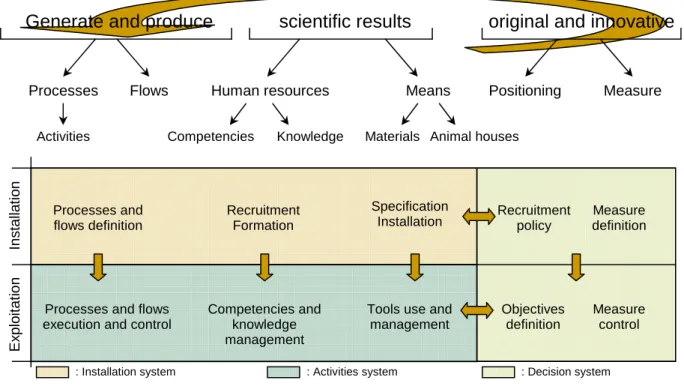
The objective is to design and install the specific and appropriated processes for this system and its strategic objective. The systemic approach enables to cover all aspects of the center and to face its complexity. From its principal issues and objectives, we can structure the necessary organization. For instance we can consider the first strategic driver of MIRCen: scientific excellence. This issue can be stated as “generate and produce original and innovative scientific results”. In order to answer this objective, we need: processes and flows which generate and produce and create the values, human resources and means from that the scientific results issue, and a positioning strategy and measure tools so as to define and evaluate the original and innovative aspects. Considering now the two principal phases of the project (installation and exploitation), we can associate each element (processes, flows, human resources…) to an action to set up. We can then regroup these actions into systems and make the links between them appear. We thus obtain a first structural organization of the research center.
Fig. 4. System decomposition method
Recruitment policy Specification
Installation
Generate and produce
scientific results
original and innovative
Processes Flows
Activities Competencies Knowledge
Measure Positioning Means Human resources Animal houses Materials
: Installation system : Activities system : Decision system Processes and flows definition Recruitment Formation Measure definition Measure control Objectives definition Processes and flows
execution and control
Competencies and knowledge management
Tools use and management In s ta lla ti o n E x p lo it a ti o n
This approach can be reiterated for each action. We consider then the action as an objective and we decompose it into needs (processes, flows, human resources, means…), then into actions. By repeating and detailing this method, we obtain a fine decomposition in systems and sub-systems necessary to answer the issues.
May 29, 2006 Presentation Ph.D. V.2 – Aude Schindler 24/22
METHODOLOGICAL ACTIVITY SYSTEM PROVISIONING ACTIVITY SYSTEM VALORIZATION ACTIVITY SYSTEM SCIENTIFIC ACTIVITY SYSTEM
INSTALLATION SYSTEM DECISION SYSTEM
ACTIVITIES SYSTEM Schedule of conditions
Needs of research / stakeholders
Strategic requirements
Realization Repositioning
Scientific production
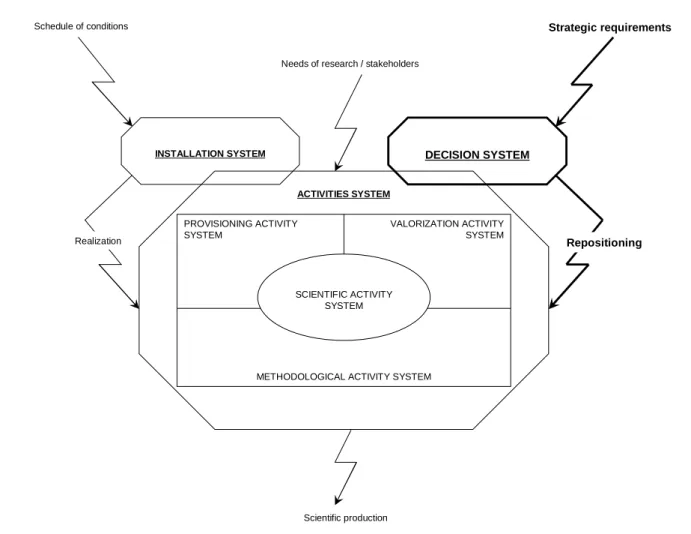
Fig. 5. Decomposition of the MIRCen system and positioning of the decision system
The different terms have been chosen to communicate with the members of the CEA, who are not familiar to the systemic language.
We can consider now the decision system more specifically. Its role is basically to fix the strategic objectives and establish the measure tools. Its three principal phases are the constitution of the decision structure, the realization of the decision and finally the dissolution of the decision structure.
Fig. 6. Phases of the MIRCen decision system and positioning of the phase of strategic decision-making The core business phase of the decision system is the strategic decision-making phase.
STRAT. DECISION-MAKING DECIS. STRUCT. CONSTITUTION DECIS. STRUCT. DISSOLUTION Time
4 The design process of the decision system
To design the decision system, we consider it in its principal phase, the core business phase, which is the realization of the strategic decisions. Then we list the stakeholders, issues, deliverables, processes, and resources that are necessary to realize correctly this phase. We can thus design the useful organization and establish the essential means which permit to answer the demands of the stakeholders in the best possible way. Here we present these steps in depth.
4.1 List of the stakeholders
We can list the different stakeholders of the realization of the strategic decisions phase of the decision system using the following classical decomposition:
Table 2
Classical categorization of the stakeholders
1. Customers Who do the strategic decisions bring an added value to? 1.1. 1.2. 1.3. 1.4. Final customers Shareholders Employees Mankind
Who are the strategic decisions intended to?
Who invests (time, money…) in the decision-making? Who realizes this decision-making?
What is the contribution of these decisions to the society? 2. Environment In which environment is the strategic decision-making located?
2.1. 2.2. 2.3. 2.4. Competitors Suppliers Market Mankind
Who are the competitors of this decision-making?
Who provides the necessary elements for the decision-making? What is the market of this decision-making?
Which society constraints does the decision-making have to respect?
The customers are considered in terms of creation of values whereas the environment is considered in terms of constraints. In the following table, we present a sample of different selected stakeholders.
Table 3
Examples of stakeholders of our study case MIRCen
Customers: Environment: Final customers 1/ 2/ 6/ … Activities system CEA a. French State b. European Union Competitors 1/ 2/ …
Strategic direction of the CEA Operational piloting system
Shareholders 1/ 2/ 3/ … CEA INSERM Région Ile-de-France Suppliers 1/ 2/ 3/ …
Strategic direction of the CEA Strategic direction of the INSERM Activities system
Employees 1/ …
Decision structure Market 1/
… Decision-making Mankind 1/ 2/ 3/ 4/ … Scientific community Sick population Industrial community Poles and networks
Mankind 1/
…
Adverse associations, authorities, agencies, institutions…
The list is not exhaustive. Each stakeholder has to be taken into account and a specific weigh has to be assessed for each of them so that the list is usable. This first list is very important as it defines who the system has to satisfy. But how can this satisfaction be ensured? What are the expectations of each stakeholder? How can their satisfaction be measured?
4.2 List of the issues and deliverables
The list of the issues2 and deliverables aims at identifying the expectations of each stakeholder. The work has only been drafted for the moment and is still in progress. However, some examples of issues and deliverables can be presented in order to clarify the study and present its continuations.
It can be interesting to distinguish two kinds of issues for each stakeholder: the classical issues, which are common to most of the industrial systems, and the specific issues to decision systems in general and to the decision system of MIRCen in particular. We adopted this decomposition to present the following issues and we applied it to the decision-making phase of the decision system.
Table 4
Examples of issues for the different stakeholders of a decision system
I. Examples of classical issues for the different stakeholders of an industrial system Final customers 1/
2/ 3/ …
Conformity product and/or service Continuous improvement Innovation Employees 1/ 2/ 3/ 4/ 5/ …
Interest of the work Remuneration Gratification Social climate Working conditions Shareholders 1/ 2/ 3/ … Value Profitability Image Mankind 1/ 2/ 3/ … Ethic Employment Environment care
II. Examples of specific issues for the different stakeholders of a decision system Final customers 1/ 2/ 3/ 4/ 5/ 6/ …
Fixing of the strategic objectives Definition of the necessary means Setting-up of these means Following of the set-up actions Arbitration
Prospective
These issues have to be supported and specified for the decision system of MIRCen.
For each of these issues, a list of interests, satisfactions, criteria of satisfaction, and then deliverables can be found. We thus obtain an ensemble of deliverables which may be redundant, or contradictory, or useless… We have to aggregate them to eliminate all these problems. The weighing that can be set up enables to take into account the relative importance of the stakeholders. We thus obtain a restricted list of homogeneous deliverables on which we can rely on to build the necessary organization to answer them.
4.3 Necessary processes and resources
We can now design the system to meet the issues of every stakeholder in the best possible way. We can determine the necessary processes to realize each of these aggregated deliverables. Then we can list the activities to be set up for each of these processes. Finally we can establish the resources used for each of these activities. For example, considering the issue “Fixing of the strategic objectives”, the process of fixing of the strategic objectives has to be set up. The activities which compose this process are among other things the synthesis of the global strategic objectives of the CEA, the formulation of objectives applicable to the MIRCen context and the communication of these objectives. Considering the issue of “Conformity service”, a process of quality control has to be set up. Since we are in a design phase, some uncertainties naturally remain. That is why we chose the most global possible analysis even if it requires removing aspects of this analysis thereafter if necessary.
2
To define precisely the decision system, it is necessary to establish well its structure (what the system is: who is implied and to what level in the decision-making?), its activity (what the system does: what is the role of the decision system?), its evolution (what the system becomes: what is the envisaged future of the decision system?) and its finality (what the system brings: who and what is this system meant to be good for?). Then with some sensitivity analyzes, we can find the most significant point and thus detail them.
This systematic approach can be used on all sorts of systems to set up performance measurement [16], quality management, costs / values command and control, or to study the various methods of research valorization for instance. It enables to create adaptive structure: if the environment of an organization changes, we can see rapidly the implications of this change for the issues and then for the necessary structure and resources.
5 Quality, performance follow-up and values
5.1 Feedback on the values created by the processes
The general method developed in paragraph 2.3 could be represented as figure 7. The researched values are clarified for each phase of the life cycle and for each customer at the beginning of the general process, so that all creating values processes are developed to answer at this search. It becomes “easy” to establish a feedback to control the efficiency of the processes. The processes are under control.
Fig. 7. Overview of the general method
5.2 Indicators, measures, command and control
It is not so easy to control the R&D processes performance [17]. But if we consider the different customers’ demands and environments’ constraints with the three efficiency types of Michel KALIKA [18] (economic, organizational, and social, we can add environmental too), we dispose of a robust indicators database to measure this efficiency. We have developed some indicators roadmaps, but we have not developed piloting processing to change the dysfunctioning processes.
6 Conclusion
In this paper we present an exploratory research on a method to design flexible and agile organizational structures. In fact this systemic design method allows integrating all company’s stakeholders’ points of view and expectations in order to design an organizational structure. Furthermore this method could also be used to manage the evolution of the organizational structure. Thanks to our systemic design methods we suggest that companies could adapt their organization to the economic changing environment and developed changing performance indicators. We have developed this theoretical proposition thanks to the beginning of the MIRCen design study case. The development of this case-study is one of the perspectives of our research. We will have to value more specifically whether managers could easy use such methods to design, manage and adapt organizational structures. Furthermore in our future researches we aim also at characterizing the impact of such designed organizations on global values creation for a company.
Decomposing the life cycle into phases
-Clarifying the finalities of each customer Formulating the finalities into deliverables Developing processes to product the deliverables Affecting the necessary resources Realizing the processes
Controlling the satisfaction of the demands and the respect
7 References
[1] Drucker, Peter (1998). On the profession of management, Harvard Business School Press, Boston, Mass., USA.
[2] Longueville, Barthélémy (2003). “Capitalisation des processus de décision dans les projets d’innovation: application à l’automobile”, Thesis (Ph.D.) – Ecole Centrale Paris, Châtenay-Malabry, France.
[3] Soderquist, Klas Eric and Prastacos, Gregory P. (2002). “Knowledge transfer in npd projects: lessons from 12 global corporations”, in OKCL 2002, the third European Conference on Organizational Knowledge, Learning
and Capabilities, Athens, Greece.
[4] Gilbert, Myrna and Cordey-Hayes, Martyn (1996). “Understanding the process of knowledge transfer to achieve successful technological innovation”, Technovation 16 (6), 301-312.
[5] Cummings, Jeffrey L. and Teng, Bing-Sheng (2003). “Transferring R&D knowledge: the key factors affecting knowledge transfer success”, Journal of Engineering and Technology Management 20, 39-68.
[6] Un, Annique C. and Cuervo-Cazurra, Alvaro (2002). “Complements or substitutes?: organization a project team strategies for developing the capability to mobilize and create new knowledge”, in OKCL 2002, the third
European Conference on Organizational Knowledge, Learning and Capabilities, Athens, Greece.
[7] Drucker, Peter (1993). Post-capitalist society, Harper Business, New York, USA.
[8] Le Moigne, Jean-Louis (1999). La modélisation des systèmes complexes, Dunod, Paris, France.
[9] Von Bertalanffy, Ludwig (1968). General system theory: foundations, development, applications, George Braziller, New York, USA.
[10] Eynard, Benoît (1999). “Modélisation du produit et des activités de conception: contribution à la conduite et à la traçabilité du processus d'ingénierie”, Thesis (Ph.D.) – Université de Bordeaux I, Bordeaux, France.
[11] Stal - Le Cardinal, Julie (2000). “Etude des dysfonctionnements des processus de décision: application au choix d'acteur”, Thesis (Ph.D.) – Ecole Centrale de Paris, Châtenay-Malabry, France.
[12] Cantzler, Olivier (1996). “Une architecture conceptuelle pour la pérennisation d'historiques globaux de conception de produits industriels complexes”, Thesis (Ph.D.) – Ecole Centrale Paris, Châtenay-Malabry, France. [13] Ermine, Jean-Louis (1998). “Capter et créer le capital savoir”, in Annales de l'Ecole des Mines, Paris, France.
[14] Perron, Sylvain (2002). “Contributions au Soutien Logistique Intégré des systèmes industriels: application à la ligne d’intégration lazer”, Thesis (Ph.D.) – Ecole Centrale Paris, Châtenay-Malabry, France.
[15] Tabatoni, Pierre and Jarniou, Pierre (1975). Les systèmes de gestion, PUF, Paris, France.
[16] Clivillé, Vincent (2004). “Approche systémique et méthode multicritère pour la définition d’un système d’indicateurs de performance”, Thesis (Ph.D.) – Université de Savoie, Annecy, France.
[17] Kaumanns, Jan (2005). “Evaluation of R&D processes”, Thesis (Master) – Ecole Centrale Paris, Châtenay-Malabry, France.
[18] Kalika, Michel (1988). Structure d’entreprise: réalité, déterminants, performance, Economica, Paris, France.
![Fig. 1. Canonical model of the General System (Source: extracted from [8])](https://thumb-eu.123doks.com/thumbv2/123doknet/13016966.381054/4.892.113.791.253.456/fig-canonical-model-general-source-extracted.webp)
![Fig. 2. Canonical model O.I.D. (Source: extracted from [8])](https://thumb-eu.123doks.com/thumbv2/123doknet/13016966.381054/6.892.101.788.174.431/fig-canonical-model-o-i-d-source-extracted.webp)