READ THESE TERMS AND CONDITIONS CAREFULLY BEFORE USING THIS WEBSITE. https://nrc-publications.canada.ca/eng/copyright
Vous avez des questions? Nous pouvons vous aider. Pour communiquer directement avec un auteur, consultez la première page de la revue dans laquelle son article a été publié afin de trouver ses coordonnées. Si vous n’arrivez pas à les repérer, communiquez avec nous à [email protected].
Questions? Contact the NRC Publications Archive team at
[email protected]. If you wish to email the authors directly, please see the first page of the publication for their contact information.
NRC Publications Archive
Archives des publications du CNRC
This publication could be one of several versions: author’s original, accepted manuscript or the publisher’s version. / La version de cette publication peut être l’une des suivantes : la version prépublication de l’auteur, la version acceptée du manuscrit ou la version de l’éditeur.
Access and use of this website and the material on it are subject to the Terms and Conditions set forth at
Aesthetic aspects of multi-unit housing
Ferguson, R. S.
https://publications-cnrc.canada.ca/fra/droits
L’accès à ce site Web et l’utilisation de son contenu sont assujettis aux conditions présentées dans le site
LISEZ CES CONDITIONS ATTENTIVEMENT AVANT D’UTILISER CE SITE WEB.
NRC Publications Record / Notice d'Archives des publications de CNRC:
https://nrc-publications.canada.ca/eng/view/object/?id=6e5f8ae0-37a5-4a4f-b613-059a241cc43f
https://publications-cnrc.canada.ca/fra/voir/objet/?id=6e5f8ae0-37a5-4a4f-b613-059a241cc43f
N2l-t2
no, 218
e . 2
BI,DG
NATIONAL RESEARCH COUNCIL
CANADA
CONSEIL NATIONAL DE RECHERCHES
3066s
Aesthetic
Aspects
of Multi-unit Housing
by
R. S. FERGASON
A N A L Y Z E D
Reprinted from"Towards Industrialised Building" The Third CIB Congress, Copenhagen, 1965
Technical Paper No. 218 of the
Division of Building Research
OTTAWA
April, 1966
4:*utr
NRC 8959
Price 10 cents
H t
R. S. Ferguson
Aesthetic aspects of multi-unit housing
By R. S. Ferguson (Canada)
lndustrialised building technique need not be an insurmount-able handicap to the achievement of aesthetically acceptinsurmount-able design. The industrial technique is a tool which increases man's power many times. Because of the increased rate at which building is accomplished more intense thought and effort must be given to direction or design. Failure to make this effort has
d.** Fig.2. "... and at other times monotonous."
left the machine in charge. The trail it leaves is sometimes dis-turbingly chaotic (Figure 1) and at other times inhumanly mo-notonous (Figure 2). These effects can be avoided by proper consideration of industrial technique and aesthetics.
Industrial technique
A suitable aesthetic for housing must express materials, tech-nique and building use. The forms and expressions to which we have become accustomed are those developed for and suited to the craft technique. As building has changed from a craft to an industry, technological and organizational developments have made these old forms obsolescent, but the problem of creating suitable new forms has not been solved.
The developments which have caused this are of five kinds:
(l) Development of new materials
The processes of manufacture create new materials to supple-ment and often supplant natural ones. Man rather than nature determines the finish of these materials, but in so doing the harmony of one creator is lost.
(2) Mass production
Mass-produced articles are rarely of local origin. Most
manu-402
factured materials are designed by someone who does not know where or how they are going to be used. The architect and de-signer becomes a chooser and fitter of predesigned articles. His job is more essential but less appreciated by the layman. Al-though it does not require an expert to make a choice, it does require one to make a good choice. But what is good? Recently the artistic world has lost interest in an objective standard of aesthetics, of what is good and bad, and judgments must there-fore be made on faith in some expert's word.
This attitude of artists and architects encourages the purchase and erection of building materials without expert artistic as-sistance. The buyer is often unable to appreciate the effect of the material in combination with others and manufacturers strive for finishes which are individually attractive and eyecatching. In so doing they complicate the aesthetic problem.
(3) Specialisation in design
The trend in industrialisation has been towards specialisation in design. When furnaces replaced fireplaces and structural frames replaced bearing walls mechanical and structural engineers re-placed architects. With respect to design this is a disintegrative trend unless positive efforts to cooperate are made.
(4) Communal dependence
The pre-industrial agrarian or feudal manor was composed of socially dependent but functionally independent housing units. Each man was responsible to someone above him and for some-one below him on the social scale, but he cut his own wood, drew his own water, taught his own children, and grew his own food. The post-industrial community is just the opposite. It is com-posed of socially independent but functionally dependent units. No man is responsible to or for any other man in the community, but he is completely dependent on the community for such services as water, sewer, roads, schools, and playgrounds. When-ever a service has become industrialised it has been taken out of the home.
(5) Automobile sprawl
The spread of cities depends on the means of transportation. The private automobile has succeeded the railway and the street-car and has excelled these means in spreading cities into the countryside. The macro effect has been an urban explosion, but the micro effect is equally important. The scale of building and the standard of detailing and landscaping upon which the charm of the residential aesthetic is based is a pedestrian one. It cannot be appreciated by automobile and the presence of the automobile prevents its appreciation by foot. Pedestrians and automobiles both have their rightful place, but they do not mix. Notwith-standing this it is rare to find the two separated.
Two main influences in aesthetics
Two influences are fused in any work of art. The first is the influence of society, which guides the artist in attributing to the work some recognizable form. Society provides order and harmo-ny and a common language of form, which enables an object to be identified, described and classed. The second influence is the intuition of the artist. He uses the common language and applies his talent to achieve some unique expression. Both contributions are necessary. If an art object is dull and monotonous, it is lacking in the liveliness and interest provided by the artist; if it is chaotic and incoherent, it is lacking in the order and the common lan-guage provided by society,
It will be appreciated that some social cooperation is neces-sary for art. This cooperation is not likely to come about under an industrial system without some determined positive effort. In a craft society such an effort was hardly necessary, and due to cultural lag it is probable that its need now is not yet generally recognized. It is fashionable at present to assume that art is purely intuitive and that there is no contribution that society can make. Through industrial technique building continues at an ever-increasing pace, yet because of its increasingly industrial
nature and the trend to non-objectivity in art, the artistic influ-ence in building is becoming more and more alienated.
A mediaeval form of individualistic craft design cannot be revived. Harmony and coherence can only be achieved now through cooperation by the many resporxible for fashioning the various objects that form the residential environment. A new aesthetic language is needed so that the many designers involved can communicate and work together. Because of the difficulties of achieving this there is a tendency in technical circles to ignore aesthetics. While this may be excusable, it is hardly practicable under the circumstances. The public places appearance near the top of its list of requirements, and more often than not the form and the finish materials of a building are chosen for aesthetic reasons even though they might be rejected on technical grounds. To close the gap between aesthetics and technology science and industry must take a hand.
A language of form
The effect of the industrial technique on aesthetics can be illustrated. A language of form will evolve through the study of form in relation to industrial technique and the development of common understandings. It is then and only then that aesthetics can make the environment more interesting and meaningful. The following are a few selected examples chosen to illustrate the relation between form, function and language.
Fig. 3. Typical speculative housing development.
Figure 3 illustrates typical speculative housing development in Canada. The straight road is as much due to the straightness of the draftsmen's square as to anything else. Pavement and houses are positioned according to prescribed standards.
The form ofcomposition used here is the 'vista'. It is successful when all variety is subdued to emphasize an object at the focal point. In this example the effect is weakened by distracting vari-ations in the houses on either side, and the lack of any prominent object at the focal point. In its present form visual distractions and lack of interest in the proper place create dangers for pe-destrians and the drivers of vehicles. It is an uneconomical. un-safe and dull compromise of pedestrian and vehicular needs.
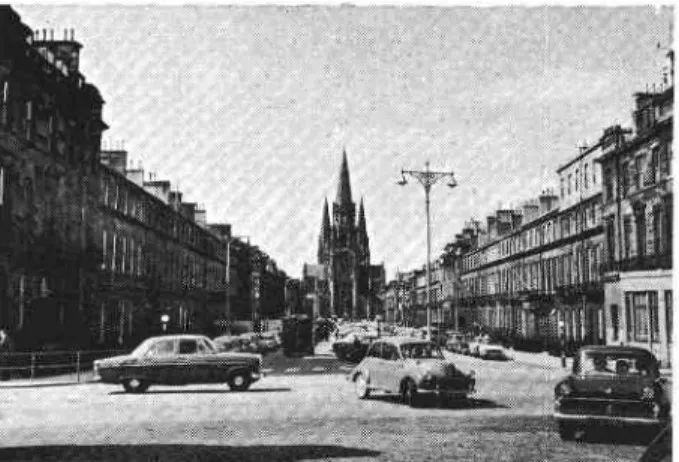
Figure 4 illustrates the correct employment of the vista. The faults discussed in connection with the previous picture are missing. Even the greater density of building in this picture does not invalidate the comparison.
This composition (Figure 5) illustrates the group. Interest is focussed on the visual centre of gravity, in this case the tallest house. The group is distinct from other forms because it focusses attention on the buildings. In other forms such as the vista, the square, the crescent (Figure 6) or hillside development, the build-ings are more often supporting elements of the composition.
The interest in this picture is created by subduing all variety in the pictorial elements to emphasize the curve. This form of composition resembles the vista because it leads the eye on, but it is unfinished and leaves in question what is around the bend. It is not a restful composition, but is suitable for driveways where it is seen from a fast-movine vehicle.
H t
R. S. Ferguson
Fig.4. Correct employment of the vista.
Fig.5. In this group interest is focussed on the visual centre of gravity.
Fig.6. All variety of form is subordinated to the curved hori-zontal lines of the building.
Conclusion. Positive measures to control development are necessary if both chaotic and monotonous landscapes are to be avoided. Interest and coherence can be achieved most satis-factorily when there is cooperation among those who contribute to the composition of a landscape-the draftsmen of zoning regulations and subdivision controls, surveyors, municipal utili-ties and roads departments, the builders, the manufacturers of materials, and last but not least the designers of the buildings themselves.
Under careful examination it is clear that the subject of the composition is rarely buildings. In the vista, the curved street and some other forms, it is appropriate to subdue basic differences
H t
R. S. Ferguson
in the buildings. The square focusses attention on the enclosed space by subduing variation in the facades. While variety is neces-sary, it is seldom that it must be provided by the housing units. There does not appear to be any basic conflict between aesthetics and the mass-production technique, but the evolution of a lan-guage of form and positive and deliberate steps toward coope-ration among all those who make decisions affecting design of multi-unit housing are necessary for adequate aesthetic results.
References
1 Report of the Committee of Inquiry into the Design of the Residential Environment, Journal of the Royal Architectural Institute of Canada, Vol. 37, No. 5, May 1969' p. 175. 2 "Design Pays." Report of a Symposium held at the Royal
Institute of British Architects, 2 May, 1958.
3 "Man-Made America: Chaos or Control?" by Christopher Tunnard and Boris Pushkarev, New Haven, Yale University' 1963.