Volume12, Issue 4 2012 Article4
Does Demographic Change Affect the Current
Account? A Reconsideration
Michael Graff
∗Kam Ki Tang
†Jie Zhang
‡∗Jacobs University Bremen and ETH Zurich, [email protected] †University of Queensland, [email protected]
‡National University of Singapore, [email protected] DOI: 10.1515/1524-5861.1885
Account? A Reconsideration
∗
Michael Graff, Kam Ki Tang, and Jie ZhangAbstract
This paper re-examines the impact of demographic factors on the current account balance. To this end, we develop an analytical framework that is more general than the one commonly used in the literature in three aspects. First, it accounts for the facts that the world current account balance must be equal to zero. Second, a bigger economy will have greater impacts on others, but be influenced less by them. Third, a more open economy will have greater impacts on others and at the same time be more readily influenced by them. We then confront two alternative empirical specifications based on both the new and the conventional framework with a panel of data. In contrast to the findings based on the conventional framework, our results with the new framework indicate that population ageing does not appear to have discernible impacts on the current account balance.
KEYWORDS: demography, ageing, openness, current account, general equilibrium
∗The authors would like to acknowledge the support from the Australian Research Council’s Dis-covery Projects funding scheme (project number DP0878752).
1. INTRODUCTION
Motivated by the observations that advanced economies are ageing rapidly and that emerging economies are following soon, there has been increasing interest in
the macroeconomic effects of ageing.1 One recurrent topic of interest in the
litera-ture is the impacts of ageing, and demography in general, on the current account
balance.2
The focus of this paper is on how to model demographic impacts on the current account balance in a world of heterogeneous economic openness and sizes. The hitherto standard practice of accounting for these heterogeneities is to include measures of openness in the regressions and to normalise the current ac-count balance with Gross Domestic Product (GDP), respectively. In this paper, we show, first, that in a general equilibrium setting this practice is insufficient, and second, that the problem can be addressed by using a new framework.
According to the life cycle hypothesis of consumption, young house-holds borrow against their future income, middle-age househouse-holds save for relin-quishing debts and retirement, and old-aged households dissave. Accordingly, countries with a relative young or old population are more likely to run current account deficits (more on this later).
Where cross-country (including panel) data are used – as is typically the case in the related literature – three factors need to be considered in modelling the demographic impacts on the current account balance. The first factor is the gen-eral equilibrium condition. Since the current account balances must sum to zero for the world as a whole, demographic changes that affect the home country’s balance must affect the rest of the world’s (ROW’s) balance in the opposite direc-tion; conversely, demographic changes in the ROW must also affect the home country. This implies that it is not the home country’s own pace of demographic changes that matters, but its pace relative to the ROW (Chinn and Prasad 2003). The second factor is a country’s size. Other things being equal, the larger the home country is, the more influence it should have on others, while at the same time it should be less susceptible to external disturbances. The last factor is open-ness. For a given size, a more open economy should have a more pronounced im-pact on others and simultaneously be more readily influenced by the ROW.
Without due consideration of these three factors taken together, any em-pirical estimation of the effects of demography on the current account balance is likely to be biased in various ways, depending on the distributions of demo-graphic measures, openness and sizes in the sample. To the best of our
1 Some important earlier works include Higgins and Williamson (1997) and Higgins (1998). Also
see Edwards (1996) and Li et al. (2007).
2 Recent examples include Chinn and Prasad (2003), Chinn and Ito (2007), Gruber and Kamin
edge, this is the first study that pertains to this structural issue in the related em-pirical literature.
To illustrate our argument, we estimate the impacts of demographic change on the current account balance using both the conventional and our pro-posed new framework, which allows us to compare and contrast the results.
Our panel data set comprises 84 countries and 47 years from 1960 to
2006.3
The rest of the paper is organised as follows. Section 2 reviews the related literature. Section 3 derives the new modelling framework. Section 4 describes the data used for our empirical analyses. Section 5 presents and discusses the re-sults and the final section concludes.
Based on our data and methods, we find that the effect of population age-ing on the current account balance is much more subdued than what has been re-corded in previous studies based on the conventional framework.
2. LITERATURE REVIEW
National account identities dictate that the current account balance is equal to the
excess of national savings (T G S) over domestic investment ( )I or the
ex-cess of output ( )Y over domestic absorption (C I G):
( ) ( )
CA T G S I Y C I G (1)
where CA, T, G, Sand C represent, respectively, the current account balance,
tax revenue, government expenditure, private savings and private consumption. It is on the basis of this identity that demography is hypothesised to influ-ence the current account balance. According to Modigliani’s (1970) life cycle hy-pothesis, households at working age are the prime net savers of societies, while young households are likely to be borrowers and old-age ones are likely to be dis-savers. Therefore, countries with a relatively young or old population are more likely to consume more than what they produce, resulting in a current account deficit. While the majority of the literature adopts this hypothesis and thus expects
youth and old-age dependency4
Often missing in the discussion is the investment aspect. Since the current account balance is equal to excess saving over investment, demography can only influence the current account balance to the extent that its respective effects on to have negative impacts on the current account balance, this is not the full story.
3 The limitation to years before 2007 is deliberate; for detail, see section 4.2.
4 Here, youth and old-age dependency are defined as population aged 0-14 and 65+ to population
saving and investment do not net out each other. In this aspect, youth and old-age dependency could have opposite effects on the current account balance. This is because countries with a young population will see their labour force growing in the future, making long-term capital investment more attractive there than in countries with an aging population (Cooper, 2008).
Another missing piece is longevity. Population ageing is characterised not
only by rising old-age dependency but also by rising longevity,5
National account identities also necessitate a country’s current account balance to be equal to its receipts from the ROW for goods, services, investment income, and unilateral transfers minus its payment to the ROW. Thus, a current account surplus (deficit) represents a net outflow (inflow) of capital. As such, the effects of demography on the current account balance must be casted in the light of open economies.
yet the theoreti-cal impacts of the two on saving are different. As people expect to live longer, they are induced to save more, counterbalancing the impacts of higher old-age dependency (Li et al., 2007).
Clearly, these considerations reflect the three factors discussed in the in-troduction, namely general equilibrium, size, and openness. We shall consider these factors simultaneously in our modelling of the current account balances within the world economy.
The paper is related to a strand of the literature on the macroeconomic im-pacts of population ageing. Within this literature, Higgins and Williamson (1997) and Higgins (1998) find that countries with relatively young populations are capi-tal importers, whereas those with relatively old populations are capicapi-tal exporters. Amongst these two studies, only Higgins (1998) controls for openness. He finds that demography does not affect the balance of trade in economies classified as closed based on the Sachs and Warner (1995) binary measure of openness. Our study differs from these two studies in that we take into consideration relative rather than absolute demography shifts across countries, as well as the heteroge-neity of countries in terms of openness and relative economic size.
In recent years, some studies examining the macroeconomic effects of demography also incorporate the condition that external balances must sum up to zero for the world economy as a whole. These include Feroli (2003), Domeij and Flodén (2006), Attanasio et al. (2006), and Mérette and Georges (2010). However, these studies use numerical simulations as their main investigation tool, in
5 Another aspect of population ageing is a falling fertility rate. However, in the short to medium
term, a falling fertility rate means a lower youth dependency rate, but not a rising old-age depend-ency.
trast to the empirical parameter estimation by regression analyses in the current
paper.6
Another strand of related studies seeks to explain current account imbal-ances; e.g. Chinn and Prasad (2003), Chinn and Ito (2007), Gruber and Kamin (2007), and Legg et al. (2007). The last two mentioned above emphasise the effect of the Asian financial crisis as a catalyst of the Asian economies’ compulsion to build up large foreign reserves, known as the global savings glut hypothesis. Kim and Lee (2007), running a VAR, find that for ten East Asian countries from 1981-2003, the dependency ratio has a significantly negative effect on the current account balance, thus providing evidence that the effects of the present demo-graphic transition are no longer restricted to the wealthiest economies.
While these studies differ vastly in terms of sample coverage and econo-metric approaches, in general, it is fair to summarise that they find that demogra-phy matters and that a higher dependency ratio tends to result in a smaller current account balance. In what follows, we shall challenge this finding.
Importantly, the existing body of literature indicates that cross-country or panel data are more instrumental than individual country time series data in iden-tifying demographic effects on saving, because the variation of demographic vari-ables is typically more pronounced across countries than across time (Masson et al., 1998). For this reason, our analyses draw on a large panel data set rather than on a cross section of countries or on longitudinal data for particular countries.
Another difference between the current paper and the previous literature is that we estimate both static and dynamic models. Higgins (1998) and Gruber and Kamin (2007), for instance, do not account for the strong persistence of the de-pendent variables in their econometric models and their results are thus subject to
severe omitted variable bias.7
6 Obviously the literature on current account balance covers many other issues besides
demo-graphic changes. For instance, Gretz and Highfill (2010) use Monte Carlo simulation to show how private sector R&D subsidies could improve the US current account balance; and Lizardo and Mollick (2009) show that when the current account deficit exceeds 4.2% of GDP, which is known as the “Mann’s rule”, the market will price down the US dollar significantly against other major currencies.
Higgins and Williamson (1997) and Legg et al. (2007) do take into account the dynamic nature of the data, but use different esti-mation techniques. In particular, Higgins and Williamson use a two-stage-least-square estimator, while Legg et al. use a variant of dynamic panel data estimation from Anderson-Hsiao (1981). For the dynamic modelling, our empirical methods also include the generalised methods of moments (GMM) estimators proposed by Arellano and Bover (1995) and Blundell and Bond (1998).
7 Although Higgins (1998) uses 5-year averages to try to smooth out short run volatility, this does
3. THE NEW MODELING FRAMEWORK
Consider the following general expression of the current account balance:
( , )
i i i
CA X , (2)
where CAi is defined as the current account balance as a share of GDP in country
i; i is a scalar measure of economic openness (1 for fully open, 0 for completely
closed); and Xi is a vector of domestic factors in the home country that are
ex-pected to affect its current account balance.
In what follows, we modify this general framework to take into account of, one at a time, general equilibrium, openness and size as discussed previously.
Firstly, the general equilibrium condition implies that, if a domestic factor affects the home country’s current account balance, it must affect the balance for the ROW in the opposite direction. As such, it is the change in country i relative to that in the ROW that matters in determining its current account balance. To ac-commodate this, we modify (2) into
( , )
i i i i
CA X RWX , (3)
where RWXi measures the value of the same variables as inXi, but for the rest
of the world (ROW):8
{ , }
i average j j i
RWX X . (4)
Assuming Xiand RWXi enter (.) additively is reasonable, when the
ar-guments are expressed either in percentage terms or as log term values.
Secondly, the impact of (Xi RWXi) on the home country’s current
ac-count balance should be conditional on its openness. In particular, the less open
8 This is the specification in Chinn and Prasad (2003). However, we found that for our data set
i
X
and (XiRWX as specified in (4) are correlated close to unity, meaning that just accounting for i) the general equilibrium condition alone would make little practical differences to not considering it at all.
its economy is, the less susceptible its current account balance to both internal and external disturbances should be; for a completely closed economy, the current
ac-count balance must be equal to zero for any values of (Xi RWXi). This implies
that (3) can be written as
( )
i i i i
CA X RWX , (5)
where RWXi is defined as in (4).
This specification, however, still neglects another aspect of openness. Not only has a country to be open to be influenced by others, but also that other coun-tries have to be open to be able to exert their influence. To account for this, we replace the unweighted averaging function in (4) with an openness-weighted av-eraging function: / i j j j j i j i
RWX X . (6)Assuming (.) is a linear function of its arguments, the corresponding
re-gression model of (5) is
CAi = α0 + θi (Xi – RWXi) 'α1 + ei , (7)
where ei is the error term.
Thirdly, for the same degree of openness, a larger economy will have a more pronounced influence on others, but be less affected by others at the same time. To account for this size factor, we need to modify both (6) and (7) as fol-lows: CAi = α0 + θiZi (Xi – RWXi) 'α1 + ei (8) / i j j j j j j i j i GDP GDP
RWX X (9)/ j j j j j i i GDP Z GDP
. (10)The modification to the identify function for RWXi is straightforward, as
we merely replace the openness-weighted averaging function in (6) with an open-ness-GDP weighted averaging function in (9). The latter means that shocks from larger and more open foreign countries will be weighted higher than those from smaller and less open ones in imputing the external disturbances confronted by the home country.
The modification to the equation for CAi is somewhat more complicated,
as we multiply the interaction term i(Xi RWXi) with a new term,Zi. This
new term Zi is the inverse of the relative size of the domestic economy compared
to the world average, and the size of each foreign country is also weighted by its
openness. The scalar,Zi , is larger than one for small economies and smaller than
one for large economies. The reason for this specification is clear when we con-sider a world consisting of only two countries, in which the home country i is
twice the size of the foreign country j, and the vector of Xi has only one element.
Then further suppose i j 1 and ( Xi Xj)1. In the counterfactual
case that Zi does not appear in equation (8), CAi 1 . Since
(Xj Xi) 1
, CAj 1 holds simultaneously. In dollar terms, the
cur-rent account surplus in country i has to match the curcur-rent account deficit in
coun-try j. However, since CA is expressed as a ratio to GDP – a standard practice in
the literature – to ensure that the world current account balance is zero, the effect
of (Xi Xj) on CAi must be half as that of (Xj Xi) on CAj. That is, the
marginal effect will be smaller for the larger economy, and vice versa. In the
ab-sence of Zi, the estimated marginal effect will be somewhere between the actual
marginal effects on CAi and CAj. In a more general, multi-country setting, the
error will depend on the distribution of economic sizes. The inclusion of Zi in (8)
provides a solution to this problem and should hence lead to a more accurate
es-timation of the effect of (Xi RWXi) on CAi .9
9 There is a reason why we measure the size of the home economy relative to the world average,
but not the average of the ROW. Consider the two-country example in the text. If we use the
measure enters Zi because, like that inRWXi, an economy can influence others only to the degree that it is open.
4 EXPLANATORY VARIABLES AND DATA 4.1 Explanatory variables
Our objects of interest are the demographic effects on the current account balance. This is related to – but different from – studies of the determinants of the current account balance. The main difference is that we focus on demographic factors and include a limited number of control variables. Given that the literature has elicited numerous determinants of these two macro variables, a legitimate concern is how many and which of those determinants have to be included as controls to avoid biased estimations for the demographic effects. In this aspect, it is useful to notice that the demographic structure of a country is shaped by its fertility and mortality rates over decades, making it deeply predetermined and most likely exogenous with respect to many other macroeconomic variables. Accordingly, the exclusion of those variables should not cause omission bias to the estimates for demography. On the other hand, it can be argued that demography and many other macroeco-nomic variables are all driven by even deeper determinants such as culture, and therefore models that are too parsimonious would still be subject to omitted vari-able bias. Our strategy, therefore, is first to estimate models with only demo-graphic variables, and then to add a number of control variables to test if the re-sults of the more parsimonious specifications are robust.
Following common practice in the literature, we measure demographic structure using youth and old-age dependency ratios. For the control variables, since the current account is equal to excess saving over investment and is associ-ated to international capital flows, factors pertaining to lifecycle consumption smoothing, investment return and risk are particularly relevant. Variables pertain-ing to consumption smoothpertain-ing include income growth, the rural population share, and the labour participation rate. Our controls pertaining to investment return in-clude human capital (measured by average years of schooling) and the business cycle (measured by the output gap, lags of the dependent variables and year dummies). Factors pertaining to risk include financial development (measured by a financial development index), institutional quality and political stability (meas-ured by a composite risk index), and a measure of economic openness.
age size of the ROW, for the small country, its relative size will be equal to 2 and that of the big-ger country will be equal to ½. As a result, the marginal effect of the home country will be a quar-ter of that of the foreign country, instead of just half of it.
A number of these variables require some elaboration. First, we do not
in-clude income in levels because income is found to be non-stationary,10 and hence,
it would weaken the internal instruments used in GMM estimations; as a result,
only its first-difference, i.e. the income growth rate, is used.11
4.2 Data
Second, the share of the rural population in the total population is included as a control variable be-cause rural households, especially those in developing countries, may not have as good access to financial intermediation as their urban counterparts and thus have different saving behaviour. Lastly, a measure of economic openness is included, mainly to ease comparison with the conventional model, but we also include it in our alternative model as a standalone control variable to avoid the transformed variables from picking up the effect of the openness measure.
The definitions, data sources and basic summary statistics of the variables referred to are summarised in Table 1. Most of the variables are measured according to standard practice in the related empirical literature that draws on cross-country panel data. Yet, a few of our variables deserve some discussion.
Since the current account balance is associated with international capital
flows, we focus on financial openness in constructing the openness variable .
This variable is based on the index constructed by Chinn and Ito (2007), which is the first principle component of three binary variables on capital controls recorded in the IMF's Annual Report on Exchange Arrangements and Exchange Restric-tions. Using this index instead of a trade openness measure also has the advantage that it is institution-based and therefore less susceptible to endogeneity problems and variation due to business cycles. Notwithstanding, we also refer to a standard trade openness measure for a robustness check.
The usual proxies for financial development or activity rely on money and credit
volumes.12 However, they suffer from a number of shortcomings that cast doubt
on their usefulness in cross-country and inter-temporal comparisons.13
10 This is based on the results of Fisher and Im-Pesaran-Shin panel unit root tests.
We
there-11 For the non-GMM estimations such as fixed effects models, we have experimented with
includ-ing income as well, however without noticeable effects on the results (see section 5.1).
12 Both Gruber and Kamin (2007) and Chinn and Ito (2007) use the ratio of private credit to GDP,
expressed as a deviation from its GDP-weighted sample means as a proxy for financial develop-ment. Legg et al. (2007) use the annual stock market turnover as a proportion of share market capitalisation as a proxy for financial depth.
13 The standard variable is M2/GDP (e.g. see King and Levine, 1993). However, due to
defini-tional instability and difficulties in internadefini-tional comparability, the selection of a suitable mone-tary aggregate creates a serious problem (Siklos and Barton, 2001). Moreover, monemone-tary aggre-gates may be highly misleading as they indicate monetisation rather than financial sophistication
fore refer to a multi-indicator measurement of financial activity that captures not only the degree of monetization or financial intermediation, but – in addition – the share of resources a society devotes to run its financial system. In particular, our measurement consists of the following four indicators: the share of the labour force employed in the financial system; the number of banks and branches per capita; the share of the financial system in GDP; and the traditional measure M2/GDP. While each of these variables individually is plagued with a host of va-lidity problems, we trust that collectively they can be transformed into a reasona-bly reliable measure for the intended notion of financial activity. To that end, the factor scores of the first principle component of the four variables are taken as our
numerical estimates for financial development.14
For institutional quality and political stability (combined), we refer to the political risk index from the International Country Risk Guide. A higher value of this index implies better institutional quality and higher political stability. For simplicity, we refer to the variable as ‘institutional quality’.
This measure stands for a re-source-based concept of financial development. This notion of financial develop-ment is thus different from the common notion of financial depth, as it signifies a real rather than a monetary phenomenon.
The coverage of the panel results from a pragmatic approach. We started with the broadest cross-section allowed for by data availability; yet to curb sam-pling effects due to excessive unbalancedness of the panel, we excluded those
countries for which data are available for recent years only.15 Moreover,
follow-ing common practice in cross-country studies, we disregarded very small
coun-tries,16
(Lynch, 1996). Another standard proxy is credit within the private sector/GDP, which is used by King and Levine (1993). The measure, however suffers from the fact that highly beneficial credits are lumped together with non-performing loans. In addition, this variable refers to bank-based fi-nance rather than total intermediation, and thereby may be a misleading indicator of financial de-velopment in countries where a substantial part of investment is raised through the primary capital market.
as their integration into the global economy can be assumed to differ sub-stantially from larger economies, as well as OPEC countries whose national in-come derives mainly from exporting crude oil. The remaining 84 countries are listed in the Appendix.
14 Specifically, the data of these four variables for all countries and nine points in time (1960,
1965, ..., 2000) were pooled into a panel, and the first principle component was extracted. The first component already accounts for 75% of total variance, and all communalities are 0.69 or higher, indicating a one-dimensional data space. For a comparable approach to measure financial devel-opment, see Graff (2005).
15 This is mainly because these countries became independent entities only recently, particularly
after the collapse of the Soviet Union and Yugoslavia.
16 Our cut-off is 1 million inhabitants during any year from 1960-2004 as recorded in the Penn
Table 1: Data definitions, sources and summary statistics
Variable Definition Source No. of
obs. Mean dev. Std.
The current
ac-count balance The current account balance to GDP ratio (in %)
Penn World Tables 6.2 (PWT)
2530 -2.83 6.59 Youth
depend-ency ratio Population aged 0-14 to population aged 15-64
World Development Indicators (WDI)
2530 0.61 0.25 Old-age
depend-ency ratio Population aged 65+ to population aged 15-64
WDI
2530 0.11 0.07 Life expectancy Life expectancy at
birth WDI 2530 64.55 11.62
Rural population
share Share of rural popula-tion in total popula-tion (in %)
WDI
2530 48.29 24.82 Years of
school-ing Average years of schooling Barro and Lee (2001) 2530 5.59 2.97 Financial
devel-opment The first principle component of four financial development indicators
Graff (2005)
2528 0.32 1.11 Income growth
rate Growth rate of income per capita (%) PWT 2516 1.77 4.51 Output gap Output gap (in % of
potential GDP) Relative deviation of annual GDP (PWT) from potential output, where the latter is de-rived by HP-filtering ( 100) the logged
empirical GDP series. 2522 0.12 4.16 Labor
participa-tion rate Labor participation rate (in %) WDI 2167 69.11 9.26 Institutional
quality Composite political risk index (0-100, a larger number means better institutional quality and higher po-litical stability)
International Country Risk Guide
The longitudinal dimension of the panel consists of yearly data that – given the coverage in most international data sets referred to in this literature –
start in 1960. We extended the data collection to 2006, 17
As can be expected, there is a considerable number of missing observa-tions for the maximum of 3948 data points. The data set is hence an unbalanced panel in every respect. A typical sample size for our regressions comprises slightly more than 2700 observations.
resulting in a maximum of 47 yearly observations.
18
5. EMPIRICAL RESULTS
The most severe constraint on the sample size comes from the institutional quality measure and then the labour participation rate. Including these two variables means a loss of more than 1000 observations. Therefore, we shall first estimate our models without these two variables to take advantage of the maximum size of the data set, and then add them to the models to test for the sensitivity of our estimates.
While our objects of interest are the demographic effects on the current account balance, a premise of the paper is that our suggested framework is theoretically sounder than the conventional one. Nonetheless, whether the new framework would lead to different findings in practice is a different matter. Thus, in what fol-lows we focus on the comparison between the results regarding demography ob-tained using the new and conventional frameworks respectively. Although the new framework is more elaborated than the conventional one, their comparison is straightforward once we notice that both can be represented in similar ways:
X , 0 ˆ , i t i t CA α1 + ei,t (new) (11) X , 0 , i t i t CA β1 + εi,t (conventional), (12)
17 Notice that we deliberately refrain from pushing the sample period to the latest available years
(2011 for most countries), as this would include the bubble economy of 2007-2008, the 2008/2009 recession as well as the currency turmoil since 2011. During these most recent years, current ac-counts were first inflated, later plunged as never before since the end of World War II and lately driven by accumulated imbalances, and this spectacular variance is certainly not driven by the long-term determinants, in which we are interested.
18 For a strictly balanced panel, the sample coverage drops to 75 countries and 22 years from year
where ˆ ( )
i iZi i i
X X RWX can be considered as a transformed version of Xi.
Since ˆX and i Xi have different means and standard deviations, to make the
com-parison of their coefficients meaningful, they are standardised before entering the regressions.
5.1 Fixed effects estimations within the conventional framework
We first estimate the conventional model using two-way fixed effects (i.e. country and year fixed effects). The country fixed effects are to control for time invariant country heterogeneity like geography or culture, and the year fixed effect are to control for country common but time varying factors like the global business cy-cle. The results are reported in Table 2. Figures in parentheses are robust standard errors.
When only the two demographic variables are included in the model (2a), both coefficients’ point estimates are negative, but insignificant at standard levels. Recall that while most of the literature assumes an expected negative sign for the two demographic variables based on the life cycle theory, the literature review in section 2 suggests that a more comprehensive consideration leads to no conclu-sive presumption regarding their signs. Accordingly, we assess statistical signifi-cance for these variables with two-sided tests.
In model (2b), a number of control variables are added to the model, in-cluding the rural population share, average years of schooling, financial develop-ment, income growth, the output gap and financial openness. Now old-age de-pendency becomes significant at the 10% level, retaining the negative sign. In model (2c), two more control variables are added, namely the labour participation rate and institutional quality. This cuts the sample size by more than one-third. However, the findings regarding the two demographic variables remain the same in qualitative terms, albeit that the coefficient of old-age dependency becomes somewhat larger. Thus, interpreting these results mechanically, an increase in the old-age dependency ratio by one standard deviation may reduce the current ac-count balance by some 0.4 standard deviations. In what follows, we take this as the baseline model for the sensitivity analyses.
We also estimated the baseline model using random rather than fixed ef-fects (2d). The results are similar to those of the fixed efef-fects model in qualitative terms. However, the Hausman test strongly rejects the null hypothesis that the random effects estimates are consistent. Thus, we maintain the fixed effects framework.
Table 2: Fixed effect estimations within the conventional framework; dependent variable: current account balance/GDP
2a 2b 2c 2d 2e 2f
Youth dependency -0.122 -0.005 -0.010 -0.214 -0.002 -0.102 (0.15) (0.20) (0.29) (0.16) (0.28) (0.32) Old-age dependency -0.064 -0.296* -0.405** -0.203* -0.410** -0.425**
(0.14) (0.17) (0.20) (0.12) (0.20) (0.18) Rural population share 0.101 0.790 0.147 0.784 0.647
(0.43) (0.52) (0.14) (0.52) (0.48) Years of schooling 0.683*** 0.547** 0.357*** 0.549** 0.551** (0.25) (0.25) (0.14) (0.25) (0.26) Financial development 0.297 0.054 0.182 0.052 -0.037 (0.21) (0.18) (0.16) (0.18) (0.15) Income growth 0.009 0.034 0.046 0.035 0.037 (0.04) (0.05) (0.05) (0.05) (0.05) Output gap -0.066** -0.074* -0.081* -0.074* -0.086* (0.03) (0.04) (0.04) (0.04) (0.04) Financial openness -0.053 -0.105 -0.076 -0.104 -0.101 (0.08) (0.09) (0.07) (0.09) (0.08) Labor participation rate 0.143 0.034 0.139 0.127 (0.13) (0.08) (0.13) (0.14) Institutional quality -0.067 -0.078 -0.073 -0.051 (0.08) (0.07) (0.08) (0.08) Life expectancy 0.061 (0.24) Income 0.349 (0.34) R-squared 0.071 0.103 0.084 0.084 0.088 N 2739 2551 1686 1686 1686 1686
*, **, *** denote significance at 10%, 5% and 1% respectively. Figures in parentheses are robust standard errors.
As a robustness check, in model (2e), we add yet another demographic variable, namely life expectancy, to the baseline model. The reason of including this variable is that population ageing is characterised not only by higher old-age
dependency, but also by rising life expectancy.19
19 In Li et al. (2007), the fertility rate instead of youth dependency is used as a measure of
demog-raphy, along with life expectancy and old-age dependency. Yet, in low-income countries, infant and child mortality rates are often regrettably high, so the youth dependency rate is more accurate to capture the demographic structure, as it reflects both fertility and mortality.
Since these two aspects are highly correlated, while having opposite expected effects on saving, omitting life expectancy may lead to biased estimation for old-age dependency. On the other
hand, since the information content of the three demographic variables overlaps substantially, including all of them implies multicollinearity problems. Despite this concern, the results are almost identical to those of the baseline model (i.e. 2c), and the life expectancy variable is not significant at any conventional level.
Another robustness check is to include income in the model (2f). Although this variable is non-stationary, that is less an issue for the fixed effects estimations than for GMM. The results remain virtually the same as in the baseline case.
Overall, the findings based on the conventional framework indicate that – after controlling for a reasonable number of confounders – both youth and old-age dependency appear to have negative effects on the current account balance, but only the effect of the old-age dependency is statistically significant. This would therefore suggest that population ageing indeed has discernible negative impacts on the current account balance, while a question mark is in order regarding youth dependency. Previous studies also tended to find negative effects for both age
de-pendency ratios,20
5.2 Fixed effects estimations within the new framework
even though not all record both of them as statistically signifi-cant. So, in general, our results are consistent with previous findings based on a similar framework, which is reassuring as a starting point. Let us now proceed to our new specification.
Within the new framework, we start with re-estimating the baseline model (3a). The results are reported in Table 3. Both dependency ratios are now insignificant at even most moderate standard levels, i.e. referring to statistical inference, the coefficients are not distinguishable from zero. We also estimated the model using random effects (3b) but, once again, the Hausman test strongly rejects the null hypothesis that the random effects estimates are consistent. We also repeat the two robustness tests of adding life expectancy (3c) and income (3d), respectively, to the model and find the results remaining the same as in the baseline case. [Table 3]
The key message we get from these results is that the new framework leads to very different conclusions regarding the effects of demographic factors on the current account balance. Specifically, compared to the results from the conventional framework, the new results do not support the hypothesis that popu-lation ageing would have unambiguous and negative impacts on the current ac-count balance. In what follows, we shall investigate this more closely.
20 However, in some of their estimations, Chinn and Prasad (2003) record a positive effect of
5.3 Dynamic panel estimations within the new framework
Given that the current account balance is characterised by strong inertia,21
omit-ting its lagged values in the fixed effects models could result in inconsistent esti-mation of the coefficients for demography and other explanatory variables (Bond, 2002). To address this issue, we now include lagged values of the current account balance into the model and estimate it using GMM estimators. The Difference (DIFF) GMM estimator, following Holtz-Eakin et al. (1988) and Arellano and Bond (1991), involves first differencing the equation to remove the cross sectional fixed effects: X , ˆ , i t i t CA α1
k1kCAi t k, vt ei t, (new) (13)and then using lagged level variables as instruments. The conventional framework
is obtained by substituting X for i t, Xˆi t, .
Arellano and Bover (1995) and Blundell and Bond (1998) improve the DIFF GMM estimators by simultaneously estimating the level equation using the lagged first-difference of a variable as an instrument. The modified version is commonly referred to as the System (SYS) GMM estimator. Post-estimation Dif-ference-in-Hansen tests are performed to assess if the additional moment condi-tions with the SYS GMM estimator as compared to the DIFF GMM estimator are valid. Both estimators require the first-differenced errors to be serially uncorre-lated, which can be tested post-estimation. The number of lags for the dependent variable is extended until this condition is fulfilled.
The estimations are performed using a two-step process, as this does not require homoskedasticity of the error term, and the standard errors are corrected for small sample bias following Windmeijer (2005). Since the two-step GMM es-timation presupposes that the errors are not correlated across countries, the year fixed effects are retained in the model to remove universal time-related shocks from the errors (Roodman, 2009a).
Table 3: Fixed effect estimations within the new framework; dependent variable: current account balance/GDP
3a 3b 3c 3d
Youth dependency 0.045 -0.231 0.088 0.047 (0.23) (0.21) (0.22) (0.23) Old-age dependency -0.193 -0.022 -0.149 -0.209 (0.27) (0.21) (0.27) (0.33) Rural population share 0.141 0.150 0.197 0.139
(0.26) (0.18) (0.24) (0.26) Years of schooling 0.628* 0.325 0.551* 0.603 (0.34) (0.24) (0.33) (0.41) Financial development -0.151 -0.114 -0.165 -0.163 (0.30) (0.32) (0.31) (0.26) Income growth -0.031 -0.025 -0.033 -0.031 (0.05) (0.05) (0.05) (0.05) Output gap -0.056 -0.056 -0.054 -0.057 (0.05) (0.05) (0.05) (0.05) Financial openness -0.054 0.062 -0.062 -0.050 (0.10) (0.08) (0.10) (0.10) Labor participation rate -0.054 -0.005 -0.037 -0.062 (0.09) (0.08) (0.10) (0.13) Institutional quality -0.149 -0.164* -0.179 -0.144 (0.12) (0.09) (0.12) (0.11) Life expectancy 0.220 (0.28) Income 0.047 (0.40) R-squared 0.068 0.070 0.069 N 1619 1619 1619 1619
*, **, *** denote significance at 10%, 5% and 1% respectively. Figures in parentheses are robust standard errors.
The youth dependency ratio, the old-age dependency ratio, the rural popu-lation share, average years of schooling, and financial openness are treated as ex-ogenous, as they are slowly evolving stock or level variables. Financial develop-ment is treated as a predetermined variable, meaning that its first and deeper lags are used as instruments. The remaining variables are treated as endogenous, meaning that only their second and deeper lags are used as instruments. Yet, using too many instruments can lead to downward bias of the standard errors. Therefore, we limit the number of lags in generating instruments to two, unless a
post-estimation diagnostic test results in a demand for longer lags, as well as
“collaps-ing” the moment conditions.22
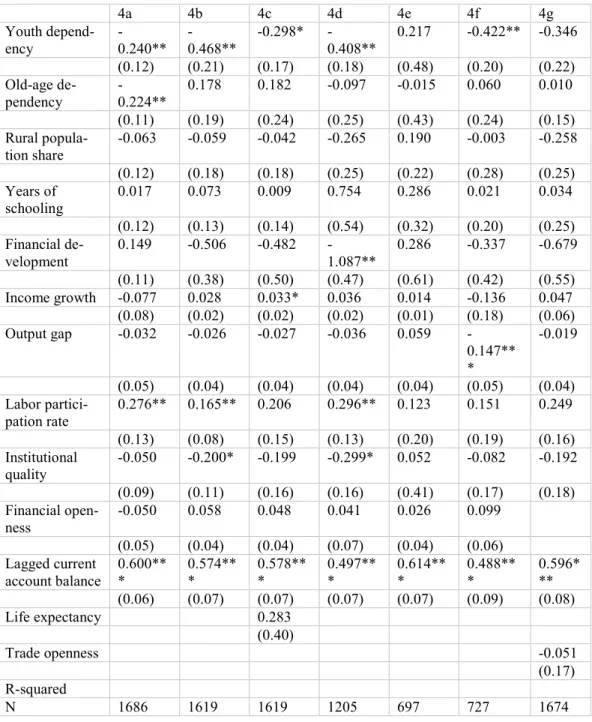
The results are reported in Table 4. All estimations reported in the table pass the autocorrelation and over-identification tests described above.
For the conventional model (4a), the lagged value of the current account
balance is significant and shows a sizable coefficient, vindicating its inclusion.23
For the new model (4b), once again, the lagged value of the current ac-count balance is significant and sizable. Moreover, there are noticeable changes to the demographic effects as compared to the static models. Youth dependency is now significantly negative. On the other hand, old-age dependency has a positive point estimate, but remains insignificant, as in the other specifications based on our suggested new framework.
The incorporation of short run dynamics in the model sees some substantial changes to the results compared to the static model. Both dependency ratios are now significantly negative at the 5% level. This finding thus would deliver sup-port for the lifecycle hypothesis described in the introduction.
We also conducted a number of robustness tests for the dynamic panel model. To keep the discussion focused, we only go through the results regarding
the new framework.24
Firstly, when life expectancy is added to the model (4c), the youth de-pendency ratio becomes insignificant. This is probably due to multicollinearity.
Secondly, since some sizeable OECD countries tend to have compara-tively low saving ratios, and at the same time attract a lot of international capital, one may also question if their current account balances respond to demographic changes differently from other countries. To examine this, we split the sample into an OECD and a non-OECD subsample. However, as in the OECD subsample, there is severe multicollinearity between regressors, including the youth depend-ency ratio, we can only report meaningful results for the non-OECD subsample (4d). Importantly, excluding the OECD countries does not change the main find-ings from the baseline case in that only the youth-age dependency ratio is signifi-cantly negative.
22 For a detailed discussion, see Roodmand (2009b).
23 Results from diagnostic tests suggest that one lag term is sufficient.
Table 4: Dynamic panel estimations; dependent variable: current account bal-ance/GDP 4a 4b 4c 4d 4e 4f 4g Youth depend-ency -0.240** -0.468** -0.298* -0.408** 0.217 -0.422** -0.346 (0.12) (0.21) (0.17) (0.18) (0.48) (0.20) (0.22) Old-age de-pendency -0.224** 0.178 0.182 -0.097 -0.015 0.060 0.010 (0.11) (0.19) (0.24) (0.25) (0.43) (0.24) (0.15) Rural popula-tion share -0.063 -0.059 -0.042 -0.265 0.190 -0.003 -0.258 (0.12) (0.18) (0.18) (0.25) (0.22) (0.28) (0.25) Years of schooling 0.017 0.073 0.009 0.754 0.286 0.021 0.034 (0.12) (0.13) (0.14) (0.54) (0.32) (0.20) (0.25) Financial de-velopment 0.149 -0.506 -0.482 -1.087** 0.286 -0.337 -0.679 (0.11) (0.38) (0.50) (0.47) (0.61) (0.42) (0.55) Income growth -0.077 0.028 0.033* 0.036 0.014 -0.136 0.047 (0.08) (0.02) (0.02) (0.02) (0.01) (0.18) (0.06) Output gap -0.032 -0.026 -0.027 -0.036 0.059 -0.147** * -0.019 (0.05) (0.04) (0.04) (0.04) (0.04) (0.05) (0.04) Labor partici-pation rate 0.276** 0.165** 0.206 0.296** 0.123 0.151 0.249 (0.13) (0.08) (0.15) (0.13) (0.20) (0.19) (0.16) Institutional quality -0.050 -0.200* -0.199 -0.299* 0.052 -0.082 -0.192 (0.09) (0.11) (0.16) (0.16) (0.41) (0.17) (0.18) Financial open-ness -0.050 0.058 0.048 0.041 0.026 0.099 (0.05) (0.04) (0.04) (0.07) (0.04) (0.06) Lagged current account balance 0.600*** 0.574*** 0.578*** 0.497*** 0.614*** 0.488*** 0.596*** (0.06) (0.07) (0.07) (0.07) (0.07) (0.09) (0.08) Life expectancy 0.283 (0.40) Trade openness -0.051 (0.17) R-squared N 1686 1619 1619 1205 697 727 1674 *, **, *** denote significance at 10%, 5% and 1% respectively.
Thirdly, we divide the data set into two 10-year periods, one from 1986 to
1995, and the other one from 1996 to 2005.25
Lastly, we refer to a standard measure of trade openness in place of finan-cial openness in constructing
There are two considerations lead-ing to this robustness check. Firstly, it allows us to examine whether the demo-graphic effects on the current account balance change over time. Secondly, the SYS GMM estimator is designed for data sets of “large N, but small T”. For the period of 1986-1995 (4e), both dependency ratios are insignificant, whereas for the period of 1996-2005 (4f), the key results are again the same as in the full sam-ple in that only the youth dependency ratio is significant and negative.
i
X . The most commonly used measure of trade
openness is total trade normalised with GDP. This measure, however, is sensitive to the business cycle. Therefore, we extract the long run trend using the Hodrick-Prescott filter and treat it as a predetermined rather than exogenous variable. The youth dependency ratio retains the negative sign, as before, but its standard error has increased somewhat such that its significance level falls out of the two side 10% range (p=0.12) (4g).
5.4 Discussion
What can we take from the reported regressions? Although the details vary from estimation to estimation, as expected, a number of general observations regarding the demographic effects on the current account balance is in order.
Firstly, accounting for the inertia of the current account balance makes substantial differences to the results within both the new and conventional frame-works. Accordingly, when discussing the principal findings on the demographic effects on the current account balance, it is important to emphasise whether the results are based on static or dynamic models.
Secondly, for either the static or the dynamic models, our results based on the new framework are noticeably different from those based on the conventional ap-proach. This suggests that at the very least, accounting for general equilibrium, relative size and openness is important in modelling the current account balance; and that at the very most, all previous estimations based on the conventional framework are biased.
Thirdly, for either the static or the dynamic models, the results based on the new framework indicate that the effect of population ageing on the current ac-count balance is much more subdue than reported in previous studies using the conventional framework. As discussed in the literature review, this is not contra-dictory to the theoretical arguments, because population ageing could affect both savings and investment, leaving its effect on excess saving over investment (i.e.
the current account balance) ambiguous. Furthermore, people moving toward re-tirement may save more, and retirees may dissave more slowly due to longevity uncertainty. In this regard, it is plausible for population ageing to have either a positive or a negative impact on the current account balance, or no discernible impacts at all – as found in this study.
6. CONCLUSION
This paper re-examines the effects of demography on the current account balance. A key departure of the paper from, and hence its contribution to the current litera-ture is its consideration of the general equilibrium nalitera-ture of the current account balance in a world of heterogeneous economic size and openness. Our modelling framework differs from the conventional one in three aspects. Firstly, it recog-nises that in a general equilibrium setting, it is the relative pace of demographic changes across countries rather than the absolute pace of changes in a particular country that contributes to determining its current account balance. Secondly, it acknowledges the fact that a country can influence others and likewise be influ-enced by others only up to the extent that it is economically open. Thirdly, it ac-counts for the fact that the influence of one country on another depends on their relative sizes.
This new framework is put to test referring to a large panel data set. The empirical strategy is to estimate the new and conventional models and contrast their differences. It is demonstrated that the new framework leads to noticeable changes in some conclusions based on the conventional one. The new evidence indicates that population ageing as measured by old-age dependency does not have discernible impacts on the current account balance, and thus suggesting that different findings in the previous literature may be due to the negligence of the general equilibrium, size and openness factors.
In a nutshell, the effects of demographic factors on the current account balance may comprise more – and sometimes conflicting – driving forces than previously considered, which calls for more research along the lines suggested here. Last but not the least, although the current study focuses on demography, the key rationale behind the new framework is quite general and hence applicable to empirical studies of many other open economy issues.
APPENDIX Country coverage
Angola Ecuador Lesotho Poland
Argentina Egypt Madagascar Portugal Australia El Salvador Malaysia Rwanda
Austria Ethiopia Mali Senegal
Bangladesh Finland Mauritania Sierra Leone Belgium France Mauritius Singapore
Benin Germany Mexico Spain
Bolivia Ghana Morocco Sri Lanka
Brazil Guatemala Mozambique Sudan
Bulgaria Haiti Nepal Sweden
Burundi Honduras Netherlands Switzerland Cameroon Hungary New Zealand Syria
Canada India Nicaragua Thailand
Chile Indonesia Niger Togo
China Israel Nigeria Trinidad and Tobago
Colombia Italy Norway Tunisia
Congo Jamaica Pakistan Turkey
Costa Rica Japan Panama Uganda
Cote d`Ivoire Jordan Papua New Guinea United Kingdom
Denmark Kenya Peru United States
Dominican Republic Korea Philippines Uruguay
REFERENCES
Arellano, Manuel, and Stephen Bond (1991) ‘Some tests of specification for panel data: Monte Carlo evidence and an application to employment equations.’ Re-view of Economic Studies, 58(2): 277-297.
Arellano, Manuel, and Olympia Bover (1995) ‘Another look at the instrumental variables estimation of error components models.’ Journal of Econometrics, 68(1): 29-51.
Attanasio, Orazio P., Sagiri Kitao, and Giovanni L. Violante (2006) ‘Quantifying the effects of the demographic transition in developing economies.’ Advances in Macroeconomics 6(1): Article 2.
Barro, J. Robert, and Jong-Wha Lee (2001) ‘International data on education at-tainment: updates and implications.’ Oxford Economic Papers 53(3): 541-563.
Bond, Stephen (2002) ‘Dynamic panel data models: A guide to micro data meth-ods and practice.’ CEMMAP Working Paper CWP09/02. The Institute for Fis-cal Studies, Department of Economics, University College of London.
Blundell, Richard, and Stephen Bond (1998) ‘Initial conditions and moment re-strictions in dynamic panel data models.’ Journal of Econometrics, 87(1): 115-143.
Chinn, Menzie D., and Hiro Ito (2007) ‘Trade account balances, financial devel-opment and institutions: assaying the world “saving glut.”’ Journal of Interna-tional Money and Finance 26(4): 546-569.
Chinn, Menzie D., and Eswar S. Prasad (2003) ‘Medium-term determinants of current accounts in industrial and developing countries: an empirical explora-tion.’ Journal of International Economics 59(1): 47-76.
Cooper, Richard N. (2008) ‘Global imbalances: globalization, demography, and sustainability.’ Journal of Economic Perspective 22(3): 93-112.
Domeij, David, and Martin Flodén (2006) ‘Population aging and international capital flows.’ International Economic Review 47(3): 1013-1032.
Edwards, Sebastian (1996) ‘Why are Latin America's saving rates so low? An in-ternational comparative analysis.’ Journal of Development Economics 51: 5-44. Feroli, Michael (2003) ‘Capital flows among the G-7 nations: A demographic perspective.’ Finance and Economics Discussion Series 2005-54, Board of Governors of the Federal Reserve System.
Graff, Michael (2005) ‘Socio-Economic Factors and the Finance-Growth Nexus.’ European Journal of Finance 11(3): 183-205.
Gretz, Richard, and Jannett Highfill (2010) ‘Recession, R&D spending, and the current account: bad news, bad news, and little encouragement.’ Global Econ-omy Journal, 10(1): article 7.
Gruber, Joseph W., and Steven B. Kamin (2007) ‘Explaining the global pattern of current account imbalances.’ Journal of International Money and Finance, 26(4): 500-522.
Higgins, Matthew (1998) ‘Demography, national savings and international capital flows.’ International Economic Review, 39(2): 343-369.
Higgins, Matthew, and Jeffrey G. Williamson (1997) ‘Age structure dynamics in Asia and dependency on foreign capital.’ Population and Development Review, 23(2): 261-293.
Holtz-Eakin, Douglas, Whitney Newey, and Harvey S. Rosen (1988) ‘Estimating vector autoregressions with panel data.’ Econometrica, 56(6): 1371-1395. Kim, Soyoung, and Jong-Wha Lee (2007) ‘Demographic changes, saving, and
current account in East Asia.’ Asian Economic Papers 6(2): 22-53.
King, Robert. G., and Ross Levine (1993) ‘Finance and Growth. Schumpeter Might Be Right.’ Quarterly Journal of Economics, 108(3): 717-738.
Lizardo, Radhames, and Andre V. Mollick (2009) ‘The sustainability of the U.S. current account deficit: revisiting Mann’s rule.’ Global Economy Journal, 9(4): article 4.
Li, Hongbin, Jie Zhang, and Junsen Zhang (2007) ‘Effects of longevity and de-pendency rates on saving and growth: Evidence from a panel of cross coun-tries.’ Journal of Development Economics, 84(1): 138-154.
Legg, Anthony, Nalini Prasad, and Tim Robinson (2007) ‘Global imbalances and the global saving glut – a panel data assessment.’ Research Discussion Paper, Reserve Bank of Australia, 2007-2011.
Lynch, David (1996) ‘Measuring Financial Sector Development: A Study of Selected Asia-Pacific Countries.’ The Developing Economies, 34(1): 3-33. Masson, Paul R., Tamin Bayoumi, and Hossein Samiei (1998) ‘International
evi-dence on the determinants of private saving.’ The World Bank Economic Re-view, 12(3): 483-501.
Mérette, Marcel, and Patrick Georges (2010) ‘Demographic changes and the gains from globalisation: An analysis of ageing, capital flows, and international trade’ Global Economy Journal, 10(3): article 3.
Modigliani, Franco (1970) ‘The life cycle hypothesis of consumption.’ in: W. A. Eltis, M. F. G. Scott, and J. N. Wolfe, eds., Induction, growth, and trade: Es-says in Honour of Sir Roy Harrod, Oxford University Press: 197–225.
Obstfeld, Maurice, and Kenneth Rogoff (2000) ‘The six major puzzles in interna-tional macroeconomics: is there is a common cause?’ NBER Macroeconomics Annual. The MIT Press.
Roodman, David (2009a) ‘How to do xtabond2: an introduction to difference and system GMM in Stata.’ The Stata Journal, 9(1): 86-136.
Roodman, David (2009b) ‘A note on the theme of too many instruments.’ Oxford Bulletin of Economics and Statistics, 71(1): 135-158.
Sachs, Jeffrey, and Andrew Warner (1995) ‘Economic reform and the process of global integration.’ Brookings Papers on Economic Activity 1, pp.1-118. Siklos, Pierre L., and Andrew G. Barton (2001) ‘Monetary Aggregates as
Indica-tors of Economic Activity in Canada: Empirical Evidence.’ Canadian Journal of Economics, 34(1): 1-17.
Windmeijer, Frank (2005) ‘A finite sample correction for the variance of linear efficient two-step GMM estimators.’ Journal of Econometrics, 126(1): 25-51.