People’s Democratic Republic of Algeria
Ministry of Higher Education and Scientific Research 8 MAI 1945 UNIVERSITY / GUELMA ةملاق / 1945 يام 8 ةعماج FACULTY OF LETTERS AND LANGUAGES تاغللا و بادلآا ةيلك DEPARTMENT OF LETTERS & ENGLISH LANGUAGE ةيزيلجنلااةغللا و بادلآا مسق
Option : Civilisation
Prospects of Scottish Independence in the
Aftermath of Brexit
A Dissertation Submitted to the Department of Letters and English Language in Partial Fulfillment of the Requirements for the Degree of Master in Language and Culture
Board of Examiners
Supervisor: Mr. BOUDECHICHE Hamid University of 8 Mai 1945- Guelma Chairman: Prof. ELAGGOUNE Abdealhak University of 8 Mai 1945 Guelma Examiner: Miss. TOULGUI Insaf University of 8 Mai 1945- Guelma
Presented by: KECHRID Marwa Supervised by: Mr. BOUDECHICHE Hamid
Acknowledgments
First and foremost, I thank Allah the Almighty Who guided me and helped me in
achieving this academic work, and Whose many blessings have made me the person I am
today.
My profound obligation is to my supervisor Mr. Hamid Boudechiche, without whose
help I could never have contemplated completing this dissertation. His support, guidance and
encouragement helped me in every step of this research, and he never hesitated to provide
critical comments or offer any kind of help.
My utmost gratitude is owed to the members of the examining committee for kindly
taking of their valuable time to go through the very pages of this work, and providing me with
their valuable and insightful remarks and critical comments and questions.
I would like to acknowledge a personal debt. I only hope that this work repays, albeit
in a small way, the many kindnesses of every person who supported me and stood by my side
Dedication
Thanks to Allah Who helped me and gave me the strength and the patience to finish
this work.
My joy and sense of fulfillment would not be complete without saying thanks to
everyone who afforded me with help and support throughout this research experience.
A great and profound gratitude goes to my beloved parents ALI and Richi Sorya. They
have been the source of encouragement I needed throughout the course of writing this
dissertation. The source of the wisdom and the principal of my life, the candle that enlighten
my darkness. Because of their continual guidance and advices, I preserve the same trend of
success from the primary school until now.
Thank you my mother and my father for being there for me and for teaching me to
fightfor what I believe in.
I dedicate this humble work to my brothers Amin and Akram and sister in-law for
their moral support, as to all my best friends especially: my dearest Benhamouda Hanan.
Mouna and Fatma Athmenia for their support, love, help and encouragement. Also to my big
family and my fiancé.
To my supervisor, Mr. Hamid Boudechiche, for his help, support and guidance.
And to all my teachers for their encouragement and continued support.
Abstract
This dissertation titled “Prospects of Scottish Independence in the Aftermath of Brexit”,
aims to examine the Scottish struggle for independence; after more than three centuries of
alliance with Britain. Also it traces back the main stages through which the Scottish arrived at
holding the Independence Referendum in the 18th of September, 2014. This work emphasizes
the major reactions of the Anglo-Scottish union. Additionally, the current work sheds light on
the main motives behind this desire for independence, and it provides the main arguments that
support it. Notably this paper gives an overview about Brexit and its implications on the
United Kingdom. In this context, it focuses on Brexit as a motive for Scotland to continue its
march on the independence path mainly, the opportunity of holding a second referendum. It
also examines Scotland’s future after the formal completion of the Berxit procedures with the
Résumé
Cemémoire porte sur l'effet de la sortie de la Grande-Bretagne de l'Union Européenne sur l'indépendance de l’écosse. Destiné à étudier le combat écossais pour l'indépendance après
plus de trois siècles d'alliance avec la Grande-Bretagne. Il suit également les principales
étapes franchies par les Ecossais lors du référendum d'indépendance du 18 septembre 2014.
Cette action souligne les principales réactions de l'Union anglo-écossaise. De plus, ce travail
éclaire les motivations sous-jacentes de ce désir d'indépendance et présente les principaux
arguments qui le soutiennent. Il convient de noter que ce mémoire donne un aperçu de la
sortie de la Grande-Bretagne de l'Union européenne et de ses implications pour le
Royaume-Uni. Dans ce contexte, il met l'accent sur la sortie de Grande-Bretagne de l'Union européenne
comme un motif pour l'écosse de continuer principalement sur la voie de l'indépendance et la
possibilité d'organiser un second référendum. Avec les attentes de l'avenir de l'écosse après
صخلم ت فده هذه ةركذملا ناونعب “ رثأ يبورولأا داحتلاا نم ايناطيرب جورخ للاقتسلاا ىلع يدنلتكسلأا ” ىلإ عارصلا ةسارد للاقتسلاا لجأ نم يدنلتكسلإا . ايناطيرب عم فلاحتلا نم نورق ةثلاث نم رثكأ دعب . يتلا ةيسيئرلا لحارملا عبتت اهنأ امك يف للاقتسلاا ءاتفتسا ءارجإ يف نويدنلتكسلإا اهيلإ لصو 18 ربمتبس 2014 . ةيسيئرلا لعفلا دودر ىلع لمعلا اذه دكؤي ولجنلأا داحتلال -نلتكسأ يف ةبغرلا هذه ءارو ةيساسلأا عفاودلا ىلع ءوضلا لمعلا اذه طلسي ،كلذ ىلإ ةفاضلإاب .يد .همعدت يتلا ةيسيئرلا ججحلا مدقيو ،للاقتسلاا هذه نأ ىلإ ةراشلإا ردجتو ةركذملا نع ةماع ةحمل مدقت نم ايناطيرب جورخ يبورولأا داحتلاا " تيسكيرب " يف .ةدحتملا ةكلمملا ىلع اهتاريثأتو داحتلاا نم ايناطيرب جورخ ىلع زكرت اهنإف ،قايسلا اذه ىلإ ابنج .ٍناث ءاتفتسا ءارجإ ةصرفو ،يسيئر لكشب للاقتسلاا راسم ىلع اهتريسم ةلصاومل ادنلتكسلإ عفادك يبورولأا تاءارجإ نم ايمسر ءاهتنلاا دعب ادنلتكسا لبقتسم تاعقوت عم بنج يبورولأا داحتلاا نم ايناطيرب جورخ .
Lis of Abbreviations and Acronyms EEA European Economic Area
EEC European Economic Community
EU European Union
FAI Fraser of Allander Institute GDP Gross Domestic Product MPs Members of the Parliament MSP Members of Scottish Parliament SNP Scottish National Party
UK United Kingdom
UKIP UK Independence Party
Table of Contents
General Introduction Erreur ! Signet non défini.
Chapter One : Devolution and Scotland Act 7
Introduction 7
1.1. The Path towards the Act of Union 7
1.1.1. The Act of Settlement: June 12, 1701 8
1.1.2. The Act of Security: 5th of August, 1704 9
1.1.3. The Alien Act, 1705 10 1.1.4. The Act of Union 1707 Erreur ! Signet non défini.
1.1.5. Articles of the Treaty of Union Erreur ! Signet non défini.
1.2. Scotland after the Act of Union 1707 Erreur ! Signet non défini.
1.2.1. Economic Changes Erreur ! Signet non défini.
1.2.2. Social and Cultural Changes Erreur ! Signet non défini.
1.2.3. Political Changes Erreur ! Signet non défini.
1.3. A Background to Devolution in Scotland Erreur ! Signet non défini.
1.3.1. . The Royal Commission on the Constitution Erreur ! Signet non défini.
1.3.2. Scottish Devolution Referendum in 1979 20 1.3.3. The Cunningham Amendment Erreur ! Signet non défini.
1.3.4. A Background to the Scottish Devolution Referendum 1997 Erreur ! Signet non défini.
1.3.5. The 1997 Referendum Erreur ! Signet non défini.
1.3.6. The Scotland
Bill Erreur ! Signet non défini. 1.3.7. The Scotland Act 1998 Erreur ! Signet non défini.
Conclusion 30
Chapter Two: Scottish Independence Referendum Erreur ! Signet non défini.
Introduction Erreur ! Signet non défini.
2.1. The Path to the 2014 Referendum Erreur ! Signet non défini.
2.1.1. The Impacts of the Scotland Act 1998 Erreur ! Signet non défini.
2.1.2. The White Paper: “Choosing Scotland’s Future” and the Calman Commission Erreur ! Signet non défini.
2.2. Referendum Bill 2010 Erreur ! Signet non défini.
2.2.1. The Impact of 2011 Elections Erreur ! Signet non défini.
2.3 Your Scotland, Your Referendum 42
2.3.1. The Edinburgh Agreement Erreur ! Signet non défini.
2.4. The Referendum
Bills Erreur ! Signet non défini.
2.4.1. Scottish Independence Referendum (Franchise) Act 2013 Erreur ! Signet non défini.
2.4.2. The Scottish Independence Referendum (Franchise) Bill Erreur ! Signet non défini.
2.4.3. II. The Scottish Independence
Referendum Erreur ! Signet non défini.
2.5. The Referendum Campaigns Erreur ! Signet non défini.
2.5.1. “Yes Scotland” Erreur ! Signet non défini.
2.5.2. Identity and
Society Erreur ! Signet non défini.
2.5.3. Equality and
Economy Erreur ! Signet non défini.
2.5.4. Better Together
Campaign Erreur ! Signet non défini. 2.5.5. Arguments and Reasons for the “No”
Vote Erreur ! Signet non défini.
2.5.6. Two Complementary Identities Erreur ! Signet non défini.
2.5.7. The Question of Scotland’s Economic Future Erreur ! Signet non défini.
2.5.8. More Powers from Westminster and the Fear of Isolation Erreur ! Signet non défini.
Conclusion Erreur ! Signet non défini.
Chapter Three: Effects of Brexit on Scottish Independence Erreur ! Signet non défini.
Introduction Erreur ! Signet non défini.
3.1.
Brexit Er reur ! Signet non défini.
3.1.1. Significance of the Concept Erreur ! Signet non défini.
3.1.2. Causes of Brexit Erreur ! Signet non défini.
3.1.3. Effects of Brexit Erreur ! Signet non défini.
3.2. Brexit and its Effects on Scotland Erreur ! Signet non défini.
3.2.1. Scottish Reaction to Brexit Erreur ! Signet non défini.
3.2.2.
Acceptance Er reur ! Signet non défini.
3.2.3. Stop Brexit Erreur ! Signet non défini.
3.2.4. Soft Brexit for the UK Erreur ! Signet non défini.
3.2.5. Differentiated Brexit Erreur ! Signet non défini.
3.2.6.
Independence Er reur ! Signet non défini.
3.3. Costs of Brexit on Scotland Erreur ! Signet non défini.
3.4. Brexit and Scottish Independence Erreur ! Signet non défini.
3.4.1. Brexit as a Hindrance for Scottish Independence Erreur ! Signet non défini.
3.4.2. Brexit as a Factor for Scottish Independence Erreur ! Signet non défini.
3.5. The Future
Scotland Erreur ! Signet non défini.
Conclusion Erreur ! Signet non défini.
General Conclusion Erreur ! Signet non défini.
Bibliograpgy Erreur ! Signet non défini.
Appendices 87
Appendix I: The Articles of Union Erreur ! Signet non défini.
Appendix 2: The list of reserved subjects in The Act of Scotland 1998 Erreur ! Signet non défini.
List of Tables
Table 1: Results of Scottish Parliament Referendum 1979 22
Table 2: Scottish Parliament Referendum Results 1997 28
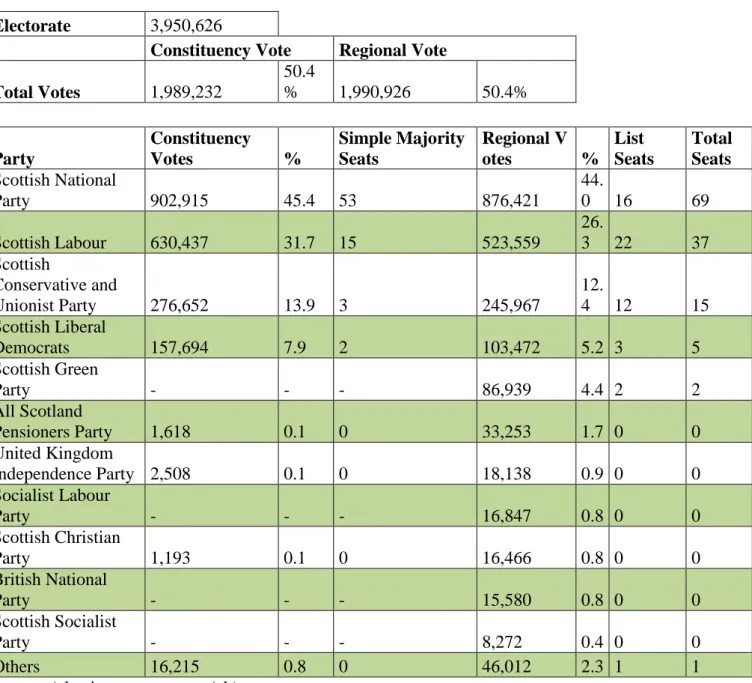
Table 3: May 5, 2011 Election Results - Scotland Totals 40
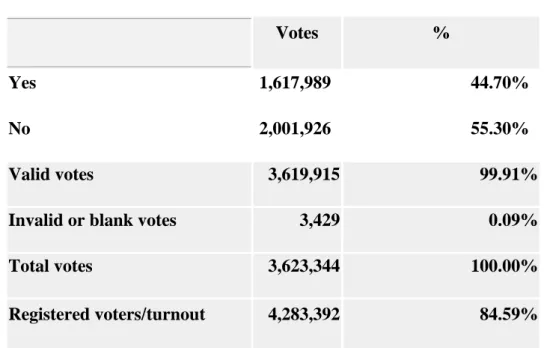
Table 4: Results of the18th September 2014 Scottish Independence Referendum ("Scottish
Independence Referendum, 2014") 48 Table 5: The Referendum Results on the UK’s Exit of the EU on 23rd June 2016 58
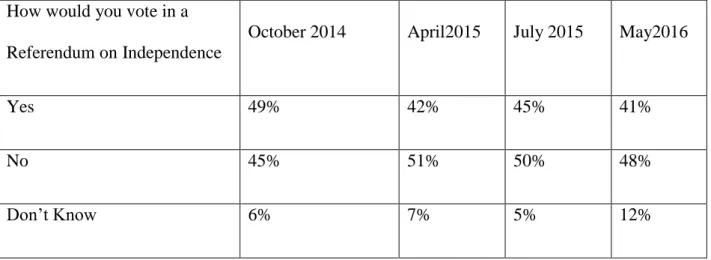
Table 6: Support for Independence in Scotland: October2014, April 2015, July 2015, May
List of Figures
Figure 1: The Scottish Referendum Ballot Paper 1999 Erreur ! Signet non défini.
General Introduction
Uniting the kingdoms of Scotland and England had been proposed for a hundred years
before it actually happened in 1707. Suspicion and mistrust between the two countries had
prevented the union throughout the 17th century. The Scots feared that they would simply
become another region of England. For England the fear that the Scots may take sides with
France and rekindle the “Auld Alliance” was decisive. The “Alud Alliance” refers to an
alliance made in 1295 between the kingdoms of Scotland and France. The alliance was
formed for the purpose of controlling England's numerous invasions (Bonner 5-30). England
relied heavily on Scottish soldiers and to see them turn and join ranks with the French would
have been disastrous. In the late 1690s however, thousands of ordinary Scottish folk had been
tempted to invest their hard earned money in a plan to link the two great oceans of the world
by establishing an overland trading route between the Pacific and Atlantic.
Poorly, the venture ended early in 1700 with significant loss of life and financial ruin for
the Kingdom of Scotland. With planned many influential individuals and whole families left
bankrupt by the disaster, a few financial incentives appear to have convinced some dithering
Scottish MPs of the potential benefits of a union with England. Moreover, in a poorly
attended Scottish Parliament the MPs voted to agree on the Union and on 16 January 1707 the
Act of Union was signed. The Act came into effect on May 1st 1707; the Scottish Parliament
was dissolved and England and Scotland became one country. However, Scotland kept its
independence with respect to its legal and religious systems, but coinage, taxation, trade,
sovereignty, parliament and flag became one.
Since the Treaty of Union in 1707, which unified the English and Scottish parliaments in
London, Scotland, has legally been joined with England. Over three hundred years later,
Scotland formed a parliament, which set Scotland on a path of devolution with an unclear
home rule, but their attempts were failure, particularly the devolution referendum of 1979. In
1999, the Scottish Parliament was established in Edinburgh after the devolution referendum of
1997. Recently in 2011, the Scottish National Party; which was created in 1934, won
parliamentary elections with 69 seats, taking control over the Scottish parliament, and thus
permitting the first minister to demand the first Scottish Independence Referendum. This
latter was held on the last 18th, September, 2014.
Moreover, in the Scottish Independence Referendum held on the 18th September 2014,
scots voted for remaining as a part of the United Kingdom. Yet the United Kingdom suffered
of many problems because of the Scottish Independence Referendum. However, the Scottish parliament asked for a second referendum because of “Brexit”. The Brexit refers to the
possibility of Britain withdrawing from the European Union (EU). It was argued that if the
UK separates itself from the EU, these fees can be used to benefit the UK. In 23 June, 2016
the people of Scotland voted decisively to remain in the European Union while the people of
the United Kingdom as a whole voted to leave. While Scotland voted for the Remain.
Brexit is considered as a turning point in the history of the United Kingdom, since many
issues would change. Therefore, this study is not only a mere description of the relationship of
Britain and Scottish before and after the Act of Union, but it is also an analytical account of the UK’s membership and experience in the EU. It further not only describes the Brexit and
the British situation after the complete exit from the EU, but it also gives an analytical
explanation that digs deep into the Brexit impact on the United Kingdom generally and the
Scottish reaction practically. In addition to explaining the British and Scottish relationship
before and after the UK withdraw with EU, this study also helps in giving clear image about
the possible economic situation in Britain in one hand and in Scotland in the other hand.
In pursuit of the main topic, this dissertation deals with different questions concerning the
impact of the British withdrawal from the EU on the Scottish referendum. It attempts to
provide answers to the following questions: What are the events that led to the unification of
Britain and Scotland? In what way this unification changed the type of relation between the
two countries? How will Brexit affect the Scottish referendum? Does Brexit mean the
Scotland exit from the UK? Will Scotland be an independent country? Will this affect the UK
as whole?
To provide a solid ground that supports the main concern of the dissertation, this study is
drawn on many works that have dealt with the UK’s membership in the EU, its relationship
with Scotland, and the latest referendum to leave the EU and the likely impacts it would have
on the Scottish referendum and independence.
In order to accomplish this study, the bulk of this dissertation will be written based on the
findings in different books, journals, and empirical research articles that best serve the topic.
In the reading and data collection, the research will be certainly based on works which dig
deep in the Scottish relationship with the UK, before and after the Act of Union and give
more hints and reveal more the reality behind this act. In addition to the works which explain
the Brexit and the Scottish reaction. The study will tackle scholars’ evaluation, analysis and
explanation of some previously used books and articles that will be of great importance in the
progression
Christopher Whatley, by far the most eminent of the authors, adds further context to the
Anglo-Scottish story. In The Scots and the Union 20 Oct 2006, he argues that it wasn't just
threats and inducements that created Great Britain, but a committed group of Scottish
Protestants who had long seen union as a means of extinguishing Catholic influence of the
Moreover, Britain is now set to leave the European Union; the 2015 Conservative
Manifesto contained a pledge to hold a referendum on UK membership of the EU On March
29th the UK Prime Minister, Theresa May, formally notified the EU, in accordance with
Article 50 of the Treaty of Lisbon that the UK proposed to withdraw. Harold D. Clarke,
Matthew Goodwin, and Paul Whiteley wrote Brexit: Why Britain Voted to Leave the
European Union. This book reveals, the historic vote for Brexit marked the culmination of trends in domestic politics and in the UK’s relationship with the EU that have been building
over many years. However, in Scotland a majority of those who participated in the
referendum voted to Remain in the EU.
That certainly seems to have been the assumption under which the Scottish Government
has been operating in recent months. In December it published a white paper in which it
proposed that the UK as a whole should be seeking to remain in the EU single market and that
it should continue to adhere to the freedom of movement provisions of the European Union. It
also proposed that even if the UK were to be outside the single market and no longer
observing the freedom of movement provisions, Scotland could and should be able to do so,
even while remaining part of the UK. In short, the Scottish Government was suggesting that
the UK might have a variegated relationship with the EU, with some parts having a closer
relationship than others.
This work is divided into three main chapters. Chapter one entitled “Devolution and
Scotland Act” provides the historical account of the development of the Anglo-Scottish
relations. It sheds light on the Union of English and Scottish Crowns and the political union.
In addition, it gives a description of the nature of union and the changes in Scotland in
particular and the United Kingdom as a whole. Moreover, it focuses on the concept of
It also explains the basic reasons which pushed the Scottish people to ask for
devolution. The Kilbrandon report, which changed the Scottish view towards the British
identity and the Scottish one, added to the political and mainly the economic reasons behind
devolution. This chapter explains the results of the spread of the concept of devolution, which
is the Scottish Referendum of 1979 and 1997 and the causes of its failure. This chapter also
explains the results of this latter election. Finally, it deals with the Scotland Bill of 1998 and
its role in the Scottish parliament.
The Second chapter holds the title “The Scottish Independence Referendum”. It proves
that the Scottish referendum independence was a result of many political developments and
changes in Scotland. It also addresses the impact of the Scotland Act 1998. It gives a
description of the new Scottish politics by focusing mainly on the nature of the government
after the introduction of the coalition and minority government.
Further, it discusses the impact of general elections since 1999 to 2011 with the
explanation of the legislative framework, such as: The Scotland Bill and Your Voice Your
Referendum, between the governments of Scotland and UK during that era. Finally, the
present chapter gives the general structure of Independence Referendum on September 2014.
The analysis of the results of the referendum in light of the campaigning of this referendum
which has a major impact on the results of this later, is also handled within this chapter The third chapter which is entitled “Effects of Brexit on Scottish Independence”,
provides that the Scottish independence path changed because of many factors, one of which
is the Brexit. The later emerged during the 23 June 2016 referendum, which was held in the
United Kingdom to decide if the British want to leave the European Union or not. It explains
that during the later referendum the Scottish people had a different point of view than the
other parts of the UK. This reason led to the emergence of the idea of the second Scottish
explaining the reasons of its emergence and its costs on the UK in general and on Scotland in
particular.
Additionally, this chapter focuses on the Scottish arguments why Brexit refused. In
addition, it gives a possibility about the arguments which would make the Scottish use Brexit
as a factor for the independence, or why the Scottish believes that Brexit is an obstacle in the
Chapter One
1. Devolution and Scotland Act. Introduction
The first chapter of this dissertation is entitled “Devolution and Scotland Act”
provides the historical account of the development of the Anglo-Scottish relations; it sheds
light on the Union of English and Scottish Crowns and the political union. In addition, it gives
a description of the nature of union and the changes in Scotland in particular and the United
Kingdom as a whole.
Moreover, this chapter focuses on the concept of Devolution which appeared after
more than a century of union. It explains the basic reasons which pushed the Scottish people
to ask for devolution. The Kilbrandon report, which changed the Scottish view towards the
British identity and the Scottish one, added to the political and mainly the economic reasons
behind devolution.
After that, this chapter explains the results of the spread of the concept of devolution,
which is the first Scottish Referendum of 1979. The causes of failure of this referendum
eventually led up to the Scottish referendum of 1997. The chapter also explains of the results
of this latter election. Finally, it deals with the Scotland Bill of 1998 and its role in the
Scottish parliament.
1.1. The Path towards the Act of Union
Until the early 17th century, England and Scotland were two entirely independent
kingdoms (Lambert). This however, changed dramatically in 1603 on the death of Elizabeth I
of England. The death of this English monarch announced the end of the English Tudor
dynasty and left the throne with no heirs because she was the last, unmarried and childless
monarch in the Tudor line of succession. The English crown passed to the next available heir,
grandmother (Margaret Tudor). As a result, England and Scotland now shared the same monarch under what was known as the “Union of Crowns” (Lmabert “A History of the
17th…”).
After the union of the crowns there was no immediate move to unite the countries.
However, during the last decade of the 17th century, there was not only political and
economic stagnation in Scotland, but there was a big famine as the country was recovering
from a severe crop failure (Pettegree). Since the Anglo-Scottish relations were still not
satisfactory, there was an urgent need to find a way to solidify them. One of the possible
solutions was to strengthen the bonds between the countries and create a well-functioning
union, Great Britain, despite the fact that Scotland tried to improve its economic situation
without the help of Britain. For that purpose, the Scottish established a trade company called
the Company of Scotland for trade with Africa and the West Indies. However, without the
involvement of Britain all attempts were in vain (De Castella and Judah).
There had been many attempts to unite politically the two realms between 1606 and 1689,
but the parliament failed to join them until the early years of the eighteenth century. The
process of unification passed through many stages and acts, which were legislated in order to
regulate the union and the relation of the two countries under the union (“Scotland and England: a…”)
1.1.1. The Act of Settlement June 12, 1701
It is Act of Parliament that, since 1701 had regulated the succession to the throne of Great
Britain. The English Parliament was concerned about the identity of the successor who was to succeed the throne after Queen Anne’s death. The act disqualified anyone who became a
Roman Catholic, or who married one, from inheriting the throne and this removed a lot of
lines who were closely related to Queen Anne and the Stuart line. The Act also helped
leave the country without Parliaments approval, nor were they able to throw the country into
war without Parliament’s agreement. Eventually it was decided that Electress Sophia of
Hanover, a granddaughter of James VI & I, would be next in line to the throne. The Act of
Settlement is nowadays still valid ("Act of Settlement 1701 - Wikisource, The Free Online
Library"). This act stated that:
no person born out of the kingdoms of England, Scotland, or Ireland, or the dominions
thereunto belonging (although he be naturalized or made a denizen), except such as
are born of English parents, shall be capable to be of the Privy Council, or a member
of either House of Parliament, or enjoy any office or place of trust, either civil or
military, or to have any grant of lands, tenements, or hereditaments from the Crown to
himself, or to any other or others in trust for him (Hallam 465).
In response to this act, the Scottish Parliament passed two acts in 1703. The first act was
the Act Anent Peace in which Scotland claimed its control over its foreign policy and expressed its refute to wage war for England’s benefits. Yet the second act was the Act of
Security.
1.1.2. The Act of Security 5th of August 1704
Scotland refused to follow the English Act of Settlement and responded with issuing the
Act of Security, an important step towards Union, in 1704 according which the succession
was resolved by Parliament and that the successor in England would not be named if Scottish
grievances over religion, liberty, and trade were not met. In other words, this act was
supposed to preserve the independence of the Scottish Crown. It also provided, rather
pointedly, for a military force to be trained for the defense of the country. Further measures
removed foreign policy from the control of the Sovereign and provided for the duty-free
upon the said Death of Her Majesty, without Heirs of her Body… the foresaid Estates
of Parliament… are hereby Authorized and Empowered, to Nominate and Declare the
Successor to the Imperial Crown of this Realm, and to Settle the succession thereof…
being always of the Royal Line of Scotland and of the true Protestant Religion.
Providing always that the same be not successors to the Crown of England, unless
there be such conditions of Government settled as may secure the Honor and
Sovereignty of this Crown and Kingdom; the Freedom, Frequency and Power of
Parliament; Religion; and Liberty and Trade of the Nation from English or any
Foreign Influence
In return, the English Parliament responded in 1705 with the Alien Act.
1.1.3. The Alien Act 1705
English reaction to the Act of Security was swift. In 1705, the Alien Act was passed.
Under this act all Scotsmen were to be treated as aliens, also this act would also class all
Scottish people living in England as “aliens” and any property they owned would be” alien property”. This would mean that a line of inheritance would not be guaranteed which could
lead to Scottish landowners losing their estates in England.
that from and after the 25 day of December 1705, no Person or Persons being a Native or Natives of the Kingdom of Scotland… shall be capable to inherit any
Lands... within this Kingdom of England ... or to enjoy any Benefit or
Advantage of a natural-born Subject of England: But every such Person shall
be from henceforth adjudged and taken as an Alien born out of the allegiance
of the Queen of England, until such time as the Succession to the Crown of
Scotland, be declared and settled by an Act of Parliament in Scotland ("Union
Moreover, England threatened that unless Scotland agreed to negotiate terms for union and
accepted the Hanoverian succession. The act of Aliens also set out to ban exports of major
Scottish products - cattle, sheep, coal or linen in England despite the harsh circumstances
happening in Scotland. At that time, the countries seemed to be close to war. (Westminster
passes the Alien Act 1705).
Since the war between the countries was not in the interest of neither England nor that of
Scotland, they had to act quickly in order to avoid the armed conflict. That was why in summer 1705 John Campbell, 2nd Duke of Argyll, set off to Edinburgh as the Queen’s
Commissioner to initiate negotiations for the Anglo-Scottish union. It took some time to
persuade the Scottish Parliament to authorize the negotiations for the Treaty of Union.
1.1.4. The Act of Union 1707
The process and the negotiations about the Act of Union was not an easy task to fulfill.
Each country was trying to protect its goods and needs, also both of countries tried to benefit
to the maximum extent from the union. The idea of the Union had its supporters and
opponents. One of the major anti-union representatives was the Church of Scotland. Another
group of opponents were the Jacobites whose attitude against the union outgrew into a
revolution in later years. Meanwhile, it is considered as “inevitable” because of the economic
and social growth of the island of Great Britain, and saw it as a middle solution for both
English and Scottish interests. Others considered it as a result of self-interest and bribery of
some members of the last Scottish Parliament, while other historians saw it as a natural
termination of the Union of Crowns of 1603. These interpretations overwhelmed the Scottish
politics since 1707 (Bowie).
The Treaty of Union was negotiated between the two countries (the commissioners
and the British MPs) which led to the drawing up of the Bills which became the 1706/1707
the representatives of the Scottish parliament carry on the discussions over the union issue in
1706; these led to the unification of the Scottish and the English Parliaments and formed the
Parliament of Great Britain in 1707 (Robertson 129-130). The newly created parliament was
housed in the Palace of Westminster in London, the former home of the English Parliament
while both former parliaments of England and Scotland are dissolved. These Acts are
referred to as the Union of the Parliaments.
1.1.5. Articles of the Treaty of Union
Thus the Treaty of Union consisted of 25 articles (see appendix) each of which dealt with
an area in which the kingdoms were united and the way the union worked. The
commissioners agreed on the articles and signed the Treaty. The articles were the following:
Article I stated 1 May 1707 as the day from which the two kingdoms were united. The name
of the union should be Great Britain; and the flag -Union Jack should be used. Article II,
Princess Sophia is to inherit the succession to the monarchy of the United Kingdom, and her
successor should be of a Protestant belief while Catholics are to be excluded from the
succession.
Article III, established new Parliament which was mutual for Scotland and England,
known as the Parliament of Great Britain. Article VI provided for the subjects of the United
Kingdom the total freedom to trade and navigate to and from any port or area within the
Kingdom and its Dominions. Moreover, it highlighted the communication of all other rights and privileges of the Kingdom’s people except the agreed upon in these articles (“Articles of
Union”).
Articles V – XV, XVII and XVII dealt with trade, taxes, regulations and every aspect
of equal treating all subjects of the new Union, while Article XVI solved the problem with
common currency and the following Scottish re-coinage. Then, Article XIX dealt with the
jurisdiction of Scotland. Article XX solved the question of heritable Offices, Superiorities,
heritable Jurisdictions, and Offices for life and Jurisdictions for life. While Article XXI
protected the rights and privileges of the boroughs, Article XXII, declared that there should be
16 Scottish representatives in the House of Lords and 45 Scottish MPs in the House of Commons (“Articles of Union”).
Finally, Article XXIII provided the Scottish and the English peers must have equal
rights, and Article XXIV provided Great Britain with a new seal different from the one used
before the Union was established. Furthermore, Article XXV said that all Laws and Statutes
in either Kingdom so far as they are contrary to, or inconsistent with the Terms of these
Articles, or any of them, shall from and after the Union cease and become void, and shall be so declared to be by the respective Parliaments of the said Kingdoms (“Articles of Union”).
The debate about the articles took a long period of time, since each part of the deal
tried to make sure of the results of the union and tried to agree on the articles. However, the
last article was approved on 14 January 1707 (Hanham).
1.2. Scotland after the Act of Union 1707
The Act of Union was a turning point in the British and Scottish history. Without
regard to the reasons of the union, debates after 1707 turned around the consequences of the
union. Mostly because many non-supporters of the union claimed that the union is all about
the British domination over Scotland. Thus many scholars admitted that the Act of Union
caused an absolute change in Scotland in many areas of social, economic and political life.
1.2.1. Economic Changes
One historical interpretation of the union is that it was the only way out of an
economic dead-end for Scotland. Yet in the years immediately after 1707, the economic
disadvantages severely outweighed the advantages gained by the Scottish from the union.
situation in Scotland, since it allowed skills, technology and ideas to move from England to
Scotland. This latter helped in renewing and fashioning materials. Also trade was refreshed
and merchant shipping benefited, particularly through trade with Baltic and Caribbean. For example, by 1725, Glasgow had doubled its import of tobacco but it wouldn’t be until the
1740s before the real boom developed. in addition to the linen industry which brought more
economic benefits and goods. Besides the improvement in the agriculture knowledge because
of the use of new methods which were imported from England; and the use of technology
which facilitated the process and doubled the products.
The middle decades of the eighteenth century witnessed a change in the Scottish ports,
it became increasingly specialized in their trade with Newcastle. The emergence of multiple
Scottish ports independently of Leith also encouraged the opening of new trading links with
north-eastern England. Therefore, in terms of inter-regional trade between north-eastern England and southern and eastern Scotland, Scotland’s old trades did not disappear but
merely relocated and were divided between Newcastle, Sunderland and Stockton. On one
hand, the inter-regional trade improved the two countries economy Andon the other, the
Anglo-Scottish inter-regional trade became increasingly complementary.
Similarly, as a part of the United Kingdom, Scotland has a free access to European
Community Markets. As a result, the Scottish exports has access to the largest markets
(almost 40 percent of world trade and almost 30 percent of the world production). Since 1707,
Scotland as a part of the Union, has enjoyed the four freedoms. The freedom of goods,
services, people and capital. As a result, the Scottish economy flourished and developed
(Mackay 1-10).
1.2.2. Social and Cultural Changes
The loss of their identity was the biggest fear of the Scottish after the union. One
culture and customs and making a clear difference between their culture and the British one,
in order to avoid any mix in culture or the overwhelming of the British culture on their mother
culture. In addition to writing about their identity as in 1739 Scotland published the first edition of the “Scots Magazine” as a way of writing about Scottish history, culture and current
affairs. It was the world’s first magazine.
Despites the many attempts of the Scottish to avoid the change, William Robertson
and David Hume emphasized that the circumstances produced by the Union of 1707 had
resulted in a new phase of civilization in Scotland. In such way the union caused many changes such as including “liberalism in the Church, changes in the curriculum of the
universities like including the British history, the development of Edinburgh as a middle class social center, political stability, the decline of religious controversy, and growing wealth”
(Ouston 10).
1.2.3. Political Changes
At first, Scottish politics were merged into English - there was no Privy Council in
Edinburgh and no one in London had responsibility for Scotland. New boards or commissions
were set up in Scotland providing jobs in return for government support. After 1725 the
pattern of politics became clearer because of the Earl of Islay. From London he controlled a
network of appointees using a portfolio of patronage, handled in Edinburgh by Lord Milton.
In the 1740s Islay's supporters lost their majority of Scottish MPs but this was restored after
the Jacobite rising of 1745-6. The 1745 Jacobite rising led by Charles Edward Stewart was an
unexpected rebellion which made its successes seem more dramatic and its failure more
complete (Carrell).
These Jocobits were against the union, they tried to work with France in order to
colonize Scotland and make it a part of it rather than a part of Britain. By the 1750s the
implemented the British government's wishes rather than representing Scotland to the
government. This tension has existed ever since (Chapman).
Another effect of the Union was the changes in Scottish law. Even though the Articles
of the Union stated that Scotland could keep its own laws and sovereignty, they were altered
later by the British government. In 1708, the English Law of Treason was extended into
Scotland after the Jacobite rebellion. Thus many Scots thought this was overstepping the
mark. Therefore, on 1712 House of Lords became a court of appeal for Scottish cases
("Parliament Of The United Kingdom").
1.3. A Background to Devolution in Scotland
During the 18th and 19th centuries Scotland was a part of the United Kingdom. At that
period both countries were assimilated together, and they were benefiting from the union at
the social, economic and political levels. There were hardly any signs of dissatisfaction on
either side. Generally speaking, this period was beneficial for both Scotland and England.
However, things changed at the beginning of 20th century when the tendency of Scotland to
become an independent nation was revived. Yet many factors, including the rise of the Irish
Home Rule movement in the nineteenth century, led to the emergence of a Scottish Home
Rule Association in 1886. However, in 1907 a Scottish Committee of the House of Commons
was set up and Scottish Members could deal with Scottish Bills. The Scottish enthusiasm for
the recovery of national sovereignty was stopped by World War I and later World War II, but
after that it got stronger and stronger. ("BBC - Intermediate 2 Bitesize Modern Studies - The
Principles of the Scottish Parliament: Revision 3")
Thus the Scottish Office was a department of the United Kingdom Government from
1885 until 1999, exercising a wide range of government functions in relation to Scotland
under the control of the Secretary of State for Scotland (gov.uk). The turning point in the
formed under the leadership of John MacCormick. Its original aim was to secure a Scottish
Parliament within the UK, but during the Second World War separatists favoring
independence took chargeand gradually started to undertake the steps to create an
independent nation.
Moreover, in 1939 with the opening of St Andrew's House in Edinburgh as the
administrative headquarters of government in Scotland came the transfer of the functions of
the Scottish Office from London to Scotland. Since then, Dover House, the London end of the
Scottish Office, has had only a skeleton staff and a branch office role. This reorganization
included many Scottish departments as the department of Agriculture, Health and Education.
Likewise, in 1949, Scottish Covenant was written. It was a petition which was signed by two
million of Scots and proposed to the UK to create a home rule for Scotland. The document
stipulated:
We, the people of Scotland who subscribe to this Engagement, declare our
belief that reform in the constitution of our country is necessary to secure good
government in accordance with our Scottish traditions and to promote the
spiritual and economic welfare of our nation.
We affirm that the desire for such reform is both deep and widespread through
the whole community, transcending all political differences and sectional
interests, and we undertake to continue united in purpose for its achievement.
With that end in view we solemnly enter into this Covenant whereby we
pledge ourselves, in all loyalty to the Crown and within the framework of the
United Kingdom, to do everything in our power to secure for Scotland a
Parliament with adequate legislative authority in Scottish affairs (Mitchell
101).
1.3.1. The Royal Commission on the Constitution
Another motive for devolution was the Report of Royal Commission on the
Constitution, or what is called The Kilbrandon Report. In 1966 Plaid Cymru was able to
elected the first MP to the British Parliament, this election was considered as a win of the
Welsh Nationalist Party. Similarly, the election of a Scottish National Party in 1967 had a
great effect in British Politics. Due to these Irish and Scottish electoral feats, Prime Minister
Harold Wilson created the Kilbrandon Report in 1969.This report worked on the examination
of the constitution of the United Kingdom besides the consideration of change in the
constitutional status of both Scotland and Wales and the structure of UK government as a
whole. He also, in his speeches, insisted on the election of a Scottish assembly. In May 1968
during his speech to the Scottish Conservative Conference at Perth he said:
And so in this situation I turn again to our basic principles. We find there two
important strands. The first is that we have long been the Party of Union. Our fundamental
belief is in the destiny of the United Kingdom. The second strand is our belief in the
devolution of power (Edward Heath, The Declaration of Perth And The Scottish Conservative
And Unionist Party, 1966-1970 1).
While in October 1973 the final works of the Kilbrandon Commission was published.
The report discussed many issues in the United Kingdom, as the economic and political
relationship between the units providing the description of how it should be, with the possible
solutions for the current problems (Kilbrandon 7). Meanwhile, the main body of this latter
commission favored the form of devolution for Scotland and Wales. Accordingly, devolution is defined as “the delegation of central government powers without the relinquishment of
sovereignty”. In addition, it rejected separatism (i.e. independence) and federalism as
solutions and a majority of its members favored the creation of Scottish and Welsh assemblies
“regional coordinating and advisory councils, partly indirectly elected by the local authorities
and partly nominated.”
International changes in the world like the fall of the former empires, in. the post-war
decolonization and the consequent loss of power in international arena, the French rejection
UK membership to the European Communities, all added to the decline of the British sense of
exceptionality (Krejcovà 16). In addition to the internal changes the Kilbrandon Report noted
the implications of devolution for central demand management in terms of total public
expenditure (Kilbrandon para.679).
The discovery of North Sea oil in 1970 removed many of the economic fears
associated with secession. This led to the emergence of new organizations and associations with different slogans like: “It`s our oil” which encouraged devolution and independence,
because without independence Scotland would not benefit from the oil. After that on
September 1974, the new Labor government published a White Paper based on the
Kilbarandon Commission entitled Democracy and Devolution.
It consisted of a series of Proposals for Scotland and Wales with the Scottish
Assembly having legislative but not tax-raising powers and the Welsh Assembly having
executive powers only. There was a sharp rise in nationalist support, which registered in the
first of the two general elections of 1974, when the SNP gained 22% of the votes and became
the 2nd strongest party in the UK ("Scottish Referendums").
Consequently, a second White Paper was published in November 1975 entitled Our
Changing Democracy: Devolution to Scotland and Wales. A Scotland and Wales Bill was
published in November 1976 but the government, lacking a secure majority, was unable to get
it through all the necessary stages in Parliament and the Bill was abandoned. Furthermore,
interests were getting more and more severe and it finally led to the Scottish Devolution
Referendum in 1979.
1.3.2. Scottish Devolution Referendum in 1979
The basic step of the 1979 referendum was chiefly the 1978 Scotland Act because it was the first occasion for official discussions of devolution in British Politics. Thus the Act”
is a strange document bearing the scars of its parliamentary experience” (Greer 144). The
Scotland Act provided the referendum on devolution in Scotland and specified in great detail
the legislative and executive competences devolved from Westminster. According to this act
some powers must be transferred from the Scottish Office to a devolved Scottish legislature
and enumerated the responsibilities that would be left to the proposed Scottish Assembly.
Strictly speaking, the Act proposed a Scottish Assembly with limited powers including
authority over education, environment, health, home affairs, legal matters and social services.
However, the act was considered as detailed and specific but complicated, ambiguous and
difficult to understand. The key principles of the legislation are summarized below:
-The establishment of a Scottish Assembly elected by first past the post consisting of
145-150 members.
- The creation of a separate Westminster style Scottish Executive, headed by a First
Secretary chosen by the Assembly.
- Retention of a Secretary of State for Scotland with oversight functions.
- The transfer of legislative powers for a broad range of subjects including health and
social services (not social security benefits) education (including universities) housing
planning, transport (excluding rail) roads and various Home Office functions relating
to the courts, the legal profession, crime and the fire services. Also to be transferred
were most matters connected with local government in Scotland, specifically structure
the Highlands and Islands Development Board (within statutory guidelines set by
central government).
- No independent powers of taxation for the Assembly. Finance was to be derived
from a non-statutory block grant; however, the Assembly would be responsible for
distributing rate support grant to local authorities. -Legislation subject to judicial
scrutiny before Royal Assent, and post assent judicial review was also provided for.
This act caused a dilemma and was extremely controversial because it included an extra
requirement which needed to be confirmed or disconfirmed. Some MPs agreed and some
others disagreed and suggested instead to organize a post-legislative Devolution Referendum.
The date was scheduled on 1, March 1979. So the 1979 election came to legislate the Scotland
Act of 1978. On that day Scottish voters were asked "Do you want the provisions of the
Scotland Act 1978 to be put into effect?"
However, at that time, there was a rise in the YES Campaign and NO Campaign. For
the YES campaign, the main campaigning groups were to be the Labour Movement Yes
Campaign, the Scottish National Party, the Yes for Scotland group, the Alliance for an
Assembly, the Liberals and the Communists, although other groups emerged during the
campaign, such as the Conservative Yes group and several student organizations. These
groups were pro-devolution. Justifying their opinion with their strong sense of Scottish
identity. they also believed that Scotland needed more home rule. On the other hand, the "No"
side was slightly less fragmented, with Scotland Says No, Labour Vote No and the
Conservative Party No campaign.
Defending their opinion, the NO campaigners argued that devolution will definitely
lead to the independence and Scotland cannot be stable without England. They argued that
there are other options and solutions for the situation besides a strong sense of British identity.
is that most people in Scotland feel some mix of the two identities”. They incorporated an
argument sometimes called the “vote no and get a better Act” technique which suggested that
a more acceptable agreement could be reached if the 1979 referendum failed than if it passed.
Meanwhile, the NO campaign encouraged people to vote with not and even not going to vote. Because of the “Cunningham Amendment” or “40 Per Cent Rule.”
1.3.3. The Cunningham Amendment
Named after George Cunningham, who belonged to the Labor Party. Cunningham
strongly opposed Scottish devolution. According to Vernon Bogdanor, the Cunningham amendment “has some claim to be the most significant backbench initiative in British politics
since the war for it played a crucial part in securing the repeal of the Scotland Act, depriving the Scots of an Assembly for which a majority had voted” (Vernon 249).
At Cunningham’s prompting the House accepted an amendment to the 1978 Scotland
Act that a majority voting “yes” in the devolution referendum would have to constitute at least
40% of the Scottish electorate. Lord Cunningham tried to limit the possibility of the
devolution. He claimed that: If it appears to the Secretary of State that less than 40% of the
persons entitled to vote in the referendum have voted “Yes” in reply to the question posed in
the Appendix to Schedule 17 of this Act or that a majority of the answers given in the
referendum have been “No” he shall lay before Parliament the draft of an Order in Council for
the repeal of this Act (Scotland Act 1978 38).
The results were as follows:
Table 1: Results of Scottish Parliament Referendum 1979
Type Electorate Turnout No Yes
Number 3 747 112 2 383 163 1 153 520 1 230 937
Percentage 100% 63,6% 48.4% 51.6%
In the 1797 election, even though the majority of voters, 51.6 percent voted in favor of
the establishment of the Scottish assembly, it was rejected because this percentage formed
only 32.8 percent of the Scottish electorate, which would, broke the Cunningham Amendment
(Krejcovà 18). The referendum showed that the question did not gain a mass support as a
result the Scottish assembly was not published. However, the Scottish attempts did not stop
but it gets stronger leading to another referendum organized during 1997.
1.3.4. A Background to the Scottish Devolution Referendum 1997
After the unsuccessful attempt in the Scottish Devolution Referendum 1979
throughout the 1980s and early 1990s Scottish home rule was resolutely off the Westminster
agenda. Within Scotland pressure for a devolved parliament began to grow again. therefore,
many pro-devolutions members and parties joined together forming what is named the
Scottish Constitutional Convention of 1989. The committee, chaired by Sir Robert Grieve,
issued a report in July 1988, A Claim of Right for Scotland. The report (paragraph 12.1)
recommended that a convention should be established to “draw up a scheme for a Scottish
Assembly, mobilise Scottish opinion behind that scheme and deal with the Government in
securing approval of the scheme, or an acceptable modification of it"
It is argued that without the Convention’s work devolution would not have come as quickly, or as consensually, to Scotland as it did after Labour’s general election victory in
1997. In his book Politics and Society in Scotland in 1998 Alice Brown who is Professor of
Politics at the University of Edinburgh and Co-Director of the Governance of Scotland
Forum, claimed that the Convention built wide political and popular support for devolution
and helped put in place the framework that would create the Scottish Parliament. Meanwhile
the aim of the Constitutional Convention was to achieve to Scottish home rule and
sovereignty, In the words of John Smith to the Constitutional Convention, a Scottish Parliament would reflect the “settled will of the Scottish people” (Gary 47).
Thereby their slogan was “A Claim of Right for Scotland”. Support for the
Convention came from Labor, Liberals, Democrats, Nationalists, churches, unions, small
businesses and other civic groups who initiated a campaign for constitutional change but it
was boycotted by the Conservatives and SNP after some internal debate and disagreement.
The Convention met for the first time on 30 March 1989 adopted a declaration of policy which acknowledged “the sovereign right of the Scottish people to determine the form of
Government best suited to their needs”. Which declared the sovereign right of the Scottish
people to determine the form of government in their country and pledged to devise a scheme
for a Scottish Assembly or Parliament.
The Scottish Constitutional Convention conducted a wide-ranging policy development
exercise, involving public consultations, working parties and plenary meetings, and produced what it considered to be a final report in late 1990, Towards Scotland’s Parliament, in
anticipation of a Conservative defeat at the next general election. However, when the
Conservatives were re-elected in April 1992, the Convention resumed its labors, culminating
in the much more substantial Scotland’s Parliament: Scotland’s Right on November 1995. According to this report “The creation of the Scottish parliament will mark a distinct change
of approach, by placing a culture of co-operation and stability at the heart of the relationship between the Parliament and local authorities”.
Since it incorporates the plans in Key Proposals for Scotland's Parliament, noting in its final section that” the Convention fully recognizes that detailed work of both a political and
legal nature remains to be done to draft the Scottish Parliament Bill. That responsibility rests ultimately with the UK Government, and with the political parties in Westminster.” (The Way
Forward 18)
This report focused particularly on the form of the electoral system, gender balance, the parliament’s practices and procedures, and its relationship to both Westminster and the
European Union. Proposed power sharing went largely along the lines of powers that were
already attributed to the Scotland Office. The significant responsibilities left to Westminster included defense, foreign aff airs, immigration, nationality, social security policy and
economic and fiscal responsibilities. Notably the Convention did suggest that the Scottish
Parliament should be allowed to vary tax rates (The Experiences of Scottish Devolution 33).
The Convention would take part in that process where appropriate and in particular
would work towards the creation of a set of standing orders in consultation with organizations
and individuals. For the immediate future the Convention tried to accomplish two key
objectives which are first to increase public awareness of how widely the powers of Scotland's
Parliament will range; of their implications and of the impact they will make on key areas of concern; and “to facilitate and heed informed public debate about the expectations people
have of constitutional change, any reservations they harbor, and any ideas they wish to advance.”( Crick and Miller 1-8)
1.3.5. The 1997 Referendum
The conservatives were against devolution, basing their point of view on the grounds that “the development of new assemblies in Scotland and Wales would create strains which
could well pull apart the union” and could create rivalry and conflict between these
parliaments or assemblies and the parliament at Westminster. After eighteen years of
Conservative domination, The Labor party won the UK general election in May 1997. As a
result, Tony Blair became the British Prime Minister. Labor were pro-devolution. Tony Blair has been called the “Godfather of Devolution”, because he “cut through the haggling and got
things done”. Also he claimed “For Scotland we propose the creation of the parliament …
firmly based on the Scottish Constitutional Convention.”
After the 1997 election the Scottish Parliament published a White paper titled “Scotland’s Parliament” in 24 July 1997. This paper followed the constitutional convention
proposals. The labors cited in the white paper the detailed proposals for making a Scottish
Parliament with law and tax-varying powers The Government’s proposals were put to a
referendum of Scottish voters in September 1997 (Fraser 18).
By 1990s devolution had become a much more consensual issue in Scotland. Four
reasons are generally given for this. First of all, eighteen years of Conservative rule and
Thatcherite policies had convinced the mainly Labor voting populations of Scotland that there
was a “democratic deficit” in Britain which only the creation of local assemblies could
improve. Secondly, the 1997 referendums, which took place in the aftermath of Labor’s
landslide election, were held in a very different context from the 1979 referendums, which
had been organized by the weak Callaghan government.
This meant that the 1997 Labor government was not held to ransom by rebel Labor
MPs as the 1979 Labor government had been. Thirdly, the pro-devolutionists were much
more united the second time round, as a quick comparison between the 1979 and 1997
referendum campaigns will show. Finally, the 1979 referendums had been post-legislative and
had concerned the precise devolution projects contained in the 1978 Scotland Act.
Moreover, the referendum asked two questions of the Scottish electorate: figure1 • First: did they approve of a Scottish Parliament:
(i) I agree that there should be a Scottish Parliament; or
(ii) I do not agree that there should be a Scottish Parliament
• Second: did they wish it to have the power to vary the standard rate of income tax in
Scotland by up to three pence in the pound:
(i) I agree that a Scottish Parliament should have tax-varying powers; or
However, in the 1997 referendum campaign, Labor, the Liberal Democrats, the
Greens, and the SNP all campaigned for “Yes” votes or the “yes, yes” vote on both the
creation of a Scottish Parliament and on tax raising powers. The cooperation of these parties
could be seen a “minor miracle” it was called “Scotland Forward” this latter was launched on
15 May 1997. Its chairman is businessman Nigel Smith. In this union they based their
campaign on the demand for a Parliament which should be quite different from Westminster,
and based in a “new politics”. The Scottish Parliament would be more open, more inclusive,
more transparent and more directly in touch with the people. Meanwhile, the Conservative
Party campaigned for a “No” vote on both questions, in other word, to campaign for a vote
against both the establishment of a Scottish parliament, and the granting of tax-raising powers
to such a body in the forthcoming referendum. Eventually they formed “Think Twice”
campaign on 20 June 1997.
Think Twice was established by Conservative public relations manager Brian
Monteith as a nonparty campaign. However, after failing to find funding or cross party
support for his campaign it was officially taken over by the Conservative Party. However, at
that time another campaign emerged named: “No, Yes campaign”.it was created by some
conservatives. They were pro-devolution yet against the tax-raising.
The 1997 referendum votes results gave a decisive majority for a Scottish Parliament
with 74.3% “Yes” (a total of 1,775,045 voters).at the same time, on the issue of tax-varying
powers we find 63.5% (1,512,889 voters) agree and 36.5% disagree. Only two areas, Orkney
and Dumfries & Galloway, voted “no” in this referendum. The first question was decided
with 44 per cent of the Scottish electorate in favor so even if the 40 per cent rule of 1979 had
been in place, this vote would have secured a Scottish Parliament.
This result was satisfactory enough for Tony Blair to declare, on 13 September 1997, “Well done. This is a good day for Scotland, and a good day for Britain and the United
Kingdom…the era of big centralized government is over!”. All in all, Devolution was a
postponed goal since 1979 and which could be achieved by 1997 referendum, an achievement
that was considered as a victory of nationalism (Plchovà 24), as the Scottish people expressed
their will to have their own legislative body.
Table 2: Scottish Parliament Referendum Results 1997
Number Question Votes cast Percentage
1 Agree 1,775,045 74.3 Disagree 614,400 25.7 2 Agree 1,512,889 63.5 Disagree 870,263 36.5 Source: http://thaicouncil.org/publications/184263092x.pdf
Moreover, the results of the 1997 Devolution Referendum implied the foundation of
an elected, devolved Scottish parliament, whose principal role would be to legislate formatters
affecting Scotland: areas such as education, health, the criminal law, the environment and
industrial support. However, matters such as defense, foreign policy and the broad economy
were still to be run by Westminster. Many people were surprised about the events in Scotland.
James Robertson is a Scottish writer who was involved in the political magazine Radical
Scotland in the 1980s.
When talking about 1997 election, proudly stated: “It is impressive rather than
magnificent, stylish rather than grand, humorous rather than staid, welcoming rather than
imposing, celebratory rather than monumental. It invites comment and challenges
preconceptions…It honours history but projects itself into the future. It seems right for 21st
century Scotland” (Robertson 11). Finally, The Scottish devolution referendum marked the
end of an era. For most of the twentieth century, the home rule debate has formed a backdrop
1.3.6. The Scotland Bill
After the referendum which was held in Scotland on 11 September 1997and which
produced a clear majority in favor of the creation of a Scottish Parliament with tax varying
powers, the Government introduced the Scotland Bill. This bill was introduced on 17
December 1997. It provided for the establishment of a Scottish Parliament and a Scottish
Administration it devolved significant responsibilities to a Scottish Parliament with legislative
and tax-varying powers. Indeed, former Prime Minister Lord Home made these points in the
second reading debate on the 1977 Scotland Bill:
“I am quite certain that an Assembly must be given some ability to raise revenue,
otherwise we shall be asking for trouble. It need not be a great deal. The cry for the
right to tax is very popular before the taxes have to be applied. If1 had had my way,
and it had not conflicted with regulations in Europe...1would have applied a sales tax.
It would have been immensely unpopular, and no Assembly would have wielded it
except in the most moderate way”
However, the Second Reading of the Scotland Bill 1997 took place on 14 November 1977,
with 307 votes for and 263 against. Yet after the second reading the bill become Scotland Act
on 19 November 1998, at Westminster by Donald Dewar.
1.3.7. The Scotland Act 1998
The Scotland Act 1998 defines the legislative competence of the Scottish Parliament.
It does so largely by listing a range of subjects where legislative competence is reserved to the
UK Parliament. This Bill designated areas as reserved to the UK instead of setting out all the
areas that are devolved to the Scottish Parliament. This allows the Scottish Parliament more
freedom to act on any issues not reserved. The act is in form of a list. However, the list of
reserved matters is lengthy and complex. In some areas legislative competence differs slightly
The Act of Scotland 1998 see (Appendix 2) All in All, The Scotland Act 1998 transformed
the constitutional position in Scotland within the UK by the establishment of its own
parliament.
Conclusion
Throughout this chapter and with the data it provides, the results show the fact that the
Scottish people were not satisfied with the Union since after the many changes which
accorded in their society in many levels of the life, their dissatisfaction was clearly shown.
Through their demand of devolution. This chapter also shed light on the reasons of the
unsuccessful first devolution, with the changes in the second Referendum and the main role
that the labor party played after the 1997election. Finally, it describes the Act of Scotland
1998 which helped to establish the Scottish parliament and to regulate the relationship with