HAL Id: tel-02974809
https://tel.archives-ouvertes.fr/tel-02974809
Submitted on 22 Oct 2020
HAL is a multi-disciplinary open access
archive for the deposit and dissemination of sci-entific research documents, whether they are pub-lished or not. The documents may come from teaching and research institutions in France or abroad, or from public or private research centers.
L’archive ouverte pluridisciplinaire HAL, est destinée au dépôt et à la diffusion de documents scientifiques de niveau recherche, publiés ou non, émanant des établissements d’enseignement et de recherche français ou étrangers, des laboratoires publics ou privés.
Cluster-based Data Dissemination in Vehicular Ad-hoc
Networks (VANETs)
Mengying Ren
To cite this version:
Mengying Ren. Cluster-based Data Dissemination in Vehicular Ad-hoc Networks (VANETs). Net-working and Internet Architecture [cs.NI]. Université de Technologie de Troyes, 2018. English. �NNT : 2018TROY0007�. �tel-02974809�
THESE
pour l’obtention du grade de
D
OCTEUR
de l’U
NIVERSITE
DE
T
ECHNOLOGIE DE
T
ROYES
Spécialité : INGENIERIE SOCIOTECHNIQUE DES CONNAISSANCES
DES RESEAUX ET DU DEVELOPPEMENT DURABLE
présentée et soutenue par
Mengying REN
le 6 avril 2018
Cluster-based Data Dissemination in Vehicular Ad-hoc Networks
(VANETs)
JURY
M. J. HÄRRI PROFESSEUR EURECOM - HDR Président M. B. BENSAOU ASSOCIATE PROFESSOR Examinateur M. A.-L. BEYLOT PROFESSEUR DES UNIVERSITES Rapporteur M. L. KHOUKHI PROFESSEUR ASSOCIE UTT - HDR Directeur de thèse Mme H. LABIOD PROFESSEURE DES UNIVERSITES Directrice de thèse Mme A. MOLINARO PROFESSORE ASSOCIATO Rapporteur Mme V. VÈQUE PROFESSEURE DES UNIVERSITES Examinateur
M. Jun ZHANG DOCTEUR Examinateur
Personnalité invitée
Acknowledgements
First and foremost, I would like to express my sincere gratitude to my supervisors Prof. Lyes Khoukhi and Prof. Houda Labiod. I am truly grateful for their continuous guidance, motivation and support, without which this work would not have been possible. Thanks to their guidance in both my master’s internship and this thesis, I have been introduced to the domain of vehicular networking and become a problem solver. Meanwhile, I would also like to thank Prof. V´eronique V`eque for her guidance in both internship and the thesis. During my research work, all of them kept immense interest on my topic of research and have always been available to offer valuable comments and advises.
A special thank goes to Dr. Jun Zhang. Working with him helped me with a deeper understanding on the topic of vehicular networking. The work on clustering and data dissemination algorithms in VANETs would not have been realized without the numerous discussions we have had. Thanks to his guidance in both my master’s internship and this thesis. I would also like to thank Prof. Ahmed Serhrouchni for his help during my research life.
I gratefully acknowledge the members of my Ph.D defense committee. Sincere thanks to Prof. Andr´e-Luc Beylot and Prof. Antonella Molinaro for devoting their time to reading this manuscript and providing insightful comments. I thank also Prof. J´erˆome H¨arri, Prof. Brahim Bensaou, and Sir Alain Servel, who have kindly accepted to serve on the committee.
I gratefully acknowledge all the members of Environnement de R´eseaux Autonomes (ERA) of Universit´e de Technologie de Troyes (UTT) and all the members of Informatique et R´eseaux (INFRES) of T´el´ecom ParisTech, for their enormous help and friendship from my master period to Ph.D period. I thank every lecturer, who have given excellent courses and guided my experimental works. I thank all the colleagues, for sharing a comfortable research environment with me. Although I cannot name everyone, I have felt the kindness and friendship from them over coffee-talks, discussions and even smiles we exchanged when crossed in the corridor.
UTT and T´el´ecom ParisTech, Mesdames Pascale Denis, Isabelle Leclercq, Th´er`ese Kazari-an, Lidia Forero, and C´eline Bizart. Thank for their availability and help during my study at UTT and T´el´ecom ParisTech.
My time at UTT and T´el´ecom ParisTech was made enjoyable and memorable in large part due to my dear friends. Particular thanks go to Chen Guo, Yi Huang, Yanyan Yang, Lingxue Yang, Xi Jia, Xufei Zhang, Hao Cai, You Wang, and Pengwenlong Gu for accompanying me all the way and letting me not give up in front of stress and pressure. Words cannot express my gratitude to them.
I would like to thank China Scholarship Council (CSC) for its generous financial support during the 60 months, which made possible my study in France.
Last but not least, I owe my deepest gratitude to my parents for their endless understand-ing, support and love. They have always been the source of courage in my life.
Abstract
Due to the rapid development of wireless communication technologies and the grow-ing demand of services in Vehicular Ad-hoc Networks (VANETs), efficient clustergrow-ing al-gorithms are mandatory to solve the network scalability problem and to support more applications in VANETs. However, due to the dynamic nature of VANETs network topol-ogy, clustering algorithms are required to guarantee the cluster’s stability. Therefore, this thesis aims to propose a framework for clustering algorithms for VANETs, to improve clus-ter’s stability and to increase the efficiency of data transmission. In this thesis, we firstly investigate a new mobility-based scheme for dynamic clustering (MoDyC) in VANETs using the mobility-based clustering metric to construct clusters. Then, we propose our framework for clustering algorithm named UFC. Based on this framework, we evaluate the impacts of different clustering metrics and cluster merging schemes on cluster’s stability. Meanwhile, a leadership-based cluster merging scheme (LCM) is presented to increase the cluster stability. To analyze the cluster stability, we propose a Markov chain model to model the clustering process and to investigate its performance. Finally, this thesis stud-ies a scenario, aiming to disseminate vehicular emergency messages through cluster-based data dissemination scheme.
Keywords: Intelligent Transportation Systems (ITS), Vehicular Ad-hoc Networks (VANETs), clustering, cluster merging, data dissemination, Markov chain.
vii
R´
esum´
e
En raison de l’essor rapide des technologies de communication sans fil et de la de-mande croissante de services dans les r´eseaux ad hoc v´ehiculaires (VANETs), le besoin d’algorithmes de clustering efficaces est n´ecessaire pour r´esoudre le probl`eme de mise `a l’´echelle et le besoin croissant d’applications dans les VANETs. Cependant, `a cause de la nature dynamique des VANETs, les algorithmes de clustering doivent assurer la stabilit´e du cluster. Pour cela, l’objectif de la th`ese est de proposer un cadre g´en´erique servant `a d´efinir des algorithmes de clustering afin d’am´eliorer la stabilit´e du cluster et d’augmenter l’efficacit´e de la transmission de donn´ees. Dans cette th`ese, nous introduisons un algo-rithme de clustering (MoDyC) qui se base sur la m´etrique de mobilit´e pour former des clusters. Ensuite, nous proposons un cadre g´en´erique servant `a d´efinir des algorithmes de clustering appel´e UFC. Nous ´evaluons l’impact des m´etriques de clustering et des m´ethodes de fusion de clusters sur le crit`ere de stabilit´e. Nous proposons une nouvelle m´ethode de fusion de cluster appel´ee LCM. Cette m´ethode bas´ee sur la m´etrique Leadership permet d’augmenter la stabilit´e du cluster. Nous analysons les performances des algorithmes de clustering propos´es. Dans le but de mod´eliser le processus de clustering, nous proposons un mod`ele bas´e sur les chaˆınes de Markov. A partir de ce mod`ele, nous analysons la sta-bilit´e du cluster. Cette th`ese se termine par l’´etude d’un sc´enario de diffusion de messages d’urgence en utilisant un sch´ema de diffusion de donn´ees en cluster.
Mots-cl´es : R´eseaux ad-hoc v´ehiculaires (VANETs), Syst`emes de Transport Intelli-gents, clustering, diss´emination des donn´ees, chaˆınes de Markov.
Contents
Acknowledgements i
Abstract v
R´esum´e vii
List of Tables xiv
List of Figures xvii
List of Acronyms xxi
1 Introduction 1
1.1 Overview of Vehicular Ad-hoc Network. . . 1
1.1.1 Characteristics and challenges . . . 1
1.1.2 Technologies . . . 3
1.1.2.1 Dedicated Short Range Communication (DSRC) . . . 3
1.1.2.2 Cellular-V2X (C-V2X) communication . . . 4
1.1.3 Applications . . . 4
1.2 Motivations and Objectives . . . 6
1.3 Thesis Contributions and organization . . . 7
2 State-of-the-art 11 2.1 Introduction. . . 11
2.2 Overview on clustering algorithms in VANETs . . . 12
2.3 History of VANETs Clustering algorithms . . . 14
2.4 Clustering mechanisms in VANETs . . . 16
2.4.1.1 First Declaration Wins . . . 17
2.4.1.2 First vehicle in the moving direction . . . 18
2.4.1.3 Weighted sum . . . 18
2.4.1.4 Aggregate relative mobility . . . 21
2.4.1.5 Dominating set based . . . 22
2.4.1.6 Other cluster head selection approaches . . . 23
2.4.2 Cluster construction approaches . . . 23
2.4.2.1 Single-hop cluster . . . 24
2.4.2.2 Multi-hop cluster . . . 25
2.4.3 Cluster maintenance approaches . . . 26
2.4.3.1 Vehicle leaving and joining process . . . 26
2.4.3.2 Cluster merging process . . . 27
2.5 Classification of clustering algorithms . . . 28
2.5.1 Clustering for Context-based Applications . . . 28
2.5.1.1 Cluster-based information dissemination. . . 29
2.5.1.2 Routing . . . 30
2.5.1.3 Traffic density estimation . . . 30
2.5.1.4 Traffic safety . . . 31 2.5.1.5 Traffic prediction. . . 31 2.5.1.6 Data aggregation. . . 31 2.5.1.7 MAC clustering . . . 33 2.5.2 Hybrid clustering . . . 33 2.6 Performance Evaluation . . . 36 2.6.1 Performance metrics . . . 37
2.6.1.1 Cluster performance metrics . . . 38
2.6.1.2 Network performance metrics . . . 38
2.6.2 Simulation scenarios . . . 39
2.7 Conclusion . . . 41
3 MoDyC: A Mobility-based Scheme for Dynamic Clustering in VANETs 43 3.1 Introduction. . . 43
3.2 Mobility-based Clustering Algorithm . . . 43
3.2.1 Cluster Definition . . . 44
3.2.2 Cluster State Transition . . . 45
CONTENTS xi
3.2.4 Cluster Head Selection . . . 48
3.2.5 Gateway Node Selection . . . 49
3.2.6 Cluster Maintenance . . . 49 3.2.6.1 Cluster merging . . . 50 3.2.6.2 Leaving a cluster . . . 51 3.2.6.3 CML and GW updating. . . 51 3.2.7 Important Messages . . . 52 3.3 Performance Evaluation . . . 53 3.3.1 Performance Metrics . . . 54 3.3.2 Results Analysis . . . 55
3.3.2.1 Impact of ”Safe Distance Threshold” Dt . . . 55
3.3.2.2 Impact of Beacon Interval (BI) . . . 55
3.3.2.3 Impact of maximum lane speed. . . 56
3.4 Conclusion . . . 60
4 A Unified Framework of Clustering Approach (UFC) in VANETs 63 4.1 Introduction. . . 63
4.2 Description of The Framework . . . 64
4.2.1 Vehicle states . . . 66
4.2.2 Neighbor Sampling (NS) . . . 66
4.2.3 Backoff-based CH Selection (BCS) . . . 68
4.2.3.1 Metric-based CH selection method . . . 68
4.2.3.2 Random-based CH selection method . . . 69
4.2.4 Cluster Formation . . . 70
4.2.5 Backup CH based vehicle re-clustering . . . 70
4.2.5.1 Backup CH List (BCHL) creation . . . 71
4.2.5.2 Backup CH List (BCHL) ranking . . . 72
4.2.6 Cluster maintenance . . . 72 4.2.6.1 CML updating . . . 72 4.2.6.2 BCHL updating . . . 73 4.2.6.3 Leaving a cluster . . . 73 4.2.6.4 Cluster merging . . . 73 4.2.7 Main messages . . . 74 4.3 Performance Evaluation . . . 74 4.3.1 Testing scenarios . . . 75
4.3.2 Performance metrics . . . 76
4.3.2.1 Macroscopic performance . . . 77
4.3.2.2 Microscopic performance . . . 78
4.3.3 Performance optimization of UFC . . . 79
4.3.3.1 Backoff timer TW calculation . . . 79
4.3.3.2 Cluster capacity M AX CM . . . 82
4.3.3.3 Backup CH number M AX BCH . . . 83
4.3.4 Performance comparison with VMaSC and Lowest-ID . . . 84
4.3.5 Summary of observations . . . 90
4.4 UFC Analysis . . . 90
4.4.1 Overhead analysis . . . 90
4.4.2 UFC performance analysis. . . 91
4.5 Conclusion . . . 92
5 Impact of Merging Schemes on VANET Clusters Stability 93 5.1 Introduction. . . 93
5.2 Related Work . . . 94
5.3 Description of Cluster Merging Scheme. . . 95
5.3.1 Merging condition check . . . 95
5.3.2 Leadership-based CHmerge selection . . . 96
5.4 Scheme Analysis . . . 98 5.5 Performance Evaluation . . . 100 5.5.1 Testing scenarios . . . 100 5.5.2 Performance metrics . . . 101 5.5.2.1 Macroscopic performance . . . 102 5.5.2.2 Microscopic performance . . . 102 5.5.3 Performance analysis . . . 103 5.6 Conclusion . . . 105
6 A Stochastic Model for Vehicle Clustering Performance Analysis 107 6.1 Introduction. . . 107
6.2 Analytic Model . . . 108
6.3 Analysis of Clustering Performance . . . 110
6.3.1 Cluster head lifetime . . . 112
CONTENTS xiii
6.3.3 Candidate cluster member lifetime . . . 112
6.3.4 Time duration in initial state . . . 113
6.3.5 Prediction of state distribution during the clustering process . . . . 113
6.4 Results and Discussion . . . 114
6.4.1 Vehicle state lifetime . . . 114
6.4.2 Prediction of future state distribution . . . 116
6.5 Conclusion . . . 118
7 Cluster-based Emergency Message Dissemination in VANETs 121 7.1 Introduction. . . 121
7.2 Description of the scheme . . . 121
7.3 Performance Evaluation . . . 123
7.3.1 Testing scenarios . . . 124
7.3.2 Performance metrics . . . 125
7.3.3 Performance analysis . . . 126
7.4 Conclusion . . . 128
8 Conclusions and Perspectives 133 8.1 Conclusions . . . 133
8.2 Perspectives . . . 135
8.2.1 Extension of UFC . . . 135
8.2.2 Extension of stochastic model for clustering . . . 136
8.2.3 Perspectives of clustering algorithms . . . 136
Bibliography 138
A List of publications 153
List of Tables
1.1 List of use cases. . . 5
2.1 Comparison of previous surveys . . . 14
2.2 Number of citations . . . 16
2.3 Classification of clustering algorithms . . . 32
2.4 Hybrid cluster architecture . . . 34
2.5 Existing performance metrics . . . 37
2.6 Comparison of urban simulation scenarios . . . 39
2.7 Comparison of highway simulation scenarios . . . 40
3.1 Notations . . . 45
3.2 List of important messages . . . 52
3.3 Simulation parameters . . . 54
4.1 Notations . . . 65
4.2 List of important messages . . . 74
4.3 Message exchanging . . . 75
4.4 Vehicle setting for scenario A.1 . . . 75
4.5 Vehicle setting for scenario A.2 . . . 75
4.6 Vehicle setting for scenario B.1 and B.2 . . . 76
4.7 Testing scenario settings . . . 76
4.8 Default simulation parameters. . . 78
4.9 Settings of PHY and MAC layer . . . 79
4.10 Average CH lifetime (s) . . . 86
4.11 Average number of clusters . . . 86
4.13 Average number of CMs . . . 88
5.1 Default simulation parameters. . . 101
6.1 Simulation results of the averaged CH and CM lifetime on NS2 . . . 115
6.2 Stationary distribution Q∗ . . . 117
7.1 Vehicle setting for scenario A.1 . . . 123
7.2 Vehicle setting for scenario A.2 . . . 123
7.3 Vehicle setting for scenario B.1 and B.2 . . . 123
7.4 Testing scenario settings . . . 124
7.5 Default simulation parameters. . . 124
7.6 Settings of PHY and MAC layer . . . 125
B.1 Classification des algorithmes de clustering . . . 164
B.2 Architectures de cluster hybrides . . . 165
List of Figures
1.1 ITS-Intelligent Transportation Systems. . . 2
1.2 V2X communications. . . 3
1.3 Overview of the thesis . . . 8
2.1 Cluster topology . . . 13
2.2 The development of clustering algorithms in VANETs. (Color blue: without comparison; Color black: with comparison.) . . . 15
3.1 Clusters (T R: Transmission Range; L: cluster length; Dt: Safe Distance threshold; GW i, GW b: Gateway node.) . . . 44
3.2 State transition machine . . . 46
3.3 Cluster formation . . . 47
3.4 Cluster merging (Lmerge: length of the merged cluster; Dt: Safe Distance threshold.). . . 50
3.5 Impacts of Dt on cluster performance . . . 56
3.6 Impact of BI on cluster performance with the increased maximum lane speed (MLS) . . . 57
3.7 Average duration of each vehicle state of MoDyC . . . 58
3.8 Comparison of vehicle states’ lifetime under the impact of vehicle’s MLS (Confidential Interval: 95%) . . . 58
3.9 Vehicle state number comparison under the impact of vehicle’s MLS (Con-fidential Interval: 95%). . . 59
3.10 Cluster stability comparison under the impact of vehicle’s MLS (Confiden-tial Interval: 95%) . . . 60
4.2 State transition . . . 66 4.3 Vehicles’ speed distribution . . . 77 4.4 Impact of TW calculation method on the macroscopic performance of UFC. 80 4.5 Impact of TW calculation method on the microscopic performance of UFC . 81 4.6 Impacts of cluster capacity (MAX CM) on cluster performance of UFC . . 82 4.7 Impacts of MAX BCH on CM re-clustering performance . . . 84 4.8 CH lifetime comparison between UCF, LID, and VMaSC . . . 85 4.9 CM lifetime comparison between UFC, LID, and VMaSC . . . 87 4.10 Cluster performance comparison between UFC and LID scheme . . . 89 5.1 Cluster Cf and Cb. . . 95 5.2 Impacts of MI on CH lifetime.. . . 102 5.3 Impacts of MI on CM lifetime. . . 103 5.4 Impacts of MI on the average role change rate. . . 104 5.5 Impacts of MI on CM disconnection rate. . . 105 6.1 Markov chain model of vehicle clustering state transition. . . 108 6.2 State transition probabilities pij(t) . . . 109 6.3 2-state Markov chain model . . . 111 6.4 Expected state duration Esi (t = 700s). . . 115 6.5 Expected state duration Esi (t = 3000s) . . . 116 6.6 Expected state duration Esi (300 − 330s) . . . 117 6.7 State distribution Q(t) (t = 3000s) . . . 118 7.1 Emergency message dissemination . . . 122 7.2 Packet Delivery Ratio (%) . . . 126 7.3 Average Packet Delivery Delay (s) . . . 127 7.4 Packet Delivery Ratio (%) under Scenario A.1. . . 129 7.5 Packet Delivery Ratio (%) under Scenario A.2. . . 130 7.6 Packet Delivery Ratio (%) under Scenario B.1. . . 131 7.7 Packet Delivery Ratio (%) under Scenario B.2. . . 132 B.1 STI-Syst`emes de Transport Intelligents. . . 156 B.2 Topologies de cluster . . . 160 B.3 Le development des algorithms de clustering dans les VANETs. (Couleur
LIST OF FIGURES xix B.4 Clusters (T R: Transmission Range; L: cluster length; Dt: Safe Distance
threshold; GW i, GW b: Gateway node.) . . . 167 B.5 Machine d’´etats finis . . . 168 B.6 Impacts de Dt sur les performances du cluster . . . 169 B.7 Comparaison de nombre d’´etat de v´ehicule sous l’impact de MLS de v´ehicule
(Intervalle de confiance : 95%) . . . 169 B.8 Comparaison de la stabilit´e du cluster sous l’impact de MLS (Intervalle de
confiance : 95%) . . . 170 B.9 Machine d’´etats finis . . . 171 B.10 Comparaison de la dur´ee de vie de CH entre UCF, LID, et VMaSC . . . 172 B.11 Comparaison de la dur´ee de vie de CM entre UFC, LID, et VMaSC . . . . 173 B.12 Comparaison des performances de clustering entre l’UFC et LID . . . 174 B.13 La dur´ee de vie de CH sous l’impact de MI . . . 176 B.14 Le taux de d´econnections de CM sous l’impact de MI. . . 177 B.15 La chaˆıne de Markov de 2-´etat . . . 178 B.16 La dur´ee d’´etat pr´evue Esi (t = 3000s) . . . 179 B.17 La distribution des ´etats Q(t) (t = 3000s) . . . 180
List of Acronyms
3GPP Third Generation Partnership Project 5G Fifth Generation
CAM Cooperative Awareness Message
C-ITS Cooperative-Intelligent Transportation Systems D2D Device-to-Device
DENM Decentralized Environmental Notification Message DSRC Dedicated Short Range Communication
ETSI European Telecommunications Standards Institute FCC Federal Communications Commission
GPS Global Positioning System
HetVNET Heterogeneous Vehicular NETwork
IEEE Institute of Electrical and Electronics Engineers LTE Long Term Evolution
MANET Mobile Ad-hoc NETwork OBU On Board Unit
RSS Received Signal Strength RSU Roadside Unit
TR Transmission Range
UMTS Universal Mobile Telecommunications System V2I Vehicle-to-Infrastructure
V2V Vehicle-to-Vehicle
V2R Vehicle-to-Roadside Unit V2X Vehicle-to-Everything
VANET Vehicular Ad-hoc NETwork
WAVE Wireless Access in Vehicular Environment WiFi Wireless Fidelity
Chapter
1
Introduction
1.1
Overview of Vehicular Ad-hoc Network
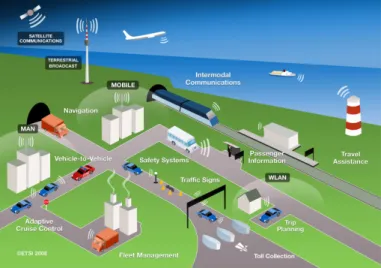
Vehicular Ad-hoc Network, known as VANET, is a self-organizing network formed by a collection of moving vehicles [1]. With the rapid development of automotive manufac-turing, vehicles are becoming more and more intelligent and powerful. Vehicles now can communicate with other vehicles directly through wireless technologies in a V2V Vehicle) manner or indirectly through roadside infrastructures in a V2I (Vehicle-to-Infrastructure) or I2V (Infrastructure-to-Vehicle) manner [2]. Moreover, vehicles can also connect with motorcycles via V2M (Vehicle-to-Motorcycle) communication and pedes-trians via V2P (Vehicle-to-Pedespedes-trians) communication. Meanwhile, the development of cellular technologies, such as Long-Term Evolution (LTE), enables vehicles to communi-cate directly with the cellular network. Collectively, these wireless connections are referred to as V2X (vehicle-to-everything) communication, which can support numerous use-cases of Cooperative Intelligent Transportation Systems (C-ITS), including both safety and non-safety services. Figure1.1presents the future Intelligent Transportation Systems depicted by the European Telecommunications Standards Institute (ETSI) [3].
In the rest of this chapter, we overview the characteristics of VANET and introduce the associated technologies, as well as the applications of C-ITS. Furthermore, we identify the challenges in VANET and address the motivations and objectives of this thesis. At last, we present the contributions and organization of this thesis.
1.1.1 Characteristics and challenges
Compared with the traditional Mobile Ad-hoc Network (MANET), the specific charac-teristics and challenges of VANET have attracted researchers and industry from different
Figure 1.1: ITS-Intelligent Transportation Systems
fields to investigate VANET applications, technologies, protocols, and standards. VANET inherits similar features from MANET; however, shows some unique characteristics, lead-ing to some new challenges.
• Predictable vehicle mobility: Instead of moving randomly in MANET, vehicles’ mo-bility is constrained by road topologies, as well as traffic conditions, traffic lights, and road signs. Thus, a vehicle’s trajectory is predictable which can assist some ITS applications.
• Various vehicle mobility patterns: VANET is characterized by varying mobility pat-terns. The velocities of trucks, cars, and motorcycles are usually different. Mean-while, the velocity limitations are different according to traffic conditions.
• Highly dynamic network topology: Due to the fast movement of vehicles on the road, especially under highway scenario, the network topology changes rapidly. A vehicle with higher speed may pass another vehicle quickly, causing unstable inter-vehicle connections. Therefore, the information transmission between these vehicles is not reliable, which may further cause traffic safety problems. A large amount of research works, such as [4][5], focus on enhancing the information transmission reliability under highly dynamic network topology, especially when transmitting emergency messages.
• Unlimited network scale: The network scale of VANET may be huge, such as in big dense urban scenarios. Without a central controller in VANET, the limited trans-mission range can only support short-range vehicle communications, which is not sufficient to support some VANET services. Instead of this flat network
architec-1.1 Overview of Vehicular Ad-hoc Network 3 ture, the hierarchical network architecture can solve the network scalability problem. Moreover, Heterogeneous Vehicular NETwork (HetVNET), which integrates cellular networks with V2V communication technologies, is also a potential solution [6] [7].
1.1.2 Technologies
As shown in Figure 1.2 [8], communications between vehicles, Road Side Units (RSUs), and infrastructures are summarized as Vehicle-to-Everything (V2X) communication. V2X communication can be supported by numerous wireless access technologies. Some of these communication technologies support medium range and short range communications in a distributed manner (e.g., DSRC). In contrast, other technologies support communications in long-range, relying on a centralized infrastructure (e.g., Cellular-V2X). The wireless access technologies are discussed in the following.
Figure 1.2: V2X communications
1.1.2.1 Dedicated Short Range Communication (DSRC)
In 1999, the U.S. Federal Communications Commission (FCC) allocated 75 MHz (from 5.850 GHz to 5.925 GHz) bandwidth for Dedicated Short Range Communication (DSRC) in vehicular environments. DSRC is based on the IEEE 802.11p/1609 Wireless Access in Vehicular Environment (WAVE) protocols [9], which are particularly designed to meet the requirements of vehicular communications. The term ”Short Range” in DSRC means that the communication takes place over hundreds of meters (100m-1000m). In Europe, such as this ”Short Range” communication is standardized as ETSI ITS-G5 [10], which is also based on the IEEE 802.11p. Both these IEEE 802.11p based solutions (DSRC/WAVE and ETSI ITS-G5) can support the direct V2V communication and Vehicle-to-RSU (V2R) communication with out infrastructure. In this case, emergency messages can be deliv-ered with lower latency. However, there are some limitations without a central controller (infrastructure), especially in the case of traffic congestion due to the low throughput and
unbounded delay of CSMA/CA under high load.
1.1.2.2 Cellular-V2X (C-V2X) communication
C-V2X communication is the connection with cellular networks. With the wide deploy-ment of cellular networks, numerous services can be realized with the support of a cellular network that can provide larger coverage and higher data rate. In recent years, the most popular cellular technologies that researchers focus on are LTE and Fifth Generarion (5G). LTE-V2X : In general, LTE networks can provide high capacity with wide coverage and support more services for vehicles. In [11], the researchers have analyzed the advan-tages and challenges of LTE for vehicular networking and compared the main candidate wireless technologies for V2X communications. Moreover, in [12], the authors compared the performance of LTE and Universal Mobile Telecommunications System (UMTS) for vehicular safety applications at intersections. The analysis shows that LTE system can support a demand of transmitting around 1500 Cooperative Awareness Messages (CAM)s [13] per second per cell.
LTE-D2D : Device-to-Device (D2D) communications is one of the techniques that support V2V communication [14]. In D2D, neighboring User Equipment (UE)s can di-rectly communicate with each other. However, devices in LTE system need to discover the existence of their peer before any direct communication. Therefore, the discover process may cause long latency, which is not acceptable for transmitting emergency messages. In this case, DSRC is more suitable for V2V communication.
5G-V2X : Even though LTE can support more V2X use cases, it is expected that more stringent requirements for latency, range, speed, reliability, location accuracy, privacy, and message payloads are needed to support more advanced use cases for future intelligent and on-connected vehicles. In [15], the researchers state that the network slicing technology of 5G, which logically isolates network functions and resources, can effectively cope with a wide variety of use cases with divergent demands provided over the 5G infrastructure by multiple tenants. Meanwhile, they also propose some set of slices for 5G-V2X system.
1.1.3 Applications
C-ITS applications can be categorized into three types, including road safety, traffic effi-ciency, and entertainment applications. The road safety applications aim to avoid traffic accidents and protect road users’ lives. The traffic efficiency applications focus on im-proving the traffic efficiency, such as avoiding traffic jams. Finally, the entertainment
1.1 Overview of Vehicular Ad-hoc Network 5
Table 1.1: List of use cases
Group Use cases
3GPP
Vehicle Platooning, sensor and state map sharing,
automated cooperative driving for short distance grouping,
cooperative collision avoidance (CoCA) of connected automated vehicles, information sharing for partial/conditional automated driving,
video data sharing for assisted and improved automated driving (VaD), intersection safety information provisioning for urban driving,
dynamic ride sharing, emergency trajectory alignment, cooperative lane change (CLC) of automated vehicles.
C-ITS
Day 1
Hazardous location notifications:
Slow or stationary vehicle(s) & Traffic ahead warning,
Road works warning, Weather conditions, Emergency brake light, Emergency vehicle approaching;
Signage applications: In-vehicle signage, In-vehicle speed limits, Signal violation/Intersection Safety,
Traffic signal priority request by designated vehicles,
Green Light Optimal Speed Advisory (GLOSA), Probe vehicle data, Shockwave Damping (falls under ETSI Category “local hazard warning”).
Day 1.5
Information on fuelling & charging stations for alternative fuel vehicles, Vulnerable Road user protection,
On street parking management & information,
Off street parking information, Park & Ride information, Connected & Cooperative navigation into and out of the city, Traffic information & Smart routing.
applications aim at providing more comfortable and convenient journeys for road users. The detailed description of each application type is introduced as follows.
• Road safety applications: These applications require vehicles to detect or gather emergency information immediately by vehicle sensors. Furthermore, the emergency messages should be delivered or disseminated to the target vehicles or areas with short latency and high accuracy. The affected range of these applications are usually small, and the safety messages should not be very large. Among all applications, the road safety application is the most investigated and most deployed. A classification of road safety applications is addressed in the ETSI standard [16], as well as the relative technical requirements.
• Traffic efficiency applications: These applications focus on the overall efficiency of the transportation system. An example is to avoid traffic jams by informing vehicles in the distance to change to the road with lower traffic density. This kind of appli-cation usually requires a large effected range. Compared with safety appliappli-cations, the transmission latency and accuracy are not stringent.
• Entertainment applications: These applications are supported by various communi-cation technologies. The applicommuni-cations, such as Internet access, content downloading, information sharing, always require broad bandwidth and large capacity of storage.
With the development of autonomous driving and V2X communications, more chal-lenging use cases are considered as a basis to derive service requirements. Both recent the Third Generation Partnership Project (3GPP) technical report [17] and C-ITS Platform final report [18] have defined new V2X-based use cases. Table 1.1 lists some of the use cases.
1.2
Motivations and Objectives
Among the ITS applications mentioned above, the most urgent and challenging one is the safety-related application. For this kind of application, information dissemination usually requires low latency, high accuracy, and high reliability. At the same time, VANET has a scalability problem that cannot be solved by a flat network architecture without a central controller. Thus, researchers have proposed a hierarchical network architecture to solve this problem. In such hierarchical network, vehicles are virtually organized into different groups, called clusters.
In each vehicle group, there exists one leader and several member vehicles. The leader is responsible for inter-cluster communication, and group members can communicate directly with their group leader [1]. However, the dynamic network topology may cause vehicle groups to be unstable, which makes clusters meaningless, and even leads to unnecessary overhead. In this case, finding an effective method to construct stable and resistant vehicle clusters is indispensable. To this end, our first objective in this thesis is to design a clustering algorithm for VANET to guarantee cluster’s stability .
Researchers have proposed numerous metrics to construct clusters in their clustering algorithms and have proved the effectiveness of their proposed metrics. However, it is still hard to tell which clustering metric works better in cluster’s stability. Moreover, since clustering algorithms are proposed under various scenarios, it is hard to fairly evaluate
1.3 Thesis Contributions and organization 7 these algorithms. Thus, the second objective of this thesis is to design a framework of the clustering algorithm in VANETs, in order to fairly evaluate different clustering metrics and analyze their impacts.
During the research, we observed that cluster maintenance process plays an important role to ensures tability. As an indispensable part of cluster maintenance process, cluster merging method may have some influence on clustering performance. However, the method of cluster merging is always overlooked when compared to the cluster head selection and cluster formation process. Based on our proposed clustering framework, this thesis also evaluates the impacts of cluster merging schemes on clustering performance and designs a new cluster merging scheme.
To deeply understand clustering algorithm, modeling the entire clustering process mathematically is required. Therefore, another objective of this thesis is to propose a stochastic model for clustering performance analysis.
As mentioned above, road safety applications for VANETs depend mainly on dis-seminating warning messages to deliver information to the concerned vehicles. However, disseminating information suffers from the broadcast storm problem and the interference from the existing periodic single-hop beacon messages. The hierarchical network architec-ture, such as cluster, can effectively solve these problems by avoiding redundant message transmissions. Meanwhile, content caching methods enable temporary storage of less ur-gent information so that emergency messages can be sent as quickly as possible. The last objective of this thesis is to propose a cluster-based data dissemination scheme for emergency message transmission .
In summary, the main purpose of this thesis is to design effective clustering algorithms to support reliable data transmission in VANETs.
1.3
Thesis Contributions and organization
This thesis brings original contributions, essentially to clustering algorithms and cluster-based data dissemination mechanisms in VANETs. Firstly, we overview the existing clus-tering algorithms and cluster-based data dissemination mechanisms. Secondly, we propose a mobility-based clustering algorithm MoDyC to improve the cluster stability. Thirdly, to analyze the impacts of different clustering metrics on clustering performance, we introduce a clustering framework UFC. Based on this framework, we discuss the impacts of cluster merging schemes and improve the cluster stability via a new cluster merging method L-CM. Additionally, we model the clustering process as a discrete-time finite-state Markov
chain, which enables us to analyze and predict the clustering performance. Finally, we propose a cluster-based data dissemination scheme with data caching in VANETs. Figure 1.3 illustrates our contributions. The organization of the manuscript is listed in what follows. !"#$%&'()*'(* +,-./# ,!)0&'$12* 3%#')(*4(3* '25!%2%($4$'0( !"#$%&'()' 607'!'$8974#%3* :!"#$%&'()*;60<8 =* !"#$%&'*)' !"#$%&'()* >&42%?0&@*;AB = !"#$%&'+) 603%!'() -%')170&* C425!'()*;-C= <4$4* <'##%2'(4$'0( !"#$%&',)' .2%&)%(:8* 2%##4)%* 3'##%2'(4$'0( D4:@0>>974#%3* E* #%!%:$'0(*;D C= !"#$%&'-)' !"#$%&*2%&)'()* ;F 6= !"#$%&* 24'($%(4(:% D4:@A5 E*74#%3* &%9:!"#$%&'()*;DA E=
Figure 1.3: Overview of the thesis
Chapter 2 reviews the clustering algorithms in VANETs. Clustering algorithms are divided into three essential procedures: cluster head selection, cluster construction, and cluster maintenance. For each process, we summarize the methods and the challenges. Moreover, we provide a classification of the existing clustering algorithms based on the application contexts. Among them, we focus on data dissemination algorithms based on clustering. This work has been submitted as a survey paper which is under review.
Chapter 3 introduces a mobility-based clustering algorithm for VANETs, named MoDy-C, which can improve the cluster’s stability. Clusters are established by adding vehicles one by one which is moving towards in the same direction, and the cluster size is restrict-ed by the distance between the cluster head and its potential cluster member. MoDyC establishes one-hop clusters, and the cluster head is the central node of the cluster. To evaluate the cluster’s stability, we compare MoDyC with two benchmark clustering algo-rithms under the highway scenarios, and MoDyC shows higher cluster stability. This work has been published in [19] and [20].
Chapter 4 is dedicated to proposing a unified framework of clustering algorithms, named UFC, which enables a comprehensive analysis of the impacts of different clustering metrics. To analyze the framework, we generate various traffic scenarios via the traffic mobility simulator SUMO. The performance of the framework is validated through self-parameter optimization and the comparison with benchmark algorithms. This work has
1.3 Thesis Contributions and organization 9 been published as a journal paper [21].
Chapter 5 discusses the impact of cluster merging schemes on clustering performance. We overview the cluster merging schemes in the existing clustering algorithms and intro-duces a new cluster merging scheme, the leadership-based cluster merging scheme, named LCM. LCM scheme is compared with two other cluster merging schemes, based on the proposed clustering framework UFC. The results illustrate that LCM scheme can improve the cluster stability. This work has been presented and published as a conference paper [22].
Chapter 6 proposes a stochastic model to analyze the clustering performance in VANET-s. The vehicle state transitions during clustering process are modeled as a discrete-time finite-state Markov chain. Every vehicle acts as one of the predefined clustering states at each time step. From the previous experimental results, we can calculate the state tran-sition probability matrix, which enables the prediction of clustering performance without the limitation of simulation time in the network simulator. This work has been accepted as a conference paper [23].
Chapter 7 proposes an emergency message dissemination scheme combined with UFC clustering algorithm. This work is evaluated by the comparison of combining with another clustering algorithm.
Finally, Chapter 8 concludes this thesis and points out some limitations of the work. Meanwhile, the perspectives of the future work are discussed.
Chapter
2
State-of-the-art
2.1
Introduction
For all of the ITS applications that we have mentioned in Chapter 1, the most impor-tant and investigated one is the safety-related application. ETSI has provided a detailed classification for road safety applications in the standard [16]. To support these services, information should usually be transmitted with low latency and high accuracy. However, the large number of mobile vehicles and the dynamic network topology cause scalability and unstable connection problems. One efficient solution to these challenges is clustering algorithms, which virtually organize vehicles into groups, named clusters [1].
In past years, many clustering algorithms were proposed in Mobile Ad Hoc Networks (MANETs) (e.g., [24], [25], and etc.), aiming to save network resources and to increase network efficiency. According to the predictable mobility and predefined road topology of VANETs, researchers found that previous clustering algorithms in MANETs were no longer suitable for VANETs. Due to the time of achieving clustering procedure, additional control overheads may be added. Thus, a good clustering algorithm should not only form minimum number of clusters but should also dynamically maintain the cluster structure without large overhead over the network. However, frequent dynamic cluster maintenance may cause unnecessary cluster re-formation. Therefore, cluster topology should not be sensitive to vehicles’ movements in order to avoid frequent cluster re-formation.
This chapter surveys the existing clustering algorithms and cluster-based data dissem-ination algorithms in VANETs from the following aspects: clustering methods, context-based clustering algorithms, and cluster performance evaluation. A complete description of mechanisms in each clustering step is provided in this chapter. Moreover, a detailed comparison and discussion of various approaches and their performance metrics are
pre-sented. The main contributions in this chapter are listed in what follows:
• We summarize and compare the existing surveys by highlighting their advantages and pointing out the limitations. As far as we know, this is the first work of clustering algorithms that compares the existing related surveys;
• We provide an overview of the development of clustering algorithms in VANETs from the year 1999 to the year 2017, which has never been summarized in previous research work;
• We explore more recent research works than previous survey articles, provide a new classification according the context, and highlight the hybrid clustering algorithm, since it plays a more important role with the development of network access tech-nologies;
• We summarize and classify the existing clustering techniques in terms of clustering procedure: cluster head selection, cluster formation, and cluster maintenance; • We observe various context of the existing clustering algorithms, including hybrid
clustering architecture;
• We present a comprehensive analysis of the performance evaluation methods of clus-tering algorithms, including performance metrics, simulation tools, traffic scenarios, etc.. A new classification of clustering performance metrics is proposed;
• We conclude the challenges and the future development of clustering algorithms in VANETs.
2.2
Overview on clustering algorithms in VANETs
Clusters in VANETs indicate virtual groups of vehicles. Each cluster has one cluster head (CH) that is the leader of the group. A CH is followed by several vehicles, named as cluster members (CMs). Cluster topology can be classified into two categories: one-hop clusters and multi-hop ones, as shown in Figure 2.1 . One-hop clusters are usually constructed based on CH’s transmission range (TR). CHs add their one-hop neighbors into clusters. Each CM can communicate directly with its CH via V2V communication; two different CMs can communicate with each other directly or via their cluster head. In recent years, multi-hop clusters (e.g., [26], [27], and so on) are proposed in order to construct more stable clusters, in which not all CMs could communicate with their CH directly.
2.2 Overview on clustering algorithms in VANETs 13
!" !#
(a) One-hop cluster
!" !#
(b) Multi-hop cluster Figure 2.1: Cluster topology
In recent years, several surveys were published, which summarize the existing cluster-ing algorithms in VANETs. In 2012, the authors of [29] have synthesized the clustering algorithms for VANETs from the year 2000 to 2012. They briefly described the cluster-ing algorithms independently, and compared the followcluster-ing contents: clustercluster-ing metrics, radius (cluster topology), location services, cluster density, and simulators. The authors addressed that there is a lack of a fair comparison of different clustering methods, since the simulation scenarios, network simulators, and performance metrics change substantially in different clustering algorithms. However, this survey is considered incomplete without providing a classification and detailed algorithms comparison.
In the year 2014, another survey [1] has been published, covering more research work-s. The authors presented a detailed classification of clustering in VANETs based upon various key parameters. The existing algorithms were divided as follows: predictive clus-tering, backbone based clusclus-tering, MAC based clusclus-tering, traditional clusclus-tering, hybrid clustering, and secure clustering. The authors described the algorithms precisely in each category; meanwhile, a comparison and short discussion have been given. Compared to the previous survey, this work is much more complete and meaningful; however, the pa-rameter comparisons among different algorithms are not persuasive enough only with the fuzzy words “low”, “medium”, and “high”.
The latest survey of VANETs clustering techniques has been published in the year 2016 [31]. Compared with other existing surveys, it applied a more complete taxonomy of VANETs clustering techniques, especially from the aspects of applications of clustering and the problem of evaluating and comparing the performance of clustering algorithm-s, which have not been discussed in previous surveys. Moreover, the authors precisely
summarized the strategies for each part of clustering procedure, including cluster head selection, cluster formation, and cluster maintenance. It provides comprehensive analysis and comparisons; however, the authors have not analyzed the context and simulation sce-narios of the algorithms, and there is a lack of comparison of performance metrics which is important in comparing clustering algorithms. In Table2.1, a comparison of the existing surveys is summarized.
Table 2.1: Comparison of previous surveys
Comparison aspects 2012 [29] 2014 [1] 2016 [31]
Our work Overview Number of algorithms 19 43 45 66
General
Algorithm classification X X X
Application X X
Architecture X
Cluster head selection X X X X
Clustering Cluster formation X X
techniques Cluster maintenance X X
Performance metrics X
Performance Simulator X X
evaluation Traffic scenario X
channel model X X
2.3
History of VANETs Clustering algorithms
The VANETs clustering techniques started to be developed in the early 1990s, and have increased in recent years. Figure2.2provides a blueprint for the development of clustering algorithms proposed from the early 1990s to the year 2017. The X-axis indicates the year, and the Y-axis shows the proposed algorithms. In this figure, a relation among these existing clustering algorithms is presented. The black arrow indicates that the following algorithm is compared with the original one in the simulation, and the blue arrow shows that the following algorithm follows the framework of the original one; however, it did not make a comparison.
In Figure2.2, about 51 existing clustering algorithms have been observed from the early 1990s to the year 2017. Among these clustering algorithms, around 30% algorithms are derived from the idea of the earliest Lowest-ID (LID) algorithm [32] , which was originally proposed for MANETs to increase the communication efficiency among mobile nodes. In
2.3 History of VANETs Clustering algorithms 15 1994 1996 1998 2000 2002 2004 2006 2008 2010 2012 2014 2016 WCA GDMAC MDMAC PPC DBC SP−CL E−SP−CL VWCA CBMAC CBLR CCP VMaSC C−RACCA MOBIC PC CF−IVC DBA−MAC CMGM MI−VANET CBPKI CAC MCC−MAC NMCS FQGWS C−DRIVE HCA VPC TBC SBCA FLBA CCA ALCA CPTD TACR DMCNF MCA−VANET MCTC UOFC AMACAD DGMA MobHiD UF TC−MAC CSBP LID/HD DMAC K−conID K−hop RMAC APPROVE ALM
Figure 2.2: The development of clustering algorithms in VANETs. (Color blue: without comparison; Color black: with comparison.)
the year 2005, the authors summarized the existing clustering algorithms in MANETs in [34]. In this article, MANETs clustering algorithms have been classified based upon different metrics, including DS-based (Dominating Set based), low-maintenance, mobility-aware, energy-efficient, low-balancing, and combined-metrics-based clustering.
With the increased popularity of VANETs, some MANETs clustering algorithms were deployed to adapt to the particular characteristics of vehicular communications. It is easy to observe that after the year 2005, plenty of clustering algorithms were published for VANETs. Furthermore, most of these were derived from the previous MANETs clustering algorithms, including DMAC [35], MOBIC [36], [24], K-ConID [37], and PC [38].
Since 2010, numerous applications in VANETs were explored, and clustering algo-rithms were designed based on the requirements of solving specific problems, instead of purely to increase the cluster stability. Besides one-hop cluster topology, multi-hop cluster was widely accepted (e.g., K-hop [26], HCA [27], etc.) because of the increased application requirements and the limited range of wireless transmission. Meanwhile, the development of cellular technologies, including UMTS and LTE, expanded the deployment of clustering algorithms in vehicular networks. Hybrid clustering architecture, including both V2V and V2I communication manners, is becoming a new trend (e.g., [39], [40]), enabling more applications in vehicular networks. More detailed discussions are given in
the rest of this chapter.
Table 2.2: Number of citations
Algorithm 2007 2008 2009 2010 2011 2012 2013 2014 2015 2016 2017 Total Mean
APPROVE-2
N/A N/A N/A N/A N/A N/A N/A 8 18 25 12 63 15.75
[41]
K-hop
N/A N/A N/A N/A N/A 2 8 8 14 23 12 67 9.57
[26]
ALM
N/A N/A N/A N/A 5 12 6 11 18 16 19 87 10.88
[42]
C-RACCA
N/A N/A N/A 3 8 8 22 19 14 14 14 102 12.75
[43] APPROVE-1 N/A N/A 1 4 9 29 19 22 20 30 10 144 16 [44] PPC N/A 2 10 15 9 12 15 22 21 21 19 146 14.6 [45] CBMAC N/A N/A 5 7 5 9 15 11 6 12 4 74 6.73 [46] CCP-2 N/A 1 15 16 29 26 34 39 27 31 24 242 22 [47] CCP-1 5 8 6 7 14 13 8 17 18 9 4 109 9.08 [48]
Based on the clustering algorithms shown in Fig. 2.2, the most popular algorithms that were particularly designed for VANETs are selected: PPC [45], ALM [42], k-hop [26], APROVE [41], C-DRIVE [49][50][50], CBMAC [46], CCP [47], and C-RACCA [43]. The criteria of popularity are based on the number of citations and the frequency of this algorithm been compared with other algorithms. We observe the frequency of the article being cited from the year 2006 to the year 2017 and analyze the development trend of clustering algorithms. In Table 2.2, it is easy to observe that multi-hop cluster topology [26] is becoming popular in recent years.
2.4
Clustering mechanisms in VANETs
Vehicular clusters’ construction is a dynamic procedure due to the high mobility of vehi-cles and intermittent communications. Vehivehi-cles have to obtain the necessary information from their neighboring vehicles, including their identities, positions, velocities, etc.. The potential cluster head will be selected based upon the criteria, such as relative mobility, received signal strength, link lifetime, etc.. Clusters will be established by adding potential vehicle members. In [31], a basic flow of clustering algorithm was introduced, indicating the general steps of clustering algorithms.
This section presents a summary of the approaches and the criteria of each of the clus-tering steps, including cluster head selection, cluster formation, and cluster maintenance. For each method, a discussion of the advantages and disadvantages is given.
2.4 Clustering mechanisms in VANETs 17
2.4.1 Cluster head selection approaches
In clustering algorithm, the most vital part is to select a reliable leader, which can achieve the highest stability among its vicinities. In most clustering algorithms, CHs are selected at the beginning of the clustering process. Then, the cluster formation process is controlled by the selected CHs. In this subsection, the CH selection approaches are classified and analyzed.
2.4.1.1 First Declaration Wins
The First Declaration Wins (FDW) mechanism was firstly proposed in the Passive Clus-tering algorithm (PC) [38] in the year 2002. FDW is a cluster head election rule which does not require any metric information. FDW is based on the idea of contention, in which a vehicle, firstly claiming to be a cluster head, dominates the other vehicles within its transmission range.
In CF-IVC [53], the authors proposed a clustering formation protocol for inter-vehicle communication, based on the Passive Clustering (PC) model proposed in [38]. FDW rule has been applied in this mechanism. The first node, relaying the received packet with its CH claim, wins the competition. Any neighboring node that receives the cluster head information would change its state to be CMs.
Another protocol that applied FDW rule for CH election is PassCAR [54]. It proposed a passive clustering aided routing protocol for VANETs. If two nodes are in the CHREADY
state, the FDW mechanism ensures that only one node will become the CH. Another node in the transmission range of CH will become the CM.
A contention based CH selection algorithm has been introduced in a Unified Frame-work of Clustering algorithm (UFC) [21]. In the initial state, every vehicle calculates a contention timer based on its neighbors’ information. All vehicles will start to count down the contention timer at the same time, and the first one finish the countdown will become the CH and broadcast a CH announcement message.
Discussion: The FDW CH selection method can reduce the exchanged packets. Initial clusters can be established very fast without any additional restrictions. However, the stability of the formed clusters cannot be guaranteed since there are no criteria to evaluate the link connections between CMs and their CH. The method proposed in UFC [21], which is also a part of this thesis, solved this problem by adding a velocity criteria before FDW.
2.4.1.2 First vehicle in the moving direction
C-DRIVE [49] [55] was firstly proposed in the year 2009, aiming at estimating the density of vehicles on a given road segment. The authors supposed that each vehicle is equipped with a digital map to determine the direction that it will travel. The first vehicle entering the region in a particular direction is considered as CH. Each CH is responsible for computing the density of vehicles in its cluster; this information will help the traffic signal to adjust its signal timings and thus to manage the traffic effectively.
MC-DRIVE [50] is a modified C-DRIVE [55] method, to estimate vehicles’ density at the intersection. The first vehicle entering the road is considered as a temporary CH, which is designed for leading the cluster formation process.
In [56], the authors proposed a multi-hop cluster-based routing protocol, named CON-VOY, for highway scenario. The CH is simply the vehicle moving at the first place of the convoy. The CH leads cluster formation and controls the size of vehicle convoy.
Another typical vehicle cluster method is called platoon. Vehicle platooning is a tech-nique where highway traffic is organized into groups of close-following vehicles called pla-toon or convoy. The idea of organizing traffic in plapla-toons to dramatically increase road capacity is originally proposed in [57] by PATH for Intelligent Vehicle Highway System (IVHS). In 2015, a platoon management protocol for Cooperative Adaptive Cruise Control (CACC) was proposed in [58]. A platoon leader is the first vehicle in the platoon with at least one follower. With CACC technique, the headway can be reduced to further improve the platooning efficiency.
Discussion: The approach to select the first vehicle in the moving direction as the CH is easy to realize. This method is more suitable for the intersection area. Once the CH is chosen, it will directly add the running vehicles behind it as the CMs. However, the selected CH could frequently be overtaken on the road. How to update the CH information and reduce the control overhead is a big challenge.
2.4.1.3 Weighted sum
In VANETs, CH selection is usually based on multiple mobility metrics, such as speed, po-sition, node degree (number of neighbors), and link lifetime. Each protocol has its cluster stability definitions. The cluster head selection is based on the following two conditions: vehicle’s mobility pattern and the relative mobility respect to vehicle’s neighbors. Mobility based metrics are widely used in recent VANETs CH selection, such as speed, position, link lifetime and node degree (usually the number of one-hop neighbors).
2.4 Clustering mechanisms in VANETs 19 According to the research, it is easy to observe that most of the CH selection methods are based on the weighted sum of various parameters. Weight based clustering method was originally proposed for MANETs in [24]. The CH is selected based upon the combined weight value, including different metrics values, and the weighting factors are distributed to each of these metrics.
In [59], the authors proposed a compound clustering scheme based on two groups of parameters: Lowest-ID or Highest Degree, and the traffic specific position or Closest Velocity to Average algorithms, to find a more stable clustering method. A utility function was proposed, presented as the weighted sum (utility) for each vehicle. The vehicle with the highest utility is selected to be the CH. The implementation uses a weighting factor of 85% to the Lowest-ID or Highest-Degree method and 15% to the traffic-specific information of position or velocity. However, the authors did not specify how to define the weighting factor.
DBC [60] proposed a new multilevel clustering algorithm for VANETs based on vehi-cle’s connection level estimation, link quality level estimation, and traffic condition esti-mation. Connectivity level estimation is to estimate the density. Link quality is presented by signal-to-noise (SNR). The notion Group Membership Lifetime (GML) counter is pro-posed to indicate the duration of the node links to other group members. GML is used to check the reliability of node. The vehicle with the most stable communication with other group members gains the highest weight and becomes CH. However, the calculation of the weight value has not been discussed in the paper.
In [62], the authors proposed a lane-based clustering algorithm (TC-MAC-1). The main idea is to select a CH based on the lane where most of the traffic appears. It is based on the assumption that each vehicle knows its exact lane on the road via a lane detection system and in-depth digital street map. With the knowledge of lane information, vehicles moving on the road can be easily separated by three types: Left Turn, Right Turn, and No Turn. Like previous weighted sum method, each vehicle computes and broadcasts its CH level, based on the information of network connectivity level, average distance level, and average velocity level. Here, the lane weighting factor is determined based on the ratio of the number of lanes for each traffic flow to the total number of lanes on the roadway.
The authors proposed VWCA clustering algorithm in [63], based on the original W-CA [24] and entropy-based clustering algorithm [64]. The authors defined the entropy value of local networks, where the “local networks” denotes a vehicle’s neighborhood list. Entropy value has been proved to reduce the frequency of cluster re-affiliation [63]
effec-tively. Besides, the authors proposed three novel parameters for the weight calculation: vehicle’s distrust value, relative moving direction, and the number of neighbors. Each vehicle calculates its combined weight value in a distributed manner. The one with the minimum combined weight value is selected to be CH. The authors evaluated the influence of weighting factors on the cluster performance. The weighting factors can be dynamically chosen according to their purpose, which is considered as a great improvement.
The authors of [65] proposed a destination-based clustering protocol (AMACAD). Each vehicle calculates a weighted value between one of its neighbors, Fv,z, based on relative
distance, relative speed, and relative destination. Cluster head is selected according to the sum of Fv,z. The effects of weighting factors on the number of cluster and CH lifetime were
tested. Similar to VWCA [63], the weighting factors are dynamically assigned according to the different scenario.
In [66], the authors proposed a fuzzy-logic based CH selection method (FLBA). Each vehicle calculates a stability factor SF based on its average speed difference respect to all of its neighbors. CH selection is based on a weighted stability factor SFw, represented
by the weighted sum of the vehicle’s current SFw and the previous SFw−1. The vehicle
with the highest SFw is selected as CH. The weighting factor, called smoothing factor, is
predetermined as 0.5; however, the authors did not explain the reason for this value. In [67], the authors proposed a multi-agent based clustering protocol (MDDC). Sta-bility metric was introduced to determine the CH. The elected CH should have higher connectivity degree (number of neighbors), less average speed, and longer travel time on the lane. The leading vehicle computes stability factor for all the cluster members. The stability metric was represented by a weighted sum of these parameters. The CM with the highest stability metric is chosen as the CH. The weighting factors are determined by the initiator vehicle. However, the selection of weighting factors has not been described in detail.
The authors proposed an Affinity Propagation (AP) [68] based clustering algorithm (APROVE) for VANETs in [41]. Every vehicle calculates the responsibility and availability value in a distributed manner. The proposed method is based on position, velocity, and the prediction of vehicles near future position. For each clustering interval, vehicle calculates its CH convergence value, represented as the sum of the responsibility array and availability array. The vehicle with a positive convergence value will become a CH.
Discussion: Weighted sum based CH selection method was widely applied during the development of clustering algorithms in VANETs. The selected elements vary under
dif-2.4 Clustering mechanisms in VANETs 21 ferent context with the assigned weighting factors. The researchers could introduce any metrics if they have an adequate reason. For example, the trust value proposed in VW-CA [63]. The approach guaranteed a comprehensive consideration of various parameters that may influence the clustering performance; however, the weighting factors assignment is still an open issue, which may considerably affect the clustering performance. Only a small part of the research works provided a reasonable approach in weighting factor selection.
2.4.1.4 Aggregate relative mobility
The aggregate relative mobility based CH selection approach was firstly proposed for MANETs in [36], named MOBIC. The authors proposed a relative mobility metric to select the CH. The ratio of the received and transmitted power between two successive packet transmissions from a neighboring node can represent the relative mobility between two nodes, indicated as a log value. Each node aggregates the variance of relative mobility value of all its neighbors, and the one that has the lowest aggregate relative mobility value with respect to its neighbors should become CH.
The idea of the aggregate relative mobility in MOBIC [36] is impressive; however, calculating two nodes’ relative mobility through the Received Signal Strength (RSS) is considered unreliable. In [42], the researchers proposed a proposed an Aggregate Local Mobility (ALM) clustering algorithm to prolong the cluster lifetime for VANETs. Similar to MOBIC [36], ALM was also based on the aggregate relative mobility; however, it replaced the Received Signal Strength (RSS) by the relative distance between two nodes. In [26], the authors proposed another aggregated relative mobility based clustering algorithm for VANETs, named K-hop. Different from ALM [42], the authors introduced the ratio of packet deliver delay of two consecutive packets to calculate vehicle’s N-hop relative mobility, instead of the ratio of relative distance. Moreover, the previous one-hop cluster structure was extended to k-hop cluster structure. The aggregate relative mobility value is the sum of the relative mobility times a weight value for all neighbor nodes in N-hop. The vehicle node which has the smallest aggregate relative mobility is selected as the CH.
Discussion: Comparing with previous CH selection approaches, the aggregate relative mobility based approach is dynamic. The relative mobility between two nodes depends on the information of both the last and the current time interval. Theoretically speaking, this method is more precise with vehicles’ historical data; however, the appropriation of
selecting the time interval is very important to ensure the accuracy of vehicles’ relative mobilities.
2.4.1.5 Dominating set based
Dominating Set (DS) is a typical technique in the clustering algorithm. A survey about clustering for MANETs [34] has summarized DS-based clustering. The idea of finding Connected Dominating Set (CDS) for MANETs comes from the fact that any vehicle can communicate with another vehicle in the same CDS. The researchers adjusted the DS-based clustering algorithms to VANETs, and the dominating set nodes are considered as CHs, ensuring the communication among CHs.
In [45], a position based clustering algorithm (PPC) was proposed to form stable backbone in a highly dynamic vehicular environment. The authors applied the idea of Minimum Dominating Set (MDS). The proposed cluster is a 2-hop cluster, and the cluster size is controlled by the predefined maximum cluster radius. If a vehicle has long travel time and small speed deviation on the road segment, it will have higher priority to be the CH. To ensure that only one vehicle is selected in the cluster, a hash function has been introduced.
A Hierarchical Clustering Algorithm (HCA) algorithm was proposed in [69], which also selected the CHs based upon the concept of DS. The authors formulated the problem of creating 2-hop clusters and scheduling them as distributed G2 dominating set problem. HCA aimed to find a randomized approach which can benefit both from a small dominating set and fast convergence. A CH is a member of Dominating Set G2, and it manages and synchronizes the shared channel access for all other nodes in the formed cluster.
In [70], a routing protocol for VANETs (SCRP) was proposed. The objective is to choose routing paths with minimum end-to-end delay (E2ED) for non-safety applications in urban VANETs. The backbone vehicles are selected as the CDS. These nodes are s-elected according to vehicles’ Stability Factor, considering the average distance and the speed relationship between a vehicle and its neighbors. The Stability Factor is also repre-sented as a weighted sum value. The vehicle with lowest Stability Factor is added to the backbone.
Discussion: Formulating the clustering algorithm to a selection of dominating set is not a new solution both in MANETs and VANETs. The CHs are the vehicles in the dominating set to ensure the connection among CHs; meanwhile, to reduce the redundant clusters.
2.4 Clustering mechanisms in VANETs 23 2.4.1.6 Other cluster head selection approaches
Apart from the mentioned CH selection approaches, there exist some other interesting clustering algorithm. Ant Colony System (ACS), initially proposed in [71], has been extended to solve the clustering problem. In the year 2012 and 2015, researchers have proposed two ACS-based clustering algorithm respectively: TACR [72] and ASVANET [73]. TACR used ant colony routing technique based on the trust, and the CH selection was based on vehicle’s direction, position, and relative speed. Different in ASVANET algorithm, the CH selection happens after the construction. The node closest to the center of the cluster is selected to be CH. However, the performance of ASVANET did not show any improvement compared with the Lowest-ID [32] algorithm.
Similar to ASVANET, another center based CH selection method was proposed in [19]. The authors introduced the concept of temporary CH, which is the first vehicle moving forward, to assist the cluster construction. The temporary CH will deliver the CH role to the vehicle which is the closest to the center of the cluster according to the predefined cluster’s radius. However, this method requires a long time for the cluster construction, and the cluster information may be incorrect.
Discussion: The CH selection process is the most crucial part of the clustering algo-rithm. Instead of using a single metric at the beginning, such as the node identification in Lowest-ID [32], more and more CH selection methods are essentially depending on mul-tiple mobility metrics, such as relative speed, relative distance, number of neighbors, and link duration between two vehicles. The difference is the approach of combining these primary metrics. Besides, the strategy of CH selection also depends on the context. For instance, at the intersection scenario, like C-DRIVE [50], it is more efficient to choose CHs according to their moving directions.
2.4.2 Cluster construction approaches
This section discuss the cluster construction from the aspect of the cluster topology. After the CH selection process, clusters are formed according to multiple predefined criteria, including transmission range, cluster radius, the maximum number of member vehicles, etc.. Although the cluster formation criteria vary in each algorithm, there are only two cluster topologies of the formed cluster: single-hop cluster and multi-hop cluster.