RESEARCH OUTPUTS / RÉSULTATS DE RECHERCHE
Author(s) - Auteur(s) :
Publication date - Date de publication :
Permanent link - Permalien :
Rights / License - Licence de droit d’auteur :
Institutional Repository - Research Portal
Dépôt Institutionnel - Portail de la Recherche
researchportal.unamur.be
University of Namur
Data sharing for digital markets contestability
Feasey, Richard; DE STREEL, Alexandre
Publication date:
2020
Document Version
Publisher's PDF, also known as Version of record
Link to publication
Citation for pulished version (HARVARD):
Feasey, R & DE STREEL, A 2020, Data sharing for digital markets contestability: towards a governance
framework. CERRE, Bruxelles.
General rights
Copyright and moral rights for the publications made accessible in the public portal are retained by the authors and/or other copyright owners and it is a condition of accessing publications that users recognise and abide by the legal requirements associated with these rights.
• Users may download and print one copy of any publication from the public portal for the purpose of private study or research. • You may not further distribute the material or use it for any profit-making activity or commercial gain
• You may freely distribute the URL identifying the publication in the public portal ? Take down policy
If you believe that this document breaches copyright please contact us providing details, and we will remove access to the work immediately and investigate your claim.
Richard Feasey
Alexandre de Streel
REPORT
September 2020
DATA SHARING
FOR DIGITAL MARKETS
CONTESTABILITY
The project, within the framework of which this report has been prepared, has received the support and/or input of the following organisations: ARCEP, BIPT, Facebook, Mediaset, Microsoft, Snap Inc. and Telefónica. As provided for in CERRE's by-laws and in the procedural rules from its “Transparency & Independence Policy”, this report has been prepared in strict academic independence. At all times during the development process, the research’s authors, the Joint Academic Directors and the Director General remain the sole decision-makers concerning all content in the report.
The views expressed in this CERRE report are attributable only to the authors in a personal capacity and not to any institution with which they are associated. In addition, they do not necessarily correspond either to those of CERRE, or to any sponsor or members of CERRE.
© Copyright 2020, Centre on Regulation in Europe (CERRE)
[email protected] www.cerre.eu
Table of contents
About CERRE ... 5
About the authors ... 6
Executive summary ... 7
1
Introduction ... 14
1.1 Aim and scope of the report ... 14
1.2 Types of data ... 15
1.2.1 Personal data ... 15
1.2.2 Non-personal data ... 17
1.3 Types of data sharing ... 18
1.4 Types of interoperability ... 19
2
Incentives to share data ... 21
2.1 Incentives of the individual users to share their data ... 21
2.2 Incentives of firms to share aggregated user data... 26
2.3 Barriers to data sharing and market failures ... 29
3
Competition policy and data sharing ... 33
3.1 Compulsory access under Article 102 TFEU ... 33
3.1.1 Relevant case-law ... 33
3.1.2 Conditions of essential facilities and application to data ... 36
3.2 Compulsory access under Merger Regulation ... 38
3.3 Limits of data sharing by Article 101 TFEU ... 40
4
Horizontal and sectoral EU laws for data sharing... 44
4.1 Existing legislations enabling data sharing ... 44
4.1.1 EU rules on data portability ... 45
4.1.2 EU rules on data sharing ... 48
4.2 Existing legislations limiting data sharing ... 51
5
Regulatory governance of data sharing ... 55
5.1 The scope of data sharing ... 55
5.1.1 Which digital platforms should be obliged to provide access to data? ... 55
5.1.2 Which organisations are entitled to obtain access to data (and the conditions to meet before they can do so)? ... 59
5.1.3 The types of data to be shared, the geographic scope from which it is drawn, and the conditions under which sharing can occur, including on whose initiative? ... 62
5.2 The conditions of sharing ... 70
5.2.1 Technical standardisation ... 71
5.2.2 The data transfer process ... 73
5.2.4 Prices for data access ... 77
5.2.5 Promoting disruptive business models ... 82
5.2.6 Exiting from data sharing arrangements ... 83
6
Policy recommendations ... 86
About CERRE
Providing top-quality studies and dissemination activities, the Centre on Regulation in Europe (CERRE) promotes robust and consistent regulation in Europe’s network and digital industries. CERRE’s members are regulatory authorities and operators in those industries as well as universities. CERRE’s added value is based on:
• its original, multidisciplinary and cross-sector approach;
• the widely acknowledged academic credentials and policy experience of its team and
associated staff members;
• its scientific independence and impartiality;
• the direct relevance and timeliness of its contributions to the policy and regulatory development process applicable to network industries and the markets for their services. CERRE's activities include contributions to the development of norms, standards and policy recommendations related to the regulation of service providers, to the specification of market rules and to improvements in the management of infrastructure in a changing political, economic, technological and social environment. CERRE’s work also aims at clarifying the respective roles of market operators, governments and regulatory authorities, as well as at strengthening the expertise of the latter, since in many Member States, regulators are part of a relatively recent profession.
About the authors
Richard Feasey is a CERRE Senior Research Fellow, an independent consultant and a Senior Adviser to the Payment Systems Regulator in the UK. He lectures at University College London and Kings College London. Richard was previously the Public Policy Director of Vodafone Group plc from 2001 until 2013. In October 2017, he was appointed to the panel of the UK’s Competition and Markets Authority and in October 2018 to the National Infrastructure Commission for Wales.
Alexandre de Streel is a Professor of European law at the Universities of Namur and Louvain in Belgium. He is Academic Co-Director at the Centre on Regulation in Europe (CERRE) and the Director of the Research Centre for Information, Law and Society (CRIDS), focusing his research on Regulation and Competition Law in the network industries. He is a member of the Scientific Committee of the Florence School of Regulation (FSR) at the European University Institute in Florence and Research Fellow at European Institute of Public Administration (EIPA) in Maastricht. Professor de Streel regularly advises international organisations (such as the European Commission, European Parliament, OECD, EBRD) and national regulatory authorities on regulatory and competition issues in network industries. He is also an Assessor (member of the decisional body) at the Belgian Competition Authority.
Executive summary
There is today growing momentum behind proposals for ‘data sharing’ as a remedy for competition concerns in digital markets, as well as efforts by the European Commission (including in the forthcoming Data Act of 2021) to promote the sharing of data more widely in the European economy. However, there is as yet less focus on the practical challenges that will need to be overcome to implement data sharing arrangements that effectively promote innovation and competition in or preserve the contestability of digital markets. There is also limited experience of regulated data sharing in practice. This report aims to address that gap and offers a series of recommendations on what authorities will need to do if data sharing by digital platforms is to occur at scale in Europe. The report complements another CERRE Report on the role of data for digital market contestability.
I. Incentives to share data
Data is already being shared voluntarily under a wide variety of conditions and for a variety of reasons. One category of data sharing arrangements is those initiated by individuals, which normally involve personal data, and in which the benefits of sharing generally accrue to that individual. Examples include digital platforms that allow individuals to
download their data to better understand what has been collected about them; laws such as the General Data Protection Regulation (GDPR) which allow individuals to initiate a transfer of data from one organisation to another to switch service provider or ‘multi-home’ across several providers; other regulations such as the Second Payment Services Directive (PSD2) or the Open Banking regime in the UK which allow individuals to initiate the continuous sharing of data with providers of complementary services; and ‘Personal Data Stores’ who manage data on behalf of individuals and provide greater security, convenience or opportunities to monetise data.
Although there are many such opportunities for an individual to share data today, very few appear
in fact to do so. Some major governmental initiatives to promote data sharing, such as Midata in
the UK or the smart energy meter data programmes in Europe, have failed to meet expectations. This seems to be because users have a low level of trust in the arrangements, find the process complex and time consuming, or find it difficult to evaluate the benefits they might obtain from doing so.
Data can also be shared between organisations voluntarily, normally in bulk and without first requiring the consent of individual users. In this case, the benefits of data sharing are likely to be enjoyed by a large number of users rather than being confined to a specific individual. Organisations such as insurance companies may share data when there is a mutual
advantage to doing so (to identify fraudulent activity), digital platforms, such as Facebook, may allow others to access data they hold to encourage complementary innovation or may provide ‘ancillary’ services such as identity management in return for access to the data of those other firms that use them. Firms like Bloomberg or Nielsen may collect and sell data, or, like MasterCard, may donate data to support research or other causes. Firms may not share the data itself, but may allow others to interrogate it through ‘sandboxes’ or ‘trusted intermediaries’. Many public organisations share significant volumes of data generally without charge and the Open Data Directive imposes significant data sharing obligation of public sector data.
Although more data is shared between organisations, they encounter similar issues to
individuals. It can be complex and difficult to agree on the technical standards required for data to
flow smoothly between them. Firms may be uncertain about the legal status of the data over which they exercise control and whether sharing may expose them to unforeseen liabilities. They may also be uncertain about the credentials of the intended recipients or their capacity to keep data secure, or about the kinds of reputational risks which became apparent, for example, after Cambridge Analytica obtained access to data on Facebook users. For these and other reasons, many organisations may conclude that the costs and risks of data sharing outweigh the potential benefits.
Some form of regulation may be required to overcome some of the barriers to sharing data, even when both parties otherwise have incentives to share data and would benefit from doing so. This report is, however, concerned with circumstances in which one of the parties has powerful incentives not to share data because it is a significant source of a competitive advantage which is difficult or impossible for others to replicate, and which therefore allows that platform to preserve its ‘gatekeeper’ position in its core market and at the same time to leverage these advantages into other markets. The objective of imposing
an obligation to share data in these circumstances is therefore to preserve the contestability of adjacent markets as well as, more speculatively, to support rivalry in the core market and ultimately, to promote data driven innovation in the EU.
II. EU legal framework for data sharing
Competition laws may impose data sharing obligation under some strict conditions. If data
could be considered as essential facilities, the refusal to share such data may be considered as an abuse of dominant position prohibited by Article 102 TFEU. However, the conditions of the essential facilities, even when they are adapted to take into account the specific characteristics of data, are difficult to meet and, to date, very few refusals to share data have been considered as abusive. Moreover, when two data-rich firms merge, the competition authority may impose some remedies if the combination of previously separate data sets would significantly impede effective competition. In such circumstances, the authority may either impose the merging parties to share data with their competitors (as has been the case in Thomson/Reuters) or impede the combination of data sets by the merging parties (as may be the case in the yet to be decided Google/Fitbit case).
Alongside competition law, the EU horizontal or sector laws also contain several rules that
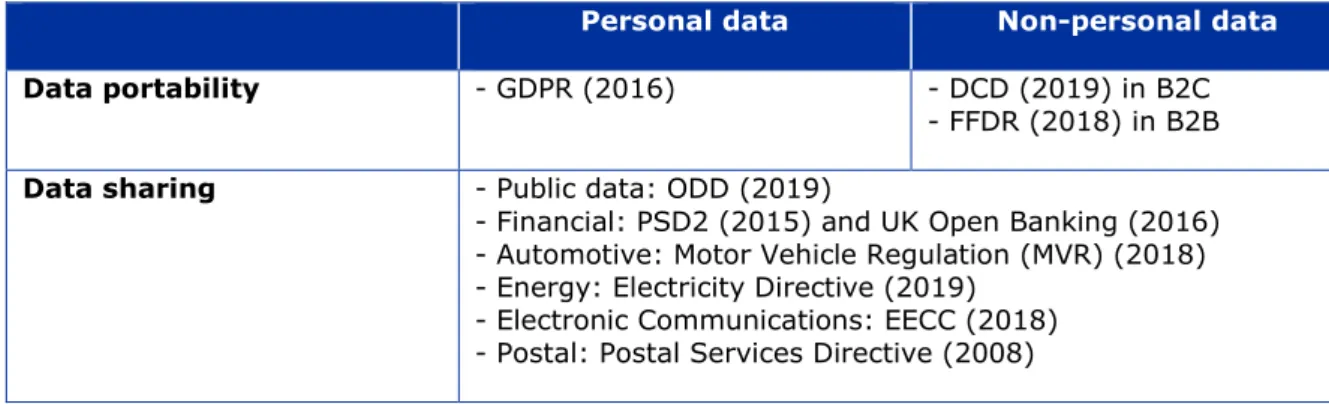
stimulate or impose data sharing and data portability. Concerning horizontal rules applicable
to all sectors of the economy, the obligations focus mainly on the portability of personal data (with the 2016 General Data Protection Regulation and the 2019 Digital Content Directive). The portability of non-personal data is encouraged, but not imposed, by the 2018 Free Flow of Data Regulation. Although steps in the right direction, these rules have several limits and shortcomings and they do not provide for a fully-fledged data sharing framework. The most comprehensive data sharing obligation and governance framework is imposed by the 2019 Open Data Directive which applies to data owned by public sector bodies and public undertakings in the EU. There are also extensive data sharing obligations in several sectoral legislation, for instance in the financial sector (2015 Second Payment Services Directive), the automotive sector (2018 Motor Vehicle Regulation), and the energy sector (2019 New Electricity Directive).
Thus, while the EU legal framework contains some rules imposing data sharing, rules are
in general limited and do not provide for a comprehensive and effective governance framework to share data.
III. Recommendations for an effective governance framework in case data sharing is imposed
This report does not recommend that a particular institution, whether at the national or European level, is given the task of regulating data sharing. Whatever the precise institutional arrangements, we identify several challenges which a regulator will need to overcome. These include determining the identity of the digital platforms that will be obliged to share data; deciding the conditions under which data is shared and the obligations of recipients; the user experience (if user consents are required); the scope and other characteristics of the data to be shared; arrangements for the governance of data sharing and the resolution of disputes and errors; and the commercial or other terms under which data is shared. The report presents several conclusions and makes several recommendations.
Regulating recipients as well as donors
The report concludes that regulation for data sharing should not be viewed as being limited
That is because it will also require strict oversight of potentially a very large number of smaller firms that might seek access to such data and which may then rely upon it to provide services of various kinds. Given the potentially wide range of uses to which data could be applied, and the wide range of organisations which may require access to such data, individual users will not consent to the sharing of data unless they can be confident that any recipient of the data will keep it secure and will adhere to other conditions of sharing, so as to preserve trust in, and the integrity of the overall data sharing process. The controllers of commercial data will also be rightly concerned about bulk sharing obligations if misuse by others puts their reputation or commercial position at risk. Recipients of data may be also putting themselves in a position of acute dependency (since they may rely upon uninterrupted data sharing to sustain their services for users) and will not enter into such arrangements unless they consider that they have adequate protections and rights of redress in the event of any disruption or interruption in supply. A comprehensive system of regulation of both donors and recipients of data will be required to guard against misuse and to ensure trust on all sides.
It follows that if regulated data sharing is to be adopted at a significant scale, regulators will need to establish an effective regime for overseeing those in receipt of data and for enforcing the rules effectively on an ongoing basis. This will need to include rules governing
the resolution of disputes and determining how liabilities fall if consumers or other firms are harmed. Since many of those who share or receive data are unlikely to hold market power or otherwise to be guilty of any abuse, we consider that oversight of such arrangements is unlikely to be an appropriate task for a competition authority and will instead require a dedicated regulatory body.
Extensive obligations to adopt common technical standards
All forms of data sharing will require the adoption of common technical standards by both
those sharing data and those in receipt of it. The same standards should be adopted for all the
different forms of data sharing that we propose. We consider that potential recipients of data have sufficient incentives to adopt the standards since they would not otherwise obtain access to the data they require. Those platforms that have been directed to share data will need to be obliged to adopt the relevant standards, such that data can be shared in a form and manner which supports the regulatory objectives. In the early stages of regulation, this may impose additional costs on the newly regulated entities as they have to restructure the way they manage their existing data assets or adopt new external interfaces. This may also contribute to delay in the implementation of new data sharing obligations, which will be a particular concern if the objective of data sharing is to prevent leveraging into emerging digital markets. In the longer term, we conclude that data sharing regulation should promote the very extensive adoption of common technical standards by organisations which may not currently have obligations to share data (but which might be required to in the future), those who may not currently request access to data (but will want to preserve the option to do so in the future), and in relation to forms of data which may not currently be shared (but which may be required to be shared in future). This ‘anticipatory’ approach to technical
standards means that regulators should consider the application of common technical standards to data sharing in sectors well beyond the existing scope of large digital platforms, as has been proposed in Australia. In short, we recommend regulators should decouple requirements to adopt common technical standards from obligations to share data in the expectation that the former will be much more extensive than the latter.
The most important and difficult role for regulators will lie in determining the type and scope of data that is to be shared and which organisations should be obliged to share it. We conclude that two
forms of regulated sharing are likely to dominate.
Recommendations on sharing of data about individual users
The first form of sharing – and the one which is likely to be capable of being implemented
first - will be the sharing or porting of data about individual users. This mode of sharing is
likely to be appropriate when the individual concerned will benefit directly from the sharing process, usually through the provision by the recipients of complimentary services in adjacent markets. The
value of the data, in this case, lies in its depth and personalised nature, rather than in its volume. The process to enable the sharing of the data will generally require that the user consent to the transfer, and the process by which these user consents are obtained and authenticated will have a significant impact on the effectiveness of this remedy. Technologies such as biometric IDs will have a significant role to play.
The data to be transferred would be data provided by the user to the platform and data derived from observations of that individual’s interactions with the platform. It would
exclude ‘inferred data’ that is created by the platform itself (as well as excluding third party data that is purchased from other sources). The presumption should be that all relevant data about an individual would be shared.
The overall competitive impact of these data sharing arrangements will necessarily be limited, given the relatively high transaction costs associated with first obtaining individual consents from every user and the relatively small volumes of data that will be transferred each time consent is obtained. Over time, however, data that is obtained in this way could accumulate and be used for other purposes. For this reason, we recommend that obligations to share data about individual
users in the way we propose should be quite extensive and apply to digital platforms which we would describe as meeting the ‘gatekeeper minus’ threshold. This would mean a strong
presumption that the obligation to share would apply to all platforms which the regulator had determined as having ‘gatekeeper’ or equivalent status and to some others as well. However, this
obligation would not apply to every platform or firm, and so would be less extensive than, for
example, the ‘data portability’ obligations which apply under the GDPR (which are narrower
in scope). We do not recommend that the European Commission seek to expand the existing GDPR
data portability requirements to address the competition concerns we consider in this report and conclude that a separate regime, specifically designed for this purpose, is the better approach.
We consider that there is a case for a regulator to require the sharing of individual user data without any form of payment passing between the donor and the recipient. Each party
would be expected to bear its costs to the transfer.
It is unclear at this stage how effective the arrangements for the sharing of individual data outlined above would prove to be. However, there is a risk that the high transaction costs and uncertain benefits continue to deter users and render this approach relatively ineffective in preserving the contestability of the markets we are concerned with. In such circumstances, we recommend the
European institutions should consider more radical approaches, including changes to the GDPR which would allow for individual users to ‘opt out’ their data (rather than requiring
them to ‘opt in’) when transfers of their data are initiated - provided always that the recipients of the data comply with the relevant regulatory conditions.
We recognise that this may represent some loss of consumer sovereignty over their data, but consider that such a trade-off may need to be made if data sharing arrangements are to achieve their aim of ensuring contestability in digital markets. It is far from clear that the interests of European consumers are better served by preserving rights to consent whilst allowing new digital markets to be dominated by existing ‘gatekeeper’ platforms. Indeed, in the long run, the privacy rights of European consumers may be better served by measures that more effectively promote competition. At the very least, the debate should be had and we, therefore, recommend the
European Commission consider provisions in the forthcoming Data Act to enable the use of ‘opt out’ arrangements for the sharing of personal data to preserve market contestability under certain prescribed conditions. There is certainly a precedent for such
arrangements, since control of personal data sets has often changed without individual user ‘opt ins’ when one firm acquires another firm or when one firm acquires another’s data assets.
Recommendations on the bulk sharing of user data
The second form of sharing will be the bulk transfer of aggregate user data. As with the first
category, this would involve sharing data provided by individual users or arising from their interactions with the platform but would exclude inferences that are generated by the platform itself. This mode of sharing is likely to support entry into adjacent or emerging markets, with such entry being supported by insights derived from large data sets. It may even to support competition in some or all of the core market activities from which, or by means of which, the data has been derived. The overall competitive impact of these data sharing arrangements could be significant – likely more significant than for individual user data - since the volume of data to be shared is likely to be very substantial and may represent a significant proportion of the donor platform's data assets. In some circumstances, it may be necessary for the data to be shared without first anonymising it to allow recipients to effectively rival the incumbent platform. Since obtaining individual consents from
every user would not be feasible in these circumstances, we recommend that regulators and policymakers consider other mechanisms to enable the bulk sharing of non-anonymised user data.
Alternatively, regulators should consider requiring the platform that controls the data to allow third party access to the full data set for training algorithms or otherwise deriving the same sorts of insights from the data that are available to the incumbent. The terms
under which such access is provided would also need to be carefully regulated since those seeking access to the data sets would remain dependent upon the owner of the assets providing full and unrestricted access. Similar challenges arise even the data is held by a ‘neutral’ intermediary. Such arrangements are therefore likely to require a high degree of regulatory oversight (and associated cost), although they also have considerable attractions if non-anonymised data is important to preserve contestability or if very large data sets are involved.
Although we would expect all the relevant data about an individual user to be shared with every recipient, there is likely to be much greater heterogeneity of demand amongst potential
recipients of bulk transfers of aggregate data. Some potential recipients may require (or may
only be able to handle) relatively small volumes of data, representing only a fraction of that held by the donor. Others may require the sharing of much larger data sets. There may also be questions about the geographic scope of the data to be shared. This will present two challenges. First, the regulator will need to ensure that a suitable menu of data options is developed, preferably collaboratively and inclusively, to ensure that the needs of as wide a range of potential recipients as possible will be met as far as possible. This is likely to involve a degree of compromise on the part of some parties, with the regulator adjudicating between conflicting demands.
Second, we consider there is a strong prima facie case for assuming that recipients of
aggregated data should be required to pay the data, with the payment varying by the volume and value of the data being shared (and not simply the costs of implementing the data sharing arrangements or storing the data). The primary concern here is to preserve
incentives for both parties in the sharing arrangement to innovate and invest in existing or new digital services to acquire additional data for themselves. We do not want data sharing arrangements to crowd out other forms of commercial activity from which users derive significant benefits, particularly in many digital markets.
However, we do not make firm recommendations as to how these prices should be derived because we have yet to find a well-developed methodology for doing so. Requiring firms to agree with terms on a ‘FRAND’ basis may not be adequate in several circumstances. We recommend that a study
be undertaken by the Commission to consider how regulators would establish wholesale prices for data that was to be shared. The methodologies and the practices which were developed
for the public open data framework to calculate the marginal costs and to recover costs developed for public data may feed this study. We also consider that setting appropriate wholesale prices for the receipt of aggregate data will also be necessary to ensure that recipients have appropriate
incentives to reassess their data requirements as they grow and develop their businesses, allowing for the possibility that they would terminate existing data sharing arrangements once they have acquired, or are in a position to acquire, sufficient data for themselves from their users. Otherwise, extensive data sharing arrangements could likely become a permanent feature of European digital markets in the years to come.
The final question in this context concerns the identity of the platforms that would be obliged to share aggregated personal data on a bulk basis. We conclude that this should be a much-limited
set of entities than we recommend for the porting of individual data and would not
necessarily be a requirement of every platform that was found to hold ‘gatekeeper’ status under the European Commission’s latest proposals, although we think a designation of ‘gatekeeper’ status should establish a rebuttable presumption. We, therefore, characterise this sub-set of entities
as being those that meet a (more demanding) ‘gatekeeper plus’ threshold. The analysis
required to demonstrate this would need to be undertaken on a case by case basis.
The challenge ahead
The recommendations in this report, if adopted, would represent an extensive programme of regulatory activity that would need to be undertaken by bodies with responsibilities for implementing data sharing which have yet to be assigned in Europe. Establishing the institutional and
regulatory framework to deliver data sharing at scale will require legislation. Moreover, we
recommend that the European policymakers consider further legislative changes in the forthcoming Data Act to enable the sharing of personal data on an opt out basis under certain narrowly prescribed circumstances and to ensure contestability in digital markets.
Finally, we are mindful that data sharing remedies that we have considered in this report arise from the assumption that digital platforms will continue to derive significant market power from their centralised control of big data sets which they have accumulated by enabling diffuse groups of users to transact with each other through the platform. This may be the case, but regulators and policymakers should also keep an eye on (and potentially take steps to promote) new technologies
and architectures which might in the future enable a much greater degree of decentralisation and wider distribution of data, thereby removing the very sources of market
01
1 Introduction
11.1 Aim and scope of the report
This report seeks to engage with the practical challenges which public authorities will face if they were to decide to oblige digital platforms to share their data with potential competitors. There is today considerable and growing momentum behind proposals for ‘data sharing’ as a remedy for competition concerns in digital markets, but as yet little detail as to what they might consist of or how they might work. This report can be read alongside other research that has been undertaken by
colleagues at CERRE2 which has produced detailed case studies of data used by specific types of
digital platforms (online search, e-commerce, and media platforms) and detailed proposals for how data sharing might promote market contestability, competition, and innovation in each case. This report complements their work by considering what practical steps public authorities would need to take, and what issues they would need to address if the sorts of data sharing arrangements which they propose were to be effectively implemented3.
We start by reviewing how data is shared in other contexts and what might be learned from the arrangements that have been instituted to facilitate such sharing. Unsurprisingly, we observe that data is shared when parties to the arrangement derive a benefit from doing so. For example, we suggest that if the sharing of data is to require the prior consent of a particular user then such arrangements are only likely to work if that user perceives a direct benefit (or ‘private value’) from the arrangement. If both all parties to the arrangement stand to benefit, then sharing may occur voluntarily without the intervention of public authorities, although there may still be significant obstacles and transactions costs which explain why, in the view of many, the potential benefits of voluntary data sharing are a long way from being fully realised in Europe today.
If some parties stand to gain from sharing, but others not, then some form of intervention is likely to be required before it occurs. We assume such an intervention would be required to oblige a large digital platform to share data which it holds with a potential competitor. We, therefore, consider the various existing legal instruments which have been or could be, used to require firms (and public bodies) to port or share data. Some of these instruments, such as the General Data Protection Directive, require data portability to fulfil goals other than the promotion of competition, whereas others, such as competition law, clearly have competition as their primary focus.
From this review, we identify several practical questions that will need to be addressed by any data sharing regime which seeking to promote or safeguard market contestability, competition and innovation in digital markets. The answers to some of these questions depend upon the form of competition which any measures might be intended to promote. In many cases, we would expect data sharing to be employed as a means of promoting ‘complementary innovation’ and preventing foreclosure in adjacent markets rather than having the more ambitious aim of displacing a dominant digital platform from the core market from which it derives its data advantages. Sometimes these arrangements might allow data intermediaries or data aggregators to help individual users enjoy greater benefits from multi-homing. Sometimes they may instead enable innovation and competition in adjacent markets that benefit users in general.
There are some signs that European policymakers are prepared to incentivise more data sharing. Since at least 2018, the Commission has sought to facilitate arrangements that allow firms to share
1 The authors are grateful to Bruno Liebhaberg, Jan Krämer and Thomas Tombal for their helpful comments and suggestions. 2 Krämer, Schnurr and Broughton Micova (2020).
data amongst themselves or with public bodies4. In February 2020, the Commission adopted ‘A
European strategy for data’5 which identified, amongst other things, existing barriers to the sharing
of data between businesses, including: ‘a lack of economic incentives (including the fear of losing a competitive edge), lack of trust between economic operators that the data will be used in line with contractual agreements, imbalances in negotiating power, the fear of misappropriation of the data by third parties, and a lack of legal clarity on who can do what with the data (for example for co-created data, in particular, IoT data)’6. Many of these issues are directly relevant to the data
governance arrangements we discuss in this report and the Commission currently intends to address
many of them by way of a new Data Act in 2021.7
In addition to facilitating data sharing more broadly, the Commission also engaged in what it describes as ‘broader fact-finding around the high degree of market power of certain platforms and also in the context of the Commission’s work on the Digital Services Act package. Based on this fact-finding, the Commission will consider how best to address more systemic issues related to platforms and data, including by ex-ante regulation if appropriate, to ensure that markets stay open and fair.’8
Recent papers produced by the Commission indicate that relevant cases studies will include “situations, where the market does not provide for a market based solution and these platforms are unwilling to share their data, it may be necessary to require such platform through ex ante regulatory measures to offer access to the required data on reasonable, standardized and non-discriminatory terms.”9 The Commission is also consulting on proposals to adopt what it refers to as a ‘new
competition tool’ and/or an ‘ex-ante regulatory instrument of very large online platforms acting as gatekeepers’, either or both of which, if adopted, would be likely to support the imposition of obligations to share data10.
This report discusses the practical challenges that would need to be overcome if these or other initiatives are to lead to data sharing remedies that ensure digital markets remain contestable.
1.2 Types of data 1.2.1 Personal data
Before considering the many different types of existing data sharing and portability arrangements that can be observed in Europe today, it is important to introduce some of the terminologies we employ in this report. There are many different types of data but no comprehensive or authoritative taxonomy. For our purposes, a distinction should be drawn between what is commonly referred to as ‘personal’ data and ‘non-personal’ data. This is important because (as we explain further in section 3), under the General Data Protection Directive (GDPR), individual users have certain legal claims over and rights concerning personal data that do not apply to non-personal data. Personal data is
4 In 2018, the Commission published a Staff Working Document ‘Guidance on sharing private sector data in the European data
economy, SWD(2018) 124 which provided firms with basic guidance on the contractual issues which typically need to be addressed, including the scope and nature of the data to be shared, the use to which it can be put, the parties with which it is to be shared, how the data is to be protected, the technical means by which access is to be provided, liabilities if data is of poor quality or is false, supply is interrupted or data is destroyed or lost. The guidelines encourage (but clearly cannot oblige) European firms to adopt standardised APIs in order to facilitate data transfers. In the same year, the Commission adopted a Communication, ‘Towards a common European data space’ (COM(2018) 232), in which, amongst other things, it proposed that ‘Support Centre for data sharing under the Connecting Europe Facility programme will put in place a set of measures to make it easier to share private sector data in addition to public sector data4. It offers know-how and assistance on data sharing by providing best practice
examples and information on APIs, existing model contracts and other legal and technical aspects’4. The Commission also
proposed to promote the adoption of common APIs.
5 Communication from the Commission of 19 February 2020, A European strategy for data, COM(2020) 66. 6 Ibid p.8
7 In July 2020, the Commission services consulted on proposals for a regulation governing ‘Common European Data Spaces’, Ares
(2020)3480073.
8 Ibid p.14
9 European Commission, Inception Impact Assessment for Digital Services Act Package: ex ante regulatory instrument 10 Commission launches consultation to seek views on Digital Services Act package’, press release, IP/20/962
defined as ‘any information relating to an identified or identifiable natural person’11. This could
encompass a very wide range of data in the context of a digital platform. It is therefore common to sub-divide such personal data into at least four categories (an approach which has been employed by, amongst others, the OECD, European data protection authorities, and advisers to the Commission12).
First, there is ‘provided’ data, which is data about an identifiable user that has been provided to the platform by the user themselves, often (but not always) at the time when they first sign up for a particular digital service. Data may also be provided, for example, every time a user posts new photos or comments on their social media service. Such data may have considerable value for digital platforms but is commonly regarded as having been provided by, and so remaining under, the control of the user who provided it. It is replicable in the sense that if a user can supply data to one digital platform then they could, in principle, supply the same data to other platforms as well. However, if users have provided a lot of data over a long period, or if they use the digital platform itself as a means of storing data, it may be more difficult to replicate provided data unless the user can themselves download a copy from the platform in question. Accordingly, the GDPR provides users with the rights to download data which they have themselves earlier provided to the platform without incurring costs by doing so.
Second, there is ‘observed data’, which is data that is generated through interactions between an identifiable user and the platform. We consider this category of data is often the most important when it comes to sources of competitive advantage in digital markets since it is by observing the responses and actions of individual users that digital platforms are often able to generate predictions about how individual users will interact in future or what might best or more closely fulfil their needs. A standard example is the observed propensity of individual users to click on links that are served in response to search queries. This data will provide a search engine with information both about the likely preferences and needs of that individual user, but also with valuable inferences, when combined with observed data from other users, about what all users with similar characteristics might want13.
Importantly, for our purposes, observed data is difficult to replicate since its creation relies upon what is likely to be a very large volume of interactions between the individual user and the digital platform itself, often undertaken over an extended period. To replicate this data, a user would not only have to switch from one digital platform to another but would then have to engage with the new provider for an extended period to allow them to generate a similar profile and data set. However if, as is often the case, observed data helps to ensure higher quality interactions with the platform, the user may find themselves having to forgo these benefits when they switch to a new provider. Moreover, a large number of users may need to co-ordinate their switching to a new provider if they are collected to benefit from the insights that a digital platform obtains from being able to analyse aggregated sets of observed data.
In one sense, observed data is co-created by the user and the platform since it cannot arise without the presence of both parties. The GDPR considers that users should retain similar rights over observed data as they do over provided data, including the right to download it at no cost and to require that it be transferred to another platform if technically feasible. The platform’s rights over observed data will depend upon the consents it has obtained from users and the contractual obligations it is subject to.
11 Regulation 2016/679 of the European Parliament and of the Council of 27 April 2016 on the protection of natural persons with
regard to the processing of personal data and on the free movement of such data, and repealing Directive 95/46 (General Data Protection Regulation), OJ [2016] L 199/1, Article 4
12 See Guidelines of 13 April 2017 of Working Party 29 on the right to data portability, WP242 rev.01. Also Cremer et al.(2019)
and OECD (2019).
Third, there is ‘inferred data’, which is data that is derived from the analysis of other data that is undertaken by the platform itself. The creation of inferred data does not, therefore, require any further interaction with the user even though the inferences may relate to that user. A digital platform’s capacity to generate insightful, innovative, or useful inferences from the data that it has accumulated may be an important source of competitive differentiation and advantage in markets where such insights can be translated into differentiated services. Inferred data that is valuable may, therefore, be difficult to replicate and may reflect genuine innovation on the part of the platform that holds it. At the same time, it may be sufficient for a rival platform to obtain access to the underlying inputs - the provided and/or observed data from which the inferences are drawn - to be able to compete effectively. Inferred data is not, therefore, commonly regarded as being under the control of the individual user, although a digital platform may still require their consent if such data were to be shared.
Fourth, a digital platform may be able to acquire personal data from a third party rather than obtaining it from the user or their interactions with the user. Data of this kind may be acquired to complete profiles of users when they have neglected to provide certain personal details, or for other purposes. As we note in the next section, such data is likely to be available for sale from a variety of specialist data providers and so easily obtained by rival platforms as well. Interventions by public authorities are unlikely to be necessary unless a large digital platform were able to acquire competitively valuable data on an exclusive basis. We are not aware of this having been a concern to date, and so the sharing of acquired personal data is not considered further in this report.
1.2.2 Non-personal data
Having discussed four discrete categories of personal data, the same categories can be applied
for our purposes to non-personal data, being information that does not relate to an identifiable
individual. Thus, non-personal provided data may be information that was originally provided by an identifiable user but which has subsequently been reconfigured, or anonymised, so that the identity of the user who provided it is no longer apparent. Similarly, non-personal observed data will have been generated by interactions between the platform and identifiable users, but subsequently manipulated so that the identities of those users are removed.
The issue of anonymisation is a highly technical one and has become a subject to some controversy. On the one hand, the anonymisation of data may remove privacy concerns and allow data to be shared under less onerous conditions, including without the need to obtain consent from individual users before doing so. This should facilitate data sharing. Indeed, by its nature, anonymisation requires the aggregation of large volumes of data. On the other hand, anonymisation involves the extraction of information that may otherwise have significant value. An anonymised set of data that is shared is likely to be less competitively valuable than the source data which is retained by the digital platform that obtained it directly from individual users. Anonymisation, therefore, facilitates the sharing of data in bulk, but with a necessary loss of valuable information in the process.
Aside from personal data that has been anonymised, non-personal data may of course also refer to data that has not been acquired from or is the result of interactions with, any identifiable users. Digital platforms may obtain information from a vast range of sources, including their own and third party private and public organisations, to support the provision of relevant services to their users. Much of this data (such as weather forecasts or traffic or footfall data) is available from third parties, easily replicated by all platforms, and not a key focus in this report. We should, however, note that concerns have increasingly been raised about the terms of access to data that is increasingly generated by sensors and other Internet of Things devices and which is critical to the provision of maintenance, diagnostic, and other ancillary services relating to machinery. We discuss in section 3, for example, the European regulation which was introduced to enable independent garages to obtain access to the data that is required to undertake the repair and servicing of modern automobiles.
Similar issues have arisen concerning access to and the ownership of data that is generated by tractors in the agricultural sector14.
1.3 Types of data sharing
It is also important to explain what we mean by the term ‘sharing’ when we employ it in this report. Again, there does not appear to be an authoritative taxonomy but we take ‘sharing’ for our purposes to involve the provision by a digital platform of access to specified categories of data to third parties continuously. This distinguishes ‘data sharing’ from a process that more often involves the one-off transfer of a specified set of data from one firm to another, generally at the initiative of the individual user15. The distinction is important because provided data is invariably provided only once by a user,
which means that a one-off transfer of that data to another platform is sufficient to replicate the data. However, as noted earlier, observed data is generally accumulated through the interaction between a user and the platform over time, with more recent data likely to be more valuable and competitively significant than older interactions. If new entrants seek to compete directly with an incumbent digital platform, it seems likely that users will seek to multi-home across both platforms, at least until the new competitor has established its credentials. That requires an effective data access remedy to allow for the continuous transfer of observed data from the incumbent platform to the entrants, at least for some time. However, we have also explained that we consider that data sharing remedies are often likely to be used to safeguard or promote competition in adjacent markets rather than displacing the incumbent platform altogether. In these circumstances, the user will continue to interact with the incumbent platform in the upstream market irrespective of whether there is an entry in the downstream or adjacent market. The incumbent platform will therefore continue to obtain access to observed data and effective competition in the adjacent markets may require that such data continues to be shared.
Although there are many possible forms of data sharing, we follow our CERRE colleagues in considering that two are most likely to be relevant when the objective is the promotion of competition in digital markets.
- The first of these involves the sharing of personal data about an individual user to facilitate the provision of services in adjacent markets from which they stand to benefit. In this case, arrangements will be needed to obtain appropriate consent from the user. We refer to this as (continuous) sharing or portability of individual user data.
- The second involves the sharing, in bulk, of data about aggregate user behaviour or preferences to facilitate the provision of matching and other services that require access to such data to compete. We refer to this as (bulk) sharing of aggregate user data. A different set of arrangements (and different thresholds for intervention) will be appropriate in this case.16
The sharing arrangements should be informed by the type of data sharing that is required to effectively remedy the competition concern. We consider how existing European laws, particularly those relating to the safeguarding of rights to privacy, might be accommodated within the arrangements we envisage and what might need to change for any measures to be fully effective. We also identify other aspects of European law which could and should be improved upon. Some of these changes may be controversial or difficult, but we consider that data sharing remedies are very
14 OECD (2019), p.99 15 Cremer et al (2019) p.83
16 A further (but in our view difficult) distinction might be drawn between data that has been acquired as a by-product of use of
the platform (such as search queries) and data which forms an integral part of the service itself (such as content posted by users on social media. For further discussion of these distinctions, see Krämer, Schnurr and Broughton Micova (2020), Section 3 and 4.4.2
unlikely to achieve their competition objectives in Europe unless policymakers are prepared to commit seriously to the effort and to overcome some formidable obstacles.
1.4 Types of interoperability
Several other studies also introduce distinctions between different forms of ‘interoperability’.17 One
important case is what the Commission’s advisers describe as ‘full protocol interoperability’, which refers to arrangements under which the services of competing platforms will interwork or interoperate with each other. A standard example would involve the users of one digital messaging service being able to communicate directly with the users of another, rival messaging service without them having to subscribe to the other service. Alternatively, users on a particular social messaging platform might be able to post photos or comments on the pages of users on another social messaging platform (and vice versa). ‘Full protocol interoperability’ might be required as a competition remedy in markets exhibiting strong direct network effects, particularly if users single-home rather than multi-single-home. In such markets, new entrants may be otherwise unable to persuade users to forgo the benefits of network effects by switching away from the incumbent platform. There are many interesting issues associated with the imposition of ‘full protocol interoperability’ remedies of this kind, but they are not the focus of this report. Our interest is with the sharing of data held by digital platforms rather than the interworking of services that they may provide. As we explain in more detail in Section 5.2.1, the effective sharing of data between firms continuously is likely to require a significant degree of interoperability, likely facilitated by the provision of various
standardised technical interfaces and the adoption of common standards for data models
(which reference how data and meta-data are structured and organised so that it can be analysed, manipulated and extracted for relevant purposes). There are various ways in which such ‘interoperability’ might be accomplished, each involving different costs and benefits, and so we envisage the development of technical arrangements as being more of a process than an event. Their form will be determined to a large degree by prior decisions about the type of data that is to be shared and the terms under which this is to be done. We do not, therefore, consider it necessary to associate our consideration of data sharing with any particular form of interoperability or set of technical arrangements.
02
Incentives to
share data
2 Incentives to share data
Data sharing is undertaken for a wide range of purposes, and has been, or could be, implemented under a wide range of different arrangements, some of which involve regulation but many of which are entirely voluntary. In this section, we review some of the arrangements that exist and consider what might be learned from them. In subsequent sections, we discuss existing examples of European rules of data sharing. Later we consider the implications of our findings for the rules and governance of regulated data sharing to promote competition.
As we noted in the introduction, data sharing arrangements are likely to emerge when both parties
to the arrangement derive some benefits from participating18. Economists often remind us that data
has certain properties that may make it easy to share. Data is non-rivalrous, meaning that the same data can be used by different parties for different purposes without the activities of one party affecting the opportunities of others. There also appear to be economies of scope in aggregation, meaning that data from different sources can be combined to yield insights and benefits which could not have been obtained from either of the sources independently19. This is in addition to the
additional benefits which might be derived from simply increasing the volume of data that is available to different parties. It is these unusual properties of data that may provide strong incentives to share data for mutual benefit, but which may equally provide incentives for firms and others to deprive potential competitors of access to data.
Sometimes the beneficiaries of data sharing are particular individuals, sometimes they are organisations such as firms or public organisations. In the latter case, individuals who obtain services or products from firms or citizens who rely on public organisations are also likely to share in the benefits which those organisations derive from having access to data, or from sharing it. Nonetheless, we think a useful distinction can be drawn between data sharing which benefits a specific individual – and which is therefore generally initiated by that same individual – and data sharing which has broader benefits and which is generally initiated by an organisation. The data that is accessed at the initiative of a user is generally data about that specific user and is generally required to provide services for their benefit20. Data that is accessed at the initiative of an organisation may involve data
that has been acquired from a large number of users and subsequently anonymised or it may be non-personal data that has been derived from other sources (including being created by the organisation itself). In these cases, the data is required to provide services from which a large number of users, rather than any particular user, are likely to benefit21.
2.1 Incentives of the individual users to share their data
In Europe (and increasingly in other parts of the world), individual users are considered to have certain rights over data that they have themselves provided to organisations, including both firms and public bodies. These rights arise from the conviction that citizens and consumers should exercise control over data that relates specifically to them (and by which they can be identified), even if they have chosen to share it with other parties. Under the GDPR, control involves rights to require the deletion of data which has previously been provided or which has been observed or inferred from their interactions with the organisation in question, but also rights to require the return of data back to the same user (irrespective of whether or not the data is subsequently deleted by organisation that held it) in a standardised format and, ‘where technically feasible’, the direct transfer or ‘porting’ of the data to another organisation. We note that the first review of the implementation of the GDPR
18 See Martens et al. (2020). 19 Krämer et al. (2020), Section 2. 20 Cremer et al (2019:25)
(after 2 years) found that the application of the right to port individual user data by users had been very limited22.
We have identified several reasons why an individual user might wish to obtain access to personal data and/or to share it:
- An individual user may require access to the data that has been accumulated by the platform about him to better understand what it is (and perhaps subsequently to
make changes to what data is collected from them in the future). This may be particularly important with observed data that is acquired and accumulated every time the user engages with a digital platform, such as data about search terms that have been entered or web sites that have been visited. Data access may therefore serve to reduce the information asymmetries between users and digital platforms and, potentially, ensure that users can then alter their privacy settings to ensure that the data disclosed and retained is the minimum necessary to meet their requirements. The OECD (2019:43) refers to this motivation as ‘informational self-determination’. The early data access arrangements that were developed by digital platforms like Google (‘Google Take Out’) and Facebook appear to have been primarily intended to serve this purpose, allowing data to be provided to the user on request but not, at least easily, to be transferred to another organisation. Evidence of user demand for such capabilities is not publicly disclosed by either Google or Facebook (in contrast, Google does disclose the demands it receives from Governments and other organisations for their users' data23), although Google referred to ‘millions of users’ having
downloaded their data in 201624. It is reported that user demand for access to data held by
Facebook increased significantly following the revelations in 2018 that Facebook had shared user data from over 50 million accounts with Cambridge Analytica25.
- An individual user may require access to the data held about her because she wishes to share it with another service provider. As noted earlier, this could be done
either as a single transfer or continuously into the future. The former could be the case if a user wishes to switch from one provider to another (in a ‘single homing’ environment) or if the data is confined to the provided data. The latter is more likely to be appropriate if a user wishes to ‘multi-home’ with several providers simultaneously26 and if the data included
observed data. In the former case, the individual user is likely to be switching because they perceive some benefit for themselves in doing so. It may be possible for them to switch without obtaining access to their data from the existing platform, but they may then incur costs in terms of time and effort in replicating the data for their new provider. If the data is observed data, then it will take a new platform time to accumulate the data (and the insights it derives from it), and the service the user receives from the new provider until sufficient data is accumulated may be inferior. Some users may not be willing or able to switch without access to the data, and so would be deprived of the service altogether. Individual users might, in theory, be prepared to download data from one platform and upload it to another,
22 ‘The Staff working Document accompanying the Communication (COM (2020) 264) found ‘The right to data portability is not
used to its full potential. The European Strategy for Data (hereafter Data Strategy), adopted by the Commission on 19 February 2020, emphasised the need to facilitate all possible uses of this right (e.g. by mandating technical interfaces and machine-readably formats allowing portability of data in (near-to) real-time). Operators note that there are sometimes difficulties in providing the data in a structured, commonly used machine-readable format (due to the lack of standard). Only organisations in particular sectors, such as banking, telecommunications, water and heating meters, report having implemented the necessary interfaces . New technological tools have been developed to facilitate the exercise by individuals of their rights under the GDPR, not limited to data portability (e.g. personal data spaces and personal information management services).’, SWD (2020) 115
23https://transparencyreport.google.com/user-data/overview 24 House of Lords (2016), para 245
25https://www.vox.com/2018/11/20/18105541/facebook-user-data-request-download-delays-high-volume
26 For example, the average UK user multi-homed across 7.1 social media platforms in 2019, see
as the GDPR appears to contemplate27. But in practice, the sharing of data on any scale is
likely to require the user (or its agent) to initiate a direct and continuous transfer of data from one platform to another using APIs. There are several examples of initiatives that are intended to help individual users share ‘their’ data in this way:
o Several Government initiatives have sought to facilitate the sharing of data
between providers of utility, financial or medical services to facilitate switching in markets where users tend to single-home. In Europe, initiatives
such as the UK Government’s Midata project, launched in 2011 or the French Mesinfos programme28 have sought to promote data access voluntarily. More
successful have been the so-called Green and Blue Button programmes in the United States, launched in 2010 and 2012 respectively, which have allowed, in the Green Button case, over 60 million households to download information about their energy consumption from 150 energy providers (and to facilitate data access for third parties) and, in the Blue Button case, 150 million persons to access their medical records from 16,00 organisations29.
o Several private sector initiatives to facilitate the transfer of data. The most
relevant of these for our purposes is the Data Transfer Project (DTP) in which Google, Facebook, Apple, Microsoft, and several other (mainly large) digital platforms are currently developing a set of ‘adaptors’ which would enable the transfer of user data via the proprietary APIs of each platform from one to another. The DTP was founded in 2018 and is still under ‘active development’. One of the challenges is, as the DTP notes, the formats for data in different ‘verticals’ (emails, photos, or music each represent a different vertical in this context) ‘have emerged organically in a largely
disconnected ecosystem’30. This means that each organisation may use a different
proprietary ‘data model’ to organise the data it acquires, as well as proprietary APIs which already allow that data to be shared with third party developers. The DTP aims to address these issues by developing ‘adaptors’ which allow data to be converted from one proprietary model to another and by encouraging the future development and adoption of common data models in the future31. It is unclear at this stage when
the full DTP functionality will be made available to users, nor what it might comprise of, although we know Facebook has adopted DTP functionality to enable the sharing of photos with Google32.
- Individual users may require access to data about them because the sharing of that data may allow them to benefit from ‘complementary innovation’ in other (data-dependent) markets. In this case, the user does not seek access to data to substitute one
service for another of a similar kind but to obtain a new service. This may arise if data from a single organisation is shared with one or more third parties, but it may also arise if the data from one or more organisations with whom that user interacts is then shared with a
27 In addition, Article 16 of the Content Services Directive 2019 (2019/770) allows users to request a digital platform to provide
any non-personal digital content which they created or provided whilst being provided with services upon the termination of the relationship with the service provider. However, there is no obligation for the platform in question to facilitate the transfer of this data to another provider.
28 Crtl-Shift (2018), p.30
29 OECD (2019), p.126, Ctrl-Shift (2018), p.82-3 30https://datatransferproject.dev/documentation
31 See Gal and Rubenfeld (2019). The authors suggest that interim solutions, such as ‘data translators’ which are ‘algorithms,
which relate the data attributes of one data set to those of another data set, can (partly) solve some of the data integration problems outlined above while significantly reducing intervention in the choices of market player’, p.766
32 Kramer, Senellart and de Streel (2020) report: ‘A number of import or export connectors have been implemented to interface
with various platforms, but there are very few public-facing sites that do use the DTP (the most prominent being a specific use case on Facebook: users have been able very recently to use it to transfer their photos to Google Photos’,p.47. On Facebook’s most recent data portability plans, see Facebook (2020)