RESEARCH OUTPUTS / RÉSULTATS DE RECHERCHE
Author(s) - Auteur(s) :
Publication date - Date de publication :
Permanent link - Permalien :
Rights / License - Licence de droit d’auteur :
Bibliothèque Universitaire Moretus Plantin
Institutional Repository - Research Portal
Dépôt Institutionnel - Portail de la Recherche
researchportal.unamur.be
University of Namur
Processing and characterization of the low density lipoprotein receptor in the human
colonic carcinoma cell subclone HT29-18
Mazière, J C; Mazière, C; Emami, S; Noel, B; Poumay, Y; Ronveaux, M F; Chastre, E; Porte,
H; Barbu, V; Biade, S; Santus, René; Gespach, Christian P.
Published in:
Bioscience reports
Publication date:
1992
Document Version
Publisher's PDF, also known as Version of record
Link to publication
Citation for pulished version (HARVARD):
Mazière, JC, Mazière, C, Emami, S, Noel, B, Poumay, Y, Ronveaux, MF, Chastre, E, Porte, H, Barbu, V, Biade,
S, Santus, R & Gespach, CP 1992, 'Processing and characterization of the low density lipoprotein receptor in
the human colonic carcinoma cell subclone HT29-18: a potential pathway for delivering therapeutic drugs and
genes', Bioscience reports, vol. 12, no. 6, pp. 483-94.
General rights
Copyright and moral rights for the publications made accessible in the public portal are retained by the authors and/or other copyright owners and it is a condition of accessing publications that users recognise and abide by the legal requirements associated with these rights. • Users may download and print one copy of any publication from the public portal for the purpose of private study or research. • You may not further distribute the material or use it for any profit-making activity or commercial gain
• You may freely distribute the URL identifying the publication in the public portal ?
Take down policy
If you believe that this document breaches copyright please contact us providing details, and we will remove access to the work immediately and investigate your claim.
Bioscience Reports, Vol. 12, No. 6, 1992
Processing and Characterization of the Low
Density Lipoprotein Receptor in the Human
Colonic Carcinoma Cell Subclone HT29-18:
A Potential Pathway for Delivering
Therapeutic Drugs and Genes
J. C. Mazi~re, ~'4 C. Mazi~re, 1 S. E m a m i , 2 B. N o e l , 3
Y . P o u m a y , 3 M. F. R o n v e a u x , 3 E . Chastre, 2 H . Porte, 2
V . Barbu, 1 S. Biade, ~ R . Santus, 4 and C. Gespach 2's
Received August 6, 1992; revised August 27, 1992
Low density lipoprotein (LDL) processing has been investigated in the subcloned human colonic carcinoma cell line HT29-18. LDL binding at 4~ was a saturable process in relation to time and LDL concentration. The Kd for LDL binding was 11 #g/ml. ApoE-free HDL 3 or acetylated LDL did not significantly compete with 125I-LDL binding, up to 500/~g/ml. 125I-LDL binding was decreased by 70% in HT29-18 cells preincubated for 24 hours in culture medium containing I00/zg/ml unlabelled LDL. Ligand blotting studies performed on HT29-18 homogenates using colloidal gold labelled LDL indicated the presence of one autoradiographic band corresponding to an apparent molecular weight of 130 kDa, which is consistent with the previously reported molecular weight of the LDL receptor in human fibroblasts. At 37~ 125I-LDL was actively internalized by HT29-18 cells and lysosomal degradation occurred as demonstrated by the inhibitory effect of chloroquine. LDL uptake and degradation by H'I29-18 cells also resulted in a marked decrease in endogenous sterol synthesis. These data demonstrate that the HT29-18 human cancerous intestinal cells are able to specifically bind and internalize LDL, and that LDL processing results in down-regulation of sterol biosynthesis. Thus, intestinal epithelial cells possess specific LDL receptors that can be exploited to accomplish drug delivery and gene transfer via the receptor-mediated endocytosis pathway.
KEY WORDS: LDL Receptor; internalization; gene and drug therapy; colon cancer. ABBREVIATIONS: HDL, HCL3, high density lipoprotein; LDL, low density lipoprotein.
~ Lahoratoire de Biochimie, INSERM U312, Facult6 de M6decine Saint-Antoine, 27 rue Chaligny, 75012 Paris, France.
2 INSERM U55, H6pital Saint-Antoine, 184 rue du Faubourg Saint-Antoine, Paris, France. 3 Unit6 de Cytologie, Facult6s Universitaires Notre Dame de la Paix, Namur, Belgium.
4Laboratoire de Physico-Chimie de l'Adaptation Biologique, INSERM U312, Mus6um d'Histoire Naturelle, 43 rue Cuvier, 75006, Paris, France.
5 To whom correspondence should be addressed.
483
484 Mazi6re et aL
I N T R O D U C T I O N
Low density lipoprotein (LDL) is the main cholesterol carrier in plasma. It is
catabolized in a variety of tissues by a process involving receptor-mediated
endocytosis, resulting in down-regulation of endogenous cholesterol biosynthesis
(1, 2). The role of intracellular cholesterol metabolism during cell growth and
proliferation has been documented in normal and transformed tissues (3-5).
Endogenous cholesterol synthesis is a prerequisite in the active renewal and
differentiation of crypt cell progenitors in the small intestine and colon (6, 7).
Recent advances in carcinogenesis research indicate that cell division and
proliferation are certainly crucial events connected with the risk of cancer, such as
familial polyposis coli polyps. This last correlation led us to study the interaction
of LDL with HT29-18 human colonic cancer cells, since colorectal cancer is one
of the most common types of malignant disease "~n Western population.
In this paper, we investigated LDL processing and sterol synthesis in
HT29-18 cells, a subclone obtained from a human colonic adenocarcinoma (8).
The HT-29 cells can be primed for differentiation into enterocyte-like and goblet
cells following substitution of glucose for galactose in the culture medium (9, 10).
Thus, HT29 cells constitute a suitable model to characterize the molecular and
biochemical events related to intestinal cell proliferation and differentiation, and
to test new therapeutic approaches against colonic cancers.
Our findings demonstrate specific binding and internalization of LDL by
HT29-18 cells. This process is down-regulated after preincubation of the human
cancerous intestinal cells in the presence of LDL. We also provide evidence for a
lysosomal catabolism of the protein moiety of LDL and for inhibition of sterol
synthesis by LDL.
MATERIALS A N D M E T H O D S
Materials
125INa (13-17 Ci/mg) was from Amersham (Buckinghamshire, U.K.). [2-
14 C]
sodium acetate (55 mCi/mmol) was from C E A (Saclay, France). Dulbecco's
modified minimum essential medium (DMEM) with Earle's salts and fetal calf
serum were from Gibco (Grand Island, N.Y., U.S.A.). Ultroser G was purchased
from Industries Biologiques Franqaises (Villeneuve la Garenne, France). Silicagel
plates F 1500 were from Schleicher and Schuell (Dassel, W. Germany).
Cell Culture
The HT29-18 subclone generously provided by Dr. D. Louvard (Unit6 de
Biologie des Membranes, Institut Pasteur, Paris, France) was cultured in D M E M
supplemented with 10% fetal calf serum as previously described (8). Experiments
were performed on confluent cell monolayers, approximately 3 to 4 days after
seeding.
LDL processing in human colonic cancer cells
485
LDL Preparation and Labelling with ~2SlNa:
LDL was prepared from normal human serum by 3 steps ultracentrifugation
at 105,000 • g in a L8-55 Beckman centrifuge, according to Havel
et al.(11). The
LDL was taken as the 1.024-1.050 density fractions. After dialysis against 0.1 M
g l y c i n e / 0 . 1 M N a O H buffer ( p H = 1 0 ) , the LDL was iodinated using l mCi
125INa/mg LDL, according to Bilheimer
et al.(12). After labelling, the LDL was
extensively dialyzed against 0.1 M Tris-HCl buffer ( p H = 7 . 4 ) , filtered through
0.4:5/~m Millipore filters and stored at 4~
The specific radioactivity was about
250-350 dpm/ng of LDL protein. Free 12Siodine in the preparation was under
2%. Protein determination was done by the Lowry method (13).
Preparation of LDL Colloidal Gold Conjugates
Colloidal gold was prepared according to Frens (14) in order to obtain 17 nm
gold particles. Conjugation of L D L to gold particles was performed as described
by Handley
et al.(15), and modified by Robenek
et al.(16).
LDL Binding, Uptake and Degradation
HT29-18 cells were cultured for 24 hours in D M E M medium supplemented
with 2% of the serum substitute Ultroser G, instead of fetal calf serum for
maximum LDL receptor expression. Cells were then washed 3 times with
phosphate buffered saline (PBS, pH = 7.4). Binding, uptake and degradation of
125-I-LDL were studied according to Goldstein and Brown (1). The nonspecific
component of 125I-LDL binding, uptake or degradation was determined by
addition of a 50-fold excess of unlabelled LDL along with the tracer. The specific
component was calculated from the difference between total and nonspecific
binding, uptake or degradation. Results are expressed as ng bound LDL/mg of
cell protein.
Visualization of the LDL Receptor by Ligand Blotting
The LDL receptor molecule was also identified by the ligand blotting method
(17). About 20 • 106 cells were solubilized with 1.5% Triton X 100 according to
Friedman
et al.(18). SDS-polyacrylamide gel electrophoresis was performed on a
homogeneous Phastgel 7.5 with a Phastsystem (Pharmacia, Upsala, Sweden), and
proteins were transferred on a nitrocellulose sheet using a semi-dry transfer
system (NovaBlot, Pharmacia). The nitrocellulose was then incubated for 2 h at
room temperature with 140 ~g/ml colloidal gold-labelled LDL. The LDL/gold
particle ratio was 7/1 as assessed by electron microscopy, thus corresponding to
20 #g/ml of unlabelled LDL. The LDL-receptor complex was revealed using the
IntenSE BL silver enhancement kit (Janssen Life Sciences Products, Beerse,
Belgium).
486 MaziSre et al.
Lipid Synthesis
Cells were cultured for 24 h in D M E M supplemented with 2 % Ultroser G for maximal induction of sterol synthesis, and then incubated for 4 h at 37~ in the presence of 1 0 # C i / m l sodium aac-acetate. A f t e r three washes with PBS, HT29-18 cells were harvested with a rubber policeman. Lipid analysis was performed by thin layer c h r o m a t o g r a p h y , as preveously described (19). Results are expressed as pmol of 14C-acetate i n c o r p o r a t e d / m g of cell protein.
All experiments were repeated at least 3 times in duplicate. W h e r e appropriate, statistical analysis was p e r f o r m e d using the Student's t test.
RESULTS
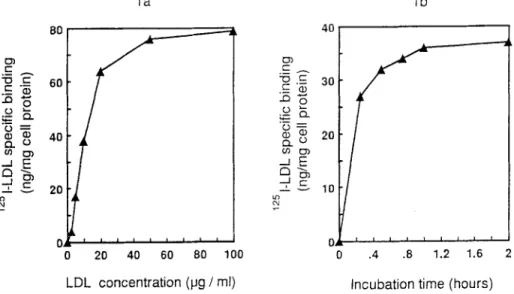
Figure l a shows the specific binding of ~esI-LDL in HT29-18 cells as a function of the lipoprotein concentration. A t 4~ a plateau was observed for about 40/~g/ml lipoproteins. Scatchard analysis (20) indicated a Kd value of 11/~g/ml, close to that f o u n d by N a n o e t al. in the rat intestinal cell line I R D 9 8 (7). The maximal binding capacity was about 85 ng L D L p r o t e i n / m g cell protein. The nonspecific binding represented 23% of the total xasI-LDL binding. W h e n HT28-18 cells were incubated at 4~ in the presence of 10/~g/ml ~25I-LDL, the plateau was reached after 1 h incubation (Fig. lb). Thus, L D L binding in
l a l b 80 " o r - 60
o =
Q . o ~ 4 0 o ) 0 " } - - ~20
i i J i i i 1 i i 20 40 60 80 100 4O t D ) ~5~- ._~ .$ 30 t . 5 x.. : : - - (D.. -J, r- 10 o o .4 .8 1.2 1.6 LDL concentration (pg / ml) Incubation time (hours) Fig. 1. Specific binding of lzSI-LDL to HT29-18 human colonic cancer cells, a: ~251-LDL binding as a function of LDL concentration. Cells were cultured for 24 h in Dulbecco's MEM medium supplemented with 2% Ultroser G. Then 125I-LDL binding was measured at 4~ in the presence of various concentrations of 125I-LDL ranging from 2.5 to 100/~g/ml. Results are expressed as ng of 125I-LDL bound/mg of cell protein (data are means of 4 experiments), b: Specific ~zSI-LDL binding to HT29-18 cells as function of time. Incubations were performed at 4~ in the presence of 10 ~g/ml leeI-LDL. Results are expressed as ng 1zsI-LDL bound per mg of cell protein (data are means of 3 experiments).LDL processing in human colonic cancer cells 487
300
0 " 0S "~ 200
C1. " L 3 ~ ,~3 O N O _ 1 iN
0-- 0 ' I I I I 2 4 6Incubation time (hours)
Fig. 2. Kinetics of specific 125I-LDL uptake ( A ) and degradation ( 0 ) in HT29-18 cells. Cells were cultured for 24 h in the presence of Ultroser instead of FCS, as indicated in the legend of Figure 1. Then, the uptake and degradation of LDL were studied at 37~ in the presence of 10#g/ml ~25I-LDL. Results are expressed as ng lzsI-LDL internalized or de- graded (data are means of 6 experiments).
HT29-18 cells appeared to be a saturable process, in relation to time and LDL
concentration.
Figure 2 shows the kinetics of 125I-LDL internalization and degradation in
HT29-18 cells incubated at 37~
LDL uptake plateaued after 1 h incubation,
while LDL degradation was negligible and increased linearly until 4 h incubation.
The lysosomal inhibitor chloroquine reduced in a dose-dependent manner
125I-LDL degradation by HT29-18 cells. At the concentration of 1 raM, this drug
inhibited degradation by 80% (Figure 3). This result suggests that the protein
moiety of LDL is degraded in lysosomes in HT29-18 cells, as previously observed
in various cell types, including fibroblasts (21) and hepatocytes (22).
In order to study the specificity of the 125I-LDL binding, competition
experiments were performed with increasing concentrations of unlabelled LDL,
apo E-free HDL3 or acetylated LDL. Figure 4 shows that 125I-LDL binding was
100.
c:
80
0
" ~ 0~ 60
qC~ _~ o 4 0 120
I I i ~ I I I I I 1 2 3 4 5Chloroquine concentration (mM)
Fig. 3. Effect of chloroquine on 125I-LDL degradation in HT29-18 cells. Cells were in- cubated for 4h at 37~ in the presence of 10/~g/ml 125I-LDL alone or combined with the indicated concentrations of chloroquine. Re- suits are expressed as percent of control (100%: 235 • 34ng/mg of cell protein). Data are means of 4 experiments.
488 Mazi~re et al.
100!
~0~ ~o 60
~ 40 20 l 1 I i 20 40 60 80 100 HDL 3 AcLDL LDLLipoprotein concentration ( IJg / ml)
Fig. 4. Competition between unlabelled LDL (A),
unlabelled acetylated LDL (U) or unlabelled HDL3 (0)
with lzSI-LDL binding in HT29-18 cells. The cells were
incubated for 1 h at 4~ in the presence of 10#g/ml
lzSI-LDL alone or the indicated agents. Results are
expressed as percent of control (100%: 42 + 3 ng/mg of
cell protein). Data are means of 4 experiments.
efficiently displaced by unlabelled L D L , resulting in 60% and 80% inhibition of
binding at the L D L concentrations of 25 and 2 5 0 / t g / m l , respectively. In contrast,
unlabelled HDL3 or acetylated L D L did not significantly c o m p e t e with 125I-LDL
binding, in the range of the concentrations studied.
Figure 5 displays the ligand-blotting identification of the L D L r e c e p t o r in
HT29-18 cells (lane c). A cell extract of MRC5 normal h u m a n fibroblasts has
also been studied as a positive control (lane a). It can be observed that in
non-reducing conditions, in the absence of fl-mercaptoethanol, only one band
was obtained, which was located at the same position in the 2 cell types,
corresponding to an apparent molecular weight of 130 kDa. This is consistent
with the molecular weight of the L D L receptor obtained in h u m a n fibroblasts
treated under similar conditions (23). It can also be observed in Fig. 5 that when
experiments were p e r f o r m e d in the presence of an excess of native L D L (at
500/~g/ml), no autoradiographic band was detectable in HT29-18 cells and
fibroblasts (lanes d and b). In the presence of 1 m M E D T A , no band was
observed either with MRC5 fibroblasts or with HT29 extracts
(data not shown),
indicating that L D L binding by the HT29-18 L D L r e c e p t o r is d e p e n d e n t upon the
presence of free calcium, as previously observed in h u m a n fibroblasts (24). W h e n
incubated in reducing conditions, in the presence of /3-mercaptoethanol, the
apparent molecular weight of the L D L receptor in HT29-18 cells shifted to
160 k D a
(data not shown).
Similar findings have b e e n r e p o r t e d for the apo B / E
receptor in h u m a n fibroblasts (23). Our data indicate that the L D L r e c e p t o r in
ITI~9-18 h u m a n colonic carcinoma cells has the same molecular weight and
LDL processing in human colonic cancer cells
489
Fig. 5. Ligand blots of the LDL receptor in MRC5 human
fibroblasts (a, b) and HT29-18 human colonic carcinoma cells
(c, d). Samples obtained from Triton •
extracts were
subjected to SDS-PAGE in a 7.5% homogeneous Phastgel
and transferred electrophoretically to nitrocellulose paper.
The blots were incubated with LDL-gold conjugates
(140 #g/ml) in the absence (a, c) or in the presence (b, d) of
an excess of unlabeled LDL (500#g/ml). Migrations of
molecular weight standards transferred onto the nitrocellulose
paper are illustrated on the left.
calcium d e p e n d e n c y t h a n the a p o B / E r e c e p t o r in h u m a n fibroblasts.
T h e down-regulation of the L D L r e c e p t o r by exogenous L D L was also
investigated in HT29-18 cells incubated for 24 h in culture m e d i u m s u p p l e m e n t e d
with increasing concentrations of unlabelled L D L . T h e L D L t r e a t m e n t resulted in
a d o s e - d e p e n d e n t decrease of 125I-LDL binding (Figure 6). H a l f - m a x i m a l and
maximal down-regulation were respectively o b s e r v e d at the concentrations of
unlabelled L D L of 25 and 250/~g/ml. T h e effect of unlabelled L D L incubated for
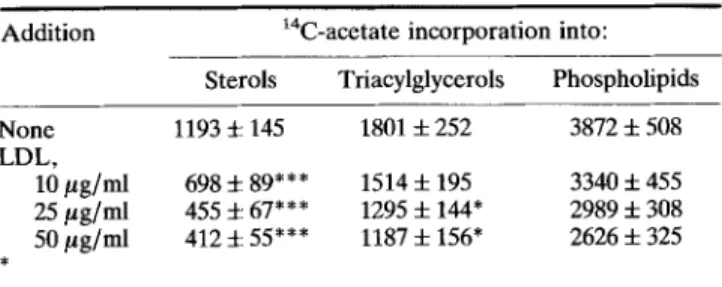
24 h on lipid synthesis in HT29-18 cells is p r e s e n t e d in T a b l e 1. It can be o b s e r v e d
that L D L induced a d o s e - d e p e n d e n t decrease in sodium 14C-acetate incorporation
into sterols (38% and 66% decrease for L D L at 10 and 50/~g/ml, respectively).
In contrast, incorporation of the p r e c u r s o r into triacylglycerols or total phos-
pholipids was m u c h less affected.
DISCUSSION
T h e r e are only few data concerning the L D L processing by intestinal
epiithelial cells. In rats, specific L D L binding has b e e n described by Suzuki
et al.in enzyme-dispersed mucosal cells (25), a n d m o r e recently by N a n o
et al.in the
490 Mazi~re et al. . o E - o o D 100~ 80 60 40 20 0 I ! I I 0 20 40 60 80 100
LDL concentration ( IJg / ml )
Fig. 6. Down-regulation by LDL of specific 12sI- LDL binding in human colonic cancer cells HT29- 18. After 24 h culture in DMEM supplemented with 2% Ultroser G and the indicated concentrations of LDL, HT29-18 cells were washed 3 times with PBS and incubated for 1 h at 4~ in the presence of 10 ttg/ml 125I-LDL. Results are expressed as percent of control (100%: 40:t:7ng/mg of cell protein). Data are means of 3 experiments.
epithelial cell line IRD 98 established from explants of fetal small intestine (7). In
the present work, we clearly demonstrate that the human cancerous colonic
HT29-18 cells can bind, internalize and degrade LDL in a specific manner. The
specificity of the LDL receptor in HT29-18 cells is illustrated by the absence of
competition between the 125I-LDL binding sites and apo E-free
H D L 3 o racetylated LDL. Internalization and lysosomal degradation occurs, as dem-
Table 1. Effect of LDL on lipid synthesis from sodium 14C-acetate in HT29-18 cells
Addition laC-acetate incorporation into: Sterols Triacylglycerols Phospholipids None 1193 • 145 1801 + 252 3872 -1- 508 LDL,
10/tg/ml 698 5- 89*** 1514 + 195 3340 + 455 25/~g/ml 455 i 67*** 1295 + 144" 2989 + 308 50/~g/ml 412 :k 55*** 1187 + 156" 2626 + 325
Cell monolayers were preincubated for 24h in the absence or presence of 10 to 50 #~ LDL/ml in DMEM supplemented with 2% Ultroser G. Sodium 1 C-acetate (10/tCi/ml) was added for 4 h at 37~ Lipid analysis was performed by thin layer chromatography. Results are means of 6 experiments+s.d. *: p <0.05; ***: p < 0.001 by the Student's t test.
LDL processing in human colonic cancer cells
491
onstrated by the decrease in lzSI-labelled peptides released in the incubation
medium and the intracellular accumulation of 125I-LDL in the presence of
chloroquine. Moreover, post-receptor events took place, as demonstrated by the
down-regulation of 125I-LDL binding and of sterol biosynthesis in HT29-18 cells
cultured in the presence of LDL. Finally, the existence of the receptor for LDL in
HT29-18 cells is directly demonstrated by ligand blotting studies.
At the present time, the pathophysiological significance of L D L processing in
carcinoma-derived colonic epithelial cells, and its occurrence in normal human
intestine remained undefined. Although the subclone examined in this study was
obtained from a primary colonic carcinoma, there is evidence that cells of the
H'1-29 line resemble normal human intestinal epithelial cells with respect to
several morphologic, biochemical, functional and immunological criteria. These
include villin and intestinal brush border enzyme synthesis, expression of
vasoactive intestinal peptide receptors, EGF and oL2-adrenergic receptors, and
preservation of mucin-associated antigens (9, 10, 26, 27). Undifferentiated HT29
cells proliferate as unpolarized layers in a standard culture medium and undergo
enterocyte or goblet cell differentiation after glucose privation or butyrate
treatment (29-30). This cell line therefore constitute a powerful model in the
study of LDL and cholesterol metabolism during the maturation and the
functional differentiation of human epithelial cells. The developmental pattern of
the LDL pathway in normal intestinal epithelial cells remains to be explored in
view of the dietary changes occurring in the suckling newborn and at the weaning
(30). It is therefore tempting to suggest that milk lipoproteins and dietary
proteins can exert a physiological regulation on the processing of LDL in
intestine.
HT29-18 cells also appear to be an interesting model to study the targeting
and transfer of genes and some therapeutic agents
viathe LDL receptor pathway.
Several epidemiological and laboratory animal model studies indicate that the
aetiology of colon cancer is multifactorial and complex (27). Surgical excision has
be.en considered as the only effective treatment for colon cancer. However, the
prognosis of patients with colorectal cancer remains poor, mainly due to the
occurrence of metastatic invasions and resistance to chemotherapy involving
maltiresistance gene expression and other mechanisms (31-36). Gene-based
therapy
viathe LDL receptor-mediated pathway, using LDL covalently linked to
DNA-binding structures such as polyamines, polylysines or other conjugates will
allow the delivery of genetic informations encoding anti-metastatic, anti-
o~cogenic functions, such as tumor suppressor proteins or antisens elements.
Some studies are also concerned with the role of LDL in the transport of
hydrophobic anticancer drugs, especially anticancer porphyrin derivatives (37-
41). L D L has been shown to be the most potent vehicle for delivering anticancer
porphyrins to cells. Tumors which can be reached by external or endoscopic
irradiation, and among them colorectal cancers, are good targets for photo-
dynamic therapy. Studies are now in progress to investigate the different
mechanisms involved in the lytic processes related to the delivery of porphyrins to
ITF29-18 cells through the L D L pathway.
492 Mazirre et al.
ACKNOWLEDGEMENTS
J. C. M a z i ~ r e a n d C. G e s p a c h t h a n k L a L i g u e N a t i o n a l e C o n t r e L e C a n c e r , C o m i t 6 de P a r i s , a n d M R T ( g r a n t n ~ 90G0234) f o r f i n a n c i a l s u p p o r t .
REFERENCES
1. Goldstein, J. L. and Brown, M. S. (1974) Binding and degradation of LDL by cultured human fibroblasts: comparison of cells from a normal subject and from a patient with homozygous familial hypercholesterolemia. J. BioL Chem., 249: 5153-5162.
2. Goldstein, J. L. and Brown, M. S. (1976) The LDL pathway in human fibroblasts: a receptor-mediated mechanism for the regulation of cholesterol metabolism. Current. Top. Cell.
Regul., 11:147-181.
3. Gal, D., McDonald, P. C., Porter, J. C. and Simpson, E. R. (1981) Cholesterol metabolism in cancer cells in monolayer culture. III. Low-density lipoprotein metabolism. Int. J. Cancer, 28:315-319.
4. Mazi~re, J. C., Mazi~re, C., Mora, L. and Polonovski, J. (1981) Cholesterol metabolism in normal and SV40 transformed hamster fibroblasts. Effect of LDL. Biochimie, 63-221-226. 5. Fairbanks, K. P., Barbu, V. D., Witte, L. D., Weinstein, I. B. and Goodman, D. S. (1986)
Effects of mevinolin and mevalonate on cell growth in several transformed cell lines. J. Cell.
Physiol., 127:216-22.
6. Stange, E. F., Preclick, G., Schneider, A., Alvai, M., and Ditschuneit, H. (1981) Regulation of 3-hydroxy-3-methyl-glutaryl Coenzyme A reductase activity by endogenous steroi synthesis in cultured intestinal mucosa. Biochim. Biophys. Acta, 663:613-620.
7. Nano, J. L., Barbaras, R., N6grel, R., and Rampal, P. (1986) Regulation of cholesterol synthesis and binding of lipoproteins in cultured rat intestinal epithelial cells. Biochim. Biophys. Acta, 876: 72-79.
8. Louvard, D., Godefroy, O., Huet, C., Sahuquillo-Merino, C., Robine, S. and Coudrier, E. (1985) Current Communication in Molecular Biology. Protein Transport and Secretion, (Gething, M. J., ed.,) Cold Spring Harbor Laboratory, pp. 168-173.
9. Pinto, M., Appay, M. D., Simon-Assman, P., Chevalier, G., Dracopoli, N., Fogh, J., and Zweibaum, A. (1982) Enterocytic differentiation of cultured human colon cancer cells by replacement of glucose by galactose in the medium. Biol. Cell., 44" 193-196.
10. Dudouet, B., Robine, S., Sahuquillo-Merino, C., Blair, L., Coudrier, E., and Louvard, D. (1987) Changes in villin synthesis and subceUular distribution during intestinal differentiation of HT29-18 clones. J. Cell. Biol., 105:359-369.
11. Havel, R. J., Eder, H. A., and Bragdon, J. H. (1955) The distribution and chemical composition of ultracentrifugally separated lipoproteins in human serum. J. Clin. Invest., 34:1345-1353. 12. Bilheimer, D. W., Eisenberg, S., and Levy, R. I. (1972) The metabolism of very low density
lipoproteins, I. Preliminary in vivo and in vitro observations. Biochim. Biophys. Acta, 260"212-221.
13. Lowry, O. M., Rosebrough, N. J., Farr, A. L., and Randall, R. J. (1951) Protein measurement with the Folin phenol reagent. J. BioL Chem., 193:265-275.
14. Frens, G. (1973) Controlled nucleation for the regulation of the particle size in monodispersed gold solutions. Nature Phys. Sci., 241:20-22.
15. Handley, D. A., Arbeeny, C. M., Witte, L. D. and Chien, S. (1981) Colloidal gold-low density lipoprotein conjugates as membrane receptor probes. Proc. Natl. Acad. Sci. USA, 78"368-371. 16. Robenek, H., Rassat, J., Hesz, A., and Griinwald, J. (1982) A correlative study of the
topographical distribution of the receptors for low density lipoprotein (LDL) conjugated to colloidal gold in cultured human skin fibroblasts employing thin section, freeze-fracture, deep-etching, and surface replication techniques. Eur. J. Cell. Biol., 27:242-250.
17. Roach, P. D., Zollinger, M., and Noel, S. P. (1987) Detection of the low density lipoprotein (LDL) receptor on nitrocellulose paper with colloidal gold-LDL conjugates. J. Lipid Res., 28:1515-1521.
LDL processing in human colonic cancer cells 493 18. Freidman, G., Wernette-Hammond, M. E., Hui, D. Y., Mahley, R. W., and Innerarity, T. L. (1987) Characterization of lipoprotein receptors on rat Fu5AH hepatoma cells. J. Lipid Res.,
28:1482-1494.
19. Mazi~re, C., Mazi~re, J. C., Mora, L., and Polonovski, J. (1987) Rapid analysis of cellular lipids without extraction. J. Biochem. Biophys. Meth., 14:267-272.
20. Scatchard, G. (1949) The attraction of proteins for small molecules and ions. Ann. Acad. Sci., 51: 660-672.
21. Goldstein, J. L., Dana, S. E., Faust, J. R., Beaudet, A. L., and Brown, M. S. (1975) Inhibition of the proteolytic degradation of LDL in human fibroblasts by chloroquine, concanavalin A and Triton WR 1339. J. Biol. Chem., 250:1703-1713.
22. Pangburn, S. H., Newton, R . S., Chang, C. M., Weinstein, D. and Steinberg, D. (1981) Receptor-mediated catabolism of homologous low density lipoproteins in cultured pig hepat- ocytes. J. Biol. Chem., 256:3340-3347.
23. Daniel, T. O., Schneider, W. J., Goldstein, J. L. and Brown, M. S. (1983) Visualisation of lipoprotein receptors by ligand blotting. J. Biol. Chem., 258:4606-4611.
24. Basu, S. K., Goldstein, J. L. and Brown, M. S. (1978) Characterization of the LDL receptor prepared from human fibroblasts. J. Biol. Chem., 253:3852-3857.
25. Suzuki, N., Fidge, N., Nestel, P., and Yin, J. (1983). Interaction of serum lipoproteins with the intestine. Evidence for specific high density lipoprotein-binding sites on isolated rat intestinal mucosa cells. J. Lipid Res., 24:253-264.
26. Chastre, E., Emami, S., Rosselin, G., and Gespach, C. (1985) Vasoactive intestinal peptide receptor activity and specificity during differentiation and retro-differentiation of the human colonic cancerous subclone HT29-18. FEBS Lett., 188:197-203.
27. Chastre, E., Emami, S., and Gespach, C. (1989) Expression of membrane receptors and (proto)oncogenes during the ontogenic development and neoplastic transformation of the intestinal mucosa. Life Sci. 44:1721-1742.
28. Augeron, C., and Laboisse, C. L. (1984) Emergence of permanently differentiated cell clones in a human colonic cancer cell line in culture after treatment with sodium butyrate. Cancer Res., 44: 3961-3969.
29. Huet, C., Sahuquillo-Merino, C., Coudrier, E., and Louvard, D. (1987) Absorptive mucus- secreting subclones isolated from a multipotent intestinal cell line (HT-29) provide new models for ceil polarity and terminal differentiation. J. Cell. Biol., 105:345-357.
30. Gespach, C., Emami, S., and Chastre, E. (i988) Membrane receptors in the gastrointestinal tract. Biosci. Reps, 8:199-233.
31. Raymond, M., Rose, E., Housman, D. E., and Gros, P. (1990) Physical mapping, amplification, and overexpression of the mouse mdr gene family in multidrug-resistant cells. Mol. Cell. Biol., 10: 16842-1651.
32. Mickisch, G. H., Merlino, G. T., Galski, H., Gottesman, M. M., and Pastan, I. (1991) Transgenic mice that express the human multidrug-resistance gene in bone marrow enable a rapid identification of agents that reverse drug resistance. Proc. Natl. Acad. Sci. USA, 88:547-551. 33. Hammond, D. K., and Strobel, H. W. (1990) Human colon tumor cell line LS174T drug
metabolizing system. Mol. Cell. Endocrinol. 93:95-105.
34. Pelletier, H., Millot, J.-M., Chauffert, B., Manfait, M., Genne, P., and Martin, F. (1990) Mechanisms of resistance of confluent human and rat colon cancer cells to anthracyclines: Alterations of drug passive diffusion. Cancer Res. 50:6626-6631.
35. Lesuffleur, T., Kornowski, A., Luccioni, C., Muleris, M., Barbat, A., Beaumatin, J., Dussaulx, E., Dutrillaux, B. and Zweibaum, A. (1991) Adaptation to 5-fluorouracil of the heterogeneous human colon tumor cell line HT-29 results in the selection of cells committed to differentiation.
Int. J. Cancer, 49:721-730.
36. Lesuffleur, T., Barbat, A., Luccioni, C., Beaumatin, J., Clair, M., Kornowski, A., Dussaulx, E., Dutrillaux, B. and Zweibaum, A. (1991) Dihydrofolate reductase gene amplification-associated shift of differentiation in methotrexate-adapted HT-29 cells. J. Cell. Biol., 115:1409-1418. 37. Jori, G., Beltramini, M., Reddi, E., Salvato, B., Pagnan, A., Ziro, L., Tomio, L., and Tsanov,
T. (1984) Evidence for a major role of lipoproteins as hematoporphyrin carriers in vivo. Cancer
Lett., 24:291-297.
38. Reyftmann, J. P., Morli6re, P., Goldstein, S., Santus, R., Dubertret, L., and Lagrange, D. (1984) Interaction of human low density lipoproteins: a spectroscopic and photochemical study.
Photochem. Photobiol., 40: 721-729.
39. Candide, C., Morli~re, P., Mazi~re, J. C., Goldstein, S., Santus, R., Dubertret, L., Reyftmann, J. P., and Polonovski, J. (1986) In vitro interaction of the photoactive anticancer porphyrin derivative photofrin II with low density lipoprotein and its delivery to cultured human fibroblasts.
494 Mazi~re et al. 40. Morli~re, P., Kohen, E., Reyftmann, J. P., Santus, R., Kohen, C., Mazi~re, J. C., Goldstein, S., Mangel, W. F. and Dubertret, L. (1987) Photosensitization by porphyrins delivered to L ceils by human serum tow density lipoproteins. A microspectrofluorimetric study. Photochem. Photobiol., 46:183-191.
41. Candide, C., Mazi~re, J. C., Santus, R., Mazi~re, C., Morli~re, P., Reyftmann, J. P., and Dubertreit, L. (1989) Phtotosensitization of Wi26 VA4 transformed human fibroblasts by low density lipoprotein loaded with the anticancer porphyrin mixture Photofrin II; evidence for endoplasmic reticulum alteration. Cancer Lett., 44:157-161.